







Abstract
This study contributes to the literature by being the first to examine the relative impacts of normative (procedural justice and obligation to obey) and instrumental (police effectiveness and risk) factors of policing on police empowerment in Saudi Arabia. Conducting this study in the Middle East also broadens our understanding of attitudes toward the police beyond Western societies, as the Middle East has rarely been studied by researchers. Using cross-sectional data from a sample of 235 Saudi citizens, procedural justice, obligation to obey, and effectiveness, but not risk, predicted Saudi citizens’ willingness to empower their country’s police. In addition, age predicted Saudi citizens’ willingness to empower the Saudi police. The implications of our findings for policing, policy, and future research are discussed.
Keywords
Introduction
This study examines the differential impacts of normative and instrumental models of policing on willingness to empower the police in a sample of Saudi citizens domiciled in Saudi Arabia. There are a handful of studies that have looked at the disparate impacts of normative and instrumental models of policing on police empowerment in the United States (Moule et al., 2019; Pryce, 2019; Sunshine and Tyler, 2003), Australia (Sargeant et al., 2024), the Caribbean (Pryce and Grant, 2020), Asia (Kuen et al., 2024), and Africa (Muibu, 2023; Muibu and Olawole, 2022). However, this is the first study to examine the relative effects of normative and instrumental models of policing on police empowerment in any Middle Eastern country, which should increase our understanding of the process-based model of policing beyond Western (e.g. the United States, the United Kingdom, and Australia) and postcolonial (e.g. Ghana, Jamaica) societies. In the current study, we examine in the Saudi population the relative effects of two normative (procedural justice and obligation to obey) and two instrumental (police effectiveness and risk) factors of policing on willingness to empower the Saudi police.
Results from prior procedural justice-related studies have unsurprisingly shown mixed results (Murphy and Cherney, 2012; Johnson et al., 2014; Pryce et al., 2017; Sunshine and Tyler, 2003). What researchers do not yet know is the role that procedural justice—and other antecedents—plays in understanding the willingness to empower the police in Middle Eastern countries. As a result, a study from Saudi Arabia, one of the most powerful Middle Eastern countries, would improve our understanding of how procedural justice affects policing around the globe, thus extending research and scholarship on attitudes toward the police. Overall, the majority of procedural justice research has shown that the concept improves policing by increasing the legitimacy of the police in the eyes of the policed. Of the studies that have examined the relative effects of normative and instrumental factors of policing on citizens’ willingness to cooperate with, comply with, and empower the police, only a few studies have focused on police empowerment (e.g. see Kuen et al., 2024; Metcalfe and Hodge, 2018; Moule et al., 2024; Muibu, 2023; Pryce, 2019; Pryce and Grant, 2020; Sargeant et al., 2024; Sunshine and Tyler, 2003).
Literature review
Police empowerment
Sunshine and Tyler (2003: 517) define police empowerment as the public’s willingness to extend to the police “a wider range of discretion to perform their duties.” Empowerment effectively confers on officers the public’s trust and confidence, which fosters a positive relationship between the police and local communities and leads to people wanting to accept officers’ decisions more readily. When the police are empowered, citizens are less likely to be overly critical of officers’ actions, decisions, and directives, thus making it easier for the police to serve the community effectively (Sunshine and Tyler, 2003). Thus, understanding the antecedents of police empowerment should be important to police leaders, policymakers, scholars, and citizens because it has a direct bearing on how effective the police are in providing security and safety for all citizens, not just a privileged few (Boateng, 2019; Chenane et al., 2020). Research has shown that the public is more likely to empower the police if the latter are seen as trustworthy and procedurally just (Pryce, 2019; Sunshine and Tyler, 2003).
An empowered police force will also enjoy greater discretion from the public to carry out their essential duties in the community, which is vital for promoting the rule of law (Sunshine and Tyler, 2003). Moreover, understanding the antecedents of police empowerment has a direct bearing on the legitimacy of the police and how that legitimacy translates into willingness to comply and cooperate with the police. Because an important goal of police agencies is to secure the trust of the citizenry such that the latter become (or remain) the “eyes and ears” of the police in local communities (Cordner, 1995), knowing what factors might lead to citizen empowerment of the police should be empirically examined, as this knowledge should lead to better officer decision-making. Thus, the current study offers scholars and practitioners the opportunity to understand how normative and instrumental elements of policing influence Saudi citizens’ willingness to empower their country’s police.
Procedural justice
Tyler’s process-based model of regulation has been revolutionary in our understanding of normative and instrumental models of policing (Tyler and Huo, 2002). Procedural justice has been shown to fundamentally elicit obligation to obey, which may then lead to compliance with, cooperation with, and empowerment of the police. As it currently stands in the contemporary policing and social psychology literature, procedural justice is a two-strand concept that contains elements of quality of treatment and quality of decision-making, which is also how the concept is measured. Referencing the work done by Thibaut and Walker (1975), Tyler and Lind (1992) argued that procedural justice should be extended to a relational model of authority, which addresses the interactions between authority figures and subordinates. Tyler and Lind’s (1992) model concluded that procedural justice is useful in studying authority relations because of its element of quality of treatment, which addresses the importance of extending respect to people in the social environment. Overall, the “efficacy” of procedural justice, the idea that the use of fair procedures by authority figures (e.g. the police) is important for engendering trust and cooperation within the populace, may be more important than the outcomes people receive from their encounters with legal authorities. When officers are procedurally fair in their encounters with members of the community, they are more likely to be seen as trustworthy (Pryce and Chenane, 2021; Sarpong, 2024).
Boateng (2019) has argued that applying procedural justice in formal encounters between officers and community members may lower citizens’ exasperation with officers’ on-the-job decision-making (e.g. issuance of citations and tickets), lead to greater likelihood of compliance with officer directives, and reduce citizens’ need to act unlawfully (e.g. an assault on an officer). On the one hand, the quality of decision-making means officers giving citizens a voice in the decision-making process, being neutral, being competent, and being consistent when making decisions. On the other hand, the quality of treatment means that officers must treat community members with dignity and respect, acknowledge their rights, and consider their concerns during the encounter. As such, when citizens believe that the police have extended procedural fairness and respect (crucial elements of procedural justice) to them, they are more likely to cooperate with and empower officers in the co-production of communal safety and security (Boateng et al., 2022; Chenane et al., 2024).
Obligation to obey
Tyler’s process-based model of regulation has pointed to obligation to obey as a consequence of procedural justice (Pryce et al., 2017) and an antecedent of willingness to empower the police (Pryce, 2019; Sunshine and Tyler, 2003). Although obligation predicted empowerment in Sunshine and Tyler’s (2003) study, obligation was employed as one of two components of legitimacy; the other component being institutional trust. Pryce’s (2019) study, just the second article to test the police empowerment hypothesis after Sunshine and Tyler’s (2003) pivotal work, disaggregated obligation to obey and trust because the two concepts were empirically disparate in his sample. Thus, Pryce (2019) tested obligation to obey as a proxy for legitimacy. Interestingly, it was Tyler (2006: 38) who argued that obligation was a strong proxy for legitimacy, as he referred to obligation as “the most direct measure of citizens’ assessments of legitimacy.” Thus, we use the same approach in the current study: obligation serves as a standalone, independent variable.
The conceptual relationships that tie procedural justice, obligation to obey, and empowerment together have been well established in the criminological literature and generally lead to improved police–citizen relations. Overall, these normative considerations of policing may be more important than instrumental ones, which depend on perceptions of reward and risk of punishment. As clearly articulated by Sunshine and Tyler (2003: 514), the “feeling of obligation is not simply linked to the authority’s possession of instruments of reward or coercion but also to properties of the authority that lead people to feel it is entitled to be obeyed.” Thus, obligation stands as an important link between procedural justice and empowerment of the police.
Police effectiveness, risk, and distributive justice
In contrast to the process-based model of regulation are instrumental considerations that citizens employ when deciding to comply with, cooperate with, or empower the police (Kruis et al., 2023). These instrumental considerations are based on calculations of whether cooperating with or empowering the police would yield positive results. When such decisions might prove beneficial, people are likely to employ them to obtain favorable results in their dealings with law enforcement. Police effectiveness, risk, and distributive justice are considered instrumental models of policing because these are not “activated” as a result of an internalized sense of duty. Rather, these concepts are employed by citizens from an instrumental perspective: if an individual can avoid getting into trouble with the law, then that individual might make a rational calculation about what needs to be done to achieve his or her goal of punishment avoidance. In situations in which a citizen does not feel that he or she should confer legitimacy on the police because of a past negative experience, such an individual, even without invoking normative considerations, may agree to assist the police to handle disorder and crime in the community, provided they see the police as effectively controlling crime (Boateng, 2018).
Sunshine and Tyler (2003: 514) define the instrumental elements of risk, effectiveness, and distributive justice in this manner:
the police gain acceptance when they are viewed by the public as (1) creating credible sanctioning threats for those who break rules (risk), (2) effectively controlling crime and criminal behavior [effectiveness], and (3) fairly distributing police services across people and communities (distributive fairness).
Thus, community members may be willing to assist officers if the latter are both effective at fighting crime and fair in the distribution of police services. Furthermore, risk is the window through which citizens assess their likelihood of being punished for law violation. When such an assessment is made, the individual then decides if obeying the law would be in their best interest (Pryce et al., 2017). Pryce et al. (2017) added that community members may fear arrest by the police insofar as they have a heightened perception of the risk involved in engaging in a law-breaking behavior.
Distributive justice refers to how citizens feel about the distribution of police services in society (Sunshine and Tyler, 2003). The public has a right to expect police services to be distributed fairly, the absence of which may lead to charges of unfairness. Nix et al. (2015) noted that while distributive justice is linked to the fairness of outcomes, procedural justice is tied to the fairness of the process of interactions between the police and the public. Brooks-Crew et al. (2022) argued that distributive justice serves to address citizens’ perceptions of fairness of outcomes and also allows people to compare their outcomes with those of others in similar situations. As an example, people’s expectations of fairness of outcomes under the law mean that wealth, status, and prestige should not affect police responsiveness when dealing with the complaints of the public or how seriously an officer takes a community member’s request for service.
Experiences with the police
Both personal and vicarious contact with police influences attitudes toward the police (Pryce, 2018; Weitzer and Tuch, 2005). Expectedly, community members who have had unpleasant experiences (e.g. rude or discourteous behavior) with officers indicate poorer attitudes toward the police (Tyler and Huo, 2002). For example, Pryce (2018) found that negative personal experience with the police lowered satisfaction with the police. Vicarious experience also affects how people evaluate the police (Weitzer and Tuch, 2005). Smith (1991) argued that people may still harbor negative views of the police, even if their personal encounter with an officer was pleasant. This may result from vicarious experiences with police. Although a person’s first contact with the criminal justice system is likely to be with an officer (Davis et al., 2018), most citizens would never experience a face-to-face encounter with the police; as a result, their perceptions of the police and policing may be affected by situations beyond personal experiences with police (Rosenbaum et al., 2005), to include relatives’ and friends’ accounts of encounters with officers (Weitzer and Tuch, 2005). Thus, we tested both personal and vicarious experiences in the current study, which should broaden our understanding of the effects of people’s experiences on empowerment beyond Western and postcolonial societies.
Policing in Saudi Arabia
Saudi Arabia’s police force is known as the Public Security Department, which is overseen by the Ministry of Interior, the government office that is charged with maintaining law and order in the country (Alhussein, 2023). The Director of Public Security oversees the Public Security Department, a force that is divided into regional levels, which are the 13 administrative zones in Saudi Arabia. In line with the vision of the Kingdom’s leaders to modernize the police force, the Saudi Arabian Police Force has experienced positive change and growth in the last few decades (Law on Police Use of Force in Saudi Arabia, n.d.). As a requirement and to improve professionalization of the force, new recruits to the police college undergo 2 years of training after graduating from high school. Compared to an average of a few months (typically between 20 and 22 weeks) to train officers in the United States (Chappell, 2008; Date, 2023), Saudi Arabia’s police officers spend four times as much time in the academy as their counterparts in the United States. This makes the training of Saudi officers more comprehensive, with the benefits of sending into local communities well-trained and well-rounded officers capable of addressing the country’s policing needs.
Sharia law has been credited with the low crime rate in Saudi Arabia. Sharia’s tenets unfold into a comprehensive legal framework that makes both prevention and punishment top priorities for the police administration. In Saudi Arabia, the police and the judiciary possess extraordinary powers (this is known as ta’zir), which allows them vast discretion in their decision-making and rulings. For example, ta’zir gives officers the flexibility they need to enforce the country’s laws. In addition, ta’zir gives judges the power to issue varying degrees of punishment to offenders as they see fit, while also taking into consideration the severity of and the circumstances surrounding the crime (Almjnoni and Rahman, 2021; Boateng et al., 2023). This broad discretionary authority reposed in officers and judges serves as a wall of deterrence that generally keeps potential offenders on the side of reason and the law, as offenders know that they would be punished severely and swiftly should they be caught. In addition, Saudi society’s proclivity to cultural/social harmony and the observance of religious norms all help to foster citizens’ respect for the law and a willingness to assist the police to maintain public order, further driving down the country’s crime rates (Ahmed, 2021).
Compared to other countries, Saudi Arabia has a low crime rate. Recent crime data show that the overall crime index in Saudi Arabia is 31.29 out of 100, which points to a low level of criminal activity (Lindner, 2024). The country’s murder rate is only 1.12 per 100,000 people, and the robbery rate is also very low: 0.2 per 100,000 citizens (Lindner, 2024). These low crime rates may be attributable to Saudi citizens’ willingness to abide by Islamic law and Sharia principles, as well as to citizens’ fear of being punished severely if caught breaking the law (Alotaibi, 2020, 2021). But as is expected when addressing crime rates, caution is required when interpreting crime data, as some crimes simply are not reported to the authorities (Lindner, 2024).
Although Saudi Arabia has enjoyed relatively low crimes rates, these numbers have not come without controversy. Unquestionably, the Kingdom’s approach to enhancing harmony and providing security to its citizens sometimes involves measures that may seem very harsh, compared to other nations’ approaches (Boateng et al., 2023). These actions are often rooted in the government’s commitment to safeguarding the Kingdom’s values and traditions. Notwithstanding, the Kingdom’s leaders believe that their style of policing and enforcement of public security are heavily misunderstood by the outside world. Even then, the Saudi leadership believes in creating a healthy balance between its cultural and legal framework and the expectations of the international community.
The Saudi Arabian police enjoy substantial discretion in the performance of their duties, which reflects the country’s distinctive legal and cultural context. Because of the discretion given to law enforcement to maintain law and order, officers’ actions sometimes lead to accusations of the use of excessive force. As noted by Pryce et al. (2023), people have questioned the nature of the country’s regulatory framework that gives the police near-unfettered authority, especially when it comes to officers’ use of firearms in promoting public safety (also see Alotaibi, 2020). While Saudi law provides guidelines within the aforementioned regulatory framework, these guidelines are differentially applied to meet the different challenges that officers face in carrying out their national security functions. Citizens’ and the international community’s concerns about proportionality in officers’ use of force appear to influence the government’s broader push to improve professionalism and accountability within the Kingdom’s police agencies.
In addition to conventional crimes, officers are making great strides in their policing of cybercrimes, as the Kingdom continues to enhance its policing efforts and to make the country a safer place for its citizens. The low rate of cyber fraud, which is at just 1.02 per 100,000 people, shows that the country takes its fight against cybercrime seriously (Lindner, 2024). To make enforcement effective, the Saudi Government has established specialized divisions within the police force to identify and neutralize emerging threats, while at the same time tightening cybersecurity laws (Boateng et al., 2023). Although these measures help to protect against cyber threats, the government is not oblivious to concerns about the fine balance between providing security and protecting individual freedoms, particularly in cyberspace.
In recent years, the Saudi Arabian police have been working diligently to improve their image and professionalism. Concrete steps taken in this direction involve a community policing plan, the use of modern police technologies, and enhanced training. The police force believes that implementing these measures would improve its professionalism and enhance safety and security for the citizenry. Still, questions remain about the Saudi Government’s campaign to reform the police. What is not in question is the government’s push to rid the country of corruption, epitomized by the apprehensions of some princes, government officials, and business people in 2017 on charges of corruption. The government believes that making examples of those leaders would serve as a warning to others that it takes corruption seriously. In addition to the arrests of corrupt officials, the government wants to strengthen the existing legal and regulatory framework, in hopes of lowering incidents of police misconduct. Finally, the country’s Vision 2030 initiative would help to enact comprehensive economic and social reform, including changes to policing to make it more effective (Mohale et al., 2022). These reforms will be tethered to the principles of the rule of law and human rights while simultaneously fighting crime, maintaining law and order, and increasing professionalism within the force.
Current study
The present study employs a non-probability survey to examine perceptions of police in a sample of 235 Saudi citizens domiciled in Saudi Arabia. The following research questions are examined in the article:
What are the relative effects of normative and instrumental factors of policing on Saudi citizens’ willingness to empower their country’s police?
Do age, gender, homeownership, and other demographic variables predict Saudi citizens’ willingness to empower their country’s police?
Do Saudi citizens’ personal and vicarious experiences with police impact their willingness to empower their country’s police?
Answers to these questions would contribute to the policing literature in Saudi Arabia and the larger Middle East, a region that has not been given adequate attention by scholars in the study of attitudes toward and experiences with the police.
Data and methods
The data for the present study were collected from Saudi citizens using the WhatsApp 1 platform.
One of the authors, a Saudi citizen, who earned his doctorate in legal studies at a U.K. university and is proficient in both his native Arabic and English, translated the questionnaire from English to Arabic. He subsequently obtained institutional review board (IRB) approval through his university in Saudi Arabia prior to the commencement of the study in the spring of 2024. According to the country’s 2022 Census, the population of Saudi Arabia is about 32 million. Notably, 61% of the population is male, and 39% is female. The median age is 29 years, with the largest group being those between 25 and 54 years of age (this constitutes 53% of the population). This is followed by those between 0 and 14 years, which constitutes 25% of the population.
The authors employed an online open access Google Forms document to collect data, with hopes of reaching as many respondents as possible from the 13 Saudi administrative regions. The Kingdom is divided into 13 administrative regions, as noted earlier, and each region is divided into several governorates, the number of which varies from one region to another. These administrative regions are Riyadh Province, Mecca Province, Medina Province, Al-Qassim Province, Ha’il Province, Al-Jawf Province, Northern Borders Province, Tabuk Province, Eastern Province, Asir Province, Al-Bahah Province, Najran Province, and Jazan Province.
The authors presented the survey to participants in both English and Arabic, as Arabic is the official language of Saudi Arabia. To make the survey more comprehensive, the authors used the two languages side by side on Google Forms, to allow participants to select the language they felt more comfortable with when completing the questionnaire. To comply with IRB regulations, the authors sent the survey along with several required forms to their Saudi co-author’s university’s ethical committee for approval. Soon after, the survey went live for at least 5 months, during which the survey link was distributed via the following means: WhatsApp and in-person. According to Chenane and Hammond (2021), social media, including WhatsApp, have become important platforms for recruiting participants for scholarly research. Chenane and Hammond (2021) have specifically argued that (1) social media platforms have become increasingly important avenues, outside of conventional data-collection approaches, for inviting people to participate in research; (2) social media have helped in scholars’ attempts to find research participants from hard-to-reach populations who could otherwise not be reached using traditional data-collection approaches; and (3) researchers could build rapport with survey participants via social media.
Of the 304 participants, 200 completed the questionnaire via WhatsApp, while the remaining 104 completed the survey in-person at the Majmaah town of Riyadh region. This in-person distribution of the survey was done by our Saudi Arabian co-author, who is a faculty member at a local university in the Riyadh region. Those who received the survey link in-person filled it out on the spot via their emails or iPads, and some completed a paper survey. To comply with IRB requirements, all respondents were at least 18 years old. After reviewing participant data in Google Forms, the authors rejected several entries that had incomplete data, culminating in a final sample size of 235.
Variables
Police empowerment
The dependent variable, police empowerment, was measured using four items (see Sunshine and Tyler, 2003). A four-point Likert-type scale—(1) strongly disagree, (2) disagree, (3) agree, and (4) strongly agree—was employed to measure empowerment. The scale was coded so that higher scores reflected higher levels of empowerment. The four survey items were: (1) The police should have the power to decide which areas of the city should receive the most police protection; (2) the police are best able to decide how to deal with crime in your neighborhood because of their training and experience; (3) the police should have the power to do whatever they think is needed to fight crime; (4) the police will be able to effectively control crime if we give them enough power. These responses were then combined to create an empowerment index (Cronbach’s alpha = .797; mean = 3.41, standard deviation [SD] = .508).
Independent variables
All the independent variables—obligation to obey, procedural justice, distributive justice, effectiveness, and risk—were adapted from prior studies (Pryce, 2018; Sunshine and Tyler, 2003). Procedural justice and obligation are normative factors of policing, while distributive justice, effectiveness, and risk are instrumental factors of policing.
Procedural justice
Procedural justice was measured as quality of treatment (four items) and quality of decision-making (three items). A four-point Likert-type scale—(1) strongly disagree, (2) disagree, (3) agree, and (4) strongly agree—was used to measure this variable. The scale was coded so that higher scores reflected higher levels of quality of treatment and quality of decision-making. The measures for quality of treatment were: (1) The police treat people with respect; (2) the police treat people fairly; (3) the police respect people’s rights; (4) the police are courteous to people they come into contact with. The measures for quality of decision-making were: (5) The police make decisions based on facts; (6) the police explain their decisions to the people they deal with; (7) the police consider the views of the people involved before making their decisions. These responses were then combined to create a procedural justice index (Cronbach’s alpha = .9, mean = 3.31, SD = .567).
Obligation to obey
Participants were asked to indicate their agreement by selecting an answer from a four-point Likert-type scale: (1) strongly disagree, (2) disagree, (3) agree, and (4) strongly agree. The scale was coded so that higher scores reflected higher levels of obligation to obey. The measures for obligation to obey were: (1) You should accept police decisions even if you think they are wrong; (2) you should do what the police tell you to do even if you do not understand why the order was given; (3) you should do what the police tell you to do even if you disagree with the police’s order; (4) you should always do what the police tell you to do even if you do not like the way the police treat you. These responses were then combined to create an obligation to obey index (Cronbach’s alpha = .844, mean = 3.04, SD = .643).
Distributive justice
Distributive justice was a three-item variable: (1) The police provide the same quality of service to all people; (2) the police enforce the law consistently when dealing with all people; (3) the police make sure people receive outcomes they deserve under the law. The scale was coded so that higher scores reflected higher levels of distributive justice. These responses were then combined to create a distributive justice index (Cronbach’s alpha = .889, mean = 3.21, SD = .699).
Police effectiveness
A four-point Likert-type scale—(1) strongly disagree, (2) disagree, (3) agree, and (4) strongly agree—was used to measure effectiveness. The scale was coded so that higher scores reflected higher levels of effectiveness. The five items were: (1) The police are effective at controlling gang violence; (2) the police are effective at controlling drugs; (3) the police are effective at controlling gun violence; (4) the police are effective at controlling burglary; (5) the police respond quickly to calls for assistance from victims of crime. The questions were then combined to create an effectiveness index (Cronbach’s alpha = .913, mean = 3.34, SD = .749).
Risk
A four-point Likert-type scale—(1) strongly disagree, (2) disagree, (3) agree, and (4) strongly agree—was used to measure risk. The scale was coded so that higher scores reflected higher levels of risk. The five items were: (1) You would be caught and punished if you parked your car illegally; (2) you would be caught and punished if you made noise at night; (3) you would be caught and punished if you sped or broke traffic laws; (4) you would be caught and punished if you purchased stolen items on the street; (5) you would be caught and punished if you used marijuana and cocaine in public places. The questions were then combined to create a risk index (Cronbach’s alpha = .901, mean = 2.39, SD = .952).
Experiences with the police
We employed two items to measure experiences with police. Both items were measured dichotomously (Yes = 1; No = 0). The personal experience item was: (1) Have the police ever used excessive force against you? (mean = .03, SD = .161). The vicarious experience item was: (2) Have the police ever used excessive force against anyone else in your household? (mean = .05, SD = .214).
Control variables
The following control variables were included in this study to provide unbiased estimates of the effects of the independent variables on the dependent variable:
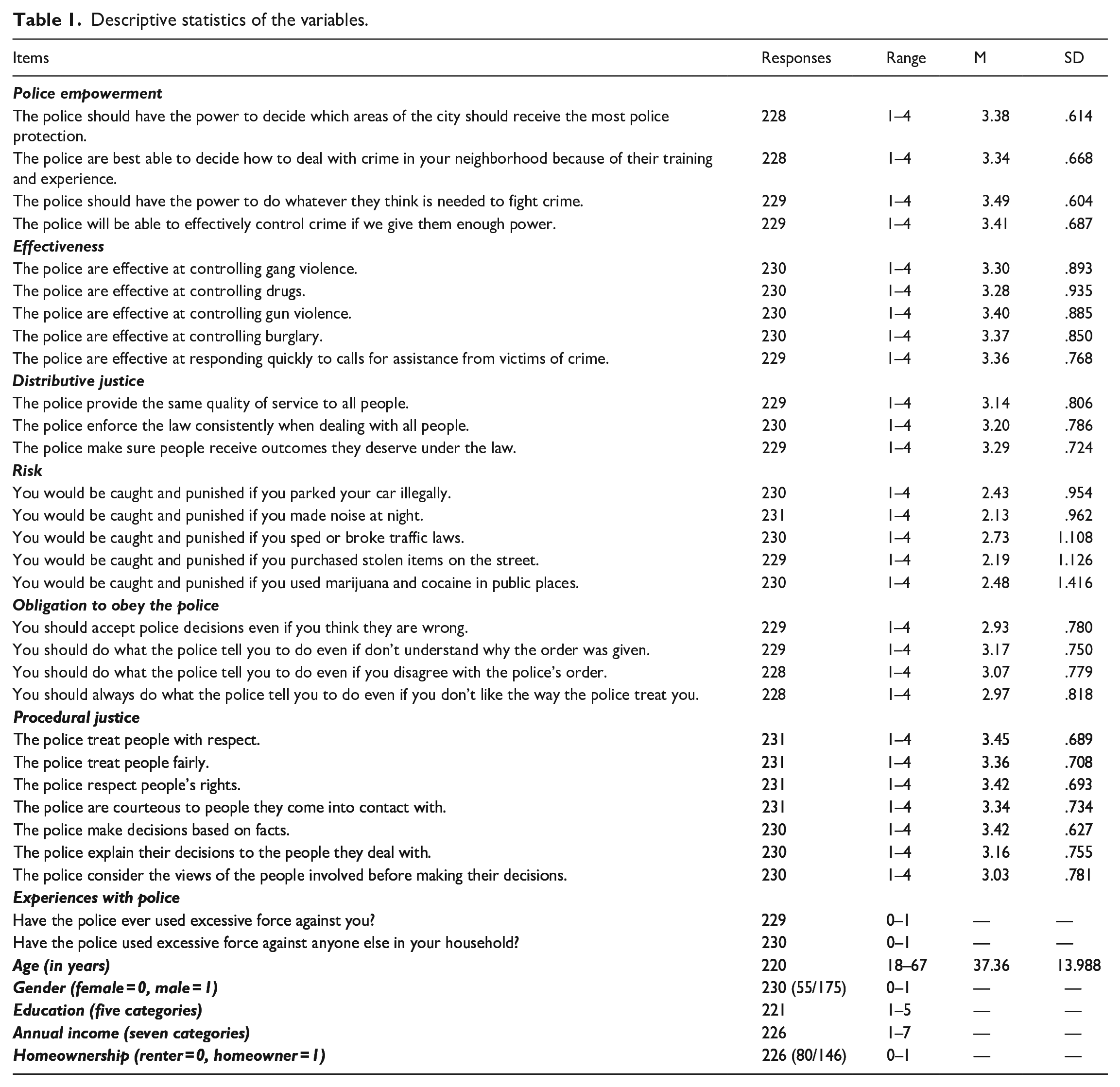
Table 1 shows the descriptive statistics of the variables.
Descriptive statistics of the variables.
Sample characteristics
Twenty-four percent of the sample are women (n = 55), and 75% are men (n = 175). Respondents ranged in age from 18 to 67 years, with a mean age of 37.36 years. Respondents’ annual household incomes varied considerably, with the majority (38.2%) reporting incomes less than $20,000 a year. In fact, only 17 participants (7.3%) reported incomes over $100,000 per year. Furthermore, 62.7% of respondents (n = 146) reported owning their own home, with just 34.3% of respondents (n = 80) indicating that they were renters. Regarding participants’ levels of formal education, just 2.1% of respondents (n = 5) had less than a high school diploma, 15% had a high school diploma or equivalent (n = 35), and the rest of the sample (n = 181) had a college degree or higher.
Principal components analysis
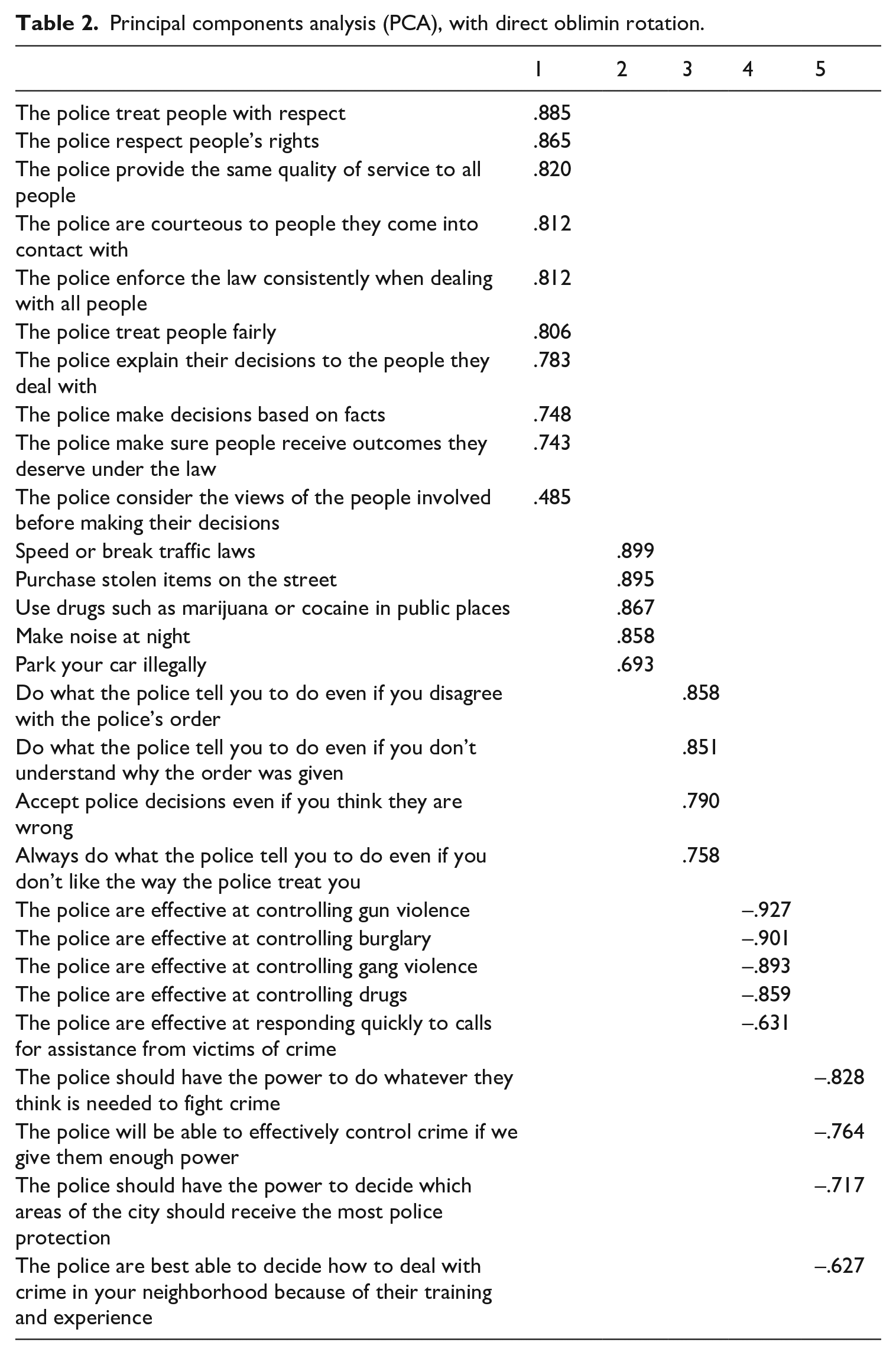
To test for the factor loadings in the current study, the items measuring empowerment, procedural justice, obligation to obey, effectiveness, risk, and distributive justice were simultaneously subjected to principal components analysis (PCA), with Direct Oblimin rotation 2 (e.g. see Pryce, 2018). The Kaiser-Meyer-Olkin measure of sampling adequacy was .894 (Kaiser, 1970, 1974), and Bartlett’s Test of Sphericity reached statistical significance (Bartlett, 1954), which meant the data were suitable for the analysis performed (Pallant, 2010). When factor analysis was performed, items for procedural justice and distributive loaded together; as a result, distributive justice was excluded from the analysis in the current study, as the goal was to examine procedural justice as a primary antecedent of police empowerment. Table 2 shows the factor loadings for the substantive variables tested in the current study.
Principal components analysis (PCA), with direct oblimin rotation.
Confirmatory factor analysis
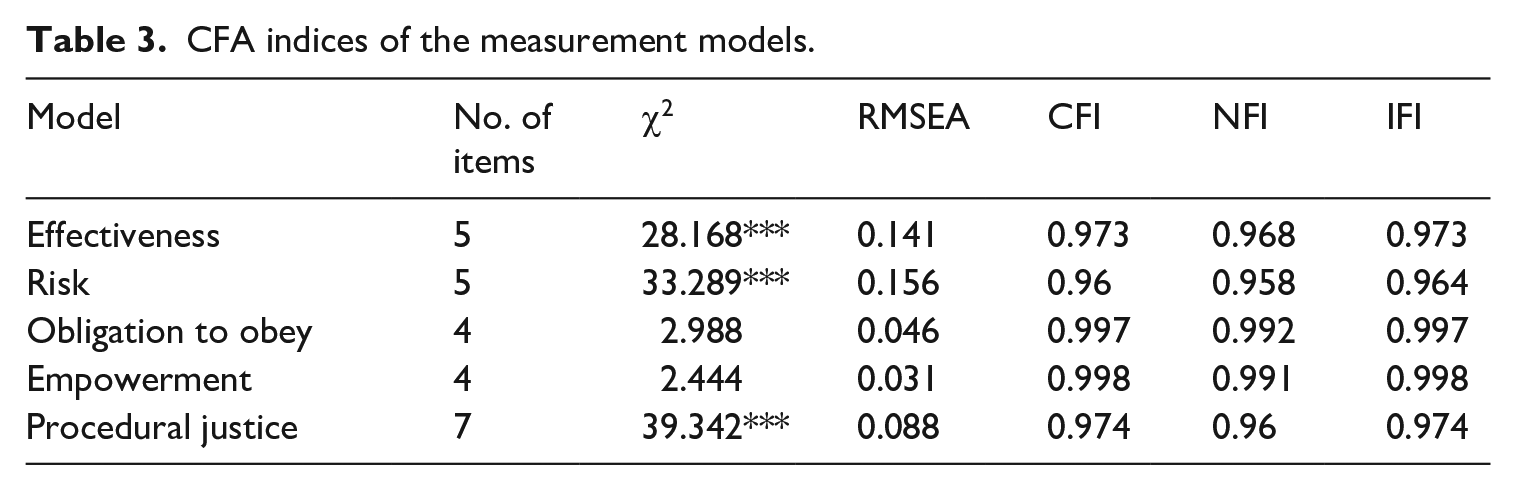
Following our initial EFA analysis (see Table 2), we performed confirmatory factor analysis to confirm and validate the indicators of the key latent variables. This analysis was to ensure that the items identified in the EFA analysis truly measured the constructs. For all our CFA models, we used five fit indices to assess the fit of the models: chi-square goodness-of-fit (χ2), root mean square error of approximation (RMSEA), comparative fit index (CFI), normed fit index (NFI), and incremental fit index (IFI). To determine the model fit, we used the following cutoff criteria: χ2 > .05, CFI, NFI, AND IFI ⩾ 0.95, and RMSEA ⩽ 0.08. The results of the CFA are presented in Table 3. As presented in the table, all our models showed a good fit, except the effectiveness model that had a slightly higher RMSEA but had significantly higher CFI, NFI, and IFI values, indicating a good fit. Based on these results, we constructed our scale variables.
CFA indices of the measurement models.
Because the correlation between procedural justice and distributive justice was too high—.833—we excluded distributive justice from the model to address the issue of multicollinearity—or, in another sense, the absence of discriminant validity (see Maguire and Johnson, 2010). The correlation results for the substantive independent variables and the dependent variable are shown in Table 4.
Correlations of the substantive variables.
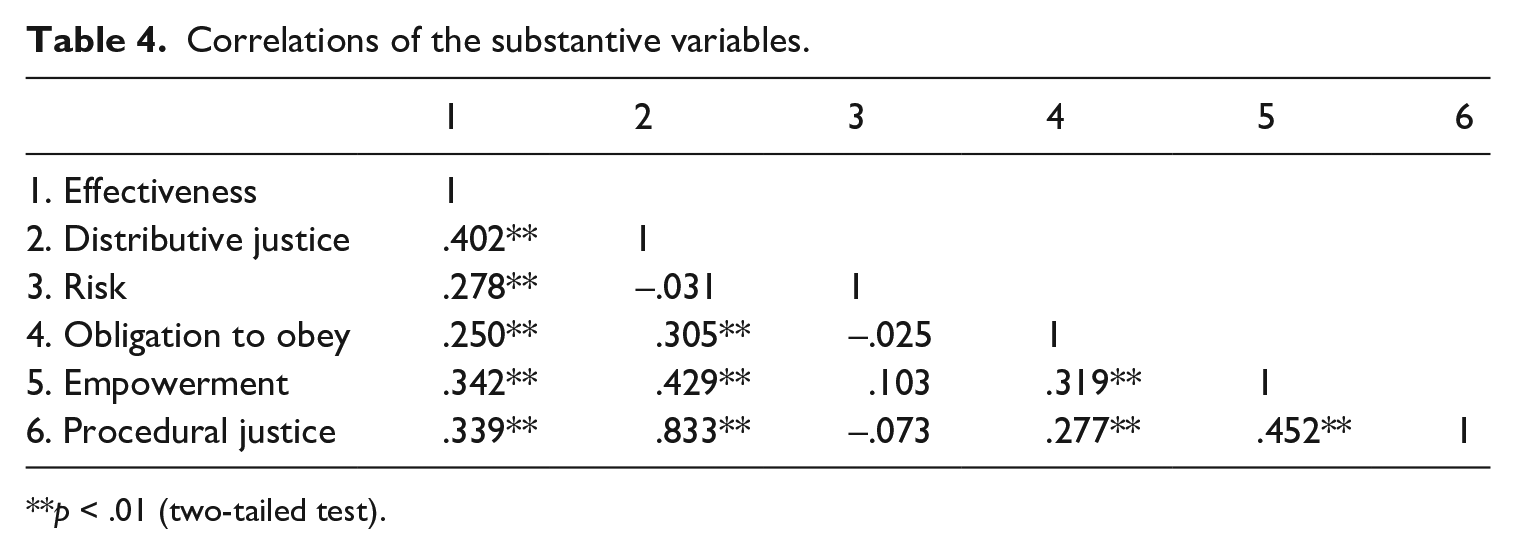
p < .01 (two-tailed test).
Findings
Analytic strategy
Due to the limitations of correlation results, and because the relationship between any two variables may be spurious as a result of the presence of several control variables, all the variables in this study were subjected to ordinary least-squares (OLS) regression analyses. The use of regression analyses to test all four models (see Table 5) accomplished two things: (1) to help determine the relative influence that each independent variable had on empowerment, and (2) to help reach the conclusion that the influence of any one independent variable was independent of the influence of the other independent variables in the equation (Sunshine and Tyler, 2003). Once we removed distributive justice from the model, none of the correlations between the dependent variable and independent variables, and between any two independent variables, exceeded .70 (Pallant, 2010), so all of the independent variables and the dependent variable were retained for analysis.
Regression results for police empowerment.
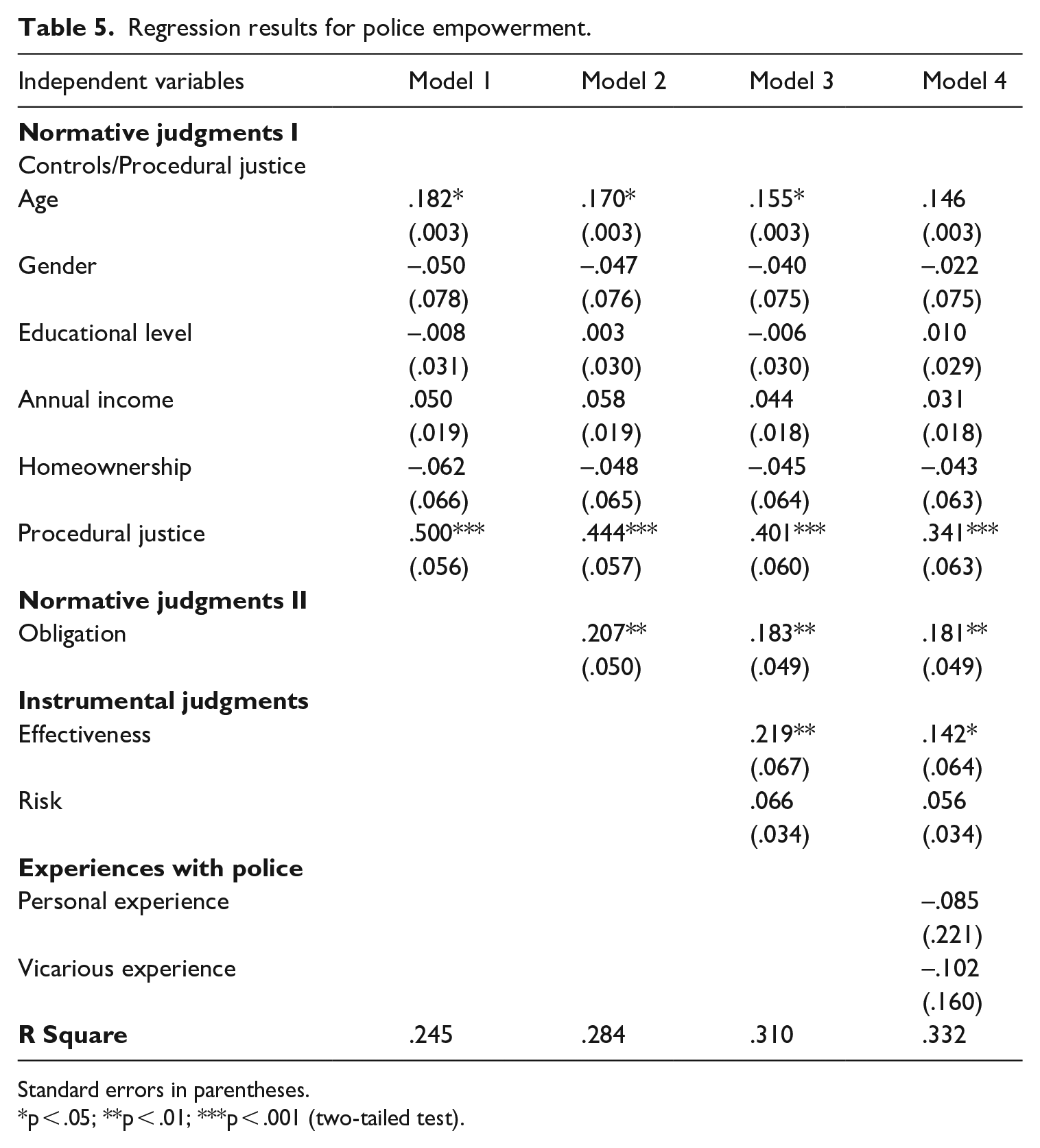
Standard errors in parentheses.
p < .05; **p < .01; ***p < .001 (two-tailed test).
Regression results
Normative factors I
Table 5 presents results from four OLS regression models. In model 1, we analyzed the effect of procedural justice as well as the control variables (age, gender, educational level, annual income, and homeownership status) on empowerment. Procedural justice was statistically significantly related to empowerment (beta = .500, p < .001). Thus, when more Saudi citizens perceive the police as more procedurally fair, they were more likely to be willing to empower the Saudi police. Of the control variables, only age was significantly related to empowerment (beta = .182, p = .021). In other words, older citizens were more willing to empower the police. This model explained 25% of the variation in willingness to empower the Saudi police (F = 11.044, p < .001).
Normative factors II
In model 2, we examined the effects of both normative factors (procedural justice and obligation) as well as the control variables (age, gender, educational level, annual income, and homeownership status) on empowerment. Procedural justice, once again, predicted empowerment (beta = .444, p < .001). In addition, obligation to obey predicted empowerment (beta = .207, p = .001). In other words, participants who viewed the Saudi police as more procedurally fair and participants with a stronger internalized sense of obligation to obey were more willing to empower the Saudi police. In addition, age was the only control variable that predicted empowerment (beta = .170, p = .027). Thus, older citizens were more willing to empower the police. This model explained 28% of the variation in willingness to empower the Saudi police (F = 11.522, p < .001).
Instrumental factors
In model 3, we added the instrumental models of police effectiveness and risk to the regression model, alongside all the normative and control variables. Yet again, procedural justice predicted empowerment (beta = .401, p < .001). Obligation also predicted empowerment (beta = .183, p = .004). In addition, the instrumental model of effectiveness predicted empowerment (beta = .137, p = .042), but to a lesser degree than did procedural justice. Risk did not predict empowerment. As in Models 1 and 2, age was the only control variable that predicted empowerment (beta = .155, p = .042). Thus, older citizens were more willing to empower the police. This model explained 31% of the variation in empowerment (F = 10.011, p < .001).
Personal and vicarious experiences with police
In model 4, all the variables in model 3 were retained, and personal experience and vicarious experience with the police were then added to the regression model. Yet again, procedural justice predicted empowerment (beta = .341, p < .001). Obligation also predicted empowerment (beta = .181, p = .004). Moreover, effectiveness predicted empowerment (beta = .142, p = .035). Neither personal experience nor vicarious experience predicted empowerment. None of the control variables predicted empowerment in this fourth regression model. The model explained 33% of the variation in empowerment (F = 8.973, p < .001).
Discussion
The process-based model (Sunshine and Tyler, 2003) has featured prominently in the literature in reference to the relative effects of normative and instrumental models of policing in communities across the globe. While some studies noted that normative factors exerted a greater influence than instrumental factors (Sunshine and Tyler, 2003) on policing success, others found the opposite result (Sargeant et al., 2014). These differing results show that the germaneness of either model may be context-specific (Pryce, 2019). Furthermore, these disparate results may point to the presence of different “value systems” around the world as far as views of the police and policing are concerned. While research in Western nations generally points to normative concerns as being more important than utilitarian ones, research in postcolonial societies show the opposite. But there is a third strand of findings, in which normative and utilitarian considerations are both important in the eyes of the citizenry. Saudi Arabia appears to be a country in this third group.
In addressing our first research question, we note that procedural justice, obligation to obey, and effectiveness were all strong predictors of empowerment, although procedural justice exerted the greatest influence, followed by effectiveness, and then by obligation (see Model 3). In Model 4, procedural justice still exerted the greatest influence, followed by obligation, and then by effectiveness. Thus, in this study, it appears that normative models generally outperform instrumental models as far as Saudi citizens’ willingness to empower the police is concerned. The results of the current study are similar to what we know about the role of the process-based model of policing in the United States and other Western societies (Sunshine and Tyler, 2003). In other words, Saudi citizens’ willingness to empower the police is attributable more to procedural fairness than to police effectiveness. Thus, the process-based model of policing appears to be more relevant to Saudi citizens than are instrumental considerations. Although effectiveness also predicted police empowerment, it generally did so on a smaller scale than did procedural justice. This finding means that Saudi citizens expect their country’s police to also fight crime and disorder to be empowered. So, inasmuch as Saudi citizens invoke normative values in their assessments of their country’s police, it appears that normative concerns are not the only “channels” through which the police would be empowered, as the police’s ability to fight and prevent crime, a utilitarian concern, also matters. Sunshine and Tyler (2003), in their first study prior to the horrific acts of terrorism on 9/11, observed that legitimacy was an antecedent of empowerment. Their result can be compared to obligation’s predictive effect on empowerment in the present study. Other scholars also found that obligation predicted empowerment (Pryce, 2019).
In answering our second research question, we note that only age had a statistically significant impact on police empowerment. Specifically, older Saudi citizens were more willing to empower their country’s police, a result that was not surprising as older people generally tend to have more positive opinions of the police (Chenane et al., 2024; Kruis et al., 2023). In their second post-9/11 study, Sunshine and Tyler (2003) found that wealthier, older, and more educated respondents were less likely to empower the police.
In answering our third research question, we point out that neither personal experience nor vicarious experience prognosticated empowerment. Revisiting the participants’ responses to the experiences with police questions, we note that, of the 227 participants who answered the personal experience question, 221 indicated no, while only 6 indicated yes. Similarly, of the 230 participants who answered the vicarious experience question, 219 indicated no, while only 11 indicated yes. These results may point to Saudi officers’ respect for their fellow citizens, as can be seen from the empirical connection between procedural justice and empowerment in the current study. It may also mean that Saudi citizens are rarely in physical situations with their country’s police, which may stem from any number of reasons, including the existence of a good relationship between the police and the policed. Still, we can only speculate, as the experiences with police variables were not statistically significantly related to empowerment.
The present study has a number of limitations. First, we encourage the use of probability samples in the future, as our convenience sample limits the study’s generalizability. We used a convenience sample, however, because it is difficult to get approval to conduct research on the police in Saudi Arabia, as the “vetting” process for research proposals is painstaking and extensive. Second, we tested citizens’ opinions rather than their actual experiences with police. We do not presume that findings based on attitudes will be similar to those based on actual experiences. Third, we encourage the use of qualitative research, as it will provide a strong alternative to quantitative studies, as qualitative studies tend to reveal nuances and greater insights into people’s views of and experiences with the police. Finally, we encourage the use of larger samples to increase the robustness of the findings.
Peripheral to the three main research questions in the present study is the issue of discriminant validity (Pryce et al., 2017). Although Tyler and other scholars have argued that procedural justice and distributive justice are conceptually distinct, these two latent variables have not always been empirically disparate in research studies, including our study. For example, Pryce et al. (2017) found that both variables loaded together when factor analyzed; as such, distributive justice was excluded from their study, as they noted that procedural justice was more relevant in their attempt to understand the relative impacts of normative and instrumental models of policing in a sample of West African immigrants based in the United States. The empirical overlap between procedural justice and distributive justice calls into question the accuracy of the scales used for measuring both concepts and may point to the need for more studies to improve the conceptualization and measurement of these variables. As more studies about attitudes toward the police are carried out in different geographical and geopolitical contexts (Pryce and Whitaker, 2023; Solomon and Chenane, 2021), our understanding about what works in policing would be clearer, as effective policing cannot take a one-size-fits-all approach.
Policy implications
This article’s findings point to important policy considerations. First, both procedural justice and effectiveness were significantly related to empowerment in the present study. This result means that Saudi citizens hold multiple and complex viewpoints when considering whether to empower their country’s police. In one vein, Saudis hold strong normative views about the police. In another vein, Saudi citizens expect their police to perform their community roles of public safety and security satisfactorily in order to earn their trust and be empowered. Thus, Saudi police leaders and government officials must enact policies that take into consideration both factors of policing. Second, policymakers should endeavor to understand why younger people are less willing to empower the police. Because the police serve all community members, police agencies’ ability to gain extensive public support would be important for policing success.
Footnotes
Acknowledgements
The authors extend their appreciation to the Deanship of Postgraduate Studies and Scientific Research at Majmaah University for supporting this research through Project Number R-2025-1506.
Declaration of Conflicting Interests
The author(s) declared no potential conflicts of interest with respect to the research, authorship, and/or publication of this article.
Funding
The author(s) received no financial support for the research, authorship, and/or publication of this article.
