






Abstract
The aim of this paper is to uncover the difference in perception and decisions between male and female judges toward restorative justice in intimate partner violence. The research takes a qualitative method approach, according to which 15 male judges and 15 female judges in Bogotá Colombia were interviewed. The information was analyzed using thematic analysis. Findings suggest that a case-by-case rule is followed, which is motivated by the enthusiasm toward restorative justice and the need to deny its application when certain situations occur. Although the case-by-case rule can be seen as a similarity, there were also found some differences. For instance, female judges interviewed are more flexible toward the penalty limit imposed for restorative justice compared with male judges. In addition, they exposed a personal resistance toward the application of restorative justice in this offense, while male judges manifested a social and media one.
Keywords
Introduction
Just as in the social sciences, the study of law benefits from the lottery metaphor to explain how luck plays an important role in defining outcomes. While development studies use the “crib lottery” as a way of describing how social outcomes depend on people’s circumstances at birth (Bedoya et al., 2015), studies in law have shown that judiciary outcomes are highly dependent on the assigned judge. According to the psychological literature, judges are not as impartial as they are stated to be by the law. They are humans, lawyers, and judges, and even though the literature has not arrived at a definite conclusion of which of these three best defines the most their ways of reasoning and deciding, it is clear that judges do not act only as law dictates them, but rather they have biases and diverse ways of thinking (Guthrie et al., 2007; Maroney, 2011; Schauer, 2010), which has been proven by the use of different methodologies (Belknap and Mcdonald, 2010; Heyes and Saberian, 2019; Kutadeladze and Leimberg, 2018; Rachlinski and Wistrich, 2017).
One of the factors affecting this lottery is the judge’s gender. Women were historically restricted from performing these roles, but have gained a major participation at present. It was argued that women were not capable due to their emotional instability and mood swings, which were seen as a threat to the legal context (Schultz, 2006). Nevertheless, other schools of thought perceived the inclusion of female judges as a positive aspect or at least a different conception from the male one. They posited that women had an ethics of care approach based on empathy and the specific context, while men had an ethics of justice approach based on the application of abstract rules and standards (Gilligan, 1993). Nowadays, these differences are still being studied in multiple areas, including in criminal law, by analyzing how sentencing varies depending on the judge’s gender and the offense. For instance, they have proven that female versus male judges’ decisions vary in gender-based violence cases in the United States, making it more probable to get a conviction if there is a female judge (Peresie, 2005). Moreover, results have also shown that female judges are harsher than male judges by being more likely to condemn and give longer sentences (Hebert and Steffensmeier, 1999). Some mechanisms described by the literature are the fact that female judges act as representatives of their gender and also develop greater empathy for victims (Arantegui et al., 2024).
Within this framework, several aspects have been studied with a judge’s gender difference approach, but there is still a gap in the literature in terms of studying alternatives to the criminal prosecution, such as the application of a principle of opportunity. For instance, if a restorative process is followed, it is possible for the prosecutor to ask the supervisory judge to give application to the legal figure in certain cases. This means the supervisory judge is the last person in charge of deciding if the criminal prosecution will continue, if the process will be suspended until certain commitments are achieved, and if restorative justice can be already considered as a way out of the usual process that might end in conviction.
Restorative justice is defined as a process where victims, offenders, and communities are restored, considering their dimensions of restoration (Braithwaite, 1999). It appears as a progressive conception of justice for criminal cases that leaves aside older perspectives focused exclusively on retribution and prison as the main punishment (Hagemann, 2003). In addition, restorative justice represents an interesting and not unanimous debate in terms of its application in cases of intimate partner violence. This has been reviewed widely by feminist authors and female criminal law professors. Some are supporters that view it as a positive solution to the current system problems, while others are detractors of it and conceive it as a way to revictimize women and even privatize gender-based violence (Larrauri, 2009).
To illustrate, a restorative process can be a lengthy process, lasting several months, during which the victim’s needs for reparation are explored, the motives that lead the offender to commit the offense are studied, and the impact on the community affected by the crime, such as children or parents, is examined. This is done to establish several commitments that will be fulfilled in the coming months if a supervisory judge approves its application. In a restorative process for intimate partner violence, a victim may express the need for the offender to undergo various therapies, such as ask for forgiveness, among others. In addition, it may be observed that the offender has issues with alcohol abuse and holds certain prejudices against women, which motivated the offense and can be addressed by cognitive behavioral therapy, Alcoholics Anonymous, or other methods. Finally, children may also need therapy, along with specific actions from the aggressor to repair the harm and prevent future incidents.
Having said this, through this investigation the difference in perception and some insights for decision-making processes between male and female judges toward restorative justice in intimate partner violence will be uncovered. This will be done considering the differences that have been found between genders, depending on the offense type and the important role judges develop in restorative processes due to the application of a principle of opportunity.
To further elaborate, contrary to other countries such as Mexico, in Colombia it is not totally forbidden to apply a principle of opportunity for restorative justice in this offense. The Colombian legal framework allows one to apply it when it is related to domestic violence cases without circumstances that aggravate the penalty. The possibility of still applying the figure in cases that do not present circumstances that aggravate the penalty or the fact that prosecutors and judges may not respect the limit imposed gives an interesting scenario to study this topic. As theory states, judges do not always do what specific legal rules demand them to do and face a freedom and constraint dilemma (Kennedy, 1999).
Research design
In order to answer the research question that has been previously stated, this study opted for a qualitative research method. The method selected for data collection were semi-structured interviews due to their efficiency and richness in collecting deeper attitudes and opinions that will be useful for the comparisons made in the data analysis section (Guest et al., 2017).
This project conducted online semi-structured interviews, on an average of 45 minutes considering time restrictions, using as basis the topic guide presented in Appendix 1. These interviews were conducted with judges in Bogotá, Colombia, who are in charge of deciding if a principle of opportunity for restorative justice is suitable to be applied in a case in lieu of criminal prosecution. According to the information given by the Office of Judiciary Services of Paloquemao, where the majority of the judges are located, at the moment of the interviews there were 80 supervisory judges in Bogotá, 40 women and 40 men, from which 30 were interviewed, which was considered an ideal sample size source of information (Belknap and Mcdonald, 2010). This sample was divided between men and women evenly considering all judges, since the assignation of the judge in charge of the decision is done randomly.
The sampling process was purposive and snowball sampling for female and male judges based on the following inclusion criteria. First, being currently a supervisory judge, taking into account that this study aimed to evaluate restorative justice in lieu of criminal prosecution. In that sense, current supervisory judges are preferred to those who previously held the position, due to potential recall error, the possibility of having recent experiences related to this and how they position toward the topic. Second, having been a supervisory judge for at least 2 years or having to decide at least one principle of opportunity for restorative justice. Finally, being between 28—lower bound given by the youngest judge interviewed—and 45 years old was desirable to have an upper bound in the participants’ age. This was delimited by the sample and looked forward to tackle differences between younger and older judges’ decisions, so the age effect tried to be isolated (Kulik et al., 2003).
The sample obtained included 15 women and 15 men relatively similar in the observed characteristics in terms of civil status, place of birth, and age. In terms of reported age, the male judges’ sample was similar to the female judges’ composition, which can be seen in Figure 1.
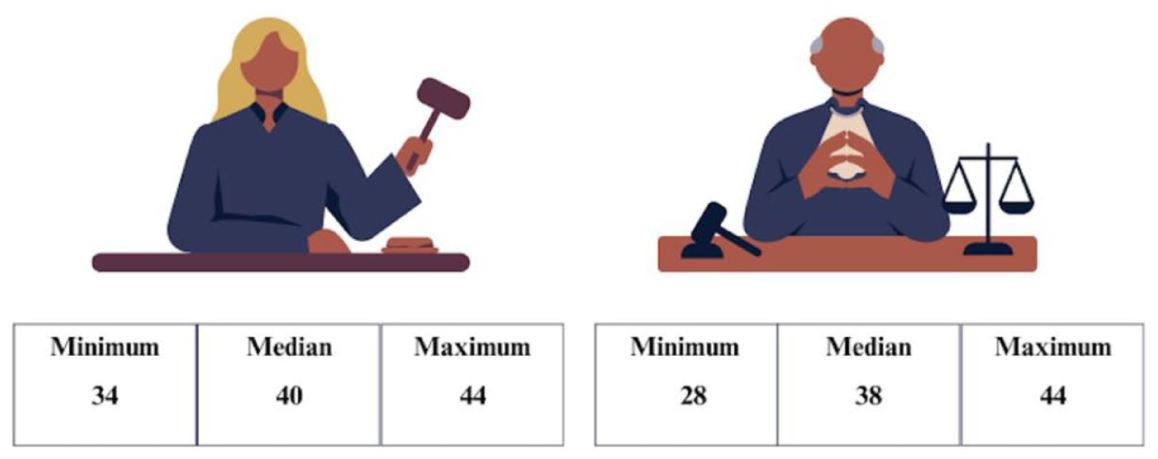
Judges’ sample composition related to reported age.
The online semi-structured interviews were done after obtaining written consent. In order to obtain factors that lead the final decision and reduce the gap between what people say and do, this study explored participants’ decision experiences by using a real vignette case from an intimate partner violence case that described a physical and economical violence from a man toward his female partner. This is a real case that was decided by the Supreme Court, but was not related to restorative decisions to avoid expected answers on participants. The use of “real-life” vignettes in interviews has been broadly studied and multiple advantages have been discovered of it, among which is the rapid elicitation of rich information that is considered valuable for this study due to time restrictions (Johannessen and Sampson, 2020).
For data analysis, all the interviews were recorded and transcribed by the Teams software. They were edited and anonymized by the researcher and afterwards the recordings and initial transcriptions were deleted to preserve participants’ anonymity. An Nvivo project, which was password protected, was created to aid the codification process by separating female judges from male judges’ transcriptions in different sets and code using thematic analysis. It was chosen considering its initial utility to identify relevant themes from a sample in an inductive way, but also by the possibility given to compare these between samples once they were identified. An iterative process was done to analyze the information gathered. The delimitation of themes and the analysis of their corresponding codes served to construct a decision-making process and the perspectives of each gender in comparison with the other, as it will be described. For further understanding on how the analysis was done, Appendix 2 shows the initial coding done for the female judges’ sample transcriptions, including the analysis done and the improvements that were thought of. In addition, Appendix 3 shows the initial coding as well for the male judges’ sample with the analysis and comparisons made that were important for the final analysis obtained presented in Figure 2 (“Findings” section). Finally, Appendix 4 outlines the final codification produced through thematic analysis.
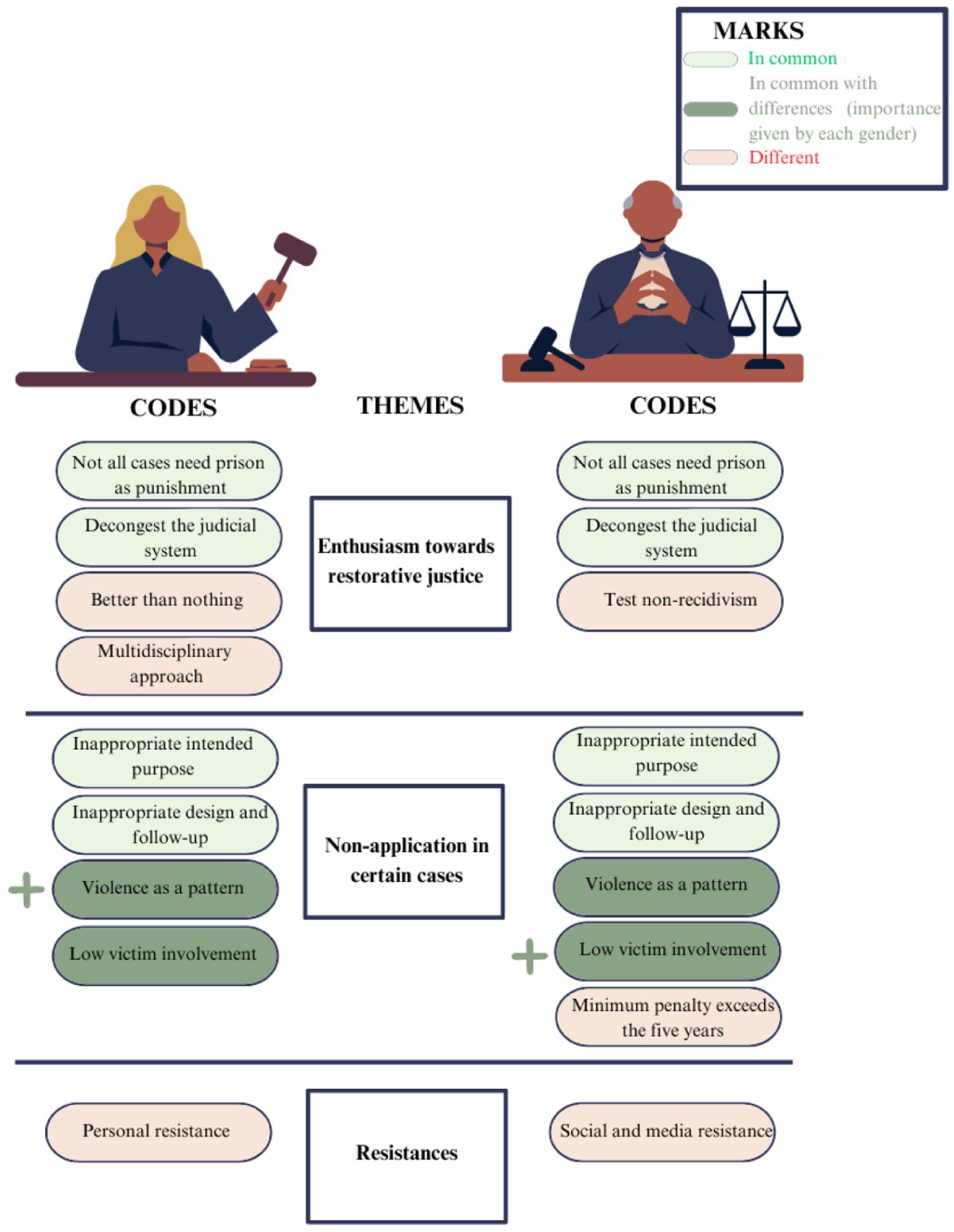
Final analysis obtained between genders after an iterative process.
With respect to positionality, an important consideration is the interviewer’s gender, particularly when interviewing male judges about intimate partner violence. After analyzing and reflecting on the data, it is possible that the interviewer’s female gender influenced the judges’ emphasis on social expectations. Male judges more frequently expressed social resistance to the application of restorative justice in cases of intimate partner violence compared with female judges, and the consistency with which this resistance was mentioned may be related to the interviewer’s gender and the expectations judges perceived were placed upon them. Nevertheless, regarding decision-making processes and other factors, male judges appeared to speak openly and at times explicitly acknowledged their own biases toward this offense. This openness may be explained by the discretionary nature of judicial analysis in cases where legal outcomes are not fully predetermined, allowing space for personal interpretation and reflection without the perceived need to adhere strictly to legally or politically correct discourse.
Findings
Within this framework, this study wanted to uncover how female and male supervisory judges perceived restorative justice related specifically to intimate partner violence. After the iterative process previously described, the coding resulted in the themes and codes presented in Figure 2.
It was found that both female and male supervisory judges follow a case-by-case rule when deciding on the application of restorative justice as a way out of the criminal prosecution in intimate partner violence. This case-by-case approach, identified as a global theme encompassing the data presented in Figure 2, is driven by enthusiasm for the application of restorative justice. However, its non-application under certain conditions is influenced by both shared and divergent factors across genders. In addition, even though there were found multiple similarities in the way of thinking and the answers given to the vignette, there is a dissimilar resistance between genders, being personal for female supervisory judges in the study compared with a social and media one identified for male supervisory judges.
Restorative justice in intimate partner violence: Benefits and judicial enthusiasm for its application
Enthusiasm for restorative justice is evident among both genders. Both groups believe that not all cases require imprisonment as punishment and view restorative justice as a valuable alternative to alleviate congestion in the judicial system. First, in their legal education, lawyers are taught that criminal law should be a last resort. In line with this principle, most of the supervisory judges interviewed affirmed that criminal law is currently being overused in many cases, and there should be a filtering mechanism based on the severity of the offense to determine the appropriate course of action. Judges from both genders emphasized the importance of seeking alternatives to imprisonment that genuinely resolve the conflict and provide a sense of restoration for the parties involved. Second, a widely recognized issue is the overwhelming number of cases and the limited resources available to provide effective responses. Restorative justice offers an alternative pathway that helps reduce the workload, considering the significant amount of time typically required for a criminal prosecution to result in a final sentence.
Furthermore, supervisory judges identified additional reasons for adopting restorative justice as an alternative to traditional prosecution, with some variation between genders. Male supervisory judges, in particular, highlighted the utility of the principle of opportunity in suspending criminal prosecutions as a mechanism for testing recidivism. According to legal regulations, this principle allows for the suspension of a criminal prosecution, with the case potentially being dismissed if the agreed-upon conditions are met during the suspension period. Male judges suggested that the application of restorative justice in such cases can serve as a means of assessing whether the offender is willing to change and whether restorative justice can be an effective resolution for the case. As Juan, a male judge, stated, And suddenly, with these mediation methods, the main objective is achieved. The State should be looking for to prevent this type of aggression from being repeated, continuing, or even escalating, as has happened many times, sometimes ending in homicide. I believe this could be a method, with the direct participation of the State, that provides a solution effectively guaranteeing protection for women.
Conversely, female judges highlighted restorative justice as a valuable approach that integrates a multidisciplinary perspective, allowing professionals from various fields to provide guidance tailored to the specific circumstances of each case. Moreover, they viewed restorative justice as a preferable alternative to no intervention at all. It is widely recognized, particularly among those familiar with gender-based violence cases, that victims often choose not to testify against their partners or retract their statements for a variety of reasons, including fear or being in a “honeymoon” phase of the relationship. Female judges were acutely aware of these dynamics and expressed that restorative justice offers a meaningful alternative compared with the likely acquittals that result from traditional court proceedings, which can strain the judicial system. As Maria, one female judge noted, On many occasions, restorative justice can be effective. In addition to being a supervisory judge, I also served as a trial judge, and in cases of domestic violence, I often observed that when cases reach the trial stage, they often end in acquittal. This is mostly because the victims, who are predominantly women, do not testify at trial. The victim is the one who can provide key details about the circumstances of time, manner and place of the events, but she often refuses, stating that it is her husband and invoking her right not to testify against her partner. If you had asked me about this four years ago, I would have said restorative justice in such cases was highly problematic. However, today I believe it could be somewhat more effective because, even in those instances, some form of justice can be achieved. What concerns me more is that serious offenses like domestic violence often go unpunished, which is why my perspective on this has changed significantly.
A stricter gavel: The non-application of restorative justice in intimate partner violence cases through a gendered judicial lens
Judges did not only point out positive aspects, but also the need to reconsider and even deny the application of restorative justice as a way out in certain cases when several situations are presented. Supervisory judges from both genders expressed that they have found some cases in which restorative justice was intended to be applied with the inappropriate intended purpose. Instead of being used for the reparation and non-repetition of the offense, prosecutors used it as a way to get rid of a case and aggressors to simply get a benefit to avoid prison. Judges said they noticed it when commitments were not achieved by the aggressor and prosecutors had poor knowledge of the case needs and the victim situation. All this related to an inappropriate intended purpose of prosecutors and aggressors. For instance, a female judge pointed out an experience in which the prosecutor was looking for the application of the principle of opportunity for restorative justice to avoid the prescription of the case. This means considering the time that had passed since the occurrence of the event, the Prosecution Office could no longer investigate that case. Moreover, judges also pointed out that there are some cases in which there is an inappropriate design and follow-up in the restorative approach given to the case.
After all the interviews were conducted, it can be seen that restorative processes in intimate partner violence, mainly occurring between heterosexual partners with female victims, are characterized by several common commitments. Aggressors are asked to attend psychological therapy, apologize to the victim, do social work, commit to avoid repeating the conduct, and be given gender-based violence lessons or impulse control talks, among others. These vary in terms of how long they need to be followed or how many therapies the aggressor needs to attend. In general, male and female supervisory judges affirmed for a principle of opportunity for restorative justice to be applied. It was necessary to have commitments that truly guarantee the reparation and non-repetition, clear commitments that were properly achieved by the actors involved and followed by the authorities, otherwise they would have to deny it.
Continuing, beyond the underlying purposes of its application and the nature of the commitments, both genders also identified low victim involvement and the presence of violence as recurring factors that warrant thorough examination to justify the denial of its implementation. However, even though both genders mentioned them, it was evidenced a stronger pattern and importance given to low victim involvement from male supervisory judges in the sample, compared with violence as a pattern related to female judges.
Low victim involvement can be defined as the absence of active participation in the process from the victim or the opposition of her to continue using this alternative. Opposition was commonly observed as a determinant factor to deny the application, except for a few male judges who module it depending on if victims were capricious and the only reason why they did it was because of revenge and retaliation. Esteban, a male judge said, If the motivation is only revenge—to see him in prison or punished—and it’s assumed that this applies in such cases, I don’t believe it’s necessary to follow exactly what the victim wants. The responsibility is to listen to her, understand her reasons carefully, and likely do some educational work with her, but I don’t think her will should be legally decisive. It’s not feasible to base everything on the victim’s wishes.
Male supervisory judges affirmed that it is very common to see commitments established by the prosecutor and accepted by the aggressors without involving the victim and her sense of justice. There were some cases in which victims were present in the hearing and it could be seen that they were not an active actor in the process and in many cases did not even receive the compensations mentioned. Juan, a male judge who denied a principle of opportunity because of it, said, I told the victim the conditions: “There won’t be a conviction here. The criminal process will end, and there will be no sanction. These are the conditions. Did you participate? Tell me, what role did you have in this?” She responded, “Yes, yes, I agree with everything the prosecutor said,” but she didn’t even tell me if he had compensated her or given her the money. So, I specifically asked the victim, “Did he compensate you? According to the record, he gave you 500,000 pesos. I’d like to know how that compensation was made—how did he give it to you?” That’s when I heard from the back, “A bank transfer.” She looked aside and said, “Yes, he transferred the 500,000 pesos to me.” (. . .) In reality, the victim hadn’t been compensated. She didn’t even know how she had been compensated. This wasn’t done properly, so I wasn’t going to accept this plea deal. I don’t know what happened after that. Maybe they took it to another judge, and perhaps it went better, and another judge approved it. But that’s the last case I remember—it was a while ago, not recently.
Now, in terms of violence as a pattern, intimate partner violence is continuously described as a violent cycle that becomes systematic and tends to increase the level of violence. Both genders mentioned the impossibility of applying this figure when the violence has been continuous; this implies the use of physical elements and clearly shows domination over the woman, considering the victim is at risk and only prison can serve to protect her. Nevertheless, this factor had a greater importance for female judges and was consistently mentioned by the majority of them. Restorative justice is seen as a reward for primary offenders and it cannot be a reward for aggressors who constantly commit this conduct, since this is a clear factor that shows the lack of will of the aggressor to achieve the commitments and truly change. Helena, a female judge was asked about her decision to the vignette if it was the fifth time this had occurred, and she said, That would have an impact because it can’t be seen as something spontaneous. It’s not just a reaction caused by a bad mood, which we all experience, or a hormonal surge. Instead, it’s part of a cycle of violence, and this cycle clearly harms the protected legal rights. Given this, the principle of opportunity for restorative justice cannot be applied here, because this situation doesn’t align with the focus of restorative justice. It involves someone who has shown no intention to change, hasn’t altered his behavior, and whose actions are clearly aimed at causing harm.
Although it might seem all judges would give this answer when asked about recidivism and deciding in terms of it, there were some, mainly male judges, who still mentioned the need to analyze the case and the context. They also mentioned that the other aggressions would not have the possibility to apply restorative justice due to legal restrictions. Considering this, the specific aggression could have a different treatment and try another alternative rather than prison.
Resistance to restorative justice in intimate partner violence: A gendered perspective on female versus male judges
After studying the discourses given throughout the interview, it was found that there is a resistance toward the application of restorative justice in intimate partner violence. On the one hand, male judges described it as a social and media resistance, mainly characterized by the will of having harsher punishments to aggressors of these conducts and the establishment of more limitations to the application of other alternatives instead of prison, and by the social reproach to it given by society in general, but especially by social media. There is a higher attention to this phenomenon given by media nowadays, and with it a higher reproach to judges’ decisions in which they decide not to incarcerate aggressors. On the other hand, female judges also expressed a resistance, but even though it was not expressly mentioned, it is considered an implicit resistance that some of them have. Female judges presented cases of restorative justice in which they were moved by the process and the accused manifestations. However, these cases were related to other offenses and specifically in intimate partner violence cases, some said that they do not fully trust aggressors’ repentance and will to change. At the end it seems this resistance does not vary their decisions, but this definitely needs to be tested in further cases where case conditions are varied, including social media exposure considering male judges’ findings.
Furthermore, this finding reinforces the freedom-versus-constraint dilemma (Kennedy, 1999), in which social media functions as a constraint on judicial decision-making. The heightened attention given to gender-based violence by the Colombian Supreme Court and Constitutional Court may be understood as a response to pressure from feminist organizations and public repudiation of gender-based violence on social media. This dynamic may lead judges to adopt a gender-sensitive approach in particular cases, not necessarily because they personally endorse it, but as a form of defensive judging aimed at preventing public backlash, especially when their identities are exposed through social media.
Carrots or sticks? Weighing restorative justice as an approach in all intimate partner violence cases
As previously mentioned, the Colombian legal framework stipulates that the principle of opportunity, based on restorative justice, can only be applied if there are no aggravating circumstances that increase the penalty in this offense. This is typically observed in cases of domestic violence between partners or ex-partners, where the circumstance is included considering a gender-based violence. Therefore, it is essential to conclude the findings section with insights regarding the application or non-application of this limitation. After asking judges about their stance on not applying restorative justice in aggravated cases, and corroborating this with their responses to the vignette, the results can be seen in Figure 3.
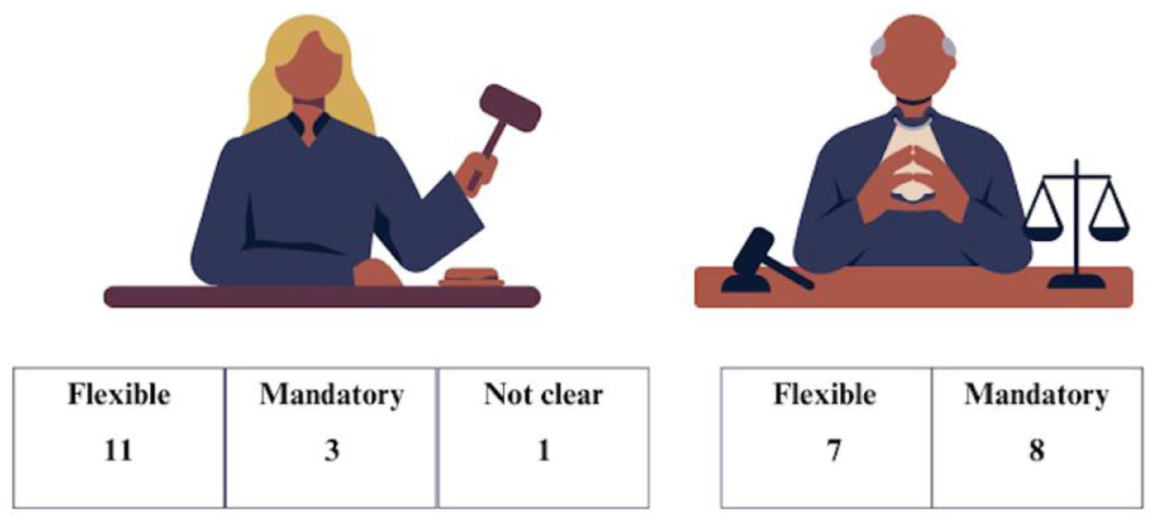
Judges’ positions toward the legal limit imposed for the application of principles of opportunity for restorative justice.
Eleven female judges were flexible in the application of the limit depending on the case, three agreed the limit was mandatory and should be taken into account to take the final decision, and one did not mention a clear position. In the case of the male judges’ sample, seven were flexible about it and eight expressed that the limit was mandatory. Although differences do not vary in a huge magnitude considering also the sample and population size, participants’ manifestations and decisions toward the vignette suggest that the female supervisory judges in Bogotá who were interviewed in this study are more flexible toward the limit for restorative justice in general than the male judges. This means the majority of female judges, contrary to the majority of male judges interviewed, do not necessarily deny the application of restorative justice as a way out of the process in those cases that exceed the minimum penalty of 5 years for mediation as a way out of the process by just considering the limit imposed.
Concerning the sample of female supervisory judges who mentioned that they were flexible with the legal limit and were consistent with it when solving the vignette, the justifications given in general mentioned the evaluation of the penalty as a residual activity that should not be as principal as the study of other factors, such as the consensus among victims, the reparation of the offense, and the willingness to execute the commitments by the aggressor that have been established, among others. Martha, a female judge said, I hardly ever focus on it. Of course, I check the penalty for the offense, but not as the deciding factor in making my decision. I look at other circumstances. I consider whether the person has stayed in the same place, whether the conduct has not been repeated, if the principle of opportunity hasn’t been granted in the last five years, and if they’ve committed to social work. To me, those factors carry more weight than checking if the offense carries a 6- or 7-year sentence. I don’t get too literal with the penalty because the spirit of early termination is about creating harmony and consensus among the parties involved. If everyone agrees, why should we keep overburdening the justice system when there are more complex cases that require deeper analysis?
With respect to male judges who share this position, the discourse is quite similar in terms of giving a higher relevance to other factors. However, male judges apart from affirming this, gave legal justifications to support the decisions made, which include restorative justice principles and their legal functions as constitutional judges. The discourses used to justify the application do not affect the final result, but is an interesting point that shows differences in how the gender of the judge may vary in how they justify their points of view and decisions. At the same time, it starts revealing some mechanisms and the relationship of these justifications with the ethics of care versus the ethics of justice approach previously exposed. The differences observed become relevant when analyzing how these decisions hold up in appellate reviews when requested by the parties, and it can also inform the development of strategic litigation arguments based on the judge’s gender. José, a male judge affirmed, The application of the principle of opportunity also falls within the duties of a constitutional judge, and every decision we make as constitutional judges involves conducting proportionality tests. So, as some of my colleagues have mentioned, what seems to be a strict prohibition can, in fact, be more flexible. In each case, we can weigh whether that limitation has been exceeded, whether it’s possible to suspend the trial, or if the person has already fulfilled their obligations. If the individual has no criminal record and hasn’t had the principle of opportunity applied within the last five years, and if all the general and specific requirements are met, the principle of opportunity can be applied in that particular case.
Besides, both genders develop similar justifications to strictly follow the limits, which basically can be summarized in the relevance of formalist views of law that have gained.
Discussion
After conducting 30 interviews with female and male supervisory judges in Bogotá, multiple findings were presented in terms of how these judges perceived restorative justice in intimate partner violence and the differences observed between genders. Now, it is important to discuss several reflections left after these findings, in terms of dilemmas observed in the practice, male versus female perceptions and insights of their decisions, and restorative justice in intimate partner violence.
A theoretical dilemma observed in the daily basis role
Once this study was addressed, a theoretical dilemma was exposed: judges were between a progressive alternative that did not conceive prison as the solution versus the position of some feminists arguing that the application of this figure generated revictimization and turned the conflict into a private one rather than one of public interest concern. Taking into account the findings, it can be seen that this theoretical dilemma is evidenced in the practice and is prominent in judges’ discourses with some extra elements to be considered.
First, it can be observed the progressive position, related to the enthusiasm toward restorative justice, in the need to consider alternative solutions and do not consider prison as the only one. Although the main motivation observed for both genders is related to decongesting the system, it can also be seen the relevance of understanding that there are some situations that do not require prison due to the offense harshness and the need to repair the harm caused by the conflict. Second, it can also be observed a more retributive position revealed in the resistances proposed by each gender, personal for female judges and social and media for male judges, and the presence of some of the situations mentioned by some feminist’s position.
In terms of giving private rather than public interest to intimate partner violence by applying a restorative process, it must be said that this is evidenced at least for those occasional and less severe offenses, where judges consider that the final decision should be given by the actors involved and are less strict when evaluating the application. On the contrary, when violence is considered as a pattern and the victim can be considered at risk, this alternative is not applied and drastically denied especially by female judges, which means this phenomenon turns into a private interest issue depending on the harshness of the aggression and the pattern observed. With respect to revictimization, as it was seen from judges’ manifestations and experiences, there are some cases in which victims are not actively involved in the process. Many judges, especially male judges, mentioned that they asked the victim how she felt and opened an in-depth conversation with the victim to see if the objectives of restorative justice were fulfilled, but it must be important to test this taking into account time restrictions, workloads, and also the fact that they are supervisory judges and do not get an in-depth knowledge of the case. The majority of them said that they reprogrammed the audiences when the victim was not present, but one of them also mentioned that even though they had these discourses about victim participation, they were not as strict with the victims’ summons as they were with the aggressors’ ones.
Are female supervisory judges from Venus and male judges from Mars?
Are female supervisory judges different from male supervisory judges? Do they decide differently? Is the lottery of the judge also affected by gender? Theory has shown that female judges have a different way of reasoning and deciding legal matters compared with male judges. Female judges act guided by the conception of ethics of care, which means they analyze the context and specific situation to materialize justice. On the contrary, male judges have a conception of ethics of justice based on abstract principles and the need to follow the rules (Gilligan, 1993). For instance, this was clearly observed in the findings regarding the legal limit to deny its application; male judges interviewed in comparison to female judges were more formalist and followed more strictly the legal limit imposed that limits the application in aggravated cases, while the majority of female judges interviewed gave a higher relevance to the specific case and context analysis. It must be evaluated that female judges were more flexible with the limit imposed for restorative justice, but this does not mean they are more flexible toward restorative justice in general, since they studied carefully the commitments that were agreed upon and how this helped in terms of reparation. This means female judges interviewed might apply restorative justice to cases that exceed the 5 years limit, but only after doing a strict test of other factors involved in the restorative process.
Moreover, differences between genders have been addressed by quantitative and qualitative studies. Studies interested in these questions in criminal law found that women were harsher than men when sentencing for gender-based violence offenses (Peresie, 2005). Women tended to be more retributive in these types of offenses and this study does not completely reject that hypothesis considering the violence as a pattern factor that was more predominant in female supervisory judges than male supervisory judges. Also, the fact that personal resistance was identified for female rather than male judges, which were more motivated by external factors. In addition, contrary to male judges and despite the high workload, female judges did remember cases, not related to intimate partner violence, with enough details about the offense, the commitments, and the manifestations given by the aggressor. Some female judges even mentioned that restorative justice application in general consisted in a humane and moving process that truly showed the importance and utility of restorative justice. However, for intimate partner violence, this flexibility and sensibility toward the process was not completely seen and it balanced up with male judges.
Having said this, it can be seen a different approach to the phenomenon between genders, even though they might have similar criteria to apply it or not varying the importance given to each factor. The question concerning gender differences gains relevance considering how women have been gaining participation in courts, especially in lower levels such as the one used as a sample of the study, where it can be seen a 50–50 in supervisory judges in Bogota at the moment of the study’s execution compared with the fact that currently there is only one female magistrate out of nine in the Supreme Court for the criminal law area. The supervisory judges’ composition is gaining more female participation, and with it is important to question how justice processes develop when female judges enter to participate in this sphere. With these findings, it can be considered as a hypothesis that our system might become less retributive with higher female representation, and restorative processes can be an alternative to prison. This is not an absolute response, since as shown, it varies depending on the offense and other particularities, but at least for the overall considering specifically the legal limit position observed and the general attitude of seeing restorative justice as a humane and moving process.
Is restorative justice a nice utopia in the paper or an effective solution for intimate partner violence?
According to the findings, a typical restorative justice process applied in an intimate partner violence case is characterized by therapies, showing repentance, committing to non-repetition, and other variable factors, such as social work and gender-based violence talks, among others. There was not much emphasis on how these processes helped to achieve restorative justice objectives, since it has been commonly assumed by the practice that these are related to the offense and look forward to repair it. It was interesting to notice the general use of these commitments by just varying the numbers or certain details depending on the case. It can be seen that the conception of justice in these processes is not just a result of the mediation process between the actors involved or the community affected by it, but also of the prosecutor and the judge who decides the application of the principle of opportunity. A dilemma is presented as well in which judges need to decide between respecting what the actors involved had agreed on, versus denying the principle of opportunity or varying the conditions when they are not considered enough or appropriate. The big question left after this study is who should define what is considered as justice in the particular case, and how this contributes to tackle the phenomenon? This investigation wants to leave a big question mark on this, since it might have a huge impact when evaluating the effectiveness of these programs.
In addition, another interesting point is the fact that judges from both genders did not mention that there were not enough resources to properly develop restorative justice as judges in other countries have mentioned (Belknap and Mcdonald, 2010). Judges interviewed mentioned the lack of resources to attend all the entries of the system, but not specifically for the matter we were discussing, the decision and application of restorative justice programs. Here, it is relevant not only to question judges’ or prosecutors’ ways of acting, but also the actors involved in the execution of the process and the service given by them. For instance, how Health Promotion Agencies provide adequate therapies to aggressors and victims considering time limitations and workloads constraints if compared with particular services, without assuming that these are the adequate ones, but at least to question several points. These questionings need to be answered to establish or not if restorative justice processes are effective to tackle intimate partner violence and the circumstances needed for it for which this study is still a limited source.
In conclusion, rather than simply providing a binary answer to whether restorative justice should be applied in cases of intimate partner violence, it is crucial to examine the specific contexts in which its application may be appropriate and to identify the necessary resources to ensure effective solutions. These solutions should aim to prevent the recurrence and escalation of intimate partner violence. Restorative justice must transcend its status as an idealized concept and become an integral part of the State’s criminal policy, driven by a genuine commitment to reparation and healing, rather than merely serving as a tool for alleviating the burden on the justice system.
Gender violence mediatic boom, the effect on judges’ decisions
Gender-based violence has gained a major coverage in media and in the society in general. Newspapers and news are making more visible this phenomenon, the society’s response toward it, and the activism of women rights organizations. This boom was consistently identified by male judges and expressed as a factor of resistance against the application of restorative justice in intimate partner violence cases. In addition, it was also mentioned that prosecutors feared the application of this figure in these cases, a situation also described by female judges who stated sometimes that they even observed less principles of opportunity and more requests of custodial measures. All this related to the boom of this phenomenon, which has been intensified and exposed by social media. Although this mediatic boom was identified in some male judges’ discourses, and it did not necessarily show much impact on the decisions they made, it must be stated this study did not cover in-depth the impact of the increasing social coverage of gender-based violence.
Conclusion
It can be concluded that judges from both genders in this study follow a case-by-case rule in which both position themselves between the enthusiasm toward restorative justice and the non-application of it when certain conditions are presented. Certain similarities and differences were found as they have been previously presented, but in general it can be seen there is enthusiasm toward restorative justice as a valuable and useful mechanism to tackle this phenomenon, but there is still a resistance toward it in some cases that differs between genders and points out differences in the approximation toward it.
This study adds to the existing body of literature by highlighting notable differences in the perceptions and reasoning of supervisory judges when analyzed through a gendered lens. For instance, female judges generally displayed greater flexibility than their male counterparts in adhering to legal limits regarding the application of restorative justice. They were more inclined to consider contextual factors and other elements that might indicate the potential benefits of restorative justice in a given case. Moreover, the study reveals distinct forms of resistance to restorative processes: female judges tended to express personal reservations, while male judges exhibited resistance shaped more by media influence and societal expectations, particularly in cases of intimate partner violence. These findings reaffirm previously explored mechanisms driving gender-based differences in judicial decision-making and underscore the pivotal role of female judges, not only in representing their gender but also in demonstrating heightened affective empathy toward victims (Christov-Moore et al., 2016).
As it has been previously stated, this study is useful for policy design, implementation, and execution in terms of restorative justice for intimate partner violence in Colombia. Judges’ perspectives are a fundamental aspect, taking into account that they are decision-makers in this process. This study serves not only to give useful insights for this specific policy, but also as a precedent to stimulate the inclusion of judges in Colombia in rigorous qualitative research for public policy in general.
Finally, it must be restated that this study is limited to judges in Bogotá and considered a heterosexual partner vignette considering observed statistics in this phenomenon, so it might be important to evaluate if the findings obtained can be seen out of Colombia’s capital and within other sexual orientations. This limits the scope of the conclusions and was done also because evaluating other biases would have required a different research design, including varying the vignettes and increasing the sample size. As a common qualitative research critique, this study evaluates peoples’ perceptions which may differ from what they do in practice. Although a “real-life” vignette was addressed and the use of some of the techniques presented to address challenges in the study of motivated action (Cook and Small, 2021), it is important to further test these findings by ethnographic studies, as some studies have done when analyzing the intersection of class and race in criminal courts (Clair, 2020), or quantitative collection strategies based on judges’ decisions data. This will complement this study once the current data limitations are overcome and test some of the hypotheses presented. The biggest challenge of this work as all academic papers is to transcend the paper and be used as it has been intended to be for.
Footnotes
Appendix 1

Funding
The author received no financial support for the research, authorship, and/or publication of this article.
Declaration of conflicting interests
The author declared no potential conflicts of interest with respect to the research, authorship, and/or publication of this article.