







Abstract
Today’s complex film world seems to upset the dual structure corresponding with Bourdieu’s categorization of ‘restricted’ and ‘large-scale’ fields of cultural production. This article examines how movies in French, Dutch, American and British film fields are classified in terms of material practices and symbolic affordances. It explores how popular, professional, and critical recognition are related to film production as well as interpretation. Analysis of the most successful film titles of 2007 offers insight into the film field’s differentiation. Distinction between mainstream and artistic film shows a gradual rather than a dichotomous positioning that spans between conventionality and innovation. Apparently, the intertwining of small-scale and large-scale film fields cannot be perceived as a straightforward loss of distinction or an overall shift of production logics, but rather as ‘production on the boundaries’ in which filmmakers combine production logics to cater to publics with various levels of aesthetic fluency and omnivorous taste patterns.
Introduction
In the contemporary film field, the ‘art house hit’ is no longer an oxymoron, as typical art house films like Amélie and Little Miss Sunshine have done very well at the box office in the past decade. Today’s complex and intertwined film world thus seems to upset the dual structure that corresponds with Bourdieu’s (1993) influential categorization of ‘restricted’ and ‘large-scale’ fields of cultural production. Traditionally, films have often been divided into commercial blockbusters versus works of art, as specific forms of production seemed to match with specific forms of content (Tudor, 2005). This homologue relationship may be subject to significant changes – resulting in different perceptions of what constitutes valuable film – or, put more generally, culture.
Cultural classification processes – which involve describing, interpreting, labelling and evaluating products according to the particular field’s underlying logics – have evolved in the course of time (cf. Janssen et al., 2011). Not only is there a multitude of institutional agents that offer some form of recognition in the field, but their respective positions seem to increasingly overlap. Whereas the functioning of agents such as critics and compilers of all-time greatest films lists has been studied extensively the past years (e.g. Allen and Lincoln, 2004; Hsu, 2006; Zuckerman and Kim, 2003), it is less clear what kinds of films receive recognition by these agents. This paper examines how films that are bestowed with popular, professional, and critical recognition differ with regard to their production characteristics and content, and what these attributes’ relative importance is in the various processes of film classification.
Cultural sociologists have studied the range of classifications of cinema made by publics, peers, and critics who offer, respectively, popular, professional, and critical recognition (Allen and Lincoln, 2004; Hicks and Petrova, 2006). These various institutional agents’ different positions in the field result in different criteria and divergent preferences. Recognition is thus likely to be rewarded to inherently different types of film. Simultaneously, film scholarship provides an array of studies on, among others, narrative, genres, national cinemas, movie stars, film experiences, and ideology in film (e.g. race, class, sexuality, feminism) as well as work on specific directors, film schools, and eras (Bordwell, 2006; Buckland, 2009; Cook, 2007; Mast et al., 1992). Studies on the intersection of film traits and artistic/commercial success from a sociological or economic perspective often restrict themselves to gauging production costs and star power (e.g. Holbrook and Addis, 2008). We bring the two paradigms in dialogue to examine how films’ attributes relate to cultural classification practices beyond the traditional blockbuster/art house movie divide. We argue that the production logics, which propel the way films are classified, are more fine-tuned than that. On the one hand, film production comprises a material process in which key elements that affect the publics’ and critics’ perception (e.g. setting, time, familiarity theme, narrative complexity) are carefully deliberated. On the other hand, despite their reliance on formatting, pre-screenings, and other risk-aversion strategies, film producers cannot fully anticipate how viewers will respond in terms of interpretation and valorization (Friedland and Alford, 1991). However fervently producers attempt to control a film’s reputation and performance, they cannot govern how much symbolic capital the film will achieve.
By analysing production traits and viewers’ classifications of the top films of 2007 according to three forms of institutional recognition (public, peers, critics), this study explores the possible convergence of movie stereotypes and a film’s institutional framework. To increase the reliability of our research, we study successful films in four countries: France, the Netherlands, the UK and the US. While cultural classification systems have repeatedly been shown to differ across countries due to varying social, political, economic, and cultural contexts (Janssen et al., 2008; Lamont and Thévenot, 2000), such comparison is not the aim of this article. Still, by sampling films from countries that vary in their global market share, in production output, and in the status within film history from an artistic perspective, we offer more insight as regards understanding the internationally oriented film field. In particular, we can analyse the transnational nature of different types of recognition.
Classification of Film
Today, the film field is highly differentiated: the supply shows great variation in terms of genres and subgenres, but also with regard to films’ artistic or commercial orientations. Whereas the idea of film as art has become widely accepted (Baumann, 2007), certainly not all movies are rewarded such a position within the dominant classification system (DiMaggio, 1987; Janssen, 1999); a large portion of the film industry’s output still belongs with in popular culture. As the small-scale field of film art and the large-scale field of commercial film answer to different principles (Tudor, 2005), filmmakers (and viewers) in these realms show strongly diverging opinions on what is a ‘good’ movie. In the small-scale field accumulation of symbolic capital (or artistic value) is pursued, while the field of large-scale production is more concerned with obtaining economic capital (material value) (Bourdieu, 1993). These respective goals not only prescribe two dispositions that differ greatly – satisfying the ‘right’ aesthetic criteria versus appealing to the largest possible audience – they also impose expectations on production traits. Whatever forms of recognition filmmakers aspire to achieve, they seek the approval of relevant institutions that are legitimized to attribute this recognition.
Building on sociological analyses of how different forms of value are created in cultural fields (DiMaggio, 1987; Van Rees, 1983; Shrum, 1996), Baumann (2007) has outlined the institutionalization of the film field since the mid-1930s and its consequences for film classification. Over time, various forms of institutional recognition have given weight to a more artistic perspective on film in comparison to the traditional notion of film as entertainment. Miscellaneous institutional arrangements now generate forms of recognition that cater to the aspirations of all kinds of filmmakers. Yet three forms of recognition still appear to stand out: popular recognition by publics (e.g. box office success), critical recognition by critics (e.g. film reviews) and professional recognition by peers (e.g. film awards) (Lampel and Nadavulakereb, 2009; Schmutz, 2005).
There is no clear-cut distinction, however, as was shown by analysis of how films get retrospectively consecrated (Allen and Lincoln, 2004): various institutions in the American film field seem to award merit to the same films or filmmakers, whereas their respective positions in the field suggest a differentiation of classifications. Of course, this also casts doubt on the alleged opposition between the fields of restricted and large-scale cultural production. Apparently, some films emanating from the large-scale production field nonetheless receive large levels of esteem by peers (e.g. The Dark Knight), and/or critical acclaim in either the long or short run (e.g. Terminator 2: Judgment Day). Alternatively, some films originating from the circuit of restricted production are ultimately recognized by audiences (e.g. Lost in Translation). In addition, films that receive highly regarded Oscar nominations seem to gain popular appeal and perform better at the box office in the weeks after the announcements (Nelson et al., 2001). This notion of converging film fields appears to be in line with the erosion of hierarchies between and within cultural genres (Janssen et al., 2008, 2011); audiences have been seen to become more omnivorous in their cultural tastes, consuming both high art and popular culture regardless of their command of cultural capital (Van Eijck and Knulst, 2005).
In an era of globalization, commercialization and digitization, Bourdieu’s concepts thus tend to be stretched (Hesmondhalgh, 2006). In a ‘universe of declassification’ (Prior, 2005: 124), cultural classification seems to supersede the dichotomy between art and commercial culture. The institutional logics – the material practices and symbolic affordances guiding the behaviours of institutional agents (Dowd, 2004) – that govern the film field have become increasingly complex due to processes of product differentiation, audience segmentations (Hesmondhalgh, 2002; Schatz, 2009; Tudor, 2005) and declining authority of experts (Keen, 2007; Lupo, 2007). The increased complexity of the present-day audiovisual industry results in hybrid cultural products that combine traits originating from both art and entertainment sectors. A fitting illustration of this trend is found in Hollywood majors that now run subdivisions focusing on art films and regard them as a new lucrative niche market; this appears to be such ‘production on the boundaries’ (Hesmondhalgh, 2006: 222) between restricted and large-scale fields of film production.
Innovation and Convention in Hollywood
Institutional logics – ‘socially constructed packages of practices, assumptions, values, beliefs, and rules that provide a framework in which production is organized and business is conducted’ (Thornton and Ocasio, 1999: 804) – alter when economic and social contexts change. Factors such as changes in competition, new views on legitimacy, and upcoming technologies may put pressure on a prevailing logic. For example, the music industry saw a change from a logic of centralized production managed in a highly concentrated top-down manner, to a logic of decentralized production in which semi-autonomous divisions are in tune with the latest trends and adaptable to innovation (Dowd, 2004). The developments in the film field we have described make it plausible to suppose a comparable shift in dominant institutional logics in the second half of the 20th century.
The concept of innovation features as a central point of interest when discussing classifications of art and popular culture. As we said before, publics, peers, and critics evaluate films with varying levels of cultural capital, and so a reoccurring theme in academic discourse on how culture is classified by these various institutions concerns their appreciation of innovation (Crane, 1976). The study of the fine arts is centred on uniqueness; high art is often based on convention ‘mixed with inventions of great genius’ (Cawelti, 2001: 206). Preferences expressed in popular, professional, and critical recognition presumably answer to different mixtures of conventions and innovation, as these agents have particular measures of expertise and thus distinct ideas of conservatism and inventiveness (Ferguson, 2009). The higher appreciation of innovation with peers and critics signals the ubiquity of cultural capital, the cultivated aesthetic disposition also described as ‘aesthetic fluency’ (Bourdieu, 1984). An inclination for more conventional content indicates an audience with less cultural capital, and a popular aesthetic. Thus, the diverging positions publics, peers and critics hold in the film field are consequent to what they perceive as old or new. For all parties, the realization of innovative movies means a negotiation between conventional and unconventional elements.
Maintained conventions
Innovation in cultural production thus implies the continuous trade-off between following previous successes and developing new product traits to find new markets, audiences and/or the approval of institutional experts with the ability to ascribe symbolic value. This process partly concerns material practices: decisions on the allocation of resources affecting both the production itself (e.g. actors, story, special effects) (Bordwell, 2006) as well as its market visibility (marketing, public relations) (Drake, 2008).
Hollywood’s dominance in commercial film production points, firstly, to the importance of material resources in this industry. Conventional film requires big budgets that allow for much spectacle, elaborate film universes, special effects, and the participation of big movie stars (Faulkner and Anderson, 1987; Wallace et al., 1993), which makes it mainly the business of major conglomerates. Such large investments require films to achieve high revenues, which prompts studios to produce movies that potentially attract large audiences. Film contents in terms of theme, place, and time are affected accordingly. Since the film conventions that Hollywood established regarding the industry’s material practices are extended to the entire Western world, issues of filming location and language relate to conventionality as well. As the prevailing movie majors ‘attack the global market by creating films that present universal themes and that rely on sense-stimulating appeal’ (Barthel-Bouchier, 2011: 78), mainstream consumers are accustomed to films originating from the US or other (Western) countries of close cultural proximity (Straubhaar, 2007), filmed in familiar settings, spoken in English and focusing on universal themes.
A film’s human capital presents another aspect of material production that influences its degree of innovativeness. Being collaborative productions, all films are unique in terms of the collection of contributors, who may vary in talent, experience, artistic legitimacy, and ‘star power’. Famous actors and directors particularly enable filmmakers and audiences to form reasonable expectations on the basis of the reputations built in prior work, an important feature in this risky cultural industry (Baker and Faulkner, 1991; Rossman et al., 2010).
Finally, positions on the innovation-convention continuum are actively constructed through interplay with established field-specific traditions. Such cultural classification tools comprise genre labels, formulas, adaptation of other cultural products, and development of series. Because genre divides the film supply into compartments and genre conventions are common knowledge, genre signifies meaning in cultural products (Griswold, 1987). Genre gives boundaries to what the audience can expect a film to entail (Lena and Peterson, 2008), while providing producers with a rationale to follow (Bielby and Bielby, 1994) and an incentive for a film’s exportability and revenue potential (Barthel-Bouchier, 2011). The alleged homogeneity in popular culture products is often related to the use of formulas (Peterson and Berger, 1975), i.e. more specific blueprints of how to tell a story that have proven successful in previous films. An example is the ‘meet cute’ (Neale, 2007), a formula frequently used in romantic comedies, prescribing two potential lovers to meet in an unusual way.
In the volatile movie industry, another frequently applied strategy is to adapt successful products from other cultural fields (Schatz, 2009), e.g. bestselling novels (Eat Pray Love), video games (Prince of Persia: The Sands of Time), television series (The A-Team), and historical/biographical material (The King’s Speech). Producers may also choose to exploit narratives or characters from previous film hits (Hesmondhalgh, 2002) by creating sequels or prequels (the X-Men series) or spin-offs (Puss in Boots). Other tactics imply creating variations of hit films (e.g. various romantic comedies succeeded Four Weddings and a Funeral) or trying out new concepts (e.g. 3D technology in Avatar).
Perceived innovation
Producers do not simply make use of cultural classification in their publicity and marketing; they must labour for the intended interpretations of classifications to come across. Put more generally, innovation should be perceived as such to be truly innovative, just as creativity is only that when publicly recognized to some extent (Plucker et al., 2009). Beside material practices, institutional logics also incorporate symbolic affordances by relevant social agents (Friedland and Alford, 1991). The symbolic aspect of innovation in cultural production not only constrains producers’ material practices, it also informs manners of movie classification amongst experts and regular viewers.
As mainstream film consumers’ standards of what film should be about or look like are stipulated by Hollywoodian aesthetic and technological reference points (McDonald and Wasko, 2008), conventions lie with production values that command mass appeal. Film conventions thus have a strong affiliation with the commercial goal of major studios. This implies a rather homogeneous supply of movies that express ‘a quite restricted range of sentiments in conventionalized ways’ (Peterson and Berger, 1975: 163) by means of a limited collection of cultural, social, or psychological themes (Cawelti, 2001). Such themes generally concern everyday life and exert a sense of familiarity (Van Venrooij and Schmutz, 2010). Growth of innovation’s prominence in the production logic eminent in the film field then results in the exploration of more diverse and socially informed themes (Peterson and Berger, 1975) that are more abstract and remote to the viewer. Since novelty uncovers the limitations of one’s cultural capital (Bourdieu, 1984), innovative elements require more interpretation and complicate the film audience’s apprehension of meanings expressed. Various degrees of familiarity of thematic film content lead to distinct viewing experiences; movies may require more or less from their audience’s cognitive skills. Film can fulfil the need to submerge oneself in entertainment seeking escapism, or to take on an artistic expression that requires concentration and analysis (Silvia and Berg, 2011). The ease with which one watches a movie can thus vary greatly.
Expectations
In line with the supposed relation between filmmakers’ pursuit of commercial viability and degrees of innovation in film, we anticipate films that were praised by the general public to uphold a higher level of conventionality while professionally or critically acclaimed films would contain more innovative elements. Specifically, popular films are expected to abide by Hollywood production rules, heavily utilize genre and formula to reduce complexity of narratives, display familiarity in thematic content, and oblige the audience’s cognitive skills. Films with critical recognition will find themselves at the other end of this continuum. Further, films with professional recognition are likely to find an intermediate position as peer filmmakers may appreciate novelty as connoisseurs, while highly regarding filmmakers with a talent for achieving mass appeal.
Data and Methods
This study examines whether a typology of films with popular, professional, and critical recognition can be drafted with regard to material practices and symbolic value. The data consist of film titles rewarded with the most popular, professional, and critical recognition in France, the Netherlands, the United Kingdom, and the United States in 2007. 1 These countries represent different film fields. The US has a large film production with a strong focus on (the export of) commercial films (Hollywood). While not as successful as the US, the British film industry is successful in producing films that can cross borders but is still much influenced by Hollywood (Heise and Tudor, 2007; Lampel and Nadavulakereb, 2009). France has, within Europe, a relatively large and successful film industry – also because of the protective cultural policies of the French government (Scott, 2000) – and is traditionally known for its film art. The Netherlands have a very small national industry and Dutch audiences are very susceptible to Hollywood films. Selecting 20 film titles per category resulted in 60 film titles per country, with an overlap between countries and film categories leading to a final sample of 113 film titles. This modest sample size restrains generalization but serves the purpose of getting the clearest possible outline of the differences between film types (i.e. distinctions are most visible in the extremes).
This study concerns feature films that the Motion Pictures Association of America has declared rated PG-13, NC-17, or R 2 and that have been released in theatres in the relevant countries. Popular recognition was measured as commercial success; the 20 best-selling feature films were selected for each country. Winning or being nominated for prestigious film awards was used as the parameter for professional recognition. This was first done on a national level (César Awards, Cannes Film Festival, Gouden Kalveren, BAFTA Awards, British Independent Film Awards, Sundance Festival, Academy Awards), and if this method did not provide 20 titles, then the most internationally influential film awards, the Academy Awards, were used to fill the gap. Due to the very obvious ‘winner takes all’ principle (English, 2005), there tends to be a small number of films that receive most of the awards.
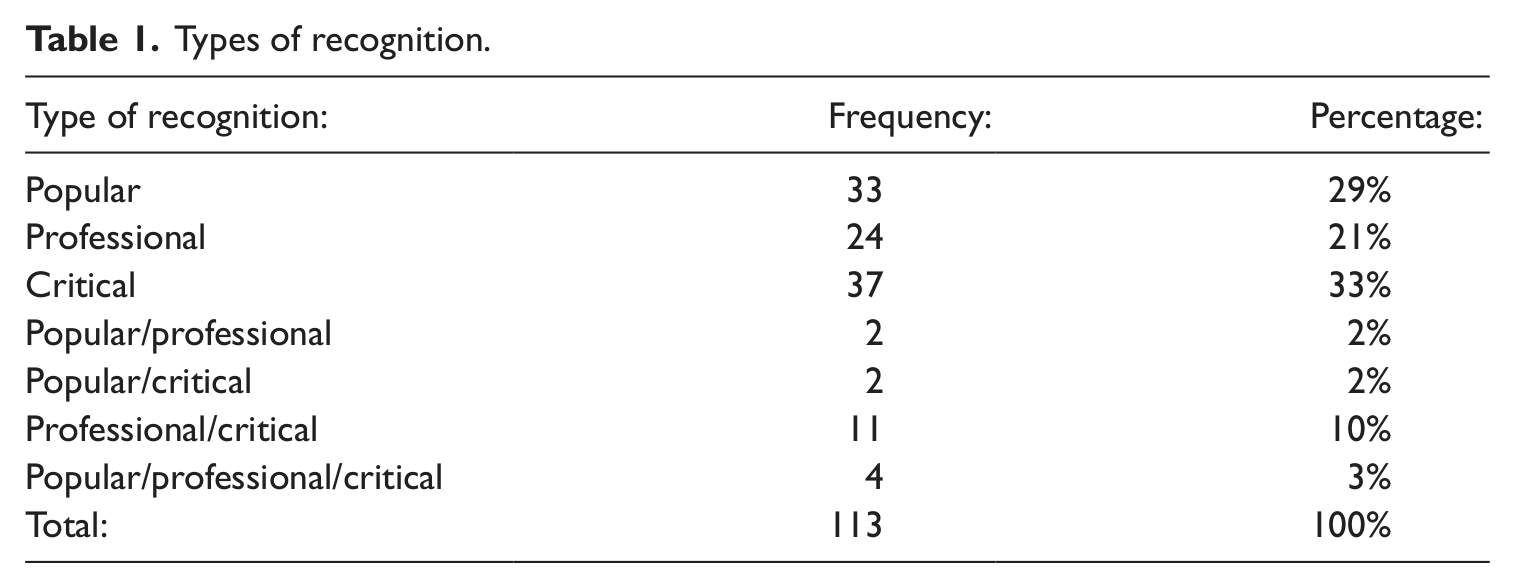
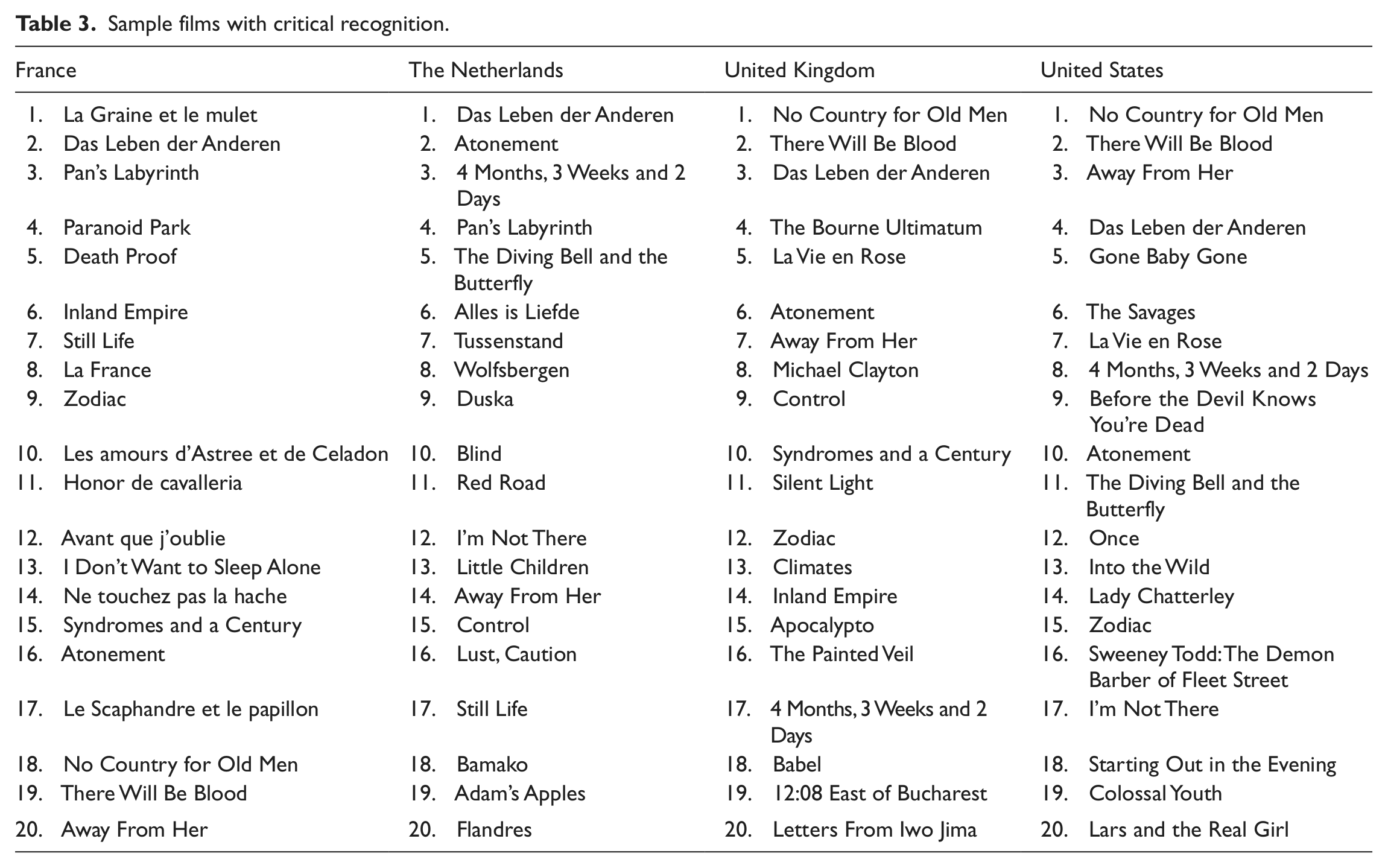
Critical recognition is rewarded when a critics’ association, quality newspaper or specialist magazine places a film in a yearly shortlist or hands out awards. The sample of films in this category was selected on a national level (Syndicat Français de la Critique de Cinema, Cahiers du Cinema, Kring van Nederlandse Filmjournalisten, De Volkskrant, NRC Handelsblad, The British Film Critics’ Circle, The Times, The Guardian, New York Film Critics, Los Angeles Film Critics, New York Times, and Los Angeles Times), and when these shortlists did not provide enough film titles the most prestigious internationally oriented critics’ awards (Golden Globe Awards) were used to complete the list. An overview of the complete film sample is found in Appendix A, and the distribution over film types is displayed in Table 1.
Types of recognition.
In line with our theoretical framework, our empirical analysis consists of two parts, for which different measurements and analyses are performed. Material practices are operationalized through a number of production attributes that are extracted from online resources like the Internet Movie Database (IMDb), Box Office Mojo, and The Numbers. Where needed, we recoded variables to fit our inductive statistical analysis.
For every film, we retrieved the production budget, consisting of four categories: (1) less than $999,999; (2) $1–$20 million; (3) $20–$100 million; and (4) more than $100 million. We operationalized film contents via the dominant location in the narrative (Place, at the country level), the dominant historical period in the narrative (Time) and the dominant theme of the film. Place contains three categories: (1) US; (2) Europe; and (3) elsewhere. Time also has three categories: (1) current times (2000s); (2) 1950–2000 or recent history; and (3) remote periods. 3 The film’s theme was constructed in four steps via an inductive process. First, we extracted for each film the two most prominent keywords from IMDb’s 4 Plot key words and Plot synopsis – that is: keywords that seemed to express the film content most accurately. Second, we summarized these keywords into a more general theme (we found 30 different themes) as well as a context in which the theme is played out. Thirdly, we looked for similarities among these general themes by grouping them together and deleting redundancies. In the fourth and final step, we collapsed the themes in each group to an even more abstract level, resulting in four overarching themes: ‘good vs. evil’, ‘portrait of an individual’, ‘human relations’ and ‘social issues’. For instance, keywords for Rush Hour 3 were ‘murder’ and ‘police’. These keywords were summarized into the general theme ‘crime’ played out in the context ‘murder’, while the general theme ‘crime’ ultimately was placed under the overarching theme ‘good vs. evil’.
The human capital of a film was measured via two variables: the ‘star power’ wielded by, respectively, the leading actor and the director. To this end, we used the Starmeter feature in IMDb as a measurement tool; this feature translates the number of searches in IMDb on an actor’s or director’s name in a given week into a periodical ranking. For each film, we charted the ranking of the two leading actors and the director a month before the relevant film’s release via the Starmeter archive. Recoding led to both actors’ star power and director’s star power consisting of three categories: top ranking (1–1000), middle ranking (1001–50,000) and low ranking (50,001 and beyond).
Finally, we operationalized cultural classification characteristics by establishing the genre of the film and whether the film concerned an adaptation of another cultural product, and/or a serial format. Genre was established using IMDb. We distinguish three main categories here: (1) drama, (2) comedy, and (3) action/suspense, since alternative genres like musical, fantasy, and science fiction were seldom found in our sample. 5 Adaptation contains three categories: (1) no adaptation/original script, (2) adaptation of a popular culture product (e.g. comic, musical, TV show), and (3) adaptation of high culture product (e.g. novel, play). Serial format is simply coded as applicable or not.
Whereas material practices are regarded as concrete outcomes of decisions within the filmmaking process, the symbolic affordances that guide film producers are operationalized via film viewers’ perceptions. We asked six regular film viewers to fill out a questionnaire in which they were invited to assess the conventional and/or innovative nature of our film corpus. Each viewer received a subset of 40 films with a small description (based on IMDb synopsis) and was asked to rate each film (on a scale from 0 to 4) on four attributes. These represented four dimensions of the continuum between conventionality and innovation in movies: (a) conformity to Hollywood production norms, (b) complexity of narrative, (c) familiarity of thematic content, and (d) difficulty of viewing experience. 6 Subsequently, we calculated the mean ratings per film for each dimension. Reliability analyses showed that the assessments for each dimension were highly consistent: .91 (a), .87 (b), .75 (c), and .89 (d).
Results
Material practices
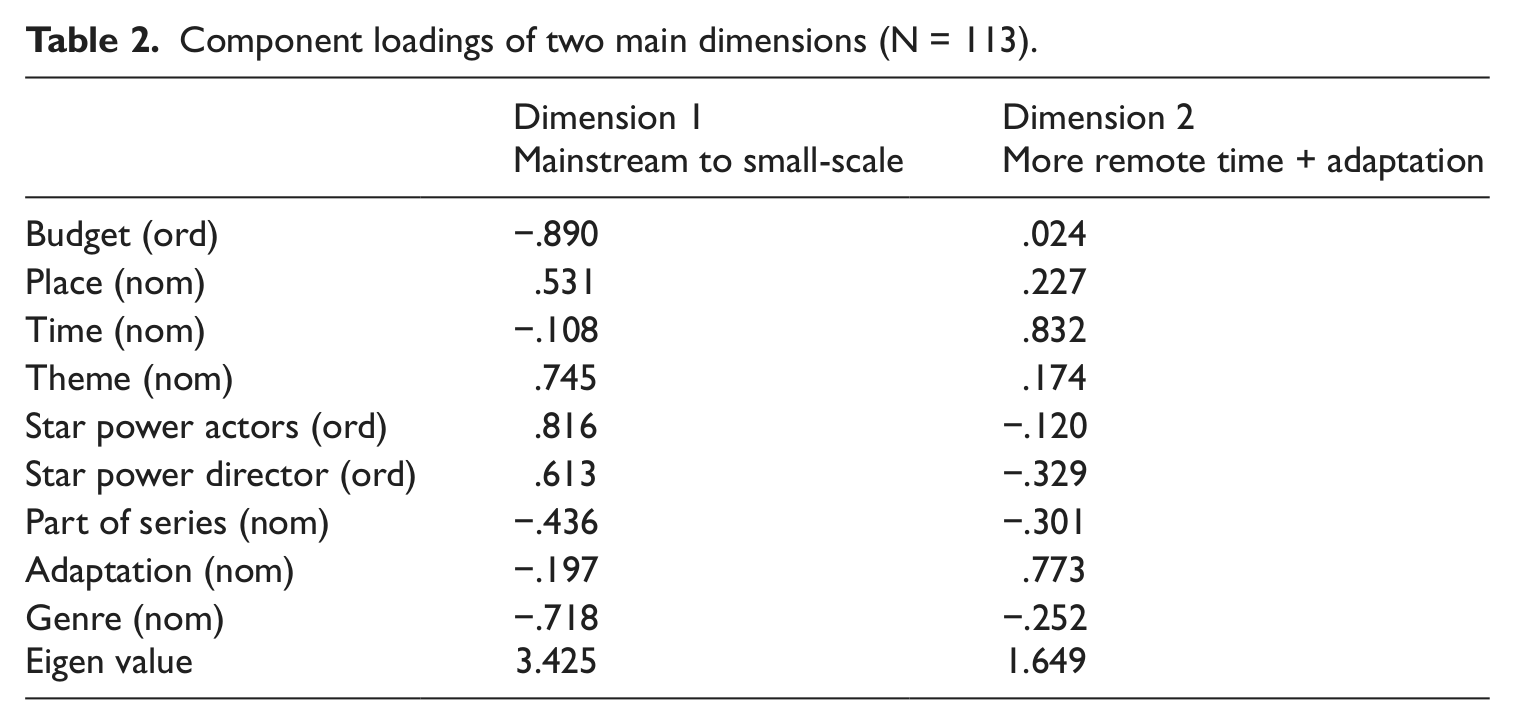
We first conducted a Categorical Principal Components Analysis (CATPCA) to find underlying patterns in the ‘material’ film attributes. We report the two-dimension solution since imposing a third dimension on the data decreased the interpretation of the results (possibly because of the small N). Table 2 shows the variables’ contributions to the distinguished dimensions. Clearly, dimension 1 (Eigenvalue = 3.4) mainly differentiates films based upon budget, star power, genre and theme. Dimension 2 (Eigenvalue = 1.6) signals differences in time and adaptation. In Figure 1, the quantifications per category in these variables facilitate an easier interpretation of the dimensions. Here, we see that films of the suspense/action genre, with high budgets, high ranking actors and directors, and content within the ‘good vs. evil’ theme, have lower object scores than their counterparts. Dimension 1 thus indicates the difference between films that show many of the characteristics of mainstream movies versus films from the domain of small-scale production. Films in our sample score between -2.24 (very mainstream) and 1.45 (very small-scale).
Component loadings of two main dimensions (N = 113).

Interplay of two dimensions of material practices.
On the other hand, dimension 2 differentiates between films set in a remote time period (the distant past or future) that are based upon popular and high culture products on the one hand, and more contemporarily-situated films that are not adaptations. Apparently, many historical (e.g. 300, set in classical Greece, and Elizabeth: The Golden Age, set in the 16th century) but also futuristic films (e.g. I Am Legend) are adaptations from books or historic/biographical material. Here, films in our sample score between -1.95 (very contemporary) and 1.69 (large time distance).
Having established two underlying dimensions within material production values, we tested whether the films recognized by audiences, critics and professionals differ on these dimensions by conducting an ANOVA analysis. The object scores of the Categorical Principal Components Analysis were saved and then, for the sake of interpretation, transformed to a scale ranging from 0 to 4. Table 3 shows that films that received predominantly popular recognition are significantly more conventional (M = 1.59) than the other two film types (M = 2.81 and M = 3.08). While they also seem to be slightly more often contemporary without adaptation, this difference is not significant. Interestingly, we find no difference between films with critical and professional recognition.
Differences between films with popular, critical and professional recognition in two dimensions of material production value (mean and s.d.).
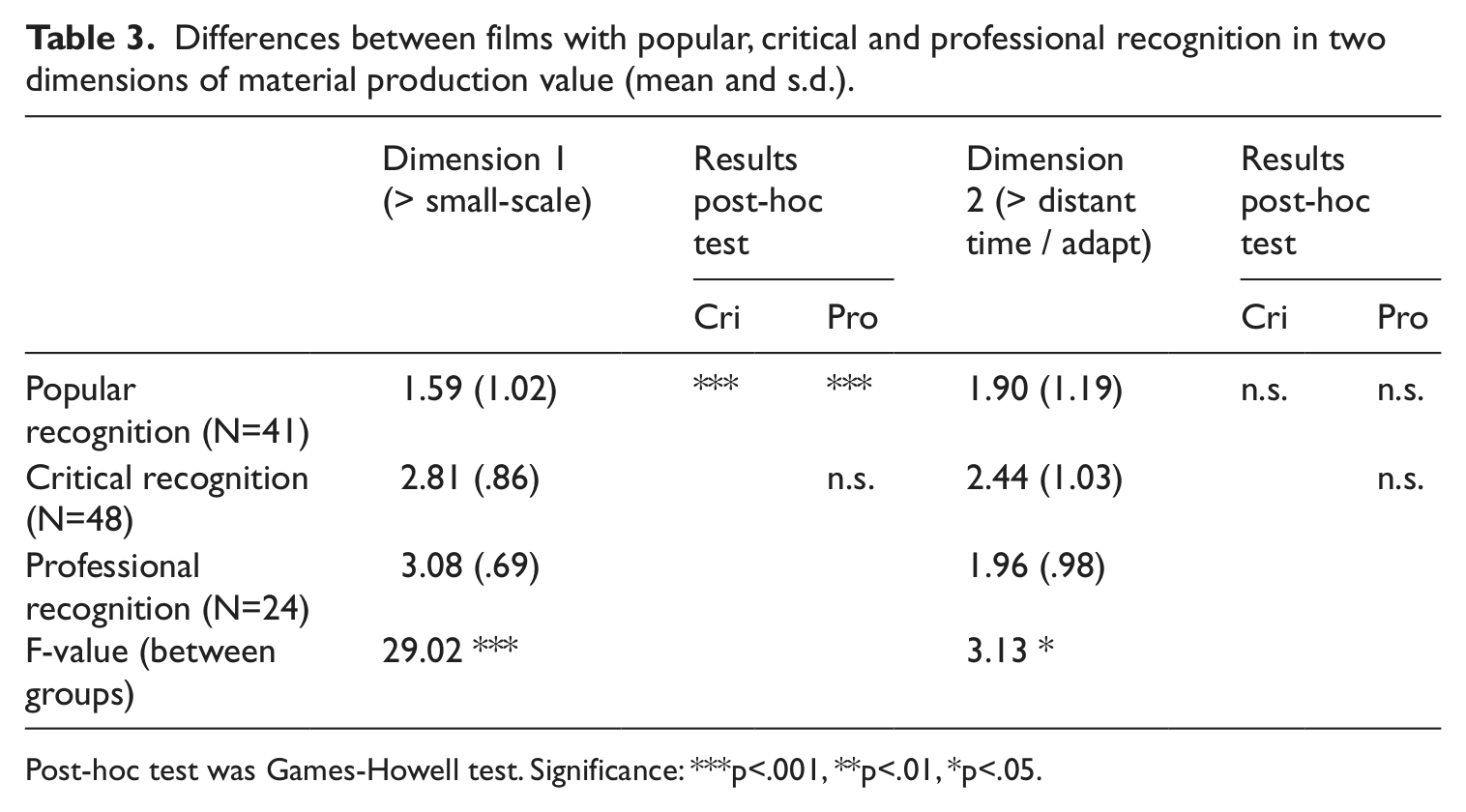
Post-hoc test was Games-Howell test. Significance: ***p<.001, **p<.01, *p<.05.
Symbolic affordances
Symbolic aspects of institutional logics were measured via four predefined dimensions, which capture how film viewers perceive the films in terms of conformation to Hollywood norms, narrative complexity, theme familiarity and difficulty of viewing experience.
The results, as presented in Table 4, all point in the same direction: films which received popular recognition are conceived as considerably more conventional – and thus less innovative – on all four dimensions than films recognized by critics or professionals. That is, they are more in line with Hollywood norms, have less complex narratives, have more familiar themes and grant easier viewing experiences. Similar to the results for material practices, no significant differences are found between films that were recognized by critics and professionals.
Differences between films with popular, critical and professional recognition in four dimensions of symbolic affordances (mean and s.d.).
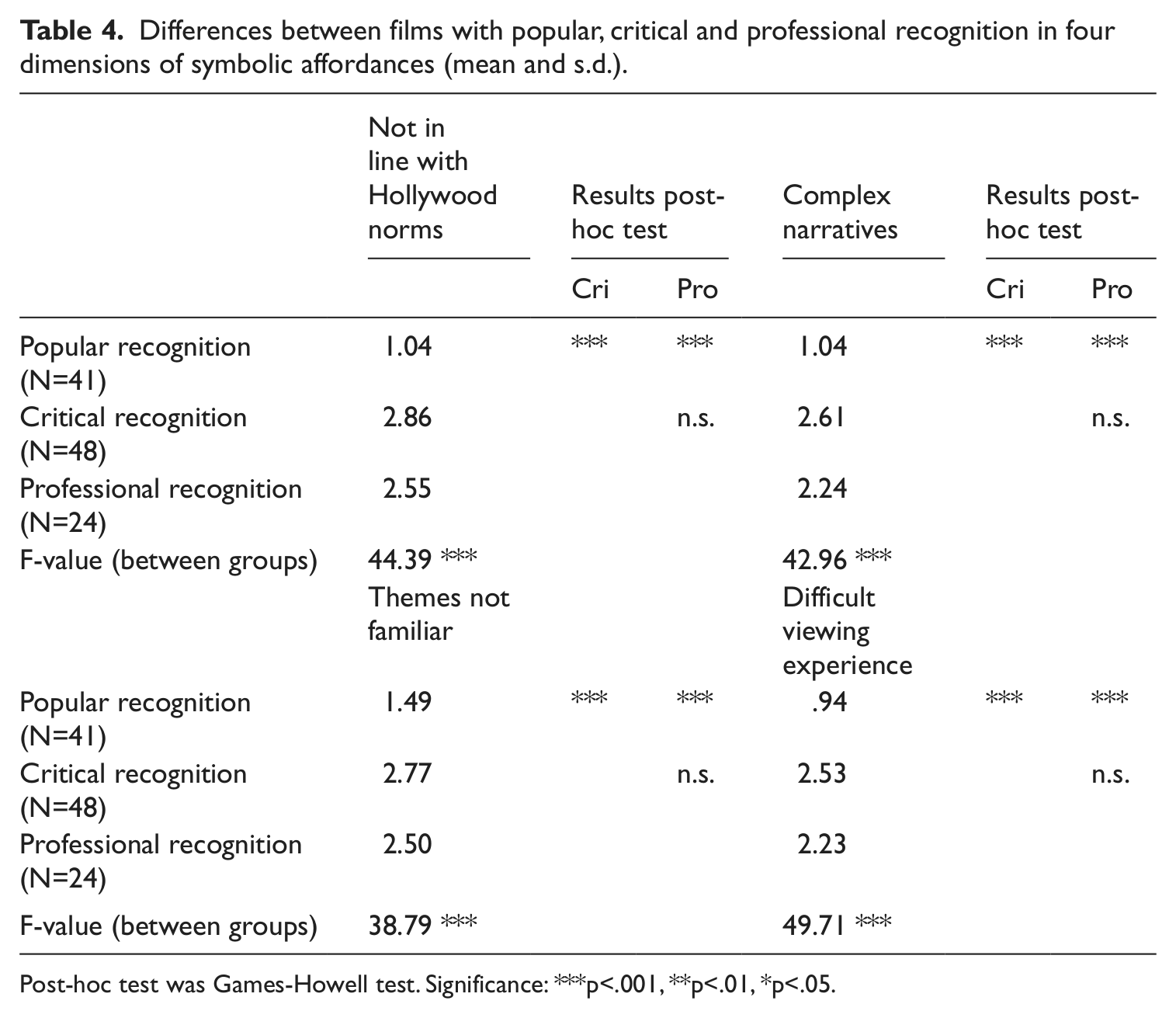
Post-hoc test was Games-Howell test. Significance: ***p<.001, **p<.01, *p<.05.
Interaction of material and symbolic film traits
A final step in our analysis of how films are classified and perceived concerns the interaction of material and symbolic film traits. Here we turn to multivariate analyses in which we analysed the influence of types of recognition as well as material practices on symbolic affordances by film viewers. While we do not claim to establish ‘true’ causal effects, we argue that both the way producers position their products in the market and the recognition of critics and professionals precede symbolic affordances (as the survey was held in 2011). Also, it is not unlikely that viewers notice such characteristics, which then affects their perceptions of the films. Our analysis mainly tries to provide a more detailed yet exploratory account of how the two sides of institutional logics interact.
Table 5 presents the outcomes of four OLS regression analyses. In each analysis, we first estimated a basic model containing only the three types of recognition. The results of these models are in line with the ANOVAs presented in the previous sections: films with popular recognition are in all facets less innovative than films with professional recognition. There are no significant differences between professionally and critically acclaimed films, albeit the latter seem to be slightly more complex in their narratives. Note that for all dimensions a relatively high percentage of about 40 per cent of the variance is explained.
The influence of different types of recognition and material film traits on symbolic film traits (beta’s) (N = 113).
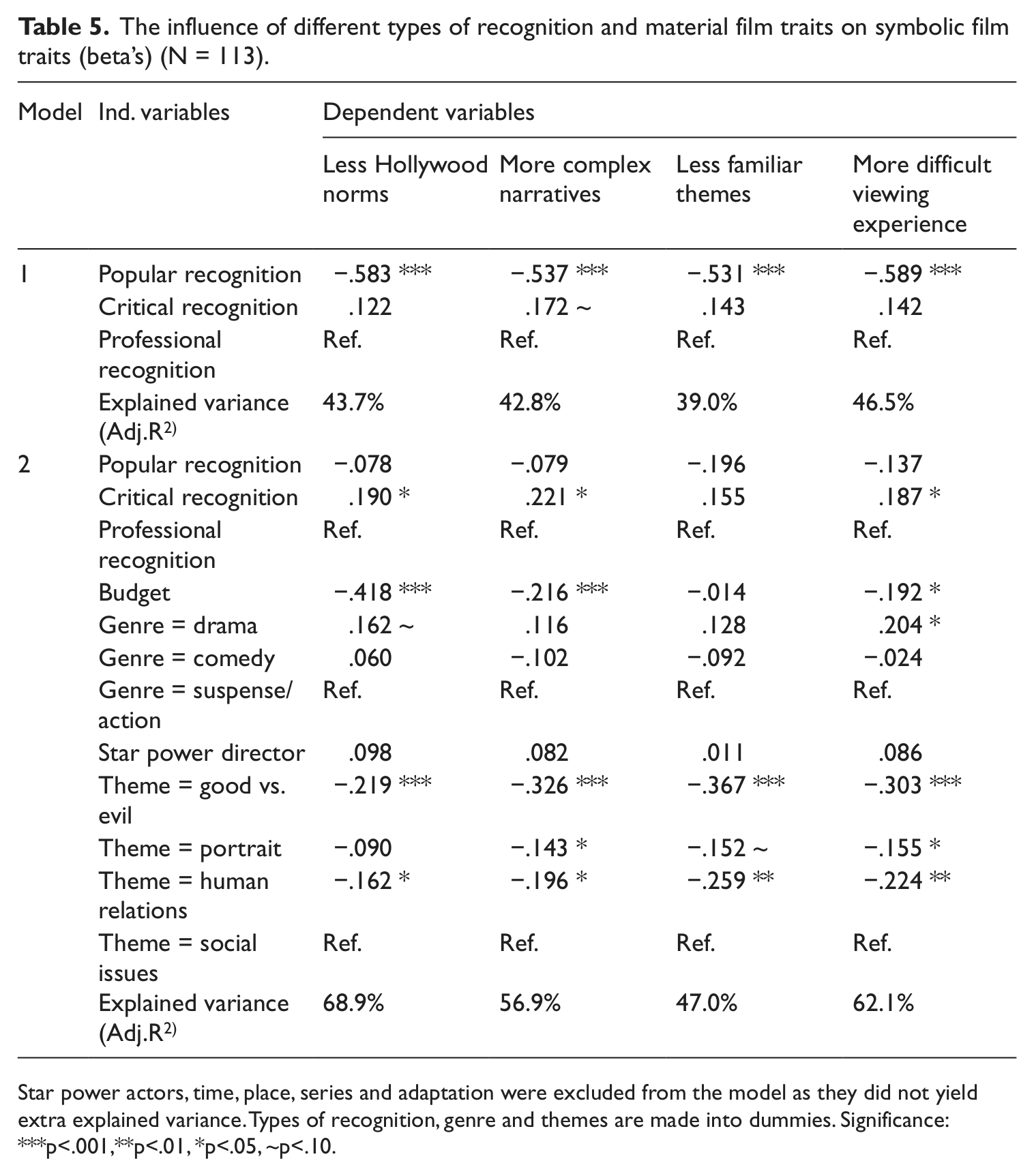
Star power actors, time, place, series and adaptation were excluded from the model as they did not yield extra explained variance. Types of recognition, genre and themes are made into dummies. Significance: ***p<.001,**p<.01, *p<.05, ~p<.10.
In model 2 we add a selection of material film traits to the model; variables that added no explained variance were excluded, and also in order to obtain a more parsimonious model given the low N. The absence of effects of these characteristics is, of course, an outcome of its own. The model further discloses several relevant findings. First, we observe that all differences between films with popular recognition and professional recognition disappear, while some differences come into play between critically and professionally recognized pictures. This is mainly the effect of the film budget. Keeping the budget constant shows that critically acclaimed films are considered more innovative (except for the familiarity of themes) than professionally recognized films, and that the alleged differences between the professionally and popular recognized films should be attributed to budget. However, this decrease is not solely the result of variation in film budget. Regarding all four dimensions, some small differences remain (unreported analyses) yet disappear completely after introducing the themes of the film (see model 2). Films revolving around the themes ‘good vs. evil’ and ‘human relations’ are considered less innovative than films with the theme ‘social issues’. Thus, the films’ overarching themes are significantly connected to how viewers perceive the symbolic potential of the film and this seems to neutralize all differences in recognition between the popular and the professional. These significant effects of budget and particularly theme are the second relevant finding of the analyses, since they quite precisely demonstrate the interaction between material and symbolic attributes. Rather than aspects like serial format, adaptation, or star power, it is the thematic content of the film that seems to structure the way film viewers perceive its innovation.
Thirdly, we find some modest differences between the four symbolic dimensions of the film’s conventionality or innovativeness. Clearly, the degree to which movies conform to Hollywood norms has the highest level of explained variance, which can mainly be attributed to the film budget. The extent to which a film contains familiar themes is the most difficult to explain; model 2 only renders the presence of particular themes significant. Budget does not affect the familiarity of themes. Genre hardly influences viewers’ perceptions; only drama is associated with less conformity to Hollywood norms and more difficult viewing experiences.
Finally, we tested whether films that were sampled in one, two, three, and four countries differed on the two dimensions found with regard to material practices and the four symbolic traits, by conducting an ANOVA analysis. The results show that films that were sampled in France, the Netherlands, the United States and the United Kingdom are significantly more conventional than films that occur in fewer samples. Not only are films sampled in all four countries produced along more conventional lines (Dimension 1. M = 1.44) than films sampled in one or two countries (M = 2.86 and M = 2.08), they are also perceived as most conforming to Hollywood standards (M = 1.51 against M = 2.41 and M = 2.00). The internationally successful films were also seen to contain less complex narratives and more familiar themes, and to offer an easy viewing experience, but the samples did not differ significantly on these dimensions.
Conclusion
This article has examined how movies in contemporary film fields in France, the Netherlands, the United States, and the United Kingdom are classified in terms of production characteristics and content. More specifically, it seeks to understand how the recognition that films can receive is related to the way films are produced, their intrinsic elements (material practices), but also the way they are interpreted by audiences (their symbolic affordances). Within a cultural landscape in which hierarchical differences are declining (Janssen et al., 2008, 2011), audiences become increasingly omnivorous (Peterson and Kern, 1996), and marketing divisions are gaining power in most cultural genres, the interactions between the ‘symbolic’ and the ‘material’ side of cultural production as well as ‘innovation’ and ‘convention’ need to be analysed in more detail.
Based upon samples of the 20 most successful films in three different institutional domains in four countries, we conducted an empirical analysis of how movies with large popular, professional and critical recognition differ regarding conventionality and innovation in the early 2000s. In terms of material practices, the traditional distinction between commercial and artistic movies still holds – although in a continuous rather than a discrete manner. Production budget, star power of the director, genre and thematic content still matter. Popular films mostly answer to Hollywood’s traditional profit-oriented logic (multi-million-dollar budgets, major movie stars, well known directors, clearly signalling genres, and comprehensible themes), whereas professionally and critically recognized films fit this conventional profile far less well. Furthermore, we examined film’s symbolic affordances; film viewers’ perceptions of conventionality and/or innovation in film became apparent in four dimensions. Popular film was perceived as most conventional; these titles were judged to conform most closely to Hollywood norms, to hold little narrative complexity, to represent familiar themes, and to offer an easy viewing experience. Films with professional or critical recognition scored in the opposite direction on these dimensions.
Previous research shed light on the prominence of narrative complexity and comprehensibility in relation to viewers’ interest and pleasure in films (Silvia and Berg, 2011); expertise facilitates aesthetic experience, decreases confusion, and generates interest. Our findings are in keeping with such conclusions, and offer insight into the distinction that remains between mainstream and art house film despite the field’s further differentiation in past decades. However, this distinction proves to be a gradual rather than a dichotomous one. Commercially successful and critically acclaimed films present the extremes of a continuum between conventionality and innovation. In particular, the films with professional recognition represent the blurring of boundaries. While being consecrated through awards and prizes, they do not solely resemble the art(istic) movie.
Much of the distinction with in popular movies lay in the budget differences and the themes that were presented. Apparently, the intertwining of small-scale and large-scale film fields (Bourdieu, 1993) cannot be perceived as a straightforward loss of distinction or an overall shift of production logics (Thornton and Ocasio, 1999), but rather as the so-called ‘production on the boundaries’ (Hesmondhalgh, 2006) in which filmmakers combine production logics to cater to publics with various levels of aesthetic fluency. This strategy allows producers to serve today’s omnivorous film audiences well (Van Eijck and Knulst, 2005); consumers’ tastes can be met on either side of the continuum between innovation and conventionality, as well as on any point in-between the two extremes. In line with previous research, films that become successful in more than one country tend to be more conventional (cf. Barthel-Boucher, 2011) than those that attract only one particular audience; the French, Dutch, British, and American contexts were least difficult to circumvent for films that were only moderately innovative.
Since the explorative character of our study and its modest sample size restrain generalizations, future research is needed to construct more elaborate measures of film’s attributes. Furthermore, the expansion of the data sample in a longitudinal manner would greatly benefit research on the conventionality or innovativeness of film types. However, this dialogue between cultural sociology and film studies does add nuance to the traditional picture of mainstream versus artistic film. It appears that it is not just Hollywood’s signature large production budgets and star power which determine a film’s classification: the impact of thematic content presents a complex dynamic between material practices and symbolic affordances. Whereas the commercial blockbuster does still appear to oppose the art house film, the distinction proves to be a gradual slide from conventionality to innovation. All in all, the results of this paper suggest that due to increasing complexity of the film field, the legitimizing power of institutional agents has levelled, which makes it increasingly difficult for single individuals and organizations to put a mark on classification processes.
Footnotes
Appendix A. Data Sample
Sample films with critical recognition.
| France | The Netherlands | United Kingdom | United States |
|---|---|---|---|
| 1. La Graine et le mulet | 1. Das Leben der Anderen | 1. No Country for Old Men | 1. No Country for Old Men |
| 2. Das Leben der Anderen | 2. Atonement | 2. There Will Be Blood | 2. There Will Be Blood |
| 3. Pan’s Labyrinth | 3. 4 Months, 3 Weeks and 2 Days | 3. Das Leben der Anderen | 3. Away From Her |
| 4. Paranoid Park | 4. Pan’s Labyrinth | 4. The Bourne Ultimatum | 4. Das Leben der Anderen |
| 5. Death Proof | 5. The Diving Bell and the Butterfly | 5. La Vie en Rose | 5. Gone Baby Gone |
| 6. Inland Empire | 6. Alles is Liefde | 6. Atonement | 6. The Savages |
| 7. Still Life | 7. Tussenstand | 7. Away From Her | 7. La Vie en Rose |
| 8. La France | 8. Wolfsbergen | 8. Michael Clayton | 8. 4 Months, 3 Weeks and 2 Days |
| 9. Zodiac | 9. Duska | 9. Control | 9. Before the Devil Knows You’re Dead |
| 10. Les amours d’Astree et de Celadon | 10. Blind | 10. Syndromes and a Century | 10. Atonement |
| 11. Honor de cavalleria | 11. Red Road | 11. Silent Light | 11. The Diving Bell and the Butterfly |
| 12. Avant que j’oublie | 12. I’m Not There | 12. Zodiac | 12. Once |
| 13. I Don’t Want to Sleep Alone | 13. Little Children | 13. Climates | 13. Into the Wild |
| 14. Ne touchez pas la hache | 14. Away From Her | 14. Inland Empire | 14. Lady Chatterley |
| 15. Syndromes and a Century | 15. Control | 15. Apocalypto | 15. Zodiac |
| 16. Atonement | 16. Lust, Caution | 16. The Painted Veil | 16. Sweeney Todd: The Demon Barber of Fleet Street |
| 17. Le Scaphandre et le papillon | 17. Still Life | 17. 4 Months, 3 Weeks and 2 Days | 17. I’m Not There |
| 18. No Country for Old Men | 18. Bamako | 18. Babel | 18. Starting Out in the Evening |
| 19. There Will Be Blood | 19. Adam’s Apples | 19. 12:08 East of Bucharest | 19. Colossal Youth |
| 20. Away From Her | 20. Flandres | 20. Letters From Iwo Jima | 20. Lars and the Real Girl |
Funding
This research was supported by the Netherlands Organization for Scientific Research as part of the VICI project Cultural Classification Systems in Transition (NWO project #277-45-001).