







Abstract
American sociologists working in the production perspective have produced a rich body of work on systems of aesthetic-cultural production, distribution, and consumption, but they have paid relatively little attention to the work of art. Aligning with new sociological work that takes the work of art seriously, this article contributes to an aesthetically inflected sociology of the arts: research that includes the work of art as an integral part of the analysis. Substantively, we examine a 19th-century scandal surrounding paintings of nudes. We show that the work of art constitutes crucial evidence for understanding arts scandals. Artworks are connected with social and aesthetic issues by means of their pictorial elements, which are viewed by a public through historically situated ‘period eyes’. Each of these elements is needed to spark an arts controversy, and all must be studied in order to understand them.
Introduction
American scholarship in the sociology of the arts often focuses on the institutional arrangements within which the arts are produced, distributed, and received, but pays relatively little attention to the work of art. We make an argument for an aesthetically inflected sociology of the arts that includes aesthetic objects and discourses as a key point of analysis. We focus on the visual arts. To be clear, we do not wish to argue against a sociology of the institutional arrangements within the artistic field or the arts in relation to other social institutions and organizations. Instead, we argue for a sociology of the arts that includes the work of art as an integral part of the analysis.
We briefly consider influential formulations of the field that focus on institutional arrangements, pointing to the fact that the sociology of the arts tends to marginalize the very stuff it purports to study. We then turn to a smaller body of more recent work in which sociologists have incorporated the work of art, arguing that this budding literature is still to bloom fully. Our focus is controversies over artistic content, as arts scandals tend to spring up around societal fault lines, revealing the underlying nature of pressing social concerns and conflict among social groups. Moreover, arts controversies necessarily involve the work of art. Specifically, we see the power of art to ignite scandal. As Adut (2008: 224) observes, ‘art scandals are laden with sentiments and discourses throwing into full relief the extent to which aesthetics can acquire a moral dimension’. We show that this moral dimension of aesthetics springs from the interaction of specific works of art with the aesthetic conventions of the time, as viewed through the lens of social discourse. Empirically, our research involves a case study of a 19th-century controversy over the nude, allowing us to contribute to the sociology of arts scandals.
Frameworks in American Arts Sociology
Two major frameworks have been influential in American sociology of art: production of culture and Bourdieu’s theory of the field. 1 The production of culture approach arose in the 1970s as a reaction against Marxian-inspired reflection approaches and remained influential after the turn of the millennium (Peterson and Anand, 2004). Becker (2008 [1982]), a central theorist in the production of culture approach (although he is also more than this), usefully dismantles the romantic view of the artist as isolated genius by showing the inherently collective nature of aesthetic-cultural production. Becker’s work, as with other production theorists, defocalizes the work of art in favour of the social networks involved in creating, distributing, and receiving the work.
Unlike Becker, who looks at cooperation and conflict within networks of production, Bourdieu (1992, 1993) suggests that the field of cultural production is a site of struggle for symbolic and material resources within a larger field of power in society. In addition, his theory of cultural capital (1984) brings attention to the consumption of art. For scholars of art, the key contribution of the distinction thesis is the social function that art plays in legitimating social difference, thereby demonstrating the crucial role of culture in the creation and reproduction of systems of inequality.
While Becker and Bourdieu have written about specific works, artists, and genres, the impact of their work on the discipline has been on research that leaves the work of art aside. As de la Fuente (2010: 4) observes: Desperate to avoid the twin problems of ‘essentialism’ and ‘formalism’, sociological accounts of art have often tended to focus on factors other than the artwork itself. For example, the three most cited works in the field of the sociology of art since about 1980 have been Howard Becker’s (1982) Art Worlds and Pierre Bourdieu’s (1984, 1993) Distinction and The Field of Cultural Production. In all cases, the preference was for a sociological account of the logics of ‘art worlds’ or ‘fields’, on the production side, and class and other identity categories on the consumption or audience side.
Put another way, the field’s division into a production and a consumption side 2 meant that ‘supply and demand became separated out in ways which stripped out the art work itself from the focus of attention’ (Hanquinet and Savage, 2016: 10). This elision of works of art is problematic for the sociology of art. Not the least of the consequences is the distinct split between analyses of the institutional aspects of art production and research on meaning.
Most promising in newer research on meaning, in our view, is work associated with the Yale Center for Cultural Sociology. Scholars such as JC Alexander (2008), Eyerman (2016), and McCormick (2015) take an explicitly nonreductive stance that moves us beyond the dichotomous focus on meaning as emanating either from the work of art/artist or the audience/viewer to a conceptualization of meaning as process, an ‘emergent property in the interaction between subject and object’, as Eyerman (2016: 32) states. Importantly, this theoretical standpoint allows for recognition of the agency of the artwork itself via the power of its aesthetic-expressive qualities to evoke an emotional resonance in the viewer (see JC Alexander, 2008; DeNora, 2000; Griswold, 1987), a decisive move away from the residues of reflection theory that have continued to lurk in the corners of our discipline, best efforts aside. This does not mean a return to the reification of the work of art as transcendent, free-floating object or artist as isolated genius; the production and experience of aesthetic-cultural objects are always rooted in time and place, as are discourses on art at a given historical juncture. Placing meaning at the centre of sociological analysis underscores the argument that the sociology of art cannot be limited to institutional analysis alone.
This article argues for an integrative approach to the sociology of art. We argue that sociological research focusing on the institutional arrangements within which the arts are produced, distributed, and received can be fruitfully combined with an analysis of the work of art. Our empirical case study, moreover, demonstrates that a comprehensive understanding of a scandal over the nude in late-19th century Paris and New York is only possible when the work of art is included.
At present, a number of scholars in the field have argued in favour of a sociology of the arts that overcomes the traditional dividing line between institutional and interpretative approaches in sociological research on the arts. Our survey of this work has identified consensus along three major points. First, when sociologists limit their work to empirical investigations of the organizational aspects of arts production and consumption, aesthetic questions are relegated to the humanities. As Eyerman and McCormick (2016: 11) have incisively observed, ‘This has left us with an empirically vigorous, yet aesthetically lifeless, sociology of the arts.’ In contrast, this recent literature has placed meaning at the centre of the discussion, citing the need for theoretical and methodological strategies adequate to the task (see Eyerman, 2016). Second, the work of art is seen as a crucial object of study or source of data. Explicit arguments for incorporating the artwork into sociological analysis include Alexander and Bowler (2014); Becker, Faulkner, and Kirschenblatt-Gimblett (2006); Bowler (1994); de la Fuente (2007, 2010); Eyerman and McCormick (2016); Hanquinet and Savage (2016); Witkin (1995, 1997); Wolff (1992); and Zolberg (1990). Third, we see strong arguments that moving the field forward implies a necessary engagement with the insights and tools of other disciplines, most notably, humanities-based work in such areas as art history, musicology, and literary studies (de la Fuente, 2007; Eyerman, 2016; Eyerman and Ring, 1998; Inglis, 2005). We address each of these points in turn, focusing on art history as the humanities discipline most suitable to our case study in the visual arts.
Sociology and the Humanities
In taking a demystifying stance toward the work of art, the artist, and artistic labour, sociology is a de-legitimizing force with respect to canonized cultural disciplines and the aesthetic systems that underlie them. Sociology’s emphasis on the structural aspects behind creative production shifts attention away from individual artists and works, and away from notions of artistic genius, in favour of the broader social and cultural contexts within which artworks are created, distributed and consumed. Indeed, as Hanquinet and Savage (2016: 8) observe about Bourdieu’s work, ‘cultural sociology becomes a social critique of art itself’. They also suggest that the social ‘critique of humanities [is] central to the self-conception of sociology’ (2016: 9).
Along these lines, some sociologists are critical of sociological research that looks specifically at artworks or that attempts to study meaning. As Peterson (1994: 184) put it, ‘If production studies run the risk of eliminating “culture” from the sociology of culture, researchers who focus on the content of cultural products run the risk of … taking the “sociology” out’. This comment highlights the influence, still strong, of positivism in American sociology. Crane (1992: 86) writes that (American) sociologists, tend to view society as a collection of causally related variables. The goal of the social scientist is to produce a set of laws describing the causes of human behaviour. This approach leads to a conceptualization of cultural symbols as ‘black boxes’ whose meanings and interrelationships do not require analysis.
A black-box approach necessarily leaves out aesthetic objects and discourses. Related to this is the tendency in sociology to separate ‘society’ from ‘the arts’ (Hanquinet and Savage 2016). The separation is false. Art is embedded in society, and as aesthetic objects are ‘social things’, art, we argue, is amenable to sociological enquiry. As Zolberg (1990: 193) writes: Contextualizing the arts is a necessary strategy if we are to understand how certain activities and objects come to be defined as art, if, and on what basis they are hierarchically ordered, and how some art comes to be judged as better than others … uncritical contextualization runs the risk of losing sight of the art itself, trivializing art in general, and prematurely closes off the possibility (and legitimacy) of evaluating art works or genres.
The impasse that exists between sociology and humanistic disciplines such as art history (see Tanner, 2003) needs to be reassessed. If, as Becker, Faulkner, and Kirshenblatt-Gimblett write, ‘There has always been a blind spot in the sociology of art: any discussion of specific artworks’, it is also true that ‘it can be the kind of thing we do’ (2006: 1; emphasis added).
The Work of Art as an Object of Study
Alongside Zolberg’s call for attending to art, an impressive, growing – but relatively small – body of sociological work on the arts, which does engage with the work of art, has emerged. Important work in this area includes Griswold (1987, 1992) on literature; DeNora (1995, 2000), Hanrahan (2000), and McCormick (2012, 2015) on music; and Dubin (1992, 1999) on the visual arts. In looking at the interaction of sonic materials and receivers, DeNora (2000) creates a theory of music-in-action that places music centrally in a sociological analysis. Expanded to art-in-action (Acord and DeNora, 2008), this work shares affinities with Hennion’s (2007) theory of attachments, in which taste is considered an activity, an embodied co-production between situated tasters (‘amateurs’) and the constructed properties of objects of taste. Both Hennion and DeNora, in different ways, talk about art objects as not having ‘effects’ but nevertheless, using DeNora’s language, affording some kinds of interactions or uses more than others. This work, along with recent research on materiality and embodiment in arts consumption (Benzecry and Collins, 2014; Griswold et al., 2013; Rose-Greenland, 2016) includes the work of art, but springs from a consumption-oriented approach that requires evidence grounded in interviews or ethnography.
We examine the artwork in a historical context, where fieldwork with long-dead receivers is not possible. Thus, we are unable to examine the aesthetic experiences of individuals directly, as in the consumption-oriented approaches described earlier. 3 Nevertheless, it is possible to construct a situated understanding of aesthetic responses to artworks which are grounded in the aesthetic conventions of that era. This allows us to understand, for instance, who considers an artwork obscene and why. We explicitly analyse the work of art, staying relatively close to the work with respect to its original social and aesthetic context, rather than making broad connections to the narratives of classical social theory, as in Witkin (1995, 1997). 4
Tools of Other Disciplines
DeNora’s (2000) research on music-in-action looks explicitly at the ‘affordances’ of music, and she draws on musicology to understand musical materials. We similarly use tools from art history to understand arts controversies more fully, and here we discuss some traditional tools (still in use) as well as more contemporary art historical approaches to visual objects. Zolberg (1990: 192–193) specifically called for such cross-disciplinary work: As a response to the danger of obliterating the art object or prematurely excluding evaluation as a legitimate project, it is important to foster the study of aesthetics and the arts as special fields and for scholars in each, humanities and social scientists, to learn from one another. What this implies is that it is just as legitimate for specialists to direct their attention to art qua art, as to its contextualization.
Traditional art history provides us with two useful tools for examining works of art. The first approach emphasizes the formal aesthetic qualities of the artwork. Formalism, put in the simplest terms, looks at the content of the object with reference to its colour, line, shapes, and style, as well as the interactions of these and other elements within the pictorial frame. A purely formal analysis suggests that an art object can be understood solely with reference to its visual elements. (In practice, no art historian, even the most traditional, considers only compositional elements of a work of art.) A second traditional approach in art history is iconography, which is the study of the symbolic elements of works of art, focusing on content beyond style or form. An iconographic approach connects with society, as symbols such as the apple as temptation in the Garden of Eden, or dogs as representations of fidelity, are necessarily constructed in society before they can be used by artists. The analysis of visual data, then, is inseparable from the broader cultural context within which it resides (Panofsky, 1983 [1955]), and iconographical elements, scrutinized by the researcher, reveal the deeper, cultural significance of a work.
While the analysis of form and content characteristic of traditional art-historical approaches continues to provide useful tools for the analysis of images, formal and iconographical approaches have been criticized, from within and outside art history, for focusing on artists (especially white, western male artists) as the central actors and for neglecting ideological systems or other contextualizing factors. Such critiques constitute the foundation of the perspective in art history known as the ‘new (social) art history’ – an approach that is no longer new, but which remains central to art history. A key premise of this perspective concerns the necessity of articulating the social embeddedness of art, a principle easily recognizable to sociologists. Whereas traditional art-historical accounts ignored socio-historical context, or considered it only as a ‘colourful backdrop’ to formalist analysis of works, the new social history of art features artists’ engagement with the social, political, and economic conditions of their time (see Clark, 1973). Of the art historians drawing on this approach, the work of Baxandall (1972) is perhaps the best known and most frequently cited among sociologists (Tanner, 2010). Baxandall’s notion of the ‘period eye’ is particularly useful for examining historical controversies in art, given his suggestion that it is possible to re-create a plausible understanding of the ‘cognitive style’ of a specific time period. To sketch a specific period eye, it is essential to attend to actual artworks and the contemporary aesthetic conventions through which they were comprehended.
The social history of art is multidisciplinary. While influenced by Marxian theory, it is strongly critical of the base/superstructure model that characterized earlier Marxist approaches to art, notably Hauser. 5 It also draws on feminist theory, semiotics and poststructuralist theory, and Foucauldian discourse theory. Feminist art historians have criticized not only traditional art historical scholarship but also work in the social history of art for its neglect of gender. For instance, Pollock (1988: 53) notes that while the influential contemporary art historian TJ Clark acknowledged the degree to which paintings like Manet’s Olympia implied a male viewer, the primacy given to social class in his early work failed to address the degree to which the very definition of modernity was gendered. Gender conditioned the definitional categories of what ‘counted’ as modern in painting; in other words, the representation of public spaces like the city streets, brothels, and bars to which respectable women artists of the period had limited access (Pollock, 1988: 50–90; see also Wolff, 1990: 34–66). 6 And gender occupies a pivotal role in the modernist work of art – as Pollock points out, female sexuality and commercial exchange constitute the subject matter of ‘many of the canonical works held up as the founding monuments of modern art’ (1988: 54).
For arts sociologists, these developments represent a significant gain over the limitations of traditional perspectives in art history and, as such, an opportunity to move beyond the dichotomy of institutional and interpretative frameworks for the analysis of art. Yet, as Eyerman and McCormick have observed, ‘while art history can be said to have experienced a sociological turn, incorporating the sociology of art worlds into its analysis of the content and meaning of artworks, sociology has not reciprocated’ (2016: 2). In part, this may be understood as a reflection of disciplinary tensions that arise from differences of subject matter, analytic emphasis, and broader epistemological goals (including the tension between generalizability and particularity, which obtains within sociology as well as between sociology and art history). Yet, while it is important to recognize these distinctions, we can borrow analytic tools from art historians that allow us to examine the work of art without neglecting the social issues that remain the core of sociological analysis. As we demonstrate, doing so affords us the opportunity to highlight the salience of the artwork in art scandals.
In this article, we employ three primary tools from art history: a close analysis of form and content, including the interaction between form and content; attention to iconography; and consideration of the period eye. The work of feminist art historians affords us special attention to the gendered dimensions of the work of art and its reception in both late 19th-century France and New York.
Case Study: The 19th-Century Nude
We illustrate the importance of considering artworks in arts sociology with a case study focusing on the 1887 anti-obscenity campaign in New York led by moral entrepreneur Anthony Comstock. We consider the case of a painting that was deemed obscene by the New York judge in Comstock’s case, and which had been previously banned from the Paris Salon. In this way, we show the fruitfulness of dialogue between art history and sociology and demonstrate the centrality of artwork in art scandals.
This scandal was studied by sociologist Nicola Beisel (1993, 1997). Her sociological observations on social class are exemplary, in more ways than one. On the one hand, her trenchant analysis illuminates core sociological concerns, as we will describe later. On the other hand, Beisel’s research is typical of sociology in that the empirical research centres on an arts controversy, yet her analysis barely mentions specific works of art and contains only a shallow mention of aesthetic conventions. In this respect, our article is a critique of Beisel, but it is, moreover, a critique of sociology in general and its tendency to ignore the aesthetic dimension. No sociologist worth her salt would ignore class in a case study on class conflict, so why do sociologists routinely ignore works of art, even in studies of conflict over art?
In 1887, American social reformer Anthony Comstock arrested prominent New York gallery dealer Roland Knoedler on charges of obscenity for the sale of photographic reproductions of French paintings of female nudes, some of which had been exhibited in the prestigious Paris Salon. Comstock, the founder and leader of the New York Society for the Suppression of Vice, had led a series of successful campaigns against obscenity, including the 1883 conviction of store clerk August Muller for selling reproductions of (apparently) the same works sold by Knoedler. 7 But while the Muller case provoked little commentary, Knoedler’s arrest led to controversy, with extensive newspaper coverage and the loss of support for Comstock from social elites who had backed his previous campaigns (Beisel, 1993: 145).
Beisel’s (1993, 1997) empirical puzzle was why the outcomes of the two cases were so different, if the artworks were ‘the same’. She shows that the difference related to the social characteristics of the taste public that received the art. As a member of New York’s social elite, Knoedler represented a dramatic departure from the lower-status people Comstock had previously prosecuted. Knoedler’s gallery had been influential in ‘developing a taste for European Salon art among America’s upper class’ (Beisel, 1993: 145). In arresting Knoedler, Comstock attacked the art that his elite supporters had come to view as symbolic of their own taste and refinement. As Beisel states, ‘The arrest of Muller for selling cheap photographic reproductions of paintings of nudes in a poor section of the city was a plausible extension of the crusade against the poor. But the arrest of Knoedler, one of the city’s leading art dealers, questioned the purity of the upper class itself’ (1993: 158).
Thus, Beisel’s analysis shows the importance of class distinctions between wealthy elites and the poor in moral crusades. Moreover, she illustrates the role played by status distinctions among the wealthy. Patrons of the fine arts could classify themselves as ‘cultured’ and therefore superior to not only the lower classes but also their own wealthy, but less sophisticated, peers. Art was an effective weapon in the struggle for status within upper-class circles. In addition, knowledge of the arts served as proof of wealthy Americans’ refined taste and demonstrated their lack of provincialism to European elites (Beisel, 1993: 149). To side with Comstock in the attack on Knoedler would threaten the aura of cosmopolitanism they had carefully cultivated. The Knoedler case thus highlights the importance of cultural capital in the context of the development of a high cultural model in the late 19th century (DiMaggio, 1982).
In the end, Comstock ‘won’ the legal battle in the Knoedler case in that two of the 37 reproductions were deemed obscene in court. However, the presiding judge in the case chided Comstock for bringing charges relating to the 35 other works and the case was a public relations failure that largely signalled the end of Comstock’s career (Beisel, 1993: 146).
Beisel’s work is rich with sociological insight that draws out the social conflicts that lay behind the controversy in the Comstock case. However, her study tells us relatively little about why only two of Knoedler’s nudes were considered obscene. We argue that analysis of the work of art is necessary for understanding controversies over art. In order to grasp why a few French paintings might be considered indecent at that time in history, we turn to an analysis of Henri Gervex’s Rolla, one of the two works deemed obscene by the New York judge, 8 and, interestingly, a painting that had already been swept up in controversy, in Paris, nine years earlier. In analysing this work, we not only learn about Gervex’s canvas, we shed light on the nature of arts controversies.
Mastery of the nude was a cornerstone of the academic training of an artist well into the 19th century (Nead, 1992: 2; Pollock, 1988: 44). Properly depicted, the nude represented the classically derived formal values of purity, balance, and order. In Paris, the typical Salon nude employed a number of conventions toward that end, including placement of the figure in a mythological or biblical setting and a particular painterly style, the neoclassical, which was favoured by the Académie des Beaux-Arts. A clear exemplar is Alexandre Cabanel’s best-known work, The Birth of Venus (1863) (Figure 1). In 19th-century France, female nudes were often depicted and exhibited in large public events as part of the Paris Salons, as was Cabanel’s Venus. The painting received critical acclaim and was purchased by Napoleon III for his private collection (Musée d’Orsay). Twenty years later, this painting became a central part of the Comstock debate in New York, where it was cited by Comstock’s opponents as an example of artistic greatness and proof of the absurdity of the moral reformer’s campaign. 9
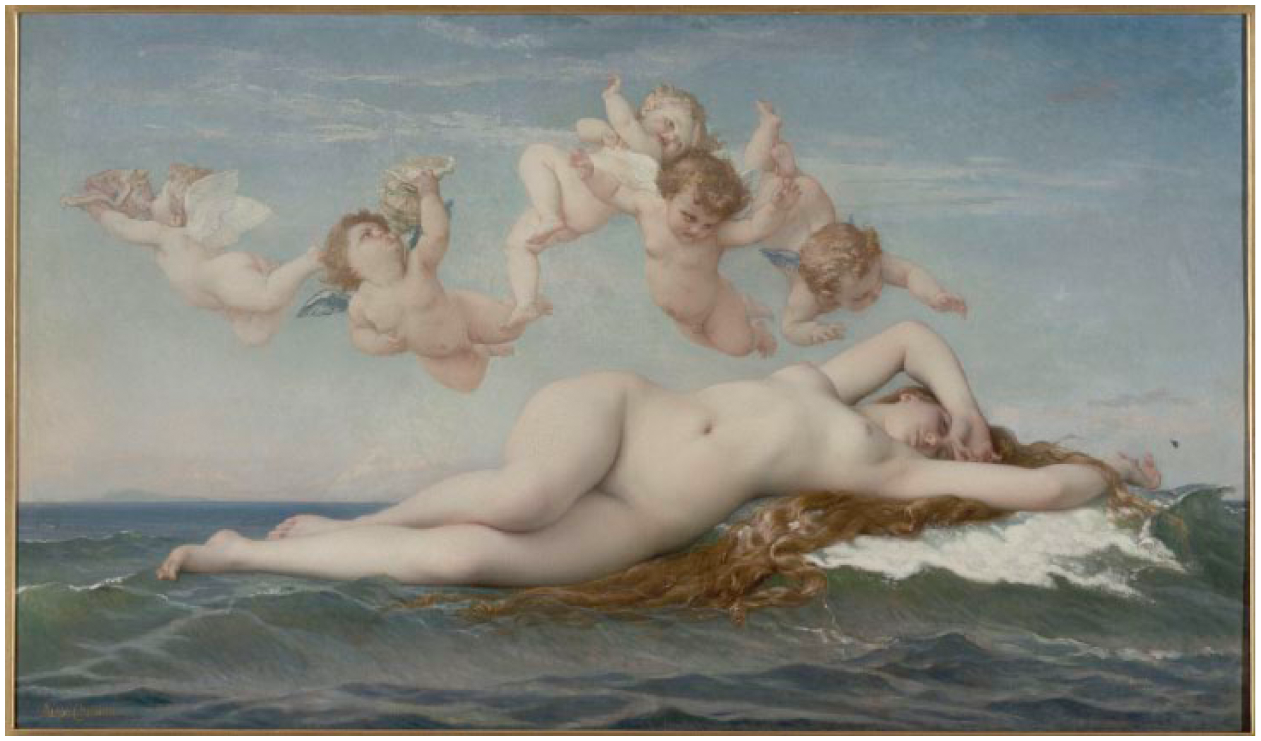
Alexandre Cabanel (1823–1889) The Birth of Venus, 1863. Oil on canvas, H. 130; W. 225 cm.
Gervex submitted Rolla (1878) (Figure 2) to the Paris Salon 15 years after Cabanel’s success. Initially accepted, the painting was yanked from the Salon just before it opened, on the grounds of impropriety. There was some controversy among Academic artists and critics over whether the painting should have been removed, and the painting was quickly exhibited in a private gallery where it attracted large crowds (Dawkins, 2002: 22).
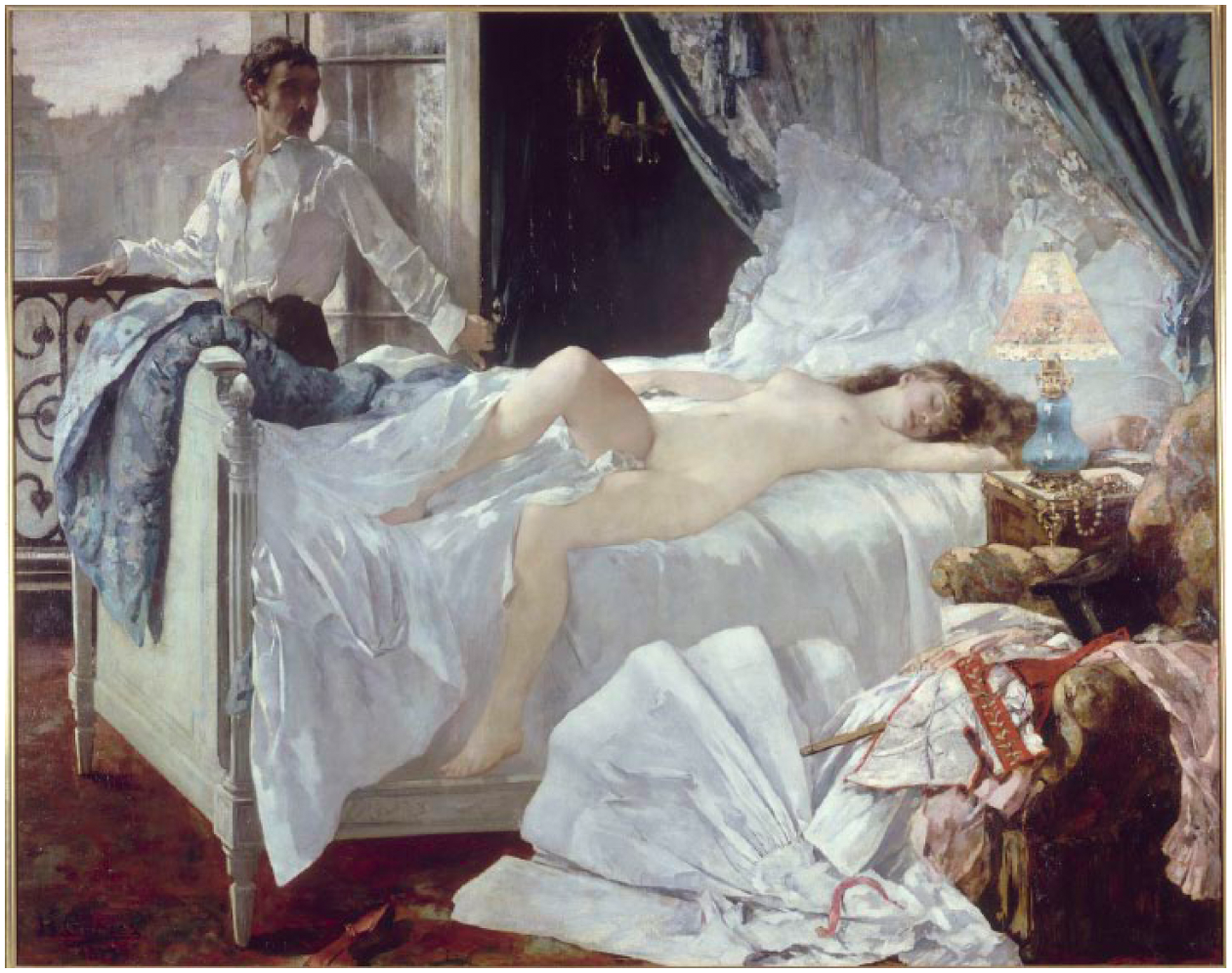
Henri Gervex (1852–1929) Rolla, 1878, Oil on canvas, H. 175; W. 220 cm.
To understand the difference in the perceived appropriateness of Cabanel’s and Gervex’s works, we must understand differences in the paintings themselves. Like Cabanel, with whom he had studied, Gervex was (and remained) an esteemed painter in French academic circles. The nude female form is the focus of both paintings and the rendering of the nude figures themselves was faithful to the painterly conventions of the academic nude (Clayson, 1991: 82; Dawkins, 2002: 18). As art historian Clayson (1991: 82) writes of Gervex’s nude, ‘There is nothing to be discovered in the treatment of her skin, anatomy, or pose that differentiates her from the canonical nude of the period’. And in contrast to the boldness of Manet’s controversial Olympia (1963), who stares out directly at the viewer, Gervex’s nude, like Cabanal’s, has a demure visage. What was shocking about the Gervex was the depicted setting, which located the scene in the present day, along with the treatment of clothing, which suggested licentiousness: Rolla depicted sexual decadence in contemporary Paris (Clayson, 1991: 82; Dawkins, 2002: 18).
Gervex based Rolla on a poem by Alfred de Musset written in the 1830s, which tells the story of a debauched bourgeois, Jacques Rolla, and a prostitute, Marion. Rolla had squandered his fortune on drink and women, and the poem ends with the young man committing suicide. A subordinate story in the poem involves the young prostitute, who ended up in her deplorable condition because of poverty. Thus, the poem involves social commentary and moralizing, showing the just desserts for debauchery in ‘a world in moral disarray’ (Clayson, 1991: 81). In creating the painting, however, Gervex introduced elements that modernized the nude, lent an erotic charge to the story, and cast an aura of ambiguity onto the morality of the tale conveyed in the poem.
According to academic convention, the setting should have been antiquity or a distant land, safely displaced from the moral dangers of modern life (Dawkins, 2002: 20). Instead, the ‘stylized floral motifs of the iron balustrade and the mansarded buildings on the facing street’ visible from the balcony door signified a present-day Paris to the late 19th-century viewer (Clayson, 1991: 82). Gervex replaced the squalid interior described by Musset with a well-appointed room that includes a Louis XVI bed (Clayson, 1991: 82). The pile of hastily discarded clothing in the foreground of the painting was deemed especially scandalous: the gentleman’s top hat on top of the young woman’s cast-off lingerie and the partially-laced corset lying inside out suggested the haste with which Marion’s undergarments had been removed (Clayson, 1991: 90).
The full petticoat signified a lower-class, public prostitute whose outer garments consisted of second-hand dresses rather than the slim silhouettes favoured by fashionable women (or brothel courtesans) of the day. Other signifiers include the phallic symbol of the cane piercing through Marion’s lingerie (and the fact that Marion’s body leans toward this phallic symbol in contrast to the tumescent form of the duvet draped over the foot of the bed). Marion’s red corset appears to be an inexpensive readymade – brightly coloured corsets were popular articles that were machine made and could be bought cheaply. They were also recent arrivals on the market, becoming common only in the 1870s (Clayson, 1991: 89–90). More generally, ‘removing one’s stays had long been, iconographically, a symbol of female dishonour, of taking leave of social decencies. A woman shown next to her abandoned corset had abandoned morality’ (Clayson, 1991: 90).
The poem suggested that Rolla would pay the price for his decadence, through suicide, but the painting showed Rolla in a moment of reflection – his deserved end is not visible in the work (Clayson, 1991: 83). In the poem, Marion was described as a corrupted innocent, who might be expected to show some reluctance in plying her trade (Clayson, 1991: 81). In Gervex’s rendering, however, the young woman’s relaxed pose and the discarded clothing ‘suggests that her venting of sensual energy was voluntary and rather enthusiastic’ (Clayson, 1991: 90). Paradoxically, Gervex’s faithfulness to academic conventions about the figure of the nude was part of the reason for the controversy that the painting incited – the serene calm of the supine body suggested Marion’s willingness, if not pleasure, in engaging in the night’s activities (Clayson, 1991: 90). Thus, Gervex’s detractors feared that ‘the painting would stimulate, rather than sublimate, eroticism’ (Dawkins, 2002: 20).
Art historical scholarship, focused on the work of art in the context of its controversial reception, allows a deeper understanding of the painting, both stylistically and in terms of detail about specific content, in ways that enhance our understanding of social debates about obscenity in art. Gervex’s painting suggested the pleasures and dangers of contemporary street prostitution, as well as hinting at female sexuality. These were taboo subjects for artists during this period, when the commercialization of sex and, in particular, fears about the threat of prostitution to family and moral order were major topics of concern. Although Gervex’s portrayal of the nude figure was well within the parameters of formal academic convention, the fact that the artist had modernized the setting, populated the canvas with contemporary characters, and cast an aura of libidinous pleasure over the scene flouted prevailing moral convention in a way that incited pressing social concerns of the period. As art historian Dawkins notes, ‘modernizing the nude risked plunging the picture into the public discourse and private anxieties associated with fears of lower-class sexual deviance and contagious diseases’ (2002: 20–21). Further, Marion’s status as a street prostitute, as signified by her clothing – a point of information made available to us only through attention to the content of the painting – illuminates the intersection of class and sexuality that have historically and today constituted a mainstay of moral campaigns.
Art historical analysis shows us how the various pictorial elements of the painting work both individually and together to have made the painting both exciting and morally dangerous in the context of the late 19th century. Art historical analysis also shows that attention to form as well as content in the work of art is important for sociological research on the arts. Gervex’s placement of the pile of clothing in the foreground of the painting and use of the colour red (rich in symbolism) functioned to draw the viewer’s eye to those elements of the painting. At first glance, the form of the nude figure as rendered by Gervex was unproblematic. Had his Marion been placed in a mythical setting, floating on clouds like Cabanal’s Venus, surrounded by putti or as an odalisque in a Turkish harem, her body would have adhered to conventional standards about the appropriate display of the female nude (see Pollock, 1999). Instead, as we have shown, the various elements of the painting’s content, which cued the viewer to a contemporary, luxurious setting and implied a sexual encounter characterized by lustful abandonment, set off the storm of controversy. It was in fact the painter’s fidelity to formal convention in combination with the room’s contents that worked to create the succès de scandale that ensued.
A key aspect of Rolla is that it crossed boundaries. Marion was a classical nude dropped into a contemporary setting, and herein lies Rolla’s transgression. The female body contained ‘within the protocols of the high-art is … linked to definitions of correct aesthetic experience’ (Nead, 1992: 31). However, as we have argued, the setting and accoutrements in Rolla bring in extra-conventional aspects that render the work dangerous. Gervex violated contemporary conventions by breaking down boundaries between categories meant to be separate, thus creating a form of symbolic pollution (see Douglas, 1966; Dubin, 1992; Nead, 1992). The appropriate depiction of sexuality rested on the premise that ‘it happens to others and that it happens elsewhere’ (Pollock, 1999: 292).
This brings us to the period eye. When considering a controversy, one needs to consider who the work shocked, and why. We have shown that Rolla offended certain 19th-century viewers, because they could read the signs of the contemporary setting and the passion implied by the pile of clothing, just as Renaissance viewers could read the importance of pictorial elements painted in expensive ultramarine rather than ordinary ‘German blue’ (Baxandall, 1972: 11). The painting was removed from the Salon by a Beaux-Arts administrator with the ‘tacit complicity of the Salon jury’ (Gervex quoted in Clayson, 1991: 172), and this action, coupled with the dissenting support of Gervex by other artists and some critics, brought the work wider public attention when it was displayed in a private gallery. The moral entrepreneurship of the Academicians was enhanced by the comments of critics who, focusing on the contemporary setting and discarded clothing, questioned the morality of the painting (Clayson, 1991: 83–87). The New York judge evidently concurred.
Indeed, Beisel makes an explicit connection between the Paris and New York controversies, noting that the judge in the Knoedler case ‘upheld Parisian criteria about morality in art’ (1997: 190). It is important to recognize, as Beisel does, that these judgements about morality in art are explicitly framed by social discourses about morality in the wider society. Beisel observes, ‘Parisian discourses about obscenity in art concerned the commercialization of sex in an increasingly class-divided city and were motivated in part by fears of the effects of prostitution on the family and society’ (1997: 173).
Nevertheless, the work did not displease everybody. The public attended a private showing in large numbers. As sociologists point out, moral campaigns against art often create interest in the very objects they wish to suppress (Dubin, 1999: 257; Heinich, 2005). An important element of the Parisian controversy was that the painting had been intended for the Salon, which was a very public setting, and when deselected, it received press attention. Had Gervex’s work been painted for a private setting, such as a gentleman’s club or a boudoir, it is likely it would not have been controversial. As Wolff (1990: 27) observes, risqué paintings unacceptable for public exhibition could be displayed in private places. An arts controversy necessarily involves work that the public will see (Adut, 2008). These observations suggest that a controversy needs a moral entrepreneur (Becker, 1963) to bring the scandal to light and a public to notice it and to be scandalized.
The work of art is an important piece of evidence for sociological analysis. Beisel’s analysis demonstrates that the reception of art depends on the social characteristics of the community that receives it, and considers the broader social context (such as concerns about morality and prostitution) within which aesthetic production takes place. But the reception of art also depends on characteristics specific to the works of art in question, and the aesthetic conventions by which it is framed. Not all nudes are created equal. Where Cabanel’s painting could be reliably framed in an aesthetic discourse about formal ideals of beauty, Gervex’s canvas brought social anxieties about contemporary morality to the forefront.
Discussion
The controversy over Rolla in both Paris and New York shows that the work of art is a vital source of information for arts sociology. The work of art tells us about social things – the signifiers that tell us, for instance, that Marion was a prostitute, and a street prostitute at that, and that the scene was set in contemporary Paris. Gervex’s pictorial strategy subtly but decisively broke with conventional academic standards of presentation and thus rendered Rolla morally dangerous. The pictorial elements of the work of art can be used as social facts, placed in specific historical and economic contexts as objects grounded in time and place. Thus, we have demonstrated that art is not a mere symbolic prop to be arbitrarily decoded; rather, it is a central actor in the creation of meaning, including the debated meanings inherent in controversy.
Beisel’s contribution targets moral reform in Victorian America. From her work, we learn that art controversies can tell us about social class, and about conflicts between classes and between class fragments. Beisel’s analysis largely ignores the art that was part of the Comstock controversy, however, leaving it as an unseen, ‘uncolourful’ backdrop. Beisel does not provide a list of the 37 reproductions that formed the evidence in the case against Knoedler, and we learn nothing about the works that were not found obscene beyond her statement that the images were ‘photographic reproductions of paintings of nudes by French artists such as Bouguereau, Cabanel, Henner, and Lefebvre’ (Beisel, 1997: 168; see also 1993: 145).
Gervex and Rolla are mentioned briefly in Beisel’s book (1997: 173, 190). She writes, In Paris, only realistic portrayals of prostitution rendered a painting obscene, and it is likely that … Rolla violated this criterion … Gervex’s Rolla was thrown out of the 1878 Salon as indecent. The painting depicts Rolla, a debauched son of the bourgeoisie, about to commit suicide after spending his last money on a night of pleasure with [Marion], a beautiful young prostitute. (Beisel, 1997: 190)
This description oversimplifies the situation in several ways: It trims the complexity of issues involved to one, that of prostitution, setting aside such issues as the depiction of female desire. It ignores the need for analysis to see that Marion is portrayed as a street prostitute (as opposed to a courtesan or a mistress). It downplays the importance of Gervex’s decision to depart from artistic conventions of the period and render the story in a contemporary setting, and it ignores elements of the wider moral discourse of the time, such as the requirement for ‘just desserts’ in depictions of moral lapses, and the fact that the moral lesson was lost when Gervex translated de Musset’s poem from printer’s ink to oil paint. It also negates the controversy that ensued over the removal of Rolla from the Salon, presenting as unproblematic the judgement that it was ‘indecent’ and disregards the popularity of the painting when it was subsequently shown at a private gallery. Beisel’s description is also wrong in that Rolla is hardly a ‘realistic’ depiction of prostitution, but is instead a romanticized and erotically charged version – and indeed, that was part of the problem, in that elements of the picture suggest that Marion was an enthusiastic participant in a sexual encounter, rather than a reluctant, paid partner.
The controversy did involve judgements about morality, but as we have shown, the problem with Rolla was not that it featured a nude or even that it portrayed prostitution, per se, but that it offered a licentious reading of a modern-day encounter between a bourgeois gentleman and a beautiful, young – and apparently willing – woman for pay. More specifically, it was the artist’s deployment of academic convention in his rendering of the figure in combination with the modernized, highly detailed setting that rendered the canvas an object of moral outrage and fascination. Neither element alone was sufficient to create the scandal that ensued – it is only through an examination of the interplay between the form and content of the painting that a fuller understanding of the controversy is made possible.
By looking at Rolla in this way we are able to suggest a ‘period eye’ for the work with respect to the 19th-century controversies. Examining the work of art in its historical context brings out the significance of details contained in the painting that a 21st-century viewer might not notice. 10 At the same time, it is important to note that we are not suggesting a fixed reading of the painting – in either the present or past –but rather a reading situated in the controversies of the time. There is no ‘one true meaning’ of Gervex’s Rolla (or Cabanel’s Venus for that matter). The aim of the analysis is to situate the debate over meaning in the light of the factors, both social and aesthetic, available to us as scholars.
Our research allows us to draw some conclusions about arts controversies: such scandals (1) need a public (to witness and debate), (2) are sparked by moral crusaders (with their own interests), (3) are set against moral concerns of the day (social discourses and pressing social concerns), (4) are framed by aesthetic conventions (definitions of acceptable art), and (5) are about artworks (which often cross boundaries). Sociology, as represented by Beisel’s work, is good at identifying the first three factors. Beisel also gestures toward the importance of aesthetic conventions; however, Beisel’s work, as with many sociological studies, fails to engage the work of art, and therefore misses how the work itself transgresses boundaries and thereby invites scandal.
We have set our consideration of the work of art and aesthetic discourses into an institutional analysis of an arts controversy. We do not propose to replace a one-sided analysis of the social contexts within which works of art are produced, distributed, or received with an equally one-sided analysis of works of art. Instead, we show how a focus on production, distribution, and reception can be strengthened and augmented by the inclusion of aesthetic objects into sociological analysis, in this case, for understanding art scandals and judgements about obscenity or impropriety.
Our main goal in this article was to argue for the importance of art in the sociology of art. By attending to the work of art explicitly, as part of sociological enquiry, we show how a particular artwork connected with social and aesthetic issues by means of its pictorial elements. The case study allows us to propose an important corrective to sociological understandings of arts controversies, to include not only public, moral, social dimensions but also aesthetic conventions, and crucially, to attend to the role that the artwork itself plays in an arts controversy. This is the point of an aesthetically inflected sociology of the arts, to create a stronger, richer sociology that generates greater insight, by removing the blinders that obscure the sociological eye’s view of the art itself.
Footnotes
Acknowledgements
For his insightful comments on an earlier draft of this paper, we thank Mark Jacobs, along with the anonymous reviewers. We particularly wish to acknowledge Vera Zolberg, with whom we discussed this project, for the inspiration she provided over the years. We dedicate this paper to her memory.
Funding
The author(s) received no financial support for the research, authorship, and/or publication of this article.
