







Abstract
Any policy requires a ‘frame’ and, by the same token, entails an ‘overflow’, externalizing a certain part of the world as irrelevant. This mundane business of policy framing and overflowing became an urgent matter of concern in Japan in March 2011, as the Fukushima nuclear disaster exposed how the existing frame of nuclear safety had permitted the fatal overflow of severe accident management. In fact, despite the creation of the new regulatory agency in September 2012, the post-Fukushima frame of nuclear safety continued to externalize off-site evacuation planning – a key component of severe accident management – until March 2015. To explain such persistence of the overflow, I borrow the concept of ‘sociotechnical imaginary’ from the policy-oriented strand of science and technology studies and infuse it with hermeneutical rigor of the strong program of cultural sociology. Specifically, I illustrate how the trajectory of Japan’s nuclear safety was decisively shaped by the pacifist imaginary and the safety myth, organized around the binary opposition ‘sacred = civilian use = safe vs. profane = military use = dangerous’, without reducing this deeper cultural logic of framing and overflowing to the political economy of nuclear energy or the global isomorphism of nuclear technology.
Any policy requires a ‘frame’, a collectively held cognitive schema that reduces the complexity of the world to a manageable level by establishing a boundary of relevance. Any frame, then, necessarily entails an ‘overflow’, a part of the world that is externalized as irrelevant to a given policy issue (Callon, 1998). This mundane business of policy framing, however, became an urgent matter of concern in Japan in March 2011, when the Fukushima nuclear disaster exposed overflows in the existing frame of nuclear safety. The most fatal of these overflows was severe accident management, as pointed out by three separate investigations by the Rebuild Japan Initiative Foundation (RJIF, 2012), the Investigation Committee (IC) of the Cabinet Office (2012), and the National Diet of Japan Fukushima Nuclear Accident Independent Investigation Commission (NAIIC, 2012a). Moreover, the post-Fukushima regulatory reform continued to externalize off-site evacuation planning – a key component of severe accident management – until March 2015 (Cabinet Office, 2015), even though this overflow had already contributed to the deaths of hundreds of physically vulnerable evacuees in Fukushima Prefecture (Aikawa, 2013; Naramoto, 2015).
But what explains the continuous overflow of severe accident management in the pre-Fukushima frame of nuclear safety as well as the post-Fukushima frame’s initial refusal to internalize off-site evacuation planning? To answer the questions, the existing research typically points to the ‘nuclear energy village’, an extensive network of pro-nuclear actors in national and local governments, construction and manufacturing, electricity generation and transmission, and mass media, collaborating to compromise Japan’s nuclear safety (e.g. Funabashi et al., 2012; Kikuchi, 2020). In this article, however, I show that such a political economy of nuclear energy – the force of power and money – alone cannot fully explain the trajectory of Japan’s nuclear safety. Rather, a satisfactory explanation requires an understanding of the underlying cultural logic of cognition and valuation that legitimates certain frames and overflows of nuclear safety.
To illuminate such a cultural logic of framing and overflowing, I propose to cross-fertilize the policy-oriented strand of science and technology studies (STS) and the strong program of cultural sociology. To this end, I first borrow the concept of ‘sociotechnical imaginary’ from STS researchers (Jasanoff and Kim, 2009, 2015) to prepare the ground for investigating a ‘cosmology’ that delimits in the minds of policymakers a range of possible and desirable roles of science and technology in the world. Then, to refine this STS concept, I bring in the strong program of cultural sociology capable of semiotically elaborating on the content of a given sociotechnical imaginary in terms of the sacred–profane binary opposition (Alexander, 2008; Alexander and Smith, 1993). I then proceed to show how Japan after the Second World War developed a pacifist imaginary of nuclear energy that defined the civilian use of nuclear energy as sacred and the military use as profane – postwar Japan’s national mission was to master nuclear technology to make the world more peaceful and prosperous. Through the subsequent development of Japan’s civilian nuclear programs, the sacred–profane binary opposition facilitated the formation of the ‘nuclear safety myth’ that defined the civilian use as safe and the military use as dangerous. Because it was mythically impossible for the civilian use to endanger people’s lives, Japan’s nuclear safety was rendered subsidiary to the promotion of nuclear energy.
To be sure, something similar to Japan’s nuclear safety myth existed on a global scale, as many policymakers, scientists, and engineers around the world shared the belief that nuclear energy should be used to benefit humankind (Higuchi, 2020), and that nuclear accidents could be prevented (Downer, 2014; Perrow, 2013). Although such global isomorphism is expected given the universalistic characters of science and technology in the modern world (Drori et al., 2002; Meyer, 2010), the nuclear safety myth nonetheless gained greater resonance in Japan because the ‘peaceful use of nuclear energy’ became integral to postwar Japan’s pacifist nation-building (Saito, 2006). Given this semiotically stronger association between nuclear energy and pacifism, Japan held on to the nuclear safety myth even after the 1979 Three Mile Island (TMI) accident, the 1986 Chernobyl disaster, and the 1999 Tōkaimura nuclear accident. It was only after the Fukushima nuclear disaster that Japan revised the existing myth by redefining ‘emergency-prepared’ as safe and ‘emergency-unprepared’ as dangerous, in line with what the International Atomic Energy Agency (IAEA) had been recommending since the 1990s (IAEA, 2007; International Nuclear Safety Advisory Group, 1996).
Even then, because the government technocratically reframed nuclear safety by emphasizing the technical rigor of the newly created Nuclear Regulation Authority (NRA), approval of off-site evacuation planning continued to overflow: any future severe accident was imagined to be safely contained within the premises of nuclear power plants, rendering off-site evacuation planning ultimately irrelevant. However, as it became clear that the majority of citizens became sceptical of the pacifist imaginary of nuclear energy (Agency for Natural Resources and Energy, 2018; Japan Atomic Energy Relations Organization, 2018), in March 2015, the government finally expanded the post-Fukushima frame of nuclear safety, specifically its definition of emergency preparedness, to internalize approval of off-site evacuation planning (Cabinet Office, 2015). The following explains this nationally distinct trajectory of Japan’s nuclear safety – its underlying cultural logic and resultant frames and overflows – through the cross-fertilization of policy-oriented STS and the strong program, without reducing it to either the political economy of nuclear energy or the global isomorphism of the nuclear safety myth.
From Frame to Cosmology: Sociotechnical Imaginary as a Cultural Logic
Whenever people formulate a policy, they need a causal understanding of the world – what is causing a problem under consideration, and how a proposed policy is supposed to address it. Such a causal understanding of the world requires a ‘frame’, a collectively held cognitive schema that reduces the complexity of the world to a manageable level. Building on Erving Goffman’s frame analysis, Michel Callon (1998: 249) argued that a frame ‘establishes a boundary within which interactions – the significance and content of which are self-evident to the protagonists – take place more or less independently of their surrounding context’. Any framing, then, necessarily entails ‘overflowing’, that is, externalization of certain parts of the world that fall outside of the ‘boundary’ as irrelevant to a given policy.
Such policy framing and overflowing inevitably produce ramifications for people who inhabit the externalized parts of the world – a policy still impinges on their lives, but these effects are rendered irrelevant by the frame and hence ignored by policymakers. Such overflowing is particularly pervasive in highly technical policy issues; for example, policy frames in biomedicine, genetic engineering, and energy development are often adopted in a technologically deterministic and top-down manner, externalizing social aspects of science and technology and downplaying the concerns of citizens who will be affected (Callon et al., 2009; Hilgartner et al., 2015). But why do policymakers settle on a certain frame when deliberating on a highly technical policy issue? In turn, why do they permit a certain overflow?
Obviously, social movement studies can help answer these questions, shedding light on interactional dynamics among relevant political actors advocating different policy frames. The concept of ‘mobilizing structure’ (McAdam et al., 1996), for example, enables an analysis of how different groups of policymakers and their allies mobilize financial, human, and other resources to advance their preferred policy frames. The concept of ‘political opportunity’ (Meyer and Minkoff, 2004) is also useful for understanding when an existing policy frame can be successfully contested, given changing power dynamics between incumbents and challengers who have stakes in a given policy issue. After all, the concept of frame itself is central to social movement studies (Benford and Snow, 2000) because mobilizing structures, political opportunities, and other mechanisms of collective action are fundamentally mediated by meaning-making processes: an emotionally resonant policy frame can motivate people to join the mobilizing structures to support it and exploit available political opportunities to institutionalize it. In short, social movement studies can help examine how and why the politics of framing unfolds through the interplay of mobilizing structures, political opportunities, and framing processes (Hess, 2007; Jasper, 1990).
Nevertheless, social movement studies tend to focus on situationally specific political contentions, often taking for granted the macro structures and historical trajectories of political systems that define the parameters of mobilization (Frickel et al., 2010; Walder, 2009). Such a situationally specific focus, however, can prevent researchers from examining how concrete frames are derived from culturally deeper logics of meaning-making that have been formed over a long time (Thornton et al., 2012: 151–156). Indeed, the growing strand of policy-oriented STS research suggests that policy framing is always mediated by cultural logics that delimit people’s understandings of what kinds of science and technology can contribute to realizing the societies that they deem possible and desirable (Felt et al., 2010; Jasanoff, 2005). 1
Among various STS concepts aimed at understanding the role of cultural logics in policy framing, I propose to draw on the concept of ‘sociotechnical imaginary’ (Jasanoff and Kim, 2009, 2015). Simply put, sociotechnical imaginaries are ‘collectively held, institutionally stabilized, and publicly performed visions of desirable futures, animated by shared understandings of forms of social life and social order attainable through, and supportive of, advances in science and technology’ (Jasanoff, 2015: 4). This concept is particularly useful because it connects framing processes, which are essentially cognitive and situationally specific, to the deeper and more durable logic of meaning-making – imaginary – that includes affect, desire, valuation, and other psychological processes widely shared in a given society. Since sociotechnical imaginary delimits a range of possible and desirable futures in terms of advances of science and technology, it serves as the horizon of framing processes in highly technical policy debates: some policy frames are adopted, while others are not, depending on how they resonate with dominant sociotechnical imaginaries at particular times and places.
Moreover, this policy-oriented STS concept emphasizes cross-national differences because it is based on the ‘co-productionist’ approach (Chilvers and Kearnes, 2015; Jasanoff, 2006): even though science and technology have global characters (Drori et al., 2002; Meyer, 2010), they are also co-produced with particular political orders, economic arrangements, and sociocultural practices specific to nation-states. Indeed, such coexistence of global isomorphism and national difference is found in the domain of nuclear safety as well. While IAEA constructs global models and standards, different countries continue to have different laws, policies, and mechanisms of nuclear safety (Heads of the European Radiological Protection Competent Authorities, 2020). The concept of sociotechnical imaginary therefore sheds light on nationally specific cultural logics of framing and overflowing in nuclear safety against the backdrop of globally shared imaginaries that emphasize the benefits of nuclear energy (Higuchi, 2020) and the preventability of nuclear accidents (Downer, 2014; Perrow, 2013).
At the same time, this concept is quite descriptive in the sense that it does not specify the structure of imaginary itself; for example, what kinds of principles are used to classify futures into ‘desirable’ and ‘undesirable’ as well as forms of social life and order into ‘attainable’ and ‘unattainable’? While the contents of specific sociotechnical imaginaries are bound to vary across times and places, I suggest that the strong program of cultural sociology (Alexander, 2008; Alexander and Smith, 1993) can help to elaborate on their structural feature as a set of binary oppositions, and this structuralist perspective can bring hermeneutical rigor to the understanding of the contents of sociotechnical imaginaries as cultural logics.
Historically, such a binary view of cultural logics was developed by Émile Durkheim (1995) who argued that religious cosmologies were anchored in the binary opposition between sacred and profane, and this Durkheimian insight was subsequently extended by Claude Lévi-Strauss (1955), Mary Douglas (2002), Peter Berger (1967), and Clifford Geertz (1972), among many others. Specifically, the founders of the strong program Jeffrey Alexander and Philip Smith (1993: 157) argued that ‘Sacred symbols provide images of purity and they charge those who are committed to them with protecting their referents from harm. Profane symbols embody this harm; they provide images of pollution, identifying actions, groups, and processes that must be defended against.’ From this structuralist perspective, any sociotechnical imaginary is organized around the sacred–profane opposition regarding the place of science and technology in the cosmos. By articulating good and bad kinds of science and technology, a given sociotechnical imaginary legitimates some futures and forecloses others while serving as a focal point of political struggles among groups advocating different policy frames in pertinent technical issues. Thus, the strong program foregrounds the fact that not only ‘primitive’ but also ‘modern’ societies have their own myths that define the meaning and value of science and technology in their worlds (cf. Latour, 1993).
In return, the co-productionist concept of sociotechnical imaginary brings out the best of the strong program in examining how a cultural logic interacts with the ‘political and material structures’, whereby ‘the content and application of culture’ is determined in conjunction with ‘particular situations, struggles and functional imperatives’ (Alexander and Smith, 1993: 159–160). Indeed, this capability distinguishes the strong program from its predecessor in the sociology of scientific knowledge (Bloor, 1991) that insisted on the autonomy of science-as-culture at the expense of the co-productionist inquiry into culture-power interactions in the wider society (cf. Callon and Latour, 1981). Thus, the co-productionist concept of sociotechnical imaginary can reinforce the strong program’s capability to investigate how and why a particular frame of nuclear safety is adopted at a particular time and place as the result of complex interactions between a cultural logic and political, economic, and other structures that are involved in the civilian use of nuclear energy (Hecht, 2009, 2012) – without sacrificing hermeneutical rigor in semiotic analysis of the cultural logic itself.
The Formation of the Pacifist Imaginary of Nuclear Energy
Specifically, the proposed cross-fertilization of policy-oriented STS and the strong program helps explain the most critical overflow in Japan’s nuclear safety before the Fukushima nuclear disaster – severe accident management. As Nuclear Safety Commission (NSC) chairman Madarame Haruki testified in February 2012, ‘It was a fundamental mistake not to consider a severe accident . . . Our safety standard has not kept up with the international standard at all. In a sense, we are conducting safety inspection based on technical knowledge that was available thirty years ago’ (reprinted in NAIIC, 2012b: 121). In fact, the government ignored the report of IAEA’s 2007 mission that had recommended Japan’s nuclear emergency preparedness and response be improved (Andrews-Speed, 2020), while NSC and the regulatory agency Nuclear and Industrial Safety Agency (NISA) only partially adopted the concept of ‘defence in depth in nuclear safety’ that IAEA had recommended in 1996 (IC, 2012: Ch. 5; NAIIC, 2012b: Ch. 1). As a result, at the time of the 2011 nuclear disaster, none of the nuclear power plants in Japan installed measures to mitigate severe accidents, not to mention the absence of off-site evacuation planning approved by a third party.
The most common explanation for this persistent overflow of severe accident management is the influence of the ‘nuclear energy village’, an extensive network of actors in national and local governments, energy, manufacturing, and construction sectors, and mass media, collaborating to promote nuclear energy in Japan (Funabashi et al., 2012; Kikuchi, 2020; Komatsu, 2012). Simply put, electric power companies used profits made of nuclear power generation to make monetary contributions to politicians, pay newspaper and broadcasting companies to advertise the benefits of nuclear energy, and provide research funding for academic researchers in nuclear-related fields. Electric power companies also created lucrative advisory positions for retired senior bureaucrats from energy-related ministries and agencies in returning favours for the government’s pro-nuclear policies. These operations of the nuclear energy village constitute a political-economic explanation: the huge amount of power and money involved in nuclear energy motivated the governments, electric power companies, and other relevant actors to prioritize the promotion of nuclear energy over the enforcement of nuclear safety.
This political-economic explanation, however, ignores the fact that a distinct sociotechnical imaginary of nuclear energy had already emerged even before a commercially viable nuclear power plant became conceivable in Japan. When policymakers began to discuss the possibility of acquiring nuclear technology through the Atoms for Peace program in the first months of 1954, Japan’s economy depended largely on hydroelectric power and continued to do so until the late 1960 when oil became the largest energy source – only in 1986, the share of nuclear energy in Japan’s energy mix surpassed that of oil (Agency for Natural Resources and Energy, 2017). Indeed, the policymakers were eager to participate in the Atoms for Peace program because it resonated with the emerging pacifist imaginary of science. Having established the new constitution to ‘forever renounce war as a sovereign right of the nation’, the government had begun to promote science as a means to reconstruct Japan as a ‘democratic, civilized, and peaceful nation’ based on the diagnosis that ‘the underdevelopment of science – and rational thinking associated with it – had permitted militarism and extreme nationalism’ to lead prewar Japan into the wrongful war (Ministry of Education, 1946: 7). To this end, the government had created the Science Council of Japan in 1948 ‘to contribute to the peaceful reconstruction of our country [and] the welfare of humankind’ (e-Gov, 1948). The Atoms for Peace program thus stimulated the policymakers’ imaginaries about ‘the third industrial revolution powered by nuclear energy’ as part and parcel of postwar Japan’s pacifist nation-building (House of Representatives, 1954a).
More important, just after the Diet approved the decision to initiate research on the civilian use of nuclear energy in the first week of March 1954, a ‘critical conjuncture’ (Mahoney, 2000) happened: the crew of the Japanese fishing boat Lucky Dragon 5 suffered acute radiation sickness from the fallout of a hydrogen bomb near Bikini Atoll in early March, and the tuna that they had brought back to Japan showed high levels of radiation. The shock of the Lucky Dragon 5 incident reverberated across Japan to the extent that all 46 of the country’s prefectural councils passed antinuclear resolutions between March and October 1954 (Hiroshima City, 1982: 121). A nationwide campaign to collect signatures against nuclear weapons also began in August 1954 and accumulated more than 30 million signatures within a year (Nihon Hidankyōshi Henshū Iinkai, 2009: 71−73). While the antinuclear movement raged across Japan, major national newspapers Asahi shinbun (1954) and Yomiuri shinbun (1954) also emphasized the importance of ‘using nuclear energy for peace’ as a lesson to be drawn from the incident vis-à-vis the atomic bombings of Hiroshima and Nagasaki. The phrase ‘the peaceful use of nuclear energy’ resonated with many citizens because the atomic bombings, in spite of the destruction they had caused, ended the war and brought ‘peace’ to Japan. They thus believed that nothing would be more fitting for Japan, the only nation victimized by nuclear weapons, to use the awesome power of atoms for peaceful purposes (Yoshimi, 2012).
Then, in early April, both the House of Representatives and the House of Councillors unanimously adopted the resolution to demand international management of nuclear energy and ban nuclear weapons. Expressing their support for the resolution, members of both the ruling and opposition parties highlighted Japan’s historic mission, as ‘the only nation in the world that suffered from nuclear weapons’, to promote ‘the peaceful use of nuclear energy’ worldwide (House of Representatives, 1954b). In particular, Sada Tadataka, a member of the largest opposition Japan Socialist Party (JSP) that spearheaded the effort to provide reliefs for the hibakusha in Hiroshima and Nagasaki, passionately endorsed the resolution: We the Japanese shall never forget the fact we are the only nation that suffered genocides from the atomic bombing of Hiroshima – for the first time in human history – and again Nagasaki. And we have been terrified yet again by the hydrogen-bomb testing and its deadly fallout. Precisely because we have directly experienced the inhumane destruction by atomic and hydrogen bombs, we have the duty, and the right, to forcefully call on the entire world to ban nuclear weapons and use nuclear energy for peaceful purposes at the international level . . . [and] ultimately pledge to end all wars and attain eternal world peace. (House of Councillors, 1954)
Here, postwar Japan’s pacifist nation-building intersected with memories of the atomic bombings and the national movement against nuclear weapons, articulating the sacred–profane binary opposition – civilian vs. military – constitutive of the pacifist imaginary of nuclear energy.
Given widespread support for the civilian use of nuclear energy, the government proceeded to sign a nuclear cooperation agreement with the USA in November 1955 to import nuclear technology and fuels necessary for operating research reactors inside Japan (Tanaka, 2009). Then, in December 1955, the government, now ruled by the Liberal Democratic Party (LDP), created the Basic Act on Atomic Energy to ‘promote research, development, and use of nuclear energy to secure future energy sources, facilitate scientific progress and industrial development, and contribute to the welfare of humankind and the living standard of Japanese citizens’ (e-Gov, 1955) and went on to establish the Atomic Energy Commission (AEC) in 1956. Celebrating the establishment of the AEC, its first chairman Shōriki Matsutarō of the LDP reinforced Japan’s national mission for the peaceful use of nuclear energy: The fact that Japan, the first and only victim of atomic bombing, should now embark upon her national enterprise for the peaceful utilization of atomic energy, is of a vast significance, I believe, not only to our country alone but also to the entire world . . . We member of the Commission have decided to dedicate ourselves to the atomic energy development program because of our desire to serve the interests of all nations, including our own. (AEC, 1956)
In short, Japan’s pacifist imaginary of nuclear energy emerged around the constitutive binary opposition – sacred = civilian vs. profane = military – when the 1954 Lucky Dragon 5 incident produced the conjuncture of memories of Hiroshima and Nagasaki, the nationwide antinuclear movement, and the pacifist project of postwar nation-rebuilding. To be sure, this constitutive binary opposition itself may not be unique to Japan because many scientists and citizens in the USA and elsewhere advocated the peaceful use of nuclear energy while demanding the end of the nuclear arms race during the escalating Cold War (Higuchi, 2020). Nevertheless, this binary opposition was much more deeply institutionalized in Japan, as evidenced by the fact that, among the signatories of the Treaty on the Non-Proliferation of Nuclear Weapons, Japan became the only non-weapons country possessing major fuel reprocessing facilities that could be used to develop nuclear bombs (Ōta, 2014: Ch. 5). Japan was granted this unique status because it promised to use those facilities exclusively for recycling spent fuels for electricity generation – and international society largely deemed Japan’s pacifist commitment credible. Thus, the constitutive binary opposition of the pacifist imaginary acquired extra emotional resonance and, hence, cultural depth.
The Consolidation of the Nuclear Safety Myth: The Subsidiary Frame and its Overflows before Fukushima
As the ‘peaceful use of nuclear energy’ was elevated to the status of the sacred, the government promoted the construction of nuclear power plants without sufficient regard for nuclear safety (Yoshioka, 2011). When AEC approved the construction of the first commercial nuclear reactors, including one at the Fukushima Daiichi, in 1966, it had no safety standards regarding earthquakes, tsunami, and other natural disasters (NAIIC, 2012b: Ch. 1). As Tajima Eizō, who had served on AEC between 1972 and 1974, later recounted, ‘at that time, we lacked clear criteria for approving the construction of nuclear reactors. And yet, we were asked to guarantee the “safety” of construction plans’ (quoted in RJIF, 2012: 296). In fact, AEC considered the possibility of an accident only in its vague and non-binding guidelines for the siting of nuclear reactors: ‘in the worst-case scenario of a severe accident, the public shall not suffer from radiation injury; and ‘even in an unthinkable scenario wherein the magnitude of an accident exceeds that of a severe accident, the public shall not suffer from significant radiation injury’ (AEC, 1964). These non-binding guidelines provided only rough numbers for defining ‘radiation injuries’ and did not discuss nuclear emergency preparedness and response at all.
Such subordination of nuclear safety to the promotion of nuclear energy was consolidated after the 1973 oil crisis. Because the demand for electricity had grown annually by 10% between 1954 and 1973 and was projected to grow even more (Agency for Natural Resources and Energy, 2005), the government turned to nuclear energy as a main alternative to oil that had made up more than 70% of Japan’s energy source. To this end, the government not only created a set of three laws in June 1974, to provide huge subsidies to municipalities willing to host nuclear power plants, but also began to promote the nuclear safety myth. As AEC chairman Moriyama Kinji of the LDP argued, ‘To be sure, the history of nuclear energy began with the military use, and our country has the excruciating experience of Hiroshima and Nagasaki. And, for this very reason, the peaceful use of nuclear energy has been vigilant about safety, so much so that no nuclear accident has ever happened in Japan and elsewhere to expose operators or general publics to radiation’ (House of Councillors, 1974). In fact, Moriyama insisted, ‘I’m 100 percent confident about the safety of light-water reactors, which are commonly used for nuclear power generation in our country. Precisely because the peaceful use of nuclear energy has a short history, nuclear reactors are equipped with the latest technologies, including multilayer-protection mechanisms that ensure safety’ (House of Representatives, 1974). Thus, to assure citizens, especially those in municipalities to host nuclear power plants, the government promoted the myth – civilian = safe vs. military = dangerous – building on the sacred–profane opposition constitutive of the pacifist imaginary.
This nuclear safety myth was then reinforced after the nuclear vessel Mutsu had an accident in September 1974, leaking radioactivity from its reactor. This prompted the government to establish NSC in October 1978 by taking the American Nuclear Regulatory Commission (NRC) as a model. In reality, the newly created NSC was severely compromised by the government’s pro-nuclear policy: NSC was defined as an advisory board with only five members; its secretariat staff was borrowed from the pro-nuclear Science and Technology Agency (STA); its role was to rationalize, rather than regulate, the safety of nuclear reactors; and many regulatory functions remained dispersed across the pro-nuclear organizations, such as AEC, STA, and the Ministry of International Trade and Industry (NHK ETV Tokushū Shuzaihan, 2013: 251–257). For these reasons, the JSP, the Communist Party, and other members of the opposition objected to the creation of NSC; however, none of the opposition parties questioned the legitimacy of the ‘peaceful use of nuclear energy’ itself (House of Councillors, 1976; House of Representatives, 1976). Even though the government and the opposition disagreed over how to ensure nuclear safety, they all shared the pacifist imaginary and the belief that nuclear technology could be mastered.
This is why the government did not deliberate on national-level guidelines for nuclear emergency until March 1979, when the TMI accident prompted municipalities hosting nuclear reactors to request such guidelines. Even then, the government initially resisted the request, arguing ‘because we strictly implement nuclear safety regulation, the probability of accidents like the one that happened in the United States is almost zero’ (House of Councillors, 1979). Moreover, although NSC eventually created non-binding guidelines for nuclear emergency in June 1980, the government refused to update the guidelines after the 1986 Chernobyl disaster, insisting that ‘our measures for accident management are perfect’, ‘we have nothing to worry about’, and ‘the existing system of nuclear safety by the government and electric power companies is already sufficient’ (House of Representatives, 1986). Only in December 1999 did the government finally create the Act on Special Measures Concerning Nuclear Emergency Preparedness, as the Tōkaimura nuclear accident earlier that year had killed two nuclear workers and exposed hundreds of local residents to leaked radioactive materials (Ministry of Justice, 2009). Nevertheless, although the new Act established an organizational framework for nuclear emergency preparedness and response, Japan’s nuclear safety continued to assume that a reactor pressure vessel would always remain intact in case of an accident and, accordingly, that any radioactive leak would be contained within the premises of a nuclear power plant (Matsuno, 2007: ch.3). This is why NSC’s guidelines (2010) for Emergency Planning Zone (an 8–10km radius of a plant) remained non-binding and held municipalities as responsible for off-site evacuation planning without subjecting them to any approving mechanism.
This situation – the externalization of a severe accident that would require off-site evacuation to minimize radiation exposure of the public – did not change even after the government created NISA as a regulatory agency proper in 2001. This was mainly because NISA was a subsidiary organization of the pro-nuclear Ministry of Economy, Trade and Industry (METI): since top officials worked at NISA for 2−3 years and then rotated back to their parent organization METI, they were neither motivated to enforce nuclear safety nor capable of acquiring sufficient expertise to effectively regulate electric power companies (RJIF, 2012: 303–304). Equally important, NISA, as well as its advisory body NSC, lacked the authority to enforce safety standards on electric power companies; for example, NISA and NSC could not require electric power companies to ‘backfit’ their nuclear power plants, meaning, to install new measures, when NISA and NSC updated safety standards. In fact, NISA and NSC entrusted nuclear safety to electric power companies by declaring ‘accident management . . . shall be considered and implemented by the operators based on their “technical competency” and “expertise”, but shall not require authority to regulate the specific details of measures’ (reprinted in NAIIC, 2012a: 28).
Thus, in pre-Fukushima Japan, what can be called the ‘subsidiary frame of nuclear safety’ came to be adopted – subsidiary in the sense that NISA and NSC only provided post hoc rationalization for the government’s pro-nuclear policy (Tateno, 2015: 8). As a result, despite the multiple nuclear accidents in Japan and abroad from the 1970s onward, Japan’s nuclear safety continued to permit the major overflow of severe accident management. This was mainly because the nuclear safety myth, built on pacifist imaginary, defined the civilian use of nuclear energy as safe and the military use as dangerous, hence suppressing the possibility of a severe accident endangering the public. The cultural depth of the myth and the imaginary was evinced by the fact that the JSP, the Communist Party, and other members of the opposition did not question the sacred–profane constitutive binary itself even while pressing the government for greater nuclear safety from the 1960s through the 2000s. 2 Similarly, although a small number of citizens began to oppose nuclear power generation from the mid-1970s onward against the backdrop of Minamata disease, Yokkaichi asthma, and other health problems caused by growing environmental pollution (Kaido, 2011; Takagi, 2000), the majority continued to support the civilian use of nuclear energy because the pacifist imaginary remained resonant with them (Cabinet Office, 1969; Energy and Information Technology Research Foundation, 1995; Shibata and Tomokiyo, 1999: Chs 2–4).
The Technocratic Reframing of Nuclear Safety and the Belated Internalization of Off-Site Evacuation Planning
The subsidiary frame of nuclear safety, however, was drastically challenged by the nuclear disaster in March 2011, when a large tsunami, as high as 14–15 meters, hit the Fukushima Daiichi and destroyed various equipment and facilities, including the emergency generators to maintain cooling systems. As this station blackout led to the failure of the cooling systems, nuclear fuels at Units 1 to 3 began to heat up, melt, and damage reactor pressure vessels, releasing radioactivity into the air and the sea. While the emergency situation at the Fukushima Daiichi was stabilized in late April 2011, the government, headed by the Democratic Party of Japan (DPJ) that had ousted the LDP in 2009, began to deliberate on how to improve Japan’s nuclear safety. The DPJ government’s main goal was to increase the autonomy of a new regulatory agency by making it independent of pro-nuclear METI as well as strengthen its authority by integrating regulatory functions that had been dispersed across ministries (Cabinet Secretariat, 2011; Prime Minister’s Office, 2011a). As DPJ Prime Minister Noda Yoshihiko declared in September 2011, Japan’s new national mission was ‘to raise the safety of nuclear power generation to the highest level in the world’ (Prime Minister’s Office, 2011b).
To this end, the DPJ government submitted two related bills to the Diet in January 2012, proposing to create the ‘Nuclear Regulatory Agency’ and its advisory body the ‘Nuclear Safety Investigation Committee’ under the Ministry of Environment. These bills, however, met heavy criticism from the LDP and other opposition parties: they demanded even greater autonomy and authority for a new regulatory agency in the style of America’s NRC, blaming the DPJ for its political interference with the emergency response by NISA and the Tokyo Electric Power Company (TEPCO) that ended up exacerbating the nuclear disaster (Shiozaki, 2012). The DPJ government quickly accommodated the opposition’s demand to quell the criticism (Matsuoka et al., 2013: Ch. 2) and passed the Act for Establishment of the Nuclear Regulation Authority (NRA) in June 2012. The new Act (NRA, 2012a) defined the NRA as a committee consisting of five members ‘who shall exercise their authority impartially and independently based on expert knowledge’, assisted with its secretariat Nuclear Regulatory Agency as a bureau of the Ministry of Environment. NRA’s secretariat was, in turn, to be staffed by about 460 civil servants, most of whom had previously worked at NSC and NISA; and to ensure NRA’s autonomy, secretariat staff members were banned from rotating back to positions at METI as well as from switching to jobs in the nuclear industry. Thus, the new Act reframed Japan’s nuclear safety as ‘technocratic’ in the sense that NRA, independent of pro-nuclear interests, was authorized to make binding decisions based solely on its technical expertise.
To consolidate the technocratic frame, NRA set out to ‘create new safety standards – the most rigorous in the world – according to the safety standards recommended by IAEA and adopted by other countries’, as its chairman Tanaka Shun’ichi argued (House of Representatives, 2013). NRA (2013) therefore incorporated severe accident management into its new safety standards by ‘thoroughly adopting the concept of “defence in depth”’. This regulatory reform belatedly improved Japan’s nuclear safety in line with what had been already recommended by IAEA since the 1990s (IAEA, 2007; International Nuclear Safety Advisory Group, 1996) and finally revised Japan’s nuclear safety myth: the old binary opposition ‘civilian = safe vs. military = dangerous’ was replaced by the new one ‘emergency-prepared = safe vs. emergency-unprepared = dangerous’.
And yet, NRA’s new safety standards continued to deviate from the international standards and practices in that off-site evacuation planning remained externalized from severe accident management. To be sure, NRA (2012b) created guidelines for off-site evacuation planning for 5km and 30km radii of a nuclear power plant – ‘Precautionary Action Zone’ (PAZ) and ‘Urgent Protective Action Planning Zone’ (UPZ), respectively; however, neither NRA nor another third party was responsible for approving evacuation plans created by prefectural and municipal governments. This continuing overflow of off-site evacuation planning was notable, not only in comparison with the USA and European countries that had subjected off-site evacuation planning to either regulatory approval or other approving mechanisms (European Atomic Energy Community, 2014: 108; United States Nuclear Regulatory Commission, 2018), but also in light of the fact that more than 700 Fukushima residents had died from physical exhaustion and a lack of necessary medical care during and after the chaotic and ill-coordinated evacuation (Reconstruction Agency, 2012).
Such a fatal overflow persisted because the technocratic reframing in post-Fukushima Japan was still anchored in the pacifist imaginary that remained prevalent within the government. While still deliberating on the creation of the NRA in May 2012, for example, DPJ Prime Minister Noda justified nuclear energy cooperation agreements with Vietnam, Jordan, and other countries as follows: It’s our country’s important responsibility to share the experience and lessons of last year’s nuclear disaster with the world and contribute to the international improvement of nuclear safety. This is why it’s meaningful to engage in nuclear cooperation by ensuring the non-proliferation and peaceful use of nuclear energy as well as offering very safe nuclear technologies. (House of Representatives, 2012)
Similarly, after the LDP-Kōmeitō coalition ousted the DPJ in December 2012, LDP Prime Minister Abe Shinzō insisted, ‘Our country has the responsibility to improve nuclear safety and contribute to the peaceful use of nuclear energy at the international level by sharing the insights and lessons from the severe accident worldwide’ (House of Representatives, 2014). For these policymakers, then, it was all the more important to embrace the sacredness of the civilian use of nuclear energy as a means to benefit the whole world by sharing its nuclear technologies that became safer precisely because of the nuclear disaster.
Nevertheless, the majority of citizens began to oppose the restart of nuclear reactors, as evinced in various opinion polls conducted by the government and newspaper companies (Agency for Natural Resources and Energy, 2018). These citizens associated ‘nuclear energy’ with ‘dangerous’, ‘unreliable’, ‘worrisome’, and other negative images (Japan Atomic Energy Relations Organization, 2018). For example, the ‘Goodbye to Nuclear Power Plant’ campaign, which collected over 7 million signatures by June 2012, declared ‘while the problem of the hibakusha in Hiroshima and Nagasaki remain unresolved, we have now become both the victims and perpetrators of nuclear power generation . . . Humans cannot coexist with nuclear energy (Citizens’ Nuclear Information Center, 2011). Here, the Fukushima nuclear disaster disarticulated nuclear energy from postwar Japanese identity as an antinuclear pacifist nation based on memories of the atomic bombings: the binary opposition constitutive of the pacifist imaginary ‘sacred = civilian vs. profane = military’ was challenged by another one of ‘sacred = nuclear-free = safe vs. profane = nuclear = dangerous’ antithetical to any nuclear safety myth. Sure enough, when the DPJ government organized the nationwide discussion in summer 2012, the majority of citizens expressed their wish to make Japan nuclear-free by 2030 (Asahi shinbun, 2012); for example, among 89,124 public comments that were submitted to the government between 2 July and 12 August, about 81% supported the immediate nuclear-free scenario, and about 9% the gradual phase-out of nuclear energy by 2030; and, among 1447 people who expressed their opinions at 11 public hearings that were held across Japan between 14 July and 4 August, 68% supported the immediate nuclear-free scenario, and 11% supported the reduction of nuclear energy to 15% in Japan’s energy mix by 2030.
As a result, off-site evacuation planning became a focal point in the policy debate on Unit 1 at the Sendai Nuclear Power Plant in Kagoshima Prefecture after NRA had approved its restart in July 2014 – the first ever nuclear reactor to restart under the post-Fukushima frame of nuclear safety. Across Japan at the time, municipalities within PAZs and UPZs were generally short on staff who possessed the technical expertise necessary for creating effective evacuation plans (Kamioka, 2014: 10); for example, as of August 2014, 41 out of 122 municipalities within 30km radii of nuclear power plants still had no evacuation plans (Amano, 2015: 210). A lack of evacuation plans for medical and social-welfare facilities was particularly worrisome to residents near nuclear power plants because the 2011 nuclear disaster had affected hospital patients and the elderly at senior homes most badly (Aikawa, 2013; Naramoto, 2015). In fact, only 2 out of 85 medical facilities and 15 out of 159 social-welfare facilities within UPZ of the Sendai Nuclear Power Plant had managed to create evacuation plans by August 2014 (House of Representatives, 2014). This is why members of the opposition repeatedly demanded that the government should not restart any nuclear reactor before operationally feasible off-site evacuation plans were created (e.g. House of Councillors, 2014, 2015). Similarly, Citizens’ Commission on Nuclear Energy (2014: 146), a new umbrella organization of antinuclear and environmental NGOs in Japan, criticized not only NRA’s guidelines for PAZ and UPZ as operationally infeasible but also the persistent overflow of off-site evacuation planning as ‘a huge problem in the regulatory framework inherited from NSC’; instead, the commission demanded that NRA ‘take the responsibility to review plans for nuclear emergency preparedness and response’.
In response to the growing demand for internalizing the overflow of off-site evacuation planning, the government finally established the Regional Councils for Nuclear Emergency Preparedness and Response in March 2015. Consisting of members from local governments hosting nuclear power plants, the Cabinet Office, NRA, and other relevant agencies, the regional councils were tasked to create evacuation plans for PAZs and UPZs and verify them as ‘rational according to NRA’s guidelines for nuclear emergency preparedness and response’ (Cabinet Office, 2015). Importantly, this belated internalization of off-site evacuation planning was initiated by the ruling LDP, a long-time key member of the nuclear energy village that had compromised nuclear safety in pre-Fukushima Japan. In fact, the LDP continued to support nuclear energy after the 2011 nuclear disaster; for example, when the LDP-Kōmeitō government followed through with the DPJ’s initiative to liberalize the electricity market to promote renewable energy in April 2013, it also introduced various regulatory mechanisms to help nuclear energy remain profitable (Kumamoto, 2017). However, precisely because the LDP still wanted to maintain nuclear energy, it needed to appease the majority of citizens who had turned against it (Kamikawa, 2018) by internalizing off-site evacuation planning into the post-Fukushima frame of nuclear safety. This demonstrated that the nuclear energy village vis-à-vis the political-economic force of power and money had to adapt to the change in the deeper cultural logic – the majority of citizens no longer supporting the pacifist imaginary – in order to survive. 3
Conclusion and Implications
The preceding analysis has shown how the STS concept of sociotechnical imaginary and the strong program of cultural sociology can be fruitfully combined to illuminate the underlying cultural logic of framing and overflowing in Japan’s nuclear safety. As summarized in Figure 1, the pacifist imaginary of nuclear energy first emerged around the sacred–profane binary opposition between ‘civilian’ and ‘military’, as the 1954 Lucky Dragon 5 incident created the critical conjuncture between memories of the atomic bombings, the antinuclear movement, and the postwar project of pacifist nation-building. Given this constitutive binary opposition, Japan subsequently developed the nuclear safety myth that semiotically associated the civilian use with ‘safe’ and the military use with ‘dangerous’. As a result, the subsidiary frame of nuclear safety merely provided post hoc rationalization for the promotion of nuclear energy and, by the same token, permitted the overflow of severe accident management. The myth and the resultant frame and overflow persisted despite several nuclear accidents both inside and outside Japan and IAEA’s recommendations on severe accident management.
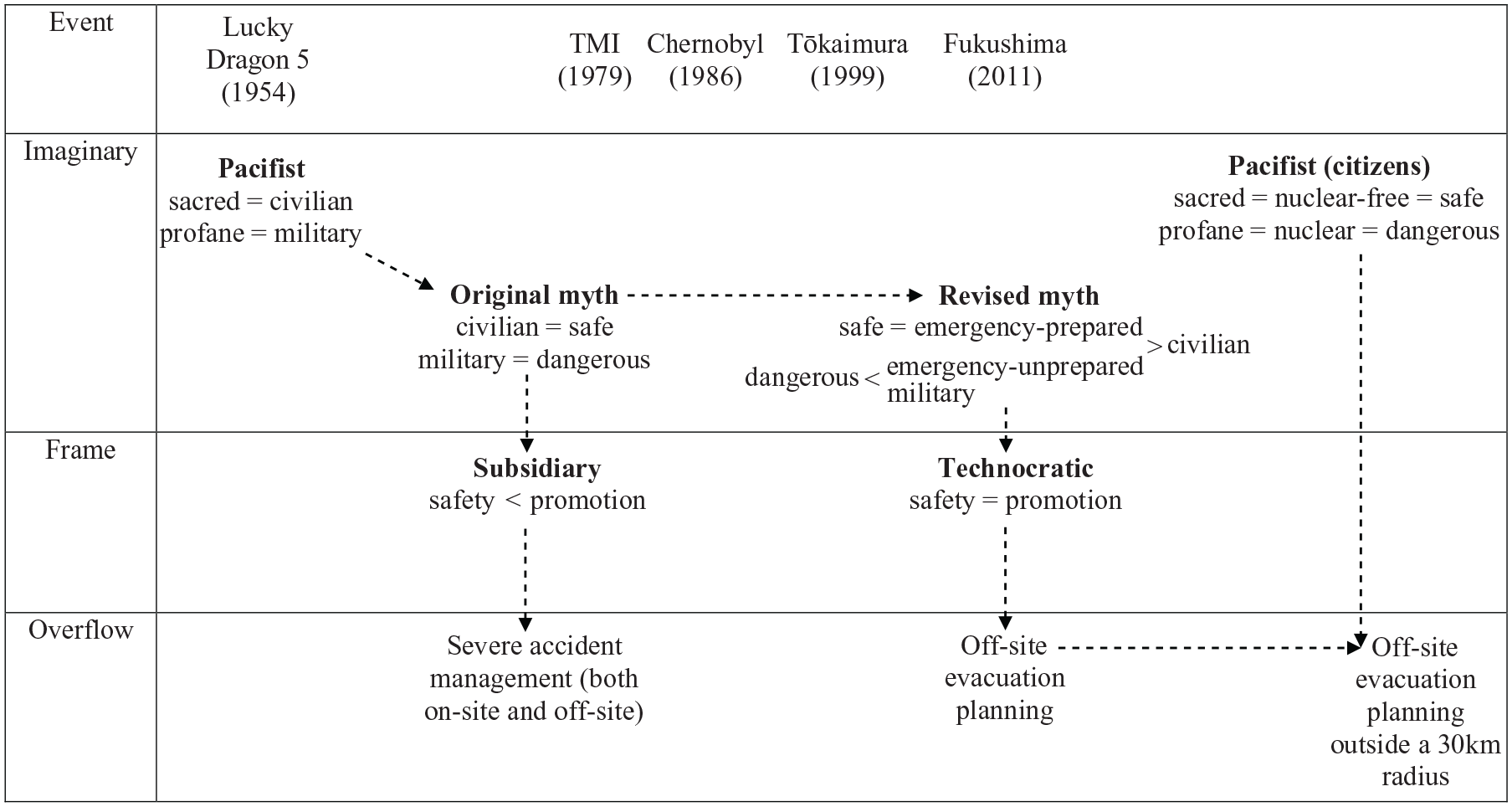
The trajectory of Japan’s nuclear safety.
The 2011 Fukushima nuclear disaster, however, finally challenged the constitutive binary opposition, the nuclear safety myth, and the subsidiary frame. By tasking the newly created NRA to improve severe accident management, the government revised the nuclear safety myth by semiotically rearticulating ‘safe’ and ‘dangerous’ with ‘emergency-prepared’ and ‘emergency-unprepared’, respectively. At the same time, precisely because the post-Fukushima reframing of nuclear safety took a technocratic tone, it continued to permit the overflow of off-site evacuation planning – NRA’s technical rigor was imagined guaranteeing that any future severe accident would be contained on-site, dispensing the necessity of off-site evacuation planning. For the majority of citizens, however, the nuclear disaster undermined the constitutive binary opposition itself: nuclear energy, whether in the form of nuclear weapons (‘military’) in Hiroshima and Nagasaki or nuclear reactors (‘civilian’) in Fukushima, threatened human life. Seeing the majority of citizens turning against nuclear energy, the government expanded the post-Fukushima frame of nuclear safety to internalize off-site evacuation planning.
In conclusion, it is useful to remember that policy framing is always accompanied by overflowing. To be sure, the post-Fukushima technocratic reframing eventually internalized off-site evacuation planning; however, it continued to externalize emergency preparedness and response beyond UPZ, even though some municipalities outside a 30km radius of the Fukushima Daiichi (e.g. Fukushima City, Kawamata Town, and Iitate Village) had been severely contaminated (Citizens’ Commission on Nuclear Energy, 2014: 165). While the politics of framing and overflowing in post-Fukushima Japan reached a temporary settlement, it is likely to generate more rounds of contestation because Japan’s nuclear safety is confronted with new challenges, such as the decommissioning of nuclear reactors and the storage and disposal of nuclear waste (Agency for Natural Resources and Energy, 2019).
To understand the ongoing evolution of Japan’s nuclear safety, the STS concept of sociotechnical imaginary can illuminate a deeper cultural logic of framing and overflowing in science and technology policymaking, whereas the strong program of cultural sociology can inject hermeneutical rigor into semiotic analysis of the structured content of the cultural logic and its co-operations with economic, political, social, and other structures. Moreover, this cross-fertilization of policy-oriented STS and the strong program is able to attend to the specificities of cultural logics that are causally irreducible to the political-economic force of power and money or the effects of global isomorphism: the pacifist imaginary preceded and enabled the nuclear energy village to develop, and the latter needed to work through the revised nuclear safety myth, internalizing off-site evacuation planning, to survive in post-Fukushima Japan; and the extra emotional resonance of the pacifist imaginary and the safety myth in postwar Japan led to the nationally distinct trajectory of nuclear safety from the 1950s through the 2010s in spite of the globally isomorphic characters of nuclear technology.
In addition to these analytical advantages, this cross-fertilization offers important programmatic implications for both the policy-oriented strand of STS and the strong program of cultural sociology. To begin with, when STS researchers study science and technology policymaking, they tend to focus on how the co-production of power and knowledge bears on ‘people, institutions, ideas and preferences that are of greatest political concern’ (Jasanoff, 2006: 23), rather than how the material-semiotic contents of science and technology are performed through human–nonhuman networks (Latour, 2005; Law, 2008). In this regard, the strong program can remind policy-oriented STS to examine the semiotic dimension of science and technology policymaking in the light of how sociotechnical imaginaries and other elements of culture are structured around binary oppositions.
In return, the policy-oriented strand of STS can reinforce the strong program’s capability to examine the interaction between culture and other structures. While the strong program has produced multiple empirical studies of culture-power interactions (Alexander, 2006; Alexander et al., 2006), it tends to focus on the performative aspect of power without deeply probing into its material infrastructures, especially the institutionalized role of expert knowledge in policymaking (Callon et al., 2009; Hilgartner et al., 2015). Although the performative aspect of power is perhaps more important than ever due to the spread of social media and the rise of populism (Nichols, 2017), the strong program can become even stronger if it expands its scope, with the help of policy-oriented STS, to examine how imaginaries, narratives, and knowledge claims about science and technology – prominent cultural objects in the modern world – shape politics and other structures.
Importantly, such cross-fertilization can facilitate rigorous comparative research with significant implications for the public. How do trajectories of nuclear safety vary across countries? How have these trajectories been shaped by nationally specific sociotechnical imaginaries and consequently accompanied by distinct frames and overflows of nuclear safety? Collectively examining these questions, researchers in cultural sociology, STS, and other relevant fields can alert the public to potential ramifications of nuclear safety currently practiced in their countries. Hopefully, this article will contribute to such critical conversations on the role of cultural logics in science and technology policymaking.
Footnotes
Acknowledgements
For their helpful comments on earlier versions of this paper, I thank the anonymous reviewers and Kean Birch, Les Levidow, and Nick Prior.
Funding
The author disclosed receipt of the following financial support for the research, authorship, and/or publication of this article: This research was supported by the Singapore Management University School of Social Sciences Discretionary Account for Research and Teaching (DART) Fund and the Singapore Ministry of Education (MOE) Academic Research Fund (AcRF) Tier 1 grant.
