







Abstract
This article focuses on contemporary urban art in the city of Lisbon. We understand urban art as an art world that has developed through a historical process that, in Portugal, is essentially three decades old. It began with the emergence of the subculture of graffiti in Portugal and it culminates in the gradual artification, commodification and institutionalization of graffiti and street art. We believe this was caused by a particular historical arrangement during the previous decade that produced extremely favourable conditions for the emergence of a set of artists in this field. This arrangement is characterized internationally by the expansion and recognition of street art and, on a national level (especially in Lisbon), by the actions of a number of agents (media, municipalities, art world, commercial entities, academia) that contributed to a higher visibility and legitimacy of this artistic community. Thus, we argue that a structure of opportunities was created that a allowed a number of actors to establish and define a strategy of professionalization in this field. In this article we analyse three types of opportunities: practice opportunities, symbolic, and financial. We consider the social actors that generate these opportunities as well as the way in which artists perceive them and adapt.
Introduction
Urban art has been increasingly enjoying a more prominent role in the contemporary city and the art market. First, its presence has become conspicuous in cities, partly due to the growing number of festivals and events dedicated to this art form, but also thanks to the incentives by local authorities who have been exploiting this asset through city branding strategies (Guinard and Margier, 2017; Mould, 2015; Pavoni, 2019). Second, the art market and art institutions have increasingly been classifying urban art as a legitimate art movement 1 (Bengtsen, 2014; Waclawek, 2011; Wells, 2016). Some of the most prominent representatives of urban art such as Banksy, JR, Blu, Shepard Fairey, Os Gémeos, Swoon, KAWS, Vhils or Kobra have obtained a significant degree of international notoriety and have been included in exhibitions in established institutions. 2 Currently, the works created by these artists reach substantially high prices in the contemporary art market (Bengtsen, 2014; Rea, 2019; White, 2019). As corollary of this institutionalization, recent years have seen the emergence of several museums dedicated to this art movement. 3
Notwithstanding this global trend, we consider it pertinent to examine the processes behind the rise and institutionalization of urban art at a local level. It is crucial to understand the social, cultural and economic contexts which, in any given city or metropolitan area, generate opportunities for the proliferation and consolidation of urban art. The aim of this article is to analyse the emergence and consolidation of urban art in Lisbon. The city and its metropolitan area are home to an artistic legacy and a community of urban artists of growing international significance, especially during the past decade. This becomes, for this reason, an interesting case study in which to analyse the process by which new art worlds emerge (Becker, 1982).
Our aim is to analyse this process from a theoretical problematic that crosses structural and conjunctional dimensions with the individual agency of artists. First, we suggest that the existence of a favourable conjuncture was crucial for the evolution of urban art. It is precisely such conjuncture that we will be describing. We propose an analytical model involving three types of opportunities: practical, financial, and symbolic. It is our view that these opportunities result from the actions of a set of social actors with disparate interests, positions, and fields of action (media, artists, municipalities, private entities, art market).
Second, we argue that the new opportunities have facilitated the consolidation of urban art by creating conditions favourable for sustaining a career in art (Campos, 2021; Campos and Sequeira, 2018). We consider it essential to examine the dimension of individual agency and the behaviour of artists in the particular situation they find themselves in. Our approach draws from careership theory, premised on the notion that ‘career decision-making and progression take place in the interactions between the person and the fields they inhabit’ (Hodkinson, 2009: 6). According to this theory, the social environment, individual dispositions, and the horizons for action condition the way in which people see their future and career.
This article is organized into three sections. The first aims at defining the concept of urban art. The second section is more descriptive and aims at delineating the historical conjuncture which saw the expansion of urban art in Lisbon. In the third section, we apply the analytical and conceptual model to the context in analysis.
Note on Method
The authors have for over a decade been involved in several research projects (2008–2020) dealing with Urban Art in Lisbon and Portugal (Campos, 2013, 2015, 2021; Campos and Barbio, 2021; Campos and Sequeira, 2018, 2020). Our close familiarity with the field allowed us to carry out an in-depth and longitudinal analysis responsive to historical developments. Although this corresponds to an important empirical and theoretical corpus of scientific reflection, this particular article was based on more recent data in the scope of a funded project carried out between 2017 and 2020. This qualitative project was essentially based on ethnographic field observation and in-depth interviews with a range of social actors. (artists, public officials, curators, gallerists, entrepreneurs). These interviews, were semi-structured, following a flexible script, adapted to the interviewees’ different profiles. The analytics corpus was composed of 1643 documents (official documents, news articles, websites, etc.) and 37 interviews, which were analysed in an open analytic process with à posteriori categorization done on NVivo 12 software. 4 The interviewees cited throughout this article have been duly anonymized considering that the interviews also involved conversations around illicit activities.
Conceptualizing the Urban Art World
Despite the existing affinity between urban art and the English language term ‘street art’, we argue that they correspond to distinct universes. The first points to a validated and acclaimed artistic field. The second corresponds to a phenomenon characterized by ambivalence, oscillating between an exclusively illegal version, non-legitimized by the authorities, as some authors see it (Ross, 2016) and an emerging and increasingly institutionalized art world (Bengtsen, 2014; Schacter, 2014). The concept of street art may, for that reason, be misleading in its representation of such distinct and, in a certain way, incompatible universes. Still, we recognize the existing proximities and overlaps between both concepts and that the growing international mediatization and appreciation of street art has influenced urban art in Portugal and helps explain its success. In this article we use the concept of urban art not only because it is commonly used in the country, but also on account of its heuristic value. Heuristically, it draws a clear line between our intentions and the ambiguity of the term street-art.
Urban art might be interpreted here ‘as an umbrella term for any art in the style of Street Art, Style Writing or mural art’ (Blanché, 2016: 59). From the point of view of plastic expression, it might be described as an ‘extended family’ (Campos and Sequeira, 2019, 2020) involving a combination of techniques and pictorial formats (spray painting, stencil, reverse graffiti, stickers, etc.) generally associated with art practices developed originally in urban public spaces. The emergence and consolidation of urban art took place via three distinct routes stimulated by a range of social agents.
We speak, first, of an art route produced in public spaces. The skills developed in this milieu – involving not only technical proficiency in the use of certain instruments (spray, brush, etc.) but also a particular relationship with the surrounding environment and urban materiality – determine the singularity of this art movement. Hence, it becomes easy to understand that the rise of certain names in the world of urban art is preceded by informal training through a connection with the universe of graffiti and street art (Baird, 2018; Banet-Weiser, 2011; McAuliffe, 2012; Molnár, 2018).
Urban art produced for urban public spaces is increasingly understood as a form of public art ( Bengtsen, 2013; Grondeau and Pondaven, 2018; Schacter, 2014). This frequently involves projects by public bodies (mainly municipalities), often in partnership with private entities (associations, art collectives, cultural entrepreneurs, etc.) The ornamental nature of urban art has become more prominent, turning into a way whereby public authorities and private entities can benefit and add value to the territory (Evans, 2009, 2016; Grondeau and Pondaven, 2018; Jazdzewska, 2018; McAuliffe, 2012; Mould, 2015). This first field is materialized mostly through a range of diverse events and initiatives, such as festivals and commissioned murals (de Miguel-Molina et al., 2013; Quinn, 2005; Richards and Colombo, 2017; Zebracki, 2018). The valorization of the territory is often associated with processes of gentrification and touristification in urban centres (Andron, 2018; Evans, 2016; Pavoni, 2019), but also with the revamping of the image of certain peripheral neighbourhoods and degraded areas 5 (Campos et al., 2021; Raposo, 2019).
A second route involves the transition from the street into the gallery. This results from a process of artification (Shapiro, 2012, 2019) and aestheticization of certain street expressions, such as graffiti (Campos, 2015) and from a gradual legitimization and institutionalization of street art and muralism. There is, then, an approximation to the world of contemporary art, involving the participation of multiple actors: gallerists, curators, art critics, art collectors (Banet-Weiser, 2011; Dickens, 2010; Kramer, 2010; Molnár, 2018). This process is not entirely recent, since from the early days of graffiti in New York there were instances of graffiti-writers successfully entering the gallery circuit and the art market (Castleman, 1982; Lachmann, 1988).
Finally, there is a more eclectic, multifaceted, and ambivalent route linked to the commodification of urban art in the context of cultural industries, marketing and advertising (Banet-Weiser, 2011; Molnár, 2018; Ross et al., 2020). This sector is boosted by a range of diverse actors who exploit the growing visibility of urban art thus contributing to its growth and dissemination. This means not only small and big companies but also a wide variety of private investors use urban art for different ends. The interior design of a bar, the customization of street wear, the illustration of a ceramic piece, the participation in advertising campaigns are some of the examples among several others.
The Emergence of Urban Art: A Favourable Historical Conjuncture
A timely combination of events took place in Portugal during the first two decades of the 21st century that was highly propitious to the flourishing of urban art. This was especially true of Lisbon. This situation developed from several interrelated endogenous and exogenous factors. It is undeniable that the growth of urban art in the capital city was in great measure shaped by transnational forces. This international context is therefore a good place to start. First, we must stress that from the point of view of urban planning and city management, the narrative of the creative city as a model of development has achieved widespread approval during these years (Evans, 2009; Mould, 2015). The triumph of this model cannot be viewed separately from the central role that creativity has assumed as a discursive resource that has been recurrently employed by political and economic powers (Banet-Weiser, 2011; McRobbie, 2016, 2002; Molnár, 2018). Hence, the success of a paradigm of social and economic progress based on the promotion of creative industries and clusters (de Miguel-Molina et al., 2013; Pavoni, 2019; Richards and Colombo, 2017) or on the attractiveness of the creative class (Florida, 2012). Alongside this rhetoric we also saw the imposition of the generic idea that art and culture increasingly represent assets for cities. Art and culture – not only expressed though the existing works but also through the presence of a dynamic artistic community – confer prestige and promote the city as a brand in a competitive world (Guinard and Margier, 2018). Consequently, investing in creative neighbourhoods, creative industries, public art, cultural festivals, or monumental architecture is taken to have positive returns in terms of city image and investment attractivity.
Urban art fits nicely in this narrative, with associations to a series of meanings pointing to the idea of youthfulness, contemporaneity, creativity and cultural vitality. Hence, and as noted by several authors, there is an articulation between growth and institutionalization of street art and the use of urban policies inspired in the idea of the creative city (Evans, 2009; McAuliffe, 2012; Mould, 2015). However, some critical voices do exist, not only coming from artists 6 but also from academics. Various authors have reflected on the less visible impact of regulation and proliferation of urban art in the context of the neoliberal creative city. Questions around co-optation, political instrumentalization, touristification, and urban gentrification have been highlighted (Andron, 2018; Pavoni, 2019; Raposo, 2019; Schacter, 2014).
Second, this is a recent art movement with high media visibility. The main person responsible for the ascent of urban art is Banksy. 7 What is known as the ‘Banksy effect’ 8 is reflected in the gradual recognition of street art on a global level and by its establishment as a legitimate artistic category. Consequently, street art is revealed as an extremely versatile field, both as a mass expression with strong media visibility and near the cultural mainstream, and also as something capable of penetrating into the most selective and elitist contemporary art market. So, since the beginning of the millennium that we have been witnessing the growing institutionalization of street art (Bengtsen, 2014, 2013) as evidenced by the number of exhibitions taking place in museums, galleries, and prestigious institutions.
Portugal has not escaped this global trend. Lisbon in particular has, during the 2010s, become an international reference in the world of urban art (Campos and Sequeira, 2020; Grondeau and Prodaven, 2018) as evidenced by its recurrent appearance in the tops produced by several global agencies. 9 The case of Lisbon is interesting because it is largely the result of a political strategy. Crucial for the institutionalization of urban art, was the inauguration in 2008 of the Galeria de Arte Urbana [Urban Art Gallery] (GAU). This is a Lisbon City Hall department whose aim is to incentivize and disseminate graffiti and street art in Lisbon through a regulated and institutionalized program. This municipal structure took on its shoulders the responsibility for creating a space where urban art could flourish, through the institutional and financial support of events and artists. It did not escape the effects of the economic and social crisis affecting the country in between 2010 and 2014. 10 Through a range of incentives, GAU sought to fight against the negative effects of the crisis, thus creating new opportunities for artists.
From a historical perspective, it is also important to note that the development of a set of opportunities and the emergence of urban art was preceded by the steady expansion of a community of graffiti-writers in the Lisbon Metropolitan Area. Graffiti appeared in Portugal during the 1990s in this geographical area, and by the end of the first decade it already constituted a substantial community (Campos, 2021; Moore, 2010). In other words, the arrival of GAU occurred at a time when a community of graffiti writers and street artists were also seeking alternative forms of artistic expression. It is also worth mentioning that GAU was aligned with a broader strategy for the arts and culture in the city. The document ‘Strategic vision: Lisbon 2012’, prepared by the municipality, positions itself in favour of culture and creativity as engines of development for the city (Grondeau and Pondaven, 2018).
In this context, from 2005 onwards, several initiatives take shape, initially fostered by crews of graffiti writers and street artists, and later organized by GAU. We might mention the six editions of the pioneering exhibitions labelled Visual Street Performances – VSP (2005–2010) created and produced by a group of young people with links to graffiti and which had a significant impact. Also important during the last few years was the creation in Lisbon of an international festival of urban art – the Muro [the Wall] festival – with three editions (2016, 2017 and 2019) (see Figure 1). This festival, organized by GAU, is the culmination of a series of other projects that deserve to be mentioned due to their impact in the city. These are Crono (2010 and 2011), 11 40 anos, 40 murais [40 years, 40 murals] (2014) (see Figure 2), Paratissima (2016) and also the public art works promoted by the Underdogs gallery. In addition to these important initiatives there were several others of a smaller scale that benefited from this new mood animating the city, many of them supported by GAU.
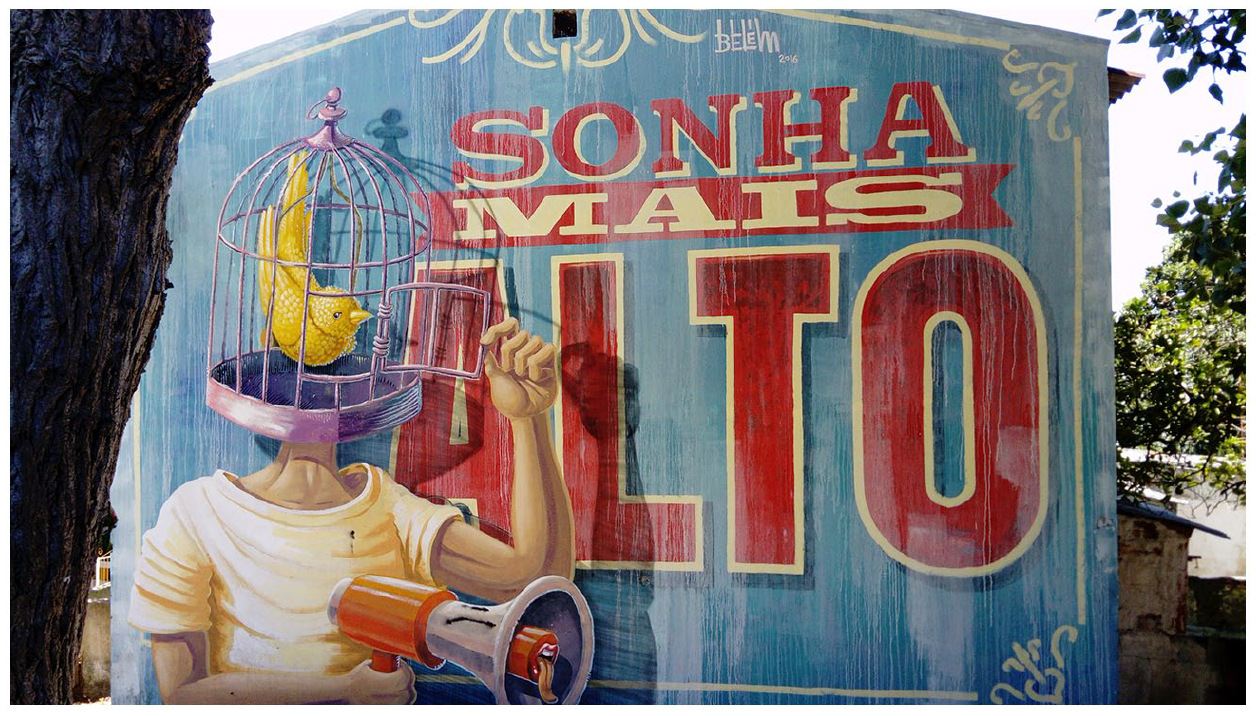
Muro festival, 1st edition, artwork by Mário Belém (photo by Ricardo Campos). 12
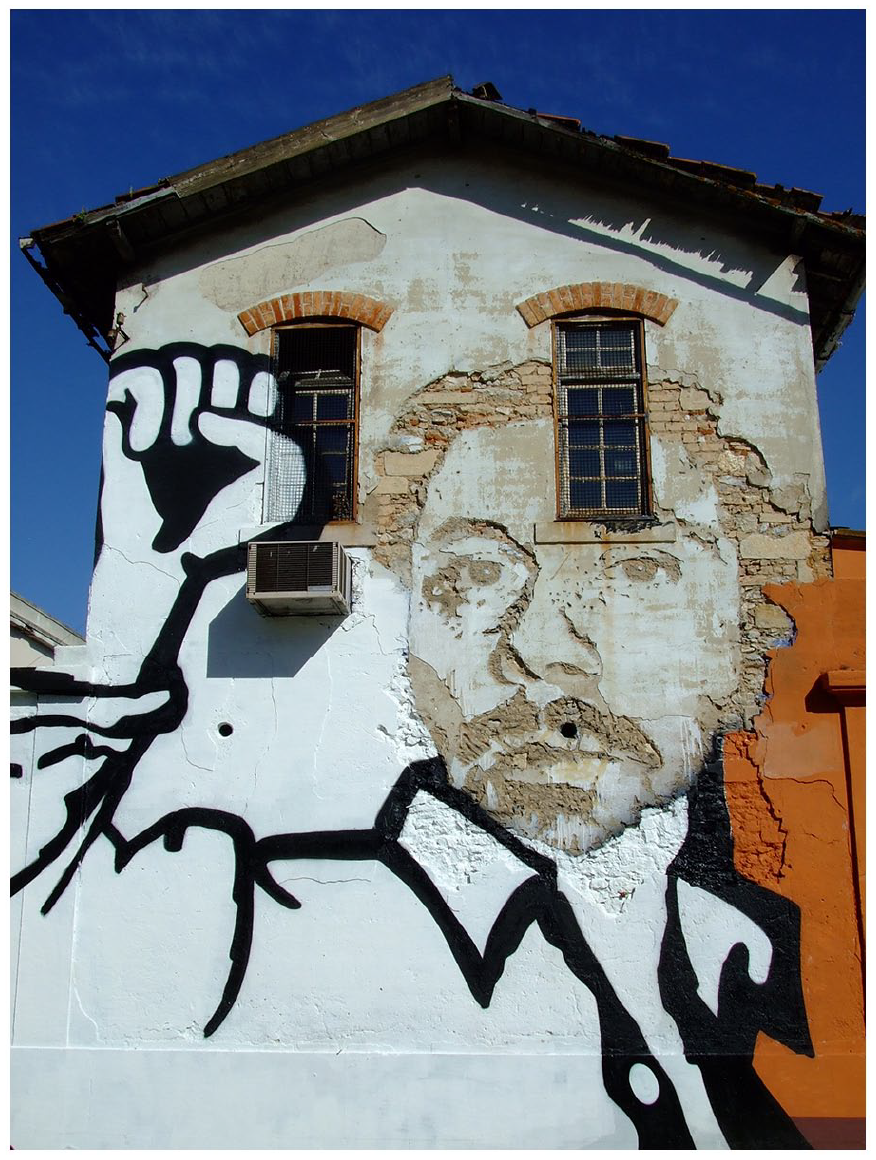
Project ‘40 anos, 40 murais’ (40 years, 40 murals), artwork by Vhils 13 (photo by Ricardo Campos).
Emerging Opportunities and Career Aspirations: The Case of Lisbon
The brief historical review in the previous section aimed at providing an understanding of the social, cultural and political trends that led to the creation of a climate that was beneficial to the flourishing of urban art. We argue that the fortunate combination of a range of opportunities occurred producing a fertile soil for the emergence of career aspirations in this field. Opportunities are here understood as a set of factors that limit or reinforce the action of social, individual or collective actors.
Emerging Art Worlds and New Opportunities
For Becker (1982), art worlds are social constructs resulting from the cooperation of several social actors. That is precisely our approach on researching the way in which the world of urban art emerges and is consolidated. Becker did not ignore the issue of social change, the transformation and birth of art worlds. He placed particular emphasis on innovation, moving away from conventions, and on hierarchical conflict, as engines of change. For Becker, the emergence of new art worlds is linked to the appearance of new ideas, practices and audiences, as well as to major technological developments. Despite employing Becker’s approach, we consider Bourdieu’s concept of field (1993), which involves more structural questions. For Bourdieu, the position of actors expresses distinct interests, tensions, and power relations which influence the makeup of the field and its rules. This way, urban art can be considered a cultural and artistic field in Bourdieu’s sense. We therefore agree with Bengtsen (2014), who in his approach to the world of street art sees these two theoretical perspectives as potentially complementary, instead of antagonistic.
Our position is that in order to flourish, art worlds rely on the concrete actions of certain agents and on the appearance of a favourable combination of opportunities. We assume, then, a dynamic approach based on the idea of social transformation. On the question of the transition from subcultural milieus into the art world, the concept of artification should be invoked. According to Shapiro (2012: 20–21) artification ‘designates the transformation of non-art into art’ that results from ‘a combination of processes—practical and symbolic, organizational and discursive—by which people agree to identify an object or an activity as art’.
This is a process which, according to Shapiro (2019) has been intensifying and accelerating in line with social and technological changes. Such is the case in analysis, when we see that urban art has developed into a legitimized art world in about two decades. This is a complex process, involving an interconnected set of agents and dynamics among which the author emphasizes several micro-processes (Shapiro, 2019), namely: displacement, renaming, shifting categories, organizational and institutional change, functional differentiation, redefining time, legal consolidation, patronage, aesthetic formalization, and intellectualization. In the current case, we would like to highlight three of these processes since they were crucial for the legitimation of urban art. First of all, the process of displacement. One of the most common ways to add value and reconfigure aesthetic goods is through their removal from the original context, placing them in spaces where art is produced and exhibited (galleries, museums, stages). This is clearly what happened in the case of graffiti and street art which, to be converted into an art commodity, began to appear in different mediums (canvas, paper, etc.), thus enabling their exhibition and acquisition in the art market (Dickens, 2010; Wells, 2016). There are also cases where street artworks have been removed in order to be sold or displayed in galleries and museums.
A second process is that of renaming. The change in terminology is crucial for the creation of a new representation around certain practices, objects, and people. Often this process follows physical displacement. In other words, from the moment a graffiti-writer or street-artist is admitted into a gallery or museum, he or she ceases to be seen as a (mere) vandal and (potentially) assumes the role of an artist. We see that not only the media but also art institutions, have increasingly classified graffiti, street art or muralism, as legitimate art forms, included in a broader art movement that we have here defined as urban art.
Patronage is a third process. Sponsorship by specific institutions brings legitimacy to activities while also adding to their value. As noted by Shapiro (2019: 271) ‘these support systems enhance the perception of an ontological difference between art and other activities deemed unworthy of such official monies’. Public authorities in several countries have intervened by sponsoring and hosting graffiti, street art and urban art festivals, thus acknowledging their value in terms of the economic and cultural development of cities (Campos and Barbio, 2021; Grondeau and Pondaven, 2018; Guinard and Margier, 2017).
Therefore, we argue that the artification process was fostered by a particular set of historical opportunities. The concept of opportunity is particularly relevant for the study of dynamics of social transformation in the current case and in all those originating in stigmatized and disregarded cultural fields, involving minority, subcultural, or deviant practices and ideas. These are social contexts which become targets of different types of legal, symbolic or physical constraints. In other words, we can speak of a ‘structure of constraints’ limiting particular social practices and conditioning their expansion and flourishing. This happens because certain practices are catalogued by authorities or dominant groups as less important, undesirable, or corrupting. In this respect, the history of graffiti is quite illuminating. Against this, the existence of a structure of opportunities reshapes the horizons for action and mobilizes the agency of actors in specific directions. In this particular case, we believe that this reconfiguration of the environment has incentivized these social actors to become urban artists assuming a singular artistic identity. This led to the appearance of a conjuncture beneficial to professionalization. In turn, the professionalization or semi-professionalization contributed to the consolidation of this art world. 14
The question of opportunities is especially relevant in informal contexts where defined professional career paths and state-sponsored official models for acquisition of skills are absent. In this sense, there are no direct paths legitimized by institutions. Careers are, in many ways, the fruit of serendipity and individuals adapting to random circumstances. In other words, there is neither an education structure nor a job market adapted to graffiti, street art or urban art. Consequently, only the emergence of an appropriate set of circumstances can facilitate the development of new horizons for action that foresees aspirations related to a possible professionalization.
A Three-Dimensional Opportunity Model
In our examination of urban art, we have outlined a three-dimensional analytical model, involving three types of opportunities. Clearly, these cannot be understood in a compartmented way since they are strongly interrelated.
First, we argue that there are what we might define as practice opportunities. These involve the creation of wide range of conditions that facilitate or incentivize the development of certain social practices. In this specific case, this means a suitable environment for actors to produce their works in optimal conditions, developing artistic skills, and achieving visibility and reputation. This is not a minor aspect when we are speaking of an artistic format which is created, essentially, in an urban public space where a range of factors might significantly constrain artistic engagement. So, for a set of technical and artistic aptitudes to be consolidated and allow artists to enrich their portfolio and achieve visibility, it matters to have favourable conditions in place.
But it should be noted that urban art emerged from the historical process that saw graffiti and street art expand and achieve growing acclaim in the context of Lisbon’s metropolitan area, particularly during the 1990s (Campos, 2013, 2021). In other words, we argue that there existed practice opportunities for the blossoming of this type of non-authorized street expression. These practice opportunities were crucial for the development of skills and attainment of prestige of a generation of artists. Unlike what happened in other countries, the attitude of authorities and public powers has always been rather soft when it comes to graffiti. There was an absence in the public sphere of a robust recriminatory and persecutory discourse. Graffiti only began to be seen as a problem around the mid-2000s (the mid-noughties), the period that saw the rise of urban art.
Second, we can speak of symbolic opportunities. These relate to the creation of conditions that can boost the profiles of artists, their works and, consequently, the artistic movement. The positive image and visibility currently enjoyed by urban art result from a discursive-representational process which involves the media, public powers, and a range of actors in the public sphere (art critics, curators, gallerists, artists, academics, etc.). This results in the gradual reconfiguration of the image of graffiti and street art – which are traditionally associated with vandalism and a certain obscurity – which transition into the sphere of art. 15
Finally, we must also mention financial opportunities, linked to the diversification of sources of financing of artistic creation (commissions, festivals, gallery exhibitions, customization of objects, etc.).
Opportunity Model: Social Actors
This opportunity model emerges from interconnected dynamics which involve multiple social actors. The situation under analysis reveals the existence of five main types of actors with direct intervention in the creation of these opportunities. These are the media, public authorities, a more dispersed set of actors coming from the art market and from private and commercial entities, and finally academics (see Figure 3).
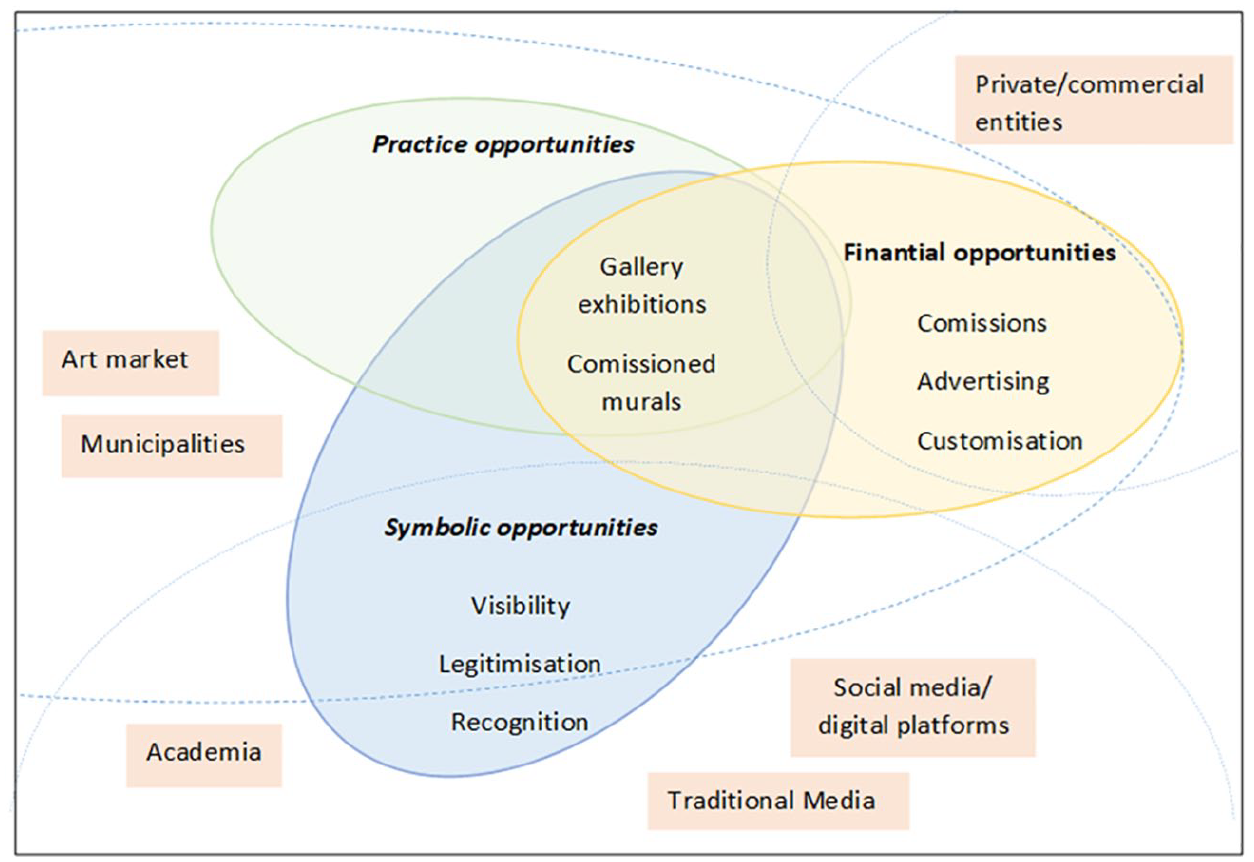
Urban Art – Social actors and opportunity model.
The media represent an external agent that is crucial for the emergence of the urban art world, mostly due to the symbolic opportunities created that reconfigure social representations around the world of graffiti and street art. The mainstream media (television, newspapers, magazines) were, in fact, decisive in generating the positive image of these expressions, by converting them into formats with cultural, aesthetic, and commercial value. This way they built a core mechanism that increased the visibility of this artistic movement, legitimizing and bringing it into public consciousness.
16
It is essentially through these avenues that some artists are able to obtain public recognition.
17
This element is widely acknowledged by artists themselves:
In Portugal there was this acceptance by the mainstream media who began to show urban art and, sometimes, to focus on what goes on abroad. In projects and whatever . . . In other words, the mainstream media offers something and the people take it, right? So, it was already like that out there. It already existed abroad, like, large scale projects, and like, and a huge . . . and a huge influence of urban art, street art, you know, in galleries and in projects, and in facades, and whatever . . . as a result, a new vision began to develop here in Portugal. Mainstream media stopped calling it vandalism, began labelling as artists the people who vandalised. The Portuguese public, sitting in their couches, watch this and applaud, right? If the mainstream media reverts to refer as vandalism to the people who were artists, who stopped being artists because they were vandals, vandals, you see? Then the image of urban art will lose value in the eyes of the people. (Interview with Graffiti writer, urban artist and designer, 40 years old, Lisbon)
In parallel with the traditional media, we must not ignore the role played by digital technology and social media. Their role is more ambivalent, in the sense that we are speaking of a vast network, fostered by different social actors. In other words, this communicational ecosystem includes as content producers, both individuals belonging to the urban art community and those outside it. However, the role played by social media in the dissemination of graffiti and the rise of street art has been highlighted by several authors (Bengtsen, 2014; MacDowall and De Souza, 2018; Molnar, 2018). On the one hand, it has allowed for the creation of a truly global community centred around a particular aesthetic manifestation. The internet is a space where the work of artists from different parts of the globe can be exhibited, opening up a range of options for communication and organization, and likewise engendering a spirit of community. On the other hand, the internet has acted as a key component in the dissemination and perpetuation of artists and their work, contributing to the reversal of the ephemeral nature typical of these forms of expression. Finally, we can now expect the recognition and careers of artists to be increasingly dependent on the digital format and social networks. Digital platforms facilitate the display and dissemination of artists who thus dispense with commercial intermediaries. In this sense, it is fair to say that the internet and social media interfere at the level of symbolic and commercial opportunities, as noted by many of those we interviewed:
You can have an international exposure, because of these things like Instagram and Facebook, which you could never have before. Above all, no excuses to lick ass to gallery owners! (Interview with Urban artist and designer, 40 years old, Lisbon) Visibility is also important. Because there is one thing that has changed a lot in street art in the last few years, which is the internet. So in the past you had to make 500 stencils to have some notoriety. Nowadays you just need to make one, take a picture and put it on the internet. So I play with that a little bit too. I play it to my advantage. Sometimes I go to vacant factories and nobody will see that, 10 people will see that in life. But the fact of having that photograph – because that’s what art also lives on – reaches thousands of people. (Interview with urban artist, 35 years old, Lisbon)
In turn, public authorities play a fundamental role since their actions bring about the development of the three types of opportunity: practice, financial, and symbolic. As we previously saw, urban art has been used, mostly by municipalities but also by national bodies under the tutelage of different ministries, as one of the most effective tools for the creation of public art. The municipality of Lisbon had a pivotal role through the creation of GAU, mostly due to the symbolic opportunities it created. The recognition of this artistic expression as valid and relevant for landscape development gave this movement a previously absent status. GAU was, in this way, a decisive factor for the regulation and representation of urban art, in particular due to the opposition it stresses between it – considered a valid art form, respectable, and deserving of its support – and illegal graffiti, which they still consider as an act of vandalism, subject to reprisals and removal from the public space.
On the other hand, it also played a key role on account of the practice opportunities it generated. The projects promoted or supported by GAU, usually for the production of large-scale murals, gave scope for artists to experiment painting within a safe and authorized environment and, often, of an unusual scale.
18
It represents an opportunity for artists to develop their styles and techniques in a way that the illegal and spontaneous practice does not allow. Thus, it can stimulate new talents and promote the route of the regulated urban art. Some of those we interviewed stress the importance of GAU in the following way:
[Having the City Hall’s support] is positive because it creates opportunities for people who want to increase their efforts and for those who may, sometimes, be a bit lost and are able to find there a route to channel their energies. Like, when you’re 14 or 15 and begin painting, you want to do it everywhere. It’s normal. On walls, everywhere . . . And, sometimes, you stay in that line of work and stagnate when you could be doing something better. It’s a learning opportunity. So, the creation of metallic walls, panels, competitions, might open up new paths. And you might even stop doing graffiti. [. . .] Sometimes you need a push to find your way. These new opportunities might be just what you need. (Interview with Urban artist and cultural producer, 27 years old, Lisbon) I think that people have suddenly woken up. I think that the fact that GAU was created helped a great deal, because until then it was something clandestine and suburban and now there is a certain curatorship and it’s planned. It’s always positive to have a body that organises and structures. It’s always positive. I think that people have woken up. I think that there are more artists, such as myself, emerging. For us it’s always positive. (Interview with Urban artist and plastic artist, 36 years old, Lisbon)
The projects commissioned by public bodies also represent financial opportunities for artists since, in most cases, it is paid work. But financial opportunities also come indirectly. In other words, the visibility presented by works commissioned in these contexts opens up new avenues. That may lead to more paid jobs, namely for commercial entities – such as companies and individuals – or jobs for galleries in other physical supports.
The actors linked to the art market open up several types of opportunity. To begin with, they elevate certain practices and works to the status of art thus performing the role of legitimization which is crucial for the movement in terms of achieving expression and public support. This range of social actors (gallerists, curators, art critics) has been playing an important role in the world of urban art by changing their positions regarding practices formerly distant from the artistic field. This environment also increases the artists’ practical and financial opportunities, opening up new avenues of aesthetic production and new ways of commodifying work. The production of canvases, sculptures, serigraphs and so on, is not the customary format of artists with a background in graffiti and street art. The invitations to exhibit their work offer, for this reason, occasions to experiment with new formats and techniques.
We also find a new set of actors emerging specifically from the amplification of this field of urban art and from the resulting opportunity structures. These are specialists (curators, producers and entrepreneurs) who organize large events such as festivals (by creating associations for this purpose, for example) but who also work closely with artists through artistic mentoring or by mediating between artists and other agents (municipalities, collectors, galleries).
Another set of actors that should be mentioned comprises those associated with the more commercial aspect. These are commercial entities that are alert to the visibility of the urban art phenomenon, seek to use its imagery and the work of its artists to link them to products through commercial and marketing campaigns. They do this because they are well aware of the capacity for branding that certain urban artists manifest. Carried over by the growing visibility and appeal of this form of expression, in particular by its ratification by public authorities, private entities have become an increasingly relevant source of revenue.
Finally, we should mention the role played by academics (Campos and Sequeira, 2019; Ferro, 2016; Neves, 2015). We believe that academics have assumed – especially since the mid-2000s − an increasingly important role in legitimizing graffiti and street art at two levels: on the one hand, by giving visibility and validating this academic subject, 19 on the other hand, by deconstructing the clearly negative stereotypes put forward by the media and politicians that until that time set the tone of the debate. 20
Seize the Opportunity: Horizons of Action and Career Aspirations
In this article we argue that career aspirations in urban art emerge from a range of opportunities that are created by several actors and that are favourable to projects of professionalization. In this context it makes sense to go back to the careership theory proposed by Hodkinson and Sparkes (1997; see also Hodkinson, 2009). As they see it, individuals take decisions involving the future in the function of horizons for action. Such horizons depend on individual dispositions but also on an environment which includes different actors and institutions (education system, labour market, political system, peer group). In our conversation with artists, the perception that we are going through a particularly beneficial period became clear:
to be completely honest, I never imagined it would get to this stage [. . .] I thought this was just a fad and that it would die faster than is actually happening. Inevitably, all this economic interest ended up sustaining the whole movement, right? Of course! Because if in the meantime there is money to promote these things, the movement is not going to die so easily. (Interview with Urban artist and architect, 28 years old, Lisbon) The whole thing happening with the phenomenon of urban art – muralism, street art, or whatever you wish to call it – is providing opportunities for artists, opening the doors of galleries, it is including artists in projects and events outside of the country, they are getting called to go elsewhere. (Interview with Urban artist and designer, 37 years old, Lisbon)
Hence, aspirations relative to developing a professional career as an artist can be fulfilled. There is an integrated range of opportunities that overlap and cascade down. What usually happens is that the professional career does not derive from a decision taken at a particular moment. It develops by way of jobs and projects that appear. One of our interviewees describes it in an illuminating way:
it wasn’t a decision. Essentially, when I finished my degree, I was already painting, was already doing some things, but I never even considered that it could turn into a profession or even that it could make me some cash [. . .] I finished my degree in – I don’t know, March 2013 − and I had 2 or 3 paintings planned, 2 or 3 events where I would participate [. . .] The idea was to spend the Summer, [. . .] and then in September try to finish my portfolio to find a job in architecture. But things kept on happening, the 2 projects I had scheduled became 3, 4 and then another one came. Meanwhile, more or less in September/October a very interesting job came up which gave me opportunity. In a way, it opened up my horizons in several ways, on the other way it was a job that paid really well for what I was used to, because I never made any money with my work. So far these have been mostly symbolic, and I had never really tried. But in that moment the opportunity came up and the terms were really good! [. . .] So, it opened up my horizons, like: ok, I’m doing something I love, which is painting; which means to produce work; which means doing interesting work; I’m making enough to be able to support myself doing it and at the same time I’m taking this, I don’t know, I have always taken things very professionally, very seriously [. . .] And then it became even more serious because I had a client, and had a number of people relying on my work. And that made me see that maybe it was possible to turn it into a profession. (Interview with Urban artist and architect, 28 years old, Lisbon)
It should be noted that the importance of the opportunities created over a decade was such that they attracted a considerable range of artists who did not originally have links to graffiti or street art. And so, illustrators, plastic artists, designers saw the emerging field of urban art as an expanding and financially attractive option and their participation helped reinforce its hybrid nature.
21
One of the interviewees highlights exactly this new situation:
I think that it [painting in the public space] is a way of [. . .] making yourself known to all the gallerists. I think it’s a far more immediate way for you to reach people, and what happens is that, like . . . imagine, any of these guys painting in the street now, most of them are already doing serigraphs or prints, are already selling even if only locally, it’s just a first step before gradually entering the art market. (Interview with Urban artist and designer, 40 years old, Lisbon)
It is not suggested that artists are merely reactive to structures, since there is a high level of adaptation, agency, and co-creation of suitable conditions that must be noted. It is thus important to invoke the concept of ‘strategic interaction’ (McAdam et al., 2001; Tilly, 1977) concerning the tactics and strategies delineated by actors in terms of the opportunities detected and the way in which they are seized. Facing the same opportunity structure, urban artists develop different strategies based on their biographical trajectories, the capital they own, and their structural position in the field of urban art. The horizons for action are not impermeable and rigid, but rather subject to mutations. Not only are there changes in the field of labour, but individuals also possess agency. It is for this reason relevant to consider, as argued by Hodkinson (2009) that individuals also construct opportunities, that is, they play an active role in the creation of advantageous situations as far as their careers are concerned. In the context of art worlds, Becker also stresses the importance of certain individuals for the creation or transformation of art worlds, acting out as pioneers who set up new practices or ideas. For this reason, it is important to mention that several of those with street art and graffiti backgrounds were more than mere beneficiaries of the opportunities created, they were actually crucial to their existence to begin with. This way, some graffiti-writers and street artists have been very active in the organization of urban art events and festivals, in engaging with local authorities and the media, in developing academic projects, or in setting-up collectives or associations, among other initiatives. 22
The importance of individual agency in the creation of opportunities and professional career-launch in urban art is, in our opinion, related to two issues. First, to more general and transversal issues that involve a certain kind of current creative work spirit which we previously described. Regardless of the analytical models put forward, there is a common feature in artistic careers: the fact that they depend on a specific type of entrepreneurship that is associated with the arts. Here, artists build their careers according to ‘freelance’ models or according to a sequence of projects organized around the construction of ‘portfolios’ that allow them to demonstrate versatility in the context of a coherent whole that embodies their identity as artists (Bridgstock, 2012; Lingo and Tepper, 2013; Menger, 1999). Thus, in urban art, as in many other artistic careers, we increasingly find a model of the autonomous and freelance worker based on self-promotion (McRobbie, 2016, 2002) or self-branding (Banet-Weiser, 2011). 23 Second, there are cultural, ethical and praxiological specificities associated with the origins of urban art that influence how agents are positioned and adapt to the circumstances. We cannot ignore that the careers in the world of urban art are in large measure built by artists with a background in the subcultures of graffiti and street art where they have acquired a range of proficiencies that are recycled in the construction of a professional career.
Conclusion
We are currently witnessing a unique historical period when it comes to the possibility of developing an artistic career involving urban art. For over 10 years we have been observing the transformation of this field and following the professional and artistic evolution of several of those who had a background in graffiti and street art. As we see it, both the opportunities emerging in this period and the opening up of a setting favourable to professionalization were decisive elements for the formation and consolidation of urban art as a new art world (Becker, 1982). To become institutionalized, this art world required symbolic, financial and practical opportunities. In our analysis we have observed the inter-connectedness in these opportunities, as well as the social actors involved.
This benefited in particular those with a background in the subcultures of graffiti and street art, while also attracting other artists with more conventional biographies. This ambiance around urban art generated, as a matter of fact, countless financial and practical opportunities. Dynamized by a range of social actors (media, municipalities, art world, commercial entities), the possible contexts and activities for urban art practitioners multiplied thus creating a complex and multifaceted structure which is characteristic of this world. This was a period in which the public discourse mobilized by the authorities (political, cultural or economic) was favourable to the recognition of urban art. In line with this propitious cultural climate, there was a multiplication of commissions, festivals, gallery exhibitions, customization of objects, among other opportunities of economic support for this activity. Urban artists adapted to this conjuncture and responded to the evolving circumstances. They developed strategies for career progression that involved their individual competences, as well as the financial and symbolic returns derived from their activities.
Footnotes
Funding
This project has been funded with support from the Fundação para a Ciência e Tecnologia, grant number IF/01592/2015.
Notes
Author biographies
Ricardo Campos is a researcher at CICS.Nova – Interdiciplinary Centre of Social Sciences (NOVA University Lisbon), Portugal. His publications include Popular & Visual Culture: Design, Circulation and Consumption (with Clara Sarmento, Cambridge Scholars Publishing, 2014) Transglobal Sounds. Music, Youth and Migration (with João Sardinha, Bloomsbury Academic Publishing, 2016), Political graffiti in critical times. The Aesthetics of Street Politics (with A. Pavoni and Y. Zaimakis, Berghahn Books, 2021), Exploring Ibero-American Youth Cultures in the 21st Century. Creativity, Resistance and Transgression in the City (with Jordi Nofre, Palgrave Macmillan, 2021).
Leda Barbio is collaborator at CICS.Nova – Interdisciplinary Centre of Social Sciences. Completed in 2006 the Degree in Sociology, in 2007 the PhD Course in Social Sciences (Public Policies and Social Inequalities) and in 2017 the PhD in Urban, Territory and Environment Sociology. Participated in research projects on drug use and abuse, but mainly in the areas of poverty, social and spatial segregation, and youth cultures. Has participated in the project ‘TransUrbArts – Emergent Urban Arts in Lisbon and São Paulo’ (2016–2020), financed by FCT/MCTES.
Ágata Sequeira is a sociologist and was a PhD grant holder through DINAMIA’CET-IUL / FCT, with urban sociology and sociology of art being the main fields of research. She has a PhD in Sociology from ISCTE–IUL, with the thesis ‘The City is the Habitat of Art’: Street art and the construction of public space in Lisbon, in 2016. With several publications, she has participated in research projects on urban art and urban art tourism (TransUrbArts – Emergent Urban Arts ins Lisbon and São Paulo (2016–2020), financed by FCT/MCTES) and art, activism and youth cultures (‘ArtCitizenship’ (2018–2021), financed by FCT/MCTES). She holds a degree in Sociology and a Master in Sociology of Communication and Culture in the same institution, with thesis on the reception of public art. The main areas of research are sociology and urban ethnography as well as sociology of art. Research interests include urban dynamics at the level of public space, the art that is created and displayed in it, the construction of public space and city images, and associative movements and the right to the city.