







Abstract
This article challenges the assumption in a classical sociology of art that artworks are created in the artist’s studio as independent and self-sufficient objects. Given that artistic production merges with exhibition making in contemporary art, I argue that the production of artworks needs to be situated in the exhibition space. In this institutional and physical environment, a set of scenographic principles dominate. Scenography is an ideology and method for exhibition making that emphasises the audience’s experience of the exhibition as a coherent entity. In the exhibition context, therefore, artworks are produced as an integral part of the scenography. Drawing upon six cases of solo exhibitions in museums and galleries, I reveal how the material, conceptual, and experiential features of artworks are shaped by scenographic considerations. The six cases also demonstrate the variations in the production of contemporary art. This article further develops the sociology of art in three ways. First, I show a middle way between the classical sociology of art and the recent material turn in cultural sociology. While the former explains artworks as social products but often fails to show the direct impact of social factors on features of artworks, the latter prioritises the agency of artworks qua artistic features but take these as given. Through the concept of scenography, I explain the social genesis of artistic features without prioritising human or non-human actors. Second, I call more attention to the dialogue with art history, especially its turns towards exhibitions for apprehending new developments in art. Third, the hybrid practices in visual art extend our understanding of artistic mediation as art itself, which becomes more applicable to different genres of art.
Introduction: Artworks in Sociology
Compared to art history and philosophy, sociology is a latecomer to the study of art. Before the sociology of art became an established subdiscipline, art historian Arnold Hauser (1974) prescribed a congenital deficiency for it: the first and most vital limit of the sociology of art is its incapacity to define and understand aesthetic qualities, as they have ‘no sociological equivalence’ (my translation). In the process of discipline building, many sociologists accord with this prescription, and the disciplinary labour division tends to be understood as a dichotomy: while art history studies ‘art itself’, sociology studies the ‘social context’ of art or social phenomena surrounding art (Crane, 1987; Gombrich, 1975; Tanner, 2003; White and White, 1993; Zangwill, 2002; Zolberg, 1990). Although the disciplinary dispute is itself a sociological issue (Tanner, 2003) and an essentialist view of art connoted by the term ‘art itself’ has long been marginal (Adajian, 2016; Danto, 1964; Levinson, 2003; Stecker, 2003), the perceived dichotomy does point to an undeniable trait of sociological approaches to art. That is, artworks themselves, be it the content, form, structure, or other artistic features of artworks, hardly become the focus in mainstream sociology of art. This is particularly true after the sociology of art became an established subdiscipline since the 1990s, which concurred with the canonisation of Bourdieu’s (1993) and Becker’s (1974, 1982) works in Anglo-American sociology. Both theorists explain the social production of art. In Becker’s programme, ‘social’ means ‘collective’ and ‘conventions’. Hence, artworks result from the collaboration between artists and their co-producers, who are constrained by materiality, technology and conventions. Bourdieu (1993) distinguishes between the material and symbolic production of art. For him, the social production of art goes far beyond the artist’s material production and encompasses all the actions that enable art to be perceived as valuable by the audience. At stake here is the social world of producers, not artworks.
It is against the neglect of artworks in mainstream sociology that a few sociologists proposed ‘a new sociology of art’ that aims to ‘put art back’ (Acord and DeNora, 2008; de la Fuente 2007, 2010). However, de la Fuente (2007, 2010) lumped together a variety of different approaches, which cannot support the juxtaposition between the ‘new’ and ‘old’ sociology of art. 1 What truly fulfils the agenda of making artworks the analytical focus is the material turn in cultural sociology (Bartmański and Alexander, 2012; Crane and Bovone, 2006; Griswold et al., 2013; Pierides and Woodman, 2012). Drawing upon Alfred Gell’s theory on art’s agency and Bruno Latour’s concept of actant, this object-oriented approach that ‘de-privileges human creators’ and focuses on the ‘flows of affect between bodies, things and ideas’ (Fox, 2015) yields a series of insightful empirical studies. They have shown how artworks, qua materiality and meaning, mediate and shape human actions (Acord, 2010; Acord and DeNora, 2008; Domínguez Rubio, 2012; Domínguez Rubio and Silva, 2013).
In fact, when we look beyond the confine of anglophone literature, the debate on whether artworks can or should be studied in sociology reoccurred intermittently. At least two other approaches to artworks can be identified from the history of sociology. First, against his positivistic rival Alphons Silberman who argued for researching the social effect of art only, Theodor Adorno insisted on studying the content and structure of artworks (Bürger, 1978). Adorno’s (1978) iconological analysis aims to reveal the relationship between art and society condensed in artworks. For instance, the sonata-form of instrumental music was said to reflect a part–whole relationship homologous to the individual–society relationship (Adorno, 1984, cited in Witkin, 1988: 52). Second, refusing to abandon the internal analysis of artworks to art history or the philosophy of art, a sociology of artwork (une sociologie des œuvres), was advocated by Bruno Péquignot and Pascale Ancel. For them, to study the artwork itself (l’œuvre même) means to acknowledge its autonomous status and reject the common sociological approaches that study the work in relation to either its producers or recipients. The solution is then to treat painting as a language, a set of ‘iconic and plastic reading codes’ (Raynaud, 1999), for language can be understood without referring to the speaker or listener.
However, both approaches remained marginal or fell into oblivion, (at least) partly due to their own problems. Adorno’s homology approach is considered dubious by succeeding sociologists of music (e.g. Hennion, 1988; Witkin, 1998). Above all, there is no plausible explanation for the homology between artistic content and social structure. La sociologie des œuvres cannot explain divergent readings of the same work because it refuses to consider variations in recipients’ competence (Raynaud, 1999). Although the debate and discussion it sparked in France continued from the 1980s to the 2000s (Hennion, 1986; Lévy and Quemin, 2007), la sociologie des œuvres had little impact beyond the French context and is diminished by other French sociologists of art such as Raymonde Moulin, Antoine Hennion, and Nathalie Heinich.
Hence, the object-oriented approach reintroduces artworks as a research topic in anglophone sociology. It does so by redefining the research questions. Whereas sociology typically explains how social factors penetrate the production of art (Becker, 1982; Bourdieu, 1993), the object-oriented approach reverses this explanatory route and examines actions taken by artworks upon human actors instead. Not only is human agency underplayed but also the sociological explanation of artworks remains a predicament.
This article shares the objective to improve sociological studies of artworks but begins with a different reading of the classical sociology of art. First, I contend that it is not a dead end to explain how social factors penetrate the production of art. What truly undermines Becker’s and Bourdieu’s frameworks is not their ignorance of artworks, but the failure to draw a direct and plausible link between the context and the content, form, style or materiality of artworks. Such a link, in Bourdieu’s and Becker’s frameworks, is mediated by art producers instead. In other words, although their approaches are considered to be contextual, they contextualise the producers only, not the artwork. While artists are situated in their networks (Becker’s theory of art worlds) or a field of positions (Bourdieu’s field theory), the artwork is isolated from its context and each other. The isolation can be best illustrated by Becker’s (1982) description of an imagined situation:
Imagine that, as curator of sculpture of an art museum, you have invited a distinguished sculptor to exhibit a new work. He arrives driving a flatbed truck, on which rests a giant construction combining several pieces of large, heavy, industrial machinery into an interesting and pleasing shape [. . .] the two of you discover that the door on the dock will not admit anything taller than fifteen feet; the sculpture is much larger than that [. . .] even if you got it into the museum, it would fall through the floor into the basement [. . .] the building will not support so much weight. Finally, disgruntled, he takes it away. (Becker, 1982: 26–27)
This tale assumes that the sculptor has created his large sculpture without considering the holding capacity of the exhibition room. It also assumes that artworks are (trans)portable objects of fixed sizes, which physically remain stable and independent in any context. Artistic production, accordingly, means the application of techniques, styles and ideas to a certain material medium. And the site of such production is typically the artist’s studio (which can be the size of a factory).
Such a view of artistic production and its underlying assumption of artworks as isolated objects is outdated. A series of artistic and curatorial experiments since the 1950s have changed what is conventionally known as art (Altshuler, 2013a; Belting, 2003; O’Neill, 2007; Reiss, 1999; von Hantelmann, 2011). These changes were not captured by Becker or Bourdieu, probably because the term to describe this new genre of art – contemporary art – was only coined in the 1980s (Smith, 2009), by which time the two had already developed their theories of art.
Contemporary art as a new paradigm (Heinich, 2014a) then leads to my second point. As outlined by Heinich (1998), the sociology of art in principle needs to be experimental and changed when social reality changes. Given that art practices have transformed, sociology needs an updated concept of art and a refined understanding of artworks. This is also an important point of departure that empirical studies of the object-oriented approach hint at but fail to proclaim. For example, Domínguez Rubio and Silva’s (2013) case studies cover new media art, installation and performance art. Domínguez Rubio (2012) and Kobyshcha (2018) both study art made in the landscape or outdoor areas. These works are ontologically different from paintings, sculpture, or literary works – archetypes of artworks in the classical sociology of art. While the new genre of art has sparked heated discussion in art history and aesthetics (Belting, 2003; Danto, 1998; Lee, 2013), how it challenges the conceptual apparatus of sociology needs to be thoroughly examined, despite Heinich’s (2014a) pioneering work.
My approach to artworks is based on the new concept of art and its way of production. As a corrective to the classical sociology of art that situates producers but not artworks, here I identify the immediate context of artistic production as the exhibition space, in which scenographic principles for the making of exhibitions prevail. Scenography, originating in theatrical stage design, emphasises the audience’s experience of the exhibition as a coherent entity, of which artworks are produced as an integral part. Using cases of solo exhibitions that I collected from my extensive fieldwork, I will demonstrate how artworks are completed in the scenographic handling of the exhibition space, drawing a direct and plausible link between the context and the content, form, style or materiality of artworks. In this article, artistic production refers to the conceptualisation and materialisation of artworks, or in other words, the realisation of the artist’s propositions.
As the point of departure for my contextualised analysis of artworks, the following section begins by recapitulating the paradigm of contemporary art identified by Heinich (2014a). I then move on to elaborate the production model in contemporary art through the key concept of exhibition scenography and its relation to different types of artworks. Before I discuss my case studies, I clarify the methods used to reconstruct the process of artistic production and the origin of my cases. Each of the three empirical sections then explains the production of one type of artwork through two solo exhibitions. Finally, I conclude by highlighting the contribution of this article, which develops further the sociological apparatus for the study of mediations (exhibitions) as art, in response to the changes in artistic practices and the art-historical turn towards exhibitions.
Contemporary Art and Exhibition Making: The New Paradigm
Contemporary art can be a confusing term. In art history, it is to be distinguished from modern art and does not mean simply all art made by our contemporaries (Smith, 2009). However, while modern art is usually understood as a succession of different styles, contemporary art seems to have eluded such a generalisation. Its essence is perhaps best captured by Nathalie Heinich (2014a), who concludes that a fundamental paradigm shift occured in the transition from modern art to contemporary art. When modern art, say, Impressionism and Cubism, transgresses the classical figuration or figuration itself, contemporary art transgresses the common-sense boundaries of art (Heinich, 2014a).
In this new paradigm, a piece of artwork amounts to ‘the whole set of operations, actions, interpretations, etc. brought about by this [the artist’s] proposition’ (Heinich, 2014b). And the ability of the artists to formulate, articulate and justify their proposition is vital (Fine, 2018; Schneeman, 2012; Thornton, 2009). For example, Maria Abramovic could sit in the Museum of Modern Art for 700 hours for a piece of performance art. Ai Weiwei could bring 1,001 Chinese citizens to Kassel as an art project called Fairytale. Hence, artworks are not necessarily (trans)portable, tangible objects of fixed sizes, and their exact realisation can be dependent on the context.
Accordingly, the production of art means the realisation of the artist’s proposition rather than the crafting of artefacts in the artist’s studio. A dominant production model that merges the production of artworks with the making of exhibitions has been observed (Gleadowe, 2011; Myers, 2011). This began in the 1970s with curators inviting artists to realise their process-based projects inside the museum and gallery halls (Altshuler, 2013a; O’Neill, 2007; von Hantelmann, 2011). While art museums used to centre around the collection, preservation and display of artefacts, they now are part of the productive regime (Altshuler, 2013b; Moulin and Vale, 1995; Smith, 2009). Consequently, the production of many artworks is only completed inside the exhibition rooms, even though it may begin in the artist’s studio.
While the literature on exhibition making tends to focus on curating and curators’ roles (e.g. Acord, 2010; Heinich and Pollak, 1996; Lam, 2013), I highlight artists as indispensable exhibition makers because they provide the artwork. In fact, artists are often given the leeway to reconstruct the exhibition space or assume the curator’s role (den Oudsten, 2017; Klonk, 2009; Reiss, 1999). Especially in solo exhibitions, where artists have the exhibition space all to themselves, they often dominate the process of exhibition making. Many established artists have their own teams that are capable of making exhibitions from start to finish. This is not to deny the input of various non-artist actors, whose agencies have been captured by Yaneva’s (2003) close observation of installing a large-scale artwork in the museum. This article chooses to focus on the artist’s intention and agency as a corrective to the object-oriented approach that prioritises the agency of artworks.
The strong involvement of artists means that the production of artworks as situated in exhibition making is not limited to the placement and adjustment of artworks, which Acord (2014) termed ‘physical framing’. Neither is the situated production ‘site-specific’ only, which was the focus of Dominguez Rubio’s (2012) research on material production. The situated production model applies to any works that are produced for exhibitions.
To sum up, in the new paradigm of contemporary art, the immediate context of artistic production is the exhibition space. It stands for not only a physical-spatial container for artworks, but also a symbolic location for the public appreciation and critical examination of art by an audience.
Hence, to remedy the problem with classical frameworks in the sociology of art, I situate artworks back in their immediate context – the exhibition space. This allows us to build a direct link between the artwork and its context by revealing how the conceptual and material features of the artwork are shaped by its exhibition space. This direct link exists because artists comply with an ideology and method for exhibition making called scenography. In what follows, I will elaborate on the situated production model in contemporary art through the concept of scenography and its practices in relation to different types of artwork.
Exhibition Scenography and A Typology of Artworks
Scenography is a method for exhibition making that originated in theatrical stage design. There it means to create the environment of performance by synthesising various elements such as objects, space, texts, lighting, sounds and bodily movements (Howard, 2009; McKinney and Butterworth, 2009). Beyond the theatre context, scenography has also been widely adopted in performance, visual art and architecture, which in turn fosters ‘expanded scenography’, an umbrella term for hybrid practices of atmospheric transformation of space that integrate the agency of spectators into the holistic planning (Hann, 2018; McKinney and Palmer, 2017). In contemporary art, as observed by many, exhibition scenography has obtained its autonomy and established its hold over the making and exhibiting of art (den Oudsten, 2017; Heinich, 2014a; Lam, 2013; Reiss, 1999). Above all, three scenographic principles prevail and distinguish contemporary exhibition making from modern art display.
First, compared to object-centred modern art display that considers each artwork as ‘a self-sufficient artefact’ (Carrier, 1987), exhibition scenography is about the relationships between objects and the coherent unity emerging from these relationships (den Oudsten, 2017; Heinich, 2014a). In theatrical performance, the coherence is maintained by relating all other elements to the play (McKinney and Butterworth, 2009). In an exhibition, some central curatorial ideas may inform the orchestration of various elements.
Second, given the vital importance of space in scenography (Aronson, 2017; Howard, 2009; McKinney and Butterworth, 2009), the scenographic turn in exhibition making designates an important shift in handling the exhibition space. It is a shift from surface to space and from interior to dynamics. First, the gallery space is no longer employed merely as continuous walls to hang pictures linearly but regarded to be a ‘metaphorical stage’ (Lam, 2013), where each exhibition is a mise-en-scene of art, the same way a concert interprets a piece of music (Heinich, 2014a). Second, beyond the ‘white cube’ interior, scenography recognises and activates the ‘dynamics’ and ‘atmosphere’ of a space. The modern gallery space is set to be neutral and capable of accommodating any artwork through a standard ‘white cube’ interior: walls are painted white, windows are sealed, and the rooms are filled with bright unnatural lighting (Klonk, 2009; O’Doherty, 1986). Although space is not considered neutral in contemporary art, the modern ‘white cube’ interior stays because it allows easy transformation (Klonk, 2009). This does not mean that every exhibition space is the same, for the ‘dynamics’ and ‘atmosphere’ of a space lies in its geometry and architectural configuration of the building (Howard, 2009). From the unique physical-spatial characters of each exhibition space emerges the possibilities of different scenography.
Third, while the modern linear art display aims for audience members’ gazes, exhibition scenography reconfigures audience members as ‘perceiving bodies’ (McKinney and Butterworth, 2009; McKinney and Palmer, 2017) and explores the full repertoire of their sensual experience (Reiss, 1999; Heinich, 2014a). The same way theatrical scenography manages bodily movements of the performers, exhibition scenography considers the movements of the audience. After all, without the audience, an exhibition can hardly fulfil its definition. Exhibition visitors intervene in the space through gazing, walking and interacting with each other and the works. Furthermore, they are invited not to look at objects, but to immerse themselves in an artistic environment (Mehzoud, 2019). Scenography is the pursuit of a holistic experience of art in the exhibition space for the audience.
Practically, scenography requires holistic planning of exhibitions that takes into account the exhibition space from the first moment. It follows that artists need to be involved in the early stage of exhibition making. They usually inspect the exhibition space before conceiving the plan for creation: observing the geometry of the exhibition rooms so that they can tailor their works to it. The site-visit has become a standard practice in major European and American museums since the 1990s, especially when it concerns commissioned works (Reiss, 1999). If direct viewing is not convenient, artists will be given a detailed floor plan that indicates the height, length, width, horizontal and vertical diagonals of the exhibition rooms. Observed space is also recorded and recreated through floor plans, photographs and computational simulations. Artists can then process the space and plan the scenography, of which artworks are an important part. Hence, when the installation of an exhibition begins, artists often arrive with a clear plan, which is then adjusted and modified in the process of installation as exhibition makers can better envisage the experience of the audience when walking across the site (Howard, 2009).
Now the delusion in Becker’s tale cited earlier is clear. Quite contrary to his imagination, the sculptor would have visited the museum beforehand and already been informed of the door size. Site-visits as a standard practice in exhibition making, which certainly prevents the costly hassle of transporting a giant sculpture that would not fit in the exhibition room, is essential to the holistic planning required by scenography.
Precisely through artists’ adoption of scenographic principles, the exhibition context shapes artworks. In this context, artworks are produced in relation to the exhibition scenography. This means, first, objects are created, not as isolated and self-sufficient, but in relation to each other as an integral part of the scenography. Second, artworks need to be tailored to the ambience and physical-spatial traits of the exhibition space. Third, artworks are made for the audience’s experience, whose bodily movement and perceptions need to be taken into account. The ideology of scenography does not only mould what occurs inside the exhibition halls, but also penetrates the creative activities that take place in the artist’s studio. This is because although some works are not produced inside the exhibition room, eventually they become an integral part of the scenography and thereby cannot be created in isolation. Consequently, the situated production model applies to not only works that are produced in situ, but any artworks produced for an envisaged audience.
The relationship between scenography and art production varies, however, depending on the type of artwork. Hence, for a more nuanced understanding, I further develop Heinich’s (2014a) categorisation of artworks beyond objecthood and distinguish between site-specific and allographic works.
First, site-specific artworks usually take the form of experiential art, installation, performance, or hybrid practices that merge with the exhibition space into a whole. They equate to, as Heinich (2014a) puts it, the scenography itself. Hence, they can also be aptly termed scenographic works. An exemplar piece is The Weather Project by Olafur Eliasson, commissioned by Tate Modern. The artist created an environment through a permeating mist and representations of the sun and the sky in Turbine Hall. Although some of the small compositional parts can be finished in the artist’s studio, scenographic works are more often built and mounted directly inside the exhibition space. It is usually impossible to reconstruct the work in a different space without modifying its essential features, which are derived from the physical-spatial characters of a specific exhibition space.
Second, allographic artworks often exist as propositions until they are realised or materialised in the scenographic staging of an exhibition. Originally, Goodman (1976) made the distinction between allographic and autographic works to note the fact that paintings and sculptures, archetypes of the latter category, can have multiple copies but not multiple realisations in the way music and theatre do. Heinich (2014a) extends the concept of ‘allographic works’ to include new forms of visual arts, such as video, performance and conceptual art, which can now have multiple realisations. Joseph Kosuth’s iconic piece One and Three Chairs (1965) belongs to this category. With the consent of the artist, the work can be realised unlimited times: one can choose a chair, take a photo of the chair, and place them together alongside a copy of a dictionary entry for the word ‘chair’. Most allographic works are produced through two procedures. The conceptual features are often completed in the artist’s studio, and then the work becomes materialised and completed inside the exhibition space. For instance, in video art, the video is first filmed or animated, and typically studio-edited, and then it becomes completed when screened or projected in an exhibition. Especially since the 1990s, multi-channel video art becomes installation-alike and requires the synchronisation of several videos and specific placement of each screen or projection (Horowitz, 2011). Unlike site-specific artworks, allographic works have multiple realisations. Each realisation is tailored to its specific exhibition context.
Hence, although they both incorporate the exhibition space as a ‘compositional element’ (Heinich, 2014a), I distinguish between scenographic and allographic works because they relate to space differently. While the conceptualisation of scenographic works is derived from the exhibition space, allographic works employ the space as a carrier that does not intrude into their conceptual features.
Despite the new paradigm and its new way of production, a significant number of works continue to be produced in the paradigm of modern art, commonly found in paintings, sculptures, and photographs. 2 Together with small one-piece installations, I call these artefactual works. They are materially and conceptually complete before moving into the exhibition space. The staging of these works in an exhibition does not interfere with their physical features. Hence, they are a residual for Heinich’s (2014a) typology of works in contemporary art and seem to support Becker’s view of isolated production. However, actually, the production of artefactual artworks, so long as they are created for an envisaged audience, can also be analysed within my framework. The exhibition space operates here as what may be called an invisible framework. That is, the size of artefactual works is impacted by the geometry of the exhibition space, although artists may not even be aware of such impact, especially when they exhibit regularly in a certain type of exhibition space. This impact is also confirmed by a rediscovery of the modern gallery space in art history. For instance, Ward (1996) claimed that Monet’s series painting would be inconceivable without the one-man show. And Picasso’s sensitivity to salon space carried over to his later creations: he continued to create large-size paintings, of ‘salon mode’ after 1905, although by then, he no longer needed to exhibit his works in salons (Cottington, 1988: 353).
To sum up, in contemporary art, the production of many artworks is situated in the exhibition context. It stands for the physical-spatial space and an audience that must be borne in mind by the artist at the point of conceiving his or her creation. The scenographic principles determine the overall planning of artistic production.
Representing the Creative Process: Fieldwork and Methods
The difficulty of recording and reconstructing the production process is rooted in its emergent nature, which is rarely a linear process (Menger, 2006). It adds to the difficulty when artists cannot fully explain the rationale behind each move or each choice they make (Acord, 2010; Domoínguez Rubio, 2012; Mukerji, 2007). Yet the creative process is also revealed to be intentional and monitored (Sternberg, 1999). Although not every move of the artist is accountable, the production process of contemporary art can still be well represented, as Yaneva (2003) did, by identifying the artist’s anticipation, the crucial steps to its realisation, and major adjustments to the original plan. For this purpose, participant observation has also been proved an effective method for the study of artistic production (Acord, 2012; Kobyshcha, 2018; Yaneva, 2003), while video recordings and interviews can then enhance the researcher’s observations (Acord 2012; Vom Lehn et al., 2001).
Hence, to capture the situated production of artworks, I used participant observation as the principal method for my fieldwork, assisted with video recordings and supplemented by interviews. I conducted my multiphase fieldwork in China over a period of three years, covering both Beijing and Shanghai – the two hubs of Chinese contemporary art. Between October 2014 and July 2015, I spent 10 months observing exhibition making in museums and galleries. Solo exhibitions were chosen because of their proximity to artistic production (Zhang, 2019). During these 10 months, I attended numerous exhibition openings and conversed with various artists and curators. Moreover, I also shadowed an independent curator and participated in meetings that either initiated or discussed the details of a new exhibition. This first phase aimed for a deep understanding of exhibition-oriented artistic production. I then revisited the field in the summers of 2016 and 2017, visiting 30 artists’ studios and interviewing them outside the exhibition context. The visits and interviews provided comprehensive insights into artists’ full repertoire of creation, in which the exhibition-oriented creation is situated.
Participant observation worked particularly effectively in China where the production of art keeps a fast tempo. The disadvantage of participant observation mentioned by Domoínguez Rubio (2012) in following artistic production that takes months and years to finish, was avoided. In China, most on-site projects are finished within two months. Commercial galleries expect their artists to present new works in solo exhibitions at least every other year. In museums, an exhibition usually opens within two years from the date of its initiation. 3 Consequently, 10 months was long enough for me to cover the making of four exhibitions from their early planning phase to their openings. I did not only record what happened inside the exhibition rooms but began with the initial stage. I visited the artists’ studios, followed them to material providers’ factories/studios, and joined the meetings that discussed and finalised the construction plans. For each exhibition I observed, visual renderings, floor plans, photographs and exhibition narratives were collected. Video recordings and follow-up interviews were also used to assist and supplement my observations of exhibition making.
The four solo exhibitions I observed were three gallery shows, which represent small, medium and large galleries, and one exhibition in a museum whose exhibition programmes focus on new media art and architecture. Two artists, Liang and Gao, chose to mount site-specific installations. Through the production process of the two installations, we will see how both artists’ choices of scenography determined the concept and materiality of artworks. The two exhibitions I use to illustrate allographic works are solo exhibitions of video art. Here, production amounts to the preparation of scenographic elements and the realisation of the artist’s propositions in a specific exhibition space. In the excursion to artefactual artworks in the era of contemporary art, I compare two exhibitions of paintings in the same gallery. There I also offer observations and understandings obtained from studio visits and interviews with artists, as the production of artefactual works mostly takes place in the studio.
The Growth of Site-specific Installations
The two artists began the conception of their works with the experience and observation of the gallery space. Hence, to follow them, we should first look at the exhibition spaces. Liang’s solo exhibition took place in a relatively large gallery. It has two storeys. Facing the entryway is the main exhibition room that is open-roofed. An architectural structure as such is called an atrium. Next to its right is a smaller side ‘white-cube’ room where one can take the stairs to the first floor. Then one finds oneself in an open-sided corridor that runs around the atrium and overlooks the open-roofed main exhibition room (see Figure 1a). Gao’s solo exhibition was in a smaller gallery with one single exhibition room. It is a fairly standard ‘white cube’, but the chic of the space lies in a glazed balcony to the right corner facing the street.
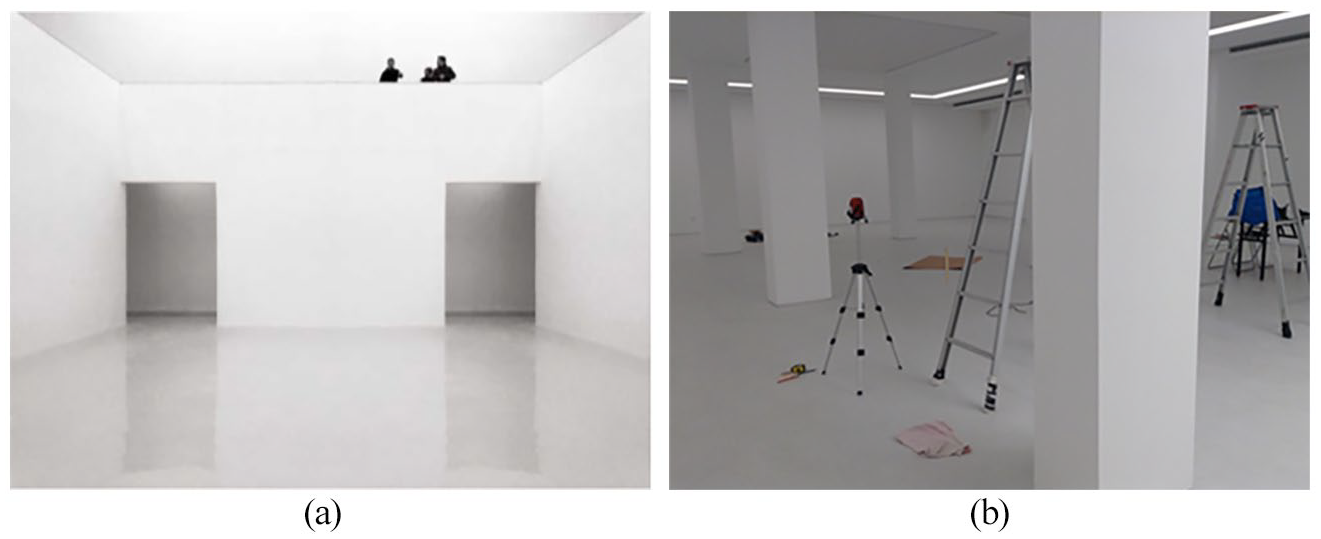
The exhibition space as physical context.
The audience’s bodily movements were the first thing both artists considered. Liang’s idea was to separate the viewing of the artwork’s material basis from the experience of it. For this purpose, he proposed to build an aboveground tunnel that connected the entrance of the main exhibition room to the stairs leading to the first floor. The audience who entered the exhibition would immediately find themselves inside the tunnel and unable to see beyond its walls. Yet the tunnel was the only route through the exhibition room and to the first floor. Only when they arrived at the corridor on the first floor would they be able to see the exterior and shape of the tunnel they had gone through. Liang was inspired by the architectural configuration of the gallery space. An experienced artist who specialises in site-specific installations, Liang noticed the unique vibe of the space created by the atrium structure. The open roof of the main exhibition room enables an aerial view of it from the circular corridor on the first floor (see Figure 1a). Liang, therefore, planned to create viewing points on the first floor and constrain the audience’s visions on the ground floor. By so doing, he aimed to decompose and redefine the audience’s experience of the artwork. Liang said that he also wanted to expose the production process, which was often concealed from the audience. To this end, along the walls of the corridor on the first floor, he arranged a linear display of the materials used in the production and the receipts of all his purchases; by the exit, a short film, which was edited from the daily video recordings of the exhibition hall, showed the entire on-site production process. To accentuate the contrast between fine (finished) and coarse (unfinished, in preparation), he left the interior of the tunnel unpolished, exposing traces of fabrications (nails, cuts, supporting columns, and uneven splices), but camouflaged the exterior with fine wallpapers (see Figure 2). This created different layers of experience as the audience moved around in the exhibition.
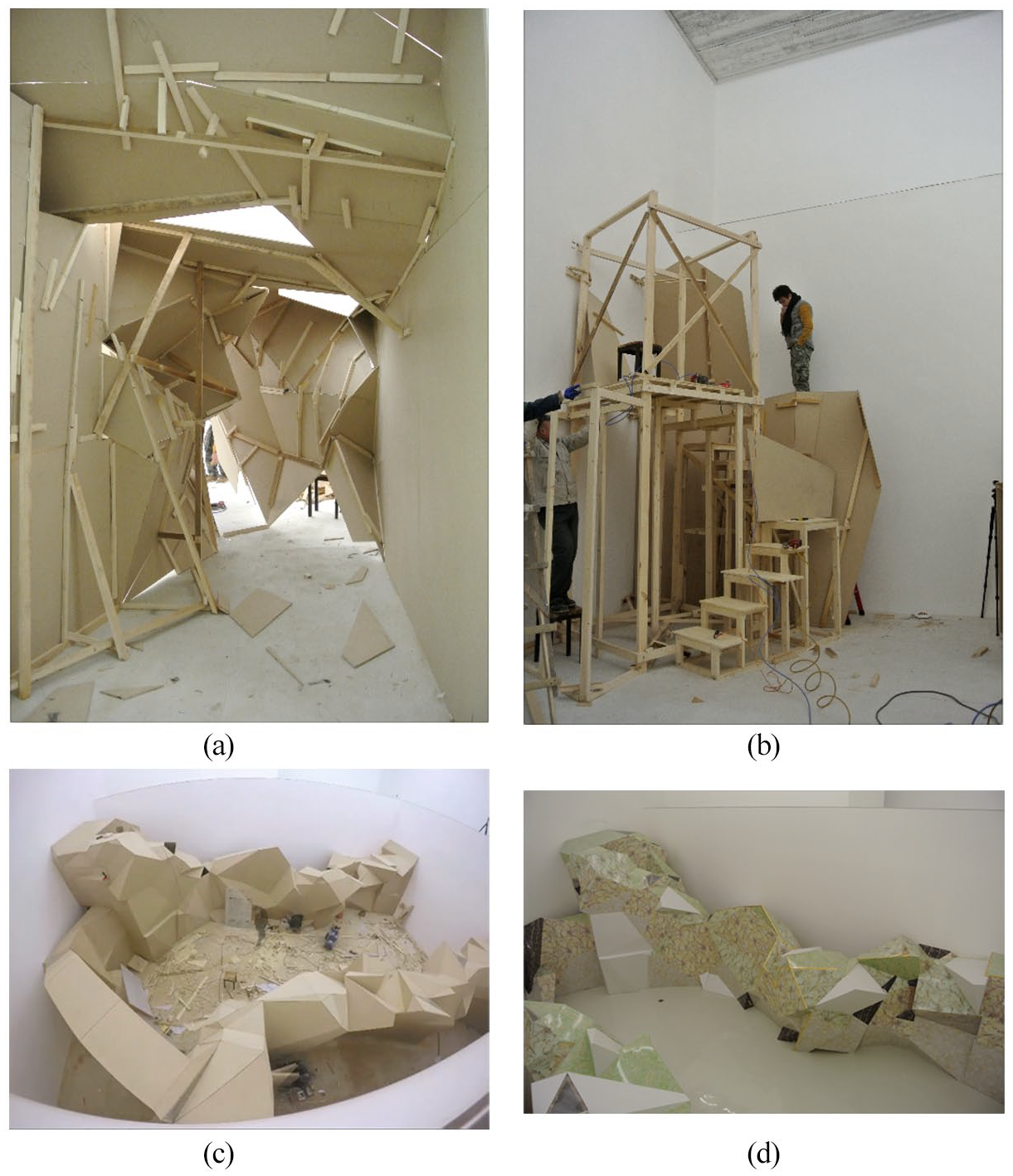
The installation process of Liang’s solo exhibition.
The young artist Gao also designed a viewing route for the audience. This scenographic choice, however, is partially mandated by the physics of Gao’s art practices. He had been making small-scale kinetic installations for two years and was then working on his first solo exhibition, a debut exhibition that the gallerist had urged him on. Gao and the gallerist agreed upon a clear objective for this show: to conclude his practices of kinetic installation with a room-filling on-site installation. His kinetic installations typically involved moving threads within a wooden box. Powered by small electric motors, the movements of the threads were controlled by pulleys. The artist’s plan was then to transfer and accommodate the mechanism of the kinetic installation to the gallery space. There was, however, a problem. The six supporting columns broke the spatial continuity of the exhibition space. Gao could not handle this space the way he handled a wooden box. But he observed a natural division between the space for the moving threads and the space for the audience to stroll in: the inner space surrounded by the columns and an outer circle between the columns and the gallery walls (see Figure 1b). Therefore, he mounted the threads in the inner space and left the outer circle clear for viewers to walk around and obtain a 360-degree view of the installation. The division was also practical, as it prevented the audience from disturbing the movements of the threads. Moreover, the columns could also serve as anchor points, upon which pulleys and powering devices could be built and, importantly, be hidden from view by an additional wrapping of the columns. Unlike Liang, who was experienced in articulating his ideas and explaining his artworks over a career of 12 years, Gao was uncertain about the concept or theme of his solo exhibition. He told the gallery staff to wait until his installation shaped up and saw whether any idea struck him. His desired scenography was clear: to wow the audience with a space in which densely overlapping threads move although no signs for the powering of these movements are given. To intrigue the audience from outside, he also planned to mount a small kinetic installation in the glazed balcony. It would become a kinetic window display when people came close, as he connected the electric motors to a motion detector.
As artists moved to the execution of their designed scenography, new challenges followed. For Liang, a major concern was how to ‘entertain’ the audience in the dim tunnel, which took over one minute to go through. Liang designed turns, slopes, and a spiral staircase to enhance the experience. Although the roof was to be closed, enough lights were allowed in so that the interior of the tunnel could still be seen. The variations in the tunnel’s inner structure also produced a more interesting aerial view for visitors, who would later see the exterior of the same tunnel from the first floor.
In Gao’s case, as the construction went on, his desired scenography changed. In the second week, when all the panels for fastening the powering devices were already built around the columns from top to bottom (see Figure 3a), Gao stayed in the gallery late and attempted to install the threads. The next morning, when I came back to record the process, I found an empty gallery instead. Gao dismantled all the devices and changed his plan radically. He reduced the dense overlapping threads to one single thread and made it run in a loop surrounding the columns, go through the middle of the inner ring space and back to the loop again (Figure 3b). Not surprisingly, Gao was unable to explain the change. He said that his original plan made the space too complex and condensed. Gao was troubled by this feeling of being inarticulate. As a remedy, the gallery staff proposed a theme ‘Approaching Zero’ to convey the minimalist ambience present in the space. Gao gladly accepted the proposal and reckoned the concept consistent with all his previous installations. As he related to me many times, his goal was never to engage with fancy technology or dazzling visual effect, but to trigger a simple delight of curiosity. A scenography of simplicity and ingenuity, therefore, was more in line with his artistic pursuit.
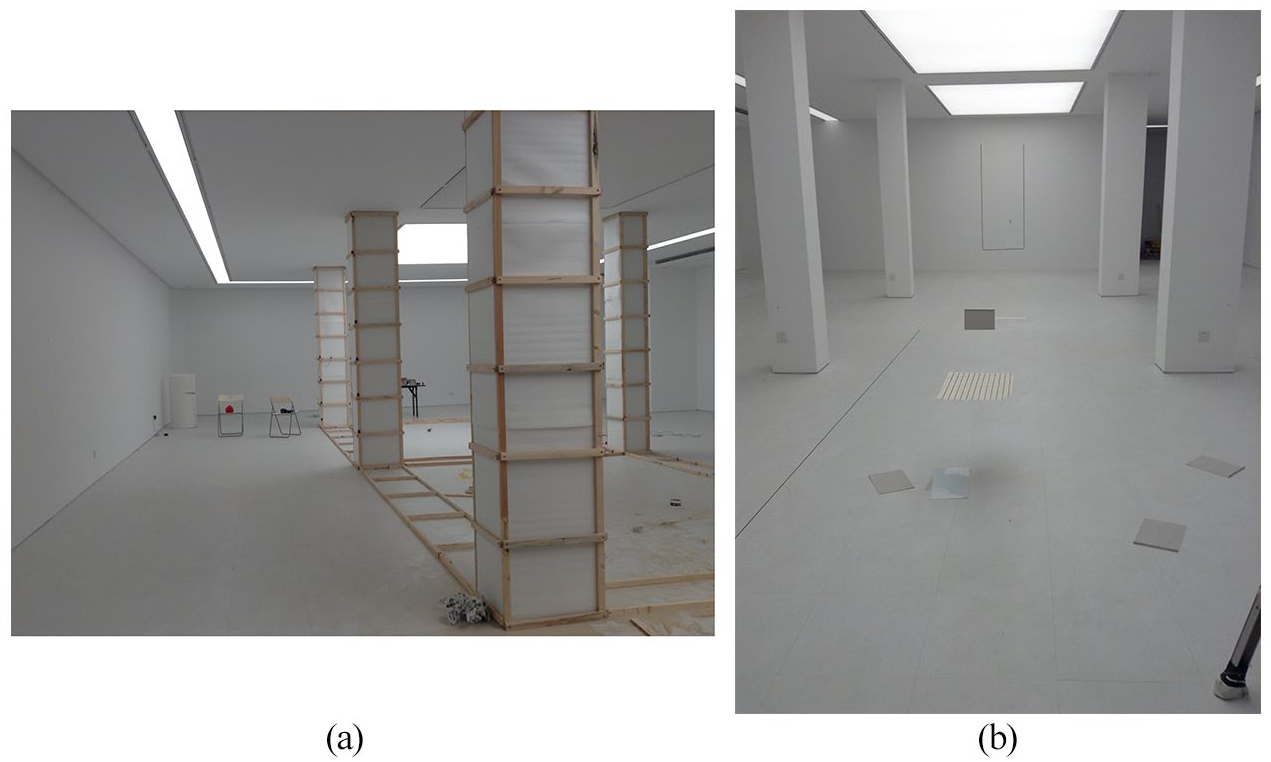
The installation process of Gao’s solo exhibition. A set of two pictures showing Gao’s original plan for the artwork and the eventual outcome.
With this said, artists’ choices of scenography cannot be separated from their distinct artistic approaches. In achieving the desired scenography, artists strive for an ideal synthesis that imbues the exhibition space with their signatures. Both artists ensured such synthesis by drawing upon the spatial characters of the exhibition space when conceiving their creations. Both cases illustrate that the conceptual features of artworks can be rooted in the exhibition space.
The Realisation of Allographic Works
It is a coincidence that the two exhibitions in this section were both artists’ first shows in China. Wang used to be based in New York, made his career there, and moved to Beijing a while ago. A museum in Shanghai invited him to mount an exhibition, which Wang took as a great opportunity to introduce himself. For this purpose, he created three new multi-channel videos tailored to the museum’s exhibition halls. The young Paris-based artist Yao was preparing for her first gallery show in China. Aiming for a comprehensive presentation of Yao’s videos, the gallerist and Yao decided upon four single-channel videos and one room-filling installation composed of several videos. No new works were created, but the installation and adaptation of these works of video art to the small gallery space was the main challenge.
The concepts of Wang’s video artworks were not derived from the exhibition context. Even so, before Wang began his filming, he came to observe and record the museum space, which was then simulated on a computer and used in the planning of the scenography. Wang planned an immersive environment. This involved first the removal of all lighting. It was also required by the projection of videos, which could hardly be realised in strong bright lights. The ‘white cube’ was turned into a ‘dark vault’, which shut the audience off from the outside world. To enhance the immersive feeling, Wang designed large screens for the projection, so that the human figures in the videos were of real-person sizes or even bigger. The gazing of the human figures from the videos made it hard for the audience to pull themselves out of the immersive environment.
These scenographic considerations placed constraints on the realisation of Wang’s video works. The multi-channel artwork Whose Studio (2015) can well illustrate the point. The concept of this piece was derived from Courbet’s famous painting The Painter’s Studio (1854–1855). In this depiction of his studio, Courbet included an art collector, an art critic, a priest, a merchant, a beggar girl, lovers, and a naked female muse to represent both the art world and society. To appropriate similar compositional elements, Wang aimed to represent different social groups in China in his multi-channelled video art. Yet the number of social groups was limited by the size of the exhibition hall. On the one hand, there was a maximum number of screens the exhibition hall could hold before it began to look overfilled. The size of the screens could not be reduced, as the immersive ambience would be altered. On the other hand, as the videos were projected onto the screens, it was technically challenging to show multiple videos without overlaps. The artist decided on nine screens, although nine social groups did not cover all categories of those in Courbet’s painting, still less of all social groups in China. 4 The artist’s rendering (Figure 4) shows that nine screens filled the exhibition hall almost to its full capacity.
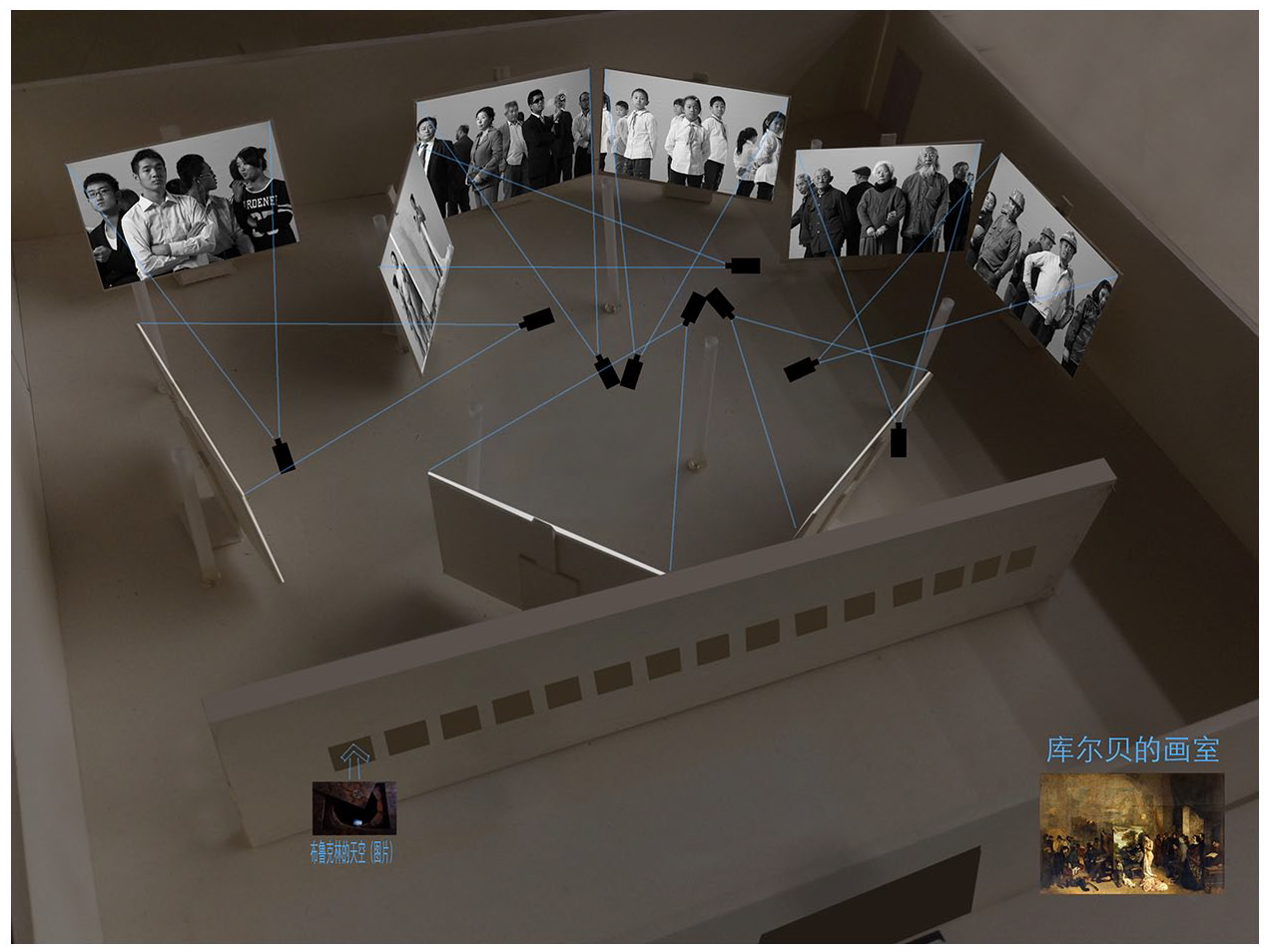
Rendering of the installation plan of Whose Studio, provided by the artist. A rendering that shows the placement of screens in the exhibition hall for Wang’s artwork.
The challenge for Yao was to adapt and re-install her video works to the small gallery space, which is composed of two small rooms each measuring about 25 square metres. This can be best seen in the installation of her key work Sanzu Ding and its Motif (2014), which amounts to a semi-archaeological investigation of Sanzu Ding (a type of bronze vessel on three legs dated to the Bronze Age in China). This work contains five videos, many images, and forged unearthed artefacts to imitate archaeological displays. When first installed in Paris, the components were spread along a long wall. The gallery in Beijing did not have a large exhibition room for a linear display. Yao hence used one of the exhibition rooms for this installation only, spread the components out in three walls, reduced the distance between some artefacts, and commissioned some artefacts of smaller sizes for this new display. She was happy with this realisation, as the audience would be surrounded by all the elements she set up, creating a new type of immersive experience.
Although single-channel videos can be displayed on wall-mountable monitors and hung like paintings, the artist decided to diversify the ways of screening to enrich the audience’s experience. Because one of the rooms were reserved for the key work composed of four videos shown by monitors, only one monitor was used in the other room. Two other videos were projected onto the wall. Yao also managed to re-create her video A Piece of Red Cloth (2014), in which the artist held a piece of red cloth in multiple natural settings such as on the beach, on the top of a mountain, and in front of a cottage. According to the artist, this is a poetic piece, a distinctively unique one in her repertoire of works mostly engaged with politics and discourse. Instead of projecting it onto the white wall as it was in a previous exhibition, this time Yao had it projected onto a piece of beige linen cloth; the images became spotty because of the colour and fabric of this cloth. Its upper edge was wrapped around a twig hung on the wall by linen ropes. The use of natural materials and the spotty screening nuanced the poetic vibe of the video.
In the realisation of allographic works, we have seen that the scenographic handling of the space does not intrude into the concept of the artwork. However, the particular exhibition context leaves its signature on the materiality and experiential features of the artwork. Artists need to adapt the spatial relationships among the composing elements, the size and quantity of these elements to the specific spaces. This adaptation can also be achieved by modifying the way a piece of allographic work is realised, creating new emergent experiential features.
An Excursion into Artefactual Works
One day in my fieldwork, I was invited to an opening in LuXan gallery (pseudonym). It was for a German painter whom the gallery decided to introduce to the Chinese market. The gallerist thought I might be interested to meet the artist, as I happen to speak German. As I entered the exhibition, something struck me as odd, but I was not able to name it. I sent a picture of the gallery space to an artist friend. He told me the reason: the small paintings are out of scale with the gallery space; they are ‘swallowed’ by the space.
Before I explain what my artist friend meant by ‘swallow’, we need to go back to the principles of modern art display. Grounded in the ideology that regards each artwork as self-sufficient, it emphasises the distinctiveness of each artist and each work (Carrier, 1987; Mainardi, 1991). Deviant to this basic principle is Salon display, popular in the 18th and 19th centuries. There, paintings were placed on the wall from floor to ceiling. Opposite to salon display, the modern exhibition room should not be overfilled. Yet little has been said about what this display principle means for the production of artworks. My artist informants developed their interpretations in the practices of exhibition making: an artwork that is given its own space must be able to ‘sustain’ itself; the volume of an artwork should be in scale with the exhibition space. Otherwise, it is ‘swallowed’ by the space.
With this said, it is clear that modern art display does not fade away and remains an important aspect of scenography. It conditions the size and scale of artworks, although such a simple mechanism often eludes people’s attention.
There are, however, instances where the mechanism becomes visible. One of such instances is when deviances happen, as in the case I mentioned at the beginning of this section. Having spent enough time in the field, I seemed to have developed a sense of space and noticed the deviance. To further illustrate the point, I show here a picture of the German artist’s exhibition (Figure 5a) side by side with that of another artist’s show in the same gallery (Figure 5b). The contrast here is clear. The other artist’s paintings are more in scale with the exhibition space. This artist has been collaborating with the gallery for several years. He exhibited here frequently and had a better command of the gallery space. Although he does not create specifically for this gallery only, the sensitivity to the exhibition context carries over into all his creations. The German artist came to China to mount his first solo show with LuXan gallery. He was not familiar with the gallery space and did not bear the exhibition space in mind when creating these paintings.
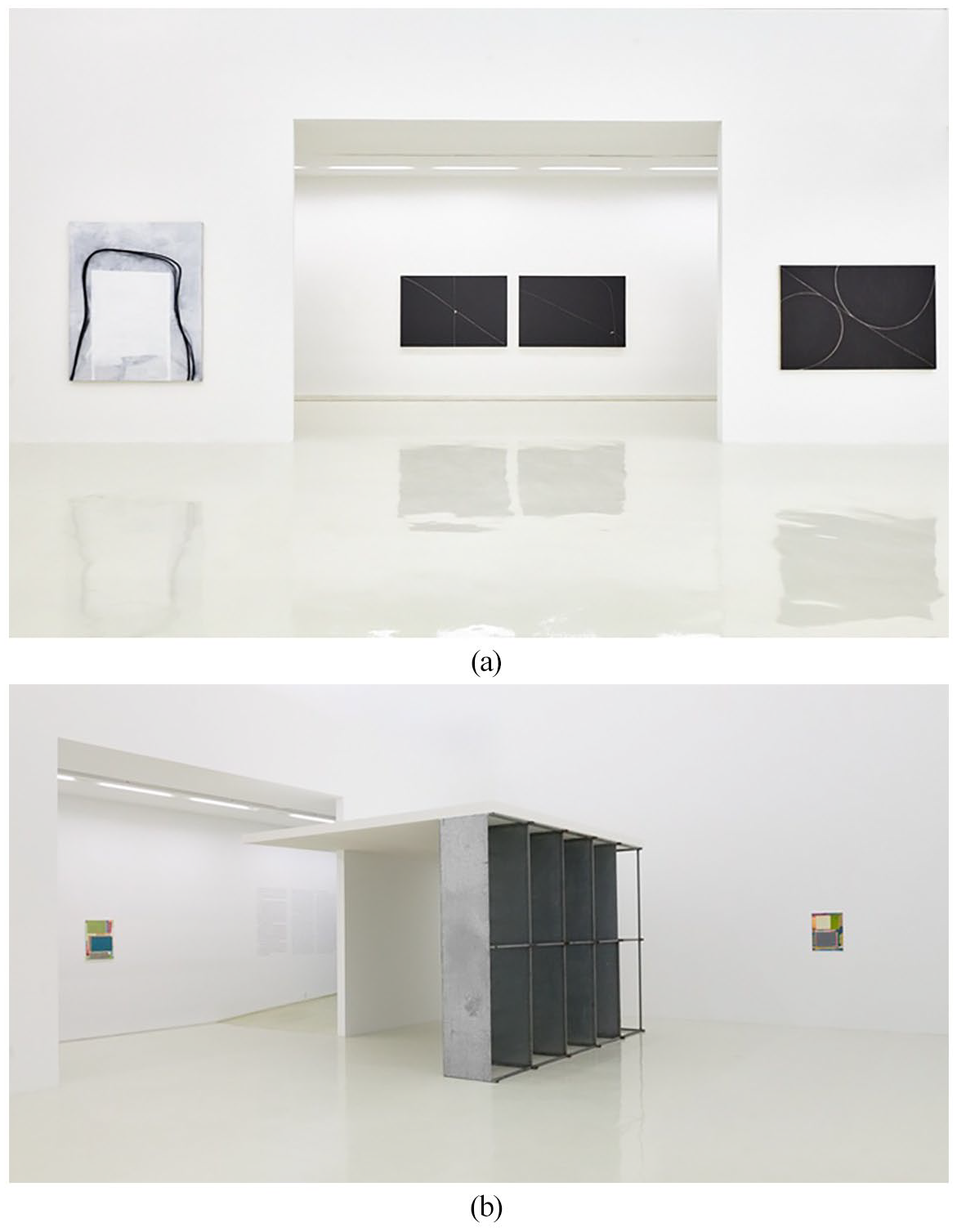
Painting sizes and sensitivity to the space. Two artists’ exhibitions in the same gallery.
Another instance is when young artists, in the process of upgrading to larger galleries, perceive the changed requirement of painting sizes. One of the artists I visited, Yan, expressed an explicit concern with sizes. When asked about his current plan, Yan told me he wanted to create some larger canvasses. Only in the second year of his professional career, Yan exhibited with several small galleries. He now intended to collaborate with ‘better’ galleries. But these galleries usually have larger exhibition rooms, for which his previous paintings were too small. Noting the sizes of the works may help to illustrate the point. Most of Yan’s paintings were 60 cm by 80 cm, whereas for a gallery such as the one in Figure 5, canvasses of 2 m by 2 m would suit the space better.
Actually, as artists’ careers develop, their paintings tend to become larger, because artists usually begin by exhibiting in small galleries, move on to larger ones, and then eventually, if they manage to move further, in spacious museum halls. Many artists I visited found the height of the exhibition room most challenging, because the height extends an exhibition space vertically, which cannot be filled by stacking several paintings from bottom to top. 5 In China, for instance, walls of a small gallery are typically three to four metres high, for which Yan’s paintings of 60 cm by 80 cm are suitable. Walls of a medium-sized gallery are typically five to nine metres high, which require paintings that measure 2 m by 2 m minimum. Museums could have even higher ceilings. This helps to explain why top artists, who exhibit in large spaces, often produce large canvasses. 6
Conclusion
The subject matter of artworks, which causes recurring debates in sociology, has recently been revived by the material turn in cultural sociology. Turning towards the objects as human equivalents, the inquiry moves from the traditional focus on the social world of producers to artworks themselves. However, this object-oriented approach, by prioritising the actions taken by objects upon humans, also moves away from the inquiry into the social production of art, a central task of cultural sociology. It remains a predicament how to demonstrate artworks to be ‘social’ products without reducing them to their socio-economic bases. Moreover, even though their empirical studies of the object-oriented approach deal de facto with works of contemporary art (e.g. Domínguez Rubio, 2012; Domínguez Rubio and Silva, 2013; Kobyshcha, 2018), they fail to identify contemporary art as a new artistic paradigm. Part of the reason for this obtuseness is the often-delayed reception of French sociology in anglophone literature. Consequently, neglected has been the urgent need to address the new development in our research subject and ‘ce que l’art fait à la Sociologie’ (Heinich, 1998). For instance, Bourdieu’s (1993) concept of ‘(artistic) position’ 7 is based on style as a collective label. In contemporary art, style dissolves as a collective label on the level of practice and discourse: artists no longer pursue a group identity but are expected to have their own signatures (Fine, 2018; Heinich, 2014a; Wohl, 2019). How can we then re-conceptualise ‘artistic position’?
As an attempt to reveal what contemporary art does to sociology, this article reconceptualises the production of artworks by situating them in the exhibition context. The classical sociology of art tends to situate the producers but not the artworks, which are assumed to be isolated and self-sufficient objects. I have shown that this assumption is obsolete in contemporary art. I have demonstrated, through the making process of solo exhibitions, that artworks are made in relation to the exhibition space and to engage with the audience. Another corrective to the ‘old’ sociology of art is to draw a direct link between the conceptual, material, and experiential features of artworks and their context of production, by reconfiguring the latter as the exhibition space. Through the concept of scenography, I have redefined art institutions as the exhibition space — a hybrid of artistic and institutional space. Traditionally, art institutions such as galleries and museums, constitute the career system for artists (Crane, 1987; Moulin, 1987; White and White, 1993), but are rarely discussed as the immediate context of producing artworks. Here I have shown that when artists enter an exhibition space, they do not only enter the norms, rituals, or procedures regulating human interactions, but also the physical context of artistic production and appreciation. It is the middle ground where artistic, technical, and social factors merge into scenographic principles, which shape the ideational, material, and experiential features of artworks. Unlike the object-oriented approach, I did not give priority to the agency of objects. This, however, does not prevent me from showing the contingency in the productive process (Domínguez Rubio, 2012) or ‘dance of agency’ among objects and human actors (Griswold et al., 2013). In my stories, the productive process is steered by artists, but they are shown to be inspired by the spatial-physical characteristics of the space, obliged to change their plans, and be responsive to challenges and possibilities generated by objects, space and envisaged audience members. I have therefore demonstrated that for sociology to approach artworks, we do not need to turn away from the social production of art, nor is a contextualised analysis of art in itself a problem. Scenography allows the reintroduction of ‘institutions’ as the immediate context directly linked to the artwork, while avoiding the pitfall of reducing art to its socio-economic bases.
Through the exhibition context, I have also denounced the false dichotomy between ‘art’ and ‘context’, which I sketched at the beginning of this article. When it comes to the disciplinary demarcation between art history and sociology, such a dichotomy, which misrepresents both sides and becomes an obstacle for dialogues, is often taken for granted. In fact, art historians often employ contextualised analysis too (Berger, 2008; Edwards, 1999; Garber, 2008). Moreover, arguments in the two disciplines sometimes accord. For instance, many art historians contend that artworks are the deposit of social relationships (Baxandall, 1988; Clunas, 2004), echoing Adorno’s thesis. As stated by Heinich (2012), art historical research can provide us with rich materials. This article has been inspired by art historians’ turn towards a history of exhibitions since the 1990s (Greenberg et al., 1996; Staniszewski, 1998). The questions they raised pointed to the intertwining between production and mediation: ‘How exhibition forms and demands have affected artistic production’, ‘how the size of gallery affect artworks’, and ‘to what extent modern art internalize[d] exhibition schedules, formats, modes of unity, of visuality and even of sociability into its own production’ (O’Neill, 2007; Ward, 1996). Yet group exhibitions and curatorial innovations have been more popular in art history (Altshuler, 2013a; Cagol, 2015; Gleadowe, 2011; Myers, 2011; Rattemeyers, 2011), whereas, as pointed out by Ribas (2015), research on solo exhibitions remains scarce. Hence, by recognising the contribution of solo exhibitions to artistic production, this article is a corrective to the preference of group exhibitions in art history. The importance of solo exhibitions to the sociological understanding of the art world also needs to be highlighted, as an artist’s career centres around a series of solo exhibitions. The career system of modern art has been conceptualised as a ‘dealer-critic system’ (White and White, 1993). Its evolution until the 1970s has also been charted (Crane, 1987; Moulin, 1987; Moulin and Vale, 1995). Given that now the new paradigm of contemporary art has become institutionalised and consolidated (Heinich, 2014a), perhaps another new task for the sociology of art is to chart the new career system, which is linked to the making of solo exhibitions as suggested by a growing body of literature on exhibitions in sociology (Fuller, 2015; Fuller and Ren, 2019; Wohl, 2019; Zamora-Kapoor et al., 2020).
Indeed, sociologists often discuss art in general but at the same time have a particular archetype in mind – for Bourdieu it was literature and for Becker it was jazz, my archetype here is visual art. This does not mean that my argument is exclusively applicable to visual art. For one thing, contemporary visual art incorporates performative, musical, and literary elements into its practices. Hybrid practices are also common to other forms of art. Scenography, the key concept of this article, is derived from hybrid practices in theatre, performance, visual art, and architecture. For another, my contextualised approach to artworks brings visual art in close proximity to music and extends our understanding of artistic mediation, a key concept in the sociology of art (Farkhatdinov, 2014; Heinich, 2012; Hennion, 1989, 1995, 2003; Shrum, 1991). Mediations, which in this article are exhibitions, mould the production of artworks and in some cases become the artworks themselves, the same way that music becomes the subject of appreciation when played and replayed. In other words, ‘mediations are [. . .] the art itself’ (Hennion, 2003: 84). Although Hennion (2003) thought that mediation as art itself is ‘particularly obvious in the case of music’, the hybrid practices have created new possibilities for us to generalise about different forms of fine arts.
Footnotes
Funding
The author received no financial support for the research, authorship, and/or publication of this article.
