







Abstract
Do artists’ justificatory strategies to obtain government grants reflect expectations from the funding body, or are they predominantly tied to artists’ field positions? Using Multiple Correspondence Analysis on Flemish (Belgium) visual artists’ grant proposals spanning 51 years (1965–2015, n = 494), we find that, with some notable exceptions, field positions and artists’ justifications for obtaining subsidies are only marginally related. Instead, strategies mainly reflect the period they are written in, showing the influence of both cultural policy and the art field. These findings support Bourdieu’s idea that there is no mechanical homology between positions and position-takings, but that the ‘space of possibles’ in which agents express themselves, strongly bears on this relationship. Furthermore, our study suggests that strategic considerations turn the grant proposal into a genre.
Keywords
Introduction
Applying for a grant involves using rhetorical devices to convince a committee of experts that one’s work is worthy of governmental support. With a limited amount of money distributed each year, the setting is competitive. So, justifications for grant money in proposal letters may be considered exemplary instances of what Bourdieu calls position-takings, that is, ‘the strategies which the occupants of the different positions implement in their struggles to defend or improve their positions’ (1983: 313). Particularly for artists – but this also goes for academics to some degree – obtaining a grant is a means for achieving or maintaining a level of prominence in one’s field. But ‘unlike bureaucratic careers, such as those offered by the university system’, the cultural field ‘offer[s] ill-defined posts, waiting to be made rather than ready-made, and [. . .] career-paths which are themselves full of uncertainty’ (Bourdieu, 1983: 324). In other words, the struggle over capital in the art field is much less formalized than in academia, because positions and career trajectories in the arts are less predictable and stable. This volatility makes discursive position-takings – what we call justificatory strategies (also see Boltanski and Thévenot, 2006) – an important area of study for gaining insight into how power is created and articulated symbolically in the art field.
Existing research on grant proposals typically focuses on the academic field and analyses how successful grants are written (e.g. Chung and Shauver, 2008; Connor and Mauranen, 1999; Halpern and Blackburn, 2005), or seeks to unearth the rhetorical moves that define the ‘genre’ (i.e. rhetorical conventions – see Miller, 1984) of grant writing (e.g. Connor and Upton, 2004). With our analysis, we take a sociological approach to studying proposal letters. More particularly, we aim to empirically uncover the various types of justifications visual artists use in their quest for grant money and analyse the underlying mechanisms prompting artists to use one justificatory strategy over another.
Next to showing how grant proposals can be salient objects of sociological inquiry, our research adds to existing work in the sociology of the arts. Studies of aesthetic dispositions have done valuable work on establishing the relationship between position and disposition, such as education level and cultural consumption (Van Eijck, 1999), or artists’ positions in the art field and their aesthetic inclinations (Roose and Vandenhaute, 2010). However, the contextual aspects in which dispositions are expressed, such as evolutions in the art field and the political field, are rarely taken into account. Grant proposals for state money are located at the interface of the fields of art and politics, and, as such, they provide a unique source for studying how artists navigate struggles over resources in a changing artistic and political environment. Artistic legitimations may vary, for example, with varying levels of artistic professionalism expected by the government, with the changing role(s) or function(s) ascribed to the arts, and with evolutions in the number and size of grants made available to artists. So, using a historical perspective, we consider both the influence of artists’ reputational trajectories (i.e. field positions) in the art field as well as the historical context (i.e. ‘space of possibles’) in which they write their proposals (Bourdieu, 1996: 234–239, also see Boltanski and Thévenot, 1999, 2006). In this way, the study recognizes Bourdieu’s insistence that ‘[t]he relationship among positions and position-takings is by no means a relationship of mechanical determination’. The central question is how strongly reputational trajectories of applying artists affect the justificatory strategies used in their proposal letters depending on shifts in cultural policy and the art field. So, in other words, we explore the effects of context for understanding how Bourdieusian positions and dispositions are related.
Theoretical Framework
Bourdieu’s Homology Thesis and the ‘Space of Possibles’
Bourdieu’s influential work presents the art field as an arena in which individuals compete for symbolic and economic resources, such as recognition and money. Obtaining a grant is part of this struggle, as it may well improve an artist’s position, allowing them to, for example, invest in materials or studio space. Grants are also a form of symbolic capital that signal legitimacy in and of themselves (Peters and Roose, 2021). To maintain or change their positions, Bourdieu (1990: 66) argues that artists need to acquire a ‘feel for the game’ and advance position-takings or strategies they reckon to be a legitimate currency in the struggle. Justificatory strategies in grant proposals are, in this sense, weapons artists use in the struggle for a better position in the art field.
In Bourdieu’s field theory, artists acquire this ‘feel for the game’ through socialization: individual biographies become the ‘cultural structures that exist in people’s bodies and minds and shape a wide variety of their behaviours, beliefs and thoughts’ (Coulangeon and Lemel, 2009: 49). This process generates a homology between position and position-taking, such as between artists’ field positions and the justificatory strategies they deploy in grant proposals.
Bourdieu’s homology thesis has attracted considerable criticism: if people’s acts, strategies, beliefs, and so on, are prescribed by their positions, there is little room left for individual agency, reflexivity and societal change (e.g. Atkinson, 2019; Gielen, 2008; Heinich, 2012: 695; Jenkins, 1982). However, he (Bourdieu, 1983: 342, 345, 1996: 234) explicitly challenged the interpretation and application of his theory as a mechanical relationship between positions and position-takings. Besides field position, he argued that the so-called ‘space of possibles’ (Bourdieu, 1983: 344, 1996: 234–239) that presents itself to an agent, determines position-takings, ‘that is, as an ensemble of probable constraints which are the condition and the counterpart of a set of possible uses’ (Bourdieu, 1996: 235). In other words, although agents’ positions indeed determine their dispositions, the context in which the agent acts determines which elements of their dispositions they put into action (also see Lahire, 2003). The relationship between position and position-taking is then only determinative in the sense that a person’s position determines the range of possible position-takings that they can deploy in a given situation, while the ‘space of possibles acts as a discloser of dispositions’ (Bourdieu, 1996: 235). Position-takings are ‘adjusted to the actual possibilities agents have’ (Husu, 2013: 8). So, the ‘space of possibles’ may differ to such an extent from one moment or place to another that agents with the same field position will engage in different, sometimes even conflicting, position-takings when moving from one situation to another (Bourdieu, 1983: 345). In that sense, justificatory strategies are the product of a combination of the ‘space of possibles’ that surrounds applicants at a given moment in time on the one hand, and applicants’ field positions on the other.
Developments in the Art Field, Cultural Policy, and Applicants’ Justificatory Strategies
In previous work, we found that justificatory discourse in grant proposals followed developments from the field of contemporary art and cultural policy (Peters and Roose, 2020) – that is, from the ‘space of possibles’. Before the 1990s, artists predominantly used ‘autonomous’ strategies to substantiate their claims for government money, focusing on reputational, aesthetic and romantic justifications in their proposals. Reputational strategies highlight how the artist is connected to leading institutions and individuals in the art field, such as galleries, prizes and curators; aesthetic strategies bring in features of artefacts, such as concept and form; and romantic strategies are a reminder of the ‘suffering genius’ trope, stressing a sense of vocation and dire socioeconomic, physical and/or psychological conditions. These autonomous legitimations ran parallel with the art field’s pursuit throughout the 20th century to produce art for art’s sake: art should not serve any other purpose than art itself. A significant break with this tendency came in the 1990s through what Bishop (2006) calls the ‘social turn’. Art starts to engage with the social by increasingly involving or implicating audiences in the artefact or through societal interventions (also see Bourriaud, 1998). Artists also refer to academic research, ranging from chemistry to sociology, to justify their work (Laermans, 2018; Peters and Roose, 2020; Schinkel, 2010). And indeed, from 2000 onwards, we found that artists increasingly used social and academic justifications in grant proposals. Social legitimations suggest the applicant’s work has direct societal benefits or serves as political criticism. Academic justifications approach the artistic practice scientifically, with academic references, referring to their work as research, and drawing inspiration from academic fields such as chemistry and anthropology. Another discourse that accompanied the rise of the social and the academic was the growing use of entrepreneurial discourse, characterized by business jargon, calculation, professional self-reliance, and emphasizing one’s busy schedule.
Besides shifts in the contemporary art field, changes in cultural policy affect the form and content of legitimizing discourse used by artists. Indeed, when artists apply for state money, they must at least temporarily engage with the state’s logic: proposals are situated at the intersection of the art field and the political field so that during the application, artists ‘are closest to the dominant pole of the field of power and therefore most responsive to external demands (i.e. the most heteronomous)’ (Bourdieu, 1983: 321–322). Strategic concerns are likely to prompt artists to address issues perceived to be essential for policymakers.
The pressures and possibilities from cultural policy on grant applicants have changed significantly over the past 50 years. Firstly, just like in many other western countries (e.g. Cummings and Schuster, 1989), the ‘space of possibles’ for Flemish grant-applying artists has evolved from a model that sought to support both artistic talent and struggling artists, to a model that rejects social welfare considerations and legitimates subsidies based on excellence, and economic and societal accountability, as evidenced by discourse in the newsletters distributed to visual artists by the committee and the legal art decrees which we discuss in-depth elsewhere (Peters and Roose, 2022). While between 1965 and 1992 the Flemish visual art committee distributed small grants both to reputed and struggling artists, from 1992 onwards it granted ‘more financial resources for fewer but high-quality artists’ (Gielen, 2002: 236 – translated from Dutch; also see Peters and Roose, 2022, for a more detailed historical account of shifts in grant sizes). Finally, while before the 1990s the committee for the most part supported artists by buying their works, since the 1990s, it distributed virtually only grants for work in progress (Peters and Roose, 2022).
Although the committee never explicitly demanded that artists use a certain type of discourse, the development from a cultural policy motivated by providing social welfare and stimulating artistic excellence to a policy aimed at professional artists that frames the artist as a type of social worker or entrepreneur ran parallel with a shift from romantic justifications to entrepreneurial and social strategies. A second change in cultural policy is that ministers and committees expected more extensive discursive justification from artists in legitimating their grant requests since the 1990s, as they began focusing on distributing grants for work-in-progress rather than finished work (Gielen, 2003). We found that the amount of discourse accompanying the request for state support increased considerably between 1965 and 2015 – an increase that may also be partially attributed to contemporary, conceptual artefacts needing more discursive clarification (Peters and Roose, 2020).
Field Positions and Justificatory Strategies
Notably, while our previous findings suggest that artists adapt the wordiness and content of their justifications to the condition of the field they apply in, little is known about the extent to which applicants’ field positions explain variation in legitimations. Grant-writing artists are not passively responding to historical pressures, and our previous analysis did not inquire how their personal trajectories in the art field lead to certain strategic discourses. Bourdieu’s ideas on the link between positions and position-takings (i.e. justificatory strategies) suggest several possible scenarios for artists to choose one justificatory strategy over another within a specific historical context.
Following Bourdieu’s homology thesis, we expect reputed artists to draw on different strategies than newcomers. Moreover, we expect these strategies to depend on the historical context they are used in. Applicants new to the field, and those who find themselves consistently rejected by it, may find that that their efforts to access the established art field on the establishment’s own terms are often unsuccessful. Newcomers’ and rejects’ best bet is to use ‘dispositions and prises de position which clash with the prevailing norms of production and the expectations of the field’ (Bourdieu, 1983: 337), while ‘the dominant have an interest in continuity, identity and reproduction’ and, therefore, in maintaining the status quo (Bourdieu, 1983: 340). Certainly, not only have more reputed artists been socialized into the prevailing doxa of the field during the time they have spent in it - they are also affected by the symbolic capital they are endowed with through their academic track records, exhibition trajectories at galleries and art museums, or obtained prizes and grants (Beckert and Rössel, 2013; Braden, 2009; Fraiberger et al., 2018; Peters and Roose, 2021). In that way, reputational trajectories shape the range of justificatory strategies artists can adopt – impressing evaluation committees with reputational success is the most obvious. Alternatively, having experience with gallery representation, which is a commercial enterprise, may stimulate artists to use entrepreneurial strategies. The use of these reputational or entrepreneurial strategies is predominantly manifested in times when objectified clues of artistic excellence are called for by policy, such as in a regime based on professionalism in Flanders after 1990.
Artists who are new to the art field, who do not want to be part of the gallery circuit, or struggle to make a name for themselves, may resort to other strategies. When welfare considerations are part of cultural policy, and smaller amounts of money are distributed, newcomers may draw on romantic justifications and the image of the struggling artist. Indeed, many artists find themselves in socioeconomically precarious positions (Abbing, 2008) and may be inclined to use language that reflects or even exploits their marginalized situation. ‘[I]n the short run,’ Bourdieu (1996: 83) argues when discussing the careers of not (yet) recognized artists, ‘the artist cannot triumph on the symbolic terrain except by losing on the economic terrain.’ Being depleted of reputation and against using economic reasoning, newcomers may justify their artistic ambitions through the ‘labor of love’ argument, appealing to ‘the Christlike mystique of the ‘artiste maudit’, sacrificed in this world and consecrated in the one beyond’ (Bourdieu, 1996: 83). Thus, non-reputed artists may use romantic strategies to show their vocation and sacrifices for the arts, and these pleas for help may resonate better with a government that aims to alleviate the economic hardship experienced by struggling artists. Even though applicants with strong reputations may refrain from using the suffering artist trope, vocational motives may still appear in their proposals, considering they occupy positions in the field of restricted, rather than large-scale, production.
In more recent years, strategies for newcomers and lowly reputed artists may be grounded in Bourdieu’s orthodoxy–heresy opposition: they may seek to justify their work by appealing to legitimations that clash with the prevailing norms or that are entirely new to the art field at the time. So, it may be especially artists with no or little reputation who draw on the innovative legitimations typical for the social and academic turn (see Bishop, 2006; Laermans, 2018; Schinkel, 2010). When these strategies become more familiar to the field over time, and as these newcomers become part of the established order themselves, artists from higher reputational standings are also likely to use them.
Data and Methods
Description of the Sample
Empirically determining how and how much position-takings vary with positions and with the historically shifting ‘space of possibles’, demands historical information on grant proposals and the various forms of reputations possessed by applying artists. We retrieve this information from archived documents at the State Archive in Beveren-Waas and the Department of Culture, Youth and Media in Brussels (both in Belgium). These documents contain the official reports of committee meetings and applicants’ grant proposals between 1965 and 2015. Between 2015 and 2017, the first author and an assistant digitized all meeting reports containing all committee decisions (yes, no, and if yes, how much money) on every grant proposal between 1965 and 2015. Based on these reports, we listed all 12,254 grant proposals done by 4526 artists. Using this list as a sampling frame, we randomly selected 10 proposals per year, resulting in a sample of 510 proposals. We then digitized the applicants’ personal files for each of the sampled proposals, containing the application letters from which we determined the justifications through a qualitative content analysis of the previously selected proposals (Peters and Roose, 2020) and résumés to arrive at artists’ reputations. Additionally, we kept track of the total amount of money applicants had received from the Flemish government until the moment of selection. There were 16 proposals unfit for analysis, as they turned out to be either written by relatives of the applicant after the applicant had deceased or only contained invoices rather than a letter, leaving a realized sample size of 494.
Variables
Justificatory Strategies
Six Justificatory Strategies in Grant Proposals
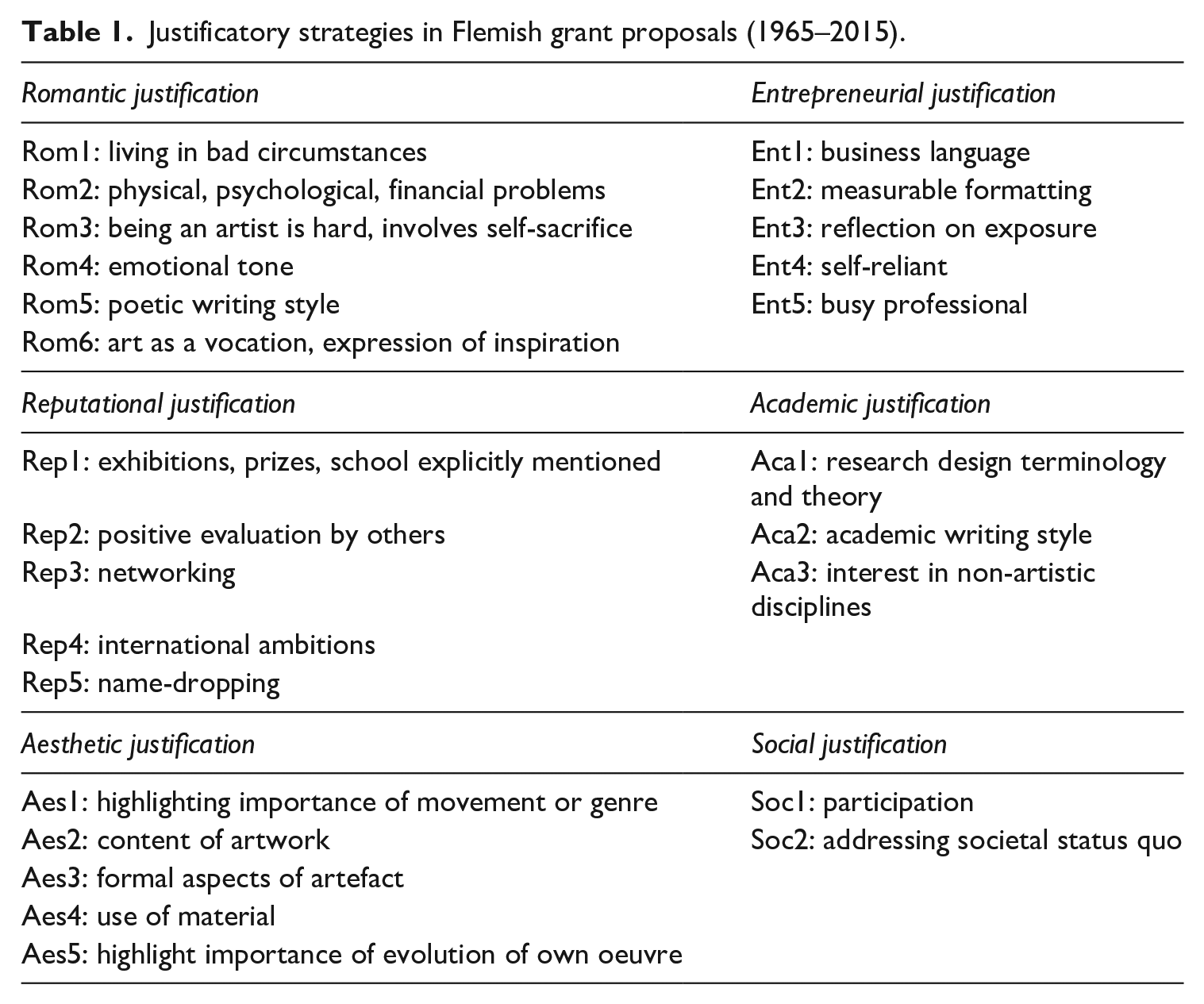
Each of the six justificatory strategies is made up of several codes (see Table 1; also see Peters and Roose, 2020, for an in-depth explanation of the coding process). While the codes within one justification are thematically associated, their individual meanings differ. Therefore, they may be used less or more frequently by different applicants or at different historical moments. For example, while one artist using the romantic strategy emphasizes psychological problems and an artistic calling (Rom2 and Rom6), another artist also using this strategy only mentions the importance of an artistic calling (Rom6). To allow for this nuance, our analysis includes the various codes making up each justificatory strategy.
Justificatory strategies in Flemish grant proposals (1965–2015).
Space of Possibles
For the ‘space of possibles’, we use two variables: historical period and type of government support.
Historical Period
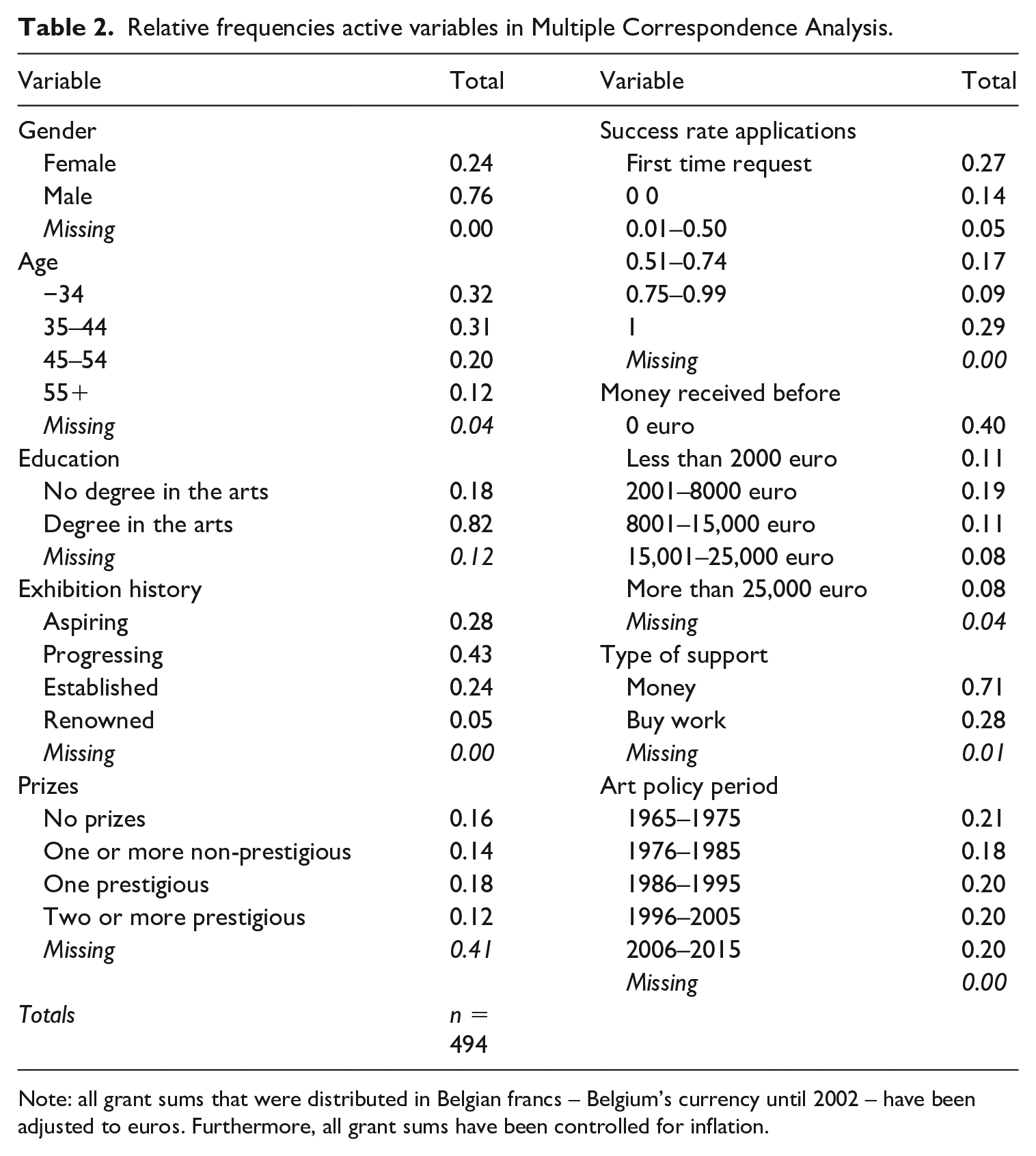
The passage of time captures changes in the ‘space of possibles’ in which artists apply for grants. Importantly, this measure conflates changes in the cultural policy context with changes in the art field context (and with other contexts, for that matter), but this is unavoidable when including a temporal dimension. We split up the period under study (1965–2015) into five equal parts: 1965–1975 (containing 21% of cases); 1976–1985 (18%); 1986–1995 (20%); 1996–2005 (20%), and 2006–2015 (20%). We used the date on the selected proposals to allocate cases to one of the five periods. The decision to equally divide the data into five periods is a trade-off between capturing ample variance in changes over time and having a sufficient number of cases in each period.
Type of Government Support
The type of support offered by the government to artists is part of the character of cultural policy. Until the mid-1980s, artists typically received support by the state purchasing their work rather than a sum of money meant for the artist to use for the creation process. Buying work declined rapidly from the 1990s in favour of providing project money. Since 2003, the Flemish state has stopped purchasing artworks as a form of subsidy to artists. Type of support is a binary variable: ‘Money’ (71%) and ‘Buy work’ (28%).
Field Position
Artists’ field positions are made up of several reputational indicators. Applicants’ CVs, which were included in all proposals, mention four such indicators: exhibition reputation, prize reputation, grant reputation and academic reputation. Per proposal, we determined these indicators only up to and including the year of selection, thus not including exhibitions, prizes, grants and education achieved after the evaluation.
Exhibition Reputation
To determine the prestige of an artist’s exhibition history, we used a two-step procedure (see Appendix in Peters and Roose, 2020, for a full account of this variable’s composition). First, we estimated the prestige of each exhibition space. Second, we combined the number and prestige of an artist’s past exhibitions into a categorical variable. We used three criteria to determine the prestige of the exhibition space: (1) whether it primarily shows art, (2) whether it is located in a major city, and (3) whether it appears in the top 100 most visited art museums and galleries worldwide. We gave art museums more weight than gallery exhibitions, considering that art museums generally hold a more established institutional status. For instance, one exhibition at a peripheral art museum ‘equals’ an exhibition at a central gallery. Using the combination of these criteria, galleries and art museums are either ‘unofficial’, ‘peripheral’, ‘central’, or ‘renowned’. Unofficial spaces are those venues that do not routinely exhibit art, such as bars or living rooms temporarily transformed into exhibition spaces. Peripheral spaces are official exhibition spaces that find themselves outside major cities. Central spaces are located in major cities but do not appear in the top 100, such as Campo gallery in Antwerp. Renowned spaces find themselves in cities central to the art field and appear in the top 100, such as Tate Modern. Based on the number and prestige of applicants’ past exhibitions, we construct a four-category indicator: ‘aspiring’ (28%), ‘progressing’ (43%), ‘established’ (24%) and ‘renowned’ (5%) artists (see Table 2). Aspiring applicants have either never exhibited or only in unofficial spaces and peripheral galleries. Progressing applicants have one exhibition at a peripheral art museum and a maximum of two at a central gallery. Established applicants exhibited at two or more peripheral art museums, had shows at three or more central galleries and/or one or two central museums. Renowned applicants exhibited at three or more central art museums, had one solo exhibition at a central art museum, and/or one exhibition at a renowned art museum.
Relative frequencies active variables in Multiple Correspondence Analysis.
Note: all grant sums that were distributed in Belgian francs – Belgium’s currency until 2002 – have been adjusted to euros. Furthermore, all grant sums have been controlled for inflation.
Prize Reputation
Just like for exhibition reputation, we considered the prestige and number of prizes for prize reputation. Due to the multitude and variety of prizes won by applicants overall – many of which from early periods are obsolete today, which complicates determining their status – we operationalized prestige by the geographical scopes of prizes. We label prizes from art academies and competitions held within the boundaries of cities and towns as ‘non-prestigious’, whereas we mark national and international prizes as ‘prestigious’. We use four categories: ‘no prizes’ (16%), ‘one or more non-prestigious prizes’ (14%), ‘one prestigious prize’ (18%), and ‘two or more prestigious prizes’ (12%) (see Table 2).
Grant Reputation
An artist’s reputation can also take the form of previously obtained grants. We operationalized grant reputation by calculating the proportion of positive and negative evaluations an artist has had from the Flemish committee before the selected proposal, that is, the number of previously accepted proposals divided by the total number of previous proposals. This proportion does not consider the number of proposals an artist has done before. For example, an artist who has had one successful proposal in the past has the same score as an artist who has done 15, all successful, proposals in the past (both 100%). However, it offers a way of measuring success and failure apart from the absolute number of proposals an artist has written, which is necessary considering the large collinearity between the number of successes/failures and the number of attempts. Likewise, an artist who applies for the first time – a debutant – has the same score as an artist who applied and failed 15 times (both 0%). Therefore, we split grant success into categories (see Table 2), with 0% success rate (14%, only failed proposals in the past) being the least successful, followed by 1–50% (5%), 51–74% (17%), 75–99% (9%) and 100% grant success (29%, the most successful category). Debutants form a separate category (27%).
Academic Reputation
Art academies are vital institutions for many artists, giving direction to their careers. A certificate from an art academy can function as a reputational cue, signalling that the artist has proven artistic skills. Applicants can score 0, ‘No degree in the arts’ (18%), or 1, ‘Degree in the arts’ (82%). We infer from applicants’ CVs whether they have obtained an art degree – so, next to autodidacts, applicants who had individual classes at an art school that did not amount to a degree or attended private classes score a ‘0’.
Additional Variables
We take up gender and age as control variables since they are indirectly connected to reputation.
Gender
Throughout history, female artists have been socially and symbolically excluded from the professional art field in the West more generally (Braden, 2009; Schmutz, 2009; Tuchman and Fortin, 1985) and in Flanders particularly (Sterckx, 2001). Although the art field has become more open to women, inequalities persist (Van Boxelaere, 2019). We determined applicants’ genders based on their names. We considered how meeting reports referred to the applicant when names were gender-ambiguous. We included gender as a binary variable: male = 0 (76%), female = 1 (24%).
Age
Heinich (2012: 697) states that ‘[a]n artist’s longevity is a primary condition to be recognized while still living’. In this way, age is intimately intertwined with reputation. We split up applicants’ ages into four categories: −34 (32%); 35–44 (31%); 45–54 (20%); and 55+ (12%).
Finally, we take up a variable that occupies an ambiguous position as a potential measure both of field position and the space of possibles: grant size.
Grant Size
Assuming that the reputational value of obtaining large grants differs from small grants, we considered the total amount of grant money artists have obtained at the moment of selection, excluding the money they may have obtained with the selected proposal. There are six categories for grant money: 0 euro (40%); less than 2000 euros (11%); 2001–8000 euros (19%); 8001–15,000 euros (11%); 15,001–25,000 euros (8%) and over 25,000 euros (8%). It may simultaneously be a measure of space of possibles, since the sizes of grants distributed to artists by the committee greatly increased over time.
Methods
We use Multiple Correspondence Analysis (MCA), a relational technique that extracts and visualizes latent dimensions from large contingency tables (Greenacre and Blasius, 2006; LeRoux and Houanet, 2010). It creates a map where modalities – that is, categories of variables – and individual cases appear as dots in a Euclidean space. The degree of distance between dots signals (dis)similarity, so, dots that cluster together are similar, while those that stand far apart are dissimilar. We used SPAD 7.4 to run our MCA. The active variables – i.e. the variables used to constitute or create the space – are the reputations of the artists (exhibition reputation, grant reputation, prize reputation, academic reputation), the historical situation (the five time periods, and type of government support), and individual characteristics (gender, age). As supplementary variables – i.e. the variables that are plotted into the space afterwards to see whether they are associated with one or more of the dimensions – we include the codes contained in the various justificatory strategies. So, our goal is to see if and how discursive strategies are related to the structuring dimensions based on reputational and time variables. Note that since we take up a time dimension in our MCA, we do not create a Bourdieusian field in the strict sense: grant applicants cannot be ‘struggling’ over capital with one another when they do not apply in the same timeframe.
Results
Active Variables: Historical and Reputational Dimensions
Table 3 shows the decomposition of inertia over the first five axes. Inertia refers to the amount of variance in the contingency table used as input for the MCA (based on a Chi-square measure). Its decomposition indicates how much of the total variance is explained by each of the axes. The modified inertia rates show that two dimensions are central to the dispersion of the active variables, with 54% for axis 1 and 31% for axis 2. We exclude axes 3 to 5 from our analysis, as they account for only 7% or less of the modified inertia.
Eigenvalues, raw and modified inertia rates for the first five axes.
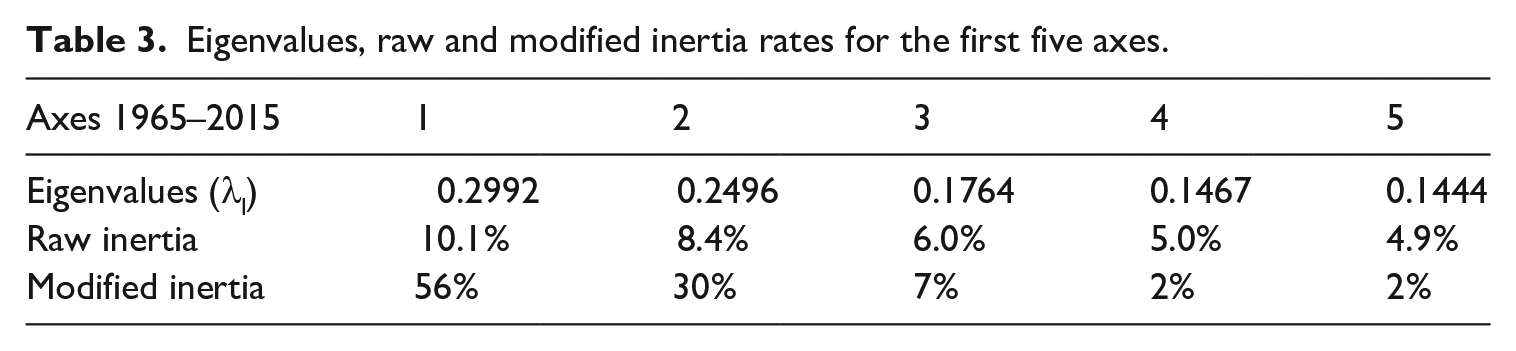
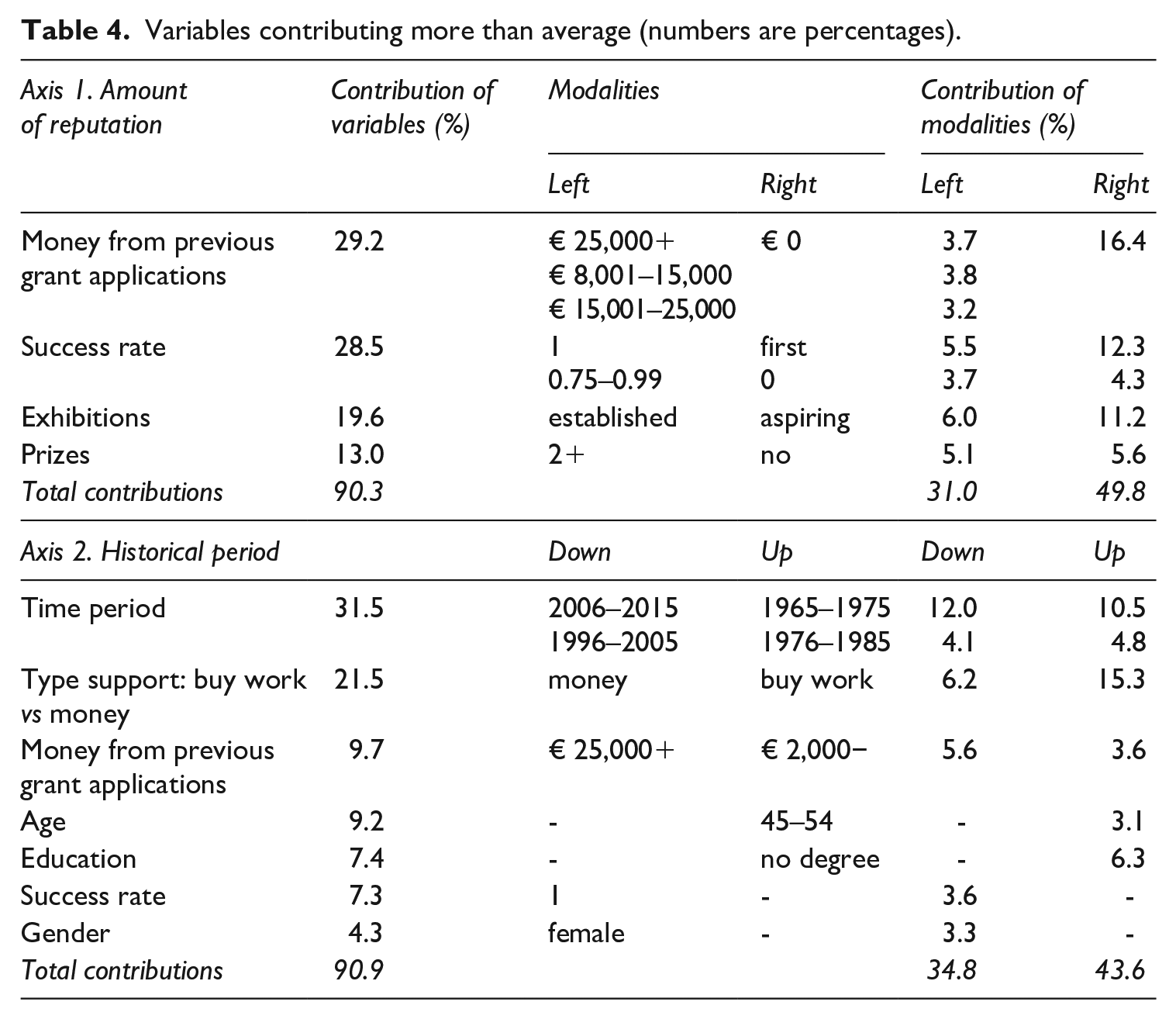
Table 4 and Graph 1 show the modalities of the active variables that contribute more than average to the orientations of the first two axes. Axis 1, the strongest dimension, represents the amount of capital artists dispose of. As such, it is a reputational dimension. Its left side depicts categories showing a solid reputation: having exhibited in prestigious galleries and art museums, having been highly successful in obtaining government grants, corroborated by having received a relatively greater amount of grant money and having won more than two prizes. So, the left pole houses renowned artists who achieved the highest reputation among grant applicants in three forms: exhibition reputation, grant reputation (in terms of proportion of successful versus unsuccessful grant applications and total monetary size of obtained grants), and prize reputation. Academic reputation (having a degree in the arts) is not related to high or low levels of other types of reputation. This is probably because most applicants (82%) have a degree in the arts.
Variables contributing more than average (numbers are percentages).
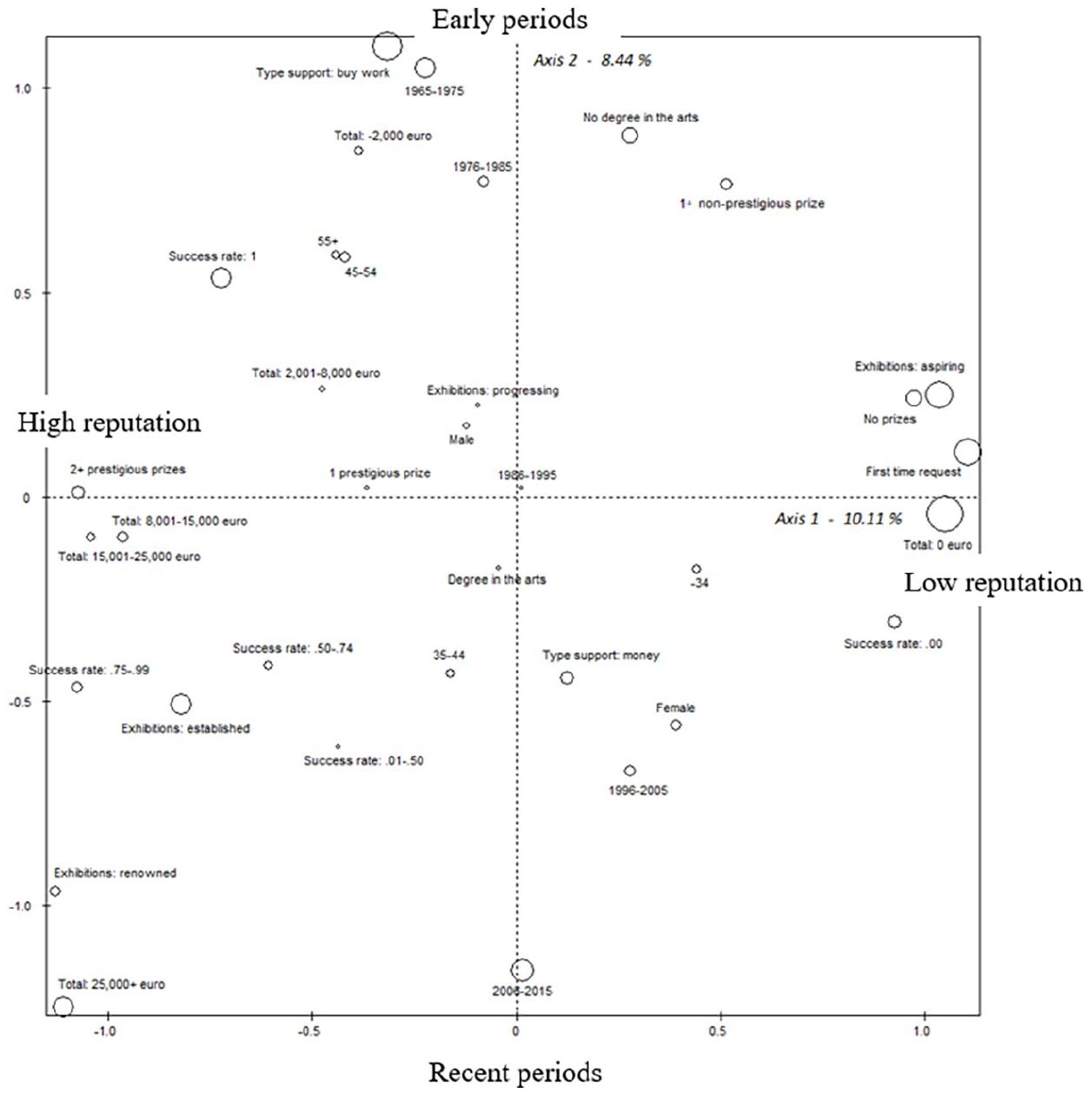
Cloud of modalities contributing more than average to plane 1–2.
On the reputational axis’ right side are categories associated with not (yet) having successfully built an institutional reputation: having had zero or only non-reputed exhibitions or prizes, having failed at previous attempts for grant money or applying for a grant for the first time, and having obtained zero euros in grant money altogether. We also see the youngest artists here (<34 years), showing that reputation typically comes with age. This pole of axis 1 thus houses aspiring artists, who score low on all types of reputation.
Axis 2 is a historical dimension: it opposes the most current period (2006–2015) at the bottom with the earliest period (1965–1975) at the top. At the bottom, in the most recent years, there are more female applicants and subsidies in the form of project money. Two reputational categories turn up structuring axis 2: having received a large sum of money (>25,000 euros in total) is situated close to the bottom, having received a small amount (<2000 euros in total) at the top. This confirms the status of grant size as a measure of both field position and time-related ‘space of possibles’: the earliest years of cultural policy are characterized by grants in the form of purchases involving smaller sums of money (<2000 euros) given to autodidacts (no degree in the arts) and the oldest grant applicants. Applications were often successful during the earlier period (reflected in the 100% success rate). The large sums of money and lower success rates in recent periods and the small sums of money and high success rates in earlier periods reflect the opposition between two differing ‘spaces of possibles’. Firstly, an inclusive early cultural policy (1965–1995) that distributed small grants for reputed as well as struggling artists, and secondly, a professionalized recent policy (1996–2015) that sought to professionalize the Flemish art field by distributing only relatively large grants to ‘excellent’ artists.
Supplementary Variables: Justificatory Strategies
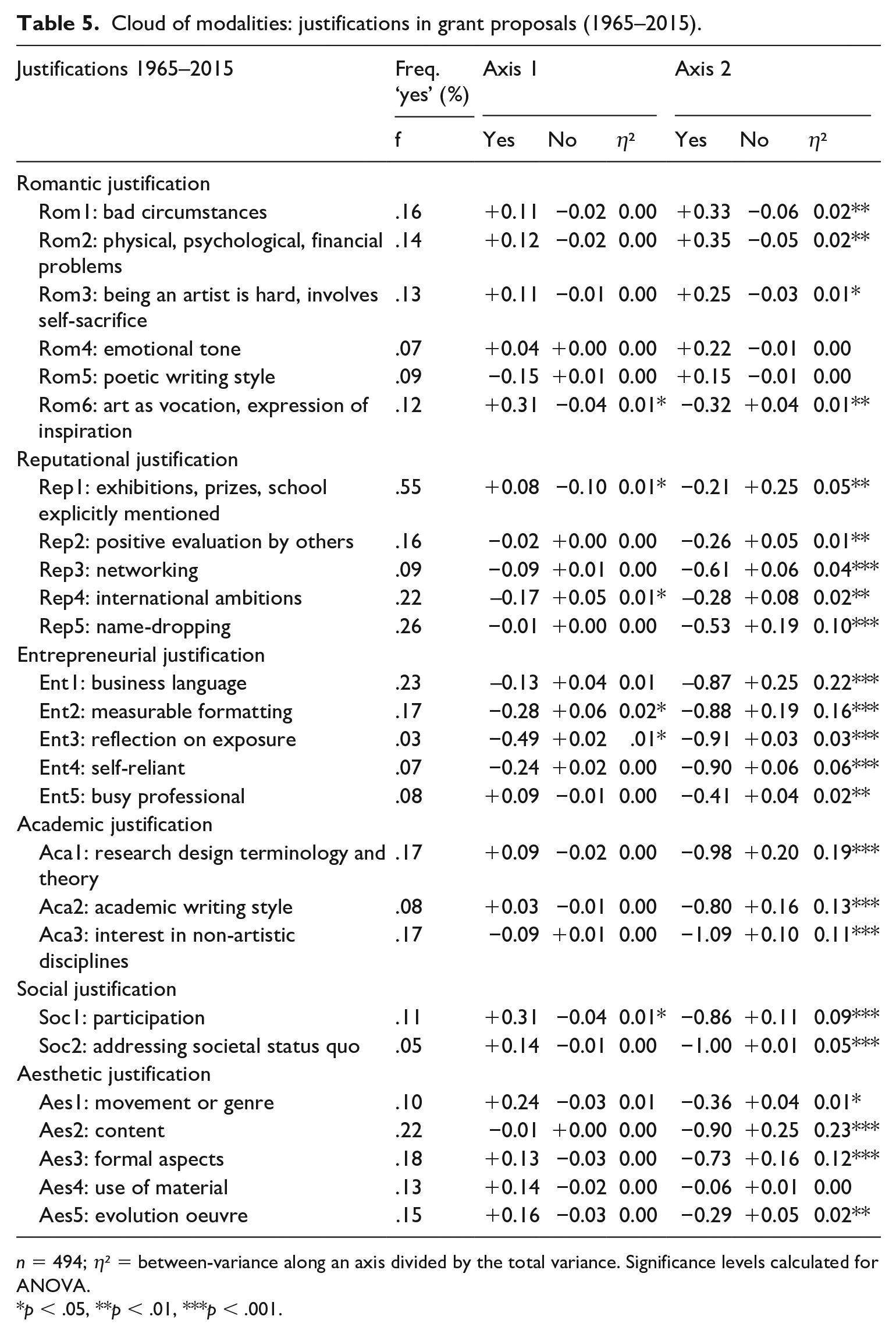
With Table 5 and Graph 2, we present the core of our analysis: they show the positions of each of the codes making up the six justificatory strategies used in grant proposals on the reputational and historical dimensions (axes 1 and 2). The codes are supplementary variables, meaning that they do not contribute to the structure of the space. We consider distances between the positive and negative codes along both axes (e.g. between Aes2: content+, and Aes2: content−), which indicates the general absence or presence of one particular code due to reputational differences (axis 1) or historical developments (axis 2). We also look at distances between different codes along the axes (e.g. between Aes2+ and Rom4−). The longer the distances between codes along a dimension, the more significant their difference and the more they are associated with reputational or historical variance. Deviance measures should be at least 0.5 to be considered ‘notable or moderately large’ (Le Roux and Rouanet, 2010: 59); measures of 1 and over are ‘large’ (Robette and Roueff, 2019: 119). When the logic of ANOVA is applied to the scattering of individuals along each of the axes for each category of a code (see Table A1 and Graph A1 in Appendix, with Ent1 as an example), η² (eta-square) is obtained. It measures the amount of variance explained in the scattering of individuals around the modality mean points by each axis (Ent1+ and Ent1−). In other words, the η²s in Table 5 indicate the amount of variance ‘explained’ in each label by the two axes, respectively.
Cloud of modalities: justifications in grant proposals (1965–2015).
n = 494; η² = between-variance along an axis divided by the total variance. Significance levels calculated for ANOVA.
p < .05, **p < .01, ***p < .001.
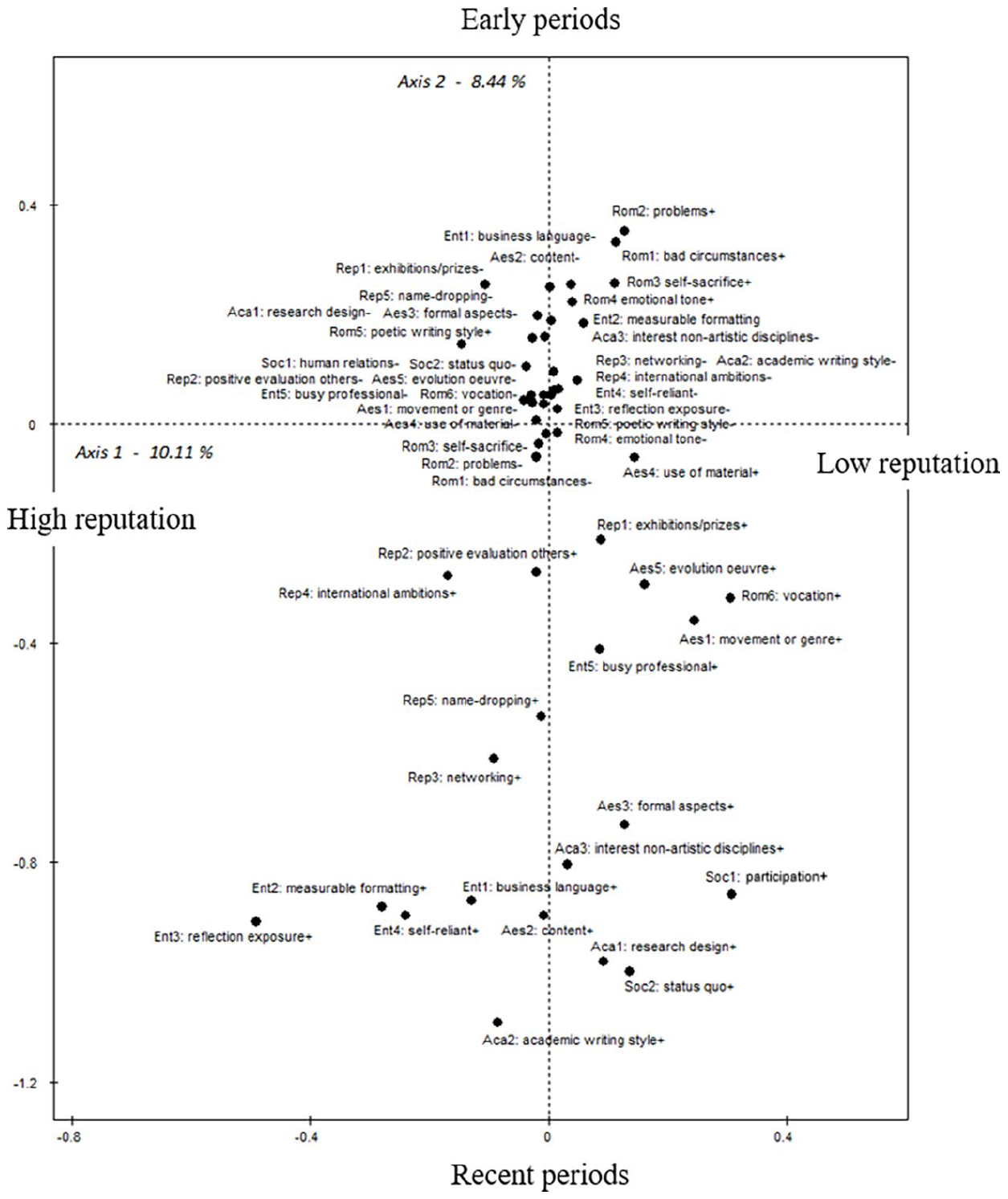
Cloud of modalities with supplementary variables: justifications in artists’ grant proposals (1965–2015).
In general, one can see that the codes align along the historical dimension (axis 2). There is considerable variation here: 10 distance or deviance measures between positive and negative code values are around 1 (from 0.90 to 1.19). So, justificatory strategies in proposals differ strongly between early and recent periods. First, the earliest historical contexts (top of Graph 2) are characterized by a relative absence of justificatory discourse, evident from the abundance of minuses. 1 Also, codes from the romantic justification that emphasize the applicant’s experienced hardships (Rom1, Rom2 and Rom3) are used considerably more in the earlier decades, fitting with the historical context in which art for art’s sake values still held sway in the art field, and cultural policy included social welfare goals.
Secondly, slightly south of the X-axis, six codes are prevalent at any point in time – they are situated near the centre of the axis – but somewhat overrepresented in more recent historical contexts compared to the romantic codes of earlier periods. These are: flaunting past exhibitions and obtained prizes (Rep1+); mentioning positive evaluations from others (Rep2+); showing international ambition (Rep4+); discussing the evolution of one’s oeuvre (Aes5+); framing the artistic profession as a vocation (Rom6+); and emphasizing that one is a busy professional (Ent5+). So, the romantic strategy, which prevailed in earlier years, has not wholly disappeared: the elements that express suffering and sacrifice have gone, but more contemporary applicants still used its vocational component.
Thirdly, more to the south, there are three codes tied to more recent situations: name-dropping key individuals from the art field (Rep5+); showing one is networking within the field (Rep3+); and discussing formal aspects of artworks (Aes3+). And finally, the labels positioned most towards the most recent period are: showing interest in non-artistic disciplines (Aca3+), reflecting on participatory values (Soc1+), using business language (Ent1+), measurable formatting of the proposal (Ent2+), emphasizing one’s self-reliance as an artist (Ent4+), reflection on exposure (Ent3+), discussing the content of one’s artworks (Aes2+), applying a research design (Aca1+), addressing the social status quo (Soc2+), and using an academic writing style (Aca2+). This justificatory transformation towards more heteronomous (entrepreneurial, academic, and social) strategies coincides with major shifts in the space of possibles starting in the early 1990s. Flemish cultural policy moved from artistic excellence and social welfare criteria to increasingly valuing professionalism, entrepreneurialism, and social impact-driven artists. Around that time, the visual art field also increasingly focused on incorporating heteronomous values, such as politics and research.
In contrast to the large variation in justificatory strategies along the historical dimension, strategies only slightly fan out along the reputational axis. This minor diffusion instantly shows that generally, the strategies artists use vary little with their reputations. Importantly, codes on the reputational axis can only be sensibly compared when they are at similar coordinates on the historical axis, since, for example, artists who used the vocational code (Rom6+) around the mid-1990s could not have been struggling over grants with artists reflecting on the exposure of their work (Ent3+) in the mid-2000s.
We see that until the mid-1990s, artists’ reputations are not notably associated with justifications at all. This lack of relationship could be partly due to the overall lack of justificatory discourse in proposals during early periods. Nevertheless, there is some notable variation along the reputational axis in more recent periods. Although there is little variation between the negative and positive values of codes here, there is a notable difference between several codes from entrepreneurial and social strategies. Firstly, renowned and reputed artists in recent periods had a higher probability of reflecting on how they can make their work known to an audience (Ent3+) and were far removed from artists who stress the participatory value of their art (Soc1+) or criticize the status quo with their work (Soc2+). Secondly, artists who used academic strategies, especially incorporating a research design in their work (Aca1+), were more likely to be more lowly reputed than artists using entrepreneurial strategies. Thus, there is an interaction between reputation (axis 1) and the historical context (axis 2): the applicants who introduced the social (Soc1+ and Soc2+) and academic (Aca1+) strategies in grant discourse during the mid-1990s, were those with a relatively low reputation. This finding connects to Bourdieu’s idea that in the struggle for capital, less reputed artists are most likely to bring in new position-takings to penetrate the established order (what he called ‘heresy’). Interestingly, the entrepreneurial strategy (Ent3+) was also novel at this time, but introduced precisely by more reputed artists. Rather than a form of heresy, it seems to be an offspring of progressing neoliberal thinking in cultural policy (i.e. the space of possibles). The fact that it is used by highly, and not lowly, reputed artists is probably rooted in the fact that these artists have a name they can promote and establish further in the art field.
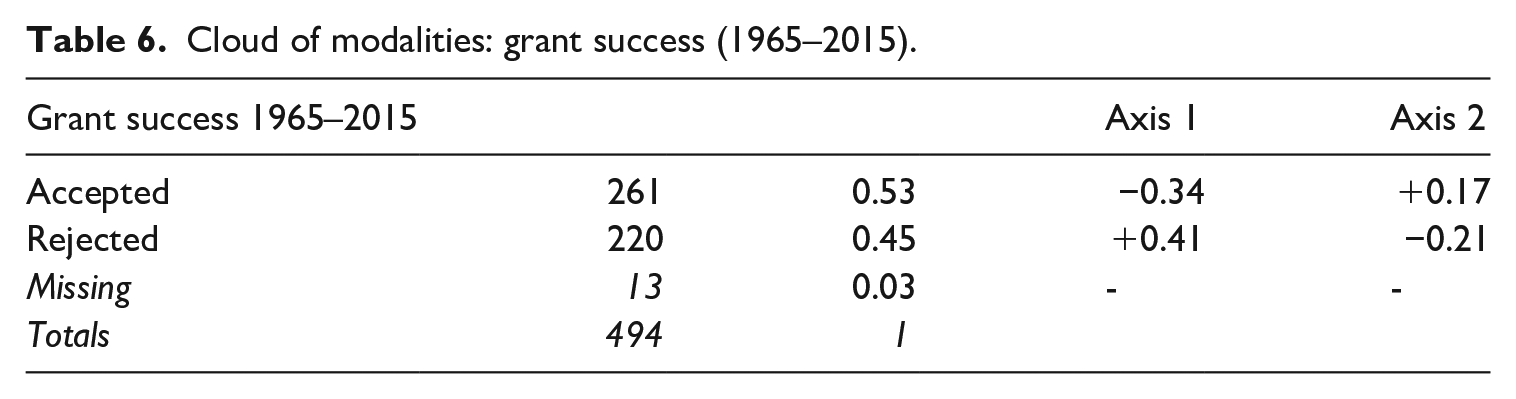
Considering that the reputational axis is the most important structuring dimension of the MCA, it is striking that there is little association between reputation and justificatory strategy, that is, between position and position-taking. Indeed, applicants vastly differed in reputational standing, and the reputational dimension does correlate with whether or not artists obtained a grant (see Table 6). The distance between being accepted by the committee and being rejected is 0.75 along the reputational dimension. Along the historical dimension, the difference is 0.38. So, the first axis, which stands for reputation – in terms of government money received previously and the number and prestige of exhibitions and prizes – is predictive of success in obtaining a government grant (also see Peters and Roose, 2021).
Cloud of modalities: grant success (1965–2015).
Conclusion and Discussion
Motivated by Bourdieu’s insistence that position-takings are a combination of agents’ field positions and the ‘space of possibles’ in which they are expressed, we set out to address in what ways and how much artists’ justificatory strategies for obtaining government grants are affected by historical evolutions in the field of art and cultural policy on the one hand, and by applicants’ field positions on the other. Through an MCA of 494 grant proposals of visual artists in Flanders between 1965 and 2015, we observed that justificatory strategies in grant proposals varied especially strongly and frequently with historical period, and only slightly with field position.
During earlier years (1965–1985), when cultural policy included social welfare goals, and the visual art field was dominated by art for art’s sake values, proposals relied predominantly on romantic strategies – especially those elements of the strategy that emphasize artists’ personal hardships and self-sacrifice for the arts. In more recent times – particularly from 1996 onwards – applicants were far more likely to use heteronomous (academic, socially engaged and entrepreneurial) strategies and abandoned the suffering artist discourse. This shift was not only in line with changes such as the social (Bishop, 2006) and scientific turns (Peters and Roose, 2020; Laermans, 2018; Schinkel, 2010) in the art field at the time. It also coincided with a major change in Flemish cultural policy in the early 1990s, namely, its increased focus on heteronomous values such as entrepreneurialism and social impact, and banishment of its former reliance on social welfare considerations for the evaluation of artists’ proposals.
The observed shift towards more heteronomous justificatory strategies among grant-applying artists does not imply that applicants more recently have dropped autonomous principles: aesthetic and reputational strategies, which make reference to characteristics of artworks and symbolic capital from the art field, were used by applicants in any period. Even the romantic strategy, which became decidedly less popular as the years went by, partially survived in the form of vocational legitimations. This underlines the persisting centrality of an innate drive for artists to make art – even when they also use entrepreneurial strategies, which may at face value seem at odds with romantic values. So, while the suffering artist trope went out of vogue, the romantic experience of an artistic calling continued to be embraced.
Even though Flemish grant-applying artists differed substantially in reputation, justificatory strategies hardly varied with applicants’ field positions. However, the ways in which strategies did vary with field position, are telling. Supporting Bourdieu’s idea that newcomers and ‘rejects’ in the art field seek to penetrate the existing order through new types of aesthetics and aesthetic legitimations, it was the artists with relatively low reputational standings who introduced some of the social and academic strategies into grant proposal discourse in the mid-1990s. Higher reputed applicants made use of entrepreneurial discourse, which was also novel at the time but which confirms the (neoliberal) status quo rather than challenging it.
The overall small degree of variation in justificatory strategies with field position indicates that artists largely adapted their justifications to pressures from, or possibilities offered by, the historical situation – i.e. the space of possibles – in which they applied. It suggests that when artists assume the role of grant applicant, they fine-tune their strategies to the constraints imposed by the art field and cultural policy. Hence we underwrite Bourdieu’s insistence that scholars ought ‘to condemn the inclination [. . .] to reduce [his] model [. . .] to the mechanical and mechanistic mode of thinking in which inherited capital [. . .] determines the position occupied, which in turn directly determines prises de position’ (1983: 345, footnote). Whereas a field position-bound habitus determines the range of position-takings (i.e. strategies) an agent can deploy, the preferred strategy is determined by the specific situation it is used in.
Interestingly, although French pragmatists are seen as some of Bourdieu’s harshest critics, Bourdieu’s idea of the space of possibles strongly resembles Boltanski and Thévenot’s (1999) concept of ‘limited plurality’, the idea that agents possess a socially determined package of justifications from which they draw depending on the situational demands. Both theoretical ideas in turn have strong connections to the concept of genre in rhetoric theory, defined as a ‘rhetorical ‘response’ to situational ‘demands’ perceived by the rhetor’ (Miller, 1984: 152). The ‘cultural rationality’ engaged in by grant applicants in this highly strategic situation is a ‘means for mediating private intentions and social exigence’ (Miller, 1984: 163–165). In other words, when seeking to obtain institutional money for one’s personal ambitions, artists pertain to the contemporary conventions of grant proposal writing. Thus, the grant proposal seems to be a genre that can be mastered both by non-reputed as well as reputed artists, a genre that changes over time due to changes in cultural policy demands and new justifications brought in by lowly reputed or newcomer-artists who seek to settle in the subsidized art field. Of course, the current study is limited to the analysis of the way artists chose to eventually present themselves to the committee and therefore cannot determine if and how applicants deliberately anticipate and respond to values in cultural policy. Interviews with grant-applying artists can shed light on these questions.
The observed isomorphism between artistic discourse and cultural policy in grant proposals may well have intensified since 2015, the limit of our current study. The tools artists possess for grant writing are continuously expanding. Not only are there countless step-by-step writing guides, proposal formats, and examples of successful grant proposals online, there are businesses and individuals in Europe and the USA that make a living by ghost-writing grant proposals for artists, and as such are liable to write in a predominantly strategical manner. The increased likelihood that rather than writing their own grant applications, artists outsource the grant writing to professional writers may well matter for how and how much the idiosyncrasies of artists, but also values from the art field in general, are part of the subsidized art discourse. Indeed, considering artists’ socioeconomic realities were not only precarious in the past but are often still economically insecure today (Abbing, 2008; Siongers et al., 2016), the disappearance of the types of romantic strategies that express suffering and a need for help combined with the rise of entrepreneurial strategies is likely attributable to the expansion of neoliberal ideology that dictates artists should be self-reliant entrepreneurs, rather than to an actual amelioration of artists’ socioeconomic positions.
Footnotes
Appendix
Coordinates in Cloud of Modalities, Cloud of Individuals and breakdown of variance for Ent1, or ‘the use of business language’.
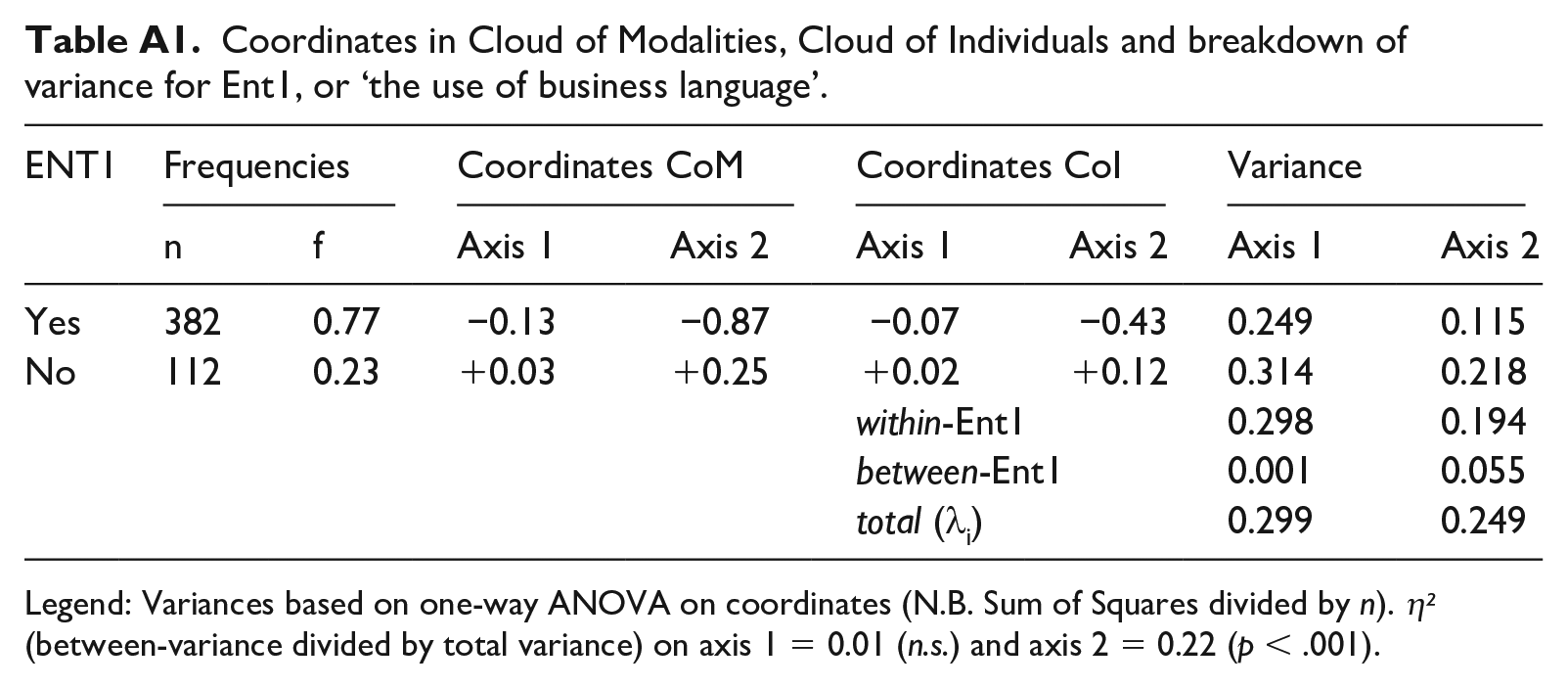
| ENT1 | Frequencies | Coordinates CoM | Coordinates CoI | Variance | ||||
|---|---|---|---|---|---|---|---|---|
| n | f | Axis 1 | Axis 2 | Axis 1 | Axis 2 | Axis 1 | Axis 2 | |
| Yes | 382 | 0.77 | −0.13 | −0.87 | −0.07 | −0.43 | 0.249 | 0.115 |
| No | 112 | 0.23 | +0.03 | +0.25 | +0.02 | +0.12 | 0.314 | 0.218 |
| within-Ent1 | 0.298 | 0.194 | ||||||
| between-Ent1 | 0.001 | 0.055 | ||||||
| total (λi) | 0.299 | 0.249 | ||||||
Legend: Variances based on one-way ANOVA on coordinates (N.B. Sum of Squares divided by n). η² (between-variance divided by total variance) on axis 1 = 0.01 (n.s.) and axis 2 = 0.22 (p < .001).
Funding
The authors received a BOF-fund (Bijzonder Onderzoeksfonds) with code 01J09915 for the research, authorship, and/or publication of this article.