







Abstract
Accession to the European Union (EU) aroused diverse emotions in public debate among citizens, but the everyday experience of being an EU member is much more difficult to narrate than by relating to two contrasting views for and against European integration. The situation becomes more complicated if we analyse the emotional responses of Polish farmers, for whom joining the EU has been one more change in the last two centuries: the fall of feudalism, the agricultural reform after the Second World War, and the post-1989 political transformation. We aim to analyse personal narratives while observing how feelings about the EU have become embedded in everyday life experience narratives and how they are expressed and managed in a socio-cultural context. The presence of contradictory views was expected, as was the appearance of a combination of emotions and indifference, and, finally, the use of emotions as resistance. Based on the analysis of 55 memoirs from 1918 to 2018, we have determined the possible types of the integration experience; firstly, Poland’s accession to the EU meant change and was associated mainly with positive emotions, secondly, with negative emotions, thirdly, it meant change, and was associated with ambiguous emotions; and lastly, it did not mean a change. We noted not only the contrasting positions e.g. hope and fear but also the mixture of emotions and various paths of resistance that included demonstrating the inadequacy of the master narrative to personal experience or neutralising it but also filling the intermediary space between two opposite views and finding a way out from this opposition to the higher level of division and thus narrating non-change. It is the sense of personal dignity and permanence that negates the perception of accession as a change.
Keywords
I have a distrust that allows me to survive. I don’t talk to strangers, so get out of my village. I’m tired and I sit on my bench, the last one in the village. [. . .] sit down on the edge. I sit in the middle. I am the king of this bench, remember. Everyone knows it and slides into me. I’ve been gobbling it up for fifty years, and I’m not giving it up for union, schengen [!] and forestry subsidies. This bench has been around for as long as I can remember. Not the same, because when one suffered the ravages of time, a new one immediately appeared in its place. But still the same. Grandpa nailed these benches together himself and installed them himself. Because Grandpa liked to bask in the sun. Because grandpa liked to watch his farm. [. . .] That bench is no longer there. The house is gone too – lost to modernity.
Introduction
Although the topic of European integration is an emotive issue in public life in most countries, scholars indicate that Europeans do not ‘feel’ the European Union – the essence of this institution cannot be emotionally experienced, as it cannot be easily transposed in everyday life experience, which may cause the indifference of the inhabitants, and more often, uncertainty (Verbalyte and Scheve, 2018). Creating or finding a new European ‘grand narrative’ (encompassing a variety of national stories or helping a new one emerge on the post-national level) (Eder, 2009; Thiesse, 2019; Verbalyte and Scheve, 2018) that would portray a new European identity could contribute to building the emotional image of this supranational economic organisation. However, researchers note instead a ‘profusion of narratives around the European Union, showing that integration is not understood the same way by all and that its complex nature leads to diverse narratives about its past, present, and future’ (Gellwitzki and Houde, 2022). Rural inhabitants are one of the social groups that might be considered an important research topic. European agriculture in the modern era underwent major structural changes for nearly 50 years (European programmes, being only one example of it), preceded though by: the demise of the Soviet Union and finally of any plausible socialist model of development; and the ideological and political ascendancy of neoliberalism in a highly selective rolling back of the state, including the structural adjustment programmes, economic liberalisation, and state reform/good governance agendas imposed on [. . .] the former Soviet bloc. (Borras, 2009: 5–6)
According to the Polish scholar Izabella Bukraba-Rylska (2014: 65), the countryside especially needs a narrative that would allow the adoption of the changes succeeding the EU accession. She averred that a response for the lack of a more general view of the process of European integration, as assessed by the rural environment, should be a broader research framework ‘with the added advantage of referring to longue durée processes and to a wider area than just Poland’. Her suggestion was ‘to see the EU as another version of the ‘large-scale farming’ project in European history, similar to others (e.g. Mitteleuropa, Paneuropa or Grossraumwirtschaft)’ (2014: 78). We aim to analyse the personal narratives of Polish farmers while observing how feelings about the EU have become embedded in the narrative of their everyday life experiences in the post-accession Poland and how they are expressed and managed in a socio-cultural context. Exploring the deeper, emotionally loaded dimension of European integration from the perspective of rural inhabitants could undermine the intense polarisation of attitudes, visible prima facie, and, possibly, present the dynamics of creation of a searched ‘grand narrative’ 20 years after entering the EU concerning its role comprising various emotions.
European Integration as Social Change – Central European Perspective and Socio-economic Circumstances of Polish Accession
Poland’s accession to the EU occurred in 2004 as part of the so-called major enlargement. The consequences for the countryside discussed in this Polish case can be seen from a dual perspective: of countries of the previous enlargements that subdue the transformation of earlier years and post-communist countries. Among the first group, Spain’s socio-economic characteristics (‘agriculture representing a higher percentage of the gross national product than it does in other countries of the European Union and with an income per capita below the average for the EU, Spain’s economy being more affected by CAP, and receiving more development funds from Brussels than do Germany and the United Kingdom’, Medrano, 2010: 45) bring it closer to Poland and reveal some common supranational features. For Spanish citizens ‘the Common Agricultural Policy [is] a source of dissatisfaction, and aid received from the European Union [is] a source of satisfaction’, as on the one hand, they demonstrate ‘an absurdity, that is, the setting of quotas on certain farm products, such as milk or olive oil, even if farmers get monetary compensation in exchange’, and on the other, they admit they ‘were quite happy with the Cohesion and Structural Funds that have been flowing to Spain from the European Union’ (Medrano, 2010: 45). Herzog and Tucker (2009) gave the example of Estonia as a country in which fear of the EU means, inter alia, paradoxically, fear of backwardness, as the transformation reforms were far-reaching in this country; therefore ‘the size of the gap between winners and losers might also tighten a bit’ as some winners may oppose EU membership. ‘One Estonian opponent described the EU as ‘a Soviet Union in disguise’ that will force the country to deliberalize its progressive economic policies, including a zero-percent corporate income tax’ (241). As Gorlach (2006: 27) observed, ‘Under post-communist reality, globalisation seemed to be a major source of fear. But at the same time, the possibility of joining the European Union [. . .] formed the counterbalancing platform of hope’.
The underinvested Polish countryside, with its fragmented agrarian structure and a surplus of agricultural workers, was to become one of the main beneficiaries of integration; at the same time, the course and consequences of the process aroused the fears of politicians and farmers. In the pre-accession period, the difficulties concerning the functioning of one market for the economically significant, but dispersed and heterogeneous farming population of Europe were vividly described thus by Andreas Bodenstedt (1998: 114): ‘It is probably easier to establish a common European Parliament or to build a thoroughfare through a tunnel under the Alps than to find for all these ethnically and culturally diverse communities a common way to live in flourishing prosperity’. Dilemmas between ‘catching up’ and ‘backwardness’ resulted in political agitations and media debates of politicians and scholars to convince Polish people of the great opportunity their country’s accession to the EU represented for farmers, that is, the chance to develop and modernise the Polish countryside. On the other hand, violent farmers’ demonstrations expressed fears founded on ‘policy Euroscepticism’ regarding the transition to the market economy as an economic loss and ‘national identity Euroscepticism’ involving standing up for the perceived national interest and considering the EU as ‘a civilisation of death’ (Tucker et al., 2002: 567–568). The coexistence of two contrasting narratives may remind us of ‘cultural trauma’, as society was mobilised to discuss and contest the issue; thus, it perceived entry into the EU as the event causing tensions needing removal. Though it was introduced first by Sztompka (2000) for the description of the post-1989 phenomenon, a line of continuity in the Polish positions towards social changes seems to be culturally conditioned.
Over the last two centuries alone, the Polish countryside has experienced the fall of feudalism with the enfranchisement of peasants (which profoundly transformed the many centuries-long social structures), the agricultural reforms after the Second World War, and the analysed political transformation and entry into the EU. The processes of change encompassed various aspects of rural residents’ lives related to mentality, economy, landscape and infrastructure. They were accompanied by the acceleration of the literacy process at the turn of the nineteenth and twentieth centuries and were additionally entangled with national issues (the process of shaping the national peasant identity during the partitions and after Poland regained independence in 1918).
Attitude of Polish Countryside Towards Changes
After 15 years of membership, rural residents’ attitude towards the European Community was described as ‘stable, decisive acceptance’ (Fedyszak-Radziejowska, 2020: 70). However, before Poland’s inclusion in the EU structures, demoscopic studies indicated fluctuations in social moods in rural areas, depending on the economic situation, the moment of the natural cycle or the assessment of the current political situation in the country, with a particular decrease in optimism in the crucial season of 2003/2004 (Fedyszak-Radziejowska et al., 2004). The broadly understood mistrust (‘that allows me to survive’, we may add) towards what is foreign and new had its roots both in the historically distant, but still mentally alive, the legacy of serfdom, as well as in the recent painful experiences with the free market after 1989. The socio-economic transition in 1989 was considered by rural communities as ‘one more partition of Poland’ or the elites’ conspiracy against the Polish countryside (Tosiek, 2022). Due to the higher socio-economic costs of political transformation in the countryside than in the city, ‘a large part of farmers and rural residents, not without reason, considered themselves ‘losers’ of the transformation process’ (Wilkin, 2004: 7). According to Tucker et al. (2002: 557–559), ‘for post-communist citizens, membership in the EU can function as an implicit guarantee that the economic reforms undertaken since the end of communism will not be reversed’ and ‘losers’, hurt by the transition, ‘will oppose this step’. ‘Polish accession launched the historical fear of losing sovereignty’, as, in contrast to Western European countries, in Poland, the ethnic minorities or immigrants are not perceived as great a threat as other countries (mainly Germany and Russia) as well as international organisations like the EU (Lipiński and Stępińska, 2020: 38). There was a fear of modern colonisation – the purchase of land by foreigners and the necessity of working for them (Roguska, 2000). In the internally diverse group of farmers, the creative optimists could be distinguished, as more easily adapting to change, and ‘a mass of passive people with a sense of harm and confusion’ (Perepeczko, 1995: 222). Remembering change(s) is hence an important factor influencing the process of adjustment to European integration.
Andrzej Kaleta (2021) points out a certain paradox: in the pre-accession period, a fuller and more complex picture of European integration was drawn; for instance, the effects of integration on the socio-professional structure in the countryside were debated, and the concerns of the rural population and their state of knowledge were analysed. However, in the post-accession period, ‘the integration process in the countryside and agriculture was reduced to the transfer of money, serving only the realisation of narrowly and extremely mercantile economic interests [. . .]’ (Kaleta 150–151). This narrative about financial profits, modernisation and material goods – an important tool in the hands of those favouring European integration – has not responded to all emotional reactions, especially the fear of losing spiritual values such as losing sovereignty and national identity, fear of modern colonization as mentioned earlier, characteristic of those against European common policy. This situation corresponds to the view that ‘Europe needs a different story than that of exchanging goods through the medium of money’ (Eder, 2009: 434). In other words, this story should also relate to the emotional aspect of European citizens’ everyday life.
Theoretical Background
Emotions and European Integration
The theme of emotions related to European integration is raised in the survey research focusing on citizens’ attitudes towards the EU. The various notions signifying emotions are evoked in the questions asked, often already divided into positive, negative or neutral emotions, such as hope, fear, anger, resentment, threat, shame, pride, fear, enthusiasm, hate, indignation, and uncertainty, inter alia. What can be observed in such research is not only the variety of emotions considered but also their polarisation, often included in catchy phrases, e.g. the Polish and other East European countries’ path to Europe, and – more widely – to development – was ‘the long way between the Scylla of hopes and the Charibda [sic] of fears’ (Gorlach, 2006: 27). The dualistic model (yes/no, good/bad) works well for plebiscites and referendums when specific decisions are to be taken. However, short, categorical answers do not capture the complexity of social emotions as a response to change.
Recently, we can observe the emergence of research that goes beyond the strict dichotomy, which unveils the more complex vision of emotions accompanying European integration; yet this is still done insufficiently, given the scope of this attitude and the analysis of its sources. For instance, the winners and losers split is further discussed by Herzog and Tucker (2009: 240), who ask whether ‘we can add some additional nuance to the picture by theorizing about how our expectations about the winners–losers hypothesis might vary over time’. According to Eder (2009: 439), ‘The story that is told about Europe is then a story in which the relations between the actors [of national stories] are at stake. Winners and losers [. . .] change positions and try to find a new position in an emerging European script’.
Apart from including in the research those who see both sides of the EU integration (see the Spanish example mentioned earlier) or observing how they switch their roles, we may note a deeper reflection on the mediatory phenomena. Herzog and Tucker (2009: 244) classified the responses of those who assessed their situation as staying ‘the same’ as the representants of ‘an intermediary category between being a winner or a loser’. Further, indifference, for example, arouses interest. In the research on the attitudes of the inhabitants of the rural and urban settlements in the Czech–Polish borderland, the majority of answers for the questions about the degree of a social threat after the entry into the EU on a 1–10 scale was 5 and the scholar termed this attitude as ‘neither hot nor cold’, concluding that ‘the entry into the EU is on the whole perceived by the inhabitants without bigger emotions’ (Václavíková, 2011: 57, 60). Whether the foundation for this ‘indifferent’ attitude is the lack of intensive emotions or has an emotional layer too, is a crucial question.
Another possibility of widening the reflection on the emotions concerning EU integration is to observe not only their polar opposite character as well as an intermediary but also their combination. The emotional mixture is the phenomenon that surpasses the dichotomy and opens the way to a new ‘alternative structure of feeling’ – ‘hope mixed with fear, and contempt mixed with hope, also constitute frequent emotional mixes directed towards an opponent’ (Flam, 2005a: 33). It was noted inter alia in the Polish context of dockside workers’ protest in the 1980s: ‘they hoped to be heard, but feared that they would not be’. On a more detailed level, that is, one of the emotions discussed not only in the European integration context, Barbalet proposed the third possibility of fear response, in between escape and rebellion. Besides the ‘fight and flight’ dichotomy he proposed ‘containment’, describing it as ‘an attempt to limit or redirect the source of fear’ (Barbalet 2001: 5). According to the scholar, non-elite groups too are able ‘to deploy resources in the containment of negative prospects perceived as constituting a threat to their interests and responsible for a feeling of social fear’, that leads to ‘innovation and development’ that ‘divert the threat of the other, enhance the subject’s own capacities and generally realign power relations and render innocuous the prospects which were feared’ (Barbalet 2001: 169).
Emotions in the Personal Narratives: Elaboration and Resistance
Concerning any reflection on the attitude of the rural population towards European integration (usually such surveys were concerned with the whole Polish population), the question was rather limited to reflecting the satisfaction of material needs and equalisation of opportunities. The impact of European integration on their day-to-day, wide-ranging experiences was not addressed. Our research aims to unveil the emotional side of the process of European integration for rural inhabitants through their personal stories that preserve the memory of the past, as well as details of daily duties and hope for the future. Thus, their narratives trace emotions connected with social change and everyday life simultaneously, the point at which two opposite forces meet: In modernity, the everyday becomes the setting for a dynamic process: for making the unfamiliar familiar; for getting accustomed to the disruption of custom; for struggling to incorporate the new; for adjusting to different ways of living. The everyday marks the success and failure of this process. It witnesses the absorption of the most revolutionary of inventions into the landscape of the mundane. [. . .] But signs of failure can be noticed everywhere: the language of the everyday is not an upbeat endorsement of the new; it echoes with frustrations, with the disappointment of broken promises. (Highmore, 2002: 2)
Personal narratives are understood in our research as ‘derived from a balance between master narratives’ (McLean and Syed, 2015: 324); in other words, they are understood ‘as a dynamic between competing master and alternative narratives’ (McLean and Syed, 2023: 57). Master narratives ‘exist at the societal/cultural level’ and ‘provide the frame and the material to form one’s own identity narrative, serving as the ready-made option for how to construct a meaningful and productive life within a society’ (McLean and Syed, 2015: 325). In the initial model of this framework, the presence of one master narrative and the possibility of constructing or finding alternatives by the individuals was envisioned ideally. However, recent studies feel that ‘Culture is multi-layered and cannot be reduced to a single master narrative that is either resisted or adopted’ (Hochman and Spector-Mersel, 2020: 15). It corresponds with the situation of focusing on the intermediary categories, usually less discussed that the polar opposite one. This theoretical research foundation is allowed due to ‘the idea of master narrative engagement as providing not just a framework for thinking about individual lives but also as a framework for thinking about social change’ (Hammack and Toolis, 2016: 352).
Highmore (2002: 17) indicates that we should not limit the everyday to reproducing that which dominates in social relations and encourages seeing ‘everyday as site of resistance, revolution and transformation’. Managing deviations, resisting master narratives and transforming them may assume various forms. The strategy of ‘the use of other master narratives to manage deviations’ (McLean et al., 2018: 644–649) implies the replacement of, for instance, one biographical master (focused on important life events and their order) narrative by a structural master narrative. Two structural master narratives described widely in narrative psychology are redemption and contamination sequence. The story of the redemptive self is ‘the one that moves from negative to positive, tragedy to triumph’ (McAdams, 2013). In contrast, the contamination sequence is an example of a structural master narrative in which people interpret their lives as going from good to bad and this negative experience ‘is described as overwhelming or polluting the preexisting positivity’ (McAdams, 2001). We found particularly relevant for our study the strategies mentioned by Hochman and Spector-Mersel (2020), of ‘navigating between various types of master narratives’, though applied by them in different national and historical contexts, namely, explicit debate, implicit debate, and neutralisation of the episodic master narrative.
Considering the role of emotions in this master narrative framework, we may see them as an element of the content of master and alternative narratives, for instance (often evoked in our research) oppositional hope and fear, pride of being European or pride of national identity, strong commitment to locality and fear of losing it, pride contra feeling of abandonment and inferiority. However, the place of emotions is not limited to the element of contention, as they may take a middle position as the mediatory factor or may even resist this polarisation, building a path of resistance. In the literature, we note the intriguing concept of emotions as resistance, through ‘creating and sustaining “sites of contestation” that challenge hegemonic emotional regimes’ (Schick, 2019: 261); the mentions about persons who ‘reflexively engage with their emotions to disintegrate from hegemonic emotional and cognitive norms’, ‘to re-examine areas where there are discrepancies between their politics and their emotional attachment to dominant discourses’ (Flam, 2005b: 9). This concept enables us to focus on not only ‘mass movements [that] challenge existing structures of power [. . .] it is also more than a strategic response of individuals to the workings of systemic structures in everyday contexts’ (Hynes, 2013: 572). According to Hynes, (2013: 573) resistance also has an affective dimension that operates beneath and between both individual and collective struggles – a more-than-reactive, barely recognizable, less-than-conscious mobilization of bodily potentials, which is an exploitation of the margins of openness in every situation, an activation of new capacities of bodies and an interruption of our more determinant modes of sociality.
From the formal view, Highmore (2002: 23) emphasises the textual, stylistic work done to catch the change in everyday life: ‘fashioning new forms (or tools) for apprehending new kind of experiences [. . .]’, ‘formal devices for registering a world that appears chaotic, disrupted and radically new’, thanks to which everyday can be comprehended in all of its ‘complexities and contradictions’. Amongst various possibilities, the scholar mentions making noticeable what usually passes unnoticed, for example using surprising juxtapositions and underlining the breaches and gaps as well as diversity of elements on the surface that appear homogenous. These remarks encourage adoption in our research not only thematic analysis but structural analysis too (Riessman, 2005).
Our Study
Data
We conducted a qualitative analysis of 55 farmers’ memoirs. We aimed to investigate the emotions in the personal narratives in the context of meanings and values connected to European integration in the Polish countryside. Though these emotions concern the huge socio-economic transformation, we focus on how they are felt and unveiled in everyday rural life. The basis for conducting the research was provided by the memoirs sent to the ‘One hundred years of my farm’ competition. The competition, announced before the celebration of the centenary of regaining independence, was organised in cooperation with the Institute of Rural Development and Agriculture of the Polish Academy of Sciences and the Polish Agricultural Publishing House (Michalska, 2018). This project is important for three reasons. First, it symbolically enhances the value of rural residents, who have been marginalised for years, including them in the national community in the context of an anniversary of national importance. Second, the main subject of interest is the traditional farm – a material determinant of peasant culture, perpetuating its image at the time of cultural change and its unpredictable consequences (Mencwel, 2017). Finally, it legitimises the research traditions of Polish sociology, based on personal document literature. It is worth recalling that the anti-positivist turn and the interest of humanistic sociology in the ‘subjective experiences of individuals’ contributed to the development of the method, and its origins are associated with the publication in the USA in 1918–1920 of a five-volume work by American William Isaac Thomas and Polish Florian Znaniecki (1976). In this ground-breaking work on world sociology, personal documents (autobiographies, letters, memoirs, diaries, etc.) were used for the first time in sociology as innovative source material, along with the introduction of a new research method called the personal document method, autobiographical, biographical, and sometimes Polish. The last term refers not only to the nationality of the method’s co-founder and promoter but reflects its phenomenal popularity in Polish sociology, as in its research, numerous competitions are commonly used to obtain empirical material. When the method was nascent, diary records allowed the ‘Great Stranger’ (as the writer Maria Dąbrowska called the peasants) to speak, because earlier, due to illiteracy and low social position, the vast majority of the Polish population were denied the franchise. Interest in research based on personal documents was marked by the centenary of a book (Thomas and Znaniecki, 1976) that was considered, along with five others in the social sciences, by The Science Research Council as the best known in the USA in 1937, and by 1939, had received 30 reviews in English and 10 in other languages (Kaleta, 2020).
To reach the possibly widest and most diversified group of people living in agriculture (potentially interested in participating in the competition), the advertisement for the ‘One hundred years of my farm’ competition was placed in magazines with the intended rural addressee: Tygodnik Poradnik Rolniczy, Gospodyni, Top Agrar Polska, Pod Osłonami, Warzywa i Owoce Miękkie, and Sad Nowoczesny. At the same time, although the press announcements referred to the competition rules, which were uniform in form and content, they differed in the length of the proclamation, the tone of the statement (familiar or impersonal, pathetic or casual), the degree of exposure and regularity of publication, the specification of guidelines and the hierarchy of expectations, and even the assumed addressee (the appeal published in Gospodyni encouraged adopting a female perspective in the memoirs). Though it is uncertain to what extent the place of publication of the announcement and the shape of the competition proclamation actually supported the intention of the organisers of the competition, and to what extent they excluded from participation farmers who rarely reach for the press or do not know the specific periodicals just mentioned. The project organisers did not suggest which facts of the last century to write about and which to omit. Unlike narrative interviews or life histories, the competitive diarism set an elementary framework for the memoirs (temporal, thematic), while leaving a degree of freedom in the choice of content, the level of detail, and the form of expression.
In response, 55 works were received, diverse in volume and form, including written statements (manuscripts, typescripts, printouts, sometimes with photocopies of official documents attached, films, photos and an A3 format album with handmade ornaments). In terms of basic characteristics (age, gender, place of residence, etc.), diarists are an internally diverse group. However, this does not undermine the cognitive value of the collected material. The presented research does not aspire to show strict relationships between variables like the acreage or production profile and emotions experienced. We wanted to select and specify them, to show the complexity and non-obviousness of the phenomenon. Although we consider the reproducibility of certain data interesting and worth explaining, the assumed contributory character and nonrepresentative nature of the research enforce caution in formulating comprehensive and extensive diagnoses. We conduct a micro-sociological qualitative study aimed at not only accounting for emotions but also focusing on their management, as, according to Theodore D. Kemper (1990: 5, 10, 16), ‘some of the central processes of macro-sociology are seen to rest on the long unappreciated micro-level foundation of emotion’ – in our case, the process of social change.
The awarded and distinguished works were published as a book after appropriate editing (Michalska et al., 2018). In our research, we used the entire collection of memoirs, which was deposited at the IRWiR PAN in Warsaw (the Institute of Rural Development and Agriculture of the Polish Academy of Sciences) in their original form. Our research emphasised the significance of the personal perspective on social changes. According to Sidonie Smith and Julia Watson, the memoirs ‘do not have the authority of official history’, but as subjective accounts of the public events, show ‘individual, less homogenic interpretation of the experience of historical change’ (Smith and Watson, 2010: 187). We considered memoirs as materials in which, unlike, for example, a questionnaire assessing emotions on a scale, the image of emotions will be vivid, linked to events, rich, multifaceted, and diverse.
We are aware of the shortcomings and limitations of the use of personal document analysis, which includes diaries. Criticism of the method has accompanied research practice since the beginning of the memoir movement and mainly concerns the risk of manipulation of facts (e.g. to win the favor of readers, and jurors, or to erase inconvenient content from memory), and the lack of clear guidelines on how to deal with raw material. Doubts are sometimes raised about the circumstances of writing down the accounts (especially those created, although no studies have indicated a significant relationship between financial rewards and the authors’ motivation) or the far-reaching consequences of applying the rules imposed by the organisers of memoir competitions (e.g. unlike diaries created spontaneously, limiting the number of pages may result in a forced reduction of content and loss of potentially valuable data). The analysed memoirs are, to the best of our knowledge, the unique source of the narrative approach to changes experienced by the Polish farmers; we did not find a similar corpus elsewhere.
Data Coding
The topic of Polish accession was broached in many of the analysed memoirs, though the time range of some of them does not reach 2017 as mentioned in the competition call (the last entries, for instance, pertain to the post-war period or the early 1990s). The form of the reality of this topic and its emotional elaboration varied. The coding of the data proceeded as follows. Each diary was read by both authors, who independently extracted and noted passages that could potentially be the study subject. If the diary contained units arranged chronologically, analysis encompassed all entries after 1 May 2004. In non-chronologically ordered texts, thematic links to the EU were sought (based on keywords and themes both general e.g. Europe, being European and detailed e.g. EU subsidies, Schengen). Therefore, the multi-stage process of selecting them considered parallel criteria, chronological and thematic. The nature and intensity of the experienced change (whether expressed explicitly or implicit in the structure of the farmstead’s history) were assigned to created, exhaustive and mutually exclusive categories (i.e. each comment referring to European accession and its consequences was placed in one and only one of the categories describing the impact of EU membership on the history of the farmstead). They defined generally positive or negative attitudes towards the EU (with an assumption of different intensities), and the internal differentiation of each group was determined by various emotions triggered by the change (with an assumption of dominance of one or more thereof). Importantly, the categories were constructed before the analysis of the diary materials (as per deductive coding practices and the two authors’ expertise in narrative analysis as literary scholars). The output categories were of a working nature, serving to organise the content at the initial stage of developing the material. However, as research progressed, they proved insufficient, not fully reflecting the distribution of emotions triggered by joining the Community. So as not to overlook the averaged qualities, an appropriate adjustment was made. New categories were added to those initially selected, thus preserving the principles of exhaustiveness, decouplability and specificity simultaneously.
Narrative Analysis
Participants reported that the post-accession period brought the change in their life experiences from good to bad and was connected mainly with negative emotions or, on the contrary, from bad to good, connected mainly with positive emotions. Further, participants admitted that the post-accession period brought both positive and negative changes in their lives, as elaborated in the narratives and was connected with unambiguous emotions. These situations enable the elaboration of oppositional master narratives in the personal narratives and the balancing between two master narratives. However, one more attitude was recognised, moving the discussion up to the higher level of experiencing change and non-change, as participants denied experiencing the accession as a change. We present first the most widespread Polish master narratives of European integration in the rural region and, secondly, various paths of escaping from them.
Good or Bad – Polarisation of Emotions
The most frequently explicite articulated emotion was fear – fear about the future of the state, the Polish countryside and the family (grandchildren), stemming from a sense of threat, lack of hope, loss of security, and, therefore a sense of enslavement. In my opinion, a healthy economy in agriculture no longer exists and will not exist for a long time, thanks to western aggression and interference in our economy and agriculture. (Memoir no. 41) When I started running the farm in 1976, the policy of Gierek and ministers Barcikowski and Wojtecki was clear – the path to the goal was set. There was hope, a willingness to work and satisfaction with what had been achieved. Today, the opposite is true – neither hope, nor faith in the future, nor a clear policy towards small farms. All sorts of subsidies, support and programmes mean that farmers do not work together but compete with each other – whoever is stronger and more cunning wins. The winner takes a lot, for the loser there is nothing. Whoever gets a few thousand in subsidies is a winner – whoever doesn’t get it doesn’t stand a chance. (Memoir no. 3) We are in thrall to the European Union without bloodshed. We are more enslaved than under communism. I am writing this because I am worried about my grandchildren. What awaits them? (Memoir no. 7)
Apart from a sense of fear, distrust and threat, and the bleak vision of the future – all recognised by Sztompka (2000: 79) as the symptoms of cultural trauma – what caught our attention is that these emotions do not arise from some specific situation in which the respondents found themselves, for example, from a particular event, but are part of a generalised reflection about the European Union (without even mentioning agriculture, as in the third extract just quoted) or about agriculture – the words ‘agriculture’, and ‘economy’ are mentioned, but not ‘me as a farmer’, ‘my farm’ or ‘my village’. There is talk of subsidies – but we do not know which ones, only that there are ‘all sorts of subsidies’. The present tense (‘Today is’, ‘We are’) projects into the future (‘will not exist for a long time’, ‘neither hope nor faith in the future’). The level of generality and the detachment from private history may suggest that this personal view is highly influenced by political and journalistic clichés.
Other emotions that stand out are a sense of injustice and unfairness, regret, uncertainty and being lost in bureaucratic red tape: Our parents ruled as they knew how, brought us all up, married and died [. . .] Honour their memory! The land has stayed in the family for now, not sure for how long, as many farmers around are selling for building plots, and a few are just developing, expanding, and taking EU money. (Memoir no. 26) [. . .] some people were scratching their heads: should they apply to the agency for EU subsidies or should they not let the EU trick them because the EU is sneaky, it will take an application from a farmer and it already knows what kind of a farm he has. It will be able to take back the farm. They’re not going to take that land away from us, are they? After all, we are nobody’s fools to be bereft and rejected [. . .] Despite our efforts, our sacrifices, our hard work, and our being sleepy, I still see black clouds over agriculture. (Memoir no. 54)
The sense of rejection – by Europe and the Polish state – also applies here to everyone, not just ‘me’. The fear of being cheated is also widely expressed.
The respondents understand that the transformation is ongoing. However, halfway through this journey, they feel disillusionment and loneliness: Unfortunately, the changes and transformations that have taken place in our countryside do not fully meet the expectations the Polish countryside had [. . .] It’s like pouring water from bucket to bucket: it doesn’t get any bigger from pouring, it just gets smaller along the way [. . .] When deciding to run a farm, I knew it was a long-term and expensive investment. I was and am convinced that there is no turning back from the market economy, and I realise that our Polish farms have had to go through many disappointments. I hoped that in this transitional period when we are in the Union, farmers would not be left alone and that our government would intervene and help. Hectare subsidies are not enough, we don’t want miracles for free. (Memoir no. 54)
Among the emotions articulated explicitly, the feeling that things are better, compared to how they were worse before, appears in only one diary. I have negative feelings about that time in my memory [from 2002, since the death of my father-in-law] because the children were young, there were not enough people to work on the farm and you had to face the problems on your own. At times, there were moments of doubt and a lack of strength. Over the years, the children grew up and started to help us. It was already easier; we developed the farm using the EU funds. We bought machinery, paved the yard, and built a new free-standing cow barn in 2010. (Kapturska, 2018: 82)
In this passage, we can already see that the feelings experienced by the individual are set in the context of events and their own actions: the growing up of children, their assisting in the work, and the use of the EU resources. This indicates a narrative interpretation of one’s own affairs, associated with predominant feelings of calm, with less frequent feelings of anxiety and shame, which are characteristic of a general reflection on the situation, abstracted from the course of events (Trzebiński, 2002). However, we can also observe this strategy as an example of collective identity expression: ‘Emotional ties such as the sense of pride and shame become important mechanisms for reproducing collective identities’: ‘To the extent that collective identities are linked to objects as their carriers, these objects become carriers of generalised emotions built into the object, into the image or texts. Such generalised emotions are embodied in what can be called “narratives”’ (Eder, 2009: 431).
Paths of Resistance
Mixture of Emotions
More often than unequivocally positive emotions, but much less often than unequivocally negative emotions, there is an ambiguous assessment of the change that was the entry into the EU: We still work on the same land my great-grandparents bought 100 years ago, but we work completely differently, with different methods on different equipment; we probably achieve better yields, and we have easier access to knowledge, and media. We are certainly living differently, but are we living better? This is a question I cannot answer unequivocally. Surely life used to be a little slower, perhaps with less rush under less stress. Hardly anyone remembers the meetings of the Rural Housewives’ Circles where the ladies shared their experiences, or the Farmers’ Circles where the gentlemen met. Now, the neighbours exchange polite ‘good mornings’ with each other and that’s the end of the meeting. Certainly, farm work has become lighter, no longer requiring as much physical effort from farmers as it once did. However, for the farm to function as it should, continuous planning is necessary. It is constantly necessary to keep up to date not only with agro-technical innovations but also with EU funds and subsidies, prices of cereal, crops and many other things that contribute to the operation of a profitable farm. (Memoir no. 40)
Everyday life has become sustainably easier; the changes consider the crucial aspects of rural life; and better results are achieved. The emphasis on work taking place ‘on the same land’ indicates the familiarity of this family with the fears present in the other diaries: of land being taken away and of having to yield it to foreigners. It reflects the uncontested values of peasant culture, such as ‘the land, the farm, and the family’ (Halamska, 2020: 151). Simultaneous with the change, a feeling of chronic stress related not so much to the physical work but to the work involved in filling in applications and further training appeared, as well as the lack of inter-generational sharing of experiences, of bonding. Another diarist puts it succinctly thus: ‘Today, thanks to mechanisation, you don’t need so many people to do the work and although the job is done efficiently and quickly, it is no longer so much fun, with the machine not chatting’, painting a picture like this, ‘Two neighbours in their modern tractors working in neighbouring fields talk to each other on their mobile phones all the time. It used to be that you had to stand on a balk of land, say God bless, shake hands and have a chat.’ (Kapturska, 2018: 77). The disappearance of social conventions marks a distinct, unimaginable change: ‘These are the signs of our times. Until a few years ago, this would have seemed a complete abstraction.’
In some examples from our study, the contamination sequence is used, so that the positive changes after the EU accession – the absence of internal border control, the modernisation of infrastructure, the positive cash flow and so on – are presented as spoiled, accordingly, by the loss of employment of the participant’s wife, feeling of being robbed and the lack of a successor. In 2004 – a memorable date! – Poland entered the EU. The border between Poland and Germany was opened. A friend and I went to Germany in the autumn to find out what it was like. We drove, we drove. Not a single customs officer, not a single soldier, not a single check, not a single policeman. We drove from Poland to Germany like from village to village. A grand celebration: Poland in the EU! Not for everyone [. . .] Control on the Lusatian Neisse was abolished, and customs officials and customs agents became redundant. Employees connected with customs clearance were made redundant. This included my wife (she had been a customs agent since 1997) – out on the street. I went here and there, asking for a job for my wife. Hands were spread out. Sometimes they would say: ‘No one helped us; you’re on your own’. (Memoir no. 5)
The sense of freedom, the feeling of being a citizen of a broader community that one experiences when driving with a friend and passing the national borders, turns out to be due to the same reasons that cause the participant’s wife to lose her job. In this situation, the sense of community disappears; as in the face of a difficult work situation, one still has to manage on one’s own. In the same memoir, we read a fragment of a similar structure: We used the loan to renovate five municipal roads, a school, a kindergarten and the municipal office. We obtained more than 10 million from the EU. In 2016, the road near the cemetery in Nowa Rola was renovated and in August 2017, Kopernika Street in Tuplice, at a cost of more than 600 thousand. In one of my conversations with Tuplice residents, I praised the political transformation in Poland. I heard: ‘Man, are you crazy! Everything has been destroyed. Half our lives have been stolen from us!’ (Memoir no. 5)
In the face of the figures, the specifics that emerge from the expenditure report, there is a highly emotional response indicating the impersonal way individuals are subjected to a force that leads not to development but to destruction and loss. This is another example in this narrative in which the voice is given to another person and by one’s speech, negative feelings are expressed in the form of citation. In another memoir, the happy familial situation is eventually described as particularly harmful: [. . .] the children are now grown up and working [. . .] And so none of them will be successors on the farm. Unfortunately, our farm is not modern for today’s times. We still work with C-330 and C-360 tractors. There is no successor, there is no EU funding, and without it, there is no way to buy something new. We use EU subsidies to purchase fertilisers, plant protection products and seeds. (Sobol, 2018: 153–154)
Aid from the EU appears mundane and insignificant in the face of the drama of the farm’s situation, the sense of uncertainty and dashed hopes for the farm’s survival.
Neutralising one of the Dominant Narratives and Debating with it
In other examples, the positive aspects of joining the EU are present only in the parts of personal narratives that are accounts of the public debate, whereas the private content of memoir undermines the validity of the widespread message. [They write nonsense. From the 2013 diary] Why, when writing about increasing the number of tractors and machinery on the hangings [steep slopes], will they not mention where the farmers get them from and at what price they buy them at auctions? You can accuse me of making a mockery of measures necessary for the benefit of farmers and the country. So far, I have not seen any, because government decisions alone are insufficient. They need to be implemented honestly by someone. So far, I have not seen this. So, don’t mock, but cry. (Memoir no. 54)
The starting aspect of the narrative resistance towards the master narrative about the influx of money and modernisation of the Polish countryside in the period of EU accession invokes some of the most popularised statements in the public debate, just to demonstrate their falsity. This master narrative comprises ‘nonsense’ and is shared by impersonal ‘they’, who do not know the truth. This example represents the ‘Our story versus the story about us: explicit debate’ strategy mentioned by Hochman and Spector-Mersel (2020: 9–10).
In the implicit debate, instead (Hochman and Spector-Mersel, 2020), the master narrative is not so clearly present and opposed: In 2004, the dairy in Wschowa, where we gave our milk, went bankrupt. New regulations also came in regarding the storage of milk until the dairy collected it. We have an old barn. We didn’t have the funds to modernise it and Marek gave up keeping dairy cows. We sold the cows, except for one, because I wanted my milk. I make butter and curd for the family. (Sobol, 2018: 152)
We do not encounter here any word directing us to the EU, with only the year mentioned at the beginning of the fragment being meaningful. However, the narrative comprises words like ‘new regulations’ and ‘modernisation’. These keywords reveal that in this subtype of narrative resistance, ‘episodic master narrative constitutes a kind of phantom against which the personal story is formed’ (Hochman and Spector-Mersel, 2020: 10). This present, only in the shadow phenomenon, is responsible for the bankruptcy and the decision to end dairy farming. Although 2004 is marked negatively in the familial farm’s history – there was some change, not directly named – the speaker emphasises that she did everything for this change not to be felt as a real change by her family. She presents her individual story, not the story about all farmers, as in the ‘Our story’ section. It is visible in the conclusion of the fragment: it was her will to keep one cow and she wanted to provide dairy products for her family (‘I wanted my milk’). This position reflects the attitude of focusing on daily activities aside from the change and thus resisting the fear the change may have provoked (Sztompka, 2000).
Non-change Narratives
The last-mentioned example opens the space for a more clarified experience of the situation of non-change – the fourth type mentioned earlier. The master narrative is made irrelevant to the personal narrative. The participants deny the ubiquitous dimension of changes and emphasise their ‘unreal’ character (indicated in the following extract). Our region attracts tourists; just take a trip to Lake Gluszyn and see how many summer houses and small palaces have been built here. Tourists and holidaymakers from all over Poland spend their holidays here. You can meet them there all year round. Our Kujawy region has much to boast about. Lately,
Some values invariably arouse pride and happiness in the farmers’ souls: respect for hard work and family, the beauty of the rural landscape and its peaceful character. For all these, the ironically mentioned breakthrough is not a treat or a chance, as not everyone participates in it. Whether the weather is good or bad, let’s always think about one thing: the land. The farmer has been flesh and blood since time immemorial, feeding and defending what is ours. (Memoir no. 54) We have lived and lived in the same place for generations. This was all about feeling connected to past generations. It kept everyone attached to the land they cultivated, which was their only chance to earn a living. Hence the sedentary nature of the culture. (Pawłowska, 2018: 238)
The words sedentary and eternal nature show a direct linkage with traditional Polish biographical master narrative (Kowalska and Zięba, 2022). Deviating from the master narrative about the EU is thus managed by reaching for an already available pattern, not only for this social group but for the whole Polish population.
In trying to respond to the question about the emotions underlying these non-change narratives, we should mention the sense of permanence. Another important factor was the sense of dignity. During analysis, we could observe that the memoir fragments are often filled with rhetorical questions; we also noted the changing mode of text from the narrative to argumentative. We regarded this narrative phenomenon as not only unveiling the passion with which the passages were written but also as a way of emphasising the agency of the participant (that was already marked by the fact of writing the memoir): The rules for subsidising farmers also However, peasant farmers Following the experience of the EEC and bearing in mind the need for European integration, we
To sum up, European integration does not mean a change because the farmers are farming their land as they always have, as always with patience and perseverance, with toil and dedication, as if their farms have always been in Europe. Further, this change is not a change either because it is not as negative as the anti-European master narrative, which speaks about the threat and loss of traditional values. After all, ‘I’ am doing well – it is ‘my’ strength, ‘my’ work, ‘my’ attachment to the land, ‘my’ family. It is also not as positive a change as another, development-focused master narrative, as the subsidies are not all-inclusive, not for everyone, not as big as they could be, nor for what is needed.
Discussion and Conclusion
We expected the presence of negative emotions in the narratives we studied and found that their intensity did not diminish over time since accession. Anxiety, hopelessness, feelings of injustice and loss are expressed explicitly in these narratives and embedded in other narrative strategies. Notably, these and other emotions do not appear in the analysed narratives only as an effect of social change. They are also the object of this change as in a barter exchange: farmers lead the narrative from the position that, by being members of the EU, they are sacrificing independence, peace, stability, interpersonal cordiality, attachment to the land and their daily difficult work – all for money. They perceive such a transaction as unfair. This could be an example of the impact of the master narrative about the main benefits of joining the EU. Therefore, emotions in our research material undoubtedly play a greater role than just evidencing and documenting existing opinions and attitudes among farmers regarding the EU, their role becoming closer to the position of ‘a key mediator of change’ addressed by Katie Barclay as ‘felt judgements’: ‘Felt judgements place emotion in an active position of mediator between self and society, where emotion is not only a response to events which motivates action but is also capable of shaping the meaning that inheres in events’; emotion as mediator ‘adapts with society and culture in a collaborative process of reinvention’ (Barclay, 2017: 3, 6).
Emotions in the analysed narratives also lead the way of resistance to the dichotomy of views that we expected: both as filling the intermediary space between two opposite views and finding an escape route from this opposition to the higher level of division (Scheme 1). Mediatory strategies such as ‘when one balances the positive and negative sides’ mean that ‘the process arises in which the individual tries to establish/maintain/recreate pride and dignity’ (Branta et al., 2017: 289); so, ‘losers’ are not ‘losers’ any more, but actively participate in the narrative. In this situation, we do not observe a phenomenon ‘between pride and fear’, but rather one of ‘pride despite the fear’ (Flam, 2005a: 27; and Britt and Heise, 2000: 265). James M. Jasper, who named the combination of emotions, a phenomenon analysed in our research too, as ‘moral batteries’, admitted that they are ‘crucial to action, yet still relatively unexplored’ and ‘We need to understand the rhetoric and practices organizers use to alter these combinations to foster action’ (Jasper, 2011: 298). The sources of resistance in our study are not derived from the indifference, as we may expect, but from the emphasised senses of dignity and permanence that provide the foundation of emotion for this view. The feelings of self-respect and continuity provide a kind of ‘emotion refuges’ – called ‘safe release from prevailing emotion norms of the regime’, and ‘deviance from norms through concealment’ (Reddy, 2001: 135). As B. A. Misztal noted (2013: 112), ‘Dignity in the past was connected with hierarchical differentiations of rank and status, [it] now conveys the idea that all human persons belong to the same rank and that that rank is a very high one indeed’. On the higher level, as we name it, this non-change phenomenon is rather exceptional and has not been discussed comprehensively in the context of social changes, but in the research on personal changes, it can be connected both with stability and non-development issues (Blatný and Osecká, 2005). Participants shun the notion of change just in case, so as not to have to articulate its benefits. The history of the woman who produces milk for her family as usual, despite the dairy not existing, would not be heard in other research, first because she does not even mention the EU directly, second because her attitude is not unequivocally for or against and third, she does not name the emotions either. Studying more complex, individual phenomena that escape the general picture of change in society enables a more thorough exploration of what the sources of resistance are and what they are directed towards, and to not stop with the observation of negative emotions. On this level of analysis, the notion of ‘deep transformation’ gains strength, showing how a shift in social life and personal aspects of living are understood and valued through the prism of culturally and socially available opinions and convictions that are adapted, opposed and transformed.
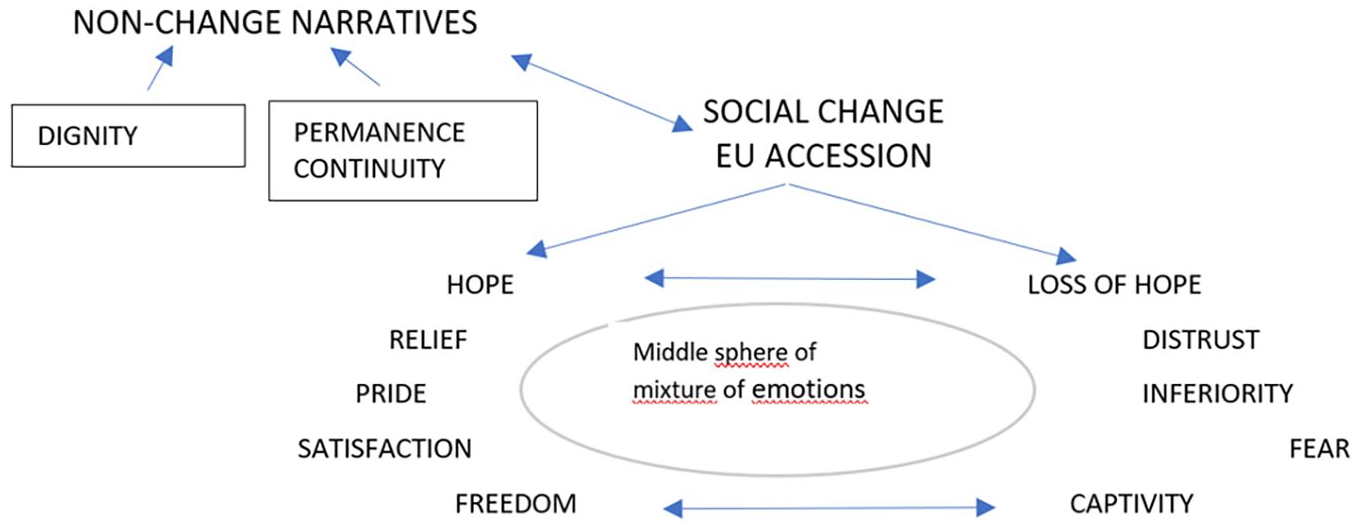
Emotions in the narratives of EU accession (opposition and mixture) and the non-change narratives and the emotional basis for such attitude.
It is extremely interesting to observe how this attitude of resisting the weight of change correlates with the actual process of ‘moderating changes’, as Halamska (2020: 211) describes it, as after the protests of farmers, Polish policies were changed. This scholar, in various parts of her works, considers ‘moderating the changes’ as a new stage between ‘tradition (defined as backwardness) and progress’ (Halamska 2020: 160). The strategy of representing the falsity of change narrative brings to the fore the aspect of time in the experience of change. In the analysed examples, the turning point of integration with the EU emerges in its temporariness juxtaposed with the durability of the land, rural landscape and familial values. Without the coexistence of a few factors, such as having a successor in the land, the positive aspects of joining the EU are not sufficient for arousing positive emotions. This can be shown by the selection of excerpts from two narratives at the beginning of our article. In the first epigraph at the beginning of our article, the bench is a symbol of power over one’s fate and independence, having ‘my village’, ‘my bench’, and ‘being the king.’ It has survived so many years and will survive many more, just like its owner. The emotions expressed are mainly distrust and the view that there is something more than money. In the second fragment, the bench is treated more symbolically – it is not always the same bench, but the grandfather’s bench. It was handmade by him and was associated with positive emotions: taking care of one’s land, relaxing in the sun, and feeling of permanence. The change that has taken place – the arrival of modernity – destroyed one particular bench, but the emotions connected with the land of the grandfather escaped from this loss, remaining part of the granddaughter’s narrative.
Another interesting aspect of our research is the publication of the selected, awarded memoirs – this way, they become a cultural product that can be read by the public and compared with one’s own reflections. Emotions represented in the personal narratives in the archived manuscripts do not ‘sum up’ or accumulate to create, for instance, collective or institutional resistance. When an act of resistance transforms into an act of storytelling, the stories function as ‘instructions about both the sources and the limitations of power. Because such stories are told in interaction with other stories’ (Ewick and Sibley, 2003).
Our study, on the one hand, corresponds to as well as strengthens the research on the Polish population and the master narratives used while narrating the experience of change in the biographical dimension. The research on the whole Polish population showed the coexistence of three biographical master narratives and the possibility of mixing them into a given personal narrative (Kowalska and Zięba, 2022). In two of them, we observe the values and goals evoked in the debate about the Polish accession: traditional Polish master narrative shows that ‘The home is the most valued achievement’ and should be protected from external forces: ‘Freedom means independence from exaggerated desires and excessive ambition’ (Kowalska and Zięba, 2022) and stabilisation and tranquillity are the basic needs and main goals. The Bildung type of Polish master narrative, instead, not only differs from but also opposes the values of traditional narratives, seeking the meaning of the good life in development, in upward mobility. These two biographical Polish master narratives may explain the existence of two contradictory positions towards the EU accession, but the presence of ‘mixed’ narratives may show that resisting the hegemony of two contrasting master narratives is not a phenomenon limited to farmers’ perception of European integration.
Further Research
Our research contributes to the current of analysing the experience of ‘feeling European Union’ (Gellwitzki and Houde, 2022; Verbalyte and von Scheve, 2018). In our epoch, as more countries are gaining the status of candidates for accession to the European Union, another enlargement awaits the contemporary world. Our results may be useful, especially since the approaching enlargement concerns Eastern European countries – Moldova and Ukraine (another Slavic nation like Poland, with which Poland shares values considered crucial topics of master narratives (Kowalska and Zięba, 2022)).
This is also the era of saying ‘no’ to the EU; so, understanding European integration as non-change may find new research territories. In the context of countries that are candidates for EU membership, our research shows that not only the material benefits of accession need to be emphasised. At the level of variety of narratives about European integration, it has been noted a national (Capelos and Katsanidou, 2018) and local diversification of stories so that ‘a more substantial engagement between and integration of the (qualitative) literature on EU narratives and (quantitative) scholarship on political communication and EU politicization can further our understanding of how actors narrate the EU and how this affects the European public’ (Gellwitzki and Houde, 2022, see also Marquart et al., 2022). In social group oriented-research such as ours, it may be more important to confront the analysed personal narratives with biographical narratives of social groups, such as farmers in our case, especially in a culture in which they constitute a significant group of the population, with a long historical and political role, and agriculture still plays a relatively important role in the economy.
Footnotes
Acknowledgements
We thank the employees of the Institute of Rural Development and Agriculture of the Polish Academy of Sciences for permitting the use of the materials collected as part of the ‘One Hundred Years of My Farm’ competition.
Funding
The authors received no financial support for the research, authorship, and/or publication of this article.
