






Abstract
Despite the growing interest in developing a micro-level understanding of strategy practices, there are few studies focusing on the official textual expression of these practices in the form of strategic plans. Using a large corpus of strategic plans from public and third sector organizations, this article examines the particular features of the strategic plan genre of communication. This corpus is systematically compared with nine other corpora derived from the same general domain (business texts) or having similar expected characteristics. Our analysis combines linguistic analysis with an analysis of the moves characteristic of the genre. The article seeks to advance a genre-based view of strategy practices to study the professional and institutional practices of strategists.
In recent years, there has been increasing interest among organizational and management scholars in understanding the distinctive practices of ‘strategy’, referring here to the activities inherent in formulating and implementing an organization’s long-term objectives, goals and future orientations (Jarzabkowski and Spee, 2009; Johnson et al., 2007). The field of ‘strategy’ or ‘strategic management’ has been constituted over the past 40 years as an important body of knowledge that is taught in management schools and that derives its roots from an eclectic amalgam of economic and sociological thought developed through the contributions of both academic writers and corporate consulting firms (Ghemawat, 2002; Kiechel, 2010). While the academic study of strategy has traditionally focused on understanding the market and resource-based drivers of competitive advantage, adherents of the more recent ‘strategy as practice’ school have turned their attention to examining strategy as an activity accomplished by practitioners or ‘strategists’ (e.g. top managers, consultants, analysts), asking questions about how these activities are accomplished, who is involved in accomplishing them and with what effects (Jarzabkowski et al., 2007; Johnson et al., 2007; Whittington, 2006, 2007).
As described by Johnson et al. (2007) and Whittington (2006), the study of ‘strategy as practice’ implies not only a focus on the everyday activities of strategy making in organizations (i.e. strategy ‘praxis’), but also an examination of the broader institutionalized forms or ‘practices’ on which they draw. One of these forms, quite central to what the term ‘strategy’ means and that often constitutes its key material manifestation, is a type of text called a ‘strategic plan’. As texts that represent a given organization’s strategy, strategic plans are of course specific to that organization, and yet the notion has a generic quality that draws on shared institutional understandings of what such a text should include (its substance), how it should be structured (its form) and what it is intended to achieve (its communicative purposes). In other words, the strategic plan can be viewed as a distinct ‘genre’ of organizational communication (Bhatia, 2004; Yates and Orlikowski, 1992) where genres are defined as ‘conventionalized discursive actions in which participating individuals or institutions have shared perceptions of communicative purposes as well as those of constraints operating on their construction, interpretation and conditions of use’ (Bhatia, 2004: 87; see also Frow, 2005; Swales, 1990).
The notion of genre offers a valuable analytic tool for investigating the structuring of professional practices. As suggested by Yates and Orlikowski (1992), genres act as ‘social templates’ that shape and are shaped by social interaction. The dynamic, situated function of genre is further developed by Frow (2005: 14): The work of genre, then, is to mediate between a social situation and the text which realizes certain features of this situation, or which responds strategically to its demands. Genre shapes strategies for occasions; it gets a certain kind of work done. Previous empirical studies of professional genres have been carried out in a variety of business contexts, albeit with a marked interest in financial reporting. For example, Rutherford (2005) recognized in the ‘accounting narrative’ genre found in corporate annual reports a desire to embellish the organizations’ actual competitive situation. Similarly, Camiciottoli (2010) observed in another genre of financial reporting, the earnings call, a desire to gain the confidence of financial analysts. In a recent interdiscursive analysis of corporate annual reports, Bhatia (2010) showed how four types of professional discourse (accounting, economics, public relations, law) intersect within this genre, reflecting the variety of communicative purposes underlying it.
This begs the question: what are the distinctive characteristics of the genre called the ‘strategic plan’? How do ‘strategic plans’ differ in their communicative purposes, discursive content and form from other organizational and business texts such as annual reports, executive speeches, other types of plans, etc.? This article explores this question drawing on theories of genre, and undertaking an analysis of a corpus of strategic plans and comparing them with other related genres of organizational communication.
This article focuses more particularly on what might be called a sub-genre of the strategic plan genre – publicly available strategic plans from public and third sector organizations presented on these organizations’ websites. Because of their medium and their broad audience, the substance, form and communicative purposes of these documents may have, as we shall see, certain specificities that could distinguish them from more internally focused documents and/or those prepared by private sector firms.
The analysis in this article is largely exploratory and descriptive, drawing on a series of textual analysis tools that examine dimensions such as verbal tone (Hart, 2001), temporal orientation (focus on past, present or future) and stance (degree of self-reference), while also exploring lexical content and the sequence of rhetorical ‘moves’ (Swales, 1990) typically revealed in strategic plans. Nevertheless, the prior literature on strategy and strategic planning offers some important reference points that enable us to place our findings in perspective. In the following section, we examine this literature in more detail and draw attention to some of the key questions it raises about the nature of the strategic plan genre.
The strategic plan as a genre in the literature
The genre in the prescriptive literature
A first place to look for ideas concerning the generic features of strategic plans is in the prescriptive managerial literature, principally textbooks and manuals for practitioners (Bhatia, 2004). A review of a variety of popular textbooks in strategic management (e.g. David, 2010; Dess et al., 2009; Hill and Jones, 2009; Hitt et al., 2010; Johnson et al., 2008) suggests that the strategic management process is composed of common activities such as mission statement development, environmental analysis, internal analysis, the development of business and corporate strategies, and strategy implementation through activities such as organizational design and strategic control. Modern textbooks also tend to have chapters on topics such as internationalization, mergers, social responsibility, leadership and entrepreneurship. However, rather surprisingly, few of these texts devote great attention to the composition of the strategic plan itself as a written document. The emphasis is generally on processes and the content of strategy, and not on its textual manifestation, although one might of course expect to see echoes of the proposed processes within the written content.
To find templates that might offer more concrete ideas about the generic elements of the strategic plan, we therefore looked beyond textbooks in strategy to more basic ‘how to’ manuals designed for managers. Some of these offer ‘tables of contents’ for strategic plans. For example, in Strategic Planning for Dummies, Olsen (2007) divides the contents into three major sections: Where are we now? (mission statement, values and guiding principles, SWOT – an acronym for the analytical themes of ‘strengths’, ‘weaknesses’, ‘opportunities’, ‘threats’); Where are we going? (sustainable competitive advantage, vision statement); How will we get there? (a more elaborated section made up of items labelled strategic objectives, strategy, short-term goals/priorities/initiatives, action items, scorecard and execution). This formatting offers a distinctive arrangement of moves, each oriented around a specific communicative purpose associated with a specific question. We see that while the first segment deals with establishing the present, the last two focus very much on the future. We also see moves arranged in a hierarchical fashion with broad future-oriented statements (vision statements) later refined into increasing fine details (action items) and accompanied by measures of progress. Finally, the ‘we’ element in the main headings leads us to expect that strategic plans will be strongly self-referential.
A second rendering of the table of contents comes from a self-styled ‘practical guide and work book’ entitled Strategic Planning for Nonprofit Organizations by Allison and Kaye (2005). This appeared particularly relevant given that our sample focuses on non-profit and public organizations. The main headings of the suggested table of contents are as follows: Introduction by the President of the Board; Executive Summary; Mission and Values Statement; Organization Profile and History; Summary of Core Strategies; Program Goals and Objectives; Financial, Administrative and Governance Goals and Objectives; Appendices (including summary of environmental assessment, SWOT analyses, summary of client surveys, membership of board and planning committees, long range budget plan, long range development plan). This table overlaps to a degree with the preceding example, with some interesting differences. Notably, the one-page introduction is proposed as a way to add legitimacy to the document, indicating that it has received broad approval – something implicit in Olsen’s (2007) presentation. A section on organization profile and history is added as a way of communicating amongst other things ‘key events, triumphs and changes’ as well as ‘major accomplishments over the past year’ (p. 263) – suggesting explicitly the need for an upbeat optimistic emphasis, but adding a focus on the past, absent from Olsen’s (2007) proposal. Finally, it is interesting to note that the justificatory environmental assessment and SWOT analyses are present but relegated to an appendix to ‘provide needed documentation for interested readers’ (p. 254).
Overall, the prescriptive texts provide some ideas about the moves to be expected in strategic plans, but they also suggest the presence of variety in labels, content and sequence. Indeed, Olsen (2007: 35) is explicit about this: Planning doesn’t have a set rulebook, so no common language exists. People refer to objectives as goals, and goals as objectives. Mission gets confused with vision and no-one seems to know where strategies fit in. Then you have indicators, measures, metrics, targets . . .
The genre in empirical research
The notion of the strategic plan as a ‘genre’ has been developed explicitly in at least two previous empirical studies. For example, Pälli et al. (2009) developed ‘a genre-based approach to strategizing’ to analyse the planning process of a Finnish city. They showed how planning discussions focused on the meaning of generic elements such as objectives and key success factors, and how different purposes were manifested in the form and content of the text. Among their more interesting findings, they found that segments of the plan served a clear ‘educational’ purpose, suggesting that the idea of doing strategic planning was something slightly foreign to the non-business context that needed justification, an element that might be echoed within our sample of public sector organizations and non-profits. Reflecting the ideas present in either or both of the prescriptive texts discussed above, they also found strong references to organizational identity, to future orientation and to self-reference.
In a further development of this stream of research using the same single case, Vaara et al. (2010) used critical discourse analysis to draw attention to the power effects of the strategic plan, identifying five discursive features that combined to achieve these effects. These include self-authorization (references to the strategic importance of the text), special terminology (use of technical strategy-related terms such as SWOT, critical success factors, etc.), discursive innovation (the generation of novel slogans or buzzwords), forced consensus (reduction in available options) and deonticity (the use of declarative statements to convey imperatives as in the expression ‘finances will strengthen’, used as a directive to administrators to strengthen finances: Vaara et al., 2010: 696).
In another study, this time of participative strategic planning in public sector organizations in Australia, MacCallum (2008) analysed two cases in depth to examine how the open discussions typical of a more participative process came to be translated into the rationally formulated genre of the typical strategic plan (references to external and internal environments and hierarchically arranged strategies and goals). In counterpoint to Vaara et al.’s (2010) analysis described above, MacCallum showed how the ‘institutional constraints of the plan genre’ (2008: 339) tended to exert power of participants, preventing them from adjusting the process or format in ways that would have allowed room for more creative reflection.
This last observation leads us to question how the more participative nature of public sector or non-profit sector planning might manifest itself in the content of the text. One way that this might happen is through the use of language that incorporates a degree of ambiguity, allowing multiple interpretations and thus enabling the translation and recognition of multiple interests – a phenomenon called ‘interpretative viability’ by Benders and Van Veen (2001) and ‘pragmatic ambiguity’ by Giroux (2006). Both concepts refer to the possibility for those who will read and use the text to interpret it in various ways, and thus to try and adapt it to their own purposes. Pragmatic ambiguity or interpretative viability can thus contribute to the emergence and persistence of a ‘unified diversity’ (Eisenberg, 1984).
The empirical presence of such a phenomenon in strategic plans is hinted at by Pälli et al. (2009: 313), who on the basis of conversation analysis note that ‘The language-game of strategizing is truly discursive: the choices made in the strategy text do have several possible meanings even to the strategists themselves’. This observation is also echoed by a number of other studies of strategic planning in public and non-profit sector organizations which, although they have not explicitly referred to genre theory, have provided some indication that ambiguity of various kinds may be inherent to planning in contexts where the need for the commitment of multiple stakeholders is believed to be important (Stone and Brush, 1996). For example, Denis et al. (1991) found that hospital strategic plans tended to be characterized by very large numbers of ‘vague’ developmental recommendations, Davenport and Leitch (2005) noted the presence of ‘strategic ambiguity’ in the strategic plan of a government granting agency, and Abdallah (2007) identified a similar pattern in the strategic plan of an arts organization that was attempting to reconcile potentially conflicting artistic, social and economic values. On the other hand, Vaara et al.’s (2010) reference to closure in the text of the strategic plan they studied, and to the use of declarative statements as a form of imperative nuances this conclusion. The question of whether and how ambiguity is expressed in strategic plans remains open.
While these previous empirical studies are interesting and allow a consideration of how context and institutional form interact in the materialization of instances of the genre of the strategic plan, their focus on a small number of specific cases and the absence of any comparison with other types of communications that serve similar and different purposes does not permit a complete understanding of the distinctive characteristics of the genre as an institutionalized phenomenon. The goal of our research is thus to further characterize strategic plans as a genre of organizational discourse by providing empirical evidence from a larger sample (specifically of public and non-profit organizations) and by contrasting them with other texts belonging to the same discipline. We now describe in more detail the methods used.
Methods
Selecting corpora for analysis
Bhatia (2004) and Biber and Conrad (2009) suggest that genres are best characterized by comparing corpora of naturally occurring texts. The first step of our research was thus to collect a number of strategic plans and to assemble groups of texts that could be used as comparatives. We originally intended to collect and compare strategic plans from both for-profit and not-for-profit organizations. However, it proved extremely difficult to have access to the former; even after repeated contacts with senior managers from several organizations, we could not obtain a sufficient number of plans to make any statistically valid comparisons. Strategic plans from the public sector and from non-governmental organizations (NGOs), on the other hand, could easily be found on the Internet. We limited the search to documents that were titled ‘strategic plan’, which came from Canadian and US organizations, which were written in English and were available as PDF files. As Table 1 indicates, we used a stratified sample scheme in order to equally represent seven types of governmental, para-governmental and non-governmental organizations. We amassed a total of 99 plans, of which 89 could be successfully converted to Word and then to RTF files.
Composition of the corpora.
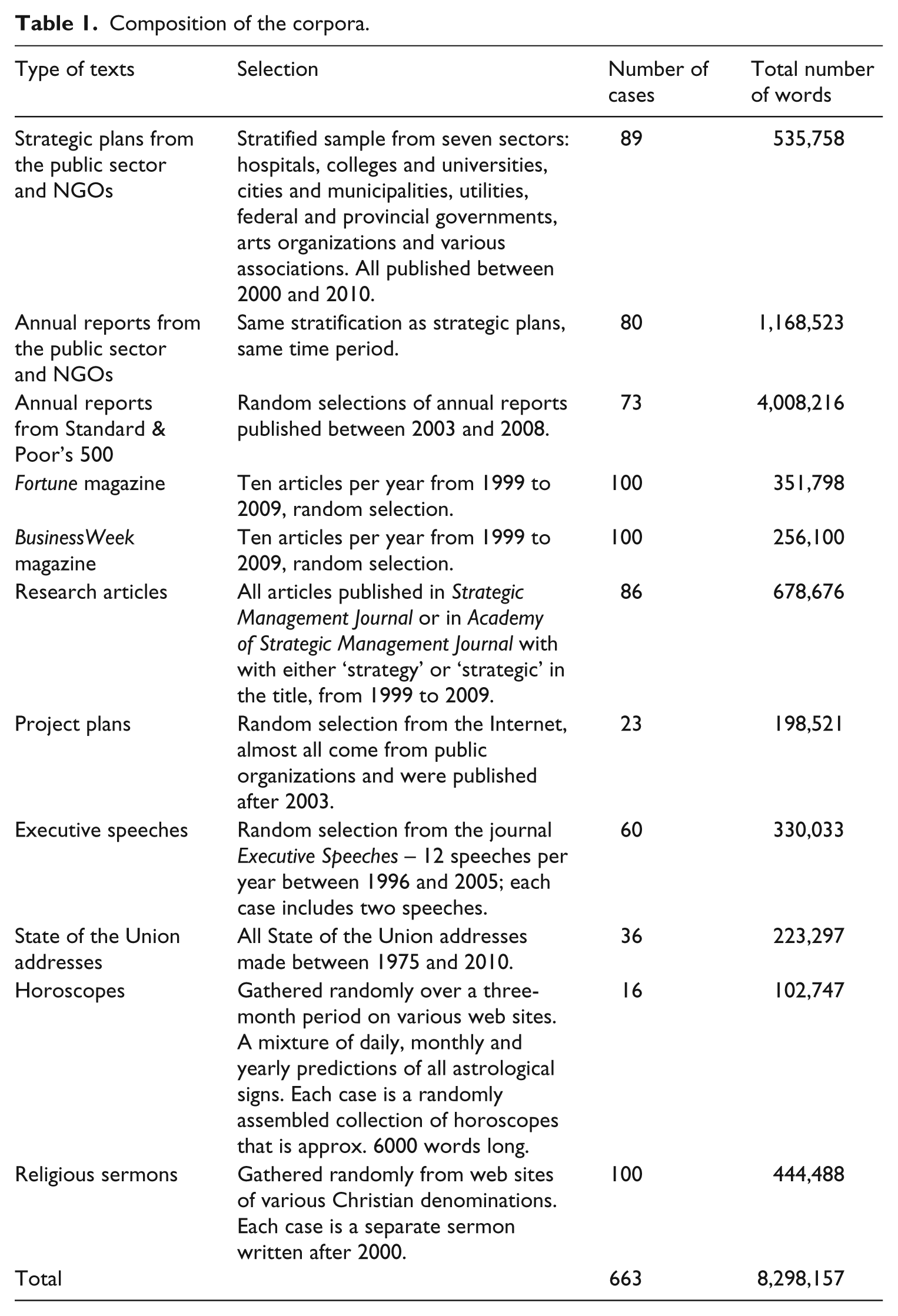
We then needed to put together comparative corpora that could, either by contrast or through similarities, allow us to characterize strategic plans. Note that as Biber and Conrad (2009) suggest, some of the best comparatives are those that are likely to use the same ‘register’ of language (i.e. share the linguistic characteristics associated with their broad domain of production – in this case organizational and business texts), but have different communicative purposes, enabling the isolation of differences specifically due to these purposes. Thus, we selected a variety of texts whose genre and communicative purposes are relatively well-known and whose general vocabulary would not be too far from that of strategic plans: annual reports, articles from business magazines (namely, Fortune and BusinessWeek) and academic research articles on strategy (see Table 1), for which a sufficiently large number of exemplars were available to enable comparative analysis.
In addition, because the strategic plans that we collected all came from the public and non-profit sectors, we needed to differentiate textual characteristics that were related to the sector from those that were specific to strategic plans. In order to identify some of the former, we assembled two separate corpora of annual reports: 80 annual reports from the Canadian and US public sector, and 73 from publicly-owned for-profit corporations included in the Standard & Poor’s (S&P) 500 largest companies.
According to Bhatia (2004), texts with the same general communicative purpose are part of a colony of genres. For instance, advertisements, reference letters and book reviews are all part of the colony of promotional genres, whereas performance reports, police reports and medical reports are all part of the colony of reporting genres. We thus considered that strategic plans might be part of a colony of planning genres, and decided to include in our analysis another type of plan, project management plans. We collected on the Internet 23 project plans for various types of projects (construction, procurement, new voting systems, etc.).
We also wanted to compare strategic plans with verbal speech serving the same general purpose of describing an organization and the context of its operations, and talking about its future. We found two sources that could provide exemplars of this situation: public speeches by top managers and public figures (as transcribed and published in Executive Speeches), and State of the Union addresses given once a year by the President of the United States.
Finally, since one of our research questions pertained to the interpretative viability of strategic texts and the role that it could play in allowing different courses of action and fostering adhesion (see above), we thought that it would be useful to compare our corpus with what is arguably the archetype of ambiguous texts, horoscopes. For this corpus, as single horoscopes are too short to constitute separate cases, larger cases were artificially created by grouping randomly selected horoscopes into 16 separate files of approximately 6000 words each. We also went in the opposite direction and collected a corpus of what might be seen as the archetype of directive texts, religious sermons. Note that the presumed focus of horoscopes on projecting the future, and of sermons on expressing deontic principles also provide intriguing, though rather extreme, ideal types or metaphorical comparators for what the strategic plan genre might potentially constitute for organization members.
Note that the publicly available nature of our selected corpus of documents no doubt has implications for their structure, content and form, since it implies a broader set of audiences than would be the case for documents with more restricted circulation. Nonetheless, the publicly available strategic plan is clearly an important sub-genre for the public and non-profit sectors and all our corpora are comparable in this respect. We consider in more depth in the discussion the boundary conditions for our findings suggested by the issue of public availability.
Analysing the corpora using WordStat
Research on genre is based on various methods of textual analysis, including content analysis and corpus linguistics. Content analysis comprises a wide range of methods, but even when it uses word counts or other quantitative methods it typically focuses on identifying underlying themes and concepts, including values, attitude and cognition (Duriau et al., 2007). Corpus linguistics is more concerned with the actual language that is used in naturally occurring texts and with finding patterns (Biber et al., 1998). Obviously, performing either content analysis or linguistic analysis on large corpora of texts requires computerized techniques. However, Baker et al. (2008) and Biber and Conrad (2009) stress that the kind of quantitative data that can be gathered through computer-assisted text analysis (CATA) has to be completed with qualitative interpretation if one is to uncover and understand language patterns and their functional role.
Genre is expressed through a number of textual features: moves, rhetorical features, topical and thematic features, various lexical and grammatical features, stance, etc. The computerized analysis we performed focused on four features: verbal tone, temporal orientation, interpretative viability and stance (i.e. wording that conveys the speaker’s attitude or opinion with regard to his or her subject). For the first four features, we used the dictionaries constructed and validated by Hart (2001) for DICTION, a text analysis software that was developed to study political speech. The dictionaries consist of 31 non-overlapping, theoretically-based semantic cluster word lists including over 10,000 search words. DICTION has often been used to characterize oral and written management discourse. Ober et al. (1999), for instance, used DICTION to compare the degree of certainty in business communications of Fortune 500 companies showing the largest profit increase and the largest profit decrease in 1996. Recently, Short and Palmer (2008) suggested that DICTION would be helpful for studying strategic management and used it to analyse a corpus of mission statements.
Although we used the dictionaries developed for DICTION, we actually transferred these dictionaries to WordStat 6 (Provalis), a CATA software that can perform dictionary-based quantitative analysis as well as word and phrases counts (Pollach, 2011) and that proved to be more powerful and reliable than DICTION. The analysis was performed with all 31 DICTION dictionaries, but we present in the results section only those categories that we judged to be interesting with regard to characterizing strategic texts and meeting our research objectives, as suggested by Short and Palmer (2008). In addition, we developed our own dictionaries to delve further into categories that, in our opinion, were either insufficiently covered or too encompassing. For example, DICTION includes past-orientation and present-orientation dictionaries, but none for future-orientation. We thus developed a dictionary comprising two sub-categories: the verbal auxiliary will and alternate formulations (we’ll, it’ll, you’ll), and a sub-category named future words including 51 words or expressions denoting future events (e.g. next year, years to come, predict, are going to, etc.).
Also, because we were particularly interested in the textual construction of ambiguity or interpretative viability, we added to DICTION’s ambivalence dictionary another dictionary containing 129 vague words (mostly indefinite adverbs and expressions such as a number of, enough of, more or less, etc.). To evaluate stance, we added to DICTION’s self-reference category three dictionaries containing a total of 123 verbs of low, median and high modal values; we also considered self-reference in the plural, something that DICTION does not do. We also constructed dictionaries comprising a total of 121 modal adjectives, adverbs and expressions of low, median and high modal values.
WordStat calculates the frequencies and proportions (as a percentage of total words) represented by each dictionary, and that for each case of each corpus. These data were transferred into an Excel file and then into SPSS. We calculated the mean and standard deviation for each corpus and compared all corpora to the original corpus of strategic plans; significance was tested using t-tests with p two-tails (without assuming equal variances).
Looking for moves
Genres are defined in part by the communicative purposes that they serve and are realized though a combination of more or less standard moves that reflect expectation of the intended audience in terms of content and format (Bhatia, 2004; Swales, 1990). Analytically, the identification of text patterning and discourse structure is helpful to identify the moves that characterize a genre and illuminate how its communicative purpose is realized. This kind of analysis cannot be automated and requires the careful reading and manual coding of each text. From the original corpus of 89 strategic plans, a stratified sample of 34 plans representing each of the seven sectors was selected for a detailed analysis of the moves.
The first phase of analysis was inductive and aimed to identify the strategic plans’ main section headings. This phase necessitates a first-hand engagement with the texts and provided the researchers with a sense of the themes addressed in each section of the plans. Sections represented fairly clear-cut boundaries of particular moves, which is in keeping with the principles of Swalesean (1990) move analysis. During this initial phase, a coding scheme was developed based on the communicative functions that particular portions of the texts realize within the overall strategic plan. Sixteen prototypical moves were identified. Table 2 provides a description of the coding scheme employed.
Strategic plan genre moves: A coding scheme.
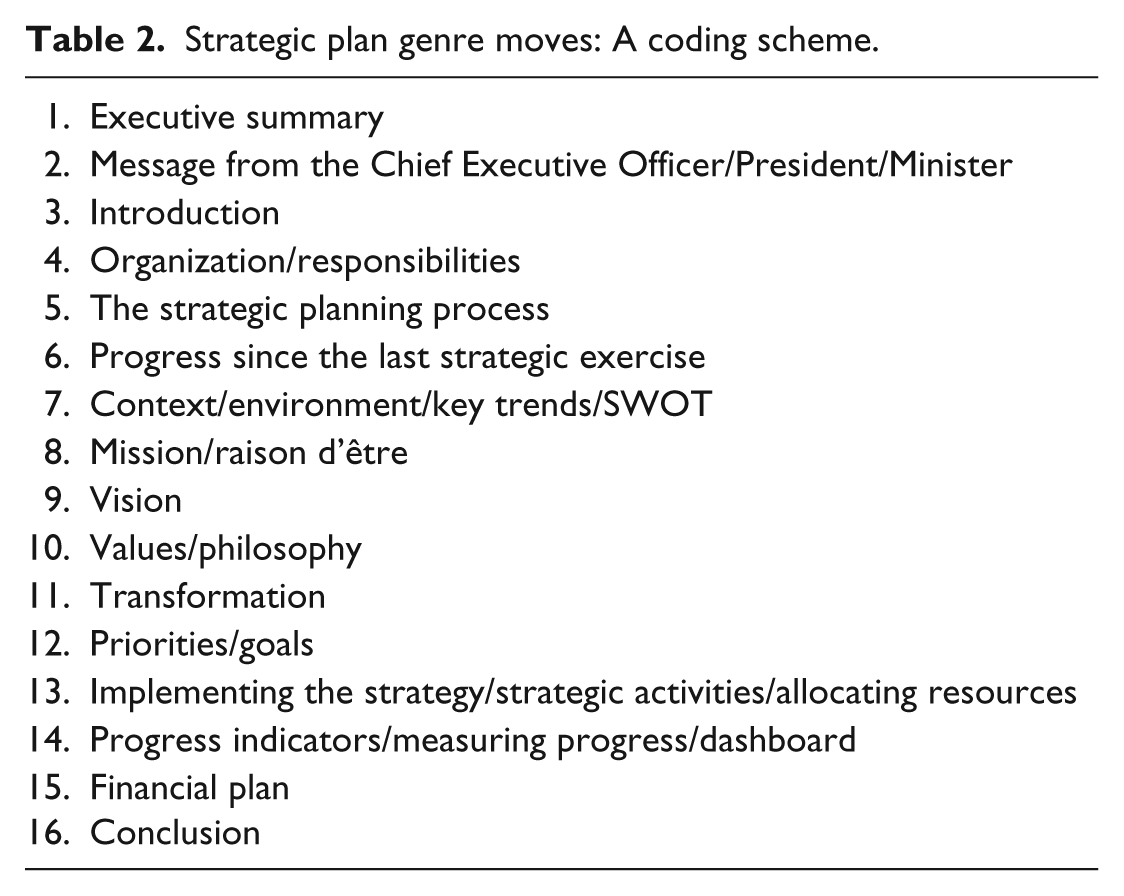
In a second phase of analysis the occurrence of the moves within the 34 strategic plans was systematically recorded using the coding scheme. The criterion used to mark the occurrence of a move was the presence of a distinct section referring to a genre move. Section headings were often a good indicator of a move. However, on several occasions, section headings happened to be misleading. For example, in a few cases, the organization was presented in a section titled ‘Introduction’, in which cases the Move Code 4 applied. Moreover, a section often contained more than one move (e.g. strategic activities were sometimes presented in tandem with the strategic priorities). In such cases, the section received more than one code.
Throughout data analysis particular attention was paid to the sequence in which the moves were introduced. Understanding the position of the moves relative to each other not only revealed the overall cognitive structuring of the plan, but also the manner in which the communicative function of particular moves was sometimes facilitated by preceding moves. For example, items such as mission and vision (Table 1, lines 8 and 9) might precede or succeed items about context (line 7) with different implications about the mutual dependence between them.
Findings
Comparing 11 corpora along a number of textual features generates a vast amount of data. Appendix Table 1 presents the frequencies (in percent of total words) for each dictionary and each corpus, as well as the t values and their significance level. Overall, we compared our corpora on a total of 40 dimensions. Strategic plans present significant differences on at least 29 of these 40 dimensions with all the other corpora except for project plans, with which they show significant differences on only 17 dimensions. This implies that as far as these dimensions are concerned (and they relate to verbal tone, temporal orientation, interpretative viability and stance), strategic plans have very unique characteristics and thus may well represent a specific genre of management texts. The fact that they are far closer to project plans than to any other corpora also seems to corroborate our initial hypothesis that strategic plans and project plans belong to the same colony of genres. Note that Appendix Table 1 does not include the results for BusinessWeek but only those for Fortune magazine. The two magazines, which acted as a control group for our analysis since we presume that both belong to the same general business magazine genre, differ significantly (at p < 0.05) on only six of the 40 dimensions analysed (and differences are significant at p < 0.01 on only two of those six), indicating that the findings of our comparative analysis are not purely a question of chance but reflect significant differences in genre. The following subsections delve further into the differences between strategic plans and other genres of texts. We selected the dimensions that led to the more interesting insights and we present the results graphically for ease of interpretation.
Setting the tone
Hart developed DICTION dictionaries to identify what he calls the verbal tone of a text. For Hart (2001), verbal tone is characterized by five master variables: certainty, optimism, activity, realism and commonality. Each master variable is itself a combination of several dictionaries. For example, Hart calculates the master variable optimism by adding the results from three dictionaries (inspiration, praise, satisfaction) and then subtracting the results from three other dictionaries (blame, hardship, denial). We believe that in calculating master variables as recommended by Hart, the possibilities for a more refined analysis are lost. We thus decided to select only those dictionaries that we thought were best suited to the characterization of strategic plans as a genre, and to present the individual results for each of those dictionaries.
Optimism and commonality
Figure 1 presents the categories that are related to optimism and negativity, which could be seen as indicators of emotional tone. The results indicate that strategic plans are more emotionally expressive than other types of written business texts (i.e. both types of annual reports, both types of articles, as well as project plans). The two types of ‘oral’ business texts (State of the Union addresses and executive speeches) are more emotional, as are horoscopes and religious sermons. However, strategic plans are generally more optimistic. In particular, they contain more words denoting inspiration (i.e. nouns denoting moral and personal virtues as well as social and political ideals) and satisfaction (i.e. terms associated with positive affects and success) than all the other corpora (except horoscopes, which are higher in satisfaction); they also express praise (i.e. adjectives related to all kinds of qualities), albeit to a lesser extent.
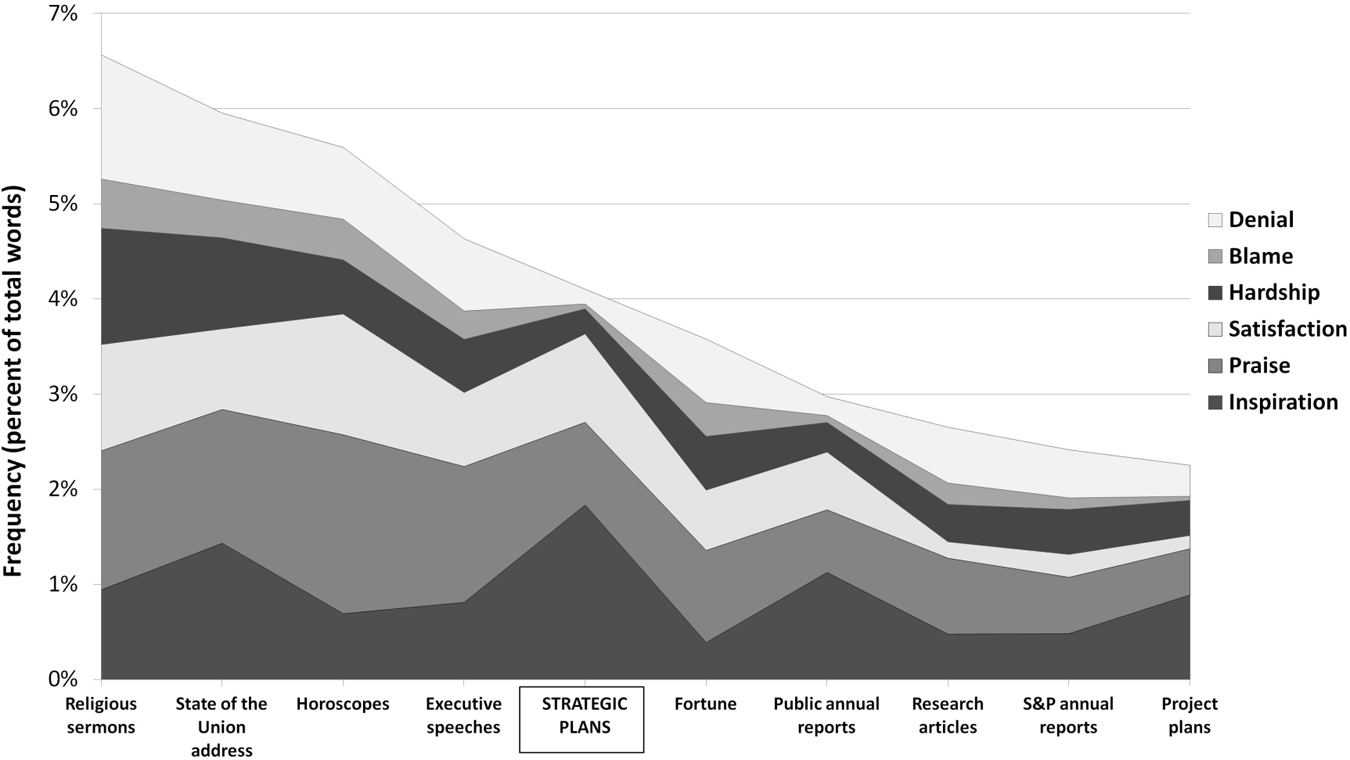
Optimism and negativity.
Not only are strategic plans more optimistic, but they are also less negative: they contain significantly fewer expressions of blame (i.e. adjectives related to unhappy circumstances and social inappropriateness), hardship (i.e. words referring to problems and fears) and denial (i.e. negative function words such as not or none 1 ) than all the other corpora except for project plans and annuals reports of organizations from the public sector. This result is particularly significant considering that previous studies (Hildebrandt and Snyder, 1981; Rutherford, 2005) have shown that letters to shareholders and annual reports exhibit what is called the Pollyanna effect (Hildebrandt and Snyder, 1981), that is, a propensity to focus on the positive side of things and to downplay the negative side. In our strategic plans, words associated with inspiration, praise and satisfaction were 50 percent more frequent than in annual reports from not-for-profit organizations and 2.8 times more frequent than in annual reports from the S&P 500. On the other hand, words associated with blame, hardship and denial represented only 0.47 percent of all words, compared to 1.09 percent for the S&P 500’s annual reports. Strategic plans thus exhibit a particularly strong Pollyanna effect. The optimistic tone also corresponds well with the recommendations we found in Allison and Kaye’s (2005) how-to book on non-profit planning presented earlier, in which the need to focus on achievements and successes was underlined.
Another master variable defined by Hart is commonality. It is composed of dictionaries concerned with various aspects of social life. We selected four dictionaries containing words denoting some kind of collective action or association: cooperation (i.e. designations of work relations, informal associations and intimate interactions); levelling (i.e. words that build a sense of completeness, such as totalizing terms and adverbs of permanence); collectives (i.e. nouns referring to social groupings and geographical entities); and rapport (i.e. terms of affinity, assent, deference and identity). Conversely, three dictionaries contain words stressing differences: diversity (i.e. words describing individual or groups differing from the norm, either positively or negatively); exclusion (i.e. words related to the sources and effects of social isolation); and liberation (i.e. expressions of individual choices and the rejection of social conventions). Figure 2 compares our 10 corpora on these dimensions.
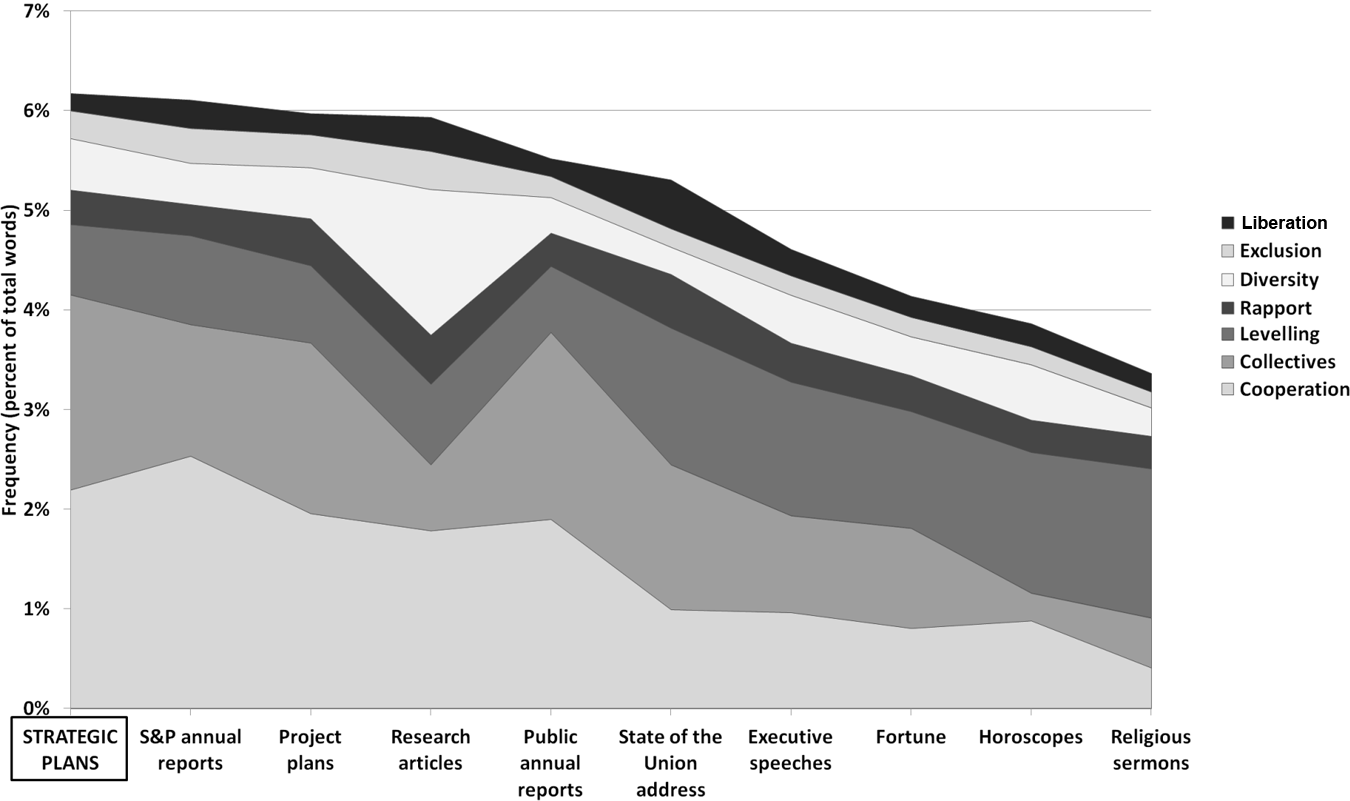
Collectivities and differences.
It seems that business texts in general are rich in expressions of collectivities and differences, with strategic plans being the richest of all. It appears that when strategic plans mention collectivities, they do so by using cooperation and collectives words (although the two variables are not correlated, with r = 0.140). These two categories represent 4.2 percent of all words in strategic plans (2.2% for cooperation and 2.0% for collectives), which is significantly more than all other corpora except for project plans (no significant difference), annual reports from the public sector (no significant difference for collectives) and annual reports from the S&P 500, which have more expressions of cooperation (2.5%). Expressions of differences are relatively uncommon in all the corpora, each of the three dictionaries representing less than 0.6 percent of total words (the only notable exception being research articles, which devote 1.5% of all words to expressions of diversity). Nevertheless, strategic plans include more words denoting diversity than either type of annual reports.
Figure 3 combines the previous results for emotional tone and commonality and allows for a better characterization of our corpora. Net optimism (x-axis) is obtained by subtracting the total frequency of negative words from the total frequency of optimistic words. Similarly, net commonality is obtained by subtracting the total frequency of words denoting collectivites from the total frequency of words denoting differences. The size of the bubbles is proportional to the frequency of words expressing accomplishments (i.e. words expressing task completion and organized human behaviour). As indicated in Appendix Table 1, of the 40 dictionaries we tested, words of accomplishment are by far the most frequently found in strategic plans. They represent 5.4 percent of all words, which is significantly more than all other corpora, including annual reports, which could be expected to be high in this category since one of their overt communicative purposes is to report on what has been accomplished during the previous year.
As Figure 3 illustrates, the four types of texts originating in organizations (strategic plans, both types of annual reports and project plans) all emphasize commonality, as do the State of the Union addresses. However, their optimistic outlook and their strong emphasis on accomplishment put the strategic plans strikingly in a class of their own.
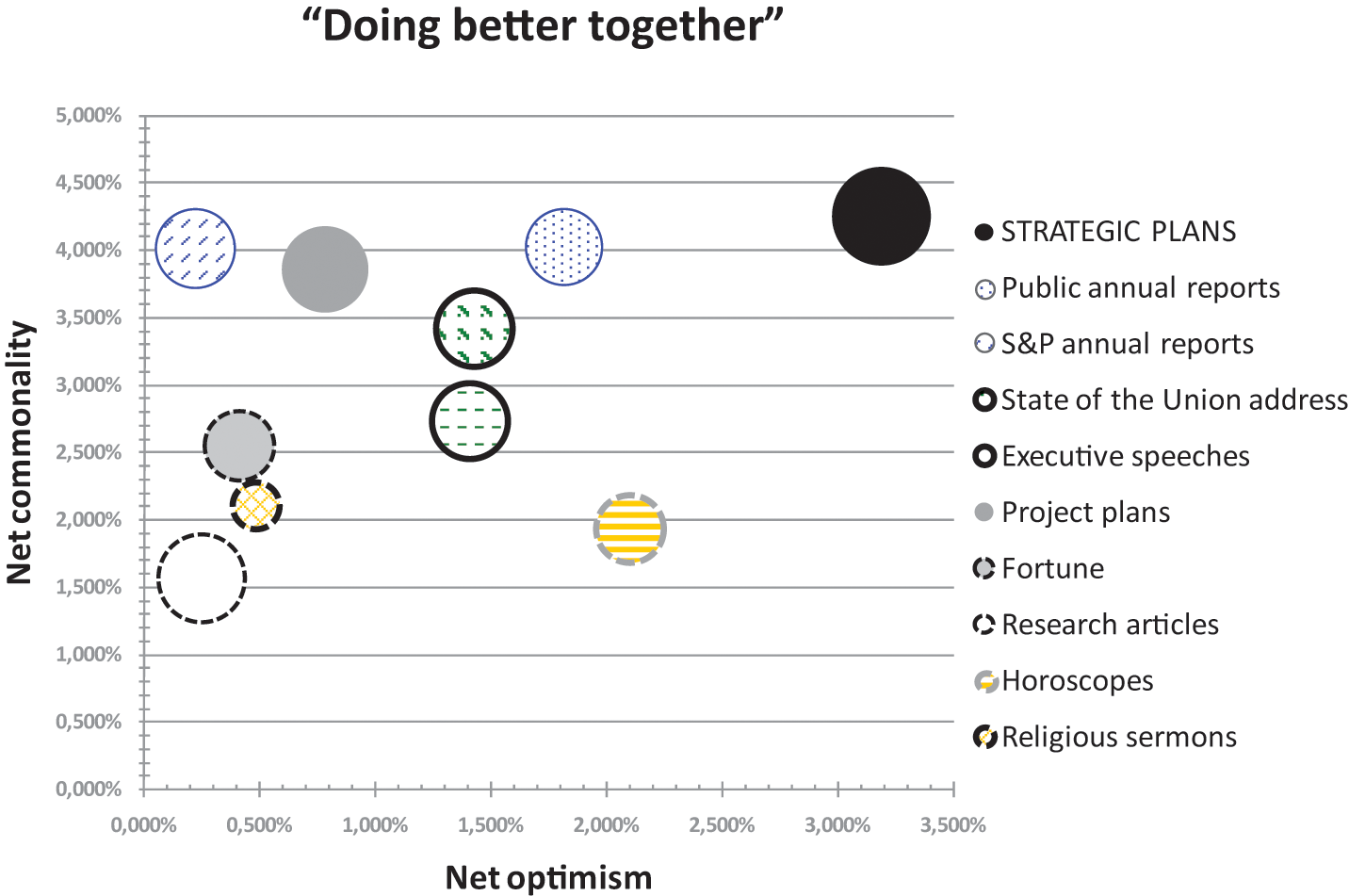
Optimism and commonality in strategic plans: ‘Doing better together’.
Temporal orientation
Three dictionaries of DICTION are devoted to temporal orientation. Temporal awareness is a list of words that situate events within a specific time-interval or that denote time. Present concern is a list of 75 general verbs which are frequently used in common American English; all verbs are in the present tense with three endings (first and third person singular, and gerund). Past concern is a list of the same verbs in the past tense.
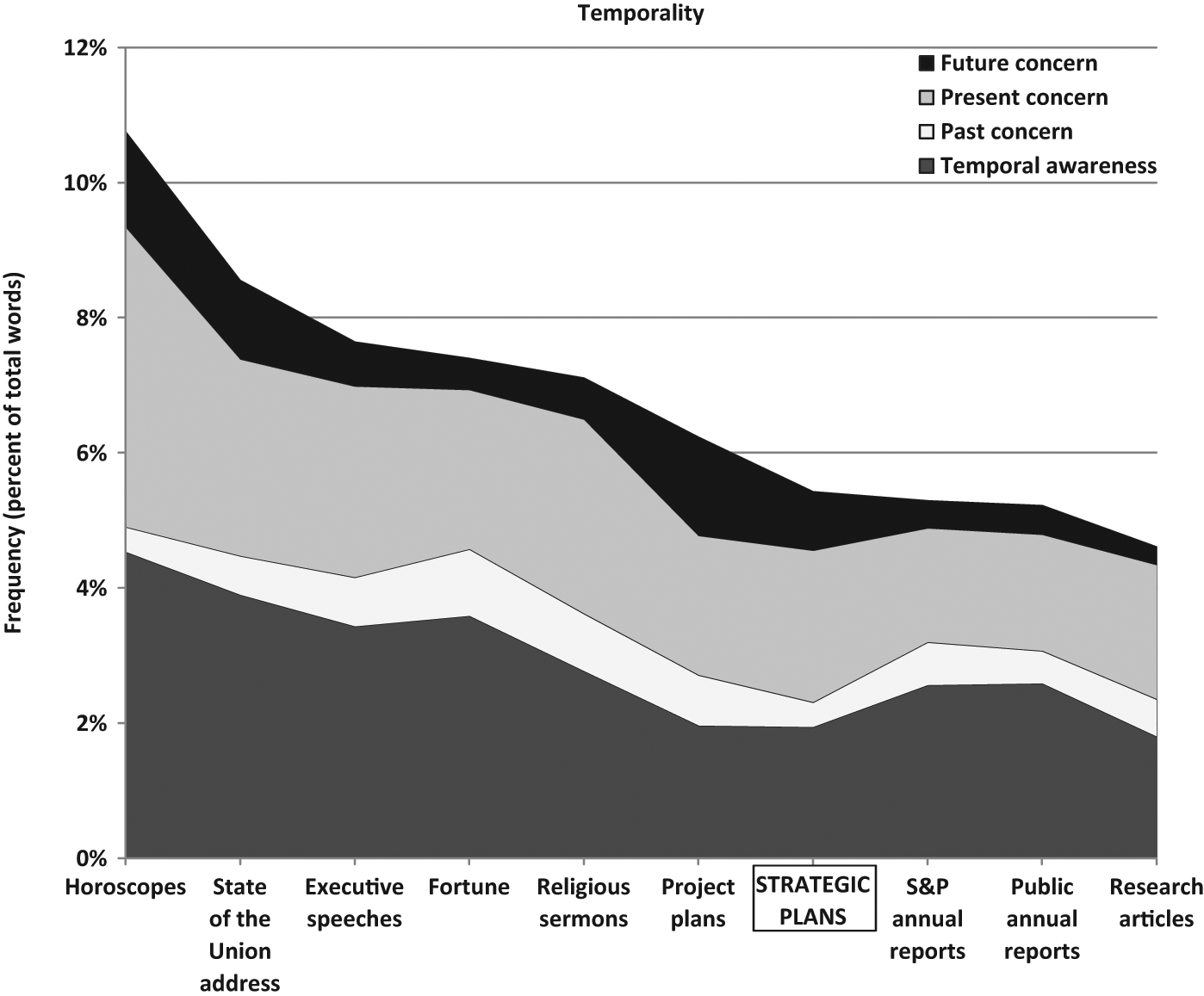
Temporal orientation.
Figure 4 illustrates the results for these three dictionaries as well as results for the two dictionaries that we added, future words and will, which have been combined into one category, future concern. We find that there are significantly more expressions of future concerns in strategic plans than in annual reports. For instance, the modal verb will amounts to 0.7 percent of all words for strategic plans, but only 0.3 percent for annual reports from the public sector and 0.2 percent for annual reports from the S&P 500. Only three corpora are more strongly oriented towards the future: State of the Union addresses (0.9%) and project plans and horoscopes (1.2% of all words for each corpus). As well as echoing the prescriptive texts we examined in our literature review, these results corroborate the findings of Pälli et al. (2009) that strategic plans used future-oriented language. However, our results indicate that all corpora are more oriented towards the present than the future or the past. This result is particularly surprising for horoscopes, strategic plans and project plans, one of their overt communicative purposes being to project what will or should happen in the future. Strategic plans are also less oriented towards the past than any of the other corpora except for horoscopes (no significant difference).
Interpretative viability
As we noted earlier, texts whose primary communicative purpose is to foster adhesion and drive collective action – which is arguably one of the goals of strategic plans – have been shown to exhibit what Benders and Van Veen (2001) call interpretative viability and Giroux (2006) called pragmatic ambiguity. The possibility of multiple interpretations is always present and goes beyond lexical choices, but texts rich in words that denote ambivalence or are vague, general or ambiguous greatly increase their interpretative viability, as shown by Giroux (2006).
Analysing interpretative viability or pragmatic ambiguity in a large number of texts is a daunting task. Generality and ambiguity, in particular, are difficult to ascertain with CATA. DICTION offers one dictionary for the analysis of ambivalence. It includes 192 words expressing hesitation and uncertainty (including some modals), as well as words referring directly to this state of mind (such as ambivalent, confused, hesitant and doubts). To this dictionary we added a new one comprising vague words (mostly indeterminate adverbs such as several, briefly, elsewhere, frequently, as well as expressions like a small number of, a long time, significant amount, etc.).
We also added two dictionaries comprising hedge words, also known as modal words of low value. For Halliday and Matthiessen (2004: 618), ‘Modality refers to the area of meaning that lies between yes and no – the intermediate ground between positive and negative polarity’. Through the use of modalities, a speaker qualifies either the degree of probability or usuality of the information that he or she is giving (in philosophy, these are referred to as epistemic modalities), or the degree of obligation or inclination of a command or promise (these are referred to as deontic modalities). Modality can be conveyed by the use of certain verbs, adverbs, adjectives or nouns. Modals also have different values or strengths: for instance, possibly and sometimes are epistemic modalities of low value, whereas certainly and always are epistemic modalities of high value. Modals of low value make a statement less assertive and are often associated with interpretative viability. The dictionary named verbs of weak deontic value is composed of 46 verbs such as contemplate, encourage, incline, etc. The dictionary named adverbs of weak modal value is composed of 27 epistemic and deontic words like possibly, perhaps, admissible, etc. Results from these analyses are shown in Figure 5.
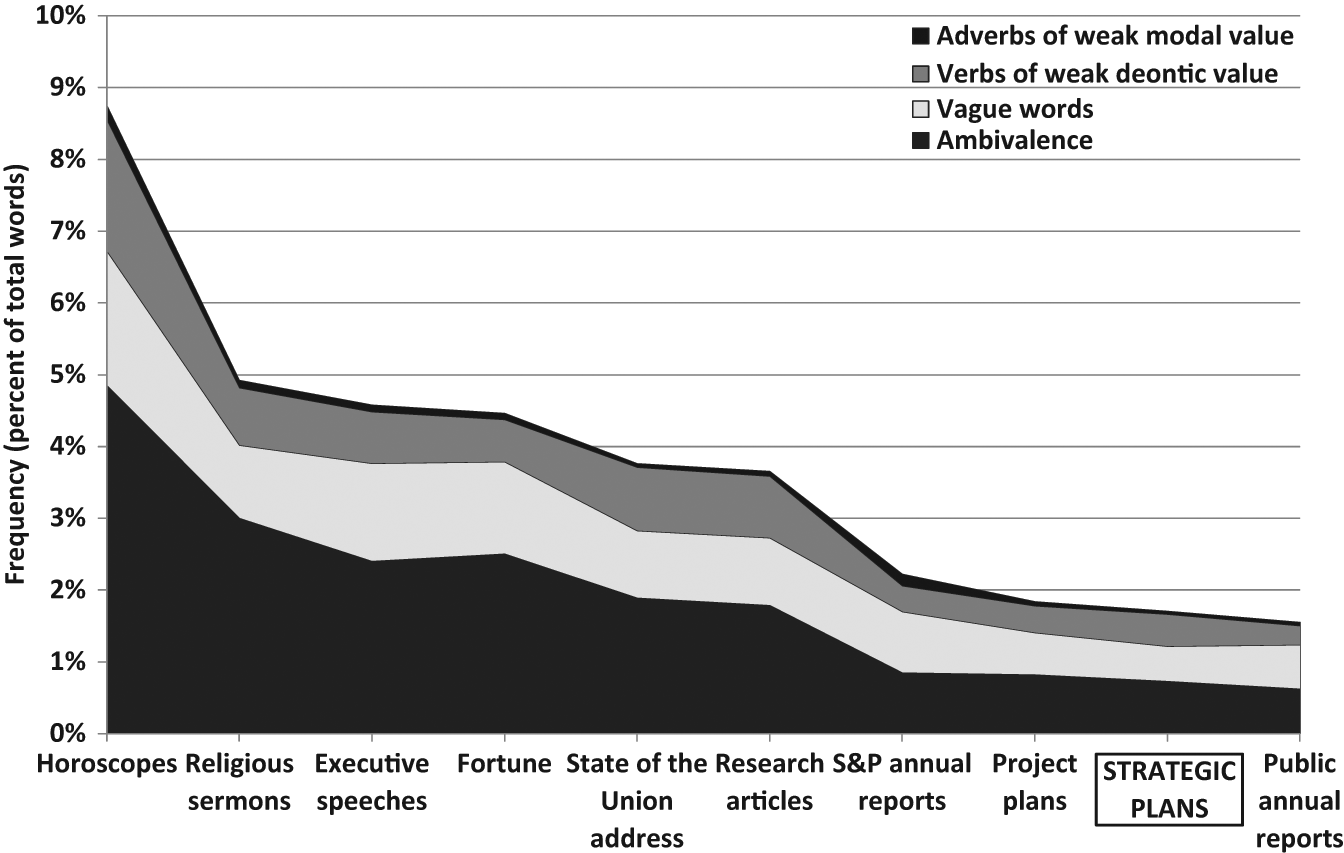
Interpretative viability.
Contrary to expectations, it appears that strategic plans are significantly less ambivalent and use fewer vague words and weak modalities than all other corpora, except for project plans (no significant difference), annual reports from the public sector (which are a little less ambivalent and have fewer verbs of weak deontic value) and annual reports from the S&P 500 companies (which have less verbs of weak deontic value). As expected, horoscopes are the most interpretatively viable corpus: their communicative purpose is to tell readers what will happen to them and what they should do about it, but they address such a wide variety of people that they must allow for a vast array of possible interpretations if they are to be minimally believable.
Taking a stance
The notion of stance is sometimes associated with self-reference, which in DICTION is indexed by the use of first-person singular pronouns (I, me, mine, my, myself). The strategic plans that we collected show significantly less self-reference than all the other corpora (see Figure 6), except for project plans and the S&P annual reports (no significant differences). In management, however, self-reference may imply references to top management (who write the texts, or have others write them in their name), or to the entire organization, suggesting that self-references might be in the first-person plural ‘we’ rather than first-person singular. We thus constructed a dictionary including the pronouns we, our, ours, us and ourselves. Of course, self-reference could also mean that the name of the organization will be used as subject, as Pälli et al. (2009) showed in their case study for the City of Lahti, but this phenomenon cannot easily be ascertained with CATA for a large corpus of texts from various sources. It turns out that strategic plans contain significantly more self-references in the plural (1.4% of all words) than all other corpora, except for executive speeches (1.8%), State of the Union addresses (3.8%) and religious sermons (1.8%) (note that these are the three ‘oral’ corpora) and S&P 500 annual reports (no significant difference), confirming earlier expectations.
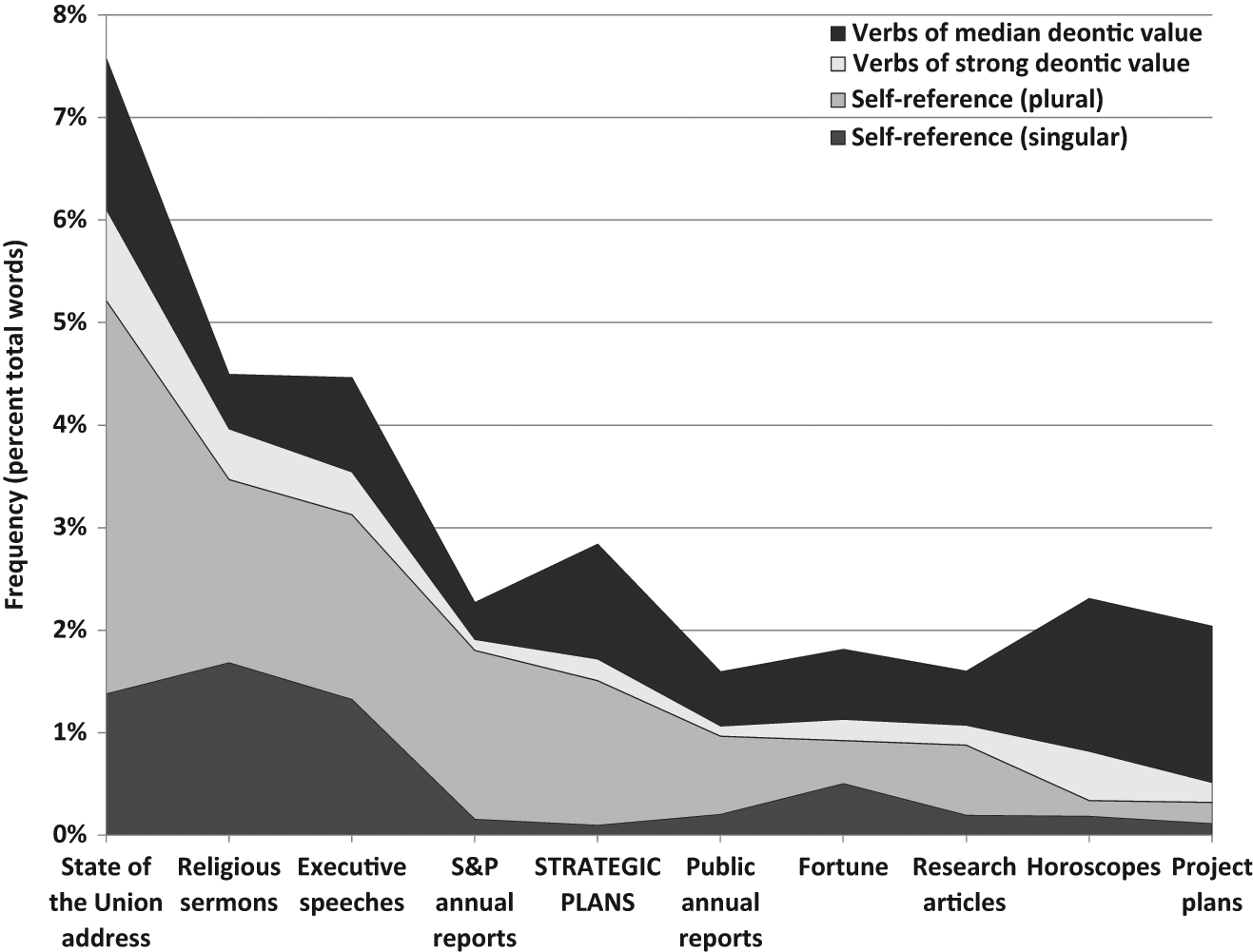
Stance.
Another way for the speaker or writer to make her presence felt is through modality. Deontic modal verbs, such as vow and command, are very similar to commissives and directives, two forms of speech acts (Austin, 1962) that commit the speaker to a certain course of action (endeavour, vow) or are an obligation issued by the speaker (encourage, command). Again, the relative value or strength of modalities is important. People who are required, urged or forbidden to pursue a certain course of action may well feel that they have less choice in the matter than if they were advised or encouraged to do so. Verbs of strong deontic value thus indicate a more affirmed stance on the part of the speaker or writer.
We constructed two more dictionaries for modals: verbs of high (39) and median (36) deontic value. Results are also shown in Figure 6. All corpora have relatively few verbs of strong deontic value. Interestingly, whereas the previous section highlighted that strategic plans have few verbs of weak deontic value, Figure 6 indicates that they also have few strong ones but more moderate ones. This would indicate that commands and commitments are not overtly hedged, but neither are they particularly strong. Directives are given and commitments are made, but there is room for other courses of action. This finding is not inconsistent with Vaara et al.’s (2010) suggestion that strategic plans may emphasize deonticity through declarative statements.
Move analysis
As indicated in the Methods section, we selected a sub-sample of 34 strategic plans to identify those structural elements that signal moves, and established a list of 16 prototypical moves. Strategic plans typically begin with a general description of the document and its purpose. With some variations among the documents as to which move dominates (see Table 3), this is accomplished by means of an executive summary, introduction, and/or the words of an organizational leader. Then, a series of moves associated with the organization and its context are initiated. About half of the plans analysed included a section that presents the organization itself. About two-thirds of the plans present an environmental scan. Twenty-seven plans had a mission statement, which was often presented as part of a triad mission/vision/values. Nineteen organizations also judged it to be relevant to describe their strategic planning process within the plan itself.
Frequencies of coded moves in 34 strategic plans.
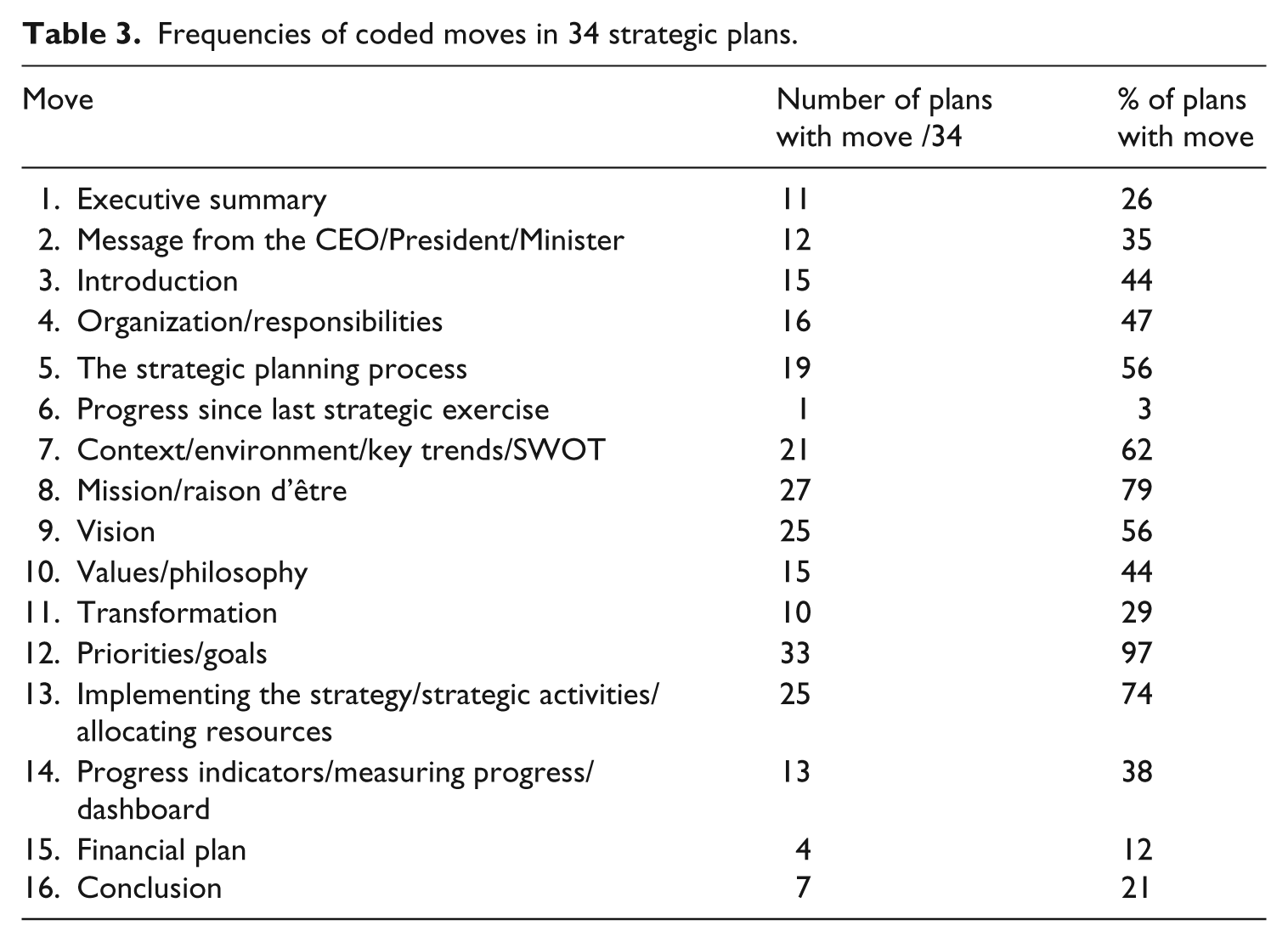
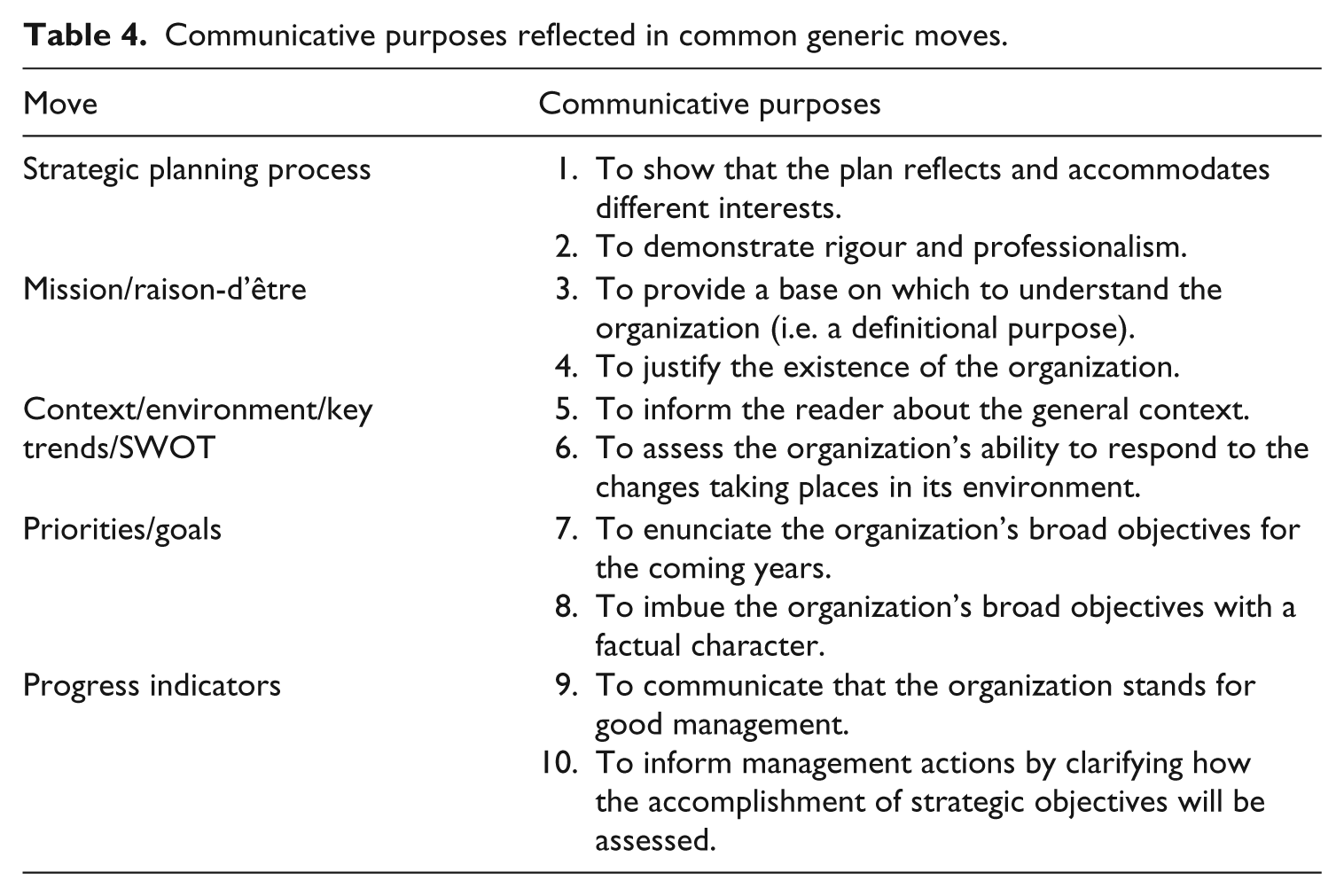
Presenting strategic goals and priorities typifies the genre strategic plan: almost all plans had this move. Concrete strategic activities were associated with strategic goals and priorities in 25 plans. The question of achievement was further addressed by means of a move concerning the measurement of progress. Next, we take a closer look at some of the most prevalent moves and their communicative purposes are discussed in greater depth (see Table 4).
Communicative purposes reflected in common generic moves.
Move ‘strategic planning process’
A large proportion of the strategic plans analysed have a section that presented the strategic planning process followed. Interestingly, this move emphasizes that the planning processe involves the participation and collaboration of many stakeholders, and that the plan is the result of consensus. The following are typical examples:
The formulation of the Sarnia Corporate Strategic Plan is the product of collaboration and consensus building by all participants – City Council, City staff, and various City groups and organizations. (City of Sarnia, p. 5) The Strategic Planning Subcommittee had representation from various other senate committees and the colleges so that the community had significant opportunity for input and comment. (Georgia State University, p. 2)
This move precludes criticisms that the plan is inadequate because it reflects only the views and interests of one or a few powerful groups of individuals. The value and legitimacy of the plan is linked to an appreciation of the different interests and their ability to accommodate these interests. In this sense, the move generally emphasizes the merits of participation and is imbued with a democratic ideal.
The strategic planning process was frequently described chronologically in terms of events and activities. Emphasis was placed on the month of the year where deliverables had to be completed or approved in order to move to the next step of the planning process. Our material includes many examples of chronological description, but the Canadian Broadcasting Corporation (CBC) serves as a particularly illustrative case.
The Corporate Plan is approved by the Board in January and then filed with the Government. Finally, before the start of the fiscal year, the Board approves each media line’s operating, capital, and working capital budgets, which have been drawn up to reflect the strategic priorities approved by the Board in September and November. (CBC 2008–9 to 2012–13, p. 14)
The existence of a formal planning process with specific schedules evokes rigour and professionalism. The description of the strategic planning process implies that there is a systematic approach to planning in the organization and that the process was carried out as it should be. In the same vein, diagrams are often used to depict the planning process and its culmination into a final plan, which also connotes professionalism and order.
Overall, note that this move relating to process is not something that was presaged by the prescriptive literature on how to write a plan that we examined in the opening sections of this article. However, the move is not dissimilar from the educational and legitimating function revealed by Pälli et al. (2009) in their analysis of a city planning process. The following paragraph perhaps reflects most explicitly the educational purpose – while at the same time in this particular case reflecting the optimistic future-oriented perspective noted above.
Without a known starting point and an agreed upon destination, charting the course for any journey would be a difficult task. The same principle holds for organizations. The reason why organizations develop strategies and plans is to generate positive results. It’s about making things better. Strategy is the roadmap to positive change. (St Joseph’s General Hospital Elliot Lake Strategic Plan 2006, p. 38)
Move ‘mission’
The mission is a clear and concise statement that defines the role that an organization should serve. In a few cases, this was explicitly labelled a ‘raison d’être’, representing a variation to the standard mission statement that appears aimed at emphasizing the organization’s value and legitimacy. For example, the raison d’être of the National Film Board of Canada explicitly justifies the organization’s existence by reference to the unique character of its contribution as compared with private sector firms.
The NFB [National Film Board] exists to reflect Canada and matters of interest to Canadians, to Canada and the rest of the world through creating and innovative and distinctive audiovisual works based on Canadian points of views and values. Our promise to Canadians is to move them and the world to see differently through exceptional, distinctive and audacious media productions that can only be created at the NFB. (National Film Board of Canada 2009–10, p. 8)
Stating the mission seems essentially to serve a definitional purpose. The mission provides a base on which to understand the organization. Although the manner in which the mission is enunciated touches the heart of an organization’s identity, the mission is subject to change. In some cases, the planning process provided an opportunity to revise the mission. Here is an example:
Given the many significant changes in the hospital’s environment, this latest statement was reviewed as part of the strategic planning process. The Strategic Planning Steering Committee felt it important to have a new statement, defining a mission, vision and values for the hospital. This new statement provides a picture for the future of the hospital different from the way it is now. (Sudbury Regional Hospital 2004, p. 13)
Move ‘context’
Twenty-one of the 34 strategic plans analysed have a section that presents some of the major changes and trends taking place in the environment. In this section, the tone is distinctively analytical and fact-based. Numbers are presented in profusion, which suggests that information provided is objective rather than the product of perception. The following passage from the plan of an electricity provider is illustrative:
Growth in commercial and government load is projected to be 1.5 percent, while negative growth of –0.2 percent is projected for residential load. The City’s population is expected to increase, and will be more densely settled through growth in apartment and condominium units. That increase in density will increase the load intensity . . . (Seattle City Light 2008, p. 16)
The move is subject to variations in terms of whether the organization’s strengths and weaknesses are introduced into the environmental scan. Indeed, some strategic plans undertake an explicit SWOT analysis, thereby giving equal importance to environmental changes and the organization’s ability to respond to those changes. Although the scope of the analysis varies (one was 15 pages long), in most cases only a list of bullet points summarizes the context and the challenges and opportunities this creates for an organization.
According to the textbook literature, the environmental scan should support the establishment of strategic priorities. For this reason, when the move ‘context’ is present in a plan, it typically precedes the move ‘priorities and goals’ (to be presented below). Significantly, however, strategic priorities are rarely explicitly linked to the move ‘context’. The move ‘context’ thus seems more intended to inform the reader about the general context in which an organization evolves than to support the establishment of concrete strategic goals. The move serves mostly an informational purpose. This observation is rather curious given the emphasis on the importance of choosing strategies as a function of internal and external analysis emerging very strongly from textbook representations of strategic management. However, the disconnection is perhaps presaged by Allison and Kaye’s (2005) relegation of the context section to an appendix. Nevertheless, the textual representation of the context and the absence of obvious linkages to subsequent sections raise questions about the degree to which the recommended processes of strategic analysis are profoundly integrated into strategic choices. At the very least, there is a suggestion here of a certain degree of ritualization that is worthy of further study.
Move ‘priorities’
Most of the strategic plans we analysed enunciated the organization’s broad objectives for the years to come. In fact, 33 out 34 plans had a section that spelled out strategic priorities or goals, suggesting that the move is central to the genre as might be guessed from a review of prescriptive how-to manuals.
However, priorities generally do not have extensive justification and are often listed in a bullet point style. Furthermore, as observed above, priorities are disconnected from the environmental scan and the analysis of the organization’s strengths and weaknesses. Priorities are presented as facts to be accepted and to proceed from. In this sense, the move where priorities are introduced is the strategic plans’ pivotal point: it is the point where information and perceptions take on the factual character necessary to inform organizational actions.
Consider, for example, how an academic institution comes to list its goals in a style that is no longer open to questioning:
The following six interrelated goals serve to identify the key areas for policy development and implementation in support of our mission. (1) To pursue truth openly and collegially by actively encouraging academic excellence; (2) To articulate, realize and celebrate the Catholic vision in all dimensions of College life; (3) To enhance the spirit of community within the College; (. . .) (6) To consolidate the College’s legal status and financial stability. (King’s University College 2007–9, p. 9)
The communicative purpose of the ‘priorities’ move is to establish the organization’s broad objectives for the coming years. The move imbues the objectives with a factual character, not necessarily in the sense that all is immediately clear and transparent, but in the sense that priorities become unquestionable, however clearly or vaguely they be individually expressed (see the quotation above). Giving strategic priorities and goals the currency of facts is a way to establish with confidence the activities to be conducted and the resources to be allocated.
Move ‘progress indicator’
Progress indicators are intended to monitor and evaluate the progress of strategic objectives. Thirteen plans explicitly address the question of monitoring and evaluation, which represents a distinct move. This move varies considerably from one plan to another in the level of details provided about how progress will be assessed. Some strategic plans simply address the importance of measurement in general terms and assure the reader that measurement will take place. This excerpt is illustrative:
Our success in achieving our strategic goals will be assessed using a set of measures gathered on a routine basis utilizing internal and external information sources. The measurement activity will be lead nationally and will support monitoring of trends across the country. The results of our measurement activity will be utilized in annual and strategic planning cycles. (Canadian Red Cross 2003–8, p. 7)
In some strategic plans, factors to evaluate progress are presented but no quantitative points of reference are included. For example, a utilities provider has the strategic priority of becoming an ‘exemplary employer’ and associates the indicators ‘worker satisfaction’ and ‘lost time injuries’ to this goal (Aquatera Utilities 2009–10, p. 11). However, no details are provided about target levels. Other strategic plans have quantitative indicators of success that are linked to strategic goals and strategic activities. For example, an NGO has strategic goals to acquire financial resources and links this goal to the following indicators of success:
Doubling the number of individual donors by 2007 and again by 2009.
Acquiring a minimum of one grant from foundation by 2007 and doubling this by 2009.
A minimum of 1 fundraising event per volunteer group annually by 2007 and doubling by 2009. (Mines Action Canada 2006–10, p. 8)
In conclusion, this move ranges from general statements about measurement to clear metrics. Thus, the move appears to serve different communicative purposes, as shown in Table 4. In its most abstract form, the move conveys the message that the organization believes in measurement and stands for good management. On the other hand, in its most detailed form, the move spells out how the accomplishment of these objectives will be assessed and seeks to inform management actions.
Discussion and conclusions
Combining corpus linguistics (Biber et al., 1998) with move analysis (Bhatia, 2004; Swales, 1990), the findings in this article confirm the distinctiveness of the strategic plan genre of communication within the context of public and non-profit organizations. The article reaches beyond prior studies by examining a large corpus of plans and by comparing them systematically with nine other corpora derived from the same general domain/linguistic content register (business and organizational texts), or having potential comparative interest based on expected characteristics (e.g. horoscopes for the particular dimensions of future orientation and interpretative viability). Strategic plans were found to possess distinctive linguistic and lexical features and to be organized according to a prototypical move structure.
While prescriptive texts on how to write a strategic plan offer guidance on the sections that a plan should include, they say little about the nature of the language used other than that it should be clear and concise. Yet the distinctiveness of strategic plans with respect to other business texts that we observed in this study suggests that those who write them share some kind of common understanding of the language to be employed. This observation provides support to the idea that the production and use of the genre is implicated in a set of professional norms and conventions (Bhatia, 2010). In other words, what makes a strategist, other than merely being involved in strategy, is an ability to instantiate the genre ‘strategic plan’ through an appropriate use of the language. As our analysis revealed, above all, enactment of the genre tends to result in a text that is distinctively inspirational and unifying, characterized by the language of optimism, collaboration and achievement.
In reflecting on the strategic plan’s observed distinctive characteristics, it is important to consider its context and intended recipients (Bhatia, 2010). When strategists construct a strategic plan, they draw on a set of professional conventions and their knowledge of the genre. But they may also consciously consider what the plan’s intended audience expects in terms of structure and content (MacCallum, 2008). This point is especially significant for the context of this study because we employed strategic plans from public and third sector organizations and plans that were in the public domain, rather than internal documents. Stone and Brush (1996) argued that doing strategic planning in public and not-for-profit organizations involves a complex balancing act between meeting needs for legitimacy from resource suppliers by demonstrating ‘formalization of management practices’ on the one hand, and meeting needs for commitment among diverse stakeholders, requiring ‘informality and vagueness to gain commitment from diverse interests’ (Stone and Brush, 1996: 633) on the other. Our analysis illustrates how these texts deal with such underlying tensions.
Thus, on the one hand, the plans reveal a formalized succession of moves broadly instantiating the prescriptive literature we introduced earlier, suggesting good management, rigour and professionalism, and reflecting the need to enhance legitimacy. The strategic plan is written as a document that communicates an organization’s strategy for the years to come. The moves provide a base on which to understand the organization, and offer guidelines to assess the accomplishment of strategic objectives. At the same time, while the move sequences are similar to what one would expect from looking at business planning guidelines, many plans also include self-referential sections clearly aimed at further legitimating the use of such guidelines within the non-profit context itself. Thus, the move ‘strategic planning process’ often refers to participative processes and stages of approval, assuring readers that not only does the plan represent careful delineation of future actions, but that this has been developed through appropriately democratic procedures, representing consensus and commitment.
The need to generate commitment (the second pole of Stone and Brush’s [1996] balancing act) seems further reflected in the language itself through the distinctive emphasis that is placed on the triple features of optimism, commonality and achievement as quite dramatically revealed in Figure 3. Previous studies have remarked on the promotional tone of strategy texts in the city context (Pälli et al., 2009), suggesting a propensity on the part of strategists to adopt expansive language. Similar observations have been made about annual reports (Bhatia, 2010; Rutherford, 2005). Our results show that the strategic plan genre employs few terms connoting negativity and uses more positively charged words than all other corpora with the exception of the horoscopes. Similarly, these plans draw people together with more words referring to commonality than any other corpus, again suggesting the importance of expressing collective consensus and collaboration. Finally, words expressing achievement were also exceptionally common, suggesting that these plans have a strongly promotional and commitment generating purpose even more marked than that previously observed for annual reports. The public availability of these documents no doubt contributes to this portrait, and it would be interesting (though more difficult from an access perspective) to see whether such features would be as marked for a corpus of internally oriented strategic plans with limited circulation.
It should be noted, however, that not all is as expected. First, contrary to expectations, we did not find strong evidence that strategic plans incorporated higher degrees of interpretative viability (or ambiguity) than other types of texts, at least not within the linguistic features analysable through computer aided text analysis, despite the clear reference to multiple stakeholders and wide participation. For example, based on the dictionaries used, the plans do not exhibit more incidences of ambivalence and vague wording than other corpora. On the other hand, as we noted, the use of moderate deontic verbs may leave some room for different interpretations. Finally, our analysis did not look at other dimensions of the texts that might reflect interpretative viability – for example, while the words themselves may not be ambiguous, the arrangement of sentences and paragraphs and the use of metaphor may provide other indicators that could be examined in future research. It is also interesting to note the way in which the move ‘priorities’ expressed future plans as ‘facts’, implicitly reducing room for interpretation about the organization’s future direction. And yet, the statements composing these priorities could in themselves connote a firm commitment to doing something that might not in itself be particularly clear. Overall, our analysis tends to confirm Vaara et al.’s (2010) notion that plans close down options, while simultaneously implying consensus around them. It seems that the need to create commitment is not expressed in linguistic vagueness, but manifests itself rather in the tone of the documents (optimism and commonality) and in references to process and consensus.
A second, somewhat surprising, observation concerns the relative independence within the strategic plans between the ‘context’ and ‘priorities’ moves. The notion that planning is a rational process in which analysis leads to and justifies choice (see also MacCallum et al., 2008) is not explicitly visible in the logical structure of these documents. Rather, the context move seems to play a largely informative and almost ritual role whose connection with the choices made is at best implicit, not explicit. Further research should examine whether this disconnect is simply a reflection of a typified writing and communication style inherent to the genre or rather a more profound rupture that might offer another means by which rationalized forms that tend to suppose centralized decision making are reconciled with participatory processes with which they are only partly compatible (Lozeau et al., 2002; MacCallum, 2008).
Overall, a genre-based view of strategy texts fills an important gap in the emerging research agenda on the practices of strategy (or strategy-as-practice), and this article contributes to that development. Research on the practice of strategy making has made significant contributions by shifting the attention away from the economic and rational dimension of strategy to the mundane activities surrounding it as a domain of activity within organizations (Jarzabkowski et al., 2007; Johnson et al., 2007). One question that strategy-as-practice has been grappling with concerns the development of analytical frames capable of showing the interplay between institutionally derived practices, the specific artifacts produced and employed by strategists and everyday activities (Rasche and Chia, 2009; Whittington, 2006). Genre theory offers a potential means to explore this interplay. While other studies have considered the strategic plan genre as reflected in specific cases (MacCallum, 2008; Pälli et al., 2009), the current study is the first to provide broader empirical evidence from a large sample of strategic plans, illuminating the distinctive characteristics of the genre within the public and non-profit sectors.
The method used in this study combines computer-assisted text analysis (CATA) with a qualitative interpretation of the moves presented in specific documents. This constitutes a powerful method to systematically compare strategic plans with other categories of texts. The method could be developed to at least three additional applications for understanding the genre further. First, the method might allow a comparison of a different sub-genre of strategic plans, such as documents intended for internal use and presentation documents. Second, the method might enable the analysis of the evolution of strategic plans throughout the strategic planning process in order to understand how emerging documents become aligned to the expected genre. Finally, CATA might enable a comparative analysis of the plans of different types of organizations (e.g. for-profit and non-profit organizations) to see whether important variations occur.
Indeed, in parallel with this research, we have begun building a corpus of plans from private firms as well as internal documents from public sector firms. Although the strategic plan genre observed reflects many of the written prescriptions for business plans, our early observations suggest that ironically, the genre within business itself may be taking a somewhat different direction. For example, in the private sector context, the PowerPoint presentation seems to be a prevalent mode of communication, resulting in extensive use of bullet point forms and graphical elements that we did not observe in our corpus. Thus, the comparison merits further study. Nevertheless, the sample of strategic plans we studied is of great interest to a large number of organizations. The genre clearly exists and has very definite institutionalized characteristics that establish it as a distinctive form of communication.
In sum, the strategic plan genre can express good management, rigour and professionalism and serve at the same time as a valuable political tool. Drawing on the accepted genre can provide a formula to coordinate social interactions and simplifies the formulation of a strategy. Strategists must be able to use the genre to gain the support they need to advance important goals, but they must also be able to creatively deviate from the genre when the situation requires it. Exploiting the malleability that the genre allows may help to achieve a communicative purpose more effectively. Departing too much from the archetypal genre might, however, make a strategic plan appear unprofessional and raise questions concerning the soundness of its content. Using genres is a complex balancing act that strategists need to master.
Footnotes
Appendix
Word frequencies and t-test for each dictionary and each corpus.
| Strategic plans | Public annual reports | S&P annual reports | State of the Union address | Executive speeches | Project plans | Fortune | Research articles | Horoscopes | Religious sermons | ||||||||||
|---|---|---|---|---|---|---|---|---|---|---|---|---|---|---|---|---|---|---|---|
| frequency (mean of 89) | frequency (mean of 80) | t | frequency (mean of 73) | t | frequency (mean of 36) | t | frequency (mean of 60) | t | frequency (mean of 23) | t | frequency (mean of 100) | t | frequency (mean of 86) | t | frequency (mean of 16) | t | frequency (mean of 100) | t | |
| Accomplishment | 5.437% | 3.256% | 10.65** | 3.501% | 10.16** | 3.288% | 10.79* | 3.246% | 10.62** | 4.261% | 3.92** | 2.704% | 14.77** | 4.287% | 4.97** | 2.571% | 15.09** | 1.237% | 23.73** |
| Concreteness | 3.738% | 4.777% | −4.37** | 4.034% | −1.50 | 4.392% | −3.26** | 3.343% | 1.95 | 3.422% | 0.87 | 4.132% | −1.96 | 2.268% | 7.24** | 1.318% | 13.22** | 2.545% | 5.94** |
| Spatial awareness | 3.605% | 2.914% | 3.01** | 1.272% | 14.70** | 3.129% | 2.41* | 2.155% | 8.27** | 1.597% | 8.66** | 1.740% | −6.42** | 1.770% | 9.51** | 1.390% | 13.85** | 1.553% | 12.13** |
| Cognitive terms | 3.372% | 1.970% | 7.65** | 1.608% | 11.45** | 1.330% | 13.25** | 2.018% | 8.47** | 4.056% | −1.77 | 1.391% | 12.76** | 3.263% | 0.60 | 1.826% | 9.69** | 1.671% | 10.79** |
| Tenacity | 3.101% | 2.838% | 1.59 | 2.881% | 1.53 | 5.427% | −14.61** | 5.281% | −14.93** | 4.423% | −5.05** | 4.767% | −14.25** | 3.990% | −5.51** | 6.490% | −20.64** | 6.776% | −21.85** |
| Present concern | 2.248% | 1.724% | 3.73** | 1.690% | 4.54** | 2.916% | −4.37** | 2.832% | −4.43** | 2.065% | 0.93 | 2.362% | −1.74 | 1.991% | 1.82 | 4.445% | −16.10** | 2.879% | −4.51** |
| Human interest | 2.223% | 1.731% | 2.26* | 2.048% | 0.80 | 7.207% | −18.26** | 5.468% | −11.27** | 0.730% | 7.24** | 4.047% | −6.90** | 1.679% | 2.85** | 8.887% | −22.73** | 9.102% | −26.15** |
| Cooperation | 2.195% | 1.900% | 2.86** | 2.534% | −3.28** | 0.995% | 12.73** | 0.965% | 12.85** | 1.958% | 1.11 | 0.807% | 15.62** | 1.786% | 3.40** | 0.883% | 14.25** | 0.410% | 19.98** |
| Collectives | 1.956% | 1.875% | 0.57 | 1.318% | 5.07** | 1.451% | 4.14** | 0.970% | 8.52** | 1.711% | 1.00 | 1.002% | 8.14** | 0.661% | 10.39** | 0.276% | 15.28** | 0.499% | 12.48 |
| Temporal awareness | 1.940% | 2.585% | −5.20** | 2.561% | −5.46** | 3.896% | −13.66** | 3.430% | −12.18** | 1.962% | −0.09 | 3.585% | −4.14** | 1.797% | 1.14 | 4.532% | −18.46** | 2.768% | −6.23** |
| Inspiration | 1.835% | 1.126% | 4.82** | 0.483% | 10.92** | 1.433% | 3.01** | 0.812% | 7.59** | 0.891% | 6.06** | 0.389% | −7.38** | 0.478% | 10.51** | 0.693% | 9.06** | 0.944% | 6.53** |
| Self-reference (plural) | 1.407% | 0.759% | 4.098** | 1.645% | −1.27 | 3.836% | −13.97** | 1.801% | −2.26* | 0.204% | 7.50** | 0.417% | 6.68** | 0.682% | 4.81** | 0.151% | 8.75** | 1.785% | −2.26* |
| Centrality | 1.256% | 0.917% | 4.46** | 1.443% | −2.64** | 0.660% | 8.86** | 0.733% | 7.55** | 0.998% | 2.38* | 0.534% | 11.08** | 1.254% | 0.02 | 0.543% | 10.56** | 0.340% | 14.23** |
| Medium deontic verbs | 1.122% | 0.531% | 8.78** | 0.361% | 13.02** | 1.477% | –4.57** | 0.922% | 3.12** | 1.527% | −2.40* | 0.685% | −1.63 | 0.529% | 9.33** | 1.492% | −4.89** | 0.533% | 9.50** |
| Passivity | 1.025% | 0.925% | 1.47 | 1.157% | −2.09* | 1.432% | −5.57** | 0.913% | 1.88 | 1.088% | −0.60 | 0.852% | −10.05** | 0.800% | 3.56** | 1.329% | −3.81** | 1.106% | −1.16 |
| Satisfaction | 0.929% | 0.608% | 3.21** | 0.241% | 7.93** | 0.848% | 0.87 | 0.779% | 1.61 | 0.141% | 9.03** | 0.635% | −0.64 | 0.173% | 8.79** | 1.269% | −3.19** | 1.118% | −1.58 |
| Praise | 0.871% | 0.660% | 3.76** | 0.594% | 5.42** | 1.408% | −7.74** | 1.429% | −8.87** | 0.486% | 4.78** | 0.970% | −14.76** | 0.800% | 1.24 | 1.883% | −11.03** | 1.463% | −7.59** |
| Communication | 0.855% | 1.030% | −2.56* | 1.142% | −4.58** | 1.056% | −3.00** | 1.523% | −6.28** | 1.493% | −4.37** | 1.590% | −9.65** | 0.954% | −1.62 | 0.874% | −0.27 | 2.046% | −13.84** |
| Ambivalence | 0.732% | 0.627% | 1.99* | 0.851% | −2.33* | 1.894% | −13.20** | 2.405% | −23.75** | 0.825% | −0.82 | 2.508% | −29.61** | 1.790% | −13.54** | 4.856% | −23.69** | 3.004% | −26.93** |
| Levelling | 0.707% | 0.664% | 0.91 | 0.893% | −4.19** | 1.373% | −9.61** | 1.341% | −13.08** | 0.777% | −0.91 | 1.173% | 11.59** | 0.810% | −2.20* | 1.413% | −11.67** | 1.498% | −13.56** |
| Numerical terms | 0.676% | 0.948% | −3.58** | 1.758% | −12.83** | 0.998% | −4.43** | 1.156% | −6.54** | 0.544% | 0.79 | 1.361% | −15.13** | 0.984% | −4.43** | 0.375% | 4.65** | 0.551% | 2.09* |
| Will | 0.675% | 0.289% | 6.62** | 0.179% | 9.47** | 0.925% | −3.32** | 0.474% | 3.44** | 1.177% | −2.93** | 0.306% | −5.35** | 0.174% | 9.22** | 1.176% | −6.36** | 0.436% | 3.88** |
| Aggression | 0.553% | 0.451% | 2.17* | 0.555% | −0.06 | 1.392% | −10.22** | 0.767% | −3.91** | 0.602% | −0.46 | 0.794% | −4.63** | 0.927% | −5.90** | 0.644% | −1.77 | 0.635% | −1.48 |
| Diversity | 0.519% | 0.358% | 5.31** | 0.416% | 3.53** | 0.273% | 7.79** | 0.481% | 1.03 | 0.514% | 0.10 | 0.388% | 4.22** | 1.460% | −11.45** | 0.554% | −1.14 | 0.284% | 6.65** |
| Vague words | 0.487% | 0.613% | −3.32 | 0.850% | −9.32** | 0.936% | −9.86** | 1.362% | −19.65** | 0.584% | −1.46 | 1.282% | −11.41** | 0.939% | −12.06** | 1.870% | −20.54** | 1.016% | −11.69** |
| Weak deontic verbs | 0.447% | 0.265% | 5.03** | 0.361% | 2.30* | 0.884% | −9.73** | 0.720% | −6.78** | 0.374% | 1.28 | 0.589% | −19.79** | 0.860% | −8.09** | 1.832% | −14.21** | 0.801% | −7.04** |
| Past concern | 0.365% | 0.480% | −3.47** | 0.634% | −8.67** | 0.576% | −5.54** | 0.724% | −8.20** | 0.746% | −5.24** | 0.986% | 2.80** | 0.552% | −5.37** | 0.368% | −0.07 | 0.849% | −11.79** |
| Rapport | 0.345% | 0.333% | 0.46 | 0.312% | 1.34 | 0.539% | −6.18** | 0.392% | −1.72 | 0.471% | −2.12* | 0.362% | −0.91 | 0.494% | −4.86** | 0.326% | 0.55 | 0.328% | 0.60 |
| Exclusion | 0.278% | 0.211% | 1.91 | 0.350% | −2.10* | 0.185% | 2.78** | 0.195% | 2.44* | 0.330% | −0.94 | 0.196% | 2.44* | 0.383% | −2.59* | 0.182% | 2.86** | 0.160% | 3.33** |
| Hardship | 0.262% | 0.309% | −1.11 | 0.470% | −5.75** | 0.955% | −12.35** | 0.557% | −6.31** | 0.366% | −1.65 | 0.562% | 5.85** | 0.391% | −3.02** | 0.567% | −6.44** | 1.220% | −8.37** |
| Strong deontic verbs | 0.209% | 0.098% | 6.35** | 0.105% | 6.37** | 0.890% | −13.87** | 0.415% | −8.26** | 0.191% | 0.69 | 0.205% | 10.51** | 0.192% | 0.85 | 0.479% | −8.54** | 0.493% | −7.20** |
| Future orientation | 0.204% | 0.149% | 2.41* | 0.236% | −1.36 | 0.246% | −1.48 | 0.188% | 0.71 | 0.290% | −1.02 | 0.165% | 1.68 | 0.099% | 5.06** | 0.237% | −1.46 | 0.183% | 0.80 |
| Liberation | 0.173% | 0.178% | −0.22 | 0.284% | −4.69** | 0.490% | −6.31** | 0.265% | −2.88** | 0.212% | −0.93 | 0.212% | −9.23** | 0.342% | −4.19** | 0.232% | −2.16* | 0.187% | −0.46 |
| Denial | 0.155% | 0.200% | −2.14* | 0.506% | −13.98** | 0.915% | −16.30** | 0.760% | −19.23** | 0.326% | −3.64** | 0.667% | −15.33** | 0.586% | −10.59** | 0.754% | −17.75** | 1.306% | −21.97** |
| Strong modal adverbs | 0.147% | 0.098% | 3.65** | 0.229% | −5.77** | 0.322% | −8.57** | 0.279% | −7.11** | 0.247% | −3.22** | 0.212% | 0.21 | 0.145% | 0.11 | 0.302% | −6.27** | 0.309% | −7.15** |
| Motion | 0.119% | 0.208% | −3.82** | 0.156% | −2.41* | 0.322% | −10.42** | 0.439% | −14.29** | 0.157% | −0.84 | 0.589% | −1.14 | 0.131% | −0.55 | 0.575% | −14.36** | 0.588% | −11.51** |
| Medium modal adverb | 0.108% | 0.078% | 2.40* | 0.120% | −0.95 | 0.106% | 0.16 | 0.179% | −4.79** | 0.054% | 3.46** | 0.124% | 6.43** | 0.328% | −10.34** | 0.609% | −13.42** | 0.094% | 1.00 |
| Self-reference (singular) | 0.101% | 0.207% | −2.18* | 0.159% | −0.67 | 1.382% | −13.33** | 1.328% | −11.08** | 0.117% | −0.37 | 0.507% | 3.26** | 0.198% | −2.41* | 0.188% | −2.23* | 1.686% | −14.85** |
| Blame | 0.053% | 0.074% | −1.74 | 0.123% | −6.87** | 0.397% | −17.04** | 0.299% | −13.13** | 0.045% | 0.63 | 0.357% | −11.52** | 0.227% | −10.03** | 0.429% | −19.88** | 0.519% | −13.79** |
| Weak modal adverbs | 0.047% | 0.053% | −0.89 | 0.167% | −8.84** | 0.056% | −1.04 | 0.099% | −5.84** | 0.063% | −1.03 | 0.092% | −3.620** | 0.072% | −2.43* | 0.203% | −8.00** | 0.109% | −5.43** |
| * Significant differences at p < 0.05 | 8/40 | 5/40 | 1/40 | 2/40 | 3/40 | 1/40 | 4/40 | 2/40 | 2/40 | ||||||||||
| ** Significant difference at p < 0.01 | 21/40 | 26/40 | 35/40 | 32/40 | 14/40 | 31/40 | 27/40 | 32/40 | 32/40 | ||||||||||

Acknowledgements
The authors are grateful to Denis Larocque for his advice on the statistical analysis.
The authors thank the Social Sciences and Humanities Research Council of Canada for their financial support.