






Abstract
Genre analysis has been applied to a sizable body of linguistic studies on various text types. However, little attention has been paid to advertorials as an emerging hybridized genre. To identify the generic and linguistic characteristics of advertorials, and therefore to classify advertorials into an appropriate genre, this study carries out a comprehensive genre analysis of advertorials based on Bhatia’s (1993) seven-step genre analysis methodology. A corpus of 55 advertorials was collected from four English-language magazines and two English-language newspapers, from which a sub-corpus of 12 samples was further selected for a thorough examination of linguistic characteristics. Attempting to gain a comprehensive view of generic features of advertorials, this study makes a critical comparison of advertorials with three inextricably related genres: advertisements, news stories and editorials. Linguistic evidence sufficiently demonstrates that advertorials share fundamental generic and linguistic natures with advertisements and proposes classifying advertorials as a sub-genre of advertisements.
Introduction
Advertisers are constantly looking for novel strategies to grab attention, arouse interest, build trust and ultimately persuade customers to buy their products or services. One recent emerging strategy is to advertise in the format of news or editorials. An increasing number of magazines have set up a ‘Special Advertising Section’ or a section with ‘Special Advertisement Features’, while newspapers provide pages of ‘Advertising Supplements’. This hybridized text type is sometimes referred to as ‘advertorials’, a name created by blending the initial part of ‘advertisements’ and the final part of ‘editorials’. As the name indicates, an advertorial tends to intrinsically act as an advertisement.
In reality, however, advertorials are more confusing and misleading than people expect. Two recently reported cases of disputes over advertorials are sufficient to prove their confusing nature. In one case, The New York Times was sued by a broadcast news personality, who claimed that she ‘was misled to believe she was being interviewed for a mental health news article when actually she was being featured in an advertising supplement’. In the other case, The Star, a popular newspaper in India, proposed that all editors could be called upon to write advertorials. This proposal was strongly rejected by the Labor Union and staff. These two cases reveal that advertorials not only confound readers, but also the information suppliers and the advertorial writers.
The significance of the present study lies in two main facets: first, it is to demonstrate why advertorials generically and linguistically share a distinct nature with advertisements, compared with news or editorials; second, this study is an exhaustive application of genre theory on a previously unexamined genre, which is expected to enhance further understanding of genre analysis and the role of evaluation in analysis of hybrid text types.
Theoretical background
Genre studies as a branch of situated discourse analysis (Bhatia, 1993, 2004; Swales, 1990) primarily focus on three distinct aspects of a discourse: textualization of lexico-grammar, organization of discourse and contextualization of discourse. In spite of various orientations and approaches, genre theory generally perceives a genre as communicative events with mutually identifiable and recognizable communicative purposes in a specific community. Genres are regarded as ‘highly structured and conventionalized constructs’, which have been conventionally identified in terms of ‘moves’. Dudley-Evans and John explain that
a ‘move’ is a unit that relates both to the author’s purpose and to the content that s/he wishes to communicate; a ‘step’ is a lower level text unit than the move that provides a detailed perspective on the options open to the author in setting out the moves. (1998, as cited in He, 2006: 12)
Bhatia (1993, 2004) proposes a typical cognitive structure which accounts for the structural interpretation of the legal case and has demonstrated that structural move analysis, which was originally designed by Swales (1990) when examining research reports, could be applied to versatile text types, such as legal documents, promotional letters and news stories.
Seeing various purposes of analysis and different foci of particular genres in question, Bhatia (1993) proposes seven steps (see Table 1) attempted for the purpose of analyzing a new genre, which has since been adopted and applied efficiently by many other researchers in the field. Academic papers are explored with thick description in light of this approach by Brett (1994), Holmes (1997) and Thompson (1994), as well as by Mulken and Meer (2005) who look into discourses in business settings. This approach identifies communicative purposes of a genre through a comprehensive examination of its situational and institutional context from steps 1–3. Linguistic analysis in step 6 is further elaborated and exemplified thoroughly by three levels of deeper textual analysis, including lexical and grammatical features, text-patterning or textualization and structural interpretation of the text-genre. This method has been proved to be efficient and productive when applied to heterogeneous genres.
Seven-step method proposed by Bhatia (1993).

Genre theory is based on analysis of language use in highly conventionalized communicative settings which constrain the selection and utilization of lexico-grammatical resources in different discourse domains. Despite great emphasis on conventions and common features, genres are by no means static or fixed. In reality, written discourses are complicated, blurred and dynamic, where genre appropriation and colonization are commonly seen. Bhatia (2004) observes that specialists or professionals constantly transfer and exploit genre features across various domains to convey private intentions, often leading to innovative, hybrid types of discourse. The advertorial as an innovative, hybrid emerging text type has been noticed and discussed in Bhatia (2004). However, systematic analysis of advertorials so far has rarely been carried out. A full-round study of advertorials is necessary to gain a comprehensive view of this emerging hybrid genre, and thus to shed light on various types of hybrid genres.
As Bhatia (2004) points out, the main ‘generic values’ of promotional writings are ‘description’ and ‘evaluation’, and evaluative elements in promotional articles are distinctive. However, few studies within the scope of genre analysis have paid due attention to the evaluative aspect of discourse. Although evaluation or stance in an article is easily ‘sensed’ or observed, measurement of its evaluative degree in an accurate way is hardly feasible. Appraisal theory, a branch of further development within the framework of Systematic Functional Linguistics proposed by Michael Halliday (1994), puts forward a systematic analytical framework to properly classify and ‘measure’ evaluative linguistic resources. Martin and White (2005) explain that evaluation is concerned with ‘the interpersonal in language, with the subjective presence of writers/speakers in texts as they adopt stances towards both the material they present and those with whom they communicate’ (p. 1). Specifically, appraisal theory proposes to divide evaluative resources into three sub-systems: attitude, engagement and graduation. Attitude is a system of meaning for mapping feelings, or in other words, ways of expressing feeling. Attitude itself has three sub-categories: affect, judgment and appreciation. Engagement is a category including the resources conveying intersubjective positioning of the speakers or authors with respect to prior utterances, alternative viewpoints and anticipated responses. The third category of graduation includes the values that act to provide grading or scaling. Martin and White (2005) explored the ‘voices’ of news, analysis and commentary discourses from an angle of identifying ‘evaluative key’ within journalistic writing. Their exploration into evaluative aspects of a small-sized corpus of journalistic writings has demonstrated that different journalistic categories do show ‘different probabilities for the occurrence of the different types of attitude, graduation and engagement’ (p. 183). Appraisal theory is applied in this study as a tool to assist in the examination of the evaluative aspect of language in advertorials at the micro-linguistic level.
Methodology
Data collection
The data set in the current study is advertorials in ‘special advertising sections’, labeled as ‘special advertising features’ in the four English-language magazines: Forbes, Fortune, Newsweek and Business Week. The four magazines are considered to be appropriate data sources as they have widespread availability globally and have reached a large audience. Furthermore, articles were also collected from the advertising supplement section in two newspapers. One was the South China Morning Post, which is a prominent daily newspaper in China with particular popularity in Hong Kong and Macao. The other was the International Herald Tribune, which has a worldwide distribution and also publishes a corresponding e-version online. All the articles were selected from recent magazines and newspapers that were published in the second half of 2006. A corpus of 55 advertorials with an estimated 101,980 words was formed, of which 70,589 words (69.2%) was from magazines and the remaining 31,391 (30.8%) from newspapers. The articles from different magazines varied in number of words in each advertorial. For example, the articles from Newsweek were shorter, while those from Fortune were longer, as compared with other magazines. In order to arrange the data in a more balanced way, one issue of Newsweek was added and one issue of Fortune was eliminated. Table 2 provides precise data information, comprising the code, media, number and number of words of advertorials from each media, as well as the date and number of issues.
Data information.

Note: ‘M’ in code numbers stands for magazine, ‘N’ for newspaper.
As the corpus was deemed too large for a thorough and comprehensive examination of linguistic features, a sub-corpus of 12 samples was further selected. From each magazine and newspaper, two advertorials were chosen as samples. The criteria of selecting the samples is set to get a variety of subjects and a wider range of target readers, so as to increase the external reliability of the study. Of the 12 selected samples, sponsors were from such various backgrounds as non-governmental organizations (M011), broadcasting companies (BBS, M012), governments (M015), and IT companies (M024) (see boldfaced data list in Appendix 1).
Analytical methodology
The seven-step analytical framework devised by Bhatia (1993) is taken as guideline in the present study for analyzing advertorials as a newly emerging genre. Two alterations were made as a means to better fit the text type under study and thus, better serve this study’s purpose. First, the analysis of institutional context suggested in the framework is mainly concerned with the culture or conventions of an organization or society where the data were collected. However, current data come from popular mass media, and therefore there are no direct relationships with particular organizations or institutions. Second, Bhatia includes a step for specialist information in genre analysis. As this study situates in expanding-circle context with limited resources, specialist information is hard to obtain. Consequently, this article takes the remaining five steps, suggested in the model and researches into two broad aspects of advertorials as a genre: communicative purposes and textual analysis. Figure 1 gives a full view of the overall research methodology and procedure.
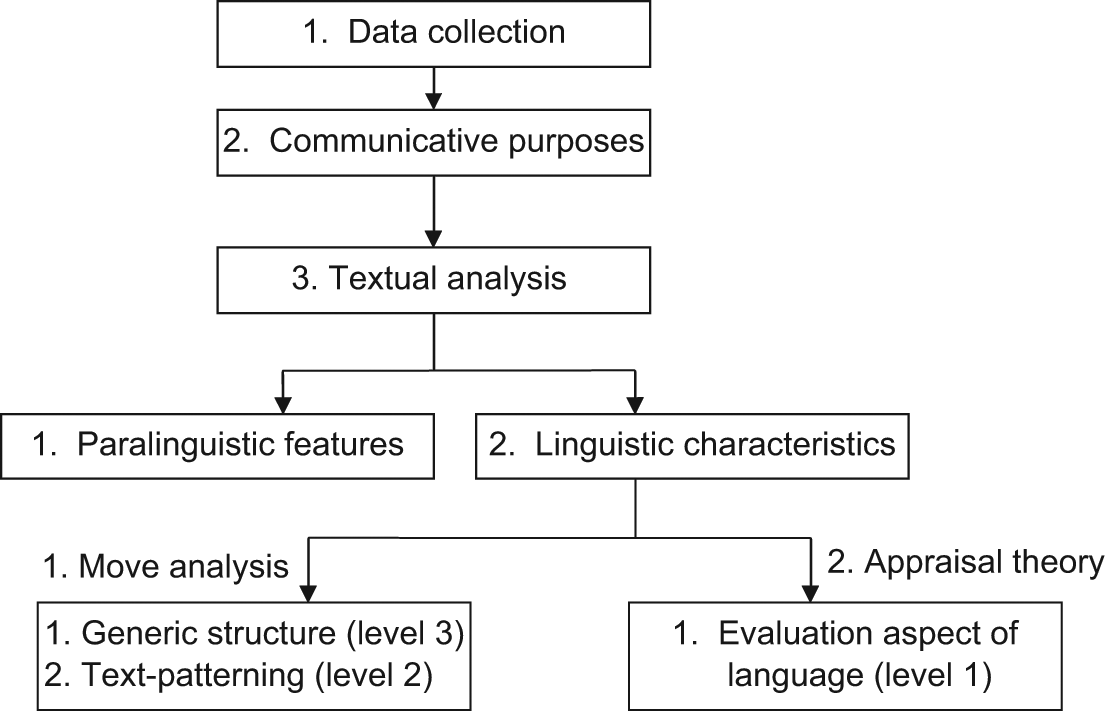
Research procedure.
Specifically, textual analysis was conducted focusing on two particular aspects: paralinguistic analysis and linguistic analysis. Although analysis of paralinguistic features was not included in Bhatia’s (1993) seven-step model, researching paralinguistic features of advertorials appropriately suits the particular objective and ultimate goal of this study. Apparently, the outlook, visual design and paralanguage of any text types in printed media create a first important impression to readers. In addition, the paralinguistic features of news stories (editorials) and advertisements are conspicuously different from each other. Therefore, carrying out an exploration of paralinguistic features of advertorials – as a blended text type of advertisements, news stories and editorials – is assumed to be essential and enlightening.
This study conducted genre analysis at the level of generic structure (level 3), which was intended to present the organization or the macro-structure of advertorials. Using the English for Specific Purposes (ESP) school’s ‘move analysis’ model as a tool, the moves and sub-moves or steps were identified and analyzed in each single sample and then an overall structure was put forward. Meanwhile, the textual purposes contributing to each move and step were set out, which makes up textualization or text-patterning suggested at level 2. Furthermore, analyses of linguistic features were substantially strengthened with an examination of the evaluative aspect of language (level 1).
Results of genre analysis
Communicative purposes of advertorials
Dictionaries tend to define ‘advertorial’ as a type of advertisement written and presented in the form of a news story or an editorial. It is rarely labeled explicitly as ‘advertorial’ in printed media. Rather, it is often placed under such categories as ‘Special Advertising Section’, ‘Advertisement Supplement’ or ‘Integrated Content’. Media companies publish advertorials and intend to make them appear to be reporting or sharing useful information with readers. In contrast, the advertiser’s ultimate purpose is to deliver the sales message and to persuade readers. Therefore, a compromise must be reached between the media company and the advertiser. Advertisers must be willing to work cooperatively with the publishers so that the content of advertorials can benefit both sides. Definitely, there are good reasons for advertisers to use this complicated advertorial strategy instead of straightforward advertisements. Endorsement is one important reason. It is commonly known that people tend to believe in things that are recommended by a reliable person or unbiased media. The media is playing a role of giving credit or an endorsement to the advertiser. Considering the situational and social factors, I suggest that a typical advertorial tends to serve the following two communicative purposes.
First is to offer valid information to the prospective clients. Usually, advertorials are used to offer information about sources, products, techniques or services of the advertised client. At the same time, the content appears to communicate opinions about social, economic, political or personal issues. For example, there are advertorials reporting on retiring programs, healthy lifestyles and Hong Kong’s rapid development. When choosing the topic, the media seriously considers whether real value is provided to the readers. If an advertorial is functioning totally like an ad, despite its news or editorial format, readers tend to doubt the credibility of the media and see it as trite.
Second, the ultimate purpose for advertisers is to grab the attention of potential customers and persuade them to buy their products or services. In order to achieve this object, three minor goals should be satisfied. First, advertorials should be able to capture the attention of readers or potential customers. Therefore, choosing the right topic that is of public interest is essential. Of course, there are other elements in attracting readers’ attention, such as the visual elements and well-written text. Second is to build positive images and highlight the distinguished features of the company, the products or the services in the interest of the sponsors. However, the focus is often placed on other aspects, such as advanced technology or the new management model the company employs, rather than the products or services per se. For instance, advertorials can adhere to industry standard best practices. Fortune editors have published an advertorial entitled ‘Power to innovate’, listing the companies which do well in applying innovative technologies into production. Forbes publishes ‘Sustainable Development – Perspective on the Future’, which builds the company’s image by praising its long-term development strategies such as their Environmental Action Plan. Third, writers want to make prospective customers take action and respond. To achieve this goal, it is important to provide the company’s contact details, such as address, telephone number or website. Most advertorials provide the contacts in a very strategic but implicit way. For example, Forbes offers website addresses under the name of ‘web dictionary’. Business Week even presents a map as an illustration and locates all the names of sponsored companies on it.
In summary, advertorials manifest two basic communicative purposes: 1) to offer information; and 2) to persuade. In order to achieve the purpose of persuasion, three minor goals should be achieved: 1) to arouse readers’ interest; 2) to build positive images in the interest of the sponsors; and 3) to achieve audience responses.
Textual analysis of the advertorials
Analysis of paralinguistic features
For different genres, we expect different visual arrangements. When we think of academic papers, we expect to see no color other than black as well as a consistent typeface throughout the text. When we think of advertisements, we expect to see many colors and other visual elements such as pictures and photos. Advertorials make the situation even more complicated. At first glance, no big differences can be detected by readers and it is not easy for readers to distinguish advertorials from other reports, especially as advertorials are usually not appropriately labeled and are designed to look like news articles. Designers create advertorials to meet the expectations that readers have for news stories or editorials in magazines and newspapers. However, when taking a closer look, several distinct paralinguistic features can be identified and an overwhelming number of the visual elements or layout arrangements tend to present advertorials as logical, unbiased and authentic texts.
Layout
Some advertorials are quite long, some even more than 10 pages. Observations suggest that both long and short advertorials are divided into a number of sub-articles with separate titles and topics or themes. The sub-articles, although not very long, are often further separated into sections with numbered or bold headers. The clear-cut structures are intended to appear in more authentic papers such as scientific reports or academic articles. Obviously, by resembling such a structure, the writers attempt to construct a logical argument on paper. The visual signals of sub-titles and headers present a logical, confident argument and mislead readers into believing what they see as authentic and trustworthy information.
Another feature deserving attention is the use of bylines. Normally, news stories have bylines while advertisements do not. In the corpus, eight out of 11 advertorials from Forbes and 100% from the International Herald Tribune are with bylines. One out of five articles in Fortune uses a byline. All the articles from Business Week, Newsweek and South China Morning Post are without bylines. The statistics show that the byline feature is highly variable but in general fairly common.
Letter shapes and color
The fact that letters have shapes and we associate different letter shapes with different text types makes the design of letter shapes a main strategy used to construct the visual image of a text. Mainly, there are two large categories for typefaces: the decorative type and the type for extended reading. Decorative typefaces are normally used to attract readers’ attention and are largely used in short, important phrases, such as the title or headers. The other type is for extended reading and does not function to attract attention per se. Besides the typeface, letters can be bold, italic, bold italic, underlined or colored. Samples of advertorials in the corpus are of high uniformity and consistency in this aspect: almost all letters in body texts are of one consistent typeface and are all colored black. Most of the headers and titles are also black or blue, with only a few cases in other colors. Blue and black are commonly viewed as comparatively ‘serious’ colors and readers associate them with power and truth: authentic papers, such as government reports, news articles and academic articles are usually in black or blue. Advertorials are actually designed to simulate the style of serious reports. Advertorials in newspapers have more standard and consistent letter shapes and colors compared with those in magazines. In the data set of this study, advertorials in newspapers are all in black and white.
Other visual elements
A distinctive feature of visual elements in advertorials is the tendency to present photos of important persons, or spot pictures related to the companies or factories in the report. In the corpus, 15 out of 31 advertorials from magazines and five out of six from the South China Morning Post presented photos of the heads or leaders of the company. Advertorials from the International Herald Tribune did not contain any photos. In addition, advertorials which didn’t include photos of important people presented pictures of successful business people. Thus, advertorials have an overwhelming tendency to present photos of leaders or successful business people as illustrations, which, I assume, is to project a sense of authority. Another distinct contextual feature of advertorials is the frequent use of graphs and charts, which are tools typically used in scientific or academic reports. These features provide a strong academic flavor to advertorials, and again, construct an authoritative, trustable and undeniable image.
Analysis of linguistic characteristics
Linguistic characteristics of a written genre can be analyzed from different perspectives. At the macro-linguistic level, analysis usually focuses on the organization or structure of the text. On the micro-linguistic level, analysis is on such aspects as the lexicon and grammar. The present study analyzed linguistic characteristics of advertorials on both the macro-level and the micro-level. On the macro-level, the generic structure of advertorials was examined by adopting the ESP school’s approach of move analysis. On the micro-level, the evaluative aspect of language as a prominent feature of advertorials was explored with the guidance of appraisal theory.
Generic structure of advertorials
Drawing upon previous proposed structures of advertisements, news stories and editorials, this study proposes a generic structure of advertorials based on an examination of 12 samples selected from the corpus of 55 advertorials. Analysis demonstrates that advertorials are typically organized in the following moves and steps (see Table 3). Two structures are identified in the body part. The structures suggest most advertorials explicitly display the products or services and some only aim to build a positive image of the sponsors.
Move structure of advertorials.

Introduction (move 1)
Move 1 is an obligatory element for all the samples examined. It is an initiating move to attract readers’ attention. This move usually includes headlines and a lead, following the standard practice of news stories. It functions to provide key information or the topic of the whole article. Specifically, the super- or main headline usually presents the most important information to arouse readers’ interest. The sub-headline is added to give a brief explanation, mention the sponsor’s name and raise a problem. A lead is adopted in most of the advertorials, attempting to give background information for the whole article and justify the prominent or interesting points of the article. It usually uses the simple present tense to highlight the reliability of the information provided. In this sense, move 1 is mainly informative.
Step 1: Headlines According to the function of headlines, 12 samples could be classified into three groups: Group 1:
1) Global Financial Services – A key location in the Global Financial Services Industry
2) Cameroon – Moving forward: Building on the Bakassi transfer
3) The Singapore advantage
All the headlines in group 1 present sponsors’ names and explicitly spell out the appeals or benefits of the offers. This strategy is to transfer the major benefits or advantages into the headline, so that even if readers don’t go on to read the whole article, they can at least grasp the essential information.
Group 2:
4) Helping Small to Mid-size Privately Held Companies and Non-profit Organizations Mitigate Management Liability Risk
5) Easing the Corporate Health Care Cost Burden
Examples in group 2 introduce the services that sponsors might provide, instead of presenting names of sponsors. This strategy attempts to target the market and attract the attention of potential customers.
Group 3:
6) Japan 2.0 – The Asian nation has emerged from its punishing post-bubble decade leaner, stronger and wiser, and ready to take on the next generation of challenges.
7) The power to innovate.
Examples in group 3 give neither the name nor the appeals of the products or services provided by the sponsor. Instead, this group of headlines highlights the topic of the whole article, creating a positive image for the sponsors. Headline 6 puts all the Japanese sponsors in a powerful economic setting, while headline 7 applauds all the sponsors for their spirit of innovation and strength.
Step 2: Lead The leads of advertorials examined can be classified into two categories: the first type includes a detailed introduction or summary of the whole article; the other type raises a problem existing in society. Of the 12 samples, nine were of the first type and three were of the second type. The first type offers readers a whole point of view of the appeals or advantages of the sponsors, while the latter ones make the readers aware of an existing problem and arouse their interest to read further, and thus find the solution. For example: Type 1: 1) . . . Ireland has emerged as one of the newest and most successful International Financial Services locations in the world. (M25) 2) There are three things that a country needs to be a major player in the brave new world . . . Taiwan has all three – an impressive trifecta that is drawing an increasing number of businesses from around the world to its five free trade zones. (M15) Type 2: 1) Although health care costs keep rising, there’s finally some good news to report – it could be worse. By 2015, health care costs will eat up 20% of the Gross Domestic Product. Even now, the United States spends 4.3 times more on health care than on national defense. (M04) 2) . . . Hunger, in fact, is the world’s number one health threat. . . . Crises such as war, tsunami, drought . . . and politics deprive innocent people of life-sustaining food. There are 30 food emergencies every year around the world and, and as a result, millions of people need ongoing food aid to survive. (M11)
Body text and conclusion (moves 2 and 3)
As previously illustrated, two different structures were proposed in move 2. Eight out of 12 samples are of structure A with products, services or programs specified in the text, while four are of structure B, just providing information about the sponsors to build a positive image. The conclusion could stand out as a separate section, but it is also common to see the conclusion embedded in the body text. Conclusions frequently contain a summary element and an evaluation element. To illustrate the structure of the body text and conclusion, two samples are analyzed (for full text, see Appendix 3). Tables 4 and 5 provide the results of sample analysis of moves 2 and 3, with textual purposes identified for each step.
Structure A: Move analysis of sample M31.

D&O, directors and officers.
Structure B: Move analysis of sample N18.

R&D, research and development.
Soliciting responses (move 4)
Eight samples include soliciting response elements. Interestingly, soliciting elements don’t appear in the body text section, but rather stand separately. Some soliciting-response elements are designed in a rather hidden way. For instance, an internet address could be given at the bottom-right corner of the text page. Sometimes, they provide the address right after the text ends but it stands as an attached part of the text, as illustrated in Figure 2 from M24.

Soliciting responses (M24).
A more explicit way is to set an independent page or another short article with a sub-title simulating an ad and soliciting responses. For instance, one advertorial is followed by another page with a picture occupying two-thirds of the space, and one paragraph soliciting responses at the very end of the page, as illustrated in Figure 3 from M31. A third way to solicit responses is to make an independent section of the text. For instance, Web Dictionary gives the internet address of the sponsors in the corner, as illustrated in Figure 4 from M11.

Soliciting responses (M31).

Soliciting responses (M11).
Evaluative aspect of language
Evaluative resources may be divided into three sub-systems: attitude, engagement and graduation. Under the system of appraisal theory, all the evaluative elements may be identified and classified into their corresponding categories in an accurate way. This study initially examines the first paragraph of each sample for appraisal analysis of the language. Some samples have a paragraph above the whole text and this paragraph is usually in a larger size and another color, which is normally regarded as a lead. The first paragraph here means the first paragraph of the text, not considering the lead paragraph above the whole text. The first paragraph was chosen from each sample for two reasons: first, some advertorials are quite long, lasting more than 10 pages. Some are short with only one page. Some advertorials include all the moves and some do not. So it is problematic to examine the language of one particular move. Second, there is no information on which part of the advertorial is more evaluative or which part is less evaluative. However, evaluative force of language in later parts is supposed to grow, or stay at more or less the same level. Appendix 2 lists all the first paragraphs of the 12 samples, with various lexicogrammatical elements marked according to different categories of evaluation.
The analysis of the evaluative aspect of advertorials reveals that all three types of evaluation resources – attitude, engagement and graduation – are used. When expressing attitude, appreciation is used more frequently than judgments and affects, while the strength of evaluation is controlled by gradable words and expressions. At all times, the authors take a positive stance toward the sponsors by using positive appreciation (excellence, promise, attractive, new, successful, etc.). There are some negative appreciations but their evaluation targets are not the sponsors. These negative evaluations mainly contribute to the sponsors’ target clients (e.g. the small and mid-sized companies) or comparisons against the sponsors (for example, the laggard Hong Kong in the past). In addition, high strength of evaluative expressions appears frequently. A good deal of superlative adjectives and nouns in the data are found, all of which are used to highlight the positive image of the sponsors, such as newest, top priority, top quality, excellence, distinctly, one of the most, real. In all, it is noticed that the language in advertorials is neither neutral nor objective; instead, it is projecting the evaluative voice of the writers on a highly gradable scale.
As a means to give a full view of the evaluative stance in one complete advertorial, one sample is chosen and analyzed (see Appendix 3). This sample is chosen, first, because it is a mid-sized article; second, its language, at least at first impression, looks quite neutral and unbiased. It is of great interest to explore further in order to dig out those lexico-grammatical elements which serve to project evaluative stance and thus to persuade target consumers. The sponsor in this sample is Zurich, a Financial Services Ltd company. It strives to highlight potential risks that privately held companies and non-profit organizations might be confronted with, and thus tries to offer a ‘simple, intelligent, beneficial’ solution: to get professional management or financial help.
The result of evaluative analysis shows that JUDGMENT as an evaluation strategy has been intensively used in this sample. A host of negative evaluations focusing on social sanction and social esteem are identified:
Social esteem – bankruptcy, insolvency, out of business
Social sanction – a breach of fiduciary duty, wrongful employment act, misappropriation of funds, sexual harassment, discrimination, wrongful termination, copyright violations, donor lawsuits, misappropriation of funds, excessive executive pay, lack of true valuation, fraudulently, negligently
All the negative evaluation of judgment reflects the stance that the writer takes against the target – those potential consumers who have not taken steps to get management advice or financial insurance. Interestingly, the condemnation is in stark contrast with several instances of positive evaluation which are attributed to the sponsor:
Appreciation – simply, benefits
Affection – fortunately
Judgment – intelligently, experienced, willingness, commitment, properly, strengthen the ability, protect . . . against risk
Another distinctive linguistic feature of this article identified by appraisal analysis is its strong amplification of negative evaluation of judgment through GRADUATION:
Quantity – magnitude (claims), great (damage), most, a host of (emerging issues)
Intensity – wreak havoc, primary, especially (troublesome), catastrophic (risk), far less (protected), in any case (liabilities)
By analysis of a complete sample, then, the linguistic tendencies and elements of evaluation may be recognized and described. It is found that the writer’s voice is clearly spelled out through strong negative evaluation against target readers. In contrast, all the positive evaluation is attributed to the sponsors themselves. The results indicate that the language of advertorials is actually rather ‘biased’, with the obvious tendency to take a persuasive and evaluative stance.
Discussion
The genre analysis of advertorials has shown that advertorials as an emerging hybridized text type embody both the paralinguistic and linguistic features of the three related genres: advertisements, news stories and editorials. Communicative purposes, generic structure and the micro-linguistic features of advertisements, news stories and editorials are interrelated and blended in advertorials.
The communicative purpose of advertorials lies in two aspects: to provide information and to persuade. All the three related genres are informative: news stories are regarded as ‘information’; advertisements are ‘descriptive’, as Bhatia (2004) observes; editorials also have an element of ‘objectively presenting the event or issue’. In terms of persuasion, editorials are persuasive as they persuade readers to agree with the writer on some controversial issues by making logical and reasonable arguments. But advertorials are persuasive in a strikingly different way as they only persuade in the interest of the sponsors and never present any opposition or any negative comments as editorials may do. Advertisements avoid negative opinions and express positive evaluation of the products or services advertised. Advertorials persuade basically in the same way as advertisements do.
With regard to paralinguistic features, advertorials share conspicuous similarity with news stories and editorials. Advertisements, regardless of whether they are presented in print media, television or on roadside boards, are usually image-based. Visual elements are one of the most essential resources in attracting people’s attention in advertisements. Advertisements are usually expected to present photos or pictures of attractive models, instead of the photos of leaders, statistical tables, or graphs. In contrast, news stories and editorials are mainly of a text-based type. The analysis of the paralinguistic features shows that advertorials in newspapers look strikingly similar to the surrounding news stories with letters in black color throughout the text, and with few visual elements. In magazines, they also resemble the surrounding news articles through use of serious colors, consistent typefaces, photos of important persons, pictures of successful businesspeople, graphs and charts. By borrowing the paralinguistic characteristics of news stories and editorials, advertorials tend to project an image of power and authority.
Generic structure of advertorials is even more complex. The superstructure of advertorials follows that of a news story, including headlines, lead, body text and conclusion. But the sub-structure of the body text actually resembles advertisements. Advertorials don’t really have an ‘event’ or ‘story’ to report as news. Instead, the body text provides detailed information about the products, services or sponsors so as to target the market. Furthermore, advertorials usually design independent sections or sub-titled articles around the main text to provide contact details (e.g. the internet address or phone number) to solicit responses from the audience, as advertisements do. News stories and editorials usually don’t have the move for soliciting responses.
The analysis of micro-linguistic aspects of advertorials was carried out within the framework of appraisal theory. The language of advertisements is evaluative, while the language of news stories is objective. Editorials reflect opinion, but according to the structures proposed for editorials, the beginning parts of editorials should be objective, as editorials usually start by introducing the event or issue in discussion objectively. The examination of the first paragraphs of advertorials shows they tend to frequently use appreciation and engagement as evaluative resources on a highly gradable scale from the outset. A further analysis of a complete sample suggests that the language is rather evaluative with an obvious projected ‘voice’ of the author.
However, it is not appropriate to view the features of advertisements, news stories and editorials as antipathetic. In contrast, features from all the three genres are blended in a natural way in advertorials. In advertorials, the similar appearance to news stories or editorials gives endorsement to the hidden nature of advertisements. By combining the three genres’ features, advertorials are expected to provide information in the interest of sponsors in a more credible way.
Conclusion
This study approaches the advertorial as an emerging hybridized text type within the framework of genre analysis. The objective is to give an in-depth and all-round generic description of advertorials by conducting analyses on situational, paralinguistic and linguistic levels. There is no simple answer to the question of whether advertorials are more like advertisements, news stories or editorials, as all the distinctive features are blended and mixed. However, this study suggests it is more appropriate to classify advertorials as a sub-genre of advertisements for the following reasons.
First, according to the communicative purposes identified, advertorials are both informative and persuasive. News stories are mostly informative. Editorials are persuasive but their argumentation is supposed to be based on unbiased facts with strong logic. Advertorials intrinsically share the same communicative purposes as advertisements but not as straightforwardly: to provide positive information and to persuade on behalf the sponsors.
Second, although the superstructure of advertorials basically resembles that of news stories, which include headlines, lead, body text and conclusion, the body text in the structure contains a number of steps to target the market and to give detailed information regarding products, services or the companies, which is a normal practice in advertisements. Furthermore, advertorials have a move for soliciting responses, which is clearly a distinct element in advertisements.
Third, analysis of the evaluation in advertorials shows that the writer’s voice is obviously not neutral, with all the negative evaluation against target readers and the positive evaluation attributed to the sponsors. The results indicate that the language of advertorials is rather ‘biased’, without logical or reasonable argumentation, which has been identified and recognized as a distinct linguistic feature of advertisement language.
In summary, advertorials share the basic communicative purposes with advertisements. Word choices and evaluative stance also show the tendency to resemble advertisements. However, the format and various paralinguistic features in advertorials are like those of news stories. These results well demonstrate that an advertorial is intrinsically an advertisement written in the format of a news story or an editorial. Considering the fact that the communicative purpose is regarded as the most important aspect for defining a genre, and that the number of advertising elements is overwhelmingly larger than the number of news stories or editorial elements identified in advertorials, this study suggests that it is more appropriate to categorize advertorials as a sub-genre of advertisements.
Footnotes
Appendix 2
Appendix 3
Appendix 1
Data list
| Code | Title | Media |
|---|---|---|
| M01 | Retirement Planning: guide for baby boomers | FB |
| M02 | Content management: end-to-end strategies from printing to shipping | FB |
| M03 | Easing the Corporate Health Care Cost burden | FB |
|
|
|
|
| M05 | Managing Risk to achieve your growth potential | FB |
| M06 | The insider’s guide to business travel: building a personalization strategy | FB |
| M07 | Suzhou Tourism | FB |
| M08 | HR technology comes of age | FB |
| M09 | Investing for the long term: retirement planning guide for baby boomers | FB |
| M10 | Electric companies invest in the electric future | FB |
|
|
|
|
|
|
|
|
| M13 | World challenge 2006: wild child | NW |
| M14 | World challenge 2006: powering up: Sidama | NW |
|
|
|
|
| M16 | Techwatch: Security | NW |
| M17 | international schools | NW |
| M18 | Keeping our peaks pristine: lifestyles of health and sustainability | NW |
| M19 | Fresh, Eco-friendly and fun: lifestyles of health and sustainability | NW |
|
|
|
|
| M21 | South Africa on target: On the road to 2010 | FTN |
| M22 | The once and future Global exporter (Republic of Cameroon) | FTN |
| M23 | Meet Me in Asia | FTN |
|
|
|
|
|
|
|
|
| M26 | Putting the back office front and center: its business transformation for TELCOS in 2007 | BW |
| M27 | Lessons from the front lines | BW |
| M28 | Puerto Rico: A new direction: The U.S. state with offshore advantages heads toward a knowledge-based economy | BW |
| M29 | Saudi Arabia: Blueprint for the future (Saudi Arabia construction) | BW |
| M30 | Maldives: Indian ocean paradise | BW |
|
|
|
|
| N01 | Sponsored supplement: Education | SCMP |
| N02 | Sponsored supplement: HKUST – 15th anniversary & 14th congregation | SCMP |
|
|
|
|
| N04 | Sponsored supplement>> HKBU-HRM graduation | SCMP |
| N05 | Sponsored feature: Hong Kong Trade Development Council | SCMP |
|
|
|
|
|
|
|
|
| N08 | Social harmony is the priority | IHT |
| N09 | Reforms stir hopes for a uniform justice system | IHT |
| N10 | Privatization efforts pick up speed | IHT |
| N11 | Conservation and development | IHT |
| N12 | Firm steps taken to combat corruption | IHT |
| N13 | Exploration potential and predicted growth | IHT |
| N14 | New measures keep economy on track | IHT |
| N15 | Doing business in the island-state: Easy, efficient and profitable | IHT |
| N16 | Singapore’s quality of life is its competitive advantage | IHT |
| N17 | Luring travelers to an island-state | IHT |
|
|
|
|
| N19 | From oil rigs to fragrances, manufacturing remains cornerstone of economy | IHT |
| N20 | Cruising to islands in the sun | IHT |
| N21 | Opening up Public Tourist Property | IHT |
| N22 | Working together: A win–win scenario | IHT |
| N23 | Working together: A win–win scenario | IHT |
| N24 | New tourism minister calls Greece ‘a window to the world’ | IHT |

Note: FB: Forbes; NW: Newsweek; FTN: Fortune; BW: Business Week; SCMP: South China Morning Post; IHT: International Herald Tribune.
Acknowledgements
I would like to extend my sincere thanks to my MA and PhD supervisor, Professor Andrew Moody at the University of Macau, for his enlightening guidance and invaluable advice. I would also like to thank Professor Gerhard Leitner at the Free University Berlin for his patience and helpful comments.
Funding
This research was supported by the University of Macau as well as by the Erasmus Mundus MULTI research project.