







Abstract
South Africa (SA) has been undergoing a process of transformation since the end of White minority rule (apartheid) in 1994. During this period, various employment and lifestyle opportunities have given rise to a growing Black middle class (BMC). Against this backdrop, the article draws upon an intersectional approach to corpus-assisted discourse studies in order to examine the construction of the BMC in a 1.4 million-word corpus composed of 20 mainstream Anglophone South African newspaper titles published between 2008 and 2014. With the help of the corpus tool AntConc, the article investigates the collocates of ‘black middle class’, ‘black diamonds’, ‘clever blacks’ and ‘coconuts’, classifying results according to semantic categories in order to provide an idea of the multiple but nuanced representations of the BMC in contemporary SA. The analysis finds several lexically rich moralizing and paternalistic discourses that, in accordance with an intersectional perspective, enact a complex pattern of strategies that are simultaneously exclusionary and inclusionary.
Keywords
Introduction
In an annual address to the National House of Traditional Leaders in 2012, the President of South Africa (SA), Jacob Zuma, reprimanded Africans who are ‘too clever’ or ‘eloquent in criticizing’ their own traditions. 1 City Press – an English-language newspaper with a largely Black middle class (BMC) readership – seized on the president’s comments and ran a story with the sensationalist headline ‘Zuma scolds “clever” blacks’ (News 24, 3 November 2012). Subsequently, the noun phrase ‘clever blacks’ took on a life of its own as a media denominator for South Africa’s BMC. And it is precisely this intersection of race and social class that is the focus of the present article. At this juncture, however, it is important to first give some brief contextual information about the nexus of race and class in SA.
SA has undergone a radical process of social transformation since the end of White minority rule (apartheid) and the rise of the African National Congress (henceforth ANC) to power in 1994. For the first time, Black South Africans attained equal political rights and could aspire to various employment and lifestyle opportunities from which they were previously excluded. Concomitantly, programmes of affirmative action, known as Black Economic Empowerment (BEE), and the de-racialization of the apartheid state apparatus, including state-owned enterprises, seemingly strengthened the BMC (Southall, 2016). The BMC has come to symbolize the promise of democratization and economic development in a new SA characterized by the historic settlement between, on one hand, an originally Marxist Black Liberation Movement (ANC), and, on the other hand, neo-liberal capital embodied by the top five White-owned corporations – Anglo-American, Rembrandt, Sanlam, Old Mutual and Liberty Life – which controlled over 83% of the Johannesburg Stock Exchange at the time of transition (see van der Walt, 2015). A Unilever Institute (2012) report suggests that the BMC numbers 4.2 million, having surpassed the White middle class in size. However, this figure is relatively small considering that 80% of the over 50 million South Africans consists of Black people, while only 8% is White. Moreover, an average Black household still earns one-sixth of its White counterpart, with informal housing (illegal/unplanned settlements) and unemployment among the Black population topping all racial groups (Statistics South Africa, 2012).
Besides socio-economic indicators, the media have played an important role in framing issues of race and class in SA. During apartheid, media discourses contributed to naturalizing racial segregation and White supremacy (Durrheim et al., 2005: 168; Friedman, 2011: 108; Tomaselli, 1997: 23–24). In stark contrast, in the post-apartheid era, English-language media promoted the idea of an egalitarian, non-racial society dubbed the ‘Rainbow nation’ (Tomaselli, 1997: 28). 2 However, it has been argued that the notion of the Rainbow nation appeals primarily to a (White) middle class worldview (Friedman, 2011; Steyn and Foster, 2008) and promotes the fallacious belief that the injustices of apartheid have been sufficiently redressed (Durrheim et al., 2005).
That media discourse has the power to reproduce and reinforce certain normative views of the world as commonsensical is not particularly new (Fairclough, 1989; Fowler, 1991; Van Dijk, 1991). That being said, while research in Critical Discourse Analysis (CDA) has illustrated how representational regimes are created and upheld along axes of class (e.g. Callier, 2014), ethnicity (e.g. Blackledge, 2005), gender (e.g. Caldas-Coulthard and Moon, 2010), race (e.g. Van Dijk, 1993) and sexuality (e.g. Motschenbacher and Stegu, 2013), what often remains uncharted is the mutual constitution of these categories in the (re)production of power imbalances – what feminist theorists (e.g. Crenshaw, 1991; Nash, 2008) have called intersectionality (see, however, Baker and Levon, 2016, for an intersectional analysis of class/gender and race/gender representational nexus points, and Milani, 2013, for the intersections of sexuality and race in self and other media representations).
Against this backdrop, the aim of this article is both empirical and theoretical. On one hand, by investigating the mutually constitutive intersections of race and class in contemporary South African media representations, we seek to understand whether and, if so, how representational inequalities take place in a context of social change like SA, which is witnessing a shift in political and underlying socio-economic power in the country. In this way, we not only add a focus on the relatively unexplored link of race and social class to existing critical discourse analytical scholarship, but we also seek to contribute to current theoretical discussions about the importance of an intersectional approach to CDA.
Methodologically, we operationalize such an intersectional framework to issues of media representation of race and class by drawing upon Baker et al.’s (2008) reflections on the fruitful synergy between CDA and corpus linguistics (see also Baker and Levon, 2016). More specifically, we constructed an approximately 1.4 million-word corpus composed of 20 mainstream South African newspaper titles published between 2008 and 2014, which we interrogated posing the following questions:
How is the BMC represented in SA newspapers and what linguistic choices contribute to these representations?
How are these representations legitimated?
Whose interests are best served by these representations?
Ultimately, these questions feed into the larger aim of understanding whether representational discrimination persists in the press despite SA’s much lauded transition to democracy. In line with Baker and Levon (2016), we follow a two-pronged analytical procedure. We begin with a corpus-driven level by means of the generation of collocate lists which drive the focus of analysis; we then move on to a corpus-based moment in which we use targeted, in-depth searches to test our hypothesis. We consider the discourses that surround the BMC as seismographic indicators of the broader social and ideological changes that have occurred (or not) in South African society.
In what follows, we begin by briefly expounding on our data and method before moving on to an in-depth examination of representations of the BMC.
An intersectional approach to corpus-assisted discourse studies
CDA is an umbrella term for a set of analytical approaches that seek to investigate how language or discourse reproduces social and political inequality, manipulation (power abuse) or domination. Despite offering convincing analytical evidence of how inequality is (re)produced through language, CDA work is largely concerned with discrete axes of social categorization, thus failing to account for the ways in which these may operate in tandem creating multiple forms of oppression. That discrimination is intersectional has been raised by Black feminist theorists for decades. In the germinal formulation given by Kimberlé Crenshaw (1991), intersectionality is an analytical lens that helps to capture ‘the various ways in which race and gender interact to shape the multiple dimensions of Black women’s […] experiences’ (p. 1244). The focus on a specific racial/gendered configuration in this definition has led to major divergences about who should be the object of intersectional analysis. While some scholars contend that intersectionality can be applied to any nexus of multiple identities, others insist that the concept should be reserved for investigations of positions of multiple marginalization (see Nash, 2008, for an overview).
Cognizant of these disagreements, we believe that if the intersectional analytical scope is to be limited to the ‘interconnections of forms of subordination’, one might run the risk of painting a rather unnuanced picture, failing to grasp the complex and ambiguous operations of power, which forge ‘intimate connections between privilege and oppression’ (Nash, 2008: 12). In saying so, we concur with Nash (2008) that ‘[i]n conceiving of privilege and oppression as complex, multivalent, and simultaneous, intersectionality could offer a more robust conception of both identity and oppression’ (p. 12).
It is the complex intersections between potential class privilege and racial oppression and discrimination that we investigate in this article. We do so by borrowing methodologies developed in corpus linguistics for the linguistic level of analysis, which allows us to conduct more qualitative (micro) analysis of texts without losing sight of contextual (macro) investigation of social structures. Corpus methods, although not forming part of the original CDA toolkit or intersectionality approaches, have a proven track record of being particularly useful for textual analysis (see Baker and Levon, 2016; Baker et al., 2008, 2013). The methodological combination allows researchers to corroborate their hypothesis (and, therefore, reduce their bias) against the analysis of much larger volumes of data, as well as move comfortably between quantitative and qualitative perspectives (Mautner, 2009: 123). Before delving into the analysis, however, we first want to outline how we constructed the corpus and spell out the analytical steps we took in order to conduct the analysis.
As SA is a ‘corpus-poor’ environment, as opposed to ‘corpus-rich’ contexts like the United States and the United Kingdom, where precompiled and annotated corpora are readily available to researchers, we built and developed our own corpora. We first built a reference corpus representative of all articles that appeared between 2008 and 2014 in 20 South African English-language broadsheet publications, using the online news database LexisNexis. This database yields all articles for the chosen period or, alternatively, a representative selection up to a cut-off point. LexisNexis contains a variety of South African titles with an emphasis on quality broadsheets rather than tabloids. Most of these publications belong to two of SA’s leading media conglomerates: Independent Newspapers Group and Avusa (TMG). All in all, the corpus is representative of English-language broadsheets published in the country that target a variety of constituencies across racial, geographic and social lines. LexisNexis archives all types of articles in the publications, including news stories, editorials, letters, and arts and culture pieces. The resulting corpus contains over 700,000 unique articles, totalling just less than 142.8 million words.
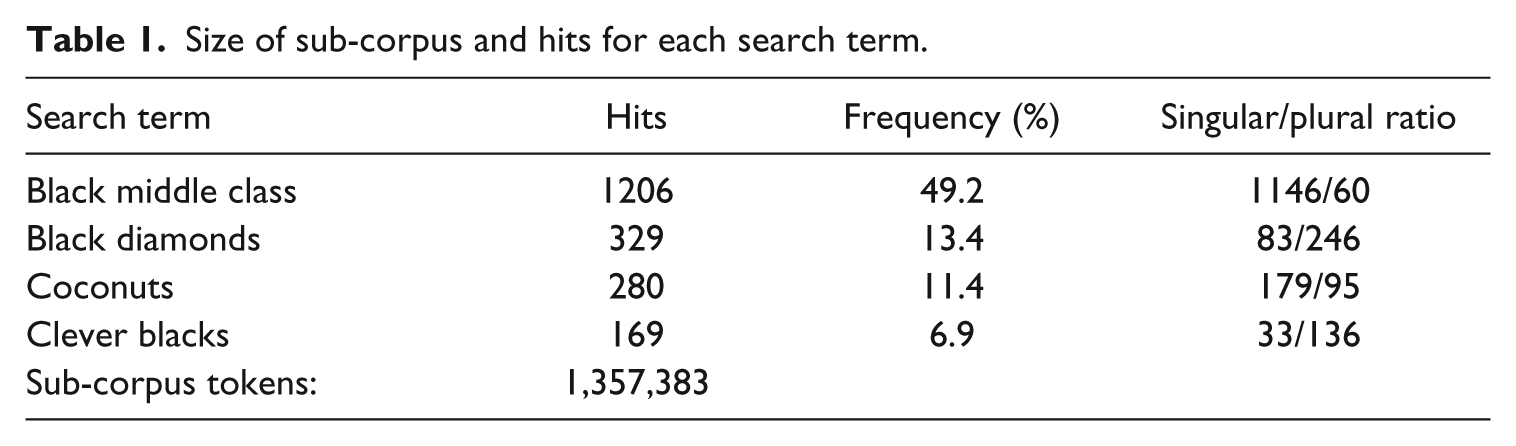
In order to allow us to examine representations of race and class specifically, we next extracted a sub-corpus of approximately 1.4 million words from the larger data set. This was done by identifying those articles from the full corpus that contained at least one of the search terms (or their plural counterparts) listed in Table 1. These search terms were selected after discussions with students and colleagues of different racial backgrounds as well as trial and error, for example, reading downloaded articles and identifying new search terms that could be used, and it was found that in many respects they had overlapping meanings.
Size of sub-corpus and hits for each search term.
The freeware corpus tool AntConc (Anthony, 2014) was used to run collocate and concordance searches, enabling us to focus on specific parts of the sub-corpus. Collocation refers to words that typically co-occur in language use, with a word’s collocates revealing its connotations or semantic/discourse prosodies, that is, attitudinal, affective, evaluative and pragmatic meaning. Therefore, collocates are good indicators of backgrounded discourses and become over time primers for readers about how to interpret a word (Durrant and Doherty, 2010; Hoey, 2005). We ran collocate searches for each search term separately (both singular and plural forms), with a span of five words to the left and five words to the right of the search term. We ordered collocates according to their MI (mutual information) statistical score (cut-off point: MI ≥ 3) (see Baker, 2006; McEnery et al., 2006). We considered the first 20 collocates of each search term, running searches with a minimum collocate frequency of both 3 and 1 where possible, in order to unpick both dominant and minority discourses. Collocation analysis enabled the plotting of significant lexical fields (Fowler, 1991: 84) – or word clusters sharing some aspect of their semantic meaning – which provided initial evidence of the existence of particular discourses meriting further analysis. Further analysis was then carried out by examining concordances – lines in tabular form that show occurrences of a word or phrase in its immediate co-text – or entire newspaper articles. Essentially, collocates functioned as signposts for discovering evidence of discourses through further concordance analysis.
We also define discourses in terms of social cognition (Van Dijk, 1995) and examine the underlying mental representations of texts, such as cognitive frames, image schemas and conceptual metaphors, that give rise to particular interpretations. The BMC is constructed through referential and predication strategies that we aim to illuminate through an eclectic mix of lexico-grammatical analysis (Halliday, 2004). Reference to groups and their action can create in-group/out-group dichotomies by positive in-group versus negative out-group presentation (Reisigl and Wodak, 2001). However, in accordance with an intersectional approach, we view the linguistic choices of newspaper texts as enacting manifold exclusionary and inclusionary strategies rather than constructing a clearly defined in-group and out-group. In this respect, representations of the BMC are viewed through the manufacture of multiple and intersecting identities as well as multiple and interdependent forms of oppression and privilege. In the next section, we shall move to both a quantitative and qualitative analysis of newspaper representations of the BMC.
The BMC in print
Collocates were mostly lexical adjectives, verbs and nouns (functional/grammatical words and personal names were excluded because they cannot help to make generalizations in most cases). We can see from the frequencies of the singular and plural search term forms (Table 1) that the plurals of ‘black diamond’ and ‘clever black’ are much more frequent than their singular form, whereas the reverse is true for ‘coconut’. We will now turn to an examination of collocates and their concordances in order to gain access to the main discourses associated with the BMC. Collocates and their co-text feature in italics. Numbers in parentheses signify concordance lines in tables. Numbers without parentheses signify collocate frequencies. The listing of collocates without numbers indicates that they occur only once.
Economic growth and citizen/consumer discourses: The ‘black middle class’
A cursory reading immediately reveals that the corpus is peppered with the language of business, consumerism and marketing. In this discursive context, the BMC carries positive connotations, and it is often invoked in articles featuring ‘good news’ about the economy. This is specifically the case with the search term ‘black middle class’. In particular, the search term collocates with quantifying adjectives, such as burgeoning 16, growing 62, rising 16, booming 4, expanding 3, sizeable 3 and emerging/emergent 80/10, which emphasize the increasing size of this group. Moreover, concordances show that the ‘black middle class’ is continually quantified, therefore collectivised/aggregated, with pre-/post-modifying expressions that highlight its expansion (Table 2: 1-5). Consequently, increases in the numbers of the ‘black middle class’ are linked, on one hand, to optimism and a growing economy with a focus on wealth creation via the market and, on the other hand, to a tendency to treat people as statistics in rational economic models.
Economic growth and national optimism.
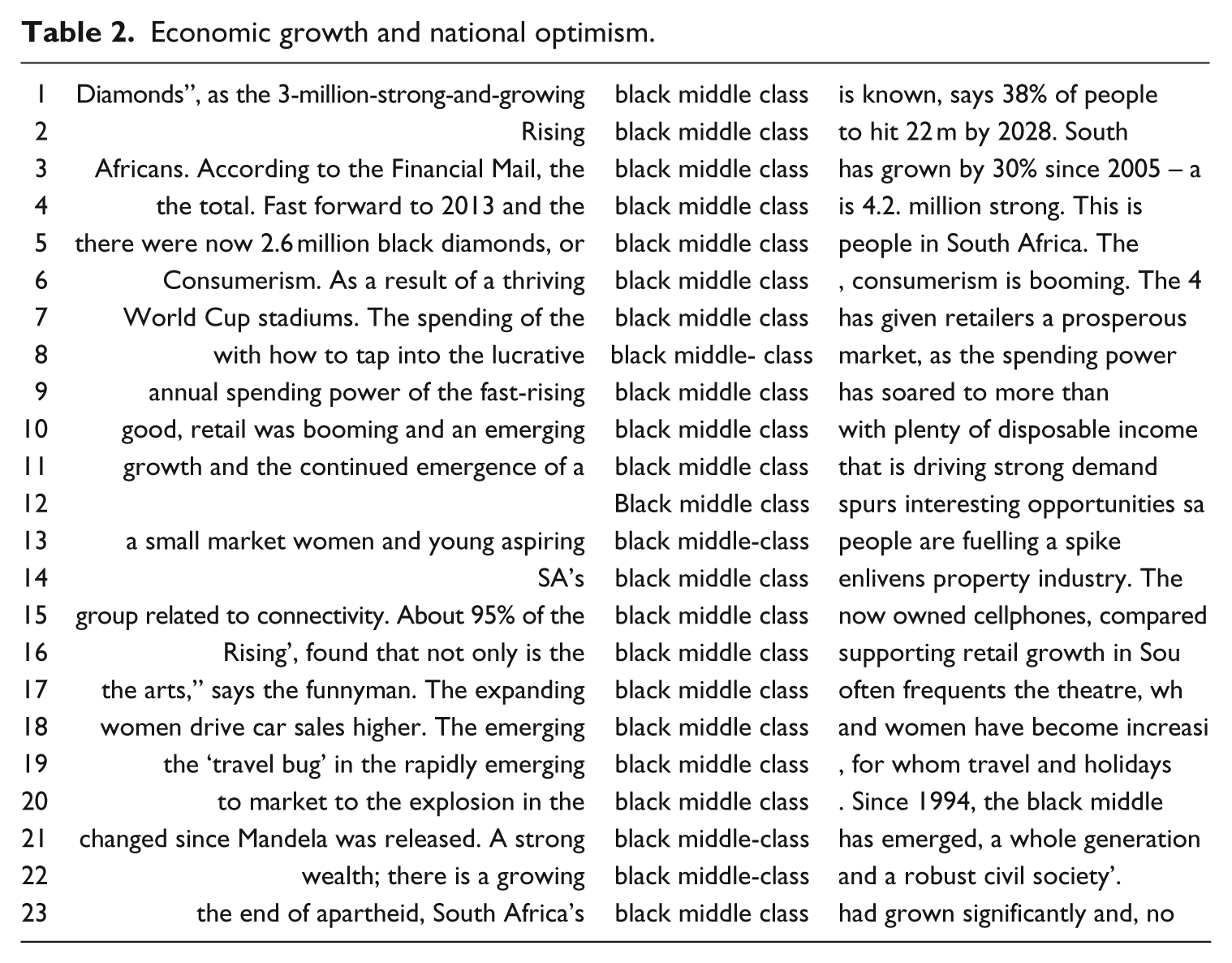
Concordances reveal evaluations of the ‘black middle class’ as thriving and this state of affairs is framed as an opportunity for business, whereby the ‘black middle class’ is seen to possess increasing spending power or disposable income (Table 2: 6–10). More specifically, when the ‘black middle class’ is in an agentive role, it is driving strong demand, spur[ring] interesting opportunities and consuming a host of commodities or services (property, cigars, cellphones, cars, travel/holidays) (Table 2: 11–19). However, there are also indications that this increase in economic power is not necessarily seen in a positive light but rather constitutes a threat, as in Extract 1:
Extract 1 In 2009, Auction Alliance noticed that residential properties in Gauteng, Mpumalanga and Limpopo were being
Here, the imperfective aspect of the past tense (were being … snapped up) stresses the non-telic property of a continuing activity that is described as aggressively executed, therefore, enhancing a sense of foreboding about this process. Concurrently, a variety of nominalizations denoting economic processes (91 in total) collocate with ‘black middle class’. They are constituted by either different combinations of modified nouns or merely nouns (Figure 1) that tend to ‘de-agentialize’ (van Leeuwen, 2008: 66) the ‘black middle class’, representing its rise/growth as a naturalized process and offshoot of economic growth more generally rather than voluntary action (van Leeuwen, 2008: 68). This decentres the ‘black middle class’ from the action by placing it in the object position of the main clause (with the nominalization usually in subject position) or in a range of subordinate and adjunct clauses. Even when the ‘black middle class’ enjoys agency within post-modifying clauses (e.g. the growth of the black middle class), it is still backgrounded as an appendage of the process, which has been transformed into a ‘thing’. Nominalizing and naturalizing economic processes also imbue them with an aura of inevitability that is consistent with the optimistic feeling of these articles. Meanwhile, as processes are nominalized, agency remains implicit and exercised by an array of other unidentified parties.
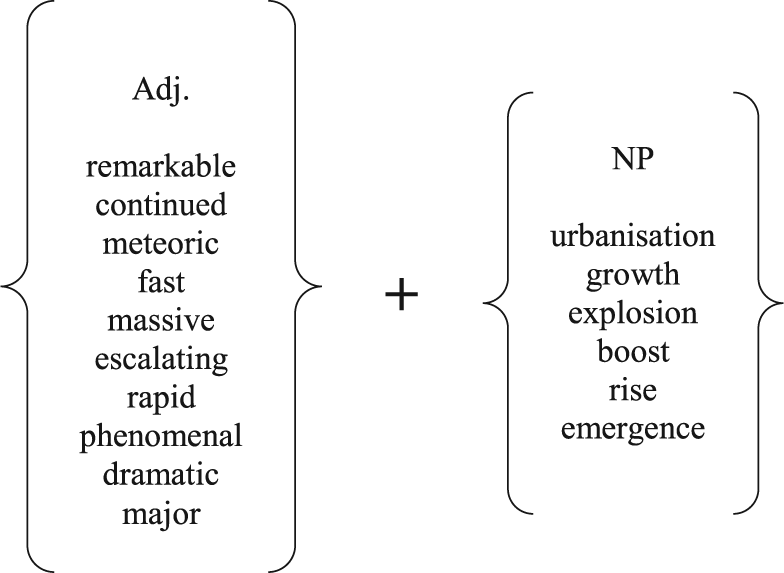
Nominalizations that collocate with ‘black middle class’.
In the following excerpts (Extracts 2 and 3) containing transitive verbs (generating, propel) where the ‘black middle class’ is acted upon, agency continues to remain elusive and the agent positions are again occupied by two nominalizations (South African economy, privatization), respectively – in this context, South African economy can be considered as a nominalization since its meaning here denotes the relationships – processes – of production and trade in the country:
Extract 2 Data released by the national mortgage origination group Bond Choice last month has cemented perceptions that the South African economy is Extract 3 Calculations show that the privatisation of all state-owned enterprises and selected municipal services would put R169,000 in cash in the hands of each South Africa’s 9.1-million households (about R1.5-trillion in total), which would overnight
It is clear from these examples that the ‘black middle class’ is not credited for the growth in the economy (other than as consumers), but is rather viewed as a beneficiary, while responsibility/agency lies with those who are implied to lead the South African economy and privatization, namely, the business/private sector.
The discourse of economic growth entails national optimism in regard to the democratization of post-apartheid SA (Table 2: 20–23). According to this perspective, the expansion of the ‘black middle class’ is seen as a stabilizing and democratizing force that can produce the envisaged non-racial society (the so-called ‘Rainbow’ nation). However, this purported egalitarian society is also one where free-market capitalism prevails. Accordingly, the ‘black middle class’, as it is constructed in South African newspapers, comprises individual/citizen consumers who participate in the democratic process by virtue of their share of disposable income or access to goods and services rather than membership of political organizations and participation in collective struggles.
Conspicuous consumption and moral decay: The ‘black diamonds’
The relatively positive representations of economic growth and Black consumers presented in the section above coexist with more negative portrayals of the BMC as self-serving and materialistic (see also Iqani, 2015, for a similar discussion in the 1990s). Negatively laden discourses manifest most patently in conjunction with the search term ‘black diamonds’, which originates in a 2006 study by the Unilever Institute for Strategic Marketing.
As an allusion to the value of diamonds, the coined metaphor sought to describe the BMC in terms of its economic potential and the commercial opportunities this presented for business as already mentioned. Thus, a metaphorical correspondence is established between a source domain (diamond: valuable gem) and a target domain (BMC: social group), which can generate a multiplicity of expressions based on the common underlying idea that BMC equals diamonds (Lakoff, 1993; Lakoff and Johnson, 1980). Collocates of ‘black diamonds’ in the corpus reveal traces of this semantic correspondence. Consequently, we find that the idea of a shiny/valuable gem is matched to consumption and increased spending power when ‘black diamonds’ sparkle or are sparkling/shining and outshine whites. However, the idea that ‘black diamonds’ are overspending, indebted or selfish is also implicit in these excerpts without being traceable to the diamond domain. In this respect, conceptual blending theory (Fauconnier and Turner, 2002) can account for the emergence of new meanings that do not originate in the source domain, especially in regard to novel metaphors before they become entrenched/conventionalized and part of semantic knowledge embedded in long-term memory (Hart, 2010). In conceptual blending theory, meaning structures are matched across different but parallel input spaces and selectively projected into a blended space where they fuse together to create new meanings (compound elements) that did not exist previously. Of course, the selective recruitment and projection of meaning ultimately reflects a particular perception of reality and can indicate ideological bias.
In order to demonstrate this creative process of metaphor production one can see in Extract 4 below how the ‘shine’ property of diamonds does not just refer to the ‘economic value’ of the BMC, but is also employed to morally condemn their alleged self-serving behaviour. Nevertheless, we can safely assume that ‘black diamonds’ are not losing their wealth (since they can afford to live in suburbs), but rather lustre, which, in this case, signifies a sense of escaping civic responsibility for the general development of SA. Moreover, the idiom pound of flesh in the subsequent explanation sentence, casts doubt over whether ‘black diamonds’ had any such sense to begin with, implying the appropriation of BEE policies for selfish/materialistic reasons. We can infer that a new correlation of the diamond property ‘shine’ emerges signifying ‘greed’:
Extract 4 Black diamonds losing Extract 5 South African National Parks (SANParks) is hoping to
In Extract 5, the verb process to unearth suggests that ‘black diamonds’ are reluctant to visit a nature reserve unless there is luxury accommodation, emphasizing their overindulgent behaviour. Here the diamond property of being ‘buried underground’ is employed to convey the idea that BMC individuals are aloof or apathetic as they are in patient position or ‘undergoing’ a transitive process (unearth). This contrasts sharply with expectations that participants should be pro-active in adopting an eco-friendly lifestyle including visits to nature parks. It could also be argued that ‘black diamonds’ are represented as unpatriotic given the international status of Kruger National Park and the efforts expended by a national body (SANParks) to make the park financially viable. However, the de-agentialization/passivation of ‘black diamonds’ highlights a more permanent meaning transformation. In general, the metaphor invites us to imagine the BMC as possessing the qualities of diamonds, implying that they are inanimate or devoid of volition and, thereby, dehumanize them.
As evidenced by these examples, co-text is crucial to the elaboration of the ‘black diamond’ metaphor. Consequently, a further look at collocates/concordances can reveal more of the characteristic associations (words and structures) – predicational strategies – that prime readers to interpret the term in particular (negative) ways. For example, consider the concordances in Table 3 where ‘black diamonds’ are engaged in, what is often portrayed as grotesque, consumption of luxury goods (1–14), associated with groups (celebrities) or places (Sandton) that represent consumption (15–18) and characterized as materialistic, annoying and dishonest (19–30).
Conspicuous consumption and moral decay.
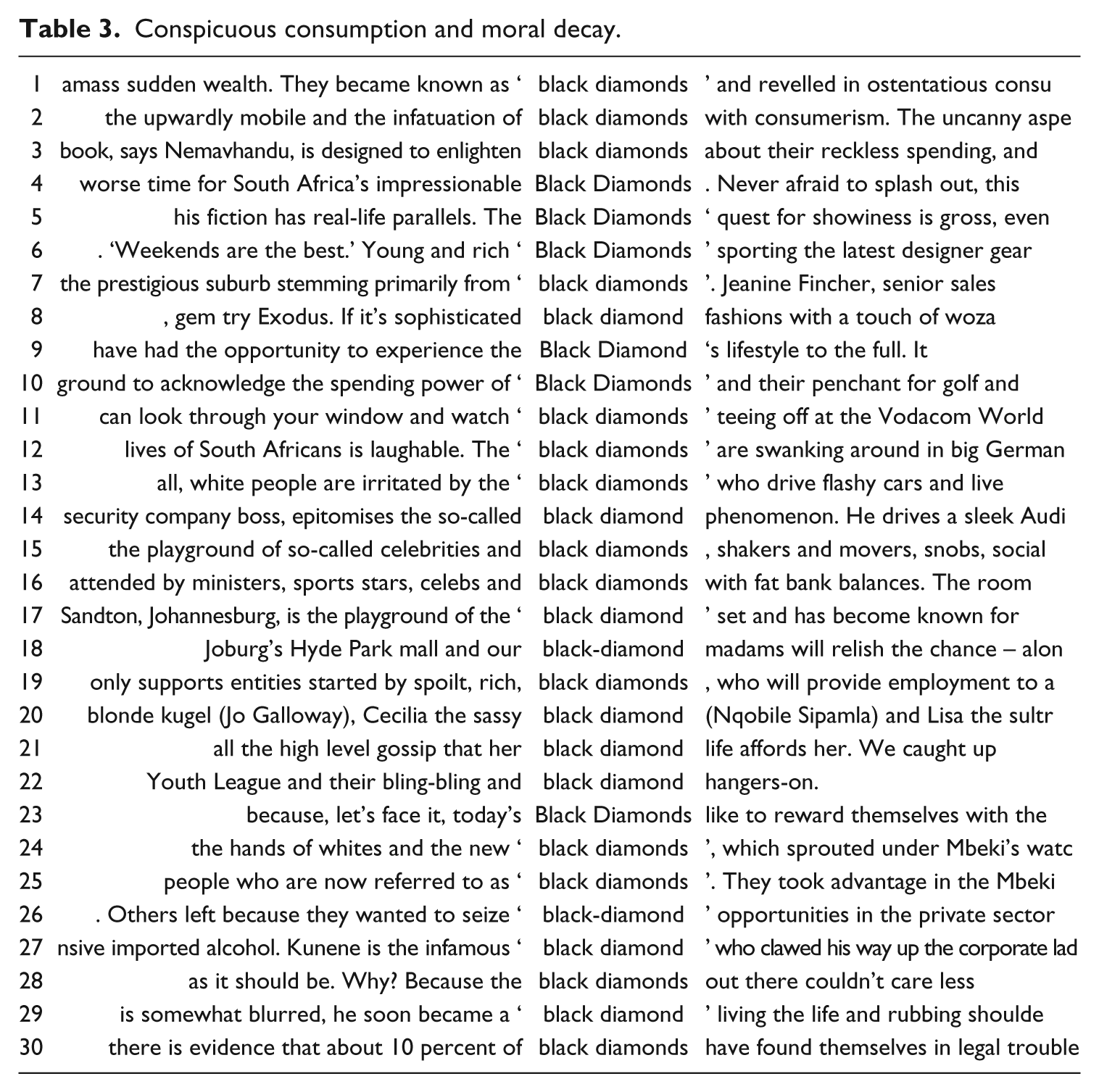
In contrast to the ‘black middle class’, ‘black diamonds’ tend to be agents in various processes. However, these are usually mental and behavioural, representing inner experiences/emotions and their outward manifestation (see Halliday, 2004: 170–171). Furthermore, the described mental processes are primarily affective, and are motivated by desires. As van Leeuwen (2008) points out, ‘the greater the power of social actors, the more likely it is that cognitive, rather than affective, reactions will be attributed to them’ (p. 58). Conversely, affective reactions are indexical of less powerful subjectivities in discourse. Indicatively, the following processes from Table 3: revelled (1), infatuation (nominalized, 2), never afraid to splash out (4), quest for showiness (5), their penchant for golf (10), swanking (12), relish (18), like to reward themselves (23), living the life (29), portray ‘black diamonds’ as swayed by emotions and profess intimate knowledge of their mental states while foregrounding/scrutinizing their behaviour. Such recurring and consistent representation of the actions that ‘black diamonds’ engage in can constitute typical episodes that can, ultimately, be internalized as part of readers’ long-term memory. Accordingly, ‘black diamonds’ are not agents in material processes unless the processes relate to consumerism/lifestyle, for example, teeing off (11) and drive flashy cars (13). But, more importantly, processes encoded in verbs such as sprouted (24), took advantage (25), clawed his way up (27) and couldn’t care less (28), attribute negative qualities to ‘black diamonds’ as acting with ruthlessness and disdain. In particular, the metaphors sprouted and clawed introduce conceptual elements from the plant and animal domains, respectively, with ‘black diamonds’ acquiring the attributes of ‘weeds’ and ‘carnivores’.
Of course, these are typical predicational strategies that constitute threat-connoting cues, appealing to the audience’s emotions (anger, fear, etc.) and motivating them against a perceived out-group (Hart, 2010: 81; Reisigl and Wodak, 2001: 46). Also, with these sorts of representations, there is the implicature that wealth alone does not equal sophistication or ‘class’, and that despite its new-found wealth, the BMC will still have inferior tastes and inferior morals. It is a way for the older (White) establishment to distinguish itself. As a result, the noun phrase ‘black diamonds’ has acquired lexical flexibility functioning as a compound adjective (see Table 3: 8, 26) and suggesting more nuanced meaning constructions beyond a purely referential function.
Race, politics and culture: The ‘clever blacks’ and ‘coconuts’
Perhaps, it is no surprise that the markedly controversial terms ‘coconuts’ and ‘clever blacks’ concentrate the most polarizing debate in newspapers. As a construction, ‘clever blacks’ is problematic because it presupposes the existence of its opposite (stupid blacks), reproducing a negative stereotype of blacks as foolish. It is more plausible, however, that Jacob Zuma’s intention was to transmit a different meaning of ‘clever’ in his speech more akin to ‘clever-clever’, which is defined in the Oxford English Dictionary as ‘excessively anxious to appear impressively clever or intelligent’. 3 Nevertheless, this alternative meaning of ‘clever’ or ‘kleva’ was largely ignored by the media with all subsequent debate framed by the assumption that the president (and ruling ANC) was referring to the BMC who is seen as more educated and likely to challenge his rule.
Newspapers proceeded to explicitly and very publicly defend ‘clever blacks’ and attack the government as personified by the president. As opposed to ‘black diamonds’, ‘clever blacks’ are included within the in-group by appealing to different symbols of inclusive identity or using first person plural pronouns and possessive determiners that include both the author and the reader. More specifically, in Extract 6, the founders of the ANC (and heroes to the nation) – the party credited with liberating SA from apartheid – the composer of Nkosi Sikelel’i Afrika – the national anthem – and our forbearers are all identified as ‘clever blacks’ to induce readers to imagine themselves as members of this group or as members of the indexed ‘Rainbow’ nation:
Extract 6 The ANC was conceived by ‘clever blacks’.
Here, ‘clever blacks’ are inserted into the historical narrative of the anti-apartheid struggle. The addition of the adverb undeniably accentuates the proposition ‘our forbearers were clever blacks’, but it also anticipates that the proposition might be challenged by some readers or other parties, pre-empting deniability and enhancing the validity of the statement. The repetitive, staccato structure of the excerpt, with prosodic stress on ‘clever blacks’ at the end of each sentence, makes it obvious that this is a response to Jacob Zuma’s comments. Anaphora drives home the positive actions of ‘clever blacks’ in the two initial, passive voiced, past tense constructions, where their achievements are thematized/topicalized (The ANC, Nkosi Sikelel’ iAfrika) and their agency made explicit in by prepositional phrases. In the third sentence, the ANC is compared to a midwife, bunker or safe house, all salient metaphors of patriotic discourse as demonstrated in expressions such as ‘birth of a nation’ and in particular instantiations of the container schema where party/country/nation is compared to a building/home (Hart, 2010: 136). The metaphors are quite telling since the ANC is portrayed as having given birth to ‘clever blacks’ (and by extension to the ‘Rainbow’ nation) as well as offering shelter and security during apartheid. In the last sentence though, it is implied that the ANC has turned away from its original task of building a democratic SA (or safe home), since it is responsible for negative actions (victimize, despise).
In Table 4, the adjectives hard-working (2), bright (3), educated (4) and young (5) or the established association with black intellectuals (1) and the deverbal adjective graduated modified by the adverbial freshly (5) all ascribe qualities of youthfulness, intelligence and prestige to this invented group (bright awkwardly modifies the nominal ‘clever black’ underscoring the fact that ‘clever’ is an indispensable part of a formulaic, referential expression as supposedly coined by Zuma). Moreover, Steve Biko (3) – a prominent anti-apartheid activist – is identified as a ‘clever black’ from the past as above. Comparably, in ANC should start listening to the clever blacks (10), ‘clever blacks’ are put in a position of power (and potentially agentialized) as knowledgeable and suitable for doing the talking/thinking, whereas the modal should obliges/advises the government (ANC) to listen as potential recipient/beneficiary. In (6), ‘clever blacks’ are addressed directly via a hortative (please take the lead) as the best hope for the country, which is suffering from the corruption and cronyism of the government according to the author. However, the existential presupposition of any clever black is suspended in the hypothetical clause, If there ever was a ‘bright clever’ black (3), which is enhanced by the non-veridical negative polarity item ever, demonstrating the perception that the term was coined by Jacob Zuma and is not necessarily a truth.
Support for ‘clever blacks’.
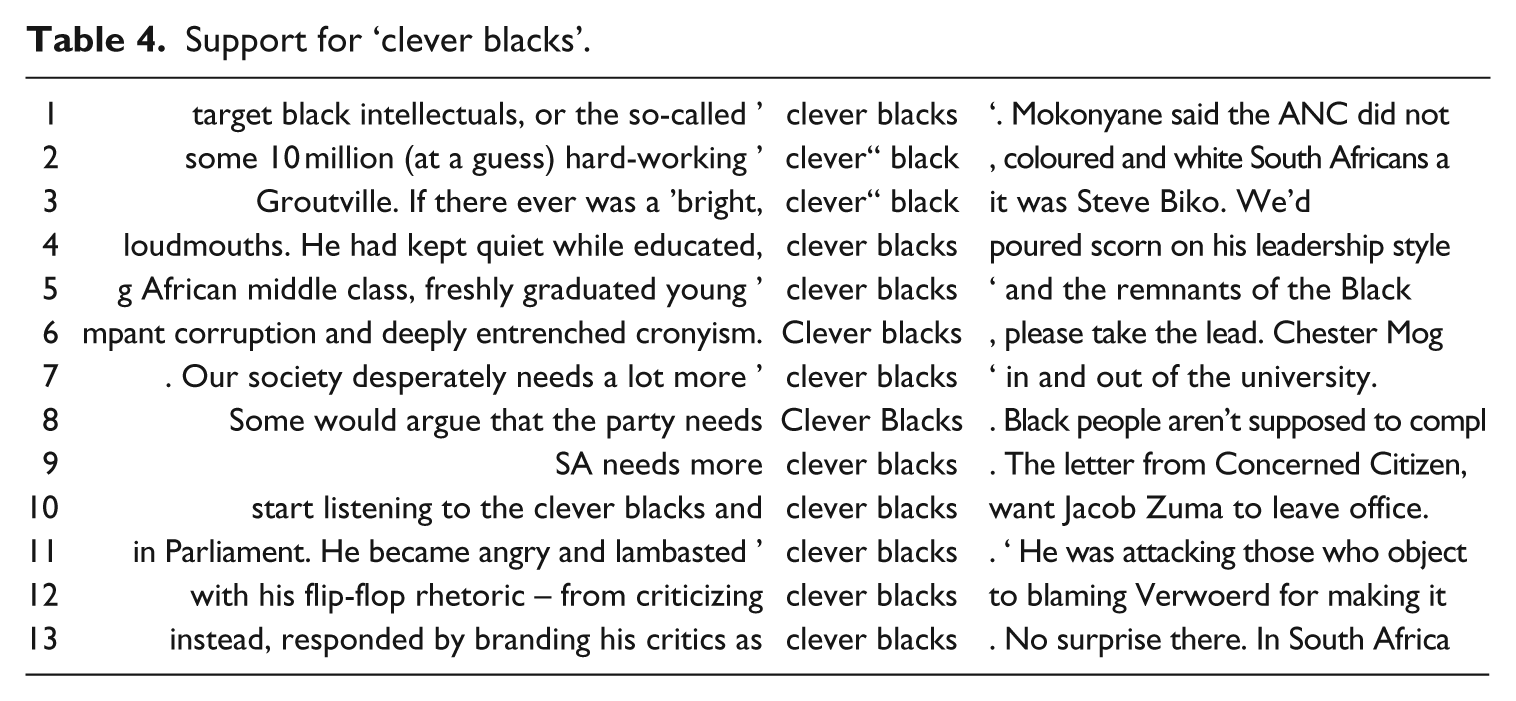
Mental process verbs needs (7, 8 and 9) and want (10) give us access to the wants/desires of the in-group. Nonetheless, the agents (or experiencers) in these processes – our society (7), the party, that is, ANC (8), SA (9) and clever blacks (10) – are impersonalized and referred to metonymically by means of places, entities, or groups that act as inclusive markers of identity, lending authority to the statements. In this way, the authors also exclude or background their agentive role as the main purveyors of the opinions in the articles, as per the journalistic practice of neutrality, attributing instead the specified wants/desires (needs more clever blacks, want Jacob Zuma to leave office) to the ‘country’, ‘society’, ‘party’ or ‘clever blacks’. This is even more evident in (8) where a well-known columnist uses an external authority (Some would argue) to maximize validity and give his argument an aura of objectivity. Crucially though, more (9) and a lot more (7) quantify the desirability for increased numbers of ‘clever blacks’.
On the other hand, the government (often personified by the current president Zuma) is portrayed as the out-group perpetrating actions that have negative consequences for the in-group (‘clever blacks’ and the nation). In particular, Zuma is seen as responsible for the demeaning actions of lambasting (11), criticizing (12) and branding (13) – a practice usually reserved for merchandise not people – his opponents as ‘clever blacks’. It is worth noting that the term ‘clever blacks’, as well as the term ‘coconuts’, which we will discuss below, are mostly attributed to the Black political elite. It is broadly claimed by newspapers that different politicians use these terms in their attempt to condemn or punish political opponents, such as the BMC, for their perceived lack of ‘blackness’ and for their acquiescence to the cultural and economic hegemony of Whites. Unsurprisingly, it is also strongly implied that this move is merely a cynical grab for power by unscrupulous, populist politicians. In Extract 7, for instance, the word remarks does not negatively prime Zuma’s statements as branding does above but the implicit urged rejection of those remarks comes anyway in the focal part of the sentence at the end (are worth revisiting) and is further strengthened by the adverbial conjunction nonetheless after the interrogative/mental verb wonder. The expression One wonders … whether is a formulaic way of introducing scepticism and deliberation about the previous premise (‘Blacks mimic Whites’):
Extract 7 President Jacob Zuma’s
The use of the group nominal ‘coconuts’ in the corpus is even more indicative in these respects. The term ‘coconuts’ (Black on the outside/White on the inside) is another post-apartheid construction originally used to describe Black children who attended formerly White-only schools, indicating socio-economic privilege and a perceived assimilation into ‘White’ culture. However, as with ‘clever blacks’, its use in the corpus is mostly attributed to Black political elites who are reportedly using it to insult their opponents. Hence, the term is often enclosed in scare quotes or features as reported speech. Such devices usher in polyphonic or double-voiced discourse (Voloshinov, 1973), enabling authors to integrate the voices of the Black elite into their own speech. In effect, everything appears to be said in response to the statements of politicians and, as a result, it has a combative quality, for example, parody or polemic. The collocates of ‘coconuts’ include a multiplicity of linguistic verbs or other lexical items indicating verbal processes that allow journalists to show they are reporting what someone said, therefore, taking distance from the expressed opinions.
While some of the collocates portray relatively unnuanced verbal processes, for example, referred 13, called 28, nicknamed 2, describing 2 and echoing, dub, clarified 4, others indicate the author’s stance towards utterances of the term. Collocates such as hinting and implied suggest an indirectness and, perhaps even, hesitation to actually enunciate the word. Other collocates explicitly point to demeaning and remedial verbal processes, for example, ridiculed 3, jeered, lampooned, criticized, label/ed 3/9, dismissed 3, branding, stigmatized, maligned, apologized 5 or to adverbials modifying verbal processes as unfair and demeaning, for example, inaccurately, derisively. In these cases, the verbal processes are beginning to resemble material processes as the agents (or sayers), who are overwhelmingly the Black political elite (ANC detractors 5), verbally act on ‘coconuts’ (Halliday, 2004: 256). In other words, the ‘sayings’ are starting to be represented as ‘doings’ with ‘coconuts’ as targets of physical rather than verbal action. As a case in point, consider the difference between describing and branding.
In the same vein, noun collocates, for example, jibes 3, abuse, insult, word 10, term 15 and adjective collocates, for example, derogatory 9, pejorative, offensive 40, hurtful, bruising, repellent, reductive, provocative occur in a range of modifying and relational attributive clauses that thematize ‘coconuts’. They mainly function as metalinguistic commentary that displays the author’s attitude, for example, ‘Coconut’ is a pejorative term. Other noun collocates isolate the term as part of reported speech (saying the word ‘coconut’) or act as main nominals when the term is adjectivized (‘coconut’ jibes). So, the term is not only used as a noun referentially but, as with ‘black diamond’, as a noun modifier – note the preponderance of its singular form, highlighting its attributive rather than referential function. The collocates list includes the word coconutism where the derivational suffix denotes philosophical systems or ideological movements but also paints people who use the word as dogmatic or authoritarian. In Table 5, a range of modifying attributive clauses derived from both collocates and more qualitative analysis make manifest the perception that ‘coconuts’ are socio-economically privileged. Nominals such as plumby English accents (6) or processes, such as speaks only English (9) centre this discussion around language and access to education. Several autobiographical accounts in the first person singular (4, 7, 8, 12 and 13) provide insight into the mental/experiential worlds of various individuals who report facing discrimination and being called ‘coconuts’ but repudiating the characterization. The individuals often indicate they have been coerced into the position of being defined as ‘coconuts’ as in the causative I have been labelled a coconut because of my accent (8).
‘Coconuts’ and socio-economic privilege.
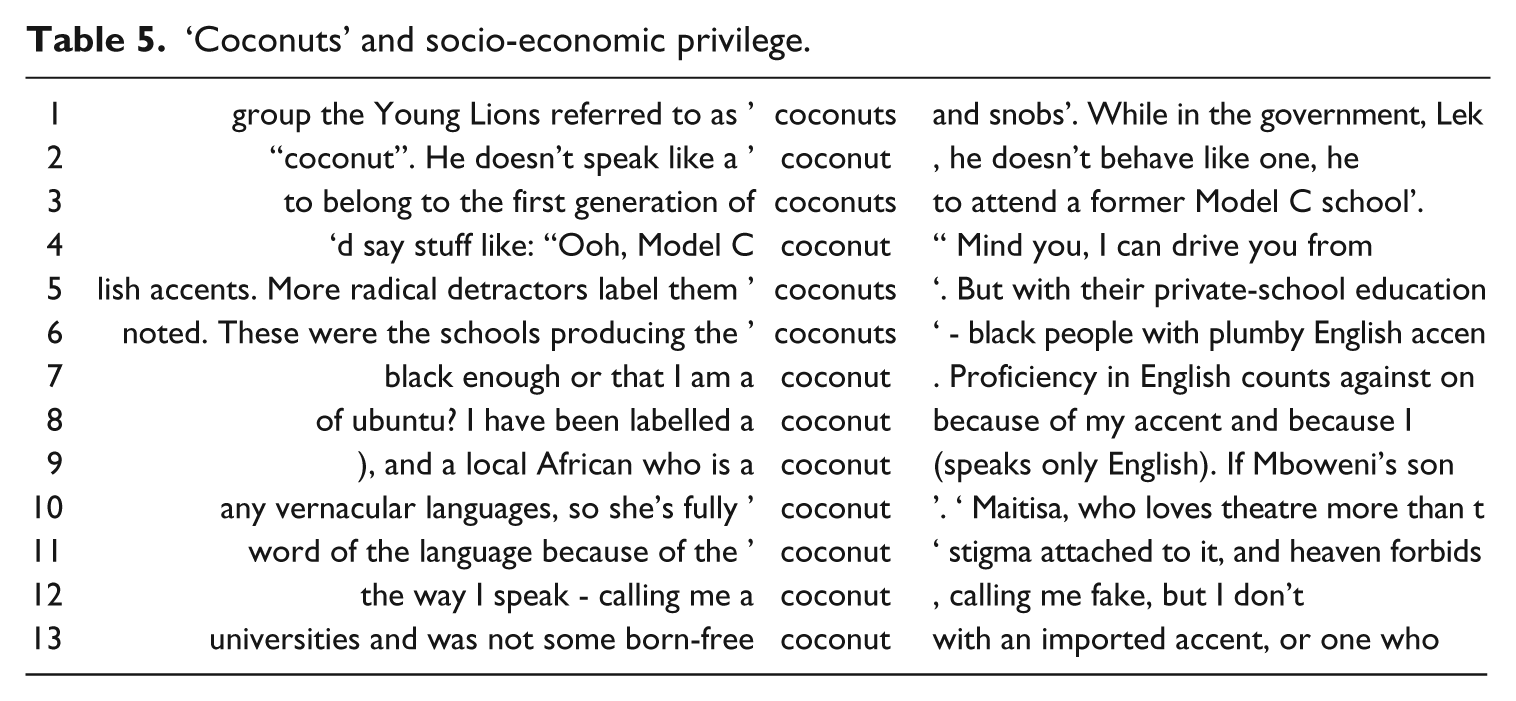
Overall, looking at collocates and concordances of ‘coconuts’ and ‘clever blacks’ proves that both these terms are treated as intersectional epithets in a new language of Black on Black prejudice. Their use is attributed to the authoritarian government and its officials (out-group) or other Black people. Readers are occasionally given access to the intimate experiences of ‘coconuts’ and ‘clever blacks’, but only in relation to their dislike of the ruling party and suffering from discrimination at the hands of other Blacks.
Corruption: An underlying theme
In this final analytical section, we sketch the associations established in newspapers between the BMC and corruption or nepotism in regard to BEE. The link has been established and explored from a sociological perspective elsewhere in the literature (see, e.g. Southall, 2016; Steyn and Foster, 2008), but the specific sets of linguistic choices that realize it remain hidden.
In Extract 8, the expressions flow of economic nutrients and juices flowing help to conceptualize BEE as a river of foodstuffs that flows from government to the ‘black middle class’ in order to keep it docile. The ‘black middle class’ is portrayed as complicit with an inherently immoral state of affairs perpetrated by government (Zuma and his cronies). Control over the ‘black middle class’ by government is exercised through the umbilical cord of BEE with the underlying proposition being that Blacks are immature (or politically immature) as evidenced by their irrational, child-like attachment to the ANC. This mother–child relationship of dependency implies an inability to exercise free will as adults. Here the author assumes the moral high-ground when faced with children misbehaving (Black political elite and the ‘Black middle class’) with the structure of the argument calling to mind the binary logic of colonial discourse (colonizer/colonized, White/Black, civilized/primitive, parent/child, etc.) (JanMohamed, 1985: 68). As can be inferred by the metaphors nutrients and juice, the capital necessary for BEE, is consumed/ingested by the ‘Black middle class’ with no discernible result, since foodstuffs are consumable goods as opposed to being durable goods (education, infrastructure, etc.) that can yield utility over time. Flow of and flowing do not indicate paucity but rather allude to continuous drainage and wastage instead of investment in the future, since it is well-known that resources are not unlimited and will eventually run out as in the gradually emptying container schema:
Extract 8 Affirmative action and its twin, black economic empowerment, are the black middle class’s Extract 9 BEE has become the
Another moralizing motif can be identified in subtextual relations to lethargy, addiction and even religion. In Extract 9, BEE is compared to the opium of the ‘black middle class’, echoing Karl Marx’s famous quote (‘religion is the opium of the people’). Ramifications of the metaphor can be understood conventionally, that is, the ‘black middle class’ is addicted to the drug of BEE. But it can also be viewed as a pun against the socialist origins of both the quote and affirmative action policies like BEE, which the author implies have turned into a ‘religion’. Nevertheless, drug addiction is a special kind of dependency that still retains its significance of moral decrepitude and corruption.
A particular role in the creation of the link between the BMC and corruption is played by the portmanteau ‘tenderpreneur’, which was popularized in 2010 after Blade Nzimande, a government minister, used the term in one of his speeches.
4
Intended to designate individuals who abuse their political influence to secure lucrative contracts (known as tenders) from government, the term was quickly appropriated by newspapers. Extract 10 clearly encapsulates the negative representations aimed at generating strong threat-connoting cues and negative emotions about this group. The goal is achieved, primarily, by depicting ‘tenderpreneurs’ as neglecting their own children, a very emotive issue that resonates with our deepest instincts of empathy as human beings:
Extract 10 [the public is] angry with the government over corruption. They see the
Crucially, it is insinuated that ‘tenderpreneurs’ are consuming whisky (or strutting instead of ‘walking’) while contributing to the spread of corruption, poverty and despair. Interestingly, a keyword list calculated by the log-likelihood score (McEnery et al., 2006: 55) and, produced in comparison to the reference corpus, reveals that whisky (156th, freq. 116, 224.993) and whiskey (501st, freq. 24, 74.491) occur with unusual frequency in the sub-corpus. Though most of these occurrences relate to the marketing/sales of the drink to the BMC, whisky is often used in the corpus as a metaphor of moral decadence (see Extracts 10 and 11):
Extract 11 The Extract 12 Privatization and Black Economic empowerment mutually Extract 13 The recipients of social grants, the new wealthy blacks and the
Analogously, the verbs feed off and nourishing in Extract 12 signify that BEE equals consumables, arriving at the meaning of corruption. The inferences arising from corruption as eating and drinking, can stimulate the sharing of discourses and conceptual structure, helping to establish metonymic links between ‘black diamonds’ and the ‘black middle class’, on one hand, and ‘tenderpreneurs’, on the other (see Extracts 11, 12 and 13). On this basis, because some members of the ‘black middle class’ are ‘black diamonds’ and some ‘black diamonds’ are ‘tenderpreneurs’, ‘tenderpreneurs’ may come to represent metonymically the entire ‘black middle class’. The relationship of equivalence as organized by the discourse of corruption in the extracts above creates semantic contagion between the terms ‘black middle class’ and ‘tenderpreneurs’.
Conclusion
This article examined the representations of the BMC in a large corpus of mainstream English-language South African newspaper articles over the period 2008 to 2014. The analysis of terms that encode the nexus of ‘blackness’ and ‘middle class-ness’ in SA unveiled seemingly coded language and a variety of covert tropes that convey predominantly negative images of wealthy Black people. This is surprising, given the existence of ‘black’ newspapers in the corpus, for example, The Sowetan (Cowling, 2014), or Black editors and journalists who are presumably more likely to report news from a ‘black angle’ (Clawson et al., 2003: 786).
On one hand, we found that the use of ‘black diamonds’ has acquired a definite negative prosody alluding to ostentatious consumption or corruption (65.2% of examined collocate concordances) despite its origin in marketing studies. This is, perhaps, counter-intuitive since ‘diamonds’ usually connote positive qualities in English, for example, ‘she is a diamond of a friend’. Moreover, similar pejorative senses of materialism or immorality/corruption (as outlined in the analytical section) also overlap with ‘black middle class’ (26.3% of examined collocate concordances), which might be expected to have a more neutral semantic prosody. On the other hand, the terms ‘clever blacks’ and ‘coconuts’ are marked out as the speech of Black political elites and overwhelmingly repudiated (96.5% and 90.4% of examined collocate concordances, respectively), exposing an inherent hostility towards politicians/government. Additionally, newspapers attempt to co-opt the BMC politically (and commercially), as is the case with the narrative of ‘clever blacks’. A more limited pattern features the re-appropriation of these apparent pejoratives (‘clever blacks’ and ‘coconuts’) by individuals who re-signify them or might even re-claim them for self-reference. The different representations of the BMC demonstrate the ideological fault-lines of post-apartheid SA between a market-oriented/liberal print media that tends to serve corporate interests and a Black political establishment that is expected to resolve the daunting levels of unemployment and inequality in the country. In a nutshell, despite BEE and some changes to ownership and editorial staff, South African mainstream newspapers are still disproportionately owned and controlled by the White minority (Majavu, 2015: 132).
Overall, the analysis unveils the specific words, metaphors, linguistic constructs and discourses that index social change and ideological bias, moulding perceptions and enabling analogous responses by the audience. It is this detailed unveiling of a language with the extraordinary power to redescribe or distort reality that we maintain has been largely glossed over in previous studies where the representations of the BMC were not subject to the toolkit available to linguists (see, for example, Iqani, 2015). An intersectional approach has allowed us to show the complex representational patterns of the BMC in South African mainstream media, patterns in which positive portrayals coexist and are intertwined with very negative and problematic ones. Although terms like ‘black diamonds’ continue to reflect ‘traditional’ racist notions of deficiency and deviancy, there are also emergent categories such as ‘clever blacks’ which, on the surface, maintain a favourable image of the BMC, as a class imbued with professionalism, integrity and an independent attitude critical of what is, according to the media, government authoritarianism/corruption. However, what remains prevalent in press coverage is the proliferation of racialized constructs that reinforce negative views of the BMC by outright moral condemnation (‘black diamonds’), while equally the image of ‘clever blacks’ can be considered a corrective or patronizing one, separating worthy Blacks from unworthy ones. This combination of seemingly contradictory representations serves to highlight the fact that we cannot treat categories like race and class as separate and discrete axes of privilege or subordination, but must instead examine the ways in which they mutually constitute one another in specific sociopolitical contexts (Cho, 2013; Mutua, 2013). Ultimately, our analyses demonstrate the multidimensionality (Hutchinson, 2001) of the figure of the BMC in contemporary SA – a multidimensionality that we argue is revealed by the kind of corpus-assisted approach to representation that we adopt here.
Footnotes
Declaration of conflicting interests
The author(s) declared no potential conflicts of interest with respect to the research, authorship, and/or publication of this article.
Funding
The author(s) disclosed receipt of the following financial support for the research, authorship, and/or publication of this article: This work was supported by the British Academy [Grant Number SCHQ02]; and the National Research Foundation of South Africa [Grant Number KIC160301159575].