







Abstract
Gamified news is a clear example of contemporary convergent practices which conflate the functionalities of formerly separate entities, video games and journalism. This practice marks a shift in the journalistic norms, positioning journalism and news users within the neoliberal paradigm. In this view, the study proposes a discursive approach to examine how gamified news discourse is colonized by the neoliberal values of marketization and commodification. The analysis takes a case study of Pirate Fishing: An Interactive Investigation, a gamified news launched by Al Jazeera. It is not just the narrative of Pirate that carries ideological bearings, rather the ludic design itself is found to be fit within the neoliberal mentality. Therefore, the ludic semiosis of Pirate Fishing is examined as well. As such, a dialectical relation between discourse, semiotics and neoliberal ideologies, in the context of gamification, is drawn in this article. Based on the analysis, seven interrelated neoliberal discourses are highlighted: ‘calculative rationality’, ‘self-entrepreneurship’, ‘minimalism’, ‘aesthetic preferences’, ‘individualism’, ‘sovereign consumer’ and ‘personal responsibility’.
Keywords
Introduction
News gamification marks the application of game properties, mechanics and tools like points, badges and leaderboards to news context (Burke, 2016; Ferrer Conill, 2016). This new journalistic practice redefines news reading activity by turning it into a playful and meaningful experience (Ferrer Conill, 2016: 41). Gamification of news stories offers ‘new journalism formats’ with a view to emphasizing the democratic and civic purposes of journalism while engaging younger users (Ferrer Conill and Karlsson, 2015: 357). From a neoliberal economic perspective, news gamification can be seen as a reaction to the recent drop in news consumption. Gamification, then, is a medium where interplay of the professional and commercial logics of journalism takes place (Ferrer Conill, 2018). However, the shift from a reading mode to a playing mode involves a shift in the discursive practices and semiotic affordances that need to be investigated to reflect on this emerging genre. In this regard, the article investigates this new form of journalism that prompts new discursive competencies and neoliberal values. The analysis takes a case study of Al Jazeera Pirate Fishing: An Interactive Investigation. This gamified case fits this study because it uses gamification on a large scale, and because it transforms news experience for users (Ferrer Conill, 2018).
This study seeks to examine how news gamification is colonized by the neoliberal logic. In so doing, it discusses the discursive and ludic semiotic strategies deployed in Al Jazeera gamified piece Pirate Fishing that connect with and reinforce neoliberal values. The study is drawn on Fairclough’s (1993) notion of the marketization of public discourse and Pérez-Latorre’s (2015) suggested analytical model for examining the semiotic affordances of video games. As such, a dialectical relation between discourse, semiotics and neoliberal ideologies is drawn in this article. Insights and findings from the semio-discursive analysis are interpreted in light of some works on neoliberalism (Harvey, 2005, 2007; Rose, 1999; Turner, 2008).
Al Jazeera gamified Pirate
Pirate Fishing is award-winning gamified news which is produced by Al Jazeera 2014. It is the first gamified, interactive investigation in which the users assume the roles of both an investigative journalist and a player. This gamified piece of news places users in the role of an investigative journalist with the task to unveil the story of illegal fishing operations off the coast of Sierra Leone. The whole story is narrated in the form of an investigation with the aim to discover the identity of mysterious trawlers, starting with spotting the trawlers and knowing the tools, the techniques and the vessels they use in their illegal fishing until their arrest. In doing so, the user is turned into a video game player who is asked to play the news by watching clips and photos of destroyed nets and pirate ships, examining maps and listening to audio stories from the local fishermen. By entering this information into the right sections of the notebook and differentiating between criminal evidence, notes and background information, the news player scores points and advances in the game status from a junior researcher to senior investigative journalist.
Pirate game is divided into four stages. The stages are named as follows: (a) Sherbro Island Delta: Investigate, illegal fishing; (b) Freetown: Contact the authorities; (c) Freetown: Discover the identity of the pirate trawler; and (d) The ocean: Board the pirate trawler.
Neoliberalism
Neoliberalism introduces a market-driven logic into public sectors which were not previously influenced by economic relations (Dean, 2010: 72). McChesney (1999) provides the following definition of neoliberalism:
Neoliberalism is the defining political economic paradigm of our time – it refers to the policies and processes whereby a relative handful of private interests are permitted to control as much as possible of social life in order to maximize their personal profit. (p. 7)
However, neoliberalism is not confined to the economic or political landscapes. Most of the social and institutional sectors undergo a transformation of their activities to fit the neoliberal metaphor (Oleksenko et al., 2018: 114). In this regard, post-modern neoliberal rationality instantiates a reconfiguration of various social disciplines such as the sectors of education (Bamberger et al., 2019; Gray et al., 2018; Ng, 2014), medicine (Defibaugh, 2019), architecture (Spencer, 2016), interior design (Ledin and Machin, 2018; Roderick, 2016), video games (Baerg, 2014; Oliva et al., 2016) and media (Phelan, 2014). That is to say, neoliberalism becomes a ‘hegemonic paradigm’ (Bello, 2009) that extends to reach all social sectors. In the words of Harvey (2007), neoliberalism is a ‘hegemonic discourse with pervasive effects on ways of thought and political economic practices to the point where it is now part of the commonsense way we interpret, live in, and understand the world’ (p. 22). Examples of the values that many scholars associate with the neoliberal mentality are ‘individualism’, ‘freedom of choice’, ‘flexibility’, ‘personal responsibility’ and ‘self-entrepreneurship’ (Rose, 1998, 1999).
In addition to being a market and social driven paradigm, neoliberalism is a linguistic phenomenon as well (Gray et al., 2018: 471). Kauppinen (2013) points out that ‘neoliberal governance is a mode of power that fundamentally operates in and through discourse’ (p. 113). Holborow (2012: 41) argues that everyday discourse and institutional practices become colonized by ‘neoliberal keywords’ such as the lexicon ‘choice’ (Holborow, 2012: 41). These neoliberal words, Holborow explains, ‘have special meanings and associations within the framework of neoliberal ideology and reflect a version of reality which promotes the interests of capital’. Correspondingly, neoliberalism produces and is reproduced by institutional discursive practices.
Fairclough (2005) states that ‘in dealing with neo-liberalism we are dealing with questions of discourse’ (p. 23). In the same vein, Krzyżanowski (2013, 2016) notes that neoliberalizing public domain entails various discursive changes that need to be investigated. In this view, this article centres on the notion that the ideological changes of social and political institutions are a discursive phenomenon (van Dijk, 1998). Chouliaraki and Fairclough (1999) comment on this instrumental nature of discourse saying:
It is an important characteristic of the economic, social and cultural changes of late modernity that they exist as discourses as well as processes that are taking place outside discourse, and that the processes that are taking place outside discourse are substantively shaped by these discourses. (p. 4)
Fairclough’s (2005) notion of discursive neoliberalism investigates how discourses are ‘enacted as new ways of acting and interacting and new social relationships, inculcated as new ways of being, new identities, and materialized, for instance in new ways of organizing time and space in institutions and organizations’ (p. 27, original emphasis).
Fairclough (2005) contends that discourse analysis can specifically contribute to investigating different aspects of social life, in a process which he calls ‘operationalizing’ discourses. Discursive operationalization of social ideologies refers to ‘the effectivity of discourses in constructing and reconstructing social life’ (Fairclough, 2005: 23). In this regard, this article examines how the discourse of Al Jazeera gamified news is operationalized to produce neoliberal rationality.
Theory and methods
This study takes Pirate Fishing, a game launched by Al Jazeera in 2014, as a case study to be analysed from a discursive-semiotic lens. The study aims at examining how the convergent practice of gamification marks a stance of a neoliberal marketization of news production. However, analysing gamified news discourse is challenging at the methodological level due to the particularities of the medium, combining two different disciplines: video games and news genre with their different invoked associations. In this regard, the study examines, from a semio-discursive perspective, the ludic design of Pirate Fishing, its play activities, including aesthetic immersion and interactional engagement, and the player’s roles.
Ludic design of video games
For Pérez-Latorre (2015), analysing video games should consider the meaning mode driven from the medium and the user’s experience. He specifies this notion with the term ‘ludic design’, referring to the game world, including verbal, visual and audio modes; the soundtracks and music; the character/player; and the game play activities. The ludic design of video games influences the representation of the character/player by defining their performed actions within five rules: (a) performance role, (b) operation rules, (c) state rules, (d) rules for inducing behaviours and (e) game mechanics.
Performance rules define the possible actions carried by the players or their avatars in the course of the play. As for operation rules, they refer to the way in which player’s performance on the physical (keyboard, mouse and game-pad) and visual interfaces of the game influences the game world and the sequence of events. The third type of ludic rules is the state rules which define the type of status achieved in the game world such as the player’s ‘lives’, ‘health’ or ‘social status’ according to the performance of the character/player. The rules for inducing behaviours, Pérez-Latorre argues, are the set of rules enacted by the game interface and promote the players to behave in a certain manner. These rules can be the reward or punishment system of the game. The game mechanics constitute the core experience of the video games. They dictate the set of actions the player should perform. There is a close relation between the game mechanics and the embedded ideologies of video games (Pérez-Latorre, 2015: 420–424). Another layer of the ludic design, as suggested by Pérez-Latorre, is the game play activities. Each unit of the video game (level, sublevel and mission) promotes performing certain activity to achieve the game objective.
Marketization of public discourse
Fairclough (1993: 142) defines the concept of the marketization of discourse as the ‘colonization of discourse by promotion’ in the different social institutions and practices. Such a socially informed new discursive practice is powered by neoliberal ideas which blur the boundaries between public and private life and collective and individual responsibility, mixing the discursive nature of fact and opinion as well as information. In his seminal work on the marketization of public discourse, Fairclough (1993) comments on the changing discursive practices of higher education institutions in the United Kingdom. He argues that the discursive practices of universities are colonized by those of the promotional discourses. Discursive marketization, according to Fairclough (1993), defines three aspects of contemporary communication: ‘technologization’, ‘conversationalization’ and ‘commodification’.
Technologizing discourse defines the redesigning of existing discursive practices to fit the criteria of institutional affectivity (Fairclough, 1993: 141). It points to the ‘level of conscious intervention to control and shape language practices in accordance with economic, political and institutional objectives’ (Fairclough and Wodak, 1997: 260). Importantly, technologization here does not refer to the strict meaning of the word ‘technology’; rather, it means a shift to the increasing ‘codification’ of communication resources and social practices (Ledin and Machin, 2018: 3). The codification of communication practices is achieved by the reliance on what is called ‘New Writing’ (Ledin and Machin, 2018; van Leeuwen, 2008). New Writing is a type of communication that relies mainly on visual resources and multimodal interaction, rather than on verbal resources alone. Ledin and Machin (2018) argue that the concept of New Writing ‘goes hand in hand with technologization and the drive to increase control over communication’ (p. 4). They provide an example with newspaper design which deploys the semiotics of fonts, colours, images and layout to codify specific attitudes and identities to readers.
As for conversationalization, it refers to the ‘colonization of the public domain by the practices of the private domain, an opening up of public orders of discourse to discursive practices which we can all attain’ (Fairclough, 1993: 140). The process of conversationalizing discourse appropriates the communication principles used in informal and personal conversations for the marketing goals of formerly professional discourse. Accordingly, conversationalization gives expression to what is referred to by Fairclough (1992, 1993, 2003) as ‘synthetic personalization’. Concerning the notion of commodification, it refers to ‘the reconstruction of, for instance, public services on the analogy of commodity markets’ (Fairclough, 2003: 235). Commodification defines as well the increased dependency on the promotional power of non-verbal (e.g. visual, digital, aural) semiotic modes other than language. Fairclough’s concept of marketizing public discourse is significant to be considered when studying news gamification since it gives insights on the market logic governing this new type of journalism.
Analysis
Discursive operationalization of neoliberal ideologies is a ‘dialectical process’ in the sense that it is not just a matter of discourses but also of genres and styles (Fairclough, 2005: 27). One particularly significant feature of news gamification genre is their convergence of news narrative and game design, that is to say, their complex mixture of news logic and gameplay logic. To this end, the current analysis focuses on both the discursive and ludic dimensions of Pirate.
The ludic design of Pirate Fishing
Pirate ludic design is defined in this article as the game-like affordances made available to the news user. Converging news storytelling with the elements of video games, Pirate produces a unique experience of news consumption. The game play activities are displayed in the right vertical bar of the game screen. Like video games, Pirate Fishing is divided into levels represented by different stages and steps. The game contains four stages displayed horizontally in the upper part of the bar, where the completed stage is highlighted in yellow colour.
As shown in Figure 1, the use of the lexical items ‘stage’, ‘steps’, ‘badges’ and ‘points’ invokes games norms and reinforces the gamifying properties.
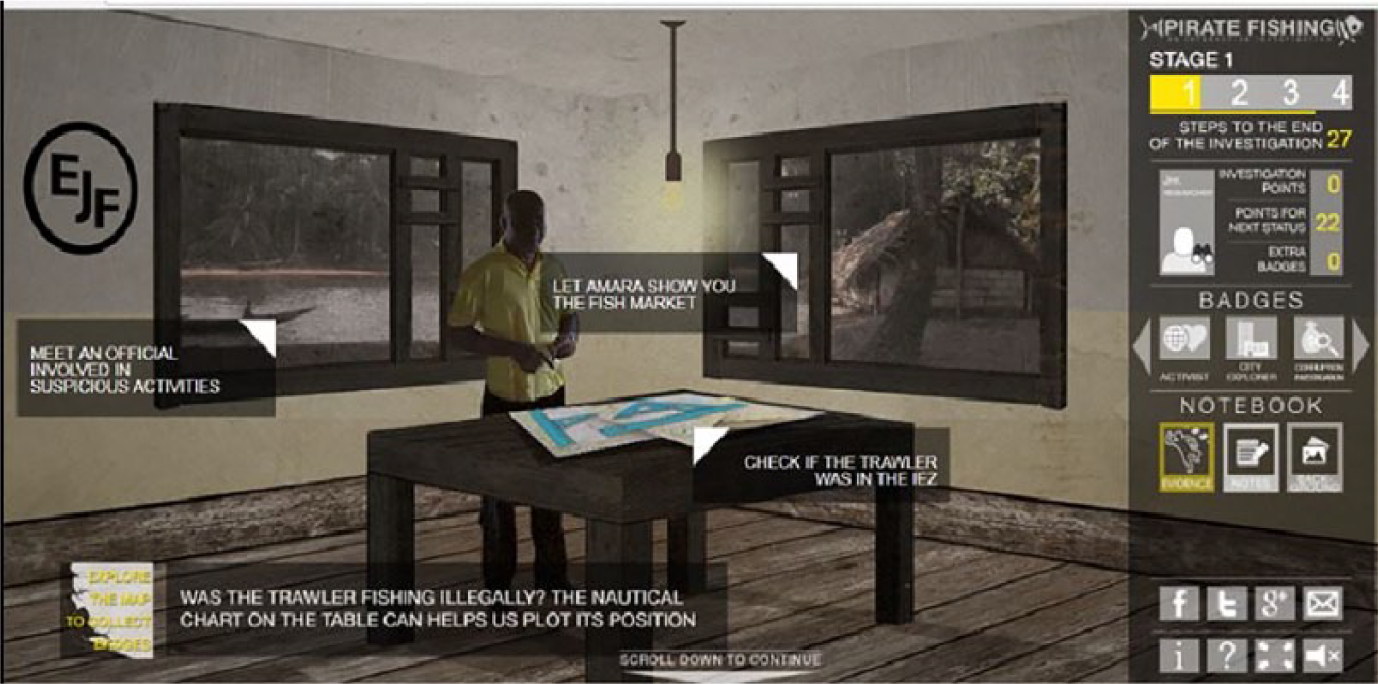
A screen shot of Pirate interface displaying its playing activities.
To get the full story behind illegal fishing in Sierra Leone, users are required to complete 32 steps. The number of steps achieved is written also in yellow under the stages ‘progress bar’. The progress bar helps the players to follow their progress and to know how much content is left to reach the next stage. From a neoliberal perspective, the progress bar and the yellow-coloured number of the completed stages, steps and points reinforce the neoliberal calculative rationality and the consumerism logic of ‘the more is better’. Rose (1999) points out that under neoliberalism social behaviour is framed by economic logic ‘as calculative actions undertaken through the universal human faculty of choice’ (p. 114). This notion is reflected in Pirate since the more stages and steps are completed, the more the news user advances in the story.
Interestingly, Pirate Fishing interface deploys the video games mechanics of ‘rewards’. Throughout the course of the play, the users are encouraged by getting ‘investigation points’ after correctly classifying information in the ‘notebook’ or ‘collected badges’. By abiding by the performance rules of the game and interacting more with the game interface, the users increase their status from ‘junior researcher’ to ‘senior reporter’. When completing ‘extra tasks’, the user gets ‘badges’. The game-like news includes six badges of ‘activist’, ‘city explorer’, ‘corruption investigation’, ‘ship spotter’, ‘technology expert’ and ‘undercover specialist’.
Similar to video games, users are asked to ‘collect’ different pieces of evidence and notes in their notebook. Collections differ from badges in that they carry visual representations of an achievement, see Figure 2.
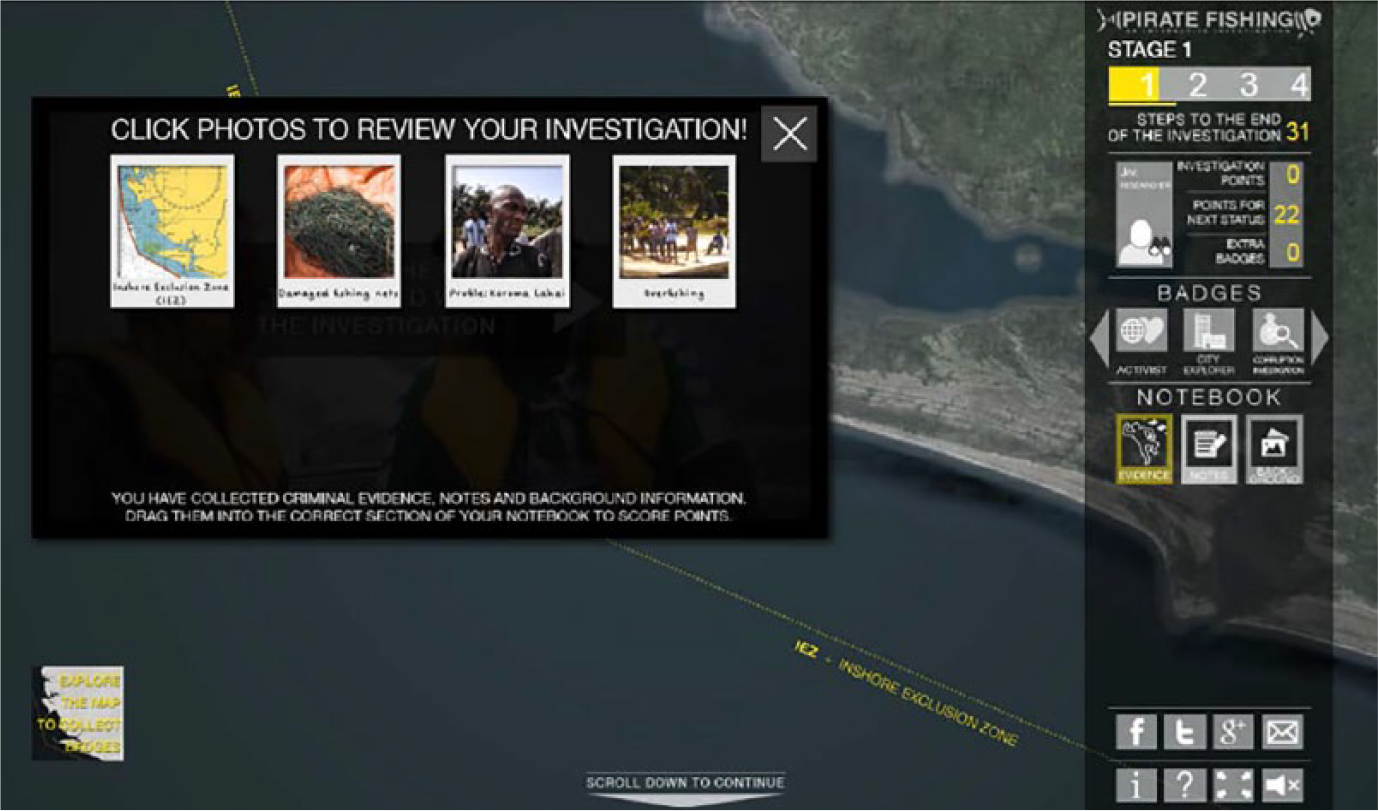
Pirate Fishing interface of visual collections.
Significantly, the reward system of Pirate Fishing implies that the more effort the news users exert in their news consumption, the more rewards they get. As the users navigate through the game, they receive badges for completing certain stages, which are shareable on social media platforms (Facebook and Twitter) found at the bottom of the right vertical bar.
As displayed by Figure 3, the game-like mechanics deployed in Al Jazeera gamified news enhance the players’ ability to construct their own status and badges. Pirate players are encouraged to proceed with the investigation process to become ‘senior reporters’ and gain the ‘specialized badges’. Thus, the motivation behind consuming the news is altered in the context of gamification from being an informative practice to being a competitive one. Interestingly, the news user becomes the game avatar who is customized and developed throughout the course of news consumption, or in other words, the course of playing the news. Correspondingly, the ludic design of Pirate with its affordances echoes the neoliberal value of self-construction. The news user’s performance and navigation in the game world reflect the neoliberal rationalities of competitive individualism and self-entrepreneurship through which individuals are encouraged to become ‘entrepreneurs of themselves’ (Rose, 1998: 158). Moreover, the incorporation of video games mechanics into Pirate interface corresponds to the neoliberal rationality of marketization which blurs the boundaries between public and private discourses. Here, the boundaries between playing and consuming news, between fun and seriousness, are conflated.

A screen shot of two interfaces demonstrating the ludic state rule of Pirate.
A close reading of Pirate interface reveals that this journalistic practice marks a shift from news composition to news design. The design of the game screen represents a process of technologization since it depends on visual resources and multimodal interaction to establish cohesion and coherence. Significantly, how the interface presents the news content to users corresponds to Halliday’s (1994) notion of ‘the grammar of little texts’ that describes advertising discourse. Such ‘minimalist’ form of news exposure contradicts the traditional complex arguments or storytelling techniques that the journalistic genres rely on. This corresponds to the neoliberal value of ‘minimalism’, or in other words, ‘the less is more’ (Murphy, 2018) when considering design. Under neoliberalism, minimal designs are more significant and functional than large ones (Hartman, 2007).
Pirate play activities
The aesthetic experience of immersion
Pirate playing activities exemplified in watching as much videos, photos and maps create an immersive storytelling environment that affectively engages the news user into the piece of news. The multi-semiotic modes of the interface establish an aesthetic experience of immersion achieved from (a) sensation, game as a sense-pleasure; (b) narrative, game as story; and (c) fellowship, game as social framework. These notions are parts of a list 1 proposed by Hunicke et al. (2004) in the context of video games and which are thought to be the most appropriate to describe the aesthetic experience of immersion offered by Pirate ludic interface. The playing activity of the game-like Pirate affords the immersive aesthetics of sensation through the background music and the recurrent depiction of the waterscapes of the cost of Sierra Leone. The resort to bird’s eye view and horizontal wide shots as in Figures 4 and 6 establishes an aesthetic sensation of ‘spatial immersion’ which can be translated into ‘see for yourself and contemplate’ (Rodriguez, 2018: 74) as the players are invited to think about how the illegal actions of piracy are being carried out in Sierra Leone.
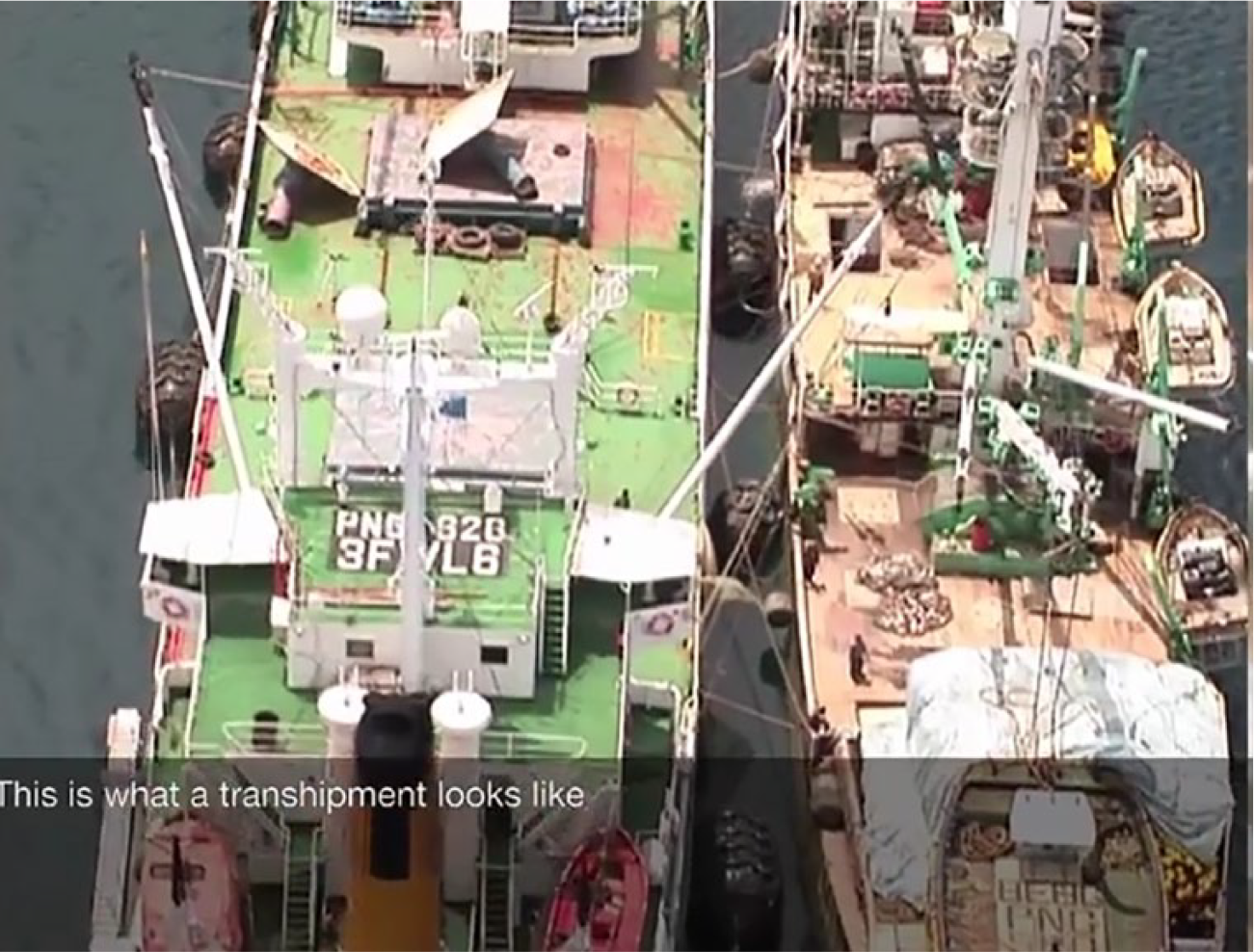
A screen shot taken from one of the game videos.
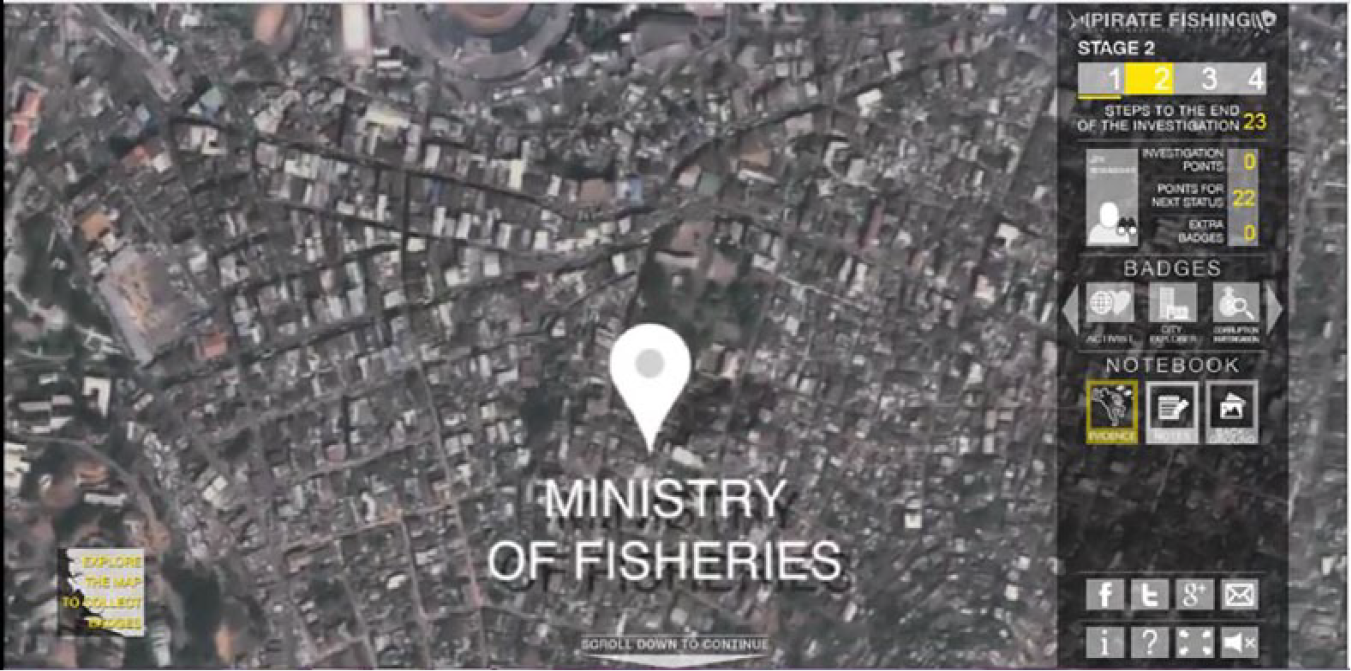
A screen shot of Pirate displaying the virtual spatialization offered to the users.
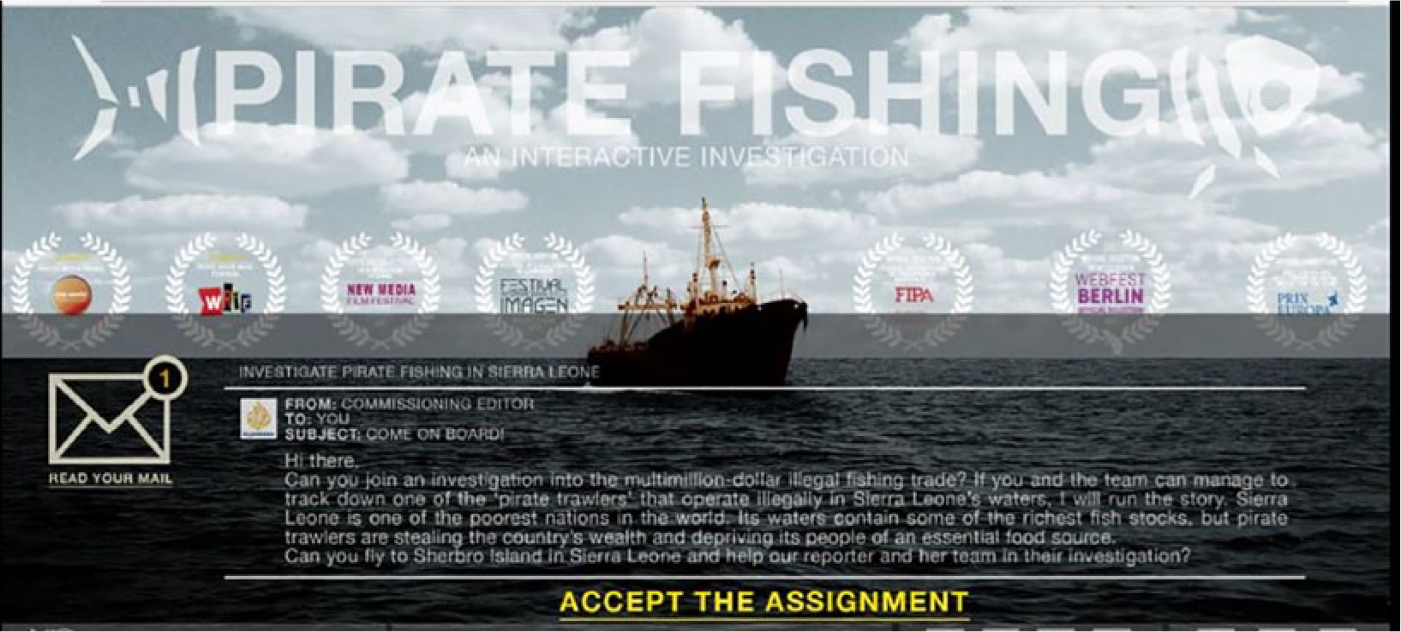
A screen shot of Pirate Fishing interface showing the personalized experience of news-making process.
Spatial immersion is employed as well in the game interface by the various uses of maps and aerial photography of Google earth screen shots through which the user gets to know the virtual locations of the illegal fishing activities (see Figure 5).
Throughout the different stages of the game, players learn more about the negative consequences of illegal fishing trade through the pop-up videos of locals, achieving the aesthetic immersion of both ‘fellowship’ and ‘narrative’. The locals tell their stories directly to the users by looking at the camera and using the first personal pronouns. Seeing real people, in real situation, adds to the sensuous, aesthetic experience.
To find the bigger picture of trawler fishing, the player should navigate different semiotic interfaces of the game which display the social and economic impact of the pirate fishing operations on the locals, which, in turn, stresses the dramatic and social aspect of Pirate. Documentary videos, sound bites, pop-up messages and photo captions which depict how Pirate Fishing destroys the living resources of Sierra Leone keep appearing to the players while navigating the game interface. The following examples are illustrative:
(a) They are destroying our materials, our fishing gears, hooks and nets.
(b) They destroyed 700 hooks.
(c) Industrial trawlers depleting coastal waters leave fewer fish for local fishermen.
This, in turn, gives the players a sense of presence and increases their empathy for the game cause.
Therefore, the immersive nature of Pirate renders users bound to the news affectively. Its immersive ludic design resources the user’s sensuous and explorative capabilities as involving aspects of the game aesthetic experience. In this regard, Al Jazeera Pirate gives the users the opportunity to not just consuming the news, rather to experience it. The playing activity promotes the neoliberal logic of ‘aesthetic preferences’ (Julier, 2007: 57) with an emphasis on the aesthetic experience of the game.
Interactional engagement
The game interface provides the players with various multimodal resources to interact with. This brings us to the concept of digital ‘interaction’ (Adami, 2015: 135). Pirate enacts user’s interaction in order to get the full story. The more the users interact with the interface, the more news stories are unfolded. Correspondingly, the neoliberal valuing of entrepreneurship is also expressed here, drawing a link between productivity and the engagement with the game world.
Significantly, Pirate play activities conversationalize the news-making process. It stimulates conversational genre by, for instance, starting the game with an assignment email from the commissioning editor defining the mission of the investigation, posing the following question to the player: ‘Can you fly to Sherbro Island in Sierra Leone and help our reporter and her team in their investigation?’ When the player presses ‘accept the assignment’, the first stage of the investigation starts.
Interestingly, the use of the second person pronoun ‘you’ personalizes the news exposure experience. The imperative mood in ‘accept the assignment’ indicates that immediate response is a must, synthetically personalizing the news experience. This is a clear example of the shift towards a neoliberal news consumption which refutes collectivism and emphasizes the neoliberal value of ‘individualism’ (Turner, 2008). In some instances of the game, the personal pronoun ‘we’ is used as well.
The use of ‘we’ in Figure 7 indicates that the discursive nature of Pirate interface involves the users in the game domain. Besides, the pronoun ‘we’ shows that the present task is shared collectively between the news user and the investigative team; the news user is one of the investigative team. The use of uppercase typography emphasizes the seriousness of the situation. A neoliberal concept of ‘personal responsibility’ (Turner, 2008) is, then, instantiated. This notion of personal responsibility is further elaborated in section ‘The role of pirate players’.
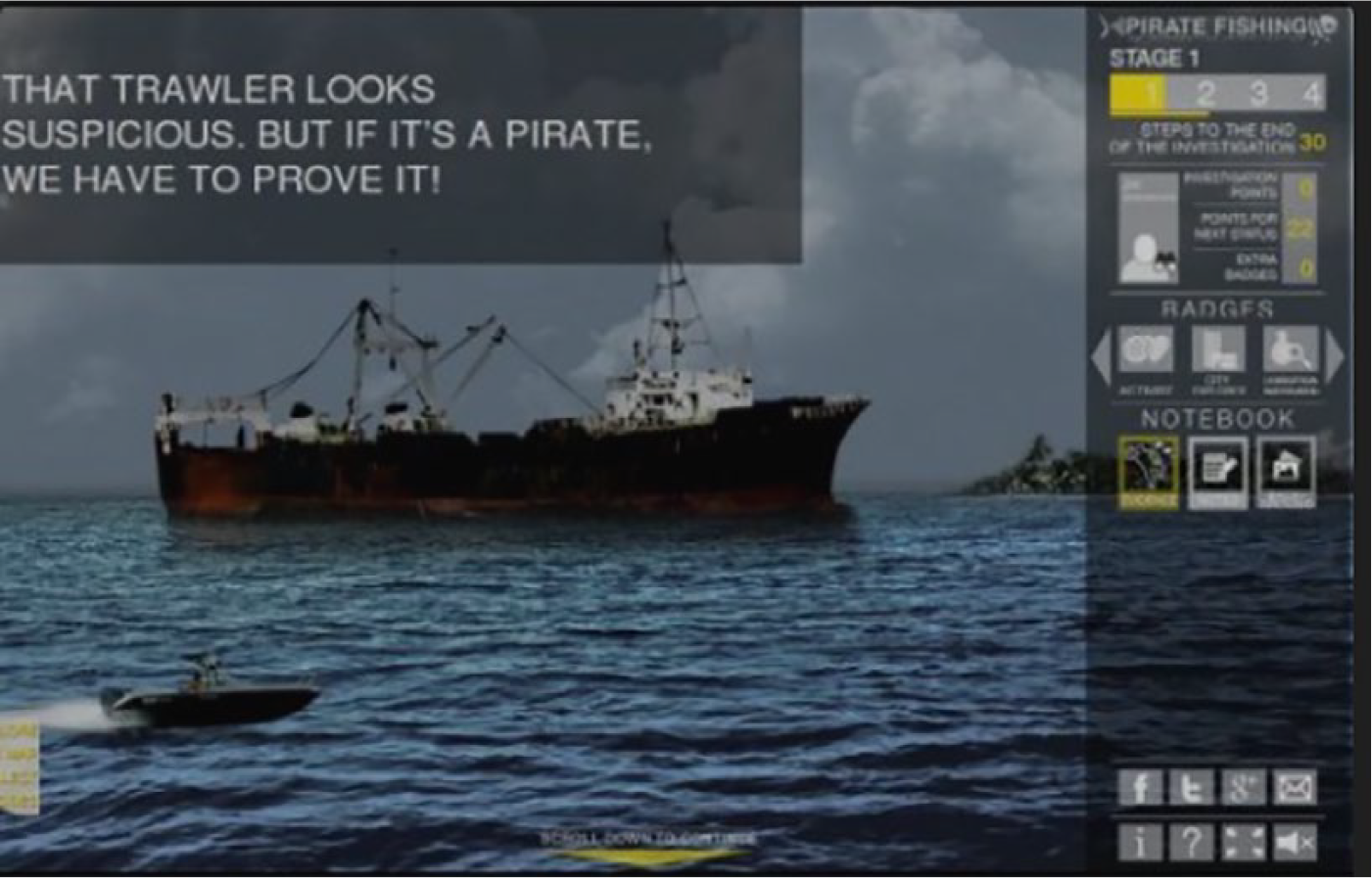
A screen shot of Pirate underlining its immersive discourse.
The engaging nature of Pirate is also reinforced by the use of pop-up messages that appear in the form of emails to the players from Juliana Rufus or other ‘secret friends’ or by the use of comment adjuncts in the form of ‘congratulations!’ pop-up screens. Comment Adjuncts as argued by Halliday (1994) ‘express the speaker’s attitude either to the proposition as a whole or to the particular speech function’ (p. 129). In this context, congratulations windows are used as incentives to tell the player that he or she has achieved the assigned task and is about to successfully move to another stage of the game, adding to the interactional properties of the game world (Figure 8).

A screen shot of Pirate Fishing interface showing its interactional nature.
The following section reflects on how gamification changes the process of news consumption by engaging, empowering and even changing the identity of the news users, turning them into players and investigative journalists while stressing their ‘agency’ (van Dijk, 2009) and social responsibility.
The role of pirate players
As mentioned earlier, Al Jazeera gamified news marks a shift from composition to design, such a process which, in the words of Bezemer and Kress (2010), ‘points to current changes in power and in principles and agencies of control which are – among others – about a shift from “vertical” to “horizontal” social structures, from hierarchical to more open, participatory relations’ (p. 11, original emphasis). The interface affordances of the game correspond at large to various neoliberal values. Most importantly, the user’s performance is an essential part in instantiating these values. Accordingly, the news user in this study is considered a semiotic mode that defines, along with other semiotic values, the affordance of the gamified news medium and, therefore, influences the content and unlocks the news story potentials. Once deciding to play, Pirate users are invited to be part of the investigative process. Significantly, Pirate players have a say in the sequence of delivering the information sources by choosing which videos to play or photos to display. The players construct individualized ‘reading paths’ (Zammit, 2007) in their interaction with the game mechanics. Therefore, Pirate interface affords user’s agency and autonomy (Ferrer Conill, 2016, 2018) marketizing the neoliberal culture of choice.
Most importantly, coherence is now the responsibility of the reader which was previously exclusive to journalists. Meanwhile, the journalist’s role in determining the best course of the events is minimized. The neoliberal logic of a sovereign consumer is, then, instantiated.
In the context of Pirate, social responsibility, which is an inherent journalistic value, is extended to include the users themselves. By proceeding into playing the game, the user assumes a social responsibility role of helping the investigation team to find the identity of the trawlers. Examples to cite are ‘Can you fly to Sherbro Island in Sierra Leone and help our reporter and her team in their investigation?’ and ‘If you and the team can manage to track down one of the “pirate trawlers” that operate illegally in Sierra Leone’s waters, I will run the story’. Accordingly, the neoliberal value of social responsibility is discursively operationalized by the lexical choices of ‘fly to Sherbro Island’, ‘help our reporters’ and ‘track down one of the pirate trawlers’. The sense of social responsibility assigned by the game interface to the users is exemplified as well by the use of the imperative mood:
(a) Meet an official involved in suspicious activities;
(b) Let Amara show you the fish market;
(c) Click if the trawler was in the Inshore Exclusive Zone (IEZ);
(d) Discover the identity of the pirate trawler;
(e) Request a meeting with officials.
Imperatives direct the users to perform certain actions, all of which serve to position them as ultimately responsible for discovering the identity of the trawlers. The users are placed as the primary agent for the investigation process. The neoliberal ideology is thus instantiated in these examples where the users are depicted as responsible for unlocking the story behind illegal fishing.
Discussion
In the context of Pirate Fishing, the news experience is marketized through playful immersion, interactional engagement and personalisation. This study argues that news gamification reconfigures news discourse in the process of marketizing and commodifying it. Marketization here means deploying market logic within the domain of news production. The neoliberal marketization of news discourse in Al Jazeera gamified news Pirate Fishing is defined through the three aspects of ‘technologization’, ‘commodification’ and ‘conversationalization’.
As revealed by the analysis, the ludic design of Pirate Fishing deploys numerous video games mechanics: stages, badges and rewards. The ludic interface affords as well multi-semiotic resources such as videos, audios, photos and maps. By converging and mixing discourses of different disciplines, news discourse in Pirate is technologized through, in the words of Fairclough (2012), ‘inter-discursive hybridity’. Significantly, the hybrid discourses, Pirate encompasses, mark a transformation from the informative functionality of news discourse to the aesthetic experience of affective immersion and interactive engagement. From a linguistic lens, Ledin and Machin (2018) attribute what they call the ‘affective functionality’ of social discourses to the medium of technologized social events in a process of the indexical coding of various semiotic elements. From a journalistic perspective, the ludic design of the Gamified Pirate can be described in the words of Papacharissi (2015) as a ‘hybrid production’ of ‘affective news’ since it supports the subjective experience and emotional immersion of the news user. Significantly, affective functionality is related to the discourse of neoliberal marketization since they echo Jenkins’ (2006: 319) ‘affective economics’, meaning a ‘new discourse in marketing and brand research that emphasizes the emotional commitments consumers make in brands as a central motivation for their purchasing decisions’ (quoted in Ferrer Conill, 2018). Furthermore, the trend of affectively engaging social participants, which is evident in Al Jazeera Pirate Fishing, ‘is part of the project of reshaping social relations and our priorities for the neoliberal order’ (Ledin and Machin, 2018: 21). Relying on convergent discourses, employing affective immersion and mixing different semiotic modes, the marketization functions in Pirate are then evident with ‘the hybridization of discourse practices, the subordination of meaning to effect, and [the change in] the mode of signification’ (Fairclough, 1993: 153).
Studying the roles of users in ‘a media environment where the boundaries between commerce, content and information are currently being redrawn’ (van Dijk, 2009: 42) is important to tell about the socio-economic and technological transformations affecting the journalistic industries. Gamification as a new journalistic practice enacts ‘audience reconfigurations’ (Ferrer Conill and Karlsson, 2015: 357) as audience/users are empowered to assume the role of investigative journalists. News technologization in the domain of Pirate marks another significant process of convergence; the news users are converged with the journalists. The gamification essence, then, is the professional experience of being an investigative reporter offered to the users. As such, gamification, in the context of Pirate, entails a revolutionary shift not only in the conceptualization of news but also in the representation of the news users’ identity. Pirate landscape commodifies the identities and practices of media consumers, providing them with new participatory possibilities and new identities such as ‘senior reporter’, ‘activist’, ‘city explorer’, ‘corruption investigation’, ‘ship spotter’, ‘technology expert’ and ‘undercover specialist’. Furthermore, Pirate ludic interface not just enables users to establish their own reading path, rather, it makes them perform ‘new media rituals’ (Ferrer Conill and Karlsson, 2015: 13) of completing ‘stages’ and ‘steps’ to acquire ‘badges’ and ‘points’ as news ‘players’. It marketizes the news experience by empowering the user to assume the role of a journalist and to have a say in not just the sequence but also the coherence of the events. Moreover, the rewarding system of Pirate reconfigures the motivation behind news consumption shifting it from the habit of informing oneself to a more competitive activity. This opens a space for the emergence of a neoliberal news user who conceptualizes the neoliberal values of ‘calculative rationality’, ‘self-entrepreneurship’ and ‘sovereign consumer’.
News discourse in Pirate is conversationalized through the use of personal pronouns, verb moods and comment adjuncts. The recurrent use of the second person pronoun ‘you’ and ‘we’ reveals how the games interface speaks directly to the users and how the users are invited to be engaged in a personalized game experience. As for the use of imperatives, it highlights the ways in which the ludic interface of Pirate directs the users to perform certain actions. This personalization style in addressing audience directly is commonly used in advertising practice (Fairclough, 1993). This conversationalizing technique is regarded by Fairclough as a type of commodification of public discourse.
To this end, it can be argued that Pirate Fishing marks a ‘semiotic moment of change’ (Fairclough, 2007) in the journalistic practices. The thesis of this study is that news gamification is a step towards neoliberal journalism.
Conclusion
News gamification is established in this study as a clear example of the neoliberal colonization of journalism. Embraced by neoliberal values and beliefs, news gamification turns towards a redefinition of the journalism discipline with much focus on user’s immersiveness, interaction and engagement. The marketization process of public discourse, according to Fairclough (1993), entails three aspects of contemporary communication: ‘technologization’, ‘conversationalization’ and ‘commodification’. These three aspects are found in this study as discursive strategies that help in reproducing a discourse of neoliberalism. Furthermore, Fairclough (2007) stresses the importance of conducting semiotic researches to underline the relations between semiosis and other ‘moments’ of the social process. To this end, this study has examined as well how the affordances of the ludic semiosis are operationalized in Pirate to echo neoliberal rationality. Gamified news discourse is not a mere multimodal medium that incorporates verbal, audio and visual narrative; rather, it borrows from video games its distinctive language of the ludic design and ludic interactive dynamics to convey meaning. In this regard, this article is drawn on Pérez-Latorre’s (2015) analytical model for exploring the structures and processes of the ludic design. Studying the ludic design of Pirate has helped in understanding how communication operates within this game-like news.
The article has investigated the discursive strategies and semiotic affordances made available by the Al Jazeera gamified news interface. It has examined the meaning potentials instantiated by the ludic interface and the user’s interaction with and acting upon it. It is found that gamification reconfigures news consumption by engaging, empowering and even changing the identity of the users, turning them into players and investigative journalists. It is found as well that gamified news interface personalizes news discourse in the process of commodifying and marketizing it. This notion is interpreted in light of Fairclough’s (1993) marketization of public discourse. As shown in the case study, the ludic interface conversationalizes the news-making process, reflecting upon the neoliberal values of ‘calculative rationality’, ‘self-entrepreneurship’, ‘minimalism’, ‘aesthetic preferences’, ‘individualism’, ‘sovereign consumer’ and ‘personal responsibility’.
This new journalistic practice marks a shift from composition to design in the process of technologizing news production. News gamification marks a significant change in the resources which were traditionally used in news-meaning making. This new form of communication prompts new discursive and semiotic competencies. Within the games world, the focus is now shifted from the structuring of the text to the structuring of the news engagement and interaction resources. Pirate empowers the users/players to do the story and investigation themselves. In this sense, news gamification reconfigures the role of news users. The study argues that the news message of the game-like news is conceptualized by the player’s interaction with the ludic interface. Pirate users are perceived in this study as semiotic resources that have input and a say in the news-making process and the unfolding of the news content. What is newly presented in the news gamification environment is the involvement of the player into the ongoing events while being assigned the social responsibility of proceeding into the investigation processes. This brings to the emergence of a neoliberal news user.
Concerning the adopted methodological approach, it raises a number of opportunities for future research, in terms of studying the new journalistic practices of news gamification. That is, it is shown that synthesizing semiotics with discourse analysis has the potential to shed further insights on the changes in journalism. Further studies are required to examine how news gamification entails for the concepts of news values, impartiality and truth.
Footnotes
Declaration of conflicting interests
The author(s) declared no potential conflicts of interest with respect to the research, authorship, and/or publication of this article.
Funding
The author(s) received no financial support for the research, authorship and/or publication of this article.
Notes
Author biography
Fawzy RM (2019) Aestheticizing suffering: Evaluative stance in pulitzer-winning photos of refugees’ crisis in Europe. Discourse Context Media 28: 69–78.
Fawzy RM (2018) A tale of two squares: Spatial iconization of the Al Tahrir and Rabaa protests. Visual Communication. Epub ahead of print 9 October 2018. DOI: 10.1177/1470357218803395.