







Abstract
This study conducts a bibliometric analysis of news discourse analysis using CiteSpace to sketch its scientific landscape based on journal articles in English in the Scopus database from 1988 through 2020. The statistical analysis provides evidence for the interdisciplinarity of this area, and shows an upward trend in general over these years as well as an accelerating growth rate in the past decade. Findings also indicate that the problem-oriented CDA has gained the most popularity in this area since its emergence, and the appraisal framework, multimodality analysis, and discursive news values have become three hotspots of news discourse analysis. In addition, the authors in the West have contributed most in this area, but those from Chinese Mainland, Malaysia, South Africa, and Indonesia have gradually been an emerging powerhouse, which has added diversity in topics and will enhance equality and promote dialogue between different communities, ethnics, and races across the globe.
Keywords
Introduction
News is central to mass media and plays a vital role in shaping social life, culture, and politics. Over the past few decades, the research on news discourse has aroused the interest of scholars from multiple disciplines, who have probed into its structure at different linguistic and textual levels as well as its production and interpretation in broad contexts. In Van Dijk’s (1988) pioneering work in this area, news discourse generally refers to an oral or written news item disseminated by news outlets through a variety of channels such as newspapers, radios, televisions, the Internet, and website portals. Following the trend of post-structuralism, Van Dijk proposed a social-cognitive model that integrates the production and comprehension of news discourse with its textual analysis. Using thematic analysis, he illustrated how news discourse was produced and could be deconstructed through the interface of the producer/receiver’ mental models of journalistic conventions and communicative events.
Focusing more on the social dimension of discourse, Fairclough (1995) developed a three-dimensional framework for critical discourse analysis (CDA), which involves text, discourse practice, and social practice. Text analysis aims at uncovering text structure, semiotic/linguistic patterns, and discursive devices. Discourse practice covers processes of text production and comprehension, including institutional routines and discourse transformations over time. Social practice refers to external contexts (beyond symbols/language) that affect the production and comprehension of discourse.
Many studies on news discourse have followed these two analytic approaches, but our knowledge has so far remained rather limited in respect to general outline and development of this area over the past few decades. As such, we are unable to evaluate its multi-disciplinary impact and judge its research trends. In recognition of this gap, this study aims to conduct a bibliometric research on news discourse analysis to sketch its scientific landscape and predict the trends.
Literature review
Bibliometric analysis is an instrument used for quantitative analysis of written publications by means of statistical and science mapping methods. Since its emergence, bibliometric studies have rapidly drawn the attention of scholars of linguistics. In order to investigate the impact of scientific literature and research trends, the researches in a specific branch of linguistics and in a specific journal were conducted, for instance, bibliometric studies on translation studies (Van Doorslaer and Gambier, 2015; Zanettin et al., 2015), on applied linguistics (De Bot, 2015; Lei and Liu, 2019b), on corpus linguistics (Liao and Lei, 2017), on fuzzy linguistic research (Chen et al., 2019), on second language acquisition (Zhang, 2020), and on the publications in the linguistic journal System (Lei and Liu, 2019a). In addition, Lei and Liao (2017) did a bibliometric investigation into linguistic publications by authors from Chinese Mainland, Hong Kong, Taiwan, and Macau, revealing China’s rapid progress in linguistics research as well as the reasons for the progress.
As far as discourse analysis is concerned, Swales (1986) and White (2004) ever used citation analysis to identify key authors and highly cited works. More recently, Huan and Guan (2020) cast a wider net and sketched its science landscape between 1978 and 2018. They concluded that this area had ‘emerged as a major, and increasingly distinctively sociological, contribution to the analysis of language in social life’ (p. 697). It was also found in their study that in addition to the prominence of the US, the UK, and Australia, China was wielding a growing share of research output. However, their study restricted its data to nine Scopus-indexed English journals mainly in the domains of Linguistics and Language and Communication and did not cover the related articles published in the journals of many other disciplines, thus failing to uncover the underlying interdisciplinary ties in the field of discourse analysis. As such, this study built a corpus by selecting as many publications in the area of news discourse analysis as possible, with one of the aims to sketch the interdisciplinary connection within this area.
Data and methods
In the field of bibliometrics, CiteSpace is a powerful tool widely used for data analysis and data visualization. It supports bibliographic and citation data retrieved from major sources such as the Web of Science, Scopus, and Dimensions (Chen, 2006). However, though it can generate distinct visual maps and statistical reports through its algorithmic method, the balanced use of automatically generated quantitative analysis and manual or semi-manual calculation will help to improve the accuracy of research findings. For example, to detect research fronts and research hotspots, keyword co-occurrence analysis instead of cluster analysis enables the researcher to yield more accurate results, because the clusters generated automatically by CiteSpace may fail to provide statistical evidences for meaningful conclusions in a systematic way. In view of the merits and demerits of CiteSpace, in this study, the authors determined threshold configuration accordingly based on the reported statistics and chose the best method to obtain the findings in order to promote the validity of the research.
In order to cover as many data relevant to this study as possible, the authors used the following terms, news, news discourse, journalistic discourse, news text, and journalist text, to search the related English-language journal articles whose titles, abstracts and keywords include any one of these terms in the Scopus database. A total of 4903 document results composed of article titles, abstracts, authors, keywords, and references were obtained and exported in the RIS format, and each document result was checked manually by deleting identical files and the results not focusing on news discourse analysis. As a result, 2206 documents were obtained. In addition, because author names and country/region names may appear in different linguistic forms though referring to the same entities, the authors checked them very carefully to ensure one linguistic form for one entity.
Findings and discussion
To have a comprehensive grasp of how the area of news discourse analysis has developed over the past few decades, the authors intended to examine: (1) the chronical development of the area; (2) the distribution of domains and Top 10 journals; (3) the most frequently discussed research topics across time; (4) the most productive countries/regions; and (5) the most highly cited authors in references across time. In the process of data analysis, manual and semi-manual calculations were performed when necessary to enhance research validity.
Chronological development of news discourse analysis
The authors calculated the number of publications each year according to the data collected for this study and generated the line chart manually. Figure 1 shows the chronological development of news discourse analysis from 1988 through 2020. It was in 1988 that the first related article was published in Scopus. Further investigation into the document results indicates that four related articles were published in the third issue of European Journal of Communication this year. These articles adopted qualitative methods and investigated printed news texts, radio news, or television news. Dahlgren (1988) discussed the methodology of interpretative analysis and revealed the function of thematic infrastructure in the interpretation of news texts. Moss (1988) examined radio news using rhetorical, representational, verbal, and intonational methods. Mancini (1988) conducted a research of television news from the angles of meta-discursive indicators and deictics. Jensen (1988) probed into the audience’s interpretation of television news via their super-themes.
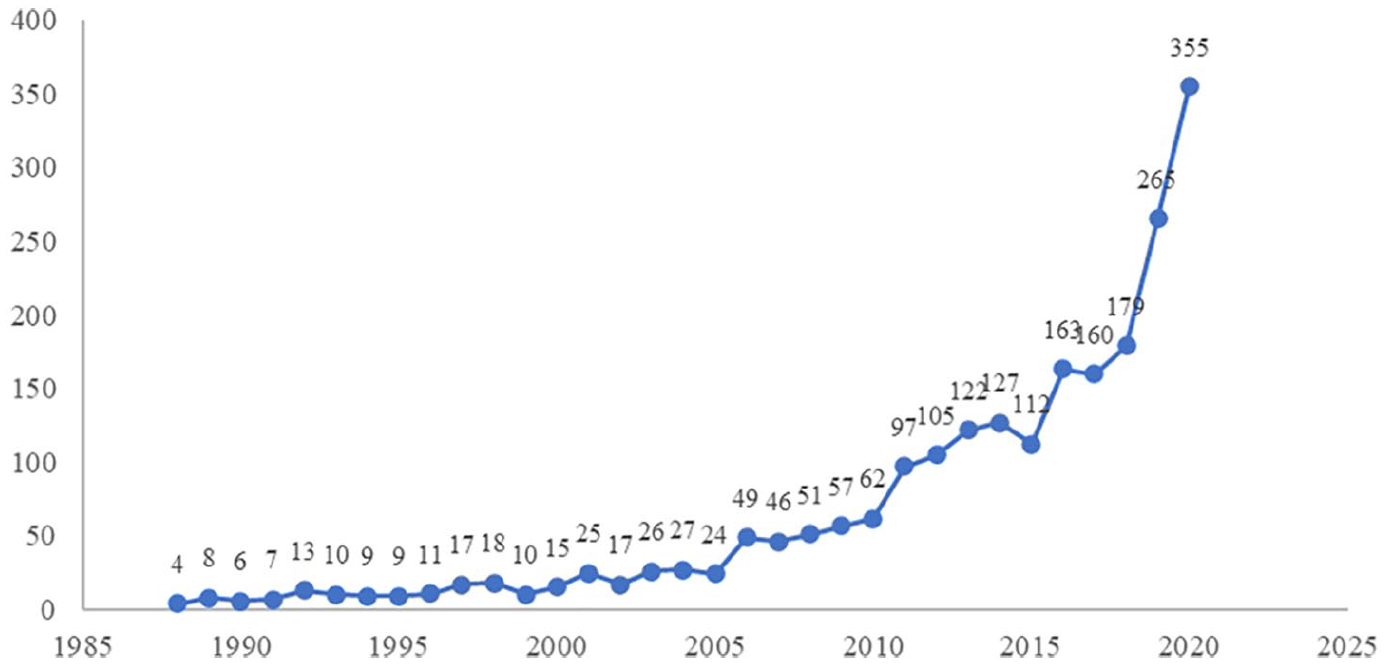
Chronological distribution of publications concerning news discourse analysis (1988‒2020).
Figure 1 displays a general upward trend and the accelerating growth rate in this area, indicative of its process as a new and powerful research field since 1988. A total of 351 articles with an average of 17.6 per year were published in Scopus over the 20-year period (1988‒2007); in contrast, over the 13-year period (2008‒2020), 1855 articles with an average of 142.7 per year were published. It can be seen from Figure 1 that the year of 2020 is the most productive one with 355 articles published. Particularly, the recent 3 years (2018–2020) has witnessed a soaring increase in the related publications. The number of articles published in 2020 (355 publications) has increased nearly twice as much as those of 2018 (179 publications).
The distribution of domains and Top 10 journals
Based on the records in Scopus, the authors calculated the proportion of each domain and mapped a pie chart which shows the distribution of the 2206 publications from 1988 through 2020. The interdisciplinary nature of news discourse analysis is clearly displayed by Figure 2. Its main research domains include Social Sciences (58%) and Arts and Humanities (30%), followed by Psychology (3%), Computer Science (2%), Business, Management, and Accounting (2%), Economics, Econometrics, and Finance (2%), Environmental Science (1%), Medicine (1%), and other (1%). These results are in accordance with our general impression that news discourse analysis is conducted mostly in the domains of Social Sciences and Arts and Humanities.
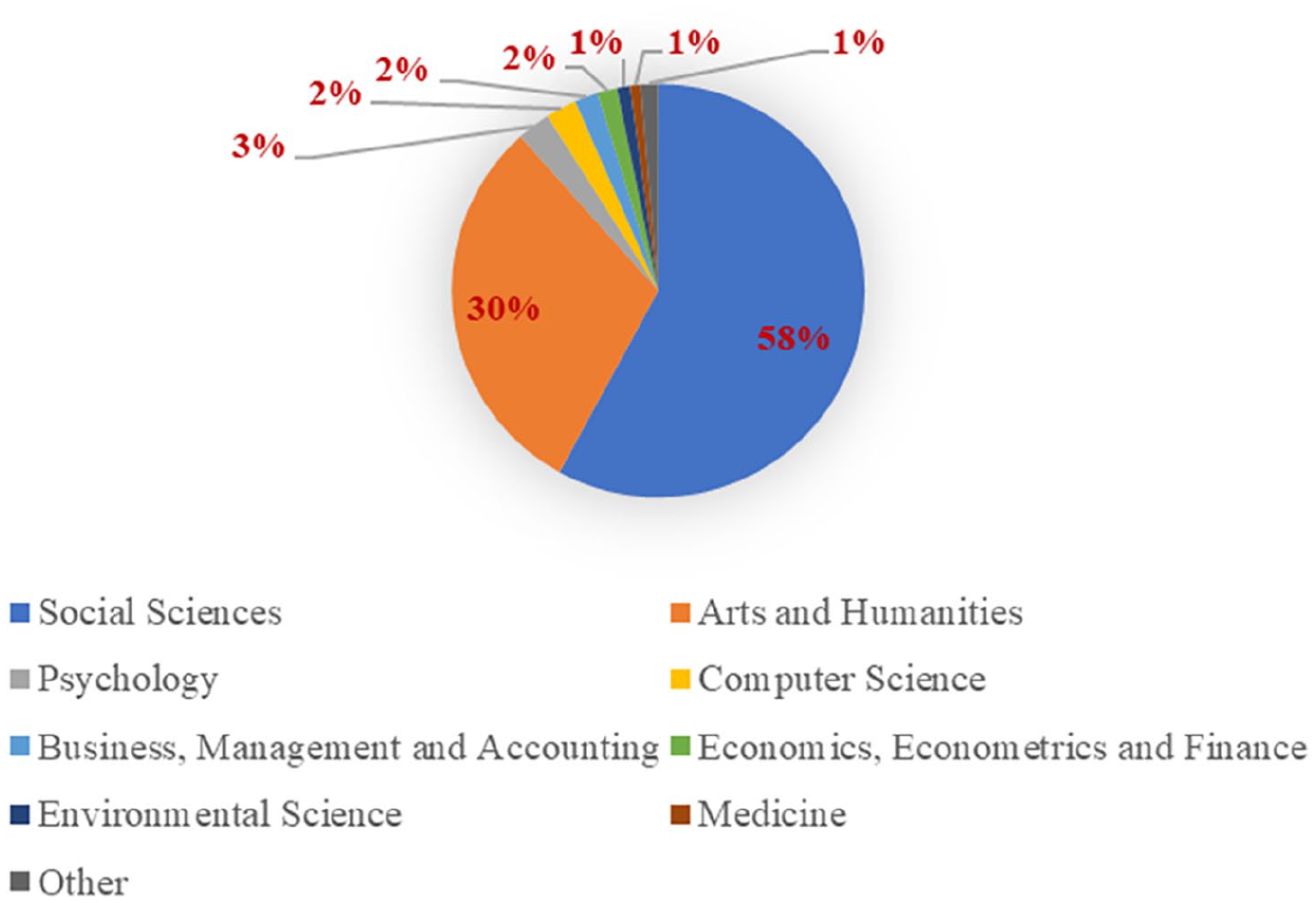
The distribution of domains of news discourse analysis (1988‒2020).
In order to figure out more details in this respect, the authors calculated the related publications for each journal. Table 1 shows the 10 journals with the largest number of related publications. Please note that Year in the tables of this study refers to the initial year when a certain item (e.g. a keyword, a publication, etc.) appeared.
Top 10 journals on news discourse analysis in terms of total publications (1988‒2020).
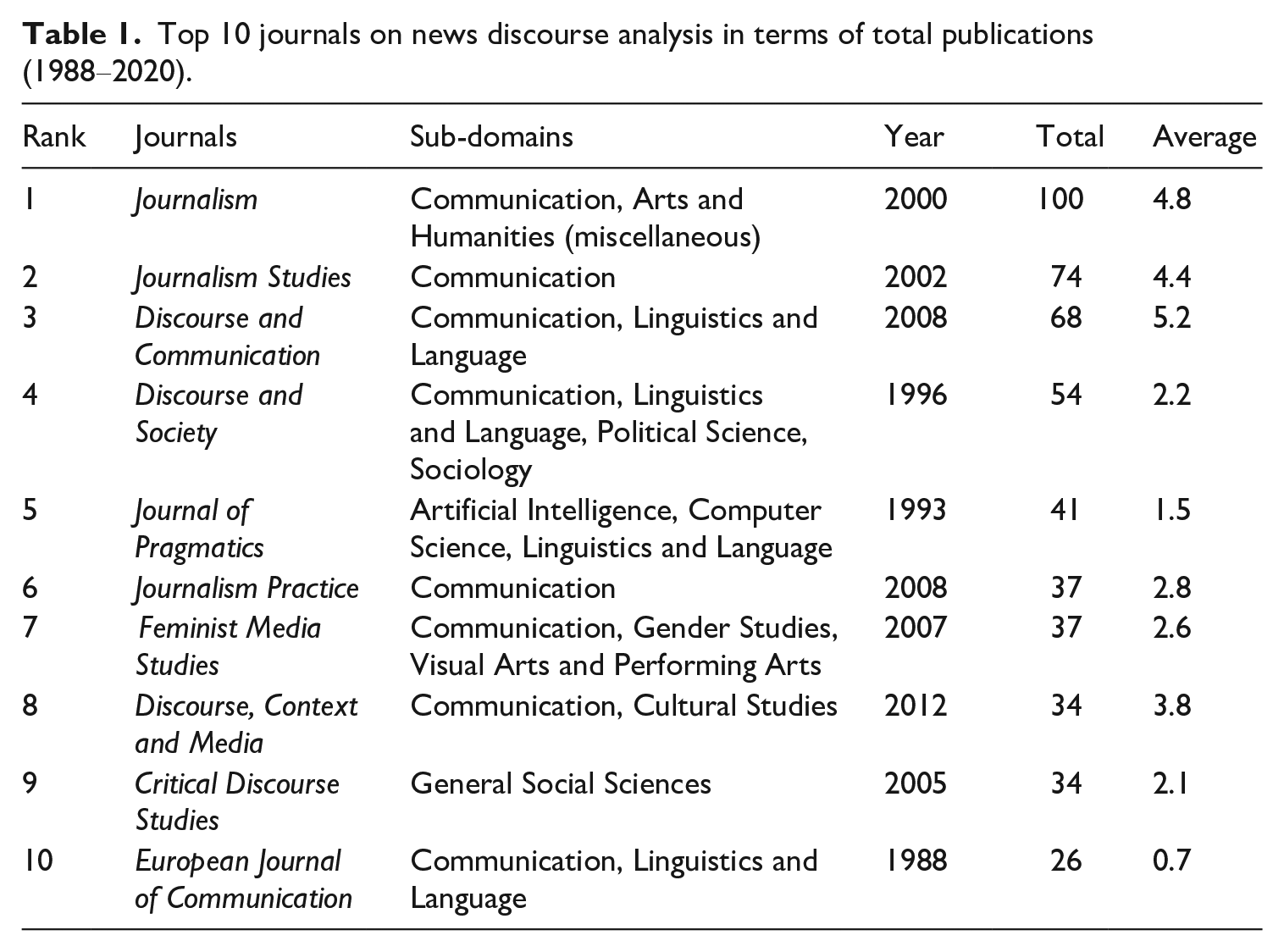
It can be seen from Table 1 that the sub-domains of these journals cover eight disciplines in Social Sciences and Art and Humanities, including Communication, Linguistics and Language, Artificial Intelligence, Sociology, Political Science, Cultural Studies, Visual Arts and Performing Arts, and Gender Studies. Of the 10 journals, there are 8 concerning Communication and 4 concerning Linguistics and Language, which may be indicative of the fact that most of the publications on news discourse analysis fall into these 2 sub-domains.
The results show that Journalism, Journalism Studies, Discourse and Communication are Top 3 journals in news discourse analysis in terms of publication count. Journalism ranks first with a total of 100, followed by Journalism Studies (74 publications), Discourse and Communication (68 publications). When it comes to average publications, Discourse and Communication tops the list with 5.2 per year between 2008 and 2020, and Journalism ranks second with 4.8 per year from 2000 through 2020, followed by Journalism Studies (4.4 per year from 2002 through 2020). In contrast, European Journal of Communication, where the first four related articles were published in 1988, turns out to rank 10th in both columns of Table 1 with a total of 26 and an average of 0.7 per year.
The most frequently discussed research topics across time
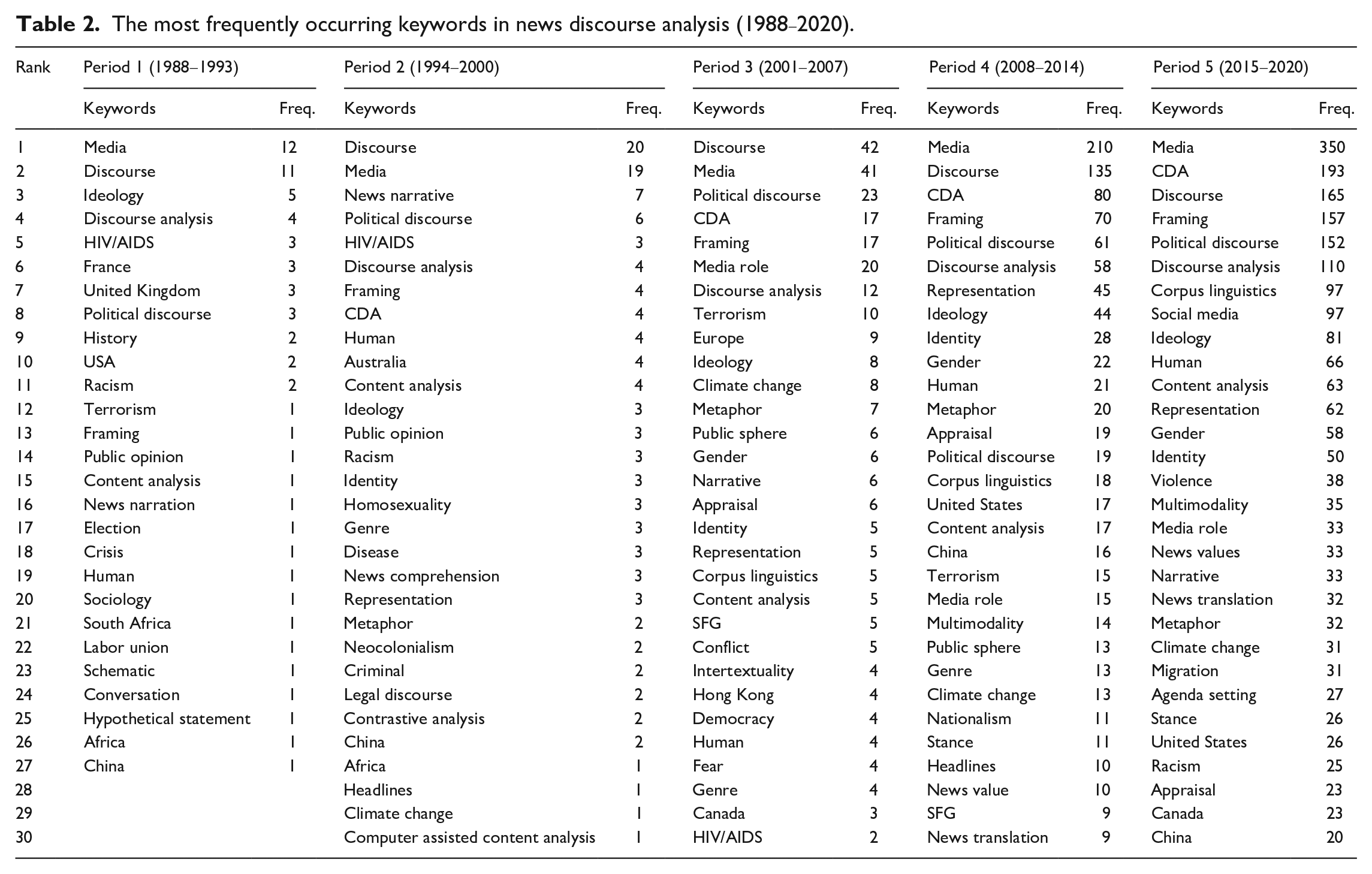
In order to detect the research trends of news discourse analysis in an effective way, the authors divided the years between 1988 and 2020 into five periods, and then manually counted the frequency of each keyword occurring in the document results. The five periods are as follows: (1) Period 1: 1988‒1993 (48 publications); (2) Period 2: 1994‒2000 (89 publications); (3) Period 3: 2001‒2007 (214 publications); (4) Period 4: 2008‒2014 (621 publications); and (5) Period 5: 2015‒2020 (1234 publications). To make the statistics in the table more concise and more readable, the keywords referring to the same research topic were integrated into one term. For example, news frame, news framing, framing analysis, frame analysis, frame, and framing were recorded as framing in the table, critical discourse analysis and critical discourse studies as CDA, and systemic functional grammar and systemic functional linguistics as SFG.
Table 2 shows the 30 keywords with the highest frequency in each period. We can see that there are some shared keywords across the five periods, including the general terms in this area (media, discourse, and discourse analysis) and more specific terms (human, political discourse, content analysis, framing, and ideology).
The most frequently occurring keywords in news discourse analysis (1988‒2020).
The presence of human in the five periods suggests that one of the main concerns of news discourse analysts is the wellbeing of mankind. Besides, the term political discourse, which covers politics, political discourse, political communication, and political linguistics in Table 3. Further investigation into the document results shows that a majority of political discourse studies are related to the topics such as election, neocolonialism, conflict, migration, terrorism, racism, etc. It is not surprising to see political discourse is so closely related to news discourse because news discourse on political issues can be conceived as one type of political discourse, as argued by Chilton and Schäffner (2002: 6). In addition, these studies are usually conducted within the CDA paradigm with emphasis on politics (Okulska and Cap, 2010: 4).
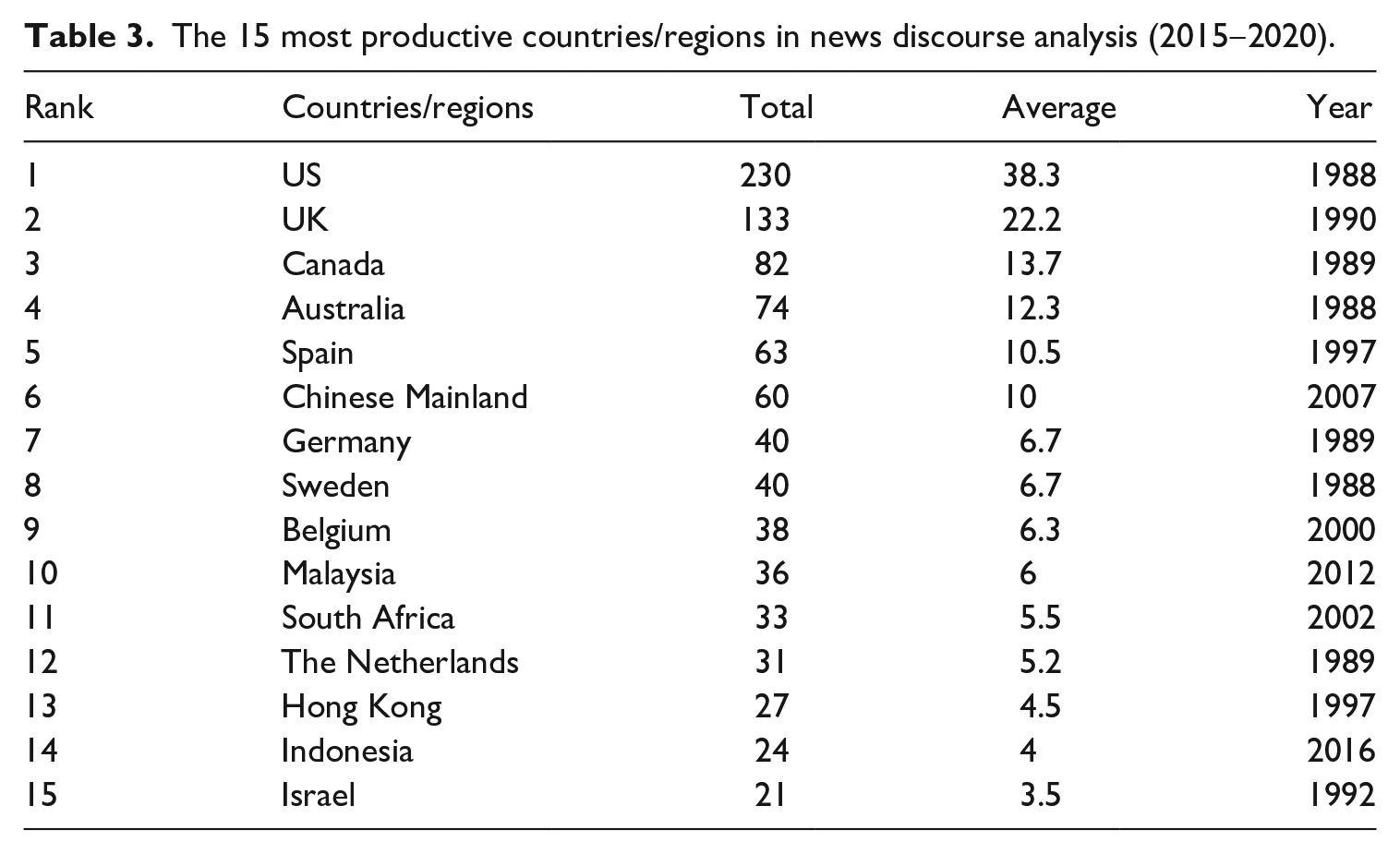
The 15 most productive countries/regions in news discourse analysis (2015‒2020).
The presence of content analysis in all the five periods indicates its popularity as a traditional qualitative method in this area. Besides, as shown by computer assisted content analysis, this method was used to analyze electronically coded texts in Period 2, implicative of the combined use of quantitative analysis and qualitative content analysis with the assistance of analytical software since then. In fact, in news discourse studies, traditional qualitative methods and theoretical exploration are always two trends along with such qualitative methods as corpus linguistics in the following three periods.
We can see from Table 2 the drastic increase of corpus linguistic (Period 3: ranking 19th with 5 occurrences; Period 4: ranking 15th with 18 occurrences; Period 5: ranking 7th with 97 occurrences). Actually, the first article to employ the corpus-based method in critical discourse analysis was written by Hardt-Mautner (1995) in Period 2, and three other articles in the database in Period 2 (Fang, 1994; Gavin and Goddard, 1998; Ohtsuki et al., 1999) also employed this approach but did not use such keywords as corpus or corpus linguistics. The appeal of this approach can be further evidenced by Table 4 in the subsection of ‘Most highly cited authors in references’, which shows that Paul Baker is among one of the first 20 highly cited authors in Period 5. The monograph Using Corpora in Discourse Analysis (Baker, 2006) and the article ‘A useful methodological synergy? Combining critical discourse analysis and corpus linguistics to examine discourses of refugees and asylum seekers in the UK press’ (Baker et al., 2008) have contributed a lot in this regard.
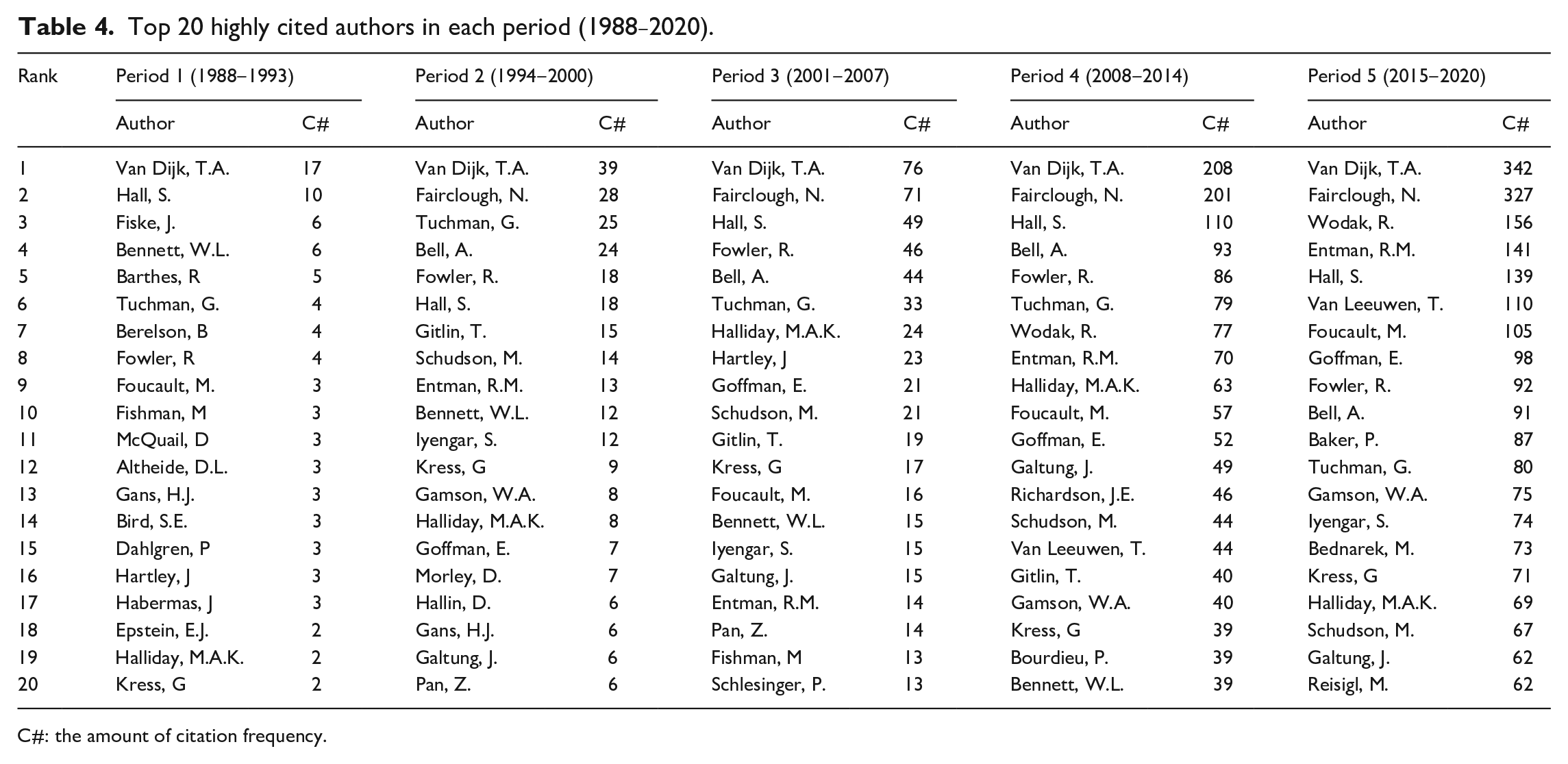
Top 20 highly cited authors in each period (1988‒2020).
C#: the amount of citation frequency.
The presence of CDA in Periods 2‒4 suggests the significance and charm of this problem-oriented and action-focused approach. CDA is characterized by de-mystifying ideology, inequality, and power (abuse) hidden in actual language use (Wodak and Meyer, 2001). By revealing ideology imbedded consciously by institutions and unconsciously by long-standing conceptions, beliefs, and values in a given society, many researchers have endeavored to analyze the representation of certain socio-political issues and identity construction of certain social groups (including national identity, cultural identity, and gender identity) in news discourses, aiming to utter ‘voices’ for the underprivileged. For instance, Al-Hejin (2012, 2015) uncovered the prejudice toward Muslim women in news, and Baker (2008, 2014) unmasked gender ideologies in media representations concerning LQBT groups. Besides, apart from the above-mentioned racism and gender issues, Table 2 shows diversified topics with the changing socio-political situations over time. For instance, HIV/AIDS appears in Periods 1‒3, and terrorism in Periods 3‒4, and climate change in Periods 2‒5. It can be anticipated that climate change will remain to be one of the focuses in the following time period because of the deteriorating global warming.
Similar to CDA, the theory of framing, used to reveal stance in news discourse and media role in the dissemination of news, also stands for the critical aspect of news discourse analysis. As an influential theory in communication studies, framing generally refers to the selection and salience of some aspects of a socio-political issue while neglecting others (Entman, 1993). However, despite the fact that framing analysis has been widely used in deconstructing media discourse since the borrowing of this notion from Irving Goffman (1974), it is considered a ‘fractured paradigm’ (Entman, 1993: 51) and ‘has never been made explicit in cognitive or discursive terms’ (Van Dijk, 2016: 21). According to Van Dijk (2016: 20), most of the studies study news discourse data through the use of content analysis (occurring in all five periods) instead of the methods of discourse analysis. However, some researchers, inspired by Entman’s (1993: 52) argument that framing is achieved by ‘the presence or absence of certain keywords’, took advantage of the shared critical perspective of framing and CDA and combined the two approaches together to examine certain socio-political issues (e.g. Chen and Wang, 2020; Liu and Li, 2017).
SFG, put forward by Halliday, is one of the linguistic theories widely used in news discourse analysis, particularly in Periods 3‒4. SFG is mainly used for the revelation of the underlying ideology in news discourse from the CDA perspective. The authors chose an article from Period 5 to show the popularity of this theory in news discourse analysis even in Period 5 though SFG is not in the list of the first 30 keywords. Lee (2016) used the corpus-based approach to analyze Halliday’s transitivity for application to CDA, whose study examined two ideologically opposed South Korean newspapers’ coverage on a nationwide public movement against US beef imports and revealed that the two newspapers contrasted with each other in representing the riot police and the demonstrators as Actor and Goal in material processes grammatically and in processes of violence conceptually. However, although many systemic functional linguists have contributed to discourse studies and news discourse analysis, there are some defects for this theory when it is used in analyzing discourse. As argued by Van Dijk (2008: 29), this linguistic theory limits itself to lexico-syntactic level, thus resulting in its inability to interpret the text at discoursal level and in external contexts beyond the text. In addition, the anti-mentalist nature of this theory prevents the analyst from understanding the production and comprehension of discourse from a cognitive perspective.
Table 2 also shows that the study of metaphor has enjoyed popularity over Periods 3‒5. What’s more, in Periods 4‒5, the appraisal framework proposed by James Martin and his colleagues and the multimodality analysis by Gunther Kress and Theo van Leeuwen have been increasingly used in the research on news discourse. Most of the studies on metaphor started from Lakoff and Johnson’s (1980) standpoint that metaphor is a conceptual system not just in language but in thought and action. As for the appraisal framework, it is believed that evaluation is a newly emerged conception used in discourse analysis, as observed by Huan and Guan (2020) and Li et al. (2020) in their bibliometric analysis. The two frameworks of appraisal and metaphor are particularly useful for CDA in understanding and analyzing how attitudinal stance or ideology is embedded in news discourse (e.g. Coffin and O’Halloran, 2005; Flowerdew and Leong, 2007; Ho, 2016). In addition, over the past decade, news discourse analysts have extended their focuses from written texts to visual images and multimodal representation of news events, from traditional mass media to social media. According to the statistics manually worked out by the authors, two of the most cited works in terms of multimodality analysis are Kress and Van Leeuwen’s (2006) Reading Images: The Grammar of Visual Design and Machin’s (2012) How to Do Critical Discourse Analysis: A Multimodal Introduction. It can be estimated that the study of metaphor, the appraisal framework, and multimodal analysis will very likely remain to be the research hotspots in news discourse analysis in the 2020’s.
What needs to be mentioned as well is the presence of news values in Periods 4‒5 and news translation in Period 5. With the ‘cultural turn’ and ‘social turn’ of translation studies since the 1970’s, news translation is viewed as a social practice manipulated by power and ideology, which is affected by historical, cultural, and political contexts; therefore, it tends to be examined from the multiple perspectives of SFG, the appraisal framework, CDA, and corpus linguistics. In addition, the approach of discursive news values conceived by Monika Bednarek, Helen Caple, and their colleagues provides ‘a new insight and analytical framework to study linguistic construction of news values’ (Huan and Guan, 2020: 709). The 33 occurrences of news values in Table 2 are a solid evidence of the fact that the years from 2015 through 2020 has witnessed the drastic growth of this novel approach.
It is also worth noting that the most discussed countries in this area are the traditional or emerging ‘big’ countries (for instance, France, United Kingdom, Australia, Canada, United States, and China). Further investigation into the publications containing these keywords shows that most of the studies concern such global issues as climate change (e.g. Olausson, 2014; Stoddart and Tindall, 2015), ethnic and racial issues (e.g. Downing, 1990; Lawlor and Tolley, 2017; Teo, 2000). These issues are in consistent with the keywords related to socio-political topics discussed above. Besides, the presence of Hong Kong in Period 3 and the occurrence of China in Periods 1‒2 and Periods 4‒5 indicates China’s ‘high visibility’ among the circle of news discourse analysts. They have shown great concern about various socio-political issues concerning China, particularly the issues of Hong Kong, a territory that has maintained its status as an international financial center and experienced profound political and economic challenges under the unique political system of ‘One country, two systems’ after it returned from 155 years of British colonial rule to China in 1997 (e.g. Flowerdew et al., 2002; Liu and Jiang, 2019).
The most productive countries/regions
In order to figure out the most productive countries/regions in this area, the authors generated the diagram according to the records in Scopus. Figure 3 displays that the US occupies a leading position, accounting for nearly 23% (503 articles) of the 2206 publications, nearly twice more than that of the UK, which ranks the second. In addition, the output of the top four countries (the US, the UK, Australia, and Canada) accounts for 48% (1054 articles) of the total.
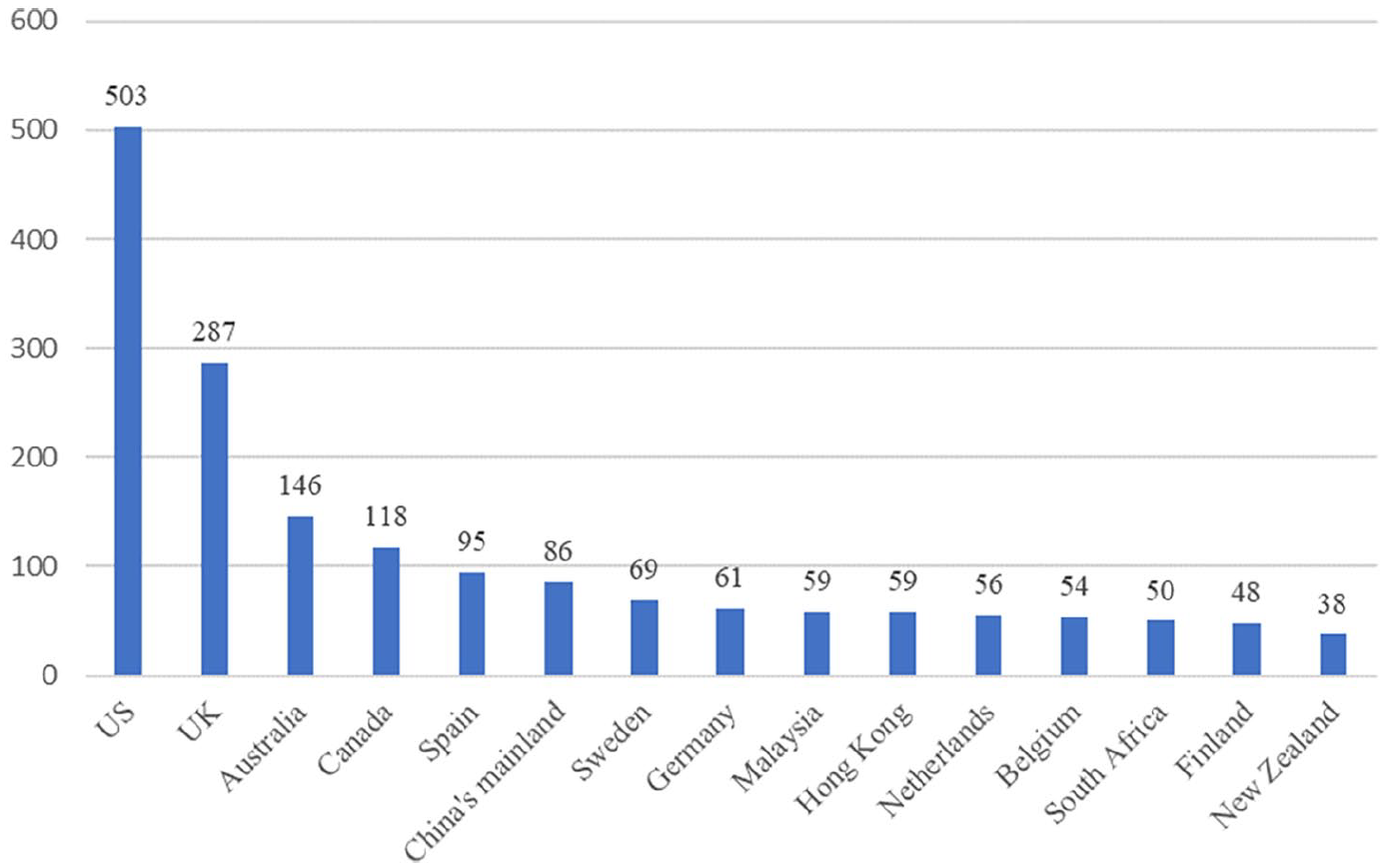
The 15 most productive countries/regions in news discourse analysis (1988‒2020).
Figure 3 also shows the authors from the developing world published much less related articles, compared with those from the developed world. A total of 195 articles by the authors from Chinese Mainland (86), Malaysia (59), and South Africa (50) takes up approximately 9% of the total. Further investigation reveals that the first related article from South Africa was published in 2002, the first from Chinese Mainland was published in 2007, and the first from Malaysia in 2012. The scholars from Chinese Mainland with an average of 7.3 publications per year and from Malaysia with an average of 6.6 per year have been an emerging academic powerhouse in news discourse analysis.
In order to have a clearer view of the recent trend in this regard, the authors generated a list of the 15 most productive countries/regions in the period of 2015‒2020 (Table 3). We can see that apart from the above-discussed Chinese Mainland (ranking 6th), Malaysia (ranking 10th), and South Africa (ranking 11th), Indonesia ranks 14th with the total of 20 publications, which may further suggest the rapid development of the research on news discourse in the developing world in the recent years.
What is also noticeable is that Israel ranks 15th with a total of 21 and an average of 3.5 in Table 3, though it is not included in Figure 3. The first related article from Israel was published in 1992, however, there were interruptions in publications before the period of 2015‒2020, as shown in our dataset. To sum up, the occurrence of Indonesia and Israel in Table 3 further indicates that the authors from more countries/regions are wielding a growing share of research output in news discourse analysis.
The most highly cited authors in references
In order to detect the research impact of scholars, author co-citation analysis was conducted by mapping the network of co-cited authors. The cited references include book chapters, monographs, and journal articles, which constitute the knowledge foundation of a specific field. The larger the nodes, the higher the citation frequency. Figure 4 displays Top 10 highly cited authors in references in descending order: Teun A. van Dijk, Norman Fairclough, Stuart Hall, Allan Bell, Ruth Wodak, Roger Fowler, Robert M. Entman, Gaye Tuchman, Michel Foucault, and Erving Goffman. All these authors are from the fields of Communication and Linguistics and Language except Michel Foucault and Erving Goffman. It is not surprising to see Foucault in this list because discourse analysis has been enlightened in many ways by his research on the use of language in historical and social contexts and his argument that the use of language is a manifestation of power. Similarly, Erving Goffman’s creation of the concept of framing has been much discussed and developed by the scholars in communication studies.
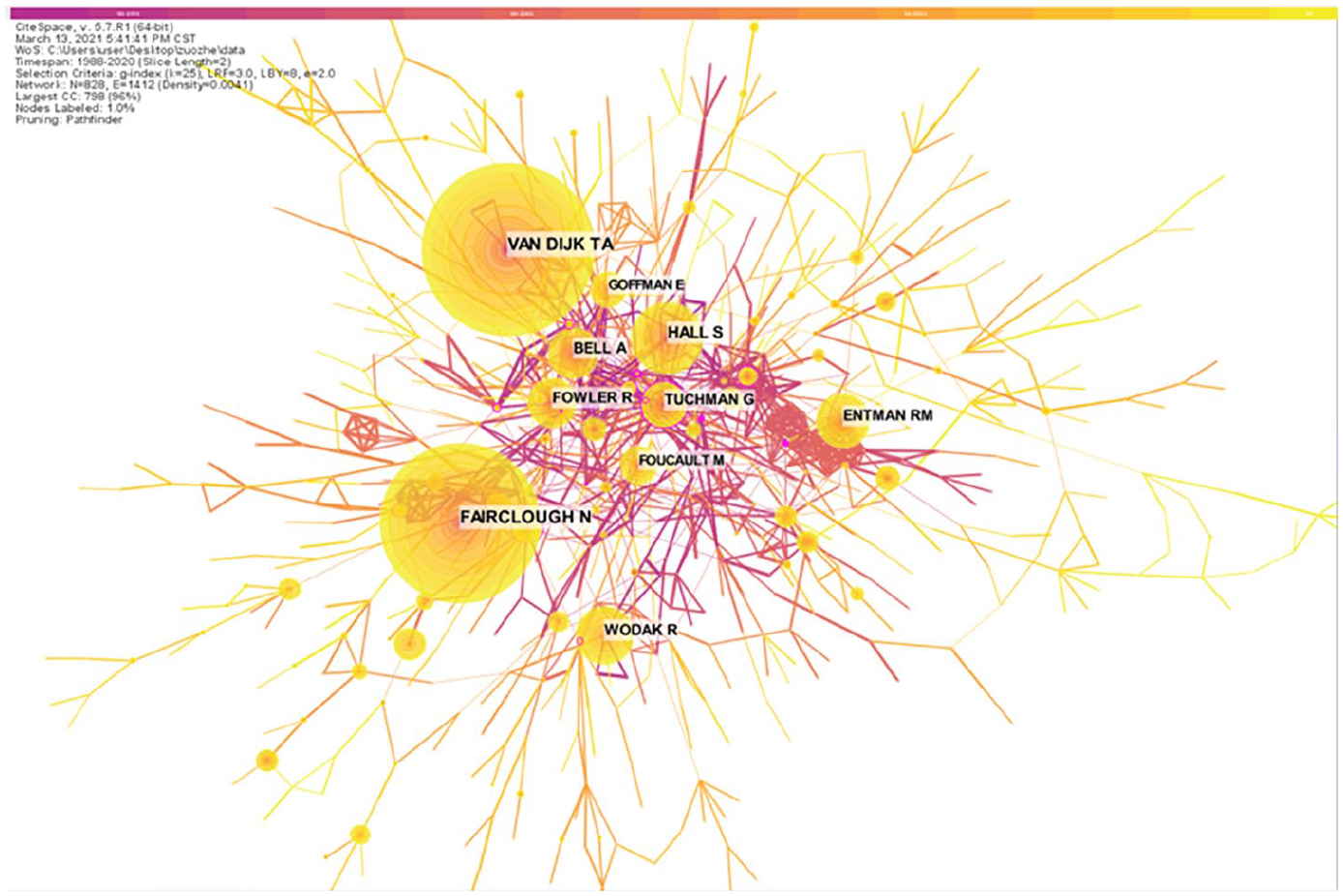
The network of co-cited authors in news discourse analysis (1988‒2020).
To further examine the most influential authors in different periods and detect the emerging scholars in news discourse analysis, the authors generated a list of the first 20 frequently cited scholars for each period (Table 4). Table 4 provides further statistical evidence that Teun A. van Dijk, Norman Fairclough, and Stuart Hall are undoubtedly the three leading scholars in news discourse analysis. Teun A. van Dijk tops the list in each of the five periods, Norman Fairclough ranks second in all periods expect Period 1, and Stuart Hall comes out in front in five periods (second in Period 1, sixth in Period 2, third in Periods 3‒4, and fourth in Period 5). Stuart Hall is particularly interested in hegemony, race, and the construction of identities in a variety of social contexts, whose works have influenced many other researches on identity construction and race issues.
Another author present in all five periods is M.A.K. Halliday. This indicates the importance and great analytic power of SFG and social semiotics in news discourse analysis from the very beginning until the present time, particularly with the CDA paradigm. In addition, SFG has enlightened many other theories or approaches such as the appraisal framework, visual grammar, and multimodality analysis.
Like M.A.K. Halliday, many other authors in Table 4 proposed or developed a theory/approach widely used in news discourse analysis, for instance, framing analysis by Robert M. Entman, discourse-historical approach (DHA) by Ruth Wodak and Martin Reisigl, multimodality analysis by Gunther Kress and Theo van Leeuwen, discursive news values by Monika Bednarek and her colleagues, and the use of corpus linguistics in discourse studies by Paul Baker.
The presence of the authors in a particular time period in Table 4 can be evidenced by the presence of keywords in Table 2. For instance, the presence of news values in Period 5 in Table 2 coincides with the presence of Monika Bednarek in the same period in Table 4. In this period, Bednarek and Caple’s (2014) article ‘Why do news values matter? Towards a new methodological framework for analysing news discourse in critical discourse analysis and beyond’ was widely cited in reference, according to the statistics in our database.
Apart from the above-discussed points, what is worthy of equal note is that some of these authors present in Table 4 employed the theories or approaches proposed by others in this same table, thus forming a wide net of citations. For instance, Bednarek’s (2006) Evaluation in Media Discourse: Analysis of a Newspaper Corpus and News Discourse (Bednarek, 2012) used the appraisal framework and corpus linguistics. These two monographs also add many citations to Monika Bednarek. The combined application of different perspectives and approaches is a trend in news discourse analysis, which may further deepen our understandings of the multi-level, multi-dimensional relations between language use, journalistic norms and practice, and broad societal contexts.
Conclusion and implications
Understanding the state of the art and emerging trends in a certain research area is of great necessity, particularly for the beginning researchers. The current bibliometric study has presented a systematic overview of news discourse analysis from 1988 through 2020 and has provided in-depth understandings of its development and trends.
To sum up, there has been an upward trend in general in news discourse analysis since 1988. In particular, the past decade has witnessed an accelerating growth rate in the related publications in Scopus. The statistical evidences also clearly show that news discourse analysis is an interdisciplinary area which involves a wide range of research domains. Apart from 88% of its publications in Social Sciences and Arts and Humanities, there are 12% of the related articles published in such diversified fields as Psychology, Computer Science, Economics, Environmental Science, Medicine, etc. We can also deduce that Communication and Linguistics and Language are the two major sub-domains where most articles on discourse analysis have been published although there are some related publications in Artificial Intelligence, Sociology, Political Science, Cultural Studies, Visual Arts and Performing Arts, and Gender Studies.
As anticipated, many theories/approaches/methods from Communication and Linguistics and Language are used in this area, such as framing, SFG, the appraisal framework, metaphor, and discursive news values, multimodality analysis, CDA, corpus linguistics, and content analysis. Among them, CDA has gained the most popularity in this academic area since the emergence of news discourse analysis, which is devoted to deconstructing not only many specific socio-political issues but also the process of translation and translated texts. Apart from the continual burst duration of CDA, the appraisal framework, multimodality analysis, and discursive news values have become three academic hotspots in this area. What enlightens us from the findings of this study is that it is a pressing task to use new theories, conceptions, and methods to provide more perspectives for investigation into news discourse. Integrating new theories, conceptions, and methods with the existing ones would be inspiring to the researcher. In this respect, the combined use of corpus linguistics and (critical) discourse studies has set us a good example.
What cannot be ignored is that the authors from the western world have contributed most in terms of publication count and highly cited authors in references. About 91% of the total publications between 1988 and 2020 are from the developed world, and all the highly cited authors in reference in this study are from the western world. However, the authors from the developing world (mainly, Chinese Mainland, Malaysia, South Africa, and Indonesia) have come to be an emerging powerhouse since 2002. It can be expected that more authors from the developing world will make contributions in this area, which will promote diversity in terms of topics. More significantly, it will promote dialogue and understanding between the South and the North and between the West and the East in the future. As an academic area which values equality, analysts of news discourse will help enhance equality between different communities, ethnics, and races across the globe as well.
However, this study is far from perfect. First, the data for this study is limited to English-language journal articles in Scopus. In fact, monographs and collected books in English and other language, as well as journal articles in other languages, are equally important in the bibliometric study of news discourse analysis. Second, bibliometric analysis inevitably involves considerable researchers’ subjectivity in deciding what to include/exclude in data collection and data analysis (also see Huan and Guan, 2020; Lei and Liu, 2019b). In our study, the selection of the related articles, the integration of related keywords into one term, and the comments on certain theories/approaches might be subjective to a greater or lesser extent.
Footnotes
Acknowledgements
We would like to thank both Doctor Changpeng Huan and Professor Leilei at Shanghai Jiaotong University (China) for their critical and constructive insights to improve an earlier version of this article. We extend our gratitude to Professor Teun van Dijk for his insightful comments as well. We assume responsibility for any remaining errors.
Declaration of conflicting interests
The author(s) declared no potential conflicts of interest with respect to the research, authorship, and/or publication of this article.
Funding
The author(s) disclosed receipt of the following financial support for the research, authorship, and/or publication of this article: The writing of this article was supported by the Major Project of National Social Science Fund of China (No. 20&ZD140) and Shanghai Social Science Planning Project (General Project; No. 2020BYY003).