







Abstract
Aviation English (AE) is a distinct register of English used by pilots and air traffic controllers. As it is one of the contributing factors to aviation safety, ICAO and its Member States’ aviation authorities require the airspace users to have the proficiency in using AE effectively. In recent years, the training and testing have gained more attention, but little work has been done to describe its linguistic features. The study set out to describe AE from the perspective of systemic functional linguistics with an aim to illustrate its linguistic features as compared to conversational English (CE). To achieve this goal, the corpora of CE and AE communications between native English speakers from the United States were respectively constructed and then scrutinized to demonstrate that AE has a significant difference from CE in functional-semantic aspects. The findings of this study reveal how distinct AE with CE in terms of speech functions. Some pedagogical implications were then proposed for enhancing AE training to cultivate the students’ competence in semantics and interaction.
Introduction
With mechanical failures featuring less and less in flight operation, more attention has been focused in recent years on human factors contributing to aviation incidents and accidents. Aviation English (AE) communication is one human element that is receiving renewed attention due to the fact that it may affect the safety of some three and a half million passengers daily (International Civil Aviation Organization [ICAO], 2017).
Standard phraseology and plain language
Aviation English is not a conversational style, but a distinct register of English: a codified, abbreviated, jargon-filled register using numbers paired with descriptors to convey crucial information succinctly (Trippe and Baese-Berk, 2019). Aviation English is the term used in the literature to describe radiotelephony communication between air traffic controllers (ATCOs) and pilots. AE is primarily performed by a specialized language, also known as standard phraseology, a semi-artificial language dependent upon English grammar with systematic and syntactic modifications (Philps, 1991). It was created by the International Civil Aviation Organization (ICAO) to cover the most common and routine situations encountered in air operation in order to serve the purpose as ICAO states: ‘to provide clear, concise, unambiguous language to communicate messages of a routine nature’ (ICAO, 2010). ICAO mandates that standard phraseology shall be utilized in all situations for which it has been specified.
AE communication needs in situations for which phraseology is not enough requires the usage of natural language–though constrained by phraseology’s rules of clarity, preciseness, and concision (Mell, 1992). ICAO refers to this form of natural language as plain language, and it is utilized as the last resort when standard phraseology is either unavailable or inadequate. Howard (2008: 370–391) highlighted that incidental deviations from AE standard phraseology frequently result in miscommunication. Day (2004) stated that when AE users deviate from AE standard phraseology, they are more likely to be misunderstood or misinterpreted. Moder (2012: 227–242) highlighted that ATCOs and pilots should avoid plain English as much as possible in their communications.
However, despite the fact that the United States of America is an ICAO member state, its internal regulations differ from those of the ICAO, as noted in its Aeronautical Information Manual: ‘Since concise phraseology may not always be adequate, use whatever words are necessary to get your message across.’ (Federal Aviation Administration, 2017).
Aviation English training
The inconformity allows pilots in the United States to utilize plain language more freely than those in other nations that follow the ICAO’s recommendation, which has a significant impact on the specialized training of AE. The commonly adopted AE training has been undertaken using an immersion strategy with the assumption that there is no substantial difference between AE and CE. As a consequence, AE training for Native English Speaker (NES) pilots was conducted concurrently with ‘on the fly’ strategy: AE training is learned simultaneously with flight training. Ground training programs designed specifically for student pilots receive little or no attention. Additionally, as training providers thought that CE plus aviation terminology may suggest AE language proficiency, Non-native English Speaker (NNES) pilots’ AE training tended to rely primarily on regular conversational English (Estival et al., 2016; Estival and Molesworth, 2009; ICAO, 2004).
Literature review
ICAO (2004) states that ‘Native speakers of English, in particular, have an ethical obligation to increase their linguistic awareness and to take special care in the delivery of messages’ and recommends that NES employ the six communication strategies, with the function of communication clearly highlighted. The emphasis in AE training should have long been on the language elements, particularly on the AE functional-semantic aspects. Numerous studies have analyzed how AE aligns with or is distinct with standard English in linguistic features. Trippe and Baese-Berk (2019: 30–46) conducted a corpus-based research into the prosodic profile, or rhythm and intonation differences between AE and CE; Borowska (2017) investigated the differences between AE and general conversation from the perspective of cross-cultural communication. The findings suggested that the proper interaction strategy should be adopted when native speakers have conversations with non-native speakers. Philps (1991:103–124) underlined that aviation phraseology differs linguistically from ‘natural English on every major linguistic level: phonology, lexis, semantics, discourse and syntax’; Bieswanger (2016: 67–85) analyzed different usage characteristics of AE standard phraseology and plain AE (including subject-matter, situation-type, participant roles, mode, and medium of discourse) and concludes that they are actually separate specialized registers of English for which the ICAO specifically outlines conditions of use; Lopez et al. (2013: 44–60) conducted a corpus-based comparative study on the different uses of English phraseology and plain language within pilot-controller communications at a lexical level, and found the distribution of the corpora lexicon that could be used to improve AE teaching. As controller-pilot communications take place in a wide variety of contexts, a large number of discourse studies should be required in order to understand how AE is actually being used (Farris and Turner, 2015).
Although extensive research have been conducted on the differences between AE and CE in lexical and syntax aspects, few attempts have so far been made to describe AE functional-semantically. Of limited research that has investigated the communicative function of AE, three studies are particularly noteworthy. Mell and Godmet (1997) suggested that the major functions of pilot-controller interaction may be classified into four categories based on their involvement in performing ATC and piloting tasks: triggering actions, sharing information, managing the pilot-controller relationship and managing the dialogue. Kukovec (2008: 127–137) asserted the functions in routine procedure in radiotelephony communication and performed the analysis of the language forms and functions. The taxonomy of communicative functions corresponds to the speaker’s intention in uttering messages to plan syllabus. Borowska (2017) extended Kukovec’s (2008) taxonomies by categorizing AE standard phraseology into 12 functions based on the syntactic patterns: making requests, approving requests, giving instructions/commands, asking for information, sharing or providing information, giving clearance, describing a state, describing a future action and an action in progress, checking understanding, self-correcting, specifying conditions, and asking for and giving confirmation.
The above literature has been descriptive in nature and focused mostly on syntactic features and pragmatic functions. No empirical studies have been conducted on the description of the functional-semantic aspects of naturally occurring AE by drawing on corpora. Another issue is that earlier AE research have been primarily focused on standard phraseology in routine AE, leaving non-routine AE and plain language underexplored. Therefore, it is difficult to gain a comprehensive set of linguistic features and functional-semantic aspects of AE without taking non-routine AE into account. The current study sets out to clarify the differences between AE and CE by analyzing and comparing the functional-semantic aspects of each register. A self-compiled ATC corpus with authentic data gathered from air traffic service (ATS) units in USA and an American spoken English corpus are respectively constructed to investigate whether AE and CE are measurably different from each other. Our findings on the functional-semantic similarities and differences between the two registers will provide useful implications for understanding the AE communication, and also for the pedagogy of AE as an instance of English for specific purposes.
The current study
Given the research gaps highlighted above, this study is designed to examine the speech function of AE communication using a qualitative method, with an aim to address the following two research questions:
RQ1: How does AE vary from CE in terms of conversational features?
RQ2: In what aspects is AE distinct from CE?
Analytical framework
Extant literature on discourse interactivity revealed that several approaches can be employed to address with discourse interactivity, with the key contribution coming from Conversation Analysis (CA), with its account for the mechanics of turn taking, adjacency pair, Speech Act theory (SAT), with its identification of the different illocutionary forces of utterances pragmatics, with the meanings of utterances interpreted contextually, and the Birmingham School, with its hierarchy of discourse units identified on structural criteria. All these accounts contributed to our understanding of discourse structure. However, Halliday (1984) extended CA and SAT interpretations of conversational structure by linking discourse structure to both context (i.e. what is going on in the dialogic situation) and to grammar (i.e. the clause system of mood). He developed the systemic functional model of dialogue, with its functional-semantic account of dialogue, which can be viewed as a functional-semantic reinterpretation of the adjacency pair (Eggins and Slade, 1997).
Halliday (1984) approached interaction from a functional-semantic perspective, offering a way of describing dialogic structure explicitly and quantifiably. He highlighted that whenever someone uses language to interact, one of the things they are doing is establishing a relationship: between the person speaking now and the person who will probably speak next. Halliday (1984) suggested that the dialogue is ‘a process of exchange’ involving two variables:
a commodity to be exchanged: either information or goods and services
roles associated with exchange relations: either giving or demanding.
This is the functional-semantic reinterpretation of CA’s conception of sequential implicativeness. Whenever speakers take on a role, they assign the listener a role as well. Halliday (1984) also suggested that the discourse patterns of speech function are expressed through moves and grammatical patterns, but he did not discuss the identification of moves in detail.
Halliday (1984) captured this interactivity by pairing each of the four basic initiating speech functions (i.e. offer, command, statement, and question) with desired or expected response (i.e. accept, compliance, acknowledgement, and answer), which constituted the preferred second-pair part of the adjacency pair.
Martin (1992) incorporated speech function and mood into the negotiation system of interpersonal system, and identified move and exchange as the unit of conversational structure. He pointed out that move is the realization of speech function, and exchange is the realization of negotiation. He enriched Halliday’s framework by supplementing move types such as ‘attend’, ‘track’, and ‘challenge’, but he did not illustrate the rank and location of such move types in the framework.
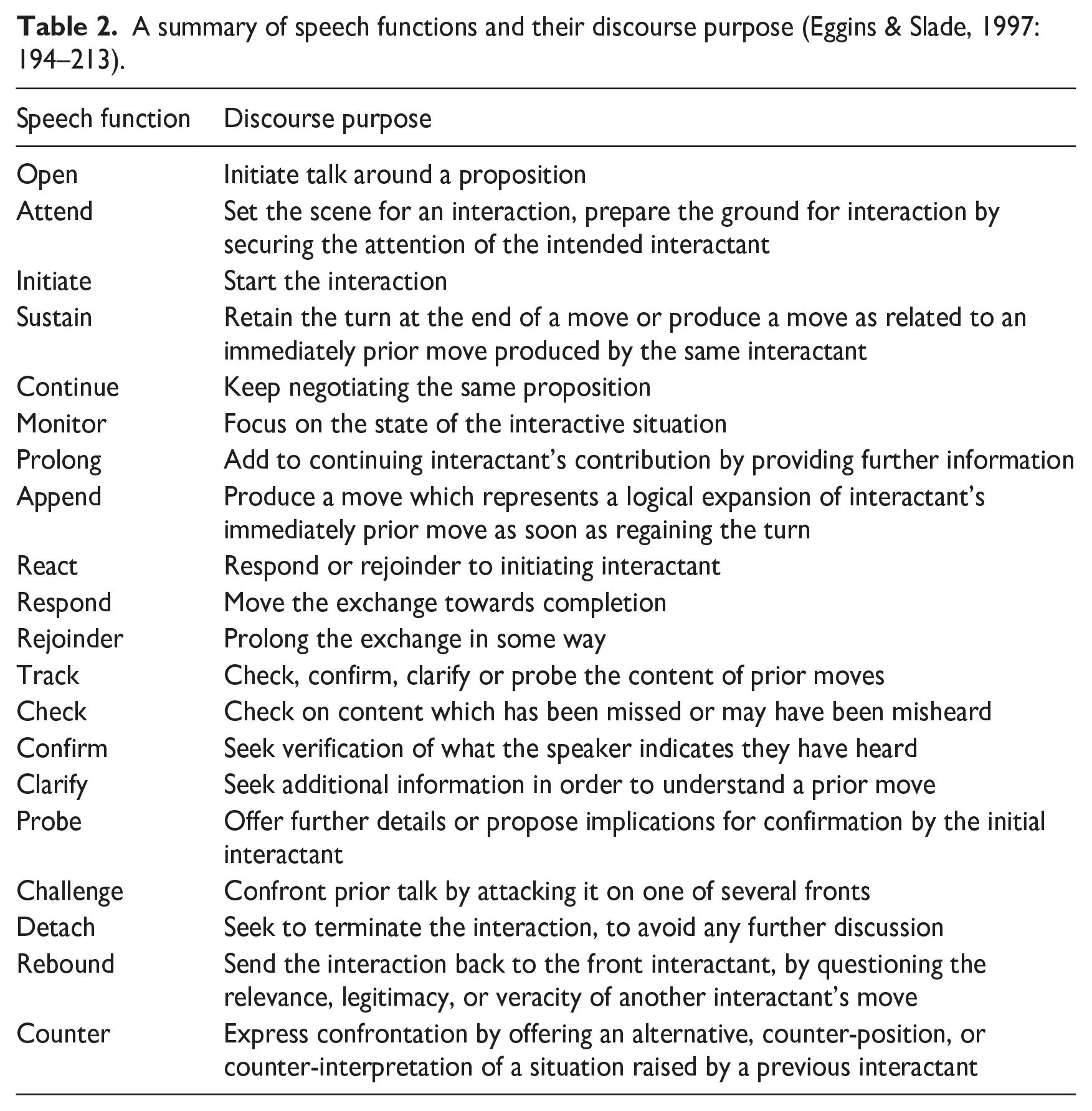
Eggins and Slade (1997) further classified the aforementioned speech function further, distinguishing the ‘initiate’ and ‘sustain’ moves, and increasing more subtle speech functions and elaborating the delicacy in the network, thus constructing a fine-grained speech function network. The speech function classes shown in Figure 1 are comprehensive, in the sense that all moves can be assigned to one of the classes included. The speech function classification is shown as a ‘network’, with categories at the left-hand side as the least delicate (most inclusive). The subclasses or subsystems, going from left to right, signify a more delicate description. The speech functions and their discourse purposes are shown in Table 2.
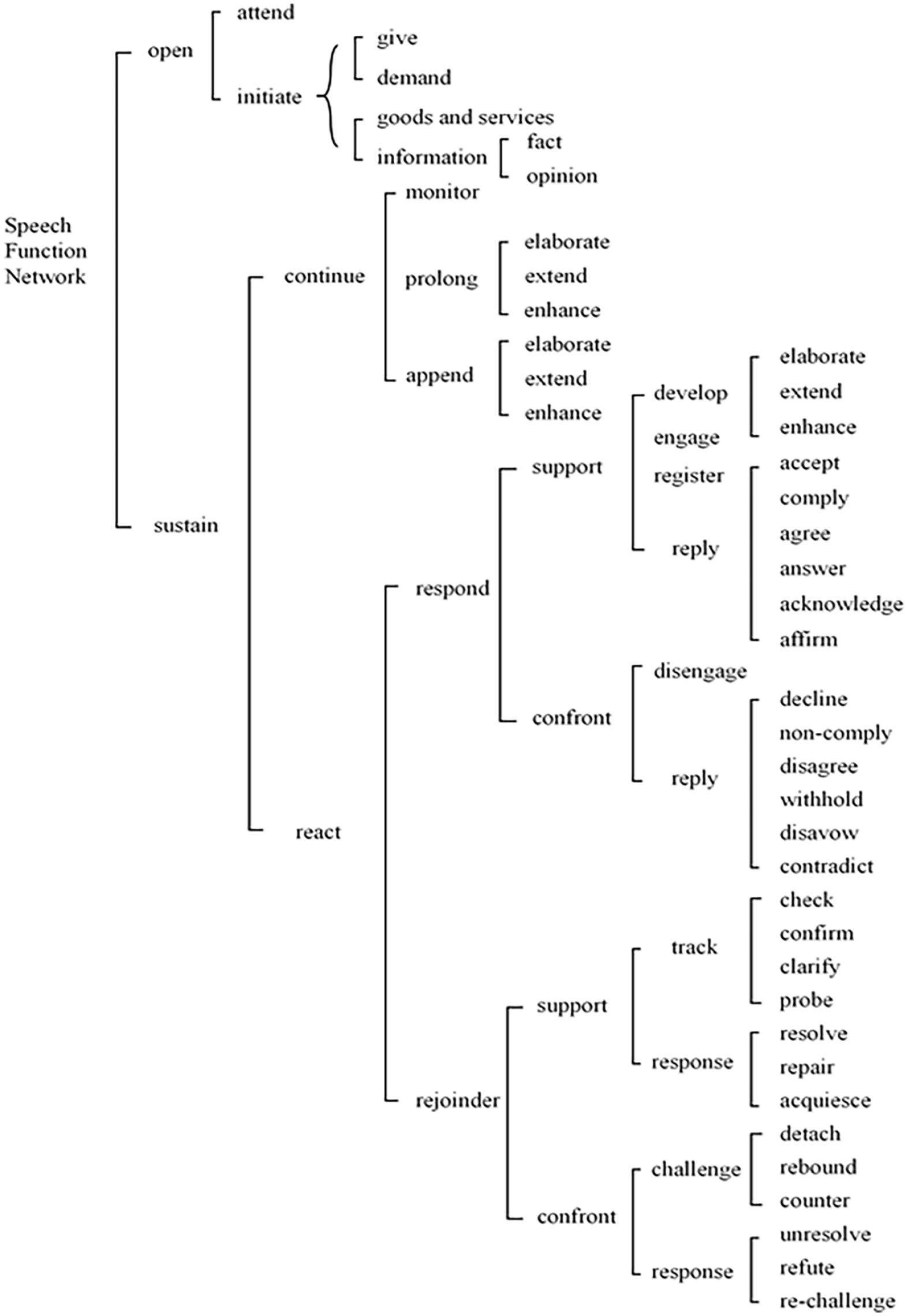
The speech function network (Eggins and Slade, 1997: 192–209).
According to the systemic functional model of dialogue proposed by Eggins and Slade (1997), the moves and turns are the units of discourse analysis. The relationship between move and clause is an instance of realization. Move is a unit of discourse organization distinctive from clause, but congruently a move is realized as a single clause and sometimes several linked clauses (i.e. through a sentence, see Martin, 1992). Move is then defined as a clause which selects independently for mood. The discourse patterns of speech function are thus expressed by moves.
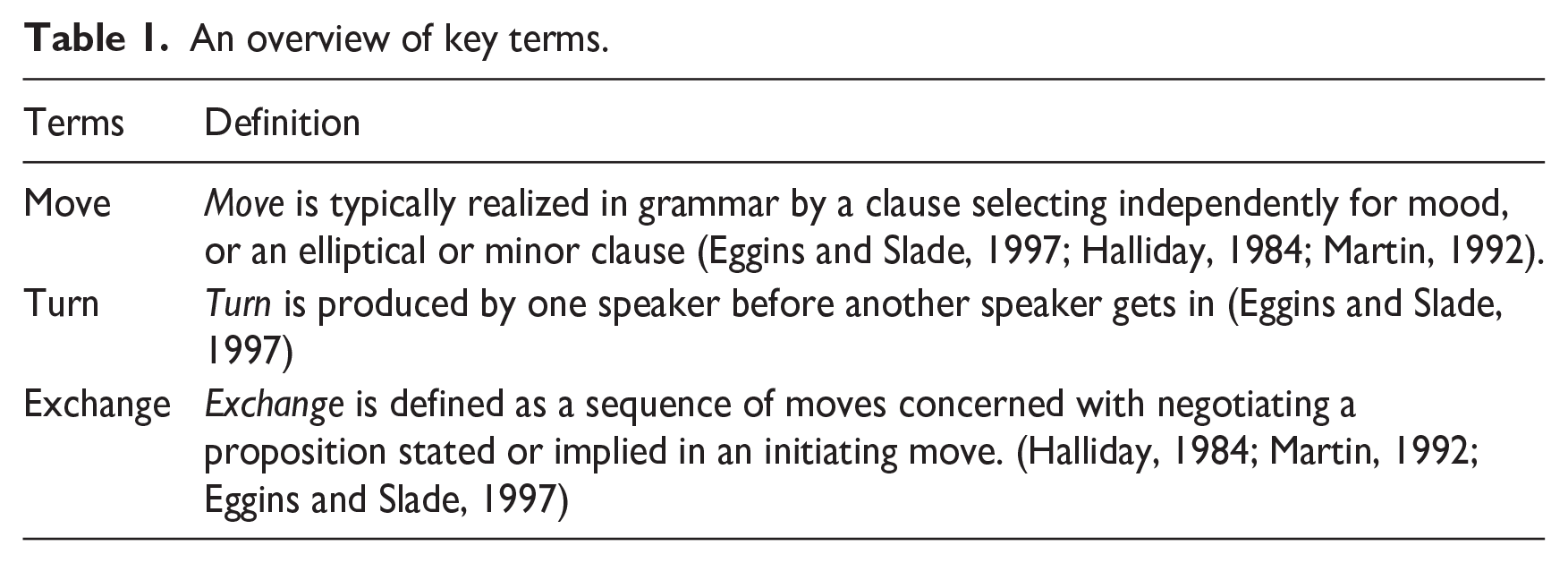
As Table 1 indicates, a conversation starts with an ‘open’ move, and continues until another ‘open’ move occurs. As the grammatical form is not necessarily equivalent to the discourse function, the discourse patterns of speech function are not carried by clause, grammatical units but by turn, a discourse unit (Eggins and Slade, 1997).
An overview of key terms.
A summary of speech functions and their discourse purpose (Eggins & Slade, 1997: 194–213).
The general principle behind the expression of mood in the clause is as follows. The grammatical category that is characteristically used to exchange information is the indicative; within the category of indicative, the characteristic expression of a statement is the declarative, that of a question is the interrogative; and within the category of interrogative, there is a further distinction between Yes/No-interrogative, for polar questions, and WH-interrogative, for content questions (Halliday, 2014).
As a framework for conversational analysis, the speech function network is especially appropriate for investigating the systematic functional variation between conversational discourses, but it has been underused in communication studies.
Data and methods
Corpora
Two corpora of Spoken American English were employed to investigate AE and CE, ignoring the differences in expression habits and communication style of speakers between NES and NNES.
CE is represented by the Santa Barbara (SB) corpus 1 , a well-representative spoken American English corpus that contains originally 60 records with naturally occurring spoken conversations gleaned from all over the USA. It is compiled with balanced demographic variables: ages, genders, occupations, regional origins, and ethnic and social backgrounds. The form of language use involves not only face-to-face conversations, but also the various ways that people use in their daily lives: telephone conversations, card games, food preparation, and on-the-job talk. However, trade-offs always exist in terms of representativeness and comparability (Leech, 2007). Conversations that have more than two speakers have been removed to ensure its comparability with AE. Eventually, the 17 records are selected to represent the CE (see the appendix A). The prepared transcript was downloaded from www.linguistics.ucsb.edu.
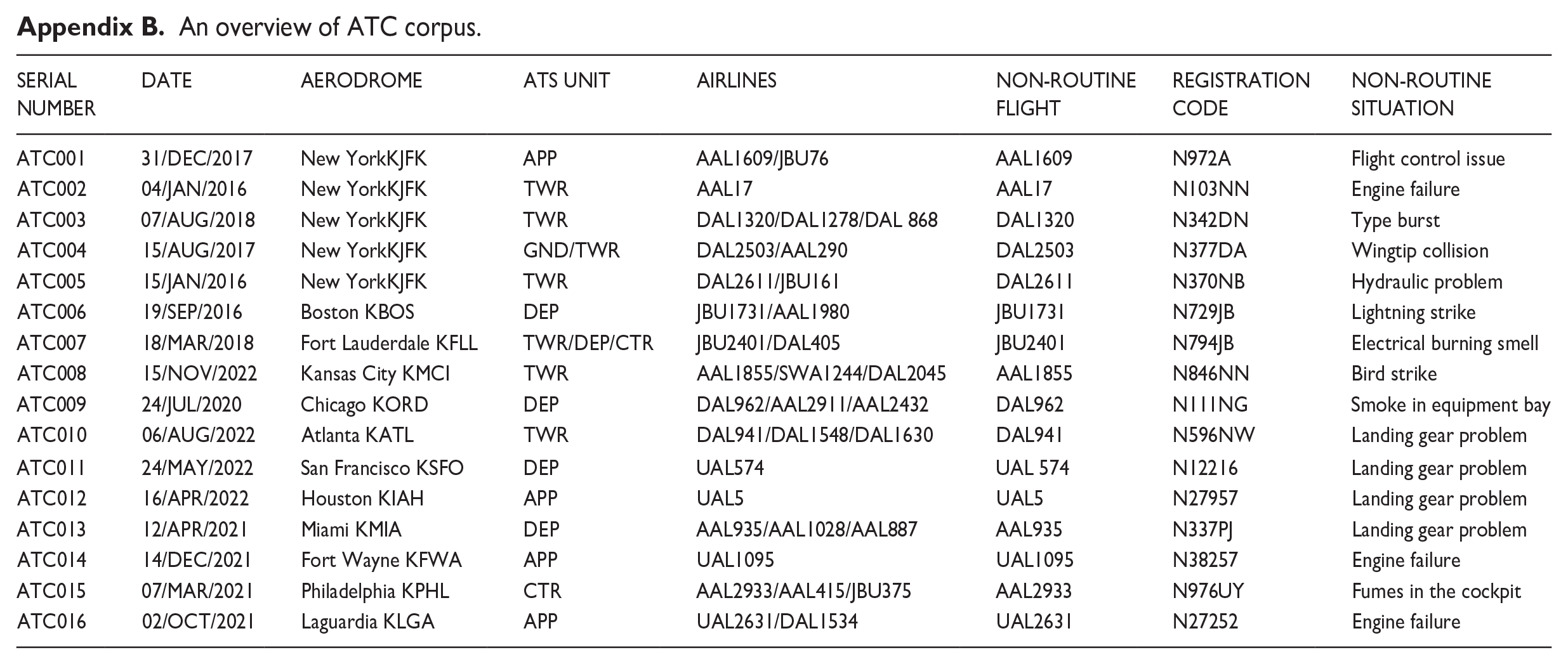
The ATC corpus is a self-compiled corpus. A total of 16 recorded radio transmissions were downloaded from the VASAviation channel, a well-known Youtube channel dedicated to upload ATC frequency conversations in emergency situations and regular operations exchanges. Each audio file records AE communications occurring in routine and non-routine situations and including a wide range of topics, such as bird strikes, engine failures, and hydraulic problems. After most silences and unrelated communications were trimmed out, only AE communications between the pilots from US airlines and ATCOs from US ATS units were retained to ensure the interactants to be the native English speaker (see the Appendix B). As the corpus is self-compiled, it has limitations in balance and representativeness.
Move coding
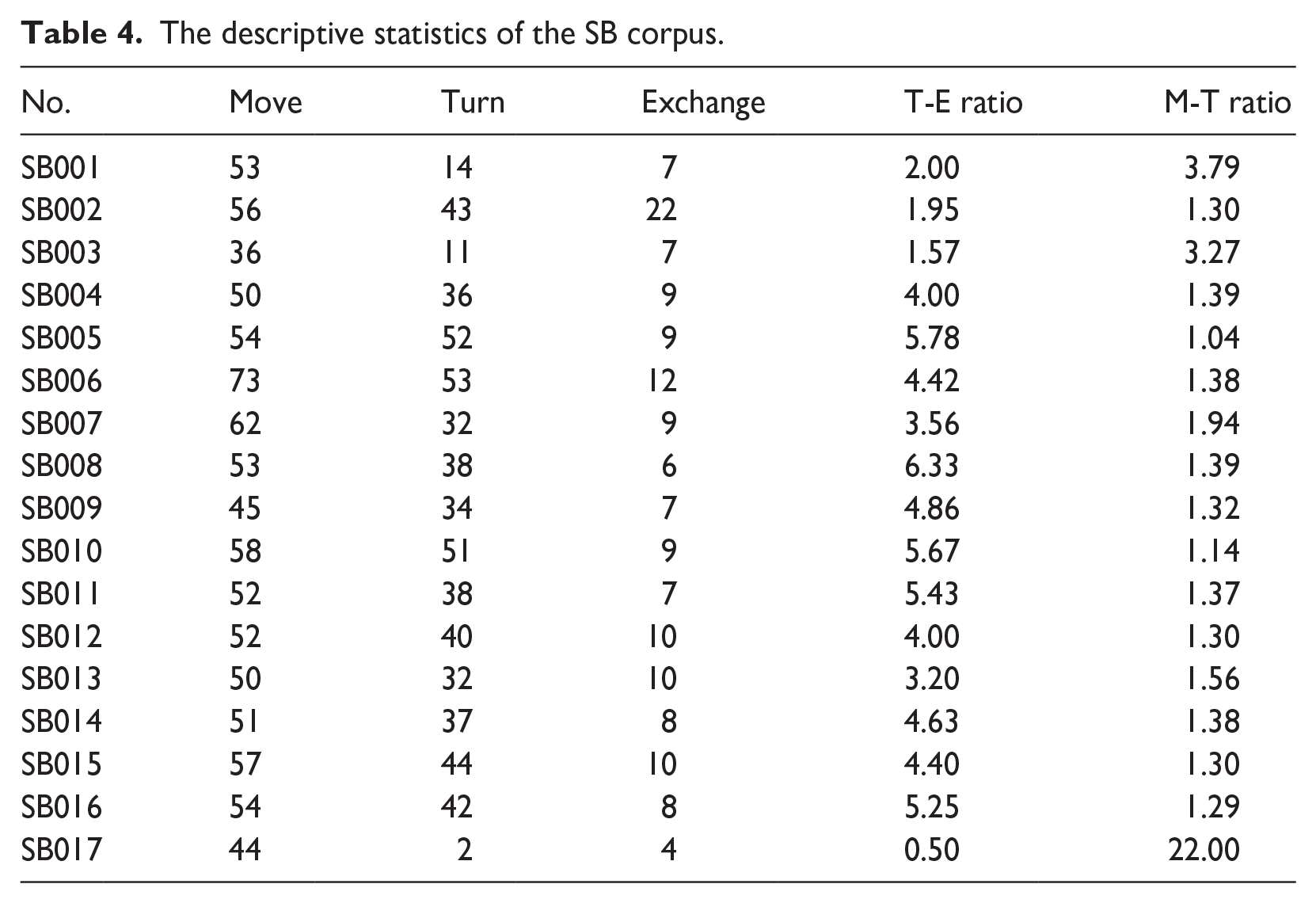
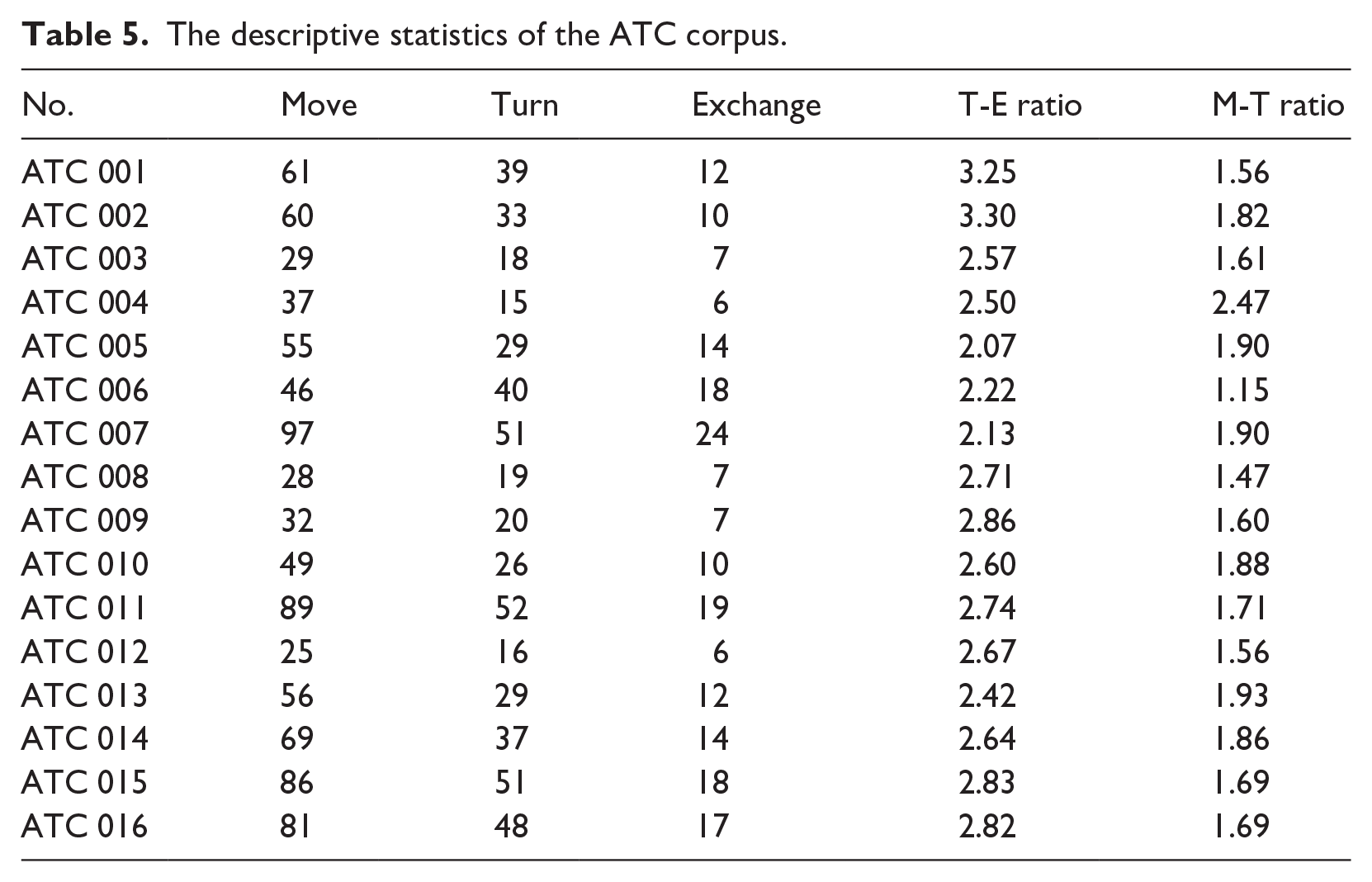
UAM corpus tool 3.0 2 was utilized to create the layers according to the speech function network. The transcription was saved in text format and incorporated into the project. The annotation was conducted on the basis of the layers while the turn and exchange were manually counted. The dataset was annotated by three researchers simultaneously in order to ensure the accuracy of move identification and the objectivity of the results. The move types are determined when at least two of them are in agreement. According to the definition of move in Table 1, the criteria of move identification is: (1) the clause which selects independently for mood; and (2) the clause which does not select independently for mood and does not function as separate moves: (a) dependent clauses and the main clause on which they depend; (b) embedded clauses; and (c) quoting or reporting clauses both direct and indirect (Eggins & Slade, 1997). The same number of moves were determined in both corpora in an attempt to facilitate cross-corpus comparison. A total of 900 moves were annotated in each corpus in accordance with the criteria, and then turns and exchanges were counted, as shown in Tables 3–5.
The overview of the two corpora.
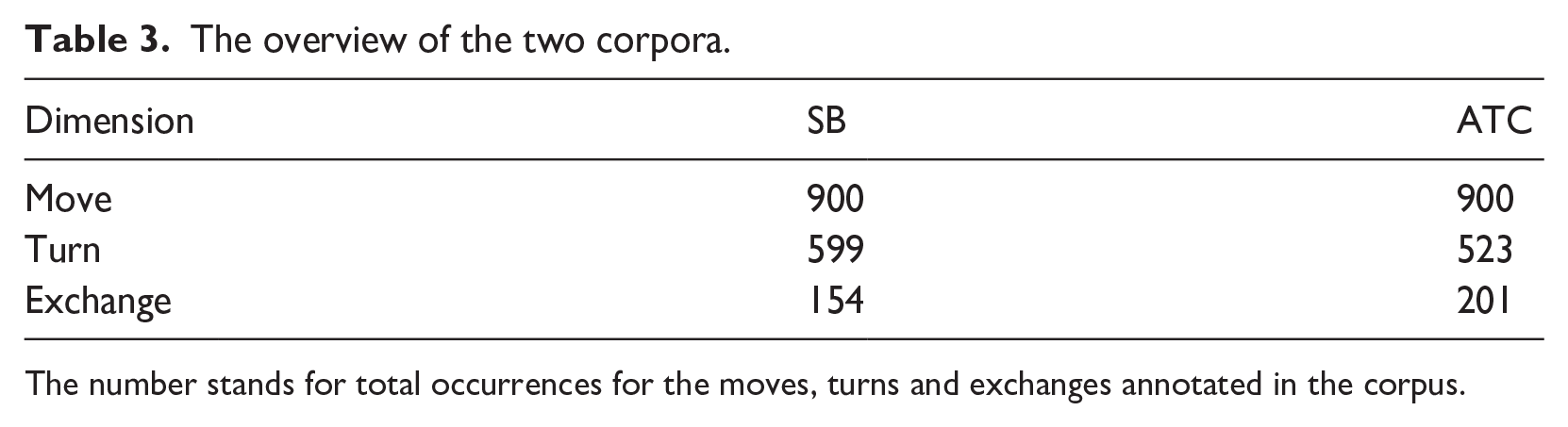
The number stands for total occurrences for the moves, turns and exchanges annotated in the corpus.
The descriptive statistics of the SB corpus.
The descriptive statistics of the ATC corpus.
Results
RQ1: How does AE vary from CE in terms of conversational features?
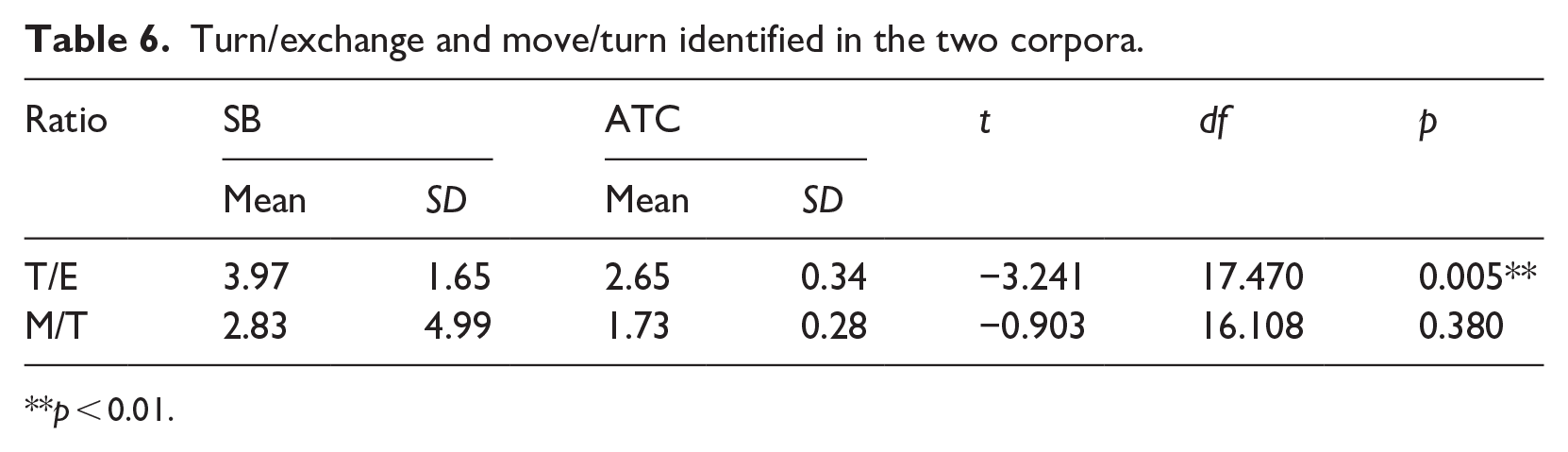
Table 6 demonstrates the independent-samples t test results for the turn-exchange ratio and move-turn ratio in the two corpora.
Turn/exchange and move/turn identified in the two corpora.
**p < 0.01.
To address the first research question, independent-samples t tests were conducted to investigate whether two corpora are significantly different in the turn-exchange ratio and the move-turn ratio. The test results demonstrate that the two corpora both have significant differences in turn-exchange ratio (t = 3.102, p = 0.005) but not in the move-turn ratio (t = -1.110, p = 0.279). The turn-exchange ratio for SB (M = 3.55, SD = 1.09) is significantly higher than ATC (M = 2.24, SD = 0.24). The results indicate that in given exchanges, there are fewer turns in the ATC corpus than in SB, but there is no significant difference between the two corpora for move-turn ratio (t = -1.110, p = 0.279).
RQ2: In what aspects is AE distinct from CE?
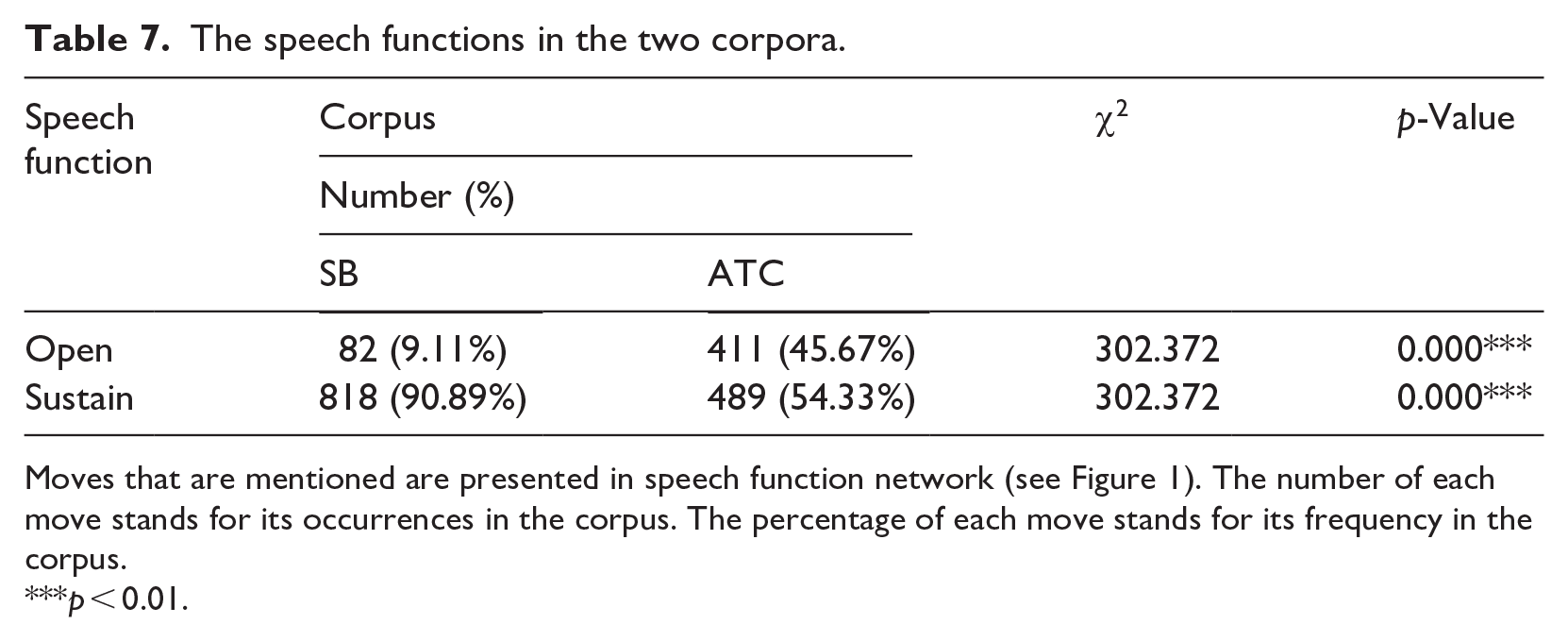
To address the second research question, Pearson’s Chi-Square tests were performed to identify whether and how the two corpora vary on speech function classes and subclasses in the speech function network. For moves with a frequency less than 5, Fisher’s exact test was utilized in place of Pearson’s Chi-squared test. The test results indicate that two corpora had a significant difference in speech function network (χ2 = 302.372, p = 0.000). The data presentation starts from the most inclusive move type to the least to ensure that the dataset can be presented clearly and hierarchically. Each type of move occurring in the ATC corpus is supported with examples. As to the move type in the ATC corpus whose percentage is significantly higher than in the SB corpus, the reasons were investigated with some examples analyzed by indicating moves (e.g. M1, M2, M3 . . .), turns (e.g. T1, T2, T3 . . .), and exchanges (e.g. EX1, EX2, EX3 . . .). The moves which only appear in the ATC corpus are summarized in the table. To simplify the contents in the table, examples are presented with move in italics in each turn.
As illustrated in Table 7, the two corpora are significantly distinct from each other in speech function. The percentage of ‘open’ moves in the ATC corpus (N = 411, 45.67%) is significantly higher than in the SB corpus (N = 82, 9.11%), but ‘sustain’ moves (N = 489, 54.33%) are significantly lower than in the SB corpus (N = 818, 90.89%).
The speech functions in the two corpora.
Moves that are mentioned are presented in speech function network (see Figure 1). The number of each move stands for its occurrences in the corpus. The percentage of each move stands for its frequency in the corpus.
***p < 0.01.
EUROCONTROL (2006: 23) presents the model of AE communication as the pilot-controller communication loop, noting that ‘the pilot-controller confirmation/correction process is a “loop” that ensures effective communication’. Borowska (2017) expands on the model by incorporating the pilot’s requests into the loop and creating a basic model of faultless communication between a controller and a pilot. The discourse structure is composed of two interaction patterns: the pilot-initiated exchange and the ATC-initiated exchange. The pilot-initiated exchange begins with the pilot’s initial call, is followed by the ATC response, and concludes with the pilot’s readback. The ATC-initiated exchange starts with the initial call and is followed by the pilot’s readback. The percentage of ‘open’ moves is comparable to the percentage of ‘sustain’ moves in a particular exchange in ATC corpus due primarily to the strictly prescribed exchange structure. In contrast, the percentage of ‘sustain’ moves is larger than that of ‘open’ moves in SB corpus because the contents of a turn are mainly up to the individual speakers, who are more likely to contribute more turns to an exchange in the casual conversation, as demonstrated by the higher turn-exchange ratio in Table 6. As only one ‘open’ move in each exchange, and so the more turns are contributed to an exchange, the higher the proportion of the ‘sustain’ moves and thus the lesser the proportion of the ‘open’ moves.
As demonstrated in Table 8, there is a significant difference between the two corpora (χ2 = 39.845, p = 0.000). The percentages of ‘attend’, ‘demand’, ‘goods and services’, and ‘fact’ moves in the ATC corpus (N = 170, 41.36%; N = 131, 54.36%; N = 92, 38.17%; N = 106, 71.14%) are significantly higher than in the SB corpus (N = 4, 4.88%; 32, 41.03%; 9, 11.54%; 37, 53.62%).
Open move in the two corpora.
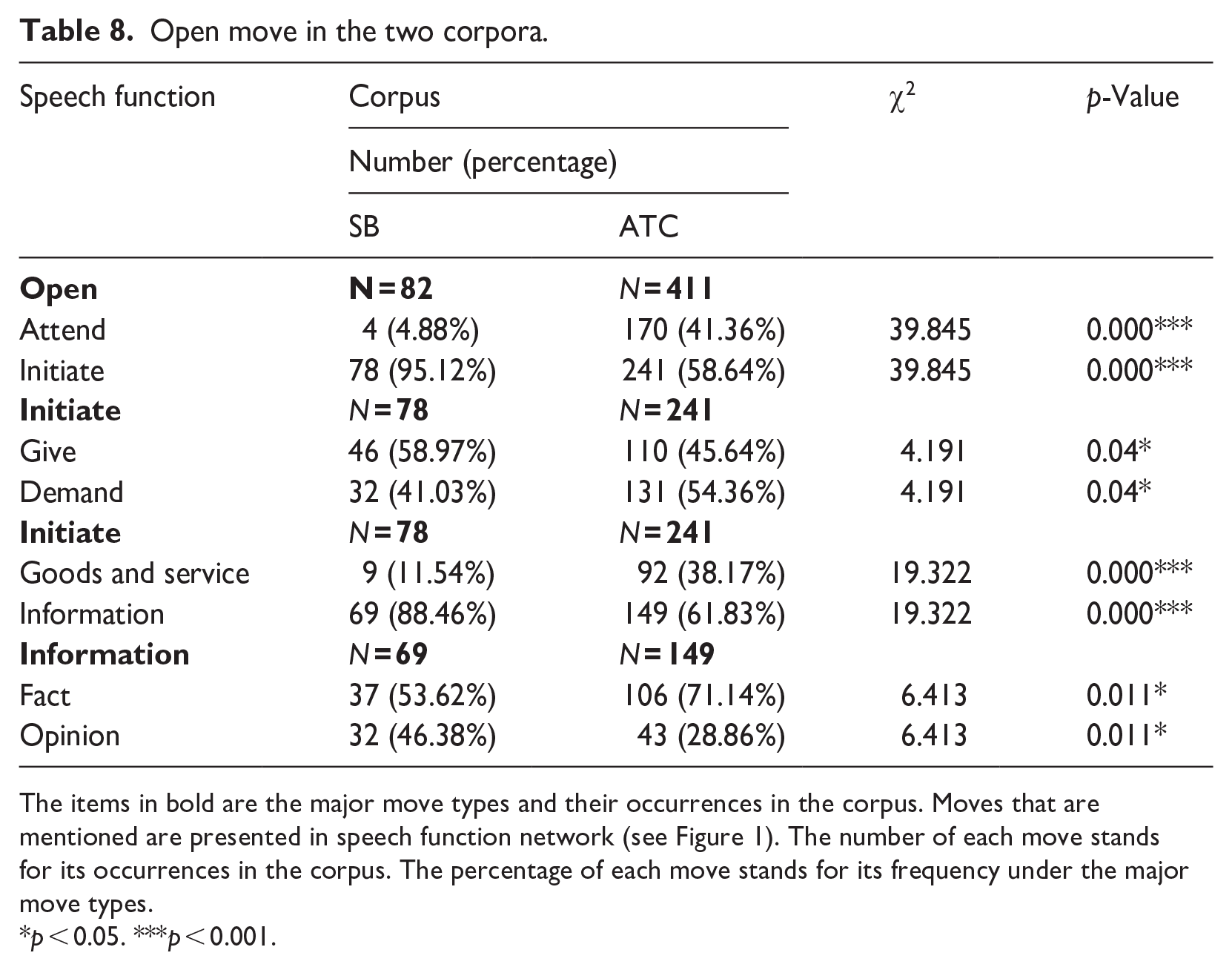
The items in bold are the major move types and their occurrences in the corpus. Moves that are mentioned are presented in speech function network (see Figure 1). The number of each move stands for its occurrences in the corpus. The percentage of each move stands for its frequency under the major move types.
p < 0.05. ***p < 0.001.
Open moves
The ‘open’ move functions as the initiate talk around a proposition. The ‘open’ move includes ‘attend’ and ‘initiate’ moves.
Attend moves
The ‘attend’ move is utilized to prepare the ground for interaction by securing the attention of the intended interactant. The percentage of ‘attend’ moves in the ATC corpus (N = 170, 41.65%) is significantly higher than in the SB corpus (N = 4, 4.88%). ICAO (2007) stipulates that when establishing communication, an aircraft should use the full callsign of both the aircraft and ATC. A typical exchange starts with a pilot calling ATC which is followed immediately by an aircraft callsign and a greeting (e.g. EX1-T1-M1). When a pilot calls an ATC station for another time, the aircraft callsign comes first and the name of the station is not necessary (e.g. EX2-T1-M1). This discursive purpose of the ‘attend’ move in AE is realized grammatically by a minor clause (callsign), and the mood realization tends to be formulaic.
EX1 (Audio-ATC-009) (T1) DAL962: Departure, Delta 962 (M1). (T2) C90B DEP: Delta 962, Chicago Departure (M1). You’re radar contact (M2). Climb and maintain 15,000 (M3). (T3) DAL962: 15,000, Delta 962 (M1). EX2 (Audio-ATC-007) (T1) JFK DEP: Jetblue 2401(M1), turn left heading 110 (M2). (T2) JBU2401: Left turn 110, Jetblue 2401 (M1).
Initiate moves
While the ‘attend’ move sets a scene for an interaction, the ‘initiate’ move gets the interaction under way. The ‘initiate’ move covers the basic opposition between giving and demanding, goods and services, and information. The findings reveal more speech functions based on routine and non-routine communication than those proposed by Borowska (2017), who categorizes communicative function of standard phraseology into 12 categories.
As indicated in Table 8, the percentage of ‘demand’, ‘goods and services’, and ‘fact’ moves (N = 131, 54.36%; N = 92, 38.17%; N = 106, 71.14%) in the ATC corpus are significantly higher than in the SB corpus (N = 32, 41.03%; N = 9, 11.54%; N = 37, 53.62%).
The ‘giving factual information’ move is utilized to realize such discourse purposes as sharing information, describing a state, describing a future action and/or an action in progress, self-correcting, specifying conditions, giving confirmation, etc. As observed from the corpus, its grammatical realizations are full or elliptical declaratives as indicated in EX3-T1-M2 and EX4-T1-M2. As specified by ICAO, the discourse purposes are grammatically realized by elliptical declaratives (e.g. Fuel dumping completed, radar contact) and minor clause (e.g. outer marker).
EX3 (Audio-ATC-016) (T1) UAL2631: We had an engine failure on the left hand side (M1) and we’ll get back to you with the rest of the numbers (M2). (T2) LGA TWR: United 2631, Roger (M1), and you can contact New York Approach on 120.4 (M2). EX4 (Audio-ATC-016) (T1) UAL574: Approach, United 574 (M1). With you on heading 010 (M2). (T2) NCT B: United 574, Norcal Approach (M1). Hello, just advise when you’re ready to return back to San Francisco (M2).
The ‘demand factual information’ move is utilized to demand factual information or demand confirmation/agreement with factual information. In AE, it realizes a variety of discourse purposes, such as asking for information, asking for confirmation, etc. The discourse purposes are realized grammatically by WH-interrogatives and Yes/No-interrogatives as indicted in EX5-T1-M1 and EX6-T1-M2. However, the grammatical realization specified in Doc.9432 is imperatives initiated as request, confirm, readback, monitor, maintain, and report (ICAO, 2007).
EX5 (Audio-ATC-001) (T1) JFK APP: What’s the nature of the emergency (M1)? (T2) AAL1696: Smoke in the back (M1). EX6 (Audio-ATC-011) (T1) NCT B: United 574 (M1), are you ready to return now (M2)? (T2) AAL1696: Yeah, affirmative (M1).
The ‘demand goods and services’ move primarily serves discourse purposes like giving clearance and instruction. As seen from the corpus, the move is realized grammatically by an imperative, as demonstrated in EX7-T1-M2 and EX8-T1-M3.
EX7 (Audio-ATC-005) (T1) JFK APP: Delta 2611 (M1), turn left heading of 010 (M2). (T2) DAL 2611: Left heading 010, Delta 2611 (M1). EX8 (Audio-ATC-008) (T1) KCA: American 1855 (M1), the MCI airport is 3-4 o’clock and about 8 miles (M2), report in sight (M3). (T2) AAL1855: In sight (M1).
The ‘giving goods and services’ move is utilized to offer goods and services. Harmer (2007) characterizes communication as ‘speaking events’ and thus aeronautical dialogue can be seen as transactional (i.e. an exchange of services) and interactive (pilot/ATCO). The ATCOs offer the possible assistance, give maximum support to the pilot and crew. As noted from the corpus, the move is grammatically realized by Yes/No interrogatives (e.g. EX9-T1-M2) and declaratives (e.g. EX10-T1-M2).
EX9 (Audio-ATC-001) (T1) JFK APP: American 1609 (M1), you guys require any assistance (M2)? (T2) AAL 1609: Standby, sir (M1). Will be just a minute, I’ll let you know (M2). EX10 (Audio-ATC-002) (T1) JFK TWR: American 17 (M1), we have the trucks standing by as a precautionary measure (M2). (T2) AAL 17: Thank you, American 17 (M1).
The ‘giving opinion information’ move is utilized to give attitudinal/evaluative information. In AE, it realizes such discourse purposes as giving clearance, approving request, etc. When a pilot encounters an unexpected event, he or she needs to evaluate the situation and report the intention to the ATCO in time. As observed from the ATC corpus, the move is grammatically realized by a full declarative (e.g. EX11-T1-M3, EX12-T1-M2, and EX12-T1-M3) and its mood realization is modality.
EX11 (Audio-ATC-002) (T1) JFK TWR: American 17 (M1), A320 is on departure roll at this time Runway 31L (M2), you’re cleared to land (M3). (T2) AAL17: 31L, cleared to land, American 17 (M1). EX12 (Audio-ATC-011) (T1) AAL2933: Philadelphia (M1), we have to land as soon as possible (M2). We need the ventilation blower on override (M3). (T2) ZNY10: American 2933, I still hear you on New York frequency (M1). Switch to Philly 124.35 (M2). (T3) AAL2933: Sorry about that (M1).
The ‘demand opinion information’ move is utilized to demand opinion information or demand agreement with opinion information. In AE, it realizes such discourse purposes as checking understanding, making requests, etc. It is grammatically realized by WH-interrogatives and Yes/No interrogatives (e.g. EX13-T1-M2 and EX14-T1-M2) and its mood realization is modality.
EX13 (Audio-ATC-011) (T1) NCT U: United 574 (M1), would you like a heading to kinda stay close to the airport there (M2)? (T2) UAL574: Affirmative (M1). EX14 (Audio-ATC-015) (T1) ZNY10: American 2933 (M1), do you need anything at Philadelphia or you just need to return (M2)? (T2) AAL2933: Just return, American 2933 (M1).
Sustain moves
As illustrated in Table 9, there is a significant difference between the two corpora in speech functions under the ‘sustain’ move (χ2 = 13.263, p = 0.000).
Sustain moves in two corpora.
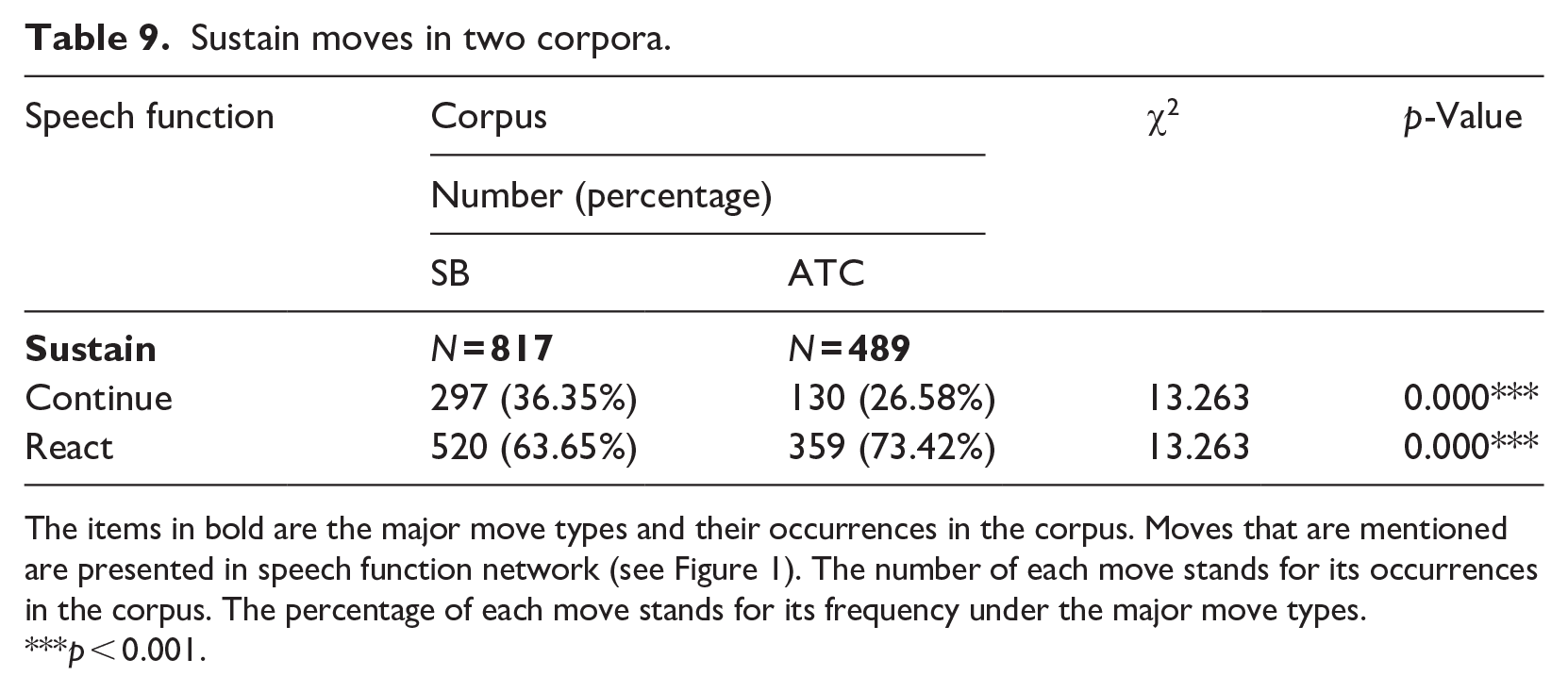
The items in bold are the major move types and their occurrences in the corpus. Moves that are mentioned are presented in speech function network (see Figure 1). The number of each move stands for its occurrences in the corpus. The percentage of each move stands for its frequency under the major move types.
***p < 0.001.
The ‘sustain’ move includes ‘continue’ and ‘react’ moves. The percentage of ‘react’ moves in the ATC corpus (N = 359, 73.42%) is significantly higher than in the SB corpus (N = 520, 63.65%).
Continue moves
The ‘continue’ move is utilized to keep negotiating the same proposition, including ‘monitor’, ‘engage’, and ‘prolong’ moves. A continuing speaker supplements their contribution by providing more information (Eggins and Slade, 1997).
The ‘monitor’ move includes deploying moves in which the speaker focuses on the state of the interactive situation, for example, by checking that the audience is still engaged. The dialogue turn in AE is highly restricted with the information in a prescribed sequence. One person should speak at a time. If more than one participant talks at the same time, one of them is usually supposed to stop (Yule, 1990). According to the pilot-controller communication loop, the ‘monitor’ move in an AE dialogue is unnecessary because the monitoring is accomplished via readback which ensures not only that the clearance has been received correctly but also that the clearance has been transmitted as intended. It also serves as a check for the right aircraft so that only that aircraft, will take action on the clearance (ICAO, 2007).
The ‘append’ move occurs when a speaker makes one move, loses the turn, but then as soon as he or she regains the turn, he or she produce a move which represents a logical expansion of his or her immediately prior move as soon as he or she regains the turn (Eggins and Slade, 1997).
In AE communication, only one individual can speak at a time so that air traffic controllers can communicate with pilots sequentially (Estival et al., 2016). Aeronautical dialogue can be described as an activity in which, for the most part, two people take turns in speaking. (Clark, Morrow and Rodvold, 1990). The ‘append’ move is not observed due primarily to highly regulated turn-taking in AE communication. Once pilots or ATCOs intend to regain their turns due to radio failure or frequency interference, they have to reestablish the AE communication in accordance with the prescribed conversation structure.
‘Prolong’ moves are those where a continuing speaker adds to his or her contribution by providing further information. As indicated in Table 10, the percentage of ‘prolong’ moves in the ATC corpus (N = 130, 100%) is significantly higher than in the SB corpus (N = 278, 93.60%). ‘Prolong’ move contains ‘elaborate’, ‘extend’, and ‘enhance’ moves that perform the functions as indicated by (Borowska, 2017) such as self-correcting, specifying conditions, describing a state, a future action and an action in progress.
Continue moves in the two corpora.
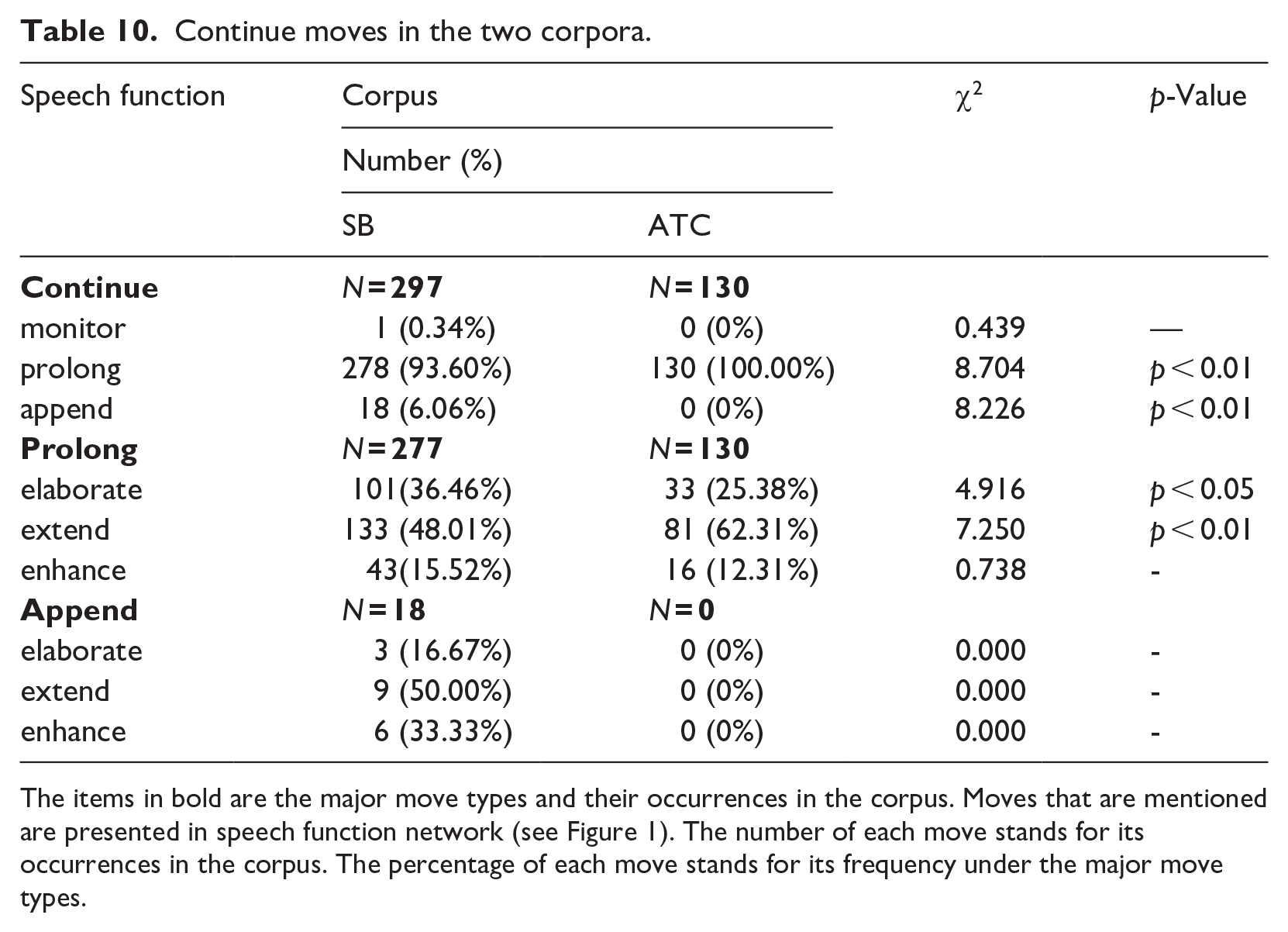
The items in bold are the major move types and their occurrences in the corpus. Moves that are mentioned are presented in speech function network (see Figure 1). The number of each move stands for its occurrences in the corpus. The percentage of each move stands for its frequency under the major move types.
The ‘elaborate’ move clarifies, restates, or exemplifies an immediately prior move. An elaborating relationship could be made explicit by the insertion of conjunctions such as for example, like, I mean between the two related moves. However, in rapid talks, elaborating conjunctions are often left implicit, with the relationship being implied by the juxtaposition of the moves (Eggins and Slade, 1997). In AE, elaborating conjunctions are often left implicit. For example, EX15-T1-M3 and EX16-T2-M2 are the clarifications of EX15-T1-M2 and EX16-T2-M1. However, no conjunctions are inserted between them.
The ‘extend’ move adds to the information in an immediately prior move, or provides contrasting information. The percentage of ‘extend’ moves in the ATC corpus (N = 81, 62.31%) is significantly higher than in the SB corpus (N = 133, 48.01%). During peak periods when task demands are high, ATCOs often issue a number of instructions at a time to a pilot in the interest of efficiency. The ATCOs often speak too quickly or provide too much information in a single message (Barshi and Farris, 2013). For example, Cleared to destination via flight planned route (M1), Runway 36R (M2), LKO-01 Departure (M3), initially climb to 4500 ft. (M4), cruising level 310 (M5), when airborne contact 119.7 (M6), and squawk 2515 (M7). M1 to M7 are independent from each other and the prior moves is extended by the subsequent. In AE, extending conjunctions could be explicit by conjunctions of and, but and or. For example, EX17-T1-M2 is extended by adding information in EX17-T1-M3 with conjunction and. EX18-T1-M3 and EX18-T1-M4 are connected by or. However, in most routine situation, extending conjunctions are often left implicit. For example, EX19-T3-M2 to M4, EX15-T2-M2 and EX15-T2-M3. As observed from corpus, the logical relationship between the ‘extend’ move and the prior move are ‘Time’, ‘Contrast’, and ‘Addition’. The grammatical and mood realization can be declarative or elliptical declarative.
The ‘enhance’ move qualifies or modifies the information in an immediately prior move by providing temporal, spatial, causal, or conditional details. The enhancing relationship could be, but need not be, made explicit through conjunctions such as then, so, because. In AE, the conjunctions are often made explicit. For example, EX18-T2-M3 is a causal detail to EX18-T2-M2, and the two moves are connected by so. EX17-T2-M3 is a move provide temporal detail to the information in EX17-T2-M2, and the two moves are connected with conjunctions then.
EX15 (Audio-ATC-002) (T1) AAL 17: We’d like to declare an emergency (M1). We got an engine problem here (M2). A compressor stall on the right engine (M3). (T2) JFK TWR: American 17, Roger (M1), You can turn left to Canarsie (M2). You can climb and maintain 2000 (M3). (T3) AAL 17: Left turn to Canarsie up to 2000, American 17 (M1). EX16 (Audio-ATC-001) (T1) JFK APP: American 1609 (M1), is that hydraulics (M2)? (T2) AAL1609: We have a flight control issue (M1). We don’t have any leading edge nor trailing edge devices. . . (M2). EX17 (Audio-ATC-002) (T1) AAL 17: We’d like them to look at the right engine (M1). Was cracking pretty hard on departure there (M2) and just wanna make sure we’re OK to clear the runway (M3). (T2) JFK TWR: Okay, I understand (M1). You’re gonna make a full stop on the runway (M2) then get the equipment out there to check out the right engine (M3). EX18 (Audio-ATC-004) (T1) Delta 2503: Tower, Delta 2503 (M1), our last instruction was CHARLIE then ECHO (M2). That’s also what you want us to do (M3) or you want us to follow the American (M4)? (T2) JFK TWR: Delta 2503 (M1), you’ll start a new line up (M2) so you can go CHARLIE then left ECHO then at FOXTROT-BRAVO follow that American again (M3). We’ll make the line little longer, thank you (M4). (T3) DAL2503: Okay (M1), we’ll continue ECHO and follow the American, Delta 2503 (M2). EX19 (Audio-ATC-009) (T1) C90B DEP: Delta962 (M1), what’s going on up there (M2)? (T2) DAL962: We have an equipment bay smoke indication (M1) so I guess we’ll have the trucks ready, please (M2). (T3) C90B DEP: Roger (M1). Fox is current at O’Hare (M2). Plan runway 28C (M3), fly heading of 070 (M4). (T4) DAL962: 070, 28C, Delta962 (M1).
React moves
The ‘react’ move includes ‘respond’ and ‘rejoinder’ moves. A significant difference was revealed between two corpora in speech functions under ‘react’ moves (χ2 = 8.854, p = 0.003). As indicated in Table 11, the percentage of ‘respond’ moves in ATC corpus is (N = 297, 82.73%) is significantly higher than in the SB corpus (N = 386, 74.23%).
React moves in the two corpora.
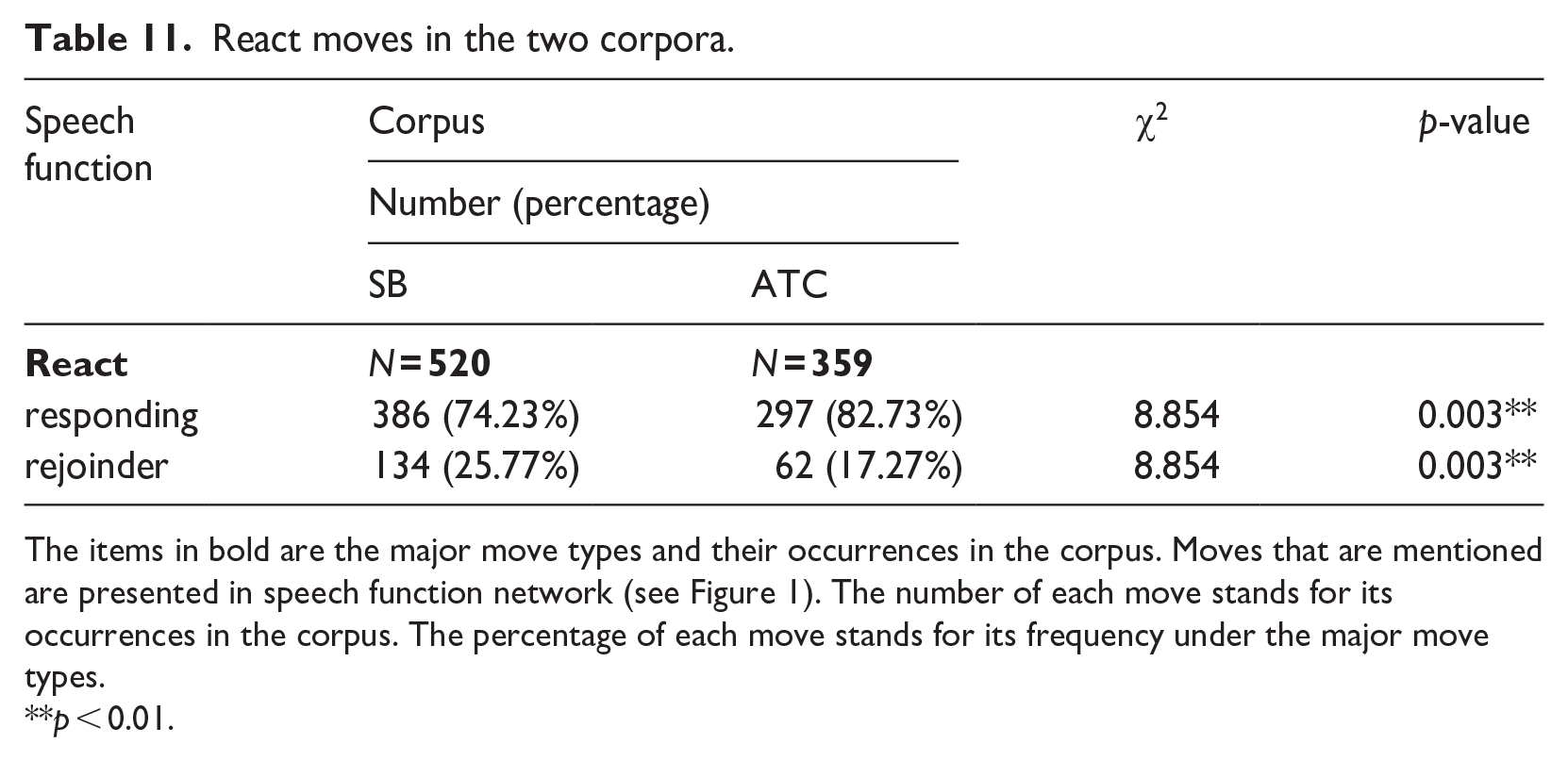
The items in bold are the major move types and their occurrences in the corpus. Moves that are mentioned are presented in speech function network (see Figure 1). The number of each move stands for its occurrences in the corpus. The percentage of each move stands for its frequency under the major move types.
**p < 0.01.
Respond moves
The ‘respond’ move is a reaction which moves the exchange towards completion. The percentage of ‘support’ moves in the ATC corpus (N = 280, 94.28%) is higher than in the SB corpus (N = 342, 88.60%). Pilots and ATCOs always agree, comply, and say ‘Yes’ out of safety concern. Specifically, pilots must obey ATC instructions, unless it would be unsafe to do so. On the other hand, the information ATCO requests from pilots must be provided as required.
As indicated in Table 12, the percentages of ‘engage’, ‘comply’, and ‘withhold’ moves in the ATC corpus (N = 14, 5.00%; N = 114, 46.15%; N = 9, 52.94%) are significantly higher than in the SB corpus (N = 1, 0.29%; N = 1, 1.03%; N = 3, 6.82%).
React move in the two corpora.
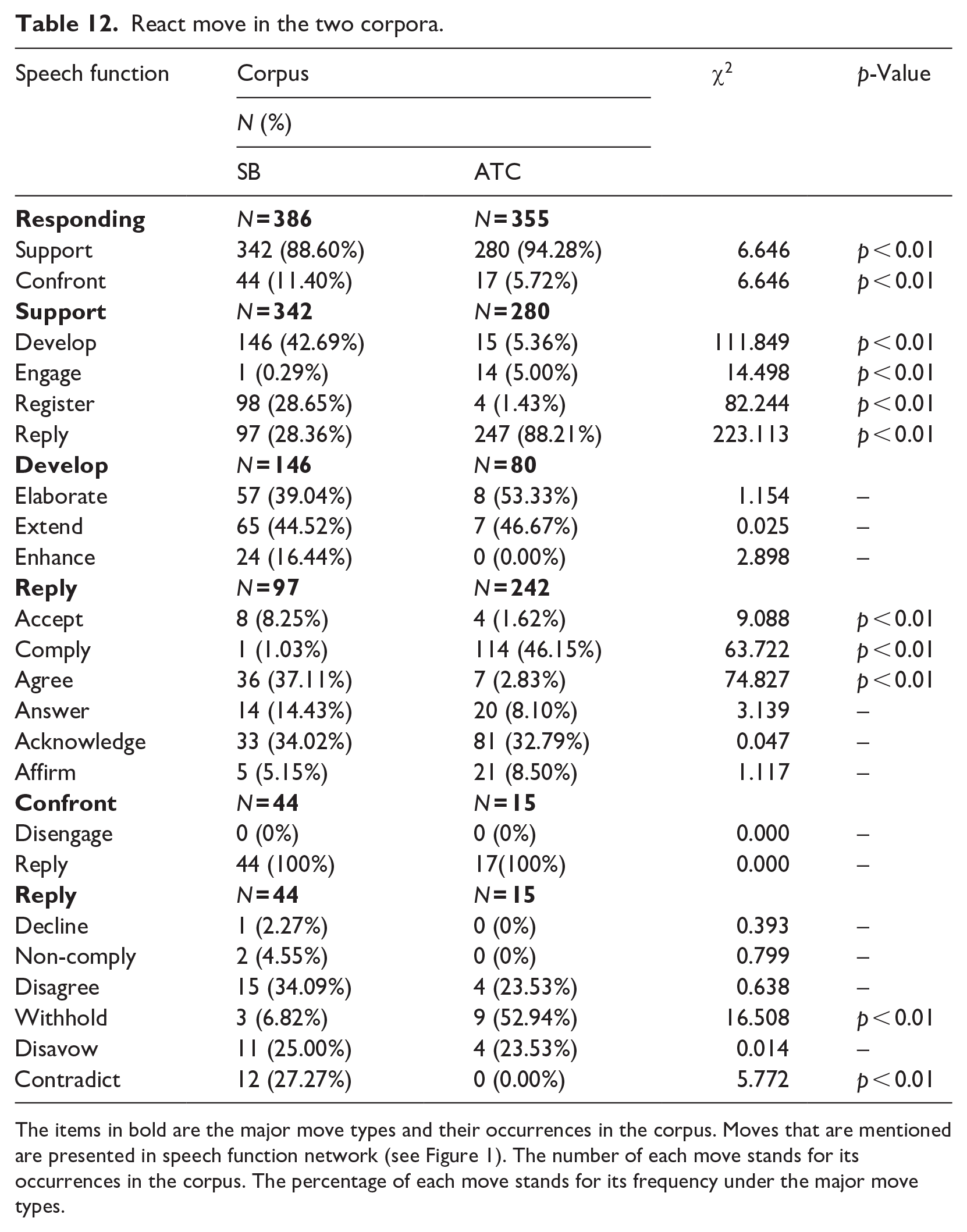
The items in bold are the major move types and their occurrences in the corpus. Moves that are mentioned are presented in speech function network (see Figure 1). The number of each move stands for its occurrences in the corpus. The percentage of each move stands for its frequency under the major move types.
Engage moves
The ‘engage’ move is an exchange-compliant reaction to the ‘attend’ move. It is minimally negotiatory, as the interactants simply agree to the negotiation going ahead. An ‘engage’ move includes responses to the attention-getting ‘attend’ move. The percentage of ‘engage’ moves in the ATC corpus (N = 14, 5.00%) is significantly higher than in the SB corpus (N = 1, 0.29%). The aircraft contacts with different ATS units and thus change from one radio frequency to another during different flight phases. Whenever the transfer of communication occurs, a new communication shall be established. In AE, the move is realized by the minor clause, as a callsign for both aircraft and aeronautical station. For example, EX20-T1-M1 is an ‘attend’ move that seeks attention from ATCO, and EX20-T2-M1 is an ‘engage’ move used to respond to the pilot. The ‘engage’ move is grammatically realized by a minor clause (i.e. callsign for aircraft and aeronautical station.) EX20 (Audio-ATC-014) (T1) UAL1095: Fort Wayne Approach, United 1905 (M1). (T2) Fort Wayne APP: United 1905, Fort Wayne Approach (M1), turn right heading 330 (M2), be vectors visual approach straight-in runway 14 (M3).
Comply moves
The ‘comply’ move is utilized to carry out a demand for goods and services and serves as a response to the ATC instruction. The percentage of ‘comply’ moves in the ATC corpus (N = 114, 46.15%) is significantly higher than in the SB corpus (N = 1, 1.03%). In AE, the instruction and clearance are conducted with the readback. Its grammatical realization is the standard word ‘Wilco (will comply)’, an elliptical declarative or minor clause with no modality. The content of readback involves the safety-related information, such as runway in use, wind direction and strength, visibility, temperature, dew point, and QNH (Robertson and Johnson, 2008). The exchange cannot be completed until the pilot produces a correct readback of the required information that ATC expect to be acknowledged. According to the dialogue loop, the safety-related information should be read back. If the readback is not correct, ATC have to correct after hearback. The renewed information should also be read back until it is correct. Therefore, the exchange tends to end up with a comply move. It also serves as a check so that the right aircraft, and only that aircraft, will take action on the clearance. (ICAO, 2007). It is grammatically realized by an element from the prior move (i.e. the safety-related information in instruction and clearance for readback) or the minor clause ‘Wilco (will comply)’. The salient feature of the ‘comply’ move in AE is that the move is always ends with aircraft callsign (e.g. EX21-T2-M1).
EX21 (Audio ATC-004) (T1) JFK GND: Delta 2503 (M1), continue Charlie then Echo (M2). Monitor 23.9 (M3), good day (M4). (T2) DAL2503: Charlie, Echo, 23.9, Delta 2503 (M1).
Withhold moves
The ‘withhold’ move is a confronting reply paired with typical initiations. A prior move can also be confronted through a ‘withhold’ move to indicate inability to provide the demanded information. The percentage of ‘withhold’ moves in the ATC corpus (N = 9, 52.94%) is significantly higher than in the SB corpus (N = 3, 6.82%). When an unexpected situation occurs, pilots have to focus their attention on controlling the aircraft and dealing with special situations, making it difficult to respond to the ATCO’s questions and instructions in a timely manner. ATCOs have to provide air traffic services to all the traffic within the responsible controlling airspace. When ATCOs find it difficult to respond simultaneously at peak periods, they tend to indicate inability to provide the demanded information to pilots. The grammatical realization of ‘withhold’ moves in AE is a minor clause, such as ‘Standby (Wait and I will call you)’ in EX24, and an elliptical declarative and imperative as shown in EX22 and EX23: EX22 (Audio ATC-016) (T1) N90Q: United 2631 (M1), do you need anything else from me, sir (M2)? (T2) UAL2631: Actually, just a few minutes here, sir (M1). We’ll take a turn as we get the checklists finished up here (M2) and we’ll get in there (M3). EX23 (Audio ATC-008) (T1) DAL941: Can you see our landing gear (M1)? (T2) ATL TWR: Give me a second, hang on (M2). EX24 (Audio ATC-011) (T1) NCTU: United574 (M1), so you are saying you wanna return to San Francisco (M2)? (T2) UAL2631: Stand by (M1). We need a couple checklists (M2). We’ll get right back but we’ll plan on that (M3).
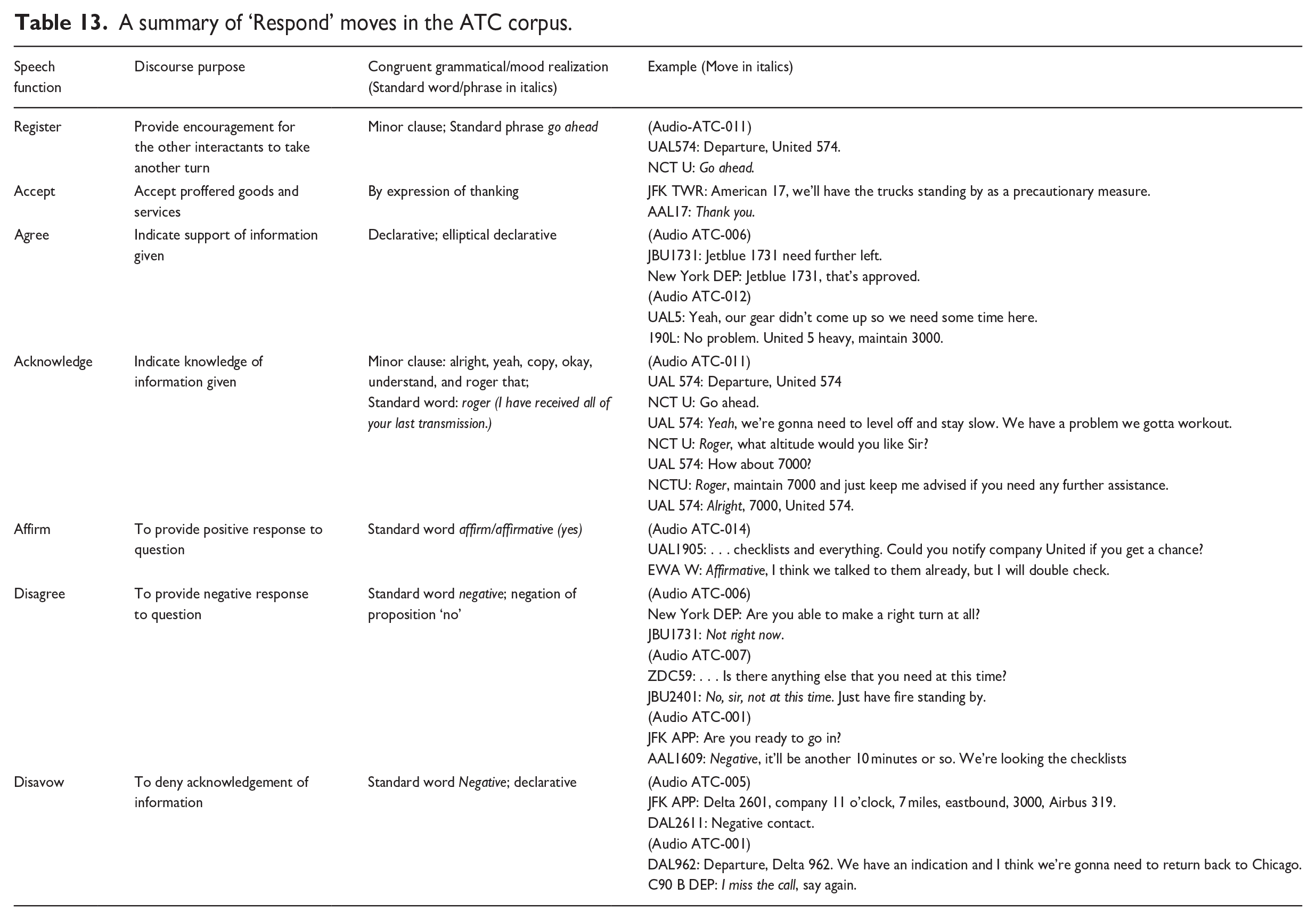
The other speech functions occurring in the ATC corpus are summarized in Table 13. To simplify the presentation, the speech functions are supported by examples with moves in italics.
A summary of ‘Respond’ moves in the ATC corpus.
Rejoinder moves
The ‘respond’ move complies with the expectation of exchange closure, achieved linguistically by negotiating only the proposition set up by the initiating speaker. A ‘rejoinder’ move, on the other hand, rather than completing the negotiation of a proposition or a proposal, tends to set underway sequences of talk that interrupt, postpone, abort, or suspend the initial speech function sequence. The percentage of ‘support’ moves in the ATC corpus (N = 62, 100%) is significantly higher than in the SB corpus (N = 119, 88.81%).
Under the ‘rejoinder’ move, the percentage of ‘check’ moves in the ATC corpus (N = 9, 20.93%) is significantly higher than in the SB corpus (N = 4, 4.71%). The ‘track’ move checks, confirms, clarifies or probes the content of the prior move.
Check moves
As indicated in Table 14, the percentage of ‘check’ moves in the ATC corpus (N = 9, 20.93%) is significantly higher than in the SB corpus (N = 4, 4.71%). The ‘check’ move checks on content which has been missed or may have been misheard. A ‘check’ move may involve specifically requesting clarification; it can also involve querying a move which has more or less been missed altogether (Eggins and Slade, 1997). It is grammatically realized by a minor clause with interrogative intonation as indicated in E25-T2-M1. The move, however, is realized by a minor clause specified in Doc. 9432 (ICAO, 2007), such as unable which is normally followed by a reason, confirm (I request verification of. . .) and standard phrase say again. AE communication features rapid speed of delivery and lack of pauses (McMillan, 1998). ATCOs may speak too fast and at a high speech rate due to their high workload, and increase message length. As such, pilots are likely to misheard or misunderstand (Barshi and Farris, 2013). The messages and information delivered in the context may be interrupted, not clearly uttered, stopped, or distorted by background noise originating from the environment as well as the cockpit equipment which may cause reception problems (Borowska, 2017). The above-mentioned factors necessitate requesting clarification that is realized by the ‘check’ move.
Rejoinder moves in the two corpora.
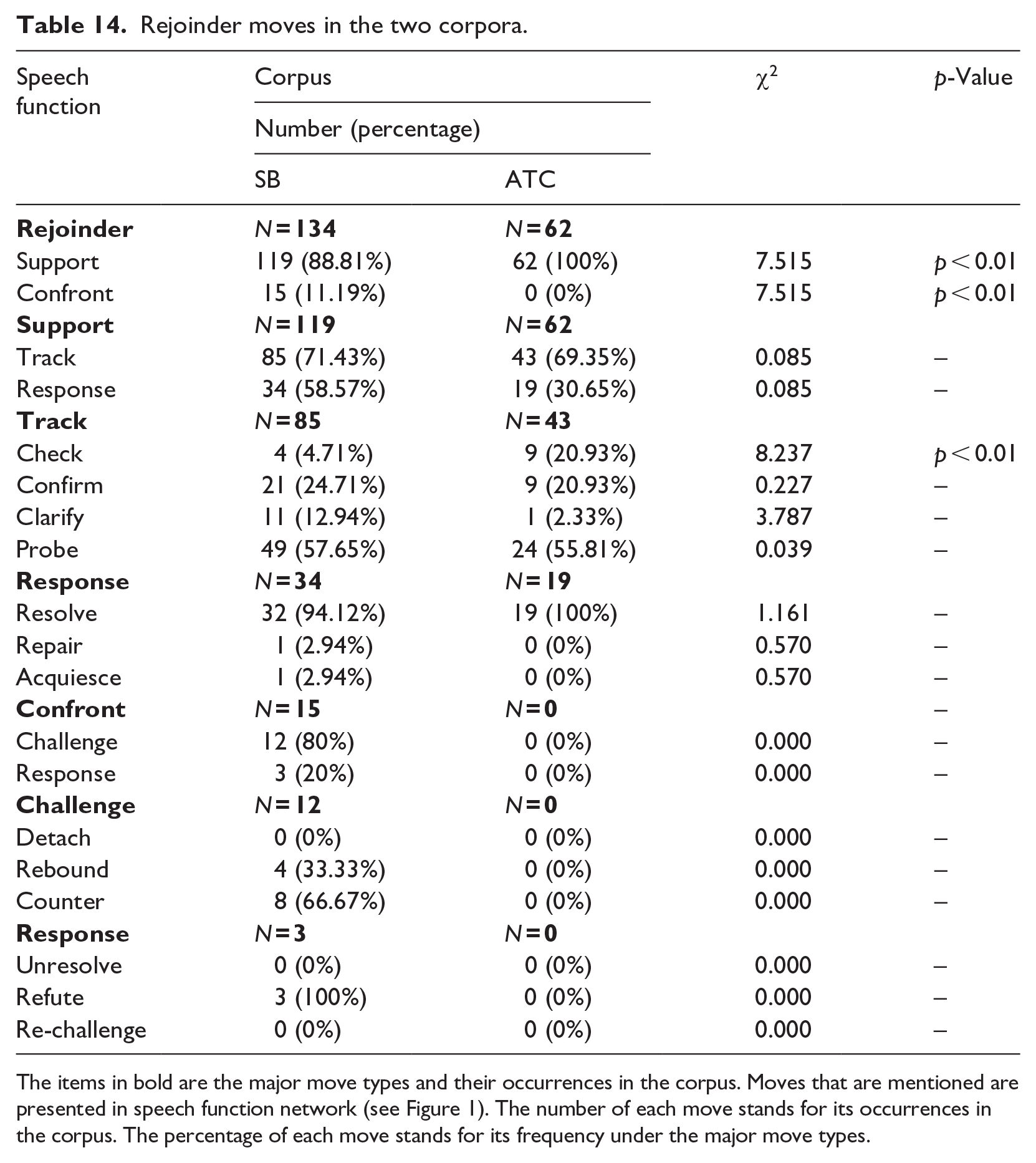
The items in bold are the major move types and their occurrences in the corpus. Moves that are mentioned are presented in speech function network (see Figure 1). The number of each move stands for its occurrences in the corpus. The percentage of each move stands for its frequency under the major move types.
EX25 (Audio-ATC-006) (T1) AAL1696: Maintain 10,000, American 1696 (M1). (T2) NY DEP: Say again (M1)? (T3) AAL1696 : Departure (M1), we have a burning smell on the back (M2).
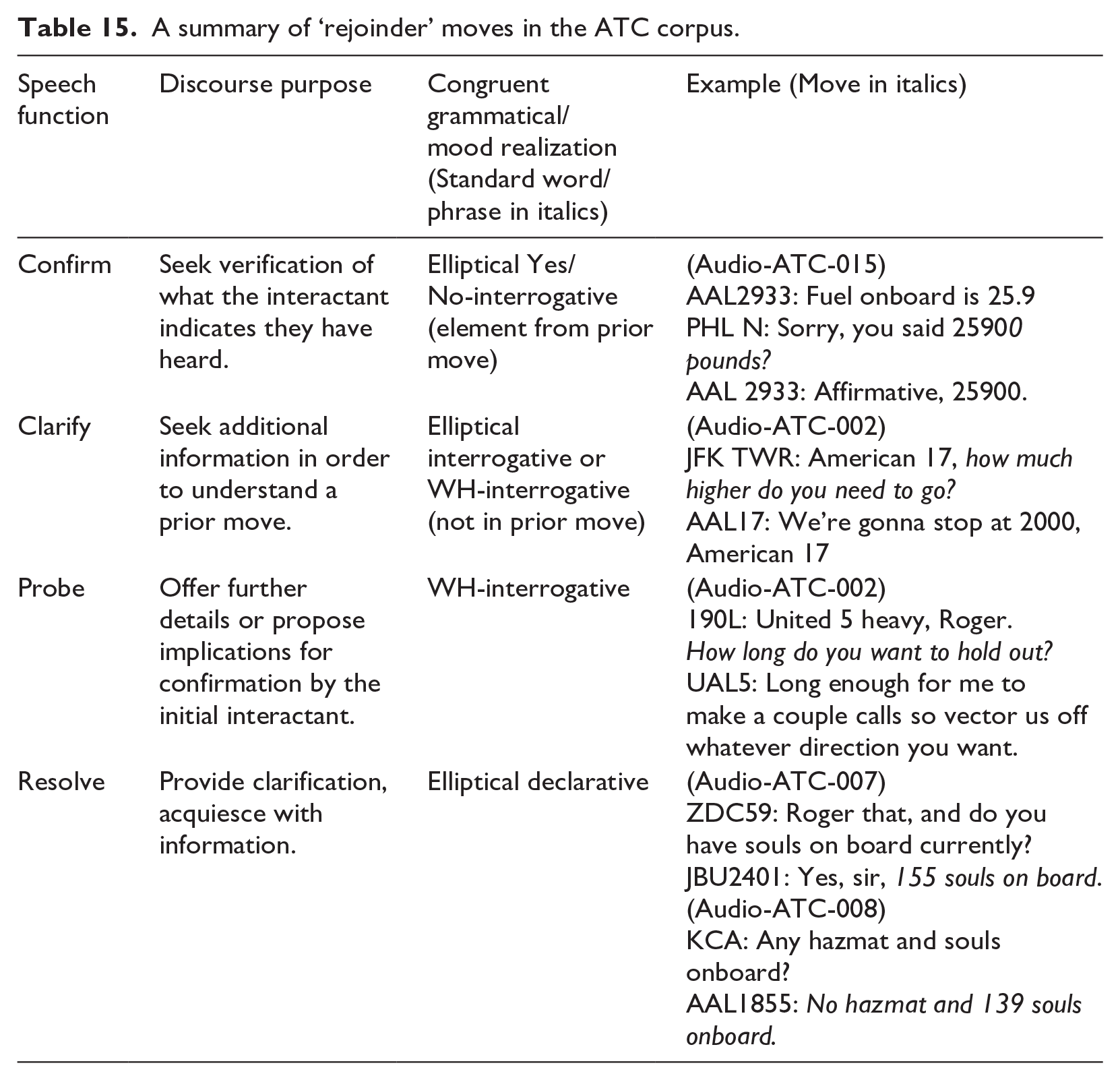
The other speech functions under ‘rejoinder’ moves occurring in the ATC corpus are summarized in Table 15.
A summary of ‘rejoinder’ moves in the ATC corpus.
Discussion
The findings regarding AE conversational and speech function features are revealed by the results of a comparative analysis of the two corpora.
As regards the first research question, our findings show that AE communication has fewer turns than CE in a given exchange. AE has a short exchange for the following reasons: First, ATCOs must provide air traffic control services to all traffic within the responsible controlling airspace at the same time. The same frequency may become congested with multiple aircraft transmitting during peak periods, making it difficult to maintain the normal turns and exchanges. Even under non-routine situations where the aircraft in emergency or urgency should be given first priority, the frequency has to be utilized to send instructions and clearance to the surrounding traffic to maintain separation. Second, ATCOs often issue a number of instructions at a time to a pilot and speak quickly in a message (Barshi and Farris, 2013). The large amount of information included in a single turn does not necessitate further turns in an exchange. Third, as long exchanges and frequent transmissions may induce high workload and could be a distraction, pilots and ATCOs tend to send concise transmissions and short exchanges. In terms of move-turn ratio, our statistical data reveal no significant difference between CE and AE. As the instructions have always to be read back in an exchange, pilots and ATCOs tend to contribute equally to the exchange in a casual conversation.
With respect to the second research question, Table 6 demonstrates that the two corpora are significantly different from each other. The distinction between AE and CE underlines the importance of specific AE teaching and also sheds lights on the training practice for NNES and NES pilots alike. As regards NNES pilots, focusing solely on improving CE, together with aviation terminology might not be helpful to their AE learning. It is insufficient either to simply offer lists of aviation specific vocabulary to complement a learner’s current language (Dusenbury and Bjerke 2013). In addition, the current flight training philosophy and practice should be reconsidered. It has to be highlighted that NES should avoid ‘on the fly’ training philosophy and immersion strategy. Even NES pilots should specifically receive ground AE training.
The speech functions in ATC that are statistically significant different with and thus have a higher percentage will be identified as the salient features to characterize AE. Their discourse purposes and grammatical and mood realization observed in the ATC corpus are summarized in Table 16. The grammatical and mood realizations of the speech functions in Doc. 9432 are summarized and contrasted to those in a real AE context.
A summary of speech functions in the ATC corpus.
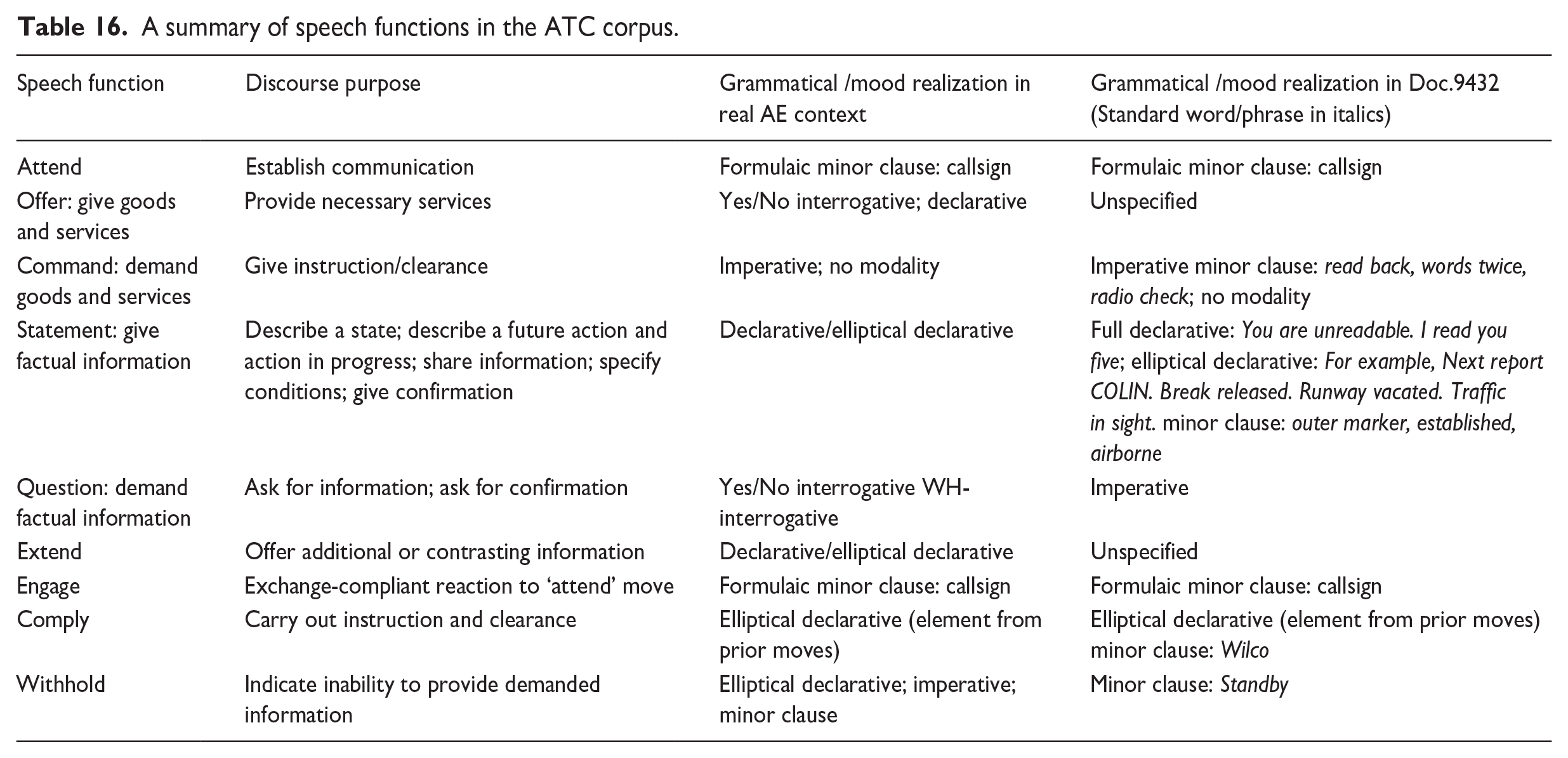
Petrashchuk (2016: 73) points out the necessity to teach standard phraseology and plain language in an integrative manner because both languages are being integrated into AE communication. The ATC corpus that includes AE communication in both routine and non-routine situations has both standard phraseology and plain language. As a result, the corpus-based findings in the current study have pedagogical implications for aviation English teaching. The corpus will be of direct and indirect benefit to AE instruction in the NES and NNES states.
As regards the direct use, the authentic AE communications in the corpus is undoubtedly an ideal material to give NNES learners insights into the AE usage by NES in a real context. Hedge (2001) suggests a better awareness of social language by listing expressions under functions. AE trainers could summarize from the authentic AE communication phrases, clauses, and sentence patterns based on speech functions, facilitating NNES learners in expressing in the proper grammatical form and mood while realizing the discourse purposes. The AE learners could also be guided to consider whether the mood used is appropriate. The disparity between speech function realizations in the ATC corpus and those presented in Doc.9432 might be offered to the NNES learners to highlight the gap between ICAO standard phraseology and real-world AE. As to NES learners, the distinction between CE and AE, as well as between real AE by NES and ICAO standard phraseology, should be emphasized to raise their awareness of the use of standard phraseology in the global context.
The ATC records compiled in this study can be employed to prepare pedagogical materials and activities, which are commonly mentioned as indirect use in literature. As ICAO (2009) explicitly states that, teaching AE must focus on speaking, listening, and interactive skills. The authentic AE communications may be useful in developing instructional design, learning materials, and test preparation to improve learners’ listening, speaking, and interactive abilities.
First, the speech functions from authentic AE are summarized and their specific realization are also added, it could be a very useful tool for instructional design and pedagogical material. The suitability of this activity is that it adds context to materials which can help increase the student’s functional output (Hedge, 2001). Second, the tagged version of the corpus generated in this study can further help curriculum designers to identify useful linguistic components when deciding which techniques will support the chosen methodology (Bullock, 2016). It is also beneficial to material writers when developing pedagogical materials and functional-notional syllabus design for AE training courses. Third, the transcription and records of these authentic AE communications can also be used by test designers and developers to expand their AE test base.
Conclusion
Previous research has demonstrated the role of AE communication in a descriptive method, but none has detailed its function in an empirical approach. In this study, we compiled an ATC corpus with authentic AE communications collected from USA and conducted a quantitative analysis of AE’s speech functions and compares them to CE’s. The results offer insights on the distinction between AE and CE, as well as the functional-semantic characteristics of AE. The corpus-based analysis significantly improves our understanding of the authentic AE, which may have implications for AE pedagogical practice, training, and testing. Our analysis also demonstrated the applicability and utility of the speech function network as a research methodology for uncovering conversational discourse variations in other domains of ESP research.
It should be mentioned that this study has its own limitations. The moves coded are insufficiently large, especially the AE communications between NNES haven’t been incorporated into the ATC corpus. Due to the absence of NNES data, it is difficult to describe functional-semantic features of NNES speech directly from the corpus. Therefore, more AE communications from a wider range should be collected and scrutinized in the future so as to illuminate more functional-semantic features of AE communication and then explore more possible pedagogical implications for AE training.
Footnotes
Appendices
An overview of ATC corpus.
| SERIAL NUMBER | DATE | AERODROME | ATS UNIT | AIRLINES | NON-ROUTINE FLIGHT | REGISTRATION CODE | NON-ROUTINE SITUATION |
|---|---|---|---|---|---|---|---|
| ATC001 | 31/DEC/2017 | New YorkKJFK | APP | AAL1609/JBU76 | AAL1609 | N972A | Flight control issue |
| ATC002 | 04/JAN/2016 | New YorkKJFK | TWR | AAL17 | AAL17 | N103NN | Engine failure |
| ATC003 | 07/AUG/2018 | New YorkKJFK | TWR | DAL1320/DAL1278/DAL 868 | DAL1320 | N342DN | Type burst |
| ATC004 | 15/AUG/2017 | New YorkKJFK | GND/TWR | DAL2503/AAL290 | DAL2503 | N377DA | Wingtip collision |
| ATC005 | 15/JAN/2016 | New YorkKJFK | TWR | DAL2611/JBU161 | DAL2611 | N370NB | Hydraulic problem |
| ATC006 | 19/SEP/2016 | Boston KBOS | DEP | JBU1731/AAL1980 | JBU1731 | N729JB | Lightning strike |
| ATC007 | 18/MAR/2018 | Fort Lauderdale KFLL | TWR/DEP/CTR | JBU2401/DAL405 | JBU2401 | N794JB | Electrical burning smell |
| ATC008 | 15/NOV/2022 | Kansas City KMCI | TWR | AAL1855/SWA1244/DAL2045 | AAL1855 | N846NN | Bird strike |
| ATC009 | 24/JUL/2020 | Chicago KORD | DEP | DAL962/AAL2911/AAL2432 | DAL962 | N111NG | Smoke in equipment bay |
| ATC010 | 06/AUG/2022 | Atlanta KATL | TWR | DAL941/DAL1548/DAL1630 | DAL941 | N596NW | Landing gear problem |
| ATC011 | 24/MAY/2022 | San Francisco KSFO | DEP | UAL574 | UAL 574 | N12216 | Landing gear problem |
| ATC012 | 16/APR/2022 | Houston KIAH | APP | UAL5 | UAL5 | N27957 | Landing gear problem |
| ATC013 | 12/APR/2021 | Miami KMIA | DEP | AAL935/AAL1028/AAL887 | AAL935 | N337PJ | Landing gear problem |
| ATC014 | 14/DEC/2021 | Fort Wayne KFWA | APP | UAL1095 | UAL1095 | N38257 | Engine failure |
| ATC015 | 07/MAR/2021 | Philadelphia KPHL | CTR | AAL2933/AAL415/JBU375 | AAL2933 | N976UY | Fumes in the cockpit |
| ATC016 | 02/OCT/2021 | Laguardia KLGA | APP | UAL2631/DAL1534 | UAL2631 | N27252 | Engine failure |
Acknowledgements
The author thanks Professor Chengyu Liu for his technical assistance. The author thanks Professor Aiguo Wang for his valuable suggestion, Lu Zhen and Xiaoyan Wei for their move annotating in corpus constructing. We would also like to thank the editor and anonymous reviewers for their insightful feedback and constructive comments.
Declaration of conflicting interests
The author(s) declared no potential conflicts of interest with respect to the research, authorship, and/or publication of this article.
Funding
The author(s) disclosed receipt of the following financial support for the research, authorship, and/or publication of this article: The research presented in this paper was supported by Fundamental Research Funds for the Central Universities [Grant Number 3122018R009].