







Abstract
This article presents an analysis of the evolving representations of feminism on Weibo, China’s foremost microblogging platform, employing a corpus-based methodology. The self-compiled corpus comprised 334,871 feminism-related posts from 2019 to 2022. Using the Sketch Engine corpus analysis tool, noun bigrams containing 女权 (feminism) were extracted, categorized, and compared to discern the portrayals and their transformations. The findings revealed a significant shift in feminism’s depiction, with an increased emphasis on its radical and aggressive aspects, and a decline in its portrayal as a quest for female privilege. During this period, the perception of feminism as an emerging social movement expanded, and the distinction between various forms of feminism and feminists based on different attributes became more prevalent, resulting in a marginally reduced representation of them as a unified entity. This research enriches the existing literature by emphasizing the dynamic portrayals of feminism on China’s social media and offering novel insights into its assessment.
Keywords
Introduction
‘Extreme feminism has become a malignant tumor on the internet,’ according to a post by the official Weibo account of the China Communist Youth League (CCYL) on April 12, 2022. This statement was prompted by criticism the organization faced after publishing a post on April 2, 2022, which showcased six images from pivotal moments in China’s history, including the Red Army’s Long March and Chinese soldiers crossing the Yalu River during the Korean War (Figure 1). The CCYL was subsequently criticized for allegedly neglecting to feature any images of women in these essential national events. Nonetheless, while two of the pictures predominantly depict men, the remaining four images consist of large crowds or individuals wearing COVID-19 hazmat suits, rendering the determination of their genders challenging (Yan, 2022). In response, the organization addressed the issue on Weibo, contending that critics were inciting public discord and promoting gender confrontation to gain attention. As of March 29, 2023, the relevant hashtag has accumulated 1.66 billion views and instigated 1.23 million discussions, cementing its position as one of the most debated topics on Weibo in the period.
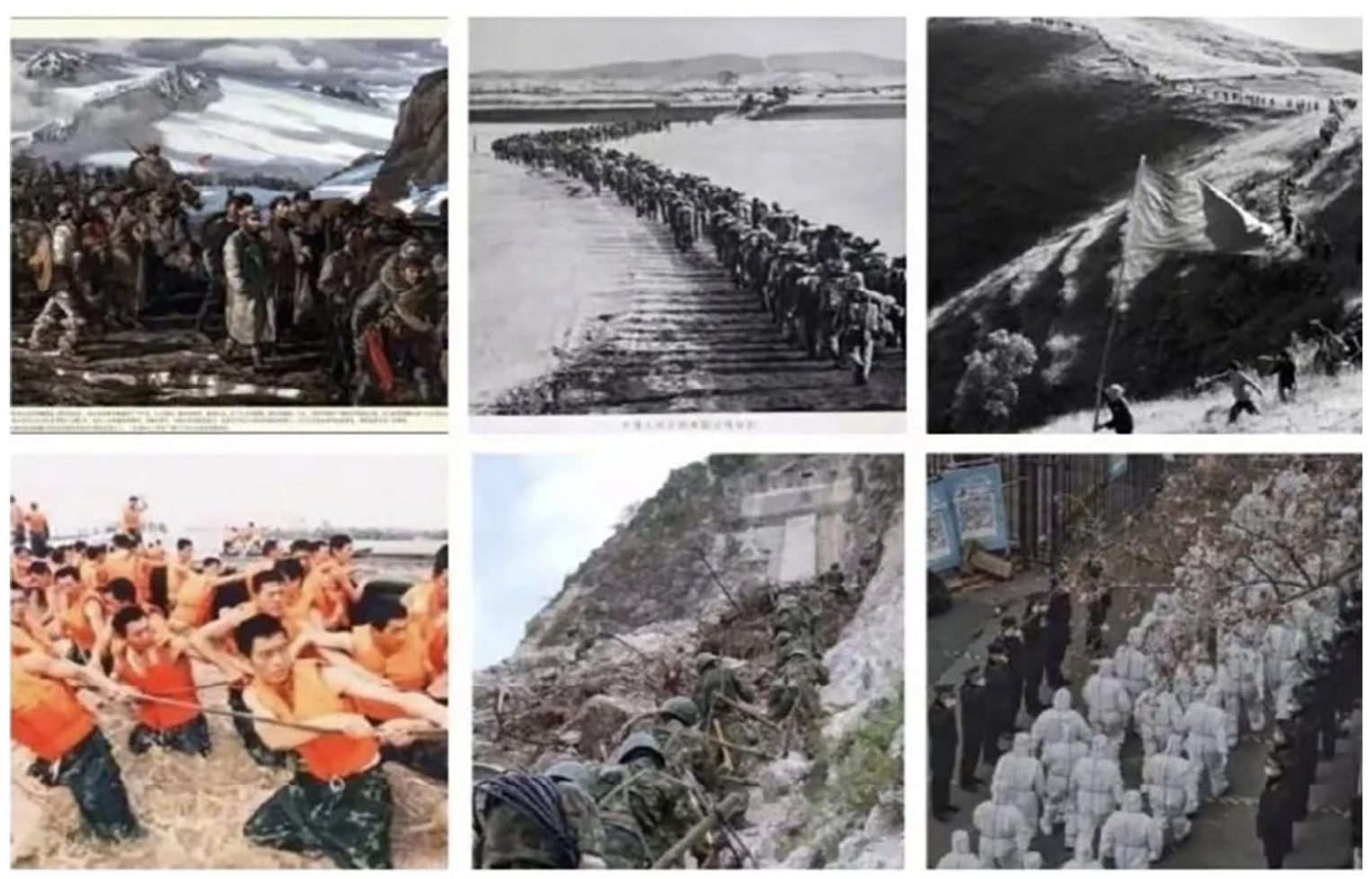
Images of key national moments posted by the China Communist Youth League on Weibo.
It is important to note that the CCYL did not claim that extreme feminism ‘is’ or ‘will’ become a ‘malignant tumor’. Instead, the organization employed a cancer metaphor to represent it as a tumor that ‘has’ already proliferated and inflicted damage on Chinese society, evoking the attribtues of ‘danger, damage, otherness, aberration, and uncontrollability’ associated with the target domain (Potts and Semino, 2019: 93). The extensive propagation of this rhetoric indicates a substantial shift in the perceptions and interpretations of feminism on Chinese social media platforms in recent years. Nonetheless, the specific nature and timeframe of this transition remain unclear. To address this gap, this study investigates the portrayals of feminism on Weibo and their development from 2019 to 2022, employing corpus linguistics methodologies. As a result, the research questions guiding this exploration include:
RQ1: What were the discourse representations of feminism on Weibo between 2019 and 2022?
RQ2: How did the representations evolve on Weibo over this period?
The chosen timeframe is particularly pertinent, as the feminist discourse has been significantly impacted by the COVID-19 pandemic. This global crisis has disproportionately impacted women across various dimensions, including health outcomes, employment, income, and education (Flor et al., 2022). As a result, gender inequality has been exacerbated (UN Women, 2020). The pandemic has thrust feminist discourse into the spotlight of public conversations, emphasizing the intersectionality of gender with health, economic, and social issues. Concurrently, feminist discourse has migrated to digital spaces, with increased focus on the gendered consequences initiated and amplified by the pandemic (Zhang, 2022). The period from 2019 to 2022 encompasses the entire duration of the COVID-19 pandemic, which was first identified in Wuhan in late 2019 and concluded in late 2022, as marked by China’s official departure from its zero-COVID policy. While this study focuses on the potential variations in representations of feminism during the pandemic, it does not endeavor to establish a direct relationship between the pandemic and these representations. Instead, the study probes the potential evolution of these representations within the framework of a globally significant event that has triggered pervasive transformations across a multitude of domains in the world and society.
This study concentrates on Weibo, China’s foremost microblogging platform, boasting over 250 million daily active users as of the third quarter of 2022. Media texts play an essential role in molding individuals’ perspectives and understanding of various aspects of society (Richardson, 2007). Weibo, possessing the capacity to both shape and mirror public understanding of feminism, serves as a vital focus for this study.
In the upcoming sections, I will begin by reviewing previous research on Chinese feminism and discourse representations. Subsequently, I will outline the study’s corpus and analytical framework. Following this, I will engage in a thematic analysis of linguistic patterns associated with the portrayal of feminism and discuss their shifts in frequency. Lastly, I will offer insights into the findings, address study limitations, and provide recommendations for future research.
Neoliberal feminism, postfeminism and She Economy in post-reform China
Before delving into the analysis of feminist portrayals on Weibo, it is necessary to understand the underlying contextual factors that may shape these representations. This understanding will be revisited in light of the research findings within the discussion section.
The considerable advancement of Chinese women’s sociopolitical standing can be attributed to the socialist feminist movement during the initial three decades following the establishment of the People’s Republic of China (PRC). This movement endowed women with equal legal rights (Peng, 2021a) and promoted their inclusion in the labor market (Yang, 2017). In the late 1970s, the PRC embarked on economic reformation policies, concentrating on industrial marketization, which bear similarities to the neoliberal approaches implemented in the UK during the 1980s (Harvey, 2007). Neoliberalism, intimately associated with a postsocialist China integrating into the global market (Li, 2021), fosters individualism by supplying a plethora of consumer goods and advocating individualistic lifestyles (Giddens, 1991). This approach cultivates self-reflexivity and values personal choice (Rofel, 2007), leading to the emergence of neoliberal feminism (McRobbie, 2013; Rottenberg, 2018). This variant of feminism positions itself as progressive, reframes social justice concerns in individualized terms, and minimizes the importance of institutionalized gender inequality (McRobbie, 2013).
Postfeminism emphasizes the nexus between new feminist movements and neoliberalism, transforming feminist politics into individualized discourses (Gill, 2007). The rise of postfeminism in China during the 1990s is characterized by young women championing individual liberty and girl power as an alternative to collective feminist endeavors (Choi and Zeng, 2022). Regrettably, this postfeminist emphasis on self-empowerment inadvertently succumbs to the pitfalls of neoliberalism (Banet-Weiser and Juhasz, 2011). Female individualization redirects public focus from structural disparities, stressing personal success or failure as contingent upon individual competencies (McRobbie, 2004; Yin and Sun, 2021).
The ascent of Chinese neoliberal feminism signifies the impact of consumer cultures on post-reform China’s gender issues (Wallis et al., 2018). Chinese neoliberal feminism, which resonates with numerous women aspiring for liberation (Rofel, 2007), characterizes them as ‘autonomous’ and ‘modern’ individuals who are enthusiastic about expressing their femininity (Liu, 2014: 22). Consumerism propels this self-expression ‘by turning people into consumers and changing their consumer behaviours’ (Peng, 2019: 3). It stimulates Chinese women to ‘indulge in the possibilities and pleasures of feminine expressions’ (Liu, 2014: 20), including the utilization of cosmetic apps as a tool for assessing and modulating their gendered appearances (Eriksson and Kenalemang, 2023; Peng, 2021b). This shift reflects the ‘transformation of the communist ideal of women as producers into the neoliberal image of women as consumers’ (Xu and Feiner, 2007: 310). Consumerism has also given rise to the women’s economy, also known as the She Economy, which recognizes women’s economic independence, consumer demand, and purchasing power as a novel economic growth point. This catalyzed the emergence of Chinese pseudo-feminism, which seamlessly integrates into the post-reform Chinese consumer culture (Peng, 2020). Although purporting to tackle gender inequality, thus rendering it attractive to women, the form of feminist discourse facilitates the financial success of women-centric enterprises by cultivating a socio-cultural environment that promotes daily consumption among Chinese women (Meng and Huang, 2017).
Representations of feminism
This study adopts Hall’s (1997) definition of representation, characterized as ‘the process by which members of a culture use language [. . .] to produce meaning [. . .] things – objects, people, events in the world’ (p. 61). Hall emphasizes the cultural, linguistic, and dynamic aspects of representation as a process in which meaning is generated and disseminated within a specific societal context. Language, or discourse, serves as the primary medium for creating and exchanging meaning. Building upon Hall’s definition, the present research is situated within the scholarly literature that examines the representation of feminism by analyzing discourses collected from media sources. Despite ongoing expansion of literature, research in this area remains limited (Lind and Salo, 2002). In order to obtain a more profound understanding, researchers have extensively employed corpus linguistic techniques and conducted comparative studies across corpora. The approach allows researchers to analyze large datasets of language use and to identify patterns and trends in discourse representation across different contexts and over time.
One of the earliest contributions to this field was made by Faludi (1991), who argued that the media portrayed women as unhappy and unfulfilled, thereby questioning the success of the movement. She also criticized the media’s depiction of successful women as being excessively masculine or unattractive, which she believed was used to undermine the validity of the women’s movement. This argument was later supported by Danner and Walsh (1999) who examined the coverage of the Fourth UN Conference on Women in the New York Times and the Washington Post. Their findings revealed that the media portrayed women as being in conflict with each other, radical and lacking traditional femininity, as evidenced by the frequent use of language associated with tension and disagreement (e.g. battles, spat, and hostility).
Lind and Salo (2002) pioneered the use of corpus linguistics in this area. They analyzed the transcripts of American public affairs radio broadcasts between 1993 and 1996, and found that feminists were often portrayed by the media as being deviant and different from regular women. This depiction was frequently reduced to false stereotypes and the media rarely associated feminists with private activities such as household work or child-rearing. Instead, feminists were strongly linked to public events such as demonstrations and protest marches, and were often labeled as radical or militant as indicated by the collocates radical, militant, and raging. The finding confirmed Rhode’s (1995: 693) observation that feminists were often depicted as radical participants in a ‘fringe’ movement and as ‘unsexed’ harpies with deviant lifestyles’. Also building upon Rhode’s (1995) demonization frame theory, Bronstein (2005) analyzed the demonization of feminism by comparing its depiction in the media during the second and third waves of the feminist movement. The results showed that the media portrayed third-wave feminism more positively, while the second wave was depicted in a much more negative way. It was found 27% of articles about the second wave applied the demonization frame, while only 2% of articles about the third wave depicted it as social deviants and outdated. The media used more positive terms to describe third-wave feminists, such as open to differences, smart, and powerful. Expanding on Lind and Salo’s (2002) research, Jaworska and Krishnamurthy (2012) investigated the representations of feminism in media beyond the Anglo-American context. Through a comparison of media coverage of feminism in British and German press, the study aimed to uncover differences in cultural perspectives towards the movement. They found that media in both countries tend to present feminism as outdated and no longer relevant, with frequent use of terms such as dead and post-. Additionally, while the British press often linked feminism with sexuality, the German press more commonly associated it with academia. This suggested that feminism was perceived as an intellectual pursuit in Germany, rather than a socio-political one.
Recognizing the absence of research into changes in representations over time, Wasterlain (2020) filled this gap by comparing the representations of feminism in a corpus of British newspapers from 1993 to 2013. Looking at the collocates, she found that the media representations of feminism were often negative, but there had been a slow shift towards a more positive portrayal over time. The concept of feminism was ambivalent, as it was associated with radicalism and extremism, but was also valued and recognized for its importance. The distinction between broadsheets and tabloids was also relevant for this analysis as it revealed different opinions and attitudes towards feminism. Tabloids tended to present the opinions of others, while broadsheets provided a platform for journalists to express their views and evaluations. This resulted in a highly variable attitude towards feminism in broadsheet media.
In addition to media representations, several studies have examined perceptions of feminism through interviews conducted with small groups of people. These studies generally reveal both affirmative and dismissive accounts of feminism, such as those found in Edley and Wetherell’s (2001) research within the UK context, Quinn and Radtke’s (2006) work in the Canadian context, and Calder-Dawe and Gavey’s (2016) study in the New Zealand context. While these investigations are not directly relevant to the focus of the present study, as they do not center on media texts, their findings will be referenced in the discussion section to provide context and elucidate the results of the current research.
The studies discussed above highlight the significant impact of stereotypes and misunderstandings on the perception of feminism, which is often marginalized or trivialized in media (McRobbie, 2009). While these studies offer valuable insights into media representations of feminism, certain limitations exist. One limitation is that they are only based on traditional media, ignoring the representations on social media. Additionally, these studies focus on discourse in Western cultural settings, with limited research on the representations of feminism in Asian countries, such as China. Moreover, their results may have limited applicability to recent or current depictions of feminism as some were based on discourses from a comparatively long time even prior to their research and representations are constantly evolving. To address these limitations, the present study aims to examine the representations of feminism on the Chinese social media platform Weibo through an analysis of posts made between 2019 and 2022.
Corpus linguistics and representations
In addition to the research on feminism, corpus linguistics methods have been utilized in a variety of other studies examining discourse representations, including those focused on vegans (Brookes and Chałupnik, 2023), donkeys (McClaughlin et al., 2022), obesity (Brookes and Baker, 2021), nurses (Gill and Baker, 2021), animal welfare (Drasovean, 2017), Muslims (Baker et al., 2013), gender issues (Hunt, 2011), gender relations (Caldas-Coulthard and Moon, 2010), climate change (Grundmann and Krishnamurthy, 2010), homosexuality (Baker, 2004), and more.
Baker et al.’s (2013) study is especially relevant to this article as it also aimed to uncover representations through analysis of noun patterns containing the keyword. This shared approach makes the study a valuable reference in evaluating the effectiveness of the research methods of the present study. Using corpus-based analysis, the authors analyzed sample news articles containing Muslim in the British press from 1998 to 2009 to identify patterns in the representations. Computational tools such as word frequency analysis, collocation analysis, and concordance analysis were employed to analyze the data and provide quantitative insights. In addition, the authors conducted a qualitative analysis to further understand the representations of Muslims in the press. This involved reading through the articles and categorizing noun collocates of Muslim according to themes that emerged. The thematic categories were then used to analyze the discourse surrounding Muslims in the British press. The study found that Muslims were often depicted in a negative light, with a focus on issues related to terrorism and extremism. Key themes emerged in the representations of Muslims, including exoticization and othering, association with violence and terrorism (e.g. Muslim terrorist), and portrayal as a homogeneous group with uniform beliefs and practices (e.g. Muslim community).
To summarize, corpus linguistics methods have been proven to be effective in identifying representations, as confirmed by various studies. Baker et al. (2013) further demonstrated the effectiveness of noun pattern analysis in this regard.
Research design
Corpus
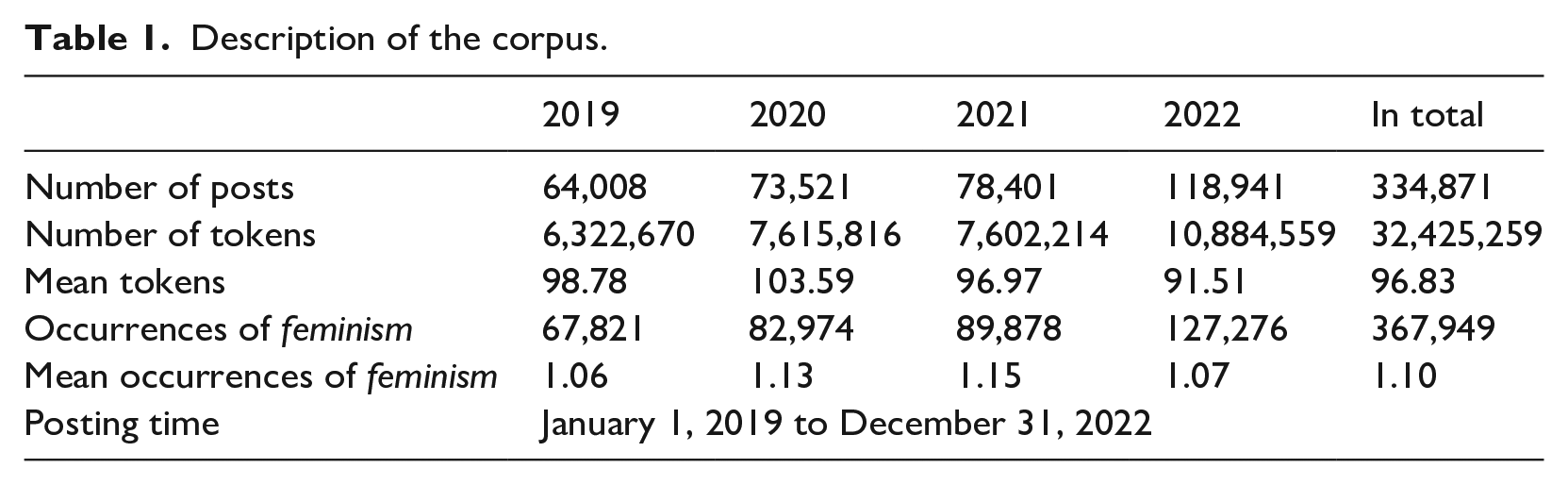
I employed the Weibo Advanced Search tool to gather discourses pertaining to feminism by searching for女权 (feminism) in daily posts from January 1, 2019, to December 31, 2022. Each day’s posts were saved in a CSV file, labeled by the specific posting date (e.g. 2019-01-01), with individual posts constituting separate rows in the corresponding file. Subsequently, files from each year were organized into their respective folders and combined using the command ‘cat *.csv >merged.csv’ to create annual corpora spanning the years 2019 to 2022 (refer to Table 1). This process yielded a comprehensive dataset of 334,871 posts, encompassing 32,425,259 tokens, within which 367,949 instances of feminism were detected. A year-over-year increase in the number of posts and instances of feminism was observed, indicating a growing frequency of discussions related to feminism on the Weibo platform during the examined timeframe.
Description of the corpus.
Regarding the ethical considerations for data collection, it is important to note that the Weibo data utilized in this study are publicly accessible. In alignment with the perspectives of Seale et al. (2006) and Ho (2022), the research use of publicly available internet materials does not necessitate obtaining informed consent from post contributors. Moreover, it is infeasible to seek informed consent from all Weibo users who generated the 334,871 posts. Following the methodology utilized by Ho (2022) and Lee (2022) in their studies on social media discourse, I have refrained from including original direct quotations in this article. The extended excerpts included in this article were translated by myself from the Chinese posts. Subsequently, I performed a Google search for all examples included in this paper to ensure the absence of any traces of the original posts and their authors. Identifiable information, including usernames and posting times, was excluded, and all posts and comments employed in this article were anonymized to ensure confidentiality protection. However, an exception was made for the post by the CCYL’s official Weibo account cited at the beginning of this article. The CCYL is a national organization, and the post has been reported by multiple news outlets, such as Beijing Evening News in Chinese and South China Morning Post in English (Yan, 2022). Consequently, this direct quotation does not raise any ethical concerns.
Data analysis
Bigram identification
I uploaded the annual corpora to Sketch Engine, a web-based corpus management and analysis tool, to extract noun bigrams containing 女权 (feminism). To exclude infrequent and uncommon items, the retrieval threshold was set at a minimum of five occurrences per million tokens across at least 30 posts. This low cut-off frequency was chosen to enable the inclusion of a larger quantity of items in the analysis. Since Sketch Engine did not offer a dispersion rate feature, I manually verified the dispersion rate using the tool’s key-word-in-context function to ensure that each bigram appeared in a minimum of 30 distinct posts. Subsequently, the bigrams were manually scrutinized to eliminate any non-nominal items. Following these procedures, I identified 108 bigrams for 2019, 113 for 2020, 118 for 2021, and 112 for 2022, as detailed in Table 2. I translated the bigrams into Chinese for inclusion in this article. To enhance the credibility of these translations, a researcher holding a Master’s degree in linguistics was employed to re-translate the translations back into Chinese, utilizing the back-translation technique. Consequently, he was unable to accurately re-translate 21 bigrams to their original Chinese forms. These items primarily consisted of synonyms, such as 真女权, 真的女权 and 真正女权, all signifying authentic or real feminism as opposed to pseudo-feminism. We then collaborated to refine the translations, confident that any discrepancies would not likely impede a proper understanding of these terms.
Description of noun bigrams containing 女权 (feminism).
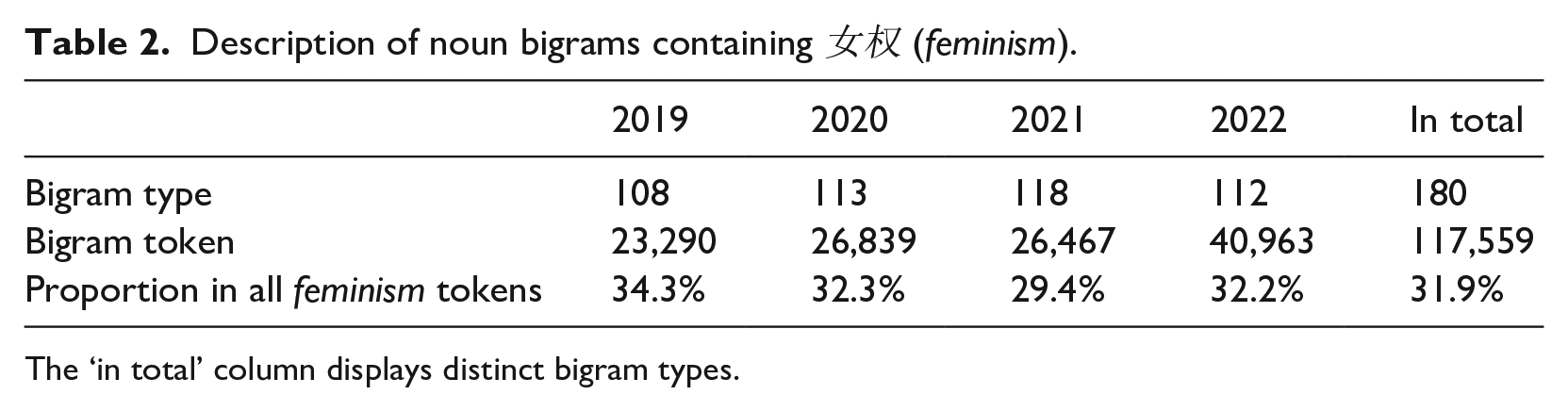
The ‘in total’ column displays distinct bigram types.
The focus of the present study was solely on noun bigrams, as they have been shown to be the most commonly used linguistic patterns to depict feminism on the Chinese internet, such as pastoral feminism (Du, 2017; Mao, 2020), feminist bitch and feminist cancer (Mao, 2020; Wu and Dong, 2019), female fist (Yang et al., 2022), and female boxers (Yang, 2022). In addition, as seen in Table 2, these 180 distinct noun bigrams account for 31.9% of all occurrences of feminism in the corpus, highlighting their importance in representing feminism on Weibo and their high research value. I chose not to focus on collocates of feminism, as recommended by Baker et al. (2013), because retrieval of collocates using corpus analysis tools is often dependent on part of speech taggers, which can result in incomplete data due to their limited accuracy, particularly for the paratactic language of Chinese. For instance, Sketch Engine found only ten tokens of extreme used as an adjectival collocate of feminism, but identified 2688 tokens of the bigram extreme feminism from the texts of 2021. This illustrates the advantage of using the bigram approach over the collocation approach in analyzing the Chinese data collected by the present study, as it yields more accurate results.
Bigram categorization and analysis
Drawing largely from Baker et al.’s (2013) approach to understanding representations of Muslims in the British press, I conducted a manual concordance analysis to categorize the noun bigrams thematically. This analysis was based on the primary topics indexed by the bigrams, rather than their literal meanings. For example, pastoral feminism in the texts refers to feminists seeking female privilege, rather than those living in peaceful countryside. To minimize subjectivity in the categorization process, the author and a linguistics MA-holding coder created a general framework together, and then performed the categorization separately. After achieving substantial agreement between the two coders in our initial coding (Cohen’s Kappa coefficient = 0.71, k > 0.60; Landis and Koch, 1977), the coders discussed and resolved any disagreements until a total consensus was reached.
To uncover changing representations, I analyzed the categorized noun bigrams in two ways. On a macro level, I evaluated the proportion and frequency distribution of items within each thematic category to identify general trends. On a micro level, I analyzed typical bigrams with high and significantly different token frequencies across yearly texts to further understand these trends. Log-likelihood (LL) tests were used to identify bigrams with a significantly higher or lower number of tokens compared to the previous year. An LL of 3.84 corresponds to a significance level of p < 0.05, 6.63 for p < 0.01, 10.83 for p < 0.001, and 15.13 for p < 0.0001 (Rayson et al., 2004).
Results and discussion
Representations
Thematic categories
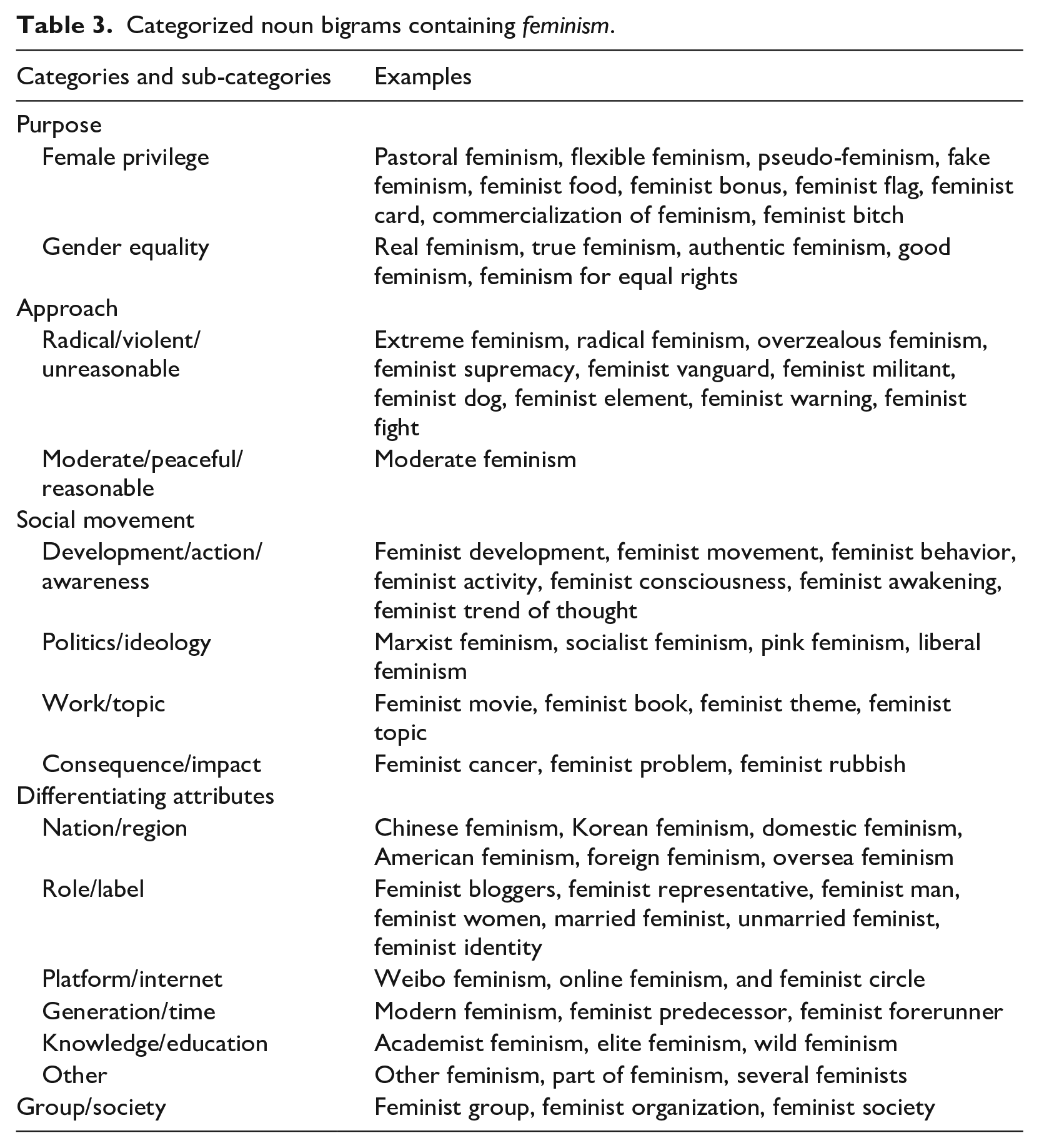
An examination of the bigrams in their contextual usage revealed five major thematic categories and 14 sub-categories (as presented in Table 3). For clarity, the original Chinese bigrams are not included in the tables below. When used as a modifier, feminism has been translated to feminist to align with common English expressions (e.g. feminist movement).
Categorized noun bigrams containing feminism.
Purpose
The bigrams in this category present two perspectives on the goals of feminism. The first group highlights a pursuit of female privilege. For example, pastoral feminism refers to feminists who seek rights but are perceived as avoiding responsibilities (Du, 2017; Mao, 2020) (Ex. 1). The term falls into the Chinese + pastoral + noun construction, where the noun is often dog in reference to a cheap and hybrid indigenous dog breed in China. This mocks the perceived hybrid origin and flexible switching between Chinese and Western ideologies of some Chinese feminists, who are criticized for using gender equality as a feminist banner/flag/card/slogan, and thus referred to as pseudo-/fake feminism. Conversely, real/good feminism represents campaigns for true gender equality (Ex. 2).
(1) I am not
(2)
Approach
This category comprises two groups of bigrams that represent radical and moderate approaches of feminist activism, respectively. The first group consists of the names of radical feminism, such as extreme feminism and radical feminism, and a series of derogatory terms used to describe the activists, such as feminist fighter/vanguard/element/dog. 分子 (element) refers to ‘people belonging to a given class, stratum, or organization, or with specific characteristics’ (Institute of Linguistics at Chinese Academy of Social Sciences, 2020: 131), such as 恐怖分子 (terrorist). Feminist element in the texts usually denotes radical feminists (Ex. 3). Dog has negative connotations in Chinese culture and language, and feminist dog portrays a violent and irrational image of radical feminists (Ex. 4). On the other hand, moderate feminism represents those who advocate peacefully and do not hold extreme negative views towards men and society (Ex. 5).
(3) Some
(4) Are students in your school potentially all
(5) Juliet belongs to
Social movement
The bigrams in this category depict feminism as a social movement and are divided into five groups based on their sub-themes. Group one relates to the development, action, and awareness of the movement (e.g. feminist development, feminist activity, and feminist consciousness). Group two includes bigrams that refer to the ideology behind the movement, such as Marxist feminism and socialist feminism, which denote a state-led feminist movement following the establishment of the People’s Republic of China. Group three encompasses works and topics related to the movement, such as feminist book and feminist theme. The final group describes the consequences and impacts of the movement, often using negative terms such as feminist cancer and feminist rubbish (Ex. 6 and 7), which portray feminism as a problematic and worthless movement, respectively.
(6)
(7) The greatest contribution to
Differentiating attributes
The bigrams in this category differentiate feminism and feminists based on a variety of attributes. Attributes include nation/region (e.g. Chinese feminism and American feminism; Ex. 8), role/label (e.g. feminist bloggers and married feminists), platform/internet presence (e.g. Weibo feminism and feminist user account), generation/time (e.g. modern feminism and post-modern feminism), and education/knowledge (e.g. academist feminism and wild feminism). Wild feminism is a metaphor used in Chinese discourse to describe feminists who have not received formal education in feminist theories or principles. Additionally, there are bigrams that do not fit into a specific theme, such as other feminism.
(8) All
Group/society
In contrast to the previous category which distinguishes feminism and feminists through various characteristics, this category portrays the participants of the movement as a cohesive entity, using terms such as feminist group and feminist organization (Ex. 9).
(9) In my observation,
Token distribution
Figure 2 shows the distribution of the bigram tokens in the 14 thematic sub-categories and the Group/society category. As shown, the category of bigrams revealing differentiating attributes has the greatest number of tokens, followed by those discussing feminists’ purposes and portraying feminism as a movement respectively. The smallest main category appears to be that about feminist organizations and society, containing 4978 tokens. In terms of the sub-categories, the bigrams pointing to feminists’ pursuit of female privilege take the largest proportion, followed by those portraying feminists as radical activists and participants in a rising social movement respectively. A substantial number of bigrams were also used as differentiating attributes to categorize feminism or feminists with varying labels and roles (e.g. feminist blogger). In contrast, the bigrams describing feminists’ pursuit of gender equality just have 8265 tokens, 36.6% of those about female privilege. More strikingly, the bigrams suggesting the moderate and peaceful approach of feminism only have 415 tokens, merely 1.9% of those indicating the radical and violent approach.
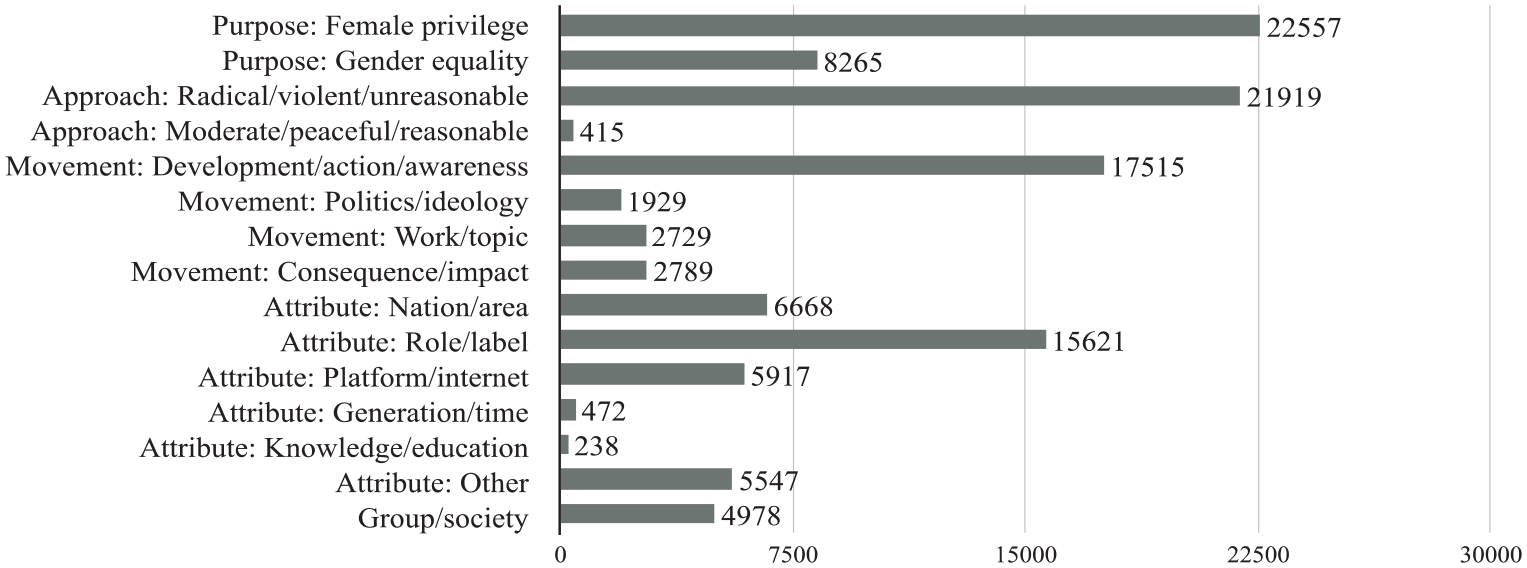
Distribution of bigram tokens containing feminism across thematic categories.
The items within the ‘differentiating attributes’ category predominantly exhibit a descriptive and neutral tone (e.g. contemporary feminism and feminist women). A similar observation can be made for most items in the social movement category, except for the sub-category emphasizing the negative repercussions of the movement (e.g. feminist cancer and feminist rubbish). The high frequency of ‘social movement’ and ‘differentiating attributes’ underscores the acknowledgment of feminism as a multifaceted and influential social movement, while the diverse attributes ascribed to feminism and feminists signify the expanding inclusivity within the movement. Nevertheless, the recurring categorization of feminists with these attributes results in a diminished perception of them as a cohesive group, which is further corroborated by the relatively low frequency of the ‘group/society’ category. This observation suggests that although online activism on Weibo thrived during the COVID-19 pandemic, the movement primarily operated on an individual level, lacking collective activism and identity. Such characteristics, emblematic of postfeminism and neoliberal feminism, have been critiqued by many left-leaning feminists (Evans and Bussey-Chamberlain, 2021).
The purpose and approach categories are where the negativity about feminism is most prevalent, as they overwhelmingly characterize feminists as seeking female privilege through a radical and violent approach, instead of striving for gender equality in a moderate and peaceful manner. This portrayal reflects a common perception of feminism in the post-feminism era as a binary construct: Extreme versus common sense. In Edley and Wetherell’s (2001) and Quinn and Radtke’s (2006) works, affirmative and derogatory representations coexisted, constructing feminism as obvious/fair and unnecessary/extreme. Calder-Dawe and Gavey (2016) discerned two contradictory feminism discourses: ‘unreasonable feminism’, which undermines feminism as fraudulent, outdated, extreme, and unfeminine, and ‘fair feminism’, which presents feminism as a response to gender inequalities. This dualistic discourse is associated with postfeminism (McRobbie, 2009) or postfeminist sensibility (Gill, 2007). McRobbie posits that acknowledging feminism facilitates dismantling feminist politics since postfeminist rhetoric claims gender equality is achieved, suppressing further social transformation demands. Postfeminist logics differentiate between reasonable and extreme feminism, constraining feminist politics and activism, and leading to ‘little room for optimism’ (Edley and Wetherell, 2001: 453). Depicting feminism and feminists as extreme and fanatical effectively discredits them, presenting feminist activism as an undesired outcome of individual feminists’ radical and contentious attitudes (Calder-Dawe and Gavey, 2016). The depiction aligns with previous research findings on representations of feminism in media (Danner and Walsh, 1999; Lind and Salo, 2002; Rhode, 1995; Wasterlain, 2020) and extends to portrayals of vegans (Brookes and Chałupnik, 2023) and Muslims (Baker et al., 2013). This portrayal of social groups as unreasonable and radical appears to be a prevalent strategy employed to trivialize and undermine specific ideologies or activist movements.
This overall negative evaluation might also be connected to the masculine crisis experienced by Chinese men due to the post-reform emergence of the neoliberal ethos. As Song and Lee (2010: 176) state, ‘[Chinese] men without money simply cannot have sex at all. They are neither able to seduce women outside marriage nor to find wives.’ The new masculinity model in post-reform Chinese society disadvantages men with insufficient economic and political power (Peng, 2020). In China, the current male to female ratio is 105.07:100, with 34.9 million more men than women (National Bureau of Statistics of China, 2021). Yang (2017) observes that the neoliberal culture, coupled with this imbalanced male-female ratio in the marriage market, grants Chinese women increased autonomy in choosing their husbands; this context shapes contemporary Chinese romantic gender dynamics, positioning young Chinese women in an advantageous position by necessitating that men secure property for marriage. Concurrently, Chinese pseudo-feminism, driven by consumerism (or She Economy) and neoliberal feminism in post-reform China, encourages interdependent relationships between Chinese women and men (Marchetti, 2009). Peng (2020) emphasizes that some self-proclaimed feminist Key Opinion Leaders like Mimeng and Ayawawa underscore distinct roles for men and women (payers and spenders respectively) within romantic relationships or marriages. These KOLs advocate for Chinese women to enjoy spending and foster economically interdependent relationships. Thus, ‘the core value of Chinese pseudo-feminism shows no differences to patriarchal ethos’ (Peng, 2020: 68), leading to negative representations on Weibo.
Some scholars propose that the negative appraisal is, in part, a result of the insufficient comprehension of feminist theories among certain Chinese feminists. Du (2017) contends that, given the limited education on these topics and disjointed perspectives on the issue, Chinese pastoral feminists may perceive gender differences as complete gender antagonism and may view favoring women over men as a means for women to attain their status. Mao (2020) posits that Chinese pastoral feminism promotes contentious views and unwarranted demands for rights without responsibility, which inevitably provoke criticism or opposition, primarily from individuals who believe that this does not represent authentic feminism.
Longitudinal variations
Distribution and frequency variations
Table 4 presents the distribution and frequency variations of bigrams containing the term feminism within different thematic categories between 2019 and 2022. Among the main categories, the ‘approach’ category saw the largest increase, with a 16.2% rise over the period due to significant increases in 2020 and 2022. It was followed by the ‘differentiating attributes’ and ‘social movement’ categories, which increased by 5.2% and 2.7%, respectively. The ‘differentiating attributes’ category saw significant growth in frequency in 2020 and 2021, but a significant decrease in 2022, while the ‘social movement’ category experienced a substantial increase in 2022. The ‘purpose’ category saw a decline, dropping from 42.2% in 2019 to 18.3% in 2022, due to decreases in 2020 and 2021, and the ‘group/society’ category decreased by 0.1%, but saw a significant rise in 2021.
Variations in the distribution and frequency of bigrams containing feminism between 2019 and 2022.
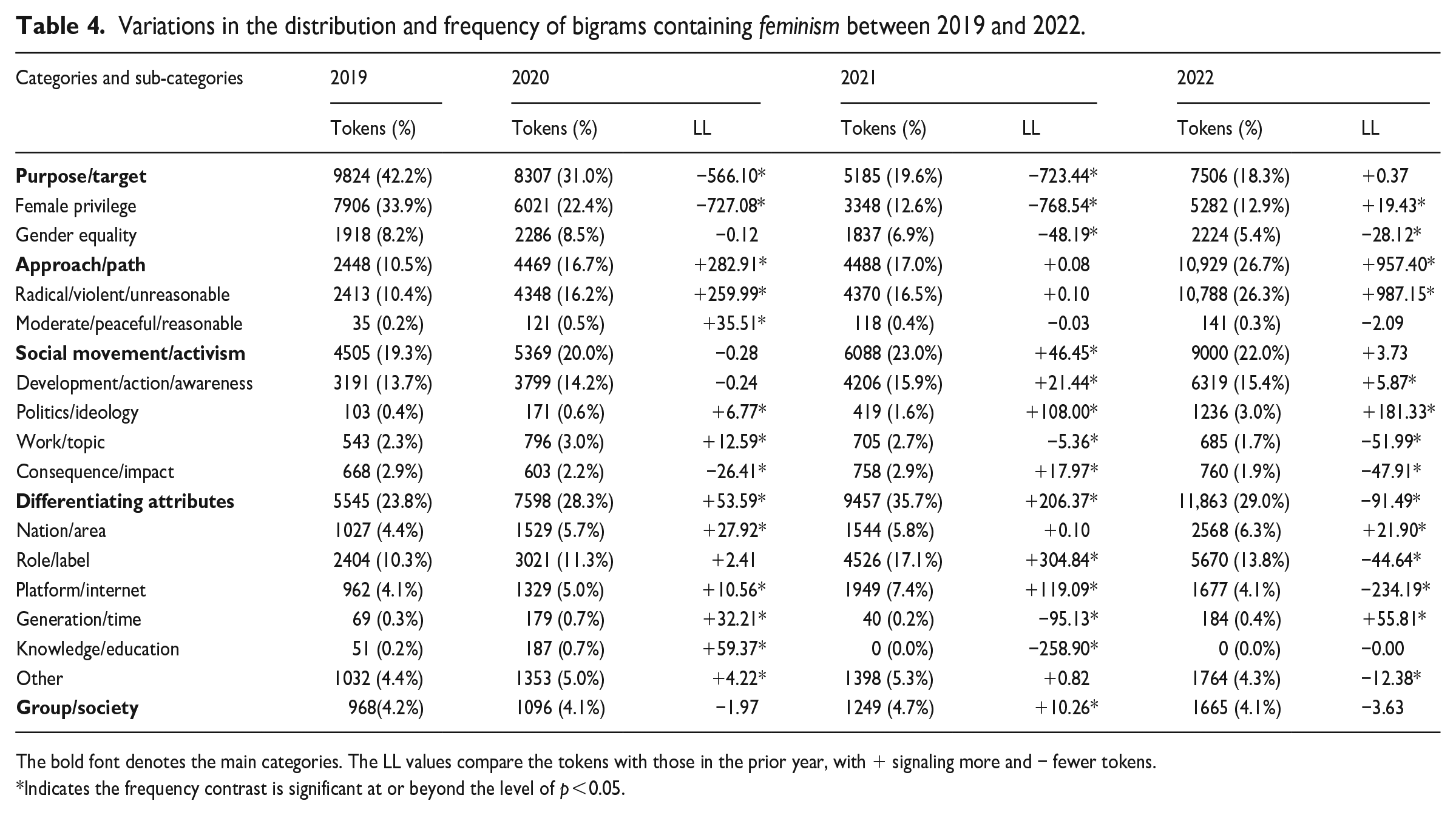
The bold font denotes the main categories. The LL values compare the tokens with those in the prior year, with + signaling more and − fewer tokens.
Indicates the frequency contrast is significant at or beyond the level of p < 0.05.
With regard to sub-categories, the ‘female privilege’ category had the largest proportion in 2019 at 33.9%, but saw a significant decline to 18.3% over the period despite a significant rebound in 2022 (LL = 19.43, p < 0.0001). This marked the greatest proportional and frequency decrease in the table. It was followed by the ‘gender equality’ category, which also decreased significantly from 8.2% to 5.4%. In contrast, the ‘radical/violent/unreasonable’ category saw the greatest growth, increasing from 10.4% to 26.3% due to substantial increases in frequency in 2020 (LL = 259.99, p < 0.0001) and 2022 (LL = 987.15, p < 0.0001). The proportion of bigrams representing a moderate and peaceful feminist approach, however, remained below 0.5%. Other sub-categories showed comparatively less marked variations. In the social movement category, the sub-categories ‘development/action/awareness’ and ‘politics/ideology’ both saw an increase of approximately 2.0%, while the ‘work/topic’ and ‘consequence/impact’ sub-categories decreased by up to 1.0%. Within the ‘differentiating attributes’ category, the ‘nation/area’ and ‘role/label’ sub-categories saw a rise of 1.9% and 3.5% respectively, while other sub-categories did not show notable overall changes over the period.
The findings indicate that while the discussions surrounding the approach of feminism were increasing, discussions on its purpose were declining. At the same time, feminism was being increasingly recognized as a growing social movement and feminists were being categorized based on a wider range of attributes that reflect their growing numbers, diversity, and influence. However, feminists were increasingly being portrayed as radical and violent rather than moderate and peaceful. This shift may be related to the rising significance of online activist discourse and gender inequalities during the COVID-19 pandemic, which brought attention to various feminist activist concerns, such as healthcare, domestic violence, and economic inequality. Feminist groups and activists in China have actively leveraged online platforms like Weibo to raise awareness about the gendered consequences initiated and amplified by the pandemic (Zhang, 2022). A comparable reaction to crises by feminists was observed by Cullen and Murphy (2016) when investigating gendered forms of mobilization in response to deep austerity in Ireland. Additionally, although the number of bigrams referring to feminists’ pursuit of female privilege had significantly decreased, it still remained the dominant representation of their purpose. This aligns with the results of Wasterlain’s (2020) study, which showed that feminism was portrayed with conflicting views, as it was associated with radicalism and extremism, but also acknowledged for its significance. This might be attributed to the ‘fragmented’ nature of social media (Bouvier, 2022: 1). Given that all users on social media platforms engage in the creation and distribution of content (KhosraviNik, 2017), a wider variety of perspectives on feminism could be encountered. My findings differ from Wasterlain’s in that I did not observe a gradual progression towards a more positive representation over time. The negative representations identified changed primarily in content but not in size from 2019 to 2022.
An interesting observation is that the radical and violent characterization of feminism had gradually become the most common discourse representation, surpassing the female privilege portrayal in 2021 and 2022. Another noteworthy discovery is that the changes in token frequency across most categories are non-linear, with sharp increases in certain years and no significant change in others. For example, the frequency of the ‘radical/violent/unreasonable’ category saw a sudden increase in both 2020 and 2022, but remained relatively unchanged in 2021. This indicates that representation shifts are not progressive and may be influenced by particular events or social contexts at the time. One such event could be the viral Weibo post in April 2022, in which the CCYL referred to extreme feminism as a malignant tumor, possibly promoting the portrayal of feminism as adopting extreme and radical methods. The subsequent section examines the extent to which extreme feminism contributes to this representation.
Typical bigrams
Pastoral feminism and extreme feminism are the two most commonly occurring bigrams containing feminism in the corpus. Results from LL tests comparing the frequencies of all bigrams from 2019 to 2022 showed that both pastoral feminism (LL = 7374.60, p < 0.0001) and extreme feminism (LL = 4064.08, p < 0.0001) had the highest LL values. Within their respective sub-categories, pastoral feminism accounts for 60.1% and extreme feminism for 68.1% of the overall tokens. The two sub-categories suggesting feminists’ pursuit of female privilege and their radical and violent approach were shown in Table 4 to be the most frequent and frequency-varying sub-categories. An analysis of the two key bigrams can therefore offer valuable insights into the evolving representations of feminism.
The results shown in Table 5 highlight the LL values of the two items, indicating a notable decrease in the frequency of pastoral feminism since 2020. On the other hand, extreme feminism has seen a substantial increase in 2020 and 2022, with no significant change observed in 2021. These changes in frequency are largely consistent with their respective sub-categories, with one exception. The sub-category of ‘female privilege’, which contains pastoral feminism, saw a significant increase in 2022, concurrent with a noticeable rise in the frequency of fake feminism and feminist flag. These findings suggest a close relationship between the representations and the high-frequency bigrams that play a significant role in shaping them. Moreover, the findings concerning pastoral feminism indicate that its high frequency, both within and outside the sub-category, might be progressively supplanted by other terms. Pastoral feminism, formerly identified as the most crucial derogatory term against feminism in various studies (e.g. Mao, 2020; Wu and Dong, 2019), appears to have diminished in significance regarding frequency, being eclipsed by extreme feminism since 2021. The substantial increase in extreme feminism’s frequency, accounting for 68.1% of the tokens depicting feminism as adopting extreme and violent methods, could be attributable to the widespread diffusion of the CCYL’s post characterizing extreme feminism as a malignant tumor.
Variations in the frequency of typical bigrams.
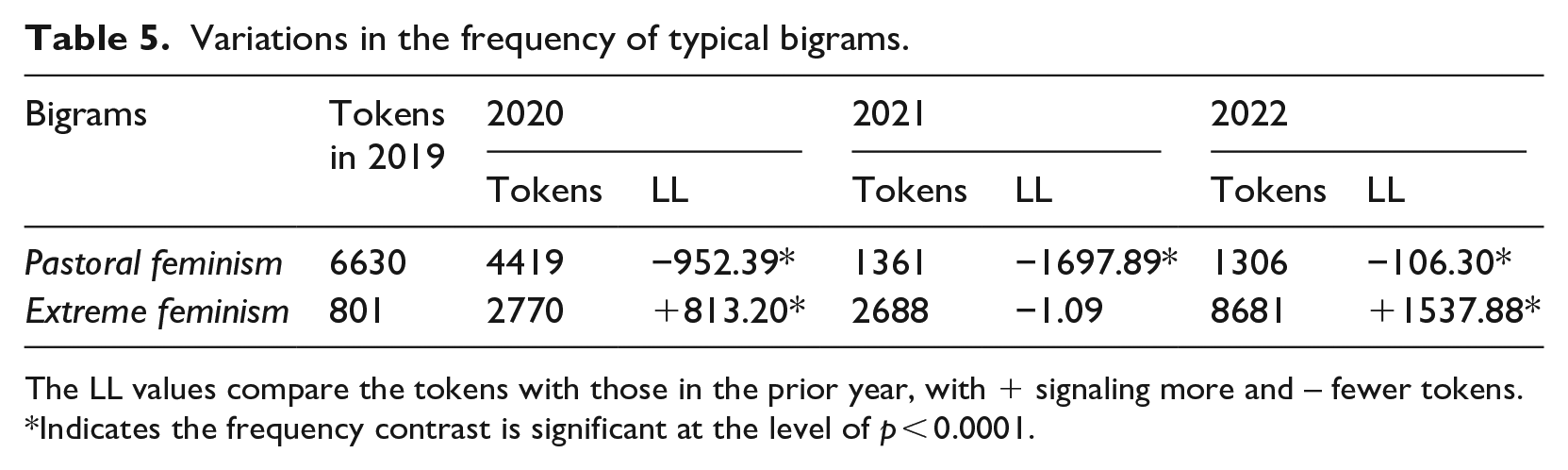
The LL values compare the tokens with those in the prior year, with + signaling more and – fewer tokens.
Indicates the frequency contrast is significant at the level of p < 0.0001.
Conclusion and implications
By analyzing the bigrams containing feminism extracted from the sample Weibo posts, I have been able to answer the two research questions with the following findings.
(1) The purpose of feminism was frequently portrayed as the pursuit of female privilege rather than the promotion of gender equality. In terms of its approach, feminism was commonly represented as employing radical and violent methods, rather than moderate and peaceful ones. Furthermore, it was recognized as a growing social movement with its own set of beliefs, actions, works, and often negative outcomes. In addition, feminists and feminism were often differentiated based on a range of attributes such as nationality, role, social media platform, generation, and education, and were less commonly portrayed as a unified entity.
(2) From 2019 to 2022, there was a noticeable shift in the focus of sample posts discussing feminists and feminism, with a greater emphasis placed on their approach and less on their purpose. During this period, feminism was increasingly portrayed as utilizing radical and violent methods, and there was a decrease in its representation as seeking female privilege, which, nonetheless, remained the dominant portrayal of its purpose. Simultaneously, recognition of feminism as a rising social movement grew. The differentiation of feminists and feminism based on various attributes became more common, leading to slightly less frequent depiction of them as a unified entity. The findings of this study also revealed that the transformation in portrayal was non-linear and strongly associated with fluctuations in the frequency of high-frequency bigrams, such as extreme feminism, which represented a radical approach, and pastoral feminism, which depicted a purpose of seeking privilege. The notable increase in frequency of extreme feminism in 2022 might be associated with the CCYL’s post, which depicted extreme feminism as a malignant tumor in April 2022. This post garnered substantial attention throughout 2022 and could have potentially fostered the depiction of feminism as radical and extreme.
While feminism had gained recognition as a growing social movement since the #MeToo movement and hashtag feminism, it on Weibo was largely portrayed as advocating for female privilege with an increasingly radical approach. These representations indicate a shift in the perception of feminism and the content and strategies used to critique it from 2019 to 2022. During this period, factors such as the COVID-19 pandemic, evolving gender norms, burgeoning online activism, and other socio-cultural elements emerged, potentially intensifying gender inequalities and conflicts. Regardless of whether the depiction of feminists as ‘extremists’ persists or escalates, negative representations associated with the movement are bound to persist and evolve. As examined, these portrayals are contextualized within the rise of postfeminism, neoliberal feminism, and the She Economy (or consumerism) in post-reform China. Nevertheless, it is essential to recognize that such portrayals have the potential to aggravate gender tensions. Both women and Muslims experience more online hate than any other gender or community (Chetty and Alathur, 2018). The abuse and harassment of women and girls in society might lead some individuals towards extremist organizations (Edwards, 2017). Given these potential consequences, it is of paramount importance for researchers to continue scrutinizing and critiquing such portrayals on Chinese social media platforms. By undertaking this investigation, it becomes viable to devise effective strategies aimed at combating the demonization and depoliticization of feminism in China, ultimately promoting a more accurate comprehension of the movement’s goals and principles.
In addition, the results of this study suggest that representations of feminism on social media can experience considerable changes within a relatively brief period. The decreased frequency of pastoral feminism and the increased prominence of extreme feminism particularly underscore the dynamic nature of online discourse related to feminism in China amid the pandemic. These findings are significant in providing a clearer understanding of how the perception and understanding of feminism is evolving on social media, and the role that high-frequency bigrams play in shaping these representations. The present study also confirmed the high research value of Chinese noun bigrams and the effectiveness of corpus linguistics methods in analyzing the changing representations of feminism. The thematic categories identified in this study can also serve as a foundation for future research exploring similar issues.
Nevertheless, the study has certain limitations. The primary limitation of this study is its descriptive nature, as it does not thoroughly investigate the socio-cultural factors that underpin the observed representations and changes. Future research is recommended to look at the incidents and hashtags that coincide with the changes in representations to shed light on the contributing factors. Moreover, this study relied on primary topics the bigrams index for categorization, without considering the possibility of multiple topics associated with a single bigram. Further detailed manual analyses and additional research resources are needed to overcome this limitation and enhance the reliability of results. Future research can also examine discourses from alternative types of platforms such as the short video-sharing site TikTok to enrich the literature and deepen our understanding of how feminism is perceived and understood by internet users in China and other parts of the world.
Footnotes
Declaration of conflicting interests
The author(s) declared no potential conflicts of interest with respect to the research, authorship, and/or publication of this article.
Funding
The author(s) received no financial support for the research, authorship, and/or publication of this article.