







Abstract
This article discusses how the economic insolvency of the contemporary mainstream media makes it particularly vulnerable to manipulation by illiberal political actors. Through a case study of CNN’s 2023 Trump Town Hall event, this article argues that democratic backsliding itself has become a potent constraint structuring news production routines and news decision-making. The metajournalistic discourse about the event maligned the role of CNN in “platforming” the former president, underscoring how platform logics have hijacked newsroom decision-making and news judgment. Journalists and other commentators pointed to the continuing power of Trump to dominate coverage and the continued inability of mainstream media to cover his threat to democracy via traditional norms of press/politics. Because news values continue to prioritize coverage of knowns over unknowns, news production routines highlight politicians with illiberal politics, who are in turn able to use the media’s discursive power to undermine democratic norms.
On May 1, 2023, CNN announced that the network would be airing a town hall featuring the presumptive Republican frontrunner for the 2024 US presidential election—Donald Trump. These programming announcements are usually just corporate public relations, but in this case, the former president was also facing 91 federal and state indictments for a variety of criminal and civil charges: his role in inciting the January 6 insurrection; stealing classified documents; falsifying business records; and unduly trying to influence the outcome of the electoral vote in Georgia, among others (Hawkins et al., 2023). Moreover, CNN seemed like an odd choice to host the candidate’s 2024 campaign debut, especially as Trump had routinely called the channel “fake news,” harassed its journalists during press conferences, posted a meme on Twitter of CNN’s logo being run over by a train, and, since 2016, had refused any interview requests from the channel.
Public stakeholders reacted with dismay and alarm. As a headline in The Guardian put it succinctly, “Dear CNN, giving Trump a town-hall platform is the height of irresponsibility,” with the subhead, “No more town halls, interviews or rallies. Coverage should be driven by clear editorial choices that serve US democracy” (Vaidhyanathan, 2023). But why did CNN decide to put on a town hall with a former president who has helped foment public distrust in democratic processes? A close examination of CNN’s Town Hall—the first official launch of the Trump 2024 campaign—orients us to newly emergent constraints that shape news production in ways that may ultimately be disruptive for democracy.
For scholars of discourse and communication, the centrality of “platform” as a key word within the discourse about the event points to a reorientation of news production values around the logics and economics of big tech companies. More existentially, the American news media has been played by illiberal, anti-democratic political power. In both 2016 and 2020, the mainstream media relied on traditional democratic norms and news routines to cover Trump, and these practices both amplified and legitimized the president’s illiberal politics and white nationalist attitudes (Carlson et al., 2021). Insurgent threats to democracy from right-wing nationalists have only grown in the ensuing years; right-wing groups have taken to faux-grassroots campaigns to organize book bans in public libraries, contest diversity, equity, and inclusion, and lobby for anti-LGBT legislation, among other causes that challenge traditional values of liberalism. In hindsight, after Trump’s resounding win in the GOP primary and his criminal conviction in May 2024, the choices made by institutional news media to legitimize the former president deserve additional scrutiny.
News production scholarship aims to help uncover the processes through which events and individuals in the world become the news content that people ultimately watch, stream, read, listen to, and so forth. For me, this question about how news is decided—the hierarchy of influences that set-in motion what gets covered and whom (Shoemaker and Reese, 1996, 2014)—is at the heart of our understanding of how journalism ends up shaping public discourse. However, I argue the single most important force driving news production is actually democratic backsliding itself: that illiberal politics undermine the news decision-making process. In trying to cover politics as usual, news organizations end up accidentally amplifying anti-democratic actors and their causes to wider publics. At present, the economic insolvency of the US news industry makes journalists especially vulnerable to pressure from illiberal political power.
To support these claims, I begin with an overview of news production scholarship and provide a broad introduction to the shifts in commercial logics of the news industry, establishing how the US news industry is experiencing platform capture due to power of big tech. I then outline how “platform” has become a slippery signifier that has nonetheless come to dominate the way that journalists and politicians alike describe the way that power, money, attention, ideas, and personality circulate among and across the public. Then, I turn to the case of CNN town hall to briefly illustrate how democratic backsliding itself is the single most important aspect for understanding contemporary political journalism.
News production scholarship today
News production scholarship helps us understand how public knowledge is discursively created via media power. Van Dijk’s (1995, 2009) has argued that journalism has social power due to its strategic control of knowledge and sustains this power through privileged access to other elites. The earlier, “first wave” of newsroom ethnography, mostly conducted in the 1970s and 1980s, provided critical insights into the “daily routines, bureaucratic nature, competitive ethos, professional ideologies, source dependencies and cultural practices of the news media” (Cottle, 2007: 1). As Cottle summarizes in his excellent overview article, these studies generated important insights into news production: it was bureaucratic, in that it was a product and process of routines, but journalism was also structured by a professional ideology (that included objectivity), and enduring news values that guided the selection and process of “newswork.” The onslaught of new technology over the past two decades since the commercialization of the Web has inspired a new “second wave” of newsroom ethnography. Much of this recent work focuses on shifting sociotechnical routines at the individual, organizational, professional, and institutional levels.
The first of these new newsroom ethnographies focused on what now seems to be quaint: the rise of the internet. These studies probed how the digital era might change how journalists thought about what becomes news, and how the internet might reorient professional role conceptions, news routines, and understandings of the audience (see e.g., Anderson, 2013; Boczkowski, 2005, 2010; Robinson, 2011; Schmitz Weiss and Domingo, 2010; Usher, 2013a, 2014, 2015). This set of ethnographies also considered emerging challenges and opportunities: the implosion of the traditional print business model (Ryfe, 2013); the rise of citizen journalism and user-generated content (Belair-Gagnon, 2015); journalists’ use of social media, especially Twitter (Revers, 2014); the introduction of digital data journalism (Usher, 2016); and the introduction of data analytics into the newsroom (Petre, 2015; Usher, 2013b). More recent news production scholarship is contextualized by a more desperate economic situation, thanks in part to the rise of “digital intermediaries” or “platforms,” the big tech companies like Google, Facebook, Apple, Twitter, TikTok, and beyond. These “digital intermediaries” serve as portals, either via search or social media, for much of the way that people now encounter news—and in turn, influence the way that news is produced, distributed, and funded (Kleis Nielsen and Ganter, 2018: 1600). This work has shifted to emphasize emerging technologies and has come to include new digital upstarts. Recent news production scholarship has focused on automation (Diakopoulos, 2019), news curation (Coddington, 2019), journalists’ strategies for building audience engagement (Christin, 2020; Nelson, 2021; Petre, 2021), and the “audience turn,” or the growing importance of audience “engagement” in newsgathering and news distribution (Costera Meijer, 2020).
But much has remained the same over the past 50 years since this first golden age of news ethnography: driving much of this scholarship is a hope—that journalism, at its best, might help power democracy, and that access to reliable, fact-based information is important for civic life. What also hasn’t changed is that the kind of information that powers democracy has rarely been aligned with market preferences. Journalism remains a bureaucratic process, constrained by the practical and material realities of deadlines, source availability, economics, and audience interest. Despite recent contestation over news values such as objectivity, news values that help journalists assign newsworthiness to events in the world remain oddly consistent. As Anderson (2017) points out, Gans’ used the phrase “enduring news values” to describe the values orienting the selection of news events worthy of coverage. Journalism continues to feature knowns more than unknowns, prioritize scandal, conflict, and bad news over good news, and emphasize episodic frames rather than thematic ones that holistically explain the “why” of news (for an overview, see O’Neill and Harcup, 2019).
American political culture and the contemporary market failure of newspapers/digital news publishing creates a new context for understanding shifts in news production, but there has been relatively minimal scholarship that has considered what these changes mean for the institutional news media. In the first wave of newsroom sociology, the dominant political culture espoused consensus over conflict—even if the norm was itself out of step with on-the-ground reality. Cook (2012) recognized that the news media was a political institution, highlighting how politicians and the news media engage in a push/pull for the power to set the discursive and symbolic frames for American politics and civic life. But today, we are at a precipice in the United States: we are witnessing the erosion of “mutual tolerance” and “institutional forbearance,” two values that underpin democratic culture (Levitsky and Ziblatt, 2019). Recent scholarship casts doubt on whether Americans can continue to preserve democratic life: as Graham and Svolik (2020) find “only a small fraction of Americans prioritize democratic principles in their electoral choices, and their tendency to do so is decreasing in several measures of polarization, including the strength of partisanship, policy extremism, and candidate platform divergence” (p. 392). As Van Dijk (1988) notes, news values are constraints that “have a cognitive representation” (p. 121); Bednarek and Caple (2014) use this insight to argue that news values are constituted through and by discourse, are not neutral, and these values of newsworthiness in turn contribute to the “(re)production of ideology” (p. 136). If politics recursively shape journalism, and that political culture is itself illiberal, journalism as the lifeblood of democracy also becomes the conveyor of democratic backsliding. While this study focuses specifically on the US news media, anti-democratic populism is on the rise across the globe, as is the ongoing capture of the global news industry by digital intermediaries/platforms like Google, Meta, and TikTok (Newman et al., 2023). The US offers the extreme case, and in this way, serves as a warning for elsewhere. The US news industry has little financial subsidy outside the commercial market; broad protections for free speech for political actors and news organizations; and minimal regulatory oversight over big tech platforms.
The economics of digital news production
News production might not be so vulnerable to illiberal politics if the commercial logics of advertising-supported journalism remained sound. The traditional political economy critique of news production is that a quest for profit is the single most powerful force structuring how news is produced and consumed; bigger profits and bigger audiences also often align with power and influence (McChesney and Nichols, 2011). More broadly, the economic concept of scarcity helps conceptualize “constraints” that shape news production—the limited time a television show has to air, the number of hours in a day to work, journalistic labor, finite audience attention, finite journalistic resource for reporting, and so forth.
While a chronicle of the economic decline of the American news industry is outside the scope of this article, these are some high notes for context. Commercial media is monetized as a dual product market—a news outlet draws news consumers through its content and in turn, sells the attention of its consumers back to advertisers. For legacy print publications, as people canceled print subscriptions, news organizations lost valuable revenue from print advertisers. Digital advertising drew far less revenue, in part because news audiences were more countable and in part because news audiences were also web audiences—with far more content competing for their time and attention. This dual product market is also the fundamental business model that powers the digital economy—and tech companies are better at harvesting attention (and user data) than news organizations might ever hope to be.
For contemporary journalism, especially for newspapers and digital-first outlets, market failure is real (Pickard, 2019)—the market can no longer support the production of news. The Great Recession marked a cliff for the rapid decline of newspaper profits and, in turn, out of efforts to manage costs, the number of journalists employed in the news industry dropped precipitously. Between 2008 and 2021, US newsroom employment dropped by 26%; newspaper employment is down by 40,000 (to about 31,000) (Walker, 2021). Since 2004, more than 1800 communities have lost regular access to local news and information—living in “news deserts” (Abernathy, 2020). Newspapers and digital-first outlets have struggled to earn enough revenue from digital advertising; Google is estimated to take at least 35 cents of every dollar of digital advertising (Montoya, 2023).
Television and cable have also had their business models disrupted by platforms, especially streaming services like Netflix, Hulu, and Amazon Prime. Television news remains popular in the United States but is increasingly challenged as Americans turn to digital devices instead of television, consume article-level on-demand video on platforms rather than via live television, and “cut the cord”—or unsubscribe from cable (Lipka and Shearer, 2023). Even in this environment, Fox News has thrived, taking advantage of an older population of viewers and a clear partisan agenda backed by Republican elites. The fortunes of the United States’ other two cable networks, MSNBC and CNN, has become more variable and dependent on drawing wider audiences from still-existing cable subscribers (Lipka and Shearer, 2023). CNN and other cable channels get a portion of what users pay for cable services; as Americans have cut the cord, not only have these subscription dollars dropped, but so have ratings, which are benchmarked against what advertisers are willing to pay networks.
Economic pressures have long driven what journalists decide to cover, and news values that prioritize spectacle and novelty have also contributed to presence of anti-democratic actors in the mainstream media. Television’s “soundbite” culture was the original clickbait, blamed for oversimplifying complex policy debates and featuring politicians who made for “good” TV regardless of the democratic merit of their politics (Patterson, 1993). More recently, national news organizations also benefited from a “Trump bump” of audience attention to national political news; digital subscriptions to the New York Times and the Washington Post tripled between 2016 and 2020 (Fischer, 2020). As the now-disgraced former CBS CEO Les Moonves said in 2016, “It may not be good for America, but it’s damn good for CBS” (Collins, 2016). What is distinct in the contemporary case is that the economic survival of journalism is intertwined with the platforming of anti-democratic politics—at a time when those anti-democratic politics threaten the dominant political and moral order and when platform logics have subverted longstanding media logics, however imperfect the balance between economics, news value, and civic import.
Platforms, the platform press, and platform politics
The slippage of the word “platform” helps trace the gradual capture of news production routines by both big tech and anti-democratic political pressure. In 2010, Gillespie noted that the “discursive positioning” of “platform” depended on “terms and ideas that are specific enough to mean something, and vague enough to work across multiple venues for multiple audiences” (p. 349). Gillespie (2010) pointed to “four semantic territories” contained within this discursive positioning: computational, architectural, figurative, and political, noting that “the emergence of ‘platform’ as a descriptive term for digital media intermediaries represents none of these, but depends on all four.” Both the verb and noun use of “platform” became central to journalistic critique of the CNN Trump town hall, in part because the word now occupies this broad discursive terrain and in part because its connotations are complementary and mutually reinforcing.
The computational understanding of “platform” includes both the Apple App Store, which gives programmers the infrastructure to have their apps reach audiences, and YouTube, in the sense that its software is the infrastructure upon which user videos are hosted and, in turn, can reach a wider distribution. Architecturally, “platform” is example of a word that comes from the physical world that takes on a new meaning computationally—someone standing on a platform (physical meaning) is boosted up over the audience for a better sightline, whereas a digital platform or “platforming” refers to the boosting and amplification of particular people, organizations, or content. If architecturally, a platform physically lifts someone up, then from a figurative semantic meaning, a platform “becomes a metaphysical one for opportunity, action, and insight” (p. 350). The political semantic terrain of platform recalls a politician or a party’s platform—despite other associations of “platform” as neutral, this political association for “platform” carries a “political valence, where a position must be taken” (p. 350). All four of these departure points for the discursive positioning of “platform”: computational, architectural, figurative, and political, take on different emphasis depending on the relative power of who is invoking the term and the social context for its use.
The Platform Press
Mainstream media is in a state of “platform capture”—when the rules and routines of newswork and politics function according to the logics of big tech (Usher, 2021). For news organizations, the rise of “platform” within the lexicon of journalism unfolded in step with the shifting news production norms and economic realities of digital publishing. To capture news audiences “where they are”—news publishers were increasingly going to have to direct audiences to their content, article by article. By the mid-2010s, news consumers were increasingly unlikely to open up their computers or mobile phones and navigate directly to the homepage or app of a news organization; instead, news consumers found news through search, social media, newsletters, aggregators, and or some sort of digital intermediary. In 2015, Facebook (Meta), Snapchat, Apple News, Google, and Twitter all introduced ways for news publishers to directly create content for their specific platforms. Via “distributed content,” newsrooms could create Facebook-specific content (or Google, or Snap) that would load more quickly and be better suited to the technological specifications of the platform. As the International Journalists’ Network (2018) put it: What it means: news media organizations hand over their content to platforms like Facebook without linking back to their own websites so that smartphone users can get nearly instant access to the content without having to wait five to 10 seconds for it to display—an eternity for impatient mobile consumers.
But platforms were not going to be honest brokers of digital content. Also in 2015, Facebook championed a “pivot to video” for news publishers, encouraging them to post video content in exchange for what would be favored algorithmic placement, delivering news publishers huge returns on traffic. But it was a lie. Facebook had goosed the digital metrics for videos in outreach to news publishers, prompting some news organizations to shift resources away from text to emphasize video production and distribution. Newsrooms blamed layoffs and financial losses on Facebook; some advertisers even pursued a lawsuit against the company (Oremus, 2018).
In 2017, the Tow Center for Digital Journalism released a report titled, “The Platform Press: How Silicon Valley Reengineered Journalism” and described the ways in which the economics of digital publishing were dependent on platforms to draw news consumers to news publishers’ digital content. The report diagnosed how big tech had captured news production and the digital news industry more generally—news production routines had become beholden to feeding social media platforms as well as Google’s search keywords. This was platform capture: news publishers could simply not exist without tech companies, and tech companies’ economic power was also undermining the market structure for news publishers. A 2023 study estimated that Google and Facebook alone take between $11.9 and $13.9 billion in revenue from news publishers through their multipronged siphoning from news search snippets to Meta’s inscrutable news feed algorithm, to the crooked digital advertising infrastructure owned, operated, and priced by Google (Holder et. al, 2023). In 2023, The New York Times reported that Google “sends 24 billion clicks per month, or 9,000 per second, to news publishers’ websites through its search engine and associated news page” (Issac, Robertson & Grant, 2023).
Platform logics also now inform how news organizations decide what becomes news and how it can best reach audiences. Even absent posting content on Facebook, news organizations are also trying to develop their own, “native” ways to algorithmically curate and target news audiences to help boost web traffic and user attention. A recent newsroom ethnography chronicled how one news outlet was designing its news personalization algorithm; authors found that it was difficult to “align[ed] journalistic values,” including journalism’s “democratic mission” with “the market-driven aim to be relevant to users in a highly competitive datafied media environment” (Schjøtt Hansen and Hartley, 2023: 924–925).
Inasmuch as the “platform press” became a way to connote the interdependencies between digital news outlets and big tech, “platform politics” became a way to refer to a similar creep of dependency by political parties, politicians, and political organizers (Kreiss and McGregor, 2018: 155). Dozens of Congressional hearings have brought the CEOs of the major digital intermediaries to testify about “data privacy/security, disinformation, antitrust concerns raised by digital platforms and the dynamics of algorithmic filtering and curation” although there has been little actual action toward platform governance, such as regulatory frameworks that would restrict platform power in these areas (Napoli, 2021: 216). Republicans have used these hearings to engage in grandstanding about “shadow banning,” “censorship,” and “de-platforming,” accusing platform companies, especially Google, Facebook, and Twitter, of deliberately suppressing conservative voices and, in their view, undermining free speech.
Amid this, platforming also became a verb—such that a politician could be de-platformed and lose access to digital platforms. While Trump had regularly violated the terms of service of Twitter and Facebook, both platforms allowed him to remain active on them. But after January 6, 2021, both Facebook and Twitter “de-platformed” Trump, along with other accounts that were identified as causing threats to public safety, control harmful content, and limit the “coordination of inauthentic behavior” (Innes and Innes, 2023: 1263). Thus, at the time of the CNN town hall, Trump was seen as too harmful to democracy and too influential in spreading misinformation to have active control over his own accounts on two of the English-speaking world’s most influential digital platforms. However, the shift of “platform” to apply to the logics of newsmaking—to give Trump a platform—represented a new turn to the word’s semantic terrain. Platform logics had so completely hijacked newsroom decision-making, news judgment, and critique that platforms weren’t just platforming or deplatforming politicians, so were news organizations.
The case: The CNN Trump Town Hall
On May 1, 2023, CNN announced that Donald Trump would be featured in one of their signature Town Hall events—which are generally imagined as sit-downs with politicians, either in a one-on-one or group setting, with an anchor asking questions and setting the timing and audience members given a chance to chime in. In the announcement, CNN directly acknowledged that “This will be Trump’s first appearance on CNN since the 2016 presidential campaign,” and also addressed the fact that Trump had pleaded not guilty to 34 different felony criminal charges, was being sued for defamation flowing from a sexual assault accusation in the 1990s, and was facing two federal investigations, one about his role in fomenting the January 6, 2021 insurrection and one about misuse of classified documents. The networks’ news story about the event also declared the rationale for the event, “The CNN Town Hall comes as Trump has quickly emerged as the frontrunner in the Republican field for president in 2024.” The town hall was held at St. Anslem College in New Hampshire, which has one of the earliest presidential primary elections, with the presumptive audience composition of Republican and undecided voters. CNN anchor and rising star Kaitlin Collins was named as the moderator; observers later commented that Collins had both quarreled with CNN’s Jeff Zucker and first worked for the Tucker Carlson-founded right-wing Daily Caller (Gomez, 2023).
In the days that would follow, dozens of commenters, politicians, experts and beyond weighed in on the significance of the town hall and Trump’s performance—with many pointing to a repeat of 2016 and 2020 news coverage, which was widely viewed as inadequate because of its failure to cover Trump as a threat to democracy, rather than as a routine “known” presidential candidate playing within democratic norms. CNN itself hosted a network-wide call the day after the event. Chairman Chris Licht would defend his decision despite rankling from staffers within CNN. A month later, on June 2, 2023, Atlantic writer Tim Alberta penned “Inside the Meltdown at CNN,” a profile of Licht and the channel that was credited with helping to fuel his ouster from the company 5 days later.
Methodological approach and rationale
The metajournalistic discourse surrounding the Trump town hall on CNN provides a helpful lens into the factors shaping CNN’s news decision-making process, which I argue serves as an exemplar for the centrality of democratic backsliding as a core constraint shaping news production routines. “Metajournalistic discourse” (Carlson, 2016) refers to the discursive process through which journalists and non-journalists critique, construct, and challenge journalistic practices, ethics, and performance as well as journalism itself as an object of power. The metajournalistic discourse about the event, its rationale, and its implications offers us insight into the overall pressures and constraints on news production. Moreover, the considerable institutional isomorphism around news production routines previously observed via ethnographic work (Lowrey, 2018) triangulates support for metajournalistic discourse as a stand-in for what I would ideally use for data about news production—first hand ethnographic observation of journalists as they work.
Thus, to assess the metajournalistic discourse surrounding the event and, in turn, highlight the dominant themes that help support my claim of democratic backsliding as the overarching influence on news coverage, I developed a corpus of 65 news articles using the Google Search term “CNN Trump Town Hall” and focused my attention on the search results with dates from May 1 to May 16, 2023. My aim was to construct a sample that was not exhaustive, but rather reflected the prevailing mainstream media discourse. The sample consisted of national and international news outlets, including 15 national television outlets, niche specialty political and media publications, press commentary (journalism trade press), and regional media (see Figure 1). These outlets were selected because of their relevance and prominence in search results as well as their influence and prominence as news brands and well-reputed specialty outlets (See Appendix A for a detailed list, including citational information for any news article from the corpus mentioned in-text). 1 I read and reread these texts four times each, and engaged in an iterative coding process, looking first for codes, concepts, and then larger themes (Strauss and Corbin, 1998): three major themes emerged that help support my argument: platforming as threatening democracy; platforming and newsroom profits; and platforming Trump-as-assignment editor.
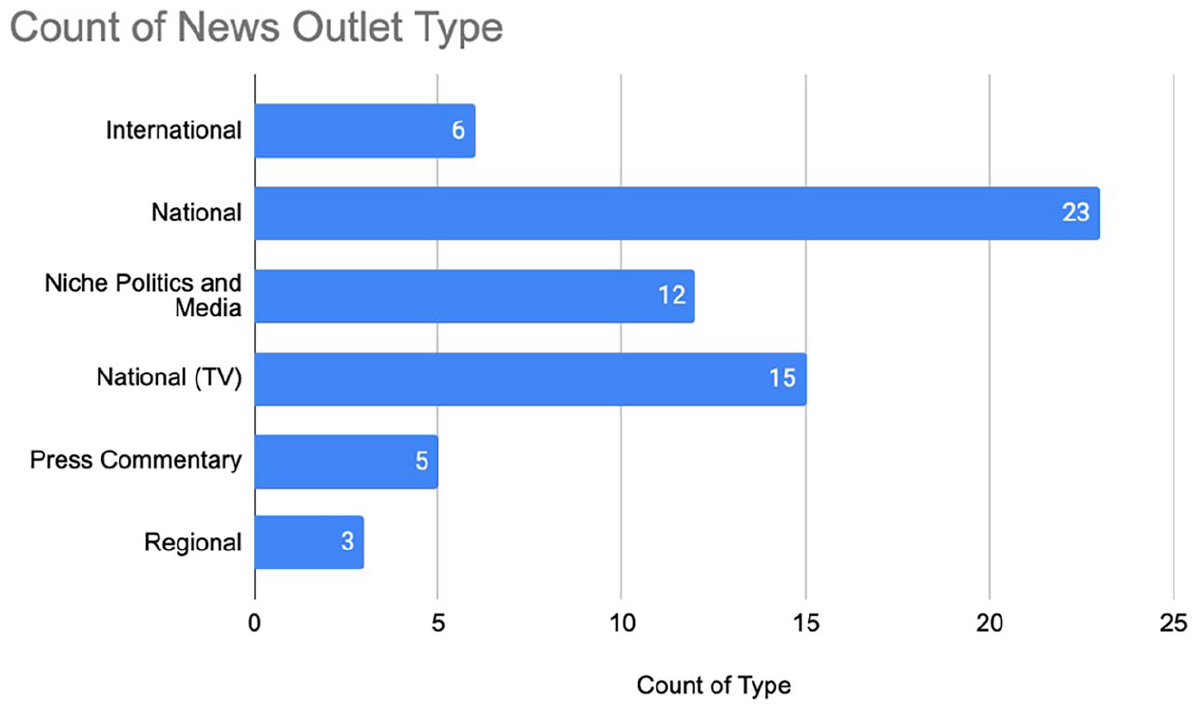
Corpus overview.
Platform—As verb, noun, and democratic threat
Both before and after the event, journalists discussed whether CNN’s decision to air the town hall was a democratically-harmful decision, invoking the word “platform,” as both verb and noun, to describe CNN’s actions in putting the candidate forward into American homes. The news production decision to feature Trump has both first-order and second-order news values. CNN is selecting to feature Trump as a known, bound up in normatively justifiable news norms wherein important people get routine coverage because the public needs to know about them. The second-order news production value, however, is the influence of illiberal politics on news production, with democratic backsliding more powerful than the traditional democratic norms of engagement and power legitimation that has historically defined relationships between press and politics. The New York Times’ reporting on the event began with a question: “Should a leading presidential contender be given the opportunity to speak to voters on live television? What if that contender is former President Donald J. Trump?” Notably, The Times did not directly weigh in on the question itself, which reporter Michael Grynbaum characterized as a “torrid media debate” with critics asking “why CNN would provide a live platform to someone who defended rioters at the United States Capitol and still insists the 2020 election was rigged” [ital. mine]. To platform Trump would also serve to legitimate the antidemocratic ideas that he pushed forward.
Other commenters also invoked “platform” to describe both the potential for legitimizing Trump’s illiberal politics as well as to invoke the wide potential reach that CNN’s town hall would have. The town hall format, which generally serves as a live Q&A with softball audience questions, also worked against journalistic norms of fact-checking and verification, allowing illiberal politics and misinformation (and democratic backsliding) to overpower journalists’ ability to curate and to frame people and events via the processes of news production. On PBS Newshour (May 11, 2023), a guest, a former NBC and ABC news producer said: When you stage a live event, you’re taking a risk, because you’re turning over a platform, as a network, as a news organization, that you have built, a relationship of trust with an audience. And, at least partly, you’re turning over that platform to the live guest who is going to say whatever they’re going to say. It was completely predictable, completely 100 percent predictable, that Donald Trump was going to lie, was going to mislead, was going to obfuscate, and was going to try to railroad the moderator. And that’s what he did. [ital. mine]
In fact, in The Guardian, Vaidyanithan specifically referenced the news production routines as embedded with this “platform” power: But he will receive the imprimatur of respectability for warranting this platform in the first place. CNN and all journalists must concede that they perform that work, despite wishing and pretending they did not. They have just been too lazy to question doing things the way they had always done things. Every major news organization has done the same. No one has wanted to admit it is a dangerous moment or new environment.[ital. mine]
The platform, as a noun, is invoked as a privilege and responsibility that CNN has the power to select and curate. However, news routines that privilege putting the president on air because he is the president or has presumptive news value is harmful for democracy. Journalists are unthinkingly and uncritically assessing Trump as similar to every other candidate, when it is clear he deviates in almost every way—which journalists acknowledged in both 2016 and in 2020.
Columbia Journalism Review’s Allsop (2023) provided an overview of the “gusher of hot takes” on May 15, five days after the initial event: Platforming Trump was irresponsible given the lies he was always likely to spew at the town hall. Actually, you can’t just wish Trump away, and the town hall was an invaluable chance to ask him tough questions and/or remind everyone of the danger he poses. Platforming Trump was not in itself irresponsible, but the format was.
In this summary, platforming is a verb that becomes a choice or pathway of action—to platform Trump was an active and conscious choice by CNN, one worthy of critique.
CNN would go on to defend the choice from this perspective; on a network-wide editorial call, CNN chairman Chris Licht said, “People woke up, and they know what the stakes are in this election in a way that they didn’t the day before.” The future of democracy provides the normative underpinning—but it is a vision of democratic life that is fundamentally premised on democratic backsliding: show Trump for who he is to the American public, because they need to know and because he is a dangerous choice for the Republic. CNN did not voice this premise, but Oliver Darcy, CNN’s senior media reporter and editor of the Reliable Sources email newsletter, did, beginning his post-town hall analysis with, “It’s hard to see how America was served by the spectacle of lies that aired on CNN Wednesday evening,” and ending it by noting “for most of the night, the nation’s eyes were transfixed on Trump’s abuse of the platform that he was given” [ital mine]. Notably, this contestation about what is and is not worthy of being featured on CNN is a debate about giving Trump a “platform”—and, akin to the logics of platform capture, news organizations, like digital platform companies, do have choices about what to prioritize at the expense of other content. Much like platforms were critiqued for enabling the spread of misinformation and undermining the distribution of news content, critics argued that CNN was proactively platforming the former president, and responsible, like digital platforms, for curating (and corrupting) the attention economy.
Platforms, newsroom profits and Trump bumps
Metajournalistic discourse also blamed CNN’s misguided economic motivations for platforming Trump. Indeed, the financial outlook for CNN prior to the town hall was uncertain, especially after the recent merger of its parent company, now Warner Bros. Discovery. In 2022, The Financial Times summarized the challenges confronting the new chairman, Chris Licht, who would “face a ratings crunch, an ad recession, low morale, tough cost-cutting targets, an editorial reset and structural decline in CNN’s business model” and pointed out an “uncomfortable truth for all news networks in America. The Trump era—brimming with anger, division and discord—had made for spectacularly good ratings and record profits” (Barker et al., 2022). Thus, the first-order explanation driving CNN’s news coverage was seen by many to be financial, but a second-order value influencing news production was the carnage of democratic backsliding, brought to live audiences by CNN.
Economic success depended on platforming (and empowering) illiberal politics. In the lead up to the event, The Guardian ran the headline “CNN’s planned town hall with Donald Trump faces criticism” with the subhead “Network and Trump had a difficult relationship when he was in office but New Hampshire event could goose both of their ratings.” The aftermath was also covered from the perspective of ratings. As the LA Times explained, “CNN’s town hall with former President Trump drew 3.3 million viewers on Wednesday, but network executives faced a tsunami of criticism for giving the Republican candidate a platform to spread lies.” In other words, CNN was selling out the American public to save its own skin. The New Republic provided an extensive critique summarizing this perspective: But if you put yourself in the shoes of a cable news executive (brain full of worms, conscience fully in “bad for America but incredible content” mode), you might be able to imagine a twisted vision in which this town hall was a win-win. For one thing, by holding the town hall, CNN was unofficially kicking off presidential primary season. Elections mean ratings boosts, and no one has ever boosted ratings quite like Donald Trump—sure, he might be a threat to the republic and the institution of journalism itself, but he always brought fireworks and eyeballs.
What so disturbed many commentators was that this play for ratings wasn’t new—in fact, it had worked, both in 2016 and 2020, although news executives were remorseful in the aftermath of both elections. Teen Vogue’s coverage of the Town Hall opened with: Hello! It’s a day ending in “y,” so a mainstream media organization has hubristically repeated an error we established as such a near-decade ago, presumably for ratings. You might’ve thought Groundhog Day had passed, but never underestimate the American political universe’s ability to make the same mistakes over and over again at great cost to its citizens.
Fox News journalists captured the sentiment, using sources inside CNN to report on the debacle. The headline for the story was: “CNN facing ‘fury’ from staffers over Trump town hall: ‘it felt like 2016 all over again’.”
But there was a broader reason beyond just a one-time ratings win for CNN. Licht contended that recapturing the loyalty of Republicans and independents who no longer watched CNN would be both good for CNN’s bottom line and, ostensibly for democracy (Barker et al., 2022). Moves to reorient the channel to be more welcoming to Republican voices began months before the town hall. As Variety explained in its write-up of the Town Hall announcement: The network has taken care to point out a new spate of bookings involving Republican newsmakers in recent months, and on Monday, aired a segment on “CNN This Morning” that examined Mike Lindell, the entrepreneur behind MyPillow, and his quest to push theories that Republicans who lost their bid for election to national office in the 2022 midterm elections, actually won.
CNN’s own coverage of the event featured the milquetoast headline “Trump’s CNN town hall is a sign of a broader and more traditional campaign strategy” (Holmes, 2023), perhaps reflecting the official network commitment to bringing Republicans back to mainstream news media. As NPR reported in the days after the town hall, the head of Warner Bros. Discovery, David Zazlav, had told investors “CNN was shedding its reputation as left-leaning,” and “All the leadership at CNN is working hard. And Republicans are back on the air. The Republicans weren’t on the air” (Folkenflick, 2023).
Republicans, however much they might peddle lies and attack democratic institutions, were going to be part of the ratings strategy for the new CNN. But appealing to the Right also had consequences for democracy, beyond just platforming Trump. The Right, in its current instantiation of illiberal nationalist populism, wasn’t just the standard “other side” of typical partisan bickering. This was a different order of anti-democratic power. If we understand one attribute of democratic backsliding to be widespread rejection by political elites of democratic norms, then CNN’s news decision-making was driven both by economics as well as by news judgment bound up in the twisted logics of democratic backsliding.
Trump as assignment editor
The third major theme that emerged across the metajournalistic discourse about the Town Hall was that Trump was once again taking advantage of the mainstream news media to push out his message—his platform through the news media’s platform—or as New York Times columnist Margaret Sullivan put it in 2020, that the mainstream media “let Trump, the great distractor, hijack news coverage and play assignment editor.” 2 Certainly, covering knowns is part and parcel of routine news coverage; after all, the expected unexpecteds of newsworthy people and places enable journalists to routinize and structure newswork. However, the interdependency of press and politics falls apart with Trump because the values that drive news production don’t work well when the known is quite deliberately aiming to “flood the zone with shit” (Paz, 2023).
In the aftermath, even headlines from reported news coverage (in comparison to opinion or analysis pieces) pointed to Trump’s ability to seize control of the narrative. These included the Associated Press’s “CNN’s town hall quickly turned chaotic, displaying the tightrope facing journalists covering Trump,” to NBC’s “Pure Trump re-injected into the main vein of American politics at CNN town hall.” The New York Times’ liveblog had a headline and subhead that read: “Trump Town Hall: Trump’s Falsehoods and Bluster Overtake CNN Town Hall. Facing questions from the audience and the moderator, Donald Trump insisted, falsely, that the 2020 election was rigged. He also dodged questions on abortion, praised Jan. 6 rioters and mocked E. Jean Carroll.”
The headlines from reported coverage also pointed to how mainstream news media had still not figured out how to avoid having Trump dictate coverage: from PBS, “CNN town hall highlights media’s struggle with how to cover Trump and his lies.” CNBC ran the headline, “CNN town hall shows the network still doesn’t know how to handle Donald Trump,” while The Associated Press’ write up of the Town Hall began by noting that Trump once again had been successful at putting the truth—and, as a corollary, journalists—on the defense: Donald Trump’s primetime return to CNN Wednesday for the first time since 2016 felt like a throwback: Trump with the long, twisting answers; the interviewer at times struggling to fact-check him or return his focus to the question at hand; and then, eventually, both talking over each other as Trump flings insults her way.
Trump was once again to direct the conversation reaching millions of American, amplifying anti-democratic norms, lies, misogyny, and misinformation, once again serving as assignment editor for the America news media—but covering him like any other candidate merely amplifies his power to undermine American democracy. As Vanity Fair’s headline and subhead proclaimed, “Donald Trump Railroads Kaitlan Collins With Lies in CNN’s Shitshow Town Hall.” The evening was an epic disaster, beyond even the worst expectations for what would unfold.
The live format made it harder to fact-check the candidate, but it is unclear whether that would have mattered. Despite the skills of Kaitlan Collins and her reminders that the election was not stolen or fraudulent, Trump took control of the opportunity to make the news his own. As Darcy explained, Trump: unleashed a firehose of disinformation upon the country, which a sizable swath of the GOP continues to believe. A professional lie machine, Trump fired off falsehoods at a rapid clip while using his bluster to overwhelm Collins, stealing command of the stage at some points of the town hall. And CNN aired it all. On and on it went. It felt like 2016 all over again. It was Trump’s unhinged social media feed brought to life on stage. And Collins was put in an uncomfortable position, given the town hall was conducted in front of a Republican audience that applauded Trump, giving a sense of unintended endorsement to his shameful antics.
To make matters worse, the Trump-friendly audience gave the Town Hall the ambiance of a Trump rally, according to some observers. The New York Magazine media columnist put it this way, “All that was missing from this CNN-sponsored MAGA rally was Trump doing his weird “dance” steps to “Y.M.C.A.”” Writing in MSNBC, Media Matters’ John Whitehouse called the town hall “literally classic GOP propaganda.”
Indeed, in both the prelude and the aftermath of the Town Hall, Trump himself made it clear just how much he was able to use this platform to help direct favorable coverage and how well he understood the vulnerabilities of the American news media. Trump was fully aware of the possibility that CNN was giving him air time in part “because they are rightfully desperate to get these fantastic (TRUMP!) ratings once again” as he noted on Truth Social. In the aftermath of the Town Hall, his campaign sent out a fundraiser that began, “I had a lot of fun taking questions from voters tonight at the town hall in New Hampshire.” For many onlookers, the town hall underscored how the mainstream media had not learned how to cover Trump like the threat to democracy that he actually presents, and again, his antics and misinformation got the boost from the news production values driving mainstream American news media itself.
Concluding thoughts: Toward illiberal discourse
My overarching argument is that shifts in news production are shaped by and shape political power–and that the dominant force driving news production are the pressures of illiberal politics and anti-democratic norms. In demonstrating this recursive relationship, this article adds value to larger debates about both the rise of illiberal politics and the market failure of journalism—and via its focus on television, augments existing work on digital-first and newspapers. While this may not be the first time that metajournalistic discourse extended the verbiage of “platform” or “platforming” to news decision-making, it is certainly one of the most high-profile. Through the case of the CNN Trump town hall, the pivot away from invoking “platform” in the context of debates that focused on what tech companies allowed to happen on their digital platforms to what news organizations choose to cover speaks to the ascendency of platform power as a hegemonic force, an unspoken structure for how journalists understand their social role and influence. While some news organizations have created a “democracy beat” to address the rising support for autocracy and nationalism, these interventions are unlikely to match the power and reach of CNN’s political coverage (Katz, 2022).
In giving Trump his first exposure as a 2024 presidential candidate, CNN was much like the digital intermediaries that profit from misinformation and give voice to those who undermine democratic norms. The shifting economic landscape of journalism has locked the fate of news in American public life in the manacles of big tech. But anti-democratic politics have more captured the American news media—a second order influence over news decision-making that is masked by the standard constraints on journalism voiced by scholars and journalist alike. Outside the United States, we see similar concerns as news organizations cover the far-right. In Europe, despite a more partisan press, journalists cannot look away from the spectacle of right-wing nationalist revanchism: “is this really happening here, again?” which also results in further free promotion of illiberal politics (examples include the rise of Marie Le Pen in France and Geert Wilders in the Netherlands, who were until recently marginalized fringe actors capturing headlines for their extremism). Illiberal politicians can also warp public broadcasting systems to bend to their will as they accumulate political power (Wright et al., 2024). This article begins from a Western democratic perspective where there are few limitations on journalists’ speech; it is important to acknowledge that in many countries around the globe, journalists are so stymied by autocrats that any hints of critique can cost them their lives (Roudakova, 2017).
Certainly, political pressure has always been a constraint on journalism, and politicians have long tried to bend journalists to amplify their profiles and politics. But we are in different terrain than ever before: news organizations really do face market failure, and this market failure is happening while the United States is experiencing democratic backsliding. Thus, journalism may be broken because its economics are failing and big tech platforms are ascendant, but fundamentally, journalism is broken because it cannot withstand the power and influence of illiberal politics.
Supplemental Material
sj-pdf-1-dcm-10.1177_17504813241266584 – Supplemental material for Why news organizations “platform” illiberal politics: Understanding news production, economic insolvency, and anti-democratic pressure through CNN’s 2023 Trump Town Hall
Supplemental material, sj-pdf-1-dcm-10.1177_17504813241266584 for Why news organizations “platform” illiberal politics: Understanding news production, economic insolvency, and anti-democratic pressure through CNN’s 2023 Trump Town Hall by Nikki Usher in Discourse & Communication
Footnotes
Declaration of conflicting interests
The author declared no potential conflicts of interest with respect to the research, authorship, and/or publication of this article.
Funding
The author received no financial support for the research, authorship, and/or publication of this article.
Supplemental material
Supplemental material for this article is available online.
Notes
Author biography
References
Supplementary Material
Please find the following supplemental material available below.
For Open Access articles published under a Creative Commons License, all supplemental material carries the same license as the article it is associated with.
For non-Open Access articles published, all supplemental material carries a non-exclusive license, and permission requests for re-use of supplemental material or any part of supplemental material shall be sent directly to the copyright owner as specified in the copyright notice associated with the article.
