






Abstract
Gambling videos involving “influencers” or “content creators” wagering real-world money are increasingly popular on sites like Twitch and Kick. To understand how this phenomenon is being presented by news media and hence disseminated into the public sphere, we examine how live streamed gambling videos are framed in the media, drawing on 120 articles from 2018 to 2024. We identify three main emerging frames – risks to young people, risks of addiction, and these streams’ questionable legality – and interrogate how these are being constructed and contextualised within expected general knowledge. The paper consequently reveals how this new form of digital gambling content consumption is being discussed and conceptualised by journalists, and hence how public debate around it is being framed. This sheds further light on how emerging gambling practices become framed within existing and familiar contexts, and shows for the first time the potential paths by which this specific phenomenon might become addressed by legislators and regulators in the future.
Introduction
Live streaming, exemplified in most countries by the website Twitch, is primarily associated with the live video broadcast of digital gaming and digital gamers (Johnson, 2024). However, rarely promoted on sites like Twitch, although not difficult to find, are channels where broadcasters (known as “streamers”) are instead streaming their digital gambling activities. Viewers of these channels are typically presented with a live screen capture of the streamer’s computer, generally showing an online slots site – though also sometimes online blackjack, other casino games, or poker – and in most cases a webcam. In these broadcasts viewers observe the real-money gambling practises of others, seeing their successes, their failures, their wins and losses, and very importantly, the emotional and affective and embodied responses to those events (Jodén and Strandell, 2022; Woodcock and Johnson, 2019a). This dimension is familiar in studies of “influencers” (Abidin, 2016) and “content creators” (Zhang and Wu, 2022), who are noteworthy online individuals able to accrue significant followings on the basis of their videos, other posted material, opinions and perspectives, and an ability to engage and entertain audiences, often across multiple social media platforms (Glatt, 2022; Johnson, 2024). While the definitions and relationships between influencers and content creators are complex, research supports an argument that the more successful live streamers can indeed be understood as influencers (Sixto-García and Losada-Fernández, 2023; Woodcock and Johnson, 2019b), and so we proceed from that basis in this paper – especially relevant in light of recent research supporting a hypothesis that gambling streamers do, indeed, make their viewers more likely to gamble (Johnson and Jackson, 2025; Wu et al., 2024).
Gambling live streaming specifically is therefore important because it marks a wholly novel intersection between two important and well-studied online phenomena – online and digital gambling, and influencer culture. Given its contemporary nature, very few externally-reviewed publications have so far addressed these gambling videos. Wu et al. (2024: 975) stress that gambling live streams are “exciting” to watch, because “streamers broadcast themselves engaging in intense forms of gambling, such as placing high-stake bets, receiving jackpot wins, and suffering heavy losses”. Johnson and Jackson (2025: 11) similarly state that we must strongly “consider the appeal that influencers and ‘content creators’ have for their fans and how exciting their activities can easily seem” when it comes to understanding the allure of online gambling content of this type. Hoebanx and French (2023: 66), meanwhile, have rightly called gambling videos an “under-regulated media”, arguing that user-created videos are increasingly becoming “a form of diffusion of gambling mechanics beyond traditional gambling venues” – and thus important to address. A fourth publication in this area notes the presence of other live streams which are not focused on gambling content, but nevertheless might integrate gambling mini games, or offer lotteries or other gambling style competitions to their viewers (Abarbanel and Johnson, 2020). These interventions have laid important groundwork and identified the importance of getting to grips with this online phenomenon, but we presently know nothing about another vital aspect of gambling live streaming – specifically, how this novel and emerging practice is being discussed, framed, and articulated, in the media. Answering this question for the first time is the goal of this paper.
News coverage communicates how technologies and practices around them are situated within society. News media have long been a key source of political information (Terkildsen and Schnell, 1997) and play a significant role in the shaping of public opinion regarding issues of debate and controversy (Haynes et al., 2016). Journalists and journalistic outlets make decisions about which details to emphasise and which ones to downplay or ignore, and these influence what publics learn and, potentially, how they feel about the subject matter (Chong and Druckman, 2007; Entman, 1993; McCombs, 2004). In the case of online gambling, Berzovan et al. (2025) observe that media framing also often influences legislation, regulation, and commercial practices. As the “expansion of Internet gambling” continues to “outpac[e] peoples’ understanding[s] of the phenomenon” (Wood and Williams, 2009: 6), it is all the more important to understand what information is being distributed on a novel phenomenon like gambling live streaming, and hence what information is shaping public understanding. Much work has indeed been done to date analysing news media framings of gambling (e.g. Miller et al., 2014; Reith and Wardle, 2022) and gaming as well (e.g. McKernan, 2013; Williams, 2003), as well as coverage of influencers and influencer culture (e.g. Droz-dit-Busset, 2022).
Gambling live streams, however, represent a wholly new practice, existing at an intersection between these topics – and it is these we therefore explore for the first time in this paper, through a content analysis of 120 news stories from 2018 to 2024 which addressed gambling live streaming. Our goal here is therefore not to assess or critique the quality or accuracy of this coverage – although we will of course compare against research findings when appropriate to shed further light on a particular idea – but rather to contribute a clear understanding of how this topic is being framed and presented as a matter for public concern. We find that while coverage in many ways draws on existing framings of gambling, it is complicated by journalists including many other domains as well (e.g. social media, gaming, and of course influencers) – thus framing gambling live streaming as something not simply reducible to gambling itself. In doing so the work demonstrates that potential future approaches to gambling live stream regulation might take different paths – for example, those more traditionally associated with platform regulation – from those ordinarily pursued with gambling, and more broadly reveals that new gambling phenomena are not always presented in journalistic work solely through existing tropes of gambling, but in ways that do acknowledge their complexities. At a moment where gamblification (Macey and Hamari, 2024) is a major online trend, this is an important broader finding that may also shape future journalistic framings of such phenomena – including future ones we cannot yet anticipate.
Existing research
Live streaming has emerged in the past decade as a major online media industry. Twitch, in most countries the dominant market leader, is one of the fifty most visited websites in the world. The site is primarily associated with games and gaming (Johnson, 2024; Taylor, 2018), while non-gaming content includes “Just Chatting” streams where broadcasters host conversations with their viewers about a range of topics including current affairs, or mental health and wellbeing. Other live streams are creative, foregrounding artistic works, writing, programming, and things of this nature, and some streamers broadcast themselves at real-life events such as music concerts, or in restaurants or shops. The (growing) prominence of non-gaming content on Twitch is shared by other platforms like YouTube and TikTok, but relative newcomer to the livestreaming scene, Kick, hosts content focused heavily on gaming, as well as on gambling. Kick has seen essentially no scholarship to date but is a key player in the gambling live streaming scene that we examine here. The site is framed as a less regulated alternative to Twitch, thereby engaging with alt-right and far right discourses about “free speech” (Browning, 2023) while also sitting within a border nexus of start-up culture, cryptocurrency, and gaming, as well as Kick’s sharply reactionary ideological stance. These factors between them have generated a toxic technoculture (Massanari, 2017) on the platform which has only begun to see study, but this smaller site’s strong and growing associations with gambling make it, alongside Twitch – much larger and containing some gambling content, but without any emphasis on gambling – the two most essential places to study when it comes to gambling live streams.
Focusing via coverage of these sites on the emerging media framings of what gambling live streams are, and why this subject matters, is the goal of this paper. Many media theorists adopt the concept of frames to explain and understand the effects of media editorial judgement on public perceptions of contemporary phenomena. Initially developed by Goffman (1974), frames are cognitive structures that individuals use to make sense of the world around them. Framings and discourses establish one’s “understanding of the nature of specific issues” (Francis and Livingstone, 2021: 212) and are thus “never neutral” (Van Hulst et al., 2025: 79) – even if ostensibly intended to be by their creators. A frame can therefore be seen as that which is used to “define a situation, to define the issues, and to set the terms of a debate” (Tankard, 2001: 96); that which determines “how are issues constructed, discourse structured, and meanings developed” (Reese, 2001: 7); or simply the presented “definition” of an “issue or situation” (Van Hulst et al., 2025: 79). The power of framing is thus found its “ability to define the terms of a debate” without others necessarily noticing this is taking place (Tankard, 2001: 97), and as a result, studying framing therefore helps us to understand how concepts and language are “used strategically to frame a particular topic” (Lindekilde, 2014: 200). Discourse analysis and framing analysis do belong to the same “family of analytical frameworks” (Lindekilde, 2014: 196), but whereas discourse analysis focuses on hegemonic and dominant discursive structures, framing analysis looks at meaning construction (Van Hulst et al., 2025: 74) – in this case, what is the meaning of gambling live streaming as a phenomenon, as constructed through journalistic work?
This is a useful enquiry because news media use frames to convey information, promote certain interpretations or solutions to issues, and otherwise attempt to guide perceptions of particular topics (Entman, 1993; McGinty et al., 2019). This makes journalists an important source of framing for public issues (Pan and Kosicki, 1993: 55) and of positive and negative valorization of contentious topics (Lindekilde, 2014: 200). They set the tone for a phenomenon by “the choice of frames” (Tankard, 2001: 98) in their writing or reporting, which is why framing analysis has indeed often been used in examining news materials to understand how contemporary topics are presented in public discussion (van Dijk, 2023: 151). Framing analysis allows us to examine how news reporting connects new phenomena or events to existing ones in readers’ minds, and is particularly valuable when we consider the legitimacy that journalists possess as speakers to fact, reality, and current events (Humphreys, 2010: 491). News stories and journalistic work can deploy many kinds of rhetorical techniques (McMullan and Mullen, 2001: 324) by which frames are emphasised and others not mentioned, and in doing so shape the way opinion on a topic is formed. Framing analysis is thus distinct from discourse analysis or content analysis by understanding news texts as items that interact with individuals’ existing understandings of phenomena (Pan and Kosicki, 1993: 58), and by focusing on how “ideas, culture and ideology” are combined with “certain situations or empirical phenomena” – gambling live streaming – to create ways that the world is understood by readers (Lindekilde, 2014: 196).
Coming now to our specific enquiry, we note that given how little research exists on this cutting-edge phenomenon, existing scholarship has not yet considered it from a framing analysis point of view. Framing analysis has long been an important part of understanding contemporary gambling practices and the contemporary gambling industry as a whole, however, which immediately highlights the value of treating this new practice in the same manner and comparing and contrasting it against other gambling phenomena. Gambling is a common topic in news and newspapers (McMullan and Mullen, 2001: 321–322) and the press is understood to shape how we think about gambling certainly as much as other elements of popular culture or advertising (Borch, 2012: 55). Responsible gambling itself has indeed been studied as a discourse and framing (Livingstone and Rintoul, 2020), showing the use of this approach to gambling as a topic area. Of particular note is how the gambling sector in the past few decades has successfully carried off the “feat” (Francis and Livingstone, 2021: 212) of normalizing the practice into a form of everyday entertainment, and this contemporary and highly pervasive framing of gambling as “innocent” (Borch, 2012: 58) entertainment (Miller et al., 2016: 172; cf. McMullan and Mullen, 2001: 322) is an important antecedent to our own study. Such a framing is of course generally being applied when used to the play of gambling – but what about its spectating? Scholarship has found that even an imagined presence of others affects how people gamble (Rockloff, 2004), and live streaming takes this out of a context of possibility and into a reality with tens, hundreds, or even thousands or more spectators tuning in to watch a gambler play. This is an extremely novel and contemporary development that has become large enough to gather mainstream interest from journalists – but how is the topic being framed? For the reader who knows nothing of gambling live streaming, videos, or influencers or content creators, how will these be inserted into their understanding of the world? Hence, rather than focusing on gambling behaviour – which gambling studies tend to prioritise – we are instead focusing on the “social structures” that inform and shape this gambling phenomenon and its reception (Borch, 2012: 55) – in this case, journalism.
Considering such questions for a novel sociotechnical practice is not a new approach for research to take, though our case study of gambling live streaming is a wholly new case study with which to ask them. Emerging technologies or practices are always subject to social construction via frames, as their meanings are constantly contested and renegotiated by various voices across society (McKernan, 2013). For example, Miller et al.’s (2014) study of “problem gambling” coverage found outlets discuss solutions to the issue more often than causes or consequences for those affected, emphasizing politics over communities and health outcomes. Media attention has also, historically, been central to the formation of mythologies and moral concerns around gambling (McMullan and Mullen, 2001). News media can thus influence perceptions of these activities and notions of what is (un)desirable about them and how (if at all) individuals should respond to or interact with them (Reith and Wardle, 2022). Public framings of a consumption practice can shape the acceptance (or not) of that practice (Humphreys, 2010: 490), and journalists can play an important role as a result of their legitimacy to speak with perceived objectivity on important topics, and hence their role in “shaping public debate” around issues (Pan and Kosicki, 1993: 69). It is therefore important that we build an understanding of exactly how gambling live streaming is being framed, and hence potential ramifications on the ongoing social construction of the practice. It is new, rapidly growing, and potentially impactful on viewers’ lives, and therefore looks set to become a major area of discussion in and around gambling in the coming years. Gambling live streams’ status as a highly contemporary and – as we show – highly controversial form of online content makes them important to bring into scholarship surrounding gambling’s embedding into (or resistance from) contemporary societies, and how journalistic framing shapes and influences this process.
Methodology
There are already hundreds of news stories on gambling live streams across both mainstream and specialist presses. The fact that any are in the mainstream press at all demonstrates that this may be emerging as an area of interest to the wider public, while the predominance of specialist presses demonstrate that this practice is getting significant attention in gambling, gaming, and tech circles – which are not small audiences in their own rights. To conduct our study of gambling live stream news stores and coverage we used three databases – ProQuest, Gale, and Factiva – on which we searched for “(stake.com OR stake.us) AND Australia AND gambl* AND (Twitch OR Kick OR stream*) and (Twitch or Kick) and gambl*”. The first of these searches reflected the fact this project was funded by an Australian grant and thus needed to reflect any commentary here that specifically addressed the Australian context, but was also highly relevant for other reasons as well. Australians are amongst the highest gamblers on the planet (Sullivan, 2024), and Kick is led in part by an Australian owner (Whittaker, 2025), with online cryptocurrency casinos Stake.com and Stake.us also being Australian-owned services connected to the ownership of Kick and thus in the phenomenon of gambling live streaming. The second search term, by contrast, was kept as wide as possible with the goal of capturing any mention of gambling on Twitch and Kick, and to secure a broader global perspective on the same issue (since these are global platforms, with viewers from almost every country on the planet). We elected to focus on articles over a 6-year period, starting from 2018 and ending with the project’s completion in October 2024.
To these articles we also added those from a Google search using the keywords “gambling”, “Twitch”, and “Kick”, to catch any missed by the above databases. Once these were all collected, we first took stock of the 120-article dataset that had been acquired. There was significant variation by country across the collected articles, with 40 of the stories being from outlets based in the United States; 23 from the United Kingdom; 20 from Australia; 11 from Bangladesh; 8 from India; and the remaining (all below 5) from Canada, the EU, Hungary, Malawi, Malta, Thailand, Turkey, and Zimbabwe. With Twitch based in the United States and Kick based in Australia, these were unsurprisingly near the top of the list, although we had not anticipated seeing particular interest from the Indian subcontinent on this topic. Outlets collected in this search were a mix of types, including major global newspapers such as The Guardian and the New York Times, local newspapers such as the Sydney Morning Herald (Australia) or the Chiang Rai Times (Thailand), tech sites such as The Verge and Dexerto, and a handful from gambling-related news and commentary sites such as PokerNews and Blockonomi. This variety demonstrates both that this is an area of interest for specialist outlets – gaming, tech, gambling, and so forth – but also mainstream outlets as well, and across a broad geographical spread. In terms of publication date, 71 (a little over half) of the articles collected were from 2023; 24 were from 2024, and 23 from 2022; and only one from 2018 and one from 2021. It was 2022 and 2023 when the controversy around these broadcasts peaked on Twitch (before the site took some action to partially limit their scope 1 ) and so these are unsurprising, but the phenomenon remains visible in public attention as demonstrated by the 2024 data, and – although outside of our dataset – a momentary search shows just as much attention being paid to the topic in 2025 as well.
Once collected and categorised, these materials (to which we assigned numbers between 1 and 120) were subjected to thematic analysis (Cain et al., 2017; Huang and Loo, 2023; Kersbergen et al., 2022). We began by identifying the topics discussed in each article – since some of them covered issues that were only raised once (e.g. a specific national context) we focused our coding on regularly-occurring ideas that were found. Coding was inductive in nature and we proceeded without any assumptions about what sort of issues would be addressed or discussed in this news coverage. We sought common points of discussion, topics which appeared regularly, and particular framings or perspectives which repeated themselves. These would all be able to point us towards an understanding of how gambling live streaming is being mediated and understood by the press, and hence how it is being understood by the average person getting their information about this novel phenomenon through such journalistic and commentary sources. The dataset was coded and double-checked by the third and first authors, and this initial process led to 21 codes in total where a topic or subject was mentioned more than once, with the least common recurring code appearing in only 2 of the 120 articles and the most common code appearing in 48 of the 120 articles. The fact even the most common code appeared in below half of the sample showed that although these articles are all discussing gambling live streams and video content, and more broadly sometimes gambling influencers and content creators, the specific focuses are diverse. This is a key finding we explore in this paper, and highlights the connections this area has to many different news interests and to many other contemporary online phenomena – and thus cannot simply be reduced to coverage of “gambling”, or even “online gambling”. Although the coding process was inductive, it was of course anticipated that some topics would be likely to arise, such as discussion of Kick’s connection to gambling site Stake, for example, or the increasing blurring of lines between gambling, social media, and digital games. These did indeed appear, but others were less predictable. For example, we were surprised to see 18 of the 120 sample discussing issues around labour and work sustainability on live streaming sites (see Johnson and Woodcock, 2017), which are issues that certainly apply to all streamers – not just those producing gambling-related material.
Our coding process led to three major themes which were consistent across all kinds of outlets – the importance of considering this phenomenon in the context of children and teenagers, the possibility of addiction from their viewing (and their play by streamers), and questions and challenges around legislation and regulation. Each of these themes had a primary code which was the same as the theme and directly reflected in around a quarter of the articles each (30, 28, and 39 respectively), all of which were themselves amongst the largest codes, but were distinguished by having also a number of additional codes which were often associated with those themes. For example, discussion of the Stake.com cryptocurrency casino, whose ownership is related to that of Kick, and Stake’s owner Ed Craven, was often invoked in discussion of the legislative and regulatory questions posed by these broadcasts. In total 98 of the 120 articles had at least one code within the three key themes (see Table 1 below), demonstrating the representativeness and importance of these three dominant themes, and hence the emergence of three very distinct and clear dominant frames coming into being about the phenomenon.
Breakdown of themes, codes, and number of articles in each theme.
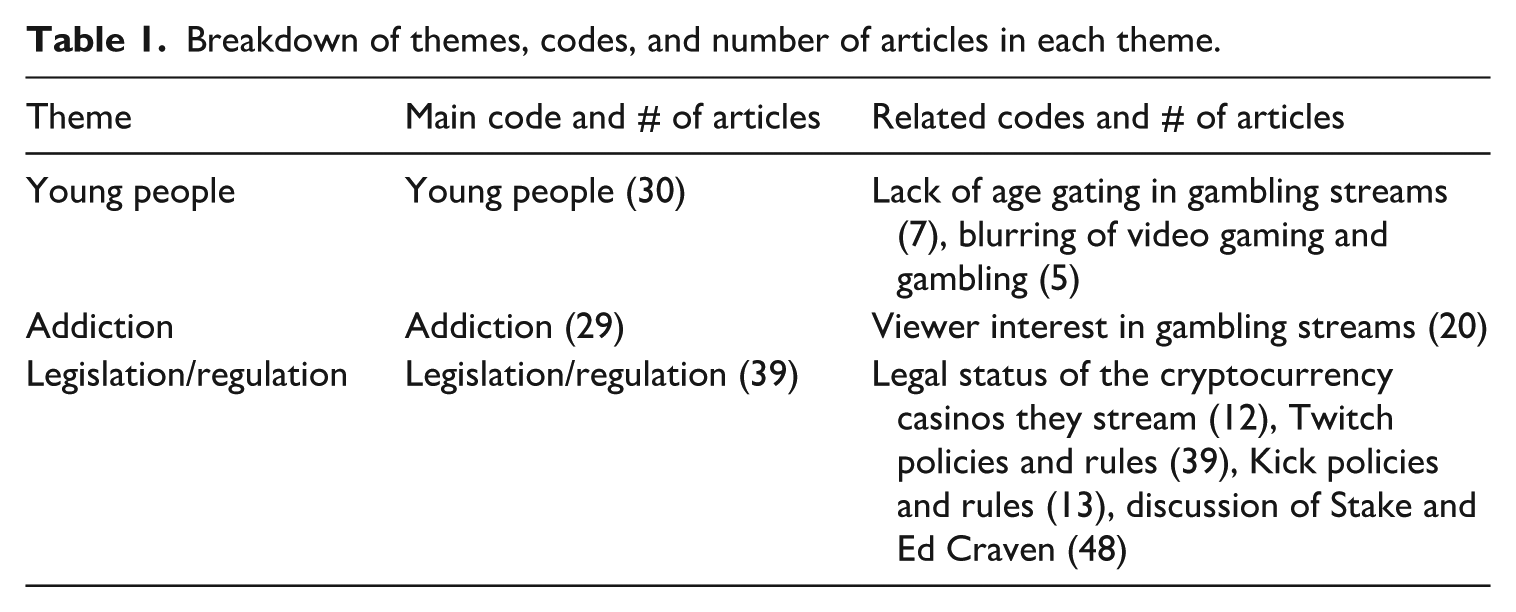
In the following discussion we therefore centre our analyses around each of these three themes in turn, drawing mostly from its primary code but also from related codes and occasionally other articles where useful. Our goal is not to pass judgement on reporting quality, but rather to identify repeated framings and perspectives being used to explain this phenomenon to readers, and being used to situate it often within other debates, issues, and contemporary phenomena. To do so we draw on direct quotes extensively and thus note that these quotes are, of course, not inherently indicative of factual correctness, but rather the creation and emergence of frames, discourses, and primary concerns around the issues at play. Across these themes we thus found three major frames emerging in discussion of this phenomenon, but also the entanglement of these frames with other topics including, as previously noted, the ongoing gaming-gambling convergence, major internet platforms, social media, influencer experiences and lifestyles, and other topics. These collectively demonstrate for the first time how gambling streamers and content creators are emerging as a distinct topic for public interest and concern, but also their emergence as one factor amongst many in a rapidly-changing digital ecosystem, leading to their framing in ways somewhat like, and somewhat unlike, traditional gambling. This is an area that is likely to continue to draw attention, especially at a moment of increasing interest in platform regulation in Europe, the social media legislation now emerging in Australia (Cover et al., 2025; Taylor, 2025), similar legislation being considered in the United Kingdom (McCallum, 2026), and so forth. It is hence a valuable moment to understand how new gambling-related phenomena become framed in the media, especially when gambling live streamers and influencers, gaming-gambling convergence in digital games, the staggeringly rapid rise of offshore cryptocurrency casinos, and many other similar, fast-moving, and singular, trends, are all coming into being with striking speed and little to no regulatory oversight.
Discussion
Children and young people
Our first finding is the regular invoking of children and young people in these articles, and the emergence of this topic as a core frame in which gambling live streaming is presented to readers. For example, one stated that “gambling on Twitch has become a hot-button topic as wealthy streamers seemingly promote their services, ostensibly to minors” (#111). Another wrote about the “concern that the abundance of gambling on Twitch was turning kids on to online gambling” (#45), and others stated that critics assert such broadcasting “promotes gambling to children since under-18s are big users of live-streaming” (#64), in part because “the site has long turned a blind eye to gambling streams” (#9). Others, however, argued that what takes place in these streams is not children stumbling into these channels, but broadcasters with a good reputation amongst children then shifting into gambling content. For example, one stated that “creators who have built up enormous audiences for playing games aimed at children like Fortnite are streaming themselves betting large amounts of money” (#100). Several articles in turn stressed the lack of age control on Twitch, with one saying “it’s possible to access gambling sites from Twitch with absolutely no age gates” and that “although content creators can mark their streams as for ‘mature audiences’, only a handful of streamers actually do this” (#1). Another noted that “Kick asks users to confirm they are above the age of 18 when viewing certain content, including gambling” (#64), but like Twitch, this only involves a simple yes-no prompt – and nothing prevents a young person from simply clicking “yes” and then watching that content. This quote from one article well thus encapsulates a lot of the concerns articulated in these pieces, talking about some of the sites these streamers play on and broadcast from: This works like any other casino. You load up your account with funds, place a bet, watch the graphics spin and either win or lose. The big difference in this case is that the casino taking your bet has no gambling licence and, in some cases, no reliable mechanism to stop under-18s getting their first taste of gambling – via an online ecosystem that is, to many parents, a total mystery. (#80)
Individual live streamers and their responses to gambling channels were also quoted in discussions of children vis-à-vis these channels, in ways that give us significant insight into the many entanglements of gambling live streaming being used to frame and present the phenomenon. One story, for example, noted that streamer Felix “xQc” Lengyel, “who previously admitted to a gambling problem”, has since “apologized for exposing his audience, much of it underage, to his gambling content” (#104). Another article, meanwhile, stated that “controversial streamer Nick ‘Nickmercs’ Kolcheff recently announced a massive $US10 million deal with Twitch rival Kick”, and that “although he once implored pro-LGBTQIA people to ‘leave children alone’, he’s not worried about teaching children how to gamble” (#102). Here we see gambling live streaming being contextualised within the ongoing culture war playing out on digital platforms, with toxic technocultures reaching newfound prominence by rejecting progressive politics in favour of those focusing on individualism, self-interest, and a strong rejection of diversity. A third article stated that “according to xQc, the streamers who wanted gambling banned don’t care about children and were actually jealous that he and other creators were making bank with gambling content”, adding that xQc asserted that Twitch’s claim to protect children by reducing content on Twitch was a form of “gaslight[ing]”, given what he perceived as adult content to still be allowed on the site (#115). This claim places gambling live streaming within the context of the broader gender politics of Twitch, where the presence and visibility of women’s bodies continues to be a source of contention and struggle (Jackson, 2023). Equally, xQc’s statement about streamers’ primary drive of making bank places the phenomenon in the context of the now well-known entrepreneurial and neoliberal logics that dominate much of live streaming (Johnson and Woodcock, 2017) and influencer and content creator culture more generally.
Other news stories, meanwhile, discussed “youth” as a more general concept for articulating the potential harm of gambling live streams – that is, to “young people”, but not specifically using the framing of “children”. Prominent in this regard were arguments that gambling live streams are tantamount to advertising, and specifically advertising targeted at young people. These included a statement that “streamers functionally advertise gambling websites to an audience that skews young” (#9); another that “streamers effectively market gambling companies to a young audience” (#13); another that “these content creators are sponsored by offshore casinos that are offering them lucrative deals, free money to gamble with, and incentives to encourage as many of their young fans as possible to sign up” (#100); and one noting that “Twitch banned gambling sites like Stake back in 2022, after users voiced concerns that prominent streamers were promoting sites to young, impressionable viewers” (#102). Others emphasised the risk of problem gambling for this group rather than the advertising-like nature of these streams, such as the observation that “around 6-9 percent of young people struggle with gambling compared to 1 percent of adults, according to the National Centre for Responsible Gambling” (#9), and another that gambling live streams are “designed to attract a young audience who are particularly vulnerable to being drawn into addiction by the gambling industry” (#19). Youth was also invoked in some other stories, such as one which noted that “Kick has 21 million accounts and has carved out a niche as the newest home for young male viewers” (#76), and another which noted that “Turkish officials ‘stated that Kick’s entry into Turkey was to attract Turkish youth to roulette’” (#84). 2 At a moment of growing worldwide concern about the experiences of young people and the internet on social media, we thus see journalists using these existing ideas in a new context to offer “structure[s] of meaning” (Humphreys, 2010: 492) for the reader to position gambling live streamers.
News stories using the “children and young people” frame thus often suggest that these live streams are either encouragement for young people to gamble, or out-and-out acts of gambling advertising. Such a framing around gambling live streaming shows the accuracy of the observation made by McKernan (2013) that technologies perceived by society as being in any way “for children” – as is the case for much influencer content (De Veirman et al., 2019; Naderer et al., 2024) – tend to evoke social narratives which focus on said technologies in terms of the perceived benefits or hazards they pose, and frame children as immature, impressionable, and vulnerable (Davies, 2001). While most sources of gambling are strictly regulated, the internet does indeed provide “accessible and largely anonymous route to an otherwise illegal activity for young people” (Messerlian et al., 2004: 4), and it has been noted that gambling influencers and celebrities might be more likely to “engage” younger people (James and Bradley, 2021: 241) – but far more research here is needed. Our study thus contributes to our emerging understanding of these broadcasters vis-à-vis young people by making it clear that young people’s potential exposure to these broadcasters is already emerging as a central framing for presenting the importance and consequences of gambling live streaming to readers of news media – even though data on the severity of this risk, if any, is currently hard to come by. In doing so news media authors draw upon existing ideas and existing research and findings about young people and gambling, and young people and the internet, to make such an argument. A focus on young people will likely become one of the key drivers towards any legislation and regulation that might emerge in the coming years, making our understanding of this framing important – especially given the moral panics that routinely arise, for example, around children and gaming.
Risk of addiction
Our second and related theme identifies the specific risk of addiction among broader demographics as a key concern in this media commentary of gambling live streams. Gambling is often framed as either harmless distraction or a dangerous source of addiction (Borch, 2012: 58), but the latter comes through far more strongly in our dataset. Such commentary involved discussion of the most famous gambling live streamers as being themselves addicted, and – surprisingly far less often – the possibility of gambling addictions emerging amongst their viewers. In the first case, many articles referred to the aforementioned streamer Felix Lengyel, aka xQc, as a “self-proclaimed gambling addict” (#41) who “lives on the border of a compulsive gambler” (#60), and who has “been open to fans about his gambling habits” such as “revealing he lost $1.1 million while gambling in Las Vegas in August” (#59). Lengyel has admitted he has a gambling problem (#104), having “once lost nearly $US2 million thanks to what he himself called a gambling ‘addiction’” (#102). Other streamers were reported in similar veins, such as one stating that prominent streamer Taylor “Trainwreck” Niknam had been labelled a “compulsive gambler” (#61), and another noting that “popular streamer DNP3 revealed that gambling streams left him with a ‘severe gambling addiction’ and ‘completely broke’” (#116). The current dominant cultural framing of gamblers as exciting and interesting was largely created through “customer beliefs about ‘coolness’” (Humphreys, 2010: 504) via media such as Ocean’s Eleven and James Bond, but here we see no such positive frame about these players – tones instead range from the concerned to the highly critical. We can immediately see here that framing is taking place (Tankard, 2001: 96) to position these streamers away from the glitz and glamour of fictional gamblers, and towards the very real existence of potentially serious gambling disorders.
Perhaps most striking in this theme, however, is discussion of streamer ItsSliker, who allegedly – as #40 described it – “took money from 1000 of the platform’s biggest creators and fans, in the amount of more than $300,000, which he later admitted in a video was to fund a gambling addiction”. This was mentioned often (#13, #14, #55, #84, #105, #106) and appears to have emerged as a significant case study for articulating the risks taken, and the damages incurred, by gambling live streamers. Case studies are often used in news stories around gambling to show gambling’s effects on real individuals (cf. Taboada, 2025: 97), yet these are some of the most influential online celebrities on the planet, with fortunes at least in the six figures. Their problems with gambling are attention-grabbing, but could seem potentially hard to relate to – yet relatability is a key social currency that live streamers offer their viewers (Johnson, 2024), which suggests why these streamers are emerging so strongly as cautionary tales. Miller et al. (2016: 163) argue that gamblers are expected to behave “responsibly” within a neoliberal frame that emphasises personal conduct and self-control, in which players must “govern themselves” (Reith, 2007: 33). Given that the alleged behaviour described here is as far to the contrary of such norms as one could imagine, examples such as these appear to be emerging as core to journalistic framings around the danger of watching and being potentially influenced by these broadcasts and these streamers.
Interestingly, however, only a few articles explicitly suggested that these streams could lead viewers down similar paths. One quoted a campaigner for gambling reform who stated that live streaming audiences are “particularly vulnerable to being drawn into addiction by the gambling industry” (#19), while another described what they called an addiction-based income model for online casino sites, such as those being broadcast in these channels (#54). However, few other articles had anything to say in this regard. This might seem surprising, but is perhaps not when we note that there is simply so little research at present examining the effects of viewing gambling content on a person’s own inclination to gamble. A major recent report commissioned by the New South Wales Offices of Responsible Gambling (Johnson and Jackson, 2025: 49) did find that “for more viewers than not it appears that watching gambling live streams does, indeed, increase their inclination to gamble”, just as one of the first publications on gambling live streams in academic journals similarly argued – this time from a psychological rather than sociological perspective – that “some viewers who attempt to use gambling streams as a form of self-regulation may actually experience more craving as a result of watching the streams” (Wu et al., 2024: 980). These are key initial findings, but are also the only two currently published and peer-reviewed studies of the area, meaning that more research needs doing. This lack of a knowledge base appears to thus be reflected in the small number of news stories that tackled such a dimension – it is, essentially, too early to make any such claims.
What we therefore see, in combining this theme with the previous one, is that news stories are framing the dangers of gambling live streaming to viewers in terms of age, rather than addiction – while the addiction frame is focused on these celebrities, not on their fanbases. In the first case we can see how similar some of the framings deployed here about gambling live streams in the 2020s are to moral panics around gaming in previous decades. Williams (2003) demonstrated that media narratives in gaming-related news were guided by associations of video games with youth and the supposed risk of encouragement towards real-world violence, just as McKernan (2013) found that video games were often portrayed by news media as a social threat for similar reasons. In terms of normalizing gambling and hence the threat of addiction, meanwhile, exposure to betting advertisements has long been correlated with developing more favourable attitudes towards gambling (Killick and Griffiths, 2021), and although online gambling videos do not explicitly present themselves as adverts, there can be no doubt that they serve comparable roles (Hoebanx and French, 2023; Johnson and Jackson, 2025). Addiction is therefore, unusually, instead being mobilised here to present the scale of the issue, and the (arguably undesirable) behaviours of live streamers, but comparatively rarely as a danger for viewers. This demonstrates that while the young people frame is very similar to that around gaming, there is a distinct imaginary coming into being here in journalistic coverage of gambling live streams and addiction. They are framed as places where one views addiction, but perhaps not as places where one becomes addicted oneself. This is thus a novel framing which surprisingly – at least until more research is done in the area – emphasises the extreme gambling practices and losses of streamers, rather than the possibility of similar problems emerging amongst viewers.
Legislation and regulation
The third theme that emerged from our data addresses legislation and regulation – most centrally by framing gambling live streams through the question of (il)legality. Such statements included one observation that “some streamers are breaking the law by gambling on Stake, given that crypto gambling is illegal in the United States” (#9); another that “streams sponsored by gambling companies and promoting playing could be illegal in Australia” because “online slots and other online casino games are banned in Australia, and the Interactive Gambling Act 2001 prohibits advertising online gambling to Australian audiences” (#100); and another which mentioned the Danish Gambling Authority had recently “reported a streamer to the police for illegal gambling advertising” (#49). #45 noted that recently “Twitch outright banned the streaming of gambling sites that were unlicensed in the US, which included Stake”, as did several others, but as #73 wrote, “it can be possible to evade regional restrictions through virtual private networks that mask a user’s location”. One of the most dramatic articulations of this issue simply stated that “due to its international exposure and lack of comprehensive oversight over stream content, Twitch effectively enables illegal casinos to exist on its platform” (#13). This particular point is not wholly accurate, and the actual picture is much more complex than this quote suggests (e.g. Abarbanel and Johnson, 2020; Johnson, 2024), but it is nevertheless an important indicator of the ongoing framing of public opinion. Another, quite strikingly, wrote vis-à-vis gambling streams that “Agcom [the Italian Communication Authority] considered that the platform providers had actual knowledge of the illegal content” (#93). The potential illegality of these streams, and the casinos they show, have thus now become a key part of the media framing around gambling live streams.
The above quotes together demonstrate significant concerns over the legal dimensions of gambling live streaming, but they also show a broader theoretical frame found in the data: the role of locality and jurisdiction. For example, #17 noted that live streamers in the US had been moving to Canada to get around the illegality of crypto gambling in the former, which was echoed by other statements including “to dodge U.S. restrictions, American streamers who broadcast themselves gambling have typically done so while outside the country” (#73), and one description of a streamer who suggested “that he will be streaming outside of North America for those gambling-related sessions, likely because Stake is banned in the US” (#102). As #52 put it, “in fact, playing at online casino sites is technically illegal in a large portion of the United States[,] prompting many gamblers to turn to a crypto casino instead”. Other articles discussed the role of physical location as well, such as #54’s commentary about the illegality of being paid in cryptocurrency in the UK, as well as crypto casinos encouraging streamers to use geo-block bypasses, also noting that “interestingly, these crypto gambling sites are directly culpable as many do not even abide by the regulations that prohibit them from operating in the UK and servicing UK users”. Another mention of this was in the Australian context, where #22 wrote that “Kick’s location means that it is under the jurisdiction of Australia’s internet regulation” and Australian regulation “requires platforms such as Kick to take reasonable steps to prevent children from accessing Class 2 material that’s R18+ or X18+, such as non-violent sexual material”. We also noted that Stake saw far more discussion in Australian sources than elsewhere, which is unsurprising given its connections to the Australian-based Kick. Broadly, then, many of the articles examined acknowledged that “the laws around [gambling] vary between countries and streaming platforms” (#52), and that this is in fact a central area of concern for gambling live streaming.
Two parts to this theme thus come through here – illegality, and regulatory or legislative challenges. Many online gamblers themselves “appear to have relatively low levels of concern regarding the legality of sites” (ibid: 237) on which they gamble, or indeed the “jurisdiction in which they are based”. We now see these factors emerging as a key framing in the coverage of gambling live streams, where the potential illegality of not just the broadcasts, but the sites being broadcast, are both central to the discussion and the context in which the phenomenon is presented. More broadly, internet gambling has long been identified as a regulatory “grey area” (Messerlian et al., 2004: 4) which has often “outpace[d] many of the laws that are supposed to regulate gambling activity” (Wood and Williams, 2009: 6), and it has been noted for several decades now that “most Internet gambling websites are housed in off-shore operations” (Messerlian et al., 2004: 4), leading to widespread “interjurisdictional inconsistency” (Gainsbury and Wood, 2011: 309). It is consequently well acknowledged that governments are “are struggling to create and enact appropriate and effective regulations” (Gainsbury and Wood, 2011: 309) to deal with the “complex regulatory challenges” (Reith, 2007: 35) posed by online gambling, and indeed a handful of researchers have begun to note the similar ambiguity posed by gambling influencers or video creators (James and Bradley, 2021: 241; Johnson and Jackson, 2025). News media thus seem to be foregrounding these issues as well in their framing of gambling live streams, suggesting that overseas companies are not operating in good faith, flouting existing rules, but also that streamers themselves seem just as comfortable in these legal grey areas as the providers themselves. Such perspectives, again, are likely to inform any future attention paid to the practice by policymakers, as well as the broader public understanding of gambling live streaming as a whole.
Conclusion
In this paper we have examined 120 news stories from recent years that cover the novel phenomenon of gambling live streams – live broadcasts, over the web, of real-money gambling play, most often hosted by “influencers” or “content creators”, or those aspiring to reach such a status. From these stories we have identified three dominant themes in the popular and journalistic framing of gambling live streams at the present moment. In doing so our study demonstrates that journalists are moving beyond gambling per se to draw on many other social, cultural, and economic domains to present this phenomenon and to acknowledge its complexity, even while that might carry risks of losing readers with less knowledge of these other domains, or little knowledge of one of several domains being addressed. Examining each of these has offered valuable insights into how this phenomenon is being framed in a range of different ways (cf. Tankard, 2001: 96), and what groundwork is being tacitly laid for potential interventions in the future, in ways that both resemble framings common to existing gambling products and services to some degree, but also exhibit unique associations – influencers, social media, platforms, gaming, cryptocurrency, and much else – which complicate the picture. They also collectively represent something which has its own importance in the broader political arena of the current moment. Specifically, finding such a high degree of coverage of the phenomenon also shows that the practice is being taken seriously, which we believe is a very positive development. When critiques are increasingly growing around the powerful roles played by social media influencers (Aarons, 2025) in the psychological and sociological shaping of young people, especially young men (Renström and Bäck, 2024; Wescott et al., 2024), it is important to bring to public attention that these negative influences are not just ideological, but they might also be increasingly financial as well. Not only might viewers potentially spend money on donations that support the gambling habits of live streamers, but such channels normalise gambling as a way to potentially “make money”, all while these streamers sometimes create massive fanbases who might seek to emulate the high-stakes lifestyles of these individuals.
These findings also enable us to identify vectors – such as young people, risks of addiction, and illegality and legislation – that seem extremely likely to represent the foundations of future attention, and potentially interventions. It is interesting to compare these to scholarship on what drives young people towards gambling itself, such as “entertainment, excitement and the possibility of winning money” (Messerlian et al., 2004: 4) – all are important, but the first two would strike us as central to the live streaming context. Live streams are entertaining places, and when something is at stake, can easily become exciting as well (Jackson, 2023). This brings to the foreground what it is that makes gambling live streams novel and thus important to address – they bring the entertaining and exciting qualities of live streaming, and of watching videos and video content more generally, into a gambling context – and do so, largely, for the first time. 3 Such overlap is highly novel, important to understand (Abarbanel and Johnson, 2020; Hoebanx and French, 2023; Johnson and Jackson, 2025; Wu et al., 2024), and evidently of interest to news media – and potentially, in coming years, to legislators and regulatory bodies as well. At a moment when Australia has enacted world-first legislation designed to limit young people’s access to online content deemed problematic (Livingstone, 2026; Prendergast and Dyer, 2026), the United Kingdom is considering following suit (Topping, 2026), and the European Union is pushing back strongly against the power of major platforms (O’Carroll, 2026), such framings becoming dominant in wider discourse will likely shape how gambling content, alongside gambling itself, will become addressed within such regulatory contexts. In particular, concern for young people and concern over illegal material are both prominent in such discussions at present – and in these framings of gambling live streams. By contrast, addiction seems unlikely to lead a legislative charge precisely because it is the streamers, not the viewers, who are becoming associated with this particular risk. This study therefore shows us that gambling-related content, such as videos, might not be addressed from quite the same directions as gambling itself, despite similar themes appearing in journalistic coverage of both.
This project’s findings can also be usefully positioned within existing research on framings and discourses surrounding gambling, influencers and content creators, and emerging technological practices. For example, Francis and Livingstone (2021: 214) recently noted that contemporary gambling legislation tends to focus on three things – protecting young people, addressing problem gambling, and regulating illegal activity – and these were the three frames most clearly expressed in our dataset, even if our themes adopted slightly different labels. These three classic perspectives are thus already emerging as “diagnostic” frames for gambling live streaming much like gambling itself. Yet there are complexities found here which are not found in those three themes – issues around the power of major online platforms, the rise of social media influencers, and live streaming’s relationship with digital gaming. These were prominent in our dataset and often served as additional important elements of these news stories, combining with these three more prominent themes to offer nuance and detail, and highlight what is specific to gambling live streaming compared to gambling per se. The three main approaches are being deployed in understanding gambling streamers are in line with the framing of gambling itself, but the secondary connections and relationships being foregrounded within these themes are highly distinct. There is also another difference this study brings to the fore, which is that while corporate and industrial gambling interests often shape news coverage and commentary about gambling (McMullan and Mullen, 2001), here, however – perhaps of the novelty of the domain, or because the gambling sector doesn’t want to be explicitly associated with the gambling influencers and streamers they support, precisely for fear of bringing government interest – the opposite is the case. The gambling industry seems to have made no real comment about individuals so far, whether in our dataset or otherwise, even though these individuals have emerged as a major and important aspect of their advertising regimes at the present moment – even if these rarely count as “advertising” in strict legal senses in most regulatory contexts. The study thus demonstrates that the emerging framings of gambling live streams draw much from the framing of gambling itself, helping us to identify potential future vectors of interest and regulatory attention, but also cannot be reduced to such – they also feature distinct elements not found elsewhere in comparable discussions, and which have not previously been addressed in studying news coverage of gambling.
Ultimately, framing analysis is an effective tool when looking to “analyze processes of meaning-making” (Van Hulst et al., 2025: 79), and we have learned much from this study about the ongoing construction of public debate and awareness around gambling live streaming, and how a “dynamic relationship” between these journalistic texts and “their wider social, cultural, and political context” (Lindekilde, 2014: 208) frames gambling live streaming in various ways likely to be familiar already to a reader – but not solely in terms related to gambling itself. It also, however, suggests key directions for future scholarship into gambling live streaming and related areas. Firstly, it is clear that just as major web platforms have seen focused study already – such as Twitch and others – Kick is increasingly becoming important and prominent enough to demand specific scholarly attention. Our study demonstrated that this is a platform at the heart of the questions and challenges posed by gambling live streaming. Secondly, across all sites hosting this kind of content, it will also be extremely important to develop a focus for attention on gambling live streamers themselves. The research project this paper is a publication from did in fact attempt to interview gambling live streamers themselves, but this population was found to be very reclusive and sometimes even highly hostile and aggressive when sent interview requests. After this emerged as a consistent theme, we concluded that gambling live streamers’ reluctance to talk likely stemmed from tacit acknowledgement about the controversial nature of the practice – an implicit admission which itself only further demonstrates the importance of reaching, and understanding, this population. Doing so will allow us to capture the perspectives of gambling live stream creators on the main topics covered in this paper, which are vital given that these are the people producing the content in question. Lastly, future research will also need to focus ever more closely on the possible effects that watching gambling live streams might have on viewers. The current data here is equivocal and complex (Johnson and Jackson, 2025) and much more needs to be known. Nevertheless, gambling live streaming and online gambling video content appear to be here to stay, and that means we need to understand as much as we can about them: who produces them and why, who watches them, and why, and as we have considered in this paper, who talks about them in public, and how – and what this might mean for the future of the practice, as it slowly comes to wider public, and likely policymaker, attention.
Footnotes
Acknowledgements
The authors express their appreciation to the New South Wales Office of Responsible Gambling for the funding that enabled this work.

Ethical considerations
Ethical clearance was neither required nor sought for this study.
Funding
The authors disclosed receipt of the following financial support for the research, authorship, and/or publication of this article: Funding for this study was generously provided by the New South Wales Office of Responsible Gambling.
Declaration of conflicting interests
The authors declared no potential conflicts of interest with respect to the research, authorship, and/or publication of this article.
Data availability statement
The authors are happy to share the collected data upon request.