






Abstract
This study investigates how power asymmetry and pragmatic control are interactionally enacted through courtroom questioning in Chinese criminal trials. Drawing on audio recordings of three criminal cases, the analysis adopts a Conversation Analysis approach while situating the findings within interactional sociolinguistics. The data show that (i) defendants and witnesses are cautious in the way they answer questions, and they are reluctant and resistant to provide damaging information for their own side; (ii) in response, prosecutors and judges deploy questioning practices to reassert epistemic authority and constrain the scope of questions functioning as a mechanism of pragmatic control through which institutional power is exercised, and four strategies are identified: changing the format of the question, specifying evidence, preface and response prompt; (iii) the examiners frequently initiate the line of questioning with an open-ended question in the first turn to solicit responses with a wide epistemic scope and subsequently uses specifying strategies as follow-up questions to elicit detailed information.
Keywords
Introduction
Courtroom interaction is characterized by a profound asymmetry of power, participation rights, and epistemic authority. From a sociological perspective, power is treated as a relative concept which includes both the ability to control others and the ability to accomplish one’s goals. Language is clearly a crucial means of enacting power (Holems and Stubbe, 2015). In the adversarial legal system, the turn-taking systems is characterized by a set of pre-allocated and highly regulated communication structures. During the examination, lawyers and prosecutors (and sometimes judges) ask questions whilst witnesses and defendants are restricted to answering (Atkinson and Drew, 1979; Drew and Fabio, 2020). A fundamental question in the organization of social interaction concerns how one individual elicits or mobilizes a response from another (Stivers and Rossano, 2010). However, responses may be relevantly missing or inadequate due to troubles in speaking, hearing, or understanding, and also disalignment, disaffiliation, or disagreement (Bolden et al., 2012). In the courtroom, questions are designed as a strategy of pragmatic control and means of enacting power by the examiners to manage resistance and reassert epistemic authority. The examiners strategically piece together information from the responses to build arguments in their favor.
A substantial body of socio-legal and discourse-analytic research has examined how courtroom questioning functions as a mechanism for pursuing particular responses from witnesses. Studies of adversarial cross-examinations consistently demonstrate that attorneys often discredit a witness’s testimony and damage credibility through posing strategic questions, while witnesses, on the other hand, may resist such challenges by offering qualified or evasive answers (Conley and O’Barr, 1998; Cotterill, 2003; Drew, 1992; Matoesian, 2005). This line of research highlights the interactional tension inherent in courtroom discourse and the asymmetrical distribution of control between legal professionals and lay participants.
Within the framework, Matoesian (2005) identifies nailing down as a key technique of control that questioners mobilize to extract preferred answers from witnesses. Through this practice, questioners manipulate linguistic ideologies and project participation of power to calibrate the epistemological criteria for determining the legitimacy of legal realities. The asking of questions thus becomes a powerful means of controlling the discourse in the courtroom.
Previous studies also emphasize the design of questions plays a crucial role in pursuing responses. The choice of certain question forms with either function or content is frequently used as a strategy to exert pressure on witnesses and elicit preferred answers (Harris, 1984). One variable that is particularly important for courtroom questions is the degree to which they include information. The more information that is included in the question, the less the witness is able to communicate a version of events that differs from that of the questioner (Gibbons, 2008).
Despite these insights, the existing research has largely treated courtroom questioning at a relatively general level. Not much attention has been paid to the specific interactional strategies through which the questioners delimit the scope of a question. Moreover, most prior studies are based on Anglo-American adversarial settings. Using Conversation Analysis (CA), this study aims to investigate the questioning practices deployed by the examiners to reassert epistemic authority and constrain the scope of questions functioning as a mechanism of pragmatic control through which institutional power is exercised. Four specific strategies are identified: changing the format of the question, specifying evidence, preface and response prompt.
Data and methodology
The data for this study consist of audio recordings collected from China Court Trial Online, a live-broadcasting platform operated by the Chinese government. The data comprise approximately 14 hours of recordings from the direct and cross-examination phases of three criminal trials conducted in three courts (the High People’s Court of Hainan Province, the High People’s Court of Heilongjiang Province, and the High People’s Court of Hubei Province) in China, including one manslaughter trial, one robbery trial and one drug-smuggling trial. In the manslaughter trial, the defendant Zhang was accused of causing the victim Luo’s death in a car crash. According to Zhang’s testimony, he drove a car to crash into a restaurant to hit a man named Feng because of gambling conflict, and the victim, a stranger who was having a meal in the same restaurant was killed. Whether the defendant was aware of the presence of other people in the restaurant constituted a key issue to the penalty. In the robbery trial, the two defendants, Xie and Luo, were accused of committing robbery that resulted in the death of the victim, a gold shop owner. The key issue to the penalty in this case was the determination of whether Xie or Luo should be identified as the principal offender and which should be treated as an accessory. In the drug-smuggling trial, the defendant was accused of drug smuggling and transportation, but he denied the accusation. He claimed that he had not left his city and that it was therefore impossible for him to have purchased drugs from another province. However, bank transaction records showed that the defendant had received a large sum of money from a so-called cosmetic direct-selling company. Whether smuggling constituted a key issue to the penalty.
In the Chinese criminal justice system, the prosecuting lawyer is responsible for leading the case against defendants, whilst a defense lawyer or advocate leads the client’s attempt to rebut the charges. However, there is no jury; a judge hears and assesses the evidence and arrives at a legal judgment, the verdict. The judge may also ask questions in the process of examination to ascertain certain facts, as deemed necessary. His or her questioning can be designed to dispute or challenge a defendant’s or witness’s evidence for the legal investigation of the fact (He, 2025).
The recordings were transcribed according to the conventions of CA (Jefferson, 2004) and analyzed using the methods of CA (Clift, 2016; Sidnell, 2010). The CA approach is distinguished by its focus on how practices, actions, activities, are structured within the flow of naturally occurring interaction. The preparation of data for analysis involves detailed transcription in order to facilitate the analysis of the details of turns and sequences. Through case-by-case analysis, it seeks to describe and explain its focal domain—the structures of social interaction (Stivers and Sidnell, 2012).
Resistance and reluctance of the defendant/witness
In the adversarial criminal-judicial system, cross-examination is essentially hostile. Attorneys test the veracity or credibility of the evidence being given by witnesses with questions which are designed to discredit the other side’s version of events, and instead to support his or her own side’s case. When being cross-examined, witnesses are, of course, conscious of this purposefulness behind the questions they are asked. They are alive to the possibility that a question or series of questions may be intended to expose errors or inconsistencies in their evidence, and hence to challenge and undermine it (Drew, 1992). Silence, delayed responses, claims of non-knowledge, and minimal answers therefore function as pragmatic strategies for managing institutional risk rather than as communicative failure. In the next excerpt, the defendant’s reluctance reflects an acute orientation to the coercive potential of questioning, highlighting how power asymmetry shapes the response behavior as well as question designs.
When the prosecutor asks the question on the crime weapons in line 1, the defendant is very cautious of the purposefulness behind the questions the prosecutor asks. There is a silence in line 2 and then the defendant answers “I don’t know what stuff (has been) taken.” In the course of producing a disagreement, a conversant may initially respond with silence as a delay device (Pomerantz, 1984a). “Not knowing/ remembering” can be an object used to avoid confirming potentially damaging or discrediting information (Drew, 1990). Under the pressure of specifying the evidence on “crossbow,” he admits he knows that “Xie took the crossbow.” One sense of such answers is that the witness might be anticipating that what he is being asked will turn out to be prejudicial. Silence and “I don’t know” are resistance functioning as pragmatic self-protection under power.
Strategies to pursue response
As question-and-answer sequence is a fundamental organizational structure to build argumentative projects in the criminal justice proceedings, questions are skillfully designed by the examiner as practices of pragmatic control to manage resistance and reassert epistemic authority. By progressively specifying the scope of questions, prosecutors and judges constrain the range of possible responses, recalibrate participation rights, and reduce the examined’s ability to maintain ambiguity. These strategies identified below are not isolated techniques but interrelated pragmatic control deployed sequentially to overcome resistance within an asymmetrical institutional framework.
Changing the format of the question
Linguistic practices in questions can be employed to place greater pressure and constraint on responses (Clayman and Heritage, 2002, 2023). The formal question-design features can exert great social pressure on responses. By changing the format of the question, the examiner reasserts institutional authority and constrains the epistemic and pragmatic space within which a response can be produced. The data show there are two formats frequently employed by the examiner to reassert control and constrain epistemic options: prepositional wh-question and negative interrogative question.
In the following excerpt, the judge changes the format of the questions by using a preposition (such as “from” and “of”) to narrow the epistemic scope and transform broad information-seeking into constrained confirmation-seeking, thereby increasing interactional control. Under the pressure of strings of question, the defendants finally provide the answer.
In this drug-smuggling trial, the judge initiates the investigation about the evidence with an open-ended question on the purchase channel of the drug to encourage more detailed information. The defendant is very cautious and no further and new information is provided by only giving an answer of “the direct selling company,” which has been mentioned in his previous testimony. The judge advances the argumentative project with another question “from whom in the direct selling company” in line 4 by narrowing epistemic options of the response. Under the pressure of the practice, the defendant gives an irrelevant answer “He got the goods from me,” shifting away from the question’s propositional focus. The judge notices the irrelevance and reluctance of the previous answer, and specifies and constrains the scope in a new question “From whom did you get the product?” with a stress and stretch tone on “you” to emphasize and remind the defendant to give a relevant answer. The defendant keeps evading the question and holds the information about the evidence to the minimum by providing an answer which has been mentioned in his previous testimony. After several adjacency pairs of questions and answers, the answer of the defendant goes back to the starting point of “from the direct selling company” in line 2. The defendant keeps on dodging the question and no further information are provided. The judge interrupts the answer of the defendant and changes the format of question into “Whom of the company?” by combing a preposition form to specify the personnel information about the drug-smuggling company. After several turns of the defendant’s evasion and the judge’s persistence in specifying epistemic options in line 4, 6, 8, and 12, the defendant admits he got the “products” from his senior executive called Ai. When asked questions which may draw damaging information from the response, the defendant can be very cautious and resist providing the information. In this excerpt, even though the defendant seems “cooperatively” provides answers to the questions, they are insufficient and irrelevant information. In order to investigate the facts of evidence, the judge keeps on enacting judicial power by reasserting pragmatic control. He starts with an open-ended question so as to give a wide epistemic space to the defendant at the beginning. When he finds the answers are insufficient and irrelevant, he narrows the scope with a prepositional wh-question form to constrain the response. After several turns of “open-ended-question—evasion—specifying-question,” the defendant finally provides the name of his senior executive, and admits he has been to the Northeast, which is contradictory to his previous testimony (He explained he didn’t go out of his city and it was impossible to buy the drugs from other province.)
Negative interrogatives are conducive for an affirmative response (Bolinger, 1957). When delivered from a position of knowledge, they are understood as “assertions” rather than “questions,” whereas when delivered from a position of ignorance they assume the more familiar guise of information seeking (Clayman and Heritage, 2002, 2023; Heinemann, 2006; Heritage, 2002; Heritage and Roth, 1995; Koshik, 2002). In criminal courtroom interaction, negative interrogative questions straddle the boundary between information-seeking and confirmation-seeking. The grammatical form of the questions is interrogative, but they are understood as asserting a point of view (cf. Clayman and Heritage, 2023), as illustrated by the next example.
In this robbery trial, two defendants are accused of committing robbery that results in the death of the victim. The key issue to fix the penalty is to identify the principal offender and accessory between the two defendants. In Excerpt 3, When Xie is asked about the fact of crime-conduct preparation including choosing the crime target, tailing the victim and crime weapon preparation, which is the crucial evidence to fix the penalty about the principal offender, he denies and asserts that the other defendant Xie asks him to prepare the crime weapons, implying Xie is responsible for the preparation. The prosecutor interrupts his answer and specifies the epistemic scope to the preparation of the crime weapons with a stress tone on “zhunbei” and puts a preface “what I asked is” to challenge the veracity of the previous answer and reminds the defendant to give an alternatively adequate response in line 8. The defendant still denies and insists on asserting that “It is Xie who prepared.” The prosecutor then uses a negative interrogative question and specifies the material evidence “facial mask” for confirmation-seeking to challenge the veracity of the defendant’s previous answer and exerts greater control on the defendant’s response. Even under the great pressure, the defendant is very cautious and explains that it is Xie who sent him money to buy the facial mask. The prosecutor keeps on pursuing a more adequate answer with a “what I asked is”-prefaced question and specifies the scope to the action of buying the facial mask. Under the pressure of strings of questions and constrains of epistemic options, the defendant admits that he bought the facial mask. The combination of different factors including the negative interrogative question, stress and stretch tone, “what I asked is”-preface and the pressure coming from a string of questions work cooperatively together and exert stressful effects on reasserting control. After a positive answer provided by the defendant, the prosecutor skillfully keeps on and asks another negative interrogative question “Didn’t you buy the iron stick?” in line 16. The defendant then gives a positive response in a short time.
In the next excerpt from the same robbery trial, the prosecutor also uses the negative interrogative questions in line 8 and 10 to challenge the veracity of the defendant’s previous answer.
The prosecutor starts the questioning with an open-ended question which provides a wide epistemic space. After the defendant gives the answer, the prosecutor rebuts the defendant’s answer by specifying the scope and focusing on “shooting test.” The defendant denies that he had a shooting test in advance and explains he just shot a dog and never had a shooting test with the intention to target at a human being. The prosecutor challenges the defendant’s denial with a negative interrogative question “Didn’t you shoot aiming at a wooden board?,” and makes the question narrow and concrete by focusing on the information “aiming at a wooden board.” With a more stressful format and specifying the scope on the “factual context,” the question in line 8 exerts greater pressure on the defendant. Under the pressure, the defendant explains he just used a steel ball instead of an arrow to shoot aiming at a wooden board, implying it is not a shooting test. The prosecutor does not accept the reason and initiates another two negative interrogatives to increase the pressure in line 10. The one second silence of the defendant shows he is reluctant to admit, but he does not keep on insisting it is not a shooting test.
Specifying evidence
When the examiners base their questioning on concrete materials (Tracy and Reijven, 2023 ), the practice can also enact institutional power by constraining epistemic options and pragmatic space. When the examiners resist providing desired answers to the question, the prosecutors (sometimes the judges) may reassert institutional authority by specifying evidence in their follow-up questions. This strategy is often used together with (but not necessarily) changing the format of the question which has been discussed in Section “Changing the format of the question” to overcome the resistance from the examined by giving irrelevant or ambiguous responses. In both Excerpts 3 and 4, the prosecutor used “a negative interrogative question + specifying evidence” form to overcome the defendant’s resistance. The “facial mask” (line 10) and “iron stick” (line 14) in excerpt 3, and “shoot aiming at a wooden board” in excerpt 4 are specified evidence which exert control and constrain the epistemic scope.
In the next manslaughter trial, whether the defendant was aware of the presence of other people in the restaurant is a key issue to fix the penalty. The defendant resisted the first question of the judge by giving a negative answer. Then the judge used a concrete referent of location to constrain the epistemic options, and consequently received a positive answer from the defendant.
In this manslaughter trial, according to the defendant’s testimony, he drives a car to crash into the restaurant to hit a man named Feng because of gambling conflict. In this excerpt, the judge asks the defendant if there was anybody beside Feng when he drove the car to hit him in Line 1. He resists the judge’s argumentative project by giving a negative answer “there was nobody.” Unsatisfied with this response, the judge constrains the scope by providing more concrete material evidence “at the west side of the door entrance” to discipline the response space. Under the pressure of epistemic and pragmatic control, the defendant changes the negative answer (line 3) into a positive one (line 5) and admits “there were some people at the west side about two meters away from the door.” By specifying the evidence, the judge exerts greater control on the defendant and succeeds in advancing his argumentative project.
Preface
It is noticeable that “what I asked is,” “my question is,” “what I said is” are used by the examiner as a turn-initial question preface to elicit more adequate responses in Chinese criminal courtroom interaction. It is commonly used by professional examiners in courtrooms to serve three functions. (1) It underscores that the defendant or witness could provide a more adequate or relevant response than the prior answer. Using this preface can reinforce or establish a line of questioning to place greater pressure on the examined. It can help the examiner to build argumentative projects by systematically addressing gaps in the defendant’s /witness’s testimony. (2) It works as a third-turn repair initiator to reissue the question for pursuing response. Turn extension in the third position implies disalignment, disaffiliation, or disagreement. The preface works as a part of the repair initiator and reinforces the degree of disagreement. (3) In cross-examination, it can be used by the prosecutor as a strategy to demonstrate and emphasize the reluctance and resistance of the defendant or witness to the overhearing audience. These prefaces function as pragmatic assertions of authority and explicitly mark the examiner’s right to define what counts as a relevant, adequate, or truthful answer. By publicly displaying dissatisfaction with a prior response, the examiner not only repairs the interaction but also draws the overhearing audience’s attention to the inadequacy and irrelevance of the prior turn, which can exert damaging effect on the credibility and veracity of the defendant’s/ witness’s testimony.
In this robbery excerpt, when the prosecutor asks the defendant (Luo) if he prepared the crime weapons, he denies and asserts it was the other defendant (Xie) who prepared. The prosecutor uses a negative interrogative question in line 1 to challenge the defendant’s denial and exerts greater control on the defendant to elicit a more adequate answer. Facing the pressure of the prosecutor’s question, Luo adjusts the response and gives an explanation “it is also Xie who transferred money (online) to me.” as a denial instead of a “yes” or “no” answer to a polar question. Unsatisfied with the evasive answer of the defendant in line 2, the prosecutor uses a preface and stretch on “you” and “buy” to emphasize that the prior answer is not a desirable answer. The preface “what I asked is” serves as a third-turn repair initiator implying disagreement and places greater pressure to reissue the question. It can also work as a strategy to demonstrate and emphasize the reluctance and resistance of the defendant to the overhearing audience, the judge, who hears and assesses the evidence and arrives at a legal judgment, the verdict.
In this robbery excerpt, when the defendant Luo is asked where the other defendant Xie picked up the crossbow, he initially answers “I didn’t pay attention to the crossbow,” and adds “Anyway, when I got onto the car, I saw it was put on the driving seat at the beginning. Afterwards, when I climbed onto the front passenger seat, he then threw the crossbow onto the back seat,” which happened when the two defendants were leaving the crime scene by car after they attacked the victim. The prosecutor uses a preface “what I asked is” to start a repair initiator and clarifies that “where” referred to “at what position of the crime scene” with an increment. It implies disalignment to the previous answer and carries the implicature that the second part of the previous answer is irrelevant to the question and pursues the response by clarifying the question on “the position of the crime scene.” The defendant repairs the previous answer by eliminating the second part which is irrelevant to what the prosecutor’s question required and retaining the first part in line 8. The repair in line 8 suggests the reissuing strategy of the prosecutor exerts illocutionary effects on the listener. The repair is an embodiment of perlocutionary effect after the defendant understands the implicature of the repair initiator.
As analyzed in Excerpt 2, the defendant dodges the questioning for several adjacency pairs on the channel of buying drugs and his upstream contact. The judge starts the questioning with an open-ended question “how did he give the goods to you” to invite the defendant to elaborate. Instead of providing the information about the channel of buying drugs directly, the defendant constructs a narrative in line 2–5 by focusing on his junior staff instead of his upstream contact. He gives a backstory by focusing on “my junior staff needed products” and “I sent the products I got from the company to him.” However, the information about his upstream contact and how the upstream contact gave the drugs to him are not mentioned in his answer. The ambiguity of the referent is also a strategy used by the defendant to evade the questioning and resist providing relevant information which may be damaging to his penalty. In the initial question of the judge in line 1, “he” refers to the upstream contact. However, “him” (line 4) and “he” (line 5) in the defendant’s answers both refer to the junior staff instead of the upstream contact. By making use of the referent ambiguity, the defendant refuses to provide information inquired by the judge in an indirect and implicit way. Unsatisfied with the irrelevant information provided by the defendant, the judge reissues the question by using a preface “what I said is” to clarify and reinforce the information he needs is “how did you get the products of direct selling.” The preface works together with the stretch sound on “you” to place greater pressure on the defendant to provide more adequate and relevant information so as to advance the argumentative project.
Response prompt
Response prompts are cues or questions that guide someone to provide a specific type of answer. It is noticeable in my data that a type of verbal response prompt characterized by a stretch sound, rising tone and a stop with an unfinished sentence is frequently used by the examiner to elicit testimony pointing to certain specific critical evidence from the defendant and witness. By inviting the examined to “complete” an unfinished utterance, examiners create the appearance of voluntary disclosure while maintaining control over the trajectory and relevance of the emerging testimony.
To advance the line of argument, the examiner needs to skillfully design the line of questioning. Two types of techniques are usually used by the examined to exert control on the testimony: (1) the examiner may lead the examined to present the critical evidences directly by himself or herself; (2) the examined may use formulation questions (He, 2025) to make gist, upshot, or inference according to the previous testimony or material evidences and ask the examined to make confirmation on the inference. The grammatical formats of questions are different. The examiner is more likely to use open-ended questions and response prompts to encourage the examined to present the critical evidence as in Excerpts 9 and 10. Meanwhile, the examined uses polar questions and tag questions to elicit confirmation from the examined on the gist, upshot or inference and limits the answer to yes or no. When the open-ended questions and response prompts fail to elicit critical evidence, the examined may thereafter use a close-ended question to elicit confirmation from the examined as in Excerpt 11.
In this manslaughter trial, the prosecutor investigates the defendant’s motive for the crime and asks questions about the gambling conflict between the defendant and Feng at the night before the crime. The prosecutor initially starts with an open-ended question to give a wide scope for the defendant to provide information. When the defendant mentions “money” in line 2, the prosecutor then asks him to give more detailed information about the money. Subsequently, the defendant provides the information about “gambling” in line 5. In the next turn, the prosecutor initially makes a gist “at the night before the crime took place, you were together. . .” according to the information provided by the defendant. However, the prosecutor does not finish the sentence and invites the defendant to finish it by providing the critical evidence. At the same time, he uses a stretch sound and rising tone on “yiqi↑:::” to encourage the defendant to finish the sentence. The answer in line 7 can prove that the strategy of response prompt used by the prosecutor succeeds in eliciting the testimony on the critical evidence.
In the same manslaughter trial as in Excerpt 9, the judge asks questions to investigate the relationship between the defendant and the victim Luo. Whether the defendant and the victim are strangers or not and whether the defendant is aware of the presence of other people in the restaurant are material evidence in fixing the penalty. When the defendant is asked “Before the crime took place, do you know Luo?,” the answer is negative. When the defendant is asked “Have (you) seen (each other) before?,” the answer is positive. The judge repeats the prior answer of the defendant in the initial part of line 5. However, he uses a stretch and rising tone “but” and then stops to invite the defendant to finish the sentence. “But” implies contradiction to the previous sentence semantically. Understanding the implication of the response prompt, the defendant cooperatively provides the information “(We) didn’t speak (to each other).” to finish the judge’s prior sentence.
In Excerpt 11, the prosecutor asks questions to investigate the crime scene details. He uses a response prompt to elicit detailed information from the defendant about the route of driving his car to hit into the barbecue shop. The defendant admits that he asked Li to move his car which parked at the door of the barbecue shop so as to drive his own car into the shop to hit Feng. Subsequently, the prosecutor uses a stretch and rising tone preposition “at” to encourage the defendant to provide the detailed position where Li parked his car. The defendant does not provide the answer. After one second silence, the prosecutor uses a polar question and a tag question according to the surveillance footage to invite the defendant’s confirmation. In this example, the prosecutor takes a response prompt as the first choice to invite the defendant to present crucial information. After it fails, the prosecutor thereafter uses close-ended questions to pursue a response.
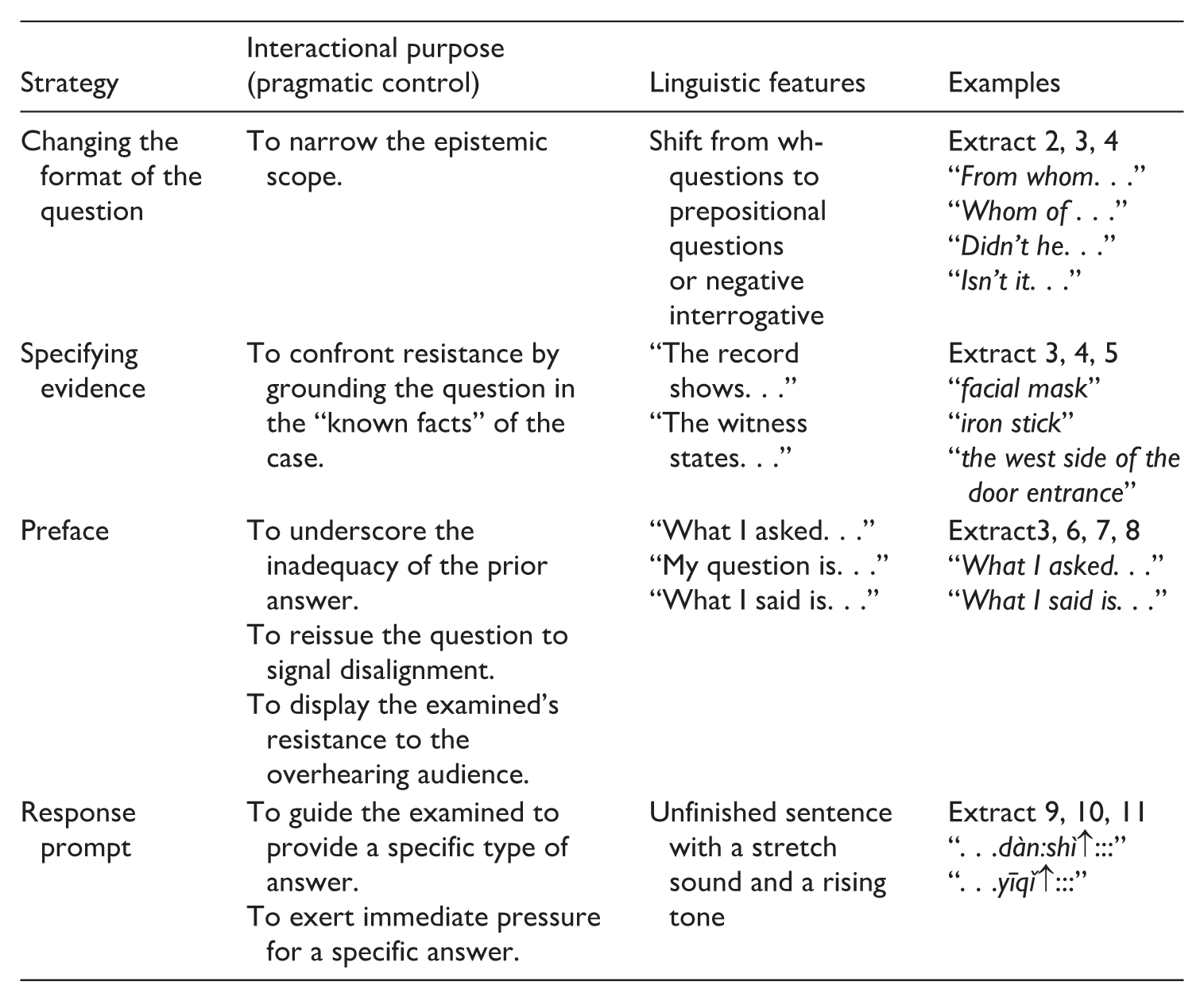
The analysis identifies four primary strategies employed by prosecutors and judges to enact pragmatic control and reassert institutional power. These strategies are not merely linguistic preferences but are interactionally enacted mechanisms designed to manage “talk-as-evidence.”
The table below summarizes these four strategies, their interactional functions, and their linguistic features within the Chinese criminal courtroom.
Discussion and conclusion
Building on CA and prior socio-legal studies of courtroom interaction, this paper demonstrates that questioning in Chinese criminal trials is a dynamic, sequentially organized process in which examiners respond to resistance, reluctance, and evasiveness by progressively narrowing epistemic space and exerting pragmatic control on the examined.
Consistent with earlier research on adversarial questioning (Atkinson and Drew, 1979; Conley and O’Barr, 1998; Cotterill, 2003; Drew, 1992; Matoesian, 2005), the findings confirm that defendants and witnesses are highly cautious when responding to potentially damaging questions. Practices such as silence, claims of “not knowing” or “not remembering,” referential ambiguity, and partial answers recur as interactional strategies for resisting the examiner’s project of building arguments (Drew, 1990; Pomerantz, 1984b). They function as means to manage institutional risks instead of communicative failures, highlighting how power asymmetry shapes response behaviors as well as question designs.
At the same time, this study extends prior research by moving beyond general accounts of courtroom control to specify how examiners delimit the scope of questioning in the Chinese criminal courtroom by identifying four recurrent strategies. Pursuing a response in courtroom interaction often involves not only repairing missing or problematic responses, but also progressively recalibrating the permissible scope of answering (Gibbons, 2008; Matoesian, 2005). Prepositional wh-questions and negative interrogatives function to narrow epistemic scope and transform broad information-seeking into constrained confirmation-seeking, thereby increasing interactional control. Similarly, the specification of concrete evidence—such as objects, locations, or documented actions—operates as a powerful resource for countering evasiveness, echoing Tracy and Reijven’s (2023) observation that material concreteness constrains epistemic options and enhances the accountability of answers. In line with CA work, turn-initial question prefaces (such as “what I asked is,” “my question is,” and “what I said is”) noticeably operate as explicit displays of disagreement, publicly marking the prior response as inadequate while simultaneously orienting to the overhearing audience. By using a response prompt characterized by a stretch sound, a rising tone and a stop with an unfinished sentence, the examiner exerts control on the defendant/witness to finish the sentence and state the material evidence by themselves. These strategies are not isolated techniques but interrelated pragmatic control deployed sequentially to overcome resistance within an asymmetrical institutional framework.
The examiner builds argumentative project through the line of questioning. The examiner frequently initiates the line of questioning with an open-ended question in the first turn to solicit responses with a wide scope and subsequently uses specifying strategies as follow-up questions to elicit detailed information according to the answer to the first-turn question. The examiner meticulously designs interconnected questioning to build argumentative project so as to achieve the jurisdictional objective. It reveals how institutional power is exercised incrementally and interactionally by constraining epistemic options and reasserting pragmatic control.
Footnotes
Appendix (from Jefferson [2004] )

Funding
The author received no financial support for the research, authorship, and/or publication of this article.
Declaration of conflicting interests
The author declared no potential conflicts of interest with respect to the research, authorship, and/or publication of this article.