






Abstract
This paper revisits the concept of presence in video-mediated professional interaction. Rather than treating presence as a cognitive state or technological effect, we conceptualize it as a situated, multimodal, and interactionally accomplished phenomenon. Drawing on ethnomethodological conversation analysis (EMCA), we analyze video-recorded interactions across institutional settings in healthcare, social work, and international business. Through abductive analysis of participants’ practices, we identify four interdependent dimensions of presence: infrastructural-spatial (material calibration and responsiveness across ecologies), embodied-visual (managing visibility and perceptual access), relational (interpersonal attunement and other-involvement), and sequential (timely and fitted contributions to interactional progression). These dimensions emerge from systematic analysis of participants’ practices for managing turn-taking and embodied conduct within fractured ecologies. The paper offers a grounded framework for understanding presence as practical interactional work, with implications for both mediated and face-to-face professional encounters.
Keywords
Introduction
In popular culture, “being present” is framed as a remedy: a personal virtue, a path to self-actualization, and an antidote to the stress and superficiality of digital life. To be truly present is said to improve one’s relationships, sharpen attention, and restore emotional depth, typically by turning away from screens, distractions, and multitasking. Presence, in this view, is often equated with mindfulness, authenticity, or wholeness: a cognitive and moral state rooted in inward awareness and outward availability. Conversely, its absence is lamented in diagnoses of “technostress,” “phubbing,” or “absent presence,” where physical co-location fails to translate into attention or connection. Two people can be physically co-present and not really be present to each other.
Such narratives invite critical inquiry: What, precisely, does being present entail? How is presence displayed, oriented to, and collaboratively sustained – not as a private state of mind, but as interactional practice? How does this unfold when people are not even physically co-located, but interacting not despite the screens, but through them, across physical and institutional distances?
The literature on presence spans multiple disciplines and paradigms, ranging from psychological models of attention and immersion, to phenomenological and sociological perspectives on embodiment and co-location, to interactional approaches focused on participation and alignment. These traditions make different assumptions about what presence is, how it manifests, and how it can be studied – whether through self-reports, experiential narratives, or observable interactional practices. Our review does not aim to synthesize these into a unified theory, but to clarify how they inform current understandings and where our EMCA-based approach diverges, particularly in its emphasis on presence as an observable, sequentially organized accomplishment.
This paper revisits the concept of presence in video-mediated settings by proposing four empirically grounded dimensions: infrastructural-spatial, embodied-visual, relational, and sequential. These dimensions are formulated as analytical abstractions derived from detailed analysis of naturally occurring institutional interaction. Rather than treating presence as a binary state, we conceptualize it as a multimodal, contingent, and interactionally sustained achievement.
Using illustrative excerpts from professional video-mediated encounters (from physiotherapy, international business, nursing, and social work), and drawing on ethnomethodology and conversation analysis (EMCA), we trace how presence is interactionally displayed, made relevant, and occasionally repaired in the situated practices. Rather than merely demonstrating that presence can be achieved in such settings, we specify how it is locally accomplished through the interplay of talk, embodied conduct, and orientations to technological and spatial ecologies. In doing so, we offer a grounded account of presence as a situated social practice.
The paper proceeds as follows. We begin with a review of existing work on presence, tracing how the concept has evolved from assumptions of physical co-location toward an interactional understanding shaped by embodiment, sequentiality, and ecological complexity. We then present our methodological approach and the video-ethnographic data, and clarify how the framework of presence was developed through abductive analysis of participants’ orientations in interaction. The analysis section comprises six excerpts from professional video-mediated encounters across diverse institutional settings. We conclude by elaborating the framework and discussing its implications for research on social interaction in mediated contexts.
Literature review
The notion of presence has long been associated with physical co-location and mutual perceptual access. Goffman’s (1959) foundational work framed presence as “co-presence,” where participants can perceive and be perceived by one another in real time. His participation framework (Goffman, 1979) and his distinction between primary and secondary involvements (Goffman, 1963) have proven valuable in understanding how participants shift their orientations between competing foci.
Phenomenologists such as Merleau-Ponty (2002) and Casey (1998) have further grounded presence not just in interpersonal co-location, but in bodily emplacement: the idea that perception is always spatially and sensorily situated. As Casey (1998) puts it, “nothing we do is unplaced” (p. ix), highlighting the deep entwinement of presence, perception, and spatial emplacement. Extending this view, some strands of research highlight that presence may also be experienced in the absence of a physically co-located or living other. In bereavement studies, for instance, individuals frequently report a sensory or quasi-sensory impression that a deceased person is still “there” (e.g., in familiar places, objects, or routines) experienced not merely as memory, but as a lived, embodied presence (Steffen and Coyle, 2011). Being a part of a broader conceptual landscape, these accounts suggest that presence is not reducible to physical proximity or temporal co-presence.
While physical co-presence is often treated as the prototypical form of presence, it is no longer tenable to assume that presence is only possible when people are physically together. Video-mediated meetings have been part of professional and institutional interaction for decades; and intensified and routinized use in the 2020s has sharpened questions about how people participate, interact, and experience one another across spatial separation. Even in such settings, participants do find ways to coordinate, respond, and meaningfully engage with one another. To account for this, Zhao (2003) proposes that co-presence consists of two dimensions: the physical mode of being with others, and the subjective experience or “sense” of being with others. As Dreyfus (2001: 62) argues, however, attempts to simulate presence through technological mediation (whether via avatars, interfaces, or virtual agents) risk abstraction if they are not anchored in the embodied nearness and perceptual openness that underpin human interaction. Building on Goffman’s participation framework, Wasson (2006) shows how participants in video-mediated encounters often straddle both the screen-mediated exchange and their immediate surroundings, navigating competing orientations across co-present and remote environments.
Early research on mediated interaction already pointed to the role of modality shifts, embodied conduct, and spatial arrangements in shaping alignment and co-presence (Norris and Jones, 2005). In their seminal study, Heath and Luff (1992) demonstrated how, in video-mediated encounters, the “technology appears to interfere with the local, sequential impact of a range of visual actions, generating a shifting imbalance between speaker and hearer and their abilities to influence each other” (pp. 335–336). Raudaskoski (1999) showed how institutional video-mediated encounters challenge ordinary interactional expectations, particularly through disruptions to mutual visibility and embodied coordination. Luff et al. (2003) later conceptualized these environments as “fractured ecologies,” where participants must navigate asymmetrically distributed perceptual access. These asymmetries arise not only from technological conditions (e.g., latency, limited camera angles), but from the fact that participants inhabit distinct physical-material environments (Raudaskoski, 1999). Taken together, these studies point to communicative asymmetries, showing how bodily orientation, turn-taking, and mutual responsiveness are systematically reconfigured under technological mediation, thereby reshaping the conditions under which presence can be achieved in remote interaction.
A growing body of EMCA research has demonstrated how participants work to sustain mutual engagement despite communicative asymmetries, though not framed explicitly in terms of presence. Licoppe and Morel (2012), for instance, show how participants in mobile and Skype calls manage disruptions such as screen freezing, delay, and desynchronization by adjusting gaze, screen layout, and turn-taking to preserve coordination. Extending this focus on mutual intelligibility, Nielsen (2019) documents how participants render otherwise inaccessible visual information publicly available (e.g., by verbalizing off-screen events, translating embodied actions into talk, or referencing spatial arrangements) to bridge perceptual asymmetries.
This work aligns with broader EMCA findings on how participants display orientation to each other’s conduct through multimodal resources. As Goodwin (1979, 1981) and Mondada (2007) demonstrate, such orientation is achieved through the coordination of speech, gaze, gesture, bodily positioning, and the spatial configuration of the environment. In video-mediated contexts, these practices take on new relevance: to render persons, objects, and actions intelligible, participants must actively manage visibility; thus adjusting their embodied conduct to be positioned for camera capture and compensating for what others cannot directly perceive (Nielsen, 2019). Consequently, mediated interaction has been argued to require respecification from the participants’ perspective (Arminen et al., 2016; Due & Licoppe, 2020), with attention to the local, embodied methods through which technological conditions are made interactionally accountable.
Presence has in media and communication studies widely been approached as a psychological phenomenon. A much cited definition by Lombard and Ditton (1997) describes presence as “the perceptual illusion of nonmediation”: the extent to which users in mediated environments respond as if the medium were not there. They distinguish six conceptualizations: social richness (e.g., warmth, intimacy), realism (the lifelikeness of representation), transportation (a sense of spatial relocation or co-location), immersion (psychological absorption), perceiving a social actor within the medium, and treating the medium itself as a social actor. While these categories have informed a large body of work (e.g., Kim et al., 2016; Lombard and Jones, 2015), they tend to treat presence as a perceptual or cognitive state, rather than as something achieved in social interaction. For example, in media psychology, Biocca et al. (2003) has argued that presence within mediated environments involves fidelity as well as perceived actorhood, sociability, and influence.
Communication scholars have further conceptualized presence in terms of social and relational dynamics. The notion of social presence has a long history in communication theory, originating with Short et al. (1976), who described it as the degree of salience or emotional intensity of interpersonal relationships within mediated communication, charted along a continuum from telephone to face-to-face interactions. Later, Palmer (1995), defined social presence as including the effective negotiation of a relationship “through an interdependent, multi-channel exchange of behaviors” (p. 291). In educational and online learning research for example Cui et al. (2013) review how instructional design can intentionally cultivate social presence in virtual classrooms, emphasizing affective and cognitive engagement.
Already Walther (1996) provided empirical critique of the Media Richness Theory by demonstrating that even “lean” media can support “rich” social presence via selective self-presentation and strategic interaction dynamics. In the domain of computer-mediated communication (CMC), classic research by Kiesler, Gergle, and Kraut demonstrated that, even in “lean” media environments such as email or online group interactions, users can collectively create warmth, alignment, and engagement by means of textual cues such as punctuation, timing, and emotive typing as substitutes for nonverbal behavior (Kalman and Gergle, 2014; Kraut et al., 1998; Sproull and Kiesler, 1991). This aligns with how presence in Human–Computer Interaction (HCI) studies is now viewed as “induced” (Felton and Jackson, 2022).
Together, these strands of research offer valuable insights into communicative cues and interactional dynamics by highlighting how warmth and cognitive engagement can be actively constructed in mediated environments, even if they tend to foreground channel properties rather than participants’ situated practices.
Presence is not merely the state of being connected; it is the accomplishment of showing up: being available for interaction, accounting for delays or silences, engaging with the subject matter, and demonstrating orientation to the other’s embodied or verbal conduct (Due et al., 2019; Hjulstad, 2016; Nielsen, 2019). It involves more than managing visibility; it also requires establishing shared focus, enabling access to the floor, and displaying uptake and progression (Hassert et al., 2016, 2024). Presence is thus sensitive to affective and moral dimensions, enacted through practices of care and attentiveness, whether in the form of timely responses, efforts to include distant participants in the discussion, and responsiveness to the specific needs and vulnerabilities of others (Due et al., 2019; Hassert et al., 2016, 2024; Nielsen et al., 2025).
While early research thus highlights how presence should be viewed as a matter of physical emplacement, or cognitive engagement, a growing body of work thus emphasizes that presence is not simply felt or perceived; it is actively and collaboratively “produced” in interaction.
Using a discourse-analytic perspective, scholars have explored how presence is socially constructed in actual interaction. Fägersten (2010), for instance, argues that social co-presence in video conferencing is constituted not simply through the social richness of the medium, but through participants’ real-time use of multimodal cues to create a sense of interactant satisfaction. In organizational communication, the communicative constitution of organizations (CCO) approach views organizational realities as emergent from and co-constructed by communicative practices, and conceptualizes presence as contingent on participants’ ability to produce fitted responses and achieve mutual alignment in real time. On this view, presence becomes a form of “co-production” (Cooren et al., 2008: 1346). While CCO and EMCA differ in analytical focus and epistemology, they share an interest in presence as an emergent, interactional phenomenon. CCO research highlights the relational and distributed nature of presence, shaped across modalities and spaces (Fairhurst and Cooren, 2009), and foregrounds how presence is co-constructed not only between participants, but also with and through material and technological assemblages. Cooren (2020) further challenges the tendency to associate materiality only with what is tangible or visible, arguing for a broader view that bridges human and non-human dimensions of interaction.
Across these research traditions, presence emerges not as an automatic or medium-driven effect, but as a reflexively sustained achievement, accomplished through what might be called “self-reflexive visibility work”: participants’ ongoing efforts to ensure that bodies, objects, and environments are seeable, audible, and accountable within a shared perceptual field. These practices (managing talk, gesture, and spatial orientation) bridge perceptual asymmetries and sustain intersubjectivity even when full visual access is constrained.
It is now evident from the research that technological mediation (with its delays, visual constraints, and spatial disjunctions) systematically complicates mutual responsiveness. From an EMCA perspective, “producing presence” under such conditions hinges on sequential alignment: the situated, timely organization of turns and actions that sustains intersubjectivity despite fractured interactional ecologies. While grounded in different methodological traditions, EMCA research (e.g., Heath and Luff, 1992), the CCO approach (e.g., Cooren et al., 2008; Fairhurst and Cooren, 2009), and multimodal discourse studies (e.g., Norris and Jones, 2005) have all highlighted how spatial arrangements and modality shifts shape participants’ efforts to secure alignment and co-presence in mediated interaction.
EMCA research has long examined how communicative asymmetries (such as latency, overlapping talk, or restricted visibility) reshape turn-taking, mutual responsiveness, and embodied coordination (Due et al., 2019; Hansen, 2020, 2022; Hjulstad, 2016; Luff et al., 2003; Raudaskoski, 1999; Stommel et al., 2020). These studies document how participants manage sequential disjunctures by repairing silences and overlaps, negotiating latency, and reconfiguring embodied conduct or screen-shared resources to guide attention and re-establish alignment. Earlier, Oittinen (2018) and Oittinen and Piirainen-Marsh (2015) demonstrated how co-orientation is interactionally achieved in professional video-mediated meetings, with attention being sequentially organized and socially managed. Similarly, Hansen (2020, 2022) shows how participants in video-mediated hospital interpreting adapt their verbal and embodied conduct to navigate spatial and technological asymmetries. Across these studies, alignment is not taken for granted but evidenced as a member’s concern: continuously, actively, and visibly achieved through multimodal practices calibrated to the constraints and affordances of the fractured ecologies of mediated settings.
Together, these strands of research demonstrate that presence in video-mediated interaction is not a given, but a situated, sequential, and multimodal accomplishment. Rather than relying solely on technological fidelity or perceptual cues, participants reflexively construct presence through embodied practices, spatial calibration, and interactional alignment. Across diverse literatures, from phenomenology to EMCA and CCO, presence emerges as a collaborative, relational, and materially situated achievement, continuously negotiated under varying conditions of access, visibility, and responsiveness. This understanding provides the foundation for the analytic framework developed in the remainder of this paper.
Aims and contribution
This study examines how presence is achieved in professional video-mediated interactions, using an ethnomethodological conversation analytic (EMCA) approach (Garfinkel, 1967; Sacks et al., 1974; Streeck et al., 2011). While presence is often conceptualized as a psychological state or general social condition, EMCA offers a way to investigate how presence is publicly displayed, sequentially organized, and practically achieved by participants in situ. Although contemporary EMCA research has illuminated how technological mediation affects participation, turn-taking, and embodied conduct, there is currently no comprehensive EMCA-based framework for understanding how presence itself is interactionally accomplished across professional settings, whether mediated or face-to-face.
This paper addresses that gap by proposing a grounded, multidimensional analytic approach to understanding presence as an ongoing interactional task. This analytic articulation is not offered as an a priori typology, but as an empirically derived set of dimensions that emerged through abductive analysis of naturally occurring video-recorded data. Drawing on institutional interactions from healthcare, international business, and social work, we identify four interdependent dimensions through which presence is locally achieved: infrastructural-spatial, embodied-visual, relational, and sequential calibration. We argue that presence should be understood as collaborative interactional work, observable in how participants manage turn-taking, respond to embodied actions, adapt to technological and spatial contingencies, and sustain mutual orientation over time.
Data and methodology
This study is grounded in ethnomethodological conversation analysis (EMCA), which investigates how participants produce and make sense of social actions through publicly observable, sequentially organized conduct (Garfinkel, 1967; Sacks et al., 1974; Schegloff, 2007). Unlike cognitive or phenomenological approaches, which often treat presence as an internal state or subjective experience, EMCA treats presence as an interactional achievement: observable in how participants display attentiveness, align their conduct, and manage contingencies in situ. It focuses on participants’ own methods for demonstrating engagement, using video data to track how these practices unfold moment by moment in real-time interaction.
We applied a video ethnographic approach to data collection (Heath, 2004; Heath et al., 2010; Mondada, 2008), recording professional video-mediated interactions in institutional settings including healthcare, international business, and social work. These settings were selected as environments in which presence matters for coordination, task progression, and accountability, and where its absence or disruption becomes interactionally consequential and thus analytically observable. The inclusion of multiple institutional domains further allows us to examine how the practices through which presence is accomplished are locally adapted yet structurally comparable across settings. The chosen settings thus function as analytically advantageous sites for examining presence as an interactional accomplishment. All participants gave informed consent and are anonymized in this paper. The data collection followed official guidelines issued by University of Copenhagen and EU GDPR regulations at the time of data collection.
We constructed logbooks to organize the data, and the recorded material were transcribed following conversation analytical principles close to the Jeffersonian (2004) conventions. From the broader data corpus, we identified and assembled a collection of excerpts where participants oriented to presence-related contingencies. These excerpts were initially transcribed using conversation analytical conventions and annotated descriptively to support close analysis of embodied conduct (Mondada, 2019). Through this analytical process the four dimensions began to emerge. The subset of excerpts selected for this paper was later retranscribed for clarity and readability, following the tradition of graphic descriptions (Laurier, 2019). Transcripts have been treated as part of the analytical process (Ochs, 1979).
The four dimensions of presence were developed through an abductive, data-driven process. While existing literature sensitized us to relevant features (such as embodiment, alignment, visibility, and ecological complexity) the categories themselves emerged through systematic analysis of participants’ orientations in the data. The framework was refined through iterative comparisons across settings and remains grounded in participants’ own practices for displaying and sustaining presence.
Although we introduce the four dimensions early in the paper for clarity, they were not defined in advance. A more detailed elaboration of their subcomponents and interactional features is presented in the latter part of the results section, following the analysis of the data excerpts.
Analyses of video mediation as members’ accomplishment
We will use a handful of data excerpts to illustrate aspects of presence. We will show presence to be constituted by infrastructural-spatial, embodied-visual, relational, and sequential calibration.
First, we will explore how participants calibrate their infrastructural-spatial presence by managing fractured ecologies. We will address this dimension by focusing on infrastructural responsiveness and self-reflexive agency, as well as enabling material visibility by responding to automated technical input. We use the term “infrastructural- spatial” rather than “technological” to capture not only the technical system itself but the broader material and spatial arrangements through which interaction is made possible and constrained.
Infrastructural responsiveness and self-reflexive agency
A key aspect of presence in video-mediated interaction is participants’ capacity to exploit the infrastructural affordances of the medium (such as camera mobility) to configure mutual visibility and to reflexively account for their conduct in relation to it. An example of this from our video data is from online physiotherapy, where physiotherapists and clients routinely reposition their webcams to enhance the other’s visual access to relevant bodily displays or physical settings critical for the ongoing activity. As they move their cameras, they comment on this action and account for the resulting change in perspective for their interlocutor, thereby treating the visual access as something to be accountable for and actively take responsibility for. The following data excerpt (Figure 1) shows how a participant’s camera-moving gesture explicitly manifests self-reflexive agency and infrastructural calibration as part of presence-making. We see the interaction from where the physiotherapist announces that she will demonstrate a physical exercise to her client: Excerpt 1: I’ll move you over here
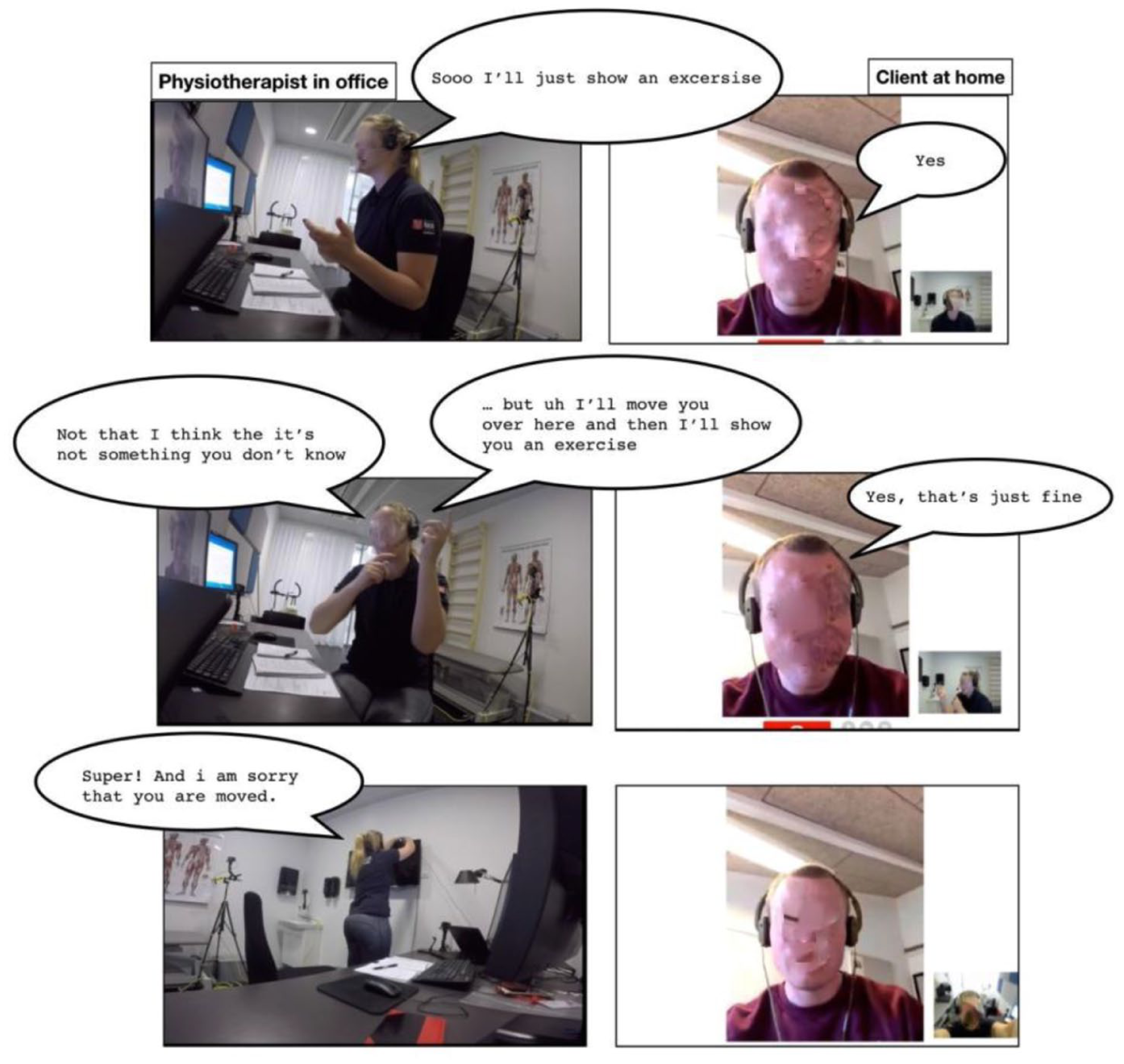
Frame 1–6: Participant moves camera to give the other location better visual access.
In the example, we see how the physiotherapist prepares the movement of the camera by projecting it verbally and constructing an assemble of man + space + technology (“I’ll just move you over here”). “You” refers in this turn both to the mediating technology and the person simultaneously. The client accepts the spatial reconfiguration, and the physiotherapist proceeds with the move, whilst explicitly apologizing for it (“I am sorry that you are moved”). The apology can be seen as an orientation to the norm of talking heads in video-mediated interaction (Licoppe and Morel, 2012), and to the social accountability of momentarily disrupting the interactional ecology. This action demonstrates an orientation to one’s own mediated presence, not merely as a bodily display but as something to be reflexively managed in relation to the other’s perceptual access. Such reflexive monitoring of the visual field constitutes a key dimension of achieving presence in goal-oriented encounters.
Enabling material visibility by responding to automated technical input
Another important dimension of presence is how participants actively take responsibility for managing their own visibility. We illustrate this with a video-mediated team meeting involving four participants in Mumbai and one in Pune. The meeting is filmed at the Mumbai location. When the head of the team in Mumbai grabs a remote control to adjust something, a box appears on the Mumbai screen, and immediately the Pune participant tilts his head (Figure 2). This case highlights how participants responsively manage visual access, treating screen artifacts as socially consequential cues within presence work.
Excerpt 2: Tilting to avoid boxes on screen
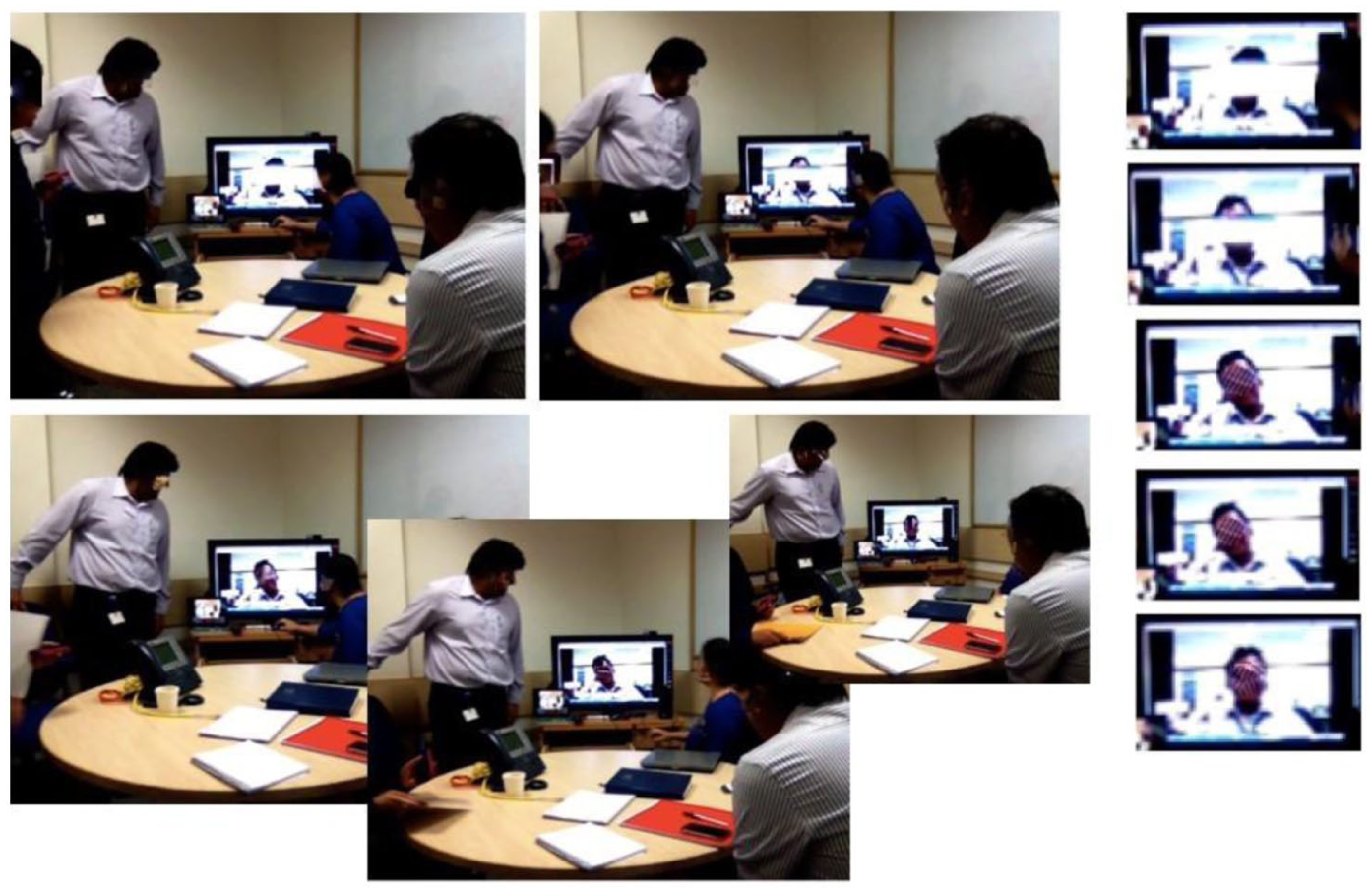
Participant responds to automated technical input by tilting his head to give the other location better visual access to him.
Through the physical tilting action, he orients to giving the participants in Mumbai better visual access to him. Nobody comments verbally on this, but his action is social towards the Mumbai group because it accomplishes the action of giving them better visual access. Moreover, as he responds to input from boxes appearing on their screen, we also see this as a person interacting nonverbally with computer messages. The boxes constitute automated technical input, and it is the very act of a human responding to the boxes that makes them social, and thus retrospectively turns the computer screen into a social actor. We see it as an aspect of presence, because the interaction with the technology-based actions is social and done as a part of the encounter with human participants, much like shifting one’s gaze from one participant to another serves to give the latter primary recipiency.
Embodied spatial co-orientation in the achievement of referential clarity
Second, we will explore how participants co-create their embodied-visual presence. We will address this dimension by focusing on participants’ embodied work to secure co-orientation and referential clarity.
The next example we use to argue that gestures and embodied actions function as place-based practices contingent on the situation and tied to specific courses of action. In the following data excerpt a participant points toward displaced spatial locations through the screen. This excerpt is from a medical consultation in which a nurse is instructing an elderly couple about how to put on a blood pressure monitor (see Figure 3). We see how visual gesturing across mediated ecologies enables place-relevant representation and co-construction of shared focus.
Excerpt 3: Pointing through the screen
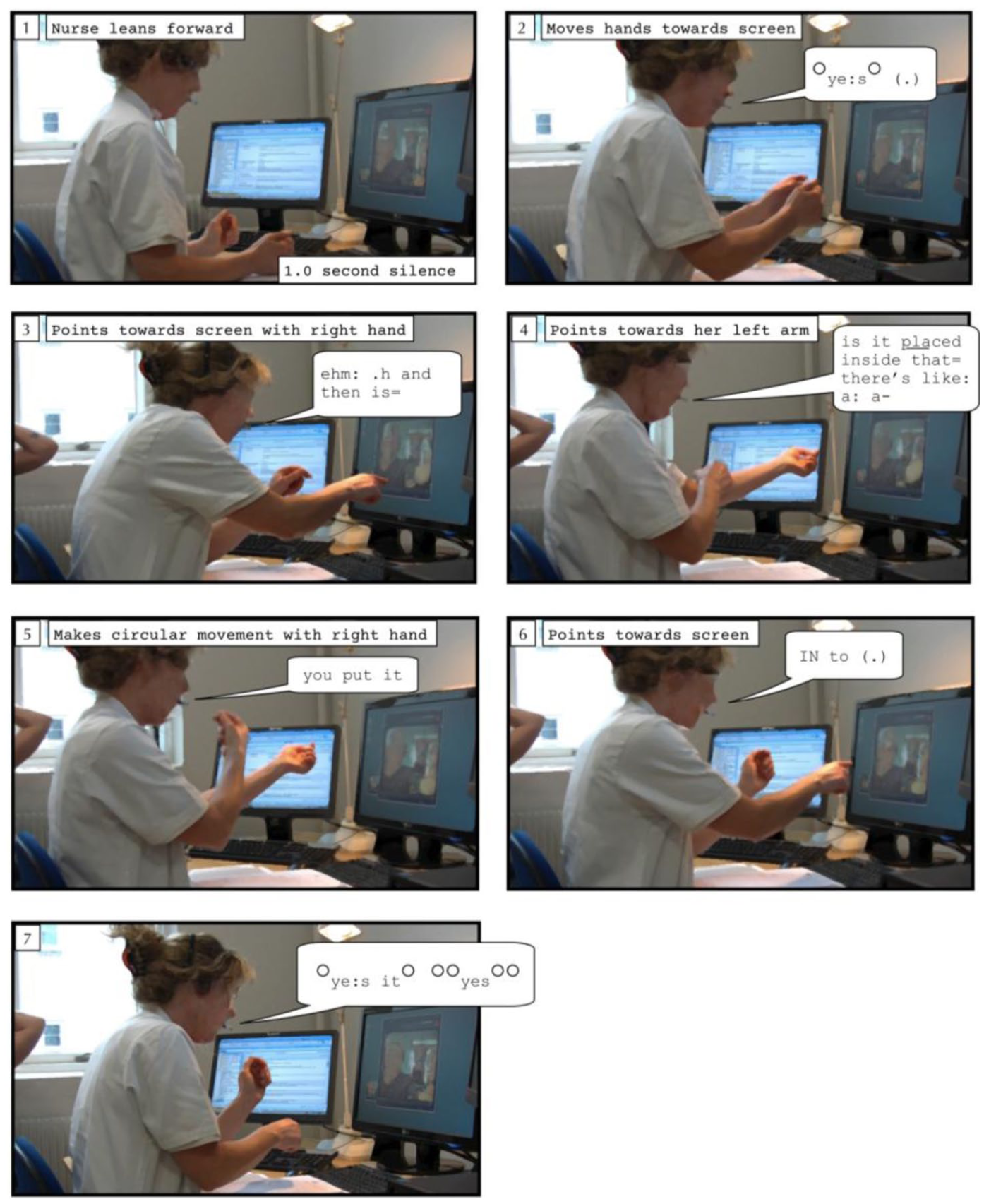
Frame 1–7: Nurse showing a patient on screen how to put on a blood pressure monitor.
We notice that when the patient’s arm reaches a position that gives the nurse visual access to the blood pressure monitor, the nurse leans forward and positions herself close to the screen. In the same movement, the nurse makes a deictic gesture pointing towards the screen with her right-hand index finger. This gesture is accompanied by the utterance “ehm: .h and then is” (Frame 3), produced with hesitation and word search. The nurse then shifts to an interrogative syntax and asks “is it placed inside that” (Frame 4). While presenting the question, the nurse points at her own lifted upper arm, equivalent to where a blood pressure monitor would be positioned if it had been attached to her. The nurse thereby clarifies what was meant by the unspecific deictic expression “that” by visually showing that the “that” referred to a specific part of the monitor, which is attached to the particpant’s arm. The nurse continues the turn by verbally elaborating the question with the declaratively constructed account “there’s like: a: a- you put it IN to” (Frames 4–6). Simultaneously, the nurse moves her hand in a circular motion, animating how the tip of the arm cuff should be pulled through the metal hoop of the monitor (Frame 5).
This embodied demonstration, which has mimicable features built into it, has a clear recipient design aimed at conveying meaning and instructional information to the dislocated participants. The nurse uses a combination of verbal, visual, and embodied cues, designed with the recipient’s perspective in mind, to establish referential clarity and to index off-screen objects. This demonstrates how participants collaboratively produce referential clarity and embodied understanding through co-construction, recipient design and other-monitoring, as a social accomplishment.
Third, we will explore how participants calibrate their relational, affective presence. We will address this dimension by focusing on affiliative other-involvement and situated immersion, as well as emotional attunement.
Affiliative other-involvement and situated immersion
We argue that immersion is dynamic and locally produced. Even if two participants are physically co-present, they may say things like: “hey, are you here?” “Where are you right now?” “Earth calling Peter!” They may wave demonstrably in front of the other’s face – thus treating disengagement as a lapse in presence. This aspect of immersion we see as place-based availability, as competing immersion may be treated by participants as accountable when the mutual encounter is not put front and center: When attention drifts, whether due to parallel tasks, offscreen stimuli, or divided focus, participants may treat this as accountable non-presence. Immersion may therefore be interpreted as engagement and involvement in everyday affairs, such as when naturally involving other locally present participants. We thus suggest a respecification of immersion from being a matter of cognitive investment to being a matter of social presence, which is indeed achievable in video-mediated interaction. We treat involvement and immersion as naturally unfolded alignment in conversation.
In the following, we show an example of other-involvement and affiliation. We argue that this aspect has to do with involvement accomplished interactionally as affiliation and other-orientation. Presence as a member’s accomplishment may be shown via affiliative responses (Pomerantz, 1984; Stivers et al., 2011), by responding to bodily input from others with embodied response (Mondada, 2009) or by turning it into something meriting a verbal response. Participants may also affiliate in other ways, such as by mirroring (Ferrera, 1994) words, gestures, facial expressions and storytelling by others; or by producing collaborative completions (Sacks, 1992), or being able to build on each other’s ideas, thereby showing themselves to be so immersed in interaction that they are able to guess what will be said next. A version of this intersubjective practice of “showing to know” what co-participants are concerned with is when participants ask about things that interest the co-participant.
The next data excerpt is from an encounter in which a patient with COPD meets regularly with a hospital nurse via a so-called COPD suitcase, which is a laptop with video meeting facilities that are very user friendly. In the middle of the conversation about oxygen measures and well-being, the patient’s dog is suddenly audible to the nurse (Figure 4). This excerpt exemplifies affiliation and immersion: participants orient to unexpected off-screen cues to sustain intersubjective alignment.
Excerpt 4: I can hear you have a dog?
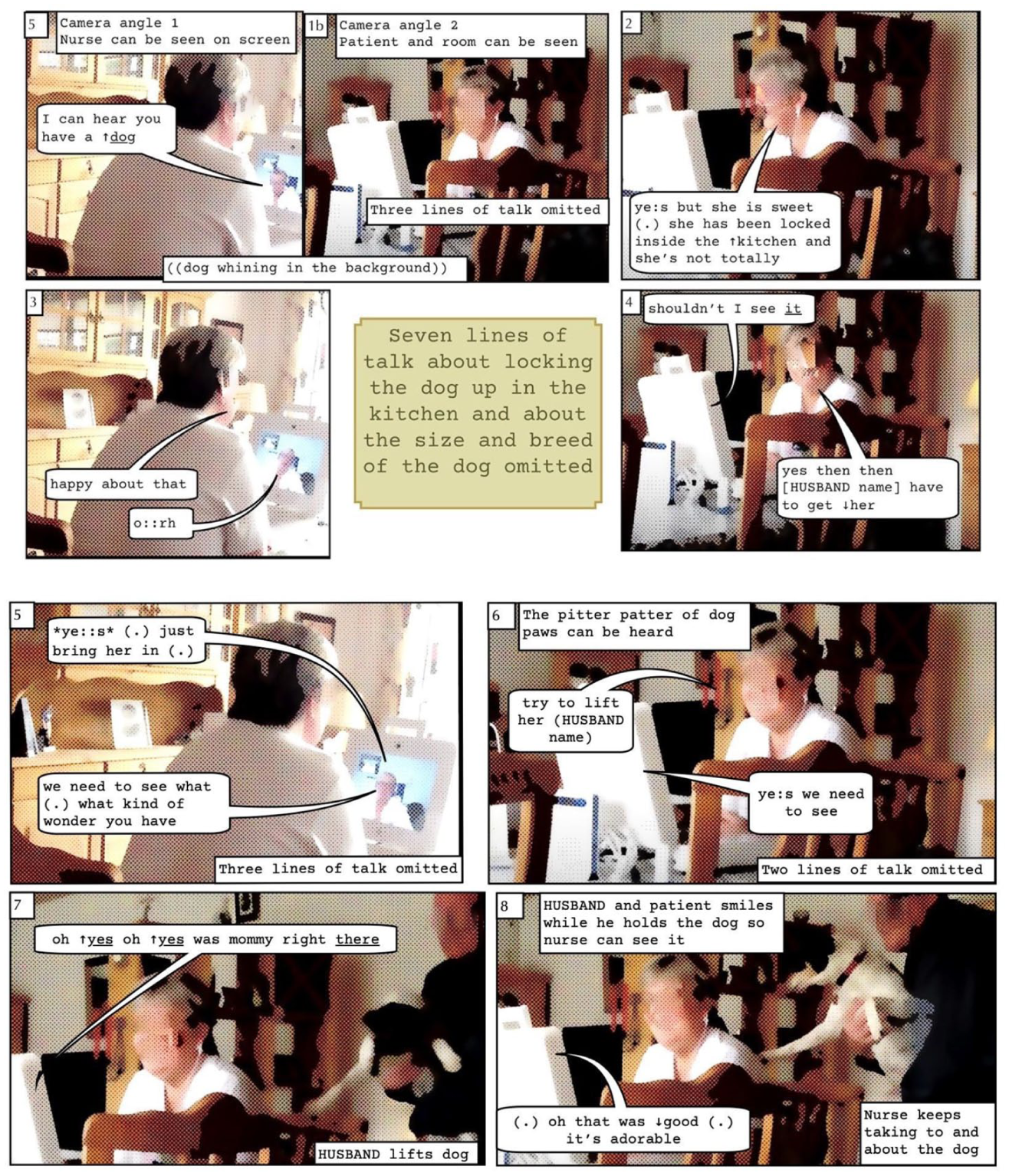
Frame 1–8: Hospital nurse and patient including dog and patient’s husband in a video meeting.
Note how the nurse immediately follows up on the dog’s whining (“I can hear you have a ↑dog”), even though it is outside the video frame. The dog is invited into the conversation: by the remote nurse, not because she has a relation to it or because it is necessary for the treatment of the patient, but presumably because of its significance to the everyday life of the patient and her spouse. The patient tells the nurse that the dog is “locked inside the ↑kitchen and she’s not totally [happy about that]” (Frame 3). The nurse immediately affiliates with this emotional display about the dog, and invites it into the participation framework. By doing so, she demonstrates an immersive engagement in the encounter – one that enables her to interpret, on the basis of the participants’ observable multimodal conduct, what might be on their minds, even if they do not mention it directly themselves. In this way, the nurse displays a finely tuned sensitivity to what is locally relevant.
Presence as emotional attunement: We use our next example to demonstrate that even a situation of emotional distress is an intersubjective achievement which contributes to an understanding of the notion of presence. The data excerpt is from a social psychiatric recovery-oriented meeting between a professional social health care worker and a mentally vulnerable citizen. The setting is a local drop-in center, which offers public social service to mentally vulnerable citizens under the stipulations of the Danish national public social psychiatric system. One distinct purpose of the recovery-oriented meeting is to support the citizen in dealing with personal and/or emotional difficulties to help improve his or her general well-being and develop autonomy in terms of managing challenges in daily life. A mentally vulnerable citizen (an emic category at this healthcare center) and the social healthcare worker are talking about the citizen’s relational problems with her partner. In what follows (see Figure 5), the citizen discloses her concern and she becomes overwhelmed with emotional distress in doing so. This excerpt illustrates how relational attunement and affective involvement emerge and are managed within the institutional setting of video-mediated care.
Excerpt 5: Do you get a bit affected now?
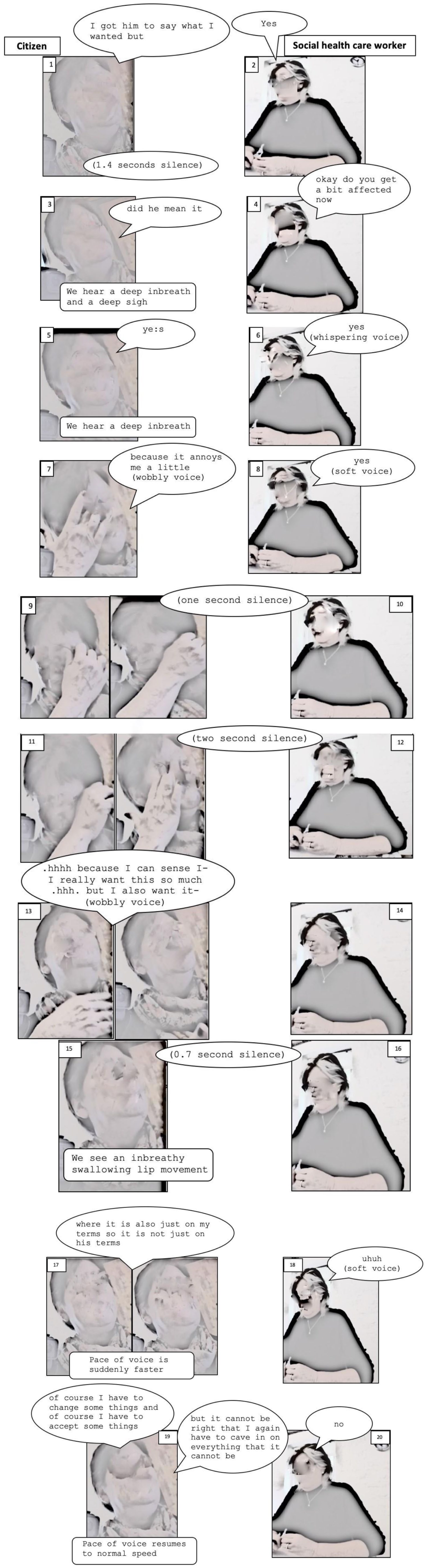
Frame 1–20: Social care worker supports a client in emotional distress.
We see how the crying sequence is a collaborative accomplishment of the two participants. Cues include whispering voices, swallowing/lip movements, wobbly voice, soft voice and changing pace, as well as long silences between turns.
The citizen displays the first sign of emotional distress in the 1.4 seconds of silence, where we hear a deep inbreath and a deep sign followed by her rhetorical question (“Did he mean it?”) (Frame 1). The social healthcare worker shows a sensitivity to the citizen’s emotional display by first inviting a continuation of talk about her troubles (Frame 2), then enquiring if she becomes affected (Frame 4). With a deep inbreath, the citizen verbally affirms this to be the case (Frame 5). The social worker remains silent (Frame 6) and the citizen continues expressing her stance on this issue with a wobbly voice and clear indication that she is wiping her eyes (Frame 7). The social healthcare worker encourages her to continue her talk (Frame 8), which is followed by a long silence (Frames 9 and 10) on the part of the citizen, during which she visibly wipes her eyes (Frame 9). The social healthcare worker demonstrates being present by maintaining her bodily position and gaze towards the screen, while withholding talk. This is followed by yet another long silence in which the citizen visibly wipes her eyes again (Frame 11). Through body and gaze, the social worker is oriented to what is going on, but remains silent (Frame 12), and now the citizen resumes verbally expressing her emotional stance (Frame 13). Her voice remains wobbly, and upon pausing, she performs an inbreath-swallowing-lip movement and gazes upward (Frame 15).
Throughout this part of the interaction, the social worker maintains a calm and fixed embodied position and gaze orientation towards the screen and refrains from talking. This prompts the citizen to resume talking once again (Frame 17), her voice no longer wobbly, and her pace of speaking is suddenly faster. The social worker invites her to continue by a minimal response token (“uhuh,” Frame 18), and as the citizen manages to get control of her rate of speaking, she now resumes a normal speed and formulates her stance on how she wishes to address her relational issue with her partner (Frame 19). The social worker shows support for her stance with a minimal response token, which affirms the stance as salient (Frame 20).
Both participants appear present and attuned to their joint activity as it unfolds, and both treat the emotional outburst as normal and allow for it to develop, peak and fade out. As the emotional distress accumulates, we see the citizen’s stepwise display of emotional distress, and how the professional responds to it. Except for the question which seeks validation that the citizen is affected (Frame 4), the professional remains calm and refrains from talking except for the few continuers (Frames 8, 10, and 18), which invites the citizen to continue talking and explore her feelings. The long silences (Frames 3, 9, 11, 12, and 14) are not treated as misplaced or unacceptable by either participant. Instead, both participants treat the unfolding emotional distress as something to be jointly inhabited, an occasion for being present together.
In this virtual setting, the participants display their interactional presence as the ability to embrace emotional outbursts as a member’s accomplishment and concern, which they collaboratively seek to acknowledge, experience, explore (peak) and allow to fade out. Through their collaborative efforts, the notion of presence – as displayed by the participants themselves – becomes a matter of embracing the emotional difficulties experienced and explored by the one, and supported and encouraged by the other. To them, presence is something that they “do” together and something that is very clearly a matter of orienting to the bodily displays. This co-presence unfolds through a distinct and locally fitted sequential pattern, which on the one hand allows for the citizen to display and work through her emotional distress and on the other hand allows for both aligning and affiliating uptakes by the social worker (Couper-Kuhlen, 2012; Stivers, 2008; Stivers et al., 2011).
Presence through sequential coordination: The last example explores how participants manage their presence by producing fitted and timely responses and interactional progression. If immediacy and structural alignment are relevant indicators of presence, then their absence, or participants’ immersion in parallel activities, becomes equally revealing. In the data excerpt below, two co-located participants take part in an ICT-mediated meeting distributed across three locations, we see split attention as a potential trouble source, causing delayed responses and repair in the cross-location meeting. The excerpt is from a five-party ICT-mediated meeting across three locations of an international company. The participants consist of Martin (MAR) and Atthar (ATT) in Copenhagen, Ishan (ISH) in Chennai and Arjun (ARJ) and Saanvi (SAA) in Mumbai. The meeting is video recorded from the Mumbai location. In the excerpt (Figure 6), we note how Saanvi mutes the equipment to initiate a conversation with co-located Arjun. This case emphasizes how latent delay and lapses in floor management pose practical challenges to sequential alignment and immediate responsiveness.
Excerpt 6: Ja Ishan
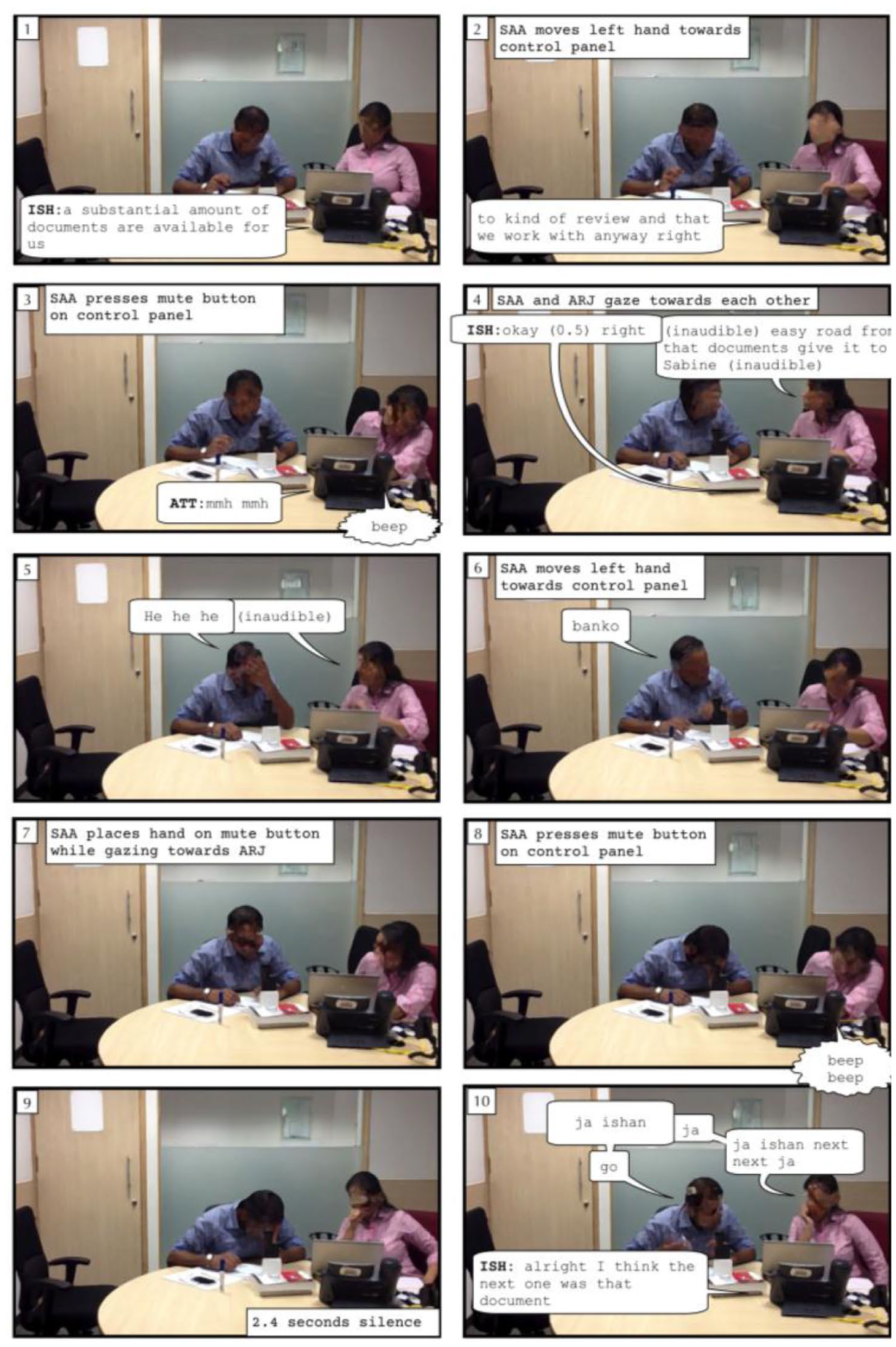
Frame 1–10: Two co-located colleagues have a bilateral conversation during a cross-location meeting.
The excerpt lasts 15 seconds and includes an 8-second pause, a “lapse” (Sacks et al., 1974). During that pause, the participants in Mumbai are muting the equipment to conduct a bilateral conversation. While participants in Chennai and Copenhagen are talking, Saanvi in Mumbai takes the initiative to mute the equipment (Frames 2 and 3). Ishan in Chennai is producing receipt tokens (Frame 4) to the confirmation from Copenhagen, and then there is an 8 second pause or lapse. During that pause Saanvi and Arjun in Mumbai are talking and giggling together (Frames 4–8). About halfway into the pause, we note that Saanvi takes the initiative to unmute the equipment (Frame 6); while preparing to re-engage in the meeting talk Saanvi turns to Arjun (Frame 7), but Arjun is oriented to the control panel, and no talk is currently being produced in the cross-locational meeting. While the excerpt is rich with interactional detail, we focus here on how the participants in Chennai and Copenhagen let the non-response from Mumbai hang, and once the participants in Mumbai realize that it is their responsibility to end the pause, they quickly produce talk designed to move the meeting forward. Arjun utters a loud, stressed and pitch reset “ja” and addresses the chair (Frame 10), and Saanvi utters a loud and high pitched “ja” in overlap (Frame 10). Finally, Ishan comes in and moves the cross-locational meeting to the next item on the agenda (Frame 10).
Lapses and latency are treated as accountable, as they involve delays in response and stall the progression of talk and its associated activity. Not responding immediately is accountable because it may indicate lack of engagement in interaction and lack of involvement in the joint activity. This lapse-repair sequence demonstrates how lapses are treated as interactional trouble, showing that immediacy is a participant concern closely tied to maintaining attentional presence.
Across these interactions, presence is not treated by participants as mere physical co-location, but as a socially accomplished, sequentially displayed orientation to one another. It is achieved through relational attunement, timely and fitted embodied contributions, and infrastructural responsiveness to technological conditions. Presence, in this sense, is not a default state but a practical task that participants continuously manage as the interaction unfolds. Taken together, the six excerpts demonstrate that presence in video-mediated professional interaction need not be blackboxed (Latour, 1999) as psychological states or cognitive immersion. Rather, it is observable in video-ethnographic data as participants’ practical and ongoing calibration across multiple modalities and ecologies, including spatial, embodied, topical, sequential, and affiliative forms of co-orientation and responsiveness.
Aspects of presence
We now return to the broader analytic articulation of presence introduced earlier. Drawing on the preceding analyses, we articulate subcomponents of each dimension to support future analytic work across settings and disciplines.
Building on the four dimensions introduced earlier, we now present a more detailed articulation of the framework, including sub-dimensions and representative practices observed across settings. These examples are drawn from the data and informed by the broader conceptual terrain outlined in the literature review.
In our analyses we have documented how participants:
orient to each other through embodied and visual cues,
adapt to latency and technical constraints,
describe off-screen phenomena for absent parties,
signal and manage participation,
calibrate camera framing and audio settings, and
recover presence when disrupted.
Many of these aspects are however not confined to the video mediation, they also contribute to constitute presence in face-to-face encounters. These observations have led us to propose a set of aspects of presence.
First, we argue that infrastructural-spatial presence (“We are in a shared space”) entails managing material anchoring and negotiating situated attention, even across fractured ecologies:
Spatial co-construction via maps, flipovers, (digital) boards, break-out-rooms, split-screens.
Place-based mediation: Using a local setting to anchor or clarify the activity (e.g., “In this room we always . . .” or “I’m at my kitchen table right now” or “Let’s do this as a walk-and-talk”).
Responsiveness to system actors: (e.g., screen freezes, mic issues, draft from window).
Managing re-presencing in a momentary synchronicity: Repairing breakdowns and interruptions, missed opportunities for response, or being away for a bio break.
Managing material asymmetries of fractured ecologies: Orientation to muting/unmuting, sound quality, connectivity, camera framing (e.g., “you’re lagging a bit, could you use headphones or mute the camera?”).
Second, we argue that embodied-visual presence (“We make ourselves and our worlds perceptible”) entails rendering embodied action, visual references and environments intelligible and available to others:
Availability: Showing up via bodily presence, or via digital connection (e.g., logged on, unmuted camera).
Self-reflexive visibility: Securing embodied availability (e.g., adjusting camera or posture).
Verbalizing visually hidden context: For example, “The cabinet is empty,” “I’m moving it to the left.”
Grounded epistemic, deontic and emotional authority: Enacting rights to know, feel, tell, guide, suggest, or instruct.
Third, we argue that relational presence (“We are here for each other”) entails displays of interpersonal commitment, attunement, and affective involvement:
Intimacy: Displays of emotional connection (e.g., softened voice, lowered volume, smile).
Affiliation: Expressions of alignment, shared stance, or emotional resonance.
Care/Nurture: Orientation to the other’s vulnerability, comfort, or well-being.
Investment: Engaging in the subject matter and treating it is consequential.
Other-involvement: Active orientation to the co-participant’s epistemic and affective state.
Facilitating participation: Helping others to participate (especially in hybrid encounters).
Touching, or making tactile contact relevant: (E.g., “I wish I could give you a hug”).
Recipient designing talk to fit the other (e.g., stance management, instructional unpacking).
Fourth, we argue that sequential presence (“We attend to what is going on”) entails the timely and fitted participation in the evolving course of interaction:
Shared focus: Displaying attentiveness to the same topic, activity, (screen-)shared materials.
Indexical navigation: Guiding joint attention (gesture, camera movement, or verbal deixis).
Relevant uptake: Producing next actions that display understanding.
Progression: Advancing the shared activity or topic.
Timely responsiveness: Producing turns without delay, or accounting for delay when it occurs.
We thus view presence as a multidimensional interactional accomplishment, irrespective of mediation. This set of aspects is not formulated as constitutive, but we suggest that the more of these aspects are met, the more present a participant may appear to co-participants and analysts.
Concluding discussion
This paper has sought to revisit presence in the context of video-mediated interactions from an ethnomethodological approach. It has reconceptualized presence as an interactionally accomplished phenomenon. Rather than assuming presence to be an internal psychological state or a product of physical co-location, we have demonstrated how it is achieved moment-by-moment through multimodal, sequential, and spatial coordination, even in technologically mediated settings.
Our data excerpts have shown, not that but, how presence is reshaped through participants’ collaborative efforts. Across diverse institutional domains (from social work and nursing to business meetings and physiotherapy) participants orient to being “present” for one another as an accountable task, involving embodied availability, attentional alignment, and affective attunement. In doing so, they negotiate fractured ecologies and asymmetric affordances to co-construct a shared space for participation.
We have also shown that presence is not a binary condition, nor is physical co-location its default form. Instead, presence appears as layered and configured: a dynamic interplay of infrastructural, spatial, embodied, relational, and sequential aspects, locally relevant and accountably displayed. The implication is that presence is always a potential accomplishment, whether in video meetings or face-to-face settings.
Spatial calibration and infrastructural responsiveness: Rather than being tethered to physical place, presence involves the orchestration of spatial and material conditions. Participants adjust their environments (e.g., camera, posture, screen orientation), account for technical disruptions, and responsively manage fractured ecologies (Luff et al., 2003). Excerpt 2 shows how participants treat screen artefacts as meaningful cues, adjusting their embodied conduct accordingly. Presence is thus enacted through responsiveness to both human and system actors, and through negotiated spatial co-orientation across distributed settings.
Embodied visibility and representational work: Participants actively manage their visibility and the visibility of activity relevant objects or embodied actions. Excerpt 3 (pointing through the screen) and Excerpt 1 (camera movement) show how gestures, gaze, and embodied demonstrations create a shared visual space. These practices are not confined to mediation; rather, they are intensified by it, as participants must reflexively render their environment available. Presence becomes a visible, representational achievement, performed through calibrated bodily, spatial and material action.
Relational attunement and other-involvement emerges through mutual displays of concern, alignment, and affiliation. As seen in Excerpt 5 (emotional distress), participants manage emotional vulnerability as a shared concern, displaying intimacy and attunement through embodied conduct, calibrated silences, and uptake. Likewise, Excerpt 4 (the dog) illustrated other-involvement, where the nurse’s attentiveness to offscreen cues sustained affective alignment. These practices show that “being present” entails more than physical proximity: it involves showing care, acknowledging the other’s state, and collaboratively navigating emotional landscapes.
Sequential coordination and interactional progression: Timely and fitted responses are critical to produce presence. Excerpt 6 (the muted exchange) highlighted how latency and inattentiveness become accountable phenomena when they disrupt expected turn-taking. Participants respond by re-engaging quickly and visibly, demonstrating their commitment to the ongoing interaction. Presence, here, is displayed through alignment, uptake, and progression, keeping the joint activity on track and responding when it falters. Consequently, immediacy may be viewed not only in terms of chronology and synchronicity but as a social accomplishment, and our analysis of Excerpt 6 has shown the role of alignment of action and response in co-creating immediacy.
In proposing this analytic vocabulary for describing presence, we challenge assumptions that treat mediated interaction as inherently impoverished. Our findings extend EMCA’s concern with local accountability by showing how participants not only manage turn-taking, reference, or repair, but how they collaboratively accomplish “being there” for each other. The framework presented here is not intended as a fixed model, but as an empirically grounded vocabulary for describing how presence is made relevant and observable in interaction. By developing the taxonomy abductively, in dialogue with both prior scholarship and the data, we aim to bridge conceptual clarity and analytic precision. This reframes presence not as something eroded by screens or distance, but as a situated, multimodal achievement that unfolds in and through practice. Our analyses suggest that presence may be understood as a socially and materially accomplished phenomenon, that emerges through sequential, multimodal, spatial, and affective practices that render participants available, aligned, and attuned to each other, whether in co-located or distributed settings. It entails not only visibility and participation, but responsiveness, epistemic engagement, and orientation to sharing context.
Reviews of the literature on space and place point to how the interactional organization of presence is largely absent in situational and subjective phenomenological approaches. Our contribution to these lines of research has been to show how video-mediated interaction involves synchronicity in time but not in physical place, requiring participants to accomplish presence through the coordination of distributed spatial, material, and embodied resources.
Instead of presuming the necessity of the full multisensorial spectrum for the accomplishment of interaction, we point to the participants’ creativity and collaboration in setting up and mirroring ecological affordances. Rather than considering place, body and context as vessels, containers and buckets (cf. Casey, 1998: 54; Heritage and Clayman, 2010), we point to how participants are actively “presence-making” (Lombard and Ditton, 1997) and accomplishing meaning, belonging and being as a cognitive and social production (cf. Harvey, 2009). We have shown in real-life data how space is not only relational, but co-constructed as function, rather than primarily to be viewed as imbued with deep meanings of roots, anchoring and historical continuity (cf. Massey, 2011). Place is not an obstacle, as activities are interactionally negotiated as indeed place based, but not place bound (Massey, 2011: 184). Space is rearranged and bodies and mediating objects such as cameras are moved (Excerpt 1) to achieve the intersubjective creation of new place meaning. Participant-initiated spatial configuration contributes to creating a mutual presence that is not body bound but rather body based. Presence is not merely a matter of physical tactile proximity or the mutual sharing of ecologies. Rather, it is relational: a social accomplishment of intimacy, immediacy, immersion and engagement, as well as a social accomplishment of representation, agency and infrastructural calibration. Presence is an ongoing, emerging, sequentially organized accomplishment, no matter if it involves crossing fractured ecologies or not. It is a continuous production: a social accomplishment.
One might argue that the term “true presence” should be reserved for physically co-located, embodied interaction, where participants have access to the full multisensory spectrum. However, as we have seen in our data, interpersonal engagement, situational immersion, and emotional attunement can indeed be accomplished by remote participants, as when the social worker immediately says, “do you get a bit affected now” (Excerpt 5) as a response to the client crying, or when the nurse asks to see the patient’s dog (Excerpt 4) as a response to hearing it complain. Conversely, individuals who are physically co-present may not be emotionally and cognitively present for each other.
The most central contribution of this paper is the conceptualization of presence. We do not see some aspects of presence as more “true” than others, but point to the different affordances created by the ecologies and how they are exploited by the participants to co-produce presence collaboratively, irrespective of place. We see presence as configured and layered. It may be tempting to use our conceptualizaton to view degrees of presence as a matter of the application of more aspects of doing presence achieving deeper presence. Rather, we find it more productive to see presence as being done interactionally in different forms with physical co-presence being just one such contributing factor – contributing, not defining. It is essential to bear in mind that people may indeed be considered not present by others even if they share the same physical place. Therefore, further exploration of presence as a social assemblage might be required to incorporate aspects of perception, which is beyond the scope of this paper.
The paper has relevance to organizational communication and mediated discourse theory by showing how professional actors collaboratively produce and repair presence under temporal, spatial, and infrastructural constraints in institutional settings, and by suggesting an analytic vocabulary for describing how presence is interactionally accomplished. Ultimately, this study offers a respecification of presence as an emergent, observable, and collaborative practice, foregrounding how it is achieved, sustained, and repaired through interactional work, and it opens new directions for studying presence not as a property of minds or bodies, but as a shared accomplishment in situated social life.
Footnotes
Acknowledgements
We would like to thank (co-contributors anonymized) for assisting in data collection and initial analysis of one of the excerpts.

Funding
The authors disclosed receipt of the following financial support for the research, authorship, and/or publication of this article: University of Copenhagen and The Velux Foundations (Grant No. 00013125)
Declaration of conflicting interests
The authors declared no potential conflicts of interest with respect to the research, authorship, and/or publication of this article.
Data availability statement
The data underlying this article cannot be shared publicly due to GDPR and signed NDAs.