







Abstract
While a patriotic tendency in traditional journalism has been intensively investigated, there is much less evidence and fewer analyses of the phenomenon regarding online journalism. In this research, three main indicators of patriotic journalism are addressed: adopting governmental framing, expressing solidarity with the community, and ignoring the enemy’s narratives and positions. These indicators are investigated while analyzing online coverage of a confrontation between Israel and Hamas. A total of 192 online news items on three Israeli news websites were analyzed, in addition to 8344 user comments. The findings reveal that journalists behaved in a patriotic manner like their counterparts from the traditional media. However, users thought it was not patriotic enough. The authors argue that while patriotic behavior in traditional journalism has been often considered as deviant from the traditional objective model of journalism, in the online interactive environment, patriotic coverage of national conflicts might be seen as a natural part of the journalistic work.
One of the most common journalistic phenomena in times of conflict, war and terrorist attacks, in particular, is the abandonment of professional–ethical values and the embrace of a nationalistic–patriotic mode of behavior by journalists (e.g. Hallin, 1986; Liebes, 1992; Schudson, 2002). This transition in journalistic behavior, which is worldwide and across eras, raises various ethical issues which are the core of the discussion on patriotic journalism. Some of these issues are: the dual identities of journalists (Zandberg and Neiger, 2005); the closed relationships of journalists with the local political elite (Robinson et al., 2009); the expressing of solidarity with the national community at the expense of objectivity and detachment as professional values (Zelizer and Allan, 2002); and the dilemma between being a nationalistic journalist or a cosmopolitan one (Elliott, 2004; Ward, 2010a, 2010b).
Patriotic journalism in times of conflict is well documented and analyzed with regard to the traditional media. However, it has been less addressed in media and journalism literature with regard to the new media. One exception is the analysis made by Allan (2003, 2006) of the American and European coverage of September 11 and the war in Iraq on websites and blogs. Allan mainly focuses on the growing demand by the public for information through online sources, and on the growing phenomenon of individuals – eye witnesses as well as bloggers – who provided online information. Less attention is given to the coverage by more established online journalistic institutions. The current study aims to contribute in this direction, theoretically as well as empirically. Theoretically, we suggest that the new media might enhance the tendency of journalists to behave in a patriotic mode in times of conflicts because of its interactivity feature. This tendency has been empirically demonstrated in many studies addressing the traditional media, as will be elaborated later. Therefore, if our assertion is correct, patriotic behavior in the new media stands – to some extent – in contradiction to a very common view in scholarly literature, according to which the transition of journalism to the internet is accompanied by new (or renewed) ethical values (see, for example, Karlsson, 2011; Mitchelstein and Boczkowski, 2013; Singer, 2008). Empirically, we introduce a case study of online journalistic coverage of Operation Pillar of Defense (in Hebrew: Operation ‘Amud Anan’), conducted by the Israel Defense Forces (IDF) in Gaza from 14–21 November 2012. We investigated three leading Israeli news sites, two of them connected to traditional media establishments and one founded as an independent internet portal with no direct connection to a traditional journalistic institution. The findings reveal that online coverage of the military conflict contains patriotic features very similar to those that were documented regarding the coverage of similar events in the traditional media. In addition, we found that the majority of user comments published following this coverage had demanded that journalists would be more patriotic than they were while covering the conflict.
In the next section, we briefly describe main features of patriotic journalism as they were documented in the traditional media; then we discuss some ethical considerations regarding online journalism and its implications for patriotic journalism. Next, our case study and findings are presented, followed by a discussion about the findings’ implications regarding the broader issue of online journalistic ethics and by some suggestions for further research.
Patriotic journalism as an ethical issue
Objectivity, as well as its associated values such as neutrality and impartiality, has been for decades one of the most acceptable and expected ethical values of journalism, at least according to the Western–liberal–democratic version of the occupation (Carpentier and Trioen, 2010; Christians et al., 2009; Deuze, 2005; Hanitzsch, 2007). However, as Donsbach and Klett (1993: 79) demonstrated, objectivity has been differently interpreted in different parts of the democratic world according to different paths of evolution of journalism in each country. While, in the Anglo-Saxon countries, objectivity refers to a fair presentation of views of all relevant sides, in Continental European countries, objectivity is ‘questioning interest groups and seeking the “truth” behind assertions’ (for more discussion on different meanings of objectivity, see the recent work of Post, 2014). Either way, objectivity has been justified either by the sociological development of journalism as a distinctive occupation (from public relations, for example, see Schudson, 2001), or by the need of journalists to protect themselves as professionals (against law suits, readers’ complaints, media owners’ demands, deadlines, etc., see Tuchman, 1972).
In spite of this professional ideology (Deuze, 2005) that embraces objectivity as a guiding value, worldwide and cross-time empirical evidence demonstrates that journalists, explicitly as well as implicitly, abandon objective coverage in times of national crises, such as wars and other violent events. In such instances, journalists take sides not only through opinion and/or commentary columns, but in informative news reports as well. This phenomenon was documented regarding the coverage of the Vietnam war by the American media (Hallin, 1986), the events of September 11 (Reese and Lewis, 2009; Schudson, 2002; Zelizer and Allan, 2002), the American wars in Korea and then in Central America (Katz, 1992), the war in Iraq (Ravi, 2005; Robinson et al., 2009), the Balkan war (Nohrstedt et al., 2000), and the Israeli–Palestinian conflicts (Al-Najjar, 2011; Liebes, 1992; Zandberg and Neiger, 2005), to mention only a few of the events and only a small portion of the academic research about their patriotic coverage.
There are various explanations in the literature for the deviance from objective (professional) coverage in times of crisis. One explanation addresses the tendency of journalists and their editors to cover stories, and in particular stories of foreign affairs, through the lenses of the local elite (‘elite-driven coverage’), and therefore to adopt the government point of view of the crisis (Robinson et al., 2009). However, there are scholars (e.g. Elliott, 2004) who differentiate between ‘nationalistic journalism’, which simply repeats governmental messages, and ‘patriotic journalism’, which reports independently and keeps the fundamental interests of citizens in mind. Furthermore, there are cases in which the public’s views on the conflict, or the views of some parts of the public, are not in line with the governmental view. In such cases, the media confronts dual risks: either alienating its audience or considered by its audience to be not patriotic (Goddard et al., 2008). The second explanation addresses the fact that journalists are simultaneously members of two communities, the national and the professional, and therefore hold two identities at the same time; as journalists and as citizens. In times of crisis, the national identity dominates over the professional one and consequently journalists prefer to express solidarity with their national/ethnic community rather than acting according to their professional codes, objectivity in particular. However, this tendency exists only during the first (undefined) period of the crisis, while afterwards, journalists return to the more professional–objective mode of work (Zandberg and Neiger, 2005). The third explanation has a more psychological basis and may apply in only some of the instances. The assumption here is that a patriotic form of action is not a conscious, intentional choice made by journalists; rather, in some cases, journalists cannot act differently from expressing solidarity with their community. This is because the journalists themselves, as individuals, are part of the story and are influenced by the event. Such a case was September 11 when American society was in trauma, and American journalists covered the events while being under the same trauma (Zelizer and Allan, 2002). Following the September 11 coverage, Schudson (2002) pointed to three occasions when American journalists instinctively and willingly abandon the effort to report from a neutral stance: national tragedies, moments of public danger, and during threats to national security.
According to the literature mentioned above, three main indicators for patriotic journalism can be identified in the coverage of crises and conflicts by traditional media. All these three indicators symbolize the deviance of the coverage from the traditional objective–impartial mode of covering journalistic stories. These are the three indicators: (a) accepting and presenting the governmental framing of the conflict without suggesting alternative possible frames; (b) demonstrating solidarity with the journalist’s nation/country/ethnic group with no detachment from the subject of the journalistic coverage; and (c) avoiding fair presentation of the other side of the conflict, its narratives and positions. In the current study, as will be elaborated later, we looked for evidence for the existence of these three indicators for patriotic behavior by journalists during online coverage of a military confrontation.
In the next section, we discuss the transition of journalism onto the online world, and its ethical implications, including with regard to patriotism in online coverage.
Online journalism, ethics and patriotism
The transition of journalism to the new media raises substantial questions regarding journalism as an occupation and journalists as professionals, and therefore occupies the attention of journalism practitioners and scholars alike. Some scholars focus on the very nature of journalism as a social phenomenon versus its economic dimension and in particular the tendency towards market-driven journalism (Cohen, 2002); others discuss the extent to which online journalism adapts itself to the unique features of the internet, interactivity in particular (see, for example, Deuze, 2003; Deuze et al., 2007; Quandt, 2008); a large cluster of studies addresses questions regarding the identity of online journalists and the difference, if it exists, between ‘professional’ online journalists and other online news providers, bloggers in particular (e.g. Agarwal and Barthel, 2015; Allan, 2003; Deuze et al., 2007; Gans, 2007; Singer, 2003, 2007); very close to this last cluster of studies, are studies that address the influence of the new online environment on journalists’ perceptions regarding their roles in society (O’Sullivan and Heinonen, 2008; Vobič and Milojević, 2013) and consequently the linkage between perceptions regarding roles, on the one hand, and professional values and norms on the other (on this linkage, see for example, Plaisance and Skewes, 2003). The current study follows this last group of studies that address the connection between roles of (online) journalism and associated values and norms. More specifically, this study raises the question: does the online environment drive both journalists and audience (users) to change their views on traditional professional values such as objectivity and impartiality with regard to journalistic behavior in times of conflicts?
A promising starting point for addressing this question is the discussion about one of the most fundamental roles of journalism in the traditional media: the ‘gatekeeper’ role. Singer (2008) suggests that the ethics of journalists in the traditional media stem from and depend upon the gatekeeper role, and that this role is no longer relevant in the online environment. Yet, Singer argues that basic ethical principles – such as truth-telling and fairness – remain vital in online journalism as well but for a different reason: the keeping of proper relationships on the internet. In the same vein, Mitchelstein and Boczkowski (2013: 384) argue that ‘although most journalists continue to prioritize their gate-keeping functions and work to control news content, some are more open to community-oriented functions and to acting as gate-openers.’ The discussion regarding gatekeepers versus gate-openers relates to one of the internet’s most distinctive features (compared to the old media) – the interactivity. This feature fits more the dialogical perception which characterizes the new media than the ‘outsider position’ in which traditional journalists stand (Soffer, 2009). Yet, interactivity can be operated on different levels according to the extent to which sites allow the public (surfers) to have an influence on the site’s content. Mainstream news sites (such as those which were investigated in this study) offer ‘a selection of editorial content and a minimal, generally filtered or moderate form of participatory communication’ (Deuze, 2003: 203). According to Deuze, a high level of public participation exists when users can directly change the journalistic content: a situation that does not exist in most mainstream news sites. In most cases, this relatively low level of interactivity relates to the capability of users to comment on the editorial content. In this study, as will be elaborated later, users’ comments were analyzed in terms of patriotism in addition to the analysis of the editorial content.
As discussed earlier, one of the most relevant ethical norms for our discussion on patriotism is objectivity and therefore one interesting issue is the attitudes of online journalists and users towards objectivity as an ethical value. There is contradictory empirical evidence regarding the acceptance of objectivity by online journalists. Carpenter (2008), for example, who compared the work of online citizen journalists with the work of online daily newspaper journalists, found that the latter, while verifying and publishing stories, still embrace objectivity because they are relying more on routine external sources, such as formal spokesmen and eye witnesses, than the former. Similar findings are demonstrated by Vobič and Milojević (2013) who interviewed online journalists from two established journalistic institutions in the Balkans. Quite opposite evidence was found by Agarwal and Barthel (2015), who demonstrated that, while some traditional norms were not disappearing with the transition to the online world, this is not the case regarding objectivity. Journalists whom these authors interviewed favored fairness as a more important ethical norm than objectivity. Furthermore, another study (Marchi, 2012) showed that young users prefer opinionated to objective news. Yet, in a networked environment – as Singer (2008) argues – objectivity should not mean detachment as it does in the traditional media. On the contrary, Singer suggests relating objectivity to loyalty of journalists to their audience ‘because in a networked world, there no longer is the “journalist”, “audience”, and “source”. There is only “us”’ (p. 75). Here, objectivity is related to the relationships between different stakeholders and to the interactivity feature of the internet. Later, we will come back to this view as a possible explanation for patriotism in online journalism. While the debate about objectivity in online journalism has not yet concluded, some scholars suggest transparency as a possible substitute value. Karlsson (2010, 2011), for example, argues that transparency is a better fit for the immediacy and interactivity features of digital media, and Singer (2008) relates transparency to accountability and responsibility which are needed for creating trust between the various stakeholders on the internet. In the same vein, Phillips (2010) associates transparency with sincerity and accuracy as two values that might be ignored in online journalism because of the importance of immediate publishing. All these values which are associated with transparency should be achieved through ‘an open media ethics’ which Ward (2010b: 276–277) defines as ‘a form of ethics discourse where the guidelines are intended for a large group of people … it allows nonprofessionals to engage in discussion and content reform’.
The above discussion suggests two main insights: first, that objectivity in online journalism might have a different meaning from that in the traditional media and therefore the idea of patriotism in online journalism might be conceived differently; second, because of the interactivity feature of the internet, patriotic behavior by journalists might be influenced by users’ attitudes towards patriotism in journalistic work. Following these insights, and assuming that users’ attitudes can be revealed through their comments on editorial content, we decided to pay attention in this study not only to journalistic texts but to user comments on these texts as well. Several studies have indicated that professional journalists hold ambivalent attitudes towards user comments. On the one hand, they approve comments as a deliberative channel, which gives the public a voice and thus enhances democracy; however, on the other hand, journalists refer to the shallow and sometimes aggressive nature of the comments that the anonymity of the internet allows (e.g. Reich, 2011; Santana, 2011; Singer, 2010). A typical example was demonstrated by Loke (2012) regarding racial feelings and views that are not usually openly expressed but are found in user comments hiding behind anonymity. In this study, we chose to examine two aspects of user comments: (a) specific reference to journalists’ patriotic coverage (this is in order to expose users’ attitudes towards this type of journalistic behavior); and (b) users’ general views on the content of the item (news on the military operation) in order to realize whether they are in favor or against the governmental position. These two points will be elaborated later.
The case study and research design
The Israeli withdrawal from the Gaza strip occurred in September 2005. The Palestinian Authority, led by the Palestinian national organization (Fatah), immediately took possession of Gaza. However, after they lost the parliamentary election in 2006 to the radical Islamic–Palestinian organization, Hamas, a struggle began between the two Palestinian parties which ended in a military coup by Hamas in June 2007. Since then, Hamas and Israel have had a long and bloody military conflict, including rockets that Hamas has launched at Israeli cities and villages and a tough Israeli blockade of the Gaza Strip. This confrontation has had several peaks of concentrated military operations. Our case study deals with one of these operations, ‘Operation Pillar of Defense’, which lasted from 14–21 November 2012. This operation and its coverage fit our main research goals (studying patriotic behavior of journalists and users’ attitudes towards such behavior) because of three main factors: (a) the operation was launched by Israel following several weeks of intensive attacks by Hamas against both military and civilian Israeli targets; these attacks caused broad public anger and demands for the government to respond militarily against Hamas; (b) the first military action of the IDF was the killing of the Hamas Chief Commander, Ahmad Ga’abary; this action was seen by the Israeli public as a great success and was followed by patriotic expressions both by politicians and citizens; (c) when the operation was continued by airstrikes alone and without ground maneuvers, criticism against the government and the army became very common.
It is not within the scope of this article to address the political and military roots of the operation, nor is it our place to evaluate its justification, military stages or outcomes. Our purpose, as mentioned earlier, was to investigate its journalistic coverage by Israeli news websites while focusing on two dimensions: the journalistic work in terms of professionalism–patriotism, on the one hand, and the user comments on the operation, on the other hand (Table 1 outlines the research design).
The research design.
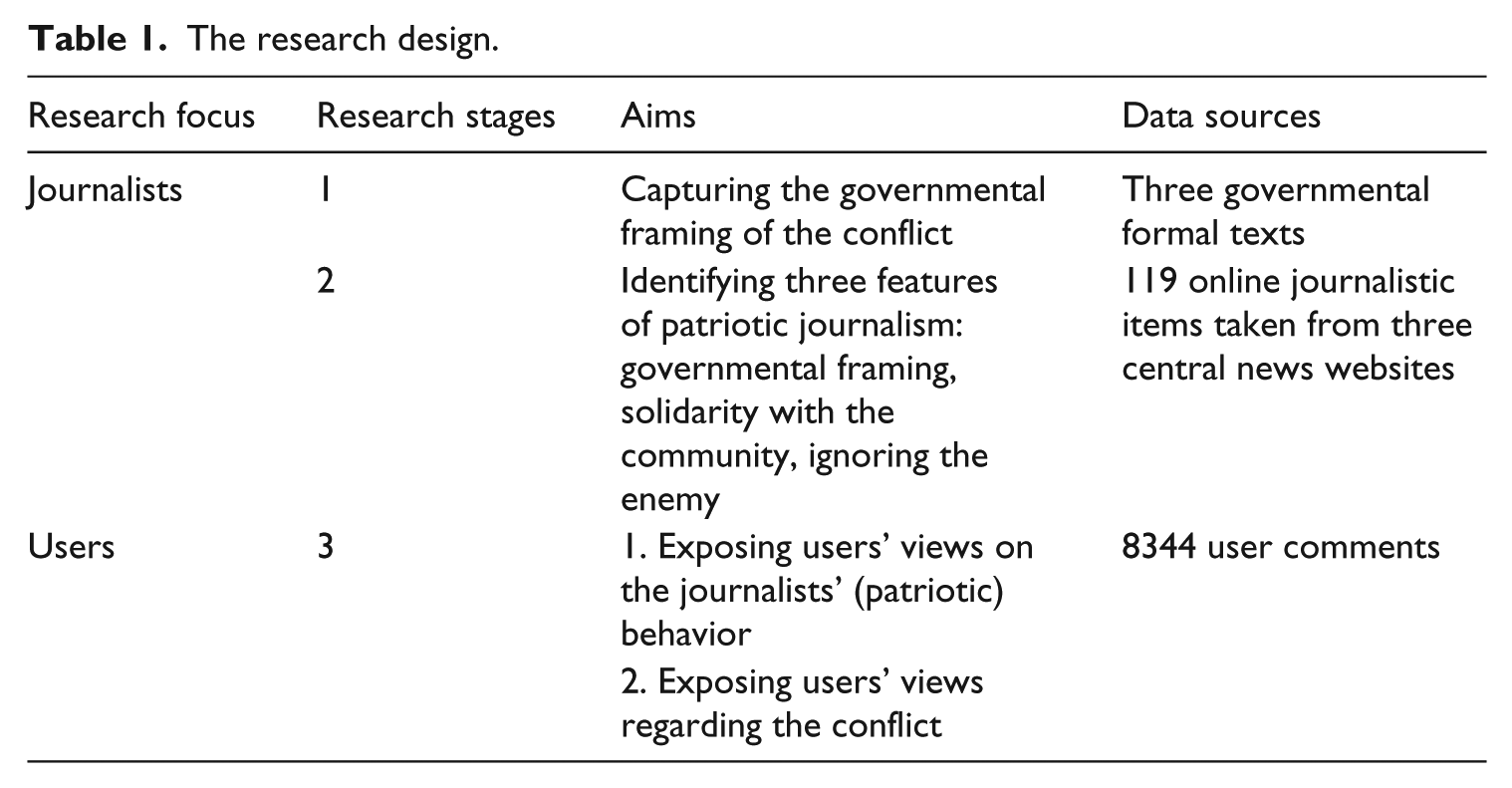
In regard to the first focus of the research – investigating the journalistic work – we addressed the three features of patriotic–journalistic behavior discussed earlier: the adoption of the governmental framing of the event, expressing solidarity with the national/ethnic community, and ignoring the other side of the conflict. In order to do so, we first analyzed three formal governmental texts: (a) a speech given by the Minister of Defense on 14 November 2012, in which he announced the operation and explained its motivation and targets; (b) a written press release published by the IDF spokesman on 15 November, in which the army reported on its initial military activities and presented its justification for the operation; (c) a speech given by the Prime Minister on 15 November, in which he spoke about the military activities, the diplomatic efforts, the casualties in Israel caused by Hamas rockets, and the justification for the operation. Following this, we analyzed all the informative texts published in the three relevant days (15–17 November) on three central Israeli news websites which at that time had the highest public exposure: Walla! (40.9%), Ynet (34.9%), and Mako (10.1%). While Walla! is an independent website, Ynet is the online division of a traditional newspaper, Yediot Aharonot, although it has a separate journalistic staff, and Mako is owned by the TV broadcaster, Keshet, and publishes TV news items produced originally for Channel 2 (which is partly owned by Keshet). Eventually, we analyzed 119 items: 47 from Ynet, 36 from Walla! and 36 from Mako. The analysis was according to the three main features of patriotic journalism discussed earlier.
The second research focus addressed all 8344 user comments on the 119 texts that were included in our sample. We first looked for direct responses of the users to the modes of the journalists’ reports (either they were professional or patriotic), and then we looked for any sort of expression exposing users’ personal views on the military operation and government policy.
Findings
The findings are presented according to the three research stages (see Table 1): analysis of the governmental texts, identifying patriotic features in the journalistic items, and exposing the users’ views (according to their comments).
The governmental texts
A clear distinction can be found in the three governmental texts between ‘we’, the good or the just ones (Israel), and ‘them’, the terrorists, the bad and evil (Hamas). This is true with regard to the three main themes that we identified within the governmental texts: (a) a legitimate state vs a terrorist entity; (b) the IDF vs a terrorist military organization; (c) Israeli citizens vs Gaza’s civilian population.
Here are four examples:
Israel does not seek war. The provocations by Hamas in the last weeks, and in particular the intensive rocket attacks, the bombing of the southern towns, and the tunnel whose end was discovered inside Israeli territory, forced us to act swiftly and decisively. (The Minister of Defense) Hamas injures children from both sides: it shoots at Israeli children and hides behind Palestinian children. (The Prime Minister) The ability of the civilians in the south to stand firm is a central component of our national strength. (The Prime Minister) The Gaza strip has turned into a frontline outpost of Iran and it causes the Israeli civilians to suffer from intolerable rocket launching and terror attacks. The IDF is decisive, and will keep on attacking targets which are bases for terror against the citizens of the State of Israel. (IDF press release)
These examples, and the remainder of the three texts, explicitly demonstrate the formal Israeli framing of the conflict: (a) the current round in the confrontation with Hamas was initiated by Hamas, who attacked Israeli citizens; (b) the IDF responded in order to destroy terrorist bases, defend Israeli citizens, and discourage Hamas from future attacks; and (c) Palestinian citizens are used by Hamas as human shields and are therefore Hamas’s victims, not Israel’s.
The journalistic items
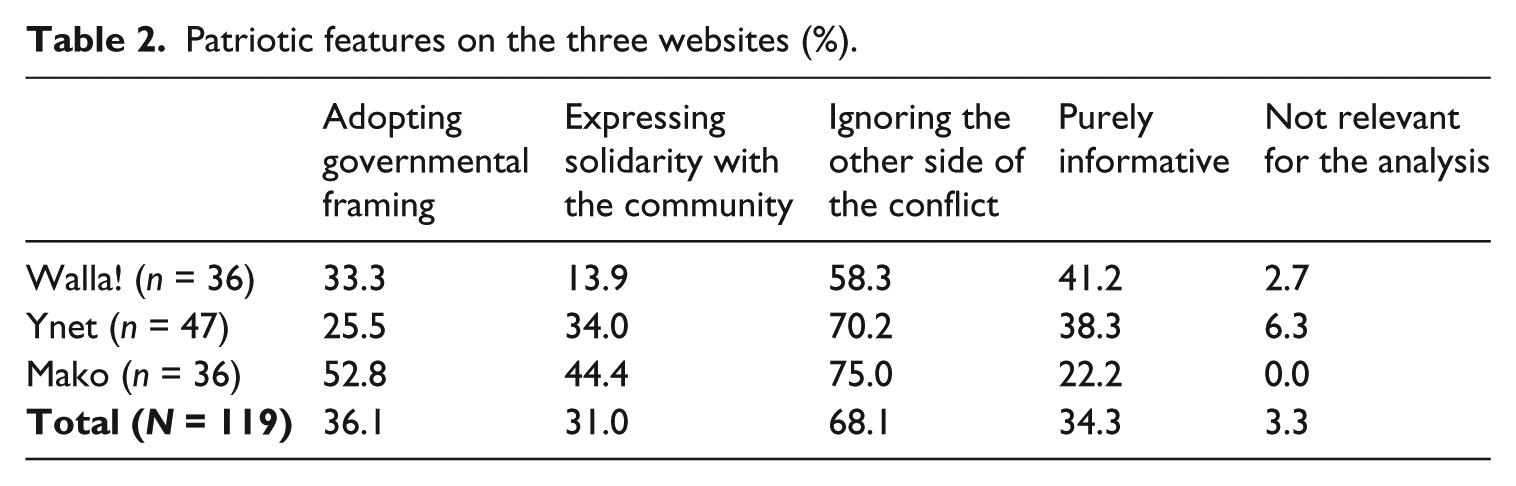
The three features of patriotic journalism were found in all three websites, albeit in different forms and at different levels. We classified a text as a patriotic one when one or more of the three patriotic features were identified. Generally speaking, in Mako a higher patriotic tendency was found compared to Walla! and Ynet. Yet, in all three websites we found texts (about one third of the entire sample) which can be defined as purely informative, with no patriotic tendency. Table 2 summarizes the data regarding patriotic features on each website (the total percentage in each row might be more than 100 because there are cases in which more than one patriotic feature were identified in a specific text).
Patriotic features on the three websites (%).
In the following, there are several examples of each of the three patriotic indicators presented in Table 2.
The first feature, ‘adopting the governmental framing of the conflict’, appears in three different forms:
(a) A direct quote from either a political/military leader or citizen/soldier who repeats/supports the formal policy:
We cannot leave women and children exposed to the madness of Hamas, which launches rockets and missiles at us for no reason. (President Peres, Walla!) We are going to defend our homeland. We will be there as long as needed. (A reserve soldier, Mako)
(b) The reporter’s words, either indirectly quoting a leader or echoing the formal policy.
The political level believes that there is no other choice but to break the terrorist capabilities of Hamas for good. (A reporter, Ynet)
(c) Using specific terms which are controversial but are used by the leadership; for example, ‘terrorist organization’ instead of ‘Hamas’ or ‘Palestinian’; ‘the terrorists were eliminated’ instead of ‘killed’ or ‘shot’.
It should be noted that not only did most items echo the government’s views, but only 2 items out of a total of 119 gave a voice to views which were different from the governmental one. The first (Ynet, 16 November), was the coverage of a demonstration of Arab–Israeli citizens; and the other (Ynet, 17 November) was an interview with a Jewish–Israeli opposition member of the Knesset (the Israeli Parliament).
The second patriotic feature, ‘expressing solidarity with the community’, was identified in three different forms:
(a) A detailed description of each of the dozens of cases in which Hamas’s rockets hit Israeli civilian targets, quoting residents whose homes were destroyed, relatives of people who were injured, and civilians who expressed strength and confidence.
I think that if the army launches such an operation, it should continue till the end. We can’t cope anymore with being under attack for such a long period. (A resident whose home was destroyed in southern Israel, Ynet) No terrorist can stop the wedding. We are strong people and we encourage the IDF to continue to protect us. (A groom’s brother whose wedding took place under rocket fire, Ynet)
(b) Detailed descriptions of each IDF officer and soldier who was killed or wounded during the operation. An outstanding example of this is a story published by Walla! about an officer who was severely wounded but insisted on being informed about the condition of his soldiers before agreeing to enter the surgery room.
(c) Reporting about governmental as well as private economic efforts to support and strengthen the southern civilian population, which was under attack. In addition, publishing announcements by formal authorities supporting the civilians who had come under attack.
The citizens keep to their daily routine while enhancing their awareness and fulfilling the IDF’s instructions. (Announcement published by the Municipality of Tel-Aviv after the first attack on the city, Walla!)
The third feature of patriotism, ‘ignoring the other side’, was addressed first by identifying the items in which the ‘other side’ (Hamas, or its supporters) was given any kind of voice, and then by content analysis of these items. Three findings in this regard are significant: (a) the vast majority of items in all three websites gave no voice to the other side: Walla! – 58.3 per cent; Ynet – 70.2 per cent; Mako – 75.0 per cent; (b) Hamas spokesmen were quoted only in 12 items: 5 of these items addressed the Egyptian Prime Minister’s visit to Gaza during the battle, and only 7 addressed directly Hamas’ positions; (c) in 9 other items, Hamas spokesmen were given a voice; however, in these cases they only approved Israeli announcements about Palestinian casualties. To sum up, only 7 items out of a total of 119 (less than 6%) gave Israeli internet surfers an opportunity to be exposed to the other side’s positions.
The users’ views
All 8344 user comments on all 119 items were addressed in the analysis. First, the comments were classified into two groups: those that directly addressed the journalistic coverage, and all the rest in which there was no such direct response. Only 269 comments were found in the first group (about 3.5%). All the comments were analyzed according to the governmental framing of the conflict in order to expose a possible relation between the users’ views on the operation and the way the government framed the event.
In the relevant 269 comments, three main types of critique against the journalistic coverage were identified: (a) the coverage provides too much information to Hamas (for example, ‘Enough, stupid reporters. You reveal to the enemy the exact location of our soldiers … stop the words and photos which expose the location’); (b) the coverage is too detailed regarding the damage caused by Hamas rockets (for example, ‘This item is demoralizing, it serves the enemy’; ‘You are trying to drive us into fear and panic – and it is not the reality’; ‘Why are you terrifying the public? Are reporters not a part of our people?’); (c) there is too much coverage of the casualties in Gaza (for example, ‘If it is so hard for you to see how many of them were injured, go and work for their news organizations’; ‘Stop publishing that we attack them … it is just giving them a platform …’; ‘Stop showing their dead and wounded.’)
The content analysis of all the comments reveals that 5465 comments out of 8344 (more than 65%) are in accordance with the governmental framing of the conflict. Generally speaking, most comments frame the conflict as ‘we, the good, the moral ones, the just and the strong side’ against ‘them, the terrorists, the cowards, the non-moral side’. Here are three representative examples:
I am a resident in the south; however, I am not afraid … let the IDF do what it knows how to do. We need to protect ourselves. We can’t send them candies while they are bombing us. We need to attack them and show them that we are not afraid … it is the State’s duty to protect its citizens in any way possible. We have a leadership that plans and operates in an excellent way. The Palestinian people are certainly not to blame for the fact that a terrorist gang took over and uses them as human shields and as a platform for committing war crimes.
Two other findings are noteworthy: (a) 1006 comments (about 12%) were classified as critiques against the government and the military. However, the vast majority of these comments criticized the leadership for being too soft towards Hamas. There were no comments that suggested either different framing or different points of view of the conflict, or accused the Israeli leadership for the acceleration rather than Hamas; (b) only 149 comments (less than 2%) addressed the Palestinian casualties, or expressed sympathy towards the other side’s losses from a humanitarian point of view.
Discussion and conclusions
This research addresses the question of whether online journalism adopts a patriotic mode while covering military confrontations just as traditional journalism has always done. In addition, user comments were analyzed in order to expose their attitude towards patriotic journalism. These two parts of our study aimed at advancing the discussion regarding the relationships between different stakeholders of online journalism. While in the old media, the distinction between professional journalists, on the one hand, and the public (audience) on the other hand is very clear, the online environment of journalism has blurred this distinction and changed the traditional relationships between professional and non-professional contributors of journalistic content. These relationships are considered by many journalism scholars as the basis for understanding online journalism in general and its ethical foundations in particular (e.g. Mitchelstein and Boczkowski, 2013; Singer, 2008). We hope that the current study’s findings add to this discussion and contribute to the understanding of the ethical norms and principles of online journalism in general and of patriotism in online journalism in particular.
To some extent, the three main features of patriotic journalism that have been identified in many studies regarding traditional journalism were found in the online coverage made by the three websites investigated here as well. First of all, journalists adopted the formal justification of the military operation as well as the formal position regarding the responsibility of the enemy (Hamas) for the escalation; no explicit alternative frames or points of view regarding the conflict were found even in one of the three news sites. Secondly, there were several expressions of explicit solidarity of the journalists with the community. The fact that there was relatively much more coverage of Israeli casualties than of Palestinian ones, and that each injured Israeli had a face while Palestinian civilian casualties were only numbers, implicitly enhances these expressions of national solidarity. Thirdly, the three websites almost totally ignored Hamas’s positions and narratives. It should be noted that the analysis in this study addressed only informative texts, and not opinion columns and the like. It could be – and this is one possible direction for future research – that the websites published such columns to balance the one-sided (patriotic) informative reports. However, even if this is the case, we think that imbalance in the informative texts illustrates the patriotic emphasis of journalists.
It is worth paying attention to the difference between the websites: Walla! – the only website that has no ties with any traditional journalistic institution – is relatively less patriotic compared to the other two websites. Furthermore, Mako which has the strongest ties with traditional media (TV channel) is the most patriotic among the three websites. The findings do not provide sufficient explanation for this difference, and further research with broader data, including interviews with reporters and editors, is needed in order to investigate the connection between these two facts.
Despite these differences, the findings undermine the assumption that the borderless nature of the internet allows online journalism to be freer of nationalistic tendencies. It seems that the national identity of the websites (as institutions) and its journalists (as individuals) dominates. One may think that other semi-journalistic channels on the internet, such as individual blogs, which are quite different from the established news websites investigated in this study, would not have this patriotic tendency. However, recent research indicates that Swedish blogs were mainly used to sustain – and not to challenge – the governmental narrative regarding the Swedish involvement in Afghanistan (Helman and Wagnsson, 2015). These findings as well as our own findings can be understood by the fact that in both cases the investigated texts are related to relatively small national communities (Sweden and Israel) written in two isolated languages (Swedish and Hebrew) that are not accessible to international audiences. In this sense, the borderless nature of the internet has no effect on local–national news websites and blogs. Consequently, professional journalists as well as bloggers behave according to the same mode as in the traditional media, including with regard to patriotic behavior. However, these findings contradict a relatively new approach in the research literature regarding the nature of patriotic journalism. While the traditional approach relates patriotism in journalism to the loyalty of journalists to their nation, country, or ethnic group (Craige, 1996; Ward, 2010b; Zandberg and Neiger, 2005), the newer approach, which is a more normative one, considers patriotism in journalism as the loyalty of journalists to the entire human society. On the one hand, it relates to globalization (Ward, 2005, 2010a, 2010b) and, on the other hand, to communitarian journalism (Borden, 2005). According to this version of journalistic patriotism, journalists should demonstrate solidarity and express sympathy according to global humanistic values rather than nationalistic/ethnic ones. These ideas recall what is known as ‘peace journalism’ (Galtung, 2002; Galtung and Fischer, 2013; Hanitzsch, 2004; Tehranian, 2002), according to which (in a nutshell), journalism should be committed not only to the objective coverage of conflicts, but to cover them in such a way that contributes to their peaceful settlement. These ideas about humanistic patriotism together with peace journalism could potentially fit online journalism like a glove because of the internet’s borderless nature. However, our findings show that national identity still dominates in times of national conflict. It might be that humanistic patriotism in journalism is more appropriate for international news websites, such as CNN International, BBC World, and the English version of Al-Jazeera, than local ones, such as the three Israeli websites in our case study. This is an additional interesting research path for future studies (see for example, Dencik, 2013; Hafez, 2011).
The findings regarding the users’ views can hardly be compared to parallel the audience’s activities in traditional journalism. This is because of the obvious differences between immediate, anonymous online comments and traditional channels of public responses, such as letters to the editor (Reich, 2011). However, our findings indicate that Israeli users favor patriotic coverage. They expect ‘their’ journalists to be part of the national community, to adopt its narratives, and to express solidarity with the community. Furthermore, the findings show that Israeli users seem to expect journalists to be even more patriotic than they are. It is not surprising, in light of our findings according to which most of the users favored a tougher policy and stronger military action against Hamas. Following this, an interesting research question for future study is: would the same journalists whose reports were analyzed here change their texts to be more explicitly patriotic following users’ comments supporting this direction?
Now it is the place to return to Singer’s (2008) suggestion regarding relating objectivity in online journalism to loyalty of journalists to their audience. Practically it means that journalistic objectivity should not be seen as impartiality and/or detachment as it has been considered in the traditional media. Rather, objectivity in the online world of journalism can be seen as one component of the relationships between journalists and their online audience. While covering national conflicts, during which patriotic feelings are dominant within the community, it would be natural for journalists to be patriotic as well. As was shown earlier in this article, such behavior has existed in traditional journalism as well, but has been considered as deviant behavior from professional ethical norms. According to the above analysis and based on the findings of this research, patriotic behavior in online journalism might be seen not as deviance but as a natural part of the journalistic work in the new environment of the internet. If this is the case, there can be two contradictory views regarding this new phenomenon: both of them are normative views rather than empirical–objective ones. The first possible view considers patriotism in journalistic work as a positive phenomenon because patriotic coverage enhances the relationships between various stakeholders of the new online environment of journalism: professional journalists, non-professional contributors of content (such as bloggers), and the local audience. In this way, a patriotic mode of journalism strengthens the solidarity within the national/ethnic community. On the other hand, according to the other view, patriotism in journalistic work is a negative phenomenon since the public is not exposed both to critiques of its government and other public institutions as well as to alternative points of view regarding the conflicts. We think that such behavior undermines one of the main roles of journalism in a democratic society – enabling the public to be aware of every fact, idea and view that might influence its life – and therefore it is unhealthy for the society’s strength and for democracy in the long run. As said previously, this is a normative view about the role of journalism (traditional and online alike) in society while in the current research we attempted to expose (and indeed did expose) a patriotic mode in online journalism.
Footnotes
Declaration of Conflicting Interests
The author(s) declared no potential conflicts of interest with respect to the research, authorship, and/or publication of this article.
Funding
The author(s) received no financial support for the research, authorship, and/or publication of this article.