







Abstract
This article examines how political cartoons reflected and mobilized resistance to growing authoritarianism and the personalization of power in contemporary Serbia. The focus is on the work of Dušan Petričić, the most influential political cartoonist in Serbia, which was published in daily Politika and weekly NIN between 2012 and 2017. Petričić’s cartoons offer interesting insights into a dramatic decline of press freedom and the rise of authoritarian personalist rule in terms of both their content and political impact. The authors draw on quantitative content analysis and qualitative multimodal analysis to examine the key representational and stylistic features of Petričić’s cartoons, both as a way to understand the relationship between his aesthetics and his political statements, and in order to critically assess some of the ways in which democratization conflicts may be expressed visually. Their analysis also draws on evidence from an in-depth interview with the author. In combining a systematic analysis of key visual patterns across a sample of cartoons with a comprehensive evaluation of how both visual and linguistic features work together to promote anti-authoritarian ideals and resistance, the article offers a framework to understand the political import of aesthetics in Serbia’s democratization process.
Over the last decade, the global wave of democratic recession has brought into question advances in democratic development since the mid-1970s. In Europe, both old and new democracies have experienced decline in this respect, with countries in which democratic institutions had been most vulnerable suffering the most (see Diamond, 2015). ‘Third wave’ democracies in southern and central Europe have experienced the rise of populist and far-right parties and movements, while press freedom and constitutional checks to governments have been considerably eroded, not least due to parallel adverse economic conditions and rising inequalities. New democracies in the Balkans have faced the same trends, but outcomes have been even more damaging, as competitive elections have turned increasingly un-free and unfair, and opposition parties and other government critics have faced major restrictions in their operation, which in turn has undermined basic democratic institutions. The successive democratic decline and return to authoritarian rule in Serbia is among more extreme examples of this trend with regard to European countries that have emerged from authoritarian rule over the last three to four decades.
These trends are normally explored in light of comparative politics debates on democracy and democratization and of objective data (such as voter turnout, number and size of political parties), attitudinal data and expert assessments of democratic procedures, content and outcomes. In this article, by contrast, we examine various dimensions of authoritarian rule from the perspective of political aesthetics and through a critical visual analysis of political cartoons. We use the concept of visual metaphor to understand how political cartoons contribute to making an abstract, yet powerful concept like that of authoritarianism both visible and intelligible to a broad public and, in doing so, also communicating a political stance on various aspects of this phenomenon, including but not limited to leadership, restrictions on press freedom and violence.
In the next section, we introduce key approaches to the concept of visual metaphor, together with examples of how this concept has been applied to analyses of political cartoons. We then provide a background to democratization and its reversal in Serbia, and situate the editorial cartoons of Dušan Petričić, who is one of Serbia’s most important political cartoonists, at the centre of emerging opposition to the authoritarian rule of the current President and former Prime Minister Aleksandar Vučić. In the following section, we describe how and why a mixed-methods approach has been used in this study, combining quantitative visual content analysis and qualitative visual analysis of political cartoons with an in-depth interview conducted with Petričić himself in order to gain a critical understanding of the key themes, tropes and motivations that set his body of work apart. We then proceed to outline findings from our quantitative visual content analysis of political cartoons between 2013 and 2017, at the height of Vučić’s authoritarian rule, focusing on key actors and themes. We also offer a detailed discussion of the relationship between authoritarianism and democratization in a contemporary Serbian context by examining a sample of editorial cartoons by Dušan Petričić. Ultimately, we argue that our analysis of Petričić’s political cartoons contributes to an enhanced critical understanding of authoritarianism in the Serbian context as a process set apart by a return to hybrid regime politics, which sits on the fence between democracy and authoritarianism, and which reflects overall democratic decline, legacies of past conflicts and highly manipulative leadership restricting independent media and political competition.
Visual metaphor and political cartoons
The study of visual metaphor is both urgent and fundamental in political communication research insofar as it contributes an enriched understanding of how major political processes may be rendered as more concrete objects for interpretation. By the same token, political cartoons are particularly rich sites for the study of visual metaphor, both because they make political concepts accessible and political stances manifest through imagery. In her work on political cartoons, El Refaie (2003: 78) defines visual metaphors as ‘visual expressions of metaphorical thoughts or concepts’. El Refaie’s definition is particularly productive for our purposes because it offers a nuanced approach to analysing political cartoons as more or less complex texts and in relation to their contexts. Her approach encompasses not only the more properly formal qualities of visual metaphor, but also its conceptual underpinnings. Importantly, El Refaie’s definition takes into account both the political interests and communicative goals of the cartoonist for the purposes of textual analysis.
The notion of metaphor is most commonly associated with linguistic statements. In translating this widespread notion to the visual mode, many have focused on the ways in which particular visual cues may be used to frame a subject or issue. British art historian EH Gombrich (1971) was one of the first scholars who attempted to explain how visual metaphor works in portrait caricature. In ‘The cartoonist’s armoury’, he stated that metaphor was one of the main ‘weapons’ in the hands of a cartoonist, and elucidated that, visually, metaphor was most often achieved as ‘visual fusion’ – as in when, for example, the face of a political leader is ‘fused’ with that of an animal (e.g. a pig) to make a statement about the individual politician’s moral calibre. In his work on advertising, Forceville (1996: 9) offered a broader definition of visual or ‘pictorial’ metaphor, stating that this is what occurs when ‘ad hoc properties and features’ are used to replace an otherwise conventional visual element in an unexpected manner. For example, in a French ad for sweet corn targeted at farmers, a wine glass is filled with corn kernels, thus yielding the metaphor ‘corn is wine’. While usually one would expect to find sweet corn in a can or a jar, the unexpected placement of corn in a wineglass projects connotations like ‘refinement’, ‘delicate taste’ and ‘preciousness’ (Forceville, 1994).
According to El Refaie (2003), the main problem with these approaches to defining visual metaphor is that they focus too narrowly on specific formal properties, and therefore do not account for the richness and potential of visual metaphor. While Gombrich’s visual fusion and Forceville’s definition of pictorial metaphor in terms of unexpected replacement of a visual cue by another are both possible types of visual metaphor, political cartoons offer a much greater variety of possibilities. Further, as El Refaie argues, the notion of visual metaphor ought to be associated not only with specific formal properties, but rather with the ways in which patterns of thinking emerge from particular visual arrangements. In this regard, she offers examples from Austrian political cartoons focusing on immigration. In one example from 1998, the metaphoric thought ‘immigration is occupation’ is not expressed through a single, explicit metaphor, but rather through a more complex combination of visual and verbal elements. The cartoon depicts a family standing in the middle of Europe, encircled by the EU flag’s stars, and holding a flag with the message ‘Neu Kurdistan’ (‘New Kurdistan’). Meanwhile, four more ships are depicted at the bottom of the image, as they are seemingly sailing from Turkey to southern Italy. Here, El Refaie claims, there is no single visual element that corresponds to the concept of ‘occupation’ or even ‘invasion’, but the different elements of the image are composed in such a way that these concepts can emerge from patterns of thinking specific to the context in which the cartoon was produced – Italy and Austria had just joined the Schengen Treaty and border controls between the two countries had thus begun to decrease.
It is important here to underline that such patterns of thinking are not universal, even though metaphorical thought is part and parcel of our everyday life (see Lakoff and Johnson, 2003). It is therefore key to examine the formal qualities of cartoons as (1) linked together in more or less complex visual arrangements, and (2) connected to contexts of production and interpretation that make particular meanings possible, if not preferred.
Within this framework, it becomes possible to analytically outline some of the main functions of visual metaphor. Morris (1993) offers a useful breakdown of some of the most common processes shaping the content of cartoons. These are condensation, combination, domestication and opposition. Condensation entails ‘the compression of a complex phenomenon into a single image that is purported to capture its essence graphically’ (p. 200). For example, inflation may be depicted as a monster towering over a country or a political leader. In other cases, specific events may be reduced ‘to their alleged common core’, as in when an archetype like David and Goliath is used to depict all struggles between unequals. Combination is linked to Gombrich’s (1971) notion of visual fusion, as it may result in ‘the blending of elements and ideas from different domains into a new composite’ that is still clearly identifiable as containing both of its constitutive elements. As we mentioned earlier, in this case a politician’s face may be grafted onto the body of an animal, such as a pig or a rat. Domestication relates to choices aimed at converting abstract ideas or unfamiliar figures or events into closer, more familiar and more concrete depictions. In US political cartoons, for example, Saddam Hussein was often portrayed as Hitler, thus relying on commonplace understandings of what evil leadership meant and therefore also mobilizing support for the invasion of Iraq, which was ultimately seen as a heroic gesture in much the same way as US intervention in World War II. Opposition, finally, is used to associate particular issues with familiar binaries like male–female, adult–child, culture–nature, etc. For example, in the French–English bilingualism debate in Canada, political cartoons often depicted French as a language for women and children rather than men and adults, thus discounting its value (Morris, 1993).
Greenberg (2002) enriched Morris’s schema by proposing an additional analytic device, the notion of transference. In visual discourse, transference ‘absolves the cartoon’s actors of their absurd actions or commentary by displacing blame to another, normally non-visible, actor’ (p. 187). As an example, Greenberg explains that, in political cartoons of immigration and the asylum system in Canada, the issue of skilled Canadians’ emigration is transferred onto the problem of unwanted foreigners’ immigration, where ‘our’ problems are being put ‘on the same plane with “their” presence’ (p. 193).
While these are useful concepts for an understanding of how metaphor works from a visual standpoint, El Refaie (2003) also outlines some of the specificities of visual metaphor in relation to its verbal counterpart. First, as she explains, the verbal mode lends itself to communicating both action and chronology better than the visual. However, visual metaphor can be used to express both of these dimensions spatially, and it is therefore better at expressing relations and hierarchies between different elements and events. Second, language enables us to attach a verbal label to even the most abstract concept, whereas visual metaphor requires that abstract concepts are communicated through more concrete symbols or ‘easily imaginable vehicles’ (p. 85). It is also for this reason that visual metaphor lends itself to personification. Third, visual metaphor may be better at ‘implicitly conveying affective meanings’ (p. 89) and therefore also ‘at tapping in to unconscious, deep-seated emotions’ (p. 90). For example, cartoons can portray subjects either as anonymous types or groups of people or, on the other hand, as individuals making eye contact with the viewer from a close distance, as in close-ups where subjects have a ‘demand’ gaze. Finally, the relationship between visual and verbal elements in cartoons is such that they mutually influence each other, to the extent that linguistic messages can both be used to ‘anchor’ a particular visual element (e.g. a person, a fortress) in a specific meaning (e.g. ‘Schengen’, ‘Europe’) and provide broader information about the cartoon’s context.
As a whole, metaphor lends itself to representing intangible, unknown, or problematic ideas and issues as more familiar. Visual metaphor in particular can convey implicit meaning through concrete references that are ‘often drawn from the domain of basic human experience’ (p. 84). Ultimately, such references are tied to ‘the culturally shared preoccupations of the moment’ and this is also why it becomes all the more important to examine the formal properties of political cartoons in relation to their contexts and, in our case, to the historical processes underlying the production of these cartoons and the cartoonist’s political stance and related creative choices.
At the same time, here it is important to emphasize that cartoons have long been central to popular critiques of power. This has especially been true in non-democratic regimes, where both artists and ordinary citizens often express their dissent through humour and satire. Likewise, both laughter and ridicule can and are often used to maintain, rather than disrupt, social order and therefore also the status quo (Billig, 2005). It is for this reason that political cartoons are particularly instrumental in reversing, debunking, and thus also destabilizing the tactics of humiliation and embarrassment that many conservative governments and authoritarian regimes enact against potential or actual dissent. For example, in his research on links between political cartoons and post-colonial critiques in African contexts, Hammett (2010: 5) notes that political cartoons are a concrete means of providing ‘a voice to the subaltern while subverting power relations, exploitation and repression’. According to Hammett, it is therefore not an accident that political cartoons are most controversial when they focus on the elites themselves and their excesses.
Along the same lines, editorial cartoonists are often discouraged from and punished for ridiculing and therefore also attacking local elites in their work. In some non-democratic regimes, like Singapore for example, cartoonists are expected to play a consensus-shaping role for the purposes of nation-building (Tju, 2004). Hence, political cartoonists are often expected to avoid taking political stances and in fact ‘over-politicization’ is frowned upon – even among editorial cartoonists themselves, who often self-censor and ‘play it safe’. Those political cartoonists who do go the extra mile to promote popular dissent against the ruling elites may incur implicit and explicit sanctions, particularly in openly authoritarian regimes that go to extreme lengths to both punish and humiliate them. For example, in Azerbaijan, which is one of the most authoritarian post-Soviet states, in recent years the government has actively repressed online political satire while also co-opting online humour to attack dissidents (Pearce and Hajizada, 2014).
As a whole, then, political cartoons are both a fundamental and scarce resource for popular dissent and anti-authoritarian critique. As Hammett (2010: 5) states, political cartoons are part and parcel of everyday acts of resistance against authoritarian elites insofar as ‘moments of satire provide spaces through which to laugh at selves and elites, to escape – even if only momentarily – the belief that one’s agency has been taken away by the extent and excesses of state power’. In the next section we turn to some of the ways in which, over the last half century, Serbian citizens have expressed their dissent against growing authoritarianism through a variety of cultural practices and artistic forms.
Authoritarianism and cultural and artistic dissent in Serbia
The rise of authoritarianism in Serbia over the last few years reflects, in a somewhat extreme manner, major outcomes of global democratic recession in new democracies, especially those in the Balkans. After communism, most East European countries turned into democracies but Serbia ended up with Slobodan Milošević’s hybrid regime. Milošević used nationalism instrumentally to gain public support at the time of federal and multinational Yugoslavia’s bloody collapse and suppressed opposition parties and civil society. Large waves of popular mobilization broke out against the regime in 1991, 1992, 1996–1997, 1999 and 2000, which ultimately booted Milošević out of power (see Vladisavljević, 2008; 2016). The regime change pushed the country strongly in the direction of democracy, economic reform, regional co-operation and EU integration, and the new democracy survived several highly contested election cycles. Since 2008, the spillover from the global economic crisis revealed a large clientelist system across the public sector as ruling parties abused state resources to employ their activists, supporters and friends. A sharp fall in living standards then made the ruling democratic coalition unpopular. The main beneficiary was the opposition’s Serbian Progressive Party (SNS), which had originated from the Serbian Radical Party (SRS), the main carrier of exclusionary nationalism and chauvinism since the early 1990s. Tomislav Nikolić and Aleksandar Vučić, the party’s leaders who had participated in Milošević’s government, now switched to vigorously promoting EU integration, good neighbourly relations with former Yugoslav republics, economic reform and campaigned against ruling parties on an anti-corruption ticket (Pavlović, 2019).
In 2012, the SNS won presidential and parliamentary elections, and formed the new ruling coalition. Democratic parties previously in power gradually imploded, leaving the country without effective opposition. This power vacuum was filled by Vučić, an increasingly popular SNS leader and deputy prime minister (soon to become prime minister and later president). His new policy agenda won him lavish praise from key international players and local NGOs involved in post-conflict reconciliation, the fierce critics of his chauvinist past. While campaigning against corruption and clientelism, the ruling coalition expanded both considerably. Elections remained competitive but turned increasingly unfair, with limited access of government critics to electronic media and highly asymmetrical resources of ruling and opposition parties. Vučić encouraged pro-government tabloid media to criminalize democratic opposition and other opponents, often through hate speech, and to wage chauvinist campaigns against ‘rival’ ethnic groups, worthy of his political roots. The smear campaigns against regime opponents sharply reduced the quality of public communication, raised concerns about the future of public debate on key issues and undermined editorial independence and press freedom (Pavlović, 2019; Vladisavljević et al., 2019).
The return to authoritarian rule initially faced little opposition, except for the ombudsman’s vigorous investigation of the government’s abuses of power and press freedom violations. Civic resistance grew only very slowly, principally from local initiatives that focused on local issues. More recently, there were protests against severe violations of individual and property rights, and growing authoritarianism. The ‘1-out-of-5-million’ protests against Vučić’s regime, which started in December 2018 in Belgrade and continued throughout 2019 have been publicly supported and led by famous actors, writers, university professors and intellectuals. The growing resistance to authoritarian rule built upon a lively tradition of cultural and artistic dissent under communism and, later, under Milošević’s authoritarianism (BalkanInsight, 2018/2019).
During the 1960s, artistic and cultural dissent in Yugoslavia challenged the Titoist system and examined reality mainly through ‘the black wave’ in literature and cinema, as well as through the journal Praxis, which represented ‘the new left’ of Belgrade’s philosophers and their students. These approaches pointed out the defects of the system and ‘the dark vision of Yugoslav socialist reality’ (Dragović-Soso, 2002: 24) so vividly that the most important film directors were forced to go into exile. Well-known intellectuals and artists who criticized the regime in the 1970s faced even harder repression. University professors lost their jobs because they mentored students whose artistic work emphasized the resemblance between socialism and fascism. Famous Serbian surrealist painter Ljuba Popović was condemned by the regime and his exhibition was closed down because a painting of the leader Tito and his wife was exhibited right ‘next to a portrait of a Yugoslav worker on a train for Germany’ (p. 48). By the 1980s there were three forms of intellectual activism: open letters and petitions defending civil rights; extraordinary action of ‘flying universities’ when professors held lectures at their homes; and some of the first attempts at self-publication to circumvent state control (pp. 49–50). During the 80s, theatre writers and directors focused on broken relations between Serbs and Croats, and farcical representations of socialism being built on poverty and threats. Musical dissent and the rock ‘n’ roll aesthetic represented by specific bands of that time (e.g. Disciplina kičme, Boye and later of Partibrejkers) indicated a kind of a rising artistic revolt against the regime. Gordy (1999: 115–116) sees the Belgrade rock scene during the war years of the 1990s as an ‘antidote to the isolation imposed on young people’ in Serbia, together with young people’s revolt against imposed breaks on cultural exchanges with other countries and their large exodus from Serbia. An ironic and comical approach that ridiculed life in the Balkans and in Serbia during Milošević’s regime was blended in an all-in-one music genres mixture and expressed by the extravagant musician and intellectual Antonije Pušić, known by his artistic name Rambo Amadeus. The largest rock bands in the capital in that period, such as Partibrejkers, EKV and Električni orgazam, revolted against the ‘neofolk vulgarity’, ‘architects of war’ and the culture of their political supporters (p. 120), but were marginalized for political reasons by the ruling party, which largely promoted neofolk musicians through media in their control. In later years, hip-hop band ‘Beogradski sindikat’ (‘Belgrade Syndicate’) and local DJ artist SevdahBaby became recognized for their singles and remixes which expose the shortcomings of the regime, criticize state-controlled media and display negative attitudes towards Vučić’s authoritarian rule. These and similar performances can be found mostly on social media and YouTube because of the powerful regime-control over mainstream TV stations in Serbia.
Despite various forms of repression executed by political regimes over the past decades, Serbia’s intellectuals, film directors, novelists, musicians, journalists, cartoonists and university professors became significant agents of artistic and cultural dissent.
Dušan Petričić’s professional background and influence
In this context, Dušan Petričić, a political cartoonist, emerged as one of the most influential critics of Vučić and his authoritarian rule. His visual messages were highly resonant among the educated public. Furthermore, his stinging critique of the regime’s dramatic violations of democratic freedoms and political competition, and of growing personalization of power, bordering on Aleksandar Vučić’s cult of personality, was both part of an emerging civil society response to the ‘normalization’ of authoritarianism and a boost to the mobilization of resistance to personalist rule. Petričić’s professional and personal background mattered greatly with regard to his influence on the broader public. His work was published in the popular daily Večernje novosti in the 1970s and 1980s, making him one of the most influential editorial cartoonists in the former Yugoslavia. At the time of Yugoslavia’s bloody collapse and Milošević’s authoritarianism, Petričić moved to Canada where he became the Toronto Star editorial cartoonist and also published his work in The New York Times and the Wall Street Journal. He has also been influential as a cartoonist for children, illustrating books for half a century, including books of important Serbian and international children’s writers Duško Radović, Ljubivoje Ršumović and Kathy Stinson.
Petričić’s cartoons were highly influential in socialist Yugoslavia, when censorship and self-censorship abounded. These constraints influenced Petričić’s work and his understanding of editorial cartoons: ‘The cartoon is not a newspaper drawing, it is a way of thinking’ (Ajanović, 1988: 30, cited in Obrenović, 2016: 43). He recognized that he learned how to communicate with the audience and to criticize politicians in a way that would be perfectly understandable to the audience but would be left uncensored by officials (Bulatović, 2017). Petričić and other established authors developed a modern political cartoon in the former Yugoslavia (Obrenović, 2016), which strongly influenced editorial cartoons in Yugoslavia’s successor states, including Serbia. Petričić started working for the daily Politika in 2009, before he moved back from Canada to Belgrade, and over time his work attracted strong criticism from the ruling coalition. The 2016 government-sponsored exhibition named Uncensored Lies listed Petričić’s cartoons, along with other visual material and media stories highly critical of government, as evidence that there was no censorship, and simultaneously encouraged pro-government tabloid media to ‘shame’ these government critics. The ruling party claimed that Petričić criticized and negatively portrayed Vučić more than any other former leader. Politika’s new editor-in-chief then fired Petričić, while the author’s cartoons found a new outlet in an influential opposition weekly NIN. Politika’s decision to fire Petričić was condemned by the independent journalist association and, cynically and unconvincingly, by the prime minister Vučić, who claimed that Petričić’s cartoons were ‘evidence of democracy’.
That Petričić’s cartoons always appeared on the front page of Politika’s Sunday edition and, later, on the second page of NIN (and occasionally on its cover page) reveals his standing and influence in the country’s contemporary political and cultural life. The following sections focus on our visual analysis of Petričić’s editorial cartoons, which aims to generate a better understanding of the implications of particular types of visual metaphor for a critical definition of authoritarianism in the Serbian context.
Mixed-method analysis of Dušan Petričić’s political cartoons
For nearly a decade now Petričić has published weekly editorial cartoons in daily Politika and weekly NIN. We examined cartoons published in the 5-year period in which democratic institutions were eroded and authoritarian rule emerged, that is, between January 2013 and December 2017. We use a mixed-methods approach that combines quantitative visual content analysis and qualitative visual analysis of political cartoons. Content analysis is the systematic and quantitative analysis of message characteristics. It seeks to describe the main features of texts and other meaningful matter accurately by examining their manifest content, something that requires detachment from interpretation in data gathering. Quantitative content analysis normally selects some features of messages and disregards others, depending on what a researcher is focusing on (Krippendorff, 2004; Neuendorf, 2002). The content analysis of visual materials is used less often than that of texts and some believe that images – being polysemic, symbolic, performative, and emotive – are more difficult to capture with such a ‘blunt instrument’. However, it can provide a foundation for sophisticated research when it is supplemented with other analytical approaches that examine the thematic, strategic and persuasive elements of images (Parry, in press; see also Bell, 2001).
Two coders coded all political cartoons that covered domestic politics and those that focused on international politics if they referred to domestic politics in some way, that is, 228 out of 284 cartoons published in the 2013–2017 period mentioned earlier (80.1%). The content analysis protocol, which built upon key concepts from the comparative politics literature on political regimes and from democratization studies, was piloted on a sample of cartoons. To monitor the quality of coding, we conducted an inter-coder reliability test on 20 randomly selected cartoons (8.8% of all coded cartoons). We used Cohen’s kappa as a highly conservative measure that takes into account only agreement beyond chance. The average score for both formal and content variables was 0.88 and for content variables only was 0.84. For Cohen’s kappa, values 0.0–0.20 reflect slight agreement, 0.21–0.40 fair, 0.41–0.60 moderate, 0.61–0.80 substantial and 0.81–1 almost perfect agreement (Landis and Koch, 1977: 165). Therefore, the reliability score for examined variables showed almost perfect agreement.
Based on the most frequent themes and actors identified in our quantitative content visual analysis, we selected four representative cartoons for our qualitative content analysis. We examined how visual metaphor is used to communicate some of the main aspects of authoritarianism in democratizing Serbia – including manipulative leadership, regime violence, silent society and subversion of press freedom. In addition, we supplement our visual analysis with Petričić’s own perspective in order to link the cartoons that we analysed to the cartoonist’s politics and practices, thus also providing an interpretive framework that situates texts (i.e. the cartoons) in their contexts (see Thurlow and Aiello, 2007). For this reason, we conducted an in depth, semi-structured interview with Petričić himself, asking him to explain his political views and understanding of emerging authoritarian rule in Serbia as well as the aesthetic choices that set apart his political cartoons in the analysed period. As a whole, ours is a critical visual analysis (Aiello, 2006), insofar as our findings highlight both the political ideologies and political implications of Petričić’s cartoons in relation to authoritarianism in democratizing Serbia. We now turn to our quantitative visual content analysis, which will also serve as the empirical basis for our qualitative analysis of the cartoons.
Quantitative visual content analysis: Key actors and themes
We coded key actors and themes that appeared in Petričić’s political cartoons. The cartoons focused overwhelmingly on Aleksandar Vučić (61.1%) and other ruling coalition politicians (33.0%), reflecting both their political weight and the main target of the cartoonist’s critique. Similarly, rare appearances of democratic opposition politicians (9.5%), and the fact that the main actors outside the ruling coalition were ordinary people (33.5%), suggest the former’s increasing irrelevance on the country’s political stage but also their political marginalization via authoritarian restrictions and manipulation (percentages add up to more than 100% because we coded up to three main actors per cartoon). Interestingly, former political leaders – including Yugoslavia’s strongman Tito, Slobodan Milošević, Vojislav Šešelj, the extremist SRS leader and former political mentor of Aleksandar Vučić and Zoran Đinđić, a democratic leader and prime minister who was assassinated in 2003 – appeared often in cartoons, keeping in mind that they had left the political stage a long time ago (8.1%). This finding reveals a long shadow of past conflicts over state-building and democratization, and their relevance for understanding contemporary politics. Extremists, such as thugs and football hooligans, also appeared often in cartoons (8.1%) – something that vividly paints the dark side of Serbian politics, especially their close links with the ruling coalition and Vučić personally. Finally, pro-government tabloid media and other media featured reasonably frequently in cartoons (5.4% and 5.9%, respectively), taking into account that they are not normally seen as political actors in their own right. This finding reflects the significance of media for the authoritarian regime as both zealous propagandists of Vučić and his authoritarian ways, and passive spectators of political affairs (as opposed to watchdogs).
Table 1 provides data aggregated to the main kinds of themes that appeared in coded cartoons, but we also discuss more specific ones in our critical analysis. We developed themes that cover: (1) leadership (i.e. character, competency, charisma, independence and residual category), drawing on the literature that explores images and perceptions of political leaders/candidates (see Edwards, 2001); (2) various aspects of political regimes (including the level of democracy, violence/peace and rule of law); and (3) policy areas that are relevant in contemporary Serbia but largely overlap with those in comparable countries (including economy, culture, EU integration and Kosovo). The theme of leadership dominated cartoons, and especially those that included Vučić in one way or another. Coded cartoons focused especially on the lack of integrity and opportunism, and dishonesty, of portrayed politicians, and Vučić in particular. In this way, they depicted a highly populist, manipulative and abusive authoritarian leadership as well as the opportunistic and sly character of its most prominent personality. The theme of democracy, which we developed on the basis of the comparative politics literature on political regimes and democracy (see Levitsky and Way, 2010), appeared in about a quarter of cartoons, relating principally to press freedom, elections and political competition. Having in mind that key aspects of this theme related to violations of press freedoms and political competition, the cartoonist vividly painted the return to hybrid regime politics, in which multi-party politics is coupled with considerable restrictions on the operation of opposition parties and on independent media.
Themes in political cartoons.*

Percentages add up to more than 100% because we coded up to two themes per cartoon.
The theme of violence and peace, which forms an important part of many authoritarian and hybrid regimes (see Levitsky and Way, 2010; Linz, 2000), also appeared frequently, with a strong swing to the violence end of the spectrum, reflecting both war and authoritarian legacies, which continue to haunt the regime’s recent converts to peace and reconciliation, and the regime’s current use of thugs to deal with its opponents. Other relevant themes included economy, culture and the rule of law, seen largely from the perspective of either the regime’s devastation of the relevant institutions and public resources or the scorn and ridicule of frequent unprincipled and philistine attempts of key regime figures to present themselves as promoters of development in these areas. What also matters here is which themes are downplayed in the cartoons in relation to their significance in the official discourse and in print and electronic media reporting in this period, which was strongly influenced by the ruling coalition. These include economy, in terms of prosperity, employment and infrastructure development, followed by issues related to EU integration and Kosovo, which suggests that the cartoonist, like much of the educated public, saw through the official and Vučić’s rhetoric, and tackled most relevant issues instead.
Critical visual analysis: Visual metaphor and authoritarian rule
Here we analyse selected cartoons qualitatively, also in relation to insights from our interview with Petričić, to explore how visual metaphor makes the concept of authoritarian rule widely accessible to the public. The cartoons represent themes that prevailed in Petričić’s work in Politika and NIN in the analysed period, including leadership, violence and democracy.
Portraying Aleksandar Vučić: Authoritarian and manipulative leadership
Aleksandar Vučić, deputy prime minister in 2013 and early 2014, was usually presented in a group with the main personalities of the ruling coalition, i.e. president Tomislav Nikolić and prime minister Ivica Dačić. The cartoonist depicted the group of three politicians as incompetent but benign theatrical characters who are, for example, clumsily juggling balls labeled ‘East’ and ‘West’, waiting for Godot, or simply crying on stage in front of the audience. He uses various visual metaphors to intensify the three leaders’ childish behaviour, portraying them with toys and teddy bears, pacifiers and baby bottles, or driving in baby strollers (e.g. Politika, 9 June 2013, 10 April 2016). Petričić’s main intention in this period was to mock these leaders’ characters and to emphasize their actions as ‘infantile and sick’, as he explained in his interview with us.
However, as soon as Vučić became prime minister in 2014, the cartoonist started to present him more as a stand-alone actor, using combinations of visual metaphors to expose negative traits of Vučić’s government and to criticize his personality and leadership. For example, Vučić appears disguised as positive and well-known figures and noble professions, such as a king, magician, pilot or even as Robin Hood or Superman (e.g. Politika, 30 March 2014). These cartoons point out the leader’s need to publicly represent himself as a competent man, a true leader, even a hero doing everything in his power to reform the country and to boost its progress, while simultaneously revealing his opportunistic character and highly partisan and personal interest behind noble goals.
To highlight Vučić’s personal character, his public image and the authoritarian character of his governance, the cartoonist sometimes uses the frame format or ‘a single-panel drawing’ characteristic of comic strips, which may contribute to a better understanding of the author’s intention (El Refaie, 2009: 194). Therefore, the frame format and repetition of the same objects in a single image appear in cartoons where Vučić’s face has been multiplied to address the personalization of power and to expose his totalizing control over the government (e.g. Vučić appears as the prime minister and also as every minister in the government, Politika, 6 April 2014) and the media (e.g. Vučić shown as each employee in a TV studio (Politika, 29 May 2016).
In ‘The package of measures’ (Figure 1), this multiplication model is used to intensify Vučić’s actions regarding economy and economic growth. In general, Vučić often presents himself as a modernizer of Serbia, doing everything he can for the country’s prosperity, at the same time accusing the former government of having economically destroyed the country and wrecked citizens’ living standards. However, one of the first economic measures after he became prime minister was to cut people’s pensions and wages to recover the budget. In this cartoon, Vučić is depicted as a hard-working leader struggling to save the country’s economy and the well-being of the population, especially of those who suffered most in this respect.
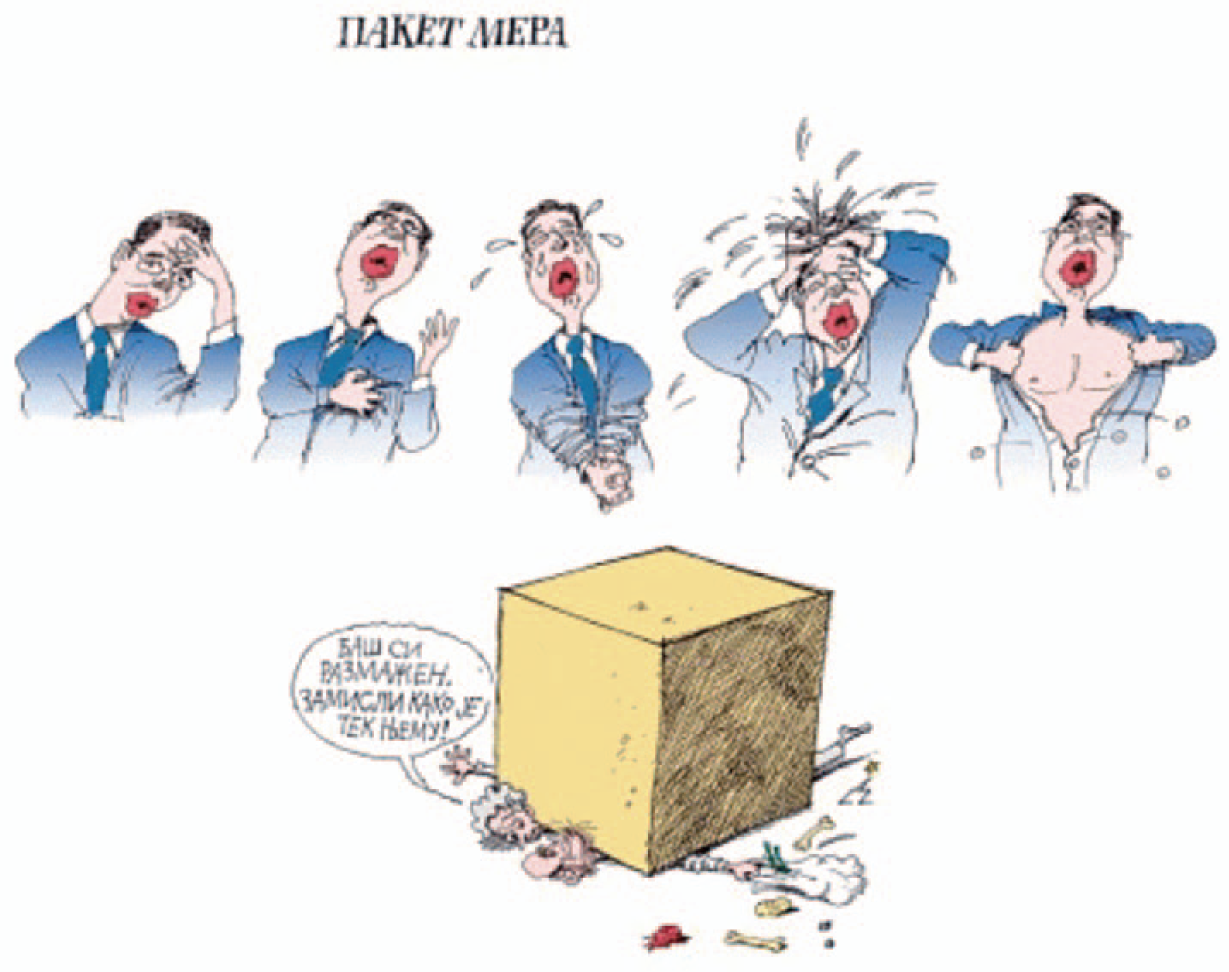
‘The package of measures [or The reform package]’ (Politika, 21 September 2014) (Quote: ‘You are so spoiled. Imagine how he feels right now!’. © Petričić Reproduced with permission.
The cartoonist draws five stages of Vučić – thinking, swearing, begging, raging and surrendering – to mock the public image of the leader who presents himself as if he had personally attempted everything he could to develop vital economic reforms while believing he was protecting citizen’s living standards. However, the package has fallen down onto ordinary people, crashing their spines. For the viewer, this cartoon may seem quite straightforward and explicit in its visual language because the reform package is literally presented as a package or a box. However, in this case, as a visual metaphor the package has a more complex meaning because it refers to difficulties as ‘impediments to motion’ or even burdens, as Lakoff (1993: 220) addresses the meaning of event structure metaphors. Here, the physical burden of the fallen weight in the form of a package may express the psychological state of ‘captured’ citizens not able to move forward because of the economic measures implemented by the government. In relation to Morris’s functions, this cartoon combines condensation and domestication. The whole set of measures and political decisions about fiscal reforms has been condensed into a simple box, while abstract and complicated ideas of economic reforms have been domesticated or translated into easily understandable language as an injuring and potentially dangerous burden that falls down onto citizens. At the same time, the cartoonist is ironically criticizing ordinary people by having them call each other spoiled at a time when their leader is doing everything he can to help them. In this regard, Greenberg’s (2002: 187) notion of transference is also covered here, as the cartoonist is ironically absolving Vučić of his actions related to introduction of severe economic reforms that affect all sections of population and by displacing the blame on other actors, in this case the citizens. Therefore, blame is transferred onto ordinary people as they are condemned for being spoiled while their leader is hardworking and tireless.
In the interview, the cartoonist explained his razor-sharp and uncompromising approach: Since the SNS took over the government in 2012, a lot has changed. The former president Tadić and his associates made mistakes, but when mistakes were revealed, they were publicly ashamed of their actions. These guys now praise their own mistakes, they don’t even blush. That is why I criticize them without compromise. At the beginning of their rule you could see some benignity, but later on the insanity escalated. (30 May 2018)
Portraying violent leadership and regime violence
Vučić has been also depicted as a leader who supports violence and violent actions. Cartoons involving violence largely use thugs to show they have been an important part of the regime, working with the regime to harass political opponents and citizens. Moreover, an allegorical approach is often employed to grab the viewer’s attention and to shed light on various aspects of the regime’s violence. For example, the metaphor of a drowning man (representing ordinary Serbian citizens) is combined with the metaphor of a sunken metal box on the bottom of the ocean (representing the ruling party) to stress how lethal the consequences of the regime’s actions may be (e.g. Politika, 31 January 2016). Also, objects which are usually associated with violence in real life, i.e. baseball bats, handcuffs, hoods or military tanks are attributed not only to criminals, but more metaphorically to noble personalities and professions such as priests and judges (Politika, 3 January 2016). Such an approach intends to highlight the consequences of the regime’s violence and the alarming rise of corruption in society. The victims of such destructive leadership in the cartoons are ordinary people, together with political, educational and cultural institutions, and Serbia as a whole. In some cartoons, Petričić goes even further and addresses the theme of violence by portraying the prime minister as a perpetrator of violence, for example as a football hooligan. In that way the cartoonist’s intention is to expose Vučić’s personal violent background and its consequences on the nature of his governance.
In the cartoon ‘The pulpit’ (Figure 2), Petričić uses the setting of the government’s press room to address the regime’s violence. This depiction of Vučić at the centre of the cartoon, lifted up and drawn in striking colours in contrast to the impersonal, colourless and faceless reporters positioned at the bottom, can be explained through Morris’s (1993) function of opposition. Differences in relations between the prime minister and the journalists are defined by binaries such as up vs down, arrogant vs humble and egotistical vs submissive. The cartoonist’s main intention here is to show how Vučić places himself above all while discounting the value of journalists. Violent personalization of power is reinforced through visual allegory, encapsulated by the stadium fence. This is a visual device that combines two powerful meanings: first, it explicitly shows that the government’s pulpit, with genuine purpose to convey messages to the public, has been replaced with the metal fence typical of football stadiums and intended to keep fans away from the playing field. Second, it associates Vučić with a visual narrative of hooliganism and extremism, also in combination with other visual elements like the burning torch and his screaming facial expression. Moreover, here he is not just an ‘ordinary’ hooligan; rather he is the football fans’ leader, waving his raised fist in the air and thus also inciting others to cheer but also to commit acts of hooliganism. Overall, in this cartoon, Vučić’s bodily gestures and actions visually echo some of the ways in which Vučić treats journalists and responds to questions that are not to his liking – he brushes them off and singles these journalists out as personal enemies. What would otherwise be considered to be a legitimate question and critique in a democracy is a personal attack on him.
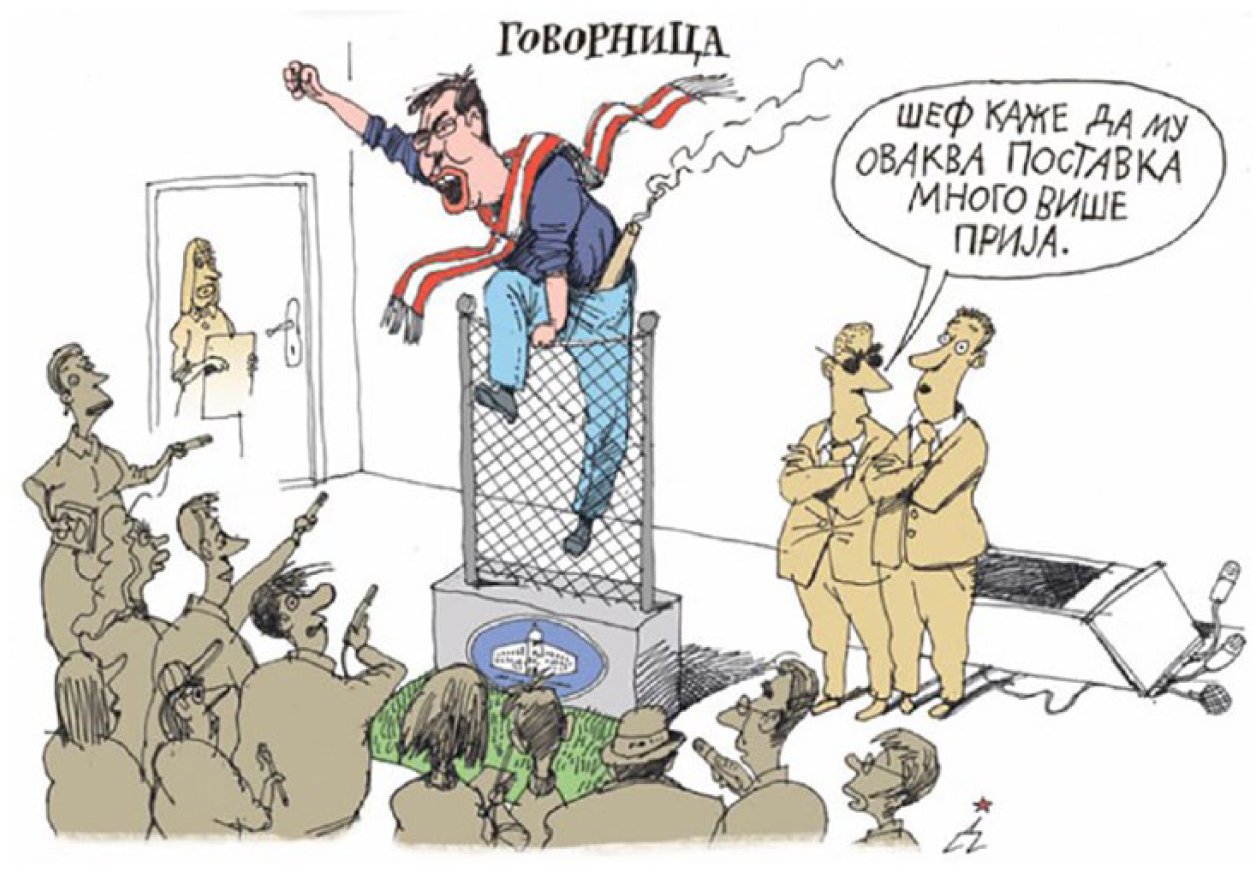
‘The pulpit’ (Politika, 17 July 2016). (Quote: ‘The boss says he prefers this setting.’). © Petričić Reproduced with permission.
Overall, the use of visual metaphors in this cartoon works to associate what has been happening inside the government with the aggressive culture of stadiums and hooliganism, but it also indicates the extent of the government’s personalization of violence. In other cartoons, regime violence is addressed either through the portrayal of politicians from the ruling coalition or thugs and criminals, but here Petričić refers to Vučić’s personal violent background as a rooter for the football team Red Star and, later, as a politician who has kept close contacts with influential groups of football fans that were widely seen as having strong links to organized crime. In the interview, Petričić expressed his disdain for Vučić by underscoring his background as a football rooter: ‘Vučić is a hooligan, he came directly from the stadium. I consider them nothing, they are just street criminals, a gang, mafia who took over’ (30 May 2018).
The representation of Serbia: Authoritarian leadership and silent society
With regards to the theme of violence, Serbia has been frequently represented as the victim of violent regime actions. Visual metaphors used in cartoons to show the country under Vučić’s rule have varied. Serbia was depicted as a house falling into the abyss, as a peasant balancing between the trains leading to the EU and to Russia or as an overcrowded basket of an air balloon about to explode at any moment. As soon as Vučić became Serbia’s president in 2017, the visual representation of Serbia became more personalized. Humanization and personalization of the country are evident in cartoons where the state has been portrayed as a hurt and vulnerable human being.
In the cartoon ‘Serbia is sleeping’ (Figure 3), the visual metaphor of a sleeping man is used to portray the state of the nation under Vučić’s rule. ‘A state is a person’ metaphor (Lakoff, 1993: 243) is common in political cartoons, especially in those reflecting foreign policy concepts. However, in this cartoon, the ‘sleeping body of a nation’ metaphor is used to underline the country’s inability, incompetence and lack of interest in standing against the violence of the regime. This cartoon depicts various criminal and violent actions by holders of some of the most dignified offices at state-level, such as president, foreign minister, parliament speaker and ministers of the government and MPs, together with a pro-government tabloid’s owner.
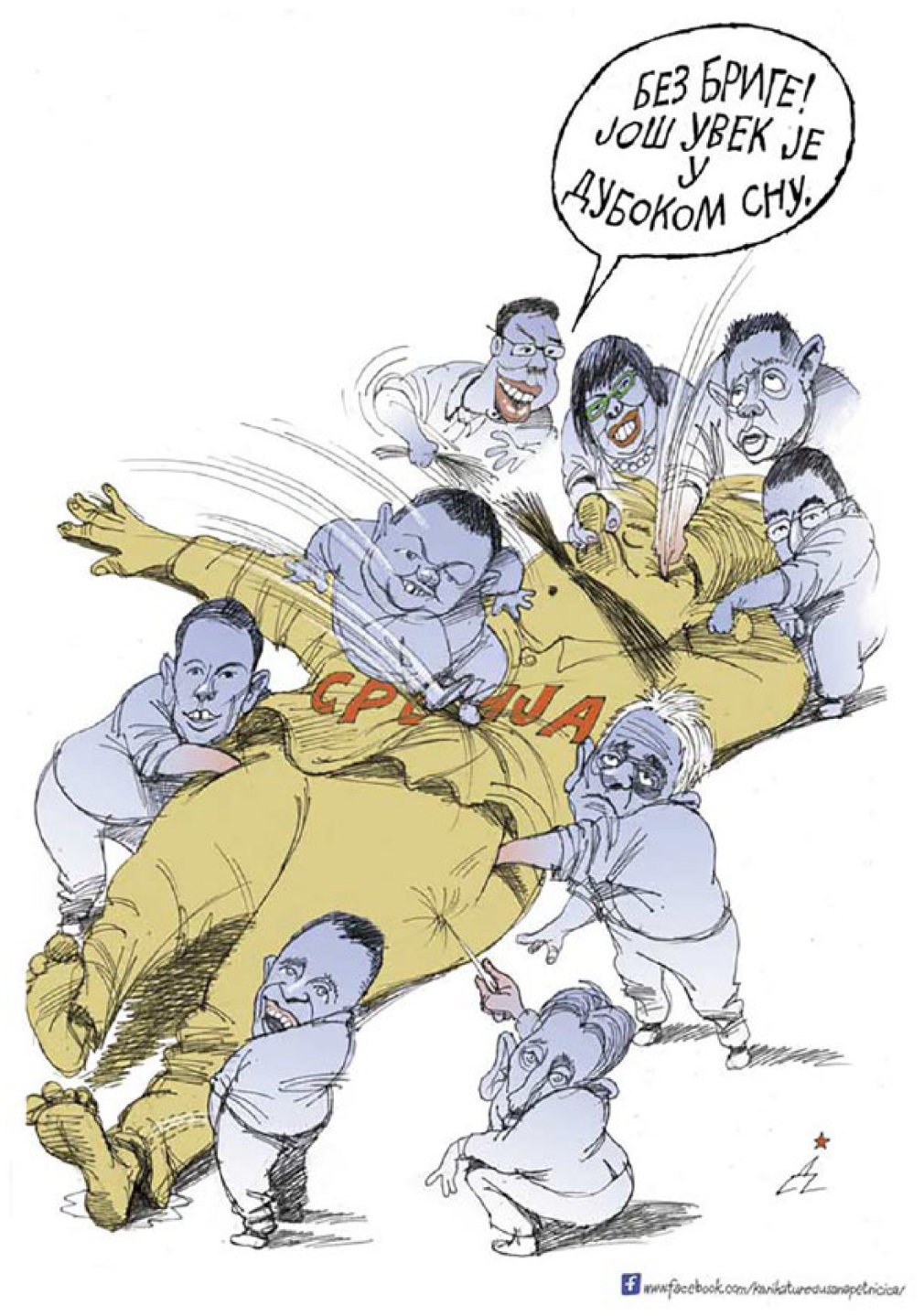
‘Serbia is sleeping’ (NIN, 20 July 2017). (Quote: ‘Don’t worry! He is still deep asleep.’). © Petričić Reproduced with permission.
There is a particular relationship between visual and verbal elements, where the verbal metaphor ‘He is still deep asleep’ expressed by president Vučić in the cartoon captures some kind of hypnotic suggestion, or more likely the meaning of death. The metaphor ‘death is a deep sleep’ is common in film images and appears as one of the conceptualizations of the ‘death’ metaphor, for example as ‘to die is to sleep’. Death as a sleep metaphor, explored in English poetry (Lakoff, 1993), Victorian obituaries (Fernandez, 2006), contemporary newspapers’ ‘In memoriam’ sections (see e.g. Allan and Burridge, 1991) and other fields offer valuable insight into the visual metaphor of ‘a sleeping man’ in this cartoon. Reading the contextual meaning of the cartoon as a whole, the sleeping metaphor here relates to death more in terms of defeat (Lakoff, 1993) and surrender (Bultnick, 1998), and it does not represent some kind of indefinite state and physical death, but rather sleep as a temporary event (Fernandez, 2006: 121). The temporality of sleeping in this cartoon is also found in the explanation that Petričić gave in the interview, as he addressed the visual metaphor of a sleeping body as ‘a nation being heavily depressed … because people allowed themselves to be trampled on’ (30 May 2018). The cartoonist’s critique is therefore not only about the violence of the regime, but also reflects the state of the nation, which he presents as intoxicated, comatose, in a trance, with eyes strongly shut, ‘almost as he does not want to wake up’, as the cartoonist explained (30 May 2018). When linked with Lakoff’s (1993: 243) argument that, in metaphors related to foreign policy concepts, ‘strong states are seen as male, and weak states as female’, this cartoon potentially implies that in the end Serbia, portrayed as ‘a sleeping man’, is a strong state that will eventually wake up. Moreover, the visual relation between the different sizes of key figures in this cartoon suggests that the country is bigger than its politicians and the politicians’ followers.
(The lack of) democracy: The subversion of press freedom
The theme of the current state of democracy is explored in cartoons through dimensions such as press freedom and political competition. Press freedom is especially important from the perspective of our research because it also involves the aspect of political communication. Aiming to expose totalizing control over the media in Serbia, the cartoonist uses a common tool in political cartoons, the graphic concretization (El Refaie, 2009: 196) of verbal meanings into a striking visual form, in such a way that the verbal metaphor of ‘having someone in a pocket’ is visually presented with Vučić having both a camera and a microphone in his pockets to express the regime’s control over the media.
The subversion of media freedom has also been emphasized through striking visual representations of low-priced, highly-circulated pro-government private tabloids and commercial televisions and their owners, which became an important instrument of authoritarian manipulation. The cartoonist refers to the hysteria and hate speech spread by pro-regime tabloids as dirty and manipulative tactics of smear campaigns ran against Vučić’s political opponents. Therefore, tabloids are presented as covered with dirt and run by cockroaches or as dogs ready to defend Vučić at any time and any cost, while all other media outlets are simply portrayed as under his control, ‘in his pockets’. To expose the lack of democracy and to intensify the theme of subversion of media freedom, the cartoonist combines the theme of violence with the theme of media freedom.
‘The leader and the media’ (Figure 4) exposes the destructive relationship of the regime with obedient media. The cartoon represents a combination of Morris’s functions of domestication and opposition. Pro-government media serving as an instrument of the regime have been domesticated with the face of Dragan Vučićević, the owner of the tabloid Informer, well known among all sections of the population for his close relations with Vučić and his readiness to defend Vučić at all costs against potential criticism. At the same time, the binary opposition of adult (Vučić) – child (Vučićević) in this cartoon does not have the intention of discounting the value of the latter, but to indicate dependency and obedience to the adult. At the same time, it glorifies the power of Vučić who has been publicly depicted as a ‘founding father’ and one of the main supporters of the tabloid Informer.
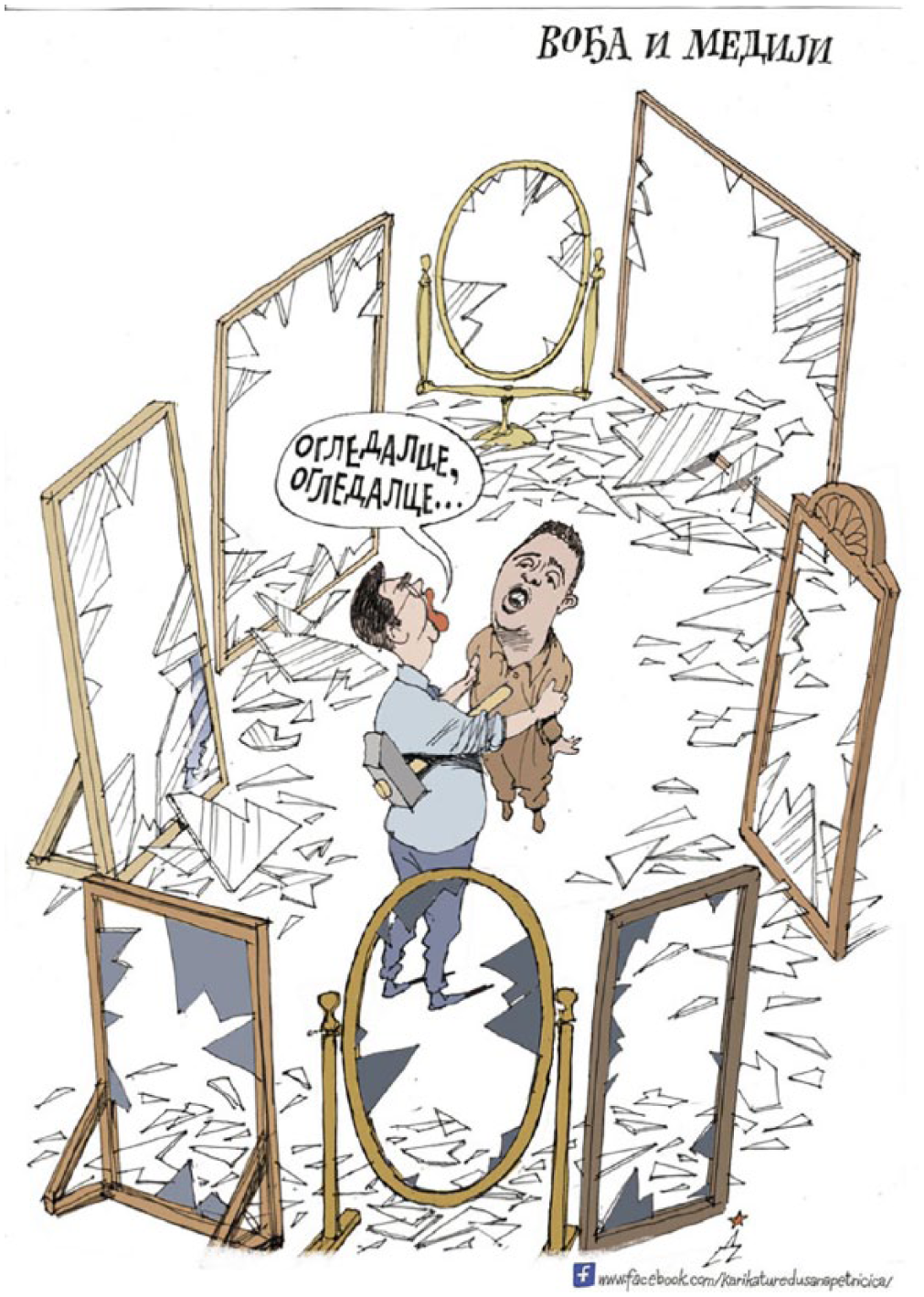
‘The leader and media’ (NIN, 28 September/2017) (Quote: ‘Magic mirror in my hand, magic mirror in my hand …’). © Petričić Reproduced with permission.
This representation of the subversion of media freedom is further intensified through the visual metaphor of a mirror. The mirror image is most often related with narcissism and is believed to ‘stand for some aspect of the self’ (Shengold, 1974: 98), and it is also often linked with the plain truth. In the history of journalism, this metaphor is most often used to label the universal journalistic function of the press being ‘the mirror of the world’ (Kilmer, 2002: 25) or a window into all facts and events. In the study of the history of the mirror metaphor in journalism, Tim Vos (2011: 584) identifies three main meanings for this metaphor: as a self-reflection and moral judgment, as a reflection of events and a reflection of readership. In this regard, the visual metaphor of broken mirrors in this cartoon conveys meanings such as those associated with the destruction of basic journalistic functions, the media as windows into the truth and the consequences of Vučić’s destructive behaviour. This cartoon further implies that the media scene has been arranged by Vučić in such a way as to only keep a handful of obedient media outlets in life. Reflecting on this theme, in the interview Petričić explained that Vučić is ‘behaving primitively, addressing the nation in a primitive way. He ruined all the mirrors; he is left only with Mitrović and Vučićević [the owners of pro-government TV network Pink and tabloid Informer, respectively] as mirrors’ (30 May 2018).
Discussion and conclusions
The comparative politics literature on political regimes and democratization has strongly contributed to our understanding of the sources, forms, dynamics and outcomes of non-democratic regimes, and of how they vary in terms of institutions, popular base, leadership and ideologies (see Levitsky and Way, 2010; Linz, 2000). At the same time, it has largely failed to effectively examine the affective and emotional dimensions of these regimes, leaving this perspective to various art forms for further exploration. The affective and emotional aspects of the rhetoric and exercise of power by authoritarian rulers, on the one side, and citizens’ various responses to such rule, on the other side, remain understudied. This is an observation that applies to some modern non-democratic regimes more than others. The drama behind totalitarian regimes of Nazi and Stalinist varieties, with their attempts at totalizing control over polity, economy, society, and even culture, as symbolized by utopian ideologies, charismatic leadership, top-down mass mobilization, large public performances and extreme violence, is captured to some extent in scholarly works, which conjure up important emotions that crystallize in these political settings.
In contrast, the affective and emotional underpinnings of contemporary hybrid regimes, which mix democratic institutions and authoritarian rule, are considerably more difficult to convey verbally. These regimes mix unexciting mentalities (as opposed to utopian and elaborate ideologies), highly eclectic, often conflicting and ever-changing policies, relentless and undignified promotion of leaders without charisma, and systematic attempts to discourage citizens from engaging meaningfully in politics. These features render the concept of hybrid regimes somewhat difficult to understand beyond narrow circles of academic and professional observers. The advantage of the concept of visual metaphor, explored via political cartoons, is that it taps into subtle ways in which authoritarian manipulation works ‘from above’ and how it resonates among ‘its subjects’. In this way, it also provides important insights into the main weaknesses of such regimes and the potential for effective resistance to authoritarian rule, and may also trigger emotions and other responses among the receptive audience.
By studying the political cartoons of one of the most influential cartoonists in the Western Balkans region, this article has also revealed how an abusive regime affects individuals, democratic institutions and the country as a whole. At the same time, this study has shown both the cartoonist’s and the newspapers’ courage to reveal many shades of authoritarian manipulation that were previously less known or completely unknown to the broader audience. Therefore, our study has shown how political cartoons add a new meaning to the ongoing events and at the same time invite the viewer to think of one-man personalist rule and the regime’s violence as occupation of democratic institutions, abuses against citizens and their freedoms, and destruction of journalistic professional standards and independent media. Petričić’s cartoons therefore serve as a counter-discourse and an instrument of counter-power to the regime and the media under the regime’s control, particularly in an atmosphere where Serbia’s press freedom, professional journalism and free speech are in severe decline (IREX, 2018), the media are under oppression and journalists are hardly able to practise their watchdog role, resist various pressures (Milojević and Krstić, 2018), and are even accused by Vučić and pro-government media of being ‘mercenaries’ of the West (Reporters Without Borders, 2018).
As a whole, an analysis of Petričić’s cartoons contributes an understanding of Serbian authoritarianism that highlights the structural failings and conditions as well as the human weaknesses and contradictions that enable it to exist in its current form. Conversely, this study contributes to further illuminating an understanding of visual metaphor as an instrument for a critique of power rooted in affective and emotional appeals.
Footnotes
Funding
The author(s) received no financial support for the research, authorship, and/or publication of this article.
