







Abstract
The events of the crisis in Ukraine (2013–2014) have created an unprecedented rift in EU–Russia relations. The focal point is often put on the long-term development of mutual frustrations due to clashing initiatives in the shared neighbourhood and an overall atmosphere of mistrust. This article makes the case that the culmination of mutual frustrations made its way into official communication and led to the embedding of elements of ‘geopolitical othering’ in Russia’s narrative on the events in Ukraine. Throughout the various stages of the conflict, representations of the role played by the EU became a recurring theme in Russia’s narrative on Ukraine’s choice between the EU and accession to the ECU. While the presence of geopolitical othering did seem to provide a stabilizing effect on the narrative, the countries’ embedded nature led to the rapid development of contentious communication, complicating potential narrative convergence between both actors.
Introduction
When talking about Russia’s discourse in the period of the Ukraine crisis, attention is often placed on dynamics in the relations between Russia and Ukraine (see, e.g., Khaldarova, 2019). In this context, references are made to the significance of Ukraine to Russian identity-building (Kuzio, 2015) and its geopolitical importance for Russia’s position in the region (Biersack and O’Lear, 2014). The case can indeed be made that both the increasing othering of Ukraine and geopolitical themes made their way into Russia’s discourse. However, to explain the particular evolution of its strategic narrative, the vector of EU–Russia relations needs to be taken into account too. Since the catalyst for the Ukraine conflict was related to Ukraine’s choice between signing the association agreement with the EU and accession to the Eurasian Customs Union, the juxtaposition of integration mechanisms in Russian rhetoric increasingly included references to underlying tensions in EU–Russia relations. In particular, concerns regarding the EU’s influence in the ‘common neighbourhood’ and the perception that Russia was not included in the discussion regarding the association agreement with Ukraine were persistent narrative themes colouring the debate (Haukkala, 2016: 654)
The constant juxtaposition of the EU and Russian approach to Ukraine’s choice between both integration mechanisms added a decisively geopolitical dimension to the developing crisis. As the conflict passed through the stage of protests to that of an outright street war, Russia’s narrative began to focus more clearly on the geopolitical nature of the tension arising from the situation. In this context, the EU was increasingly portrayed as imposing the signing of the association agreement on Ukraine and, by doing so, closing the door on a possible ‘integration of integrations’ with the ECU (see, e.g., Sergei Lavrov, 2014a). The focus on the EU and European identity was so pervasive that it impacted Russia’s narratives on Ukraine. In the transformation of Ukraine in Russian representations from a ‘brother nation’ to a ‘threatening Other’, the decisively pro-European stance of protesters on Maidan was tied to images of them as being ‘misguided’ and ‘irrational’ (Khaldarova, 2019: 11).
This article makes the case that the evolution of Russia’s strategic narrative regarding the conflict in Ukraine can be explained by the embeddedness of geopolitical othering of the EU into its discourse. The term ‘geopolitical othering’ refers to the ‘practices of othering, in which identity, politics and geography are intimately linked with each other’ (Diez, 2004: 331). In other words, elements of geopolitical othering in Russia’s official communication on the conflict in Ukraine consistently juxtaposed its own approach with the European one and linked the reasons for a diverging approach to specific attributes of identity, culture and politics. By linking theories of othering to the literature on strategic narratives, this article aims to provide an insight into the impact of geopolitical othering on Russia’s strategic narrative during the conflict in Ukraine. Strategic narratives are understood as ‘means for political actors to construct a shared meaning of the past, present and future of international politics to shape the behaviour of domestic and international actors’ (Miskimmon et al., 2013: 14).
There are two reasons for applying literature on geopolitical othering to the present study of Russia’s strategic narrative in the context of the Ukraine crisis. Firstly, it is posited that the embeddedness of geopolitical othering in Russia’s strategic narrative provides an explanation for limitations regarding potential narrative convergence between the EU and Russia because its language became increasingly characterized by language that ‘fuses practical/geopolitical terms with cultural and civilizational arguments and explanations’ (Omelicheva, 2016: 720). Secondly, since geopolitical othering introduces a spatial element in the strategic narrative, it goes beyond the construction of shared meaning of the events of the conflict by linking it to Russia’s particular perception of the history of international relations. Instead, it also incorporates a link to how the events should be understood in the context of Russia’s perception of the spatial and geopolitical relations in the international system.
While this article does not discount the importance of the temporal dimension of strategic narratives, it proposes to also take into account the use of representations of space to make sense of the division of power in the international system and its place within it. Therefore, this article follows the position of Molly Patterson and Kristin Monroe (1998: 325) that ‘narrativity demands that we discern the meaning of any single event only in temporal and spatial relationship to other events.’ In this sense, it is not only important how the events of the Ukraine crisis are presented and situated in time, but also how they are situated in space and related to Russia’s conceptualization of its role in the European region. In short, representations of how the European region is given shape and Russia’s role within this region are expected to have a profound effect on the formation of Russia’s strategic narratives on the Ukraine crisis as well.
The article is divided into five parts. The first part consists of a literature review on the practice of othering in EU–Russia relations. The second part provides insight into the particular form that geopolitical othering takes in Russia’s official communication. The third part elaborates on the research design, including the methodology employed for qualitative content analysis and the rationale behind the selected documents and coding. The fourth section presents the results of the analysis and teases out elements of geopolitical othering vis-à-vis the EU in official communication on the Ukrainian crisis issued by the President of Russia and the Ministry of Foreign Affairs of Russia between July 2013 and March 2014. These results are discussed throughout three stages of the crisis and as a function of their relation to Russia’s overall strategic narrative. The fifth section provides concluding remarks and proposes avenues for further research.
Geopolitical othering in EU–Russia relations
Before delving into the particularities of geopolitical othering of the EU by Russia, it is necessary to note that the presence of these elements of othering in its discourse should be considered within the context of the role they play in Russia’s representations of the international system and its place within this system. This is relevant since the evolution of Russia’s narrative on the international system has been quite consistent since the 2000s and included three recurring narrative themes: (1) narratives of recognition: the prestige, equality and mutual respect narrative; (2) narratives of inclusion and exclusion; and (3) multipolarity and polycentrism (Miskimmon and O’Loughlin, 2017: 115–118). I argue that all three of these narratives are interconnected and converge around the use of spatial and geopolitical imageries in Russian discourse on the international system. Central in these narratives is the use of the West as an external referent to clarify Russia’s self-representation of its role in the international system. In regard to the narrative of recognition, Russia presents itself as a member of an ‘elite group of states’, whose role and status have gone unrecognized by the West (p. 115). The narrative of inclusion and exclusion tells the story of Russia as a constructive member of the international system, which has been consistently ‘excluded from the major decisions affecting it’ (p. 114). Lastly, the narrative of multipolarity proposes an alternative to the idea of the ‘rules-based international order’, which recognizes a shift in power away from the West to the East and the Asia-Pacific region (p. 117).
In this context, geopolitical othering is considered as a form of ‘geopolitical reasoning’, understood here as ‘an innately political process of representation by which the intellectuals of statecraft designate a world and ‘fill’ it with certain dramas, subjects, histories and dilemmas’ (Ó Tuathail and Agnew, 1992: 194). When applied to a crisis like the one in Ukraine, geopolitical reasoning can play an important role to ‘make sense of international crises, to construct stories to explain these crises, to develop strategies to handle these crises as political challenges and to conceptualize “solutions” to these crises’ (ÓTuathail, 2002: 603). In this way, the use of representations of an external referent like the EU or the US in Russian foreign policy discourse can play a crucial role in the way that it represents its own actions and identity in regard to these external referents (Omelicheva, 2016: 1402). However, since geopolitical discourse is tied closely to ‘the actor’s sense of self and fundamental – identity-making – narratives’, their application in crises may aggravate existing geopolitical tensions and complicate narrative convergence (Faizullaev and Cornut, 2017: 581).
To understand how representations of the EU as a geopolitical Other come forward in Russian authorities’ discourse, it is thus necessary to understand how Russia perceives and makes sense of the dynamics in EU–Russia relations. This is especially relevant in the context of practices of othering, since the literature on practices of othering in EU–Russia relations often focuses on Russia as the other in European identity building. There are not many studies that explore Russia’s use of these practices of geopolitical othering towards the EU. Nor do they explore the impact of these practices of othering on Russian identity-building and self-representations. The concept of ‘geopolitical othering’ itself stems from a study of Thomas Diez (2004), who used it to refer to the increasing geopolitical focus in EU identity building. In his article, he makes the case that the formulation of discourse on European identity was becoming more exclusionary precisely due to the addition of geopolitics and a decrease of the more inclusive practice of ‘temporal othering’. This type of othering entails a process of self-reflection in which the other is the Self’s own past (p. 320). Whereas temporal othering entails the linking of certain attributes of an Other to a certain stage of one’s own past, geopolitical othering is rather reflected in the representation of certain attributes as linked to a ‘geographically defined political entity’. To put it concisely, geopolitical othering is characterized by the consistent comparison of self-representations to geographically external referents, to which identity, political and civilizational attributes are linked. In this way, geopolitical othering further builds on existing elements of geopolitical reasoning in the sense that it provides an indirect reflection of an actor’s self-representation of the international system and its role in this system through its representation of how an Other fits into this worldview.
It is crucial to highlight that, while geopolitical othering is not as introspective as ‘temporal othering’, it is responsive to similar practices of othering from the side of the external referent. In this sense, representations of the Other and representations of the Self are interrelated. In the context of Russia’s representations of the EU, its self-image is thus impacted by how it perceives the way that it is represented by the EU. The importance of this aspect of self-reflection through the eyes of Europe in Russian identity-building can be explained by what Vyacheslav Morozov and Bahar Rumelili (2012) call ‘liminal identity’. The idea of liminality entails that Russia is represented by itself and by Europe as partly European and partly not (p. 33). Through this process, identity attributes linked to the other can be represented as reflecting positive or negative attributes of the Self (p. 31). Therefore, the Other stands in constant comparison to the Self and can thereby be situated both in the same category and as entirely different.
This ambiguity of Russia’s European identity gives it a unique position in which it can identify itself with the term ‘European’, while simultaneously being able to criticize European civilization and providing its norms and values with alternative interpretations (Morozov and Rumelili, 2012: 34). It is because of Russia’s liminal identity that it can respond to practices of othering from the side of the EU through an emphasis on its identity as a European state in the Russian interpretation of what Europe means. Furthermore, the aspect of liminality affords Russia the agency to respond to the ‘identity construction of the Self (Europe)’ and engage in the ‘negotiation, contestation, and remaking of European identity through its own representational practices’ (p. 33).
The use of images of Europe and the EU as an Other in Russian official communication is not a new phenomenon. As pointed out by Iver Neumann (2016), Russia’s representations of Europe have played a key role in Russian identity formation since tsarist times. This is reflected in the Russian debate on whether or not it can be considered a European actor. Marlène Laruelle (2016) makes the case that this debate can be characterized by the existence of ‘three civilizational grammars’, which can be used by Russian intellectuals and officials to ‘define Russia’s identity and place in the world’ (p. 278). These three grammars point to a ‘triple choice of identity’: (1) Russia as a European country that follows a Western path of development; (2) Russia as a European country following a non-Western path of development; or (3) Russia as a non-European country. In all three grammars, Russian identity is ‘always made in relation to Europe as the yardstick, never to Asia’. This preoccupation with Europe is central in narratives on Russian identity and is characterized by a persistent duality. Through this duality, Europe is portrayed on the one hand as a ‘geopolitical, geo-economic, and at times cultural benchmark’, while on the other hand resistance to ‘western’ liberal ideas leads to recurring bouts of the ‘othering’ of Europe (Verpoest and Claessen, 2017: 340–341).
I argue that Russia’s geopolitical othering of the EU is driven just as much by its own representations of the EU as by representations of Russia by the EU. Because of this, while the EU’s form of geopolitical othering has a distinct temporal dimension, through which representations of an Other also contain a comparison with a particular stage in Europe’s past (Diez, 2004; Prozorov, 2011), Russia’s particular brand of this type of othering is characterized more by a civilizational dimension. Because of the presence of civilizational themes in its geopolitical reasoning, limitations are put on the potential for openness in a state’s narrative and it inherently becomes more exclusionary of outgroups (Diez, 2004, 2005). In the context of Russia’s communication during the Ukraine crisis, this limited its space for manoeuvre in its discourse during the Ukraine crisis.
Geopolitical othering in Russia’s strategic narrative
Since ‘actors can only form and project a narrative based upon the discourses available to them’ (Miskimmon et al., 2013: 18), the reliance of Russia’s official communication on its representations of the EU had a profound effect on the way the narrative on the Ukraine crisis was given shape. In other words, the development of Russia’s strategic narrative on the Ukraine crisis is expected to be driven both by its perception of the EU’s behaviour and its understanding of how the EU represented Russia’s behaviour. Besides direct forms of geopolitical othering, in which the EU is explicitly named as an Other, more indirect forms of geopolitical othering were present in Russia’s official discourse. Direct forms of othering are understood here from the classification made by Thomas Diez (2005) of four types of othering in the context of the ‘normative power Europe’ concept, which he considers to be a case in point for the EU’s departure from temporal forms of othering to the increased use of geopolitical othering (p. 634). These four types are considered to be representations of the other: (1) as an existential threat; (2) as inferior; (3) as violating universal principles; and (4) as different (p. 628). When these four types of othering are applied to directly point to a specific actor as an Other, they are considered here to be direct forms of othering. In the context of the present case, this entails that Russia would directly point towards the EU as being threatening, different, inferior, or as violating universal principles.
Since the presence of direct othering in the narrative does not allow for much ambiguity in the way the relationship to the EU is communicated, analysis of geopolitical othering in Russia’s strategic narratives needs to take into account the importance of intersubjectivity in its representation of the EU. This entails that Russia engages with the narrative put forward by the EU. Therefore, the form the narrative takes will be at least in part responsive. A recent study conducted by Irina Petrova (2021) makes a similar observation regarding the intersubjectivity of narratives in a comparison of the EU’s and Russia’s strategic narratives in connection to the Minsk agreements. In this context, she notes that narratives were often ‘mirrored’, relying on similar patterns, as actors made use of ‘old frames to construct the enemy image of the opponent’ and ‘relied on the same sources of legitimation’, in particular legislative sources (p.84). Because of this element of responsiveness, the article also includes an analysis of indirect forms of geopolitical othering. These indirect forms are understood here as reflecting a response from Russia to narratives issued by the EU on the way it approached the conflict. In this regard, two phenomena are considered to be influential in the shaping of these forms of othering: (1) the attributional bias (Casier, 2016); and (2) stigmatization (Adler-Nissen, 2014; Zarakol, 2011).
The concept of the ‘attributional bias’ is put forward by Tom Casier (2016) to better explain the reasons behind the deterioration of EU–Russia relations after the annexation of Crimea. He posits that this can partly be explained by looking at the way the interaction between both actors developed among growing frustrations and opposing approaches to cooperation in the Common Neighbourhood. The concept of the ‘attributional bias’ means that the interaction between both actors became increasingly driven by mutual negative images of each other’s intentions (p. 378). As relations deteriorated in the lead-up to the conflict in Ukraine, these negative images became mutually reinforcing and led to discourse attributing negative intentions to each other’s actions. It is necessary to note that the formation of these negative images was often a response to perceived negative images on the side of the EU (p. 386). The effect on Russia’s narrative is not necessarily to distance itself from Europe. Following Sergei Prozorov’s (2007) division between narratives of ‘exclusion’ and ‘self-exclusion’, Russia’s narrative is rather focused on the ‘problematization of its exclusion from Europe’ (p. 310). When Russia points to the existence of a bias from the EU towards Russia, this reinforces its idea of itself as being an integral part of the European region and that it should be included in decision-making on how the region is ordered.
A different effect emerges from Russia’s response to perceived stigmatization from the EU. In this context, I follow the thesis of Ayşe Zarakol (2011: 63) that, in international relations ‘states which fall short of the normative ideals of international society at any given time can be (and have been) stigmatized.’ Rebecca Adler-Nissen (2014: 145) further builds on this and identifies three possible strategies to cope with stigmatization: (1) stigma recognition; (2) stigma rejection; and (3) counter-stigmatization. The first two coping strategies entail some sort of recognition that the stigma is there. This is dealt with either by addressing the issues that led to its imposition and attempting to achieve normalcy (stigma recognition) or it is dealt with through the denial of being any different from the ‘norm abiders’ (stigma rejection) (pp. 153–154). I make the case that Russia’s response to instances of perceived stigma as a form of indirect geopolitical othering takes on the form of the third strategy of counter-stigmatization. This coping strategy entails the embracing of the events or attributes that led to the imposition of the stigma and transforming these into emblems of pride (p. 153). This implies that the categories of ‘normal society’ put forward by the ‘stigmatizers’ are rejected in favour of alternative interpretations of what this society should be (pp. 153–154; see also Zarakol, 2011: 223). In the case of EU–Russia relations, this follows the assessment of Iver Neumann (2016) that Russia is increasingly moving towards rejecting EU interpretations of European norms and putting forward alternative interpretations. This particular response to stigma then leads to the formulation of what Sergei Prozorov (2007: 310) calls ‘narratives of self-exclusion’, which include the ‘Russian problematization of its exclusion from Europe in the EU’s administrative practices and the reassertion by Russia of its sovereign subjectivity through a policy of ‘self-exclusion’ from the European political and normative space. Rebecca Adler-Nissen (2014: 153) points out that the use of counter-stigmatization as a response to stigma reflects an instance of in-group alignment. In the context of geopolitical othering, the counter-stigmatization response takes on the form of problematizing the imposition of the stigma through the reframing of the perceived transgression as a reflection of a nation’s values and norms.
In the context of the Ukraine crisis, Russia’s response to the phenomena of the ‘attributional bias’ and ‘stigmatization’ was given a particular shape due to the embeddedness of geopolitical othering. Since Russia’s national and geopolitical identity was tied to the outcome of the conflict, instances of ‘bias’ and ‘stigma’ by the EU as its geopolitical other were given immediate responses. In this way, geopolitical othering took on the form of (1) the leveraging of the perceived attributional bias by the EU, and (2) counter-stigmatization of the stigma imposed by the EU.
Methodology and data
The qualitative content analysis focused on statements issued through the websites of the Ministry of Foreign Affairs (MFA) of Russia and that of the President of Russia. The choice was made to focus on the websites of these institutions since these channels were actively involved in the interaction with the narratives put forward by the EU. To gain an overview of the communication disseminated through these channels, the sources gathered for this article originated from their news archives and the official Twitter account of the MFA. Documents sourced from this account were used to supplement those available on the website. This means that the documents listed both on the website and on the Twitter account were not doubly analysed. The source material that was gathered varied in publication type and featured: (1) press releases; (2) official communiqués; (3) op-eds; (4) articles featured in Russian media on the events in Ukraine; (5) speeches of government officials; (6) reports of bilateral and EU-Russia meetings; and (7) official phone calls. The sources were selected according to the criterion that they contained various combinations of the following keywords: Eurasian Customs Union, Association Agreement, Euromaidan, Crimea, Ukraine. An additional selection criterion was that documents had to directly refer to the EU’s approach to the crisis.
Data was gathered for three stages of the Ukraine crisis:
27 July 2013 – 20 November 2013: The pre-crisis stage starts with the 1025th anniversary of the Christianization of Rus’ and ends with the first day of the Euromaidan protests;
21 November 2013 – 21 February 2014: Starting on the first day of the protests and ending with the departure of Yanukovych from Ukraine;
22 February 2014 – 31 March 2014: The period leading up to the Crimean referendum and ending with the weeks directly after the incorporation of the region into the Russian Federation.
Communication issued during these three stages was subjected to a qualitative content analysis conducted using the program NVIVO. The coding of sources happened in three stages. In the first stage, documents were subjected to close reading and were searched for references to the role played by the EU during these three periods of the Ukraine crisis under review. The second stage was used to highlight instances in which these references were considered to contain elements of geopolitical othering. To assess this, the following characterization of geopolitical othering was used: ‘the conscious linkage of a geographical space with a people’s identity that is defined through the juxtaposition with a geopolitical other’ (Diez, 2004). Two elements had to be present in these references: (1) a link to either Russian or European identity; and (2) a comparison of the Russian and the EU approach. Lastly, the third and final stage was aimed at deconstructing the mechanisms underlying the addition of these elements of geopolitical othering. To do this, the typology of othering as put forward by Diez (2005) was complemented by perspectives on the leveraging of the mechanisms of the attributional bias (Casier, 2016) and the use of counter-stigmatization (Adler-Nissen, 2014). The schematic for coding is found in Table 1.
Schematic for coding of references of geopolitical othering.

The typology of othering (Diez, 2005) spans both the direct form of othering and indirect forms, which include references to the existence of the attributional bias or stigma. It is necessary to note that these indirect forms of othering impacted on the form and interpretation of the narrative. In the case of the leveraging of the attributional bias, the representation of the other as a threat, for instance, is transformed to denote the EU as putting forward a biased portrayal of Russia as a threat. A similar change takes place through the presence of the strategy of counter-stigmatization. Through this coping strategy, the stigma is turned around on the stigmatizer through the emphasis on the legitimacy of one’s own actions in comparison to perceived transgressions of the stigmatizer. This mechanism can have ‘a boomerang effect, resulting in the stigmatizer becoming perceived as the transgressor’ (Adler-Nissen, 2014: 165). For instance, the representation of Russia as violating universal principles is turned around to point to Russia as upholding universal principles as opposed to the EU ignoring or having committed transgressions.
Table 2 provides an overview of the references that were found to bear the markers of geopolitical othering of the EU. The analysis covers a total of 170 documents, which included 971 references to geopolitical othering. Of these, the pre-crisis period consisted of 13 documents containing a total of 89 references to elements of geopolitical othering. The Euromaidan stage consisted of 51 documents containing 330 references. Finally, the stage of the Crimean referendum consisted of 106 documents, which contained a total of 552 references to geopolitical othering.
Overview of the references to direct and indirect forms of geopolitical othering of the EU during the Ukraine crisis.
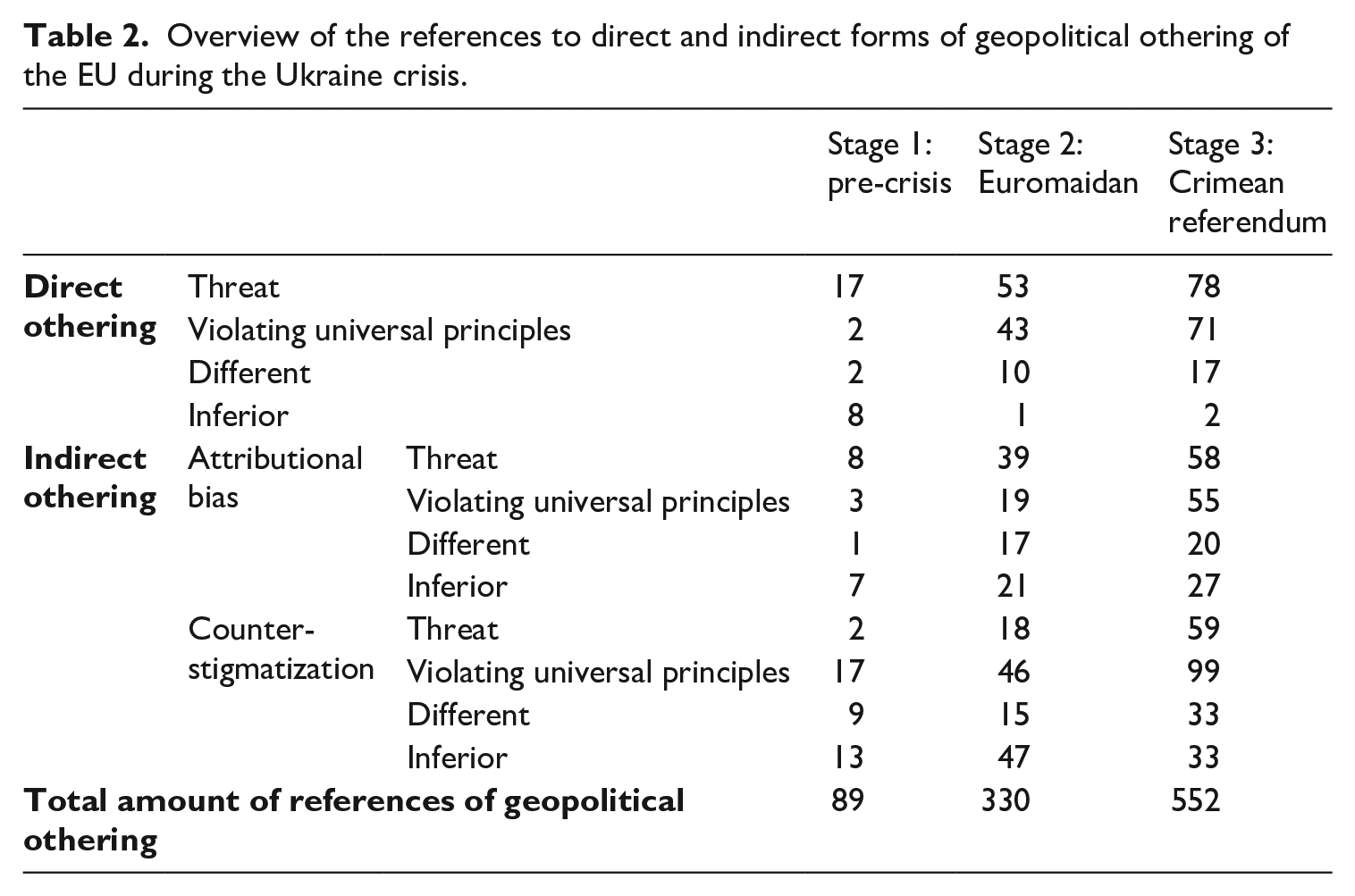
The variance in the total number of documents during these three stages can be explained by the changing intensity of the conflict and the evolution of the crisis from a debate arising from the existence of two competing integration mechanisms to popular protests and, finally, the Crimean referendum. Because of this variance in the number of documents and references, it is not easy to draw linear conclusions from this overview of absolute numbers, in which elements of geopolitical othering of the EU were observed. Therefore, the following sections will delve deeper into the content of these references and how Russia’s narrative evolved.
Evolution of Russia’s narrative throughout the Ukraine crisis
The pre-crisis stage
Analysis of the evolution of Russia’s narrative during this stage was carried out on documents ranging from 27 July to 20 November 2013. While the catalyst of the Euromaidan protests came about with the Ukrainian President’s refusal to sign the Association Agreement with the EU, the roots for these protests were growing well before this decision. These roots are traced back here to the end of July 2013 and the Russia–Ukrainian joint celebrations of the 1025th anniversary of the Christianization of Rus’. This choice is made because these celebrations were held against the background of increasing usage of civilizational themes in Russian rhetoric, in which long-established historic, economic and civilizational ties with Ukraine were highlighted (Putin, 2013a). Aside from this civilizational dimension, Russian rhetoric focused on the incompatibility of the provisions of the Association Agreement and Ukraine’s potential accession to the Eurasian Customs Union (ECU). This incompatibility rested on the fact that participation in the ECU required compliance with common tariffs, which conflicted with the foreseen elimination of tariffs through the implementation of the DCFTA. Additionally, participation in the ECU did not allow members to independently negotiate new free trade agreements (De Micco, 2015: 7). Breaking down geopolitical othering in Russia’s narrative during this period, the main focus at this time was on highlighting this incompatibility of both integration mechanisms. In this vein, two different types of geopolitical othering kept recurring, namely: (1) representations of the EU association agreement as a threat to both Ukraine’s and Russia’s economy; and (2) the assertion that Russia respected Ukraine’s sovereignty as it commented on its choice between these integration mechanisms.
In the representation of the EU association agreement as threatening, concerns were raised over the potentially detrimental effects of Ukraine’s signing of the Association Agreement on Russo-Ukrainian economic ties (see, e.g., Chizhov, 2013a; Lavrov, 2013a; Putin, 2013a). Overall, the representation of the EU as presenting an economic threat was connected to the argument that the EU was excluding Russia from negotiations surrounding the Association Agreement. This frustration regarding the exclusion of Russia from negotiations with the Eastern Partnership countries can be exemplified by a comment made by Russian Minister for Foreign Affairs, Sergei Lavrov, on 19 November 2013 at a joint press conference with the Minister for Foreign Affairs of Belarus: After the announcement of this program by the European Union, we expressed readiness to take part as an observer and to participate in the implementation of practical projects together with the EU and the so-called focal states of the ‘Eastern Partnership’, in cases where such projects were of mutual interest. In the end, we were neither invited to be observers nor were we presented any such projects. (Lavrov, 2013a)
The second recurring theme focused on the assertion that Russia would not stand in the way of Ukraine’s sovereign choice between both integration mechanisms. This assertion was made in combination with a reference to the perceived portrayal by the EU of Russia as standing in the way of Ukraine’s sovereign choice. Russia’s response to this portrayal of its actions took on the form of counter-stigmatization, through which it rejected the position that it did not respect Ukrainian sovereignty. An example of such an instance is the following statement made by Vladimir Chizhov, permanent representative of Russia to the EU, in October 2013, when commenting on the rising tensions regarding Ukraine’s choice over the competing integration mechanisms: Passions are indeed heating up, though much of this aggravation is quite artificial. Just as artificial are the accusations against Russia about attempts to recreate the Soviet Union, about its imperial ambitions and so on. We hear this here from time to time on various occasions, but at this moment Ukraine is used as an example . . . The decision, of course, is up to Ukrainians themselves . . . We only consider it our duty to give the real picture because there are so many different speculations, illusory schemes from the series of ‘how to sit on two chairs’. We explain that the time for illusions is probably coming to an end. (Chizhov, 2013b)
Rhetoric in this vein would highlight the risks to Ukraine’s economy related to the signing of the Association Agreement and put forward the idea of a potential negotiation of deepening economic ties between the EU and the ECU at a later stage. This position was put forward through a combination of a rational assessment of economic disadvantages to the signing of the agreement with the promise of a possible Eurasian–European ‘integration of integrations’ at a stage when this option could be deemed viable. President Putin, for instance, put forward the idea that it would be able to ‘negotiate more and better conditions on trade and economic relations’ and ‘coordinate our common efforts’ with the EU after Ukraine’s accession to the Customs Union (Putin, 2013b).
This combination of arguments would be used throughout the entire period of the Euromaidan crisis, with the added element of highlighting the advantages of Eurasian integration. While Russia’s communication during this stage was rather focused on highlighting the risks associated with Ukraine’s signing of the Association Agreement, the presence of themes of geopolitical othering of the EU highlighted its frustrations with being excluded from the EU–Ukraine dialogue. The narrative of exclusion would be repeated in the following stages and reframed to suggest that the EU had missed its chance to build on this idea of integration from ‘Lisbon to Vladivostok’.
The Euromaidan stage
The second stage under review is considered from the inception of the protests on 21 November 2013 after President Yanukovych refused to sign the Association Agreement until his flight from Ukraine on 22 February 2014. As the protests became increasingly violent as Yanukovych cracked down on protesters between January and February 2014, Russian rhetoric and media coverage began referring to protesters as hostile, even fascist, due to the presence of rightist groups like Pravy Sektor (Khaldarova, 2019: 12). Additionally, the message was put forward that Western governments either denied or downplayed the presence of these right-wing groups (Biersack and O’Lear, 2014: 249), which directly questioned the legitimacy of the role played by the EU in its support of the protests.
The analysis of communication issued during this period shows that these themes came to the fore through the use of geopolitical othering of the EU as threatening and violating universal principles. The emphasis in this respect was on creating the image of Russia as upholding the principle of sovereignty and non-intervention by not pushing Ukraine towards choosing between Russia and the EU. This was used to reinforce the point that messages to the contrary were related to a bias of the EU towards Russian actions. An example of this was Sergei Lavrov’s statement in early December 2013 at a press conference after the OSCE meeting in Kyiv: I would like to stress that we say that signing or not signing is the sovereign choice of Ukraine. If we clear everything that the West says of noise, emotions, of statements that are sometimes on the verge of disrespect, this boils down to the following: to sign an agreement with the European Union is the sovereign choice of Ukraine. Do you feel the difference? (Lavrov, 2013b)
As the Euromaidan protests progressed towards a more confrontational phase, the rational arguments related to the choice between integration mechanisms made way for representations of the other as a threat and as violating universal norms and principles. The make-up of this argument was expressed through a combination of (1) the attributional bias of the EU towards Russia in the context of norm violations, and (2) Russia accusing the EU of ignoring the violence of the protests. An example of accusations of the EU as ignoring norm violations is visible in the following quote of the MFA of Russia of 18 February 2014: What is happening is a direct result of the policy of connivance on the part of those Western politicians and European structures that since the very beginning of the crisis turn a blind eye to the aggressive actions of radical forces in Ukraine, thereby encouraging them to escalate and come to provocations against the legitimate authorities. (Press Department MFA Russia, 2014a)
The shift towards sharp accusations to the EU as ignoring violence and ‘extremism’ during Euromaidan was accompanied by a gradual decrease of direct references to the EU in Russian discourse of geopolitical othering. Instead, Russian officials turned to formulations such as ‘the US and its partners’, ‘our Western partners’, ‘NATO and its partners’ and ‘the US and its European partners’. One of the explanations for this is the growing internationalization of the conflict as tensions heightened surrounding covert Russian military action in Crimea and the overall shift of attention to this conflict. Another possible explanation is that Russia in this period was gradually moving towards rhetorically classifying the EU as part of the West (not Europe), making the division between its own positions and that of the EU more distinct. As Russia became more focused on countering the EU’s portrayal of the protests and Russia’s response to them, elements of geopolitical othering became increasingly infused into its counter-narratives. In this context, indirect forms of geopolitical othering focused on countering a perceived bias and stigma were increasing.
The Crimean referendum
The third period under review starts from the day Yanukovych fled Ukraine on 21 February 2014 and terminates at the end of March to include both the lead-up to the referendum and its direct aftermath. During this period, the language grew increasingly harsh as a new interim government was put into place in Kyiv. Rhetoric portraying the new government as a ‘fascist junta’ that was hostile towards the ethnic Russian population became increasingly prevalent in the Russian language media (Khaldarova, 2019). The portrayal of the existence of a threat to the Russian-speaking population was accentuated when the new Ukrainian government moved to repeal the 2012 language law which allowed for the ‘official use of Russian and other minority languages as regional languages’ (Biersack and O’Lear, 2014: 249). This rhetoric on the threat to the Russian-speaking population became quickly intertwined with civilizational themes as Russian ties to Crimea were stressed with the call of the Crimean parliament for a referendum to join the Russian Federation and the appearance of masked Russian military in the peninsula.
The issue on the agenda had shifted from the tension between integration mechanisms to a hybrid conflict situation. Because of this, the message was aimed at underscoring that: (1) a threat existed for Russian speakers in Crimea; (2) Russia was in its right and obligated to protect these people; and (3) this threat existed because of the installation of the new government in Kyiv. Additionally, this period saw a broadening of references to a geopolitical other to refer to ‘the West’. In this context, references to the EU became characterized by its position as opposed to that of Russia and featured a combination of two narratives: (1) the pressuring of Ukraine into choosing a European path; and (2) the EU ignoring the threat posed by the new government to Russian speakers. This is illustrated by numerous references to the phrase ‘ili–ili’ (or–or) to point to the creation of a forced choice by the EU, such as in the following quote: Another important point is that it is time to finally stop working towards using Ukraine as a bargaining chip in a geopolitical game, to make various appeals to the Ukrainian leadership, formulated in the spirit of ‘either you are with us or against us’. (Lavrov, 2014b)
As the events in Crimea unfolded, references to the EU as a geopolitical Other remained consistent with the message outlined above. The very event of the annexation of Crimea was characterized by Russian official discourse mainly emphasizing the protection of its own civilization in the face of outside ‘Western’ pressures. References to the EU’s role in the conflict turned to accentuate that EU and western actions had caused the political disarray in Ukraine. An example of this can be found in the following quote from a statement of the press department of the Russian MFA on 18 March 2014 in response to talks on the implementation of sanctions: The desire of Brussels to push Ukraine and other ‘focal’ countries of the ‘Eastern Partnership’ towards an artificial choice between the EU and Russia has largely provoked a deep internal political crisis in that country, which has led to an unconstitutional coup d’état in Kyiv. (Press Department MFA Russia, 2014b)
This period also showed elements of counter-stigmatization in the rhetoric to support the annexation of Crimea. For instance, in his speech to the UN Security Council on 13 March 2014, Vitaly Churkin referred to the circumstances concerning the independence of Kosovo and the fact that it was sanctioned not through a referendum, but through ‘a parliamentary decision’ (Churkin, 2014). Aside from the reference made to what was called the ‘Kosovo precedent’ in President Putin’s (2014) speech celebrating the incorporation of Crimea on 18 March, references were also made to the 1974 referendum on the island of Mayotte. In this referendum, citizens had to choose between independence and incorporation into the four-island state of Comoros or to remain with France. The contentious outcome of this referendum was referred to by both Vitaly Churkin in his statement to the UNSC and Sergei Lavrov (Lavrov, 2014a) during his meeting with the US Secretary of State, John Kerry. The use of references to Mayotte and Kosovo is a good example of counter-stigmatization in Russian official communication at this time. By pointing to these instances of contested declarations of self-determination, the conversation is turned away from focusing solely on the question of the legitimacy of the Crimean referendum and is widened to include a broader conversation. In this context, the strange paradox emerges that the use of the principles of self-determination and responsibility to protect in these cases were still condemned by Russia, while simultaneously the very same principles were invoked to justify their actions in Crimea and they employed these examples to provide the necessary precedent.
Conclusion
The aim of this study was to assess the impact of elements of geopolitical othering of the EU on Russia’s strategic narrative during the Ukraine crisis. The analysis has shown that Russia quite consistently held on to the narrative of Ukraine’s choice between Europe and Russia throughout the various stages. Within this context, the geographic juxtaposition of Europe and Russia – and therefore the presence of geopolitical othering – was a stable characteristic of Russian communication issued through the websites of the President of Russia and the Ministry of Foreign Affairs. However, the way that these elements of geopolitical othering were embedded in the narrative varied in the different stages.
In the pre-crisis stage, communication that included elements of geopolitical othering of the EU rather seemed to reflect the ‘narrative of exclusion’ (Prozorov, 2007). Frustration was expressed regarding the perceived exclusion of Russia from the negotiations between the EU and Ukraine on the Association Agreement. This narrative of exclusion complemented narrative themes emphasizing the risks to Ukraine’s and Russia’s economy if Ukraine were to sign the agreement. To support these arguments, indirect forms of geopolitical othering were added to respond to a perceived bias on the side of the EU regarding Russian pressures put on Ukraine to opt for integration into the ECU. This idea of an existing bias was complemented with the image that the EU underestimated Russia’s close historic, economic and civilizational ties with Ukraine.
During the Euromaidan stage, the themes put forward in the previous period were further built on. However, due to the increasingly contentious events in Ukraine, official communication focused on the projection of the image of EU actions as being threatening and as ignoring the violation of universal principles. This was supported through the strategy of counter-stigmatization, which was used to portray the EU as behaving emotionally and motivated by a desire to protect its interests in the region. Additionally, the EU was increasingly accused of ignoring norm violations, while in the same breath Russia portrayed itself as a responsible actor by raising concern over these issues.
The lead-up to the Crimean referendum saw the most direct focus on the portrayal of the EU and the West as a threat and as violating universal principles. This took much the same form as the language used on the ousting of Yanukovych. In this context, language exhibiting elements of counter-stigmatization became increasingly prevalent as Russia sought to justify its actions in Crimea through the reference to existing precedents in international law. Elements of geopolitical othering of the EU in Russia’s strategic narrative during this stage of the crisis, thus, rather served the purpose of countering perceived stigma and bias from the side of the EU and the West. However, while the presence of geopolitical othering reinforced Russian counter-narratives, the strong link with civilizational components significantly complicated the potential for narrative convergence and rapprochement right after the annexation of Crimea.
Through the exploration of the development of Russian strategic narratives during this period of the Ukraine crisis, this article also strived to show how the inclusion of elements of geopolitical othering affected the trajectory of these narratives. Since Russia explicitly linked its own actions in the Ukraine conflict to those of the EU, communication on the conflict gained a distinct spatial element through its portrayal of these events as a representation of existing geopolitical tensions. Additionally, the inclusion of civilizational components made the juxtaposition between both actors even more distinct and further complicated the path to potential narrative convergence. In this way, Russian narratives went beyond the frame of a Russian–Ukrainian conflict to a much broader conflict, which could be linked to existing tensions in EU–Russia relations and questions related to Russia’s identity in its relationship with the EU. Of course, this study is limited in the sense that it approaches only Russian communication during the Ukraine crisis. It would be interesting if further research could shed light on the development of EU communication and how the EU’s narrative developed in response to the Russian one. Additionally, further research is needed to look into the impact of the embedded nature of elements of geopolitical othering in Russia’s discourse in other cases and in regard to different geopolitical others, for instance, the US.
Footnotes
Funding
This research benefited from funding from the C1 project CONNECTIVITY at the KU Leuven. There is no conflict of interest.
