







Abstract
This study, conducted in Germany and Israel in May 2022, compares German and Israeli news media consumption concerning the Russian–Ukrainian war using a structured online questionnaire. A total of 1,310 and 509 valid questionnaires were completed in Germany and Israel, respectively, examining differences in how news consumers used media to access information. Specifically, objective and subjective proximity to Ukraine and Ukrainians, interest in politics and media perceptions were examined as potential predictors of use patterns of various media. For most variables, Germans and Israelis similarly sought news about the war, especially in mainstream news media. In Israel, objective and subjective proximities to Ukraine were the most significant predictors for consuming mainstream news media, with interest in politics and media trust being less important. In Germany, the latter factors predicted mainstream news media consumption more strongly than ties and subjective proximity, while trust in the mainstream media was not a significant predictor. Finally, the authors found that the lower the trust in mainstream media, the larger the volume of social media consumption about the war.
The Russian invasion of Ukraine in February 2022 naturally attracted significant attention globally. This conflict involved using heavy artillery and missiles aimed at Ukrainian civilians and non-military targets that were extensively documented. During the war’s first months, there was extensive media coverage in legacy and social, public and commercial media, especially in Western countries (Makhortykh and Bastian, 2022; Yarchi, 2022). This study aims to investigate the interrelated roles of objective proximity, subjective proximity and media trust in predicting media consumption about the Russian–Ukrainian war.
The current study compares news media consumers in Germany and Israel in terms of patterns of consuming news about the Russian–Ukrainian war in its first two months (February and March 2022). Despite many political, cultural and historical differences, these two countries share meaningful similarities that prompt the current comparison. Among them is that both, though not directly threatened by the war in Ukraine, are affected and might be further affected in several ways. Primarily, and most poignantly, hundreds of thousands of Ukrainian refugees have arrived in Germany since the outbreak of the war, and Israel has absorbed tens of thousands of refugees (see UNHCR, 2023, report).
Many of the studies of wartime media focus on the influence of the news media’s war coverage on public opinion in the countries involved, in third-party countries, or globally. With the rise of social media, research on wartime news has transformed to include the digital realm and its unique features and effects (Frey, 2018; Sobel et al., 2020). By examining how objective proximity, subjective proximity and media trust interact to shape mainstream and social media use during this foreign conflict in Germany and Israel, this study intends to provide novel theoretical insights and build upon the existing literature in this domain.
German and Israeli perspectives on the Russian–Ukrainian war
By comparing these two countries, this study aims to shed light on the connections between wartime media consumption, consumer characteristics and media trust. A comparative investigation contributes to understanding how objective and subjective proximity to the states and peoples at war and trust in news media influence the consumption of news about a war in a foreign country.
Germany and Israel have shared traits and differences relevant to examining media consumption in the context of the Russian–Ukrainian War. War refugees/immigrants from Ukraine have been arriving in both countries since the outbreak of the war. As of October 2022, there were more than 30,000 Ukrainian war refugees in Israel and about one million in Germany. Though the gap between the numbers of refugees in each country is wide, considering the overall population in Germany (83 million) and in Israeli (9.5 million) leads to the conclusion that, in relative figures, the scale of Ukrainian refugees in each state is meaningful. In addition, both countries have communities of long-time immigrants from Ukraine and Russia.
In both countries, citizens have ties to Ukraine and Russia that extend beyond national/ethnic origins, including business, academic and other ties. Moreover, Russian policies could directly influence both countries economically and militarily. Finally, as with other democratic countries, Israel and Germany share some values and norms relevant to the conflict. Both have a varied media landscape, with a mixture of mainstream public and commercial channels, and social and alternative media. However, these media landscapes differ in a few ways, among them the fact that in Germany there are few leading public TV channels, and the relative share of foreign news is rather high, while in Israel only one such channel exists, and foreign news is not as prevalent (Jędrzejewski, 2017; Wilke et al., 2012).
Germany is located on the same continent as Ukraine and Russia, and is closer to them geographically than Israel. As a result, the future of Ukraine is more relevant to Germany’s future than to that of Israel. Israel and Ukraine share some cultural values, but Germany and Ukraine are much more similar in religion, culture and history.
At least for the last few decades, Israeli civilians have been more accustomed than Germans to daily life coloured by war and conflict. In addition, they have been more exposed to damage to civilian infrastructure and civilian casualties during armed conflicts. This could either make Israelis less responsive to others’ conflicts or create a more profound identification with Ukrainians among them, leading to a heightened interest in the Ukrainians’ fate, compared with Germans. The current study examines the influence of such background variables on media consumption patterns regarding the Russian–Ukrainian war.
Foreign news
Comparative research of foreign news coverage and consumption is part of a longstanding tradition in the media and journalism, from as early as the mid-20th century (Cohen, 2013; Wilke et al., 2012). However, in recent years, due to the growing prevalence of international databases and collaborative information sources, information from many countries, including Germany and Israel, facilitates a comparison of media coverage, on the one hand, and communication consumption patterns, on the other (Lee et al., 2017; Vu et al., 2019).
Comparative cross-national studies provide an opportunity to avoid ethnocentrism and examine the behaviour of the audience, political parties and media triangle under different legal systems (Semetko and Mandelli, 1997) so that a high level of inclusion regarding the phenomenon can be achieved and the essence of differences between countries can be captured. For example, Elias and Lemish (2011) examined how immigrants from the former Soviet Union (one million in Israel and two million in Germany) consumed media from their host and home countries simultaneously, noting that, in both host countries, the immigrants intensively consumed Russian-language media in print and electronic media.
Elvestad et al. (2018) discovered that political culture and conflict affected the degree of interest in foreign news. Hanitzsch et al. (2013) examined the degree of interest in foreign news television, comparing audiences’ interest levels in foreign news across 13 countries. They found that, despite the pivotal role of foreign news in shaping people’s views, many had indicated a low level of interest in it. Specifically, Germans’ interest level in foreign news on television was higher than that of Israelis. Germans were more interested in foreign news on social, political and economic issues, and relations between countries. Conversely, the Israeli public was more interested in foreign news concerning natural disasters and sporting events. Potentially explanatory for the low interest of the Israeli public in foreign news was the dominance of the Israeli–Palestinian conflict and the region’s geopolitical dynamics. They also claim that Germans might be more interested in foreign news on social, political and economic issues due to Germany’s role in international relations and economic ties with other countries.
However, other studies have found a significant level of interest in foreign and international news among Israelis (Cohen, 2012), explained, among other things, by the high dependency of Israel on other states and international affairs. The relevant factors will be assessed in the current study, along with others arising from the present findings.
As mentioned above, Germany’s public broadcasting system exposes citizens to substantial foreign coverage. In contrast, Israel’s media landscape is heavily focused on domestic conflicts, which may discourage mainstream media use for global affairs. Therefore, we expect that Germans are more likely to use mainstream media as sources for news about Russia and Ukraine (RQ1a). For Israelis, we expect higher reliance on social media platforms to supplement limited foreign news in traditional media (RQ1b).
Media war coverage
Media coverage of wars and other national and international emergencies can shape the fate of citizens, governments and entire nations. Therefore, it is no surprise that the study of wartime media has been one of the most fertile fields in media research over recent decades (Baden and Tenenboim-Weinblatt, 2018; Yarchi, 2016). This field has increasingly shifted toward analysing social media’s effects.
The perspective of media consumers exposed to foreign news has been studied extensively beyond the wartime context (Cohen, 2013; Peterson and Allamong, 2022). Some studies have focused on people’s motivations for following news from remote places and correlations between their characteristics and foreign news consumption patterns (Arendt and Karadas, 2020; Peeters and D’Haenens, 2005).
Among the most prominent research questions examined are civilian uses of social media to gratify emergency-related needs (Bracken et al., 2005; Elishar-Malka et al., 2023; Kozman and Melki, 2017); changes in decision-makers’ ability to shape public opinion and control information flow (Merrin and Hoskins, 2020; Yarchi, 2016, 2022); and changes in media coverage patterns (Knüpfer and Entman, 2018; White, 2020). Whether in legacy or social media, armed conflicts are perceived as attention magnets with high news value for users. This is true not only when covering ‘our’ wars or the wars of our neighbours and allies but also in remote places (Philo, 2002).
Consuming wartime media
The individual perspective of media use during wars and other emergencies has been central to numerous studies in the last decades (Huang et al., 2020; Schejter and Cohen, 2013). However, most studies focus on the experience of civilians under threat and the way they use media to meet their situation-related needs rather than on their perspectives on the conflict (Elishar-Malka et al., 2023; Jiang and Ouyang, 2016; Malka et al., 2015).
Two classic communication theories contribute to understanding media users’ perspectives in peaceful times and under threat. The first, uses and gratifications theory, is a user-centred framework for analysing how users interact with and within media (Katz et al., 1974; Rubin, 2009). The theory provides insight into audience engagement with diverse media forms, encompassing television, newspapers, radio, the internet and computers (Steiner and Xu, 2020). Uses and gratification theory traditionally focuses on how social and psychological factors shape media selection and exposure, culminating in gratification. Nevertheless, cultural elements and media technologies could also impact audience gratification (Sundar and Limperos, 2013).
The second, media dependency theory, implies that increasing people’s exposure to threats will increase their media dependency on both the micro and macro levels (Ball-Rokeach, 1985; Jung, 2017; Lyu, 2019). This theory attributes media effects to the interplay between individuals, media and society rather than to the inherent characteristics of each entity. At the macro level, Ball-Rokeach (2008) describes media dependency theory as dependencies between audiences, mass media, political systems and other social institutions. At the micro level, it is seen as a dependency of individuals motivated by goal-oriented media use on social and media institutions. In crises, individuals tend to make more significant efforts to access reliable, up-to-date sources of information concerning the threat they face.
The uses and gratifications theory suggests that individuals seek out media to fulfill certain needs or gratifications. In the context of a distant war, these needs could include a desire for information, understanding, or even a sense of connection to global events. Meanwhile, the media dependency theory posits that individuals become more reliant on media during times of crisis or uncertainty. A distant war, while not a direct threat, can still create a sense of global uncertainty that increases media dependency, especially when users might feel attached to the country and people at war, and have actual ties and interests associated with them (as will be further discussed).
The studies by Melki and Kozman (2021) and Kozman et al. (2021) further support this combined theoretical framework. Melki and Kozman (2021) discuss media’s significant role in wartime, emphasizing that dependency on media increases during crises as individuals actively seek information to understand the situation, a concept rooted in the uses and gratifications theory. Kozman et al. (2021) explored the relationship between emotions, uncertainty and information-seeking behaviour during the Syrian Civil War. They found that positive emotions were linked to the time spent on certain media, but no evident relationship was found between media use and negative emotions. The study suggested that people might be exhausted by negativity and war trauma during a protracted war. Thus, any negative feelings regarding media or interpersonal sources did not translate into seeking or avoiding them for information.
Objective and subjective proximity
When examining media consumption patterns and perspectives on the Russian–Ukrainian war, it is essential to consider the significant difference between objective and subjective proximity. Consumers’ objective or subjective proximity to the foreign countries involved and their level of identification with those countries are among those characteristics (Elias and Lemish, 2011; Lee et al., 2012).
Existing literature is almost entirely focused on objective proximity in the geographical sense (Berbel-Pineda et al., 2020) and, as such, on its potential influence on foreign news production and consumption, assuming that, as the geographical proximity between two countries shrinks, the news value of stories from the ‘other’ country, as well as people’s interest in them, will rise (Harcup and Oniell, 2001; Shoemaker et al., 2007). The current study wishes to suggest a different explanation for this concept: objective proximity as an index variable based on the following categories: business, social, family and academic ties with the country at stake, as will be explained in the methodology section. In other words, this concept will represent the depth and width of connections that people from other countries might have with Ukraine.
Concerning subjective proximity, our study follows the existing literature; most studies have referred to this concept in either a psychological, social or cultural sense, or a combination of these variables (Harcup and Oniell, 2001; Shoemaker et al., 2007). While geographic proximity refers to the physical distance between countries and its potential impact on perceptions, interests and consequences, subjective proximity – or ‘psychographic proximity’ as it is sometimes referred to – encompasses shared values and cultural affinities that shape how individuals and societies engage with conflicts and events in distant nations. It is more common to examine cultural distance, or other indicators, between countries rather than on an individual level (e.g. De Santis et al., 2016).
Lovelock and Lovelock (2014) claimed that the importance of geographic proximity has diminished and has been supplanted by subjective proximity, encompassing the notion that emotions, relationships, sentiment and recognition shape the habitual ethical frameworks that guide decision-making. As previously noted, Elvestad et al. (2018) highlighted the impact of political culture and conflict on the level of interest in foreign news, a finding that aligns with similar research by Hanitzsch et al. (2013). Thus, understanding these objective and subjective measures within the German and Israeli perspectives on the Russian–Ukrainian war contributes to a comprehensive analysis of media consumption patterns during such conflicts. Therefore, the second research question is:
Users’ trust in the media
To fulfill their democratic and other roles, media users need to place a certain degree of trust in news media, particularly regarding their selection of topics, presentation of facts and the accuracy and veracity of their reporting (Kohring and Matthes, 2007). The need for trust is especially relevant during heightened information uncertainty, such as crises and armed conflicts. Therefore, ample research has focused on citizens’ generalized trust in news media, with Strömbäck et al. (2020: 142) defining such trust in a recent review as ‘the relationship between citizens (the trustors) and the news media (the trustees) where citizens, however tacit or habitual, in situations of uncertainty expect that interactions with the news media will lead to gains rather than losses’.
Much recent research has examined a presumed decline in generalized trust in news media around the globe and the expected consequences for the functioning of democracies and social cohesion, arguing, for example, that a decline in media trust coincides with a decline in political trust (e.g. Knudsen et al., 2023). However, two arguments can be made against this purported relationship. First, there is little evidence of a universal decline in media trust, with trust remaining stable or increasing over time in several countries, including Germany. Second, there is no consensus on what constitutes an ‘optimal’ level of media trust. Nevertheless, from a normative perspective, a certain level of scepticism in democratic institutions may be expected and desirable on the part of informed, self-determined citizens. Recent conceptualizations thus differentiate between healthy media scepticism (i.e. engaging in constructive criticism of shortcomings of news media) and dysfunctional media cynicism (i.e. denouncing all media as biased and corrupt), with media trust being positively associated with media scepticism and negatively with media cynicism (Quiring et al., 2021).
Research on the association between media trust and media exposure has provided mixed results (Fawzi et al., 2021). For example, generalized media trust correlates positively with exposure to mainstream news (i.e. national and regional television, and print media) and negatively with alternative, online and extranational media exposure. At the same time, most people continue to use mainstream media even when they distrust it, whether to engage critically with its content or because alternative media cannot fully substitute mainstream media (Hameleers et al., 2022; Pasitselska, 2022). Furthermore, examining the relationship between trust and exposure on a more granular level of specific media channels or individual outlets typically yields stronger positive correlations between trust and exposure (e.g. Stroud and Lee, 2013), suggesting that views about the media are widely varied.
Less research has focused specifically on trust in news media during war and conflict. For example, relying on two samples of UK citizens in the beginning stages of the 2003 Iraq War, Gunter (2009) found high levels of trust placed in public broadcasting (i.e. BBC 1 and BBC Radio) and quality national newspapers (i.e. The Guardian and The Times), as opposed to low levels of trust placed in tabloids and extranational media. These results suggest that trust in individual channels does not differ significantly between times of war and peace. Focusing on the Iraq War, Choi et al. (2006) showed that media audiences holding minority views about the war (i.e. war opponents in the US) perceived online media to be more credible than traditional mainstream media as they could obtain information aligned with their antiwar attitudes more readily on the internet.
Finally, surveying displaced and non-displaced Syrian citizens during the Syrian War, Melki and Kozman (2021) found strong positive correlations between individual outlet trust and individual outlet use for information about the war, highlighting the association between trust and exposure. Melki et al. (2022) also investigated the relationship between people’s trust in the media and selective exposure at a global comparative level and within the contexts of political upheavals and hyperconnected media systems. Their findings reveal that media trust significantly determines the preference level for pro-attitudinal news content. In light of the literature, our last two research questions would be:
Our fourth research question explores media trust’s role in shaping news consumers’ preferences for mainstream and social media as information sources about the Russian–Ukrainian conflict in Germany and Israel. We expect media trust to act as a mediator, linking objective and subjective proximities to Ukraine with media consumption patterns. This expectation is supported by Tsfati and Ariely’s (2014) work, which identifies media trust as a key mediator affecting various outcomes, from media selection to political perceptions. Their findings suggest that factors such as gender, education and political interest predict levels of trust in media, which in turn influence subsequent attitudes and behaviours. Similarly, Fawzi et al. (2021) and Stubenvoll et al. (2021) underscore the mediating role of media trust between different sets of antecedents – such as demographics and exposure to misinformation – and consequences such as media reliance and perceived credibility. While our focus is on the mediating role of media trust, it is important to acknowledge its potential to function as an antecedent or dependent variable or in interaction with other variables, as suggested by the broader literature.
Method
This study was conducted in May 2022 in both Germany and Israel using a structured questionnaire.
Sample and procedure
Participants in both countries were recruited through commercial online access panel providers. In both cases, samples are representative of the local population, in terms of size and composition. In Germany (DE), the respondents were sampled by Bilendi using nationally representative gender, age and education quotas. A total of 1,310 valid questionnaires were completed. A power analysis, run through GPower software 3.1.9.2 (Faul et al., 2009), accounted for the appropriateness of our sample size, with α = .05, power = .80 and a medium effect size (Cohen’s f > .25). Sample characteristics include age (M = 45.7, SD = 14.3), gender (49.5% female, 50.2% male, 0.2% non-binary), and education (16.0% university degree, 11.1% university-entrance level degree). Most participants (52.5%) self-identified as Christian, with 42.5 percent indicating no religious affiliation.
In Israel (IR), the respondents were sampled from the Midgam Project Web Panel. The company uses stratified sampling based on data published by the Central Bureau of Statistics and determines quotas by age, gender and education. A total of 509 valid questionnaires were completed. A power analysis accounted for the appropriateness of our sample size, with α = .05, power = .76 and a medium effect size (Cohen’s f > .25). Sample characteristics include age (M = 41.9, SD = 15.9), gender (53.6% female, 46.4% male), and education (47% university degree, 17.6% university-entrance level degree). Most participants were Jewish (86%) and identified as secular or traditional (80%).
Measures
The questionnaires were administered in German or Hebrew, depending on the country. As some measures used different scaling in the two countries, all continuous measures were normalized to a scale ranging from 0 to 1.
Media channels used for information about the war
The participants were asked to report their use of various media channels for information about the Russian–Ukrainian War on a five-point scale from never (1) to daily (5). Media channels included various categories from legacy (e.g. private broadcasting stations, newspapers), social (e.g. Facebook, Instagram), alternative (e.g. WhatsApp groups) and international media.
Objective proximity to Ukraine
As an indicator of objective proximity to Ukraine, the participants were asked about the extent of their relationship with Ukraine and Ukrainians across four areas (business ties, social ties, family ties and academic ties) on a 7-point scale ranging from no relationships (1) to many relationships (7). All four items were then summarized in a normalized mean index indicating average tie strength from no ties (0) to many ties (1). The participants seldom reported significant ties (DE: M = .069, SD = .174, α = .92; IR: M = .073, SD = .150, α = .82).
Subjective proximity to Ukraine
As an indicator of subjective proximity to Ukraine, the participants were asked how close they felt to Ukraine with four items (perceived closeness to Ukraine, the Ukrainian people, Ukrainian norms and ideology, and Ukrainian culture and traditions) on a 7-point scale ranging from not close at all (1) to very close (7). All four items were then summarized in a normalized mean index indicating average perceived closeness from no ties (0) to many ties (1). The German participants felt closer to Ukraine (DE: M = .270, SD = .289, α = .952) than the Israeli participants (IR: M = .233, SD = .255, α = .921).
Trust in media
The participants’ attitudes towards the media were measured using the 11-item, three sub-dimension scales developed by Quiring et al. (2021) on a 7-point scale ranging from does not apply at all (1) to does fully apply (7). Sample items include ‘The established news media can be trusted’ (media trust), ‘The established news media sometimes are biased, but overall, they reflect the different opinions of the society well’ (media scepticism)’ and ‘The established news media systematically tell lies to the German/Israeli people’ (media cynicism). All sub-dimensions were then summarized in normalized mean indices ranging from very low trust/scepticism/cynicism (0) to very high trust/scepticism/cynicism (1). Overall, the German participants reported greater media trust (DE: M =.525, SD = .285, α = .941) than the Israeli participants (IR: M = .377, SD = .258, α = .941) but also greater scepticism (DE: M = .532, SD = .247, α = .905; IR: M = .361, SD = .253, α = .925). Conversely, the Israeli participants reported greater media cynicism (IR: M = .587, SD = .257, α = .888) than the German participants (DE: M = .424, SD = .292, α = .924).
Controls
Control variables included political interest measured on Otto and Bacherle’s (2011) 5-item Short Scale Political Interest (SSPI) (DE: M = .505, SD = .292, α = .953; IR: M = .435, SD = .267, α = .918), political left–right self-placement with a single item measure ranging from very left (0) to very right (1; DE: M = .474, SD = .196; IR: M = .623, SD = .320), and various sociodemographic characteristics (i.e. gender).
Results
Media channels used for information about the war
Regarding RQ1, we identified differences and similarities in the media channels used in Germany and Israel. On average, German participants reported greater media use (M = .27, SD = .34) than Israeli participants (M = .21, SD = .29), t(1815) = 12.6, p < .001.
Independent samples t-tests were conducted to compare the usage of different media outlets between the two countries. The tests revealed significant differences in the mean scores for most media outlets: German respondents reported significantly higher usage of public TV channels (M = .53, SD = .34), t(1154) = 10.08, p < .001; radio channels (M = .45, SD = .33), t(1134) = 9.35, p < .001; news websites (M = .51, SD = .35), t(1108) = −3.74, p < .001; Facebook (M = .37, SD = .35), t(1600) = 14.72, p < .001; Telegram (M = .44, SD = .34), t(1321) = 4.05, p < .001; and YouTube (M = .11, SD = .24), t(1450) = 12.21, p < .001.
In contrast, Israeli respondents reported significantly higher usage of private TV channels (M = .38, SD = .28), t(1027) = 2.88, p < .05; daily newspapers (M = .40, SD = .31), t(1086) = 2.80, p < .05; alternative news (M = .36, SD = .29), t(1387) = 6.30, p < .001; WhatsApp (M = .33, SD = .30), t(1798) = 14.07, p < .001; and Instagram (M = .50, SD = .29), t(1641) = 11.35, p < .001. However, for TikTok usage, the difference between Israeli (M = .05, SD = .16) and German (M = .26, SD = .28) respondents was not statistically significant; t(1834) = .06, p > .05. Furthermore, German respondents reported significantly lower usage of international news media (M = .23, SD = .31), t(1834) = −5.41, p < .001, and international social media (M = .14, SD = .26), t(859) = −8.31, p < .001, compared to their Israeli counterparts (international news media: M = .26, SD = .29; international social media: M = .26, SD = .27).
Figure 1 illustrates the mean individual media channel consumption for information in both countries. Legacy media channels (e.g. public and private TV stations, radio, newspapers and news websites) were consumed more frequently than other media types. Public TV and radio were the most consumed channels in Germany, while news websites were the most consumed in Israel. Social media consumption was higher in Germany than in Israel, while Israeli participants consumed international media more frequently. Lastly, the consumption of self-proclaimed alternative media outlets was more pronounced in Germany, though it remained relatively low in both countries.
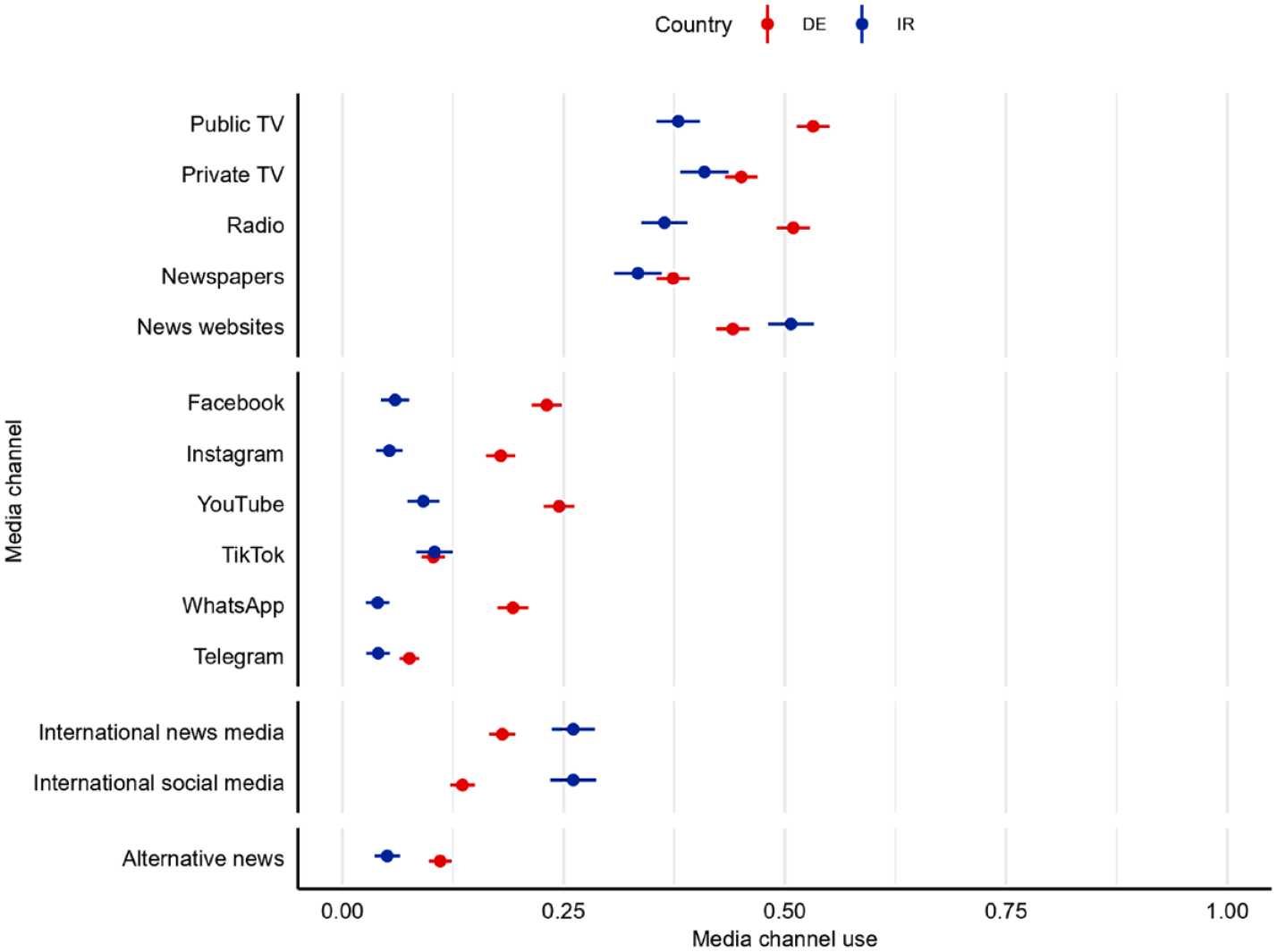
Media channels use for information about the Russian–Ukrainian war.
Predictors of media channel use
To investigate RQ2, we first computed mean indices of media use for legacy media (public and private TV stations, radio, newspapers and news websites – αGermany = .755; αIsrael = .792), social media (Facebook, Instagram, YouTube, TikTok, WhatsApp and Telegram – αGermany = .832; αIsrael = .886), and international media (international news media, international social media – αGermany = .727; αIsrael = .597). We also applied the single-item measure for alternative media. We computed linear regression models with media type (legacy, social, international and alternative media) as the predicted variable and country of residence, objective proximity (ties to Ukraine), subjective proximity (perceived closeness to Ukraine) and trust in media (media trust, scepticism and cynicism) as predictors.
All the regression linear models – for all four dependent variables – were found to be significant. This includes the model for predicting legacy media consumption (F[8,1817] = 123.510, p < .001); for predicting social media consumption (F[8,1817] = 40.164, p < .001); for predicting international media consumption (F[8,1817] = 138.061, p < .001); and the model for predicting alternative media consumption (F[8,1817] = 121.221, p < .001). Given that the country of residence emerged as a significant predictor in all regression models and influenced media consumption across all media types, we conducted separate regression analyses for each country to better understand the nuances in predictors and media consumption behaviours specific to each locale.
The consumption of legacy media in both countries was significantly predicted by greater objective and subjective proximity to Ukraine, heightened political interest and increased age (see Table 1). However, the role of media trust varied between the two nations. In Germany, both greater media trust and media cynicism significantly predicted legacy media use, whereas these factors did not have the same influence in Israel. Conversely, elevated levels of media scepticism were associated with increased legacy media consumption in Israel but not in Germany.
Regression models predicting media channel use.
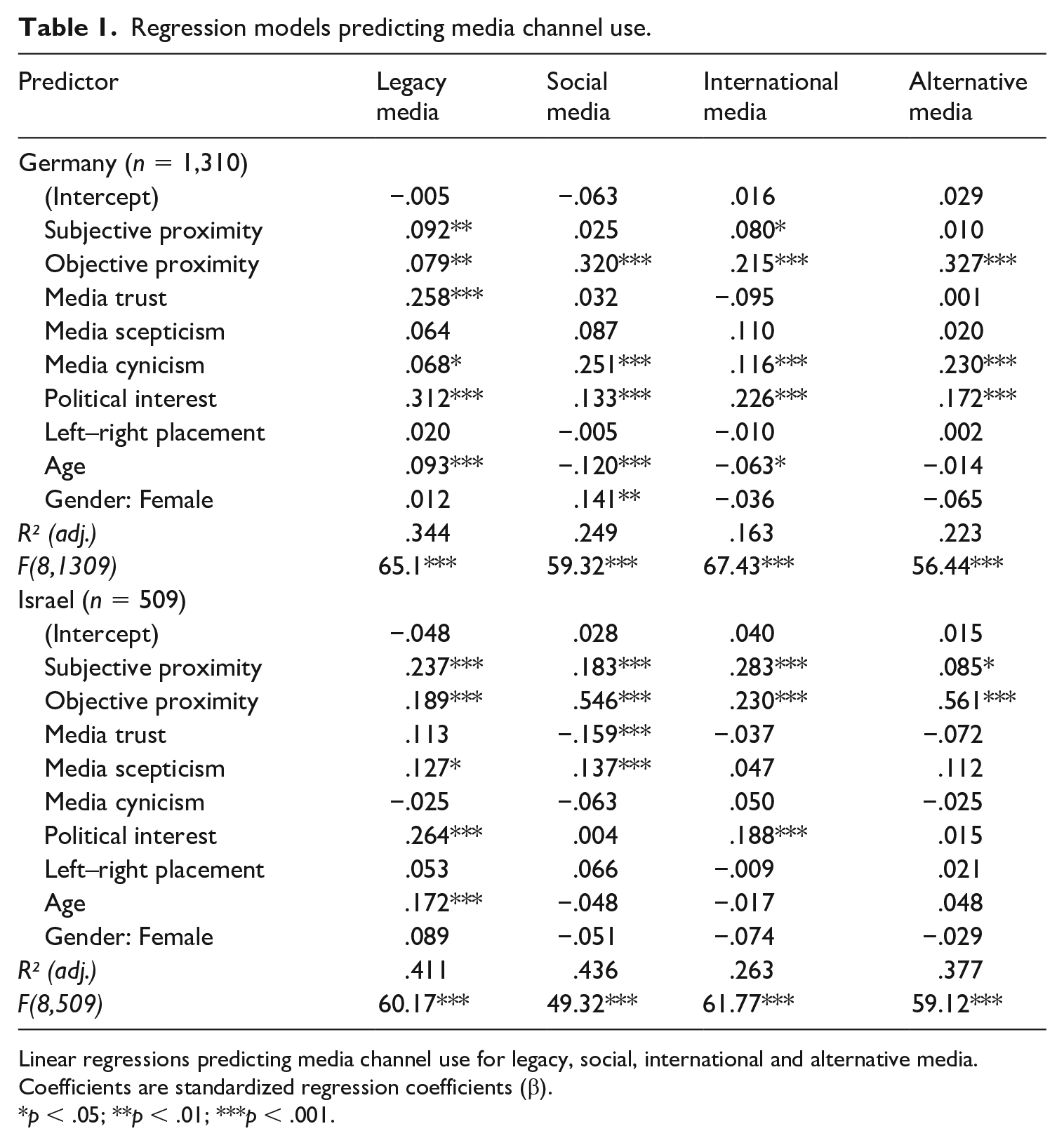
Linear regressions predicting media channel use for legacy, social, international and alternative media. Coefficients are standardized regression coefficients (β).
p < .05; **p < .01; ***p < .001.
Fewer commonalities were observed in social media usage patterns. In Germany, factors significantly predicting social media use included greater objective proximity to Ukraine, media cynicism, political interest, younger age and female gender. In Israel, however, greater objective and subjective proximity to Ukraine, lower media trust and heightened media scepticism were associated with increased social media use.
For international news media, greater objective and subjective proximity to Ukraine significantly predicted increased consumption in both countries. Additional predictors in Germany included media cynicism, political interest and younger age while, in Israel, only heightened political interest served as a significant predictor.
Lastly, greater objective proximity to Ukraine significantly predicted increased alternative media consumption in both countries. In Germany, this was also predicted by greater levels of media cynicism and political interest. In Israel, increased consumption was significantly associated with greater subjective proximity to Ukraine (see Table 1 for full statistical details).
The role of Media Trust as a mediator in the relationship between Subjective and Objective Proximity, Social Media use and Legacy Media use was scrutinized (RQ3 and RQ4). The analysis employed Hayes’s (2018) PROCESS bootstrapping command in SPSS, utilizing 5,000 iterations. Subjective and Objective Proximity served as the predictors, Media Trust functioned as the mediator, and Social and Legacy Media use were the dependent variables. Figures 2 and 3 delineate the mediation models along with their coefficients.
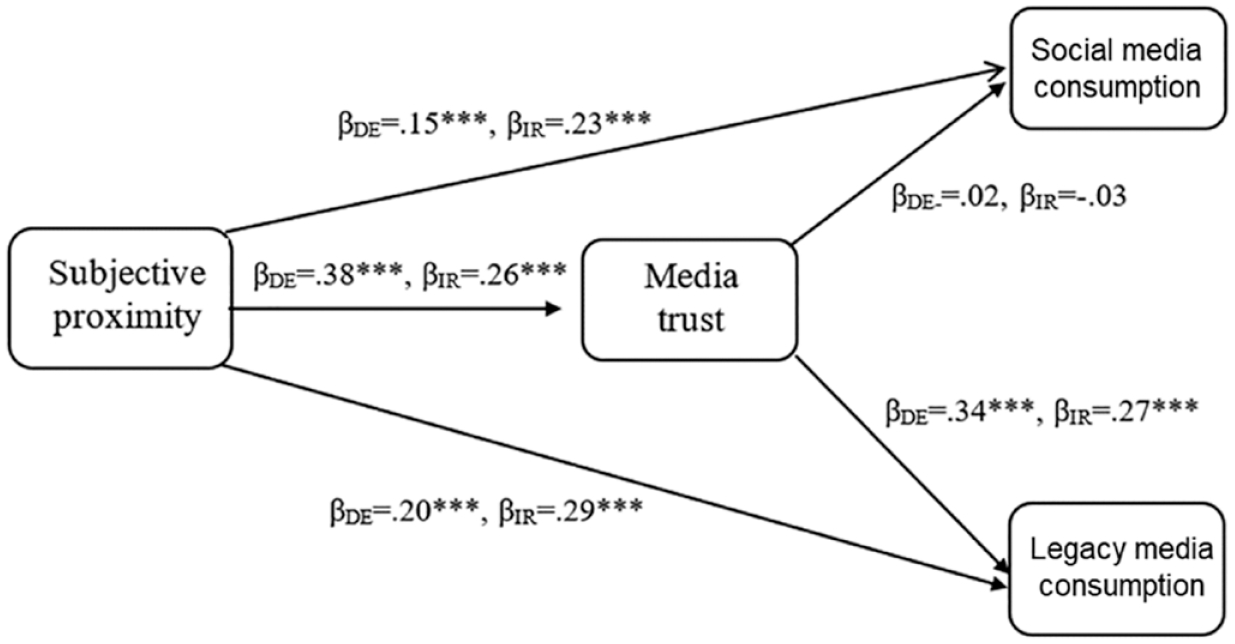
Mediation model of media trust as a mediator between subjective proximity and media uses.
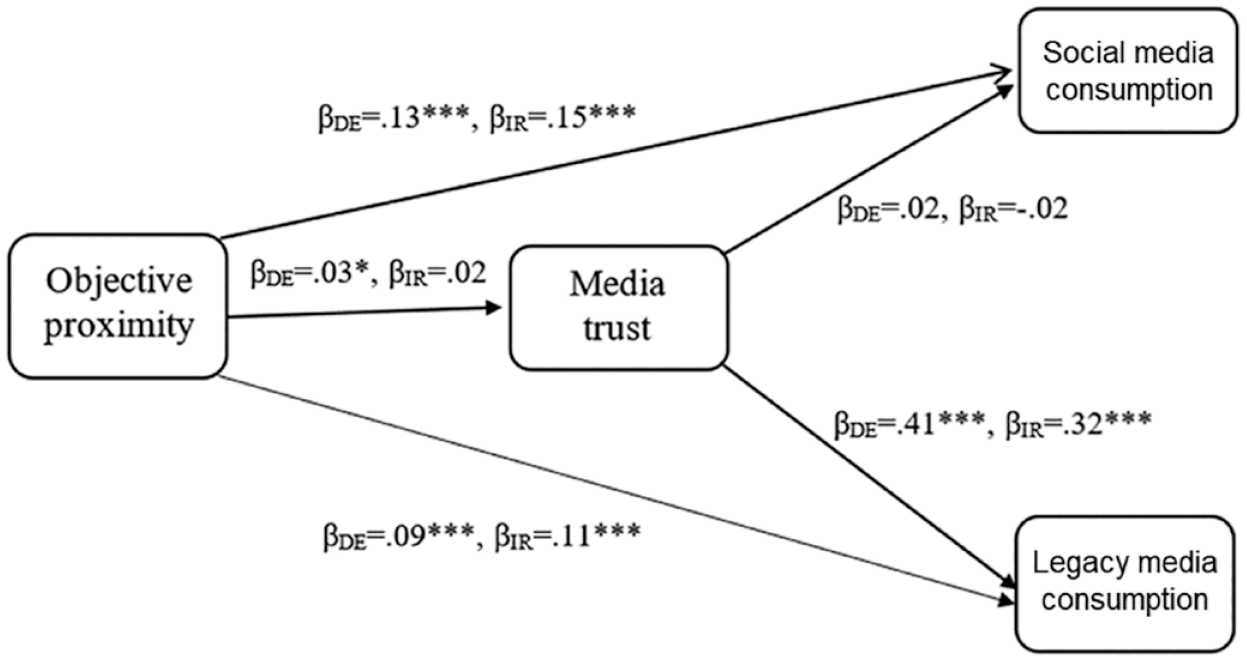
Mediation model of media trust as a mediator between objective proximity and media uses.
In Germany, all direct effects between Subjective and Objective Proximity and Social and Legacy Media use were found to be statistically significant (RQ3). The 95 percent confidence intervals (CIs) for these direct effects were as follows: 0.108–0.192 for Subjective Proximity with Social Media and 0.149–0.240 for Subjective Proximity with Legacy Media. For Objective Proximity, the CIs were 0.110–0.140 with Social Media and 0.031–0.066 with Legacy Media.
A similar pattern of significance for all direct effects was observed in Israel. The 95 percent CIs for these direct effects were: 0.171–0.276 for Subjective Proximity with Social Media and 0.223–0.362 for Subjective Proximity with Legacy Media. For Objective Proximity, the CIs were 0.138–0.171 with Social Media and 0.076–0.134 with Legacy Media.
In Germany, further exploration of the role of Media Trust was conducted (RQ4). The model indicated a direct effect of Subjective Proximity on Social Media use, rather than an indirect effect via Media Trust, as the indirect effect’s 95 percent CI included zero (−0.023 to 0.009; F[2, 1305] = 26.68; p < .001). However, an indirect effect through Media Trust was observed for both Subjective Proximity with Legacy Media use (95% CI, 0.108–0.155; F[2, 1305] = 220.88; p < .001) and Objective Proximity with Legacy Media use (95% CI, 0.035–0.172; F[2, 1306] = 193.30; p < .001). Conversely, for Objective Proximity with Social Media use, the effect was direct, not mediated through Media Trust (95% CI, −0.003 to 0.002; F[2, 1306] = 138.21; p < .001).
Similar findings were observed in Israel. The model indicated a direct, rather than an indirect, effect of Subjective Proximity on Social Media use, as the indirect effect’s 95 percent CI included zero (−0.023 to 0.034; F[2, 507] = 42.80; p < .001). For Subjective Proximity with Legacy Media use, both a direct and an indirect effect through Media Trust were observed (95% CI, 0.039–0.105; F[2, 507] = 85.66; p < .001). However, for Objective Proximity, the effects on both Social Media use (95% CI, −0.001 to 0.015; F[2, 506] = 164.45; p < .001) and Legacy Media use (95% CI, −0.025 to 0.025; F[2, 506] = 75.90; p < .001) were direct, not mediated through Media Trust.
Discussion
This study examined how various characteristics of news consumers in Israel and Germany shaped their news consumption habits regarding mainstream media coverage and social media mentions of the Russian–Ukrainian 2022 war. Findings indicate that, for most variables, Germans and Israelis look for news about the war in similar ways and under similar circumstances. People with stronger family, business, social and academic ties with Ukraine were more motivated to look for information and updates about the war than others. The same result applied to subjective ties based on identification with the Ukrainian country, people and culture. In addition, an interest in politics and growing age predicted news media consumption in both countries.
These findings are aligned with the basic principles of the two theories of media and communication informing our study: uses and gratifications, and media dependency. Users’ interest in the war, stemming from their practical (‘objective proximity’) and emotional (‘subjective proximity’) ties with Ukraine, has motivated them to stay updated while deepening their dependence on such updates. The current study indicates how relevant these two classic theories are, even in today’s multimedia environment and complex geopolitical global reality.
An overview of the role of legacy media (public and private TV stations, radio, newspapers and news websites) in Israel and Germany indicates how prominent these channels still are, at least in this given case study, as legacy media were used more often than other types of media across the board. Unsurprisingly, social media were also used intensively, while alternative media were rarely used in both countries. As for international news, these outlets were much more popular in Israel than in Germany as a source of information about the war. However, they were generally consumed at low levels compared with national legacy media and social media. Greater objective and subjective proximity to Ukraine predicted this widening of media repertoire in Israel and Germany, as one would expect under such circumstances.
Despite the above-mentioned similarities, on average, German participants reported greater media consumption than Israeli participants. This may indicate a greater need for information about the Russian–Ukrainian war in Germany than in Israel, possibly because, given the geopolitical conditions, Germany is more likely to be directly influenced by the war). This finding may also be explained considering Elvestad et al.’s (2018) study, attributing different media consumption habits about foreign events to media consumers’ level of engagement with local conflicts, considering the meaningful gap between Israel and Germany. As detailed above, Hanitzsch et al.’s (2013) explanations for different foreign news consumption patterns between countries may also contribute to our understanding of this finding.
As far as social media were concerned, German participants differed from Israeli participants in several ways. Whereas, in Germany, growing objective proximity to Ukraine predicted a rise in social media use, the same was not true for subjective proximity. In contrast, both ties with Ukraine, objective and subjective, in Israel predicted increased social media use to learn about the war. This finding might be understood as a result of being so remote from the war zone that Israelis’ interest in the Russian–Ukrainian war must have been deeply rooted in subjective proximity measures. As this sense of identification with Ukraine arose, so did the motivation to widen their media repertoires and look for relevant social media information.
A prominent corpus of literature about the motivation behind foreign media consumption habits focuses on the perspective of immigrants regarding global and homeland media while considering their level of objective and subjective proximity with the country at stake (Arendt and Karadas, 2020). The current study joins the rather small group of studies which has broadened the perspective from immigrants to people with different kinds of backgrounds, political environments, connections to, as well as levels of, identification with a remote country on which they get news updates from various media outlets and platforms (Elvestad et al., 2018). Nevertheless, the unique meaning attached to ‘objective proximity’ in this study – not in the geographical sense, but rather as an indicator of actual ties with a given country – calls for further exploration in future studies, as the line between the ‘objective’ and the ‘subjective’ might be blurred under certain circumstances.
Concerning trust, scepticism, and cynicism towards the media, differences between the countries were even more pronounced. As indicated by this study’s results, Germans’ use of legacy media was predicted by both growing trust and cynicism towards the media while, in Israel, only growth in media scepticism predicted a growth in legacy media consumption. In terms of social media use, growing media cynicism predicted growth in social media use in Germany while, in Israel, results were consistent with the vast literature on trust in the media. Whereas trust is usually positively correlated with exposure to mainstream news media, it is commonly negatively correlated with social media usage (Hameleers et al., 2022). Hence, at least for the Israeli case, the lower media trust was, the greater the use of social media for information about the war (alongside growth in media scepticism – also a predictor of social media use).
These differences between the two countries may indicate different ways of interpreting concepts like scepticism and cynicism toward the media. In addition, the degree of trust in the media seems to have varying effects on information repertoires across countries. One of Choi et al.’s (2006) major conclusions may explain this finding, according to which alternative perceptions regarding the war (compared with how mainstream media cover it) motivate people to seek information about the war in social media.
Thus, the results were consistent for proximity overall, as in most cases, both being and feeling closer to Ukraine predicted greater media use across all four media types and in both countries. In contrast, the effects of trust in media varied per country and media type. The findings of this study contribute to our understanding of how meaningful people’s objective and subjective ties with a foreign country (in addition to their general interest in politics) are for their motivation to consume news about it on both mainstream and social media. These results highlight the importance of considering objective and subjective proximity and perceptions about the media system in understanding media use for information about significant events such as the Russian–Ukrainian War. Findings also reinforce existing literature about the importance of media trust as a predictor of people’s tendency to rely on mainstream vs social media for information and news updates on a meaningful event.
This study has several limitations. The measures used in this study may not have fully captured the complexity of news consumption habits, as they focused on media use rather than content consumption. Differences between the two countries’ media landscape, especially with regard to the available supply of foreign news, must have also influenced consumption habits. Future studies should delve deeper into their potential influence. The study was conducted during the first few months of this ongoing war. As these tragic events have continued for many months, people’s interest in them and their related news consumption habits can be expected to have changed (usually in the direction of a drop in motivation to follow the news). Therefore, further study should occur at other points to better understand the influence of this interval variable – the continuation of the war. It would be useful to examine how news consumption habits concerning this war vary across events or specific conflicts and how they change over time. Another limitation that calls for further examination is the possible cumulative influence of Ukrainian refugees on veteran German and Israeli citizens from Ukraine, as well as on citizens from other origins, concerning their level of identification with Ukraine and their motivation to get updates about the war.
Footnotes
Funding
The authors received no financial support for the research, authorship and publication of this article.
