







Abstract
Using the country image repair framework, this study analyzed two opinion columns in major Russian state-controlled media outlets with content related to the Russian–Ukraine conflict, Russia Today (RT) and Sputnik, from 24 February 2022 to 20 May 2022. A thematic content analysis was used to examine 60 articles by RT and 70 articles on Sputnik. Results from the analysis determined that the five strategies of country image repair, except for mortification, were used in an attempt to legitimize the conflict in Ukraine and restore the image of Russia. Theoretical and practical implications of the results are discussed in the context of a repressive news media environment.
Keywords
On 24 February 2022, Russia attacked Ukraine as an escalation of the Russo-Ukrainian War, which started in 2014. This followed the recognition of Russia by the Donetsk People’s Republic and the Luhansk People’s Republic, two self-proclaimed breakaway quasi-states in the Donbas region (Hernandez, 2022). This caused the biggest refugee crisis since World War II (Keane and Blake, 2022), tremendous economic loss and cost (Korovkin and Makarin, 2022; Liadze et al., 2022) and a global food shortage (Jagtap et al., 2022).
There are conflicting opinions about the attacks. Western media, including the Washington Post, The Guardian (US), and BBC News (UK) called the conflict ‘the Russian invasion of Ukraine’. News outlets in India expressed concern over the ‘Russian invasion’ and called on the government to denounce the invasion (O’Boyle and Bhalla, 2022). China maintains neutrality by ‘providing support for negotiations; urging the de-escalation of conflict’ (US–China Economic and Security Review Commission, 2022).
Aside from violent armed attacks, Russia has employed different strategies for a cyber war with Ukraine. The information war was initiated using cyber-attacks which include ‘cyber espionage operations targeting the computers and networks of journalists in Ukraine, as well as Ukraine, NATO, and EU officials’ and ‘cyber-attacks to disrupt or destroy targets that were carried out in Ukraine’ (Unwala and Ghori, 2016: 6–7). Russia used several other strategies like rumor-spreading and troll-framing (Lange-Ionatamishvili et al., 2015: 108). Under the authoritarian system, the mainstream media in Russia tends to align with the government when reporting international affairs (Freedom House, 2015; Roman et al., 2017). In covering the Russia–Ukraine conflict, Russian news media may act as a government agency for public diplomacy purposes.
Drawing from several theoretical frameworks including image repair (Benoit, 2015) and warfare legitimacy (Shaw, 2002), this study thematically analyzed 130 news articles from Sputnik and Russia Today – two government-supported news organizations in Russia – to shed light on how they legitimized and repaired the country’s image in the context of the Russia–Ukraine armed conflict. In this study, we focused on state-owned media in opposition to independent media. Media independence has been measured based on whether ‘the media are able to function independently of sources of political, governmental, business and religious power and influence’ (Reporters without Borders, 2021: np).
This research provides empirical evidence of how a repressive government uses the news media as a communication tool, blurring the line between propaganda, public relations, and journalism. It contributes to the theoretical frameworks of political legitimation and country image repair.
Literature review
State–press relations
State–press relations theory refers to the interactions between governments and the news media (Chan, 2022; Entman, 2004; Luong and Vu, 2022). In the West, research has documented evidence of the news media’s influence on policy-making. Studies found that the government of a country can shape the news agenda and use news coverage to influence public opinion of that country. Findings from Zaller and Chiu (1996) illustrate this type of influence, pointing out that during the Cold War, from 1945 to 1991, the US news media frequently mirrored its government’s official views when reporting on foreign policy. The news media was no more than the US government’s ‘little helper’, ‘waxing hawkish and waning dovish as official sources led them to do’ (Zaller and Chiu, 1996: 385–386). Similarly,Dmitrova and Strömbäck (2005) indicated that US news media framed the Iraq War as a military conflict.
The West has claimed its independent press values and systems for centuries, for instance, the US stressed the importance of the freedom of expression in the First Amendment (Goodale, 1997; Lively, 1992), independent media system (Hallin and Mancini, 2010; Humphreys, 1996), and the high-ranking Western countries in the Press Freedom Index (Reporters without Borders, 2021). However, a common issue can be found: through multiple strategies (e.g. press conferences, embedded journalism and political discourse), governments have successfully exerted influences on the news media. These strategies are especially effective in crises involving foreign countries, where news media are more likely to show a pro-government stance (Chan, 1994; Entman, 2004).
The news media have also been recognized for practicing their watchdog role, monitoring governments and authorities in diplomatic crises. Studies have found that the US news media played a crucial role in altering the government’s plan for the Vietnam War, where policies changed significantly as the news became more critical of authorities (Culbert, 1998; Hallin, 1986). The example showed the interplay between the news media and governments in Western countries.
In countries outside the West, state–press relations demonstrate different dynamics, depending on the political and media system in a nation. In the newly democratic countries (e.g. Slovakia, Kosovo, Albania) the efforts of empowering and disseminating freedom of information have brought about a more liberal environment for politics and media (Camaj, 2016; Voltmer, 2008; Žuffová and Carlini, 2021). Journalists in these countries have still been suppressed by ‘physical attacks, online hate speech, surveillance, smear campaigns, strategic lawsuits against public participation (SLAPPs), insufficient protection of journalistic sources and whistle-blowers, impunity, and precarious economic conditions’ (Žuffová and Carlini, 2021). In countries where media systems fit into the category of authoritarian, governments tighten their control over media through a licensing system, frequently arresting and attacking journalists, or closing down news outlets (El Gody, 2007; Lauk, 1999; Siriyuvasak, 2007; Tai, 2014). In restrictive environments, journalists adapt and learn to self-censor to avoid government punishments, hence tending to reflect governmental views (Bodrunova et al., 2021; Cain, 2014; Tong, 2009). They are more likely to perceive their professional role as loyalists (Vu et al., 2023) or providers of infotainment and service journalism (Mellado et al., 2017) instead of being watchdogs or interventionists.
The Russian press
Journalists in countries with state-controlled media, such as Russia, frequently reflect the government’s agenda (Kazun and Kazun, 2019;Medovkina, 2019; Rimpiläinen, 2020). Kazun and Kazun (2019) found that some media outlets in Russia are controlled directly by the state while others are linked to the president, and are used by the government to influence the people (Medovkina, 2019). After the collapse of the Soviet Union, Russia maintained pressure on the media by giving outlets that supported the government special access to information (Vartanova, 2012). Russia has been transitioning to more state-controlled media with the start of Putin’s third term being ‘marked not so much by a tightening of control over media as by increasing control over the media agenda’ (Kazun and Kazun, 2019).
While independent outlets still operate in Russia, they have faced pressure from the Kremlin in recent years (Paskhalis et al., 2022). Pro-Kremlin legislators banned advertising on Russian cable and satellite channels, resulting in financial pressure on regional television providers and independent outlets. Since the Crimean crisis, the Kremlin has tightened its control over most media outlets through political pressure and censorship (Simons, 2015) and invested heavily in the mainstream media (Szostek and Hutchings, 2015; Wagnsson, 2023). According to Szostek and Hutchings (2015), the Russian leadership attaches great importance to mass communication and weaponizes it in global politics.
Communication on the Russia–Ukraine conflict
Communication research on the conflict between Russia and Ukraine has paid close attention to examining how new media (social media) and the integration of new and traditional media (e.g. social media and television) report the wars and the social interactions against these forms of reporting (Alyukov, 2021; Boatwright and Pyle, 2023; Wiggins, 2016). These studies examined crisis communication and national identity (Boatwright and Pyle, 2023), how social media bots influence public opinion (Li et al., 2023), and the use of memes to discuss conflict (Wiggins, 2016). Other research directly paid attention to the information war (Roman et al., 2017), the cyber-attack strategies (Carmack, 2022), and perspectives of stakeholders regarding the conflict (Roman et al., 2017; Unwala and Ghori, 2016). Major Russian media organizations are known to act as conduits for the Russian government (Freedom House, 2015; Oates and Lokot, 2011; Oates et al., 2021).
According to the BBC (2022), following the Ukraine crisis, Russian state media amplified their pro-Kremlin and nationalistic narratives, consistently promoting admiration for Putin, nationalistic fervor, opposition to Western influence, and attacks on Kremlin adversaries. At the same time, only a handful of Russian media outlets provide alternative perspectives, and they have limited reach (Freedom House, 2015). Studies by Tolz and Teper (2018) and Tolz and Hutchings (2023) delved into the contradictory discourse regarding the contemporary political regime, confirming the close alliance between Russian state-owned mainstream media and government.
Country image repair in armed conflicts
Image restoration theorists suggest that repairing images includes five defense strategies: denial, evasion of responsibility, reducing offensiveness, corrective action, and mortification (Benoit, 2015). Most studies focused on politicians, corporations, and celebrities (Peijuan et al., 2009). Image repair theory can analyze how governments restore their international public images. For example, after 9/11, Saudi Arabia relied on denial and bolstering to keep their public image away from terrorism (Zhang and Benoit, 2004). Peijuan et al. (2009) determined the Chinese government used denial, bolstering, and attacking the accuser to respond to the ‘Made in China’ crisis. Israel describes itself as a victim of terrorist attacks and territorial conflicts using different narratives (Handley, 2008). After the outbreak of the Iraq War, US President George W Bush used image restoration strategies to improve the image of the US (Benoit, 2006). Under Putin, the Russian government has facilitated control over previously private media (Gehlbach and Sonin, 2014). After Russia annexed Crimea, Russia used state-owned media to repair its image by primarily targeting Western audiences (Helmus et al., 2018).
There are studies on how Russia used an information war and strategic communication strategies relating to the conflict with Ukraine on social media (Lange-Ionatamishvili et al., 2015), cyber-attacks (Unwala and Ghori, 2016) or memes on social media (Wiggins, 2016). However, there is yet to be research on traditional media using country image repair during the conflict. The current research aims to answer the first research question:
RQ1: How do Russian media outlets restore the image of the country?
The legitimacy of warfare
Legitimacy is known to be the juncture of morality and power, and is a claim to righteousness (Byrne and Klem, 2015). This concept is the way authority works and what rulers think is justified. By pointing out three bases of legitimacy including rational–legal, charismatic, and traditional ones; Weber called legitimacy the ‘validity’ of the social system (Hurd, nd). Legitimacy is ‘a perception or assumption that the actions of an entity are desirable, proper or appropriate within some socially constructed system of norms, values, beliefs and definitions’ (Suchman, 1995: 574). The concept has been used in several organizational research-related disciplines such as accountability (Deegan, 2002); environmental disclosure (O’Donovan, 2002) and organizational and issue legitimacy (Chung et al., 2016).
Regarding legitimacy of warfare, Shaw (2002) argued that there are two types of re-legitimations of war since militaristic activities kill ordinary people. After World War II, countries sought to prevent war ‘at almost all costs’, delegitimizing wars (p. 344). Legitimizing wars is not a new phenomenon. World War II has been considered a ‘good war’ because it ‘halt[ed] genocide and other violence against civilians’ (p. 344). Other justifications for a good war are ‘the campaign against nuclear weapons’ or ‘humanitarian intervention’. The wars against terrorism raised concerns about the calamity it created for civilians. Shaw identified the need for re-legitimation of war as the new way of ‘risk-transfer militarism’. This has been argued to be a ‘Revolution in Military Affairs’ by the ‘enhanced precision that computer electronics brings to targeting’ and therefore ‘avoid the large-scale and widespread massacres of enemy civilians’ and ‘mitigate the effects of the “small” massacres that ‘accidentally’ happen’ (p. 348). There are five major elements in this new militarism of transferring risks, including killing the enemy, local allies taking risks on the ground, small ‘accidental’ civilian massacres, media management, and indirect casualties (Shaw, 2022).
This study investigates the strategies that Russian mainstream media used to justify the legitimacy of the country’s invasion of Ukraine. It asks:
RQ2: How do Russian news media justify the legitimacy of the invasion of Ukraine?
Method
This research employed thematic content analysis to examine the usage of country image repair in the opinion column of Russian state-controlled media outlets, Sputnik and Russia Today (RT). Sputnik and RT are widely perceived as state-controlled or funded media with ties to the Russian government (Blackwill and Gordon, 2018). Analyzing their content can provide insight into how the Russian government shapes and disseminates information on international events and policies.
Of the three approaches to content analysis (e.g. lexical, syntactic, and thematic (Oliveira et al., 2013), the last one allows researchers to explore themes and frequency, and is considered appropriate for research that focuses on interpretation (Ibrahim, 2012). Using Octoparse, an open-source online data scraping tool, we collected links to all the articles in the op-ed column on RT and the opinion column of Sputnik from 24 February 2022 to 30 May 2022. We collected 112 links on RT and 114 links on Sputnik by copying and pasting those articles into an Excel file. Then we manually scanned the articles and marked whether they were relevant to the Russia–Ukraine conflict. The scanning process left 60 articles on RT and 70 articles on Sputnik.
Next, we used MaxQDA to code these articles using a deductive coding approach, in which the coders apply a predetermined code system to the data (Bingham and Witkowsky, 2022; Saldaña and Omasta, 2018). Researchers can ‘organize the data, identify relevant data, and maintain focus on the research questions’ (Bingham and Witkowsky, 2022: 135). Using this approach on MaxQDA software, researchers can set a predetermined code system with the five strategies of country image repair. Each strategy code included sub-codes, which are the models under each strategy: Denial (Simple deny and Shift the blame); Evasion of Responsibility (Defeasibility, Provocation, Accusation, Good intentions, Accident); Reducing Offensiveness (Bolstering, Differentiation, Transcendence, Minimization); Corrective Action, and Mortification. Coders read and marked sentences or paragraphs that fell into the code (strategies) or sub-strategies (models). Two coders handled the coding process. The two coding projects were merged into an overall coding project for interpretation. Investigator triangulation was used to ensure the coders interpreted article content the same way. We used another investigator to double-check both coding result sections. This helps to ‘reduce bias that can be introduced when only one researcher acts as an observer or data collector (Keyton, 2006: 65). MaxQDA is a tool for qualitative research that is found in the methodological works of Max Weber and Alfred Schütz, which aims at a methodologically controlled construction of typologies (Kuckartz and Kuckartz, nd). This software allows researchers to organize codes and obtain inferences. Even though ‘potential gain provided by using these software packages for thematic content analysis depends on the researcher’s knowledge of content analysis since they do not take the place of the researcher in the coding process’ (Oliveira et al., 2013: 304).
Results
We found that the five strategies of country image repair, except mortification, were used by Sputnik and RT. Multiple tactics were used to legitimize the conflict in Ukraine. To answer the first question, the media outlets most often used the strategies of denial, evasion of responsibility, and reducing offensiveness. Corrective action was used minimally. Using evasion of responsibility to justify the legitimacy of the war indicated that these tactics were used to both legitimize the conflict and restore the country’s image. Justification of the superpower war and ‘using your words against you’ are the tactics to legitimize the conflict used by these media outlets (see Table 1).
Finding table.
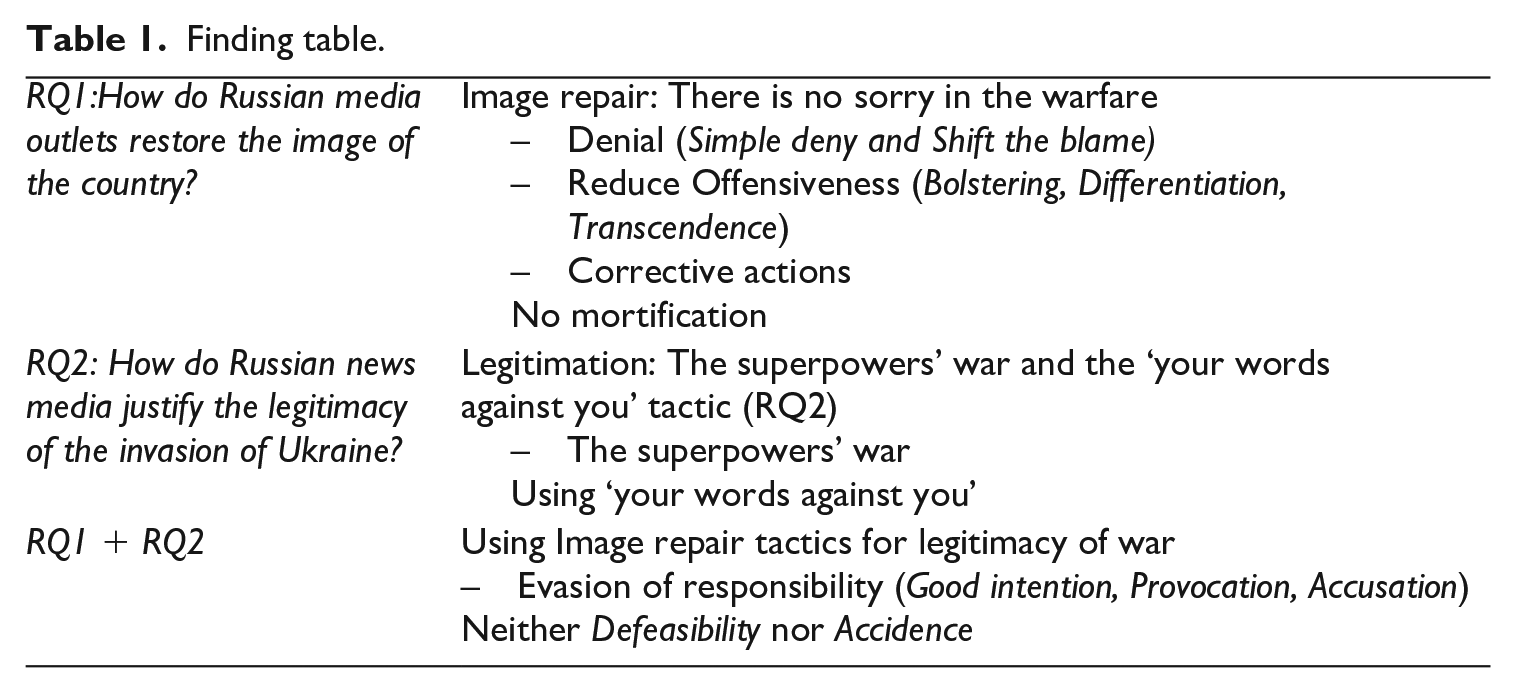
Image repair: There is no sorry in the warfare (RQ1)
As previously stated, country image restoration was primarily used through the tactics of denial, reducing offensiveness, and minimally corrective action. We found evidence of simple denial and shifting the blame (Deny); bolstering, differentiation, transcendence (Reduce offensiveness), and Corrective actions.
Use of simple denial attempted to take the blame off Russia or its military for negative events reported by Western media, the global crisis and economy. Simple denial was used to remove blame for the Russian military killing civilians in Donbas in an 8 April article, RT states that ‘evidence is saying that the bodies had white armbands, the sign of the Russian army, the soldiers wear them. So, soldiers are killing Russian Ukrainians? No way.’ Simple denial was also used in the title of the RT article ‘The imminent global food crisis is being blamed on Russia, but the truth is rather more complex’, explaining that Russia was not responsible for the global economy.
Shifting the blame was used to show ‘Biden’, ‘NATO’, ‘the West’, ‘the US’ and ‘embargo sanctions by Western countries’ were to blame. For example, two Sputnik Global articles published on 15 April and 29 April focused on ‘Biden’ and the ‘West’. The first stated that ‘Americans are seeing skyrocketing inflation and plummeting living standards, but their European peers are also facing the same problems. The eurozone is struggling with record high inflation for the sixth month, exacerbated by sweeping anti-Russian sanctions.’ This reiterated that ‘Russia‘ was the victim of the ‘West’ and Western policy. In regard to the global economic crisis, they wrote, ‘it is unlikely that the American public is ready to oppose Washington’s outpouring of money into the conflict’, placing the blame on the Biden administration and US voters while Russia is the victim of money being sent to Ukraine.
To reduce offensiveness, bolstering, especially related to humanitarianism, was commonly used to outweigh negative perceptions about the war and frequently used the words ‘Russia’ and ‘military’. In Sputnik Global on 24 February ‘even though Mariupol is in ruins after fierce combat, the Russian armed forces came in immediately with humanitarian aid and began trying to repair infrastructure, electricity, and water.’ Along with humanitarian aid, ‘Russia’ was discussed in terms of winning the war and the need for peace. Sputnik Global reiterated this, ‘as Russia is the inevitable victor, the sooner peace terms are negotiated and agreed between the two sides, the sooner the loss of Ukrainian life and property will cease.’ Bolstering showed Russia’s desire for peace and worry about civilian lives.
To reduce offensiveness, differentiation compared similar US or NATO military operations in other countries, placing Russia as a propaganda victim. This tactic frequently used ‘Russia’, ‘West/Western’ and ‘NATO’. RT, in a March 2022 article, states that ‘America’s selective outrage over Ukraine is fashioned by a well-oiled propaganda machine . . . just ask the people of Yemen.’ Sputnik Global in March 2022 stated, ‘It is obvious that the US is using Ukraine as a tool to destabilize Russia’s borderlands.’ These place Russia as the victim while NATO and the US are aggressors who have taken similar actions in other countries.
Transcendence was used to explain that Ukraine should stay neutral and was frequently paired with ‘NATO’ as the bigger problem. Sputnik Global stressed that ‘the Ukraine conflict is a symptom of a much larger geopolitical imbalance that can and must be solved peacefully . . . a World Peace Conference that will address the root causes of the NATO–Russia conflict and establish sustainable security.’ They argue there is a problem ‘NATO’ needs to fix.
Corrective action was used in RT to explain the need for ‘peace talks’, ‘a commitment to peace’, ‘peace would be a most welcome development’, ‘push for peace’ and ‘lead to peace’. This showed ‘Russia’ urging the world for peace and not at fault.
Although the media outlets often referred to bigger issues and a need for peace, neither apologized for actions taken by Russia or its military. Instead, they focused on a need for peace talks, helping impacted communities or shifting the blame to other governments.
Using image repair tactics for legitimacy of war (RQ1 + RQ2)
Evasion of responsibility was the most common tactic used to justify the conflict. This often focused on Russia being provoked, the need to save lives, or protecting Russia. As previously discussed, legitimizing the war was sometimes combined with other tactics. The word ‘Russia’ was often used in conjunction with ‘West’, ‘NATO’ or ‘US’ to show provocation. An article on RT published in March 2022 stressed that
The US and its allies have set much more radical goals than the relatively conservative containment and deterrence strategies used toward the Soviet Union. They are in fact striving to exclude Russia from world politics and to completely destroy the Russian economy.
Common statements were, ‘the West doesn’t want peace in Ukraine’ and ‘Russia has been threatened.’ They showed provocation, a need to protect Russia, and a lack of responsibility.
Good intention was a frequent strategy to legitimize the war for Russia. The media outlets frequently combined ‘Russia‘ with ‘saving lives’. An RT article published on 27 May stated ‘The Russians saved literally hundreds of thousands of human lives by coming in when they did . . . Operation Z is the beginning of the end of this war that’s gone on for eight years’. Explaining that Russia was trying to end a long conflict legitimized the war. The sub-strategy of bolstering can also be seen in the efforts to convey Russian troops for ‘the liberation of Marupo’, ‘conduct a brilliant chest game’, or ‘demonstrable battlefield victory of such a large scale’ according to an article published in Sputnik.
The war was further legitimized by the provocation and accusation of the opponents saying that the ‘West’, ‘NATO’, ‘Ukraine’ or the ‘US’ were involved with biological warfare or neo-Nazism in Ukraine. Sputnik Global stated on 8 April, ‘during Russia’s special operation in Ukraine it has obtained additional information about the military and biological activities of the US on the territory of the European state.’ RT wrote multiple times that ‘Western media clubs together white-wash Ukrainian neo-Nazis.’ In explaining the need for deNazification, Sputnik stated on 24 February:
President Putin’s special military operation to defend the people of Donbas from an imminent general offensive by the neo-Nazi regime in Kyiv not only is fully justified in international law by Article 51 of the Charter of the United Nations, but it is fully consistent with the military praxis and doctrine of self-defense of states in the face of an imminent threat emanating from a neighboring state or enemy forces.
In attempting to legitimize the conflict, Russia was protecting people by stopping Nazification in Ukraine.
Our data analysis showed that the strategies of Defeasibility and Accidence were absent. This suggests the news outlets were placing greater emphasis on portraying Russia’s attack on Ukraine as deliberate and driven by intent.
Legitimation: The superpowers’ war and the ‘your words against you’ tactic (RQ2)
In restoring Russia’s image and justifying legitimacy, the war was portrayed as a ‘superpowers’ war’ between ‘Russia’ and ‘the West’. ‘NATO’, ‘Western’, ‘Biden’, ‘president’ and ‘military’ were frequently used to shift the blame from ‘Russia’ to ‘NATO’ or the ‘West’. Sputnik used this tactic in an article on 11 May stating, ‘The Western corporate press and Hollywood celebrities have never visited the region. Western leaders and their spin doctors know that their narrative contradicts the reality on the ground in Donbas.’ This claimed the Western press was not sharing valid information but focusing on blaming Russia. A 10 May article on Sputnik Global explained ‘The role of the West’ as ‘destroying ties between Russia and Ukraine. It ruins the possibility of dialogue between people of peaceful professions.’ This placed the blame on the ‘West’ because ‘Russia’ had to protect itself, making peace impossible. While legitimizing the war, it is an example of using multiple tactics to shift the blame.
Image restoration and legitimizing the conflict were regularly used with using one’s own words against them. The RT article by Fomenko (2022) used information from the book No More War by Daniel Kovalik (2020) to explain ‘why Russia’s intervention in Ukraine is legal under international law’.
Words from Western scholars and politicians such as George Bush, Tony Blair, Henry Kissinger, and Gerhard Schroeder were used in the articles on 22 April 2022. RT repeatedly quoted former US Secretary of State Henry Kissinger to explain that ‘Ukraine should not join NATO’ and ‘NATO expansion toward Russia would be the most fateful error of American policy.’ Both articles try to legitimize the conflict while shifting the blame onto ‘NATO’ and the ‘West’ by mentioning these words frequently and using quotes from Western leaders and intellectuals. There was no evidence of Defeasibility and Accidence found in our data analysis. Most of the articles showing the active manner in the attack and victory of the war have been conveyed in the bolstering section above.
Discussion
In examining the coverage of the Russia–Ukraine War, this study found four image repair strategies (e.g. Denial, Reduce offensiveness, Evasion of responsibility, and Corrective actions) that were frequently adopted by the Russian press . Of the five categories in Benoit (2015)’s image repair framework, mortification was not used. The news outlets aimed to shift the blame to ‘NATO’, ‘Biden’, and the ‘West’. The use of ‘Russia’ was frequently tied to establishing they were ‘in control’, would ‘win’, or were ‘victims’. The Russian media outlets tried to establish a position of control while claiming to be victims of the West. ‘Biden’, ‘West’, and ‘NATO’ were used to explain how they provided support for ‘Ukraine’ and did not want peace. These words were often mentioned in the denial, bolstering, and attacking the accuser strategies. This finding is in line with previous literature (Handley, 2008; Peijuan et al., 2009; Zhang and Benoit, 2004), which found that governments frequently adopt these tactics in their public diplomacy campaigns to play the ‘victim’ in international crises.
The Russian media seem to perform a war of justification with multiple country image repair strategies. The denial strategy shifted the blame toward ‘NATO’, the ‘US’, ‘Biden’, ‘Europe’, the ‘West’, and ‘Ukraine’. Evasion of responsibility attacked those accusing Russia of invading Ukraine. This is like Peijuan et al.’s (2009) findings, which indicated that the strategy shifted the blame from Russia for the world economy because other countries placed embargoes on Russia or were providing support to Ukraine. Provocation was used to claim that Russia had to defend itself from Western powers attempting to control Russia, for instance, claiming the US had biological weapons stored in Ukraine, such as Benoit (2006). Legitimizing was used to claim Russia was saving lives by invading, and Russia was protecting Ukrainian citizens from neo-Nazis. Bolstering messages legitimized Russia’s providing humanitarian aid and reinforced that Russia would win the war, thus protecting civilians. Legitimization was used to claim that Russia wanted to avoid a nuclear war while Western countries were pushing them into one, similar to Peijuan et al. (2009). Bolstering and differentiation showed Russia as the victim of Western expansion while also being the hero to the Ukrainian people. In using the differentiation tactic, this study found that the West was often depicted as anti-Russia and responsible for the embargoes affecting the worldwide economy. Transcendence was frequently used to show that there were global symptoms beyond the conflict for the worldwide economy.
Corrective action was used sparingly. This tactic depicted Russia as the hero for providing humanitarian aid while returning Ukraine to normalcy after fighting ceased. Corrective action promoted the need for peace talks and blamed Western countries for not engaging in dialogues with Russia. Neither Defeasibility nor Accidence were used to demonstrate the activist nature of the attack. Activism involves taking an active and assertive role in advocating for change or promoting a cause or belief. Additionally, Russian media also portrayed themselves as winning the war.
To legitimize the war, multiple tactics were used. The tactic of ‘using your own words against you’ utilized Western sources to attribute and legitimize Russian points. Legitimacy in this manner has been found in previous studies concerning police and law (Cherney and Murphy, 2013; Reisig and Lloyd, 2009) and government (Gau, 2014). This tactic legitimized that Russia had the right to attack because NATO and the US took similar actions in Iraq, Yemen, and Yugoslavia. Similar studies have examined democratic countries’ legitimacy to start wars (Grimm and Merkel, 2008). Russia frequently used this to explain how the West blames Russia while not taking responsibility.
Words from elite sources along with other strategies explained how Russia was being blamed or Western countries needed to stay out of the conflict. Russian media cited political leaders or legal experts to legitimize Russia’s actions. Russia was right because they were legally protecting their borders. Shaw (2002) argued that the legitimacy of war is often explained as defending ordinary people. This research found similar tactics, they claimed Russia attacked Ukraine because citizens were being threatened by the Ukrainian government and military. This was used frequently with the words ‘NATO’, ‘Ukraine’, ‘Biden’ and ‘West’ while ‘Russia’ was the victim. These words were also used in stories related to neutrality, to avoid biological warfare and neo-Nazification. Thus, this was a ‘good war’ (Shaw, 2002: 344) because they were saving civilians.
To repair the image and legitimize the war, the media outlets took the view of and promoted the government. Media in democratic countries often reflect the views of their governments (Camaj, 2016), while state-controlled media tend to have their agenda set by the government (Kazun and Kazun, 2019; Rimpiläinen, 2020). This study reflected previous research in that the media used image repair and legitimized the war without seeming to question the government. Like Rimpiläinen (2020), little information reported came from witnesses but from sources like the government. They attacked accusers by using the words from experts in Western countries or denied that events happened.
The use of state–press relations with country image repair to evaluate the press during crises provides a new outlet for future research. Country image repair has been used to study public relations related to politicians, corporations, and celebrities (Peijuan et al., 2009) and repair countries’ images after conflict (Benoit, 2006; Handley, 2008; Peijuan et al., 2009; Zhang and Benoit, 2004); however, this theory has not been used to analyze mainstream media coverage. Therefore, the Russian media, in this case, tends to reflect governmental views in times of crises (Vu and Lee, 2012), especially state-controlled media (Camaj, 2016; Vartanova, 2012).
By using state–press relations and country image repair theory, this study evaluates how state-controlled press provides support to governments when repairing the country’s image during a crisis. Previous literature found, that in highly constrained settings, journalists often find themselves compelled to adapt and employ self-censorship strategies to evade government sanctions (Bodrunova et al., 2021; Cain, 2014; Tong, 2009). Furthermore, in such environments, there is a greater tendency for journalists to perceive their role as either supporters of the authorities (Vu et al., 2023) or providers of infotainment and service-oriented journalism (Mellado et al., 2017). Following the Crimea crisis, the Kremlin bolstered its control over Russian media organizations through the use of political coercion and censorship (Simons, 2015). Additionally, country image theory (Benoit, 2015) provides a concrete framework to examine the utilization of denial, reduce offensiveness, evasion of responsibility, and corrective actions in repairing Russia’s country image and legitimizing warfare.
This study extends country image repair’s theoretical implications by considering a different angle of the country image repair theory. The theory has traditionally analyzed corporate crisis communication strategies (Zhang and Benoit, 2009) or public diplomacy activities by governmental agencies (Peijuan, 2009). However, when the state and the press tend to align or governments use the press as a public relations tool (Vu and Lee, 2012), we argued that the theory can be sufficiently employed to examine image repair strategies used by the press.
Limitations and conclusion
There are some limitations to this study. Two Russian media outlets were used for this study. More may provide different results depending on their support of the state. This study focused on a limited period. Focusing on a longer time could show changes in the way the conflict was reported. The timeframe of the data is also relatively short (from 24 February to 20 May 2022). More data might yield more profound insights regarding both research questions. This research focused on how Russia was reporting on the conflict. Future studies could focus on coverage of other conflicts to compare them to the conflict in Ukraine.
This study identified that four of the five image repair strategies were used by Sputnik Global and Russia Today to cover the conflict in Ukraine. Popular strategies were shifting the blame to the West, attacking Western countries, projecting Russia as the victim or hero, or showing that they were protecting civilians. Future research should expand on this study to determine if the coverage and image repair strategies shifted as the conflict progressed or because of changes within the government. This research could be expanded to determine how country image repair tactics have been used by media and governments during other conflicts. Further research should focus on how those relationships are impacted throughout a conflict.
Footnotes
Appendix
1. Aleshkowsky A (20 May 2022). To the Seoul congress of the audiovisual authors international confederation. Sputnik Global.
2. Bentley R (27 May 2022) Operation Z is the beginning of the end for Kyiv’s eight-year war against Donbas, a US volunteer says. Sputnik Global.
3. Blakenship B (2022) Leading experts warned NATO expansion would lead to conflict. Why did no one listen? Russia Today.
4. Blinova E (24 February 2022a) Russia’s spec op: Why Kyiv & its Western backers had failed to implement Minsk Accords for 8 Years. Sputnik Global.
5. Blinova E (22 March 22b) US armament spree in Ukraine is last ditch effort to preserve Washington’s dominance, scholar says.
6. Blinova E (8 April 2022c) Dutch Journo: ‘We are here, in Donbas, to awaken Westerners deluded by MSM propaganda.’ Sputnik Global.
7. Blinova E (8 April 2022c) ‘We are here, in Donbas, to awaken Westerners deluded by MSM propaganda.’ Sputnik Global.
8. Blinova E (15 April 2022d) Ukraine labs: Bioweapons can be used as tools in US low-level war against Russia, ex-DoD analyst says. Sputnik Global.
9. Blinova E (29 April 2022e) Biden requesting $33 billion in military aid for Kyiv as US & EU facing stagflation, observers say. Sputnik Global.
10. Blinova E (10 May 2022f) Biden’s lend-lease: US is going to sacrifice Ukrainians at unbelievable numbers, observers say. Sputnik Global.
11. Blinova E (11 May 2022g) Journo: Is it coincidence that some CIA torture techniques are so popular with Ukrainian Neo-Nazis? Sputnik Global.
12. Blinova E (12 May 2022h) Why Biden’s Ukraine military adventure will benefit China & fail to subdue Russia. Sputnik Global.
13. Blinova E (24 May 2022i) US Volunteer: Azovstal surrender prompted a shift in Western public view of Russia’s Ukraine op. Sputnik Global.
14. Blinova E (14 February 2022k) Inflation will cost dems midterms despite White House’s ‘Putin’s price hike’ mantra, scholars say. (12 April 2022). Sputnik Global.
15. Blinova E (11 May 2022l) Is it a coincidence that some CIA torture techniques are so popular with Ukrainian neo-Nazis? Sputnik Global.
16. Blinova E (28 February 2022o) Russian spec op to demilitarize and de-Nazify Ukraine fully justified under international law. Sputnik Global.
17. Blinova E (12 May 2022p) Why Biden’s Ukraine military adventure will benefit China & fail to subdue Russia. Sputnik Global
18. Blinova E (10 May 2022q) Biden’s lend-lease: US is going to sacrifice Ukranians at unbelievable numbers. Sputnik Global.
19. Blinova E (15 April 2022r) Ukraine labs: Bioweapons can be used as tools in US low-level war against Russia, ex-DoD analyst says. Sputnik Global.
20. Bridge R (2022) Let’s pray the ‘Cold War’ between America and Russia doesn’t turn hot. Russia Today.
21. Bridge R (2022) Russophobia didn’t start with Ukraine. It’s long been brewing in the West. Russia Today.
22. Bridge R (2022) The US and NATO have never been sanctioned for starting wars. Why? Russia Today.
23. Bridge R (2022) Why do Europeans have to sacrifice hot showers to ‘stick it to Putin’? Western officials are asking citizens to renounce creature comforts and general well-being in the name of sanctions. Russia Today.
24. Johnson C (2022) How Washington’s using the Ukraine conflict to drive a wedge between Russia and China. Russia Today.
25. Johnson C (2022) How Washington’s using the Ukraine conflict to drive a wedge between Russia and China. Russia Today.
26. Johnstone C (2022) Everyone’s anti-war until the propaganda starts: Opposing violence means standing up against the most sophisticated information machine that has ever existed. Russia Today.
27. Maavak M (18 May 2022). The imminent global food crisis is being blamed on Russia, but the truth is rather more complex. Russia Today. https://www.rt.com/russia/555615-global-hunger-food-crisis/
28. Maavak M (2022) The imminent global food crisis is being blamed on Russia, but the truth is rather more complex. Russia Today.
29. Malic N (2022) Western media clubs together to white-wash Ukrainian neo-Nazis. Russia Today.
30. Marsden R (2022) When Henry Kissinger gives advice on ending the Ukraine conflict, the West should listen. Russia Today.
31. Norin E (2022) Bucha needs to be properly investigated, not used for propaganda. Russia Today.
32. Ritter S (2022) A Russian nuclear strike in Ukraine: How likely is it? Russia Today.
33. Trenin D (2022) How Russia must reinvent itself to defeat the West’s ‘hybrid war’. Russia Today.
Funding
The authors received no financial support for the research, authorship, and publication of this article.

Author biographies
Nhung Nguyen is a Ph.D. in Journalism and Mass Communications from The University of Kansas. Nguyen has over 10 years of experience in journalism reporting science and technologies and as a strategic communication/public relations professional for non-profits facilitating international and national PR and social media campaigns in environmental protection, public health, and sustainable agriculture. Her research pursuits revolve around new media (i.e., digital, immersive, interactive), public relations (PR), and risk communication. She is fascinated by how new media reshape the PR landscape and influence audience perception in high-risk scenarios (i.e., critical industries, armed conflicts, and global pandemics). Nguyen also focuses on exploring information verification in combating mis and disinformation, emphasizing the integration of theoretical frameworks and artificial intelligence (AI) to enhance public resilience to false narratives. Using the mixed methods of computational and traditional research, she seeks to contribute to our further understanding of theoretical advancements and practical implications of new media, PR, and risk communication, which can be employed to address global risks such as global pandemics, climate change, and international conflicts.
Pamela Peters is an assistant professor of Broadcasting and Journalism in the School of Communication and Media at Western Illinois University. Peters obtained her doctorate from the School of Journalism and Mass Communication at the University of Kansas. Her research examines the digital divide, race and ethnicity and forms of capital in relation to education, climate change and crisis management in digitally mediated spaces.
Hechen (Frank) Ding is a Ph.D. candidate in the School of Journalism and Mass Communications at the University of Kansas. Before joining KU, Ding earned his B.A. from the Communication University of China and his M.A. from the University of Macau. His research agenda explores how digital media and emerging technologies pose challenges to public relations, science communication, and political communication, with a focus on issues such as media credibility and trust, polarization and incivility, and disinformation and misinformation.
Hong Tien Vu is an associate professor and the Clyde and Betty Reed Professor in Journalism in the School of Journalism and Mass Communications at the University of Kansas. Vu obtained his doctorate from the School of Journalism, the University of Texas of Austin. His research examines journalism and nonprofit communication practices in addressing emerging global challenges, such as climate change, environmental degradation, health crises, and growing societal inequalities, particularly within the context of evolving technological advancements.