






Abstract
Research on foreign news coverage suggests that journalists tend to exhibit an ethnocentric bias when reporting on issues that might reflect poorly upon their nation. This stems from the institutional, commercial and cultural pressures that tend to shape the news production process. These pressures are at odds with other professional norms and values within journalism that are seen as crucial to democracy, including the need to inform the public, hold leaders accountable and expose abuses of power. This study examines these tensions in the context of US drone warfare. The authors employ social identity theory to systematically examine the manner and extent to which civilian casualties caused by US drone strikes were reported on in news coverage in the US (The New York Times) versus the UK (The Guardian) from 2009–2016. The article explores whether civilian casualty mentions in these news sources led to a more critical examination of the merits and efficacy of the drone policy.
On 19 December 2021, The New York Times released the first of a two-part series documenting the extensive human costs of US drone strikes and so-called ‘precision’ bombing in conflicts abroad since the start of the war in Afghanistan. The articles exposed previously classified Pentagon documents that not only challenged how the US government had consistently framed the narrative surrounding drone strikes for the past two decades, but they told an entirely different story. According to the author, investigative journalist, Khan (2021): The trove of documents – the military’s own confidential assessments of more than 1,300 reports of civilian casualties, obtained by The New York Times – lays bare how the air war has been marked by deeply flawed intelligence, rushed and often imprecise targeting, and the deaths of thousands of civilians, many of them children, a sharp contrast to the American government’s image of war waged by all-seeing drones and precision bombs.
Furthermore, Khan stated that the US government, under various administrations, had an active and ongoing policy of covering up the extent to which US drone strikes had killed civilians. These allegations reverberated throughout the nation and around the world. After all, it is not every day that The New York Times, or any other major US news source, for that matter, is willing to expose the US for its war crimes in such an explicit and damning way.
The release of these reports – along with the launch of The Civilian Casualty Files, an online civilian casualty tracker on the newspaper’s website – seemed to mark a seismic shift in how US news organizations, or at least The New York Times, were going to report on US drone warfare moving forward. It shone a spotlight on the unaccountable nature of the policy and the horrors associated with it. But was this merely a case of too little, too late? An effort to reclaim some credibility on this issue after having largely toed the line for years as drones were killing innocent civilians in Pakistan, Afghanistan, Yemen and elsewhere? Previous research, for example, suggests that before the release of these reports on civilian deaths, US news coverage, including The New York Times, had, for the most part, reliably embraced the strategic narrative put forward by US officials about drone strikes, emphasizing their precision, legality and strategic value in eliminating terrorist threats (see Rowling et al., 2018; Sheets et al., 2015). Such findings, no doubt, align with the well-documented tendency among news organizations to prioritize official sources and to exhibit ethnocentric biases when reporting on foreign affairs that implicate the nation, especially in times of war or when the nation is perceived to be threatened (Entman, 1991; Gans, 1980; Slattery and Doremus, 2012; Wolfsfeld et al., 2008). In effect, in such moments, it becomes imperative for presidential administrations to actively seek to control the broader narrative – to maintain public support for the war as well as to insulate itself and the nation from criticism – by constructing arguments bound to resonate with Americans. This is precisely what US officials sought to do in the context of US drone warfare. And US journalists, it seemed, were all too willing to help. That is, until The New York Times decided to challenge the narrative at the beginning of 2022.
Foreign news coverage of US drone strikes, however, tells an entirely different story. Unlike their US counterparts, foreign journalists are unencumbered by the institutional, commercial or cultural pressures to report favorably on US military actions. In fact, research has shown that foreign journalists have been much more willing to emphasize the illegality of US drone strikes, to draw attention to their imprecision and technological flaws, and proclaim that drone strikes lead to more terrorism, not less (Sheets et al., 2015). Indeed, such patterns have been shown in news coverage both within those countries considered to be staunch allies of the US as well as those deemed to be hostile enemies (Sheets et al., 2015). This divergence in how US drone strikes have been reported on within the US versus the rest of the world is an important factor, we argue, in why Americans have remained broadly supportive of the policy and why there is more resistance and opposition to the policy abroad. Research, however, has yet to systematically examine the manner and extent to which civilian casualties have been reported on in US versus foreign news coverage of drone strikes, or whether civilian casualty mentions might lead to a more critical evaluation of the policy. The absence of such work is notable, we argue, given that research indicates that, when the public is exposed to foreign casualties in war, it tends to significantly diminish public support for military action (see Johns and Davies, 2019; Ron et al., 2019; Walsh, 2015).
This study, therefore, builds on previous research in at least three important ways. First, we provide a systematic analysis of how civilian casualties caused by US drone strikes have been reported on in the news (see also Bachman, 2017). Other studies examining the public discourse surrounding drone warfare – either at home or abroad – have primarily focused on the debate among officials or within the news over the efficacy or merits of the policy, while tending to neglect the issue of civilian casualties (see Aslam, 2011; Holewinski, 2015; Kreps, 2014). Second, we examine these dynamics through a cross-national comparison of US versus UK news coverage of US drone strikes. This allows us to assess whether national identity might play an important role in determining the manner and extent to which civilian deaths caused by US drone strikes were reported on in the news. Finally, we provide a longitudinal examination of news coverage of US drone strikes throughout the entirety of the Obama administration (2009–2016), the timeframe when the frequency of US drone strikes was at its peak. To be sure, the dynamics surrounding news coverage of drones were likely ‘set’ during the Bush administration. We also know that the frequency of drone strikes surged under the Trump administration. Nonetheless, these limitations aside, our focus on the entirety of the Obama administration does provide us with the opportunity to systematically evaluate news coverage of civilian casualties over an extended period of time, when drone warfare was no doubt at the center of US war efforts abroad. Overall, our findings show not only a clear difference in how US and UK journalists cover US drone strikes, in general, but also a chasmic difference in the manner and extent to which they mention civilian casualties in their reporting. These findings, we argue, have important implications for how the policy is perceived, understood and evaluated by citizens within the US and around the world, which we elaborate on below.
Ethnocentrism in the news
Research has shown that news coverage of controversial international issues often varies meaningfully across national contexts (Clausen, 2003; Kolmer and Semetko, 2009; Wolfsfeld, 1997, 2004). Because the values, norms and processes embedded within national news systems tend to differ in important ways, journalists, according to Hafez (2000: 4), routinely select ‘topics, arguments, or frames that . . . result in diametrically opposed coverage in different countries’, even when the same event or policy issue is concerned. One potential reason for these patterns has to do with an official source bias, which tends to vary across national contexts. In addition, numerous studies have shown that journalists are sensitive to and influenced by national identity considerations when reporting on foreign affairs (Entman, 1993; Rivenburgh, 2000; Wolfsfeld et al., 2008). After all, journalists create news stories within a particular cultural context, which, according to Wolfsfeld et al. (2008), makes their ‘presumptions about collective identity . . . an especially important element in the construction of news’. Moreover, journalists tend to construct news stories – often by embracing and amplifying overtly ethnocentric narratives from policy elites – that tend to resonate with the citizenry due to commercial pressures. Indeed, failure to do so can run the risk of eliciting resistance or even a patriotic backlash from citizens who have come to expect – if not demand – such news coverage (Hutcheson et al., 2004). Ethnocentrism is, therefore, an ‘enduring news value’ (see Gans, 1980) because it aligns with the values shared by journalists, their editors, and their audiences. Simply put, journalists are inherently motivated to report on foreign affairs in ways that celebrate, accentuate, or at least align with prevailing cultural sentiments in their country.
A primary explanation, we argue, for why these patterns exist in international news coverage can be derived from social identity theory (SIT). SIT suggests that the identity of an individual is profoundly shaped by the social groups to which they belong (Rivenburgh, 2000; Tajfel, 1982). In particular, according to the theory, individuals derive comfort, security and self-esteem from those groups with which they strongly identify and, as a result, tend to evaluate them more favorably (compared to other competing groups) and behave in ways that support them (Tajfel and Turner, 1986). As Mercer (1995: 242) suggests, ‘just as people explain events in ways that enhance their self-esteem, group members tend to explain behavior in ways that enhance their group.’ Social identities can take many forms – e.g. ethnic, religious, partisan – but one of the most powerful forms of group identity is national identity. As Anderson (1983) notes, national identity commands ‘profound emotional legitimacy’ among citizens living in an ‘imagined community’ (Billig, 1995). Notably, it can lead citizens – including journalists – to engage in behavior designed to maintain or bolster the nation when it is perceived to be threatened (Entman, 1991; Wohl and Branscombe, 2008). In essence, the more invested one is in a group, the more one is motivated to protect the image, reputation and security of that group. Journalists are specifically susceptible to this type of bias for two reasons. First, as citizens themselves, they are likely to feel the same pangs of loyalty to their country as everyday citizens. Second, given that journalists are sensitive to what their audiences will be receptive to, they tend to report in a way that is resonant with their audiences. It is for these two reasons that journalists tend to report more favorably about their home country versus others.
This study examines these dynamics through a comparative analysis of how US versus UK journalists have reported on US drone warfare. We begin with an initial set of baseline hypotheses designed to assess how these news sources have, in general, reported on US drone warfare, regardless of their treatment of civilian casualties. If journalists are, indeed, ethnocentric in the ways that SIT would seem to predict, we would expect US journalists to instinctively portray US drone warfare far more favorably than their counterparts abroad. Previous research (see Rowling and Blauwkamp, 2022; Rowling et al., 2018; Sheets et al., 2015), for example, has identified four primary narratives or evaluative frames in the discourse surrounding US drone strikes: (a) strategic value – whether they effectively diminish the threat of terrorism; (b) technological capability – whether they enhance US military capabilities; (c) domestic legality – whether they are consistent with US laws; and (d) international legality – whether they comply with the laws of armed conflict. Consistent with social identity theory, then, we predict that US journalists will portray the policy much more favorably – in general (combining these four frames) and across each of these four specific frames – than UK journalists. We, therefore, offer our first two baseline hypotheses:
US drone strikes, civilian casualties and the threat to national identity
As a next step, we sought to analyze the manner and extent to which civilian casualties caused by US drone strikes were reported on by US versus UK journalists. Scholarship on SIT would seem to suggest that US journalists would be more reluctant to report on such matters compared to journalists from other countries due to national identity considerations. Specifically, allegations of widespread US war crimes – such as the indiscriminate killing of hundreds, if not thousands, of innocent civilians via US drone strikes – would, no doubt, constitute a significant threat to the image and reputation of the nation. Indeed, if such allegations were to become salient within the minds of Americans, it could shake the very foundation of US identity, tarnishing the values and ideals Americans tend to associate with their nation. SIT, therefore, offers a valuable insight into how Americans, including journalists, might respond when the nation is cast in such an unenviable light. Research in SIT shows, for example, that one of the primary mechanisms that citizens use to protect their national identity in such moments is to downplay or minimize the transgressions (see Blatz et al., 2009; Finlay, 2018; Wolfsfeld et al., 2008). As Bandura (1990, 1999) has documented in his work, so long as transgressions – such as killing innocent civilians – are ‘ignored, minimized, distorted or disbelieved’, there is scant reason for its citizens to then critically evaluate or question the moral sanctity and righteousness of the nation (1990: 37). Perhaps this is why John Brennan (2011), Obama’s US counterterrorism adviser, so brazenly stated that ‘for the past year there hasn’t been a single collateral death’ caused by US drone strikes. He apparently understood quite well that Americans would likely begin to question or protest against the policy if they were to become aware of just how many civilians had been killed in drone strikes.
In news coverage, we suspect US journalists are likely to minimize civilian casualties caused by US drone strikes in a number of important ways. We will address each in turn. First, we expect them to be more likely than foreign journalists to omit any mention of civilian casualties in their reporting (see Aday et al., 2005; Slattery et al., 2012). Simply put, the less visibility or salience that is given to this issue by reporters, the lower the threat that it is likely to pose to US identity. Second, we expect US journalists – far more than their foreign counterparts – to focus their reporting on militant casualties rather than civilian casualties caused by US drone strikes. In effect, by maximizing attention on how US drone strikes have eliminated terrorist threats by killing militants, this would serve to ensure that most Americans would see any mention of civilian deaths as an insignificant – albeit unfortunate – consequence of an otherwise broadly successful counterterrorism policy. Put another way, should news coverage become saturated with claims that US drone strikes are reliably and consistently killing militants, any accusation that civilian deaths have also been caused by these strikes is likely to have much less impact or even be drowned out entirely. We, therefore, offer our next set of hypotheses:
Third, we expect US journalists to minimize the impact of civilian casualties caused by US drone strikes through the use of ‘qualifying language’ when referencing victims of these strikes. When reporting about victims of drone strikes, for example, journalists might include such terms as ‘alleged’, ‘suspected’, ‘supposed’ or ‘believed to be’ when referencing the civilian casualties. The use of such language – which is much less definitive than if the journalist were to explicitly and unambiguously state that a drone strike had definitely killed civilians – can serve to elicit some degree of skepticism about whether the victims were actually civilians after all. Furthermore, it can also serve to undercut or attenuate the emotional or psychological response from citizens. At the same time, we might expect the opposite when US journalists reference militant casualties. By declaring, without the use of any qualifying language, that militants have been killed by a drone strike, US journalists are not only lending credence to the broader notion that the policy is effectively eradicating the terrorist threat, but they are also reducing any suspicion that civilians may have been present or killed. UK journalists, however, would have less need to engage in the use of qualifying language when discussing civilian casualties, given that their own national identity would not be at risk. Moreover, they are likely to greet claims that militants had been killed from a US drone strike with some suspicion, recognizing the tendency – and necessity – for US officials to advance such a narrative. We, therefore, offer the following hypotheses:
The final way that we expect US journalists to minimize the impact of civilian casualties caused by US drone strikes is through their unwillingness or reluctance to ‘humanize’ these victims in their reporting. Specifically, humanization involves any mention in news stories of the name, age, family, occupation or any other personal information about the victims (see Johns and Davies, 2019). We suspect that US journalists will be more likely to omit these details, compared to their foreign counterparts, because the inclusion of such things is likely to elicit a much more visceral reaction from US citizens than if they were excluded from the news story. Simply put, the omission of this type of information lessens the severity of the threat posed to the national identity and serves to bolster the image and reputation of the nation. With this in mind, we offer the following hypothesis:
Civilian casualties and public support for military action
As a final piece in our analysis, we wanted to explore whether the mere mention of civilian casualties in news coverage of US drone strikes meaningfully impacts the overall tone and tenor of reporting on the policy. Research indicates that public support for war tends to diminish considerably when foreign civilian casualties occur (see Johns and Davies, 2019; Walsh, 2015). Most notably, on the issue of drone warfare, research has shown that when Americans are exposed to evidence that US drone strikes kill civilians, they become significantly less likely to support the policy (see Ron et al., 2019). Indeed, this has been shown to have a more powerful impact on public support for the policy than any other critique, including arguments that these strikes are illegal or ineffective in combating terrorism (see Rowling and Blauwkamp, 2022).
With this in mind, we reason that US and foreign journalists alike – taking their cues from public sentiment on this issue – are likely to be more critical of US drone policy whenever civilian casualties are a significant part of the story. In other words, the more prevalent civilian casualties are in the news story, the more likely it will be that journalists will emphasize the illegality of US drone strikes, draw attention to their imprecision and technological flaws, and proclaim that drone strikes lead to more terrorism, not less. There is no denying, regardless of the nationality of a journalist or the country within which their news organization resides, that a military policy that has caused civilian casualties invites increased scrutiny. Nonetheless, we expect that, when civilian casualties are mentioned, it is likely to elicit an even harsher treatment of the policy from UK journalists than US journalists. Thus, we offer our final hypotheses:
Methodology
To examine US and UK news coverage of US drone strikes, we conducted two content analyses. From the US, we analyzed The New York Times; from the UK, we examined The Guardian. These sources were chosen because they are widely considered to be the national newspapers of record within their respective countries. All news stories were gathered via LexisNexis. We searched and collected all articles that had the key terms ‘drone’ OR ‘UAV’ OR ‘unmanned aerial’ in the period between 1 January 2009 to 31 December 2016. These dates were chosen because they include the entirety of the Obama administration, when the rate of US drone strikes was at its peak. All news stories on US drone policy, including editorials, feature stories, news analyses and commentaries were analyzed. Articles about US domestic surveillance drones, those about non-US drones, and irrelevant ‘false hits’ (e.g. articles about the ‘drone’ of insects or musical instruments) were excluded. Overall, we collected and analyzed a total of 2,038 news stories from The New York Times and 1,865 from The Guardian.
For all coding, the unit of analysis was the article. When coding for valence, we started by identifying overall assessment of the US drone policy. To do so, we coded for both positive/negative references for each of the following frames – strategic value, technological capability, international legality and domestic legality) and then computed a score of either ‘−1’ (negative reference to the frame), ‘0’ (mixed/neutral reference to the frame) or ‘1’ (positive reference to the frame). Specifically, for strategic value, positive references included statements about drones being effective in disrupting or defeating terrorism; negative references included statements about how drone strikes fuel anti-Americanism or increase the overall threat of terrorism. For technological capability, positive references included statements about drone strikes enhancing US military capabilities; negative references included statements emphasizing the technological flaws or limitations of drone warfare. For international legality, positive references included statements about drone strikes complying with the laws of war; negative references included statements about drone strikes violating those laws. Finally, for domestic legality, positive references included statements that drone strikes are constitutional or comply with domestic laws; negative references included statements about the strikes being unconstitutional or in violation of domestic laws.
Furthermore, we computed an overall article valence score to assess the balance of each frame’s valence within the entire article by summing the frame category valence scores and dividing by the number of categories coded (thus removing cases in which no frames were mentioned). This yielded a full article valence score on the same −1 to 1 scale mentioned above.
Our second category was mentions of casualties. Specifically, we coded whether and how frequently each news story referenced civilian and/or militant casualties. Then, in cases when civilian or militant casualties were mentioned, we coded for whether the journalist used qualifying language to describe the victim. This included such references as ‘alleged’, ‘suspected’, ‘believed to be’, ‘supposed’ in relation to the victim. In addition, when civilian casualties were mentioned, we coded for whether the journalists used humanizing language when describing the victim. This included references to the age, gender, name, family or occupation of the victim as well as the use of such words as ‘innocent’ or ‘unarmed’.
Finally, we assessed inter-coder reliability for all variables. Specifically, two coders coded the content on a random 10 percent subsample of news stories, and their ICR scores ranged from a Cohen’s Kappa of 0.72 to 0.92 across all codes.
Results 1
We began by analyzing how the policy of US drone warfare was, in general, reported on in US versus UK news coverage. Our expectation was that, overall, US journalists would be significantly more likely than UK journalists to frame the drone strikes favorably (H1) and that they would do so by emphasizing their strategic value, technological capability, international legality and domestic legality (H2). The independent t-test results for these expectations are shown in Table 1. As the data reveal, US journalists were significantly more likely than UK journalists to frame drone strikes favorably, in general, and across the four frames. Taken together, these findings offer strong support for our baseline hypotheses (H1 and H2).
Valence of frames in news coverage. 1 .
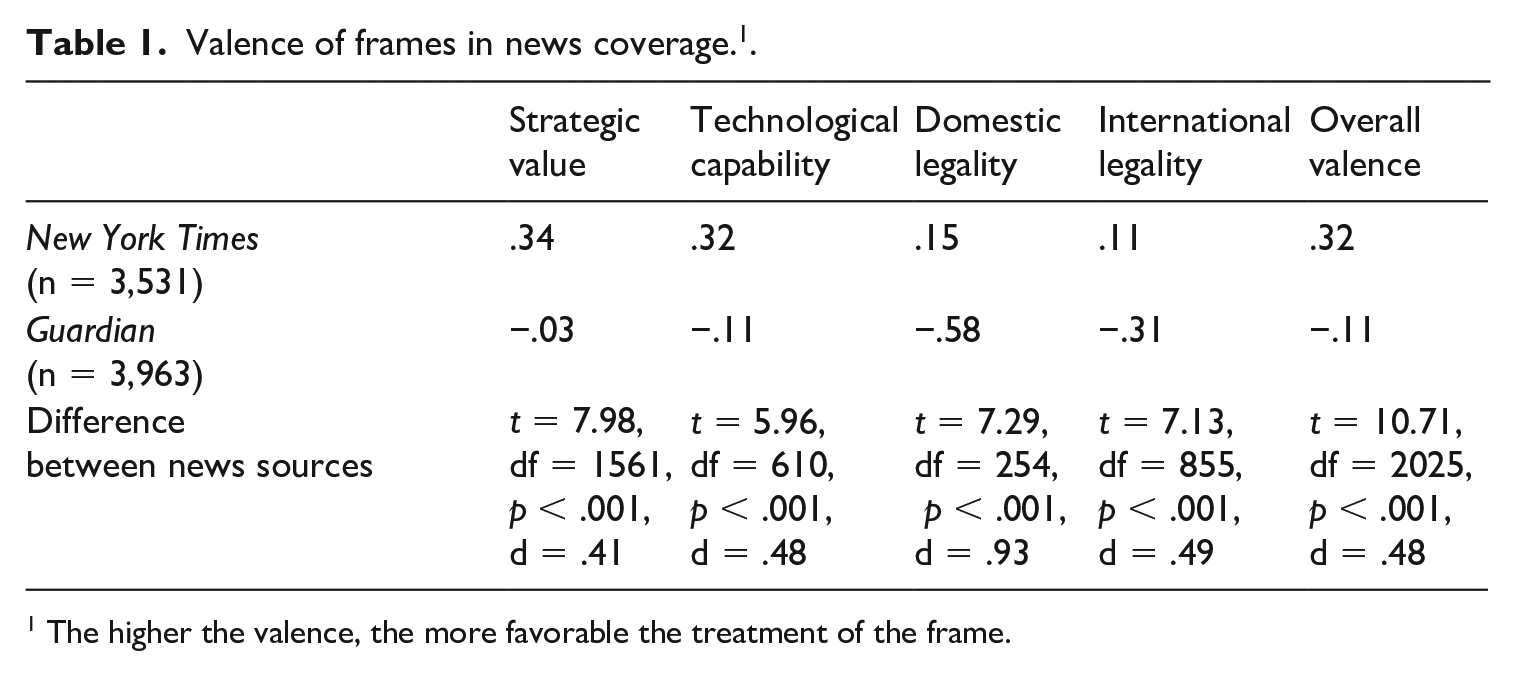
The higher the valence, the more favorable the treatment of the frame.
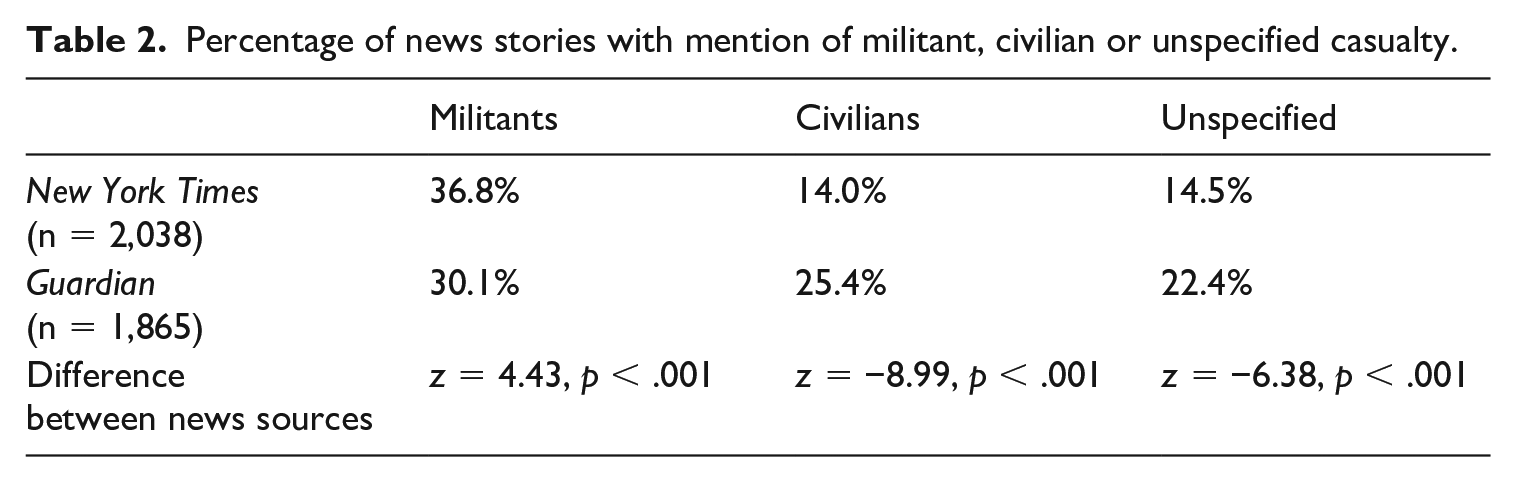
Our next set of hypotheses examined how often civilian and militant casualties caused by US drone strikes were reported on in US versus UK news coverage. First, we expected that US journalists would be less likely than UK journalists to reference civilian casualties in their reporting (H3). As Table 2 indicates, we see strong support for this hypothesis. Specifically, 14 percent of New York Times stories about drones contained at least one reference to civilian casualties, whereas a full 25.4 percent of Guardian news stories mentioned civilian casualties (z = −8.99, p < .001). Moreover, the findings in Table 3 show that civilian casualty references accounted for 23.5 percent of all casualty references (civilian, militant or unspecified) in New York Times stories; in contrast, civilian casualty references made up a full 42.9 percent of all references in The Guardian (z = −17.73, p < .001). These findings lend robust support for H3.
Percentage of news stories with mention of militant, civilian or unspecified casualty.
Among casualty mentions, percentage of references to militant, civilian or unspecified casualties across all news stories.
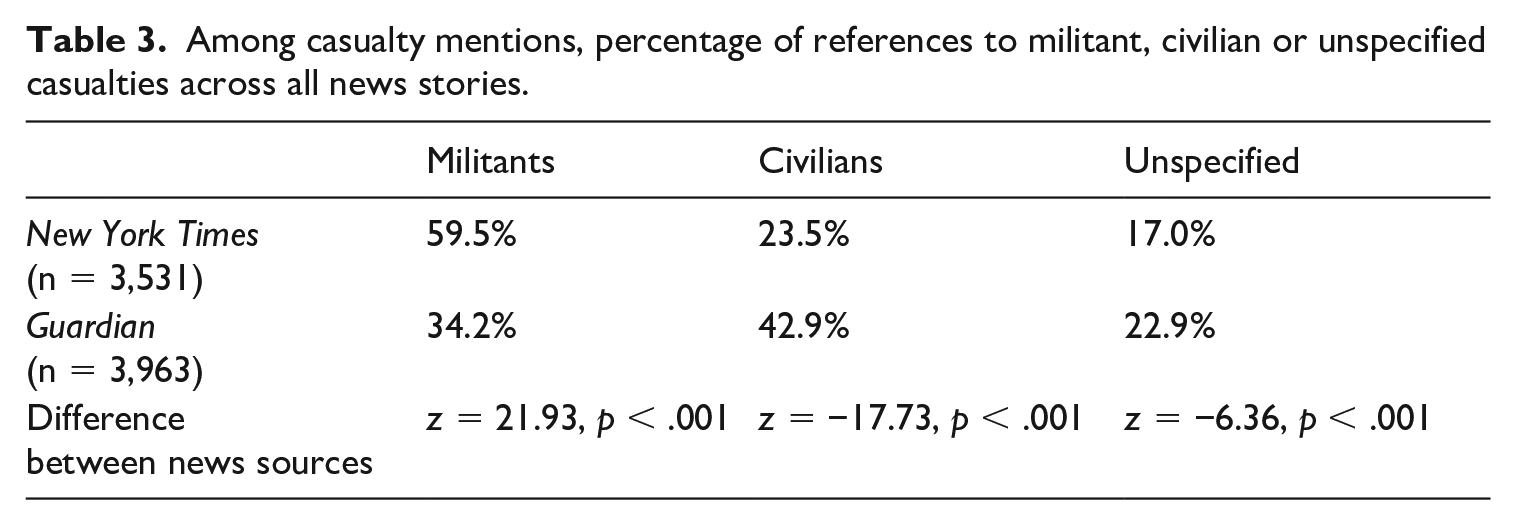
Our next expectation was that US journalists would be more likely than British journalists to reference militants in their reporting (H4). We also found strong support for this hypothesis. Specifically, 36.8 percent of New York Times news stories contained a reference to militant casualties, whereas only 30.1 percent of Guardian news stories mentioned militant casualties (z = 4.43, p < .001). In addition, the findings in Table 3 illustrate that among all references to any type of casualty, militant casualty references accounted for 59.5 percent of casualty references in The New York Times; in contrast, these references were significantly lower in Guardian news stories (34.2%, z = 21.93, p < .001). Thus, US journalists were much less likely than UK journalists to reference civilian casualties caused by US drone strikes and much more likely to reference militant casualties. Again, taken together, these findings lend strong support for H4.
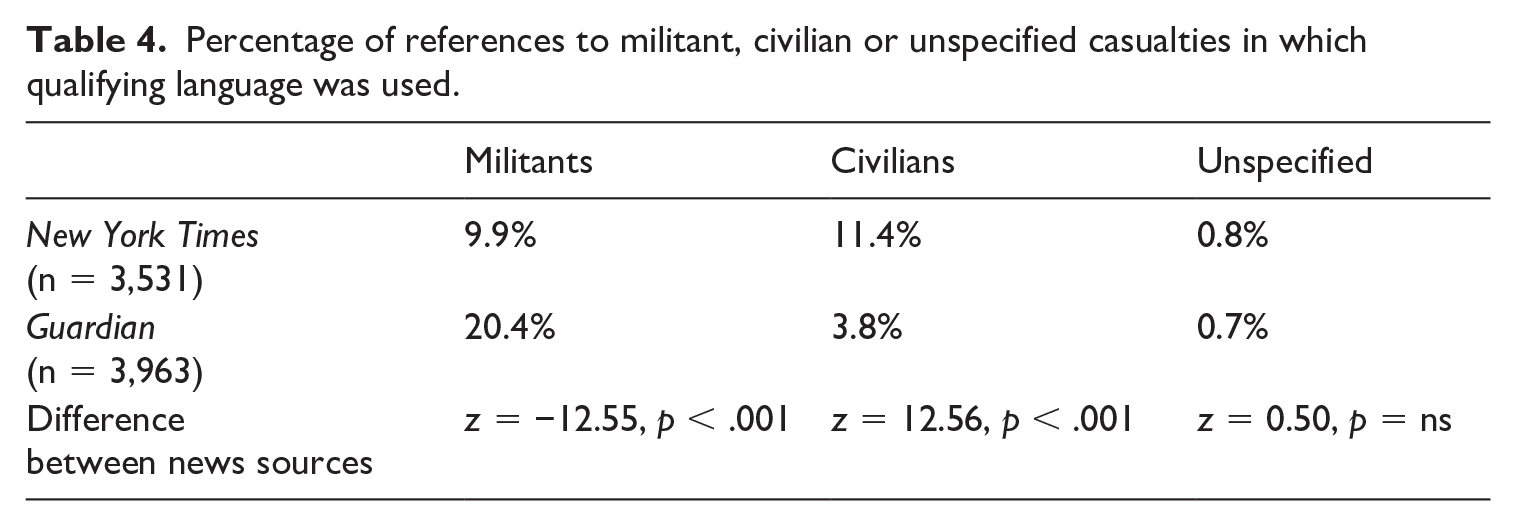
Next, we examined the extent to which casualty references – civilian or militant – contained qualifying language. Our expectation was that US journalists would be significantly more likely than UK journalists to include qualifying language when referencing civilian casualties (H5), but significantly less likely to do so when referencing militant casualties (H6). These results are shown in Table 4. As we can see, US journalists were three times more likely (11.4%) to use qualifying language when referencing civilian casualties than UK journalists (3.8%, z = 12.56, p < .001). By contrast, US journalists were less than half as likely to use qualifying language when referencing militant casualties (9.9%) than UK journalists (20.4%, z = −12.55, p < .001)). These results offer substantial support for H5 and H6.
Percentage of references to militant, civilian or unspecified casualties in which qualifying language was used.
We then looked at the extent to which civilian casualties were humanized by US versus UK journalists. Our expectation was that US journalists would be significantly less likely than UK journalists to humanize civilian casualties caused by drone strikes (H7). Overall, we found that among civilian casualties that were referenced in news stories, US journalists were significantly less likely to humanize these victims (42.2%) than UK journalists (50.5%, z = −7.19, p < .001). This finding provides strong support for H7.
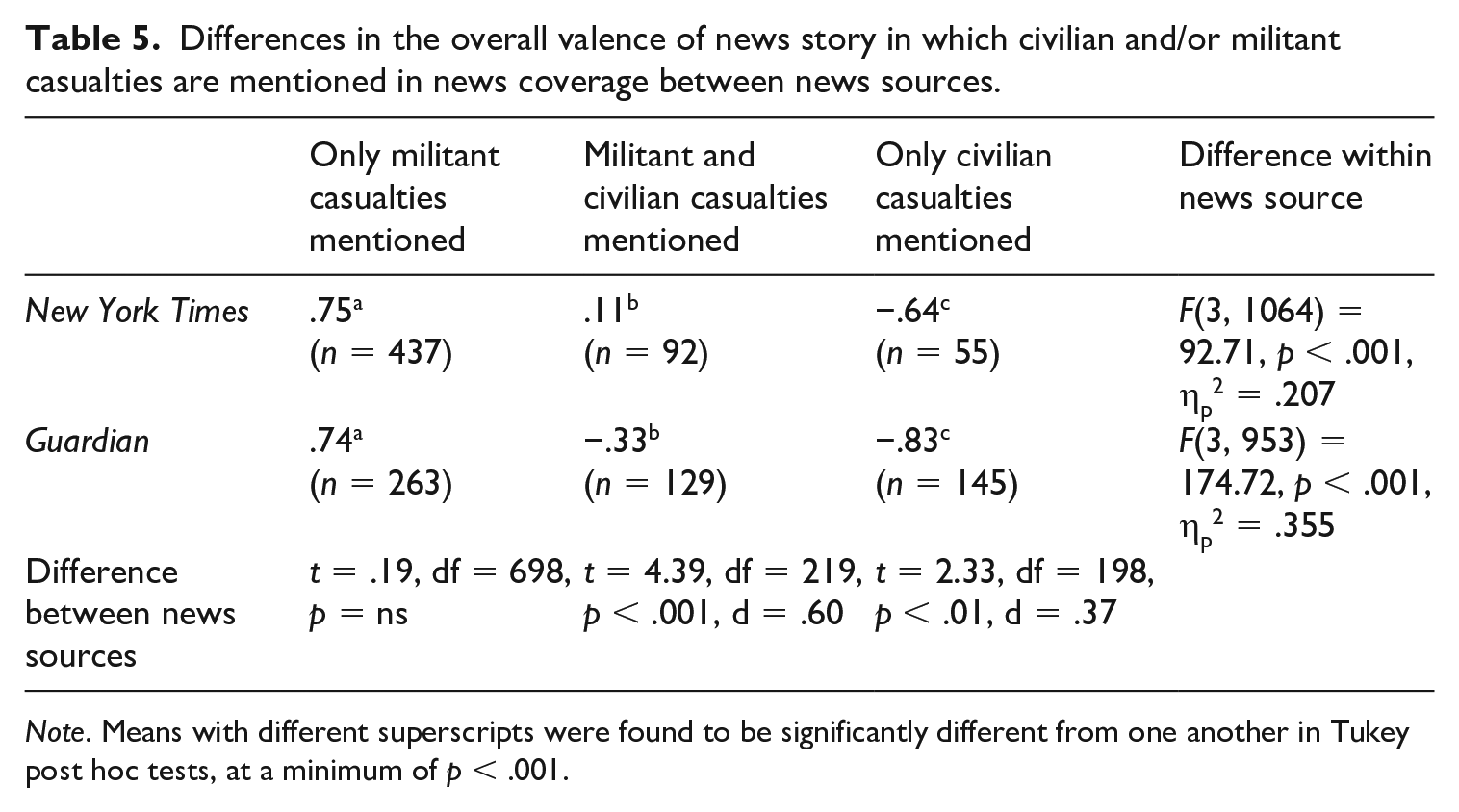
We also explored whether references to civilian (versus militant) casualties in news stories impacted how the US policy of drone warfare was, in general, portrayed in these same news stories. Our expectation was that, the more civilian casualties were mentioned, the more negative the coverage would be in both US and UK news (H8). To assess this expectation, we ran a one-way analysis of variance means test for each news source, comparing the overall valence of those news stories that mentioned only militant casualties, those mentioning both militant and civilian casualties, and those mentioning only civilian casualties. The findings are presented in Table 5 and, for visual reference, in Figure 1.
Differences in the overall valence of news story in which civilian and/or militant casualties are mentioned in news coverage between news sources.
Note. Means with different superscripts were found to be significantly different from one another in Tukey post hoc tests, at a minimum of p < .001.
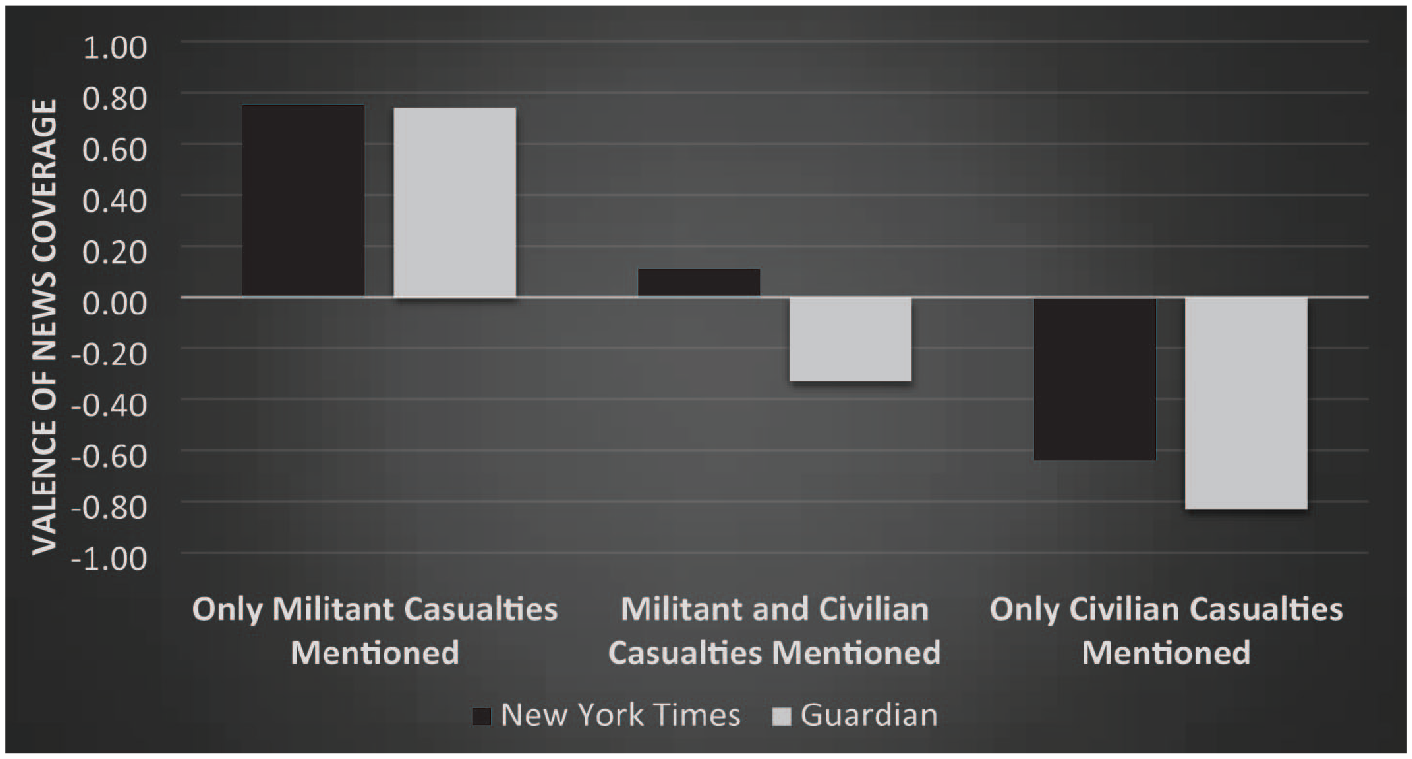
Overall valence of news story in which civilian and/or militant casualties are mentioned in news coverage.
The findings in Table 5 lend strong support for H8. Specifically, the overall valence of the news story dropped precipitously the more civilian casualties were mentioned in both The New York Times and The Guardian news stories. Specifically, in Tukey post hoc comparisons, we found a significant drop in valence from stories that mentioned only militant casualties to those that also mentioned civilian casualties, in both The New York Times (M = .75 vs M = .11, p < .001) and The Guardian (M = .74 vs M = −.33, p < .001) stories. 2 Similarly, we found another significant drop in valence from stories that mentioned both militant and civilian casualties to those that only mentioned civilian casualties, again, in both The New York Times (M = .11 vs M = −.64, p < .001) and The Guardian (M = −.33 vs M = −.83, p < .001) stories. Thus, the mere mention of civilian casualties spurred more critical coverage in both news sources, providing support for H8.
Our final expectation was that, when civilian casualties caused by US drone strikes are mentioned by US and UK journalists, it would lead UK journalists to report on the policy much more critically than US journalists (H9). As the results of the independent t-tests in the columns of Table 5 indicate, if civilian casualties were mentioned at all, UK journalists were significantly more critical of the policy than their US counterparts. 3 Overall, our findings lend full support to the notion that journalists are influenced, whether consciously or not, by their own ethnocentrism when reporting on US drone warfare.
Discussion
Overall, our results illustrate a clear and pronounced ethnocentric bias in how US (New York Times) versus foreign (Guardian) journalists reported on US drone warfare from 2009–2016. Most notably, this bias was particularly evident in how these journalists reported on innocent civilians who were killed by drone strikes. In what follows, we highlight and discuss several important findings. We then explore the implications of these findings for scholars, journalists and policymakers, focusing on what these results tell us about how (and why) journalists are likely to report on controversial US military policies moving forward and what impact this is likely to have on how the US is perceived, both at home and abroad.
First, it is important to note that all of our findings support the notion that US journalists exhibited an ethnocentric bias in their reporting on US drone warfare. These overarching patterns, we argue, speak to the underlying importance and profound impact that social identity – as well as sourcing biases – can have on how journalists respond to and report on controversial issues or policies that implicate – and potentially threaten – the image and reputation of the nation (see Bandura, 1990, 1999). Notably, this pattern was evident in how US journalists reported on the US drone policy, in general, consistently embracing the narratives routinely invoked by officials (see Rowling et al., 2018) that drone strikes are precise, legal and strategically valuable; in contrast, UK journalists were much more likely to explicitly challenge these narratives. This finding further bolsters and extends what previous studies have shown regarding international news coverage of US drone warfare (see Sheets et al., 2015; Bachman, 2017) and it adds to our broader understanding that ethnocentrism remains an ‘enduring news value’ (Gans, 1980) in US news coverage, especially when it comes to foreign affairs.
Second, these patterns become much more complex and interesting when we look at how civilian casualties caused by US drone strikes were reported on in news coverage. To be sure, the very idea that US drone strikes may be killing hundreds, if not thousands, of innocent civilians abroad would, no doubt, complicate how any journalist, regardless of the country in which they reside, would evaluate and report on this policy. Our findings, however, suggest that, because the knowledge of civilian casualties constituted a severe threat to US identity, US journalists engaged in a number of group protective tendencies designed to downplay or minimize the impact of these allegations on US attitudes when possible. Indeed, our findings indicate that US journalists were inclined to tread lightly when reporting on drone strikes, acknowledging, at times, that civilian casualties had occurred, but doing so far less frequently than their UK counterparts while also routinely inviting skepticism (through the use of qualifying language), depersonalizing the victims (not humanizing them) and shining a spotlight on militant casualties caused by US drone strikes. In effect, the combination of institutional (a dependence on official sources for timely and relevant information), commercial (the need to convey information that does not alienate or provoke a backlash from their audience) and cultural (as Americans, they too seek to protect or enhance the national identity) pressures, we argue, were central to why US journalists failed to meet their professional responsibility to adequately expose US war crimes and hold US policymakers accountable for their actions.
Third, our results indicate that it was not until US journalists were forced to confront the harsh reality that drone strikes were killing numerous innocent civilians that they then included more critical perspectives regarding the policy. In fact, in cases when civilian casualties alone (no mention of militant casualties) were reported on by US journalists, we found them to be just as likely as UK journalists to include criticism of the policy of US drone warfare, in general. Thus, when civilian casualties caused by US drone strikes could no longer be denied, the ethnocentric bias in news coverage tended to diminish. Nonetheless, it should be noted that US journalists were significantly less likely than their UK counterparts to solely discuss or focus on civilian casualties in their reporting on US drone strikes. More often than not, any mention of civilian casualties in US news coverage was often relegated to the margins of the news story, allowing for a much more expansive discussion about the militants who had been taken off the battlefield and the broader merits and efficacy of the policy. Still, it is significant, at least according to our data, that the mere mention of civilian casualties caused by US drone strikes served as an important equalizer in how US versus UK journalists evaluated the policy.
To be sure, we do not assume that national identity was the only important factor here in explaining the significant differences between US and UK journalists in their reporting on US drone strikes; we merely suggest that it was the most important factor. We also acknowledge a limitation in our study in that we solely focus on news coverage of drones during the Obama administration, despite the fact that this policy extends across multiple administrations. Moving forward, our findings carry with them some important implications. Even though it has been well established that journalists cannot be expected to operate as reliable and objective purveyors of truth and information, many Americans still believe that, when egregious – indeed, criminal – behavior by the US government occurs, US journalists will be compelled to report this information and attempt to hold officials accountable for these actions. This has not occurred in the context of US drone warfare and, it is fair to say, this fits a larger pattern in which US journalists have overlooked or at least obfuscated such aberrant behavior by the US military (Bennett et al., 2008; Rowling et al. 2011; Sheets et al., 2015). Perhaps this explains The New York Times’ mea culpa in early 2022 as they promised to report differently on drone warfare and other US military policies. But, if journalists – at The New York Times or at news organizations across the country – continue to be unwilling to do their jobs when it matters most and when they are needed most, we should expect more of the same from the US government in times of war, operating without much accountability or consequences for reckless and, at times, criminal behavior.
In conclusion, our results reveal that, over the years, Americans have, for the most part, received a largely favorable and uncritical interpretation of US drone policy; the British, on the other hand, have not. Perhaps this explains why a majority of Americans have expressed support for drone strikes in every national survey – 19 in total – that has ever been conducted on this issue, dating back to 2011 (Rowling and Blauwkamp, 2022). In contrast, the most recent global Pew Research survey found that 40 out of 43 countries surveyed – including the UK – opposed drone strikes, with opposition reaching well over 70 percent in most of the countries surveyed (Pew Research Center, 2013). This suggests that Americans were not – and are still not – receiving a complete and accurate picture of the ramifications and implications of US drone strikes. Should Americans become fully aware of the toll that these strikes are having on civilian populations in places like Afghanistan, Pakistan, Yemen, Somalia and the like, it is reasonable to assume that support for the policy would diminish considerably. But unless – or until – that happens, the profound divide between what Americans see and hear versus what foreign audiences see and hear is likely to only exacerbate anti-American sentiment abroad.
Footnotes
Funding
The authors received no financial support for the research, authorship, and publication of this article.

Notes
Author biographies
Recent publications include: Gilmore and Rowling (2021), Rowling and Blauwkamp (2022) and Sheets et al. (2023).
Address: University of Nebraska at Kearney, Kearney, USA [ email:
Recent publications include: Sheets et al. (2023), Gilmore and Rowling (2021) and Rowling et al. (2021)
Address: Utah State University, Logan, USA. [ email:
Recent publications include: Sheets et al. (2023) and Rowling et al. (2018).