







Abstract
This study employs textual analysis to examine the collaborative models of news–humanitarian coproduction by CNN and INGOs (International Non-Government Organizations) in inaccessible conflict zones. Analyzing 30 CNN newscasts and online articles, the research examines the contributions and limitations of INGOs as nontraditional actors. Findings indicate that CNN relied on INGOs to enhance three core journalistic functions: newsgathering and verification, while also inserting a moral commitment. This study sheds light on how journalistic practices and boundaries shift when limited access to a crisis zone forces news organizations to adapt alternative modes of reporting.
Introduction
Armed conflicts, environmental disasters, and climate change have left an estimated 339 million people in urgent need of humanitarian assistance worldwide (Glasman and Lawson, 2023; Hawkins, 2011). Yet only a fraction of these crises receive sustained international media attention, rendering many situations into what journalism scholars described as “forgotten crises” (Kwak and An, 2014; Yan and Bissel, 2018). The uneven visibility of suffering has profound implications for how the public understands and perceives humanitarian needs and emergencies.
When humanitarian crises are covered, journalists’ narratives often rely on simplified, decontextualized images of suffering – starving children, devastated infrastructure (Baughan, 2021). Such simplification can encourage audiences to see humanitarian intervention as a matter of charity, diverting attention from accountability or long-term solutions. It may also normalize a hierarchy of human life in which some lives are more visible and “newsworthy” than others (Chouliaraki, 2006). Additionally, some scholars have examined how the representation of distant suffering influences public engagement, with Moeller (2018: 11) arguing that the rapid shift from one crisis to another can dilute sustained public concern. These debates highlight how humanitarian crises are narrated and contextualized – an issue that becomes even more pressing when journalists face severe access restrictions that compromise their ability to independently verify information, urging them to rely on and explore other actors on the ground to document events.
The problem of underreporting is compounded in conflict zones that are physically or politically inaccessible to journalists. Restrictions on movement and access can severely limit independent reporting from the ground. This lack of access not only constrains what can be verified but also weakens media-driven pressure on policymakers (Brommesson and Ekengren, 2017) and contributes to unequal funding and attention across crises (Sobel Cohen et al., 2021). In these contexts, the question is not only which crises get covered, but who is in a position to produce knowledge about them.
As of this writing, many children in Gaza have already succumbed to malnutrition, a severe humanitarian situation, including widespread food insecurity, with one in six infants nine months or younger reported to be acutely malnourished (UN News, 2025). International news outlets, including CNN, have repeatedly stated that they cannot independently verify figures due to access restrictions, with correspondents like Clarissa Ward only intermittently able to enter Gaza and report from facilities such as the UAE-operated field hospital. Ward was the first Western journalist to report from Gaza independently while embedded with hospital medical teams.
This inaccessible humanitarian crisis presents a critical case for examining how news about fundamental rights, such as access to food, is mediated when professional journalists are unable to be present on the ground.
Against this backdrop, changes in journalism and the rise of digital platforms have enabled new actors to participate in the production and circulation of humanitarian news (Fenton, 2009; Newman, 2018). Humanitarian organizations are increasingly employing freelance journalists, media officers, and storytellers trained in journalism to gather testimonies and produce visual materials. Although they may not meet all normative expectations of professional distance, these actors supply factual and context-rich accounts that can serve as primary sources for international coverage. This development complicates established understandings of journalism as a profession and as a field that socially and discursively constructs around specific norms, roles, and boundaries (Deuze and Witschge, 2018; Paterson and Sreberny, 2004). One way to conceptualize these actors is through the concept of “interloper media” (Eldridge, 2019): media producers who operate at the edges of journalism, neither fully inside nor outside its institutional boundaries, and sometimes challenge or supplement mainstream news narratives. Interloper media was first introduced in research examining WikiLeaks’ claims that journalists belong to and hold mainstream media accountable (Eldridge, 2014). In humanitarian crises, similar dynamics emerge when INGOs and other non-traditional actors provide material that is integrated into news reporting. However, little research has examined the effectiveness of these actors in mediating humanitarian issues, their influence on shaping news, and the impact of their collaboration with news organizations on the roles and authority of journalists.
This article uses the inaccessible war zone in Gaza as a case study because it offers a clear example of how extreme access restrictions shape the flow of humanitarian information and necessitate different forms of journalistic collaboration, drawing on textual analysis of 30 newscast scripts and online articles to explore the emerging themes from this “news-humanitarian” collaboration model, and what humanitarian organizations and their storytellers contribute to the production of news.
This research makes two contributions to literature. First, it advances scholarship on the interactions between traditional journalism and non-traditional actors in reporting humanitarian crises, particularly under conditions of limited access. Second, it contributes to research on the evolving field of journalism by examining how actors at the periphery of news production participate in knowledge production, and influence the framing of humanitarian emergencies.
Relationship between INGOs and journalists
Nongovernmental organizations are playing a growing role in shaping global news coverage and, in many cases, directly producing news about the most critical humanitarian and human rights issues. They have long existed with “boots on the ground”; they produce knowledge, data, and content vital for public understanding of global issues (Powers, 2016).
In recent years, leading INGOs have intensified communication efforts. Organizations such as Humanity International, Oxfam, Médecins Sans Frontiers, Care, and Save the Children have their own “news units” and communication departments. They focus on certain kinds of crises, such as disasters, famine, climate change, and conflicts (Wright, 2019).
Although humanitarian organizations started as a group of volunteers seeking news media for publicity, they have evolved and professionalized their approach to produce specialized knowledge over the years. Now, they dedicate resources to producing reports of public importance. They apply the news media norms and fundamental functions of journalism, such as credibility, fact-checking, sources, and verification (Powers, 2018). Some scholars argue that the NGO news-orientated approach is a double-edged sword (Chouliaraki, 2013; Sambrook, 2010), allowing them to change global news production and criticize global inequalities. Such organizations have opportunities to serve as “experts” and produce specialized newsgathering and diversified news. They have responded by professionalizing and actively framing the media agenda around disasters, and the changing relationship between media and the source is a key part of this work (Abbott, 2015; Waisbord, 2011). Journalists rely on aid workers as primary informants (Ryle, 2000), which raises the question of whether they are “primary definers” (Hall et al., 2019) or “influential outsiders” (Anderson, 1993).
Boundary theory
Early literature on boundary theory in journalism focused on the professionalization of journalism and establishing a clear divide between journalists and the public. The concept of “boundary work” was introduced by referring to the efforts by journalists to distinguish their work from that of other sources. This boundary work established epistemic authority, which determined who could be a legitimate journalist and who produced legitimized knowledge. Therefore, boundary work is discursive and a struggle over authority (Ferrucci and Vos, 2017). It can also include actors and journalism practices.
Carlson and Lewis (2015) extended this concept to digital journalism and citizen journalism, which involves drawing lines that separate journalists from non-journalists, for example, how traditional journalists differentiate themselves from bloggers, citizen journalists, and other new media actors. This often highlights the tension between maintaining professional standards and adopting new media approaches. Building on Carlson and Lewis’s (2015) matrix explains three dimensions of boundary work: expansion, expulsion, and protection. Expansion refers to the extent of the border of journalism to welcome new domains or actors. Expulsion refers to placing a journalistic practice or actor outside in order to maintain social control (p.11). Protection refers to the act of autonomy of journalism and protection from non-journalistic actors.
Eyal and Pok (2011) argues that individuals and organizations positioned at boundary zones are less obligated to the Doxa, defined by Bourdieu (1993) as the set of beliefs, values, and norms taken for granted within a particular field. He argues that this space of opportunities and this less-regulated space allow new participants to explore new values.
Interlopers
With the advent of websites and new technology, journalists are no longer the only providers of information (Perloff, 2019). New actors have been interacting in the journalistic field in the past few years, bringing innovation and disruption to the field (Eldridge, 2017; Newman, 2018; Pavlik, 2021; Perreault and Ferrucci, 2020). Interloper media was initially developed by journalistic actors confronting the boundaries of journalism. For example, interloper media was first introduced in research examining Wikileaks’ claims of journalists belonging to and holding mainstream media accountable (Eldridge, 2014). In that sense, interlopers sometimes serve an informative function in the public interest or play a watchdog role. Therefore, new actors may present the public with new information, new methods for gathering news, and new verification techniques (Eldridge, 2019: 81).
Interloper media come in various forms, including independent journalists, bloggers, social media influencers, INGOs and citizen journalists (González-Tosat and Sádaba-Chalezquer, 2021). Holton and Belair-Gagnon (2018) suggest that it is insightful to study interlopers, or those newcomers to the game, while unpacking their role in shaping the news production and distribution process (e.g., humanitarian organizations).
In the context of inaccessible conflict zones and the evolving media landscape, these actors are increasingly understood through the concept of “interlopers” and “peripheral journalistic actors”, terms crucial for grasping the complex, boundary-blurring dynamics at play in humanitarian news production.
This study aligns more closely with Holton and Blair-Gagnon’s (2018) perspective. Here, the focus is not on INGOs primarily challenging or delegitimizing news, but rather on how they are brought into journalism’s process and actively influence the coproduction of humanitarian news. In inaccessible conflict zones, INGOs provide unique access, accounts and data, making them indispensable for newsgathering. This collaborative blurring of boundaries transforms INGOs from mere sources into active news producers, demonstrating their evolving contribution to the global news supply.
Research question
Method
The research used textual analysis to understand a collaborative approach to reporting humanitarian crises in inaccessible war zones. Textual analysis helps understand “language, symbols, and pictures present in texts to gain information regarding how people make sense of and communicate life and life experiences” (Allen, 2017: 1754). Allen contends that textual analysis can be effective in investigating “written, visual, or recorded texts to identify messages within the media” (p.1754). With textual analysis, researchers can gather information about “how other human beings make sense of the world” (McKee, 2003: 1).
The researcher selected CNN International for an in-depth study to explore the collaborative humanitarian news coverage of global crises. First, CNN is a historic broadcasting channel due to its significant impact on international news broadcasting and its long-standing presence. CNN began operating in 1980 and has over 347 million households worldwide (CNN Worldwide Fact Sheet; CNN, 2025). It has a staff of more than 4,000 and reaches a global audience of nearly 260 million people.
The researcher collected newscasts from 2 months of coverage (February to March 2024) from LexisNexis data transcripts, using the search keywords “starvation, Gaza, humanitarian, war, INGOS” and CNN archives to obtain the actual newscasts and online articles. The search generated 60 news stories. Of these, 30 were finally selected for humanitarian situation analysis, which involved collecting newscasts and online articles that cited or interviewed humanitarians for this analysis. The stories that were not selected were mainly irrelevant reports that primarily focused on the battlefield and war itself, and did not include interviews or cited INGOs. The researcher employed the three-step qualitative research analysis method proposed by Emerson et al. (2011). First, the transcripts were read in detail and notes were written in the margins. The second stage involved open coding, where data were examined line by line with the research question in mind to identify recurring themes and patterns. In the third stage, the researcher revisited the highlighted data for a close text reading to reconsider focused patterns and themes before writing the findings section. Instead of engaging in a comparative analysis of the distinct reporting practices of CNN and INGOs, this study foregrounds the collaborative model of crisis reporting, investigating how, in contexts such as Gaza, where traditional news outlets face restricted access, CNN and INGOs develop a joint effort that informs the public about otherwise inaccessible conflict zones.
An Excel sheet was used to track quotes and their linkage to the final themes. An inductive approach was employed, with open coding and subsequent close readings of the tests guiding the identification of recurring themes and patterns, which were then developed into specific frames. Otter AI was a software used to transcribe the text of the news stories chosen for analysis, including the date and time of the broadcast.
Findings
A total of 30 newscasts and online articles, spanning two months of coverage, were analyzed. The dominant themes identified in the analysis of CNN and humanitarian organizations’ collaboration in reporting starvation were aligned with Carlson’s (2015) boundary theory of reporting a crisis in an inaccessible place, shedding light on the role of actors from the periphery or emerging interlopers (Eldridge, 2019) to expand the boundaries of journalistic practice in significantly heightened war zone reporting. During wartime, media access is limited, and since INGOs have offices on the ground or “boots on the ground” (Powers, 2018) in war zones and their professionalized social media and websites, they sometimes report the most factual accounts with data and numbers on the scale of the humanitarian crisis and the situation on the ground. In cases where the media is unable to access the region, they may become the sole source for the news verification process, which is at the heart of journalism, when reporting on humanitarian crises. The findings highlight three recurring themes that demonstrate the ways CNN relied on and collaborated with humanitarian organizations in its coverage of starvation. These themes reveal emerging frames that position humanitarians not entirely as sources but as active collaborators in the production of news: (1) enhancing newsgathering as an eyewitness on the ground; (2) credible versus opinionated source for verification; and (3) moral commitment.
The majority of stories, which highlight the context of conflict impacting food aid and access to aid trucks, call for an “urgency to open a safe corridor for humanitarian food aid for affected communities.” Among the humanitarian organizations cited or interviewed by CNN were the World Food Program (WFP), the World Health Organization (WHO), Save the Children, UNICEF, and OCHA. The selected articles and news stories primarily focused on how and when CNN collaborated with INGOs’ humanitarians to gather or report in response to the research questions, examining the embedded frames that represent the collaborative role of INGOs as a vital co-producer of news in inaccessible spaces, which confirms Powers’ (2018) theory of on-the-ground boots.
Enhancing newsgathering
The analysis reveals a consistent pattern where humanitarian organizations functioned as indispensable eyewitnesses, significantly expanding CNN’s newsgathering capacity in supplying news in the inaccessible war zone of Gaza. Across the 30 analyzed stories, INGOs were repeatedly cited not only to provide factual updates but also to supply rich, on-the-ground descriptions of starvation, malnutrition, and the destruction of livelihoods – thereby filling the informational void left by CNN’s lack of access. Their reliance on “emergency language” such as “unprecedented”, “catastrophic phase”, “man-made famine” illustrates how these actors shaped the urgency and moral weight of the coverage. Beyond supplementing CNN’s reporting, this collaborative approach contributes to a broader implication in journalistic practice: INGOs, once viewed as peripheral sources, now operate as interlopers who redefine the boundaries of journalism by assuming roles traditionally reserved for professional reporters. This expansion underscores a crucial implication for journalism: in inaccessible conflict zones, authority shifts to the subject experts and reporting no longer rests solely with journalists but is shared with humanitarian actors whose professionalized communication and eyewitness presence make them primary informants. For example, coverage of starvation centered around humanitarians’ performance as an eyewitness for an in-depth description of the scale of anxiety, lack of food, or the destruction of livelihood and food supplies: “Anxiety is also leading to premature births,” citing the United Nations Population Fund (UNPF). The report also said over 90 percent of children “aged 6–23 months and pregnant, breastfeeding women face severe food poverty with access to two or fewer food groups per day” (13 March 2024). Another interview reported on the right to food and the destruction of agricultural lands, orchards, and fishing boats (19 February 2024). Another example, in a newscast (21 February 2024) indicates CNN citing a UN report on the staggering number of people who are going through starvation in northern Gaza, followed by an interview with Save the Children’s Janti Soeripto (see Figure 1) to report the impact on children – the interview with Save the Children described the situation and highlighted the danger and risks imposed on children in northern Gaza. The newscast ended with affirmation from the anchor and the Save the Children spokesperson on the scale and impact of the damage as unprecedented. Soeripto responded to the civilians being used as human shields, saying, “I have never seen a man-made catastrophe, and it’s tragically unprecedented.”
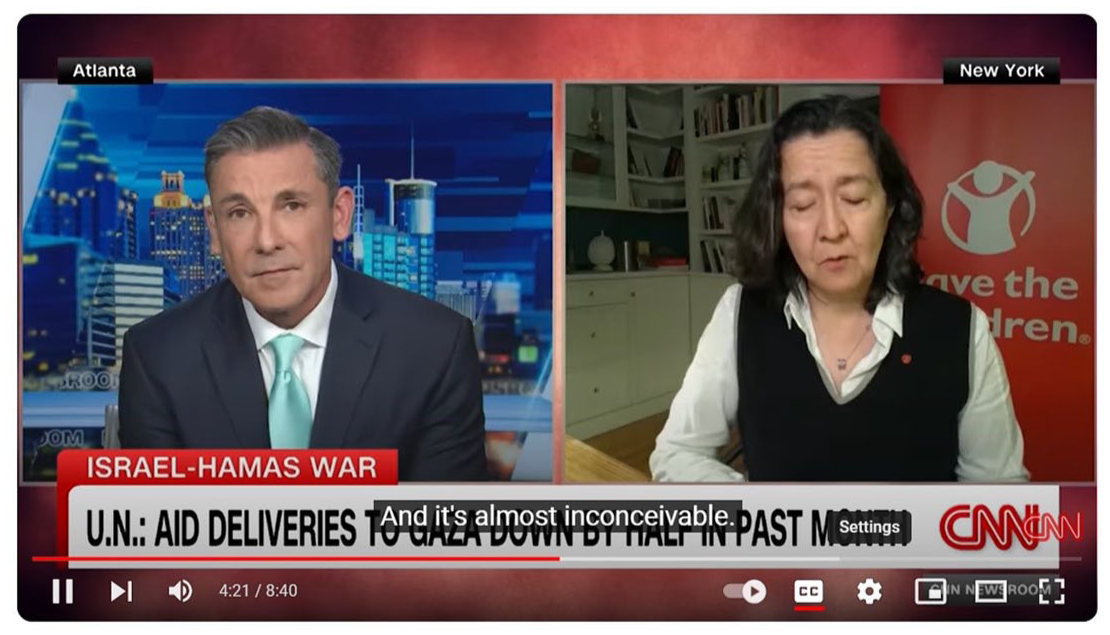
Interview with Save the Children’s Janti Soeripto (21 February 2024).
Credible versus opinionated source for verification
A second recurring pattern across the 30 analyzed stories was CNN’s dependence on humanitarian organizations for verification whenever direct access to Gaza was impossible. This reliance situates humanitarians within a “boundary zone” where they effectively safeguard journalistic credibility by supplying fact-based information, such as numbers. While the struggle over epistemic authority has traditionally emphasized journalists’ autonomy from advocacy-driven actors, the analysis reveals that INGOs became indispensable co-producers of news, especially when official sources were limited to the Ministry of Health or state military narratives. This pattern underscores how porous the boundaries between journalism and INGOs have become in navigating war-zone reporting. In practice, CNN’s recurrent pairing of disclaimers about lack of access with immediate citations from humanitarians demonstrates not only its credibility but also its growing authority as an arbiter of fact in inaccessible conflict zones.
For example, CNN cited humanitarian organizations as a reliable source in the majority of the article, particularly when citing facts or numbers of malnutrition and babies who died as a result of hunger. CNN highlighted the lack of media access to the region as a fundamental challenge to its independent verification. CNN multiple times made a statement on its inability to confirm the numbers. The verification process was shaped by skepticism surrounding the credibility of humanitarians as 100 percent credible sources or opinionated, or sometimes humanitarians are double cited for confirming incidents or numbers. For example, CNN double-cited two humanitarians in the process of verifying: (1) a WHO team visiting the hospital at the weekend corroborated the dire conditions, saying the lack of food resulted in the deaths of 10 children at the hospital; and (2) UNICEF said it was also aware of at least 10 children dying due to dehydration and malnutrition in recent days at Kamal Adwan Hospital (4 March 2024).
In many of the articles, there is a disclaimer from CNN: “CNN cannot independently confirm the numbers due to the lack of international media access to Gaza” (6 March 2024); “CNN cannot independently confirm the Gaza government’s numbers due to the lack of international media access to the strip”; and “CNN cannot independently confirm the deaths of the children or their causes due to the lack of international media access to wartime Gaza.”
Another example of the targeting of civilians clustered around aid is when CNN cited “IDF aerial video does not show clear details on whether the people in the video were carrying guns or opening fire on civilians around them.” CNN states that it cannot independently verify the content of the video, the location, or the time (14 March 2024). On the same story, this statement was followed by The United Nations Office for Coordination of Humanitarian Assistance (OCHA), which said on Monday 10 March it had documented 14 such incidents at two entrances of Gaza City between mid-January and the end of February, and at least 11 additional incidents between 1 and 8 March, during which at least 28 Palestinians were reported killed (14 March 2024). Out of the 30 analyzed articles, only one bulletin referred to another number on malnutrition due to starvation by the UNICEF Executive Director as an opinionated piece: “90% of Gaza Children under the age of five are affected by one or more infectious diseases” (see Figure 2).
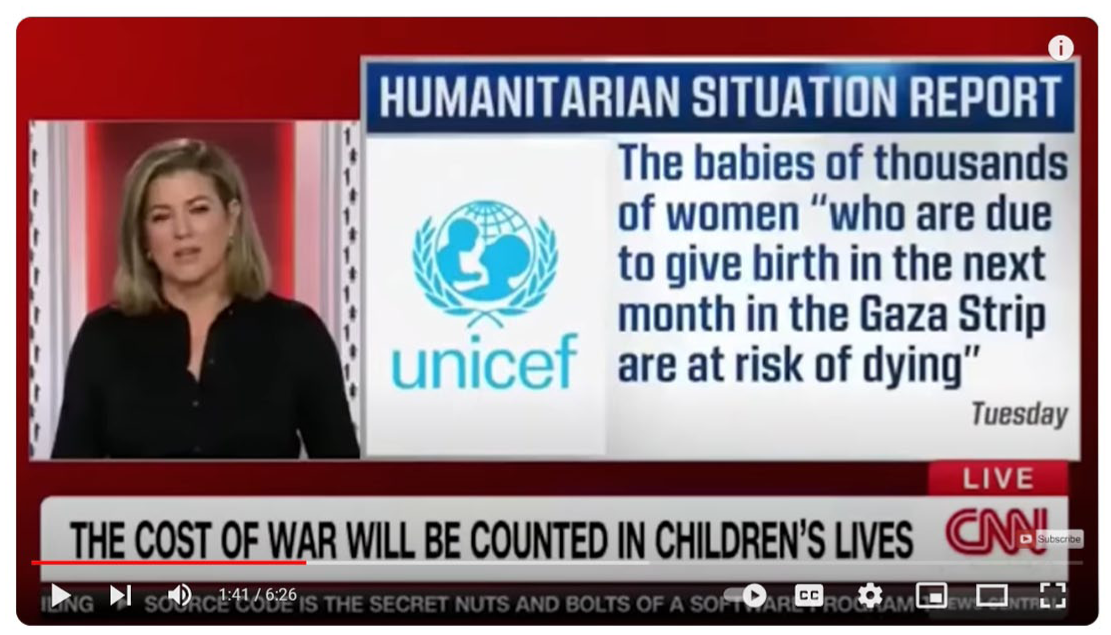
CNN reports starvation of Gaza (12 March 2024).
Moral commitment
The analysis reveals a consistent insertion of a moral commitment frame by humanitarian organizations, whereby starvation was framed not simply as a humanitarian emergency but as a deliberate act of power. By explicitly calling upon actors to end “intentional starvation” and criticizing “indiscriminate airdrops,” INGOs actively diversified CNN’s coverage, embedding advocacy frames that extended the news agenda beyond military and political logics. This pattern illustrates how humanitarianism not only provided factual accounts but also shaped public discourse by introducing frames that invoke moral evaluation and treatment recommendations (Entman, 1993). In doing so, they redirected attention toward ethical imperatives, such as access to food aid and upholding international obligations, thereby urging policymakers to intervene. This finding highlights the redefinition of journalism’s ethical responsibilities in wartime, where INGOs act as interlopers who infuse reporting with humanitarian and human rights frames, influencing the global news agenda on humanitarian affairs.
For example, CNN cited humanitarians in multiple statements to highlight emerging frames on moral commitment, and emphasized the urgency of international obligations regarding access to food during wartime. The same article quoted humanitarians dismissing using food as a degrading way of getting aid to Gazans, “immediately open all crossings into Gaza for aid workers to assist those in need” (6 March 2024). “Instead of indiscriminate airdrops in Gaza, push for an immediate ceasefire and the release of hostages, and insist that Israel uphold its duty to provide humanitarian aid, access, and other basic services” (4 March 2024).
Another notable analysis of the role of humanitarians is crowdsourcing: The channel relied on quotes from humanitarian organizations on the ground to diversify the one source-based story. The following quote, for example, illustrates the complexity of the humanitarian situation in Gaza, marked by severe shortages of food, medicine, and other essential supplies, which are hard to justify with one source. Israel’s official sources said that regulating aid is necessary for security reasons; “At least 260 aid trucks were ‘inspected and transferred’ to Gaza on Thursday, according to Israel’s Coordinator of Government Activities in the Territories, or COGAT, which manages the flow of aid into the strip” (1 March 2024). Yet international bodies like the UN and the EU argue that these actions are leading to human-made disasters, with civilians bearing the brunt. “UN experts earlier this week condemned the food aid incident – and called on Israel to relax its severe restrictions on food aid entering Gaza, where hundreds of thousands of people are facing the prospect of famine” (8 March 2024). Another example from a newscast interview with Richard Brennan, Regional Emergency Director at the World Health Organization on 22 February 2024 highlighted a moral commitment and urgency if the situation remains unchanged (see Figure 3). The WHO representative answered questions on the dire humanitarian conditions and malnutrition that will lead to death in the coming six months: “If things continue, if we see this escalation, we are going to be looking at an extra 8000 deaths in six-months’ time – if this is not a wake-up call. I don’t know what is.”
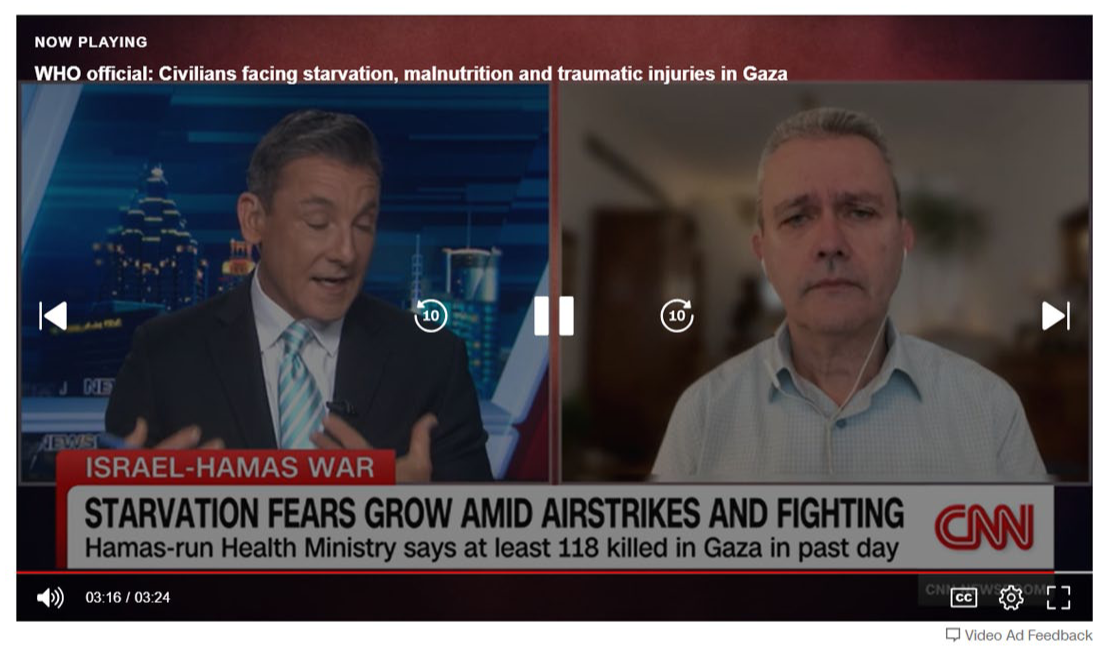
Interview with Dr. Richard Brennan, Regional Emergency Director at the World Health Organization (22 February 2024).
Discussion
The analysis of 30 newscasts and online articles revealed that humanitarian organizations, in their collaboration with CNN, effectively performed three key journalistic functions: (1) enhancing newsgathering as eyewitnesses; (2) serving as a verification source; and (3) inserting a moral commitment frame. Interpreting the boundary theory and the concept of interlopers, these findings reveal how constrained access in war zones has reshaped journalistic practice and redefined the boundaries of journalism.
The first function highlights how humanitarian organizations operated as eyewitnesses, filling informational voids and significantly expanding CNN’s newsgathering capacity. It is also important to clarify that the role examined in this study concerns humanitarian news – that is, reporting on the human consequences of war rather than coverage of military operations themselves. The focus here is on how INGOs help document distant suffering when journalists cannot independently access or witness these human-level impacts. When access to the warzone is restricted, humanitarians with “boots on the ground” and professional communication become indispensable informants. Their detailed accounts, multimedia storytelling, and use of emergency language positioned them as active newsmakers rather than passive sources.
However, this role raises important conceptual and political questions about the evolving authority of wartime reporting. The analysis does not suggest that humanitarian eye-witnessing replaces professional war correspondents; rather, in a context of extreme inaccessibility, it temporarily supplements and expands journalistic practice. The fact that humanitarians operate with institutional mandates that differ from journalistic norms of independence may mean that their choices about what to witness, document, and emphasize may diverge from what journalists would prioritize. Thus, their testimony provides essential access and immediacy, it does not eliminate the need for independent journalistic verification.
This case study is therefore illustrative of a phenomenon emerging from a unique and highly constrained environment. The expansion of humanitarian eye-witnessing arises directly in response to the extreme inaccessibility of the conflict zone, and the access failure that should not occur in the first place. In such moments, humanitarian actors perform a form of contingent witnessing that emerges only under the specific conditions of restricted access. The narrative richness or color that humanitarians’ eyewitness accounts contribute could also represent a potential limitation, as such accounts inevitably reflect the priorities and perspectives of these organizations.
Boundary theory helps clarify how these dynamics function, highlighting the contested and negotiated spaces in which INGOs temporarily expand their journalistic role. It demonstrates how authority is shared and renegotiated under conditions of inaccessibility. In this sense, humanitarian eyewitnessing expands journalistic boundaries out of necessity, while also revealing the tension between advocacy-driven and journalistic forms of witnessing.
The second function highlights how humanitarian organizations enhanced CNN’s credibility by providing fact-based information when journalists could not independently verify events. This dynamic illustrates a boundary zone, where the epistemic authority of journalism is negotiated between reporters and advocacy-driven INGOs. CNN’s routine disclaimers about lack of access, immediately followed by citations of humanitarians, reveal a pattern of co-production that was necessary to maintain accuracy and pluralism. While INGOs’ values are infused with advocacy, their role as verifiers illustrates how interlopers operate in opportunity spaces, providing news verification forms in contexts where the state of military sources dominates. From the boundary theory perspective, this reflects a renegotiation of it, where credibility and independence are maintained through porous yet pragmatic collaborations. At the same time, this credibility is not without complications. INGOs are susceptible to attempts to discredit their testimony when their accounts challenge dominant narratives. Yet their role as verifiers also illustrates how interlopers operate within opportunity spaces: they provide alternative forms of verification in a context of structural failure of access. This is a necessary – though epistemically risky – arrangement that allows journalism to uphold verification standards when traditional mechanisms of independent reporting are impossible.
The third function centers on humanitarian organizations actively shaping CNN’s coverage by illustrating a moral commitment frame. This reflects how INGOs contributed moral evaluations and treatment recommendations, urging policymakers to act and the audience to view the crisis through ethical imperatives. In doing so, humanitarian organizations extended journalism’s normative orientation towards ethical responsibility by integrating human rights discourse into CNN reporting. Yet this moral commitment also generates conceptual and political tensions, which highlight, omit, and shift the politics of representation, and journalistic judgment is no longer the sole determinant of meaning. From a boundary theory perspective, these tensions reflect a negotiated expansion of journalism’s ethical and epistemic terrain. INGOs, acting as interlopers, temporarily share the authority to define the moral significance of distant suffering. This creates a hybrid space that complicates established norms of professional autonomy. In this collaborative model, which offers pragmatic but porous ways, it underscores the need for continued critical scrutiny of how moral imperatives are integrated into crisis reporting. While necessity created this opportunity space, its emergence should not be mistaken for an ideal arrangement; rather, it reflects a form of openness that remains contested and subject to ongoing negotiation over authority, credibility, and professional boundaries.
The findings invite a re-evaluation of fundamental questions in Journalism Studies: “Who gets to be a journalist” and “What constitutes journalism” in the digital age. The porous boundaries between traditional media and NGOs create a grey area between journalism and other forms of global storytelling, challenging the conventional “epistemic authority” of established media. While this collaborative approach can expand news within the context examined in this research, diversifying news, it simultaneously necessitates a critical examination of the complex ethical responsibilities that arise when journalists’ independence is intertwined with advocacy-driven information. Future research should explore the dynamics and their implications within a context outside of a war zone, as well as their impact on informing during crisis reporting.
Footnotes

Funding
The author received no financial support for the research, authorship, and publication of this article.
Declaration of conflicting interests
The author declared no potential conflicts of interest with respect to the research, authorship, and publication of this article.