







Abstract
This article focuses on how YouTube might shape collective memory around the Greek Civil War. Drawing on the concept of postmodernism and that of digital ‘connective turn’, the authors argue that YouTube might reframe historical events in ways that weaken broader political understandings. Through the analysis of two YouTube videos (History Matters and The Armchair Historian), the article aims to unpack how the platform content reduces the Greek Civil War to simplified specific Cold War narratives. The analysis suggests that these videos often downplay the conflict’s social and political dimensions, portraying it instead as a series of misunderstandings or strategic necessities. The authors suggest that this is not simply a matter of historical distortion, but a broader process they term ‘structural revisionism’. Driven by platforms’ inner logics, YouTube promotes an emotionally engaging and easily shareable content leaving aside the historical complexity of the event. As a result, collective memory is reshaped into fragmented and depoliticized narratives aligning with platforms logics.
Keywords
Introduction
The Dekemvriana of December 1944 – when the left-wing EAM-ELAS clashed with British and government forces in Athens – represents one of the most contested moments in modern Greek history, both politically and historiographical. Far from a single episode of post-liberation unrest, the events condensed the tensions of occupation, resistance, and emerging Cold-War alignments. As Van Boeschoten (1997, 2000) and Close (1995) note, local social grievances, class divisions, and the unresolved violence of the Occupation period converged in Athens, transforming liberation into renewed civil conflict. Later interpretations have oscillated between viewing the Dekemvriana as a communist bid for power (Woodhouse, 2002) and as an imperialist intervention aimed at restoring a conservative order and protecting British geopolitical interests (Mazower, 1995). More recent scholarship, influenced by Kalyvas (2006; Kalyvas et al., 2015) and Voglis (2002), situates the episode within the longue durée of internal polarization, emphasizing how both left and right produced reductive mythologies of victimhood and betrayal that still shape collective memory. For Siani-Davies and Katsikas (2009), the legacy of the Dekemvriana complicates the narratives of reconciliation, revealing that the politics of remembering (Danforth and Van Boeschoten, 2019) and forgetting are inseparable from Greece’s democratization and integration into post-Cold-War Europe. In this sense, the Dekemvriana functions as a symbolic matrix through which subsequent historical and digital representations of the Civil War are filtered. It seems to represent an event continually re-narrated across media and platforms, where official and vernacular histories converge and contend for authority.
Our perspective extends beyond the idea of a global ‘mnemonic age’, where memory – especially after the Holocaust – functions as both a restorative and instrumental force, recovering silenced histories while sustaining nationalist myth-making (Winter and Sivan, 1999). Memory shapes identity rather than merely reflecting it, offering symbolic frameworks for defining collective belonging even as these definitions remain sites of tension and political struggle (Bell, 2008: 151). Yet the boundary between memory and myth is increasingly blurred: memory is grounded in lived experience within specific temporal and spatial contexts, whereas myth condenses complex histories into emotionally charged, simplified narratives that reinforce collective identities (Bell, 2008: 153; Winter and Sivan, 1999). Contemporary national and cultural identities rely on the repetition of such curated pasts – through ritual, education, media, and digital platforms – producing a ‘mythscape’ that fosters emotional attachment and mobilization (Bell, 2008: 153; Smith, 2004). In digital environments, these dynamics are further shaped by platform logics that regulate what is surfaced, circulated, and retained (Pietrobruno, 2018; Pušnik, 2020). Platforms like YouTube therefore do not just recount the past; they stage, stylize, and monetize it (Ørmen and Gregersen, 2023).
We examine YouTube as a site where historical memory is reframed through platform-specific forms of narration, aesthetics, and visibility. Focusing on the Greek Civil War, we analyse how collective struggle and historical experience are translated into abstract, aesthetic, or moral frameworks that may contribute to broader patterns of structural revisionism. While YouTube enables the circulation of narratives from below – including amateur and user-generated accounts that can contest or supplement official historiography – it also embeds these narratives within the constraints of platform logics. The analysis therefore explores how participatory memory practices coexist with, and are often reshaped by, the infrastructural and commercial dynamics of digital platforms. Following Mylonas (2024), who conceptualizes the Greek 1940s as an Event with enduring afterlives and reads contemporary cultural projects as counter-archives, we treat YouTube memory discourses as positioned between counter-hegemonic recuperation and platform capture. On the one hand, channels, audio-visual material, and users’ comments can function as counter-archives that bring to the surface repressed subjects, feminist and subaltern testimonies, and ‘potential history’ oriented toward unfinished emancipatory practices (Mylonas, 2024). On the other hand, the same materials are reinscribed into commercial and metricized infrastructures whose visibility logics might normalize liberal-centrist frames.
Theoretical underpinnings of memory connected to historicity
Accordingly, we draw on two intersecting perspectives: Fredric Jameson’s (1992) account of postmodernism as the cultural logic of late capitalism and Andrew Hoskins’ theory (2011b) of the connective turn. Jameson (2003) conceptualizes the postmodern condition as a loss of historicity, where temporal depth and political causality erode and the past reappears as stylized, commodified fragments – history as mood, spectacle, and surface rather than process. In short, history as fetishism rather than lived experience. Building on this, Hoskins (2017) describes the ‘connective turn’, in which platforms replace stable, institutionally curated archives with fluid, affect-driven, constantly updated streams of mediated memory, transforming memory from something preserved into something produced and circulated in real time.
Andrew Hoskins’ (2011b) notion of the ‘connective turn’ captures how memory operates once the stable temporal and institutional frameworks of historical narration collapse. In the connective environment, memory no longer resides in archives, monuments, or even individual consciousness, but in the living circulation of data, across devices, networks, and users. It is volatile, recursive, and constantly updated – a memory of the multitude (Hoskins, 2017) rather than of an identifiable subject of history. What disappears in this transformation is precisely the mediating figure of the historian or collective agent capable of organizing temporal sequence and causality. Memory thus becomes connective but not collective: an affective simultaneity without historical depth. This is the corollary of Jameson’s ‘end of temporality’: a world saturated with traces of the past yet lacking an historical subject capable of totalizing them. In Hoskins’ sense, digital memory does not condone history; it performs its disappearance through endless circulation, creating presence without continuity and attention without understanding. On platforms like YouTube, this creates a mode of ambient witnessing where memory becomes individualized and ephemeral, yet politically thin (Finlayson, 2022). Users are connected by shared mediated narratives but disconnected from material collectivity or political action.
This is due to YouTube’s affordances which privilege clickability and metrics through its algorithms. As Arthurs et al. (2018) emphasize, YouTube’s hybrid cultural–commercial structure and algorithmic logic have privileged forms of visibility grounded not in historical depth or critical pedagogy (Freedman, 2015), but in affective intensity, aesthetic coherence, and regular engagement. The platform’s recommendation systems, designed through opaque computational filtering mechanisms (Rieder, 2015), reward frequent uploaders, and controversial content, thus reshaping the cultural circulation of the past into modular, emotionally resonant, and algorithmically favored fragments. In such an environment, narration persists, but its political and dialectical content is hollowed out. As the politics of platform visibility converge with monetization (Lobato, 2016), a new memory regime emerges – one that flattens historical contradiction in favor of emotional connectivity. EP Thompson’s (1980) understanding of history as a lived process grounded in class antagonism and collective agency stands in sharp contrast to the fragmented, affect-driven forms of memory circulating on YouTube.
While YouTube presents itself as a participatory and open environment, its algorithmic infrastructures fundamentally structure visibility and engagement in ways that reproduce rather than overcome existing hierarchies. The platform’s commercial logic translates social participation into forms of attention (Beer, 2017; Bucher, 2018; Van Dijck et al., 2018). Although YouTube lacks a centralized institutional authority like traditional historiography, its narrative ecosystem remains shaped by discursive inertia and the hegemony of common sense (Gramsci, 1971). Even user-generated or oppositional videos tend to adopt the basic premises of official history – such as the moral framing of the Greek Civil War as a tragic national division or as a conflict between ‘extremes’, adopting the narrative of the state army being too harsh, but the communist threat was nonetheless very real – because these templates are culturally legible and algorithmically rewarded. Consequently, even when creators seek to contest the official narrative, their discursive and aesthetic strategies often remain anchored in its symbolic vocabulary, reproducing liberal tropes of reconciliation, heroism, and victimhood. Under this regime, visibility is not distributed evenly: content that aligns with dominant ideological narratives, emotional intensities, or simplified moral framings tends to circulate more widely, while complex, counter-hegemonic, or nuanced accounts remain marginalized.
Within this framework, the politics of remembrance on YouTube are not only ideological/cultural but also economic, in the sense that the memory practices in this cultural form are shaped in a specific political economic context, which shapes the construction and management of the medium. Historical representation becomes subordinated to the platform’s logic of visibility and engagement, where memory is recoded as data and political meaning is reduced to performance metrics.
The Greek 1940s in YouTube’s video: Platform as memory infrastructure?
The collective remembering of the 1940s in Greece – including the Nazi occupation, the armed resistance of EAM-ELAS, the British intervention during the Dekemvriana, and the fratricidal conflict of the Civil War – now finds terrain on YouTube. YouTube appears to be a decentralized and democratized memory space, where state narratives, official commemorations, and partisan historiographies can be circumvented by ordinary users through the upload of audiovisual testimonies, archival footage, documentaries, or personal reflections. As many scholars (Gillespie, 2010; Van Dijck, 2013) emphasize, aside from hosting content, digital platforms also reconfigure power relations through algorithmic governance, datafication, and visibility. Thus, YouTube operates within the logic of platform capitalism, where participation is conditioned by the technological affordances, protocols of circulation (search algorithms, recommender systems), and the underlying monetization architecture of surveillance-based advertising (Zuboff, 2019).
Traditionally, memory work surrounding conflicts like the Greek Civil War and the Axis occupation was orchestrated through centralized institutions of remembrance – national archives, school curricula, state-sponsored memorial days, political rituals, museums, and the mass media (Assmann, 2011). These institutions functioned as gatekeepers of historical legitimacy, controlling not only which narratives would be preserved but also the modes of their dissemination and affective resonance (Verovšek, 2016), hence their cultural significance in the formation of political subjects. The official historical memory was often crafted in line with hegemonic ideologies, whether those of the post-war anti-communist state, Cold War alignments, or later attempts of reconciliation, with historians acting as authorized mediators (Bodnar, 1992; Zerubavel, 2003). However, with the advent of the digital era, memory is no longer solely institutionalized through formal repositories but instead flows across platforms, such as YouTube. This has been conceptualized by Hoskins (2017) as the ‘memory of the multitude’ which emerges as a form of participatory mode of remembrance in which individuals contribute to the production, circulation, and recontextualization of the past in real time.
Yet, this form of memory is ambivalent. While it may open up the archive to previously excluded voices – such as the children of resistance fighters or victims of repression – it also marks the rise of a platformized, algorithmic visibility (Gillespie, 2010; Van Dijck, 2013). Content that conforms to viral formats (reaction videos, dramatic montages, or emotional testimonies) is far more likely to circulate than dense, critical historical analyses (Tohe, 2021). Videos reflecting on historical struggles are shaped not only by the author’s intent but by platform logics (Van Dijck, 2009). As such, Wertsch and Roediger’s (2008) distinction between collective memory and collective remembering becomes crucial. YouTube becomes a stage of performance, where fragmented memories are reassembled as personalized, aestheticized, and commodified narratives, often devoid of process, causality, or political struggle.
Moreover, the very labour of remembering – the hours of searching, editing, subtitling, and uploading – is obscured. In this sense, YouTube does not liberate history from institutions; it reconfigures historical labour as invisible, affective labour, monetized by the platform rather than its users (Pace, 2018; Srnicek, 2017). The power imbalance between users and institutional actors persists: political parties, civil society organizations, and state agencies all operate on YouTube, but with far more resources, and capacity to manipulate visibility (Ørmen and Gregersen, 2023). Van Dijck’s (2007) notion of ‘homecasting’ – where users appear empowered to circulate memory fragments from the privacy of their homes – captures the moment of formal subsumption (Murray, 2004) of historical narration into platform capitalism. However, as YouTube evolved from a participatory media space to a fully integrated commercial environment – complete with recommendation engines, and revenue sharing mechanisms – what we witness is the real subsumption of historical memory (Ørmen and Gregersen, 2023). Here, memory is hosted but also produced, shaped, circulated, and made intelligible through platform logics that serve capital. The temporality of collective memory – once tied to ritual, institutional pacing, or shared commemorative rhythms – is replaced by asynchronous, fragmented, and personalized consumption patterns. As such, history appears as spectacle (Debord, 2014), as a relation among commodified signs, reflecting the logic of commodity fetishism where the social labor of remembrance is obscured beneath the surface of emotionally resonant but decontextualized content.
If memory is increasingly assembled, circulated, and experienced within algorithmic infrastructures, then any analysis must attend not only to content but also to form as socio-technical outcomes. This calls for a closer examination of how history is performed on the platform – through narrative choices, aesthetic conventions, affective cues, and narratives.
Methodology
Therefore, our study is guided by two central questions. First, it examines how YouTube videos about the Greek Civil War might reframe historical struggle and collective experience, through abstract, aesthetic, or moral interpretations of the history. Second, it explores the extent to which different audiovisual content uploaded to YouTube can participate in a broader structural revisionism of historical memory. Through this dual focus, the study aims to uncover how platform dynamics intersect to reshape the audience’s relationship to historical knowledge.
YouTube is considered to be a significant platform for the dissemination and reception of historical knowledge, not only due to its technological affordances – such as the integration of audio-visual storytelling, interactivity, and on-demand access – but also because of its cultural resonance with older modes of transmitting history, such as school lessons, oral traditions, and museum tours (Miles and Herold, 2023). Indeed, YouTube’s features support multimodal historical narration that can appeal simultaneously to emotion and memory, making it a space where social or collective memory can be constructed in environments characterized by asynchronous temporality (Otrel-Cass, 2024). Reflecting this shift, a 2019 study found that 76 percent of respondents identified YouTube as their main source of historical information – surpassing books, cultural institutions, and formal education (Gralik et al., 2021). The study highlights the ways YouTube not only reshapes the means through which history is consumed but also redefines the logics behind it.
Unlike academic and rigorous historiography, YouTube encourages a participatory storytelling shaped by platform logics, visibility, and audience engagement (Arthurs et al., 2018; Burgess and Green, 2018). This shift challenges conventional modes of knowledge by blurring the boundaries between producers and educators and learners. As Bolter and Grusin (2000) argue, this form can be defined as a form of remediation which reshapes not just how content is presented, but how it is perceived, consumed, and legitimized. Therefore, YouTube can be considered as a space for examining how historical social consciousness is produced, contested, and commodified in the digital age. As a result, national identity formation becomes increasingly entangled with YouTube’s visual narratives, as the platform mediates symbolic struggles over the past and shapes affective memory itself (Finlayson, 2022). What is also intriguing about YouTube is how the algorithms might reinforce certain positions and not others. Research has shown that algorithmic curation often privileges engagement-driven metrics, amplifying sensational or polarizing content while marginalizing nuanced or dissenting perspectives (Fuchs, 2014; Gillespie, 2018; Pietrobruno, 2018; Van Dijck, 2013). Such mechanisms illustrate how platform logics and algorithmic power shape visibility and public discourse, effectively reinforcing dominant narratives and existing stereotypes.
For this reason, we adopted a qualitative methodological approach grounded in text-centric video analysis, with the aim of understanding how YouTube operates as a site of cultural production and consumption that shapes collective remembrance. However, given the multimodal nature of YouTube videos – combining moving images, sound, and text – our approach draws on the principles of Multimodal Critical Discourse Analysis (MCDA) (Mayr and Machin, 2012), which emphasizes how semiotic resources work together to construct meaning and ideology across modes. In this context, textual centric video analysis serves as the operational method through which multimodal discourse is examined. This framework enables us to interrogate how visual, sonic, and verbal elements co-articulate historical narratives, affective appeals, and power relations in the digital sphere. Textual analysis in this sense is not limited to language, but entails a close reading of multimodal signifiers – camera framing, editing, sound design, and commentary – that communicate political subjectivities and memory discourses (Burns and Hawkins, 2019; Vernallis, 2023).
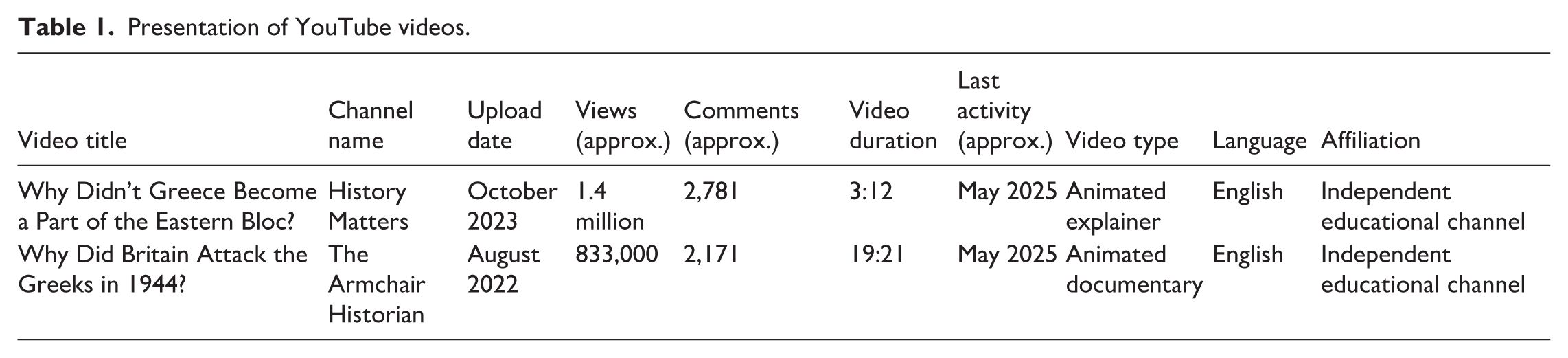
Drawing on the perspective that media texts contribute to the construction of political subjectivities (Funkenstein, 1989), we understand YouTube videos beyond functioning as containers of historical information, but as active agents in the mediation and transformation of collective memory. The platform’s affordances allow for new modes of memory-making, while simultaneously embedding such practices within the commercial and algorithmic logics of platform capitalism. Therefore, the study was conducted in two phases. The first phase involved a mapping of the YouTube landscape surrounding the Greek Civil War. This included viewing a wide selection of videos, ranging from professional documentaries to amateur along with their user-generated content. This process informed the selection of two videos for focused analysis, chosen on the basis of the following criteria: thematic relevance to key historiographical debates (particularly the continuity between the Nazi occupation, the Dekemvriana, and the Civil War), high visibility and popularity (measured through views, likes, comments, and recent activity), longevity on the platform (available online for at least five years), and independence from official institutions, civil society organizations, or political parties. The selected videos (see Table 1) were chosen to represent a diverse range of narrative strategies, aesthetic styles, and memory practices present on YouTube in relation to the Greek Civil War.
Presentation of YouTube videos.
In the second phase, a multimodal coding scheme was developed to guide the systematic analysis of each video. The scheme combined discursive, visual, and sonic categories derived from the Multimodal Critical Discourse Analysis framework (Mayr and Machin, 2012). Specifically, the coding focused on: (a) discursive frames – the linguistic and narrative structures through which historical meaning and moral positioning were articulated; (b) visual strategies – including framing, color, montage, and symbolic imagery that conveyed emotion or ideological stance; and (c) sound and music cues, which contributed to affective resonance and memory-making. The codes were inductively refined during repeated viewing and close reading, allowing for the identification of patterns in how multimodal resources worked together to construct representations of the Greek Civil War and its remembrance on YouTube.
Selection of case studies
Video 1: Why Did Britain Attack the Greeks in 1944?
This video, produced by The Armchair Historian, was selected for its hybridized narrative style, mid-length format, and platform visibility within the Anglophone YouTube landscape of Greek Civil War content. With over 833,000 views, 27,000 likes, and 2,171 comments, it demonstrates significant algorithmic reach and audience engagement. Unlike more schematic explainers, the video blends first-person narration with intermittent animated sequences, combining map-based visuals, symbolic imagery (e.g. Churchill, MI6 agents), and background music to dramatize the storytelling. These stylistic choices are not ideologically neutral: the narrator appears in a study-like setting, with props such as a pipe, invoking a visual rhetoric of scholarly authority and nostalgic historicism. The video presents a micro-level historical narrative, introducing named actors, referencing source material, and sketching organizational developments such as ELAS and DSE.
Video 2: Why Didn’t Greece Become a Part of the Eastern Bloc?
This short, animated video, produced by the independent popular educational YouTube channel History Matters, was selected for its viral reach, aesthetic distinctiveness, and prominent ranking among English-language search results related to the Greek Civil War. With over 1.4 million views, 49,000 likes, and 2,781 comments (up to June 2025), the video demonstrates a high level of engagement across multiple platform metrics, indicating significant audience reach and algorithmic visibility. Its formal features – minimalist stick-figure animation, schematic narration, and geopolitical mapping – lend it an educational tone while structurally limiting historical complexity. The video’s popularity and circulation make it an ideal case for examining how YouTube’s platform dynamics promote historically reductive yet accessible content.
Analysis: The narratives of the videos
The analysis demonstrates that both videos employ a coherent narrative framework that foregrounds moderation, stabilization, and external necessity as the principal explanatory forces of the Greek Civil War. Rather than situating the conflict within the realm of competing domestic political projects, the videos reproduce a familiar Cold War schema in which ‘extremist’ disruptions threaten a precarious post-occupation equilibrium and authoritative actors (typically governmental or Allied) which intervene to restore order. The findings that follow show how this narrative aligns with established patterns in mainstream revisionist historiography (Mylonas, 2024; Savvides and Ferra, 2024; Skalidakis, 2024), which cast left-wing mobilization as destabilizing and Western involvement as a requisite stabilizing force.
The liberal–cold war narrative and the political actors
Across both videos, despite some stylistic differences, the Greek Civil War is structured through the same modular narrative architecture that characterizes the YouTube explainer genre. Actors are sorted into portable, pre-fitted roles – moderates or stabilizers (British officials, the Greek government, later the US), radicals or sources of volatility (ELAS–EAM, ‘communist partisans’), and external guarantors (Churchill, Stalin, Tito). These roles carry immediate recognizability and require little contextualization, allowing the videos to mobilize familiar Cold War character types rather than explain the specific political, social, and ideological divisions that defined Greece in the 1940s. The internal antagonisms of Greek society – collaborationist legacies, the political institutions of ΠΕΕΑ, land conflicts, rural mobilization, and the contested visions within EAM/ELAS – therefore disappear or play marginally in the background of the videos.
The Armchair Historian employs cinematic textures such as dramatic lighting, orchestral tension cues, and symbolic imagery such as Churchill, paratroopers, and looming Soviet figures, that situate the viewer within a familiar Cold War dramaturgy of Western guardianship confronting ideological excess. History Matters, although visually minimalist, similarly frames the war through geopolitical cartography: colour-coded blocs, directional arrows, and schematic maps present Greece primarily as a spatial object within a Europe divided into spheres of influence. Stick-figure partisans and state actors function as interchangeable tokens of East–West alignment, reducing internal political struggles to their presumed significance within superpower rivalry.
There seems to be a difficulty in rendering legibly within the short-form temporal logic of the genre, which favours concise behavioural scripts over longer histories of political and social context of the event. This reliance on portable roles is reinforced by the broader narrative common to animated explainers: moderation versus extremism, geopolitical determinism, and stabilizing intervention. Because these narratives recur across the channels’ catalogues, they provide a ready-made interpretive frame into which the Greek Civil War is slotted. The specificity of the conflict becomes secondary to the recognizability of the roles themselves.
A central element of this narrative is constructed around the presented political actors. In Why Did Britain Attack the Greeks in 1944?, the Left is introduced through adjectives that emphasize behavioral deviance rather than political aims: ELAS and EAM are described as ‘ambitious’, ‘radical’, ‘uncooperative’, and ‘inflexible’. These terms mark left-wing actors as destabilizing forces whose actions exceed the boundaries of political reasonableness. By contrast, British policy is narrated with verbs that connote responsibility and necessity such as ‘stabilize’, ‘restore order’, ‘secure Greece’, assert control’ – which in turn qualifies intervention as a regrettable but essential measure. The framing of Papandreou around the 9:57–10:37 segment in The Armchair Historian video is emblematic: rather than a political figure navigating contested post-occupation terrain, he becomes ‘the steward of a lit powder keg’, a caretaker besieged by forces beyond his control (see Appendix Figure 3). In this narrative, Western actors deliberate and decide, while Greek left-wing actors generate volatility, which produces an asymmetry in the presented facts.
Narrative progression reinforces this pattern through causal shortcuts that foreclose alternative interpretations. Statements such as ‘the British had little choice but . . .’ or ‘given the circumstances . . .’ serve as mechanisms of closure, advancing the story while eliminating the interpretive labour required to consider competing trajectories. The Armchair Historian sequence at 10:07–10:19, which moves from the economic collapse of post-occupation Greece to the ‘pressing need to disarm the partisans’, exemplifies this logic: disarmament becomes a technical imperative rather than a politically charged objective contested by different segments of Greek society. In History Matters, the percentages agreement functions similarly. Rather than contextualizing it as one among several factors shaping postwar alignments, the video introduces it as the primary determinant of Greece’s trajectory, effectively reducing a complex civil conflict to an arithmetic distribution of influence. In this specific narrative common in all the videos, domestic political actors are folded into predefined roles, and historically specific phenomena – such as the institutional innovations of the resistance movement, the social composition of EAM-ELAS, or the material legacy of collaborationist structures – disappear because they do not map cleanly onto the genre’s narrative grammar. The conflict is thereby absorbed into a familiar Cold-War story world, one in which the desired outcome is the restoration of moderation and the containment of radicalism.
The endpoint of this narrative is a naturalization of inevitability. The way these videos treat the Greek Civil War epitomizes this transformation. Instead of narrating the Civil War as a long crisis shaped by overlapping conflicts – between occupation-era institutions, competing visions of sovereignty, inequalities in land ownership, and Cold War pressures – the videos present a tight sequence of externally triggered events. The result is a form of episodic historiography, where turning points replace processes, and where historical sequence is replaced by what Jameson (2003) terms a ‘perpetual present’, a flattening in which events appear without duration, continuity, or structural depth. In History Matters, Greece’s incorporation into the ‘Western capitalist world’ appears as the straightforward outcome of geography and high-level diplomacy. In The Armchair Historian, British intervention is framed as an unavoidable stabilizing act in the face of left-wing overreach. This impression of inevitability arises not from the historical evidence presented, but from the form of narration itself: the explainer genre is built around delivering a clear answer, which discourages ambiguity or open-ended outcomes, while YouTube’s algorithms reward videos that provide decisive closure with higher retention and wider circulation.
Reframing of historical actors and political agency
Another narrative which emerges from both videos is contracted around the agents, where the visual cues privilege certain actors while marginalizing others. For instance, British, US, and Allied figures appear as agents of strategic calculation and geopolitical foresight, whose decisions shape the direction of events. Greek communists, resistance fighters, and even members of Papandreou’s cabinet are framed primarily as reactive or disruptive forces within this geopolitical context (see Appendix, Figure 1). This asymmetry is produced not through explicit ideological argumentation but through the default grammar of the explainer.
In History Matters, EAM-ELAS is presented simply as ‘communist partisans’ or ‘leftist forces’, devoid of internal differentiation, institutional complexity, or political imagination. Their actions appear only in relation to British strategic concerns or Soviet restraint (see Figure 2), thereby stripping the resistance of political agency and rendering it a variable in an externally determined equation. Stalin’s decisions are explained through a handful of rational-choice predictions, further reinforcing the tendency to frame actors in terms of instrumental calculation rather than ideological reasoning or socio-political context.
The Armchair Historian extends this logic through expressive lexical choices and specific narrative setups. British decisions are narrated through verbs of intentionality – ‘deliberate’, ‘secure’, ‘intervene’ – while ELAS is described through affectively charged verbs such as ‘howled’, ‘slinked away’ or ‘planted seeds’ that reposition the Left as a source of volatility rather than a political force with articulated aims. The result is a redistribution of agency that mirrors platform logics: strategic clarity is attributed to Western powers; emotional excess and procedural opacity is attributed to local revolutionary actors. In this representational economy, the user receives a version of the Civil War where agency is unevenly distributed in accordance with the communicative pressures of the medium.
These framings coincide with what Hoskins (2018) identifies as the ‘memory of the multitude’, in which digital infrastructures redistribute agency according to communicative velocity and visibility rather than the context per se. Actors whose political projects require contextualization or ideological explanation are disadvantaged by the format, while those who can be reduced to behavioural profiles rise to narrative prominence.
YouTube affordances and the reordering of causality
In examining how these narratives circulate on YouTube, it becomes evident that the platform’s affordances actively shape the kinds of historical accounts that gain visibility. The platform functions as more than a delivery channel: its technical and communicative affordances actively shape the historical narratives it hosts. They do this by way of affordances, for example when they privilege stories of order, equilibrium and disruption, while sidelining accounts that require depth, contestation, or attention to the emergence of political subjectivities. Indeed, the causal hierarchies that structure both videos cannot be separated from the affordances of YouTube’s explainer genre. Temporal compression – 3 minutes in History Matters, under 20 minutes in The Armchair Historian – creates a narrow narrative in which only causes that are immediately communicable are represented. Explanatory forms requiring duration, sequential build-up, or internal differentiation – such as the political legitimacy of EAM-ELAS, the institutional innovations of the Πολιτική Επιτροπή Εθνικής Απελευθέρωσης (PEEA), the conflicts between resistance and collaborationist forces, or the rural social transformations unfolding since the occupation – do not fit into the accelerated pacing demanded by retention-oriented editing.
Both videos use sound strategically to stabilize their narrative templates, but they do so through contrasting aesthetic regimes that nonetheless serve similar functions in guiding interpretation. Across both videos, sound functions as a narrative anchor: in one case, by heightening emotion and simulating cinematic drama; in the other, by projecting instructional neutrality. In both cases, the auditory design supports the same structural effect-making complex political struggles immediately intelligible within the rapid, compressed explanatory format required by YouTube’s affordances.
In The Armchair Historian, sound operates as an affective amplifier. The video deploys cinematic tension cues, rhythmic pulses, and filler sounds characteristic of action media to frame political developments as moments of escalation or threat. At 10:14, for instance, the animated sequence depicting EAM–ELAS collecting arms from the Greek state is accompanied by the audible clatter of weapons falling onto the outstretched hand that symbolizes state authority. This sonic gesture transforms a complex political dispute over disarmament into an emotionally legible scene of challenge and destabilization. Throughout the video, rising musical swells underscore moments coded as crisis, while softer or resolved tones accompany scenes where British or governmental actors appear to restore stability. These choices guide the viewer’s affective attention toward a moralized arc of disorder followed by corrective intervention.
History Matters adopts an ostensibly more neutral sound palette, yet the sonic minimalism also performs narrative work. The audio track consists primarily of dry narration and small diegetic cues, such as the brief sound of a soldier figure at 2:02, which punctuates the statement that British troops clashed with Greek resistance fighters. These sparse auditory signals reinforce the schematic quality of the visuals – arrows, stick figures, bounded spaces – framing conflict as a series of discrete events rather than a process embedded in social antagonism. By avoiding musical modulation, the video cultivates a tone of pragmatic explanation, suggesting objectivity even as it compresses internal dynamics into external geopolitical causality.
Also, the visual grammars of both videos – cinematic dramatization in The Armchair Historian and minimalist abstraction in History Matters – do not merely accompany the narrative but actively shape which causes can be represented as significant. In the former, documentary-like aesthetics create a sense of evidentiary density through dynamic lighting, close-ups, orchestral scoring, and stylized 2D animations. These techniques produce a mode of authority derived from audiovisual form rather than historical method. Because these cinematic cues can be mobilized instantly, they privilege causes that lend themselves to dramatic rendering – crises, leadership decisions, rapid escalations – over those requiring sustained contextualization. The need to maintain affective momentum further encourages the elevation of ‘clean’ causal nodes such as British strategic dilemmas or the perceived urgency of disarming partisans, because these can be communicated through a single montage sequence or emotionally charged transition.
By contrast, the schematic style of History Matters generates a different but equally consequential mode of causal simplification. Stick figures, bounded territories, arrows, and colour-coded blocs translate political agency into spatial relations and directional movement. Within this grammar, causes become spatial operators – percentages of influence, geographic vulnerabilities, or map-based allocation – rather than outcomes of social conflict. Internal differentiation within the resistance, the details of chosen strategic decisions by the leaders of the resistance, competing political imaginaries, or the contested reconstruction of state authority cannot be easily visualized through arrows or colour blocks; they thus recede from causal explanation. If we are to understand these cultural artefacts as unified objects, all the elements (discourse, text, maps, visual schemas, etc,) serve the purpose of one experience (see Appendix, Figure 4).
These multimodal regimes work together with platform affordances to reorder causality. This restructuring produces condensation and a new hierarchy of causes shaped by communicative efficiency rather than historical weight. In History Matters, the percentages agreement becomes a central determinant because it can be visualized through a single map with colour-coded influence ratios, offering a clean explanatory shortcut. It becomes a causal anchor not through argumentation but through visual economy. In The Armchair Historian, the ‘pressing need to disarm the partisans’ emerges as a self-explanatory necessity because it requires no exposition about the legitimacy of resistance institutions, the fragmentation of collaborationist forces, or the political negotiations unfolding in late 1944 Athens. The affordances of the form elevate causes that can be narrated and illustrated immediately, while relegating slow-moving structural transformations to the background or removing them entirely. Through this mechanism, platform conventions seem to reorder historical causation.
Conclusion
This study has examined how YouTube videos about the Greek Civil War reshape historical understanding through the lens of platform logics. Our analysis focused on two core questions: first, how audiovisual representations reframe the material and political dimensions of historical struggle into moralized or aestheticized narratives; and, second, how such content contributes to a broader infrastructural revisionism of collective memory. By analyzing videos such as History Matters and The Armchair Historian, we have shown that what is offered is not an open or pluralistic archive of the past, but a curated and commodified system of representations governed by the cultural logic of platform capitalism.
The Greek Civil War (1946–1949) has long been one of the most ideologically charged and contested episodes in modern Greek historiography. For decades, its official interpretation was dominated by anti-communist and nationalist narratives, institutionalized during the postwar and Cold War periods and reinforced by state education, military commemorations, and mainstream media (Voglis, 2002). These accounts framed the war as a tragic ‘national division’ provoked by communist extremism, thereby legitimizing the postwar Right and Greece’s Western alignment. After the restoration of democracy in 1974, revisionist and liberal historiographies sought to ‘de-ideologize’ the conflict by emphasizing political miscalculations, ‘cycles of violence’, and moral equivalence between Right and Left (Kalyvas, 2006). In contrast, critical and social-historical approaches – drawing on Marxist, postcolonial, and memory studies traditions – have reasserted the war’s class, anti-imperialist, and emancipatory dimensions, situating it within broader struggles of decolonization and Cold War containment (Mylonas, 2024; Voglis and Nioutsikos, 2014).
Across these themes, YouTube appears not as a neutral archive of the Greek Civil War but as a technological infrastructure that reproduces ideology through form. Its affordances – visibility hierarchies, rhythmic pacing, audience metrics – translate historical discourse into performative immediacy. Jameson’s (1992) critical exposition of postmodern ‘end of history’ and Hoskins’ (2011b) ‘connective memory’ converge here: the past survives, yet without temporal direction or political agency. What emerges is a platformized historicity in which history is no longer narrated for understanding but circulated for engagement. The Civil War becomes a field of affective fragments, its revolutionary potential absorbed into the seamless temporality of the feed. Ideology is no longer simply represented within content; it is embedded in infrastructure – in the very conditions through which historical memory becomes visible, shareable, and profitable. This is what we mean by ‘structural revisionism’.
Within this historiographical landscape, YouTube representations operate as an informal, affective, and algorithmically mediated historiography. They reassemble fragments from these competing traditions but reframe them through the logics of visibility and affective immediacy rather than scholarly debate. Compared to textbook treatments and museum exhibits, which typically seek consensus and pedagogical coherence, YouTube’s vernacular memory culture foregrounds emotional intensities, spectacle, and moral polarization, echoing yet also simplifying dominant liberal or revisionist framings. In this sense, many videos reproduce the moral equivalence and ‘tragedy’ discourse of mainstream historiography, while marginalizing the counter-hegemonic readings that foreground imperialism, class struggle, or revolutionary potential. Thus, the platform’s algorithmic mediation does not simply democratize historical discourse but reconfigures historiography as attention economy, where visibility rather than archival evidence or historiographical rigour determines what counts as history – most importantly, this type of history is wholly disconnected to a political subject that connects the meaning of events to material interests.
What we see is the platform-driven reconstruction of historical meaning, beyond any surface-level misrepresentation. Rather than serving as tools for historical learning or political orientation, the videos analysed function as platform-native cultural products shaped by what Bolter and Grusin (2000) call remediation, and what Fredric Jameson (2003) describes as the end of temporality. In both cases, the past is stylized through minimalism, dramatization, or false consciousness, and reconfigured to match the algorithmic rhythms of circulation, retention, and aesthetic familiarity. In History Matters, this is expressed through flat, symmetrical representations of the Civil War, which reduce the violent repression of the Left to unfortunate misunderstandings between equals. The Armchair Historian, by contrast, frames British imperial intervention as strategic necessity, thereby transforming political domination into affective uncertainty. In both cases, the conflict is removed from its class foundations and reassembled as digestible spectacle.
This process reflects a deeper transformation of memory itself. Drawing on Andrew Hoskins’ (2011a, 2011b, 2011c) theory of the connective turn, we see how memory now flows not through institutions, archives, or shared rituals, but through platforms, metrics, and ambient witnessing. History is not narrated; it is performed algorithmically. The connective nature of the platform gives the appearance of participatory memory, but it is hollowed out by fragmentation and personalization. This is what we can call contentious memory without substance – a memory regime that circulates signs but forecloses meaning. As argued by Jameson (2003), this can be discussed as a form of postmodern culture which abolishes historical depth in favour of perpetual presentness. Temporality collapses into a series of disconnected image-events – each visually distinct, emotionally charged, and epistemologically empty. The Greek Civil War becomes just one more aestheticized fragment in a stream of Cold War episodes: modular, clickable, and void of historical contradiction. The algorithm rewards not fidelity to truth, but circulation. This is not history; it is history as genre.
Also, what we observe is a form of aestheticization as a political act itself. It is the cultural form of capitalist realism (Jameson, 1992): the idea that politics can only exist within commodified genres, that there is no alternative to the present. Resistance becomes romantic; struggle becomes stylized; ideology becomes individualized. The Greek Civil War, in this context, is no longer a foundational conflict in the making of post-war Greek capitalism, but a symbolic resource to be appropriated by creators, debated by users, and monetized through clicks. What replaces the horizon of struggle is what Ben-David et al. (2024) describe as a proliferation of alternative memories – vernacular counter-archives that exist in micro-publics. These memories are non-institutional and sometimes resistant, but rarely counter-hegemonic. They express opinions, not orientation; affect, not direction. As Neiger et al. (2011) argue, these practices lack coherence, structure, and collective purpose. They do not offer a counter-history, but a circulation of fragments. In this way, YouTube’s memory regime becomes a potential corrective to official historiography but, at the same time, an extension of its depoliticizing effects. It hosts representations but not contradiction; visibility without orientation; signs without referents. The past is modularized, flattened, and stripped of political content. This is the cultural logic of platform capitalism at work: the algorithm does not censor – it reorders, reframes, and re-narrates. It privileges spectacle over causality, engagement over fidelity, genre over history.
Footnotes
Appendix
Acknowledgements
Not applicable.

Ethical approval
Not applicable.
Informed consent statements
Not applicable.
Funding
The authors received no financial support for the research, authorship, and publication of this article.
Declaration of conflicting interests
The authors declared no potential conflicts of interest with respect to the research, authorship, and publication of this article.
Data availability statement
Data for this article from the YouTube videos were collected from publicly available resources.
Any other identifying information related to the authors and/or their institutions,funders,approval committees,etc. that might compromise anonymity
Not applicable.