







Abstract
The Russo-Ukrainian war has often been called “the first TikTok war” by the media. TikTok was widely used for sharing content during a full-scale invasion, and the number of videos filmed in Ukraine and about Ukraine has increased significantly since February 2022. This study examines the impact of native TikTok video genres on young Americans’ perception of the war in Ukraine, with a specific focus on cynicism, political efficacy, empathy, and knowledge. Experimentally (N = 794), this study explored the effects of satirical and explainer TikTok videos on public understanding and sentiment regarding the war. The findings indicate that TikTok videos generally increased cynicism about the war, and both types of video genre contributed to increased knowledge about the Russian invasion compared to a control condition. Moreover, the effects varied based on political affiliation: explainer videos increased empathy and knowledge scores among Republican participants. This article employs mediatization theory to demonstrate that platform-specific affordances and vernacular act as gatekeepers, limiting short-term persuasive effects. It further challenges the assumptions of direct media effects by showing that pre-existing political identity is a significant moderator of video influence.
Introduction
The war in Ukraine has often been referred to as the “first TikTok war,” highlighting how social media influences the coverage of foreign conflicts (Marino, 2024; Pavliuc, 2024; Steel et al., 2023). The platform has served as a tool for political communication and public diplomacy, helping Ukraine gain international support. Moreover, TikTok has emerged as a significant platform for communicating the war to global audiences (Ertuna, 2023).
To date, the scholarship on TikTok and the war against Ukraine focuses on news framing (Primig et al., 2023), the intersection of war and gender through soldiers’ accounts (Desoutter, 2025), sharing trauma (Divon and Eriksson Krutrök, 2023), spreading misinformation (Grandinetti and Bruinsma, 2023), and other related issues. The research employs a predominantly qualitative approach to examine the role of the platform in contemporary warfare. Therefore, this study contributes to the emerging literature by moving beyond content description to audience effects. By employing an experimental design, this research directly addresses what happens when young Americans watch these videos about war in Ukraine.
Many young Americans trust TikTok as a reliable news source; a Pew Research Center survey shows that 44 percent of TikTok news consumers are aged 18–29, and roughly one-third of adults under 30 regularly obtain news from the platform (Matsa et al., 2024). Nevertheless, scholarly work on how specific TikTok video genres influence war-related attitudes or audience knowledge is still limited.
This article explored the effect of two popular TikTok genres used to discuss the war: satirical multicharacter videos and explainers. Multicharacter videos or scratches are created with two or more characters, often played by a creator who reproduces scripted dialogues and uses humor (in most cases, satire) to explain complicated geopolitical issues. Explainer videos aim to explain specific war-related news or events straightforwardly, provide additional information on a topic, and add personal expertise to explain geopolitical issues. It is a common media genre that has become popular on social media, see also Zou and Hyland (2024).
The research examines how selected genres affect political efficacy, empathy, and cynicism as indicators of public sentiment and perception of the war in Ukraine. Using an online experimental design with 794 participants, this study examines the cause-and-effect relationship between exposure to satirical and explainer TikTok videos about the war in Ukraine and young Americans. By analyzing how these genres shape political sentiments and knowledge, this study provides empirical data to address the research challenges in understanding the effect of social media on foreign politics and wars.
The role of social media in wars and conflicts
There are a few common approaches to studying social media in conflict. First, research examines social media as a source of information that can shape political beliefs and be used to mediatize conflicts. With this approach, mediatization is defined as a process by which media shape, influence, and transform how events are perceived, conducted, and understood (Hjarvard, 2008). In contemporary conflicts, warfare is deeply embedded in and shaped by social media (O’Loughlin and Hoskins, 2015). Applied studies on the mediatization of war primarily focus on representation, news, and legacy media in war, the use of social and new media by involved actors, and digital war (Horbyk, 2023).
Empirical work on the mediatization of war in social media environments routinely draws on classic media effects frameworks, such as framing and agenda setting, to assess how online platforms shape perceptions of conflict (Olmastroni, 2014; Speer, 2017). In this tradition, framing is defined as “selecting and highlighting some facets of events or issues and making connections among them to promote a particular interpretation, evaluation, and solution” (Entman, 2003: 417). More recent studies extend this lineage to social-media settings, showing that platform-specific affordances (like algorithmic curation and user-generated content) modify the way war narratives are constructed and disseminated (Fjällhed et al., 2024).
At the same time, while framing explains how content creators construct and package messages about the war, the unique architecture of social media platforms complicates a simple transmission of that meaning. Stuart Hall’s (1980) seminal “encoding-decoding model” offers a critical framework for this, moving beyond simple media effects to acknowledge the audience as an active participant in meaning-making. However, the digital environment complicates Hall’s model. Unlike broadcast media, platforms like TikTok are characterized by “produsage” (Bruns, 2021), where users are simultaneously both consumers and producers of content, actively reinterpreting and recontextualizing messages through mechanisms such as duets, stitches, and comments.
While these frameworks successfully map how TikTok structures war narratives, they have not been tested for the causal effects of specific platform genres on heterogeneous audiences, leaving the scope conditions of mediatization theory unexplored.
Second, the research on social media and war examines how social media co-constructs conflict and can be utilized as a tool in warfare (Brauchler and Budka, 2020; Ford, 2025). Latest studies also focused on using social media for open source investigations (OSINT) in a war context, as a tool of cyber warfare or as a mechanism of persuasion (Ford, 2025; Hoskins and Shchelin, 2023; Oakley and Rogg, 2024; Sandhu, 2023). Moreover, social media also opens many possibilities for reporting conflict from afar – it helps spread stories that were previously difficult to collect and verify (Christensen and Khalil, 2021).
Despite a growing body of research on the role of social media in conflicts, there are still many methodological gaps. Recent studies have primarily used qualitative content analysis, network analysis, or digital ethnography to explore how the war is portrayed. However, fewer studies have experimentally isolated the causal effects of specific platform genres on audience perceptions, emotions, and knowledge. While it is documented that many satirical and explanatory videos about the war exist (Ertuna, 2023), there is limited information on how exposure to these videos influences key political sentiments.
TikTok and its influence on political behavior
Launched in 2017 by the Chinese company ByteDance, TikTok quickly gained popularity as a “just dance” platform, but it found a much broader audience worldwide during the pandemic (Ertuna, 2023). In a short time, “TikTok became the go-to app for all social media, the use of visual filters and dance videos as well as evolving news, business, travel, and social commentary” (Pendergrass, 2023: 1).
Due to its unique algorithms and content delivery, TikTok, unlike other social media platforms, does not prioritize “network publics” but is defined as a second-generation social media platform that introduced “clustered publics” (Gerbaudo, 2024). The platform is also characterized by unique affordances: hedonic (enabling playful, enjoyable experiences that positively influence users’ sense of autonomy), connective (facilitating social connection and community building, satisfying relatedness needs), and utilitarian (enabling practical information gathering and skill development, enhancing users’ sense of competence) affordances (Song et al., 2022).
At the same time, TikTok became a popular platform for political expression and activism. Since 2020, TikTok has been used as a tool for institutional communication (Sapag et al., 2023). In the last few years, TikTok has been prominent in non-profit and government communication; for example, the World Health Organization and the United Nations launched TikTok accounts during the COVID-19 pandemic to explain the issue to the younger generation (Zdunek, 2022). TikTok’s playful architecture has also been discussed in relation to propaganda (Vijay and Gekker, 2021). There is also evidence of TikTok’s successful application for protest mobilization (Brodovskaya et al., 2022).
Simultaneously, TikTok has become an essential actor in mediating digital activism during times of war and conflict. In discussing TikTok’s role in Israel–Palestine relations, Vijay and Gekker (2021: 714) define the “playful way of doing politics” within the platform and draw attention to the pro-Palestinian movement on TikTok. The movement is also discussed as a TikTok Intifada with both direct and indirect political content (Abbas et al., 2022). The notion of playful activism is further discussed in Cervi and Divon’s (2023) research on the memetic performance of the Palestinian resistance on TikTok.
Research on TikTok for war mediatization identifies a broad spectrum of specific issues that affect modern warfare. During the war in Ukraine, the platform became not only a place for activism and entertainment but also a “major information source that also shapes preconceptions about an ongoing war” (Ertuna, 2023: 75). From a dancing platform for teens, TikTok has evolved into a “key informational battlefield” for the Russian war against Ukraine (Merrin and Hoskins, 2024:3). Indeed, a recent wave of scholarship has begun to systematically analyze this phenomenon. For example, the latest research discusses the role of Ukrainian women who use their TikTok accounts and influence to bring attention to the war (Kalnes and Bjørge, 2025), the intersection of war and gender through qualitative analyses of military TikTok accounts (Desoutter, 2025), or how the conflict is witnessed and understood through creators filming from the warzone (Heřmanová et al., 2025). At the same time, TikTok creators often use satire to construct war narratives or to express cultural trauma (Divon and Eriksson Krutrök, 2023).
Satire and explainer genres as a tool in political communication
Using humor, and specifically satire, as a tool for political communication or activism is not a new phenomenon (Baumgartner and Becker, 2020). Satire is understood as a form of social ridicule that uses play and humor to expose and critique social or political issues (Petro, 2015). Over the last few decades, satirical news has become an integral part of the media landscape, often serving as a force for advocating social justice issues (Chattoo and Feldman, 2020; Young, 2019). Research suggests that satire, as a media genre, can be effective in drawing attention to specific political issues (Lee and Kwak, 2015). Other research highlights the impact of exposure to satirical news on the perception of policies (Feldman and Young, 2008), political knowledge gain (Becker and Bode, 2018), and efficient persuasion (Burgers and Brugman, 2022).
While much of the foundational research on satire’s political effects focused on traditional media, recent literature specifically examines its role in digital contexts and international relations. This is particularly true for the war in Ukraine, where user-generated satire has become a prominent feature of the information environment and participatory warfare (Kasianenko and Boichak, 2025). Recent studies have explored how black humor memes in Ukraine integrated into the national construction of the world (Bondarenko, 2025), analyzed how humor in wartime has become a global symbol of resistance (Pancheva et al., 2025), and examined the role of political cartoons in shaping narratives about war (Semotiuk and Hladyr, 2025). This work establishes that satire and humor are not merely a form of entertainment but a significant tool for political expression and narrative building in the conflict.
This study aims to investigate whether native platform genres, such as satire and explainers, can effectively influence political attitudes and knowledge about a foreign conflict, providing empirical evidence of the impact of TikTok’s genres as a mediatization tool. This methodological approach allows us to complement the existing work with measurable insights into the political impact of consuming war content on the platform.
Political sentiments and knowledge about foreign politics
Political sentiments and knowledge encompass psychological, social, and political aspects of human response to foreign armed conflicts. No single scale measures attitudes toward foreign wars, although some studies have attempted to do so (Dupuis and Cohn, 2011). Existing research has mainly focused on measuring attitudes to wars with direct country involvement. This study focused on indicators of public attitudes regarding foreign political issues – political cynicism, efficacy, empathy, and factual knowledge about the war.
Furthermore,
This study also focuses on
To address previously discussed literature gaps, the research was guided by the following research questions:
Moreover, previous research has shown that being an active TikTok user can impact the psychological factors of young adults (Chao et al., 2023), a positive user experience can boost engagement and participation among users (Li, 2021), and familiarity with a platform can enhance critical media literacy (Guo, 2023). This research suggests that TikTok users, who have long-term exposure to the platform, may exhibit different political sentiments and knowledge compared to non-users. Thus, the following research question was defined for this study:
Another important question is how people with different political preferences perceive war and how they are affected by TikTok videos. Democrats and Republicans can respond differently to satirical news (Peifer and Myrick, 2021). For example, Young (2019) showed that Democrats tend to be more receptive toward satire than Republicans.
Republicans and Democrats, often consuming different media, may hold varying attitudes toward foreign policy, particularly regarding the war in Ukraine. According to theories of motivated reasoning, individuals typically process information based on their desires and draw conclusions that align with their beliefs (Bolsen and Palm, 2019). This suggests that Democrats may be more receptive to TikTok that supports Ukraine, potentially leading them to feel more effective or empathetic than their Republican counterparts. Additionally, satirical videos may resonate more specifically with Democrats, as satire tends to appeal to them. Thus, to understand how different TikTok videos affect people who identify themselves as Democrats, Republicans, or Independents, this study was guided by the following question:
Research design
This study employed a randomized controlled survey experiment with a between-subjects design to test the effect of TikTok videos on cynicism, political efficacy, empathy, and knowledge about the war in Ukraine. The TikTok videos used in the experiment included multi-character satirical videos, explainer videos related to the ongoing war in Ukraine, and videos unrelated to politics for the control condition. Between October 25 and November 10, 2024, participants were recruited through CloudResearch, a platform chosen for its reliable data and demographically diverse samples compared to traditional university pools (Douglas et al., 2023).
The experiment targeted young Americans (aged 18 to 35, residing in the US) who also identified themselves as social media users. This age group was chosen because it represents a significant portion of TikTok’s user base, as users aged 18–34 are much more likely than their older counterparts to use TikTok in the first place (Bestvater, 2024), making them most likely to be influenced by the platform’s content. The final sample was 57 percent male, with a mean age of 29 years (SD = 4.6), and the median education was a “bachelor’s degree.”
After answering the pre-requisite questions for eligibility approval and providing consent to participate in the study, all participants were randomly assigned to one of three conditions that involved watching different TikTok video genres. Group #1 (n = 259) was assigned to watch five satirical videos of the war in Ukraine. Group #2 (n = 257) watched five explainer videos that discussed the same issues. Finally, Group #3 (n = 278) was defined as the control group, and the participants were assigned to watch five TikTok videos unrelated to war or politics. For all conditions, the videos took five minutes to view. All groups were statistically similar in age, gender, level of education, political preferences, and TikTok usage.
A total of 846 individuals were initially recruited for the study. To ensure data quality, responses from participants who did not complete the full survey or finished it in under 10 minutes (n = 52) were excluded, and these participants were not compensated. This resulted in a final sample of 794 participants.
Sampling strategy
To capture the authentic nature of TikTok content, this study used content directly from the platform. The video selection followed a multi-stage process that was designed to isolate the effect of genre while controlling for topic.
The first stage was focused on broad selection and filtering the videos. The initial pool of 300 videos was manually collected using a hashtag search (#RussiaUkrainewar, #WarinUkraine #Ukrainewar, #Russiaisaterroriststate). To control for algorithmic variables such as location and inferred user preferences, the initial video pooling was conducted on a phone with a US SIM card from a US-based location; however, the TikTok account was identified as being from Ukraine. To ensure relevance and participant comprehension, only videos in English created between February 2022 and October 2024 were retained.
Then, a purposive sampling method (Campbell et al., 2020) was applied to match the topic and genre that the study aimed to test during the experiment. First, videos that matched genre characteristics were selected – specifically, satirical or explainer videos that discussed the war in Ukraine. To ensure comparability between conditions, the researcher matched the final five videos for the explainer group and the five videos for the satire group by topic.
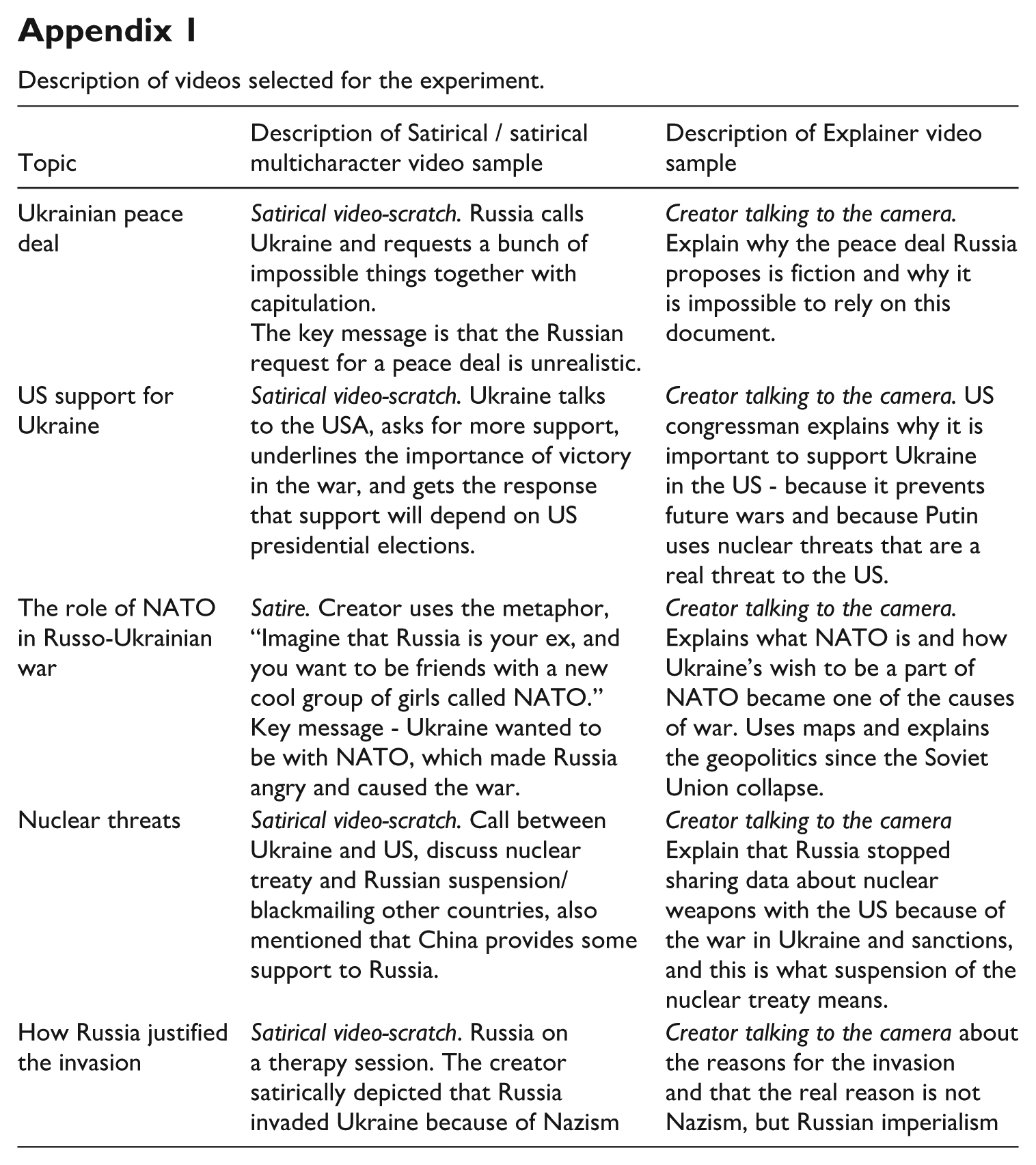
Creators’ popularity was not a primary selection criterion. The number of views or likes, like the number of followers, was not determined during the video selection for the experiment and was not visible to participants. This decision was made to prioritize the clarity of the genre and the thematic match over the potential confounding effects of a creator’s established fame. Appendix 1 provides a detailed description of the final videos used in the experiment.
After watching the videos, the participants answered several blocks of questions designed to measure the dependent variables of interest, including cynicism, political efficacy, empathy, and knowledge about the war in Ukraine. Additionally, demographic information, such as age, gender, social media usage, self-reported exposure to TikTok videos about Ukraine, political identification, and area of residence, was collected. On average, the survey took from 10 to 15 minutes to complete.
Measurement
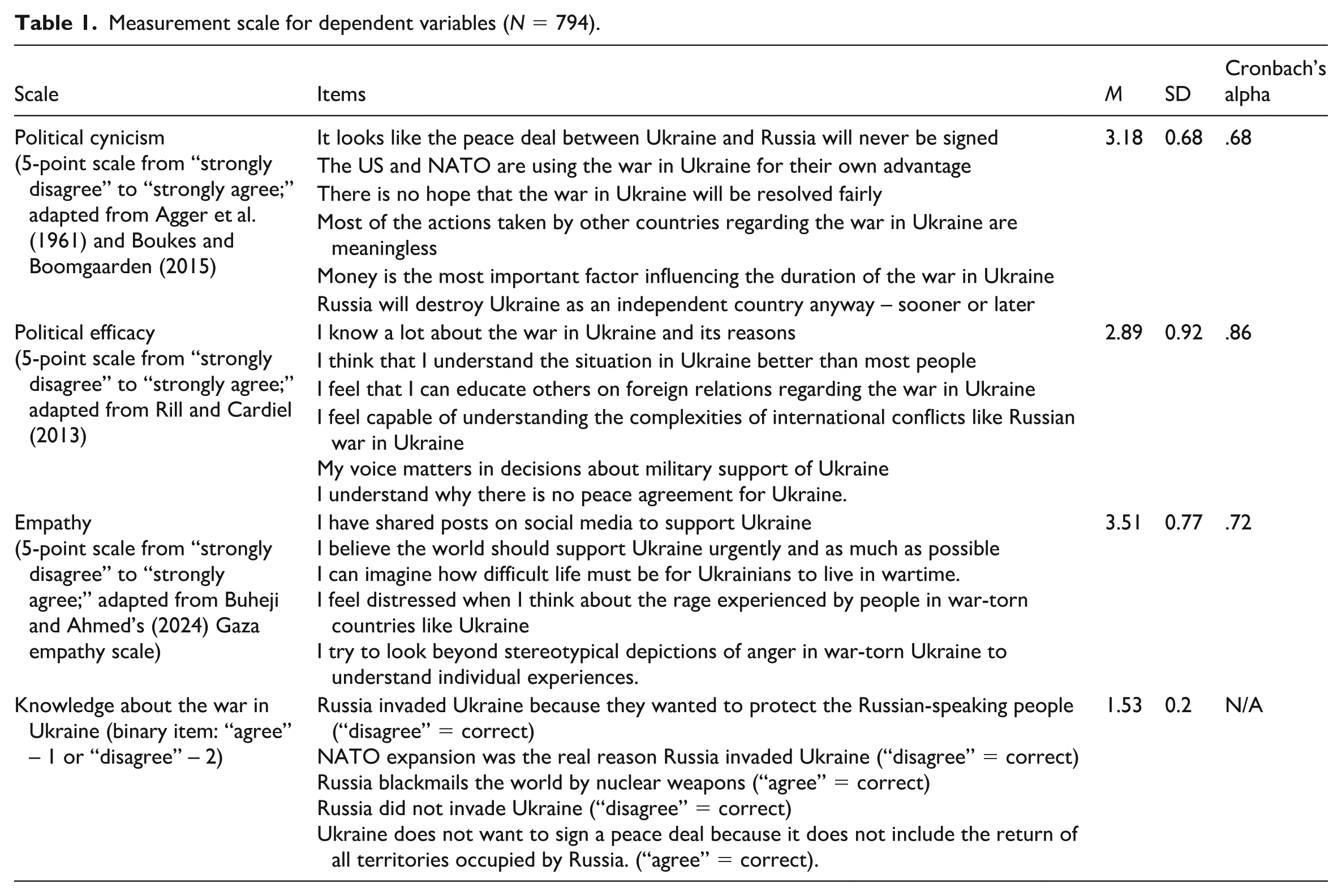
The dependent variables of political cynicism, political efficacy, and empathy were measured using 5-point Likert scales adapted from previous research to the specific context of the war in Ukraine. Table 1 reports the items used to measure each scale, along with the scale’s internal reliability, mean, and standard deviation, and Table 2 reports the multiple linear regression results predicting cynicism, efficacy, empathy, and knowledge.
Measurement scale for dependent variables (N = 794).
Multiple linear regression results predicting cynicism, efficacy, empathy, and knowledge.
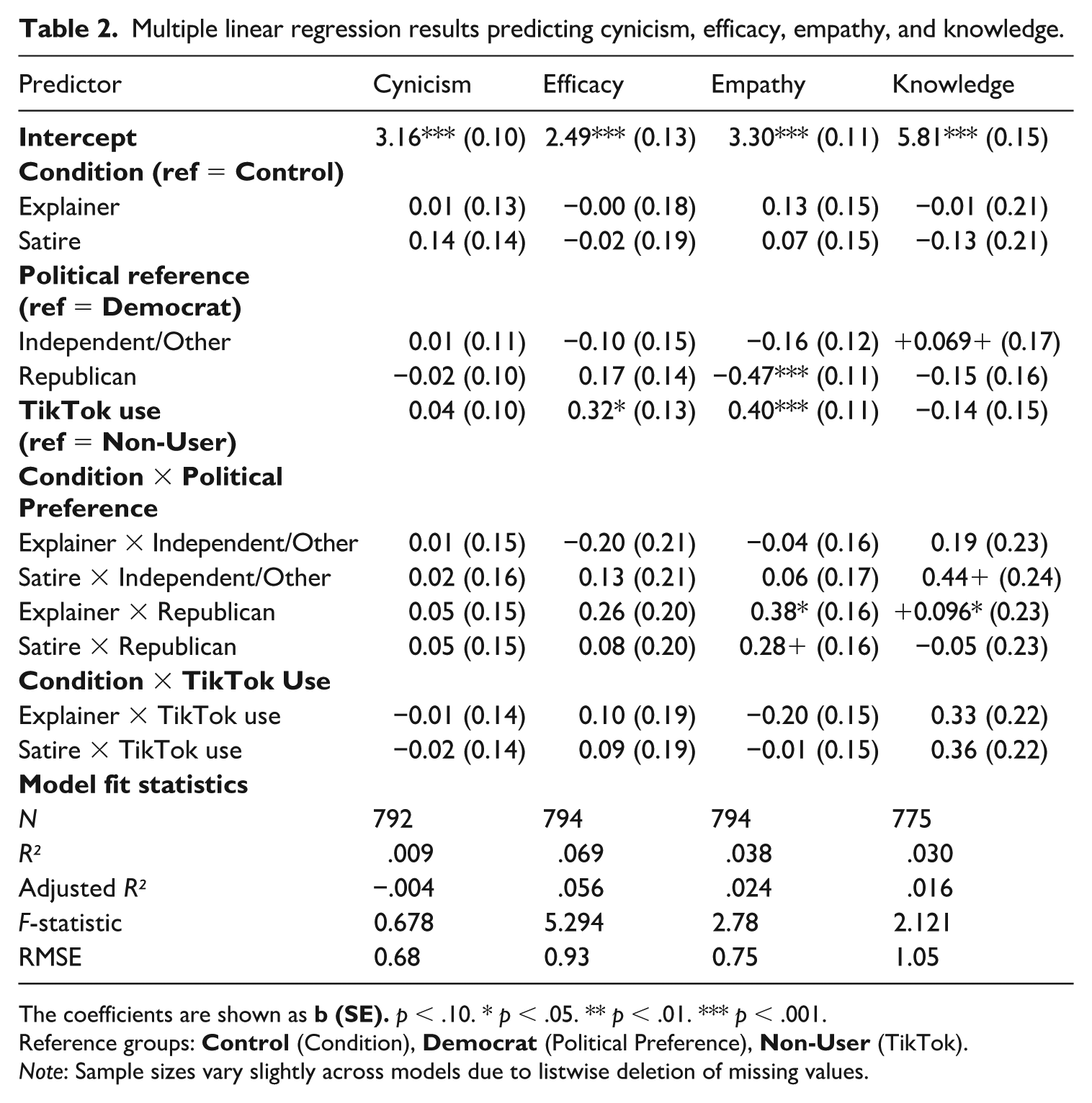
The coefficients are shown as
Reference groups:
The fourth dependent variable, knowledge about the war in Ukraine, was measured using five items specifically designed based on the content and messages of the videos (see Table 1). Participants were asked to indicate whether they agreed or disagreed with each statement. Knowledge scores were calculated as the sum of correct responses to all knowledge questions, with each correct answer receiving a score of 1. The internal reliability score was not indicated, as all the items were focused on different aspects of the issue. To ensure consistency in scoring, some items were reverse-coded so that lower scores reflected greater factual accuracy.
Participants were also asked to indicate if they were TikTok users (74.9%) or not (25.1%). Additionally, participants identified their political preferences as Democrat (54.9%), Republican (22.5%), Independent, and others combined (22.6%).
Results
A series of one-way ANOVAs and multiple linear regression models was conducted to assess the impact of different TikTok video genres. The results demonstrate that, while exposure to the video conditions produced statistically significant changes in cynicism and knowledge, the practical significance of these effects was modest, and no significant main effects were found for political efficacy or empathy. Further analysis, using multiple regression, explored the moderating roles of political preference and prior TikTok usage, revealing several conditional effects. A consistent theme throughout the analysis, however, was the poor overall model fit, underscoring that, while the video genres had a detectable influence, they were not strong predictors of these complex political attitudes.
A summary of cynicism, political efficacy, and empathy scores after exposure to control, explainer, and satirical videos about the war in Ukraine is presented in Figure 1.
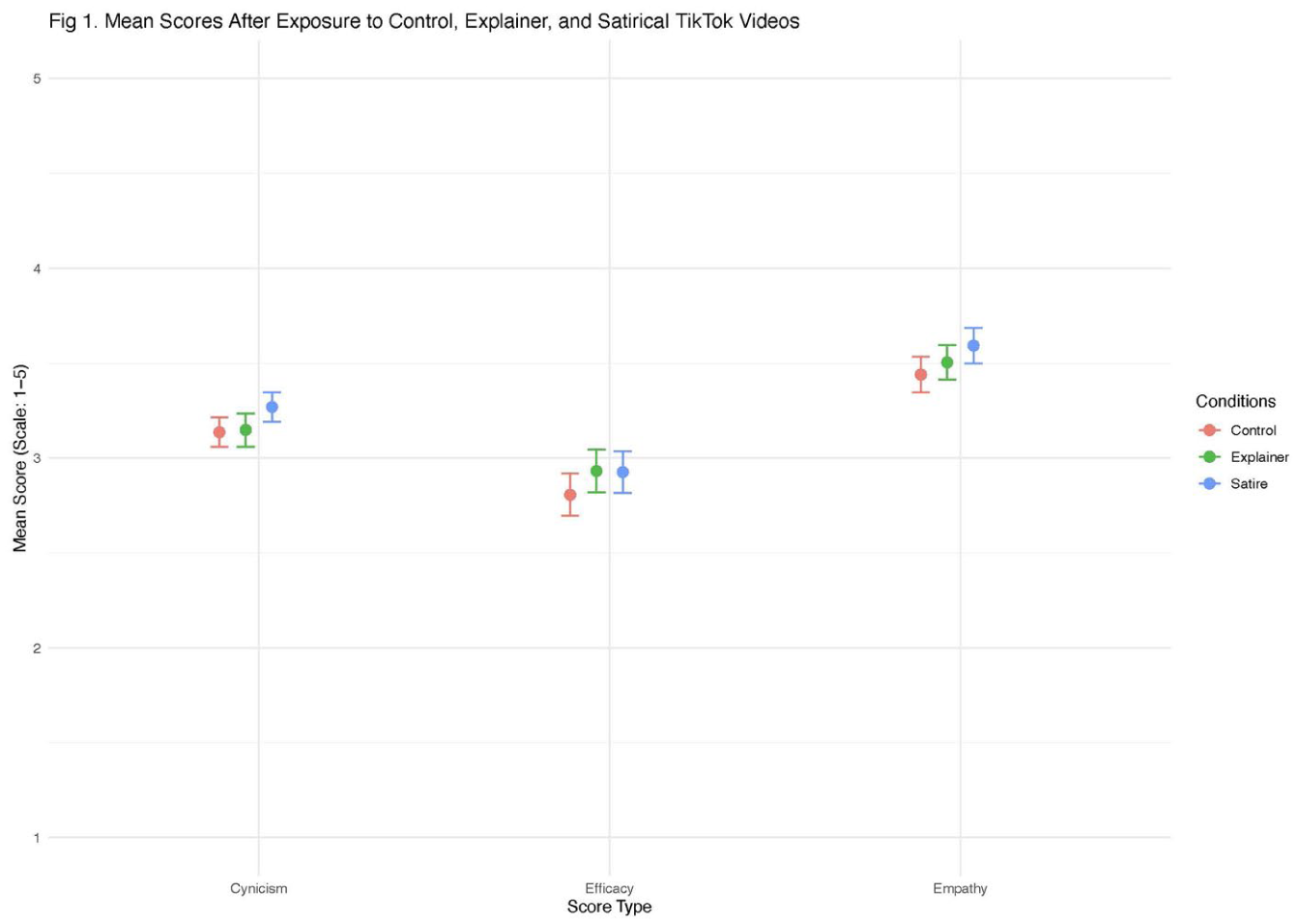
The mean for each score after exposure to control, explainer, and satirical TikTok videos: 296 × 209 mm (200 × 200 DPI).
RQ1 and RQ2: The effect of satirical videos and explainers on cynicism, political efficacy, empathy, and knowledge:
First, a one-way ANOVA was performed to assess the effect of different video genres on cynicism related to the war in Ukraine. The test revealed a small but statistically significant effect of experimental conditions (F(2,789) = 3.08, p = 0.0467, η2 = 0.0077). Cynicism was higher in the Satire condition than in the Control condition; a Tukey test indicated that this difference approached significance (mean difference = 0.133, 95% CI = [−0.005, 0.271], p = 0.063). No other pairwise comparison was statistically significant. The Tukey test results can likely be explained by the small overall effect size, and the ANOVA results indicated that the experimental conditions accounted for less than 1 percent of the variance in the cynicism scores.
For political efficacy, a one-way ANOVA indicated no significant effect from the different TikTok video conditions (F(2,791) = 1.47, p = 0.231).
The one-way ANOVA results for empathy indicated no significant differences between the video conditions (F(2,793) = 2.59, p = 0.075). Although the p-value approached significance (p < 0.1), it did not reach the conventional threshold of p < 0.05.
A one-way ANOVA revealed a significant effect of video condition on knowledge scores, F(2, 776) = 8.65, p < 0.001. Post-hoc tests confirmed that participants in both the Explainer and Satire conditions scored significantly lower than those in the control condition, reflecting greater accuracy. Despite these findings, the overall effect size was small (η²p = 0.02), indicating that the video condition accounted for only 2 percent of the variance in knowledge scores.
RQ3: The effect of satirical and explainer videos on cynicism, political efficacy, empathy, and knowledge for TikTok and non-TikTok users
Linear regression for cynicism changes for TikTok and non-TikTok users after video exposure was consistent with the ANOVA results. There was a small but significant main effect for the Satire condition, where participants reported higher cynicism scores than the control group (β = 0.141, p = 0.038). However, no significant differences were observed for the Explainer condition (β = 0.020, p = 0.774). TikTok use was not a significant predictor (β = −0.010, p = 0.912) of cynicism, and the interaction terms between TikTok use and experimental conditions were also non-significant (β = 0.04, p = 0.79).
Linear regression determined that the interaction between condition and TikTok use was not statistically significant (all β < 0.14, all p > 0.44), suggesting that the effect of TikTok genres on political efficacy did not differ significantly between TikTok users and non-TikTok users.
To determine whether TikTok users’ and non-users’ empathy was affected differently by videos, linear regression was conducted. There was a significant main effect of TikTok use (β = −0.40, p < 0.001), indicating that TikTok users reported significantly higher empathy scores than non-TikTok users. The interaction between video condition and TikTok use was not statistically significant (all β < 0.20, all p > 0.20), suggesting that the effect of videos on empathy did not differ significantly between TikTok and non-TikTok users.
To examine whether TikTok use moderates the effect of video conditions on knowledge, a linear regression was conducted. The main effect of condition showed that, compared to the control group, neither the Explainer (β = −0.01, SE = 0.21) nor the Satire (β = −0.13, SE =0.21) conditions predict knowledge scores. The main effect of TikTok use was not significant. The interaction terms indicated that TikTok users in the Explainer (β = 0.33) and Satire (β = 0.36) conditions scored higher on knowledge than non-TikTok users under the same conditions. However, the overall regression model was non-significant, and it explained only a small fraction of the changes in knowledge scores (R² = 0.03). This low R² value indicates that the combination of video condition and TikTok usage has limited predictive power for a participant’s overall knowledge.
RQ4: The effect of satirical and explainer videos on cynicism, political efficacy, empathy, and knowledge for Democrats, Republicans, and independent participants
To address RQ4, which concerned the variation in the effects of the videos based on participants’ political identification, we examined the interaction between experimental conditions and political preferences using multiple linear regression. The results showed that Democrats (M = 3.17, SD = 0.66) and Republicans (M = 3.20, SD = 0.73) had similar cynicism scores as did Independents/Others (M = 3.24, SD = 0.69). The interaction terms between condition and political preference for cynicism scores were not statistically significant (all βs < 0.22, all ps > 0.40).
Additionally, the regression results indicated that Democrats (M = 2.80, SD = 0.75) and Republicans (M = 2.98, SD = 0.91) had similar efficacy scores, as did Independents and Others (M = 2.60, SD = 0.94). The interaction between condition and political preference for the efficacy score was not statistically significant (all β < 0.30, all p > 0.14).
A linear regression model was employed to investigate the interaction effects of experimental conditions and political preferences on empathy scores. The overall model was statistically significant (F(11,784) = 2.78, p = 0.0015); however, the effect size was small (R2 = 0.038, adjusted R2 = 0.024). The results indicated that political preferences significantly influenced empathy scores, with Republicans (M = 3.37, SD = 0.9) scoring lower than Democrats (M = 3.61, SD = 0.71) (β = −0.46, p < 0.001), as did Independents (M = 3.38, SD = 0.78) (β = −0.29, p = 0.015). A significant interaction was observed between the Explainer condition and Republicans (β = 0.38, p = 0.020), suggesting that the Explainer condition was associated with higher empathy scores among Republicans than the Control condition. No significant interactions were found for Independents and the Other category (p > 0.05), the same as Democrats.
The main effect of political preferences was also significant for knowledge. Independents scored significantly higher on knowledge accuracy than Democrats did (β = 0.069, p = 0.031), suggesting that Independents answered a higher proportion of questions correctly. Republicans (β = −0.04, p = 0.106) did not significantly differ from Democrats in terms of knowledge accuracy. A significant interaction effect was found between the Explainer condition and Republicans (β = 0.096, p = 0.029), suggesting that Republicans in the Explainer condition answered more questions correctly than those in the Control condition.
Discussion
The summary of key empirical findings
Across four research questions, this study found that brief exposure to TikTok videos about war in Ukraine produces statistically detectable but practically moderate effects on young Americans’ political sentiments and knowledge, challenging the mediatization theoretical framework (O’Loughlin and Hoskins, 2015). A central finding of the analysis was the consistently low predictive power of the experimental conditions across models, highlighting that brief exposure to TikTok content is not a strong driver of those complex political attitudes.
Supporting theories on political satire (Peifer and Myrick, 2021), the finding that satirical videos increased cynicism – albeit explaining less than 1 percent of the variance – suggests the genre’s mechanism can be effective even in TikTok’s short-form environment. However, the analysis revealed that the experimental condition accounted for less than 1 percent of the variance in cynicism scores, suggesting its influence is minimal compared to pre-existing beliefs. Similarly, while both explainer and satire videos significantly boosted participants’ knowledge scores, it is essential to mention that the video condition explained only 2 percent of the variance in knowledge. This suggests that TikTok can be used as a tool to educate its audience about foreign politics; however, further research is needed due to the limitations of single and short exposures.
The video genres did not significantly affect efficacy or empathy, although empathy results approached significance. This suggests TikTok’s satirical or explainer videos might not sufficiently evoke strong efficacy and empathetic responses for complex issues like war.
Moderating effects and causal inference
This study also examined whether the effect of the videos varied based on participants’ prior level of TikTok use and their political identification. There were no significant interactions between video conditions and TikTok use, indicating that the effects of the video conditions on the dependent variables did not vary between TikTok users and non-users. However, TikTok users overall had higher levels of efficacy and empathy than non-users. The difference in efficacy may reflect TikTok users’ broader exposure to political content, fostering a sense of empowerment or understanding of political issues. Likewise, the higher empathy scores may be due to TikTok users’ greater exposure to emotionally engaging content.
The most nuanced finding emerged from the moderation analysis, which revealed that the effects of the videos were conditional on political affiliation. This finding partly aligns with existing research, which suggests that political preferences can be a predictor of TikTok engagement (Cheng and Li, 2026). While no main effect on empathy was found, Republicans showed a significant increase in both empathy and knowledge after viewing explainer videos. This suggests that straightforward, fact-based presentations may be a more persuasive format for conservatives. However, this interpretation requires further clarification. The regression models for both empathy and knowledge had poor overall fit, indicating that, while this interaction is statistically detectable, the combined influence of video type and political party still explains very little about why a person feels empathy or learns from a video. These results can be potentially valuable for the targeted information campaigns, but do not support the broad argument that such videos can be used as a powerful tool in political persuasion.
Theoretical and methodological implications
This experimental study contributes to the field of political communication, specifically extending the boundaries of the mediatization theory. First, the findings challenge the scope conditions of the mediatization by demonstrating that platform architecture and vernacular limit the short-term persuasive power. The study defines the boundary for mediatization in the hybrid media reality (Chadwick, 2017): while the findings confirm that TikTok videos can influence war-related attitudes, the consistently small effect sizes across models challenge mediatization theory’s assumption of powerful, direct media effects, suggesting instead that platform architecture and pre-existing identities operate as primary gatekeepers.
Furthermore, the results extend the understanding of Hall’s (1980) encoding–decoding model by demonstrating that, on platforms characterized by simultaneous production and consumption of content, political predisposition can be a stronger encoding framework than genre. The findings also support the political entertainment theoretical framework (Becker and Bode, 2018), showing that satire can be a powerful tool in affecting political cynicism. This article introduces the theoretical nuances of established theories on media and war, highlighting the genre congruence that transcends platform logic. It shifts the focus from the greater presence of media integration in warfare to the conditions under which this integration generates measurable political effect.
The results of the experimental study methodologically explicate the existing research on the relationship between social media and contemporary conflict. However, the consistently small effect sizes in this study underscore the complexities of measuring influence in a social media environment. Unlike the top-down model of legacy media, influence on TikTok is driven by virality and algorithmic curation as much as by the content itself. Thus, the measurement of genre effect should be discussed in connection with the general platform effect on political perception.
Limitations and policy implications
This study has several important limitations that can inform further research on the TikTok effect. First, the reliance on self-reported TikTok use and exposure limits the ability to draw causal conclusions about the impact of general TikTok use on political outcomes. Combining a survey experiment with real TikTok data from the same participants can reveal a stronger relationship between genre-long exposure and political sentiments. Additionally, the experimental design did not account for participants’ prior attitudes or media consumption habits outside of their TikTok use, which may have influenced their responses.
The experiment’s brief exposure to five videos presents a challenge to ecological validity, as it may not replicate the effects of prolonged, algorithm-driven consumption in a real-world setting. Future research could address these limitations by assessing political attitudes after exposure to a real-world TikTok feed, which may yield more representative and valuable findings.
Another limitation is the lack of strict control across video conditions, as naturally sourced content maintains authenticity but introduces variability. While videos were standardized in topic, framing, length, and creators’ gender balance, broader genre representation could yield additional insights. Moreover, recruiting participants through the research platform can limit the audience variance. While the focus of this study was on American youth, recruiting participants through TikTok ads or targeting other countries may reveal more nuanced findings.
While the finding illustrates a moderate effect size, it can offer potential implications for public diplomacy. First, the ability of both genres slightly enhances knowledge, suggesting that TikTok holds potential as a small part of a larger information campaign. Furthermore, the conditional effect on Republican participants suggests that tailoring TikTok content for different targeted audiences can be effective. Explainer videos could be promising in tailoring a political campaign for a conservative audience with a lower baseline empathy. At the same time, choosing a specific genre to reach the American young audience could not be the only tool in a diplomatic campaign, as it can have a very limited effect. For platform design, the findings reveal that the low explanatory power of content genres alone highlights the need for algorithmic transparency: if recommendation systems prioritize engagement over political importance, even well-crafted persuasive content will struggle to reach diverse publics.
Conclusion
Previous research on the role of social media in wars and conflict established a discussion about the effect of different platforms on political sentiments. Using experimental design, this study demonstrates that the platform-specific genres exert modest, conditional effects on political attitudes. It suggests that satirical videos about war may influence political cynicism, and that a conservative audience may be differently affected by satirical and explainer videos. At the same time, experimental conditions and short exposure limit the arguments about the influential role of TikTok on politics – while the effect can be detectable, for a nuanced understanding of it, research needs to combine experiment and real TikTok exposure. Future research could explore TikTok’s broader implications in digital diplomacy beyond the Ukraine invasion, examining other international issues and political communication, move beyond popular genres, and focus more on creators’ identity and popularity.
Footnotes
Appendix 1
Description of videos selected for the experiment.
| Topic | Description of Satirical / satirical multicharacter video sample | Description of Explainer video sample |
|---|---|---|
| Ukrainian peace deal | Satirical video-scratch. Russia calls Ukraine and requests a bunch of impossible things together with capitulation. The key message is that the Russian request for a peace deal is unrealistic. |
Creator talking to the camera. Explain why the peace deal Russia proposes is fiction and why it is impossible to rely on this document. |
| US support for Ukraine | Satirical video-scratch. Ukraine talks to the USA, asks for more support, underlines the importance of victory in the war, and gets the response that support will depend on US presidential elections. | Creator talking to the camera. US congressman explains why it is important to support Ukraine in the US - because it prevents future wars and because Putin uses nuclear threats that are a real threat to the US. |
| The role of NATO in Russo-Ukrainian war |
Satire. Creator uses the metaphor, “Imagine that Russia is your ex, and you want to be friends with a new cool group of girls called NATO.” Key message - Ukraine wanted to be with NATO, which made Russia angry and caused the war. |
Creator talking to the camera. Explains what NATO is and how Ukraine’s wish to be a part of NATO became one of the causes of war. Uses maps and explains the geopolitics since the Soviet Union collapse. |
| Nuclear threats | Satirical video-scratch. Call between Ukraine and US, discuss nuclear treaty and Russian suspension/blackmailing other countries, also mentioned that China provides some support to Russia. | Creator talking to the camera Explain that Russia stopped sharing data about nuclear weapons with the US because of the war in Ukraine and sanctions, and this is what suspension of the nuclear treaty means. |
| How Russia justified the invasion | Satirical video-scratch. Russia on a therapy session. The creator satirically depicted that Russia invaded Ukraine because of Nazism | Creator talking to the camera about the reasons for the invasion and that the real reason is not Nazism, but Russian imperialism |

Ethical considerations
This study was approved by the Institutional Review Board (IRB) at Rutgers University (Protocol #Pro2024001675).
Consent to participate
Informed consent was obtained from the participants before the study. The consent process was conducted online before the survey commenced.
Funding
This research received a US$1,000 award from the School of Communication and Information, Rutgers University.
Declaration of conflicting interests
The author declared no potential conflicts of interest with respect to the research, authorship, and publication of this article.
Data availability statement
The survey data supporting this research were not publicly available because of ethical considerations and participant privacy. However, they may be accessed upon reasonable request by contacting the author, Kateryna Bystrytska.