







Abstract
This study examines the coping strategies of journalists covering the Anglophone crisis in Cameroon as they face government censorship and threats from secessionists. What became known as the Anglophone crisis started as peaceful protests launched in 2016 by English-speaking lawyers and teachers, which degenerated into a secessionist insurgency leading to deaths, destruction of structures, and displacement of the population from Cameroon’s two Anglophone regions. Through semi-structured interviews with 41 media professionals, this study sought to evaluate the impact of well-known government and separatist control measures, and to examine how journalists navigate this environment to continue reporting on the armed conflict. Findings reveal that the desire for personal safety motivates the adoption of survival strategies as journalists persist in gathering and disseminating information. The study further shows that Shoemaker and Reese’s (1996) hierarchy of influences model applies to such contexts. Journalists’ response to external pressure can range from seeking alternative reporting platforms, reporting under cover, to reporting from exile. Theoretically, the findings inspire the proposal of the “pressure response reporting” model for consideration in future research.
Keywords
Introduction
Reporting political crises is a daunting task, especially when journalists report on opposing camps (Høiby and Ottosen, 2019). The complexity requires a deep understanding of the political landscape, the motivations of the factions, and the potential consequences of the disseminated information. One of the primary challenges is the inherent danger to journalists’ safety, as they may be targeted or caught in violent clashes (Waisbord, 2022). The psychological toll is equally significant. According to Kotišová (2019), the emotional aspects of crisis reporting are persistently under-researched, but they are considered crucial to shaping journalists’ experiences and their ability to report effectively. Crisis and disaster reporters face major challenges that usually include difficult access to conflict zones, unwillingness and fear from both authorities and eyewitnesses to provide information, and limited resources needed for broad coverage (Englund et al., 2023; Wahl-Jorgensen and Pantti, 2013). Topics such as journalists’ safety, attempts to influence reporting, and the role of the media in restoring or maintaining peace have been of key interest to scholars (see Charles, 2021; Reilly and Vicari, 2021; Slavtcheva-Petkova et al., 2023). Amid varying realities, reporters are known to continuously seek avenues to report, and the success of their strategies usually depends on the level of freedom of expression in the country where they operate (Demarest and Langer, 2021; Stier, 2015).
These dynamics are visible and somewhat similar to experiences of journalists reporting the Cameroon Anglophone crisis. The crisis describes a sociopolitical unrest that broke out in 2016 following peaceful protests by teachers and lawyers advocating for the respect of the Anglophone educational and legal systems. The situation escalated following stalled negotiations, the arrest of movement leaders, and the unilateral declaration of independence by secessionists in October 2017 (Cameroon News Agency, 2017). The conflict has since developed into a protracted armed confrontation characterized by widespread violence, attacks, abductions, and destruction of property (US Committee for Refugees and Migrants, 2025). It has received limited international attention, but the political, economic, social, and humanitarian implications have been substantial, forcing the Norwegian Refugee Council to label it the world’s most neglected humanitarian crisis (Norwegian Refugee Council [NRC], 2019).
Although reporting has been minimal, available evidence shows the infringement of journalists’ rights by both state and non-state entities (Reporters Sans Frontiers [RSF], 2018, 2023). Rights organizations have documented arrests, detentions, trials under the 2014 Antiterrorism Law, as well as the death of a journalist in custody (Al Jazeera, 2020). Journalists face state control measures or separatist harassment, no matter the angle of the crisis they focus on. Media outlets have received warnings, summonses, and sanctions, while the two Anglophone regions experienced more than 200 days of internet shutdown between 2017 and 2018. Conversely, separatist fighters have abducted reporters, issued threats, and killed at least one journalist (Le Monde, 2023). In this context, where media and journalists struggle to survive, economic pressures further complicate factual reporting (Hanitzsch and Mellado, 2011), as media outlets lack adequate resources for proper investigation.
From this standpoint, this study examines how journalists perceive and navigate the control mechanisms imposed by the government on the one hand and Anglophone separatists on the other. It explores journalists’ lived experiences in the face of these constraints and the strategies they adopt to sustain their reporting. Guiding this inquiry are two research questions:
In addressing these questions, this study brings in new empirical evidence from Cameroon, a relatively understudied sub-Saharan African country with its own sociopolitical realities, and adds to broader discussions on media freedom and the safety of journalists. Also, several earlier studies on censorship (e.g. Abbasi and Al-Sharqi, 2015; Chan et al., 2024; Ngangum, 2020; Nyamnjoh, 2011) have usually been limited to the government’s ability to control narratives, thus conceptualizing control as a top-down process driven by the state alone. This research explores the actions of two opposing actors and examines how journalists maintain reporting when aligning with the demands of one side often means difficult relations with the other. While existing studies related to reporting the Anglophone crisis have focused on journalistic professionalism (Fai et al., 2024) and adoption of digital technologies (Lee et al., 2023; Nfor, 2024), limited attention has been paid to journalists’ lived experiences. By focusing on the challenges journalists face while navigating overlapping pressures, this study addresses a major gap in understanding how reporting is practiced under conditions of prolonged conflict and competing centers of power.
Theoretically, this work builds on the hierarchy of influences model of Shoemaker and Reese (1996, 2014), which has received significant scholarly attention in the West and Asia (see Ali and Iqbal, 2022; Milojević and Krstić, 2018; Peruško et al., 2017; Xu and Jin, 2017). In this context, applying the model is not a mere replication but an opportunity to assess how contested authority can influence reporters. The study revealed contextual realities that inspired me to propose a framework as an additional step in not only understanding influences but also assessing journalists’ coping strategies.
Theoretical framework: Hierarchy of influences
Shoemaker and Reese’s (1996, 2014) hierarchy of influences theory highlights five interconnected levels considered to shape the production of media content. At the individual level, personal traits of journalists, such as values, preferences, and biases impact their work, although they are supposed to be guided by professional norms. Plaisance and Skewes (2003) note that journalists’ individual perception of news is significantly influenced by their personal experiences. Individuality is said to be more pronounced when dealing with urgent and time-sensitive news (Tanikawa, 2017).
The routine level highlights standardized practices in the news production cycle such as news values and storytelling techniques, that are expected to promote efficiency but sometimes tend to limit creativity. The news production process, from peaching to publication, is said to be carried out through clearly outlined routines in an environment of the persistence of old routines and the emergence of new routines facilitated by digitization (Kovačević and Perišin, 2022; Westlund and Ekström, 2021).
The organizational level considers policies and economic priorities of news organizations. This can include the influence of ownership and business-oriented goals. Ali and Iqbal (2022) note that the autonomy of journalists is significantly restricted by the organizations for which they work. The social-institutional level concentrates on external forces like advertisers, political institutions, and public relations, highlighting their impact on journalistic content. Ferrucci and Alaimo (2020), studying the impact of social institutional dynamics on the media, note that instead of fighting the influence, media institutions can become organisms that adapt to its environment as a strategy for survival.
The social systems level examines how societal structures and cultural ideologies influence journalism as part of a broader system. It emphasizes how all the other levels work together for an obvious ideological result. At this level, the media is viewed as part of an “organic, sociocultural whole, capturing some of the critical analysis of news” (Reese, 2019: 2). This model is well-suited for examining coverage of the Anglophone crisis because it links coverage decisions to layered influences. Journalists’ personal values and experiences can be seen in their reporting decisions. Such individual influences can be observed to interrelate with routine pressures since journalists tend to negotiate between established newsroom practices and the demands of breaking news in a highly volatile environment. At the organizational level, depending on editorial policies and resource availability, media outlets alternately prioritize or downplay coverage of the Anglophone crisis. These decisions are further shaped by the broader Cameroonian media landscape, within which ownership structures, regulation, and alignments impose additional priorities and limitations.
State and non-state control of media during crises
Across authoritarian and semi-autocratic states, governments are said to use censorship to influence narratives during armed conflicts, political uprisings, or natural disasters (Gohdes, 2024; Knight and Tribin, 2022). Several purposes are targeted, namely panic prevention, national interest protection, and political control maintenance (Chan et al., 2024; Kennis, 2019). The main concern advanced by states for censoring the media is the need to fight misinformation (Ali, 2022), which sometimes results in confusion or harm during uncertain times (Abbasi and Al-Sharqi, 2015).
While attempting to stabilize a prevailing situation by limiting the spread of misinformation, governments also run the risk of suppressing diverse views and important information, necessary for informed decision-making among citizens (Abbas and Zubair, 2020). Fink (2018) stressed that mistrust between the government and its citizenry can be the result of the attempt to suppress information, as citizens who have limited access to information are likely to turn to alternative media or conspiracy theories (Oyinloye et al., 2024). High levels of media control are also said to undermine the media’s watchdog role in society (Verma, 2023).
The evolving digital communication landscape has altered the conduct of censorship. Print and broadcast restrictions might still be present as in the past, but the advent of the internet and proliferation of platforms signaled a major challenge for governments’ control of information (Chang and Lin, 2020). As much as governments can still restrict or filter mainstream media content, alternative media sources have established themselves as valuable information avenues during crises, with the ability to bypass censorship (Jackson, 2014). With these new dynamics, governments have resorted to internet shutdowns, targeted surveillance, and digital disinformation campaigns (Clark et al., 2017; Vargas-Leon, 2016) to maintain control. Political leaders are always on the lookout for new ways to influence the framing of events and the shaping of public sentiment. Research by Seib (2021) suggests that during wartime, media censorship is used both to control the narrative and to suppress internal dissent, particularly from political opponents or activists.
Research on government control largely conceptualizes influence as a state-driven process. The actions and statements of non-state entities are sometimes seen to constitute a parallel and even competing source of pressure on journalists during crises. In examining attempts to influence media coverage of crises, scholars identify a few with varying degrees of intensity. Among them are opposition political parties that are noted to manipulate media narratives with populist messaging. Järviniemi (2024: 312) states that crises enable opposition politicians “to assign blame to those in power or marginalize particular groups by means of populist communication.” Another prominent source of influence is non-state armed groups who usually make use of direct coercion against journalists and news outlets (Workneh, 2022). They employ threats, abductions, and the destruction of infrastructure. Their violent actions sometimes lead to death, causing fear among journalists. Keels and Kinney (2019) suggest that rebels who carry out attacks during political crises and armed conflicts expect journalists to cover their actions. They also use social media to highlight their own messages, thereby bypassing legacy media.
Commercial ownership, business models, and advertising pressure are also noted to impose constraints on the editorial balance of media outlets during crises (Tomaz et al., 2022). This is considered as powerful as direct censorship, as news outlets tend to avoid topics that could repel commercial partners, particularly in fragile market contexts. During political crises, specifically, the capacity to shape public opinion hinges on the degree of influence that state and non-state actors exercise over both traditional and alternative media (Pop-Eleches and Way, 2023; Volkmer, 2003).
How the media survives control during crises
Under conditions of sustained coercion, journalists can be observed, not merely enduring control but actively modifying their practices to continue reporting. Zahoor and Sadiq (2021) opine that media either become parties to a crisis or remain independent reporters of incidents. Scholars (e.g. Allan, 2013; Murthy, 2013) note that citizen journalism and user-generated content become primary information sources during crises as digital eyewitness accounts disseminated across various platforms reach wider local and international audiences faster than traditional outlets (Novak and Vidoloff, 2011). Newsrooms have thus developed strategies to integrate content from citizen journalists during periods of intense information flow such as crises (Lundin and Walukiewicz, 2025; Nfor, 2024)
Another strategy that has been used by the media to bypass control is leveraging cross-border and diaspora media (Arafat, 2021; Maigari and Shehu, 2025). Through exile media and international news outlets, external channels can provide reporting alternatives and narratives unavailable domestically (Porlezza and Arafat, 2024). Also common these days as tools to bypass control of the media are Virtual Private Networks and peer-to-peer proxy services that enable users to evade filters and geo-localization (Grinko et al., 2022).
Self-censorship is another way in which journalists survive extensive control (Cook and Heilmann, 2013). Elbaz et al. (2017) underscore the internal nature of self-censorship, suggesting that individuals or groups adopt it due to perceived risks or social pressures rather than explicit restrictions. Das and Kramer (2013) highlight the individual and psychological dimensions of self-censorship. Lee (2007) emphasizes institutional pressures, highlighting how governments, corporate interests, or ideological forces shape media narratives. No matter the perspective adopted, self-censorship is an integral part of the news chain as reporters try to evade control imposed on them by various actors in the environment in which they operate (Jungblut and Hoxha, 2017). These survival strategies, as highlighted here, become even more significant in times of crisis, when, as Pavlik (2003: 75) observes, “journalism plays its most important role in society.” Existing scholarship on media control during crises has tended to exclusively focus either on state-led censorship or on non-state coercive pressures. While such contributions are laudable, they seldom provide a clear understanding of the simultaneous and opposing forms of control exerted on journalists and their responses. In this study, I examine how perceived conflicting control influences journalists’ work and how they practically navigate these combined pressures.
Methodology
This study draws on semi-structured interviews with 41 Cameroonian media professionals. I undertook a purposive sample to select participants based on these criteria: experience in covering the Anglophone crisis since its onset in 2016, being resident in one of the Anglophone regions or in the cities of Douala and Yaounde (home to major media outlets), or abroad but having met the aforementioned criteria prior to relocating. I excluded media professionals identified as government or secessionist activists. Before data collection, I sought and received clearance from the university’s ethics committee, which examined the research protocol to ensure that the process was compliant with ethical research standards and that storage procedures met all strict safety standards.
I began the selection procedure by contacting over 40 professionals, including reporters, editors, publishers, and technicians from state and private print, broadcast, and online outlets, through phone calls and social media. Twelve initially agreed to participate, and through their networks, I conducted a snowball sample to recruit an additional 29 under the same criteria. All participants reviewed the research protocol and provided informed consent to participate.
I conducted semi-structured interviews between December 2022 and May 2023, capturing diverse perspectives on this sensitive topic. The interviews were part of a larger project on the media reporting on the Anglophone crisis in Cameroon. Interview sessions lasted between 28 minutes and 1 hour 36 minutes. The findings presented here are based on analysis of parts of the interviews that focused on the government and separatist control, practitioners’ perception of these measures, the impact on their work, and the strategies they employ to survive in such a challenging environment. Follow-up questions probed specific decisions and examples to elucidate these ideas.
Considering the sensitive nature of the topic, I opted for online interviews to protect participants’ identities, thereby minimizing physical risks associated with face-to-face meetings. Online interviews also enabled participants to feel secure, facilitating honest and open discussions. While it is true that no online environment is risk-free, interviews were conducted using university-provided, password-protected systems and secure data storage spaces. To avoid possible identification of research subjects and names mentioned by interviewees, I pseudonymized the data during the manual transcription. The results have been presented without any identifiable markers.
Inductive thematic analysis, facilitated by ATLAS.ti 24 was conducted. I chose this method for its potential to identify trends within data and enable “understanding of complexity and context-specific variation” (Riger and Sigurvinsdottir, 2016: 35). The first phase of the process was a reading of the transcript to enhance familiarity with the content. This was followed by open coding that facilitated the assigning of labels to meaningful portions of the data. This step produced 65 codes and 266 quotations. Having attained the first level with the number of codes, I clustered related codes as a way of revealing patterns, merging similar themes, and dropping duplicates. I consulted with fellow researchers to ensure that the refined themes were clear, unique, and most importantly, aligned with the research questions. In total, six main themes were retained. Below are the main themes with examples of related codes:
Results
The first research question is: How do journalists perceive the actions of the Cameroonian government and Anglophone separatists as they report on the crisis? The results presented below reveal journalists’ perceptions of government and separatist actions, and capture recurring personal experiences with the possibility of shaping reporting on the crisis.
Fear
Participants described feelings of constant fear as they performed their reporting tasks. Several respondents said the government measures aimed at controlling reporting make them very cautious about what they publish. Reporters said the arrest, detention, and trial of their colleagues are difficult to forget and keep them constantly on their watch. Research participants also talked about the fear ignited by secessionist activities and claimed some of them received threats from anonymous persons claiming to be secessionists. While two of the participants had been abducted by secessionists and later released, others who knew colleagues who had experienced the same fate said they feared for themselves and for their families, as they could also be targeted. One reporter, noted to have been vocal in his report on the crisis, is said to fear any topic related to the crisis: Since NN1 was locked up and came back, he does not want to hear anything about the “Anglophone crisis”. He doesn’t. That’s how traumatic the experience was to him. (Interviewee 8)
Economic insecurity also featured as one of the factors that brings fear among the journalists. Many respondents noted that reporters might give in to government pressures because they fear losing their jobs. Fear, for other participants, went beyond daily subsistence or imprisonment to the possibility of death. They repeatedly mentioned a journalist who died in pre-trial detention and another who was shot by separatists while covering events.
Unreported events/unarchived stories
Interviewees revealed that the government crackdown and separatist reprisals led to significant gaps in reporting on the Anglophone crisis. For “fear of the unknown,” human rights violations, attacks on communities/structures, and many other events often go unreported. As a result of their silence on some of the issues, the international community is left unaware of some of the realities of the crisis. In addition to underreporting, participants highlighted information loss due to limited systematic archiving. With routine checks and control of mobile phones, laptops, and other gadgets at checkpoints in the crisis-hit regions by both state security forces and secessionist groups, participants complained that evidence cannot be safely stored. This is because they have resorted to deleting sensitive texts, photographs, audio, and video recordings, which, if seen during routine checks, can lead them into trouble. Professional online platforms also restricted the sharing of sensitive material: In most of the [professional] social media groups . . . you will hear administrators warning, ‘we don’t want to see anything about the Anglophone crisis here,’ because when you are controlled by the police and they find that you are in a WhatsApp group that is discussing the Anglophone crisis, you are in trouble . . . So, we cannot archive anything on our phones any longer. If you have anything on the phone that is crisis-related, you must delete it as soon as possible. (Interviewee 6)
Diminished investigative reporting
Some interviewees blamed both government restrictions and separatist pressures for negatively affecting investigative reporting. Journalists explained that in-depth reporting and investigations have considerably dwindled, leaving many reports incomplete or absent. This challenging situation, which has created a vacuum, has made the audience rely on rumors and social media content. Participants noted that the result of this is the loss of credibility by traditional media in the eyes of the public. Some even think that audiences know events about which some traditional media outlets have been silent. Some newsroom managers and editors forbade any mention of the crisis in print or broadcast for fear of repression.
Break in information flow
Most of the media professionals interviewed recalled that the government’s internet shutdown in the Anglophone regions between 2017 and 2018, which lasted for more than 200 days, impeded fluid communication between field reporters and central news desks. The headquarters of media outlets in Cameroon, for a majority in the French-speaking regions, had relied on correspondents from the Anglophone northwest and southwest to provide first-hand updates on the crisis. The internet blackout presented correspondents with enormous difficulties reaching out to central news desks and vice versa. This made stories from the epicenter of the crisis arrive in newsrooms several days late. Participants explained that by the time these stories reached the central news desks, other developments had overtaken the ones they sent earlier. With the only means of communication during the internet shutdown being landlines, journalists avoided using them, fearing phone tapping. This challenge, they say, resulted in significant coverage gaps.
For the months that this internet was switched off, people were not informed of several happenings . . . When the internet returned to those regions, some people tried to come back with some of the things that happened when there was no internet, but you could not come up with all of them. (Interviewee 15)
The second research question was: What coping strategies have journalists adopted to continue reporting on the Anglophone crisis despite significant control? The pressure from both the government and separatists made reporters adopt various strategies to continue their coverage. In response to the second research question, the main strategies cited are presented in this section.
Undercover reporting
For many reporters based in the English-speaking regions, working undercover has been one of the methods of surviving while reporting on the armed conflict. It began by keeping a low profile and ensuring that they were not identified as reporters by members of the public.
Personally, I try to go missing in the crowd so that I’m not singled out anywhere . . . So, I put myself in the shoes of every common person around town just to ensure that I don’t get noticed and targeted. (Interviewee 4)
Another way of working undercover has been the use of pseudonyms. Some reporters adopted pseudonyms to safely live in the crisis-affected regions while covering the crisis. For foreign correspondents, it became safer to gather the information and get it published without their names being mentioned in any part of the process.
For most websites that I report on, I use pseudonyms to avoid being identified and singled out like in the past . . . to avoid being targeted. (Interviewee 4) Sometimes, when you have gathered the information, you chat with your editor. They’ll do the report. I cannot lie to you . . . sometimes I have to send the information to our hierarchy . . . at the Head office. They will treat it there. (Interviewee 17)
Following the internet blackout, journalists in the concerned parts of the country resorted to the use of VPN to bypass the shutdown and still send reports to their media outlets. Even though it is said to have been unsustainable, journalists still attest that it enabled them to meet some urgent reporting needs.
With the absence of the internet and the zeal of some newsrooms to continue reporting on the crisis, journalists carried out risky journeys. The journeys could be categorized in two types of working. First, reporters in the English-speaking regions who needed to send reports to their news outlets in the French-speaking regions travelled to a nearby Francophone town to send their reports. Secondly, news outlets in the Anglophone regions that wanted to report on the crisis travelled to the French-speaking regions, accessed the internet, and downloaded information about the crisis to serve local audiences.
Every Friday afternoon, he [the radio station manager] drove with three or four colleagues. They’ll get to Douala, where they could get internet connectivity . . . got as much information as they could about the crisis . . . and come back. So, from Monday to the other Friday, we had something to talk about for at least 5 minutes on the crisis in the news, based on the information that was gathered from the internet in the French-speaking city. (Interviewee 25)
Alternative avenues and platforms
Since 2016, several Cameroonian newspapers, radio stations, and television stations have reported on the Anglophone crisis with much interest. However, as emphasized by interviewees, government restrictions and constant monitoring of coverage forced many reporters to resort to what they considered safer ways of practicing their profession. Some turned to alternative outlets such as social media, news websites, and diaspora-based channels, where they could report more freely on sensitive issues without the same level of direct censorship. Others are said to have shifted their focus to what they considered less risky aspects of the crisis.
I partnered with an NGO that is working with refugees in Nigeria and internally displaced persons in Cameroon. So, we tell it through the vantage point of the victims and not necessarily the perpetrators. People are able to see the human side, the human interest in it . . . (Interviewee 8)
Reporting from exile
Interviewees noted that arrests, detentions, abductions, and even rumors influenced some journalists to go into exile. Journalists who had been arrested and later released, or who felt they were being targeted, decided to leave the country. From the interviews, two groups of exiled journalists were identified. The first group consists of those who left the country but have continued reporting on the Anglophone crisis and other political events in Cameroon. Respondents noted that these groups use their personal social media platforms, others have created news websites, while a few others work with international or diaspora-based outlets. The second group is made up of reporters who, after leaving the country, abandoned reporting on the crisis. The fear for their safety and that of their families is said to have motivated both the decision to escape and the decision to stay silent.
NN2 escaped; he left the country because of that. Many journalists now leave the country like that. They invite them to seminars, they go and do not return, just because they are avoiding being arrested . . . (Interviewee 6) Some have even left the country, and they are not returning. They have gone out of the country and all that because they’ve tagged them as secessionists, and the next thing would be that they will be arrested. That is the case with NN3 and NN2. (Interviewee 18)
Discussion of findings
The purpose of this study was to examine the impact of the Cameroonian government control and the Anglophone secessionists’ threats on journalists’ coverage of the Anglophone crisis and the coping strategies adopted by journalists. The hierarchy of influences model (Shoemaker and Reese, 1996, 2014) was the theoretical basis of this research. As seen in the results, both government and separatist actors are perceived to impose ideological constraints, making journalists feel either loyalists or traitors depending on the angle of their reporting and which of the protagonists is judging their work. At the social institutional level, we see that journalist autonomy has been downplayed by state censorship and separatist intimidation, revealing weakened protection for journalists.
The organizational level reveals media outlets’ attempt to adapt to the challenging reporting environment by adopting editorial decisions based on survival rather than public interest. The routine level highlights disruption following the challenging realities of regular reporting from conflict zones and the desire for journalists to avoid provoking either party to the conflict. Routine newsroom practices can be considered as becoming compromised. Finally, the individual level reveals fear, uncertainty, and ethical dilemmas as threats from both state and non-state actors influence not only the content of journalists’ reports but also whether they would report at all on the conflict (see Stupart, 2021).
Ultimately, the hierarchy of influences model has been applied and validated by several empirical studies (see Fahmy and Johnson, 2012; Grassau et al., 2021; Uskali, 2022). The Cameroonian perspective examined here not only adds new empirical knowledge to the already existing body of work but also takes the discussion a step further to examine how media outlets and journalists adapt their work when some or all of these influences are present. In outlining the survival strategies of reporters, I suggest a consideration of what I call the ‘pressure response reporting model’.
Pressure response reporting is a combination of strategies adopted by media actors to continue reporting in the face of external pressures that undermine journalistic autonomy. The pressure, which can come from one or multiple sources, affects journalists’ work to varying degrees. This research presents three key aspects that constitute pressure response reporting within the Anglophone crisis, as shown in Figure 1.
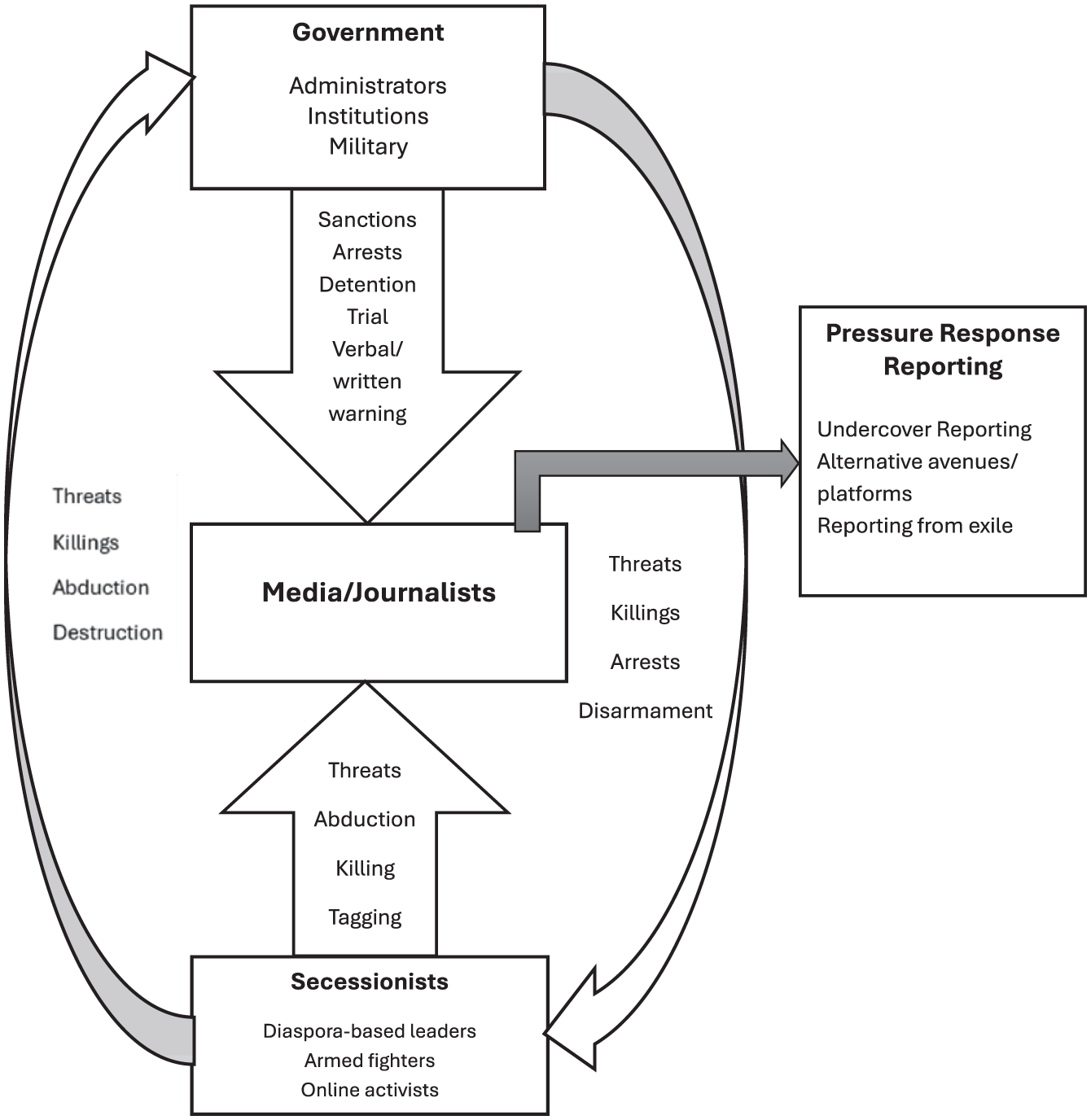
Pressure response reporting model in the Cameroon Anglophone crisis.
Journalists go undercover to conceal their identity and avoid surveillance while reporting on controversial or delicate topics. Avieson and McDonald (2017) consider undercover reporting as an important form of journalism as it can expose hidden truths while ensuring the safety of the reporter. Journalists covering the Anglophone crisis, though facing this dual pressure, still feel the need to report. Rodny-Gumede and Chasi (2016) note that even though undercover reporting entails some unethical practices on the part of the reporters, it is important as a way of revealing hidden truths.
Reporters of the Anglophone crisis adopted alternative dissemination channels such as social networking platforms, online news sites, and diaspora media outlets. Journalists successfully evaded in-house editorial constraints by leveraging possibilities that enabled them to publish without direct censorship. Henken (2021) notes that, amid government control of the media and the increasing ability of citizens to access online content, the impact of alternative news platforms increases, making them competitors of state-controlled media. By adopting alternative methods and channels, reporters of the Anglophone crisis are said to have created a degree of physical and institutional distance with potential controllers. As indicated by the results, some reporters adopted the hybrid role of reporting within the confines of newsroom editorial policies while leveraging alternative sources to share their personal views on topics of interest (Nfor, 2024; Ginosar and Reich, 2022).
Of the three strategies, reporting from exile tends to be the most disruptive of all, involving physical relocation, generally abroad, while maintaining the zest to report. One of the immediate aftermaths of the intensification of the crackdown on reporters of the Anglophone crisis has been the surge in the number of journalists who have gone into exile, seeking refuge in neighboring countries for some, and traveling across the continents to Western nations for others (Gondwe and Vialle, 2025). As with the Cameroonian case, Marston (2023) also notes some escape “after imprisonment, torture, or sham trials” from all sides. The reality could be that the same journalist faces threats from both the state and separatists, leaving no other option than seeking an escape route out of the country. While in exile, journalists benefit from some level of freedom as the threat resulting from government crackdown and separatist actions may have dwindled. As noted by Esther and Thomas (2025: 288) while studying Burundian journalists in Rwandan exile, reporters covering national issues from abroad “have shown great dedication,” citing social responsibility as their major motivation.
While it is clear that government and separatist actions influence reporting of the Anglophone crisis in one or more ways, it is also obvious that some government actions were likely to trigger certain specific reactions from the media and journalists. The government’s application of anti-terror laws that criminalize coverage of separatist activities, arrest and detention of journalists, and prosecution in the military tribunals was said to be a major driver of undercover reporting and exile. Summons of editors and journalists, verbal and written warnings to specific journalists and media outlets, and the banning of radio and TV programs and newspapers for varying lengths of time were deduced as the main influence behind the use of alternative media sources. Separatist threats, abductions and killings were highlighted as influencing all survival strategies to relatively similar levels.
Conclusion and recommendations
This study sought to examine the impact of the government and separatists’ actions on coverage of the Cameroon Anglophone crisis and the coping strategies adopted by journalists. The results agree with Hanitzsch and Mellado (2011) that political and economic factors are the most important determinants influencing journalists’ perceptions of influences, but go further to show that the role of the other influences cannot be neglected. While control measures from any entity end up limiting reporting of events (Verma, 2023), journalists are usually torn between professional norms and attachment to events (Koloma Beck and Werron, 2018; Stupart, 2021). Taking a step further from Issawi (2021), who highlighted survival tactics to co-exist in a challenging media environment, journalists’ coping strategies that lead them to continue reporting on the Anglophone crisis inspired the pressure response reporting model to be considered in future research.
For a fact, strategies highlighted under pressure response reporting have been studied by scholars over the years (see Muller and Carson, 2022; Porlezza and Arafat, 2024; Thorbjørnsrud and Figenschou, 2018). This framework crystallizes these well-known and well-established practices within journalism studies into a framework that can be examined as interlinked adaptive responses to the compound pressures exerted on journalists in the exercise of their reporting task. They thus underscore their role, not as isolated tactics but as interconnected and context-responsive measures that enable the survival of journalistic practice under extreme duress orchestrated not only by conventional control, but also by other players. As government and separatist actions, though distinct, can be considered as overlapping, so do the resulting strategies to survive them.
This study is not without limitations. The first limitation was the disparity between journalists working for the state-owned media and those working for the private media. Secondly, the fact that interviews were conducted online presented technical difficulties, with breaks in communication and blackouts that disrupted the flow of some interviews. Notwithstanding these challenges, the study still provides a valuable empirical and theoretical contribution to the subject under study and a basis for future research on pressure response reporting in other geographic and situational contexts.
Footnotes

Funding
The author disclosed receipt of the following financial support for the research, authorship, and/or publication of this article: The author was supported by a doctoral researcher contract from the Faculty of Humanities and Social Sciences, University of Jyväskylä, Finland (Dnro 1657/01.01.01.00/2021).”
Declaration of conflicting interests
The author declared no potential conflicts of interest with respect to the research, authorship, and publication of this article.