







Abstract
This article examines the patterns and functions of Internet political cartoons relating to the insecurity crisis in Nigeria, with a view to identifying the conceptual metaphors that underlie the creation of the political cartoons. Forty cartoons, drawn from digital platforms, were analysed qualitatively using aspects of Forceville’s multimodal metaphor theory. The findings reveal that the verbal and pictorial resources in the political cartoons enhance the conceptualization of the multimodal metaphors inherent in them. The study also shows that the multimodal metaphors lay bare the dangerous nature and dimensions of the insecurity crisis in Nigeria. The study concludes that identifying and analysing the multimodal metaphors in the political cartoons is a good method to demonstrate the pervasive concern about insecurity in Nigeria.
Introduction
Terrorism and insecurity constitute two of the challenges that successive administrations in Nigeria have continued to grapple with (Adebayo et al., 2024; Zubairu, 2020). From the Nigerian civil war which held the nation hostage between 1967 and 1970 (Heerten and Moses, 2014) till today, the impact of insecurity and terrorism have continued to bite hard on the citizenry. Insecurity in Nigeria now manifests in the form of political, ethnic and even religious crisis (Ndubuisi-Okolo and Anigbuogu, 2019; Udoh, 2015). None of these crises has been devoid of undesirable aftermaths: robberies, banditry, insurgencies, kidnaps and even deaths. Lately, the security situation in Nigeria appears to have greatly degenerated. The nation’s inter and intra state borders have become porous, roads have become unsafe, places of worship and schools have been under regular attacks, security agencies and agents seem to have lost grip of the situation, and loss of lives has become an almost everyday occurrence. Yet, the situation seems to be worsening by the day (Akinyetun et al., 2023; Ozoigbo, 2019).
The insecurity crisis in Nigeria has been commented upon both from the sociological and linguistic perspectives (Akubo and Okolo, 2019; Usman, 2015). However, existing literature, e.g., Agbaje et al., (2022), Ajala and Murphy (2025), Akowe (2024) and Alita et al. (2022) have ignored the way political cartoons are used to demonstrate the patterns of the insecurity crisis in Nigeria. Also, digital media has continued to gain relevance in Africa’s sociocultural and political systems (Muswede, 2022). Hence, studies have discussed the way digital media platforms have been used for political socialization (Nwokeocha, 2023), digital activism (Mengo and Awuor, 2024), political protest (Unuabonah and Oyebode, 2021) and social resistance (Adebomi, 2024a). However, none of these studies have interrogated the way Internet political cartoons have been employed to metaphorize Nigeria’s insecurity crisis. This study, therefore, demonstrates how analysing metaphors in Internet political cartoons lays bare the nature of the political crisis in Nigeria. Moreover, this study enriches and extends multimodal metaphor scholarship by exploring a corpus of political cartoons in an African country.
Political cartoons: From satire to opinion moulding
A political cartoon, according to Marin-Arrese (2015), is a drawing or series of drawings which expresses a message with the aim of entertaining, teaching or commenting about a person or an event. Cartooning (see El Refaie, 2009) is one of the satirical methods of transmitting ideas, emotions, feelings, thoughts, information and messages to others through illustrated visual arts of drawing or painting. It is usually serious in tone and commonly uses irony (see Al-Momani et al., 2016; Bouko et al., 2017; Moloney et al., 2013; Ulubeyli et al., 2015). Another major feature of a political cartoon is that “the goal is generally to expose something bad or shameful rather than to highlight the positive” (El Refaie, 2009: 176). Furthermore, Douglas et al. (1998) note that political cartoons are very insightful and helpful to understand different cultures and social systems as they provide the necessary clues to understanding ideological forces, beliefs, assumptions, and prejudices vis-à-vis their manifestation in society.
Importantly, political cartoons play a vital role in societal debates through the artistic depiction of current events and effectively contribute to the formation of public opinion (Michelmore, 2000). They also “provide meta-language for discourse about the social order by constructing idealizations of the world” (Greenberg, 2002: 182). Political cartoons are also useful in “the making of social representation” (Moloney et al., 2013: 22), as well as in “opinion-moulding and opinion-reflecting” (Caswell, 2004: 14). Structurally, messages are communicated in political cartoons through a caricature with few or no words to illustrate a point of view on current social or political issues (Edwards, 1997; Forceville, 2020). Thus, in order to capture the attention of the audience, the cartoonist employs catchy phrases, different pen strokes and pans (also meaning (visual) framing) to depict a particular character or event. To achieve these, some cohesive devices are typically adopted for information flow such as lexical devices, reiteration, collocation (see Akinmameji, 2016), grammatical devices (reference, substitution, ellipsis, conjunction) and pictorial devices (semantic mapping). These devices would make the information content of political cartoons, according to Foss (2005), to be provocative and simple with symbolic meanings that make it easy for the average reader to understand.
From the foregoing, linguists have examined the way political cartoonists satirise seemingly unpopular policies in various cultural and political contexts. Shaik et al. (2016) attempt an evaluation of Pakistani political cartoons, especially how the selected political cartoons were used as communicative and persuasive tools on internet and print media to produce significant meaning and dominant political themes at a period when Taliban attacks were rife in Pakistan. The study also explores the impact of political cartoons on the Pakistani people against the backdrop of social, political, ethical and religious milieu. This study presents a commentary on the roles of political cartoons in seeking a peaceful regime in Pakistan. However, it does not pay attention to the way semiotic resources are used to validate specific thematic preoccupations in the political cartoons.
From the African perspective, Eko (2007: 219) examines the way cartoonists employ “transilience” and “deterritorialisation” to denounce the excesses of authoritarianism among select African political leaders. Roosblad (2012) investigates the way cartoons are used to depict collective trauma resulting from South Africa’s transition from apartheid to democracy. Also, Eko (2015: 248) investigates the way political cartoons are employed to “deterritorialise” and “reterritorialise” African leaders. Eko (2019) explores how different journalistic traditions and cartoonists conceptualise the clash between freedom of expression and respect for religious sentiments in the Charlie Hebdo terrorist attack of 2015, while Rabe (2018) investigates how cartoons are employed to construct historical memories within the South African socio-political context.
Furthermore, Jimoh (2020) interrogates the political cartoon as a form of polemic expression of societal happenings in Nigeria and South Africa. The study draws insight from visual semiotics and contends that the political cartoon as a form of visual commentary enlarged the boundaries of freedom of expression in African democratic settings. It also argues that “much of what would not have been said about governmental policies are brought to the fore and interrogated through satire” (p.51). Although this study claimed to have drawn insights from visual semiotics, there is no adequate focus on the way semiotic modes shape the interpretation of the political cartoons. Ezegwu et al. (2022) undertake a framing analysis of political cartoons on Nigeria’s EndSARS protests of 2020. The study observes that the call for police reforms dominated the select newspapers’ political cartoons during the period of study. Other studies have examined cartoons as tools for “technological mediation on current socio-political” realities in Nigeria (Toluwani and Shobukonla, 2023: 218), pragmatics of humour in political cartoons (Atoloye, 2023), and cartoons as illustration of political processes (Makinde, 2024). A limitation reverberating across these studies is that they fail to explore the significant import of multimodal metaphors in the political cartoons that are investigated. This is in spite of the fact that, as El Refaie (2009) argues, multimodal metaphor theory is well equipped to analyse political cartoons (see also Edwards, 1997).
Meanwhile, existing studies on the analysis of multimodal metaphors in political cartoons have examined the relationship between visual representation and metaphors in political cartoons. El Refaie (2009) illustrates the way multimodal metaphors in political cartoons are deployed as visual representations of political thoughts or concepts. Vereza and Dienstbach (2021: 191) argue that political cartoons often evoke “multi-layered off-line frames, image metaphors and conceptual metaphors” which underscore the persuasive power (see also Akinmameji, 2017, 2018) of their semiotic arrangement, especially by inviting their audience to actively participate in the meaning-construction processes. Also, Chu (2022) identifies the pictorial mode, verbal mode, and verbal and pictorial modes combined as the modes used in the multimodal metaphorical representations in political cartoons and that the embodied aspects of the source domains are often complemented by socio-cultural knowledge. Furthermore, Echitchi (2025) examines the use of multimodal metaphors for political struggle, i.e., to depict the plight of Anglophone Cameroonians and engage them in the struggle for self-determination.
Even though these studies offer some prescriptive insights into the study of multimodal metaphors in political cartoons, no study, to the best of the researcher’s understanding, has specifically focused on the analysis of multimodal metaphors in political cartoons depicting the pervasiveness of the insecurity crisis in Nigeria. Thus, this study seeks to examine the way multimodal metaphors reveal the political cartoonists’ construal of the distressing insecurity situation in Nigeria as well as to expose the complacency of stakeholders. Specifically, this study will be guided by the following research questions: (i) How do multimodal metaphors in Internet political cartoons frame Nigeria’s insecurity crisis? and (ii) What are the patterns and functions of the metaphors in the selected Internet political cartoons?
Since we have already presented the background to the study, the section ‘Perspectives on multimodal metaphors’ presents the theoretical framework for the study. The research methodology is presented in the section titled ‘Data and methods’. The findings of the study are presented in the section ‘Analysis and discussion’. The section ‘Observations and conclusion’ presents the conclusion of the study.
Perspectives on multimodal metaphors
Metaphor has been defined as both a rhetorical and cognitive device which aids the comprehension of certain concepts (Lakoff and Johnson, 1980). Corroborating this, Kövecses (2010) observes that metaphor aids the understanding of “one conceptual domain in terms of another conceptual domain” (p.4) and the understanding of metaphors requires “systematicity” (p.10). Metaphor, especially as a cognitive device, provides new insight into how certain linguistic expressions work and can be utilised in different kinds of discourse and contexts. Studies on metaphors have been largely linked to Lakoff and Johnson’s (1980) seminal work Metaphors We Live By (Kövecses, 2010). Like many other metaphor theories, the multimodal metaphor theory draws on Lakoff and Johnson’s (1980) conceptual metaphor theory (CMT). The theory, popularised by Charles Forceville, extends Lakoff and Johnson’s (CMT) together with that of Black (1977) to include visual and multimodal discourses, such as cartoons (see Forceville, 1996, 2006, 2008, 2015).
Forceville’s (2006) multimodal metaphor or verbal–pictorial metaphor refers to “metaphors whose target and source are each represented exclusively or predominantly in different modes” (p.384). Furthermore, Forceville (2015) posits that metaphor imposes an identity relation between two things that are conventionally (or contextually) considered as belonging to different categories. These are usually identified as the source domain and the target domain. The relationship between the target and the source domains in visual and multimodal metaphor is not usually explicitly expressed but must be “inferred from the metaphor’s surface manifestation” (p.4). Inference in verbal–pictorial interpretation builds on the co-referentiality of the source and target domains (see Carroll, 1996; Forceville, 2008). The thrust of the multimodal metaphor theory, therefore, is that “metaphorical identification can be prompted by any salient manner of simultaneous cuing of two clearly identifiable domains” (Forceville, 2008: 196). This can be carried out in three systematic phases identified by Forceville (p.4).
(i) the construal of the metaphor’s target and source domains by the reader/viewer or analyst;
(ii) (if the target domain is not represented in the discourse itself) recruitment of the target domain from completely extra-textual cue(s), for instance when a textually presented and exploited source domain suggests a state of affairs in the world that is critically evaluated in the metaphor;
(iii) labelling of the metaphor’s target and source in an A IS B format, if A and B are not already verbally given in the surface construction;
Interpretation of verbal pictorial resources becomes possible once the target and the source domain have been construed (see Forceville, 2015). This (interpretation) involves mapping at least one feature (connotation, value, attitude, emotion) associated with the source onto the target [domain].
The political cartoons used for this study predominantly combine the verbal and visual modes. Hence, this article will examine how political cartoons, through multimodal metaphorical representations, present the pervasive and dangerous nature of Nigeria’s insecurity crisis. Also, the study will benefit from the way metonymies aid the metaphorical formalisations in the political cartoons, because metaphor and metonymy interact like “siblings” (Forceville, 2015: 15), and metonymy helps to convey viewpoints and evaluations just like metaphor (Forceville, 2009; Zhang and Forceville, 2020). Furthermore, the study will explore the way cultural element(s) enhance the metaphorical mapping of the cartoons because, as Achebe (2008) observes, metaphors are not only capable of telling the rich African cultural heritage but are also useful in revealing political ills.
Data and methods
Sixty political cartoons which were considered to be related to the theme of insecurity in Nigeria were initially purposively sampled for this study. The cartoons were collected between June 2022 and May 2023, towards the end of Muhammadu Buhari’s tenure as Nigeria’s president. Insecurity and terrorism were believed to be at its peak during Buhari’s time at the presidency (see Omoboriowo, 2024). The data were initially sourced from public posts on Facebook and confirmed on the websites of the publishers. The publishers include Nigerian national dailies: The Punch, Daily Trust and BusinessDay. Additional cartoons were sourced from online Nigerian/African-focused media outlets including The Heritage Times, DW Africa, EiE Nigeria and Nairaland. Facebook enhanced a wider circulation of the political cartoons because it is one of the most accessible social media platforms to Nigerians. It is also the most preferred platform for the majority of individuals accessing the news on social media (Sasu, 2024).
The 60 purposively sampled political cartoons were sorted to identify the metaphors they construe in line with the objective of this study. During this process, it was discovered that 11 out of the political cartoons do not feature such a metaphor. These were discarded. Also, 9 of the political cartoons were discarded because their target domain could not be presented in terms of the source. For example, some of the cartoons foregrounded the hypocrisy of the Nigerian government. Others portray banditry as a money-making endeavour. The cartoons in the second category were initially metaphorized as insecurity is employment. On a second look, this metaphorization seems to be telling that the IS introduces a qualification of the target or IS can be replaced by results in/leads to. In this categorisation, the target is not presented in terms of the source. After sorting, 20 political cartoons were discarded.
The remaining 40 political cartoons were grouped based on their predominant metaphors. The 40 cartoons contained monomodal metaphors (whose target and source are both completely or predominantly cued visually) and multimodal metaphors (in which the target occurs in the visual mode and the source in the written-language mode, or vice versa). After a careful consideration of these cartoons, the study is able to identify four predominant metaphorical categorisations in the political cartoons: INSECURITY IS A CRIMINAL, TERRORISM IS A SNAKE, INSECURITY (and) TERRORISM IS A MONSTER and HERDSMAN IS TERRORIST. Other metaphors such as THE POLICE ARE KIDNAPPED PERSONS occurs only rarely in the corpus and are not analysed. The frequency distribution of metaphors in the data is presented in Table 1.
Showing the metaphorical representations in the data.
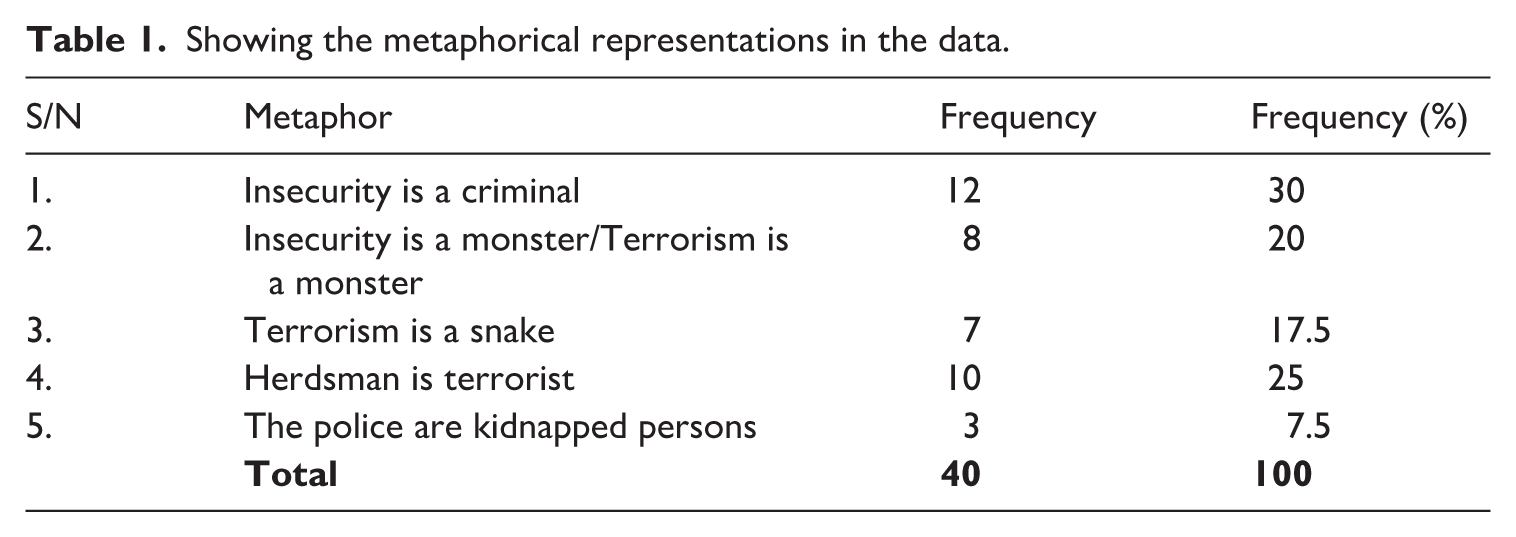
After identifying the predominant metaphors, the political cartoons whose metaphors were multimodally realised were then analysed. This is because multimodal metaphors offer a richer, more complex representation by combining different modes which allows for more nuanced and impactful meaning-making. They also leverage the interaction between different modes to create a more comprehensive and persuasive message than a single mode could convey alone (see Górska, 2018). Moreover, insecurity and terrorism are quite sensitive issues in Nigerian society. Hence, the analysis focused on multimodal metaphors in order to avoid any form of ambiguities. Only the cartoons whose target domains were verbally specified/explicitly stated were analysed in order to unmask the pattern of insecurity in Nigeria. Two political cartoons are used to exemplify each of the four metaphorical conceptualisations even though reference is made to other cartoons occurring under the same metaphorical categorisation. The political cartoons are analysed qualitatively, using Forceville’s (2015) multimodal metaphor theory. The study adopts the qualitative approach because as Tay (2017) – cited in Echitchi (2025) – observes, qualitative approaches make it possible to focus on a few examples and analyse them comprehensively. Hence, each political cartoon is examined in order to interpret how the verbal and pictorial resources supply the relevant cues required in determining the source and target domains of the multimodal conceptual metaphors in the political cartoons.
Notably, insecurity and terrorism have been interchangeably used in scholarship (Obi, 2015; Omede and Omede, 2015), and this convention is followed in this study. Although the insecurity crisis in Nigeria is multifaceted, it is common to have security threats such as insurgencies, banditry, kidnapping and herders’ crisis to be represented as insecurity crises in media reports (Atai and Esetang, 2024; Ogbu, 2024). However, Boko Haram-related activities are often specifically reported as terrorism in the media (Chuku et al., 2017; Yayla and Yahaya, 2023). Thus, the two terms are interchangeably deployed in the construal of multimodal metaphors depending on how they are verbally cued in the political cartoon(s).
Analysis and discussion
In this section, we examine the patterns and functions of the various political cartoons paying attention to the verbal and pictorial resources in them, vis-à-vis how they evoke specific metaphorical conceptualisations. The metaphorical representations in the political cartoons are highlighted and discussed subsequently.
Insecurity is a criminal
One of the prevalent multimodal metaphors that can be derived from the political cartoons under investigation in this study is insecurity is a criminal. Examples are given in Figures 1 and 2.
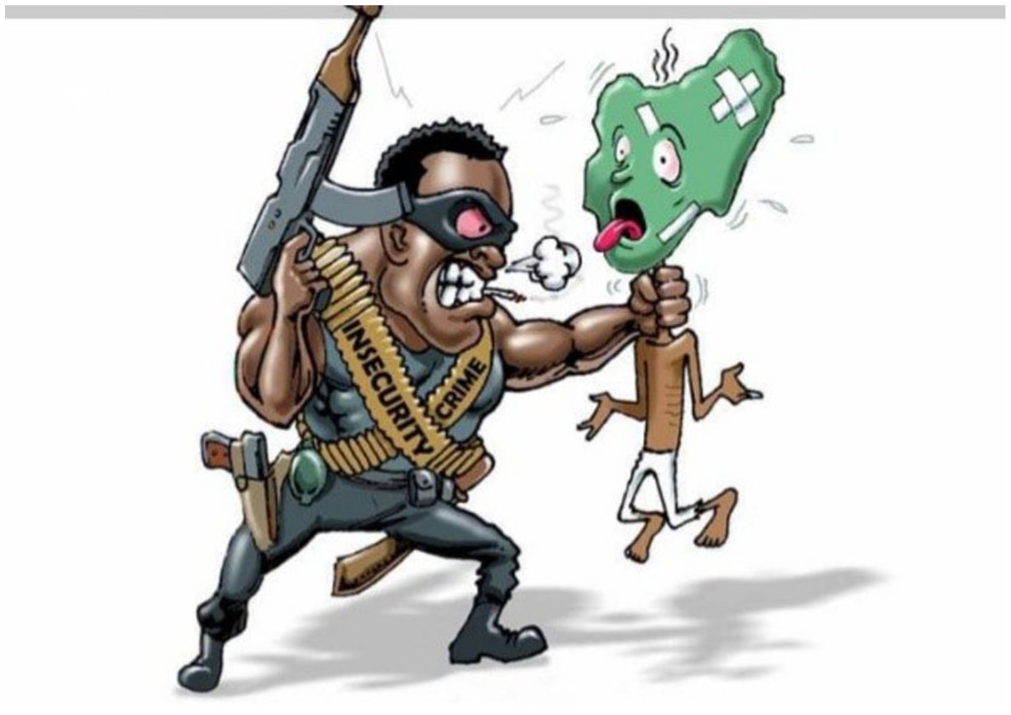
Insecurity.
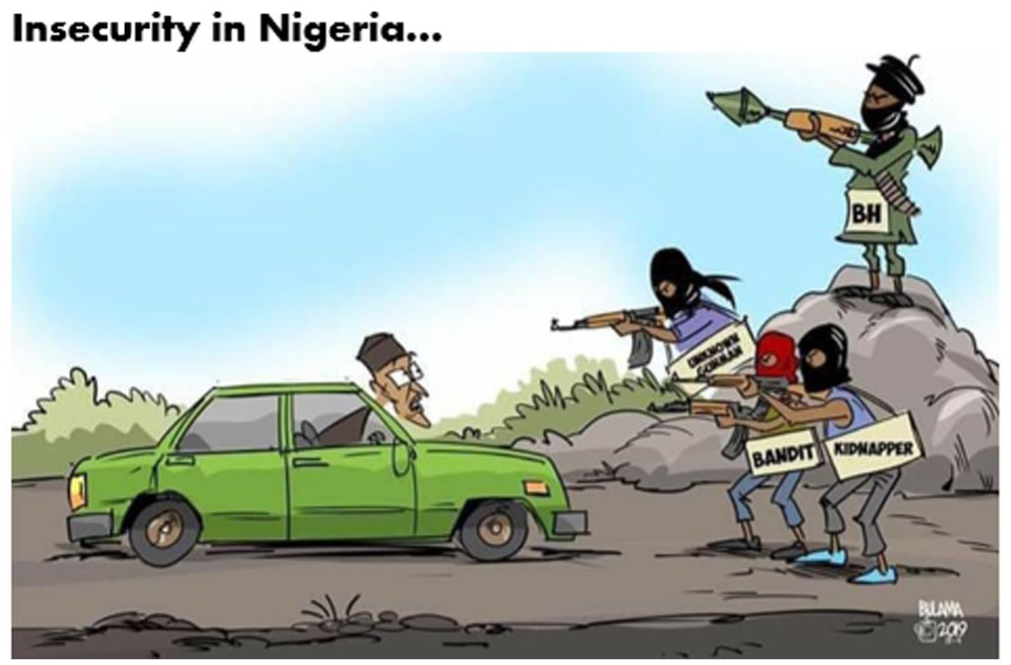
Insecurity in Nigeria.
Figure 1 exposes the overwhelming and dangerous nature of Nigeria’s insecurity crisis. This is pictorially represented by the imposing stature of the personality wearing two bullet-carrying belts. These belts are labelled crime and insecurity. The visual composition of this huge personality evokes a sense of criminality. Thus, the multimodal metaphor of INSECURITY IS A CRIMINAL can be construed in Figure 1. The target domain is verbally cued in INSECURITY while the source domain criminal is pictorially cued in the masked face, bullet-bearing belts and firearms; and verbally cued in crime. En passant, Figure 1 constructs a monomodal metaphor (via personification) of NIGERIA IS A PERSON. The target domain of this metaphor is pictorially cued in the map of Nigeria painted in green and dotted with white icons, suggesting the Nigerian national colours: green and white.
The map and colours green, white and green of the Nigerian flag are, arguably, sociocultural markers of the Nigerian identity. The depiction of the colours of the Nigerian flag also represents the FLAG FOR COUNTRY metonymy (see Zhang and Forceville, 2020). The source domain of the monomodal metaphor is visually cued in the person confronted by the personality labelled insecurity. Through the uneven sizes of the represented participants in Figure 1, the text producer portrays the insecurity challenge as bigger than Nigeria itself. It also projects Nigeria as endangered. This is reinforced by the bandaged head of the diminutive creature as well as the stuck-out tongue. Through Figure 1, the political cartoonist not only emphasises the pervasiveness of insecurity in Nigeria but also articulates that, if the situation is not checked, Nigeria may be on the verge of being strangulated by its unending insecurity crisis.
Figure 2 also construes the multimodal metaphor: INSECURITY IS A CRIMINAL. The target domain is verbally cued in insecurity. The source domain criminal is pictorially cued in masked faces and bearing of firearms. In Figure 2, the political cartoonist illustrates the multidimensional manifestations of insecurity in Nigeria and the vulnerability of government and the people. This is reinforced by the terrified look on the face of the confronted participant, which is a caricature of former President Buhari. As president, Buhari represents the Nigerian government and its people. Thus, this is a metonym of the PRESIDENT FOR COUNTRY variety. Furthermore, Figure 2 draws on the journey metaphor (Zhang and Forceville, 2020). This is represented by the image of the car (painted in green which is one of Nigeria’s national colours) and Buhari (Nigeria’s former president) as the driver. The car is being stopped by an array of security threats. This reiterates the helplessness of the Nigerian government and the overpowering nature of Nigeria’s insecurity challenges. Thus, the cartoon portrays insecurity challenges as an “impediment” (Forceville, 2016: 2), i.e., a clog in Nigeria’s wheel of progress, and exposes the danger that the insecurity crisis poses to Nigeria(ns). The multimodal metaphor of INSECURITY IS A CRIMINAL is quite predominant in the data. In another cartoon, which is not shown in the article because the target domain is not verbally rendered and to avoid repetition, insecurity is visualised as a masked and gun-bearing man trying to harass some school children (represented as wearing uniforms). This cartoon foregrounds the vulnerability of school children to banditry and further suggests that Nigerians, both young and old, are exposed to the menace.
Terrorism is a snake
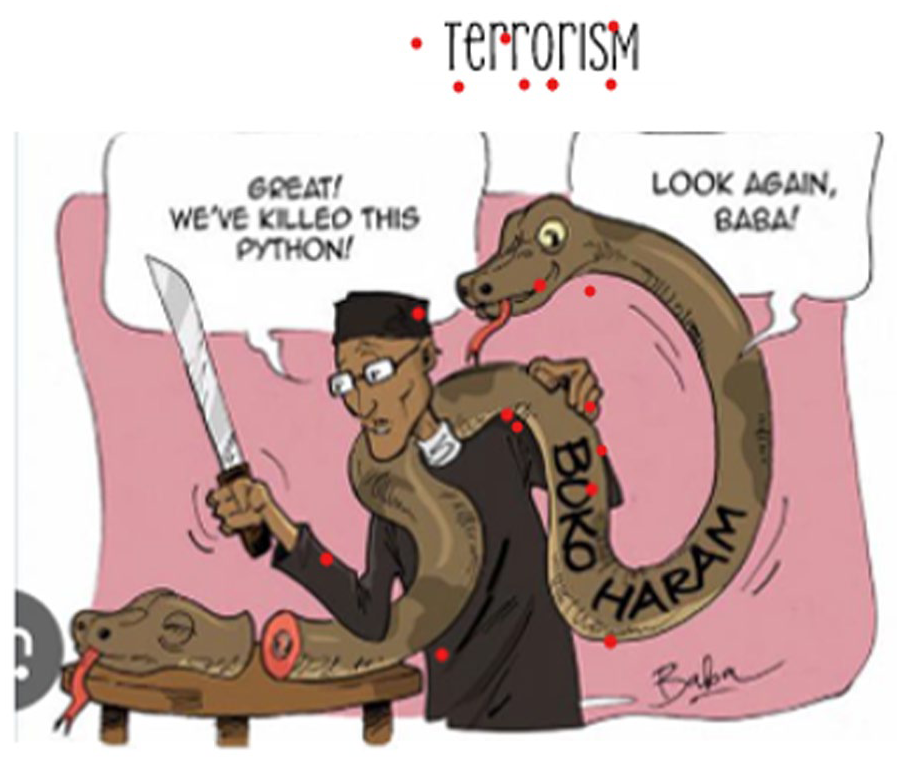
Terrorism is a snake is another multimodal metaphor constructed in the political cartoons under investigation in this study. This metaphorical conceptualisation is substantiated in Figures 3 and 4.
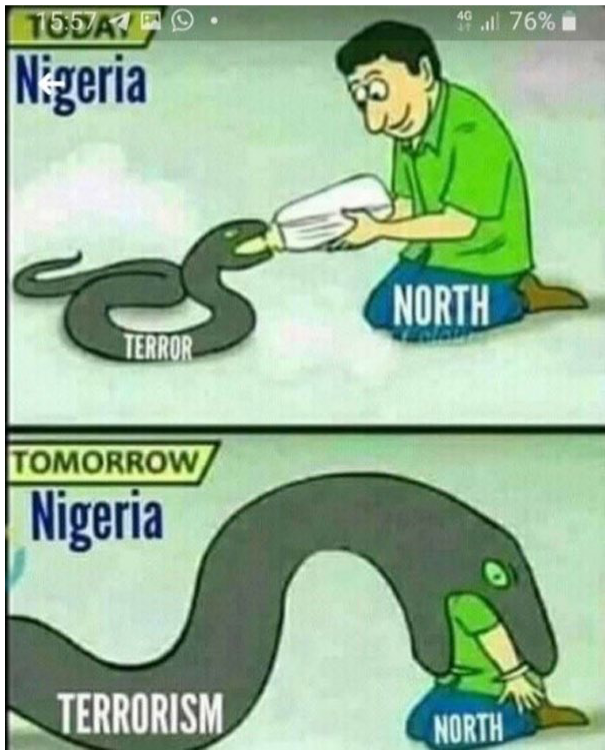
Nigeria.
Terrorism.
Figure 3 is divided into the upper and the lower picture. The text producer provides context for the cartoon by repeating the caption Nigeria on the two pictures and using, among other colours, green and white which are the two major Nigeria’s national colours. The cartoon contains the image of a serpent labelled TERRORISM and a person labelled NORTH. The person labelled north represents the entire northern Nigeria and is a metaphor via personification of the NORTH IS A PERSON. In the first picture, the cartoonist foregrounds the complicity of Northern Nigeria in the festering of terrorism in the region. This is actualised by the way the man is projected feeding the serpent like a pet. Notably, Figure 3 portrays the progression of terrorism in Nigeria. This is reinforced in its layout which is designed in such a way that salience is given to the man in the first picture while salience is given to the serpent TERROR(ISM) in Figure 2. Terrorism is represented in the image as an issue that initially appeared harmless but later metamorphosed into a devourer. The progress of terrorism in Nigeria is further captured by the labels TODAY and TOMORROW on the first and second pictures, respectively.
In Figure 3, verbo-pictorial metaphors are employed to express the creepy nature of terrorism in Nigeria. Hence, the multimodal metaphor: TERRORISM IS A SNAKE can be formalised from this political cartoon. The target domain is verbally cued in terrorism while the source domain is pictorially cued in the images of snakes in Figures 1 and 2. A snake is a poisonous and deadly animal. Thus, mapping the connotations of snake onto the target domain consolidates the terrifying nature of terrorism in Nigeria and exposes Nigerians’ perception of their country as unsafe. Remarkably, Figures 3 and 4 draw on animal metaphor (Eggertsson and Forceville, 2009). This is evident in the images of snakes and the representation of prey and predator (Echitchi, 2025), especially in Figure 3 where Northern Nigeria is portrayed as the prey, and terrorism (snake) is the predator. Indeed, northern Nigeria is the most terrorised part of the country (see Umar, 2017). Figure 4 also constructs the multimodal metaphor of TERRORISM IS A SNAKE. The multimodal metaphor in Figure 4 is expressed in a similar way as Figure 3. The target domain terrorism is verbally rendered. This is buttressed by another verbal resource Boko Haram. Boko Haram is an Islamic extremist group in Nigeria. It was declared a terrorist group by the US Department of States in 2013. The source domain is pictorially cued in the image of a snake and verbally rendered as python. Figure 4 reiterates the obdurate nature of terrorism in Nigeria. In the cartoon, Former President Buhari is pictured chopping off the head of the snake at one end. However, while the snake’s head is being chopped off, it has grown another head at the other end. This buttresses the hydra-headedness and pervasiveness of terrorism in Nigeria. Another cartoon metaphorizing TERRORISM IS A SNAKE, which is not presented here, depicts how a python labelled Boko Haram attempts to swallow the international intervention “African Union plans” that is intended to curtail it. This cartoon, like the others in the category, depicts the cartoonists’ perception of insecurity in Nigeria as intractable.
Insecurity is a monster/Terrorism is a monster
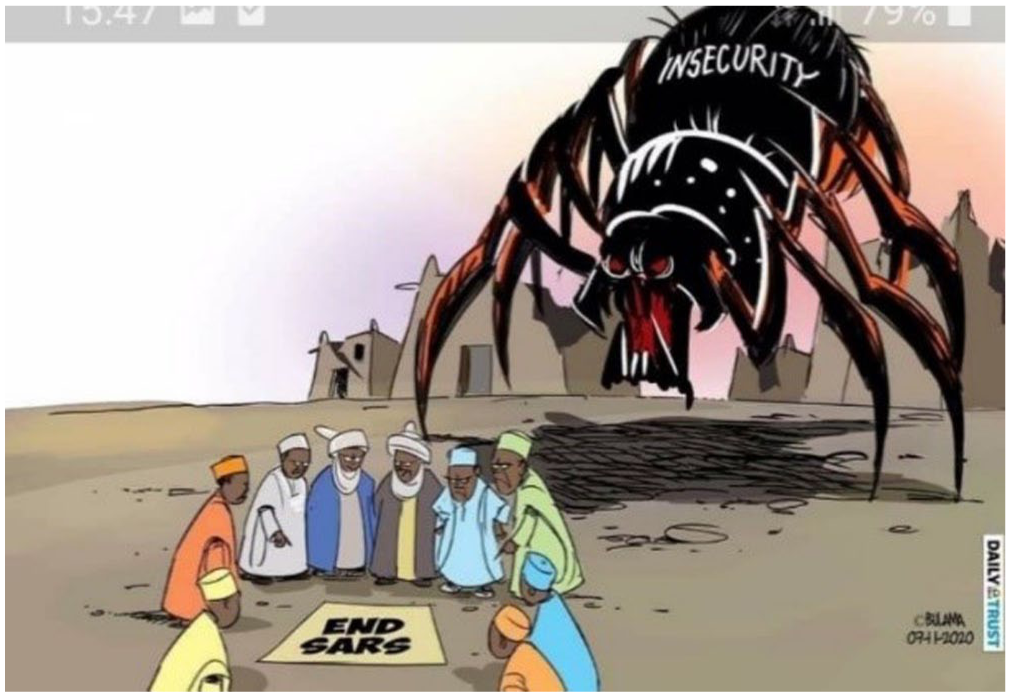
Figure 5 is another political cartoon used in exposing the monstruous impact of insecurity in Nigeria.
Insecurity and Endsars.
Figure 5 comprises both verbal and pictorial resources. The monstruous creature functions as the source domain that metaphorizes the target domain, insecurity. Apart from the large creature, there are also images of some men surrounding a poster with the inscription END SARS. Dressing, as a cultural element, enhances the interpretation of Figure 5 (see Achebe, 2008). The dress icons on the men in the image suggest that they are from northern Nigeria. The conceptual metaphor of INSECURITY IS A MONSTER can be construed in Figure 5. The target domain is verbally rendered as insecurity. The source domain monster is pictorially specified (Bounegru and Forceville, 2011) by the intimidating creature portrayed in the political cartoon. Several negative connotations can be mapped from the source domain including causing horror, fright, terror or evil. Figure 5 not only highlights the pervasiveness of insecurity in Nigeria, but also consolidates the position that Nigeria, especially the northern region, is unsafe, in terms of security of lives and property (Usman and Singh, 2021).
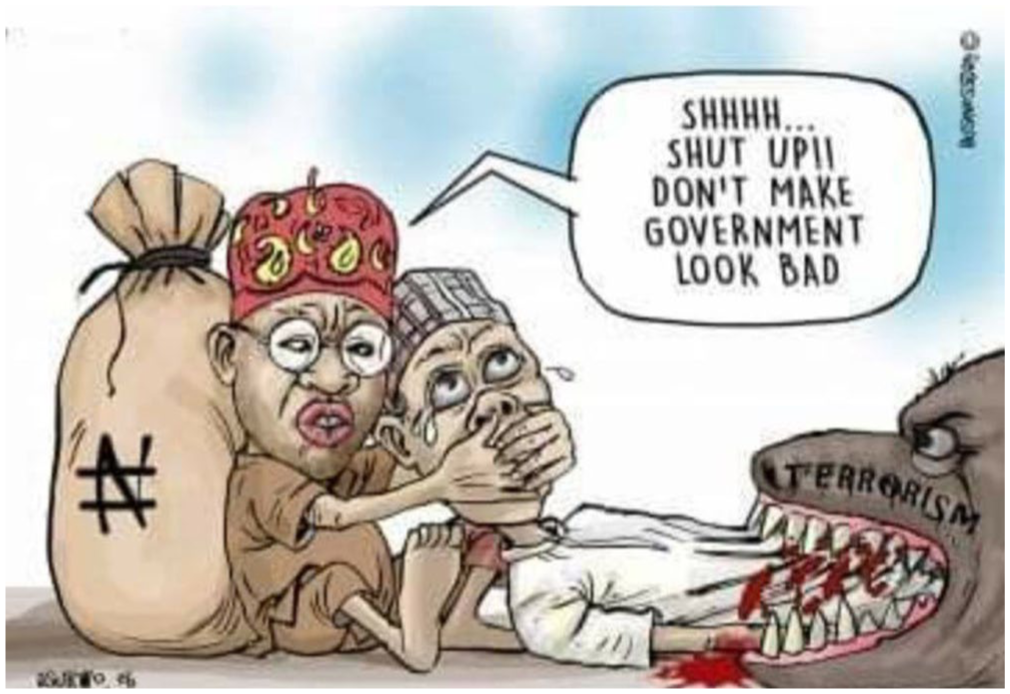
Figure 6 exposes the politicisation of Nigeria’s insecurity crisis. Despite the pervasiveness of insecurity and terrorism in Nigeria, the cartoonist believes that the Nigerian government is not showing the required commitment to executing pro-people policies that could improve the security situation in the country (see also Adebomi, 2024b, 2024c, 2025). Meaning is constructed in Figure 6 through a combination of verbal and pictorial resources. The represented participants in the political cartoon are the Nigerian government on the one hand, and victims of terrorism on the other. The Nigerian government is represented by Nigeria’s former Minister of Information, Lai Muhammed, who is symbolised by his signature cap, which is well known among the target audience (Nigerians). The minister of information represents the Nigerian government in this political cartoon because he is constitutionally recognised as the spokesperson and image maker of government. Thus, this is a metonym of the PERSON STANDS FOR ORGANIZATION variety. Through the political cartoon, the text producer substantiates that corruption and politicisation inhibit the ability of Nigerian government to nip terrorism in the bud. This is actualised through the salience of the bag load of money represented by the Naira (₦) symbol hidden behind the government representative. This further suggests that, rather than deploy the necessary financial power required to combat terrorism, the government prefers to divert the funds at the expense of the lives of the citizens (see also Adebomi, 2020a, 2020b). The complacent disposition of the Nigerian government to terrorism is reiterated by the gesture of blocking or securing the money bag by the government representative, despite the uncomfortable position of the represented victim of terrorism. This is corroborated by the verbal resource ‘Shut up!!’ Commanding the victim of terrorism to shut up despite their pains exposes the unequal social relations (Adebomi, 2024d) between the Nigerian government and the governed, and especially the suppressed status of terrorism victims. This also presents an instance of situational irony (Achebe, 1991) where there is a gap between the people’s expectation and government’s reaction towards insecurity. The multimodal metaphor of TERRORISM IS A MONSTER can be construed in Figure 6. The target domain is verbally specified in terrorism. This political cartoon also draws on the animal metaphor represented in the way the predator terrorism systematically (visually) devours its prey. The source domain monster is pictorially cued in the monstrous figure. Thus, Figure 6 exposes the pervasive (monstrous) stature of terrorism, the helplessness of victims of terrorism (Nigerians) and Nigerians’ perception of the country as unsafe. The metaphorical conceptualisation INSECURITY IS A MONSTER is the third predominant category in the dataset. Another cartoon which falls under this category but is not shown in this article to avoid unnecessary repetition verbally specifies insecurity and nepotism among the components of a (visualised) monster terrorising the Nigerian electorate.
Shut up!
Herdsman is terrorist
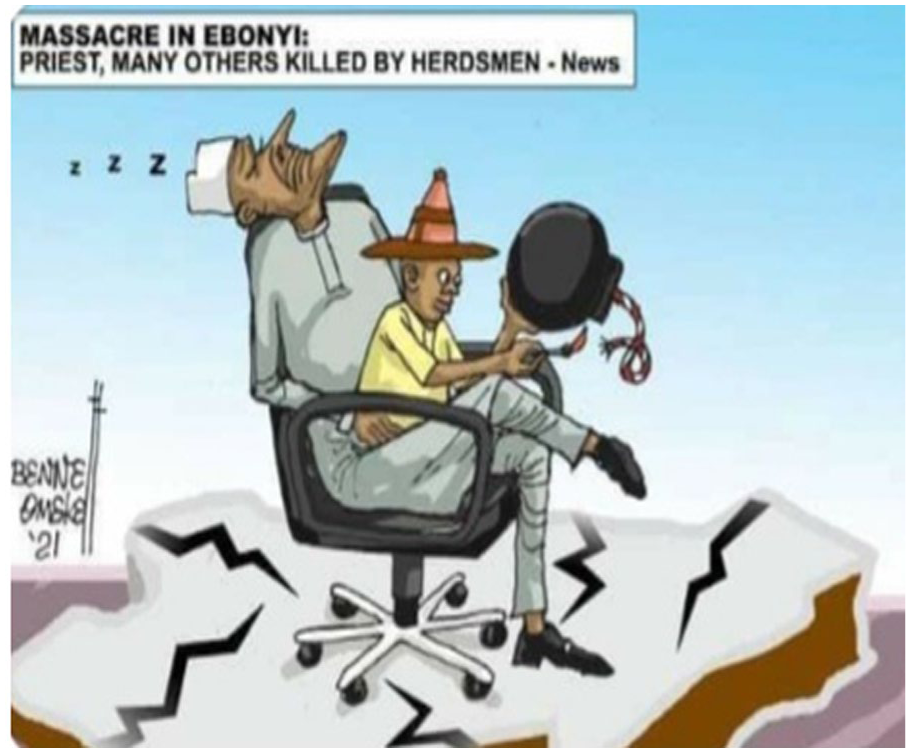
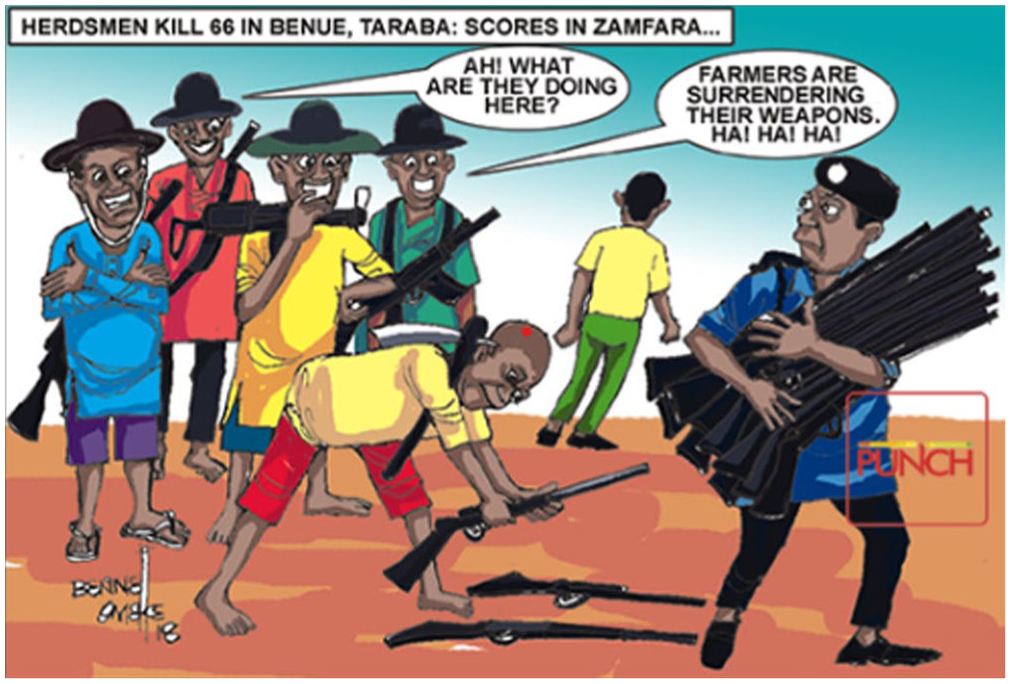
Unlike in the preceding section where the target domain is insecurity or terrorism (depending on how it is verbally rendered in the political cartoon), the target domain, as metaphorized by the cartoonists in Figures 7 and 8, is herdsmen. In these figures, the cartoonists spotlight the supposed complicity of herdsmen in Nigeria’s insecurity crises. Cultural resources such as dressing and caps play significant roles in the interpretation of these cartoons.
Massacre in Ebonyi.
Herdsmen kill 66.
Figure 7 presents a caricature of former Nigeria’s president Muhammadu Buhari placing a supposed herdsman (represented in the image by his signature cap) on his lap. Buhari is also pictured sleeping while Nigerians were being massacred. This cartoon emphasises the belief that the former president was complacent about Nigeria’s insecurity crises. By exploring the verbal and pictorial resources in Figure 7, the multimodal metaphor of HERDSMAN IS TERRORIST (protected as a young child) can be construed. The target domain herdsman is verbally cued in herdsmen and pictorially in the image of the young herder on Buhari’s lap. The source domain, terrorist, is a verbally cued massacre which has a connotation of terrorism.
Figure 8 also exposes the perceived hypocrisy of the Nigerian government towards securing the lives and property of the citizens. In Figure 8, the cartoonist deploys irony to expose one of the political complexities and contradictions in post-colonial Nigeria (see Achebe, 1991). In this cartoon, the government focuses on disarming farmers while it allows herdsmen (represented by their signature caps) to retain possession of their firearms. Figure 8 substantiates the metaphorical conceptualisation HERDSMAN IS TERRORIST. This metaphor is verbo-pictorially realised. The source domain “terrorist” is verbally specified in the kill(ing) of scores of people and pictorially in the image of firearms. The target domain herdsman is pictorially represented in the image of herdsmen bearing ammunitions and verbally in herdsmen. The conceptual (multimodal) metaphor HERDSMAN IS TERRORIST is predominant in the data for this study. In one of the cartoons under this metaphorical categorisation which is not analysed because the target domain is not explicit, former President Buhari is portrayed as focusing on other things while perceived herdsmen hold ordinary people (Nigerians) hostage. The cartoonist portrays the former president as saying: “I am not aware if these are criminal bandits or non-criminal bandits” in this cartoon.
The author of this article understands that ethnic essentialisation aggravates, rather than placates, insecurity challenges in African societies and specifically in Nigeria. Thus, it is worth mentioning that the metaphorical categorisation HERDSMAN IS TERRORIST is not intended to reproduce the stereotypical representation of any ethnic group in the country but to consolidate the argument, highlighted in the other political cartoons analysed in this study, that Nigerians view their country as terrorised and unsafe, and that cartoons are employed as viable tools for socio–political resistance. This clarification is necessary because herding is commonly associated with a specific ethnic group in Nigeria.
Observations and conclusion
This article has examined the way multimodal metaphors in internet political cartoons frame Nigeria’s insecurity crisis. It has also examined the patterns and functions of the metaphors in the selected internet political cartoons. A total of 40 insecurity-themed political cartoons, drawn from digital platforms, were analysed qualitatively using aspects of Forceville’s (2015) multimodal metaphor theory. Drawing on this theory, the study is able to identify and interpret four prevalent multimodal metaphors underlying the selected political cartoons. These are: INSECURITY IS A CRIMINAL; TERRORISM IS A SNAKE; INSECURITY OR TERRORISM IS A MONSTER and HERDSMAN IS TERRORIST. The analysis revealed a “convergence” (Bouko et al., 2017: 32) in the patterns of the cartoons which is the perception of insecurity and terrorism as horrendous. The target domains: insecurity and terrorism, are verbalised in the cartoons exemplifying the first three of the metaphorical categorisations to draw attention to the precarious state of insecurity in Nigeria. The source domains are represented in different formats – visually and verbo-pictorially – to give room for ample illustration of the dangers of insecurity and terrorism.
The study also draws on the journey metaphor (to portray insecurity and terrorism as impediments to Nigeria’s progress) and animal metaphors not only to expose the dangers of insecurity and terrorism in Nigeria but to portray Nigerians as prey. Furthermore, the study reveals the manifestation of metonymies such as FLAG FOR COUNTRY; PRESIDENT FOR COUNTRY and PERSON FOR ORGANISATION which aid the formalisation of the multimodal metaphors. The findings reveal that the multimodal metaphors frame Nigeria’s insecurity crisis as pervasive. This is in alignment with extant studies, such as Abdel-haleem et al. (2022), Stuart and Wilkenfeld (2022) and Forceville and Van de Laar (2019), which affirm that metaphors are highly efficient means to present a specific perspective on (political) events in the world, and the emotions and attitudes inherent in that perspective.
As the present study has shown, metaphors are deployed as tools to express concerns about the state of insecurity in Nigeria, vis-à-vis its impact on the helpless citizens who are on the verge of being devoured by the threat. The metaphorical conceptualisations are also utilised to express dissatisfaction about the seemingly complacent and complicit disposition of the Nigerian government and stakeholders to the monstrous issue. What, then, does Nigeria’s visual satire teach us about global insecurity discourse? It teaches that insecurity is a threat to peaceful (inter)-national co-existence. What does the visual analysis illuminate about the relationship between humour and political trauma? It shows that cartoons, which sometimes appear as humorous, are a means of socio-political resistance. What does visual satire teach us about the citizen’s attempt to render chaos legible? It teaches us that, when citizens are beleaguered, social disorder is inevitable. With the palpable fear that now engulfs many Nigerians as well as the multiplication of insecurity-induced socio-political and economic challenges in Nigeria, this study concludes that the Nigerian government and political class have crucial roles to play in managing Nigeria’s insecurity crisis and that intervention should be expedited.
Footnotes
Acknowledgements
I acknowledge the Alexander von Humboldt Foundation for graciously sponsoring my postdoctoral research stay in Germany. I am also thankful to Professor Dr. Robert Fuchs for hosting me both in Hamburg and Bonn. My research stay in Germany enabled me to commence and complete this study. I am also grateful to the reviewers of my manuscript for their very useful suggestions.

Funding
The author received no financial support for the research, authorship, and publication of this article.
Declaration of conflicting interests
The author declared no potential conflicts of interest with respect to the research, authorship, and publication of this article.