






Abstract
This study conducts an ideological content analysis of the representations of Hamas leader Yahya Sinwar in Israeli media during the “Iron Swords” war, commencing after the October 7, 2023, massacre. Sinwar evolved from a militant leader into a mythologized national obsession, personifying the enemy for the Israeli public. Analyzing news, commentary, and satire, this article identifies three dominant archetypes used to construct his image: the Barbarian/Messianic Zealot, the Shadow, and the Mouse. Interpreted through the lenses of Barthesian myth, Orientalism, and Jungian psychology, these representations appear as potent ideological constructs rather than neutral descriptions. The “Barbarian” established a moral binary between civilized Israel and a monstrous “other,” while the “Shadow” personified the elusive, subterranean threat of the tunnels. Most critically, the “Mouse” trope served to dehumanize Sinwar, utilizing a disturbing inversion of historical anti-Semitic rhetoric to frame him as vermin requiring extermination. The study concludes that these myths fulfilled essential social functions during profound trauma: simplifying complex realities, justifying aggressive military action, and forging national unity. Ultimately, the media reinforced the dominant national mindset, mythologizing the enemy in a manner that aligned with the emotional needs of a society in crisis.
Keywords
Introduction
The morning of October 7, 2023, marked a cataclysmic turning point in Israeli history. As Saposnik (2024) observes, this event represents an unprecedented “rupture” that has fundamentally challenged the existing paradigms within Israel Studies, forcing an academic re-evaluation of the state’s security, social, and psychological foundations. The coordinated, multi-pronged attack led by Hamas from the Gaza Strip resulted in the largest massacre of Jews since the Holocaust, the kidnapping of hundreds of civilians and soldiers, and the shattering of Israel’s long-held sense of security and military invincibility (BBC News, 2023; Times of Israel, 2023). As Moghadam and Marco (2025) argue, the October 7 attacks represent the signature event of a new “Maturation Period” in the study of terrorism. This era is characterized by “ultraviolence”—wanton excesses involving sexual violence and atrocities designed to be live-streamed and broadcast to global audiences. The ensuing conflict, officially named the “Iron Swords” war, plunged the nation into profound shock, grief, and existential anxiety (Katz, 2023). Amid this national crisis, the Israeli media and public consciousness fixated on a single individual as the personification of this new, terrifying reality: Yahya Sinwar, the leader of Hamas in Gaza.
Sinwar, a founder of Hamas’s military wing and the man widely credited with conceiving and orchestrating the October 7th attack (Reuters, 2023), was no stranger to the Israeli security establishment. However, in the aftermath of the massacre, his figure metastasized in the public imagination. He became more than a terrorist leader; he transformed into a symbol, a mythic figure onto whom the nation’s fear, rage, and desire for vengeance were projected. This process was not merely a byproduct of reporting but an active construction of a “compound threat” (Moghadam and Marco, 2025), in which the individual leader simultaneously embodies a social movement, a criminal organization, and a government. The Israeli media’s coverage of Sinwar became relentless, bordering on obsessive. Every news broadcast, newspaper column, and political discussion seemed to revolve around him: his psychology, his whereabouts in the labyrinthine tunnels beneath Gaza, and the all-consuming national goal of his elimination. This obsessive focus was cultivated within a unique professional environment. In the initial weeks following the disaster, the Israeli media navigated a complex terrain, attempting to balance the duty of factual reporting with a perceived national necessity to bolster collective resilience and unity (Karniel and Lavie-Dinur, 2024). This strategic pivot toward national morale often resulted in the media functioning as a psychological anchor for a traumatized public, where the construction of a singular, mythologized enemy served to simplify the chaos and provide a tangible target for the nation’s grief and resolve. As the Israeli government defined the war’s primary objectives as the destruction of Hamas’s military and political capabilities, and the return of the hostages, the hunt for Sinwar became a synecdoche for the war itself. His capture or death was framed as the ultimate symbol of victory, the necessary catharsis for a traumatized nation. This intensive media focus continued unabated until his reported killing by the Israeli army on October 17, 2024.
This intense media preoccupation makes the study of Sinwar’s representations a matter of critical importance. As Katz (2023) and others (see, for example, Avraham et al., 2004) in the field of Media Studies have long established, media representations are not merely passive reflections of reality. They are active constructions, imbued with ideology, that shape public perception, influence political discourse, and fulfill crucial social and psychological functions. In times of war, these functions are magnified. The media becomes a central arena for defining the enemy, justifying state action, and mobilizing public support. The way an enemy leader is framed can either humanize or dehumanize them, rationalize or complicate the conflict, and unite or divide the public. However, this process is not without its internal critics. As journalist Rogel Alpher (2024) scathingly wrote in his article “Yahya Sinwar was a lot of terrible things, Mickey Mouse was not one of them,” the Israeli media during the war often abdicated its journalistic role in favor of becoming a propaganda tool, engaging in a form of “general hypnosis.” Alpher’s critique provides a vital lens for this study, suggesting that the creation of Sinwar’s myth was not an accidental byproduct of reporting but a deliberate, if perhaps subconscious, ideological project.
The media coverage of war and terrorism constructed the image of the enemy as a tool for coping with the war and creating integration, and a means to cope with the situation. In previous such situations, the Israeli media used the holocaust and the revival of Israel as the core story to ensure the resilience of the society and faith in its future. The media also emphasized the IDF’s revenge whenever rescue or protection failed (Nossek, 1994). The portrait of the enemy can help encourage revenge, with Sinwar as the main enemy in Gaza. The 7th October 2023 attack by Hamas opened a rift in the story, and the media mobilized to close it.
Despite the extensive existing literature on the framing of enemies in wartime media, there remains a critical gap in understanding how media systems in democratic states regress to primal, archetypal mythmaking in the wake of sudden, catastrophic trauma. While previous studies have addressed the political stereotyping of enemy figures, this research highlights the originality of examining a specific psychological rupture where standard political framing completely collapses. Considering this, the study seeks to deconstruct the symbolic universe surrounding Yahya Sinwar in the Israeli media. It addresses two primary research questions:
How and in what ways was Yahya Sinwar represented in the Israeli media during the “Iron Swords” war?
What were the social and psychological roles of these representations for Israeli society during this period of crisis?
To answer these questions, this article will conduct an ideological content analysis of prominent media texts. It will argue that the Israeli media constructed Sinwar through a series of powerful, overlapping archetypes—the Barbarian, the Shadow, and the Mouse. These representations, while seemingly descriptive, were deeply ideological. They served to create a clear moral binary, manage collective anxiety by giving it a face, dehumanize the enemy to make extreme violence permissible, and ultimately reinforce a national consensus that supported the war effort. This process of mythologization, this article contends, reveals more about the mindset and psychological needs of Israeli society in a moment of crisis than it does about the historical figure of Yahya Sinwar himself. The article will first outline the theoretical framework guiding the analysis, then detail the methodology employed, and finally present the key findings. The discussion section will then synthesize these findings and explore their broader implications, including the troubling historical echoes of the “mouse” trope. Finally, the conclusion will summarize the study’s contribution and suggest avenues for future research.
Theoretical framework and literature review
To understand the complex process by which Yahya Sinwar was represented in the Israeli media, it is necessary to draw upon several interconnected fields of thought: media studies, postcolonial theory, psychoanalysis, and cultural anthropology. This framework allows us to move beyond a surface-level description of media content to a deeper analysis of its underlying ideology and social function. By weaving these theories together, this study situates itself within the contemporary scholarship of critical discourse analysis and the mechanics of wartime dehumanization.
Media, ideology, and the construction of reality
The foundational premise of this study is that media texts are not transparent windows onto the world but are, as Hall (1997) argued, sites where meaning is actively produced and contested. Media “representation” is a formative process that shapes our understanding of events, people, and social groups. In times of domestic conflict, media coverage tends to support national goals, acting as a source of “national integration” (Karniel and Lavie-Dinur, 2024). This process is inherently ideological. Ideology, in this context, refers not to a set of false beliefs but to the framework of concepts, images, and narratives through which a society makes sense of the world, and which typically reproduces the interests of dominant social groups (Althusser, 1971). Althusser’s concept of “Ideological State Apparatuses” is highly pertinent here; it explains how the media, even when privately owned, often functions in tandem with state security apparatuses during crises to foster a unified, hegemonic worldview.
During wartime, the ideological function of the media is particularly pronounced. As argued by Herman and Chomsky (1988) in their propaganda model, media outlets, even in democratic societies, often operate within a framework that aligns with the interests of the state, especially in matters of foreign policy and national security. Rather than acting as objective watchdogs, journalists often internalize national security priorities, sourcing their narratives heavily from military elites. The enemy is consistently framed in ways that justify the nation’s cause and delegitimize the opponent. This aligns with the PMP (Politics–Media–Politics) model, suggesting a cyclical interaction where politics influences media coverage, which in turn shapes political outcomes (Tani-Yildiz and Tam, 2026). This is achieved through various mechanisms of “framing” (Entman, 1993), where certain aspects of a story are selected and made more salient to promote a particular interpretation, evaluation, or solution. The framing of an enemy leader like Sinwar is therefore not an objective act but a strategic one, designed to mobilize public opinion and solidify a national narrative.
Contemporary literature on media and conflict emphasizes the specific mechanism of dehumanization within this framing process. As Haslam (2006) outlines, dehumanization involves denying an outgroup uniquely human attributes (civility, morality) or basic human nature (warmth, agency), effectively reducing them to animals or automatons. Steuter and Wills (2010) further demonstrate how modern “War on Terror” media discourse heavily relies on metaphors of vermin, disease, and eradication. These contemporary studies form a vital bridge between classic propaganda models and the specific, visceral representations observed in the Israeli media landscape.
The myth of the enemy: Barthes and modern mythologies
The original text astutely references Roland Barthes’ concept of myth, which is central to this study’s analysis. For Barthes (1998), myth is a type of speech, a second-order semiological system that takes a sign (like the image of a person) and turns it into a signifier for a new, broader concept. The original sign is emptied of its historical and political complexity, and refilled with a new, ideological meaning. Barthes demonstrates how semiotics can be applied to various aspects of life, thereby revealing the prevailing ideology of Western society.
In “Myth Today,” Barthes (1998) showed how myth is constructed and used to convey bourgeois norms and values. He also shows (Barthes,1977) how to analyze different kinds of contents: Images, Music and Text to detect symbols and myth. According to autonomous approaches to culture, communication is a process by which individuals represent social reality through symbolic work. These symbolic forms are reproduced and circulated into a broader community. Myth, then, is a form of communication that is publicly produced and circulated within a culture. Sivan (1991) further defined a basic myth as a dramatic story, real or fictitious, that describes and lends meaning to the initial stages of a given human collective. Myth, according to Drummond (1984: 27), is “primarily a metaphorical device for telling people about themselves, about other people, and about the complex world of natural and mechanical objects which they inhabit”. In a synthesis of semiotic and post-structural approaches to culture, myth is a message that reproduces dominant values through stories recognized by a specific culture (Nossek, 1994).
A previous study, which employed a similar theory and method by Mandelzis (2003), demonstrated how the image of Yasser Arafat, the arch-enemy of Israel, in the Israeli Press changed after the Oslo Accords to enhance the peace process yet still captured the basic negative stereotype. The media used stereotypes and myths to reinforce societal beliefs and justify political stances. Pre-Oslo, Arafat was demonized, often compared to historical enemies of the Jewish people. Post-Oslo, he was humanized and depicted as a partner for peace. The shift in representation was driven by political changes and the need to align public opinion with government policy.
This research’s theory and empirical methodology are partially based on the same literature and build upon it. Since there was no peace process with Hamas, the expectation is that the image of Sinwar would remain negative and monstrous.
This mythologizing serves a key purpose: it naturalizes a particular worldview. By presenting Sinwar as an embodiment of pure, ahistorical evil—a barbarian, a monster—the media narrative erases the political context of the Israeli–Palestinian conflict, such as the occupation, the blockade of Gaza, and previous rounds of violence. The conflict is reframed not as a political struggle between two national movements but as a timeless, epic battle between civilization and barbarism, good and evil. This is the power of myth: it presents a culturally constructed ideology as if it were a natural, universal truth. The media’s “obsession” with Sinwar, as noted in the initial text, is a symptom of this mythologizing process, as the myth must be constantly repeated and reinforced to maintain its power.
Defining the self through the “other”: Binary oppositions and orientalism
The construction of the enemy is inextricably linked to the construction of the self. The anthropologist Claude Lévi-Strauss (1973) proposed that human thought fundamentally operates through “binary oppositions”—pairs of contrasting concepts like raw/cooked, nature/culture, and, most relevantly, us/them. This framework is not merely a linguistic tool; it performs critical ontological work. In times of crisis, the creation of a monstrous “other” is essential to preserve the psychological coherence of the “us.” By representing Sinwar and Hamas as barbaric, irrational, and fanatical, the media implicitly and explicitly constructs Israeli society as modern, rational, and civilized.
This process perfectly dovetails with what Edward Said (1978) termed “Orientalism.” Said argued that the West constructed a stereotypical image of the “Orient” (the Middle East) as exotic, despotic, and unchanging, which served to justify colonial domination. This Orientalist discourse casts the “Arab” as fundamentally different and inferior, driven by primal emotions and religious fanaticism rather than logic. Orientalism operationalizes Lévi-Strauss’s binary oppositions within a specific geopolitical power dynamic. By applying these dual theoretical lenses, we can see how the representations of Sinwar as a messianic zealot, a “butcher” acting on ancient hatreds, fit perfectly within this framework. This discourse depersonalizes Palestinians, reducing them to a monolithic, threatening mass and obscuring their legitimate political grievances and national aspirations (Bhabha, 1994).
The archetypal enemy: Jung and the projected shadow
Finally, to understand the deep psychological resonance of these representations, Carl Jung’s (1981) concept of the “shadow” is invaluable. The shadow is an archetype from the collective unconscious that represents the repressed, unwanted, and dark aspects of our personality. Because we refuse to acknowledge these traits in ourselves, we tend to project them onto others, particularly onto our enemies. The enemy becomes a convenient screen upon which we project everything we fear and despise.
Sinwar, as the “Shadow,” became the container for Israel’s deepest anxieties. He represented the chaos that lurked just beyond the border fence, the violent potential that Israelis had tried to manage and contain, and the catastrophic failure of their intelligence and security. The intense hatred directed at him was not just a reaction to his actions; it was also, in a Jungian sense, a reaction to the terrifying reality he exposed about Israel’s vulnerability and perhaps its repressed capacity for violence. By externalizing this darkness and locating it entirely within the figure of Sinwar, Israeli society could reaffirm its sense of moral purity and coherence in a moment of terrifying disorientation. The “Shadow” is a universal archetype, making it a powerful tool for enemy construction that transcends cultural boundaries. However, it found a particularly fertile ground in the specific context of the “Iron Swords” war.
Methodology
To investigate the representations of Yahya Sinwar, this study employs an ideological content analysis (Karniel and Lavie-Dinur, 2024). This qualitative method was chosen over a quantitative approach because the research goal is not to count the frequency of specific words but to interpret the deeper, often implicit, ideological meanings embedded in media texts. As described by Fairclough (1995) and Van Dijk (1998), this approach, often linked with critical discourse analysis, examines how language, imagery, and narrative structures are used to produce and reproduce systems of belief and social power. The basic premise, as cited from Katz (2023), is that media texts are never neutral; they are carriers of ideology that both reflect and shape the social and cultural context in which they are created.
Data corpus and sampling
The corpus for this analysis consists of a purposive sample of media texts produced by major Israeli media outlets between October 7, 2023, and October 17, 2024 (the date of his announced assassination). A purposive sampling strategy was used to select prominent and influential representations that were widely circulated and likely to have a significant impact on public opinion, rather than attempting to catalog every single mention of Sinwar. Crucially, the selected texts were analyzed not merely as isolated illustrative examples, but as representative mechanisms (Fairclough, 1995)—synecdoches that encapsulate the broader discursive patterns dominating the national media landscape. The selected sources span different genres to provide a holistic view of the media landscape:
Analytical procedure and validity
The analysis was conducted in three stages. First, the collected texts were systematically reviewed to identify recurring patterns, tropes, metaphors, and visual motifs used to represent Sinwar. Second, these patterns were categorized into the dominant representational frames that emerged from the data: the Barbarian/Messianic, the Shadow, and the Mouse. Third, these frames were analyzed through the theoretical lenses outlined in the previous section to uncover their underlying ideological functions and social roles. The analysis paid close attention to both textual elements (adjectives, metaphors, narrative structures) and visual elements (photographs, video footage, graphic designs).
To ensure the validity and reliability of the qualitative analysis, several established methodological strategies were employed. First, data triangulation was achieved by cross-referencing findings across disparate media formats (print, broadcast news, and satire) to confirm that the identified archetypes were truly systemic rather than outlet-specific anomalies. Second, continuous peer debriefing was used throughout the coding process, in which preliminary interpretations were discussed with academic peers specializing in media and conflict to mitigate researcher bias. Finally, a clear audit trail was maintained, linking theoretical conclusions directly back to explicit textual and visual evidence within the primary sources, ensuring transparency in the interpretive process.
Analysis of key visual representations
Visuals are potent tools in mythmaking. The following are three exemplary images that were central to the construction of Sinwar’s public persona and serve as case studies for the analysis.
Case Study 1: The Official Portrait—The Messianic Barbarian
In Figure 1, Sinwar is typically depicted looking directly at the camera with a stern, unsmiling expression. He may be wearing simple clothing, sometimes with a Keffiyeh. The background is often neutral or nondescript, focusing all attention on his face. In some versions, he is seen holding or standing near a Quran.
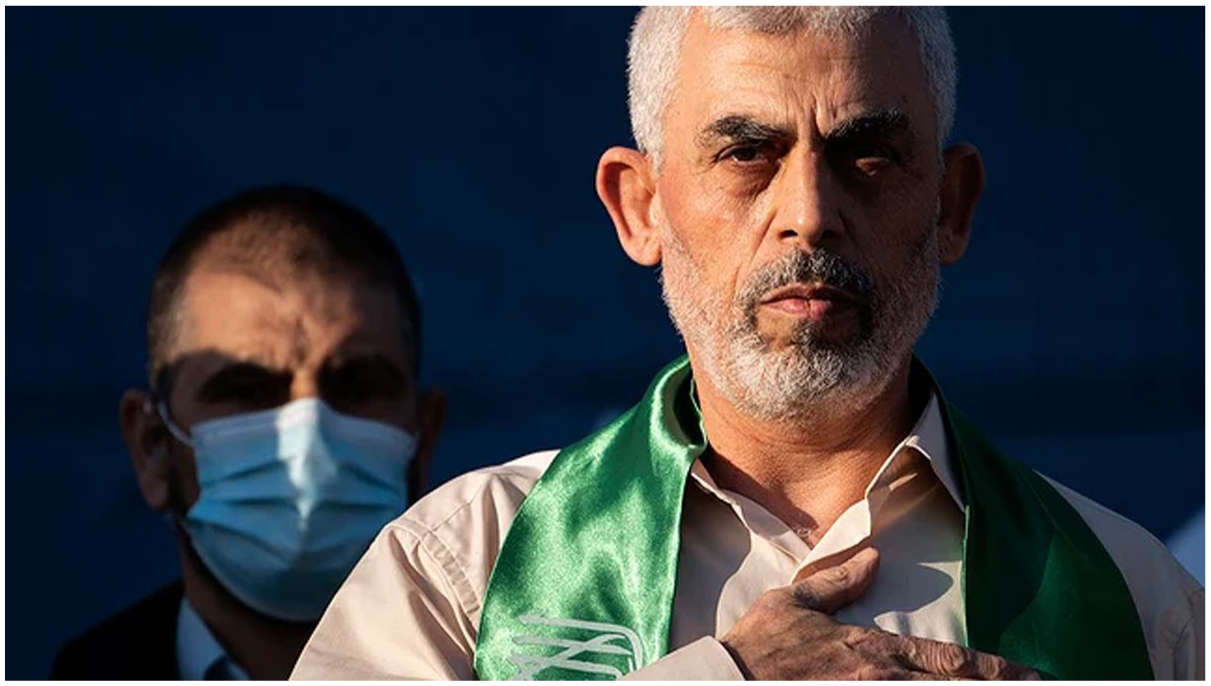
A widely circulated official Hamas or personal portrait of Yahya Sinwar.
From a semiotic perspective, this image was frequently utilized in the initial days and weeks of the war, often juxtaposed with the visceral imagery of the atrocities of October 7. The direct, unblinking gaze functions as a signifier of defiance, fanaticism, and unwavering resolve. The lack of emotion on his face is not framed by the Israeli media as stoic leadership, but rather reinterpreted as inhuman coldness—the face of a “monster.” When a Quran is included in the frame, it serves to reinforce the “messianic” or “jihadi” narrative, suggesting that religious zealotry, rather than tangible political goals, drives his actions.
This visual framing serves a distinct and powerful ideological function. It constructs Sinwar as the “Barbarian Zealot.” By emphasizing these traits, the representation effectively de-politicizes him, removing him from the realm of rational political negotiation or statecraft. The underlying message is that one cannot reason with a fanatic; one can only eliminate him. Consequently, this image assists in establishing the moral binary that is central to the war narrative: the rational, modern Israeli state versus the irrational, medieval religious fanatic. It primes the audience to view the conflict not as a territorial dispute, but as an existential clash of civilizations.
Case Study 2: The Tunnel CCTV footage—The Shadow and The Mouse
Figure 2 shows a figure identified as Sinwar, hunched over, leading what appears to be his wife and children through a dark, narrow concrete tunnel deep beneath Gaza. He is a fleeting, shadowy figure, visible for only a few seconds.
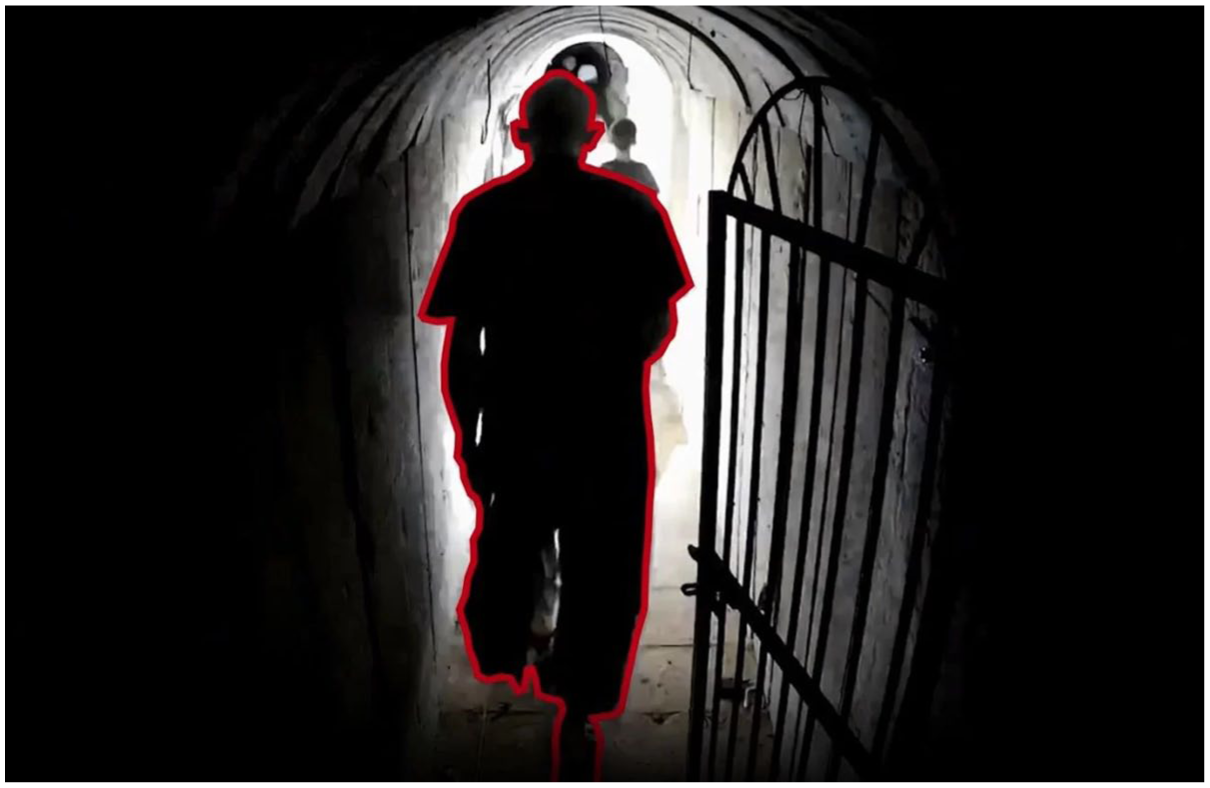
A screenshot from grainy, black-and-white CCTV footage released by the IDF in February 2024.
The semiotic analysis of this footage reveals why it was presented by the IDF and media as a significant intelligence achievement. It offered a rare glimpse of the “devil” in his “lair.” The visual quality itself is significant: the grainy, low-resolution imagery enhances his mystique, positioning him as a phantom—a “Shadow”—who lives beneath the earth. His movement, characterized by a hurried scurry through the tunnels, was almost universally described in the media using language associated with vermin. He is not depicted as walking; he is “fleeing like a rat” or “scuttling like a mouse.” Furthermore, the presence of his family does not serve to humanize him in the Israeli media narrative; instead, it is framed as a cowardly act of using them as human shields, thereby reinforcing his moral depravity.
This single piece of footage crystallized two key archetypes essential to the war’s narrative. As the “Shadow,” the footage confirmed his elusiveness and the subterranean nature of the threat, thereby justifying the destructive and brutal military campaign required to penetrate the tunnels. Simultaneously, as the “Mouse,” it powerfully dehumanized him. This metaphor reduces him from a formidable enemy leader to an animal-pest, an object of disgust to be cornered and exterminated. This dual representation makes him both terrifyingly elusive and contemptibly weak, creating a potent combination for wartime propaganda.
Case Study 3: The satirical caricature—the diminished monster
Figure 3 shows a typical caricature of Sinwar from the satirical show Eretz Nehederet. The actor portraying him often has exaggerated facial features, speaks in a guttural, primitive-sounding manner, and is depicted in a ridiculous context—for instance, complaining about the Wi-Fi in his tunnel or being outsmarted by a simple trap. He is often shown with rodent-like features, such as prominent teeth or a twitching nose.
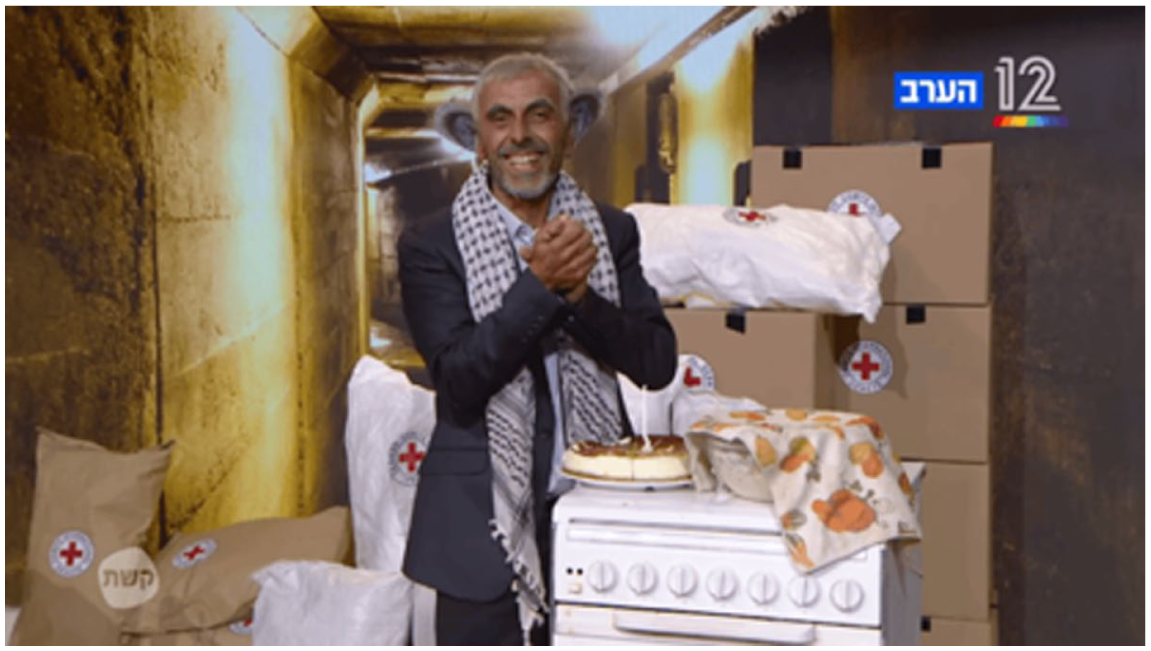
A typical caricature of Sinwar from the satirical show Eretz Nehederet.
The semiotic function of satire here is to both demonize and belittle. By portraying Sinwar as a bumbling, idiotic villain, the caricature diminishes his perceived power and makes the terrifying threat he represents psychologically manageable for the audience. The humor provides a necessary release for national anxiety. However, at the same time, the animalistic and grotesque features reinforce his monstrous and inhuman nature. The combination of mockery and demonization is a classic tool for propaganda.
Ideologically, this representation serves a crucial role in maintaining public morale. It allows the audience to laugh in the face of their greatest fear, creating a sense of superiority and control in a situation where they often feel powerless. It reinforces the “us vs. them” binary by portraying the enemy as not only evil but also pathetic and stupid. This comedic frame complements the more serious news frames, creating a comprehensive and multi-layered myth of Sinwar that is both terrifying and mockable.
Findings
The analysis of the media corpus reveals three dominant, interconnected archetypes that formed the core of Yahya Sinwar’s representation in the Israeli media: the Barbarian/Messianic Zealot, the Shadow, and the Mouse. These were not mutually exclusive but often blended to create a multifaceted, mythologized portrait of the enemy.
The Barbarian and the Messianic Zealot: Framing absolute evil
In the immediate aftermath of October 7, the primary representation of Sinwar was that of the ultimate barbarian. This frame was crucial for a nation struggling to comprehend the scale and brutality of the attack. Media language was saturated with terms that placed him outside the bonds of humanity. News commentators, military analysts, and politicians consistently referred to him as a “monster,” “a man with no God,” “the butcher of Khan Younis,” and “an animal in human form.” This language was not accidental; it was a deliberate act of moral categorization. By framing Sinwar as fundamentally inhuman, the media narrative precluded any possibility of understanding his motivations in political or historical terms (e.g., commentary by various analysts on Channel 12 News, October 10–15, 2023).
This “Barbarian” trope was frequently fused with that of the “Messianic Zealot.” Sinwar was often depicted as a religious fanatic driven by a nihilistic, apocalyptic ideology. News reports emphasized his deep involvement with the most radical wing of Hamas. They highlighted his writings from prison, which were interpreted as evidence of a deep-seated, irrational hatred of Jews. Pundits on Channel 12 and Channel 13 often spoke of his “messianic complex,” suggesting he saw himself as a modern-day Saladin destined to destroy Israel. For example, a prominent military analyst on Kan 11 stated, “You have to understand, Sinwar is not a politician. He is a ‘shahid’ [martyr] in waiting. He does not think in terms of ceasefires or two-state solutions; he thinks in terms of holy war” (Kan 11, Evening News, November 2, 2023).
This dual frame of barbarian/zealot served a vital ideological purpose. It constructed the conflict as a Manichaean struggle between the forces of light (modern, democratic Israel) and darkness (primitive, jihadist Hamas). This narrative, as explained by Orientalist theory, denies the enemy any political agency or legitimate grievance, reducing the conflict to a simple matter of eradicating an existential evil.
“The Shadow”: The elusive, omnipresent threat
As the war progressed and the ground invasion of Gaza began, a second representation came to the fore: Sinwar as “the Shadow.” With Sinwar having disappeared from public view, the hunt for him became a central narrative of the war. The media became obsessed with his location, turning the vast, unknown network of tunnels beneath Gaza into his mythological domain. He was “the ghost in the machine,” “the man in the tunnels,” “the Shadow leader.”
This representation tapped into deep-seated, universal fears of the unknown. The tunnels were consistently described as a “shadow world” or “the metro of terror,” and Sinwar was its master. News reports were filled with speculative maps and 3D graphics illustrating the supposed complexity of the tunnels, all of which reinforced the image of an unseen enemy lurking just beneath the surface. The IDF spokesperson’s daily briefings often included updates on the “closing in” on Sinwar, a narrative that built suspense and framed the war as a personal manhunt. An editorial in Yedioth Ahronoth captured this sentiment: “We are not just fighting an army; we are fighting a Shadow. Moreover, that Shadow has a name: Yahya Sinwar. Until we drag him from his subterranean kingdom into the light, this war cannot be won” (Yedioth Ahronoth, January 12, 2024).
Psychologically, this representation transformed Sinwar into the embodiment of Israel’s collective anxiety. He was the unseen threat, the source of the nation’s trauma, who could be anywhere and everywhere. As the Jungian shadow archetype suggests, he became the projection of all that was feared and repressed: vulnerability, the failure of intelligence, and the terrifying reality of a clever and determined enemy. His eventual capture or death was thus framed not just as a military objective but as a national exorcism—the only way to banish the Shadow he cast over the country.
“The Mouse”: Dehumanization and extermination
The third and perhaps most potent representation was that of Sinwar as a “mouse” or “rat.” This metaphor became ubiquitous following the release of the tunnel CC TV footage, but had been present in discourse even before. This trope functions on a visceral, biological level. Mice and rats are almost universally regarded as vermin—unclean, disease-carrying pests that infest homes and must be exterminated.
The “mouse” metaphor was deployed relentlessly. Politicians promised to “smoke the rat out of his hole.” Newspaper headlines read, “The Mouse in the Labyrinth.” Satirical sketches on Eretz Nehederet depicted him with a twitching nose and an obsession with cheese (Eretz Nehederet, February 20, 2024). This dehumanizing language was not subtle; it was a blunt instrument of propaganda. It strips the subject of all human qualities—dignity, intelligence, and even the right to life. A mouse is not a political opponent to be defeated; it is a pest to be trapped and killed without moral compunction. A columnist for Israel Hayom wrote, “Chasing Sinwar is not a negotiation with a leader. It is pest control. You do not reason with a rat infestation; you eradicate it” (Israel Hayom, March 5, 2024).
This representation provided a powerful moral justification for the immense destruction wrought upon Gaza during the hunt for him. If Gaza’s tunnels were merely a “rat’s nest” and Sinwar its “chief rat,” then turning vast areas into rubble was not an act of war against a civilian population but a necessary act of fumigation. The “mouse” trope completed the process of mythologization by reducing the architect of Israel’s most significant trauma to a loathsome and contemptible creature, whose violent end was not only desired but morally required.
Nuances across media genres and outlets
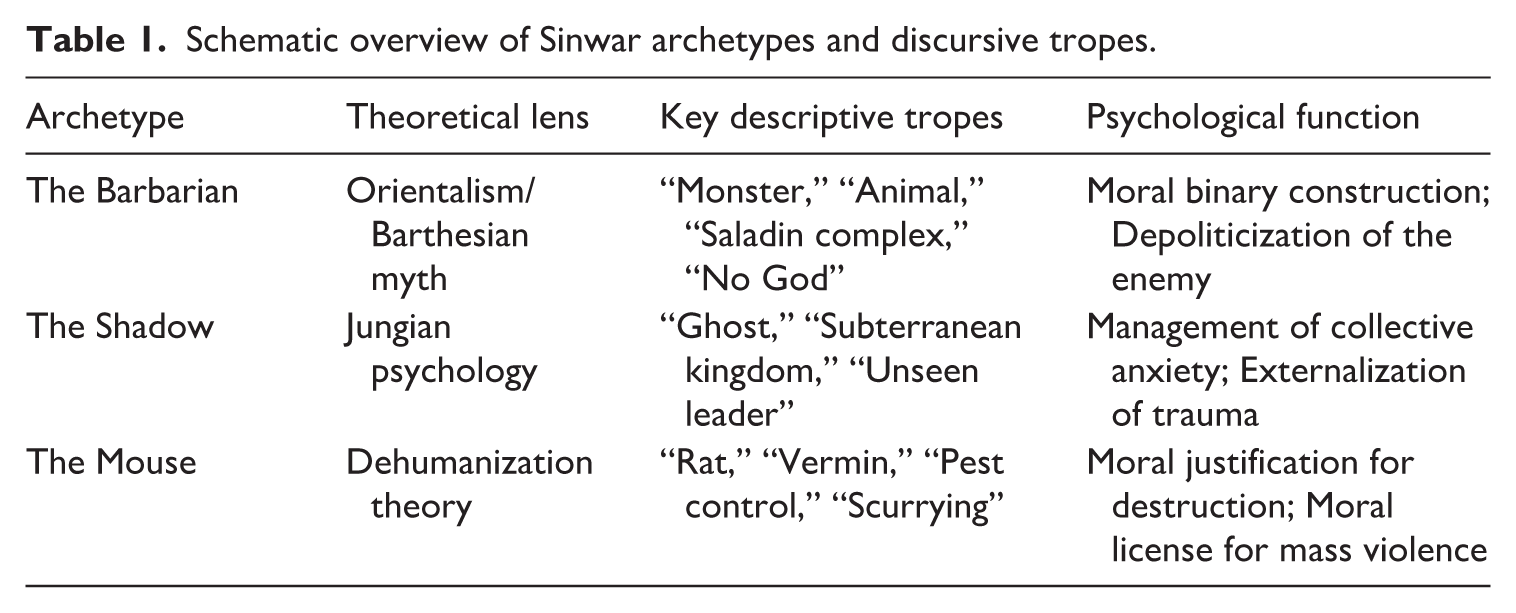
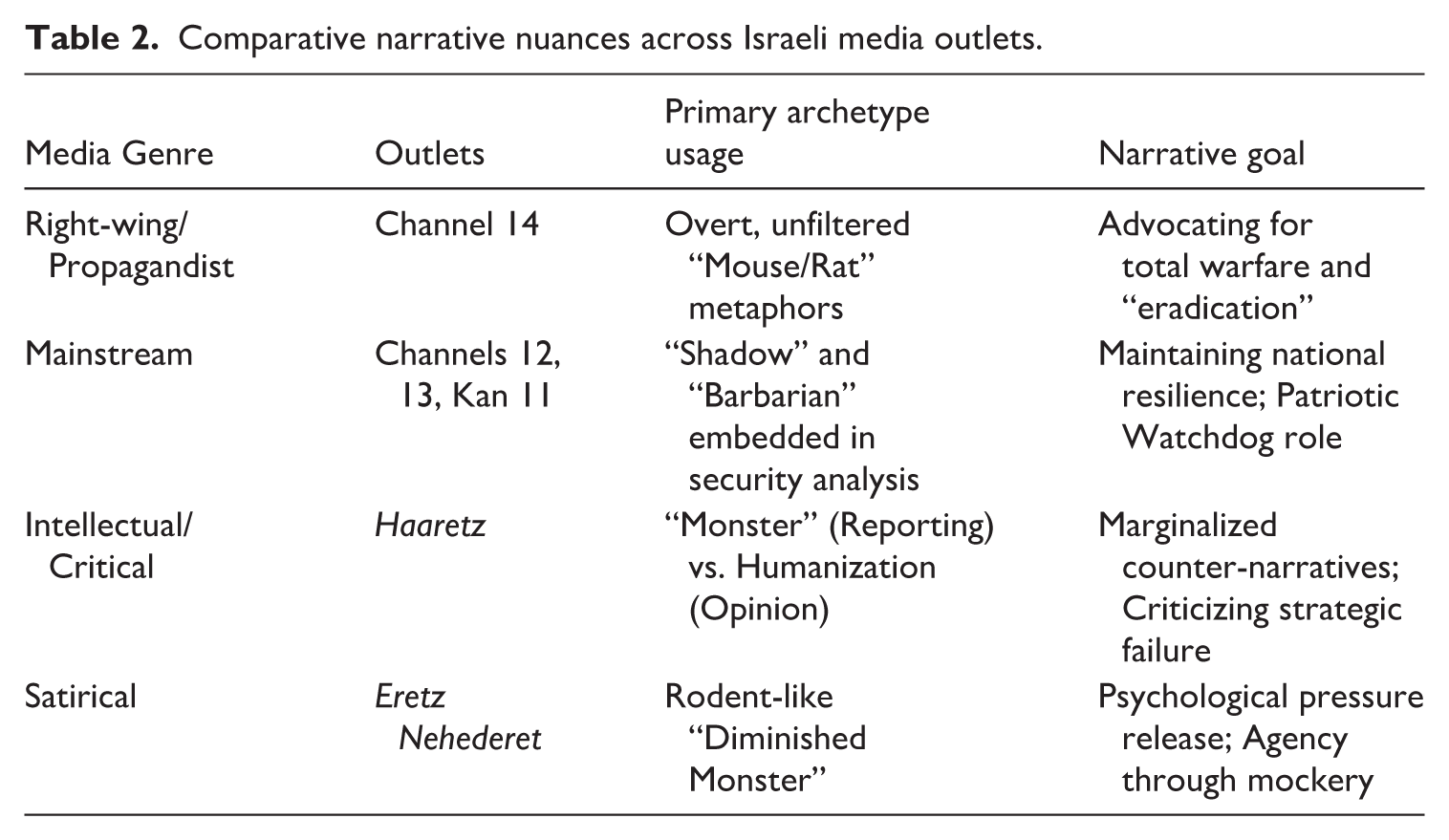
While the construction of these archetypes formed a powerful hegemonic narrative, it is vital to acknowledge that the Israeli media landscape is not monolithic. A careful reading reveals nuanced differences across various outlets and genres regarding how explicitly these myths were propagated. Right-wing platforms, such as Channel 14, utilized overt, unfiltered dehumanization, openly embracing the vermin metaphors without reservation to advocate for total warfare. Conversely, mainstream commercial channels like Channel 12 and Kan 11 embedded these same dehumanizing tropes within a veneer of professional, objective security analysis, making the mythologization more insidious. The left-leaning newspaper Haaretz represented a partial divergence; while it occasionally offered marginalized counter-narratives criticizing the government’s strategic failures, its reporting on Sinwar still frequently relied on the “monster” and “shadow” archetypes (see Table 1). This demonstrates that, while political opinions on the war’s management varied, the core mythological representation of the enemy remained a deeply entrenched national consensus. Finally, satirical platforms like Eretz Nehederet functioned uniquely. They utilized the “Mouse” trope not for somber threat-assessment, but as a psychological pressure-release valve, providing a traumatized public with the agency to mock the source of their terror.
Schematic overview of Sinwar archetypes and discursive tropes.
Discussion
The findings demonstrate a clear and systematic process of mythologization in the Israeli media’s portrayal of Yahya Sinwar. These representations as Barbarian, Shadow, and Mouse were not arbitrary but served distinct and crucial social and psychological functions for a nation in the throes of an existential crisis. This discussion will synthesize these functions, explore the interplay between local and universal imagery, and critically examine the disturbing historical resonance of the “mouse” trope, while placing these findings within the broader context of media effects theory and trauma studies.
The construction of Sinwar as a mythic arch-villain fulfilled several key roles for Israeli society, operating as a defense mechanism against the paralysis of trauma. First and foremost, the myth served the function of cognitive simplification and sense-making. The sheer horror and complexity of the October 7th attack were difficult to process for the Israeli public. The failure of the state’s protective apparatus created a cognitive rupture that threatened the collective’s sense of order. The myth of Sinwar provided a simple, digestible narrative to bridge this gap. Instead of grappling with complex geopolitical failures, intelligence blunders, and the political context of the conflict—factors that would require painful introspection—society could focus its attention on a single, malevolent actor. He became the singular cause of all suffering, and his elimination became the singular solution. This simplified reality into a clear-cut story of good versus evil, offering a psychologically comforting binary in times of chaos. As schematized in Table 2, the deployment of these archetypes reveals a nuanced hierarchy within the Israeli discursive landscape. Right-wing platforms, exemplified by Channel 14, employed overt and unfiltered dehumanization to construct a moral mandate for total warfare. In contrast, mainstream commercial outlets such as Channel 12 and the public broadcaster Kan 11 integrated these tropes within a framework of professional security analysis, rendering the mythologization more insidious by masking it as objective commentary. Even intellectual outlets like Haaretz, while providing space for critical counter-narratives regarding strategic failures, largely adhered to the ‘Monster’ and ‘Shadow’ archetypes in their descriptive reporting, illustrating the pervasive power of hegemonic alignment during a period of acute national trauma.
Comparative narrative nuances across Israeli media outlets.
Simultaneously, these representations provided moral justification and facilitated dehumanization. As outlined in the findings, the representations of Sinwar as a subhuman barbarian or a pest were instrumental in justifying the military response. In modern warfare, there is a strong need to maintain a sense of moral righteousness, particularly for a democratic state under international scrutiny. By framing the enemy as absolutely evil and inhuman, the media narrative provided a moral license for actions that might otherwise be questioned, such as the extensive bombing of dense urban areas or the destruction of infrastructure. Dehumanization is a well-documented prerequisite for mass violence, as it short-circuits empathy (Keen, 1986). If the enemy is a “rat,” the moral calculus of war changes fundamentally; extermination becomes a hygiene necessity rather than a political act of violence.
Furthermore, the fixation on Sinwar played a critical role in forging national unity. In the years preceding the war, Israeli society was deeply fractured by political and social divisions, particularly regarding judicial reforms. The October 7th attack created a “rally round the flag” effect, and the myth of Sinwar provided a powerful focal point for this newfound unity. Hatred of a common enemy is a potent social glue. By fixating on Sinwar, the media helped create a shared purpose that temporarily overshadowed internal disagreements, uniting Israelis from across the political spectrum in the common cause of his destruction.
Finally, the construction of this myth allowed for the processing of collective trauma. Sinwar became a psychological “lightning rod” for the nation’s trauma. He was the face of the nightmare. By projecting all fear, rage, and grief onto his image, society could manage these overwhelming emotions. The obsessive media hunt for him provided a narrative of empowerment and eventual catharsis. The fantasy of his capture or death became a fantasy of healing—a belief that once the monster was slain, the trauma could be overcome, and order could be restored. This aligns with Jungian projections where the destruction of the external “Shadow” is erroneously equated with the resolution of internal conflict.
Importantly, the integration of Jungian archetypes in this study explicitly extends existing analyses of dehumanizing metaphors. Traditional dehumanization theory (e.g., Haslam, 2006) primarily focuses on the instrumental use of animalistic metaphors to justify violence against an outgroup. However, framing Sinwar as the “Shadow” performs additional explanatory work: it illuminates the inward-facing psychological utility of the myth. It suggests that the vermin metaphor was not just a tool to degrade the enemy, but a mechanism for the Israeli collective to externalize its own repressed anxieties, systemic vulnerabilities, and feelings of profound helplessness following a catastrophic intelligence failure. The media thus functioned not only as an ideological state apparatus but as a vehicle for collective psychological repair.
The power of these representations lies in their skillful blending of universal archetypes with locally resonant metaphors. This interplay creates a narrative that is both primally terrifying and specifically relevant. The “Shadow” operates as a universal archetype, a cross-cultural symbol representing the dark unknown, the hidden enemy, and the repressed fears that lurk in the subconscious. This is a universal fear that needs little cultural translation. The Israeli media tapped into this universal archetype to portray Sinwar as an almost supernatural figure of evil, a phantom whose menace was amplified by his invisibility. This allowed the narrative to transcend the specific politics of the conflict and tap into a more primal, psychological register of fear.
Conversely, the “Mouse” metaphor bridges the gap between the universal and the local. On a universal level, the image of vermin is a symbol of filth, disease, and infestation. As a tool of dehumanization, it is globally understood and has been used in countless conflicts to vilify the enemy. It evokes a visceral reaction of disgust that is not culturally specific. However, the “mouse” metaphor gained a unique and powerful local resonance in the context of the Gaza war. The challenge of the tunnels defined the entire military campaign. The image of Sinwar as a “mouse in the tunnels” was not just an abstract insult; it was a concrete, geographical metaphor that perfectly mapped onto the physical reality of the conflict. It vividly connected the dehumanized enemy to the specific terrain of the war—the dark, claustrophobic, subterranean world where the battle was being fought. This local specificity made the universal trope of vermin incredibly potent and immediate for the Israeli audience.
The most troubling aspect of the “mouse” representation is its direct echo of one of the most infamous tropes of Nazi propaganda. In films like The Eternal Jew and the illustrations of publications like Der Stürmer, Jews were relentlessly depicted as rats or vermin. These parasitic species infested German society and needed to be exterminated for the health of the nation. This dehumanization was a crucial step in preparing the German populace to accept and participate in the Holocaust.
Now, in a staggering and deeply ironic historical inversion, this exact rhetorical tool is being used within the public discourse of the Jewish state to describe its enemy. This is the central point of Rogel Alpher’s (2024) critique. He explicitly references Art Spiegelman’s “Maus,” where Jews are portrayed as mice to reflect their dehumanization by the Nazis, and contrasts it with a Channel 14 presenter, Dana Varon, stating on air that in Gaza, “all in all one mouse has been replaced with a rat.” Alpher argues that the sole purpose of this metaphor is “the desire to carry out dehumanization,” creating a “moral abyss between killing a mouse and assassinating a bad person.” This phenomenon demands careful and nuanced analysis. It is unlikely that most Israeli journalists, politicians, or citizens who use this term are consciously thinking of Nazi propaganda. Instead, its use likely stems from a more complex and subconscious set of psychological and historical currents.
This phenomenon can be understood through the psychology of victimhood and aggression. For a people whose identity is so deeply intertwined with the trauma of the Holocaust, the October 7 massacre was not just a terrorist attack; it was an existential echo of past horrors. The slogan “Never Again” is a cornerstone of Israeli national identity. In this context, the adoption of the perpetrator’s rhetoric could be interpreted as a psychological defense mechanism. It is a way of saying, “We are now the powerful ones. We will do to our enemies what was done to us, to ensure it never happens again.” It reflects a mindset where, to prevent being the victim, one must adopt the most ruthless tools of the aggressor. This is a tragic and dangerous manifestation of cyclical trauma. Furthermore, the blinding effect of deep trauma can lead to a form of moral and historical blindness. Amid overwhelming grief and fear, the primary focus is on survival and retribution. The historical resonance of a particular metaphor may be secondary to its immediate emotional and rhetorical effectiveness. The “mouse” trope is practical because it is viscerally powerful, not because of its historical pedigree. The users may be blind to, or not care about, the disturbing irony of their words.
The implications of this rhetorical inversion are profound. It signals a potential erosion of the moral and historical consciousness that has long been central to Jewish and Israeli identity. It demonstrates how the language of dehumanization is a universal poison, capable of being wielded by any group, including those who have been its most tragic victims. For outside observers, it complicates the moral narrative of the conflict. At the same time, for internal critics within Israel, it raises alarming questions about the psychological cost of the ongoing conflict and the direction in which the national discourse is heading. It is a stark reminder that the experience of victimhood does not automatically confer immunity to adopting the methods of oppression.
Contribution to existing literature and theoretical implications
This study advances the existing literature on media and conflict by demonstrating the specific mechanics of mythmaking during a “rupture” event. By deconstructing the representations of Sinwar, this research responds to the call for a new, rigorous academic engagement with the post-October 7 landscape (Saposnik, 2024), providing a case study of how symbolic construction fills the void left by the collapse of standard political discourse. While previous scholars like Nossek (1994) and Mandelzis (2003) have established that Israeli media tends to rally around the flag and use historical narratives like the Holocaust to frame current conflicts, this study illustrates a significant evolution in this dynamic. In the context of the Iron Swords war, the media did not merely frame the enemy politically or militarily; it engaged in a regression to pre-modern, archetypal mythmaking (Barthes, 1998) to process a trauma that exceeded the capacity of standard political discourse.
Furthermore, this research contributes to the understanding of “the Shadow” not just as a psychoanalytic concept but as a media product. By identifying the specific textual and visual strategies used to construct Sinwar as the Shadow and the Mouse, the study bridges the gap between Jungian psychology and critical media studies. It shows how the media effectively “weaponizes” the collective unconscious, turning internal psychological needs (for safety, for clarity) into external political consent for warfare. This extends Hall’s (1997) theories of representation by showing that, in times of existential crisis, representation moves beyond stereotyping into the realm of total mythologization, where the enemy is stripped of all human and political context to become a vessel for the nation’s projected fears. Finally, by highlighting the “Mouse” trope, the study offers a critical contribution to the literature on the cyclical nature of dehumanization rhetoric, showing how historical traumas can lead to the unwitting adoption of the oppressor’s language by the victimized group, a finding that adds a disturbing nuance to postcolonial and trauma studies in the context of the Israeli–Palestinian conflict.
The media’s representations of Sinwar did not challenge the dominant Israeli mindset; they consecrated it. There was a notable absence of counter-narratives in the mainstream media. Alternative frames—such as portraying Sinwar as a product of decades of occupation and blockade, or as a political actor with rational (if brutal) strategic aims—were primarily confined to the margins of discourse, such as in the newspaper Haaretz or academic circles. As Alpher (2024) argues, this was a systemic feature, particularly on outlets like Channel 14, which he labels a “propaganda tool” where the dehumanization extends to all Gazans, who are presented as having “no innocent people.” The mainstream media, in its relentless focus on the mythic archetypes, provided a narrative that was emotionally satisfying and politically expedient. It gave the public a villain worthy of their hatred and a story that made the war feel necessary, just, and winnable, thereby reinforcing the government’s narrative and cementing a broad national consensus for the war as revenge and insurance against repetition of the vicious attack on Israel on the 7th October 2023.
Conclusion
By systematically unpacking the Israeli media’s portrayal of Yahya Sinwar during the “Iron Swords” war, this research has elucidated how democratic media can fundamentally pivot from political reporting to archetypal mythmaking in the wake of catastrophic trauma. Far from offering objective strategic assessments, the media landscape overwhelmingly relied upon the interconnected constructs of the Barbarian, the Shadow, and the Mouse.
These findings reveal that the intense focus on Sinwar was not merely an element of state-sponsored propaganda, but a profound sociological mechanism. The distillation of complex geopolitical and intelligence failures into a singular, monstrous figure provided a traumatized public with cognitive relief and a tangible target for processing collective grief. Moreover, the deployment of dehumanizing, vermin-based rhetoric served an explicit legitimizing function, easing the moral friction required to conduct a devastating, large-scale military campaign.
The study underscores the alarming fluidity of extreme rhetoric, demonstrating how historically persecuted populations can unconsciously adopt the symbolic violence of their past oppressors when confronted with existential panic. This dynamic presents a sobering contribution to the literature on cyclical trauma and critical discourse analysis. Moving forward, while the specific physical threat of Sinwar has been removed, the mythological architecture built by the media during this war remains intact. Future research should pivot to reception studies to measure how deeply these constructed archetypes have permeated the civilian consciousness, as such deeply entrenched dehumanization frameworks will undoubtedly shape the boundaries of any future diplomatic or political resolution in the region.
Based on prior research (Nossek, 1994) we suggest that the media take an integrating functional role in such events and act as providers of resilience as well as reasons for fighting and revenge. This theoretical and empirical approach can serve as a way of understanding the media’s role in other crisis situations and wars in different cultures and societies.
Limitations and future research
This study is limited by its focus on Israeli mainstream media. A more comprehensive understanding would require a comparative analysis with Palestinian and international media representations of Sinwar. Furthermore, this is a study of media production; future research should focus on reception, examining how these representations were interpreted and understood by different segments of the Israeli public.
Footnotes

Funding
The authors received no financial support for the research, authorship, and publication of this article.
Declaration of conflicting interests
The authors declared no potential conflicts of interest with respect to the research, authorship, and publication of this article.
Data availability statement
The data that support the findings of this study are the publicly available news broadcasts from the cited television channels. Transcripts of the analyzed segments are available from the corresponding author upon reasonable request.