






Abstract
The return of the Taliban in Afghanistan in August 2021 has had far-reaching implications not only for press freedom in the country but also for the mental well-being of journalists in Afghanistan. Even before the Taliban’s takeover, Afghanistan was consistently ranked among the most dangerous countries in the world for media workers (yet, little attention was paid to the mental health of journalists. The situation got worse after the Taliban returned, as hundreds of media outlets shut down and thousands of journalists lost their jobs, with many fleeing the country amid rising violence against them. Emerging evidence indicates increased mental health issues among Afghan media professionals, both those who remained in the country and those now living in exile. Although there is awareness of issues like PTSD, depression, and anxiety among reporters, research in this area is both limited and fragmented, leaving critical gaps in our understanding of the long-term psychological effects on journalists working in conflict zones (Feinstein and Osmann, 2024, ‘Predictors of psychological distress in frontline journalists: Common denominators across three decades of conflicts’; MacDonald et al., 2021, ‘Journalists and depressive symptoms: A systematic literature review’). This is a pressing public health concern that demands urgent scholarly attention to safeguard journalists’ mental well-being. We urge fellow researchers and editors to consider this issue not as a peripheral problem, but as a core challenge at the intersection of media, politics, and mental health. The psychological toll of reporting in high-stress environments demands a shift in how we prepare and support journalists. Integrating trauma-informed approaches into journalism training and curricula, and providing meaningful support for journalists in conflict zones, must be recognized as a core academic and societal responsibility.
Keywords
Afghan journalism in crisis
For journalists in Afghanistan, the dramatic collapse of the Afghan government and the return of the Taliban to power in August 2021 were both surreal and catastrophic. As an Afghan journalist puts it, “everything changed overnight” for journalists (Hassan, 2021, para 13). They suddenly had to face the Taliban, whose hostility toward press freedom and journalists had been well documented both during their first time in power in the 1990s and later during their insurgency years.
The collapse of Afghan journalism after 2021 is often described through statistics – outlets closed, journalists detained, provinces without women reporters. Although these numbers matter, they obscure the lived experiences of those who risked everything to tell the truth. Behind each data point is a reporter who faced intimidation, silence, and violence, yet kept reporting, often at great personal cost, to bear witness to a country in crisis. We argue that the psychological toll on Afghan journalists must be recognized as a central issue at the intersection of media, conflict, and public health. Their mental health is not an afterthought. It is at the heart of their safety, their freedom to report, and the survival of independent journalism itself. Addressing this human cost is essential to rebuilding Afghan journalism, preserving the voices that have been silenced, and supporting those who continue, against all odds, to bear witness.
Fearing reprisals and the rapid collapse of the fragile media freedom that had existed over the previous two decades, many journalists, caught off guard, began looking for a way to escape the Taliban. In such a situation, fear and uncertainty prevailed. They had to assess the risks of stepping outside, think about their own and their families’ safety, safeguard their sensitive information, search for ways to flee the country, and cope with overwhelming anxiety. The situation was even more dire for journalists working in the provinces. In the days leading up to the fall of Kabul on August 15, 2021, as the Taliban were advancing across the country, over 90 media outlets were forced to cease operations, and around 1,000 journalists lost their jobs. Fear spread quickly, and many journalists were too afraid to leave their homes and continue reporting, while many others were forced to leave their provinces in search of safety (Noorzai, 2021, August 12).
In the first two weeks after the fall of Kabul, many journalists rushed to board evacuation flights or went into hiding until finding a way out of the country. For many of them, years of reporting on security, human rights and women’s rights became a potential liability, and that was a major source of concern. Their profession, once seen as an important means of telling the truth and commitment to public service, suddenly placed them at risk of retaliation and persecution. Moreover, uncertainty surrounding new media policies and the Taliban’s suppressive record of press freedom generated widespread distress and a mass exodus of media workers. Within a few months of the Taliban’s takeover, Reporters Without Borders (RSF) reported that 215 media outlets, out of 543 operating before the Taliban, had shut down with women journalists disproportionately bearing the cost.
Women journalists pay the price
The media watchdog added that more than 7,000 journalists, including 76 percent of women journalists in Afghanistan, lost their jobs (see Figure 1), and that, in 11 of the country’s 34 provinces, no women journalists were working (2022, August 10).
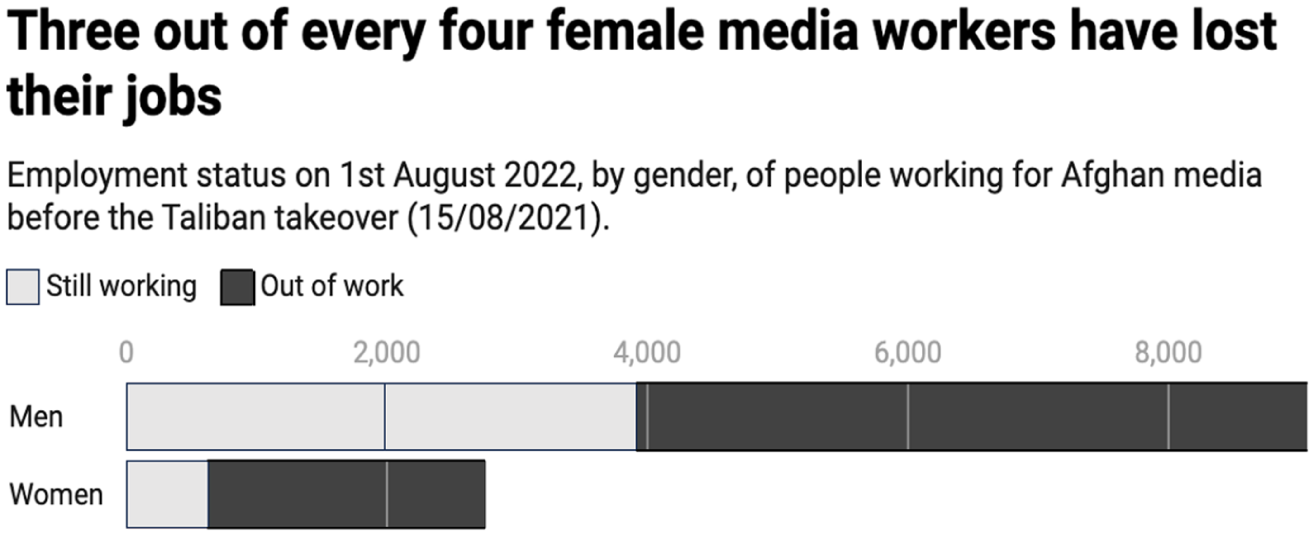
Afghanistan has lost almost 60% of its journalists since the fall of Kabul, by Reporters Without Borders, 2022. Available at: https://rsf.org/en/afghanistan-has-lost-almost-60-its-journalists-fall-kabul.
Under the Taliban, women journalists were barred from working with state-owned media. They became targets of harassment and faced strict restrictions. Female TV presenters had to cover their faces while on camera (Faizi and Paimani, 2022, May 20). Media outlets, still operating in the country, were ordered to segregate women workers, ban women’s voices on radio and television in some provinces, require them to travel for work with a male chaperone, and prohibit them from interviewing the Taliban (Human Rights Watch, 2025).
The lived experiences of many Afghan women journalists make clear that the dangers they face extend far beyond censorship or professional risk. “They work in conditions that are physically and mentally violent and tiring, without any protection,” said a Kabul-based female journalist (Reporters Without Borders, 2022, August 10).
As a result of the Taliban’s repressive policies, harassment and persecution, women journalists lost their motivation (International Federation of Journalists, 2022). They struggled with mental health, and most of them were forced into exile (Afghan Witness, 2024; Safi, 2022, September 30). However, some of these journalists remained in Afghanistan and continued their work, with some operating underground (Asian Journalists’ Support Organization, 2026).
Journalists continue to face violence
In general, the Taliban’s return to power carried profound implications not only for institutional media structures but also for journalists’ safety and livelihoods. Journalists in Afghanistan face violence, censorship, and economic hardship (Human Rights Watch, 2021, November 22; Office of the United Nations High Commissioner for Human Rights, 2024, November 14). The deteriorating situation for press freedom affected the psychological well-being of those working in the country.
During the two decades of US presence in Afghanistan (2001–2021), journalists in the country were on the frontlines of the decades-long conflict (Noorzai and Hale, 2020). Even before the Taliban’s takeover, Afghanistan was consistently ranked among the most dangerous countries in the world for media professionals (Committee to Protect Journalists, 2020).
Incidents of violence against journalists continue to rise under the Taliban. The Afghanistan Journalists Center (AFJC) recorded 172 cases of violence against journalists, including the closure of 22 outlets and the detention of 52 journalists, from March 2024 to March 2025. This marks a 24 percent increase from the same period the previous year (2025, March 16).
Afghanistan now ranks among the six most repressive countries in terms of media freedom (Reporters Without Borders, 2025b, May 14). Raids on the media offices are used to silence journalists (Reporters Without Borders, 2025c, November 4). Journalists accused of working with media in exile and having contacts with opposition groups have been detained, beaten and threatened with death (Human Rights Watch, 2025). Forced “confessions” of journalists have become common in the country (Reporters Without Borders, 2025c, November 4). The deteriorating conditions forced thousands of Afghan journalists to leave their country.
Living in exile with trauma
The journalists who fled to Western countries face a range of challenges, including rebuilding their lives in a different setting and adapting to a new language and culture. Many are unable to continue their profession. Those who fled across to the neighboring countries are living in a precarious situation. Many cannot afford housing, healthcare, and education for their children, and they cannot afford to pay for visas to extend their stay in those countries (Noorzai, 2022, December 29; O’Donnell, 2024; Reporters Without Borders, 2025a, January 22).
Many of the journalists who could not leave the country during the evacuation to Europe or North America had to flee to the neighboring countries of Iran and Pakistan. These journalists who fled the Taliban face the threat of deportation to Afghanistan, as both Iran and Pakistan, where the majority of journalists fled, have started the forcible return of Afghan refugees from their countries (Human Rights Watch, 2025).
Some journalists in exile have established media outlets; however, this has come at a high cost in terms of human and financial resources. Working in exile has had “a significant psychological impact,” as they have always been anxious about their loved ones who remained in the country (Reporters Without Borders, 2026, March 13). Like other Afghan refugees, journalists who sought refuge in neighboring and Western countries face major mental health challenges (Nylen et al., 2025).
Journalists’ trauma demands attention
Feinstein et al. (2026), in a study on wartime journalism, found that journalists, including those in Afghanistan, had a “high prevalence of PTSD [Post-Traumatic Stress Disorder], major depression and any anxiety disorder and alcohol use disorder” (p.1). Emerging evidence indicates mental health issues among Afghan media professionals, both those who remained in the country and those now living in exile. Even before the fall of Kabul, Afghan journalists had “high rates of PTSD and depressive symptoms”; however, there was a minority of Afghan journalists who received psychological therapy despite high rates of PTSD and depressive symptoms (Osmann et al., 2020: 120). It is important to note that the available therapy was limited to “psychological counseling,” particularly to women journalists and media workers (Afghan Journalists Safety Committee, nd). Taken together, these findings underscore a persistent and under-addressed mental health burden among Afghan journalists, highlighting the urgent need for comprehensive, evidence-based support systems.
Building on this concern, although there is awareness of issues like PTSD, depression, and anxiety among reporters, research in this area is both limited and fragmented, leaving critical gaps in our understanding of the long-term psychological effects on journalists working in conflict zones (Feinstein and Osmann, 2024; MacDonald et al., 2021). This is a pressing public health concern that demands urgent scholarly attention to safeguard journalists’ mental well-being (Mohammed, 2025). Journalists’ psychological resilience directly shapes the integrity of the narratives they deliver, making this a critical issue not only for clinicians and policymakers but for society as a whole. We urge fellow researchers and editors to consider this issue not as a peripheral problem, but as a core challenge at the intersection of media, politics, and mental health. The psychological toll of reporting in high-stress environments demands a shift in how we prepare and support journalists. Integrating trauma-informed approaches into journalism training and curricula, and providing meaningful support for journalists in conflict zones, must be recognized as a core academic and societal responsibility.
Recommendations: Toward trauma-informed support for journalists
While restrictions on press freedom, censorship, and economic hardship in Afghanistan have been highlighted, little attention has been paid to the human cost borne by Afghan journalists, inside the country and in exile, during times of crisis.
To improve journalists’ well‑being, we call for a more intentional shift toward trauma‑informed systems of support. For example, journalism schools and training programs can incorporate modules on trauma exposure, psychological resilience, and self‑care so that reporters are better prepared for the emotional demands of high‑risk work (Ehrenberg and Alpuim, 2024; Ogunyemi and Trifonova Price, 2023). International organizations can expand access to confidential, culturally sensitive mental-health services for Afghan journalists, including tele-counseling for those who remain in the country (Mufti et al., 2026).
For Afghan journalists forced into exile, host countries can create pathways for their professional integration through credential recognition, language training, and mentorship (UNESCO, 2024). At the same time, governments and NGOs must prioritize at‑risk journalists, especially women and provincial reporters, for humanitarian visas and relocation programs (Media Freedom Coalition, 2026).
More research is urgently needed, particularly longitudinal studies on trauma among journalists in conflict zones, with Afghanistan as a key focus (Mohammed, 2025). Finally, exiled Afghan media organizations require sustained financial and technical support, as they play a crucial role in providing independent information (Reporters Without Borders, 2024, August 26).
Footnotes

Funding
The authors received no financial support for the research, authorship, and publication of this article.
Declaration of conflicting interests
The authors declared no potential conflicts of interest with respect to the research, authorship, and publication of this article.