







Abstract
This article provides a new cognitive- and discourse-based theory to memory research. Despite the fact that a large proportion of studies in memory research are based on investigations of (interactional) cognitive and discourse processes, neither linguistics nor cognitive and social psychologists have proposed an integrative, interdisciplinary and discursive-based theory to memory research. In this article I explore how groups of people who did not know each other jointly coordinate the interlocking of their individual experiences during a period of dictatorship and their self-positioning in the here and now. The interlocking of autobiographical memories is performed by discourse strategies such as agreements and corrections, which are dependent on the participants’ shifting representations of the communicative interaction. The conversations were about personal experiences related to the 1976–83 military dictatorship in Argentina.
Introduction: Theories of social, collective and collaborative remembering
Discourse psychologists (Edwards and Middleton, 1986; Edwards et al., 1992; Middleton and Edwards, 1990; Middleton and Brown, 2005, 2008; Reavey and Brown, 2007) maintain that the discourses which form practices of memory-making always emerge from experience in situated communicative interactions. Brown et al. argue that memory is something that speakers perform, rather than a simple process of retrieving information about the past in the course of routine interaction (2001: 125). Hence, discourses about the past are descriptions that may change according to the pragmatic and rhetorical functions for which they were designed. Thus, these discourses pronounced by different social actors usually vary in pragmatic ways due to the fact that they are always constructed with regards to the communicative situation. This perspective holds that discourses about the past do not reflect any internal cognitive process that would be taking place in the actor’s minds during a communicative situation. In short, discourse psychologists acknowledge that social remembering is an action based on pragmatic goals, which are dependent on the social and conversational context in which the action occurs (Middleton and Edwards, 1990: 40). In doing so, they demonstrate that remembering in real-life settings needs to be thought of more as a situated activity or resource in order to achieve specific goals, rather than as instantiations of a storage device or archive located in people’s brains.
Several cognitive and social psychologists (Echterhoff and Hirst, 2009; Hirst and Manier, 2002, 2008; Hirst and Echterhoff, 2008) claim that examining conversations about relevant experiences in the construction of social identities is one of the most useful mechanisms for exploring how memory spreads across different groups. As collective memories are commonly formed, shared, consolidated and transformed in conversations, several studies (Hirst and Echterhoff, 2008; Muller and Hirst, 2010) investigated how different cognitive, linguistic and interactive phenomena influence processes of collective memory-making. These studies indicate that conversational dynamics (e.g. dominant narrator), and the characteristics of the speaker (e.g. expert) and listener (e.g. susceptibility, openness to new experiences) lead to mechanisms of imposition, resistance and forgetting of memories in interactional contexts. Hirst and Echterhoff (2002) also provided evidence that the conversational context of remembering plays a central role by guiding cognitive processes of editing and formatting responses in conversations about past experiences (Hirst and Echterhoff, 2002:95). Nonetheless, this finding is not incorporated into their later studies on collective memory.
Finally, studies in philosophy and cognitive psychology (Barnier et al., 2008; Campbell, 2008; Sutton, 2008, Sutton et al. 2010) agree on the fact that remembering often occurs in social groups (e.g. partners, friends, family members) in response to their views on our past or their own (Campbell, 2008:14). Thus, the act of sharing memories with others is one of the most common ways to create, maintain and negotiate human relationships. These processes of sharing memories occur through a wide range of activities which play a central role in how we reconstruct and communicate our memories. These activities are embedded in social and material environments which influence our present interests and needs when engaged in processes of remembering. Hence, the social context (e.g. setting, participants and goals) in which these practices of joint remembering unfold strongly influence what and how we remember (Harris et al., 2008: 217).
These studies in constructive-collaborative remembering (Harris et al., 2010; Harris et al., in press) indicate that collaborative remembering in small groups is situated, goal-oriented and, as expected (due to the influence exerted by the previous two features), cognitive processes that involve the interplay of our brains, bodies, and the immediate physical and social environment. Their studies showed that under some circumstances older couples engaged in practices of collaborative remembering are able to remember information that both individuals had forgotten.
Despite the fact that studies in social, collective and collaborative remembering in discourse psychology, cognitive and social psychology and philosophy pointed out the important role that environmental features play in influencing practices of remembering, they did not provide a description of the context in which such activities occur. Nor did they make explicit how this context influences such practices. Surprisingly, although experimental studies in cognitive social psychology propose explicit connections between language use, communication and memory processes (Echterhoff, 2008), they do not rely on either linguistic or discursive approaches (e.g. interactional pragmatics, discourse analysis, sociolinguistics, conversation analysis) to complement their psychological approach to practices of sharing memories in interactions – besides giving a few references to work done by Paul Grice, Stephen Levinson and Herbert Clark in pragmatics (see Echerhoff and Hirst, 2002). Discourse psychologists do account for the central role that language plays in constructing and communicating memories. However, their view is based on assumption which maintains that what people say does not reveal or express their internal cognitive processes (Edwards and Potter, 2005: 245).
One of the purposes of this article is to explain and provide evidence about the interdependences between cognitive processes and embodied discourse practices of memory-making. I will show that there is a correlation between cognitive mechanisms involved in processes of remembering and the verbalization and embodiment of such past experiences in social interactions. Thus, I argue that cognitive and embodied, as well as discursive and pragmatic processes are responsible for the re-construction and communication of memories in social and material environments. In this article I explore how participants in two focus groups of people who did not know each other, conducted in February 2008 in Buenos Aires, are cognitively and discursively engaged in joint processes of memory-making about events related to the 1976–83 military dictatorship in Argentina. The cognitive and communicative engagement of the participants of the focus groups occurs by means of discourse strategies. This study investigates the cognitive and discursive mechanisms that the participants of both focus groups employ to negotiate and synchronize representations about the experience of dictatorship with strangers who belong to same generational cohort. By means of agreements and reformulations, these mechanisms of coordination and collaboration facilitate the creation and updating of common ground (Clark, 1996; 2005; Enfield, 2008), the aim of which is the reach of consensus between the participants of the groups who lack shared memories. The concept of common ground (Clark, 1996, 2005; Clark and Brennan, 1991; Enfield, 2006, 2008) refers to the shared knowledge that is essential for communication between people.
The cases examined in this article show how individual reconstructions of past experiences are driven by processes of re-interpretation of memories in the present. Moreover, the analysis of the communicative interaction presented in this study sheds light on the ways in which socially shared knowledge of the military dictatorship is managed in private settings (Bietti, 2010). Thus, it also contributes to the empirical studies on processes of remembering events related to periods of political violence in Argentina.
An integrated social, discursive and cognitive approach to joint remembering
The aim of this section is to present a new integrative approach to memory research, which brings together linguistics and discourse analysis, on the one hand, with cognitive and social psychology, on the other. The communication of memories is an interactive, embodied and socio-cognitive phenomenon sustained by social agreement. That is, the action of communicating past experiences is not driven by the mere transmission of narratives of the past, but also by a situated reconstruction of those experiences in the present, depending on interpersonal/social group goals and pragmatic needs. Hence, I argue that processes of remembering are always action oriented reconstructions of the past, which are highly dynamic and malleable by means of communication and context. The context-dependent meanings of such situated re-constructions of the past are the basis for the cognitive pragmatics of processes of memory-making. All in all, this new approach aims to provide the grounds for a new ecologically valid theory on memory studies which accounts for the mutual interdependencies between communication, cognition, meaning and interaction guiding remembering processes in the real-world activities.
Cultural models
Cultural models (Kronenfeld, 2008; Shore, 1996) are driven by socially shared knowledge (Goldman, 1999; Jovchelovitch, 2007; Schütz and Luckmann, 1974; van Dijk, 2003, 2005) and emotional codes (Röttger-Kössler and Markowitsch, 2009) of specific epistemic communities (van Dijk, in press). Emotional codes exert a crucial influence by shaping the ways in which emotions emerge and are communicated. They also determine the way in which human beings should feel according to their location in a complex network, formed by them being embedded and interacting in social relationships, cultural norms and social institutions. These emotional codes are defined as feeling rules (Röttger-Kössler and Markowitsch, 2009) that differ in varied ways according to social status, gender, age and life experience. Thus, emotional codes need to be thought of as cultural- and subject-specific sets of feeling rules that change and develop throughout one’s life. Hence, how people interpret features of their environment (e.g. actors’ goals, cause-and-effect interactions) is in terms of knowledge previously acquired (Wyer and Skull, 1994; Zwaan and Madden, 2004) and emotional codes of their communities.
We normally make inferences about features of the information which were not present in the information provided and, even more, we tend to build connections among these features (Sperber, 2000; Sperber and Wilson, 1995, 2002; Wyer and Carlston, 1994). That is to say, we are endowed with the capacity to construct representations and meta-representations (e.g. representations about others’ mental representations, intentions, etc.) that, in many cases are selections from and elaborations on the input information on which they are based. The interpretation of perceptual and conceptual features of the social and material environment relies on cultural and multimodal shared knowledge (e.g. diagrams and other visual images, sounds, smells, language, gestures), and emotional codes which are learnt, structured and transmitted to us from the time we are born. Thus, the individual’s conceptualization of the ongoing experience is driven by the values, motivations, emotions and norms of the social and material environment we inhabit. Nonetheless, these cultural models guided by social knowledge and emotional codes need to be individuated in a certain way.
Situation models
The individual instantiations of cultural models are carried out by personal and situation models (Johnson-Laird, 1983; van Dijk and Kintsch, 1983; Zwaan and Radavansky, 1998; Zwaan et al., 2002). Situation models (van Dijk and Kintsch, 1983; Zwaan and Radavansky, 1998) enable us to construct and represent meanings from what is expressed, conveyed and perceived by sounds (and music), writing, visual images, eye-gaze, hand-pointing, touch, facial expressions and other body movements as part of everyday action and experience. We construct and update situation models when we participate in and interpret activities (e.g. talking about past events, watching the news on TV). Situation models reconstruct and represent specific situations according to personal interpretations of such events. They are organized by a schematic structure consisting of a number of fixed and schematic categories, e.g. temporal and spatial settings (in various levels of specificity according to their concrete relevance), ongoing activities (talking about past events), participants, roles, identities and relationship (including the self), opinions and emotions, knowledge and intentions and goals (van Dijk, 1999). Situation models are reconstructed and represented in memory and supported by socially shared knowledge and emotional codes driven by cultural models.
The construction and updating of situation models is determined by cognitive processes of event segmentation, understanding of utterance, reconstruction of old models of similar situations in memory (van Dijk and Kintsch, 1983; Zwaan and Madden, 2004), and instantiations of more general personal information, as well as instantiations of cultural models. Situation models create the grounds for everyday action (e.g. buy a coffee to take away), and embodied interaction and communication (e.g. family members sharing memories at the dinner table), and operate to segment activities top-down as discrete units (van Dijk and Kintsch, 1983). It is important to point out that we do not construct situation models from scratch. The reconstruction and updating of models (e.g. my first full English breakfast in London) implies the re-activation and re-shaping of old models in memory (e.g. my usual breakfast in my hometown Buenos Aires, basically consisting of a strong café latte and two small croissants).
Context models
The pragmatic and personal representation of the social and material environment coordinates and synchronizes situation models, as well as cultural models, in communicative interactions, conceived as cooperative actions. In order to meaningfully proceed in social cooperation and interpersonal communication, speakers need to take for granted that, to some extent, their representations are shared with their addressees (Givón, 2005; Tomasello, 2008). In communicative interactions, the sensation that we share goal-specific and relevant situation models with our addressees relies on our subjective and unique representation of the context in which the interaction unfolds. These unique representations of the communicative interaction are defined as context models (van Dijk, 2008, 2009).
The speaker’s context models include a representation of the mind of the interlocutor that may shift constantly from one utterance to the next during live communication. This cognitive and discursive process allows us to make strategic hypotheses about what our addressee knows. A language user’s context models are not only about his/her interlocutor’s epistemic (knowledge) and deontic states (intentions). Rather, they are constituted by the interplay of the following schematic categories: setting (time and place), current action and participants with their social and cognitive proprieties such as identities, goals and knowledge (van Dijk, 2006). These elements determine how we communicate the reconstructed and updated experiences in situation models.
The pragmatic and communicative relevance of context models relies on the fact that they control the way in which speakers accommodate their utterances to the communicative situation (van Dijk, 1999, 2009). Context models are like other situation models (van Dijk, 2008) reconstructed and updated in memory, and employed to conceptualize experiences, but they are specifically for interaction. Nonetheless, in contrast to situation models which reconstruct and represent episodes in memory and indicate what discourses are about in terms of their meanings, namely, their semantic content, context models as models of communicative interaction have a marked pragmatic nature. Context models are personal, and represent for each participant the unique definition of the current communicative situation. They enable language users to accommodate situation models in the current communicate interaction (van Dijk, 2008). According to van Dijk (2008), context models determine what experiences, knowledge, worldviews and emotions may or should be appropriately shared and communicated in the ongoing communicative situation.
Each new communicative interaction does not lead language users to construct completely new context models from scratch (as occurred with situation models). To build a completely new representation for each communicative interaction from scratch would generate too much cognitive effort, and thereby, such cognitive processes would not be efficient. Context models must be partially planned in advance (van Dijk, 2008). This becomes evident if we take a look at the schematic categories that constitute context models. Every time we engage in a new communicative interaction we have representations of similar communicative situations grounded in cultural models driven by socially shared knowledge, emotional codes and memories of personally relevant experiences of situations alike.
On the other hand, context models need to be dynamic and flexible as well. The language users need to construct and update context models automatically, implicitly and subconsciously. However, not every perceptual change provokes a shifting of context models. These changes need to be pragmatically relevant for each language user. Obviously, a shift in setting (time and place) and number of participants engaged in the communicative interaction will automatically cause an updating of context models. Perceived shifting in epistemic (knowledge) and deontic (intentions) states of the participants, as well as their roles and emotions also affect the online updating and reconstruction of context models. The updating processes are fundamental to represent perceptual changes in communicative interactions.
Discourse strategies
Language users employ discourse strategies to manage communicative instantiations of situation models and to make them appropriate for the current communicative interaction defined by context models. Here is a brief description of each of the discourse strategies that I use to explore cognitive and discourse processes of joint remembering:
Rejections and corrections
Examples of rejection play a key role in the communication of memories in groups, in which we are likely to find distributed and shared knowledge of the past. Rejections function by creating social agreement, which is crucial in cognitive and discourse processes of joint remembering within social groups. They are usually realized in negations, ‘you weren’t there’, doubts, ‘are you sure?’, and corrections, ‘that was a year ago’. Corrections are generally used to introduce new knowledge organized by situation models which may either validate a previous rejection or lead to a reformulation. Moreover, rejections and corrections often need to be supported by justificatory moves in order to strengthen our credibility as speakers.
Reformulations
Participants of communicative interactions introduce new information in terms of old information by means of reformulations. These reformulations are based on old information which can be presented by appropriating what others have said in communicative interactions.
Reminders
Reminders as well as rejections are extremely important in sharing memories within social groups in which knowledge of the past is shared or distributed. The use of reminders, such as ‘do you remember when …?’ in order to bring a shared past into the present for the sake of a specific goal (e.g. to create a feeling of connection between parents and children) makes it evident that we are dealing with joint past experiences in which memory is distributed among members of social groups. Moreover, reminders function to facilitate the re-construction of shared past experiences among members by means of mechanisms of collaborative facilitation (Harris et al., 2010). They may also act as interactive communicative devices that may trigger the generation of ‘new’ memories. These new memories can be considered cases of ‘implanted memories’ (Loftus, 2005; Newman and Lindsay, 2009), which are strategically constructed in accordance with interactional goals.
Agreements
Conversational agreements (Clark, 2005; Norrick, 2005; Pagliai, 2009; Quasthoff and Becker, 2004) are defined as discourse strategies that enable people to align with each other. In discursive processes of memory-making in groups with shared or distributed knowledge, when one member introduces a past event, agreement from the other participants leads to its reinforcement (Pagliai, 2009: 550). Furthermore, we can note a spiral effect in cases in which members are repeatedly involved in the creation of agreements during the co-reconstruction of memories (Pagliai, 2009). This spiral effect may facilitate the creation of shared memories.
Focus groups and joint remembering
Conversations in general, but also non-directive interviews, are a more natural way for speakers to reconstruct and communicate their individual and shared memories than the accomplishment of experimental tasks. The method of inquiry employed to analyze these complex discourse processes needs to be able to account for such concerns and goals that go far beyond the act of retrieving, reconstructing and updating memories. Hence, I believe that the focus group (Ibañez, 1992; Medina, 2006; Puchta and Potter, 2004) is an adequate and flexible method of inquiry which can be adapted by the researcher to explore situated processes of memory-making and relate them to relevant historical, political, social and cultural phenomena.
The focus group is a discursive and interactional activity which is helpful in the exploration of situated reconstruction, communication, negotiation and synchronization of discourses about situation models of past experiences in communicative interactions. Context models regulate the dynamics of the interaction (e.g. turn-taking, gesturing) generated during the focus group. The dynamics of the focus group are regulated by changing context models (setting, participants, intentions and goals, etc.) that enables the participants in the negotiation of common ground (Clark, 1996; Enfield, 2006, 2008). This interactional discourse process needs to be conceived as a cooperative action by which the participants are motivated to recreate situation models of individual or (partly) shared experiences on a series of topics under relatively controlled conditions. Topics are previously selected by the interviewer according to her/his research goals. These goals should be able to focus on analyzing discourse processes of remembering in relation to socially relevant issues. The cooperative and collaborative nature of the focus group makes it an adequate communicative device to create the social and cognitive grounds for the discursive co-construction of memories.
The focus groups that I conducted for this study were designed to follow some of the features of ordinary conversations in order to fulfill ecological validity. However, it is important to bear in mind that the communicative situations were artificially created, and the presence of an audio recorder may have intimidated the participants.
The focus groups were audio recorded. The audio recordings were transcribed in detail to analyze the ways in which selected participants reconstruct, negotiate and synchronize their individual and partly shared situation models of past experiences by means of discourse strategies according to shifting context models. They were formed according to a generational parameter: (1) A group of eight people aged between 70 and 80 years (C1); and (2) A second group of four people aged between 25 and 40 years (C3). The decision to organize the focus groups according to generational parameters was based on the fact that it is assumed these two groups went through different generational experiences during the period of dictatorship (see next section). Moreover, it is assumed that the cohorts represented by groups C1 and C3 were less affected than the generation born (approximately) between 1940 and 1950 which was the main target of the repression (Informe de la Comisión Nacional sobre la Desaparición de Personas (CONADEP), 2006[1984])
The focus groups created the conditions for the engagement of the participants in spontaneous reconstructions and communication of memories. The communication of these memories was focused on the accomplishment of an interactional goal. Such accomplishment guided the selection of topics, events, and how the actions and actors animating such events were cognitively and discursively reconstructed. Moreover, such informal conversations about past experiences enabled interviewers to disguise their goals by bringing up specific topics in a more casual fashion (van Dijk, 1989). Some of the features of the reconstruction and communication of memories in the focus groups were not normally under the speaker’s conscious control. This lack of constant self-monitoring enabled the addressees to trigger inferences about the speaker’s cognitive processes.
The 1976–1983 military dictatorship in Argentina
On 24 March 1976, a military junta deposed former president Isabel Perón and took control of the country of Argentina. What followed was a seven-year period of unprecedented human rights abuses, in which approximately 30,000 people were abducted and murdered by the perpetrators of the military regime (Crenzel, 2008; Duhalde, 1999; Feierstein, 2007). Hundreds of babies were born in captivity because their mothers had been kidnapped and were killed soon after giving birth. Relatives of the victims uncovered evidence that some of these babies were being passed off as the adopted children of military officers. The narrative created by the military junta leaders was sustained by a discourse on war which mentioned the non-conventional methods that the enemy (e.g. political, armed organizations) was using in order to destabilize the status quo (Feierstein, 2007). This is why the conflict was named the ‘Dirty War’, and this was how it became known abroad. The enemies identified by the military included not only people who carried out violent acts against the armed forces (e.g. members of guerrilla movements), but also ideological subversives, such as teachers, professors, students, factory workers, journalists and lawyers (CONADEP, 2006[1984]). A large proportion of the bodies of the victims of the military dictatorship were never found. Hence, the victims of the military regime came to be known as the desaparecidos (disappeared).
Creating agreements through interaction: Toward the reconstruction of memories
The extracts analyzed below indicate the ways in which discourse strategies regulate and synchronize processes of joint remembering. These processes of joint remembering synchronized by discourse strategies (e.g. agreements, reformulations) create the conditions for the emergence of memories which were unlikely to be retrieved or shared at the beginning of the conversation.
The first extract displays the participants’ first reaction after being asked what their memories from the period of dictatorship are. Before presenting the extracts, 1 I introduce a description of the context models of the extracts analyzed (Figure 1).
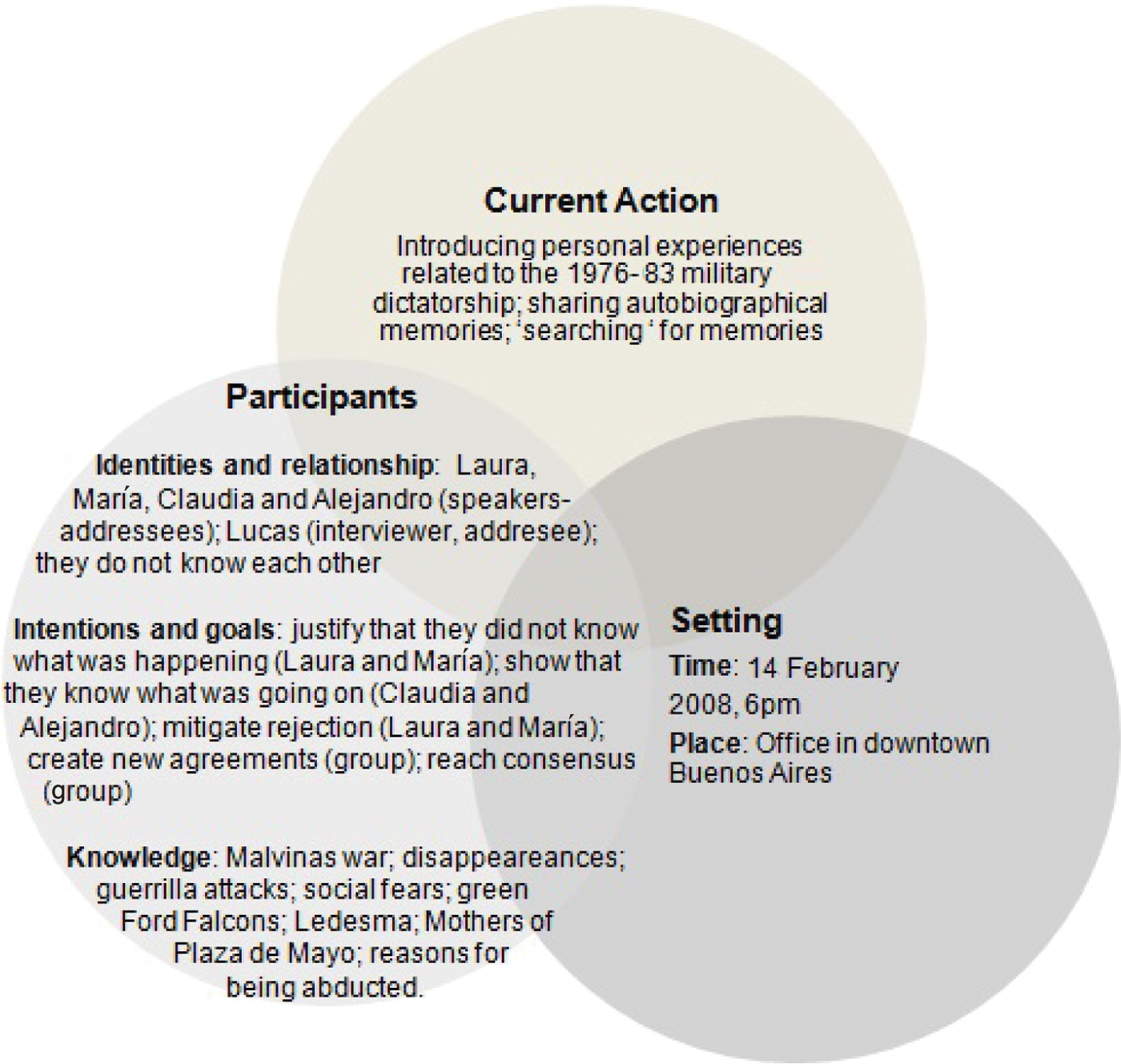
Description of context models: Group C3
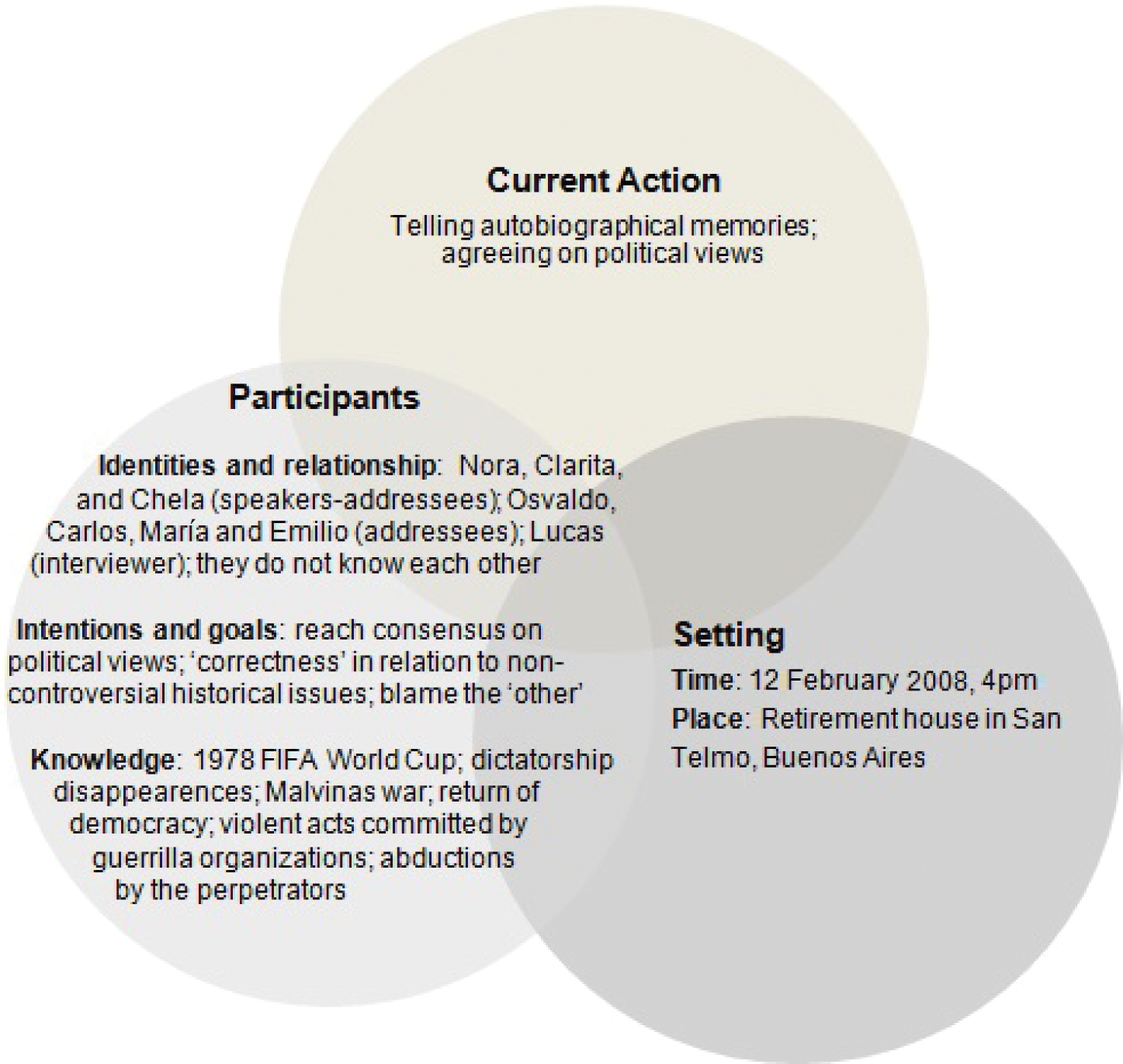
Description of context models: Group C1
Group C3: Extract 1 [4.06–6.09]
1. 2. sé yo le comentaba que yo hasta los doce años, hasta que fue lo de Malvinas o pasó a la 3. democracia yo no sabía que existiera otra forma de gobierno que fuera la (.2) la dictadura 4. militar o que hubiera dictadura miliar en el gobierno (.) eso me parecía lo normal (.) 5. después (.2) ya ahí a los doce o trece años cuando cambió todo, ahí recién es como que te 6. empezás a dar cuenta de que existían otras cosas 7. 8. 9. salir a la calle, era como que te cuidaban (.) yo era muy chica, y nos cuidaban mucho de 10. salir, no llegar tarde o (.2) se cuidaba a la gente de lo que decían, de lo que hacían o de lo 11. que mostraban, era como que todo el tiempo había mucho miedo, pero se no hablaba del 12. tema 13. 14. 15. 16. o en mi colegio no recuerdo haberlo vivido con miedo, tal vez porque como te digo era 17. interior de Jujuy, entonces tal vez posiblemente llegaba menos la información o porque 18. al ser un lugar más pequeño no no (.) había tanto e: (.) problemas como acá me imagino 19. pero no no no he vivido con miedo esa época (.) para mí no, es todo lo que nos 20. informamos después, como lo que les pasó a todas ¿Me entendés? 21. 22. allegado que le pasara algo (.) no sabíamos nada hasta que fue después el cambio de 23. gobierno cuando empezó lo de la democracia recién ahí te empezabas a dar cuenta o 24. empezabas a saber qué era lo que había sucedido 25. 26. 1. 2. until I was 12, until the Falklands or the return of democracy, I didn’t know 3. that there was a different kind of government other than (.2) the military dictatorship, or 4. even that there was a dictatorship (.) that seemed normal to me (.) later (.2) when I was 5. 12 or 13, when everything changed, that’s when you realize other things exist 6. 7. 8. to the streets, it was like you were looked after all the time (.) I was very little, and they 9. looked after us a lot if we went out, or get home late or (.2) people were cautious of what 10. they said, of what they did or what they showed, it’s like there was a lot of fear all the 11. time, but you wouldn’t talk about it 12. 13. 14. 15. don’t remember living with fear, maybe because, like I was saying, it was the interior of 16. Jujuy, so probably there less information was arriving, or maybe because it being a 17. smaller place, there wasn’t (.) so many (.) problems like I imagine there was here (.2) but 18. no, I didn’t live that period with fear (.) not me, it’s all that we found out later, like it 19. happened to everybody, understand? 20. 21. nothing happened to the people around me (.) we didn’t know anything until the 22. government changed and democracy began, that’s when you started to realize or know 23. what had happened 24. 25.
In line 1, Laura conveys what her situation as a child during the period of dictatorship was like. She uses the first person plural form nosotros ‘we’ to establish generational boundaries between the members of the focus group who were born between 1965 and 1975 and other generational groups. She pauses for 4 seconds to give herself time to reformulate her claims while reconstructing situation models of the events she plans to narrate. From line 2 onwards these events are specifically focused on her personal experience. Pauses of this kind may indicate more controlled cognitive processes of narrative pre-construction (Labov, 2006). We observe another 2-second pause prior to defining the military period as a dictatorship (lines 3–4 [3–4]). Perhaps this may be related to the fact that the military dictatorship is still widely defined as El Proceso ‘The Process’, which stands for El Proceso de Reorganización Nacional ‘The National Reorganization Process’, and is how the military junta, the media and large sectors of Argentinean society used to define the period.
Next, María agrees with Laura in her mode of remembering how she perceived the military period as a child. Thus, María creates a new common ground (Clark, 1996; Enfield, 2008) with Laura based on the fact of not knowing what was occurring during the dictatorship. However, this common ground does not appear to be totally supported by Claudia’s memories in the next turn. The verb viví ‘lived’, reinforced by the affirmative pronoun sí ‘yes’ and framed as a real recollection ‘me acuerdo’ I remember, functions as a mark of evidentiality sustaining the introduction of an emotional state miedo (line 8 [7]) ‘fear’. The repetitions of the material verb cuidar ‘look after’ (lines 9–10 [8–9]) anticipate the definition of the emotion which determined social behavior during the military dictatorship (line 8 [7–8]). However, the cause of the threat remains implicit. Thus, Claudia appraises the social situation under the conditions created by the military dictatorship.
A couple of turns later, María rejects Claudia’s appraisal of the social situation during the military regime. In this way, María tries to maintain the common ground previously created between her and Laura. The use of the negative pronoun no ‘no’ generates expectations in the addressee of María’s speech. Such a rejection must be sustained by convincing arguments, otherwise María’s image as a worthy group member could be damaged. Taking into consideration that the participants of the group do not know each other, the necessity to provide convincing arguments backing up the rejection becomes more salient. Her childhood memories deny the emotional state which determined social behavior introduced by Claudia. Nonetheless, the indices of evidentiality presented by María only refer to her own experience mi casa (line 15) ‘my house’ [line 14], mi familia (line 15) ‘my family’ [line 14], mi colegio (line 16) ‘my school’[line 14]. The individualization of her appraisal of the situation is later justified with geographical reasons (line 17 [15–16]). That is, María’s lack of knowledge is in accordance with a shared experience – everybody knew later (when democracy returned in 1983) that people were being abducted.
It is interesting to point out the difficulty that emerges at the time of defining the causes that may be provoking fear within the part of society described by Claudia. Two false starts and hesitations (line 18 [17]) reflect such difficulty, which is overcome by the noun problemas ‘problems’. We note a low degree of specificity when defining the causes of the social and political situation. Finally, Laura agrees with María’s description of the events (line 21 [19]). Such agreement requires an argument to back it up. By reformulating her claims (line 21 [20]), Laura justifies her lack of knowledge and, therefore, the sensation of fear introduced by Claudia. This justification is suggested by no tuve ningún allegado que le pasara algo (lines 21–2) ‘nothing happened to the people around me’ [line 20–1], which implies that she did not know because she was not directly affected. Then, Laura closes her turn by returning to the topic which she mentioned in the first lines, namely, that she began to find out what had been occurring during the military dictatorship when Argentineans went to the polls in 1983. Thus, Laura returns to the common ground about not knowing that she negotiated with María at the beginning of the extract.
Due to Claudia’s intervention (lines 8–12 [7–11]), María and Laura need to reformulate her previous agreement on not knowing what was going on. This agreement created the common ground that the fact of ignoring the human rights violations was ‘normal’ (e.g. Laura, line 4 and María, line 7 [6]). After Claudia’s autobiographical memories rejecting such normality, María and Laura bring such normality closer to the self by means of possessive adjectives mi casa ‘my house’, mi familia ‘my family’ (María, line 15 [14]) and verbal forms in the first person no tuve ningún allegado que le pasara algo ‘nothing happened to the people around me’ (Laura, lines 21–2 [20–1]). 2 By bringing the normality closer to the self, María and Laura are able to still maintain the common ground negotiated at the beginning of interaction. Moreover, the delimitation of the scope of their personal experiences enables them not to challenge Claudia’s memories. Despite their lack of agreement with Claudia, neither Laura nor María is attempting to disapprove of Claudia’s experience. A strong rejection of Claudia’s memories would have caused an unnecessary confrontation during the interaction by undermining the conversational expectations within the focus group (e.g. the search for consensus).
In what follows I demonstrate that the memories which are reconstructed in extract 1 are subject to corrections and new reformulations, which may even contradict the autobiographical memories expressed a few minutes before. The next extract comes 3 seconds after extract 1.
Group C3: Extract 2 [6.14–8.41]
27. 28. calle, nada más (.) eso la típica del paquete y (.2) que se yo no había que agarrar nada, pero 29. vos, que se yo (.) yo lo vivía como algo, viste cuando vos le decís a un chico “no agarrés nada 30. del piso que está con microbios” o así (.2) no no se vivía, yo no lo vivía como algo que podía 31. ser una bomba o que podía ser algo (.) otra cosa no (.) 32. 33. personas que eran conocidos de mis padres que dijeron “se los llevaron” y yo pregunté ¿A 34. dónde se los llevaron”? “Se los llevaron porque andaban en cosas raras”, esa es la explicación 35. que me dieron a mí y con eso me quedé, ¿entendés? (.2) y bueno después entendí porque se 36. los llevaron y todo (.3) pero de esa época recuerdo eso “se los llevaron” y que personas que 37. aparecieron después, sí ellos aparecieron pero después de un, de unos años 38. 39. dando vueltas (.) custodiando la escuela y en ese momento en la escuela era donde hablaban 40. de no agarrar cosas y que estábamos todo el tiempo como observados (.2) e inclusive se 41. mencionó, yo no lo verifiqué, que había una persona que atendía (.) era una escuela doble 42. escolaridad y había una persona que trabaja en la cocina, una mujer desagradable dentro de 43. todo y una vez dijeron “se la llevaron porque le encontraron un arsenal en la casa”, en ese 44. momento el pensamiento era un poco bueno (.) era una persona desagradable, realmente no 45. me extrañaría pero (.) me acuerdo de eso, de ver los Falcón verdes, en ese momento yo tenía 46. conciencia de lo que significaba un Falcón (.2) estoy hablando, no sé, quinto grado 26. 27. from the streets, that’s it (.) the typical story of the package (.2) but you, I don’t know (.) for 28. me, it was like when you tell a kid ‘don’t pick up anything off the floor because of the germs’ 29. or something like that (.2) no, it wasn’t like, for me it wasn’t like it could be a bomb or 30. something (.) something else (.) 31. 32. people my parents knew and they said ‘they were taken away’ and I asked ‘taken away 33. where?’ ‘They were taken away because they were involved in some funny business’, that’s 34. the explanation I was given and that’s what I understood, see? (.2) well, later I understood 35. why they were taken and all (.3) but of that period, I remember that ‘they were taken away’ 36. and some people reappearing later, yes, they reappeared after a few years 37. 38. watching over the school, and at that time the school was where we were told about not 39. picking up things and that we were sort of being watched all the time (.2) and even I 40. mentioned, I never verified it, that someone who worked (.) it was a full-day school and there 41. was a woman who worked in the kitchen, an unpleasant woman and once they said ‘they took 42. her away because they discovered an arsenal in her house’, at this time my thinking was 43. like (.) she was an unpleasant woman, I really wouldn’t be surprised but (.) I remember that, 44. seeing the green Falcons, at this time I was aware of what that car meant (.2) I am 45. talking about, I don’t know, maybe fifth grade.
In line 27 [26] Laura seems to begin remembering something. It is important to point out how this experience is introduced: the usage of an expression of apology is employed to make the other participants anticipate what will be said and may contradict the prior common ground. Laura’s apologies for having undermined social agreement (that neither Laura nor María knew that people were disappearing) act as a discourse strategy by framing and creating the conditions necessary to insert her childhood experience. As we observed above in regards to María (L.15 [14]]), there is a 3-second pause after the apology framing the rejection and correction (L.27 [26]). Laura does not need to re-negotiate the taking of the floor. This lack of overlapping or change in speaker may be provoked by the fact that the other participants expect Laura to back up her rejection. By providing the reasons supporting her rejection, Laura creates an implicit agreement with Claudia (lines 8–12 [7–11]), which relies on the fact that both remember the social fears about how they should have behaved as children. These social fears form part of cultural models of the experience of dictatorship.
The reformulation (lines 29–30 [28–9]) that Laura provides as an example depicts a common attitude maintained by many parents towards their children. However, within the communicative interaction it operates as a justificatory strategy by giving arguments as to why she did not know what was occurring during the period of dictatorship. Laura’s memories of her childhood experiences (including her memories of the meanings she assigned to such events) warrant her claims about her lack of knowledge. Then, María begins to remember some stories from her childhood as well (line 32 [31]). This behavior may indicate that María is reconstructing situation models about her memory traces of the period of dictatorship which were disregarded less than 2 minutes before when she said that she learnt about human rights violations, namely, after the end of the dictatorship in 1983 (lines 19–20 [18–19]). María’s memories update the common ground negotiated with Laura in the first extract. Now, it is the case she remembers some autobiographical experiences from childhood. María recalls hearing that people were being abducted. She seems to be reinterpreting her mental states as a child according to her present knowledge (e.g. those people were kidnapped by the military). Thus, for María the re-experiencing of memories during the interaction may create the conditions for the re-description of past experiences.
The new common ground between Claudia, María and Laura is based on the fact that they agree on having autobiographical memories which demonstrate that to some extent they knew that something was occurring (e.g. abductions, guerrilla attacks). Based on this updated common ground, Alejandro – who is four years older than María, and Claudia – begins to cooperate by conveying an autobiographical memory from his childhood (line 38 [37]). His narrative not only confirms Laura’s memories about the measures taught to children to prevent risks (line 40 [38–9]), but, what is more significant, the abduction of persons introduced by María (line 33 [32]). The use of a verb of perception, ver ‘to see’, serves as an index of evidentiality the aim of which is to reinforce the reliability and non-mediated trait of the memories he is communicating.
Both María (line 33 [32]) and Alejandro (line 43 [41–2]) employ a verb indicating speech, dijeron ‘they said’ to discursively manifest a distancing from reasons they were given by the adults in order to justify the abductions. Nevertheless, Alejandro goes a bit further by providing his own arguments in regards to how, when he was a child of nine or ten years of age, he understood the abductions (lines 45–6 [44–5]), rather than uncritically incorporate and internalize the motives proposed by the adults. Alejandro’s move can be thought of as a mechanism used to distance himself from the agreement maintained by Laura and María; he does not merely have memories of events related to the military dictatorship but he also portrays himself as being able to assign meaning to them at the time that the events were experienced. 3
The piece of interaction that I present next comes after 2.04 minutes of discussion (8.43–10.47) about the differences in age between Alejandro (1967), María (1971), Claudia (1971) and Laura (1971), and the lack of information and the 1978 FIFA World Cup. The previous 1.03 minute (10.49–10.52) was about which social classes and groups were more affected by the military regime. In a few words, the discussion was centered on which groups were the main target of the kidnappings by the military.
Group C3: Extract 3 [11.53–13.29]
47. 48. gente que estaba estudiando (.) e: los padres vivían en Ledesma, los chicos, e:, me refiero a 49. sus hijos, estudiaban en San Salvador o Tucumán (.) eso sí recuerdo, que se llevaron chicos de 50. eso lugares, entonces bueno, los padres estaban desesperados (.) entonces bueno (.) toda esa 51. información me llegaba de lo que escuchaba de mis padres (.2) pero casos puntuales ahí en 52. Ledesma hubo, hubo varios que después yo me enteré 53. 54. 55. 56. 57. por lo que movilizaba dentro del ingenio Ledesma (.2) entonces que es lo hicieron 58. desaparecer 59. 60. 61. grupo de las madres ahí en Ledesma porque hubo un par de desparecido si, si (.) pero tiene 62. que ver todo relacionado con el ingenio, ¿no? 63. 64. 46. 47. that were studying (.) uuhh the parents lived in Ledesma, the kids, I mean their children, 48. studied in San Salvador or Tucumán (.) I do remember that, that they took the kids from those 49. places, then, well, the parents were desperate (.) then, well (.) all that information I overheard 50. from my parents (.2) but there were specific cases in Ledesma, there were a few I found out 51. about later 52. 53. 54. 55. 56. person that had (.) a (.2) he was leader there because he mobilized people within the 57. Ledesma sugar refinery (.2) then they (the military) caused his disappearance 58. 59. 60. and the one who formed the mother’s group there in Ledesma because there were a couple of 61. desaparecidos there (.) yes, yes there was (.) yes but it had to do, it all had to do with the 62. sugar mill, isn’t it 63. 64
The updating of common ground, which facilitates the joint construction and communication of memories, which are driven by the participants’ intentions and goals, plays a central role in María’s search for memories. The situated activity of reconstructing situation models about the experience of dictatorship that enables María to retrieve and to assign new meanings to old memories is reflected in the metaphor that she employs in line 47 [46]; empezando a hacer un poco de memoria ‘beginning to make one’s memories’ presupposes that in this case remembering is an action which requires an intentional actor who is willing to remember. Two lines later, María provides a mark of evidentiality, eso sí recuerdo ‘I do remember that’, after a short pause which serves to reinforce the veracity of her memories. In letting us know the source of that autobiographical knowledge, María uses a verb of perception, escuchaba ‘listened’, which operates as a mark of evidentiality. Then, I know that during the military dictatorship there were several massive blackouts in Ledesma 4 (line 53 [52]), which were intentionally provoked by the military with the assistance of the owners of the sugar mill ‘Ledesma’. These blackouts lasted seven days and were strategically planned in order to abduct workers at the sugar mill, students and political dissidents from their houses at night (Da Silva Catela, 2003).
My intervention acts as a reminder which serves to create common ground between María and me. María and I negotiate this new common ground by expressing our shared knowledge about blackouts. This negotiation is interactionally manifested in the alternation of turns between lines 53 [52] and 59 [58]. The new common ground generates the conditions for María to communicate further memories about the events she is narrating. These reformulated conditions are discursively manifested in the growing level of specificity in the events she is sharing (lines 56–8 [55–7] and lines 60–2 [59–62]). Two false starts (lines 56 [55–6]) may reflect a certain degree of difficulty in defining the attributes of the new character el doctor Arédez ‘the doctor Arédez’. Next, María suggests a causal co-relation between Arédez’s activities at Ledesma and his kidnapping. This implicature is discursively realized by the logical connective entonces ‘so’. The suggestion of such a presupposed causal co-relation occurs after a 2-second pause, which may signal (more) controlled cognitive processes of discourse pre-construction and planning.
In the next section I explore the cognitive and discourse processes of joint remembering in a focus group aged between 70 and 80 years (group C1). The participants born between 1925 and 1935 employ agreements, corrections and reformulations to negotiate and synchronize their individual memories. As it occurred in the communicative interaction analyzed above, the memories conveyed by the participants born between 1925 and 1935 operate at two integrated cognitive levels; one level for facts, e.g. I remember I did X and Y, and a meta-representational memory for one’s own mental states, e.g. I did not believe X and Y. For generational reasons, participants of group C1 were fully aware that people were being abducted and murdered by the military –in contrast to what we have noticed in group C3.
From not knowing to remembering, but not believing
This section is divided into two subsections. The first shows the ways in which the participants of a focus group aged between 70 and 80 years try to portray themselves as members of a society which was not aware of the atrocities that the perpetrators of the military dictatorship were committing. The second subsection provides empirical evidence on the crucial role that group consensus plays across the interaction. Despite the fact that the participants of group C1 – Chela (1935), Osvaldo (1935), Carlos (1930), Clarita (1932), Dora (1932), María (1935), Nora (1931) and Emilio (1928) – were aged between 40 and 50 years during the period of dictatorship (1976–83), only 6.8 % of the total number of the missing people belonged to the that age group (CONADEP, 2006[1984]).
Before presenting the analysis of the extracts, I provide a description of the context models. The interaction was triggered by the presentation of the logo of the FIFA World Cup held in Argentina in 1978.
Group C1: Extract 4 [1.42–4.11]
1. 2. 3. 4. 5. estudiando economía en la facultad (.) me decía “hay campos de concentración, están 6. matando a la gente en la universidad” (.) estábamos entretenidos con el mundial mientras 7. pasado un hecho tan grave como el que pasó que no nos lo vamos a olvidar más 8. 9. 10. 11. 12. 13. 14. los viejos (.2) los viejos no sabían (.) creíamos que era todo mentira, que no podía ser (.) 15. entonces ese mundial que vivimos con tanto euforia hoy día recordamos (.2) porque 16. somos muy futboleros 17. 18. 19. 20. 21. 22. D 23. 24. 25. 26. 27. 28. por las ventanas, mi hijo tiene 51 años, en esa época estaba estudiando económicas, se 29. escapaban por las ventanas, era terrible el medio que tenían, agarraban a cualquiera, los 30. milicos agarraban a cualquiera, al que le tocaba, le tocaba y lo mataban 31. 32. otra parte también 33. 34. 35. casa Lanbruschini pero, ellos (los militares) tenían el poder y tenían ejercerlo 36. debidamente 37. 1. 2. arrived here 3. 4. 5. 6. studying economics in the faculty (.) he’d say to me ‘there are concentration camps, they 7. are killing people at the university’ (.) we were distracted by the World Cup while such 8. a serious thing was going on, that we will never forget it 9. 10. 11. 12. tragedy (.3) 13. 14. 15. 16. (.2) the old people didn’t know (.) we thought it was all a lie, it couldn’t be possible (.) 17. so the World Cup was lived with such euphoria, even today we remember (.2) because 18. we’re big football buffs 19. 20. 21. 22. 23. 24. D 25. 26. 27. 28. 29. 30. through windows, my son is 51 years old now, he was in studying economics back then 31. (.) they would escape through the windows, it was terrible the fear that they had (.) 32. anyone could be taken, the military would take anyone (.) whoever’s turn it was (.) that’s 33. the way it went and they killed you 34. 35. well 36. 37. 38. house but, they (the military) had the power and should have exercised it properly 39.
Nora (1935) semantically links the win of the 1978 FIFA World Cup and the military regime and introduces a sense of collective experience by means of the use of nosotros ‘we’ (line 2 [3]), which is then continually employed by other participants in the conversation. Although this is not a multimodal analysis of the interaction (e.g. one that includes descriptions of eye gazes, hand gestures, pointing, etc.), which could capture differences in the referents of the several uses of the personal pronoun in the first person plural form, Nora’s use of the first person pronoun (line 2 [3]) may have a more inclusive referent (we as Argentines) than the second which is embedded in the verb morphology no sabí
Clarita (lines 3, 8, 12 [4, 9, 14]) and Dora (line 17 [19]) agree with Nora’s description of the events. Such agreement among group members serves to morally justify the shared positive attitudes toward the win of the football World Cup and negotiate a new common ground in the communicative interaction, i.e. estábamos entretenidos con el mundial (line 6–7) ‘we were distracted by the World Cup’ [lines 7–8]. In short, the massive support of the FIFA World Cup should not be considered as behavior that helped to sustain and legitimate the regime. The apparent contradiction between knowing that people were being abducted and, at the same time, participating in the celebrations is further cancelled and justified by making clear that it was only later that they learnt what was occurring (line 13 [15])
Nevertheless, this collective experience based on a new common ground which emerges from the agreement during the interaction is undermined several times by Nora’s autobiographical memories (lines 4–7, 27–30 [5–8, 29–33]). Nora begins reconstructing situation models about her individual recollections which seem to deny her previous positioning as someone who was not aware of the crimes being committed by the perpetrators of the military regime. The transition from not knowing (lines 2, 11, 13–6 [3, 13, 15–8]) to remembering (lines 5–6, 27–30 [6–7, 29–33]) but not believing (lines 4, 14 [5, 16]) must be justified in some way to maintain a coherent moral sense. The change from the first person singular pronoun yo (L.4) ‘I’ [line 5] to the plural form nosotros (line 6) ‘we’ [line 7], which is embedded in the verb morphology creí
Nora defines what was occurring during the period of dictatorship by means of a reformulation of a previous interaction with her son (lines 4–7 [5–8]) and by reporting what she listened to (lines 27–30 [29–33]). The source of her knowledge is her son’s experiences. These operate as indices of evidentiality supporting Nora’s descriptions, which seem to be appropriated (e.g. due to the lack of challenges from other participants) according to her context models. Nora’s re-descriptions may also be cases in which the situated act of reconstructing situation models of memories of autobiographical events related to the military regime may facilitate the reinterpretation of past mental states.
It is important to point out that the only instance of rejection and correction within the communicative interaction (lines 22–6 [24–8]) aims at providing a more accurate chronology of the historical events (the FIFA World Cup in 1978, the Malvinas war in 1982, and the return of democracy a year later). This regulatory interactional mechanism indicates that accuracy in relation to non-controversial issues, such as the chronology of historical events, may be a shared goal of the group. However, as we noted, this does not occur for more controversial topics such as the description of actions (e.g. abductions), actors (e.g. perpetrators and victims), and, remarkably, the transition from not knowing to remembering but not believing.
In lines 31–2 [34–5] and 34–6 [37–8], Clarita seems to challenge the description of the victims presented by Nora a few lines above (lines 29–30 [32–3]). Clarita’s description of the human target of the political repression undermines Nora’s passive representation (lines 29–30 [32–3]). Clarita introduces such differences in the way of defining these actors by the use of both the first person singular pronoun yo ‘I’ and the subjective epistemic modalizer (Papafragou, 2006: 1696) pienso ‘I think’. Dora agrees with Clarita (line 33 [36]) on defining the political spectrum of the late 1970s in metaphorical and spatial terms, i.e. partes ‘parts’ (Clarita) and lados ‘sides’. Then, the increasing level of specificity in Clarita’s description of the actions carried out by members of armed, political organizations (lines 34–6 [37–8]) justifies the metaphorical conceptualization in terms of ‘parts’ or ‘sides’. However, the disclaimer pero (line 35 [38]) ‘but’ tries to block inferential processes generated by the spatial conceptualization, which may suggest a symmetry in the consequences of the violent actions performed by both actors. Finally, Nora agrees on the differentiation triggered by the disclaimer and, thereby, reinforces the group’s consensus.
From minute 4.42 to 10.12 the participants of the focus group C1 discussed the following themes: (1) Malvinas War (4.44–7.22); (2) the 1978 FIFA World Cup (7.29–8.56); and (3) the Mothers of Plaza de Mayo (9.06–10.08).
Group C1: Extract 5 [10.13–10.32]
38. 39. era compañero de él le cruzaron dos camiones y se lo llevaron al chico que no tenía nada que 40. ver, le rompieron toda la casa, no lo mataron de casualidad, nada que ver el chico 41. 42. 40. 41. street that studied with him, two trucks came and took him, the kid had nothing to do with 42. anything, they destroyed his house, he was lucky they didn’t kill him, he had nothing to do 43. with anything 44. 45. address book and that was it (.) 46.
Nora returns 6.02 minutes later in the interaction to the theme being discussed in extract 4. In line 38 [40], she reformulates the narrative communicated a few minutes before. In this reformulation she shares a more concrete story in which she reiterates a representation of the victims as passive actors who were abducted by the military without any compelling reason. Thus, Nora rejects Clarita’s description of the victims in lines 31–2 [34–5] and 34–6 [37–8] in which she metaphorically defined them in spatial terms. Surprisingly, it seems that Nora had agreed on Clarita’s description of victims in line 37 [39].
In line 41 [44] Clarita brings into the interaction the agenda ‘address book’ as incriminatory object. The fact of having one’s name written down in someone else’s address book as sufficient reason to be abducted and murdered may form part of socially shared knowledge about the experience of dictatorship. She is, thus, agreeing with Nora’s description of the victims as passive actors but to some extent rejecting her previous definition of the victims as actors who carried out bombings less than 6 minutes before (lines 34–6 [37–8]).
Nora’s definition of the victims as passive actors (lines 29–30 [32–3]) and her agreement with Clarita’s description of them as violent actors who carried out bombings (lines 34–6 [37–8]) seems to reformulate her previous definition a few seconds before. This shows the synchronization of different views about the victims. This synchronization led to the creation of a common ground, namely, that the military was not the only violent actor. Nora reformulates the events narrated in the first extract 6.02 minutes later, and Clarita agrees with her description of the victims (line 41 [44–5]). Thus, the new common ground negotiated in the second extract indicates that the victims were passive actors and, thereby, undermines their agreement 6 minutes before. The coordination of different views about the victims of the military regime is determined by context-dependent cognitive and discursive processes, the goal of which is to reach a consensus between the participants.
The time elapsed between lines 31–7 [34–9] and 38–42 [40–6] (6.02 minutes) may facilitate the re-negotiation of common ground in the mode of defining the victims, without being perceived as a contradiction because both, Nora and Clarita may be less conscious of what they expressed a few minutes ago.
Summary and conclusions
One of the purposes and challenges of this article was to begin building a bridge between the pragmatic nature of discourses of the past and the cognitive processes responsible for the communication and interpretation of memories in real-life settings. I have explored the cognitive and discourse processes of joint remembering in two focus groups of strangers by means of discourse strategies (e.g. agreements and reformulations). This has provided empirical evidence to better understand the ways in which two focus groups of strangers who belong to generational cohorts negotiated and coordinated memories (of events and mental states) in private settings.
The analysis has shown how the participants of focus group C3 gradually began to jointly remember memories from their childhood during the period of dictatorship. The reconstruction of situation models of their memory traces related to their childhood experiences during the ongoing communicative interaction led the participants to create and update the common ground between them. This successive reconstruction and updating of common ground was determined by means of agreements and reformulations. We also observed that the memories that the participants expressed in the interaction were not only about facts but also about their mental states at the time of experiencing the events that they reported. It is important to point out that due to the fact that the participants did not know each other, they did not have a stock of shared memories. Although they did not share situation models of past experiences (they did not experience events together), they were not only able to coordinate and synchronize recollections about similar topics (e.g. how they first learnt that people were disappearing) but also about their mental states when experiencing such events (e.g. María’s thoughts when listening to her parents justifying the abductions of a couple people they knew in Jujuy). The discursive coordination of topics and mental states of personal recollections related to the experience of dictatorship enabled them to create and update the common ground in the two extracts analyzed.
The participants of focus group C1 (also comprised of strangers) created and updated the common ground by means of agreements and reformulations, just like the participants of C3. The updating of common ground, e.g. from not knowing to remembering, but not believing, and the proposal of new memories by reinterpreting those of mental states (e.g. not believing during the period of dictatorship, but believing today) have indicated that the successive cognitive and discursive re-experiencing of individual memories of specific events influenced how the participants evaluated those memories. The updating of the common ground by means of agreements and reformulations was the common mechanism employed to generate consensus about different versions of the past. The consensus between the participants of C1 was in constant flux and, therefore, created for them cognitive and situational conditions for the emergence and coexistence (in a short period of time) of different versions of the past (e.g. representation of the victims) that did not exclude each other. More data and analysis are undoubtedly needed to explain why and how the reach of consensus overshadowed potential disagreements about the representation of the victims between the participants of C1.
Finally, by interconnecting discursive, cognitive and interactional processes, which are distributed, coordinated and synchronized by context models, I hope that my new synthetic approach to memory research can contribute to a deeper integration of the theories and methods from the cognitive and social sciences so that we may better understand how we remember in everyday life.
Footnotes
Acknowledgements
I would like to thank Teun van Dijk, John Sutton and Annabelle Lukin for their helpful comments on earlier versions of this article.