







Abstract
This article analyzes the continuation of anti-war groups and activists in Serbia who were in opposition to wars in the 1990s and, in the decade after October 2000, are still in struggle. Activism often analyzed as part of the “Dealing with the Past Projects” is here analyzed in the context of social memory studies contributing to the understanding of current memory work and memory activism in Serbia. Drawing on Eviatar Zerubavel’s analysis of calendars as sites of social organization of national memory, this text looks at the emergence of alternative calendars as formed and created by anti-war and human rights activists. By analyzing the emerging alternative civic calendar in Serbia, I discuss memory activism as related to the commemoration of the Siege of Sarajevo and the Omarska concentration camp. I then extend my analysis on what I see as the most apparent and significant day on the emerging civic alternative calendar: 10 July annual commemoration of the victims of Srebrenica taking place for the last two decades at the heart of Belgrade’s city center, Republic Square.
Keywords
Introduction
The role of social memory studies for peace and conflict studies scholars continues to be vital for the analysis and understanding of the post-war moment, and of conflict transformation processes. It is key for the analysis of internal dynamics of societies in or after conflict and to the way they negotiate their pasts, presents, and futures: what they choose to collectively remember, forget, obliterate, or deny. In this text, my interest is in societies dealing with the aftermath of conflict, repression, genocide, and mass atrocities. More specifically, I am interested in those processes in Serbia, as shaped in the space that Elizabeth Jelin (2003) referred to as a space of conflicts over the narratives and representations of the past, or what Todor Kuljić (2009) has referred to as the civil war of memories. My aim is to shed light on such mnemonic battles in Serbia in the aftermath of the violent break-up of Yugoslavia, as led (among others) by civil society actors that emerged from the anti-war groups formed already in the early 1990s. I analyze emerging civic alternative calendars and alternative commemorative rituals of Serbia’s civic civil society 1 as counter memories to the current Serbian hegemonic memories of the recent wars of the 1990s and to the new national calendar.
My aim in this text, however, is not to analyze the new Serbian national calendar that is still in its making in the aftermath of the break-up of Yugoslavia and the wars of the 1990s, but rather to uncover the emergence of additional and alternative calendars and alternative commemorative rituals as forming sites of contested territory of counter memories (Zerubavel, 1997). In this contested territory of competing views of the past, the emergence of alternative commemorative events as part of an alternative calendar to the state’s main calendar points at what could become an open space for public debates as creating and shaping collective memories, currently profoundly lacking.
I am therefore particularly interested in new alternative mnemonic communities that have been created in Serbia, communities who carry their anti-nationalist, anti-war agenda from the early 1990s into their current work in the 2000s. By focusing on the current scene of civic civil society engaged in the labor of memory and memory struggles as related to the wars of the 1990s, as well as related to struggles for democracy and human rights in the present, I highlight what I consider to be the central role of Serbia’s civil society that has emerged from earlier anti-war activism. My aim is to unveil the emerging alternative calendars in Serbia, and hence shed light on the way in which anti-war groups that were formed in the 1990s, and in particular the Women in Black in Serbia, continue to carry a role of opposition and marginality in their society after the 5 October 2000 regime change. In what follows, I therefore focus my analysis on what I see as the main event on the alternative calendar: the annual 10 July commemoration of Srebrenica as genocide in Belgrade’s Republic Square. Additionally, I discuss the appearance of younger generations of activists and groups as the Youth Initiative for Human Rights (YIHR) and Four Faces of Omarska, their commemorative rituals as appearing on Serbia’s alternative calendar related to the memory of the siege of Sarajevo and the Omarska concentration Camp, and their involvement and contribution to memory work in Serbia.
While “Dealing with the Past” became the key frame of analysis of the mnemonic battles in Serbia and its neighboring post-Yugoslav states in the context of transitional justice literature, 2 here, I choose to place my analysis in the context of social memory studies by focusing on memory work or memory activism and on the creation of alternative calendars as reflecting social disputes over memories, their social legitimization, and claims to “truth” (Jelin, 2003: 8). More precisely, I analyze segments of Serbia’s civil society that are engaged in the “Labors of Memory” and are “actively involved in the processes of symbolic transformation and elaboration of meanings of the past: human beings who ‘labor’ on and with memories of the past” (Jelin, 2003: 5).
I therefore seek to understand what is it that brings ordinary citizens to initiate and take part in activities opposing the official memory agendas of their state? How events from the recent post-Yugoslav wars such as the memory of Srebrenica, of the Siege in Sarajevo, or of the Omarska concentration camp are becoming part of an alternative civic calendar, and what additional dates may continue and appear on that calendar and others that are emerging? These questions shed light on the dynamic nature of those mnemonic battles and on the creation of alternative calendars as counter narratives. The analysis these battles and their dynamic nature is central to our understanding of post-conflict transformation processes as internal processes in societies in and after conflict.
Calendars as sites of collective memories and mnemonic battles after conflict
Examining national calendars as sites of collective memories highlight the creation and work of mnemonic communities and the preservation of their collective memories. Through the institutionalization of commemorative holidays, calendars help establish an annual cycle of remembrance and forgetting designed to ensure that several times every year members will recall certain “sacred” moments from their collective past and create the frame for “mnemonic socialization” (Zerubavel, 2003a: 318). Such mnemonic choices affect the way members of a mnemonic community attribute the actual responsibility for those conflicts as well as heated mnemonic battles over the onset of fights (Zerubavel, 2003b: 95–101).
Calendars generally tend to reflect collective identities of those who use them. By commemorating holidays of certain past events, groups can implicitly articulate their visions of their present social essence (Zerubavel, 2003a: 319). National commemorative holidays and calendars of nation-states are therefore central to understanding dynamics of memory change. Through commemorative rituals such as holiday celebrations, festivals, monuments, memorials, songs, stories, plays, and educational texts, groups create, articulate, and negotiate their shared memories of particular events. The performances of commemorative rituals allow participants not only to revive and affirm older memories of the past but also to modify them. Commemorations eventually create not only commemorative narratives but even more so form a master commemorative narrative that structures collective memory. Yet, as memory is essentially fluid, over a period of time, it may change and evolve, as well as calendars and commemorative practices.
As other countries emerging from a decade of wars and conflicts, Serbia after 2000, among other internal challenges, faces conflicts over the interpretations of the past. Such memory struggles in Serbia are present in many spheres of communal collective lives, one of them being the new national calendar that signifies a dynamic process of defining and negotiating what will be important to include or omit from Serbia’s official state calendar, and at the same time, what alternative calendars will emerge.
Institutionally speaking, such processes in Serbia cannot be addressed nor can they be understood out of the regional context of the post-Yugoslav sphere. As in all the other states that have emerged from the former Yugoslavia, the order of memories has been successfully narrowed, nationalized, and purified (Kuljić, 2009: 204). 3 Memory abuses were common practice among politicians and intellectuals during the 1990s and continued in the decades that followed. Hence, in what followed, new state structures were created, engaging in trivialization of war crimes. Such processes conceptualized incomprehensible crimes as necessary defense and at the same time relativized, trivialized, and slowly sent these crimes to oblivion (Kuljić, 2009: 203). State calendars were successfully narrowed and nationalized, and are therefore significant to analyze as sites of memory indicating such processes.
Serbia’s new national calendar, and the creation of alternative calendars
The current new calendar of the Republic of Serbia as reflective of the post-Yugoslav social organization of memory is fragmented, and yet not finalized or solidified. 4 Ask citizens of Serbia what are the national holidays currently celebrated in their country, and various answers will emerge: many people who came of age in the former Yugoslavia may be able to refer more easily to the calendar of socialist Yugoslavia, rather than to any current new state calendar, what may indicate not only the cycle of their annual schedules but also their identities and even belonging to mnemonic communities. Younger generations who no longer make reference to the Yugoslav past or to the Yugoslav calendar often simply do not know when does their country celebrate what event, and what is it that was chosen to be commemorated through the new state calendar. Predominantly, there is a sense of confusion among ordinary citizens (Kovač, 2007). Post-Yugoslav post-Milošević Serbia opted to place ideas, events and symbols from the 19th century in the center of its new identity, discourses, calendars and value systems (Petrović, 2013: 1).The Yugoslav master commemorative narrative was replaced with a new Serbian master commemorative narrative, intended to strengthen Serbian national identity. 5 In this process of change, etno-national identities were back at the forefront of daily politics and, hence, of mnemonic discussions. The shift in the role of religion can also be traced in the new calendars, asserting the indisputably Orthodox character of the Serbian nation (David, 2012a).
A clear example for this is the creation of a new holiday, now included in the state calendar on 15 February and officially titled Sretenje (Candlemas), Serbian statehood day and army day (Sretenje-Dan državnosti Srbije). This day clearly shows the role of the state as an agent of memory, and the way in which in current Serbia religious and national memories are brought together, with the past (in this case the 1804 Serbian uprising and the 1835 first Serbian constitution) being used in service of the present, 6 and how these were consolidated into one (David, 2012b: 304–308). 7
The analysis of the “state program for commemorating the anniversaries of historic events of the Serbian Liberation Wars” (Državni program obeležavanja godišnjica istorijskih događaja oslobodilačkih ratova Srbije) is particularly illuminating in that it points to the creation of a manual on how and what should be celebrated and commemorated (David, 2012a: 10). 8 It was designed as a set of protocols aiming to “fulfill the need for the dignified remembrance of victims and participants in armed struggles of the past” (David, 2012a). The decision to place the master narrative in the nineteenth century is hence designed to legitimize the current Serbian nation-state as being born out of a prolonged struggle for freedom. A total of 21 events are highlighted in the document as “historical events of the liberation of Serbia,” from which one is dedicated to the distant past and celebrates the Kosovo battle, eight are related to nineteenth century Serbia, six to the Balkan wars and First World War, five to Second World War and only one to the recent wars of the 1990s (David, 2012a: 13).
Out of a decade of wars, of which at least a portion was undeniably due to Serbian aggression, the committee comprising professionals and politicians decided to promote the memory of Serbian victimhood during the 1999 North Atlantic Treaty Organization (NATO) bombing as if it were the central motive of the wars in the 1990s (David, 2012a: 17). The other events of the wars are buried in heavy silence. Hence, the more approximate events are actively forgotten, as a means of rebuilding and reviving the new nineteenth century Serbia (Miroslava Malešević, as cited in David, 2012a: 17). This silence is exactly what anti-war groups have been attempting to break since their inception as the post-Yugoslav wars began.
In this struggle, not all memories are silenced. While the narratives of war crimes perpetration and responsibility are shattered, the narratives of Serb victims and victimization are reinforced. Thus, numerous commemorative events take place every year in Serbia to commemorate crimes committed against Serbs in Croatia, Bosnia-Herzegovina, and Kosovo. Even though such commemorative rituals are not yet officially ingrained in the state calendar, they are acknowledged and attended by state and church officials, and by families associations, and receive media coverage. 9 While strengthening discourses of victimization, such commemorations do not enlarge the space nor do they allow the emergence of any public debates about the responsibility of the state or the way it mismanaged the issues of refugees pouring into Serbia en-masse in the summer of 1995 (during Oluja (Operation Storm)) or in 1999 (from Kosovo during and after the NATO bombing). The question of responsibility remains at the heart of mnemonic battles in Serbia as well as in the entire region. The alternative calendars indeed make the link between (silenced) events and responsibility, and challenge official interpretations of the past and attempts to silence or deny responsibility for war crimes. In what follows, I will analyze the alternative calendars that have emerged and still are developing today by anti-war civil society in Serbia engaged in memory work and memory activism. 10 Analyzing their activism using the Social Memory Studies lenses and not the Transitional Justice ones will contribute to our understanding of the dynamic nature of shaping and socially constructing collective memories in the aftermath of conflict, hence possibly contributing to processes of conflict transformation.
Memory work as a continuation of anti-war activism after 2000 and the emergence of a civic alternative calendar
In the aftermath of 5 October 2000, those groups and activists already documenting war crimes and violations of human rights in the 1990s, and protesting against war and violence, took upon themselves a central role in the conflict over the interpretation of the recent past as related to the wars of the break-up of Yugoslavia. Such role of focusing on memory work is not the only engagement of activists in those circles who now face additional struggles for achieving what they understand to be a more democratic, open, and just society in Serbia. Such struggles include contested views as for the future of the country and its political system (the role of the Serbian Orthodox Church), its values (a patriarchal, traditional society or an open and more liberal one), nationalistic identities and school curricula, or more openness toward forms and shapes of otherness and differences, and so on, these questions, among others, are all still being negotiated as identities, and calendars are being socially constructed.
Anti-war activism and peace activism in the 1990s in Yugoslavia, and Serbia in particular, have become a well-researched topic. The various initiatives led by some of the founders of civil society in Serbia were well documented (Ćurgus, 2001) and analyzed (Bilić, 2012; Dević, 1997; Fridman, 2011). The role of women and feminist activism in the emergence of civil society after Yugoslavia and particularly in the anti-war, anti-nationalist civil society was also discussed and defined (Papić, 2002). But after a decade of political activism against nationalism, militarism, war, and the regime of Slobodan Milošević, 11 the expectations and hopes among anti-war activists for change and a sense of catharsis that will follow the 5 October events were shattered sooner rather than later. In fact, it became clear that the struggle of Serbia’s civil opposition was not over, even after the victory of the opposition forces (Fridman, 2011: 518). As the regime change did not lead to the abolishment of the political and social structures and legacies of the past decade (Subotić, 2009: 38–82), rather than the end for Serbia’s anti-war circles, 5 October and the formation of a new government in Belgrade marked the beginning of a new phase in their struggle for a democratic society (Fridman, 2011). Consequently, among other struggles in the post-Milošević era, anti-war civil society groups in Serbia enhanced their engagement in the battle of interpretations of the recent wars of the 1990s, in civil wars of memories (Kuljić, 2009) (more often referred to as to the Dealing with the Past Project).
Among the different generations of civic anti-war activists, a number of events and dates have emerged in recent years as days of gathering or remembrance, and dates appearing on the alternative civic calendars. I here focus on what I see as the main event on the alternative calendar: the commemoration of Srebrenica as genocide in Belgrade. However, there are more events to be analyzed: for the limited length and scope of this text, I mention here two only: the memory of the siege of Sarajevo and of the Omarska concentration camp. These events are annually commemorated and included in memory work of Belgrade-based groups. The siege of Sarajevo is commemorated every May in Belgrade since 2007 by the YIHR over the “Days of Sarajevo” festival (“Dani Sarajeva”). 12 The memory of the Omarska concentration camp is now challenged and commemorated in a number of days. 13 These days only emerged on the alternative civic calendar in recent years, mostly by the engagement of the Working Group Four faces of Omarska (Radna grupa Četiri lica Omarske) in cooperation with members of Monument Group (Grupa Spomenik) as well as with the Women in Black and the Helsinki Committee for Human Rights.
In my understanding, by far, the most apparent and significant day on the alternative calendar is still the 10 July commemoration of the victims of Srebrenica taking place for the last two decades at the heart of Belgrade’s city center, Republic Square. In what follows, I analyze this day and its contribution to the formation of counter memory in the context of current mnemonic battles in Serbia.
10 July on the alternative calendar: commemorating Srebrenica as genocide in Belgrade
During the war in Bosnia-Herzegovina, the Women in Black were already standing in downtown Belgrade in silent weekly vigils against the war, the killing of innocent people, and against silencing of the perpetration of war crimes. In the aftermath of that war and more so in the aftermath of 2000, the group continued to commemorate and remind the citizens of their country and city of events such as 6 April (the beginning of the siege on Sarajevo in 1992), 18 November (Vukovar 1991), as well as additional civic international days, such as 8 March (Women’s International Day), 15 May (International Day of Conscientious objectors), and others.
Remembering the recent wars of the 1990s in light of the fragmentation and contestation of memories in Serbia as discussed above, and creating an alternative calendar is most clearly manifested in the yearly ritual of the 10 July Srebrenica commemoration. On that day, on the eve of the official memorial and burial service in Potočari, Bosnia-Herzegovina, 14 the Woman in Black and other citizens who join them in downtown Belgrade on that commemorative ritual remember Srebrenica as genocide. What is unique about this annual commemorative ritual is that on that day not only the Woman in Black members and activists are present in the vigil. This day now brings together women and men, residents of Serbia, many of them who appear and reappear in the square year after year, as if this day is now included in their (alternative) calendar. Over the years, since I started my research about anti-war activism in Serbia and joined that vigil for the first time in 2004, I noticed many activists and former activists, individuals who are not activists at all, individuals who were adults during the wars of the 1990s, and those who were still children at that time. All join on that date in the square, standing in silence in the hour-long vigil remembering the victims of Srebrenica as victims of genocide.
The date of the silent vigil in Belgrade now corresponds with other calendars commemorating Srebrenica, not only in Potočari at the official site of burial and memory but also with the European Union (EU) calendar. On 2009, the European Parliament voted in favor of a resolution calling for recognition of 11 July as a day for EU commemoration of Srebrenica genocide. The European Parliament resolution officially calls on the Council and the Commission to commemorate appropriately the anniversary of the Srebrenica-Potočari act of genocide by supporting Parliament’s recognition of 11 July as the day of commemoration of the Srebrenica genocide all over the EU, and to call on all the countries of the Western Balkans to do the same. (EU Parliament Resolution on Srebrenica, 2009)
But the Women in Black as an anti-war group had been commemorating this date in Belgrade since right after the end of the war, continuing well into the 2000s. The decade that followed the 1995 crimes in Srebrenica saw heated mnemonic battles, including processes of denial, silencing, remembering, and reminding. The regime change in 2000 did not establish new official discourses to abolish genocide denial and relativism of numbers of victims, nor did the governments led by the Democratic Party (DS) offer a fresh new start breaking with the past. The dynamics of the denial of Srebrenica in Serbia was well researched and analyzed among others from the perspective of cooperation (or lack of) with the International Criminal Tribunal for the former Yugoslavia (ICTY) (Obradović-Wochnik, 2009b), as well as through the analysis of the state approaches to Dealing with the Past and Transitional Justice (Subotić, 2009). Official denial and public and private reactions to it shows the complexity of the civil wars on memory (Obradović-Wochnik, 2009a).
At the height of the mnemonic debates in Serbia, prior to the 10th anniversary in 2005, tensions culminated when the “Liberation of Srebrenica” was celebrated in the Belgrade Faculty of Law. On that day, on a panel titled “the Truth about Srebrenica,” participants made claims that no crimes took place and that “the victims were soldiers of the Muslim army sacrificed by Alija Izetbegović to provoke a foreign military intervention” (Humanitarian Law Center (HLC) official statement, 25 May 2005). Until today, such perceptions are not unheard of in Serbia, as well as popular common claims dismissing, degrading, and relativizing the number of victims. As long as such attitudes continued to be allowed and were not combated by legal means by the leaders of the state, civic and anti-war civil society continued to take the lead on this battle. On 1 June 2005, in response to the official denial in Serbia and to the event at the Faculty of Law, the HLC released a video showing the killing of six Muslim men by members of the Scorpions unit that was broadcast on local as well as international TV and media outlets. 15 A draft of a Declaration on Srebrenica put forth to the National Assembly of the Republic of Serbia (Declaration, 2005) 16 marked the beginning of a process that 5 years later resulted in the adoption of The Resolution on Srebrenica in the Serbian parliament in 2010. In the view of those groups, the resolution was an important step forward; however, it still did not recognize Srebrenica as genocide, and hence left the issue as one to be contested and negated in the public sphere. 17 Returning to the square that year on 10 July 2005, the Women in Black and their supporters were attacked with tear gas by an angry crowd that shouted slogans at them. One particular slogan was prominent: “Knife, Wire, Srebrenica.”Such attacks were not a new phenomenon as the square became a contested territory of interpretations of the past (Zerubavel, 1997). 18 From 2006 on, police began escorting the Women in Black on their way to and from the square. After the 2008 arrest of Radovan Karadžić in 2009, the square literally was divided into two by police forces standing as a divider between those attending the Women in Black vigil and counter demonstrators, mostly members of Obraz and 1389[see Figure 1].
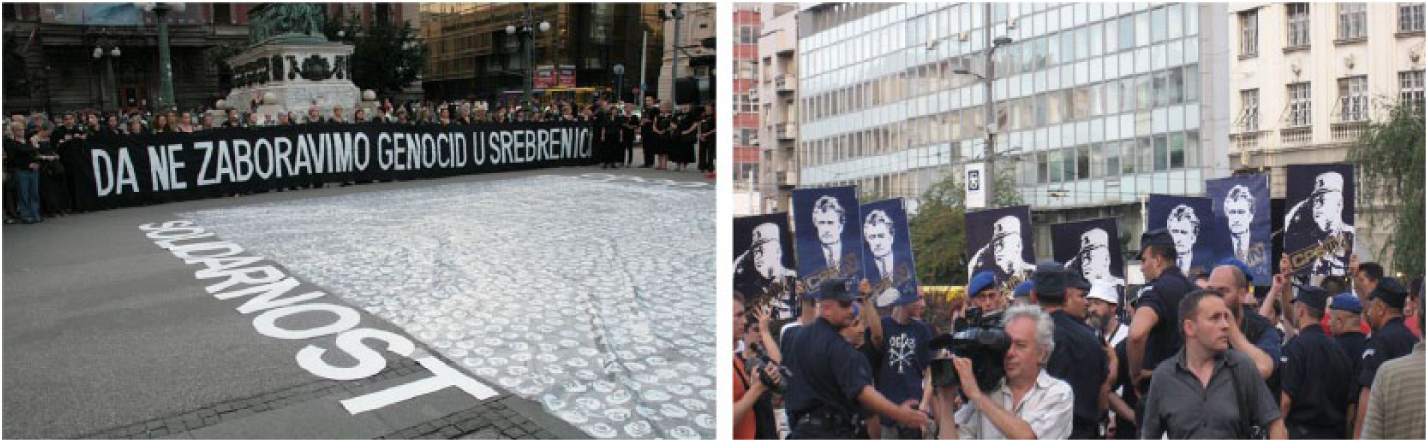
10 July 2009, the divided square.
The actual message and performance on subsequent July 10 continue and develop in an interesting manner, from silent vigils carrying banners emphasizing the memory of Srebrenica as a genocide, as well as words such as responsibility and solidarity, to carrying white roses and candles, to a street action in 2010 titled “One Pair of Shoes, One Life” in cooperation with Dah Theatre and Group Spomenik (Simić and Daly, 2011). This and the following 2 years have continued to mark the evolution of this date as an alternative commemorative event, as the message conveyed now includes more communication with passersby, formerly only conveyed through the banners held by the participants of the (silent) vigil.
On 10 July 2011, a large banner was prepared and held by the participants with the names of the victims (see Figure 2). During the hour-long vigil, the names of more than 600 victims who were to be buried the next day in Potočari were read aloud while passersby could stand and listen. On 10 July 2012, in addition to holding the same large banner again, the organizers recorded and played the testimonies of women from the group of Mothers of Srebrenica, addressing the citizens of Belgrade as to why they should know about and remember Srebrenica. Additionally, a background-recorded voice was reading a declaration of the movement stating yet again the reason why they are still in the square committed to “never forget the genocide in Srebrenica” in a country where the newly elected president made a statement denying Srebrenica as genocide (Serb President Denies Srebrenica Genocide, 2012).
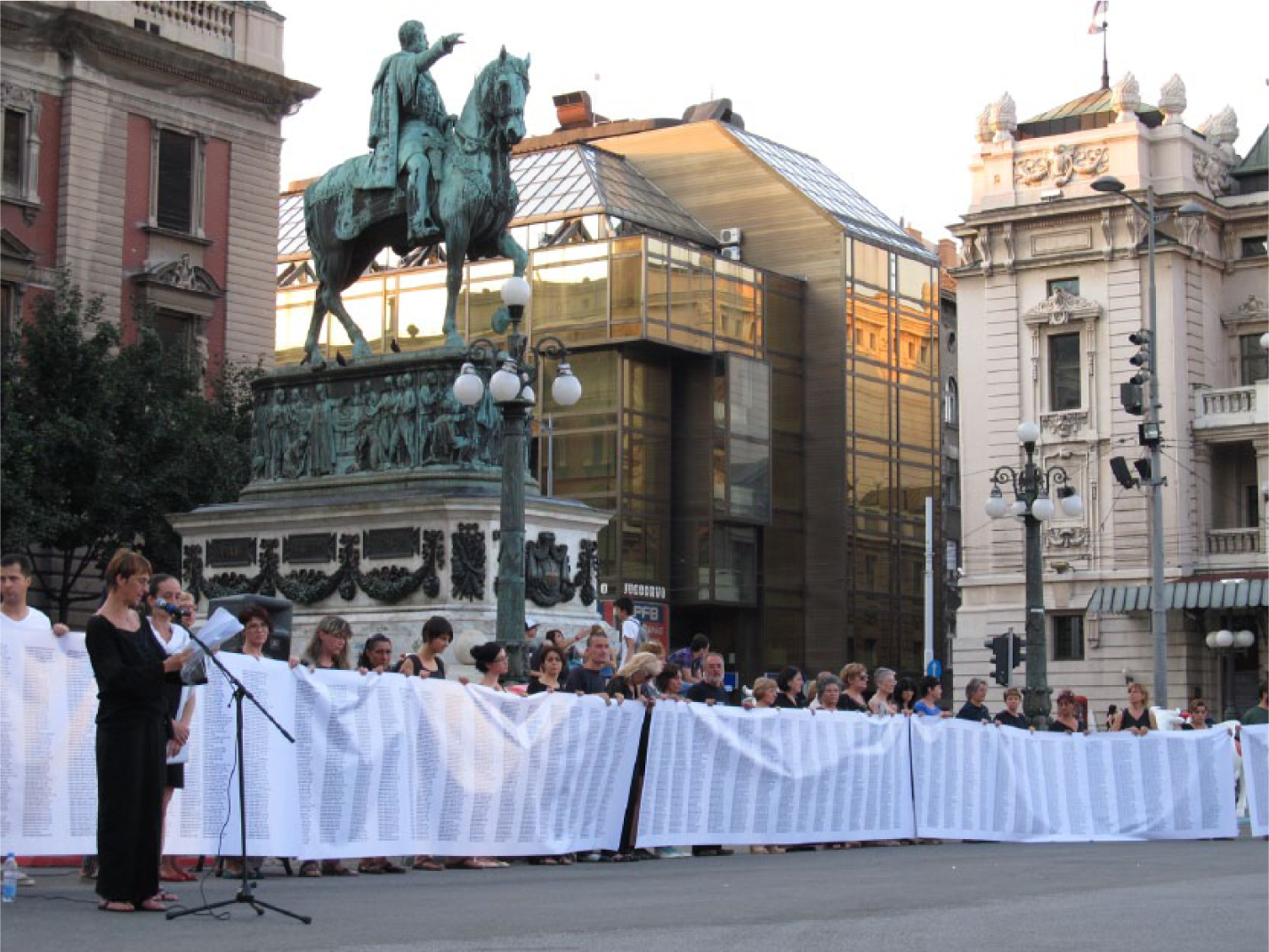
10 July 2011, commemoration.
Analyzing the 10 July commemoration of Srebrenica in Belgrade as a main event on a civic alternative calendar raises the question regarding those returning to the square year after year, participating in the annual commemorative event and street action. In observing the event as a participant over the years, I noticed that not only activists and members of the Women in Black appear in the square regularly but also others who are members of other civic groups or simply not members of any. How did they understand their participation and the calendars that they follow? 19 What was it that brought those women and men back to the square year after year? In raising this question, the most common answer I encountered was “I feel I have to be there.” Some stating even clearer, “I realized I have a political responsibility to be there on the square, every year on July 10.” While some framed it as a response to the sense of great pressure in the society—seeing the reoccurrence of the event as a test when the resistance to such memories is so great—others emphasized the extent to which this gives them a platform, as the strongest and clearest continuous anti-war voice which exists today in Serbia. In that sense, showing up in the square, in solidarity and support of a politicized message against war and nationalism feels crucial. Becoming political about those memories emerged as a need as well as a sense of obligation as citizens of Serbia. Reminding passersby about what happened in Srebrenica in 1995 has become a political platform for a different form of citizenship that can be imagined as possible, even if only for 1 hour on that square. It is a platform to bring together feminist ideologies with anti-militaristic and anti-nationalistic ones, and even more so, to bridge between the generations of those who were already adults and active during the 1990s, and those who were still children then or not politically engaged.
In talking to the founding generation of the Women in Black earlier on, the sense of responsibility of their generation was clearly stated: I have to stand for Srebrenica, this is part of my life now, this is my commitment, and not only for us here, but for the women there … but for my daughter and her friends it is different, they wouldn’t go there [to Potočari], they wouldn’t stand here [on Republic Square] … they don’t feel they did anything wrong and they are not willing to take any collective guilt … some of them don’t want to have anything to do with it … (cited in Fridman, 2006)
This generational gap is acute in analyzing anti-war activism in Serbia (Fridman, 2011), and yet there are also younger people attending the commemoration of Srebrenica annually, emphasizing that they are doing so as young citizens of Serbia. One woman in her 20s first attended the memorial only in 2011 and reflected on what it meant to her. While her mother, a member of Women in Black, was every year on the square since 1995, she explained how she never considered attending. Only when she grew up was she able to connect: standing in the square for the first time I felt a sense of relief, like I am removing the burden of denial … I realized that I was not only representing my mother there, but that I am actually standing as a responsible citizen of Serbia who is acknowledging what happened [in Srebrenica].
In that sense, the emergence of an alternative calendar on 10 July can be understood as a space created by the Women in Black for civic memories to emerge. As one participant framed it, the Women in Black are creating and making room for those memories, and with our bodies standing there we bring this memory to life … By standing there for one hour we have the strength to symbolically send a message and that is why it is so important for me to be there. (Interview with the author, 30 July 2012)
Hence, remembering the wars of the 1990s and particularly an event as Srebrenica in Belgrade’s main square offers an alternative to narratives of denial emerging as the hegemonic ones in the past two decades.
Restructuring the narrative of Srebrenica in Belgrade and commemorating it as genocide in an alternative civic calendar is crucial for the foundation of civic counter memories as related the destruction of Yugoslavia, ethno-nationalism, ethnic cleansing, and genocide. Remembering and commemorating Srebrenica as genocide—rather than solely as genocide from their point of view 20 (i.e. from the Bošniak point of view)—allows the framing of anti-nationalistic readings of this recent past. Such framing has emerged already in the early 1990s among the then anti-war civil society, as now appears in the form of an alternative calendar 20 years after it all began. By allowing the memory of Srebrenica to be present in Belgrade as a catastrophe, as genocide, as a commemorative event taking place not only in Potočari, but as part of a cycle of the [alternative] calendar, those taking part in the event are protesting not only denial of the recent past but also current civil malfunction that distinguishes memories and relativizes pain by ethno-national belonging. 21 Hence, from discussing responsibility and guilt as political categories in the decade that followed the wars of the 1990s (Duhaček, 2006), there is a possibility now to lay the ground for discussion of civic identities and engagement through memory work and commemoration of the catastrophe, not from “their point of view” only.
The memory of Sarajevo and Omarska on the alternative calendar
According to the organizers, the “Days of Sarajevo” “first emerged as a response by the youth from Serbia to the official institutional silence about what had been taking place in the capital of Bosnia and Herzegovina” (About Days of Sarajevo, 2011). In breaking the silence about the crimes that took place in Sarajevo during the war (1992–1995), when the city was besieged by Bosnian–Serbian forces, the organizers target mostly young population of their peers’ age group. Some members of this age group were only born during or after the war and, growing up in Serbia, may have not heard about those events, or were misinformed about them. The organization of the Days of Sarajevo was framed by the organizers as a reoccurring event and as a symbolic reminder of the siege of Sarajevo exactly along the line of my discussion above on labors of memory. Using engaging methods to attract young citizens to attend a festival as a commemorative event and practice, the organizers frame their discussion not only about the past but also about the future (Gutman et al., 2010), wishing to rebuild broken relations in the post-Yugoslav space through art.
The contested memory of the Omarska Concentration camp is commemorated by the Working group Four Faces of Omarska (Radna grupa četiri lica Omarske). 22 Like YIHR, this group also consists of a younger generation of activists (referring to themselves mostly as artists and theoreticians), engaged in memory work. Members of this working group work closely with Monument Group (Grupa Spomenik). 23 The date 6 August marks the day of the closure of the Omarska camp, as a consequence of the story breaking in Western media by Western journalists (Vulliamy, 1992). This day, which is still subject to controversy and contested memories, may be emerging as another day on a civic alternative calendar, commemorating the memory of the victims of the camp by groups from Serbia. While my interest here is in the Belgrade-based group commemorating the memory of the Omarska camp, their work cannot be discussed out of the context of mnemonic groups in the Prijedor municipality in Bosnia-Herzegovina (BiH) engaged in mnemonic battles against denial and obliteration in BiH and the entire region.
The struggles to create a memorial on the site of the Omarska camp ground currently functioning again as a mine and the harsh reactions to the initiative (by the mayor of Prijedor and others) point to an ongoing struggle. In this conflict, two more important days are emerging as alternative days on a civic alternative calendar: 9 and 31 May by additional mnemonic groups in BiH (and Bosnian diaspora), defining and shaping current broader debates about denial, not only in Serbia but in BiH as well. On 9 May 2011, survivors and war-time detainees of the Omarska camp returned to the camp to commemorate the memory of the victims but were not allowed to hold a commemorative event or leave flowers at the gate (Hadžović, 2011; Hodžić, 2012). This date, that in the aftermath of the Second World War commemorated the victory against fascism in socialist countries, now marks the day of memory of former camp detainees in BiH (Karabegović, 2012) and hence created further disputes (Hadžović, 2011).
And last, 31 May is emerging as another possible day on an alternative calendar of families of victims and survivors of Omarska, or of those combating denial—forming a growing virtual mnemonic community commemorating the “White Armband Day” for Victims’ Right to Dignity. As a virtual mnemonic community, the administrators of the group’s Facebook page explain their memory work: “in memory of the non-Serb citizens of Prijedor who were subjected to a campaign of extermination in 1992, and all victims throughout the world who are facing denial of their suffering” (Stop Genocide Denial, n.d.). 24
For those in Serbia struggling for the appearance and existence of counter memories of the Omarska camp in their society, traveling to the actual place on 9 May and 6 August became a central and important component of their memory work. In that case, a number of groups have officially stated their support for the construction of a memorial site in the Omarska camp together with the Association of Detainees Prijedor 92 and detainees of Bosnia and Herzegovina, with the art collective “Four Faces of Omarska,” and the “Spomenik (Monument)” working group, “the Women in Black” support the initiative for the construction of Memorial Centre in the Omarska mine complex. (Women in Black Omarska statement)
While these two examples deserve a lengthier analysis, I here discussed them to point to the multiple groups and emerging dates on the civic alternative calendar in Serbia.
Closing remarks
The main event that has emerged in the alternative calendar and that was discussed here in more length is the Women in Black silent vigil in Belgrade in memory of the victims of Srebrenica. However, it is not the only one. As discussed above, the memory of the siege of Sarajevo as well as the memory of the Omarska camp are being shaped as commemorative rituals as well among other mnemonic communities in Serbia.
Additional events that were not analyzed here for the limited length of this text, but may become part of the alternative calendar also, include the yearly “walk for Zoran” in Belgrade in memory of the assassinated premier Zoran Đinđić organized by the Liberal Democratic Party (LDP) (B92, 2012). 8 March, Women’s International Day can also be discussed and analyzed as an important and central event on the emerging alternative civic calendar. It is a day that includes street activism and brings together again different generations, members of various groups, activists, and non-activists with a clear civic, democratic, and secular message of equality. And finally, I see the events and discussions around the Pride Parade in Belgrade since 2009 evolving as a possible additional date on Serbia’s civic alternative calendar, as a continuation of the anti-war one. This points to an important connection between earlier anti-war and anti-militaristic activism that is developing in a number of directions that are inseparable: current anti-nationalist civic activism as memory work and mnemonic battles, and the civic activism for human rights and democracy, including lesbian, gay, bisexual, and transgender (LGBT) rights in Serbia. The Pride Parade event as a highly contested event, even if banned by the authorities, or taking place between four walls, may symbolize a continuation of similar struggles in relation to the mnemonic ones: how traditional or open Serbian society should or can become, and how much room for diversity or otherness should be allowed or how provincial should the society and the discussions remain (Blagojević, 2011).
Hence, analyzing civic activism as reflected in an alternative calendar that is emerging requires the understanding of those processes as ongoing ones in Serbia after the 1990s, or, as some would refer to, as Serbia in transition. Those processes of forming alternative voices and enhancing civic identities and civic engagements are occurring, among other places, in the streets of Belgrade, since the early 1990s with the creation of anti-war civil society till present day, two decades after. The legacy of the anti-war groups in the 1990s that lay the foundation for civic engagement (led among others by the Women in Black and their street activism) has continued to emerge and evolve, in the public sphere and in alternative calendars now being created, of events commemorating contested pasts (Srebrenica, Siege of Sarajevo, Omarska) and contested presents and futures (Pride parade, International women’s day).