







Abstract
Research examining the relationship between external artifacts and scientific thinking has highlighted the dynamic role of memory aids. This article explores how the nineteenth-century physicist Michael Faraday (1791–1867) used extensive laboratory notebooks and a highly structured set of retrieval strategies as dynamic aids during his scientific research. The development and dynamic use of memory artifacts are described as part of a distributed, “real-world,” cognitive environment. The processes involved are then related to aspects of expert memory and to the use of model-based reasoning in science. The system demonstrates the importance of epistemic artifacts in scientific cognition and is suggestively related to other cognitive artifacts used in scientific research that rely on similar cognitive processes.
Keywords
In recent years, a number of studies have appeared in which the nature of cognitive artifacts has been an essential part of accounts of cognition “in the wild” (Hutchins, 1995). This study uses a cognitive-historical framework (Tweney, 2013) to describe an external memory system in a scientific historical setting. We take advantage of a rich archival source to illuminate the way in which the construction of a scientific paper used memory retrieval artifacts to construct meaning.
Previous studies of artifact use have used both historical and contemporary settings to investigate how artifacts have been used in scientific cognition. Rheinberger (1997) explored the genesis and use of protein synthesis techniques among molecular biologists, and Nersessian (2008) examined the use of constructed models of “flow cells” in a bioengineering laboratory. Replications of historical techniques extended the analysis of artifacts used in scientific thinking to historical domains, a kind of “experimental ethnography” (e.g. Cavicchi, 2003; Gooding, 1990; Staubermann, 2011; Tweney, 2004). Similar analyses using replication have examined some of the epistemic artifacts used by Michael Faraday (1791–1867) during the conduct of his experimental research (Tweney, 2006).
Historians of science have analyzed the role of laboratory notebooks as epistemic artifacts for a number of scientists (Holmes et al., 2003). We extend these analyses by examining the research notebooks and memory aids kept by Michael Faraday (1791–1867). While some aspects of these devices have been described (see, for example, Gooding, 1990; Tweney, 1991; Tweney and Gooding, 1991), here we emphasize their role as epistemic artifacts. That is, such aids, like Faraday’s apparatus and specimens, were cognitive devices whose use went beyond the stereotypical role of notebooks as passive repositories of factual information; they were instead essential parts of a creative process.
It is clear that human memory is more than just a record of “facts” (Bartlett, 1932). Not only have various distinct memory storage functions been explored (e.g. Tulving, 1983) but also generative aspects of information storage have been evaluated. Ericsson and Kintsch (1995) argued that experts in a domain (but not novices or beginners) rely on the use of specialized retrieval structures, allowing highly organized material to be integrated and used, a “long-term working memory.” The external storage and retrieval systems used by Faraday are similarly specialized and served to integrate and organize the vast amount of material recorded in his notebooks.
A laboratory notebook does of course need to be a recording of “facts.” Just as we expect a telephone directory to be “factual,” we also expect a scientist’s records of experiments to be “factual.” However, Faraday’s notebooks were used in a fashion that extended their chronological ordering of factual material. We show that they were accompanied by a set of dynamic retrieval devices that played a central role in his thinking and writing. His laboratory notebooks were part of an elaborately distributed memory system with a richly interactive set of user routines, a kind of Babbage-era hypertext.
Our examination of Faraday’s external memory complements and extends studies of “memory aids” (e.g. Hertel, 1993; Neisser and Winograd, 1988). Hutchins (1995) analyzed the performance of an airplane cockpit as a cognitive system, showing that crucial relations between aircraft speed and status during landing maneuvers require a dynamically updated system to remember and display speed and other information—the cockpit is an active rememberer and thus plays an active role in landing an airplane. Similarly, in describing the organizational principles that underlie office filing systems, Norman (1993) noted that the vertical filing cabinet depended for its success upon a variety of artifacts that permit information to be structured—artifacts such as labeled tabs, standardized paper sizes, and xerographic copying processes. One of Faraday’s major needs was for an organizational principle and a set of finding artifacts that permitted him to overcome the sheer size of his data base. But, size aside, he creatively explored dynamic modes of organization and processing of the material. We seek to characterize these modes and to chart their role in Faraday’s work. This article thus is an examination of distributed cognition in an ecologically valid situation (Neisser, 1982), situated within the context of its actual use (see also Giere, 2006; Heersmink, 2013).
In recent years, there has been an emphasis on the importance of model-based reasoning in the practice of science (e.g. Clement, 2008; Nersessian, 2008). That is, much scientific thinking involves the construction, manipulation, and successive modification of dynamic models as representations of the phenomena under study. These allow us to understand the way in which artifacts participate in, and are shaped by, creative inquiry. Faraday’s memory artifacts were reflections of a dynamic process that, as we show by describing his creative working toward a publication, allowed construction of a continuously revised series of models—models, in this case, of a potential publication. In this sense, we show that Faraday’s memory artifacts go beyond the more familiar uses of memory artifacts, such as shopping lists and directories.
In the remainder of this article, we first briefly present a taxonomy of the various kinds of notebooks and retrieval devices used by Faraday and some of his early accounts of memory and mnemonic devices. We then describe the use made by Faraday of the devices in the process of working on a draft paper, thus allowing an account of the dynamics of his use of retrieval devices and notebook records. In the final section, we present an explanation of the cognitive processes implicated in his creative work with the memory aids.
Background of the case study
Michael Faraday (1791–1867) needs no justification as an important figure for study. He discovered electromagnetic induction in 1831, developed the quantitative laws of electrolysis in 1836–1837, and discovered diamagnetism in 1845. His theoretical analysis of electric and magnetic fields opened the way to James Clerk Maxwell’s integration of light, electricity, and magnetism (James, 2010, provides an excellent introduction to Faraday’s life and achievements). Born in humble circumstances, and self-educated in science, Faraday was “discovered” and mentored by the eminent and brilliant Humphry Davy, and quickly rose to an even higher stature than Davy enjoyed, becoming an icon of public adoration in Britain, much like Einstein in a later era.
Faraday left a rich documentary legacy of thought. Tweney (1991) estimated that Faraday recorded roughly 30,000 experiments, both successful and unsuccessful, in his main laboratory record, not counting a large number of speculative idea books, bibliographies, indexes, scrap-books, and so on. Most of this material is dated (or dateable), the product of a daily or near-daily effort. Faraday’s records are extensive in part because Faraday mistrusted his own memory. There was good reason for this late in his life (Hare, 1974; O’Brien, 1991), but there is internal evidence that his memory concerned him even earlier. Thus, as early as 1822, he complained in a letter about the weakness of his memory (Faraday to Ampère, 26 May 1822, in James, 1991–2012: 267), a complaint that occurred with increasing frequency in his correspondence as he aged; a possible motivation for the complexity and richness of his retrieval aids. Still, there is more than simply an attempt to compensate for a weakness. Faraday was part of a Lockean cultural tradition of ideas which saw the cultivation of memory and the keeping of records as essential to self-improvement and the acquisition of knowledge (Yeo, 2008).
Tweney (1991) identified five categories of memory aids used by Faraday: (1) Laboratory notebooks proper, including “The” Diary (a term not used until 1928; James, 2010: 120); (2) Idea books (kept only during the 1820s); (3) Loose slips; (4) Retrieval sheets; and (5) Work sheets. Faraday’s most important scientific researches were kept in a series of notebooks. Begun around 1820, Faraday kept this record as a chronological series, occasionally binding them into large volumes. From 1832, Faraday numbered the entries sequentially from 1 (25 August 1832) to 16,041 (6 March 1860). These were transcribed and published by Thomas Martin (1932–1936) as “Faraday’s Diary.” “Idea books” are early (before about 1832) non-chronological records of speculations, possible experiments, and theoretical musings (Tweney and Gooding, 1991). In contrast, laboratory notebooks are chronological records and thus possess a function similar to an episodic memory store (Tulving, 1983); they record specific events as they happened. Because idea books contain descriptions of related material with no temporal organization, they function more like semantic memory—generalized entries across multiple specifics (whether past events or proposed future events). In the idea books, entries are not dated, blank spaces are frequent, and Faraday altered some entries long after they were written. Thus, while notebooks are diachronic, with a single “growing edge,” idea books are synchronic with multiple growing edges. In later years (i.e. after about 1832), Faraday appears to have abandoned singular idea books in favor of topically organized smaller items that provided similar functions. These retrieval devices allowed Faraday to develop the “semantic” memory out of the “episodic” entries in the notebooks.
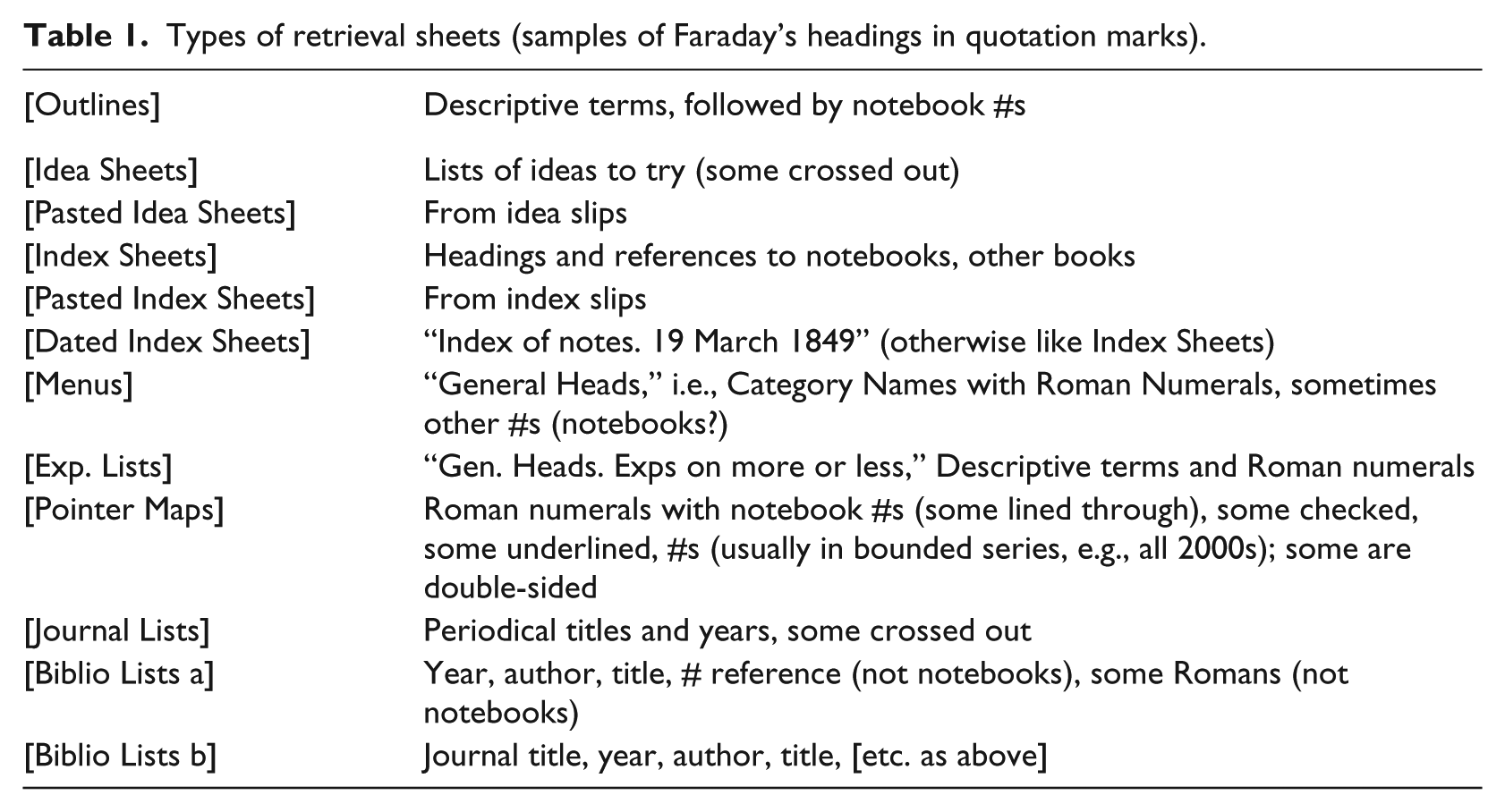
Tweney (1991) recognized three such retrieval devices (loose slips, retrieval sheets, and work sheets). We have further divided the retrieval devices into 12 categories (Table 1), some of which are based on loose slips which have been pasted on larger sheets. Loose slips are small (most are roughly 1 × 10 cm2), mostly with only one line of writing. Retrieval sheets are full sheets of foolscap (34 × 43 cm2) or half foolscap (34 × 22 cm2), though both smaller and larger sheets were used. Most have multiple entries, occasionally with blank spaces left between entries. Loose slips can be further subdivided into two types. First, there are “Index tags” (Figure 1 shows some of these pasted on a larger sheet), usually one line in length with a short heading and one or more references to numbered entries in the notebooks. In addition, there are “Idea tags” of varying sizes (Figure 2 shows some pasted to a larger sheet, along with some tags of the previous type). These are more like the content of the earlier Idea books; they contain brief notes of experiments to be tried, literature references, hypothetical possibilities, and references to notebook numbers. While some loose slips are found in the archival record, many more have been pasted onto larger sheets.
Types of retrieval sheets (samples of Faraday’s headings in quotation marks).
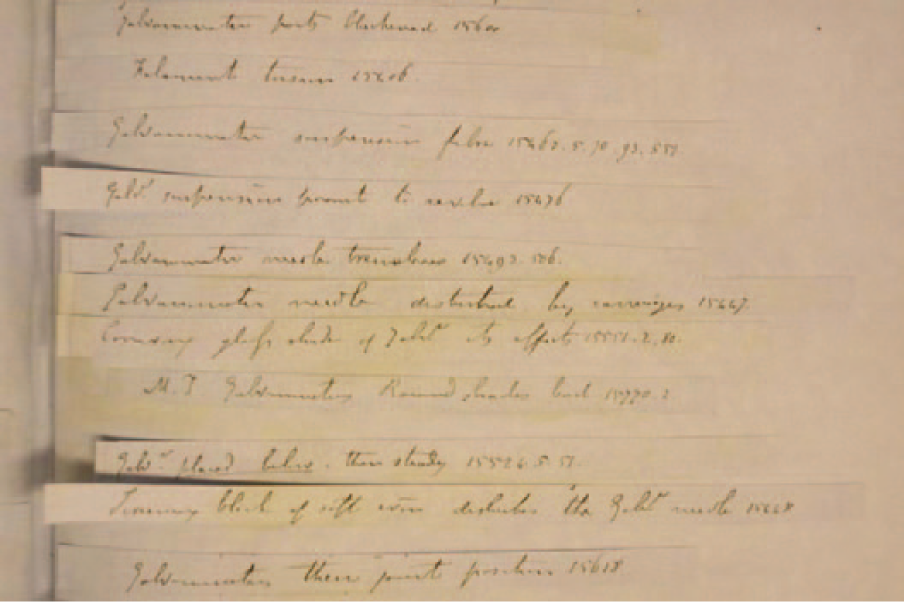
Index tags (pasted-up after Faraday’s death), IET Archives, Misc. Mss. SC2.
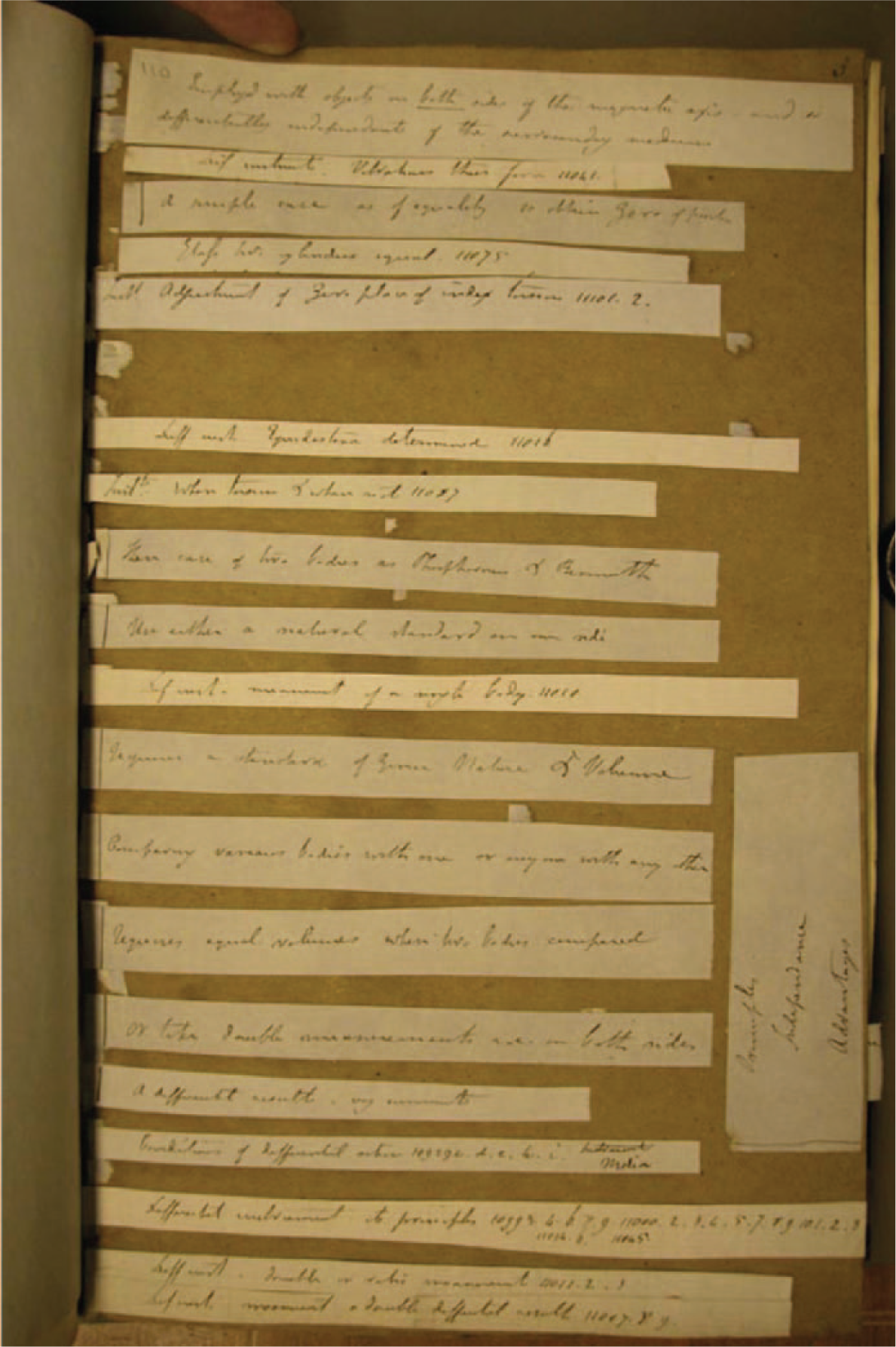
Idea tags (pasted-up by Faraday), IET Archives, Misc. Mss. SC2.
Note that index sheets and pasted index sheets resemble each other, as do idea sheets and pasted idea sheets, except in the way they were made. Some index sheets are dated, suggesting that Faraday wanted to locate them chronologically against his other endeavors. Finally, work sheets, the last of the five major types described by Tweney (1991), comprise data tables, rough notes, outlines, fragments of manuscript, and the like. Relatively few of these survive, most from late in Faraday’s career. Later, we will argue that one such document, an unfinished paper, reflects a well-developed version of such a work sheet, one that is especially revealing about his method of working.
The 12 types of retrieval aids shown in Table 1 differ in relative scope. Leaving aside the last three entries in the table (which are relatively straightforward bibliographical lists), there are two levels: (1) retrieval sheets that refer to numbered notebook entries and are hence “narrow” and (2) a “broad” kind that categorizes retrieval categories themselves. Thus, the first six types in Table 1 correspond roughly to either idea slips (and are sometimes made up from such slips) or index slips (also sometimes made up from such slips). The latter include explicit references to notebook entries by number. For example, in a page of entries on the use of a galvanometer in experiments on the time of magnetic induction, there are sheets with entries such as “galvanometer suspension to revolve, 15476,” where the number corresponds to the notebook entry. The next three kinds in Table 1, namely, menus, experiment lists, and pointer maps, are broader and sometimes use Roman numerals, sometimes notebook numbers. The Roman numerals are almost always associated with quite general category names, for example, “Electrochemical decomposition XXIV.”
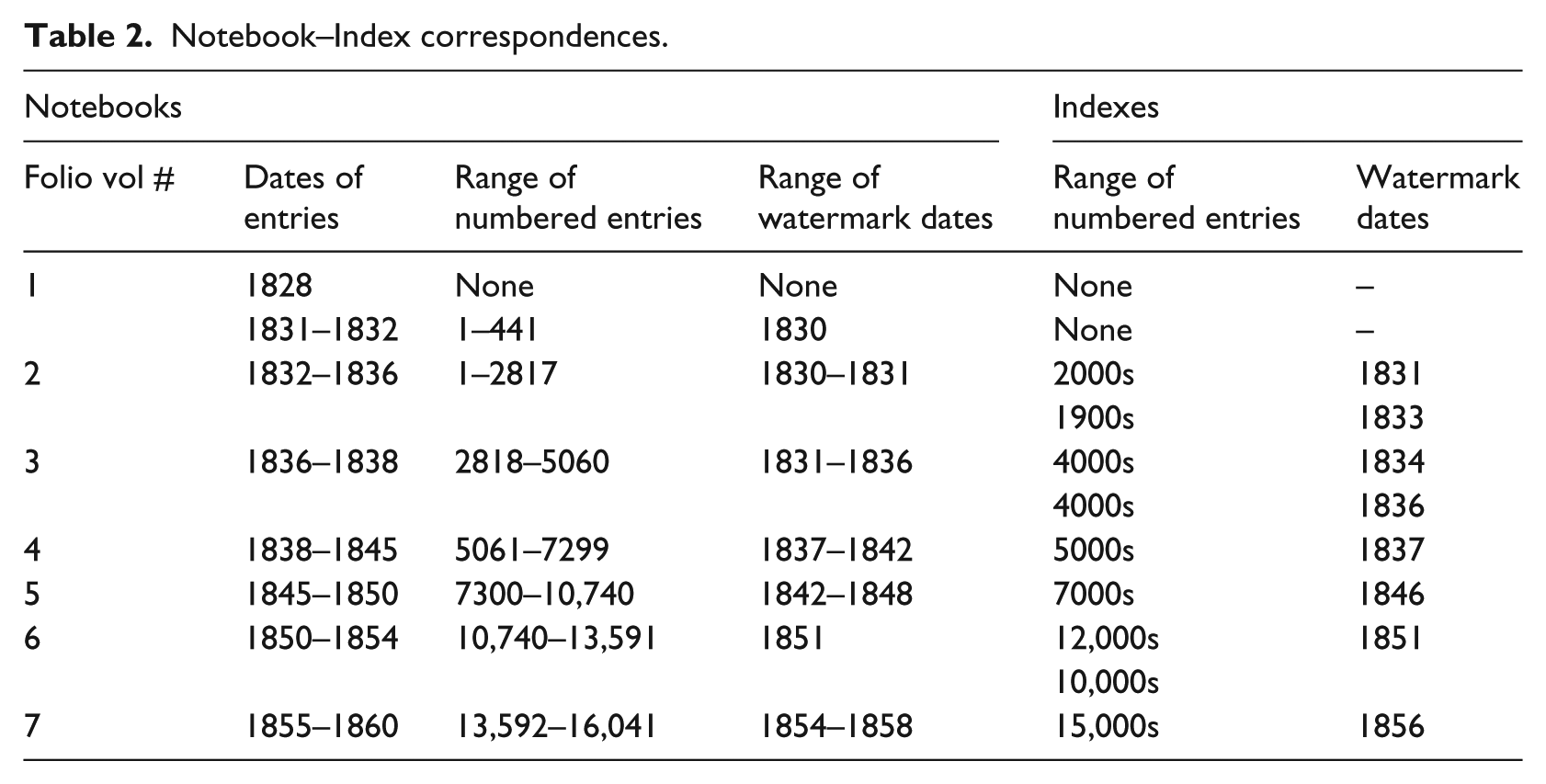
Watermarks are present in the paper of some of the sheets written by Faraday on the same kind of foolscap paper that was used for the notebook records themselves. Because some of the watermarks bear the date of manufacture of the paper (Gaskell, 1972), it is possible to correlate the paper dates with the dates given in the notebook entries. Table 2 and Figure 3 show the results when this is done across a large span of the surviving material. There is a close correlation between the numbers used in the notebooks, the numbers referenced on the index sheets, and the watermark dates. Thus, the index material was not a late attempt to construct a general index, contrary to an earlier claim (Martin, 1932–1936: v.). Instead, the sheets were made at approximately the same time as the notebook entries or not long after.
Notebook–Index correspondences.
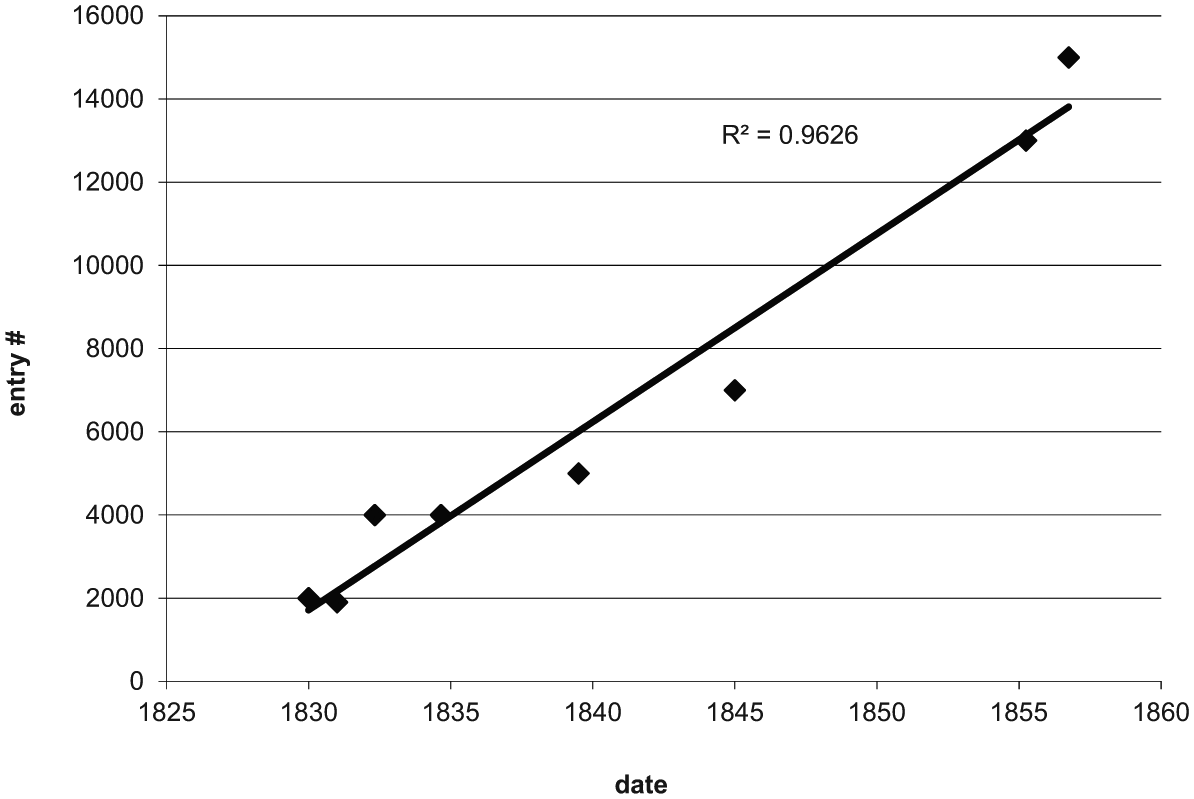
Notebook entry number as a function of watermark dates in loose slips and sheets.
The last three entries in Table 1 identify retrieval aids keyed to journal literature. Here again, we see a “broad” versus “narrow” organization, Journal Lists being, in effect, guides to broad categories and the other two representing two orthogonal ways of organizing access to the literature itself.
The retrieval aids were dynamic, not simply because they changed over time but also because the very richness of types suggests that they were “tailor made” for specific purposes. The fact that so many of the items were in the form of single-entry slips suggests that Faraday sorted and re-sorted slips in ways that go beyond the mere retrieval of information; there were clearly creative uses in mind. Tweney (1991) reported an informal exploration in which he took one retrieval sheet (a “pasted index sheet,” in the terminology of Table 1), photocopied the notebook entries referenced on the sheet, and pasted those in order on larger sheets. Unfortunately, the results were not particularly informative. Only when the selections were read in context, that is, with surrounding entries and a larger view of the topic referenced, did the retrieval sheet appear coherent.
For Faraday, it would have been an even richer experience, because he would have had access to his stored long-term memories of the topic, the particular experiment referenced, the episodic memory of the experiment, and the relevant semantic memories. For Faraday, it is safe to conclude that the retrieval devices he worked so hard to create were part of a distributed memory system that included personal memory and the notebooks. The retrieval devices were an integral part of his research. They were not “mere” indexes.
Faraday and memory
As we noted above, Faraday’s memory was, to him, worrisome. Beyond this, however, he clearly paid close attention to the workings of memory in a more constructive sense. In 1813, when Faraday was hired by Davy and began work at the Royal Institution, London was a hot-bed of “self-improvement” groups, small circles of friends who would meet regularly to discuss issues, give papers, and support each other’s efforts (Jenkins, 2008). Such groups reflected a “Lockean” flavor among their upwardly mobile members, one captured especially by the writings of Isaac Watts (1809, a book Faraday read as a teenager). As early as 1809, Faraday followed Watts’ advice by beginning to keep notebooks as an aid to memory. For example, Faraday kept a Common-Place Book from 1816 (Dacome, 2005; Locke, 1800; Yeo, 2008). Many entries indicate a playful verbal intelligence, but there are also a number of fine drawings, reflecting his interest in visual representation as well (Prescott, 1985).
Conscious concern with memory appears in the Common-Place book. For example, there is a description of Gregor Von Feinagle’s (1813) mnemonic memory scheme, which relied on the ancient “Method of Loci” (Yates, 1976). Faraday adapted Feinagle’s scheme, using a numbering scheme to create three overlapping orderings, in effect condensing three separate filled spaces into one.
Another entry is fascinating because of the light it sheds on Faraday’s growing self awareness about the nature of memory and thinking. In 1816, Faraday met a 13-year-old boy capable of extraordinary feats of mental arithmetic (an interesting memoir was written by the boy some years later; Colburn, 1833). Davy had sent the boy to Faraday “to ascertain whether there was anything useful in his method” (Faraday, 1816: 87). The boy was capable of multiplying four- or five-digit numbers by four- or five-digit numbers “generally though not always correctly.” He could factor 12-digit numbers, and could extract cube and square roots, all in his head. Faraday untangled part of the method after a series of conversations with the boy and his father. For example, multiplication was based on a series of algorithms built on a set of 24 tables which specify the possible one- or two-digit by two-digit factors for numbers which end in a given two digits; thus, a number ending in “89” could be produced by “29 × 41,” or “33 × 33,” or “37 × 97,” and so on. These memorized tables were then used, together with a set of place-keeping algorithms, to develop large products.
Faraday tried but failed to gain insight from the boy about how the tables were constructed and obtained only two of the actual tables from the boy. Faraday therefore set out on his own to reconstruct the remaining tables and was able to do so. He found that only six tables were actually necessary, since the remaining ones could be generated from the six. Whether Faraday subsequently made use of such calculational techniques is not known, though here again we see a pattern of interests in the nature and uses of memory.
A systematic laboratory notebook (“Quarto Volume I,” in Vol. 1; Martin, 1932–1932) first appears in the archival record in 1820. Entries were dated, but the date ordering is highly irregular as Faraday evidently moved back and forth by topic. In 1823, “Quarto Volume II” was started and resembles Quarto Volume I, except that it is partly blank. The last entries are dated 1833. In 1831, Faraday began “Folio Vol. I,” the beginning of the numbered, chronological notebook that formed the core of the mature memory artifact system. The book was bound by Faraday after it was written (as indicated by the general absence of blank pages). This volume, like all the later ones, recorded a huge number of failed experiments and speculations that never bore fruit or were never pursued. Thus, if the notebook does represent a “fair copy” of (presumably lost) laboratory notes (as Agassi, 1971, suggested), then it seems likely at the very least that the copy is complete. Several numbering schemes were tried and abandoned in 1831. From 25 August 1832, beginning at #1, the sequence was continued nearly to the end of his life, #16,041 being recorded on 6 March 1860. In all, seven folio volumes of the main laboratory notebooks were produced.
In cognitive terms, Faraday’s addressing scheme provided a fixed temporal base-line analogous to episodic memory, clearly an important advantage for a long and busy career. But clearly, due to the vast amount of material (and perhaps also his growing problems with memory), Faraday’s retrieval problems grew increasingly more serious as time passed. Therefore, constructing something analogous to semantic memory out of this vast archive explains the need for such things as idea sheets. Furthermore, as the watermark dates shown in Table 2 indicate, he began these schemes quite early, not later than 1832. Note that having an address attached to each entry is only part of the problem—you also have to find the address to locate the entry! We can see one way in which Faraday used the mature retrieval system by looking at a partially completed manuscript found among his papers.
Using the laboratory notebook
Retrieval aids require an encoding process in which a retrieval cue (an index tag, say) is encoded in physical form with an address to the full notebook entry. Once the tag exists, it can be used as a finding aid for the retrieval of specific notebook entries. It can also serve as a mnemonic cue useful in the structuring of notebook-based knowledge. By sorting slips one can impose one or another organization on the entries and vary that organization in the service of other goals. Such sortings are visible and were used by Faraday in the creative writing of an unfinished paper.
The manuscript, dealing with a magnetic torsion balance, along with various notes, indices, outlines, and tables, is found in “Folio Volume VIII” of Faraday’s laboratory notebook (Faraday, 1861–1862). This volume was collected and bound after Faraday’s death in 1867 and bears numbered pages (and occasional annotations) in a hand other than Faraday’s, apparently that of his widow, Sarah Faraday, who initialed one of her comments. Only part of this volume was included in the transcribed version of “Faraday’s Diary” (Martin, 1932–1936), not including the unpublished manuscript that most concerns us.
At the beginning of Folio Volume VIII is an Idea Sheet entitled “Subjects to work & think out” consisting of a list of 23 numbered topics, 4 of which have been crossed out. Number 8 (which is not crossed out) is “Description of the recent torsion balance,” which refers to the manuscript we are interested in. Like some of the other contents of the bound volume, it consists of loose notes and drafts. Watermarks for 1851 are present on some of the leaves. It is clearly a composite of several kinds of independently written (but related) items. However, because the volume’s physical structure can be examined, and because Faraday used a variety of paper colors and sizes, it is possible to reconstruct a partial chronology and to gain a number of insights into how Faraday worked with this material.
The paper describes an improved version of a balance capable of measuring weak magnetic forces. In 1845, Faraday had discovered a “peculiar phenomenon” (Faraday, [1846] 1855). It had been long known that an iron needle suspended on a thread between the poles of a horseshoe magnet would turn, lining itself up between the poles of the magnet. Besides iron, nickel and cobalt needles behave similarly. Faraday found that other substances, for example, glass or bismuth, would also turn, but in such a way as to align themselves at right angles to the poles. Faraday called such substances diamagnetics and later dubbed the others (iron, say) paramagnetics. The discovery was of great importance because it suggested that all substances (not just iron and a few others) were affected by magnetic forces (Gooding, 1981). Just as all substances were either conductors or insulators in relation to electricity, so now Faraday could argue that all substances were either diamagnetic or paramagnetic in relation to magnetism.
Following the discovery, the nature and explanation of diamagnetism had come to attain substantial theoretical importance. For Faraday, it was a key to the development of his mature field theory (Faraday, 1855; Gooding, 1981; Tweney, 1992). However, Faraday needed a precise statement of the quantitative relationships involved, particularly on the issue of whether or not the forces were inverse-square-law forces. That is, it was known that the attractions and repulsions of paramagnetics followed an inverse square law. Was the same true for the forces involved in the movement of diamagnetics? The question was difficult to resolve because the forces involved in diamagnetic movements were extremely small. The German physicist Julius Plücker had argued that the diamagnetic forces did not follow an inverse square law, a finding that was troublesome for Faraday’s notion. This appears to have been the immediate stimulus for Faraday’s work (see Tyndall, [1851] 1888, for an account in detail of the theoretical and experimental issues). Because the forces were so weak, Faraday had to construct a very sensitive balance, and his notebook records suggest how difficult this was: Using a balance he had built a few years earlier, he described important modifications and spent the months from July 1852 to mid-November 1852 refining the balance and calibrating it (Martin, 1932–1936: 73–248). This was all very difficult—the notebook entries covering the research are numbered from 12,020 to 13,009! In 1853, he published some of his results using the balance (Faraday, [1853] 1855). At that time he indicated that One great object in the construction of an instrument delicate as that described was the investigation of certain points … especially that of the right application of the law of the inverse square of the distance as the universal law of magnetic action. (Faraday, [1853] 1855: 502)
However, the present draft (which is on watermarked 1851 paper and clearly preceded the 1853 publication) differs in important ways from the published version and is probably an abandoned early draft (no later ones have been found).
The draft falls into three main sections, bound in the following order: (i) 24 sheets of blue foolscap paper folded to give 48 leaves, (ii) 24 folded sheets of blue foolscap sewn inside three folded sheets of white foolscap, and (iii) folded sheets on various colors of paper. The first part (i) corresponds roughly to an “Introduction.” Writing is mostly only on the right-hand (“recto”) sides and consists primarily of paragraphs that have been written on other sheets, then cut and pasted to the blue foolscap. This is followed by 15 blank leaves. Part (ii) corresponds to the “Methods” section. It is written directly on the sheets, but has a number of slips pasted on (see below). Part (iii), roughly a “Results” section, has a substantial variety of structure and is much rougher than the other two.
It is apparent that Faraday began the draft by writing the Methods section (Part ii, see Figures 4 and 5), writing continuously on the recto (right-hand) sides of the sheets only and describing the magnetic torsion balance in far more detail than he did in the 1853 publication. After completing this, he wrote notes toward an Introduction, apparently on separate pieces of paper, which were then pasted in order into another notebook (i.e. part i, above). Paragraphs in both parts were then numbered (from 1 to 60), and it is evident that this numbering must have been done after the first and second sections were combined. One striking feature of the Methods section is the presence of index tags to the laboratory notebook which have been pasted to the verso (left-hand) side in positions that vary depending on the corresponding text on the right (Figure 5). From this, we can infer that Faraday wrote this part of the manuscript with a set of loose index tags at hand. As he wrote, he seems to have pasted a tag on the left and written the corresponding text on the right, perhaps referring to the notebook itself as he progressed. The tags were not all written at one time: though no watermarks are visible, they vary, seemingly at random, in color and size. This part of the paper was apparently a fairly routine writing task, except for the fact that the pasted tags refer to some 200 separate entries and series of entries in the notebook, not, in general, in chronological order. The real work may have been deciding upon the order of description of the apparatus and its use and perhaps was done by sorting loose tags.
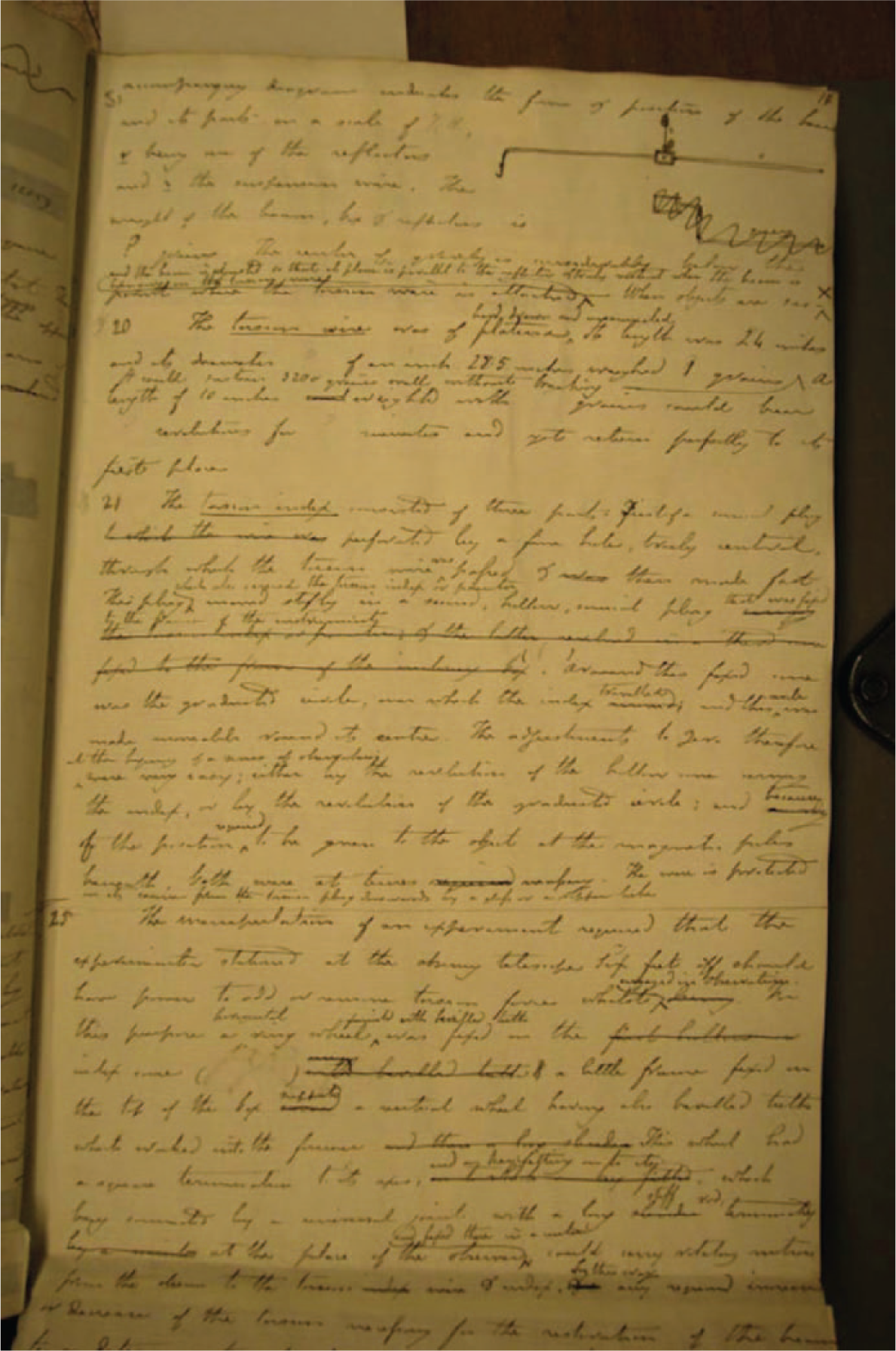
Magnetic Torsion Balance MS. (recto), RI Archives, F2J.
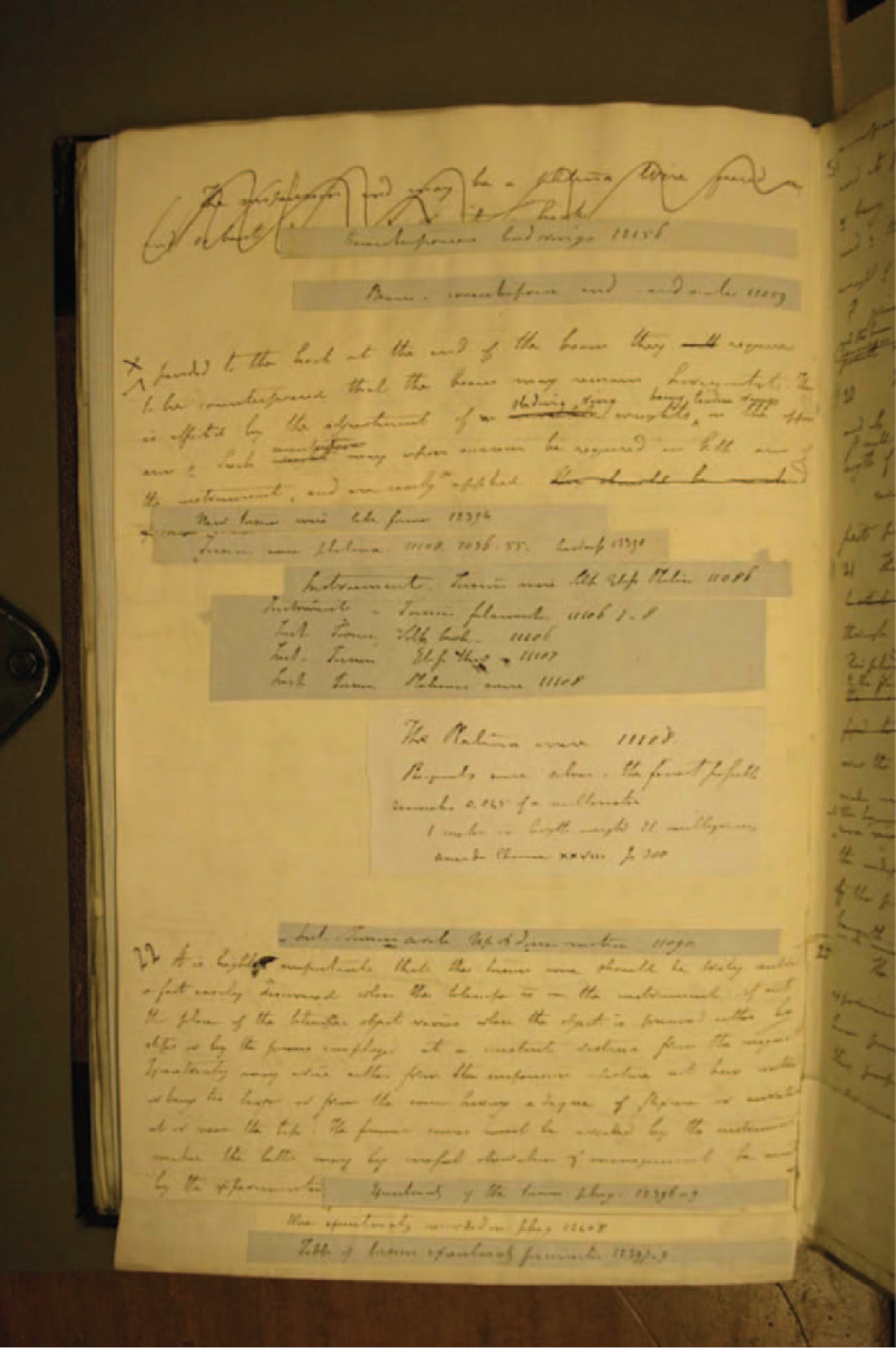
Magnetic Torsion Balance MS. (verso of same opening as in Figure 5), RI Archives, F2J.
The first part of the paper, the Introduction, has no index tags on the versos, though a few are pasted in at various points in the text itself on the rectos. Here, the composition problem was evidently different. Apparently, Faraday felt confident about his knowledge of the theoretical background of his intended paper and did not need to sort slips as he had earlier. He did, however, sort the blocks of text as such and inserted some index tags to indicate relevant passages in his notebook. In one place, he wrote a paragraph at the bottom of the verso page, evidently meaning to insert it in a later version in the text on the right. The draft introduction differs in an important respect from the published 1853 article; in the draft, he asserted clearly that every diamagnetic substance has a characteristic “magnetic capacity” (Faraday, 1851: 27). By 1853, however, he softened this view and regarded the issue as still unsettled; apparently, he was responding to some contrary results obtained by Plücker. Even the inverse square law was, he admitted, not yet fully confirmed for diamagnetic substances.
Thus, we argue that Faraday began with the second part of his paper, initially writing a series of slips at various times, then cutting and sorting the slips, and then writing a first draft by pasting slips in order on the left and writing on the right. The Introduction of the paper was written separately, perhaps as a continuous text, then cut and pasted in blocks (with occasional index slips between the blocks) on the right-hand sheets of another sewn notebook. One paragraph was written on the left, presumably to be added later.
What of the rest of the paper, and why was this draft left unfinished? Some results are present, in the form of tables of empirical results in the third part, but no text is present. The numerical results are identical to those in the 1853 publication (although the layout is very different, and not all made their way into the later paper). There are a good many loose slips that have been pasted on sheets and bound at the end of Part (3). A note in another hand (Mrs. Faraday’s?) indicates that these slips were left loose by Faraday. Most of these slips are Index tags, but two are notes that sound like experiments to be tried (i.e. Idea tags). There is also a rough outline of the entire paper which has large blank spaces, but is rather densely filled-in for topics that would constitute the main body of a Results section. And, in rather chaotic order, there are loose notes describing some results, pasted-up sheets of experiments to be tried, and a variety of other notes and tables. At the very end is a page torn from a published article, “On diamagnetism and magne-crystallic action” by John Tyndall ([1851] 1988), pasted to a larger sheet, and with a few notes pasted on by Faraday at the bottom, indicating the topics of the article and its source.
Tyndall’s article describes a torsion balance built on different principles than Faraday’s and presents data showing that the forces exerted by a magnetic field on diamagnetic substances (like bismuth) were inverse-square-law forces, as were the forces exerted on magnetic substances (see Tyndall, [1851] 1888, for a complete discussion). Tyndall’s approach to the issue was somewhat different than Faraday’s, and his balance represented a different solution to the problem than Faraday’s, but the end result was the same as Faraday’s. Tyndall wrote to Faraday indicating his views on the issue in early 1851 (Tyndall to Faraday, 4 February 1851, in James, Vol. 4: pp. 247–249). Faraday did not begin his research until July of 1852, continuing until November of 1852. He then presented a lecture at the Royal Institution on the topic in January of 1853. Tyndall was at the lecture and wrote to Faraday a few days later: I confess I never entertained the thought of applying the experiments described on the accompanying leaf as you have done, and though startled by the profound ingenuity of your argument on Friday night, I did not imagine that the conclusion could be at all approached by the route chosen. (Tyndall to Faraday, 26 January, 1853, in James, Vol. 4: p. 479, emphasis added)
It is likely that the pasted Tyndall leaf in Faraday’s manuscript is the one sent by Tyndall in January of 1853.
Faraday’s ([1853] 1855) article makes clear that he had a quite different approach to the issue than did Tyndall. For Faraday, a major goal was to establish a quantitative continuum between the paramagnetism of substances like iron and the diamagnetism of substances like bismuth, and to show that all substances fell along the continuum, even gases and liquids; “If a man could be in the Magnetic field, like Mahomet’s coffin, he would turn until across the Magnetic line, provided he was not magnetic” (Faraday, notebook entry, 8 November 1845, in Martin, 1932–1936: 325). Faraday’s ([1853] 1855) publication is far more comprehensive than Tyndall’s and speaks more directly to the theoretical issues. Tyndall’s article may have convinced Faraday that he could present a briefer account than the draft suggests he began with; with Tyndall’s approach in the public domain, Faraday reduced the original draft’s extensive account of control conditions and the need for careful calibration (which had been extensively discussed by Tyndall) to a single paragraph in the later published version. In the end, the published article is quite different than the unpublished draft. Whereas the draft centered on the balance, the published article centered on the theoretical issues involved and on the results, with the apparatus used being secondary. In effect, between the draft and the article, there must have been a quite different draft which has not survived.
Conclusion and implications
Faraday’s unfinished manuscript resides midway between the retrieval devices and a finished manuscript; it is a hybrid that allows us to see some aspects of its creation. That it is an example of distributed cognition, based in part on the retrieval artifacts, is apparent, but it is also a reflection of the processes that underlay its creation.
Faraday used the chronological record of the notebooks to order and construct a very different kind of cognitive structure, in effect transitioning his episodic records (from his notebooks) to a more generalized account in which the specific records are structured into a coherent whole, a process akin to the way in which semantic memory emerges from episodic memory. Reconstructing the pathway from the records to the draft thus permits description of how Faraday navigated from the seeming chaos of his initial experimental results, through his initial formulations, to the draft and (ultimately) to a final published text. The draft is a case of “arrested development,” allowing us to see that Faraday required and used a variety of changing organizational principles. This accounts for his use of slips, which can be sorted and re-sorted until the particular structure needed for a given purpose has been attained.
Recent studies of the construction of models in science via model-based reasoning (e.g. Nersessian, 2008) resemble the “cut and paste” methods suggested by the Faraday draft. Nersessian (2008) defined model-based reasoning as the process by which “inferences are made by means of creating models and manipulating, adapting, and evaluating them” (p. 12), where “A model [is] a representation of a system with interacting parts and with representations of those interactions” (p. 12). There is a recursive character to such reasoning, what Clement (2008) referred to as the nesting of “generate-evaluate-modify” cycles. Such cycles are prominent in bench-top laboratory science (e.g. Osbeck et al., 2011), but they also resemble the cut and paste, or sort and resort, processes that characterized Faraday’s struggles to construct the final meaning of his paper. Thus, as the case study demonstrates, the construction of scientific meaning involves the writing process, as well as the empirical and theoretical research itself and is carried out by similar means.
As with bench-top modeling, the role of both external and internal memory is especially apparent in the writing process (e.g. Menary, 2007), as the Faraday case demonstrates. Of course, every scientific paper establishes the author as an expert in the domain under study. This expertise is not complete, if only in the sense that most scientific papers conclude with discussion of what is not known about the topic. Yet the audience will expect that the author has mastered the methods described, the previous literature, the analysis of the data, and so forth, and that, whether internal or external, expert memory is involved. Establishing this level of expertise is partly what motivates the careful description of methods, results, and so forth. By writing a scientific paper, the scientist must also be confident in his or her expertise in these respects. When the result is a new one, establishing this expertise must come before or during the writing of the paper. The present case study provides a glimpse into this process.
Research on expertise has established a huge body of findings on the nature of expertise and its development, first via studies of skilled chess players (Binet, 1893 [1966]; Chase and Simon, 1973; De Groot, 1965), and more recently for a wide range of skills: athletic performance, musical performance, medical diagnosis, physics problem-solving, and many others, including expert memorizers and mental calculators similar to those Faraday examined (see the chapters in Ericsson et al., 2006). Such studies have shown that high-skill experts know more than less-skilled individuals, but they also know differently. Even when the knowledge base of experts and novices is equated, experts structure their knowledge more effectively, perceive salient or anomalous features more rapidly, and are able to “chunk” aspects of a perceived field more efficiently. Skilled expertise is domain-specific. For example, chess masters can remember more positions of a chess game than lesser players, but perform no better on random configurations of pieces. In the case of Faraday, these considerations explain why Tweney’s (1991) exploration of the retrieval sheets (above, p. 7) failed to make sense until he had read the surrounding context. Faraday’s growing expertise, as he arranged and sorted slips and pasted them onto larger sheets, would have been conducted in a much richer and better-structured internal environment. Thus, both internal environment and external environment worked together as part of a distributed cognitive system.
Ericsson and Kintsch (1995) proposed that experts possess facility in long-term working memory. Rather than simply using cues to retrieve items from long-term memory into working memory, experts have structured retrieval mechanisms that bring entire networks of relevant knowledge into (or available to) working memory. The contrast between long-term working memory and the more pervasive working memory mechanisms can be seen with simple examples. Thus, while most of us can rely on cue-based retrieval to think about “elephants,” an acquaintance, who once worked in a zoo, can automatically retrieve an entire body of skilled knowledge about elephants—their feeding habits, sleep patterns, and so on. Similarly, skilled readers are better at accessing and understanding the gist of complicated texts, compared to less-skilled readers, because they also have structured retrieval capabilities. The development of such structured retrieval explains the long and deliberative practice needed to become expert within a domain. Faraday’s examination of Feinagle’s mnemonic scheme and his account of the calculating prodigy (above, p. 10) suggest that Faraday was aware at a very early stage of the way in which expert memory could be established internally. Both kinds of performance, mnemonic retrieval and mental calculation, rely on well-learned, automatically accessible structures that must be available to long-term working memory. They work only after long practice.
In the case of Faraday’s draft, the apparent workings and re-workings of the notebook entries and the draft (mediated by slips and retrieval aids) suggest that Faraday was in the process of developing the expertise needed to fully support his paper. The full, automated, retrieval structures were only partially present, which accounts for the fact that he had to rely on the retrieval devices. In this sense, the retrieval devices are “artifacts” in the same way that laboratory specimens and apparatus are artifacts: essential epistemic parts of his cognitive arena. Note that this differs from the conventional view of writing, in which a writer knows what he or she wishes to say and simply “pours out” the text. Instead, the final text and its meaning must be “made.”
Gooding (1990) noted that the understanding of Faraday’s experimental research required more than analysis of the propositional level of representation; instead, he urged consideration of the importance of an “eye–hand–mind” dynamic. This study extends the point by suggesting that even the propositional manipulations themselves—the verbally encoded records of notebooks and retrieval artifacts—involve a central dynamic in which the participation of epistemically active memory artifacts must be acknowledged. The lesson of Faraday’s highly developed memory artifacts is that, in science, we must be prepared to understand how a scientist can “do memory,” just as a scientist can “do experiments” (see also Anderson, 2006).
This study has implications that extend beyond the particular case examined. Faraday’s specific “cut and paste” method will be familiar to those who use similar functions in modern word-processors, and his use of retrieval systems based in part on loose slips and tags resembles the kind of search and sort functions familiar to users of databases and web searches. For both Faraday and the modern scientist, the need for actively used distributed memory systems is central to the scientific endeavor. In fact, this point can be extended. In its final form, the published 1853 article, Faraday’s efforts became a distributed memory artifact for other scientists. What they made of his article would have been assimilated to their own memories, perhaps as an entry in a bibliography, or as a remembered finding in long-term working memory. As a result, what we have tracked as model-based reasoning in Faraday could become a singular artifact for another person, supporting their own model-based reasoning—a recursive extension of the original (cf. Caneva, 2005). Tyndall, for example, accepted Faraday’s findings but within a very different theoretical context, one he extended with his own experimentation. More generally, just as Faraday came to be recognized as the “discoverer” of diamagnetism, the claim that all substances are subject to magnetic forces became another universalized and collectively held “discovery” attributed to Faraday. Thus, the present claim that Faraday’s distributed memory artifacts can be understood using model-based reasoning can in principle be “scaled up” to an account of how such collective understandings arise in the larger social contexts of science.
Footnotes
Acknowledgements
Thanks are due to the staff of the Royal Institution of Great Britain (especially Irena McCabe, the former Archivist, and Frank A.J.L. James, current Head of Collections and Professor of the History and Philosophy of Science) and of the Institution of Engineering and Technology (Lenore Symons, Archivist) for their assistance with archival materials, and for permission to quote from holdings. David Harper, Susan Chitwood, Michael Doherty, the late David Gooding, Maria Ippolito, Frank A.J.L. James, Elke Kurz -Milcke, and several anonymous reviewers commented on earlier drafts. Cathy Hoffner and Karin G. Hubert assisted in the data analysis.
Funding
This work was supported by grants from the Faculty Research Committee, Bowling Green State University, and the US/UK Fulbright Commission, which supported the first author’s (R.D.T.) Visiting Research Fellowship at the University of Bath and the Royal Institution.