







Abstract
This essay analyzes the September 11 Memorial and Museum at Ground Zero in New York through the framework of memory and materiality. The 9/11 memorial and museum are both sites through which the material transformation of 9/11 is mediated—through preservation, re-creation, and fetishization and through narratives of absence, presence, and remains. I examine the meanings of material transformation in the dust that emerged in the wake of the twin towers’ fall, the design focus on absence, the material objects on display in the museum as survivor objects, and the merchandise for sale in the museum gift shop. The museum is a project of many contradictions in its varied roles as a historical museum, a tribute to those who died, a tourist destination, a patriotic nationalist project, and the repository of unidentified remains. This essay aims to reveal how 9/11 is defined through narratives of exceptionalism and material transformation.
The terrorist attacks of 11 September 2001, in particular the destruction of the Twin Towers of the World Trade Center in New York, were events in which material objects and structures were transformed in extreme ways. Materiality, in the form of buildings, furniture, emergency vehicles, and human bodies, was dramatically and irrevocably altered that day. As a shock of modernity, the fall of the Twin Towers produced a particular kind of material aftermath. While this effect of materiality is certainly not unique to 9/11, the destruction of the outsized buildings of the twin towers as a kind of singular event has meant that material transformation is a key framework through which the meaning of 9/11 has been constructed.
In May 2014, almost 13 years later, the September 11 Memorial Museum opened at Ground Zero in New York. Now paired with the 9/11 Memorial, the museum has become the primary destination for the memorialization of 9/11. Housed in a vast underground space that incorporates the “voids” of the memorial in the two footprints of the former twin towers, the museum will clearly have an enormous influence on the historical narrative and cultural memory of 9/11 in the years ahead. The memorial and the museum are both sites through which the material transformation of 9/11 is mediated—through preservation, re-creation, and fetishization and through narratives of absence, presence, and remains. In this essay, I look at the complex role of materiality in the meaning of 9/11 and its aftermath, and how the cultural memory of 9/11 is negotiated through material realms, from voids to exhibitions, from museum objects to design environments, from human remains to souvenirs. My aim here is to focus on how the memorial and museum’s exhibition and design reveal how 9/11 is defined through the narrative of material transformation and absence. The museum is a project of many tensions and contradictions in its varied roles as a historical museum, a tribute and shrine to the memory of those who died, a tourist destination, a political and patriotic nationalist project, and the repository of unidentified remains. My intent here is not to provide an overview of the museum and the range of complex issues that it raises (not the least of which is its problematic presentation of the political meaning of 9/11), but rather to decipher its particular frame of material presence and absence. 1
One of the primary narratives of 9/11, and in particular the events in New York City that resulted in the fall of the World Trade Center and the creation of Ground Zero that day, is the sense that the transformation of the physicality of the site was unprecedented in its scale and speed. This belief undergirds much of the mourning that followed in its wake. Bodies were hurtled through space, vaporized without a trace, or transformed into bits and pieces. Two 110-story buildings were inconceivably pulverized in their descent to the ground, reduced to atom-sized bits of debris. Massive objects and emergency vehicles were crushed as if they were children’s toys. Powerful steel beams were bent and twisted into strange shapes. Not only was there very little recognizable debris in relation to what had once stood there, but the swiftness of the transformative moment was unusual; the moment the towers fell has often been described as transforming the world in a matter of mere minutes from a “before” to an “after.”
This narrative that the material transformation of 9/11 was unusual is a key factor in the dominant narrative of 9/11, which is that it is an exceptional historical moment in terms of loss, violence, trauma, and political impact. It is narrated not simply as a different kind of violent event but as an unprecedented one. 9/11 exceptionalism means that this event is seen not only as unique but also as a moment when history changed, allowing for a new set of actions and rules to follow in its wake. This has deep political consequences and is particularly powerful at the site of Ground Zero. Indeed all of the rebuilding at Ground Zero has been contingent on the narrative that it is the site with few parallels in history—the dominant belief that the site can only be rebuilt in reference to the violence and loss of that day, rather than as an urban area that incorporates memorialization. 9/11 exceptionalism is also a key factor in the political aftermath of 9/11—the wars that were fought in revenge for what happened that day and the privatization of war, secret prisons, drones, and torture. Crucially, this exceptionalism justified the changing of legal norms and moral stances that followed in 9/11’s wake.
In one sense, then, one could say, the buildings did it. If 9/11 had merely involved hijacked airplanes and the destruction of low-level buildings, it would be historicized in a different way. If the attacks had only involved the Pentagon, or even the apparently intended target of the White House, the narrative of a nation under attack would have been similar, but the narrative of material transformation would not have been the same. This could help to explain why the twin towers have been the source of such deep mourning, in particular in the first few years after their destruction, and why twin forms have dominated aesthetic responses to the site. 2
The dust
Initially, it was the dust that most powerfully evoked the material transformation of 9/11 and the pervasive feeling that things had changed irrevocably. The material result of two massive buildings collapsing, the dust was initially a deathly cloud that enveloped the streets of lower Manhattan. After the towers fell, the dust was everywhere, like snow. It quickly became the dominant aspect of the strange, uncanny landscape that emerged in the area around the smoking pile of rubble at Ground Zero. In the testimonies of those who survived that day, many of whose stories are told in the museum, a primary narrative is that of surviving the onslaught of the dust that coated their clothing, blinded them, and clogged their lungs (Figure 1). In the photographs of the aftermath of 11 September, the dust is a primary visual motif—as if the strange otherworldly substance of the dust stands in for the broader sense of radical transformation. This is not ordinary dust; it seems to be a new kind of substance. Photographs of the dust coating the streets of lower Manhattan, landscapes, and ordinary objects such as tea sets and bicycles proliferated, each signaling a world undone. We could say, then, that in the case of 9/11 the transformation of material objects and landscapes resulted in new forms of materiality that demanded meaning making. Things remained, but they were not the same things—indeed, things were transformed into a substance, no longer objects in any sense of the word. If a thing indicates its technical making, its social life, and its meaningfulness to the lives that it inhabits, like the desks, chairs, personal knick-knacks, and tchotchkes that populated the offices of the twin towers while they stood, the dust had no thingness (Brown, 2001: 1–22). This transformation constituted the shock that has been associated with 9/11. How could those things be not only gone but also transformed into something else so quickly?
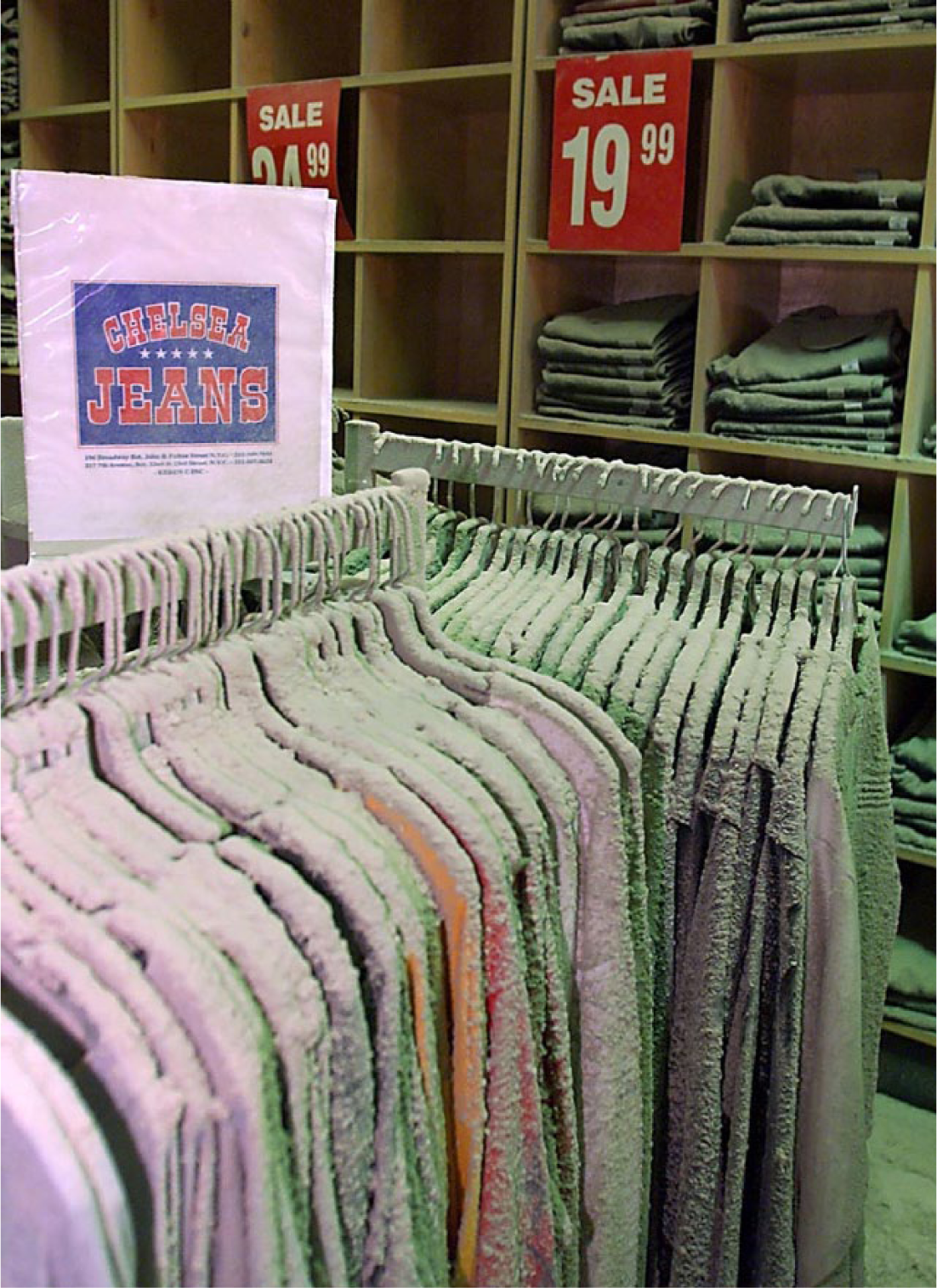
Dust in Chelsea Jeans Store, now included in the exhibition of the 9/11 Museum.
As the dust was the initial instantiation of the shock of material transformation, it was also the first substance to be actively transformed into something sacred. On 14 October 2001, mere weeks after it had become clear that there were no survivors left to be pulled from the rubble and with the recognition that the bodies of many of those who had died would never be recovered, the City of New York placed dust into urns labeled 9/11/01 and distributed them in a ceremony to families of the dead (Sturken, 2007; Waldman, 2001: B11). Here, the dust, as a new material form, something of the past yet transformed into a new substance, could be rendered through ceremony into a national substance (covered by an American flag), a memorial substance (placed in urns), a valuable substance (handled with white gloves), and by extension, a corporeal substance. In an alternate scenario, this dust would have been taken to the Fresh Kills Landfill with the designation of refuse, yet this particular dust was presented as a symbolic substitute for the ashes of the dead. 3 Debates over the status of the dust and debris of Ground Zero continue, with ongoing disputes between the city and some families, who contend that rubble and debris taken to the Fresh Kills Landfill on Staten Island contain human remains and should be brought back to Ground Zero. The liminal state of the dust reveals its status as a “polluting substance,” in Mary Douglas’ terms, because it calls into question particular social categories; is it, as Patricia Yaeger once wrote, rubble or body part? (Douglas, [1966] 1980; Yaeger, 2003: 187).
Dust is not simply the transformation of substances into something else; it reveals a cyclical materiality. As Carolyn Steedman has written, dust makes visible the continual material existence of substances of the past—a “not-going-awayness.” She writes, [Dust] is not about rubbish, not about the discarded; it is not about a surplus, left over from something else: it is not about Waste. Indeed, Dust is the opposite thing to Waste, or at least, the opposite principle to Waste. It is about circularity, the impossibility of things disappearing, or going away, or being gone. Nothing can be destroyed. (Steedman, 2002: 164)
In this sense, the dust demands the most of us in considering the material transformation that took place beginning on 11 September. What kind of substance is it? What should be done with it? Is it debris, body, both? Debates over the appropriate final resting place of the dust continue to prick because its status is indeterminable.
The most enduring signification of the dust may finally be its status as a toxic substance as the number of deaths attributed to exposure to the dust continues to grow. The dust on display at the 9/11 Museum, most notably a dust-covered pile of jeans from the Chelsea Jeans store that was near the World Trade Center and that closed shortly thereafter, is exhibited behind glass and handled as a dangerous substance. In its incorporation into bodies and in its transformation of them (literally causing illness and cancer), the dust reveals the complex interrelation of material substance and organic matter. Behind glass in a display case in the museum, the dust is once again transformed; we cannot get near it or feel it, yet its presence conveys a substance that has been arrested in time. That the dust has moved from the status of refuse to the status of a museum relic signals the uncanny material transformations at work at Ground Zero.
Absence
The fall of the buildings and their transformation into dust enabled one of the primary narratives that has dominated Ground Zero since its inception, that of absence. From the moment the two buildings fell, there was an obsessive preoccupation with the lack of their presence in the New York City skyline. The sense of unprecedented material transformation, from skyscrapers to dust, was displaced into a preoccupation, enacted in public discourse and in design, with the void. This is most clearly manifested in the design of the 9/11 Memorial, its original name, Reflecting Absence, focused the attention of memorialization not simply on the dead but on the loss of the Twin Towers, defining the space as one of absence rather than presence. The memorial’s primary feature consists of two very large pools of water cascading downward into two voids that fill the former footprints of the towers. The design feature of the voids has been a trend of contemporary architecture, in particular in the work of the architect Daniel Libeskind, who was the master planner of the Ground Zero site, although his influence diminished over the years. 4 The architectural design of the void intends to convey a sense of loss through the creation of negative spaces that physically appear empty. While voids cannot be defined as immaterial, they are by definition material spaces that aim to convey the absence of materiality. One does not experience the voids of the memorial as necessarily being filled with the water that cascades into them; rather, the water forms a kind of atmospheric substance. The design of the memorial creates a series of tensions, between absence and presence, the massive and the intimate, the solid and the fleeting. It is a key aspect of the voids that they dwarf other elements of the memorial; they are such a dominant and oversized feature, drawing energy downward into the deep pools, that it is quite hard to focus on the names inscribed into bronze panels on their edges.
This tension of absence and presence is a key framework of the experience of the 9/11 Museum, and in particular in relation to the space of the museum itself. The architectural design of the museum, by the architectural firm Davis Brody Bond, shapes the experience of visitors in relation to the physical site of Ground Zero, highlighting the “slurry wall” that held back the Hudson River that day, the foundation footprints of the columns of the original twin towers (evoking the absence of the towers), and the bedrock of the site. Museum visitors experience not only the objects, images, and sounds within the space of the museum but the actual space itself, which at 100,000 ft2 is impressively large, coded as a space of absence. Stripped to the essentials of earth, rock, and dirt, the space has an archaeological feel. This is particularly powerful in relation to the column footprints that surround the two void chambers of the tower footprints. Here, one can see the dirt and rock beneath the original columns, laid at the foundation in the late 1960s, including the wood frames that shaped the original concrete. While such an experience risks fetishizing the tower footprints themselves, the actual physical presence of these archaeological elements is quite effective. It establishes that the site itself is a key factor in the experience of the museum, something to be looked at, to be felt, and sensorially engaged.
Within the museum exhibition, narratives about the site are often couched in terms of survival. For instance, the slurry wall is often talked about in terms of heroic survival—it was damaged during the fall of the towers, but it held the Hudson River back as it was built to do, preventing even more catastrophic damage. The 9/11 Museum tells many stories of individual survival that are deeply moving and powerful testimonies to the human condition. It also narrates the story of 9/11 through objects that survived that day—“survivor objects”—that gained value in part through the fact, indeed in some cases, the miracle, that they survived. 5 Many of these objects are massive, like the two tridents that stand in the museum’s entrance, inspiring awe at their scale, reminding the visitor of the outsized scale of the buildings themselves.
For instance, in the central chamber of the museum, the Foundation Hall, an enormous space that encompasses seven stories below ground level, stands the Last Column, a 36-ft high steel colossus covered with messages, missing posters, pictures, and memorial inscriptions put there by firefighters, police, rescue workers, and other laborers who worked at the recovery mission at Ground Zero (Figure 2). The Last Column has been singled out as a unique object and received an unusual level of ceremonial treatment from the moment it was removed from Ground Zero in May 2002, when it was given an honor guard. The Last Column’s special status is derived in part from the fact that it survived as a large, intact, and unbent piece of steel. One could take this further, as the museum does, to see it as a symbol of resilience, one that speaks to the values of public servants. 6 This object, massive and “unharmed,” can, in a certain sense, provide its own counternarrative to the events of 9/11; by standing in for the city and the nation, the column evokes strength rather than vulnerability, an object that survived when people and buildings did not, a survivor with a story. At the same time, its scale reflects the broader narrative at play at the memorial and in the museum that the epic scale of this event is a factor in its historical importance—thus, the immensity of the memorial and the museum convey the sense of 9/11 exceptionalism; one consequence of this effect is the valuing of the deaths of almost 3000 people that day over the death of the hundreds of thousands who have died in the wars that were pursued in the wake of 9/11.
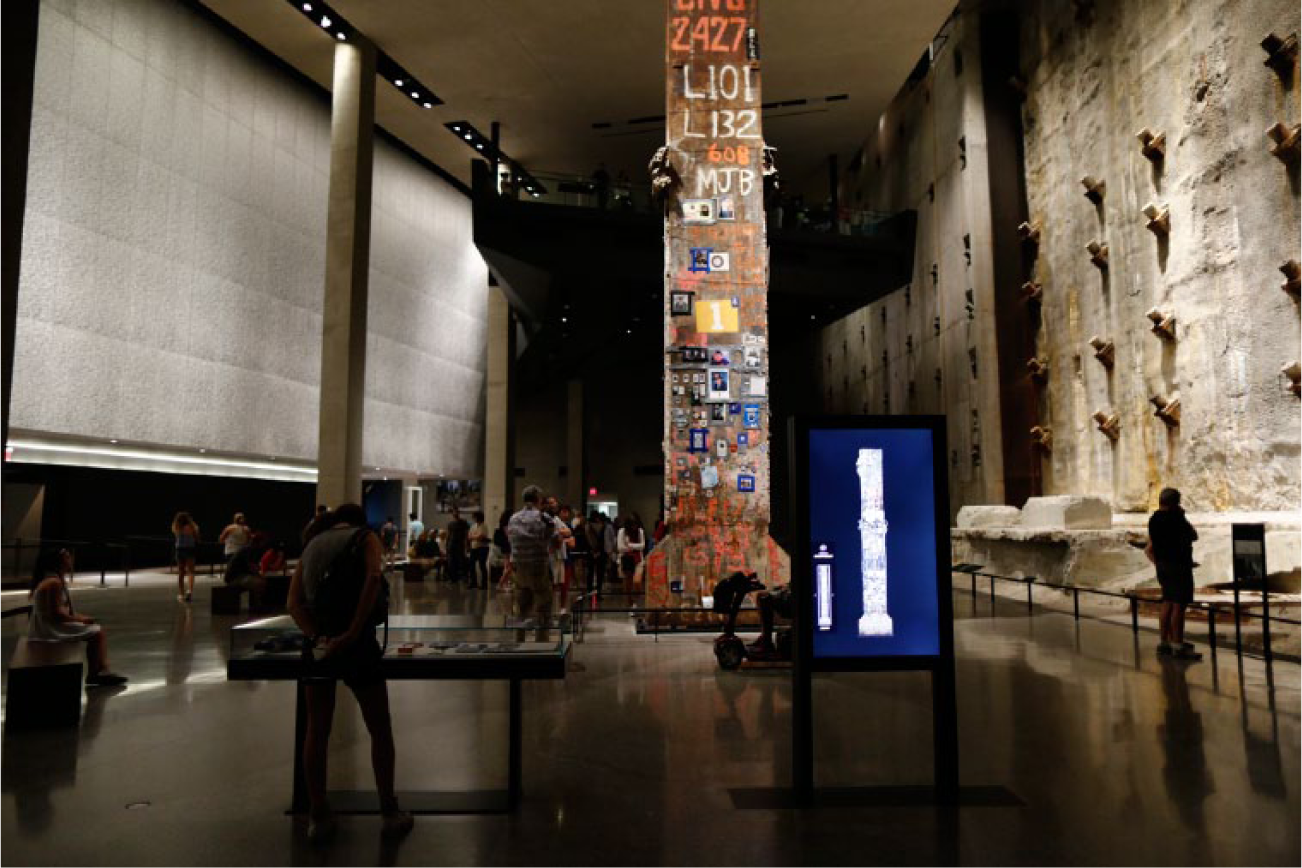
The Last Column in Foundation Hall with slurry wall on right.
Survivor objects
What happens when the material remains of violent events are placed in a museum context, in highly designed and orchestrated spaces, in the service of historical, memorial, and political narratives? The 9/11 Museum has put on display two large mangled pieces of steel, each about 30 ft long, that were taken from its first point of impact, when American Airlines Flight 11 hit the North Tower. The museum chose to display these two pieces of steel separately, rather than place them next to each other (which could have been to great effect). One of them is suspended on the side of the long ribbon walkway into the space, where the view of it is partially obstructed unless one leans over the railing. The other piece is situated strategically at the end of the Tribute Walkway, a long and large space where it can be seen from a distance (Figure 3). The impact steel signifies evidence of the massive destructive forces of that day, of the brute force of an airplane crashing at high speed into a steel building. How could this steel, formerly and even now so resolutely unbendable, have been twisted so irrevocably? The fragmentary quality of the steel makes it an object of a different sort. Standing without context at the end of this long space, this “impact steel” is rendered into a fetish.
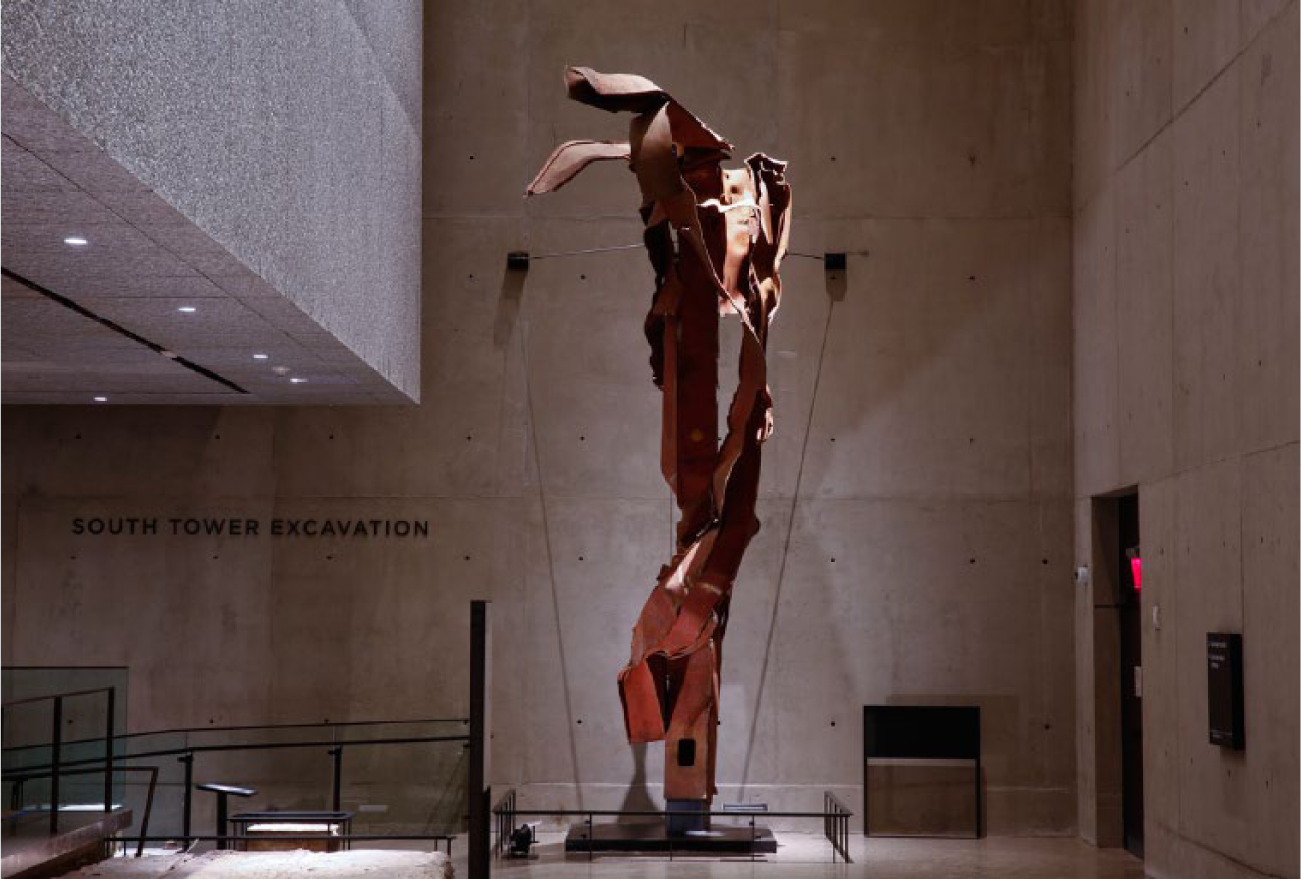
Impact Steel.
One could argue that this is exactly what the process of museumization does; it turns objects, of art, history, and everyday life into things that signify something more, into objects with mystical and magical qualities. The transformation of survivor objects into fetish objects is an inevitable outcome of the processes of museumization that include modes of display (pedestals, lighting, barriers, and signage) and the valuing of objects as part of a museum collection. When such an object becomes museumified, it is transformed in profound ways. As Andreas Huyssen has written, the museum object projects an aura of authenticity in particular when it is isolated from its “genealogical context” and subject to the “museal glance of reenchantment.” The museum fetish, he states, “transcends exchange value. It seems to carry with it a kind of anamnestic dimension, a kind of memory value” (Huyssen, 1995: 33). Like the aged museum artifact, the survivor object is pulled from another time, a time “before.”
This piece of impact steel also raises the question of aestheticization. Standing on display in the museum, the steel looks like a work of modern art, one that seems to signify the violence of modernity. It is practically Giacometti-like, evoking figuration with a sense of alienation that one might associate with artistic engagements with the modern condition. In other words, the impact steel looks as if its sculpturing was the result of aesthetic choices rather than an intentional act of violence. This might prompt us to ask, what kind of accidental aesthetics is this, and does the experience of aesthetics disturb the memorial intent of the museum? If the impact steel had been put on display in a different fashion, would such aestheticization have been mediated? It is worth noting that the other piece of steel that forms its counterpart is hung in such a way that it is impossible to see from a distance (actually it is hard to see at all, its placement is so awkward) and is much more difficult to see in artistic terms.
Material objects that have survived a cataclysmic event put on display the very transformation that turned them from ordinary objects of everyday life into survivor objects; they quite literally become storytelling devices and stand-ins for the dead. So, an object that is mangled, partially destroyed, and crushed stands in for the absent bodies that were subject to the same destructive forces. The experience of objects in the context of museums is a sensorial one, in which visitors respond to the presence of material objects through their object-ness. While this experience might be mediated by display conventions and conservation protocols that prevent visitors from touching or even smelling objects, the museum experience of material objects is nevertheless often quite specifically sensorial or, at a minimum, about projecting an experience of the senses on objects because they are physically present. The way that museums freight objects with information tends to mediate this sensorial aspect since, as Sandra Dudley writes, the epistemological mode overshadows the experiential mode in museums. The museum object is normally conceived, according to Dudley (2010), as “an object-information” composite, incomplete without explanatory text (p. 4). Yet, survivor objects can have a powerful sensory effect through their material presence in ways that engage the experiential mode over the epistemological. As viewers, we can see their textures, their battered and crumpled forms, and smell their material elements. This material presence thus imbues these objects with a kind of corporeality.
That the material objects on display in the museum are rendered corporeal exists in parallel to the fact that the site of Ground Zero and the 9/11 Museum is haunted by absent bodies: the bodies that were gone in an instant, never to be recovered, the bodies that were identified in bits and pieces, testimony to the terrible level of violence that day, and the bodies that haunt from images, bodies falling unimaginably through space. As I have noted, there are family groups that continue to advocate for some of the dust and debris that was taken to the Fresh Kills Landfill on Staten Island to be returned to Ground Zero because it was not properly checked for remains. Over the years, remains have continued to be found in the surrounding blocks by the site. Most of those that were recovered were found in fragments and pieces, and there are more than 1100 bodies that have never had a trace recovered. A massive effort at DNA identification has aimed to mediate the absence of bodies, but it can hardly be said to have quelled the pervasive feeling of the site as haunted by bodies. The bodies that are absent permeate the museum’s modes of materiality. In other words, the immaterial is a constant presence in the museum, with bodies imagined to be present at the site. None of this can be separated from the fact that a decision was made to house the unidentified remains in a separate room in the museum, to the chagrin of many families. While most visitors are unlikely to even know this room exists, its very presence can only be seen as a ghostly one.
There are many modes of memorialization at the museum and with the 9/11 memorial that aim to render the dead, and the bodies of the dead, present. The memorial does this primarily through the presence of the names, etched into the bronze panels that form the periphery of the two voids of the memorial design; this creates a kind of negative space for the names, as they are cut into the panels. In the museum, the Memorial Gallery aims to render those who died present as individuals through photographs and storytelling. The walls of the gallery display photographs of the dead and digital archives that allow visitors to call up individual’s portraits into the gallery with details of their lives and audio reminiscences if they exist. In fact, throughout the museum, the immaterial form of sound is much more effective in conjuring the dead and survivors than the more predictable mode of photography. Some of the most evocative and haunting aspects of the museum are the voicemail messages left by those who were trapped in the towers, calling their loved ones first to reassure and then to say goodbye.
Like those voices, distinct and individual, the personal objects on display (of survivors and those who died) also work powerfully to create a kind of corporeal presence. ID cards, watches, keys, shoes, wallets, and briefcases, these objects are evidence of the everyday that was irrevocably disrupted that day. The effect of these once ordinary objects is quite distinct from that of the large artifacts, such as the fire engines, antenna fragments, and the Last Column, all of which inspire awe in part through scale (Figure 4). The mundane objects, so familiar and yet so transformed, convey a kind of poignancy in their altered states. Like the missing posters that sought the dead when hope was still possible, these simple and unassuming objects evoke a prior innocence of a time when the events of 9/11 were unimaginable. This does not mean, of course, that there aren’t forms of innocence actively being deployed in the discourses at work in the museum, in particular its evocation of an America attacked without warning. Yet, with these small objects, we are reminded of the ordinariness of the lives lost that day, of the mundaneness of activities in the buildings before they were hit, of people going to work, riding in elevators, sitting at their desks, thinking of the small tasks of the day. On display in the museum, many of these ordinary objects evoke specialness not simply because they were once mundane but also because they survived the violent fall of the buildings. In this, we can see that they fulfill the role of survivor objects, as objects that persisted to have afterlives. This quality awards a kind of agency, power, if not an aliveness, to them. They survived when people did not; in a certain sense, they are objects that “lived.” In this sense, they evoke what Jane Bennett (2010) refers to as “vibrant matter”—material objects that challenge the notion that matter is inert. Bennett (2010) uses the concept of “thing-power” to define the “strange ability of ordinary, man-made items to exceed their status as objects and to manifest traces of independence or aliveness” (p. xvi). One could argue that things that are transformed through violence offer a particular kind of aliveness through their evoking of survival.
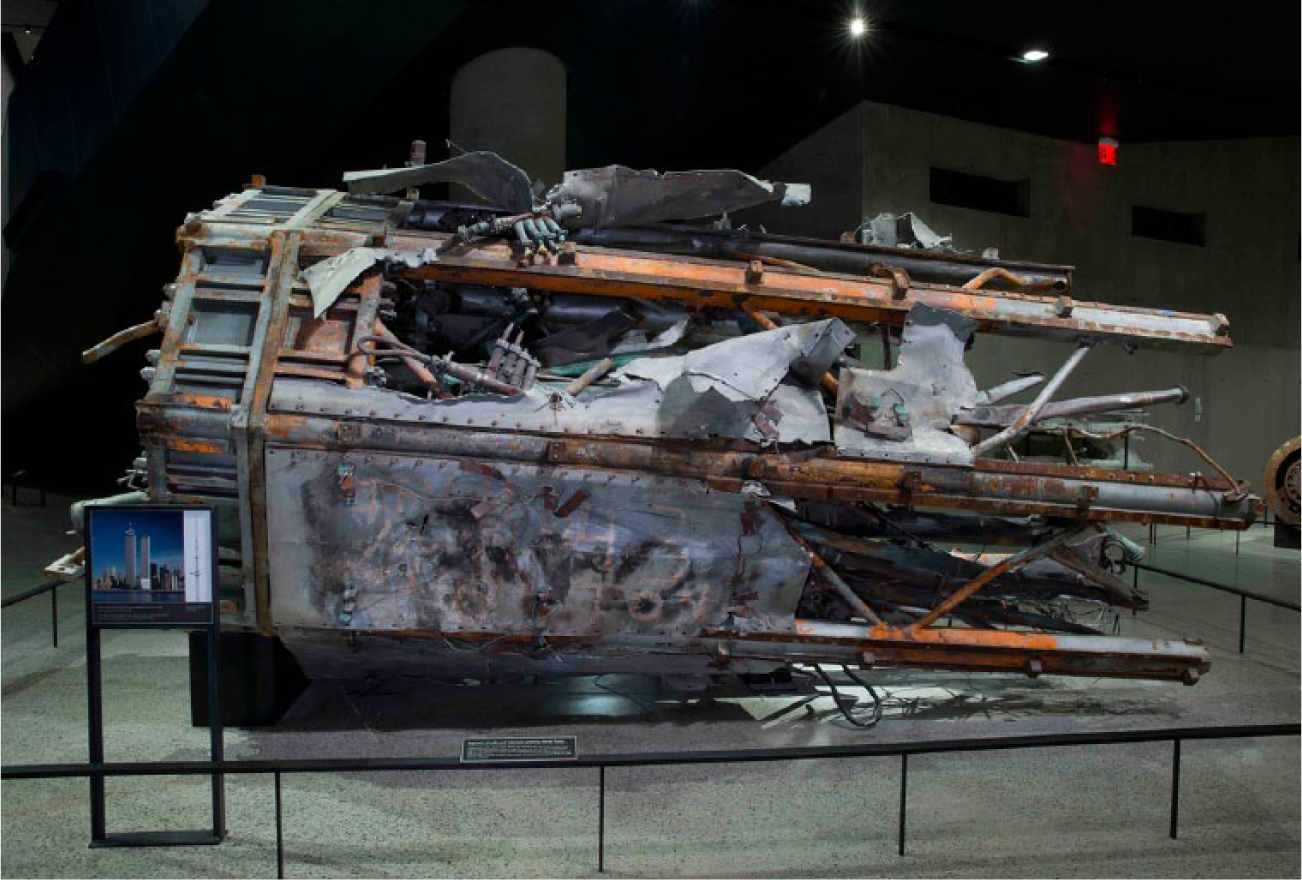
North Tower antenna on display in museum.
This quality is perhaps strongest with those objects that were once worn by people, such as shoes, wallets, and watches. For instance, Genni Gambale’s wallet, torn, crumpled, and burned, was found on the roof of the Marriott hotel across from the World Trade Center. Gambale worked for Cantor Fitzgerald on the 103rd floor of the North Tower and died that day at age 27. The wallet itself reads like an extension of her personality, with credit cards and a Brooklyn library card—the detritus of an everyday life and its modes of identification. Or, Linda Lopez’s yellow pump shoes which sit in a display case, intact though bloody. There is a long tradition of using shoes to stand in for those lost (most famously at Auschwitz and the US Holocaust Museum but also in memorializing the Boston Marathon and other events of loss), in ways that seem to imbue shoes with a very particular individualized quality. From the museum display we learn that Lopez escaped from the South Tower, in part by carrying her shoes and going barefoot. Many of these objects explicitly embody the material transformations of that day; they are battered, torn, burned, crumpled. They are described as having journeys—often they have been returned through extraordinary happenstance from the rubble to the families and then have been donated to the museum’s collection of now more than 10,000 objects. In this sense, they have moved from the realm of the personal and the ordinary into a realm of cultural memory and then to historical status in the museum.
Contested materialities
The material object that most embodies the fraught relationship to the bodies of the dead—absent, fragmentary, and present—is the “composite,” which the museum decided to put on display after much debate and controversy. This is a large chunk of debris that has been determined to represent several floors of one of the towers pancaked and compressed into a boulder-sized piece several feet high. The composite is, through its very naming, a liminal object. While it appears to have bits of paper still in it, it was apparently formed by intense heat and pressure; it was determined by the medical examiner that it does not contain any remains because the temperatures presumed to have created it would have destroyed organic matter. This position is contested by many family groups, who see it not as an object but as entombed remains. Like many of the objects on display in the museum, the composite generates meaning and affect through its textures and its material presence. It has an archeological feel to it, as if it were dug up at the site of some lost civilization, replete with the clues to a way of life, yet it also evokes Bennett’s (2010) “vibrant matter.” With jagged steel cables weaving around it, and its fused elements, it conveys a foreignness and an unknowability—it will never be possible to know what is contained within it. Its name of course defines it as a fusion of materials, an undefinable status that is about a mixing of material states to create something else.
The composite is treated by the museum as a controversial object, set aside in an alcove with careful explanations and accompanied by a box of tissues. Is it an object of scientific status, representing as it does an unusual material and physical phenomenon? Or, is it a survivor object, evidence of material remains that survived a cataclysmic event? Or, is it, as the box of tissues might signify, an object of grief and loss, standing in for those who are gone? Its strange corporeality is evidenced in its unusual textures. One is inclined in looking at it to feel awe at the phenomenal material transformation that it evokes—all that is compressed within it recalling a scientific status of molecules and atoms rearranged. In this sense, its presence engages visitors sensorially and viscerally. The museum’s wall text encourages visitors to see the composite in these terms, as an object of unique status. Yet, the box of tissues allows for it to be seen as a stand-in for the brute violence with which the dead were destroyed of all corporeal presence.
That many of the objects on display in the museum are highly politicized, like the composite, is inevitable. The very existence of a museum at Ground Zero is a highly political venture, one that not only tells the story of 9/11 but also that places the story of 9/11 within particular narratives of 9/11 exceptionalism. The museum, with its material objects and testimonies, is skillful at narrating the story of what happened on 9/11 and the deeply moving stories of survival and compassion of that day. It should surprise no one that the museum is inept at engaging with the larger story of the political meaning of 9/11, why it happened, and what political and historical events followed in its wake.
What is perhaps more surprising is that we see this enacted through materiality in the museum’s exhibitions. In the Foundation Hall, there is now a small display that includes the jacket of a US Navy Seal, a “challenge coin” signifying a mission completed by the Central Intelligence Agency (CIA), and a brick. It is the brick that I want to focus on here, since its material presence embodies in many ways the contradictory role played by objects in the construction of historical narratives. The brick was taken from the Abbottabad compound where Osama bin Laden was assassinated by US Navy Seals in 2011. The story of how the brick ended up in the museum is a strange and sorrowful one. It was chiseled out of the foundation of the compound, before the structure was torn down, by Fox News reporter Dominic Di-Natale while he was reporting in Pakistan. Di-Natale, a British ex-pat and US patriot, stated to Fox News at the time, “America is the greatest country in the world. It’s the least I could do.” 7 Tragically, he would go on to commit suicide in December 2014, after being diagnosed with brain damage related to injuries he received while covering the war in Iraq (Londoño, 2004: A28).
The brick is permeated with tragedy and death as much as it is with its intended significations of triumph and revenge. It is in its materiality a seemingly ordinary brick, somewhat “foreign” in that it is from a kind of sandy construction, but ordinary nevertheless (a brick is by definition already a composite of materials compressed together). Yet, set within a display case and contextualized with the information about its origin (the museum does not tell visitors about Di-Natale’s suicide), the brick takes on a much larger, talismanic role. It acquires the status of evidence, given that any material evidence of bin Laden’s killing is classified, and its now-contested story is known to Americans primarily through the 2013 film Zero Dark Thirty. 8 This deceptively ordinary brick symbolizes an extraordinary set of political narratives in which a man, whose power came in part through his invisibility and capacity to wield power while in hiding, was the subject of a massive man hunt, a man whose murder was seen to offer a kind of national resolution to the tragic consequences of the terrorist attacks of 9/11. In a certain sense, the journey of the brick, via Di-Natale, from Pakistan back to New York, is imbued with retrospective meaning—that the brick’s ultimate and most appropriate “resting place” is here, in this museum, among the objects of 9/11. At the same time, the apparently necessary destruction of the bin Laden compound, perhaps intended to prevent precisely the kind of souvenir hunting that Di-Natale participated in, is a strange parallel to the material destruction of the towers. The brick sits in the museum as a form of justification, an object that affirms the capacity of the nation for revenge. How could such a story ever have been imagined for this very ordinary brick when it was manufactured somewhere in Pakistan and placed by a worker within the building’s foundation? The bin Laden brick exudes a kind of agency, so powerful is its embodiment of this particular political and historical tale. It demands of us as viewers particular kinds of political responses. As a technological artifact, it can be defined as a composite of materials shaped in this form from a whole history of human built environments; as a highly symbolic political object, it stands in for an extremely complex history of violence, journeys, secrets, and revenge.
That objects on display can produce this kind of fetishization should not surprise us, although we might agree that in this particular museum such processes are perhaps more extreme than in most. To see the brick alongside the Last Column—and in concert with the other major objects in the museum, such as the impact steel, the crushed fire engines, and the dust—is to see a panoply of material substances strangely thrown together because of their arbitrary and coincidental relationship to history.
The gift shop
The sensorial experience of material objects and forms in the museum extends beyond its exhibitions to the items that are sold in its gift shop. 9/11 has been the subject of rampant commercialism and tourist objects since the first weeks after the towers fell, and given that there have been numerous gift shops around the site since the beginning, it was sadly inevitable that the museum would sell merchandise as part of its larger mission. There are many ways that we can make sense of the merchandise for sale at the museum, including critiquing its depoliticizing effect and its crassness. 9 Amidst the more tasteful educational materials such as books and films, we have stuffed animals, hoodies with the museum logo, firefighter outfits, flags and patriotic pins, scarves, jewelry, and household ceramics. What is, we might ask, the material aim in purchasing an item from the 9/11 Museum gift shop? As I have written elsewhere, such souvenirs sell a form of American innocence that obscures the complex machinations of global politics that produced the attacks of 9/11 not as something “out of the blue” but as a response to US foreign policy (Sturken, 2007). Such objects also screen over the devastating wars and crises that have been enacted in response to 9/11 and that emanate in its wake. We can read the intended uses and significations of these souvenirs in their very materiality, as they carry a trace of the authenticity of the museum and the site of Ground Zero itself. Many of the items are meant to be displayed, but it is important to the effect of much of the merchandise in the gift shop that it is intended for domestic use; these items, such as coffee mugs, hoodies, T-shirts, hats, and water bottles, are designed to be integrated into everyday life, to be worn on an ordinary day or used at the breakfast table. The museum logo, attached to items of daily life, signifies a trace of the site itself, awarding the everyday object a particular kind of moral posture that an ordinary hoodie would not carry.
The museum shop also deploys design as a kind of memory template. It commissioned a range of merchandise that uses the architectural form of the “gothic skin” of the original Twin Towers as a design motif (Figure 5). Displayed next to items that sell “absence” and “honor,” the familiar shape of the steel outer skin of the towers is transposed into a design element for domestic merchandise—cups, trays, scarves, and men’s ties. If we can think of the steel remains of the original building’s outer frame as being survivor objects, this merchandise takes its materiality one step further. It recreates this design motif in miniature, packaged for consumption. If the Twin Towers live on at the museum with their footprints, their materiality is remade into another kind of afterlife in the gift shop.
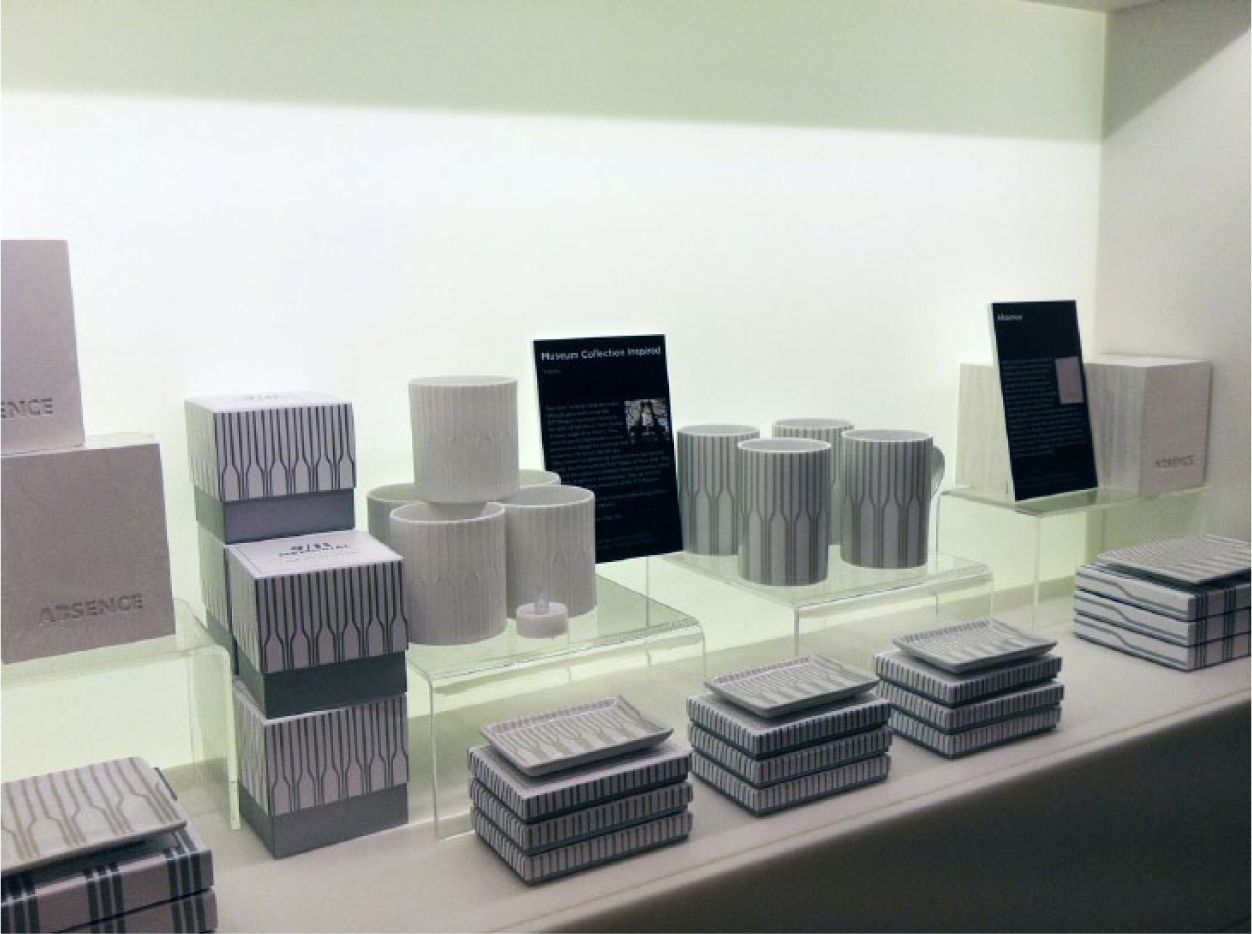
Museum Gift shop merchandise.
In contemporary American culture, we are accustomed to the ways that commercialism and branding permeate all aspects of life, from the most intimate to the most public. Why then does the museum gift shop so offend, why is it such a problem for this institution of memory to sell this stuff? Here, I think that we can return to the question of museumification and aestheticization, for the gift shop participates in a particular kind of fetishization. It does so in the classic Marxist mode because the objects in the gift shop are sold as commodities. This association of cultural memory with commodification creates anxiety; it is seen as inappropriate at a site dedicated to the memory of the dead. This reveals, among other things, that we have a romantic cultural association with memory as somehow unadulterated and unmediated, even though fetishization is inherent to memory objects. The moral discourse that shapes the museum’s role as a memory museum defines the lives lost as priceless. Other discourses, such as compensation, have explicitly attached a value to the lives of those who were killed that day, but the museum’s role is to define that loss as beyond valuation. The commodity, on the other hand, embodies a social life and will “live” as part of a system of exchange and valuation (Appadurai, 1988: 3–63). As I noted before, the museum fetish appears to transcend exchange value, according to Huyssen (1995), so its relationship to the commodity souvenir troubles this valuation (p. 33). This kind of commodity object is thus seen as cheapening memory in the process.
It is easy to critique the museum merchandise for the ways in which it packages and makes money off of loss and grief; that the income from sales go toward funding the museum does not change this fact. Yet, we can also see how these objects appeal precisely because they stand in for the survivor objects, for the material remains of the site itself, and for the sense of afterlives they convey. As conservationists often note, people have a need to take objects away from sites of meaning, as talismans; better they should buy a souvenir rather than to chisel out part of a material object on display.
In this sense, we can see that the experience of materiality in the service of memory is also about comfort, about reassurance that material life goes on, that the material cannot be destroyed but that it is remade, transformed, reinvented into new forms, even replicas and souvenirs, onwards. In its enactment of modes of presence and absence, the 9/11 Museum reminds us that cultural memory is mediated through many different kinds of material forms, through artifacts, survivor objects, architectural environments, and souvenirs. These material objects produce intangible, sensory experiences. They operate as agents, making demands on us, shaping affect, exuding vitality and vibrancy, asking of us that we think beyond the binary of matter and life.