







Abstract
Drawing on recorded and transcribed life history interviews conducted during the 1980s and 2000s, this article discusses the cinemagoing experiences of District Six residents in Cape Town from the 1920s to the 1960s, before the South African apartheid government began, from 1966, to demolish District Six. Cinemagoing was the chief leisure-time activity in District Six in these years, and when recollections of cinemagoing in the interviews are analysed as discourses of memory, three key themes emerge – cinema and place; cinema, culture, and identity; and films, film shows, and stars – with residents’ remembered experiences revealing the peculiarities of cinemagoing in this very particular locale. Cinema was so thoroughly intertwined with everyday life that residents might be regarded not so much as ‘going to’ the cinema as already being there. They were part of a global seam of filmgoers – ‘cinema citizens’ whilst in every other respect stripped of citizenship rights.
In 1984, researchers at the Cape Town History Project attached to the Department of History at the University of Cape Town conducted a series of life history interviews with former residents of the city area known as District Six, and ‘almost immediately generated path-breaking research on [its] social history’ (Bickford-Smith et al., 2001: 5). The project was later renamed the Western Cape Oral History Project and later still, in 2001, the Centre for Popular Memory. 1 It was one of a variety of initiatives in South Africa at the time that drew on oral histories as a means of producing ‘history from below’. 2 One of the researchers, Bill Nasson, subsequently chronicled his perceptions of working-class leisure-time activities in District Six, describing how these were predominantly focused on cinemagoing. As one respondent put it, ‘our way of life were based on bioscope’ (Cds. 266–27). 3 Nasson also argued that despite the regularity and social significance of cinemagoing, District Six residents also asserted and experienced their own forms of culture and leisure. These were not prescribed so much by the forces of entertainment capital but were more roundly pre-determined by traditions and histories of local popular entertainment, particularly in relation to music and to the annual street festival known as the ‘Coon Carnival’. Indeed, it is precisely this imbrication of the remembered experience of cinemagoing with local culture and street life that is repeated throughout the interviews: going to the ‘bioscope’ was a ‘firmly local’ activity (Nasson, 1989: 286). Returning to the life history interviews gathered in the 1980s, and also including a smaller set of interviews conducted in the 2000s, this article tracks the memories of cinemagoing embedded within them and excavates recurrent themes about the centrality of the cinemagoing experience in residents’ lives. This is part of a larger research project that is developing in two interrelated parts: the first addresses histories of Hollywood’s globalisation by investigating the political economy of its distribution and exhibition in South Africa; the second is a case study of the social and cultural experience of going to the cinema in District Six. 4
The turn within the ‘new cinema history’ towards investigations of the experiences of cinema audiences within wider social and historical contexts whilst simultaneously paying attention to localised peculiarities (Maltby et al., 2011) provides a useful framework for research into the macro history of (Hollywood) cinema’s globalisation and its reach into Africa, and particularly into South Africa. 5 The micro investigation of cinemagoing in District Six draws additional inspiration from several earlier research projects in the United Kingdom, and to an extent in the United States, that have also drawn upon memories of cinemagoing. These include the research of Annette Kuhn (2002) represented in An Everyday Magic: Cinema and Cultural Memory and a number of subsequent publications: Jackie Stacey’s (1994) investigation into women’s experiences of cinemagoing in the 1950s, Star Gazing: Hollywood Cinema and Female Spectatorship; and Helen Taylor’s (2014 [1989]) account of female fans of Gone with the Wind (Victor Fleming, US, 1939), Scarlett’s Women. It is important to note, however, that the research discussed here differs from that conducted in projects expressly created to gather memories of going to the cinema. Unlike these, existing life history interviews have been mined for the memories embedded within them that refer specifically to the social and cultural experience of going to the cinema. Since, in the case of District Six and its inhabitants, the practice of going to the cinema was so thoroughly entangled with everyday life, memories of cinemagoing are an inevitable feature of most of these life histories.
An account of District Six and the work of the District Six Museum will provide background to a description of the interviews and of some of the demographics that they bring to light, and also set the scene for an explanation of the method used here for locating references to cinemagoing and also of their treatment as ‘memory texts’. Sean Field (2008), who directed the Centre for Popular Memory until its closure, notes that ‘ninety four interviews [were] conducted by Bill Nasson, Shamil Jeppie and others between 1986 and 1989’ (p. 123). In the early 2000s, Thulani Nxumalo, a research student, conducted a further 10 interviews so as to include African residents of District Six. In a working version of the catalogue, 6 the total number of interviews (including Nxumalo’s subset) is identified as 121, but not all of these have been transcribed. The total number of transcripts to which I have had access is 67.
The majority of the interviews are with ‘coloured’ residents who speak predominantly English or a form of localised Afrikaans, sometimes including phrases from the less dominant language, as is typical of colloquial forms of speech. The interviews undertaken in the 2000s are with Africans speaking in English with some insertions of isiXhosa. Language is an especially rich dimension of District Six’s ‘creolisation’, and the patois of speech forms developed over its historical lifetime emerges in sharp relief when listening to or reading verbatim transcriptions of these interviews. When informants’ religions are identified, they are either Christian (‘Christe’) or Muslim (‘Slamse’). There would seem to be a wide age range, the oldest informant having been born in 1902 or 1903, while the youngest, those in Nxumalo’s subset of 10, were born in the 1940s. 7 Dates of birth, however, are not consistently noted. The total number of interviews in the collection is almost equally divided across gender. 8 As regards employment, some informants had worked in District Six itself in local enterprises – running a stall in the fish market, say, or taking in washing and ironing for better-off residents of the city. Others worked in neighbouring factories and industries or in city centre stores, or as domestic workers and nursemaids in other parts of the city. Two of the informants are particularly pertinent to the present enquiry: the daughter of local cinema owners Mr and Mrs Bailey, who were Jewish and whose original surname was Bailen; and a resident who worked as a cashier at two of the local cinemas (and at other cinemas elsewhere in Cape Town).
When I first obtained access to them, the 1980s interviews that had been transcribed were held in Manuscripts and Archives at the University of Cape Town. They had not yet been digitised, but some transcripts included an index of key themes on the front page. However, these indexes were not always correct or complete in locating references to the cinema and cinemagoing. Following the digitisation of the original transcripts, it became possible to conduct keyword searches, and I searched each transcript on the basis of the keyword ‘bioscope’ – the popular term for the cinema – and its Afrikaans equivalent ‘bioskoop’. As a means of crosschecking, I also occasionally used other keywords such as ‘film’, ‘cinema’ or ‘Star’ (the most popular and central cinema in District Six), to ensure that I had not missed something by only using the two main keywords. Of the 67 transcripts, 51 (76%) mention ‘bioscope’ or ‘bioskoop’, while in Nxumalo’s subset, 7 of the 10 transcripts include the keyword ‘bioscope’. These figures alone speak volumes for the extent to which residents remembered cinema as having been a key thread in their lives. Indeed, we might even think of it as ‘structuring’ their lives alongside their other everyday activities and commitments including domestic chores, raising their families, going to work or school, and engaging in various other forms of leisure, entertainment and political activity.
To assist in understanding District Six’s iconic status in South African history, and hence to assess the exceptional value of these life history interviews, a few details about District Six itself are in order. It came into being following the official division of Cape Town into six districts under the Municipal Act of 1867; a century later its population had reached about 66,000. 9 As urban historian Vivian Bickford-Smith explains, it was part of the ‘lower-class residential belt’ that stretched from the Castle, in the city centre, to Observatory, a suburb further away. In other words, it was right next to the city centre, Cape Town’s Central Business District. It was a defined and definable neighbourhood, geographically as well as historically, socially, culturally and in part politically. While the population of District Six ‘was drawn from all over the world’, the largest component was ‘coloured’ (Bickford-Smith, 1990: 36–37). 10 When the National Party came to power in the whites-only election of 1948, it quickly enacted a slate of apartheid legislation that included the Group Areas Act of 1950, which formed one arm of the state’s draconian measures aimed at keeping apart population groups based on racial classifications. From the early 1960s, all property development was frozen (Omar, 1990: 191), and under the provisions of this Act on 11 February 1966 District Six was proclaimed a white ‘group area’ and systematically demolished. The residents of District Six were moved to racially-defined residential developments across the Cape Flats. 11
The ‘Hands Off District Six’ campaign subsequently won some gains in preventing (white) development plans; and, arising from this and other campaigns, the District Six Museum Foundation was established in 1989 and the District Six Museum opened in 1994 in the former Methodist Church at 25a Buitenkant Street; it subsequently acquired a further building on the same street, renamed as the Homecoming Centre. It is pertinent to note that the Museum presents itself as ‘work[ing] with the memories of the District Six experience and with that of forced removals more generally’ (District Six Museum, n.d.). In describing the memory work of District Six Museum, Crain Soudien (2008) discusses the significance of memories as ‘sit[ting] behind and provid[ing] the mental schemas in terms of which people make sense of the world’ (p. 22). This is an apt description of the memories of District Six residents in the 1980s life history interviews, in which ‘schemas’ of place – District Six itself – and remembered experiences of everyday life within it, including going to the cinema, are intertwined. Ciraj Rassool (2007) identifies the Museum’s ‘memory work’ as its ‘core business’ (p. 124) and, he proclaims, it is in the ‘memory work conducted in support of the struggle for restitution of land rights in District Six that the District Six Museum has committed itself to reconstituting and recalling community in District Six in the heart of Cape Town’ (p. 124). This, he suggests, marked a new phase for the Museum, shifting its focus to a new campaign, ‘Hands On District Six’. After South Africa’s first democratically elected government took office in 1994, it promulgated the Restitution of Land Rights Act, which made it possible for former residents to submit land claims. Since then, more than 2500 ex-residents of District Six have lodged claims. With the first phase of the redevelopment plan completed, some claimants have been rehoused in District Six, with the expectation that the rest will follow as the plan is fulfilled. 12
Recognising the politics of District Six’s demise and reconstruction is crucial for understanding its local history. Memories of cinemagoing and of life in general were gathered when District Six was an ‘empty traumatic landscape’ (Rassool, 2007: 125). A profound sense of personal and collective loss can be read from, and even felt in, some of these recollections. Karen Till (2008) offers the descriptor ‘wounded place’ (p. 109), a salient reminder of District Six as a site that embodies the pain of its brutal demolition under apartheid and the terrible consequences for its residents. In this context, Kuhn’s (2002) characterisation of her informants’ accounts as ‘memory discourse’, as well as ‘memory stories’ and ‘memory texts’, is helpful (pp. 9, 11). ‘The formal attributes of memory texts’, she contends, ‘often betray a collective imagination as well as embodying truths of a more personal salience’ (Kuhn, 2002: 11). This ‘collective viewpoint’ (Portelli, quoted in Kuhn, 2002: 11) and Kuhn’s (2010) notion of ‘communities of remembering’ (pp. 2, 10) are richly articulated in the memories of former District Six residents. While the scope of this article precludes the depth of analysis accomplished by Kuhn’s research, her deductive method is adopted here in a small way. This facilitates identification of the core discursive themes underlying the District Six residents’ accounts: cinema and place; cinema, culture and identity; films, film shows and stars. Before exploring these in greater detail, I shall briefly identify and describe the cinemas themselves, drawing on the rather patchy information that is available.
As noted, before the demolition of District Six, cinemagoing was the chief leisure-time activity of its residents, and indeed there were several cinemas within District Six itself, as well as others close by in Woodstock and other parts of central Cape Town that were used by District Six residents (Figure 1). The cinemas most often remembered are, in District Six itself, the Avalon in Hanover Street (built during World War II), the British in Caledon Street (Figure 2), the National in William Street (built in 1905 as Theatre of Variety and Plays; Eckardt, 2005: 35; Figure 3) and the Star (formerly the Metro) on Hanover Street (Figure 4). Outside District Six, the City, near the market on Sir Lowry Road (now the site of the Goodhope Centre), is also frequently remembered. Older informants recollect earlier cinemas, especially the Union (formerly the Unity), on the corner of Horstley and Hanover Streets, and the Empire. The Union and the Empire were owned and run by Mr and Mrs Bailey, with Mr Bailey managing the Union and Mrs Bailey the Empire. The British was demolished in the early 1970s (The Argus, 19 October 1973: 14), but the National and the Avalon were still standing in 1973. 13
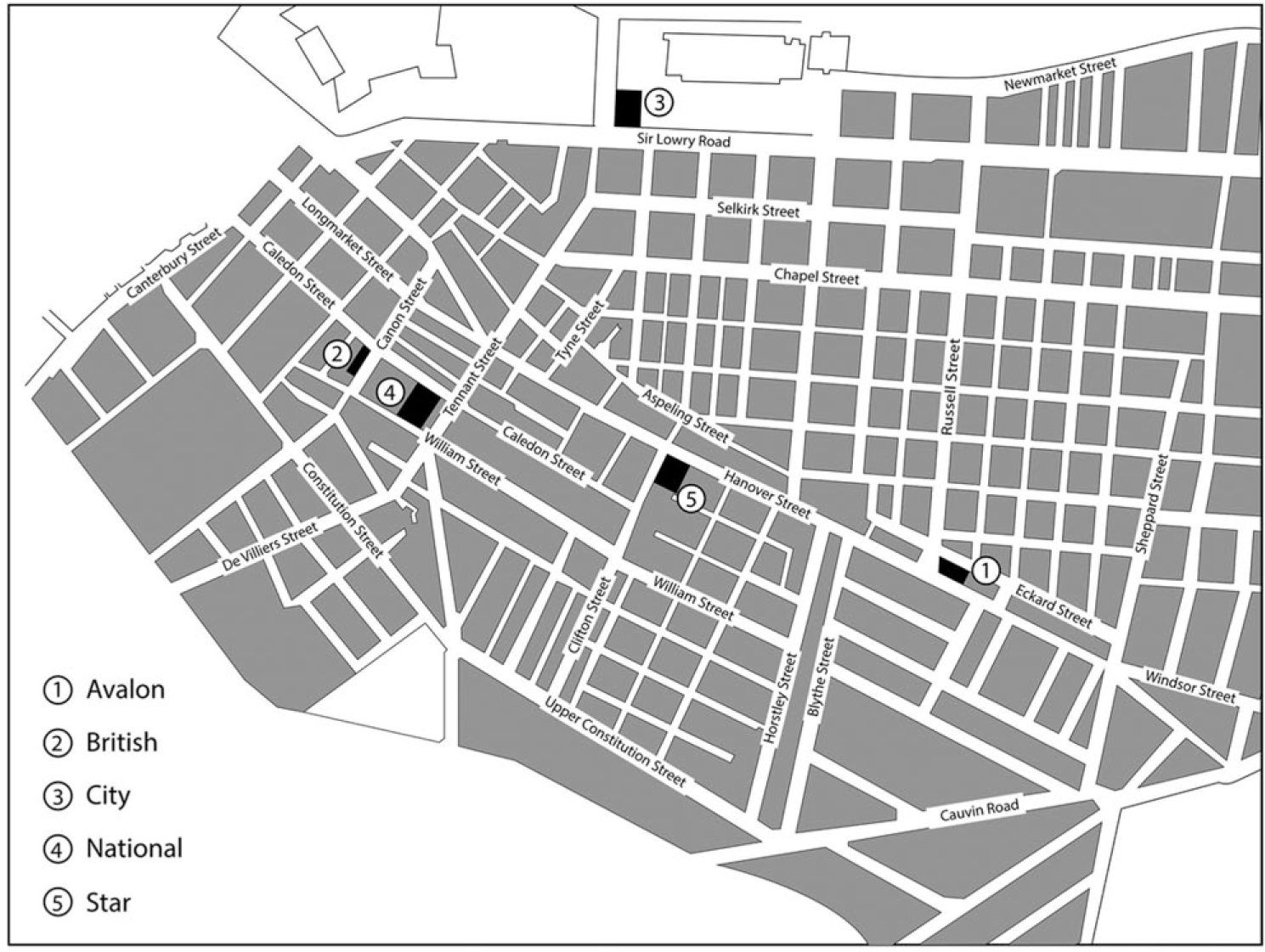
Cinemas, District Six, Cape Town. Reproduced with permission, District Six Museum.
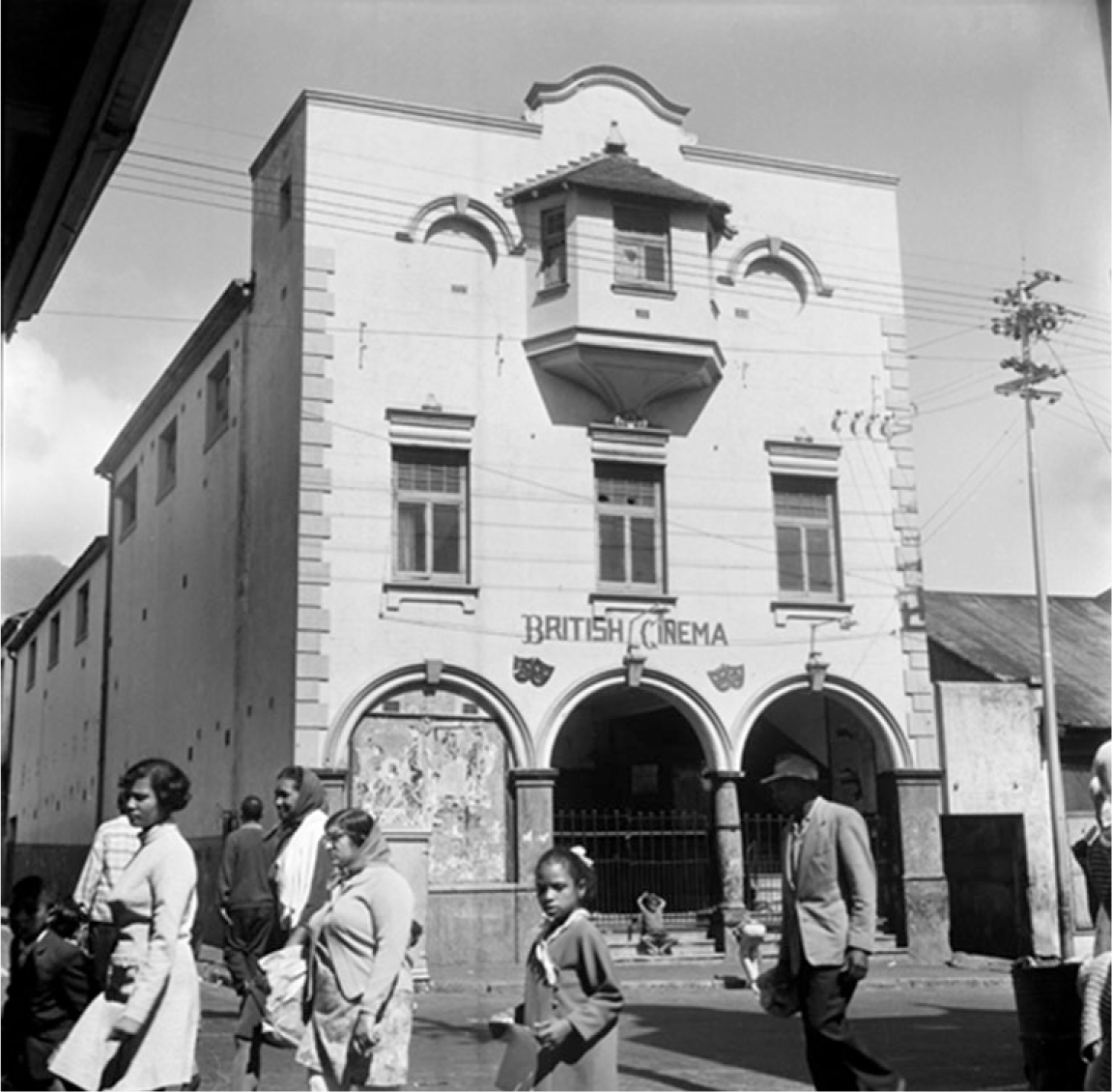
British Cinema, Caledon Street, District Six, c.1970–1975.
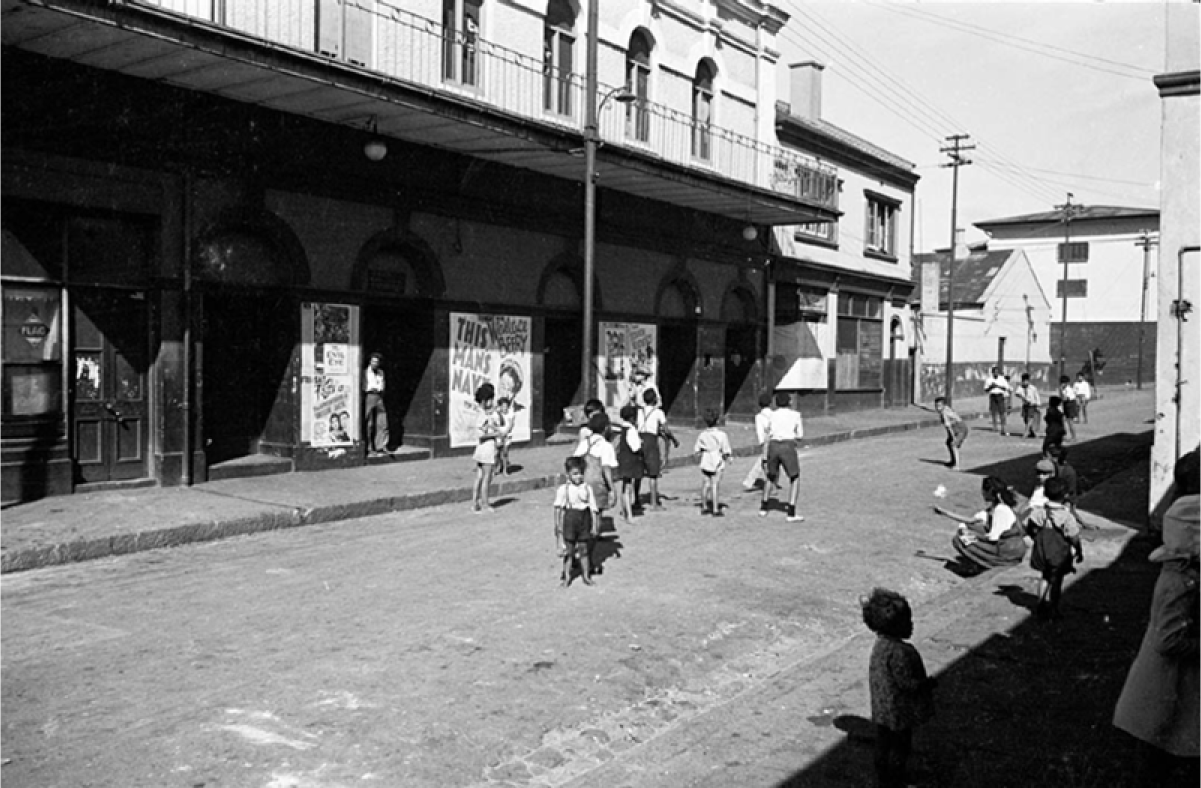
National Cinema, William Street, District Six, 1940s or early 1950s.
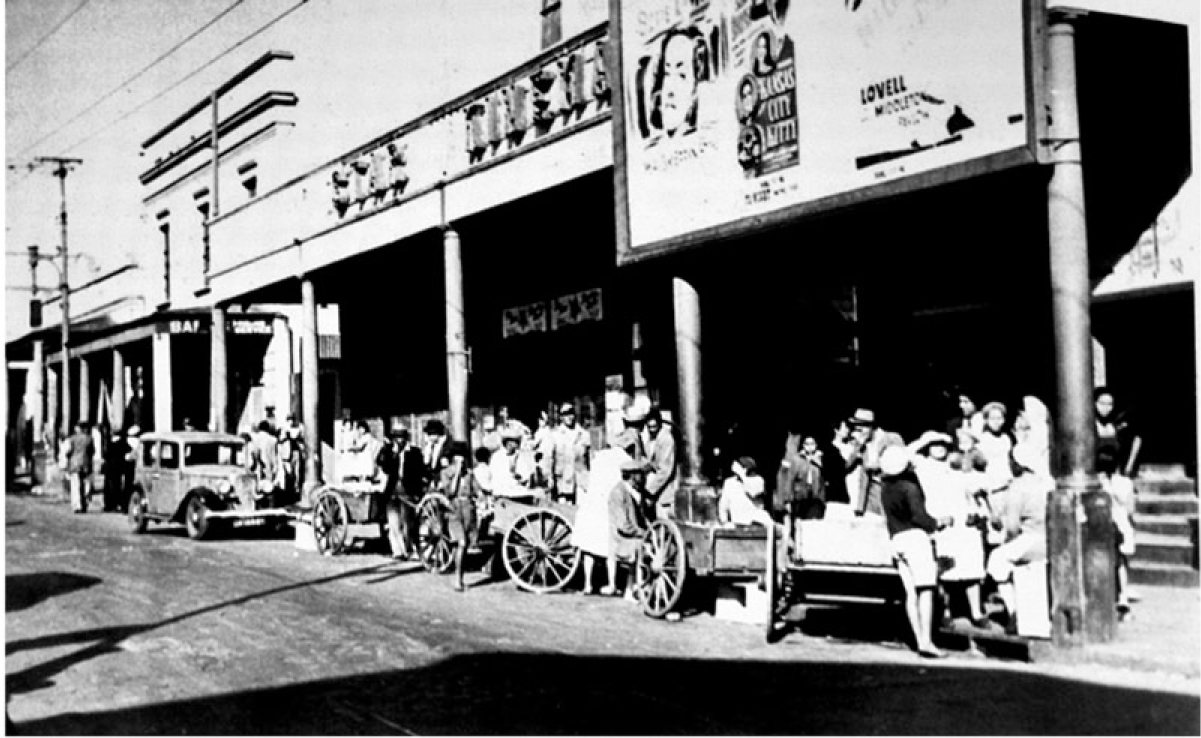
Star Cinema, Hanover Street, District Six, late 1940s. Photographer unknown.
Cinema and place
These cinemas were part of the warp and weft of District Six street life. They were used primarily for screening films, both throughout the week and on weekends, but the buildings themselves were landmarks in their own right, serving as points of topographical orientation in the memories of District Six residents. In recounting a story of a friend arrested by the police for not carrying his ‘pass’, one informant comments, ‘They arrested him, then he said no, he’s got his ID, his pass so they took [him] up to Searle Street. Searle Street was right up, you know, you pass Avalon Bioscope’ (Cds. 191). 14
In another interview, the informant explains where she lived in District Six by referring to the British cinema: It was a room it was down stairs there were people who lived up stairs and around the corner was Caledon Street where the British Bioscope were and quite a number of shops and café[s] that belong to the Malay people it was a mix[ed] area you know. (Cds. 203)
This approach to identifying oneself and one’s home is commonly present in the interviews. The cinema cashier responds to a question about when she had ‘tea time’ by orientating herself from the position of the cinema itself: ‘I was quite near the Avalon. I was in Aspeling Street. Then I would go home and then we would open up at half past one again’ (Cds. 171–173). In a further example, the informant first identifies the fact of the cinema’s existence and then locates her own house and her future husband’s house in relation to it: ‘… there was a bioscope in the street, the National bioscope, we lived near the bioscope …’. Later in the interview she comments further: When I met my husband then they also lived in William Street […] I didn’t know he lived in William Street […] We lived near each other … they lived closer opposite the bioscope, we lived a distance from the bioscope. (Author’s translation; Cds. 175–176)
The proximity of cinemas to people’s homes made possible a form of leisure that was easily within the control of parents, who could allow their children to go to the cinema while monitoring who they went with and what time they returned home: Well, when I go to the bioscope, look, as we are at the bioscope’s door, when you come out of the bioscope … see the father just standing on the stoep [verandah] he can see you are coming out of the bioscope, you go home (this was spoken very rapidly, not very clear). So now you can’t really go walking about. (Author’s translation; Cds. 134–137)
In another instance, the detail suggests that parents or guardians would find out what time the film was expected to end, for matinees as well as for evening shows, so that they would know when to expect their child to return home: Int: Did you have to be home by a certain time? Inf: Yes, when the bioscope comes out and my Auntie always used to find out if it was that time. But we weren’t allowed night shows, only matinees, and then we had to come straight home. (Cds. 88)
This relates to the significance of the cinema as a place where teenage boys and girls could meet and court: Int: Were there any special places where boys and girls could meet each other? Inf: Only the bioscope, my dear. We weren’t allowed dances. There was big dances, sometimes, but we wasn’t allowed. We was too young to go places like that. They said when you 16 then you too young. And I was young when I got married. I was only 17. In those days when you meet a boyfriend and your people see it’s going too far they rather see you married than bring shame on them. We wasn’t allowed to stay with a boy alone, or so. But in the bioscope it was a whole crowd. So the crowd would see you home safe and your boyfriend too they would see all the girls home then themselves. (Cds. 88)
This informant continues to explain how when she was older she ‘didn’t like the way I couldn’t go out’ and describes how she and her friend Mabel had ‘planned it’, to ‘go at night to bioscope’: There was a Western, man, a marvelous Western by the Star bioscope. O, the people was pushing to get in and our 2 boys as well (laughing). Oo Jenna [a form of colloquial exclamation] we had a good time. But the next day my auntie she slapped me so hard, and (laughing) Mabel got it too, on the other side. She forbid me to go to bioscope again, until after a whole month. We had to tell the boys that we girls couldn’t come out and they must leave us alone. If this one can’t come out, man, there are others. It was a sad month for me and Mabel. (Cds. 88)
As it turned out, this informant met her future husband at the ‘bioscope’: … at the matinee bioscope […] We couldn’t get tickets, and we 2 girls were standing there, me and Mabel, and he came to talk to us, this young … chap. He said he had a friend who had spare tickets so that’s how we met. So he went in with us and so we made friends. We introduce one another. And then every time he saw me he came to talk to me and I talked to him that way we get intimate with each other. (Cds. 91–92)
In such topographical references, cinemas also figure as places enmeshed in the wider street life and amenities of the locale, as well as in relation to informants’ own homes. A repeated trope is the naming of a cinema along with the street it was on, followed by descriptions of other businesses or activities on the same street. This is particularly apparent in memories of the Star cinema on Hanover Street: this is no surprise, since Hanover Street was the main thoroughfare through District Six, and the fish market, another key landmark, stood opposite it. One resident identifies ‘the three, four cinemas in our area’ and discusses his experience of District Six’s cinemas and shops in terms of ‘choice’ and ‘convenience’: So you, you had a choice, you could go to bioscope every night and see a different film. And there was a lot of shops, there was competition. You could get things very cheap because of the amount of shops which was competing against the other and that type of thing. You had your shoemaker there, you had your tailor there, you had your barber there, you had your butcher, your fishery, even your restaurants. Every thing was there. (Another person speaks and reminds him of the vegetable market.) Oh well, well now, we had a very big market, we even had a very well known fish market which was opposite the Star bioscope. (Cds. 211a)
This resident concludes his interview with a wistful reference to the proximity of his own house to the National, linking it to his experience of ‘convenience’: When I stand in my yard I could see, no I could hear, what was being said in the bioscope. You can imagine, and if I stand at my front gate I could see the entrance of the National bioscope. You see you had all those conveniences. (Cds. 211a)
This idea of ‘convenience’ is verified by other residents: ‘District Six everything is near there. You can go out your front door and go to the shop. Here [where the informant lived at the time of the interview] you must take the bus to go to the shop’ (Cds. 32). This form of comparison between life in District Six and where the informant was living at the time of the interview is very common. There are regular references to the proximity of informants’ homes to amenities of all kinds, both in District Six itself and in the city centre. The proximity of the city centre for window shopping after work or on weekends, and of the foreshore for strolling and picnics, is also commonly and nostalgically recalled.
Cinema, culture, and identity
Cinema buildings in District Six were venues for multiple events across a wide range of leisure, cultural and political activities beyond their film screening function. As community or neighbourhood places, they were central to the lives of District Six residents. The memories of the cinema owners’ daughter are especially illuminating: ‘… the bioscope was used during the weekends for meetings and for council meetings as well, and amongst the councillors was Dr Abdurahman and Isaac Persel [sic]’. She continues, with characteristic detail, ‘Dr Abdurahman always wore a black fez with a lassie [tassel] hanging down he was very smartly dressed. He always looked spic and span and immaculate’ (Cds. 165). 15
Residents also attended variety and other shows that took place in the cinemas. The cinema owners’ daughter explains that her father ‘wanted to encourage people to come to the bioscope’ (the Union), which was why he put on variety acts: … he introduced all types of entertainment he had the dancers with very wide dresses and in the operating box he had a light going with all variegated colours and as this person would intertwine her very, very wide skirts, it was like a fairy, red, mauve, green, yellow, heliotrope and it would go on all these colours and the audience would go mad, they had a review of singing and dancing, and then he had the strong man picking up weights, different kinds of weights and dumbbells and so on, then he had a boxing match on stage, so they could watch the boxing, this would be a special special night, oh we had full houses when they had the boxing on … . (Cds. 165)
Her mother, on the other hand, who did not have variety acts (in the Empire), ‘wasn’t going to be outdone’ and would ‘put on serials, and during that week [the same week as her husband’s variety show] so that she could get the public’ (Cds. 165). Several informants remember the weekly serials and the drive not to miss an episode: I just used to work […] till 1 o’clock, then, sometimes I would go from there to matinee bioscope. She [her employer] couldn’t keep me 1 minute if there was a matinee, because it wasn’t far from her house (laughing). I will even go without my food because I want to be at matinee bioscope so bad, I follow the serial and I must see it. (Cds. 90)
The cinemas and cinemagoing were closely interconnected with local cultural activities, particularly the annual ‘Coon Carnival’, as well as with wider expressions of cultural identity. The Carnival is an annual event that takes place on 2 January, the tweede Nuwe Jaar (‘second New Year’), in which minstrel troupes parade through the city centre. Before its demolition, the Carnival parade would begin in District Six. The Malay choirs are the first to celebrate the New Year and are known as nagtroepe (‘night troupes’). The cinema cashier describes her experience of waiting for the nagtroepe on New Year’s Eve: they would put out benches in front of the Star cinema and ‘sit and watch for the night teams to come’. They would ‘dance, ghoema in Cross Street. The band was all round and we used to dance in the middle, ghoema, ghoema’. 16 Her own experience of the cinema and the Carnival was interwoven in that she worked as cashier at the cinema and she and her husband also ‘sewed for the coons’. On New Year’s Day, she recalls, after having been up all night with the nagtroepe, she would often be called to fix the costumes and had to ‘go with my machine to the klops kamer [troupe room]’ (Cds. 171–173).
The Carnival has its roots in the combination of nineteenth-century minstrelsy and street performances of freed slaves in Cape Town, and has run continuously to the present day. It is well documented that Carnival troupes evidence a strong emulation of American icons, including those drawn from films (Maingard, 2003, 2007; Martin, 1999; Nasson, 1989). This takes various forms, including the names of troupes that are modelled on American and African-American names and US insignia such as stars and stripes in the design of uniforms, banners and face paint. Apart from the influence of Hollywood Westerns in the names of troupes, the most often repeated icon is that of the blackface minstrel, popularised by Al Jolson in the film The Jazz Singer (Alan Crosland, US, 1927). Although the assimilation of the minstrel figure into the Carnival had its antecedents in the American minstrel troupes that visited South Africa in the 1800s, the ‘Al Jolson look, white around the eyes and white around the mouth and the rest of it black’ (quoted in Martin, 1999: 139), became a major feature of the Carnival troupes’ painted faces after The Jazz Singer was screened in District Six in 1929. Both the film as a whole and the key moment when Al Jolson ‘blacks up’ with burnt cork in the dressing room mirror have great potential for understanding how the troupes identified with, and appropriated, Jolson’s ‘look’.
17
The extent of Jolson’s iconic status is also evident in the appropriation of his songs: The night Al died … there was hardly a street in District Six in which his favourite songs were not sung as a tribute to the creator of the Coon favourites ‘Sonny Boy’ and ‘California Here I Come’. (Quoted in Martin, 1999: 144)
Another significant aspect of cultural identity relates to gangs and gangsters, a major part of the life of District Six that is mentioned in many of the life history interviews – both in general and in relation specifically to the cinema—particularly from the 1940s. The Star was frequented by a gang called the Globe as well as by other gangs; and the Globe gang features most often in informants’ memories. This gang developed from the sons of shopkeepers on Hanover Street whose ‘security was being threatened’ by gangs formed earlier (Pinnock, 1984: 25). These young men would meet under a streetlight at the Globe Furnishing Company opposite the Star cinema. Their ‘first action’ is reported as breaking up a group of ‘toughs’ and their ‘informal tax-racket’ where they would extort a penny from each cinema patron entering the cinema (Pinnock, 1984: 25–26).
Perspectives on gangs vary, in that some remember them as only fighting other gangs rather than threatening local residents, or even as helping the local community, for example, by escorting young women safely home from the cinema. They are also remembered as sometimes sitting on the street and singing into the night. Some residents, though, remember them as having been more threatening. Some of their menacing behaviours are associated with the cinema, particularly with the Star. Gang members would sometimes use strong-arm tactics to force cinema staff to reserve seats for them, even if the screening had begun, and they did not occupy them. The Star cashier recalls: … these Globes they were so determined, they demand, you must keep their seats, irrespective if it’s time for the bioscope to be out, you must still hold onto their seats. (Cds. 171–173)
On one occasion, the head of the Globe gang harassed her by pushing the box office door open, intent on robbing her. She pressed a buzzer placed there ‘if anything goes wrong […] And in no time there was four from downstairs, the mobs, the doorman, the ushers and all that with sticks in their hands’ (Cds. 171–173). The fact that there was such a device suggests that there was a need for it, notwithstanding a comment from the same informant that the gangs ‘would fight in the bioscope, but they never interfered with us the cashiers’. The head of the Globe gang, she adds, ‘… was always beaten up. And he was always bleeding. And he was always stabbed’. She adopts an especially colloquial Afrikaans to express the approach of the gangster begging her for help, to which the translation into English does no justice, though it clearly affirms that the gangster did not want to be caught up with officialdom: ‘Come and help me I don’t want to go to hospital’ (author’s translation). Her office, she says ‘believe you me […] was a chamber of horrors’ (Cds. 171–173).
This cinema cashier also recounts how, to prevent gangs from fighting in the cinema, the doorman would take away ‘batons, with the sticks and whatever it was […] before they go in’. She is at pains to reiterate that it was not audiences in general that caused trouble but rather gangs: [T]hese hoodlums, these two gangs [The Globes and The Killers] they caused the trouble, not the people amongst themselves. We could sit in peace at night in front, the manager and I and all of a sudden we would hear fights. (Cds. 171–173)
Others have similar memories of fighting that occurred in the cinema itself: ‘… And then there was the Star bioscope. I mean that was one of our popular bioscopes. But sometimes when a drunkard comes in – you watch the film then they start fighting. The film is on the screen’ (Cds. 96–98).
Another informant, to his own amusement, provides more expressive detail of what happened when gangs fought in the cinema, the chaos that ensued and how it was talked about the following day: You know sometimes the people sits in the bioscope there […] And then there is a nice picture. Suddenly gang comes rushing in the bioscope, and everybody then, the whole crowd, that sit in that bioscope rush out of the bioscope, ha ha ha ha. […] Now they come in … like they come with a big blade ‘mes’ [knife] … screaming and shouting you know. Now they got knives and so on and the people did know that there was a (unclear) and then everybody runs out and one gang is hunting for the other. Now they hear that those men were in the bioscope. Then they come rushing, and now it is all in the darkness, hey. And all of a sudden the lights goes off, and you just see people running, ha ha ha and in one minute the whole place is empty, and then there is nobody inside […] the nicest part of it was that everybody moves in again, and they come and sit, and the show goes on again. Ha ha ha ha. […] And it happens mostly on a Saturday night. Now the Sunday is quite a bit of history like you know. They asked like … erh did you hear what has happened at the bioscope again, you know. Ha ha ha ha. […] It was the talked of the town. (Cds. 168–169)
Sometimes the behaviour of gangs in District Six reminded people of gangster films: Quite often there was a gang fight in the streets […] quite exciting to see this gang fighting. These gangsters right across the street coming down from the hill and that. It was like a real movie to see them coming down in a row. (Cds. 211)
The fact that the fish market was opposite the Star features in many residents’ memories. It was common practice to buy fish and bread or chips to take into the cinema. The proximity of the fish market also had its downside for cinemagoers, as a former stallholder comments, ‘[a]s you sit in the Star bioscope all the flies from the fish market goes in there. But that was a hell of a bioscope …’ (Cds. 32). Other informants comment on getting pocket money to cover not only the cinema ticket but ‘monkey nuts’ and sweets as well. One informant, for example, remembers getting sixpence on a Saturday that covered the cost of the cinema ticket at tuppence, plus a further tuppence for nuts and tuppence for sweets.
Patrons would also sometimes smoke dagga (marijuana) in the Star cinema, but this did not deter the serious cinemagoer from watching the film: Int: How was it in the Star bioscope? Inf: Very nice. [Afrikaans] You see people smoking dagga and they go crazy there at the back but they don’t harm any others. Allright the man who goes in at the bench […] knows there are lots of things that shouldn’t go on. He looks at his picture and then he leaves. That’s how it was. (Author’s translation; Cds. 03)
Smoking dagga in the cinema was part and parcel of the cinema experience from the earliest days of the cinema in District Six. In the Union cinema, which ran until about 1925, the owner walk[ed] along the aisle to see if everything was in order, and as she passed she would smell the dagga and she would say in Afrikaans ‘wie rook daar? [who’s smoking there?]’ and would go on and call this manager of hers and she walked along with a stick […] they were dead scared of her. (Cds. 165)
18
The various cinemas themselves are remembered as being frequented by different audiences based on a rough measure of class and wealth, as well as being associated with different kinds of social behaviour. The Avalon and the National are remembered as ‘posh’ as against the Star’s being for ‘poor people’; though the Star itself had its own hierarchy, with poorer patrons seated downstairs on long hard benches in the front and the ‘posh’ or ‘respectable’ upstairs in the circle on ‘plush but faded seats’ (Nasson, 1989: 292). This division of status is reflected in the cashier’s memories: Int: What can you remember specifically of your days at the Avalon. What was it like, what people used to come there? Inf: Well, socialites – used to come there. That was the first posh bioscope that opened. Very nice people used to come there. They would ask me to hold their tickets and I always used to get chocolates, because most of them were from the Parade [in the city centre] you know. If they were not in time to pick up their tickets then I would hold their tickets back for them. (Cds. 171–173)
Another informant proclaims that going to the cinema is her ‘favourite’ memory and moreover she ‘favoured Avalon’ even though the Star was closer ‘because it was more decent than Star bioscope’. In her case, the cinema is a place to ‘pass time’, after ‘hardworking’ (Cds. 190). Other cinemas are also remembered in terms of class. One informant describes the National thus: ‘… we liked to go to the National bioscope. That was a society bioscope …’ (Cds. 96–98). Compared with the Star however, there are far fewer memories of the other cinemas in and around District Six. This is perhaps partly attributable to the Star’s central location in Hanover Street, but may also reflect the preponderance of working-class informants in the original project.
Films, film shows, and stars
Cinema’s attraction was fuelled by publicity about films, film shows and stars. The Bailey family, who owned the Union cinema until 1925, acquired a Shetland pony – ‘a star turn in the district’ – and would write the name of the week’s film on a board at the back of the pony trap. Jack, the Baileys’ son, would drive trap and pony through the streets of District Six ‘right up to Buckingham House, Buckingham Palace, right down Zonnebloem, down Hanover Street, up Canon Street, down William Street where … there was another bioscope now and down the side street back into Hanover Street’ (Cds. 165).
When The Drum (Zoltan Korda, UK, 1938) was showing at the Star cinema, the doorman wore a pith helmet and the manager erected a fort at the entrance flying the Union Jack, paying children two pence each to ‘wear hats like you see on the proper Indians you get in India … turbans is what they were called, I think … they were made up from nice pink crinkle paper’. The children had to walk ‘up and down in Hanover Street, to give out bioscope advertisements to the people walking there’ (quoted in Nasson, 1989: 287). For The Mark of Zorro (Rouben Mamoulian, UK, 1940), ushers wore black eyemasks and fake silver spurs, and the cinema management placed a large cutout of a horse on the wall of a neighbouring shop (Nasson, 1989: 287).
More impressive, to judge from the memories recorded, were visits by actual film stars. The British singer and actress Gracie Fields visited South Africa in 1935 and appeared at the Star cinema: Inf: Many actors came from America to Cape Town. There was a … Gracie Fields and there was a coloured boy Al Johnson. Then she sings on the stage. Then he was singing too. And she hears what a voice this boy got. She picks him up on the stage. He got a dirty, filthy keppie [cap] on – she took it off and put it on her head. And she was singing that song, ‘Wish me luck as you wave me goodbye’. And he was singing with her. And later she keeps quiet and then he sings. Int: Was that the Star bioscope. Inf: The Star Bioscope yes. Every … in that bioscope. For the beauties and the uglies … (Cds. 32)
George Formby was another star visitor, on which occasion ‘they had to drive a police van right against the door’ to allow the actor to jump out into it (Cds. 171–173). Stars remembered also include ‘tough guys on the screen’ Humphrey Bogart and Edward G. Robinson (Cds. 168–169).
Cinemas were contracted to exhibit the films of different studios. The Star screened Warner Bros. films, and the Avalon those of Twentieth Century-Fox (Nasson, 1989: 288): this clearly informed residents’ choices of cinemas to patronise and would certainly have shaped the race, class, gender and age profiles of their audiences. While residents’ memories are redolent with experiences of going to the cinema, memories of the films themselves feature less prominently, as Kuhn’s (2002) research also shows. Broad categories of films – weekly serials, newsreels and cartoons – are remembered much more frequently than individual films. In relation to genres, slapstick comedies (Laurel and Hardy, and Charlie Chaplin), gangsters, Westerns and films noirs are best remembered. Where specific titles are recalled, these include Sign of the Cross (Frederick Thomson, US, 1914; Cecil B. DeMille, US, 1932), When London Sleeps (Ernest G. Batley, UK, 1914; Leslie S. Hiscott, UK, 1932), The Jazz Singer, The Singing Fool (Lloyd Bacon, US, 1928), Gone with the Wind, Snow White and the Seven Dwarfs (David Hand, US, 1937), The Drum and The Mark of Zorro.
Several informants also remember silent films: Inf: I can still remember when there was silent pictures too. Int: Silent pictures. Inf: Ja. Int: Can you explain that. Inf: It was a silent picture; you just see the mouth going and the actions but no words. But it was good. (Cds. 96–98)
The music played to accompany silent films, as well as their intertitles and subtitles, is also recollected: It was silent movies … the silent films. Show the films and the person played the piano. Now this person watched one afternoon and they know what kind or type of music. If it is sad music then you got a sad movies on […] you just sit still and you must just see all the movements on the film until they change over music […] And then they say what they wanted to say … and then like here on television (cough) (cough) then you suddenly make a speech in English … and they put it at the bottom, now the screen was the same. And now of course the music, now if there is a funeral gonna come on, then she play sad music. (Cds. 179–181)
One informant recalls the name of Johnny Thomas, the pianist who accompanied screenings: Int: Was it silent movies? Inf: Ja. Int: Did they play the piano? Inf: Ja […] I don’t know whether you heard from Johnny Thomas. That very dark fellow, he use to play the piano. A professional player, ja. And the bioscope was mostly in the afternoon. Because you could think it was mostly for children you know. Not in the night. I don’t think those days will come again. (Cds. 06)
The cinema owners’ daughter remembers this pianist as ‘Tommy’: He was my father’s pianist, he played for my father’s bioscope. Now was he white or coloured no he was coloured and he played all by ear, didn’t have any music, and he saw the film, it was a classic or sad, or something stupid with Laurel and Hardy, he had to play sort of ragtime music […] No Thomas was his surname but they called him Tommy, I think his name was Tommy Thomas. (Cds. 165)
She and her sister were pianists themselves, and her father often called on them to accompany a screening, sometimes at a moment’s notice, through an ingenious telephonic device that connected their house to the cinema: It was a long telephone with two bells in the centre of it, indicated in the centre which was marked ‘house’ and you returned this indicator towards ‘house’ and you rang it by hand and this connected to the house […] we knew it was Dad and he would say ‘what are you doing, we need a pianist up at Union bioscope, will you and V. come along?’. (Cds. 165)
She also remembers details of the methods she and her sister employed to accompany different sorts of films and scenes: Oh I can’t remember the tunes, when soldiers came along you played a march, quick turn to the march, then my sister would turn it to a march, then we came to a cowboy film, turn to a cowboy film, we had it all marked so that you just had to turn the pages of this book and get it where you wanted it, it’s amazing that we put that music together […] I really do think it was marvellous, because we were only about eleven and twelve, maybe I was going on for thirteen at that time. (Cds. 165)
The period of silent pictures is remembered not only for the films themselves and their accompanying music but also for a time when life in District Six was ‘mixed’, less policed and not violent. Recollections of silent films represent a nostalgia for that irreplaceable past: Inf: It was silent pictures. It was very nice. There was no violence. Int: [Interview continues in Afrikaans] What kind of people always went to the bioscope? Inf: Everyone the Muslims, Christians and Muslims and whites was mixed. Int: And then how was it with the whites together. Inf: [In English] Very nice. It was very nice. [In Afrikaans] That time they played cricket here with the whites, the Muslims and the whites played cricket here. Then we would watch the cricket. [Afrikaans] Nice, [English] it was nice. There won’t come a place – the government [Afrikaans] will never again build a place in its life like District Six. [English] District Six was a wonderful place. It was really wonderful … . (Author’s translations; Cds. 03)
In these memories of cinema and in the nature of their recall is embedded a wider set of issues around race and identity that ran through people’s everyday lives. Films, film shows and stars were attractions that drew residents into the cinemas. But their experience of being in the cinema itself–who they were with and sitting alongside–and how this activity addressed and formed their social and political selves remains deeply etched in their cinemagoing memories.
Conclusion
This article has explored the cinemagoing memories of former District Six residents, drawn from life history interviews conducted in the 1980s and the 2000s. Instances of memories of cinemagoing were identified via keyword searches in interview transcripts, and three key themes emerged from the recorded memories: cinema and place; cinema, culture, and identity; and films, film shows and stars.
Taken together, the memory work of the District Six Museum, alongside various memory records produced by former District Six residents, and the interview transcripts themselves, provides multiple qualitative avenues for comparing, and deepening understanding of the meaning of cinemagoing for District Six residents. Several published autobiographical works, for example, include sections on going to the cinema. 19 Photographs of the cinemas provide architectural detail and place them in the context of the streets and street life. 20 Short stories and novels based on life in District Six include accounts of going to the cinema. 21 A particularly rich resource is a book of paintings and memories by the artist Sandra McGregor, who painted the British and National cinemas, some of the pictures showing named characters who posed outside or inside the cinemas while she drew and painted, and whose stories she recounts (Fleischer, 2010). In short, the prevalence of cinemas and cinemagoing memories in a wide range of sources reconfirms the centrality of cinema in the life of District Six and adds further valuable detail to this study.
When Nasson and his co-researchers undertook their life history interviews in the late 1980s, their interest was largely in gathering and recording memories of everyday life – a ‘history from below’ – in a neighbourhood decimated under apartheid. The interweaving of everyday life and going to the cinema is evident in the multiple references to cinemagoing in these memories. Nasson’s primary focus at the time was the nature and formation of working-class leisure activity in District Six, in which cinemagoing was primary. District Six, he notes, ‘had an identity and an imagery rooted in a sense of separateness and social and cultural localism’ (Nasson, 1989: 286). It was, as Bonita Bennett and Chrischené Julius (2008) assert, a ‘bounded space’ (p. 52). It may be argued that it is this very characteristic that facilitated the weaving of cinema and cinemagoing into the fabric of daily life in District Six. Entertainment capital – in Nasson’s (1989) phraseology ‘leisure as capitalist enterprise’ (p. 286) – penetrated the boundaries of District Six, locating itself in several sites. Residents were thus not necessarily ‘going to’ the cinema: they were arguably already there. For many of them, geographically speaking, it was simply a case of crossing the road or walking around a corner to visit one or other cinema. The cinemas they frequented and the films they saw structured and shaped their lives and their identities: for most of the District Six residents, recalling the past involved recalling cinemagoing. In this sense, they might be seen as ‘cinema citizens’, members of a global seam of cinema entertainment and participants in its imaginative opportunities while at the same time, both before and during the years of apartheid, they were stripped of all other citizenship rights.
Footnotes
Acknowledgements
The author is grateful to Carolyn Hamilton, APC Research Initiative, UCT; Annette Kuhn for sustained supportive editorial guidance; Bonita Bennett, Daniël Biltereyst, Joanne Bloch, Alex Dodd, Jo-Anne Duggan, Noor Ebrahim, Maria Fannin, Sean Field, Melanie Guestyn, Chrischené Julius, Clive Kirkwood, Philippe Meers, Renate Meyer, Darren Newbury, Freddy Ogterop, Sue Ogterop, Simon Powell, Sandra Proselandis, Debra Pryor, Joe Schaffers, Christian Schoeman, Melvyn Stokes, Kylie Thomas, Gail Thorpe, John Wright, Niklaas Zimmer; and the anonymous reviewers. The author also specially thanks Emma Sandon. This article is dedicated to the District Six residents who contributed their memories to the life history interviews drawn upon here.