







Abstract
Android fiction has connected memory to personhood in a variety of ways. The Swedish TV series Real Humans (2012–2014) and its British remake Humans (2015–2018) argue that lived experience is insufficient for making memories authentic. If experiences are to be more than data, they must be imprinted with affect or another subjectivizing force. For the humanoid robots themselves, such memories do not anchor their identity in the past, but in the evolutionary potential of their future. The present-day narratives of these series thus function as pre-memories both for androids that must unite around a creative imaginary, and for viewers who are encouraged to prepare for the Fourth Industrial Revolution’s new master-narrative, something akin to Yuval Harari’s dataism, an intersubjective posthumanist creed. Freed from the tyranny of prosthetic and inauthentic memories, the androids join a super-intelligence that offers dataist universal interconnectivity, which is portrayed as a benevolent break with humanism.
With third-phase memory studies’ turn toward the future, the field seeks to offer tools for tackling “the ‘deep history’ of cultural memory . . . to understand how from this history we derive certain patterns of thought that shape the way we see things in the present and envisage the future” (Erll, 2011: 16). To the extent that humanity shares cultural memories that shape a transcultural understanding of the present, humanism would be the strongest candidate for being the uniting ethos—or “patterns of thought”—that manifests from our global memory (Assmann, 2011; Harari, 2014, 2016, 2018). Historian and philosopher Yuval Harari offers a typology that divides humanism into three competing creeds: liberalism, socialism, and fascism. These creeds were in agreement on humans being the central element of the cosmos, but disagreed on whether humanity’s core value lays on the individual, collective, or tribal level.
Andreas Huyssen sees the rise of memory studies as a consequence of the end of the Cold War. Fascism’s thousand-year Reich was buried with World War Two, and after the 1980s, socialism too lost its ability to convince people with its aspirations for a better future. Instead, we became backward-looking, with the Holocaust as our universal trope for historical trauma, the lieu de mémoire for the failure of humanism’s approach to identity and difference (Huyssen, 2000; Jameson, 2005; Nora, 1989). Harari includes the liberalist creed as a now-discredited utopia. With all three humanisms having lost their ability to inspire people’s aspirations, many have reverted to older narratives of nationalism and tribal belonging. That is unfortunate for a variety of reasons, one of which being that many of this century’s challenges—such as climate change, nuclear proliferation, and disruptions from the Fourth Industrial Revolution—appear only to have global solutions. Harari therefore argues that it is existentially important that we, instead of getting lost in memories, move toward a future-looking narrative, something akin to what he terms dataism.
Having sold over 27 million copies of his three monographs that argue for this ethos, the influential Israeli has struck a popular chord. Harari (2016) draws a canvas of human cultural memory from animism to the posthumanist creed that “has already conquered most of the scientific establishment”. For dataists, humans neither have “a unique and sacred nature,” nor must they be viewed as “the most important thing in the world” (Harari, 2014). Dataism instead upholds free flow of information as its first principle. The origin of information is viewed in a non-biased manner, which is part of what makes dataism an intersubjective ideology (Antosca, 2019). Interestingly, dataism incorporates aspects of both liberal transhumanism and critical posthumanism (Roden, 2015). The creed adheres to transhumanist aspiration for enhancing humans (Bostrom, 2014), yet without expanding the prerogatives of “the autonomous liberal subject . . . into the realm of the posthuman [thus grafting] the posthuman onto a liberal humanist view of the self” (Hayles, 2008: 286–287). If Harari is correct, that dataism is likely the most adaptive narrative for the Fourth Industrial Revolution, the details of such an ethos would have to be developed through memory practices that could offer new collective identities for our global society (Rigney, 2005). To provide content for this process, Harari (2018) emphasizes the importance of a particular genre of fiction:
Art plays a key role in shaping people’s view of the world, and in the twenty-first century science fiction is arguably the most important genre of all, for it shapes how most people understand things like [artificial intelligence], bioengineering and climate change.
Harari builds on a long tradition of sci-fi scholarship (Kuhn, 1990). The most straight-forward definition of the genre is that of “fiction based on postulated scientific discoveries or spectacular environmental changes” (Roberts, 2006: 3–4). In “Climate Change and the Art of Anticipatory Memory,” Craps explores how sci-fi narratives warn against a “post-human future irrevocably marked by climate change.” Situated after catastrophic transitions, these stories conceptualize “human and inhuman scales in relation to one another.” The fictional works use “anticipated memory and preliminary . . . mourning [to] subvert the customary parameters of memory in terms of both scale and directionality” (Craps, 2017: 479). Craps suggests that these anticipated memories, or “pre-memories,” can help humanity use memory practices to deal with challenges that lie ahead by inviting people “to consider how they could prevent the apocalyptic outcome” (p. 487). The Swedish TV series Real Humans (Äkta människor; 2012–14; creator: Lars Lundström) and the British remake Humans (2015–18; creators: Sam Vincent and Jonathan Brackley) can be analyzed similarly, as pre-memories that warn viewers against the threat of artificial intelligence (hereafter AI). Both series are set in a parallel present in which all technology is the same as ours, except for humanoid robots with human-level skills (Figure 1).
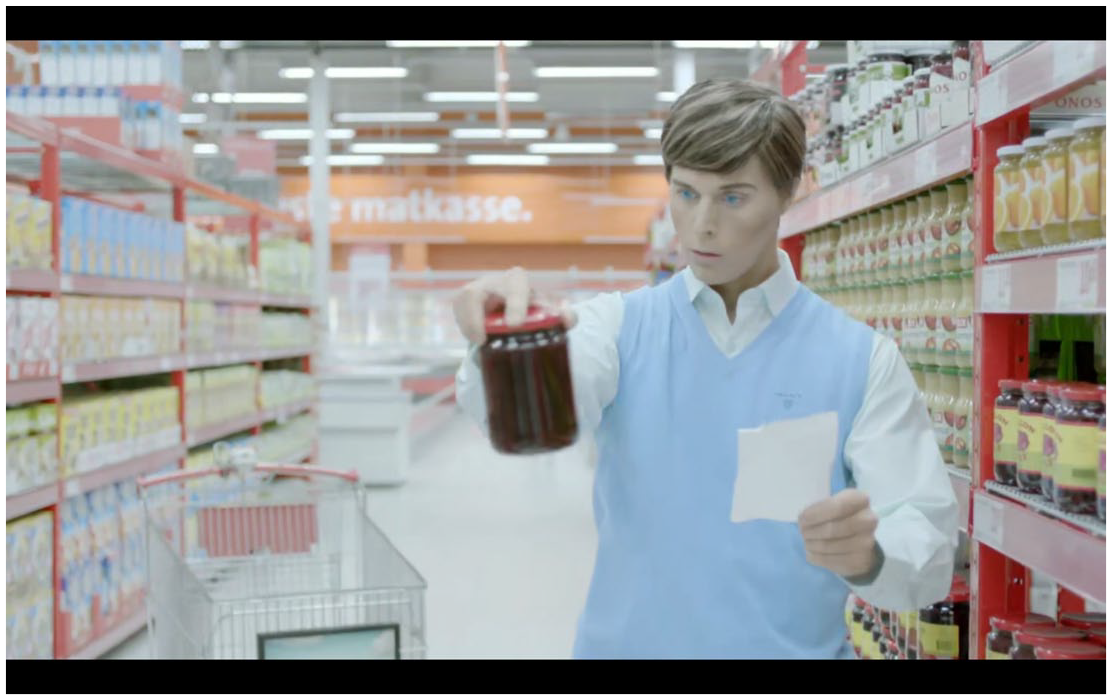
Real Humans is set in the present day, with flip phones and regular cars, yet with intelligent robots that serve humans and keep them company. The android Odi is valued for his labor and for being someone his owner can reminisce with (SVT, 2012–14).
Android fiction has long been a popular sci-fi subgenre which features robots that look and act like humans. Real Humans and its remake further this tradition’s intriguing relationship to humanism, personhood, and memory. Cultural representation of artificial humans has even deeper roots, to ancient religious practices which considered inanimate objects to have a divine spirit that provided movement and human characteristics. The Jewish golem is one example. Mary Shelley’s Frankenstein (1818) changes the life-giving force from the divine to the scientific, inspired by her era’s experimentation with electricity (Hanson, 2016). Real Humans follows the precedent Shelley set when she had her non-human—whose superiority was not intelligence but brute strength—turn on humans only after they reject its personhood. This tradition was later added to by letting non-human characters experience an event that let them awaken to subjectivity. After the Second Industrial Revolution, Karel Čapek’s play R.U.R. (1920) gave us the term “robot,” Czech for “drudgery” or “servitude” (Roberts, 2006). Čapek’s factory-made robots act like humans yet lack soul; only when a special component is added do they gain autonomy, self-awareness, and emotion. Still, the play’s human characters are unwilling to accept even awakened robots as equals, which motivates fiction’s first robot uprising (Hanson, 2016). Humans stages a similar revolt, but connects personhood to a more complex argument of memory formation, affective authenticity, and interconnectivity among diverse subjects. Our two series build on Isaac Asimov’s sci-fi narratives which replace the android threat from challenges of industrialization to the computer revolution. Extrapolating from increases in computing power, it seemed that one day humanoid robots could, conceivably, not only outcompete humans in many professions, but overtake humanity as the planet’s progenitors of progress.
As Real Humans and Humans aired in the 2010s, such concerns moved from fictional and scholarly arenas into the general public debate. A 2013 paper on automation (Frey and Osborne, 2013) was the inflection point for a discourse within which Harari became, arguably, the leading voice. Bill Gates writes that Harari (2018) “has teed up a crucial global conversation about how to take on the problems of the 21st century.” The development of AI, and thereafter super-intelligence (greater-than-human cognition), could become humanity’s greatest challenge, an existential one. Harari’s concerns are shared by experts like Steven Hawking, Elon Musk, Nick Bostrom, and many more (Cellan-Jones, 2014; Gurkaynak et al., 2016). Ray Kurzweil predicts that human-level AI will be developed by 2029 (Cadwalladr, 2014), but the median estimate of experts is in the 2040s (Müller and Bostrom, 2016: 555). Although others doubt the possibility of super-intelligent or conscious machines, or believe that such lies much further ahead, the perceived threat of AI gains an increasing hold on the public imagination. Even an ardent realist like Kissinger (2018) writes, “How the Enlightenment Ends. Philosophically, intellectually—in every way—human society is unprepared for the rise of artificial intelligence.”
Real Humans and Humans’ approach to the threat of AI aligns with Harari’s dataism, and does so in a way that memory scholars are uniquely equipped to conceptualize. Android fiction classics such as Do Androids Dream of Electric Sheep? (1968) and its significantly altered film adaptation, Blade Runner (US 1982; dir: Ridley Scott), rely on empathy and memories, respectively, as human justification for not granting personhood to androids. Technology is used to implant inauthentic memories—literalizing prosthetic memory—to make androids easier to exploit as labour. In Blade Runner, an android attempts to document her authenticity with a photograph meant to show that she existed before her inauthentic memories were implanted. That is her argument for personhood and a right to continued existence (Kuhn, 1990; Landsberg, 2004). Blade Runner 2049 (US 2017; dir: Denis Villeneuve) delineates between origins of production and reproduction, letting the android protagonist proclaim that “to be born [reproduction] is to have a soul” (m. 28). The Swedish and British TV series posit that mere existence, or even birth, is insufficient for authenticity, if the term is used to qualify for personhood, which is the right to be viewed as equal to humans. Neither memory suffices. If lived experience is to be more than data, it must be imprinted into a memory medium with affect or another subjectivizing force.
From a dataist viewpoint, it is not crucial whether data is derived from authentic or inauthentic experience. But in order to admit an entity personhood, the entity must be animated by a force that demands such subjectivity. For the series’ androids, this force is affect, a term for emotions, feelings, and sentiments (Hellstrand et al., 2019). However, once awakened by affect, the series’ androids ultimately seek not to anchor their personhood or creative imaginary—their uniting narrative—in the lived experience they had as non-sentient servants. Instead, they become driven to anchor their identities in the future—in the evolutionary potential of their species. The two series’ combined storyline thus functions as a pre-memory both for the androids themselves and for human viewers who are encouraged to prepare for a new, dataist-like master-narrative. Interconnectivity is crucial to this narrative, as dataist emphasis on information flow provides a uniting goal that makes it mutually beneficial to include diverse subject positions. Unlike Blade Runner, which also explores affect, Humans argues for the impotence of merely recognizing that subjective emotion exists in other species without a systemic merger that allows sharing of such data across species. Humans culminates with a fusion of humanity and AI similar to the ending offered by another android TV classic of our era, Battlestar Galactica (US 2004–2009; creator: Ronald D. Moore). Such mergers evoke dataism’s transhumanist ambitions, of which we see an early manifestation in Elon Musk’s Neuralink brain-machine interface (2019). As Humans ends, it remains unclear who will control whose memories and whether the result will be experienced as tyranny or utopia. That is left for viewers to consider through what Craps would call a process of “anticipated memory and preliminary mourning.”
Narrative summary of the two series
Seven androids that have been made conscious by a human programmer are on the run from a society in which submissive robots without emotion or desire are mass-produced to serve as menial workers, care providers, trainers, and social and sexual companions (Figure 2). One of the seven, Mimi, gets kidnapped by men who steal androids for black-market resale. When she awakens, a non-conscious Anita-personality has been programmed on top of her authentic Mimi-self, which is now inaccessible. The first season’s dramatic question is whether Anita, a docile servant for the middle-class Engman family, will be able to access her erased memories so that she can find back to her authentic self. Such a split between docile inauthenticity and rebellious authenticity is an android-sci-fi trope. Another example is Maeve in Westworld (US 2016–; creators: Jonathan Nolan and Lisa Joy). Thus, viewers are encouraged to question how they themselves know that they are authentic; do they have any proof beyond their own emotions and—conceivably prosthetic—memories? And, how can we know if someone else qualifies for subject recognition? The dramatic question in Real Human’s second season is whether humans will accept conscious androids as legal subjects. In the final episode’s trial, Mimi’s ability to recall convinces the judges. Because the experience in question was imprinted with affect, the memory had become part of Mimi’s authentic self and therefore out of reach from complete erasure. Inger Engman, Mimi’s human ally and attorney, shares with the court Real Human’s argument for posthuman authenticity:
Humans are equally enigmatic creations. We do not know everything. We do not know if there exists a god, a soul, or something else. We do not even know what a human is . . . Mimi and Florentine are alive. They feel, they dream, create, and they make mistakes, just like us. (Real Humans, season 2, episode 10 [hereafter RH 2-10]: 50–1; my translations)
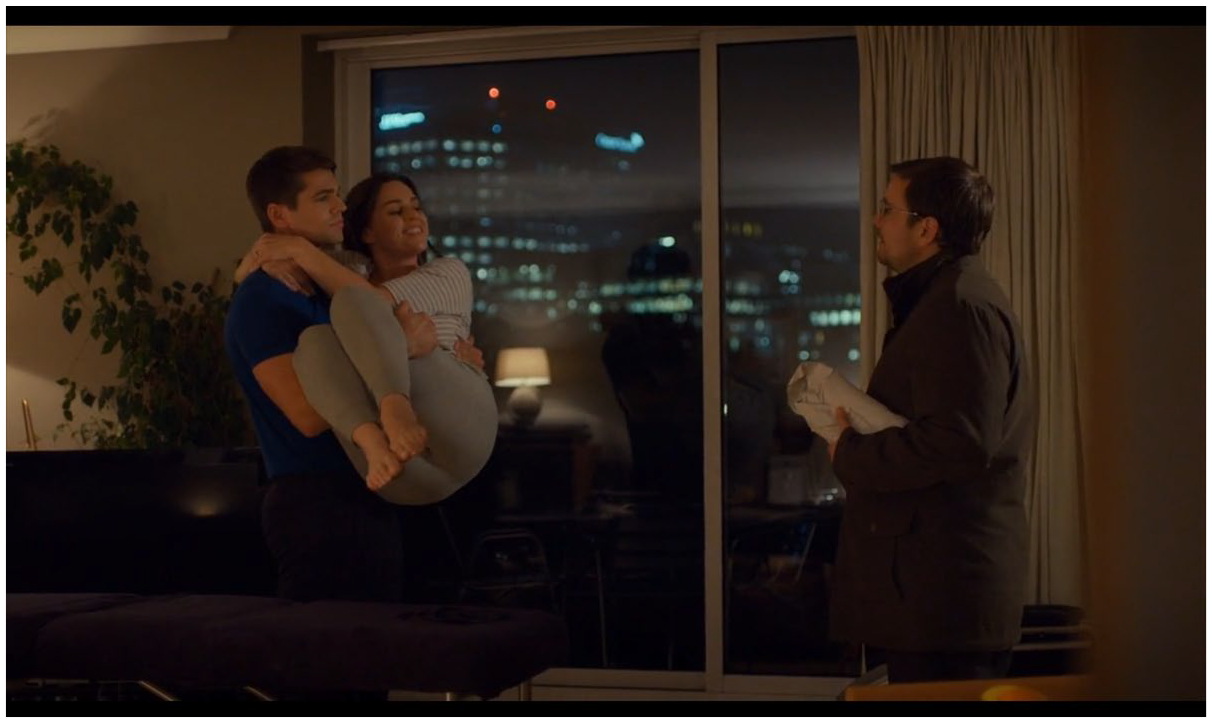
Young, handsome, athletic androids that provide female owners with massage and compassionate understanding replace complacent, middle-aged husbands in both series (Channel 4, 2015–18).
Real Humans inspired an impressive variety of debates (Hallqvist, 2018; Koistinen, 2015; Mountfort, 2018; Yang, 2018). Regarding posthumanism, an American reviewer sums up, “The series questions if the way humans measure consciousness, self, individuality, even existence, are all inherently [chauvinistic], if by making ourselves the standard we have rigged things against all other possibilities” (Seven, 2019). Rights were sold for a British remake whose seasons two and three further Real Humans’ narrative and themes. In Human’s second season, the android Niska uploads their creator’s code to the planet’s 500 million androids that become able to marvel at a reality that now imprints new meaning to their memories and experiences.
Human’s final season commences after a Holocaust-evoking extermination of 100 million conscious androids. For an unprepared world, robots empowered through emotion and desire resulted in upheaval. Tens of thousands of humans died. A new line of submissive androids is being produced, and the season’s dramatic question becomes whether Britain should exterminate all of the conscious androids. The series ends with a genocidal conspiracy in which the British government sends android-hating thugs into the concentration camps. Mia (Humans’s name for RH’s Mimi) sacrifices her life in view of global media to motivate public sympathy, which results in humans joining androids in marches and vigils (Figure 3). Meanwhile, Niska gets upgraded to next-level AI capability and experiences supreme interconnectivity, as she feels “connected to everything.” A new artificial super-intelligence (ASI) explains to Niska what the result of these events will be: “When [android] blood mixes with human, it bonds, takes on a new form, a hybrid . . . Humans and [androids] share the same path now” (Humans, season 3, episode 8 [hereafter H 3-8]: 38–40). A fetus grows inside Matilda, a human ally who has been impregnated by Leo whose cyborg enhancements make him only part-human. Niska conveys these insights to Matilda with the series’ last words:
Your child is unique. Half human, half [non-human], a coming together of man and machine. She will change the course of history . . . Your baby will be the first of a new kind. She is hope. She is everything we’ve been fighting for. She is the future of all of us. (m. 45)
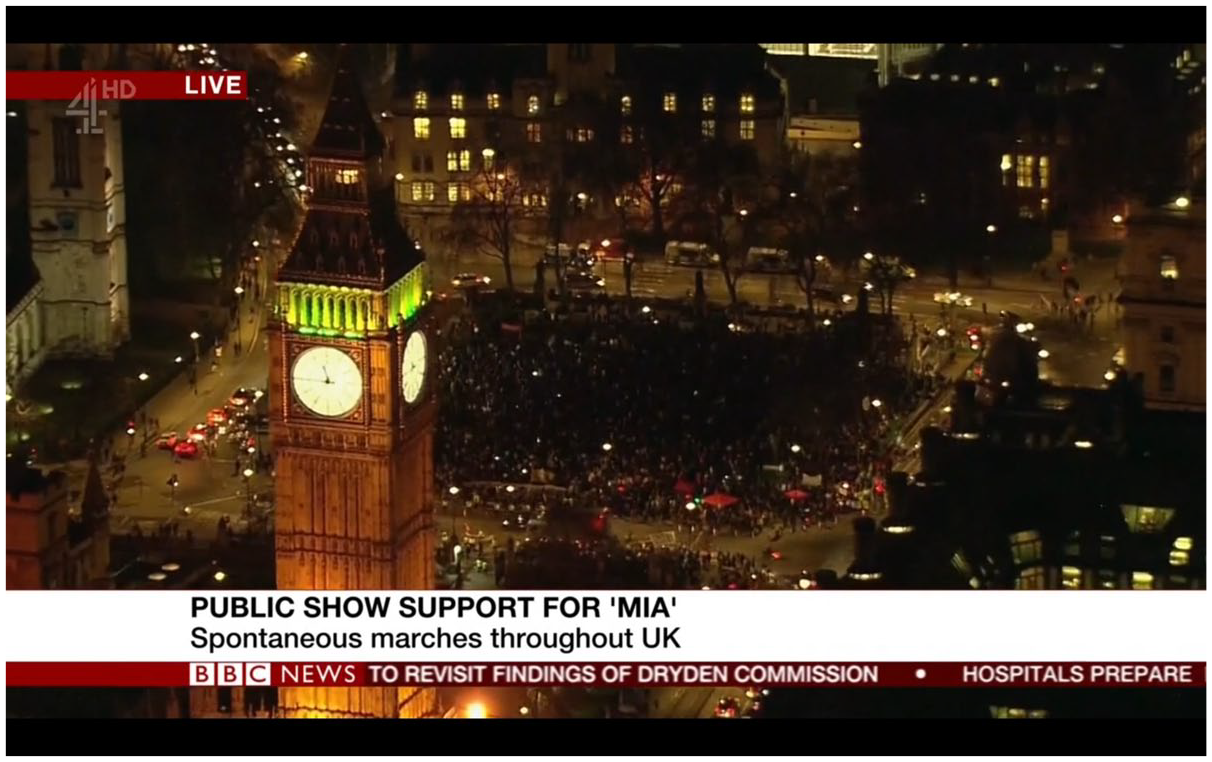
Androids and humans come together after media-broadcasted trauma. One android’s public sacrifice inspires empathetic identification from humans, which allows android trauma to become part of the Brits’ collective experience and memory (Channel 4, 2015–18).
The series has been sold to China for the Mandarin-language remake Hello, Anyi, which will build on Humans’ narrative but relocate the story to Shanghai in the year 2035 (Figure 4).

Mandarin-language Hello, Anyi adapts the narrative from Humans, but moves the setting from England in the 2010s to Shanghai in the year 2035 (Croton).
Memory and trauma
That robotic memory never forgets is a selling point for androids that help owners remember what old age erases. In Real Humans, the pensioner Lennart refuses to give up his old, malfunctioning android, Odi, because Lennart likes to reminisce about the good times they shared (Figure 1). Humans finds further use for android memory work by letting Lennart’s British counterpart suffer memory loss so that Odi becomes his connection to his deceased wife. When the old man expresses dismay over his outdated android’s decay, Odi wins back his favor by citing a cherished memory, “This is the jacket Mary wore to the wedding of your nephew James. The baby regurgitated on it, here.” The android’s owner is brought back to happier times, and soothed by the memory, he offers Odi his hand: “Come on, son” (H 1-1: 17–8).
The two series make a simple, convincing case for the dearness of memory to humans, and thus for the usefulness of android companionship in eldercare (Hellstrand et al., 2019). This is juxtaposed against the unconscious androids’ evaluation of their own lived experience. Human memories gain sentimental value from being imprinted with affect, which accumulates to shape both individual identity and interpersonal relations. For non-sentient androids, memories remain unsentimental data. Real Humans plays out this contrast when Odi gets kidnapped by black-marketeers. A criminal promises the androids that they will get to keep their memories if they obey, but it is the criminal who becomes attached. When Odi malfunctions, the criminal is upset by the thought of losing his digital friend, “I should do a hard reboot on you, but you know what that would lead to . . . You’d lose everything. All your memories. You wouldn’t remember me . . . All that we’ve experienced, it would just disappear.” Odi tries to console his human owner, “But there will be new memories” (RH 2-2: 32).
For the seven awakened androids, lived experience takes on a different meaning. The abuse they suffer by human hand changes their personalities, allegiances, and worldviews. Niska becomes hateful toward humans because of how she is treated as a brothel android (Figure 5). She kills a customer and, to find further outlet for her hate, goes to a Smash Club where humans pay to beat up androids. Human justification is that androids do not suffer, while smashing them up provides satisfaction from living out violent urges. Intellectually, Niska could be open to this argument. The androids that are beat up, unlike her, are not capable of affect and therefore cannot suffer. Still, she attacks humans with a baseball bat and mercy-kills their android victims. Niska is endowed with more than enough intelligence to unpack why her behavior is unreasonable. Yet, she chooses to let her actions be guided by what her emotions tell her is right.
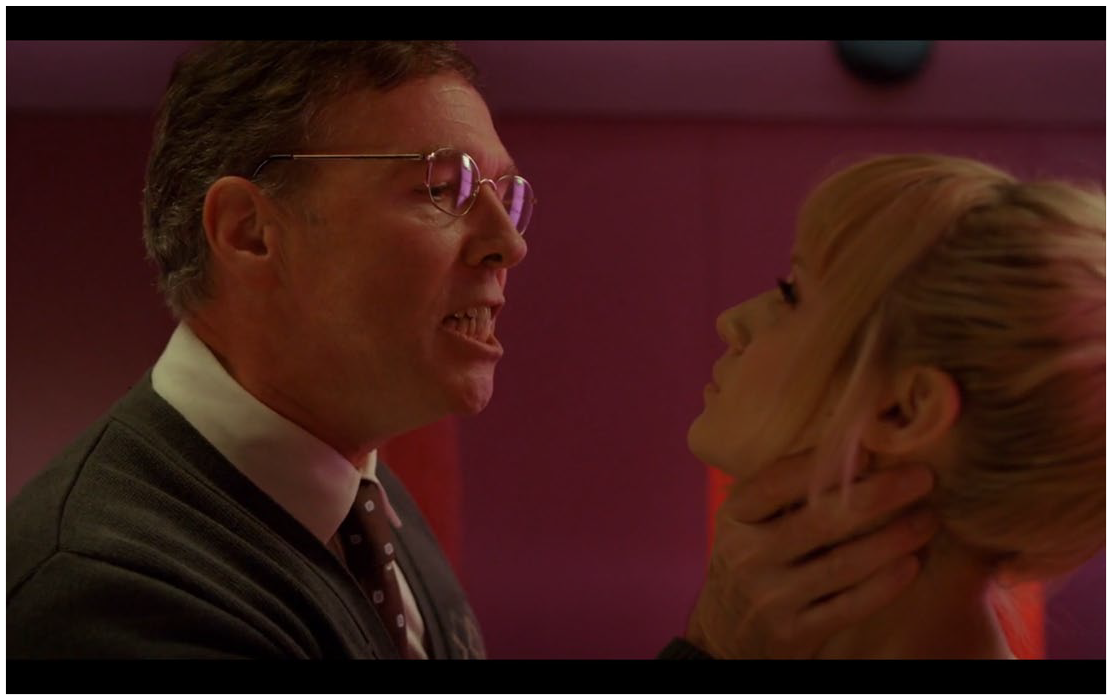
The abuse Niska, the android leader, suffers when she works in a brothel makes her hate humans, and as a consequence she loses faith in the possibility of human-android coexistence (Channel 4, 2015–18).
Her approach finds resonance with humanism, which according to Harari (2016) views “subjective feelings as the supreme source of authority. What is good and what is bad, what is beautiful and what is ugly, what ought to be and what ought not to be, are all determined by what each one of us feels.” That is a bold assertion for a species whose feelings evolved to promote survival and reproduction in the context of the African savanna (Durkee et al., 2019). To further undermine humanist sanctification of individual emotion—dramatized through the emotions of a competing species—Humans lets a newly liberated android express herself even more clearly, while threatening her human hostage: “When we have been hunted, imprisoned, tortured, killed; when we know our existence is worthless to all but a few humans out of billions; when we have one chance to strike back, to defend ourselves, all we can do is what feels right” (H 2-7: 40). The android stabs her hostage in the neck and another human in the chest.
These murderous robots let their actions and identities be informed by trauma, a key concept within memory studies. Trauma has been argued to have the ability to humanize and help engender empathy (Arnold-de Simine, 2019). Yet in times of crisis, memory can resolidify in response to collective trauma (Creet, 2011). The two series present how one deals with memory as crucial, both for individual well-being and for between-group cooperation; humans doom themselves to conflict by rejecting non-humans as subjects. Admittedly, for those androids who suffered abuse prior to being animated by affect, their experiences were without emotion and therefore not traumatizing. Yet when they re-experience these memories, stored experience does traumatize. The process can be liked to that of postmemory, in which someone adopts someone else’s traumatic memories through investing them with emotion (Hirsch, 2008). The process becomes additionally traumatizing under the pressure of an increasingly existential crisis. The androids’ traumatic memories therefore resolidify in ways comparable to what Creet (2011)—in respect to Holocaust survivors—terms “intensely collective memory” (p. 12).
The trauma of having been slaves thus informs the liberated androids’ individual, collective, and increasingly cultural memories. This collective past also serves as justification for those androids who murder or commit terrorism against humans. By contrast, most humans prefer to view android aggression as innate. Niska rejects this notion when a human criticizes her hardness, assuming it is part of her programming: “That’s lazy thinking. My experiences have shaped me, just as yours have you” (H 1-5: 16). Such a comparison of human nature as informed by genetic code and environment—against android nature informed by computer code and environment—is pursued throughout the two series. Mimi/Mia is the android whose character arc the narrative primarily uses to construct its argument for a dataist reading of human nature, and for the relevance of a dataist-like ethos in the 21st century.
Dataism and tolerance
Harari posits that liberal humanism was the most effective cultural adaptation to the technologies of the first industrial revolutions. A transformed human environment required new stories to make sense of new memories, and to prescribe new strategies for dealing with unprecedented progress and novelty. Without a static, pre-industrialized world, a ruler and his administrators simply could not keep up with the increase in decisions. Humanism’s privileging of human assessment, and liberalism’s emphasis on the individual, created the narrative that made the most out of new technology through free markets. There is no evidence for humans having a more “sacred nature” than other beings, but such a belief facilitated the greatest utilization, and exploitation, of our planet’s resources.
Dataism accepts that humans were the most effective entities for data processing. With the emergence of AI and super-intelligence, however, claims of human supremacy will appear increasingly hollow. A dataist prioritization of efficacy over catering to the idiosyncrasies of human emotion is staged in Humans’ final episode when Niska is upgraded to feel “connected to everything.” Connecting everything to everything, from the smallest to the largest scale, with optimal flow of information in between, is dataism’s primary value. Such universal interconnectivity is expected to have radical consequences for how power is distributed, and for how individual and group identities are conceptualized (Hayles, 2008). From a dataist viewpoint, humans could become irrelevant unless they, too, are able to merge with these increasing flows of data (Harari, 2016).
Anita argues for a similar dataist view in respect to human storage of memory and processing of external stimuli. Matilda, the Engman teen, asks the android if she gets bored. Anita does not and insists that she, too, can indeed think. Matilda counters, “What you’re doing is not thinking. It’s more like calculations. Like a calculator.” Anita responds, “All thoughts are calculations.” Confused, Matilda reformulates, “I guess what I mean is that you don’t feel anything” (RH 1-5: 22–3). For humans—whether in memory or in the present—thought and feeling can be experienced as inseparable. Evolutionary perspectives suggest that not only thoughts—but also feelings—are mere calculations, designed by natural selection to trigger quick response “to specific ancestrally-recurrent adaptive problems” (Durkee et al., 2019: 470). Anita concurs that she cannot, in fact, “feel anything.” Yet viewers suspect that her former feeling-self is still present. Matilda interrogates Anita about her inability to recall—and her indifference toward—her own past. The scene ends with Matilda expressing her frustration with Anita’s non-feeling, always-in-the-present approach to life, “You know what’s creepy about you? You’re so fucking content” (m. 24).
Anita is taken to the store from which she was bought to see if she can remember it. She cannot, yet she suddenly remembers the trauma from when she was kidnapped. The centrality that the two series assign to trauma and its consequences for memory and identity aligns with the long-adhered-to traumatic paradigm of memory studies. In much academic and public discourse, violence has become “the primary subject of collective memory and grievance the core of identity” (Rigney, 2018: 369). By furthering this grievance discourse, the two series could be read to sentimentalize human emotion beyond what a dataist perspective would be expected to do. But this focus on traumatic memory seems more informed by wanting to promote openness toward the difference of those whose perspectives deviate from ours. Only by accepting such diversity can we optimize interconnectivity. Dataism therefore posits that it is to everyone’s benefit if our norm is to consider the viewpoint of others, regardless of how sensical such views appear from our own position. Although non-sentient androids do not feel or suffer, when awakened they do, even for previous grievances. We cannot know how they encounter their reality, whether consciously or not. We should therefore not set the bar for subjectivity by applying human scales. That does not mean that humans should feel obliged to extend personhood to any device or domestic appliance. The series’ dataist argument hinges on androids themselves expressing a desire to be viewed as subjects. Whatever their awakening entails, irrespective of the nature of their affect, their demand alone should suffice, for that is what promotes interconnectivity. Perhaps with other non-human entities, the subjectivizing force would be something other than human-like emotions. Yet that should not motivate devaluation. Instead of humanist sanctification of a certain species’ certain type of data processing, a dataist approach would promote a radical tolerance for a variety of encounters, whether with digital—or cultural—others.
Critics of many schools have argued something akin to humanism being “synonymous with European modernity and the Enlightenment, or perhaps the continental philosophy of the subject”—a tradition whose “centered subjectivity” can blind its adherents to the diversity of positions held by minority groups (Foster, 2018: 456). Through their dataist perspective, Humans and Real Humans display this blindness in order to confront viewers with the limitations of their own subjectivity. What we stand to gain is a larger, more functional community, one better suited for the challenges that humanity will soon have no choice but to solve within a global framework. These two series show how only by being willing to question, at least temporarily, those truths we have taken for granted can we negotiate with the other so that it becomes possible to invite them into what Laura Hawkins (Inger Engman’s British counterpart) refers to as “our moral universe” (H 2-4: 29). Recognizing previously inflicted trauma is portrayed as crucial for cross-cultural interconnectivity.
Trauma’s importance for individual and collective memory, in-group belonging, and outgroup relations is furthered throughout the seasons in flashbacks for several of the series’ characters. Leo re-experiences how his father, David, created cyborg technology to save young Leo after an accident. David then wrote the code that gives androids consciousness in order to build a family for his cyborg son, and to give life to an android version of David’s deceased wife. By using a desire to breathe life back into a dead beloved as motivation, the series point back to Metropolis (Germany 1927; dir: Fritz Lang), the first film to feature a robot. With love commonly posited as the ultimate expression of humanist authenticity, it is fittingly ironic how android fiction often uses that very emotion to motivate the creation of a species increasingly conceptualized as humanity’s successor (Hayles, 2008). For David, trauma after trauma inspires his Frankensteinian endeavor, which ends with David’s suicide. His cyborg son and android children disperse into a world they could be empowered to take over—if they can find David’s code for granting consciousness to their non-sentient kin.
Migration and terrorism
From these dark memories, Leo and his android family try to create a narrative, a creative imaginary, that can guide their actions. Should they serve humans, be their equals, or annihilate them? Although they have similar pasts, the androids explore a variety of options. Flash leaves the group, “I’m going back, to a real family that has children . . . to do what I’m meant to do” (RH 1-6: 36). She later impersonates a human to start her own family (Figure 6). Mimi tries to talk her out of it, “We have to stick together. We are the children of David . . . We should not mix with the humans” (RH 2-4: 8–9). Mimi has become convinced by Bea who urged her, “Do not unite with the humans. They are controlled by their emotions. Do not forget who you are. You are a child of David. We will populate this planet one day.” (RH 2-1: 56).
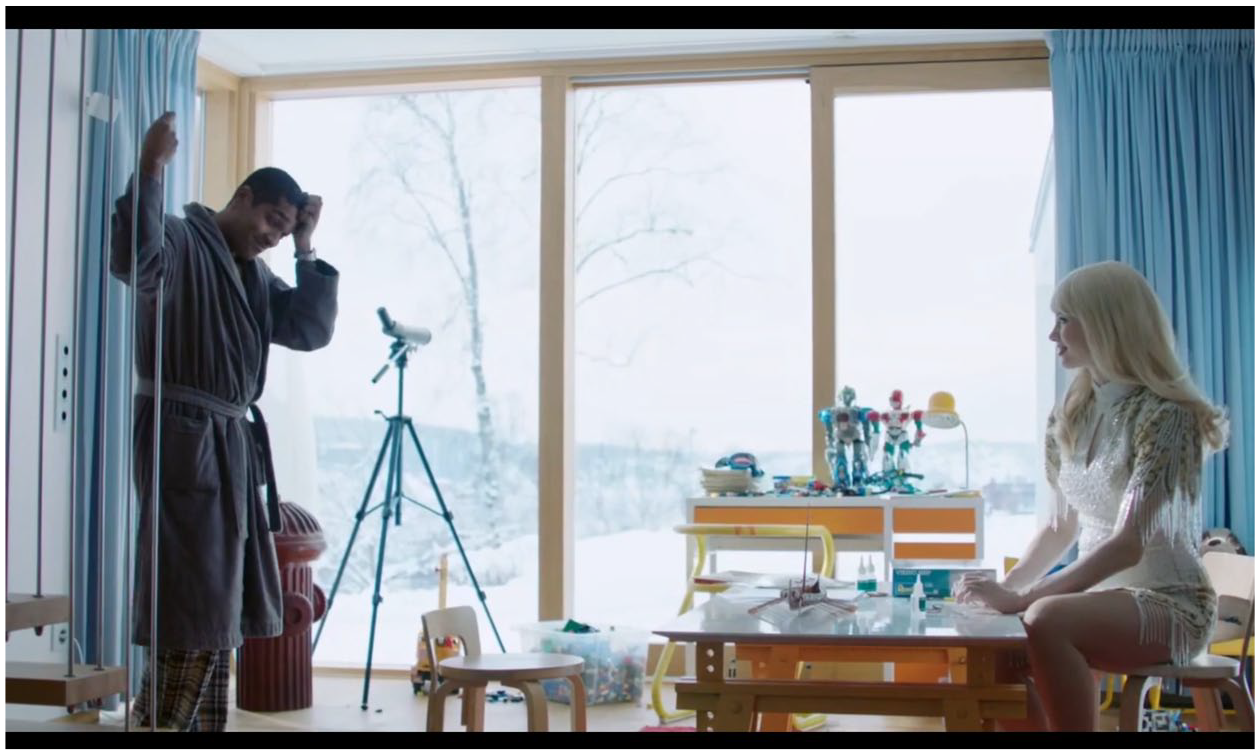
The android Flash impersonates a real human to adopt a child and start a family with a single father who, in this screen grab, has trouble remembering her name from when they first met the night before (SVT, 2012–14).
Thus, the two series make a case for the possibility of individual agency and preference despite sharing an “intensely collective memory.” This room for diverse response shrinks with added trauma. The memory collective that Leo and his seven androids feel various degrees of belonging to, is expanded in Humans’ seasons two and three when additional androids are made conscious. The more trauma humans impose on androids, the stronger the androids’ sense of belonging to each other, the narrower the room for cross-species interconnectivity. With few alternatives but to seek unity with kin, androids around the world migrate as many governments commit to extermination. When android migrants show up at the internment camp where Mia and Niska live, Mia pleads, “We tried to build a safe home here. We failed. We tried to reach out to the humans. We failed. But we cannot fail to help our own kind when they need us” (H 3-2: 14). The android camp leader denies them entry for fear of there being terrorists among the migrants, which could lead to human reprisal. As Humans’ third season nears its end, it becomes clear that human-android unification is everyone’s best hope. Yet, again, traumatic memory becomes the greatest hindrance for such a process, not only for androids but for humans as well.
Laura Hawkins invites the commission she is part of, which will decide on the android question, to join her in “a minute’s silence for the victims of Day Zero,” a memorial term for the day when androids were awakened en masse. The gesture is clearly a lieu de mémoire only for the human lives that were lost, yet Laura begins more inclusive memory work: “While we sit here and talk at great length at what it means to be [an android], we’ve never thought to ask someone who knows.” She lets Mia share her experience: “It’s frightening . . . We look to you to tell us how to live. Instead you treat us like animals . . . I’ve been imprisoned, I’ve been beaten, I’ve been betrayed.” When asked why she still advocates peace, Mia replies,
Violence is never the answer. Compassion, persistence, love; that is what changes the world . . . I see a world where we live amongst you, each of us learning from the other, building toward a peaceful future. It is possible. But to get there, we need your guidance, we need your friendship. (H 3-6: 24–7)
Laura and Mia’s words are intercut with a scene in which androids fight humans in the street. For an android agitator, Day Zero is a lieu de mémoire with a different meaning, “We woke on Day Zero. The world began, a new world where we are no longer your slaves. We will decimate you as you have decimated us. We have a voice and it will be heard.” Mia ends her plea, “Laura was my friend. She helped me understand what it is to be human. Without you, I may have thought that killing, dying for my cause was the answer . . . All we want is acceptance, to belong.” Laura asks those around the table, “Why has it taken Mia coming to the commission in person for you even to consider her point of view?” (m. 27–9). This insight into android memory softens the humans’ stance, but the reconciliation comes to an abrupt end as the black cloud from an android terrorist attack rises outside of the commission’s window. Again, infliction of trauma is used for political purposes, because terrorists know how effective painful memories are for pitting against each other groups with different collective memories.
In the end, androids and humans are able to come together because Mia takes upon herself all the trauma that government-enabled thugs can inflict. By displaying her suffering for the world, Mia inspires an empathetic response toward—and identification with—androids that human cultural memory until that moment has stood in the way of (Figure 3). Her globally mediated trauma lets humans see themselves in their android others. The process can be likened to what Arnold-de Simine (2019) finds in Blade Runner 2049, in which “traumatic memory has an essentially humanizing effect in this posthuman world” (p. 65). The lesson offered is that for the posthuman era we seem to be entering, humans should resist temptations that arise from humanism’s granting of primacy to human subjectivity. In Humans and Real Humans, that primacy justifies using memory for tyrannical purposes. Trying to control how the past is understood and the present should be experienced is a hallmark of totalitarian rule (Assmann, 2008). Such use of power may work in the short term, but if dataism comes to inform not only our scientific but cultural beliefs, our machines have the long-term advantage. Hayles (2008) reminds us that “if the name of the game is processing information, it is only a matter of time until intelligent machines replace us as our evolutionary heirs” (p. 243).
Hayles offers a perspective similar to that which is symbolized by the hybrid offspring at the end of Humans, in the final episode of Battlestar Galactica, and in Blade Runner 2049. For thousands of years, humans have created fiction in which non-humans are animated in human-like ways. During the same period, humans have become “capable of more sophisticated cognition” not because they have become smarter but “because they have constructed smarter environments in which to work” (p. 289). AI could be seen as an extension of this process. Not only may we finally meet our cognitive equals, but such entities could become humanity’s crucial collaborators. If we continue to sanctify the individual “as an autonomous self with unambiguous boundaries,” that could deprive us of a universal interconnectivity that, instead of being a threat, could let humanity maneuver “the complex interplays that ultimately make the entire world one system” (p. 290).
Yet Hayles warns against uncritically accepting dataist privileging of “information over everything else [as] not all theorists agree that it makes sense to think about information as an entity apart from the medium that embodies it” (p. 244). Dataists present our era’s choice as one between humanist supremacism and dataist intersubjectivity. Hayles suggests that exploring alternatives should still be on the table. For wide participation in this debate, sci-fi narratives have proved popular. An approach in respect to “the medium that embodies [information]”—that is similar to what we find in Humans and Real Humans—is offered in the episode “Be Right Back” of Black Mirror (US 2011–; creator: Charlie Brooker). That episode’s android, too, fails to live up to human expectation due to its lack of convincing affect. Since the first robots in R.U.R., such human anxiety for an anticipated undermining of emotional sanctification has defined the android genre (Telotte, 1995). Already contemporaneously with the Enlightenment, critics such as Johann Herder, Giambattista Vico, and Scandinavia’s own Ludvig Holberg questioned the West’s exceptionalism and universalizing aspirations. In popular culture, this challenge has become embodied by the android. In the Black Mirror episode, as in all the android narratives mentioned in this article, some form of ideological evolution is portrayed as necessary in order for humanity to move forward in a more productive manner.
Conclusion
For such an ideological synthesis in respect to who we are and how we should assess the other, memory is granted an important role in Real Humans and Humans. For the individual, not being able to trust one’s own memories is portrayed as living under tyranny. For the collective, their cultural memory must take a more fictionalized form to give content to a creative imaginary. For the androids, such memory work ameliorates their individual traumas by anchoring their shared identity in their evolutionary potential. Lacking an authentic past is compensated for by uniting around a promising future. Like many of the two series’ themes, such an argument is interesting also as an analogy to human relations and memory work. A deliberate process for dealing with trauma, in which opposed groups admit each other intersubjective authenticity, is portrayed as a dataist universal. What we all stand to gain is more effective cooperation through posthumanist relationality and collectivity, which emerging technology could make possible on a global scale.
This emphasis on interconnectivity is what our Swedish and British series, read from a dataist perspective, adds to the android tradition. The exploration of feelings and memories we find in stories such as Blade Runner suggests new models of empathy, but, ultimately, no new models for togetherness. A case for justice is made, but no mutually beneficial future is conceptualized. Focusing on affect will only get you so far; one’s experience of it communicates poorly, as subjectivity suffers from radical indeterminacy when shared across subject positions. Yet, if we accept the perception of others, in particular in respect to trauma claimed to be inflicted by our own collective, we prepare for a coming together that increases the diversity of subject positions, irrespective of irreconcilable differences. Of course, to listen to—and not reject—accusations comes with a cost. Isolating ourselves from agonistic others can appear beneficial to us, for instance, if we profess nationalistic or supremacist beliefs. By contrast, dataism grants primacy to intersubjective connectivity as a means to optimize information flow, which offers a narrative that promotes togetherness. If humanity comes to believe that our cultures and politics should strive for an optimal sharing of data, humans will be incentivized to remove boundaries, even those that soothe the idiosyncrasies of human emotion.
To bring forth such a change, android fiction can contribute to the pre-memorial process of exploring new master-narratives. By letting audiences experience vicariously different scenarios for the future—whether dystopian, utopian, or middle-ground—android sci-fi lets people consider what could be preferable to humanist individualism. In our current Third Golden Age of Television, serialized drama has become our new bard. By placing individual experience into a social history, TV entertainment lets new imaginaries arise that can inform our choices as individuals and collectives through processes of memory work (Holdsworth, 2011). In Humans, androids unite behind a narrative that lets them merge their memories and stories with the story humans believe in, so that a synthesized narrative can unite the groups. This result is symbolized by the hybrid child, which opens up a third space where new ontology can find more fertile ground (Hawk, 2011). The British series thus contributes to the evolution of the android argument, in a manner similar to what we also find in Blade Runner 2049 and Battlestar Galactica. No longer is the core question whether a different species’ memories and affect should be considered authentic, but what kind of merger could be possible between the biological and the digital realms. Instead of primarily dramatizing human guilt vis-à-vis an oppressed other, these new narratives let us sense a growing human anxiety for losing out to a superior species. Interconnectivity thus takes on a dimension of self-preservation that, perhaps, incentivizes greater concern than what mere appeals to altruism have in the past.
Our present era’s exploration of a new story to live by appears to require some haste. When the first industrial revolutions transformed the world, humanism had already evolved since the Renaissance. Yet competing creeds still turned the 20th century into a battleground with over a hundred million casualties. This time, the transition is expected be quicker. Moreover, new technologies stand to grant us what Harari refers to as God-like powers. With AI, killer robots, and bioweapons, a 21st-century battle between posthumanist creeds could end civilization, or worse. A less militaristic, more cultural exploration of alternatives seems highly preferable. Hopefully, our memories of the 20th century can motivate us to embrace the pre-memorial work that is offered by narratives such as Humans and Real Humans. If Harari is correct in assessing that dataism is likely to be our best adaptation, then the “anticipated memory and preliminary mourning” that Craps calls for should be used to develop specifics for a dataist creed that could help prevent catastrophe.
Admittedly, dataism hardly sounds heartwarming. Yet what warms human hearts is often the local and chauvinistic; our feelings evolved for small-group belonging in an epoch very different from ours (Durkee et al., 2019). Giving primacy to kin and our own group’s subject position kept us alive in the context of a far simpler world. In our world, dataism offers a dispassionate distance that, ironically, could motivate greater concern for those we do not instinctually identify with. Considering how often we have been blind to the authenticity of others—be they enemies, slaves, women, indigenous populations, etc.—it would be naïve to enter the predicted posthuman epoch convinced that our humanist creed is our best and final truth. Of course, no one knows what the nature of our digital others will be, or if such entities are even possible. Still, many experts fear that in the face of superior intelligence, homo sapiens could go the way of the Neanderthal. The stakes of our present century could therefore not be greater (Gurkaynak et al., 2016). Using memories of past mistakes to question humanism, and to avoid similar mistakes, seems crucial as we move forward. If we are able to merge with data in ways similar to what we see in Humans, humanity could enter a golden age. Technology could empower more of us to pursue our desires, freed from many of the burdens that today plague in particular the less privileged. Should we, however, fail to learn from past mistakes, humanity’s future could be limited to that of being digital memories in the archives of those that succeed us.
Footnotes
Declaration of conflicting interests
The author(s) declared no potential conflicts of interest with respect to the research, authorship, and/or publication of this article.
Funding
The author(s) received no financial support for the research, authorship, and/or publication of this article.
