







Abstract
This article analyses two Berlin-based migrants’ groups: the International Women* Space and Anu: the literary Middle East Union who, in their memory activism, create witnessing platforms and call for state accountability for its discrimination of refugees and migrants. I examine virtual and in-person events organized by both groups in 2020–2024, reports in the German and international press on those events, as well as the groups’ own publications. I show that these memory activists expressly establish a politics of solidarity in discourse-based interventions, in which they address racism, inequality and invisibility. I argue that the groups’ self-authorizing public ventures enable witnessing and mutual recognition among metropolitan residents. This analysis is significant for understanding how non-citizen memory activists enact a space of appearance, in which they establish social presence, cultivate agency and imagine alternative futures.
Keywords
This article analyses the actions of two migrant activist groups: the International Women* Space (IWS) and Anu: The Literary Middle East Union Festival (MEU). The activists are migrant-background German citizens, refugees, asylum seekers and non-citizens. The two groups articulate how migrants’ experiences in Germany are produced by ethnic, class, gender and racial conditions of inequality. I argue that both groups act as memory activists, whose witnessing enhances their sense of agency. Self-positioned as actors rather than bystanders or victims, they create memories of past and present injustice towards non-citizens and repertoires of social change. I write about these groups because they provide examples of social actors who challenge the state and German majority society by voicing claims to justice and equality towards migrants and refugees. 1 The public actions of both groups are expressly predicated on a politics of transcultural solidarity between actors who recognize their unequal positions within often racialized social hierarchies that effect the post-migration alliances they create: Arab–Jewish migrants and Muslim migrants in the case of Anu/MEU and Women of Colour refugees and migrants in the case of the IWS. The social actors in both groups are highly educated. Like social movements such as iaioflautas in Spain (Schwarz, 2022), their goal is to enact and remember hope (Rigney, 2018). They make their own experiences of exclusion, and solidarity, publicly accessible, to encourage others to join social justice activism in a quest for an alternative future.
MEU 2021 Festival co-curators were authors and cultural entrepreneurs Hila Amit and Mati Shemoelof, who both self-identify as Arab–Jews of Mizrachi origins and migrated to Berlin from Israel. The third curator was Alaa Obeid, a Palestinian activist for environmental justice and human rights based on Cologne. Amit and Shemoelof created in 2018 Anu 2 : Jews and Arabs writing in Berlin, 3 which produced several literary events and publications. I participated as an audience in in-person events in 2018 and 2019, as well as virtually in 2020 and 2021. I interviewed both Amit and Shemoelof in July 2022 and July 2024. I am a Jewish-identified Israeli who had lived for a decade in Berlin until 2020. I was welcomed by the group’s members in events I participated in.
IWS was founded as a feminist wing of the Refugee Resistance Movement in Berlin in 2012. It is a feminist, anti-racist grassroot activist group whose members are migrant and refugee women of colour. Attorney Jennifer Kamau and Activist Napuli Paul Langa are among its leaders. IWS documents refugee women experiences and creates organizations that support them, such as Women in Exile and Friends and Break Isolation Group (BIG), between refugee women in detention centres, Black and Indigenous People and People of Colour who fled the war in Ukraine and arrived in Germany as refugees. IWS creates online and actual, mobile witnessing platforms, or sites in which various groups and individuals may witness, remember and address injustice from multiple perspectives. Importantly, the actual, virtual and mobile witnessing platforms facilitate and train a gaze that observe these subjects as equal. In tours, demonstrations, podcasts and online conference recordings, these witnessing platforms enable visibility and public reflection on state-promoted convictions regarding migration and belonging and spectacles that show migrants as dangerous. Witnessing platforms are also sites of re-mediating the social reality of discrimination that was not deemed worthy of representation and memorialization by majority society (Erll and Rigney, 2009).
IWS memory activism recalled its own achievements of demanding refugee rights, and the intersectional history of injustice toward refugees in October 2022 in the celebration of 10 years of refugee rights activism in Oranienplatz (O-Platz, or Oranien Square, in Kreuzberg, Berlin). IWS has self-published three books: In Our Own Words (2015), We Exist, We Are Here (2017) and When I came to Germany (2019). The books contain testimonials and analyses of social and economic conditions by migrant and refugee women living in Germany. I have observed the works of the IWS virtually, and interviewed the co-founder, Attorney Jennifer Kamau, in Summer 2023.
Notwithstanding city and state support of some of their activities, many of both groups’ actors live in the suspended time of state-monitored bureaucratic space, the ‘urban interstices’ (Brighenti, 2013) of Oranienplatz or the refugee camps. Most MEU participants live and work in the better-off locations of migrants allowed into German society under conditions that nevertheless question the legitimacy of their existence in Germany. Both groups address their publics as composed of migrants who came before them and led similar struggles. Their events are held in English, German and the spoken languages of the participants. Both call attention to the barriers for expression mounted by the German majority culture as a nation-state project of exclusion, which render the creation and sustaining of shared meaning difficult to maintain. Both groups are a challenge to the nation-state and try to prefigure a utopian or alternative world. I address similarities and differences in activist strategies along division of virtual and in–person interventions such as the IWS repertoire of guided tours, protests, podcast and media interventions; and the MEU’s literary events, a literary festival and media addresses. The outcomes of these actions are distinct: the IWS creates a transnational women’s space, multi-media reporting, offers material and legal support and is part of a large network of activists connected to the refugee rights movement in Oranienplatz, Berlin. Anu/MEU forms in their events a plural space of utopian co-existence in the Middle East and in Europe. The two groups differ in their media presence and methods of reaching the general public: IWS has a rich archive of interventions on its website; they organize demonstrations for asylum rights in Oranienplatz, and cultural events. On Instagram, IWS has 10.6k followers and 602 posts. MEU has 919 followers and 181 posts. 4
This article proceeds with a ‘Literature review’ section, where I present the article’s contribution to the literature on memory activism by non-citizens, informed by my analysis of witnessing and public appearance. The following section, ‘Memory activism in the city’ discusses the groups’ urban memory activism. The subsequent section ‘Memory activism and the voice of non-citizens’ discusses the actors’ voices and their mediations. The next section ‘They are in the trees: non-citizen activists’ visibility’ focuses on the activists’ visual work in producing witnesses. In the section ‘Witnessing in the space of appearance’, I analyse each group’s strategies on the activation of space and the creation of witnessing platforms.
Literature review: memory activism, witnessing and appearance
This article contributes to the growing literature on memory activism (Gutman, 2017; Gutman and Wüstenberg, 2021, 2023; Wüstenberg, 2017), specifically to memory activism by non-citizens (Partridge, 2023a, 2023b). It addresses memory in and of activism (Rigney, 2021), memories of non-violent struggles (Reading and Katriel, 2015), intersectionality in memory activism (Chidgey, 2023) and migration memory (Glynn and Kleist, 2012; Huss, 2024). I consider cities as subnational spaces of migrants’ politics, where activists demand both participation and mobility. I understand their ‘presence as a political tool that disrupts normative accounts of forced migration’ (Darling, 2017: 180). Expanding this growing body of literature, this work contributes to the studies of appearance and witnessing in memory activism literature. I analyse the ways in which these activists appear to one another and to various audiences as fellow witnesses, as well as the spaces of appearance they enact at in-person events and online platforms.
I define witnessing as a social role assumed by an individual or a group who provide testimony to an event or a state of affairs. Witnesses possess knowledge and can share it from various perspectives ranging from experts to laypersons. They are co- and counter-signatories of events. They recognize and attest to knowledge about situations at the time of their occurrence and thereafter. Witnessing authority is predicated on and produces evidence, whereby the witness’s experience is demonstrative. Witnesses are attenuated, co-present and invited, or appoint themselves to provide an account of what they know over time (Wagner-Pacifici, 2005). Both groups studied here create the conditions of co-witnessing (Kacandes, 2017). They do so as actors who report and bear witness to what Kathryn Abrams and Irene Kacandes call ‘ordinariness’: the routine ‘constraints, injuries, and possibilities that witnesses relate’, and the everyday ‘manner of reporting them’. (Abrams and Kacandes, 2008: 22).
Judith Butler and Athena Athanasiou (2013) show that the recognition of and resistance to dispossession is performed by those constituted as alien to the norms of memorable national belonging, who acknowledge and, at the same time, displace the norms that authorize collective memory through national and state channels (p. 133). Considering refugee and migrants’ witnessing that challenge nation-state narratives of belonging, advances our understanding of action and power in the public sphere as intersubjective. Kelly Jean Butler analyses how the settler Australian large minority responded to different forms of Aboriginal, non-Anglo Australian migrant and asylum seeker witnessing of their families’ dispossession between 1997 and 2008, which in turn reconfigured national history in Australia. She argues that they ‘understood witnessing not simply as a personal act, but also a contribution to a collective, national process of confronting the past’ (Butler, 2013: 43), as well as acting on someone’s behalf (p. 9). This article focuses on subjects whose interventions are often less counted in explaining political change, and who act on their own behalf.
Accounting for these groups’ interventions makes it possible to analyse the emergence of witnessing platforms in memory activism in which these subjects and others may be able to address and remember injustice in order to change states’norms and practices. By attending to the groups’ members who refer to their experience of chosen migration (in the case of Anu/MEU cofouders) or forced migration (in the case of majority actors in the IWS), and who perform transcultural memory activism (Huss, 2024), we will understand the constitution of witnessing platforms where activists observe themselves, each other, and social and institutional arrangements. Witnessing platforms are grounded in spaces of appearance. Hannah Arendt argues that the Space of Appearance ‘comes into being wherever men are together in the manner of speech and action’ (Arendt, 1989 [1958]: 199). Anu/MEU, created a plural space, which imagines equal rights and calls for a peaceful, utopian coexistence both in the Middle East and in Europe. The IWS create a space of appearance that is transnational, and whose goal is to first establish an international women’s space, as in their name, in which to document, mediate and discuss the political realities of refugee women in Germany. Both groups create a space for appearing, composed of witnesses present for each other and other minority groups. The term social presence refers to the perceived ‘realness’ of a person or group in interaction. Presence is observed through the media of the interaction within a social structure.
The power of appearance, Arendt argued, exists only in its practice, linking action and speech. Arendt (1989 [1958]) maintains that appearance’s true space lies between people living together for that purpose, no matter where they happen to be. This observation also makes it possible to study the space of appearance in virtual representations of actual events. Ayten Gündoğdu (2015) emphasized the differentiated access that non-citizens have to rights, which affects their presence and appearance: ‘Those who are deprived of (an organised political) community can hardly be recognised as human beings entitled to equal rights’ (p. 2). Mass and social media play an important role in sustaining the space of appearance as well as for reflecting on the conditions of state policies that deny voice to the same groups of migrants whose public appearance is discussed here.
In her study of digital databases as a cultural form, Penelope Papailias uses the concept of ‘witnessing assemblages’. Papailias describes the performative force these recordings have, which actualize public space by affecting the forms of engagement and offering witnesses a sense of authenticity and realism (Papailias, 2016: 438). With the concept of a witnessing assemblage, we can understand the mediated space of appearance that radio podcasts, streamed cultural events and transcripts published online produce. Such assemblages, in the case of the IWS, connect the individuals broadcasting their testimony from the camps, the individuals who are encamped and whose voices are not heard otherwise, and the IWS network online. In addition, within the witnessing assemblage, ‘bystanders’ become co-witnesses who are invited to act for social justice. In actualizing the public as co-witnesses, both IWS and MEU create sites for present and future appearance of witnesses.
The literature on non-violent grassroots activism illuminates spheres of action in which groups often target non-state institutions (Reading and Katriel, 2015), such as, in the case of the two groups studied here, euro-centric domination, economic exploitation, women isolation and exclusionary regimes against People of Colour. This study contributes to analyses of grassroot memory activism that produce spaces where activists develop repertoires of remembering dispossession, calling out privileges that mask state abuse and domination of its designated others (Altınay et al., 2019; Katriel, 2021; Topolski, 2020).
I discuss memory activism from the perspective of non-citizens in order to illuminate the social exchange within hierarchical power structures that affect this activism and its outcomes, and because the lens of memory activism imbues debates on testimonies with a new meaning. Namely, this allows us the readers, and the various audiences of those activists, to witness these groups’ actions from multiple perspectives. Furthermore, these groups create and maintain transnational mnemonic spaces which substantiate their locally made claims for shared life in the city. Daniele Salerno (2024) expands the definition of memory activism: ‘the struggle of social actors to produce cultural memory and steer future remembrance’ (p. 337). Salerno studies Trans activism in Argentina. He defines the ‘instituting force’ of the adaptation of existing memory languages and semiotic frames to generate new subjectivities, social bonds and meanings. Both the IWS and Anu/MEU utilize an instituting force. IWS calls on majority society’s shortcomings in commemorating discrimination in memorial events, with which they expose the state’s neglect of the rights of discriminated subjects and generate social bonds. Anu/MEU uses the institutional force to both commemorate Muslim–Jewish conviviality in diaspora and draw on this memory for future solidarities in both the Middle East and Europe (Gidley et al., 2024).
Memory activism in the city
Anu/MEU authors locate Berlin on a grid with other cities as significant in the past, present and future, enacting urban transnationalism. Connecting Baghdad, Haifa, Berlin, Aleppo, Alexandria and other cities, MEU authors suggest how each city can be imagined in relation to other cities where these authors or their families have once been at home. Through these connections they practice reflexive border thinking (Mutluer, 2023: 101) considering their own situated positions, without implying that earlier ‘placement’ or current ‘displacement’ takes precedence. In addition, in practicing reflexive border thinking they maintain their critical distance vis-a-vis power-based knowledge production mechanisms and include subaltern groups. They mark the city as the site of diasporas as the most significant points of reference for communities of choice.
Berlin, for Anu/MEU, is a transnational launching space that enables the interconnectedness of persons, and the multifaceted experience through which places and political projects can be transcended. The IWS publications and events present Berlin and Kreuzberg specifically as a place of arrival, organizing and protest. The experiences of displacement, economic insecurity and gentrification are shared between residents and activists in the Kreuzberg neighbourhood. The district of Kreuzberg in West Berlin was a site of urban activism against racism, sexism and capitalism, and for squatting and commons in the 1970s and 1980 (Davis et al., 2010). It continues to be a site of political and artistic engagement for equality. Both groups present Berlin as a space from which to look back at the state that often excludes actors like them from full participation. In addressing these conditions, neither group celebrates their relative mobility, nor do they romanticize the societies and places they grew up in. However, they do discuss the social opportunities that migration opens.
Both groups’ activists act and many live in Kreuzberg-Neukölln. The IWS activists create Black Spatialities, which are, according to Pat Noxolo, ‘always im/possible: always erased, and yet always present’ (Noxolo, 2022: 1233). Together with Women in Exile and Friends, IWS organized a tour to towns in eastern regions such as Rostock and Forst in August 2021 to visit asylum seeker encampments. 5 This tour mobilized IWS public appearance and interfered in the everyday of citizens for whom these camps residents are invisible. IWS Radio produced ‘Lager Reports’ by women placed in the asylum camps East of Berlin. According to Perolini (2022a), the protest camp at Oranienplatz in Berlin succeeded in breaking the invisibility of migrants’ struggles in Germany. Perolini (2022b) analyses grassroot organization ‘Woman in Exile and Friends’ and argues that this anti-racist organization contributes to tackling the historical amnesia which has erased race, institutional racism and the colonial past from public debate in Germany.
IWS and MEU exist within a social and historical memory-activist landscape in Berlin. It includes the Amo Collective: a group of students, artists, scholars and members of civil society based at the Institute for European Ethnology, of the Humboldt-University, Berlin. The collective emerged through the anti-racist and decolonial struggles surrounding the renaming Mohrenstraße (‘Moor Street’) in the city’s Mitte district after the country’s first black philosopher, Anton Wilhelm Amo. 6 Amo Collective addressed interwoven histories of the ‘neighbourhood, encompassing the narratives of Jewish heritage, colonial past, vestiges of the GDR era, and the ongoing anti-racist struggles’. 7 The IWS participated in activism against right extremist violence that targets migrants. For instance, they participated in the Unravelling of the NSU Complex Alliance (NSU Tribunal, n.d.). The Alliance is a coalition of several activists’ groups that demanded a state investigation of violence against migrants between 2000 and 2011, during which period nine civilians and a policewoman were murdered by a terrorist group known as the National Socialist Underground (NSU).
This memory activism landscape further includes the coalition of non-governmental organization’s (NGO’s) Indivisible [Unteilbar] for a solidarity society and against the extreme right, discrimination and racism. Other initiatives in the Berlin critical memory landscape are ‘Decolonize Berlin, e.V’, committed to the critical examination of the history and present-day of colonialism and racism. In 2019, this association emerged from a civil society network of Black, diasporic, postcolonial and development groups in Berlin. IWS connects with the ‘Victim-Perspective Association’, which offers counselling as well as commemorates in an online exhibition of the victims of right-wing violence since 1990. Other cultural Berlin institutions have discussed these questions, such as the House of World Cultures (HKW) and the Hebbel an der Ufer (HAU) in events and exhibitions that address anti-imperialist memory and solidarity among and by migrants and non-citizens. Together, and on their own, these groups and spaces are significant in the Berlin plural public cultural scene.
These interventions create a horizon of civic action, whereby the activists and cultural entrepreneurs constitute a space of appearance in which to discuss and commemorate atrocities and past memorial activities. In IWS demonstrations, commemoration days and podcasts, new practices of remembrance emerge, in which the relations between past atrocities and present racism are highlighted. For instance, they connected the current condition of migrant women, the 1992 attack on migrants in Rostock, and the tightening asylum laws of 1993 in Germany. IWS’s memory activism revisits a past of state and right-wing citizens-led terror that was locally commemorated in Rostock. They demanded that violence against migrants be remembered in the context of the conditions of migrant women and in relation to current forms of exclusion supported by law in Germany.
By refugees and migrant activists demonstrating in Oranienplatz, from an occupied tree, and occupied former Gerhart-Hauptmann school, IWS created a demonstration platform in a part of the city that hosted larger mobilization against border regimes, connecting the right to stay with the freedom of movement for racialized migrants. Anita Bakshi (2012) studies the deployment of memory as ‘embedding in materiality in the manner in which individuals or groups “see themselves” in the built environment’ (p. 2). IWS memory activism performs memory in the city, inviting others to witness their lived memory of discrimination. They additionally contribute to the archive of present injustice, through their website’s reports, events, books, press releases and podcasts on various issues, including deportations of Kenyan women from refugee encampments east of Berlin in October 2022. 8
Anu’s memory activism calls on reconnecting Arabs and Jews in Berlin, evident in their social media handle @arabjewsberlin. It mixes the languages of their members and audience. For instance, their post announcing a literary event on 31 October 2024 was titled: Rück und Ausblick: Jews and Arabs writing in Berlin.
9
Hosted by the left-leaning Brecht Haus literature forum on contemporary literature, three of the authors participated in a retrospective on their activities as a collctive after it disbanded. They used the review perspective (Rückblick) and outward (Ausblick) to reflect on the current condition of Jews and Arabs in Berlin and recall a more harmonious convivial past that might inspire a more positive future. They write: The poets Zehava Khalfa, Abdulkadir Musa and Mati Shemoelof created connections between Muslim and Jewish voices to redefine shared existence in the diaspora. The Middle East Union festival, which took place in Berlin in 2021, became an anchor point for possible utopias. What does this collective work look like today? A conversation about the potential of poetry and the challenges of collective work.
Reflecting on a recent past of mutual action in diaspora for Arabs and Jews. Poets Mati Shemoelof and Zehava Khalfa identify as Arab-Jews. Abdulkadir Musa is a Kurdish Syrian poet , who migrated to Germany in the 1990s. The authors explored the meanings and outcomes of their past utopian work for the post on 7 October 2023, Arab-Jewish Mizrachi and Arab-Muslim diasporic writing in Berlin. 10
Anu/MEU addresses national and international law and imperial legacies. Its founders write about Germany and the European Union (EU), but also the state of Israel in a call for justice and equality for Palestinians, as Israeli citizens in Berlin’s Mizrachi diaspora. They write: We believe in an egalitarian and just vision of life for the Palestinians and the Israeli-Jews, a full democracy for all, with all the freedoms a democracy entitles its citizens[. . .]. Mizrahi Jews were living in Muslim countries for more than 1000 years. ‘Anu نحن אנו’,s events revive this long history and set a new framework for present and future options of coexistence’.
Anu offers discursive resources for coexistence both in Germany and in countries and regions that the MEU members migrated from, albeit somewhat blurring the differences between the conditions that pushed Palestinians to migrate from Israel-Palestine from those of Arab-Jews.
Shemoelof and Amit describe the MEU goals in using the term Middle East, emanating from a non-essentialist understanding of their position in Berlin as coming from a larger place-marker of the Middle East: (Mondoweiss n.d.): With our festival, we want to strengthen the dialogue on the following utopian idea: what might the Middle East Union look like, if it ever comes into being? What will it strive for? What could we learn from the European Union, and which of its shortcomings should we avoid? [. . .] what could we offer, perhaps even teach, to the European Union?
Shemoelof and Amit invite the reader to reimagine coexistence synchronically and diachronically across times and places as a way of ‘looking back’ at the nation-state system and more specifically at the EU. The MEU Festival made its appearance as a translocal and transnational space where migrants from the Global South could forge connections that were inconceivable in their countries of origin. Attesting to their effectiveness, the audience in their events was composed of various migrant, middle Eastern as well as German citizens of many generations.
Memory activism and the voice of non-citizens
Both Anu authors and IWS activists refer to their interventions as emanating from transnational, migrant communities of choice in Berlin, which enable action from their diasporic position and challenge the pre-eminence of nations in migrants’ realities. Yasemin Yildiz analyses migrant spaces of memory activism. She defines migrant spaces as not a fixed [..] but rather produced by particular interactions and engagements. Grassroots memory activism in migrant spaces is characterized by the negotiation of multiple pasts and – just as important – the interplay of multiple frames and repertoires as reference points for political intervention. (Yildiz, 2023: 224)
The post-migration alliances between different activist groups enhanced the intersectional basis of the IWS solidary struggle against racism. Social scientist and activist Bafta Sarbo gave one of eight interviews during the IWS conference in 2017 entitled ‘When I came to Germany’ where she participated in what Yildiz called ‘migrant space of memory activism’. Sarbo spoke in the panel ‘Racism & racist violence in Germany from the 90s until now’ (IWS, 2017), highlighting the history of racial violence against marginalized migrant groups in Germany in the past and in the present.
Anu/MEU and IWS posit migration as a starting point for their actions. Theyoffer alternative responses to the questions often answered by state institutions regarding what knowledge about their lives and rights counts as important, claiming that they rarely participated in constituting it (Partridge, 2023a). In the migrant spaces of memory activism, they reframe the public opinion about migrants, border control and violence against women. Both groups organized events that became memorable anchors of their advocacy: most notably for the IWS: (1) The annual IWS demonstration on 8 March, International Women’s Day, which has been an official holiday in Berlin since 2019; (2) On 25 November the International Day for the Elimination of Violence Against Women and (3) the celebration of ‘Oranienplazt turns 10’ in October 2022, which was streamed. Anu/MEU initiated five literary events between 2018 and 2021 such as ‘Reconnecting the Middle East’ In 2018; Booklet Party: Breaking the walls between ‘us’ and ‘them’ in 2018 and NahostBerlin – the literary Middle East Union in 2020.
While MEU participants ceased their activities after the festival of summer 2021, some continue to cooperate in other platforms. Anu/MEU received funding from the federal, Berlin-based Hauptstadtkulturfond for the MEU Festival, taking place in 12–15 August 2021 in various sites such as Babylon Berlin, where the opening event took place and was sold out to about 100 people; Fraenkelufer Synagogue where a musical event was also sold out, and the Literarisches Colloquium Berlin, as well as in online streaming. It partnered with media outlets such as the left-leaning daily TAZ, RBB Kultur Radio and Spitz, Hebrew Magazine in Berlin.
Among the IWS partners and sponsors are foundations such as Rosa Luxemburg, Amadeo Antonio, Open Society, Berlin’s Migration Council (migrationsrat) Berlin and Brandenburg, The Berliner Projektfonds Urbane Praxis and Mama Cash. Jennifer Kamau, its spokesperson and co-founder was member of the Federal Ministry for family Affairs, Senior Citizens, Women and Youth Comission against Anti-Black Racism that was commissioned by the UN Decade for People of African descent in 2022. In attempting to assess both groups’ impact, we may consider their grants reception by state, city and private stakeholders, the coverage of their activities in German and Berlin news outlets, IWS inclusion in Federal Anti-racism projects, and Anu’s literary events hosted in major Berlin institutions. Both groups have a significant presence in Berlin’s general public, which includes migrants and non-citizens.
Film director and co-founder of the IWS, Denise Garcia Bergt, was interviewed for the Berliner Zeitung daily on 25 November 2020, on International Day for the Elimination of Violence Against Women (Gross, 2020). Bergt connects domestic violence to refugees’ fear of deportation and the German law, explaining that although Germany adheres to the Istanbul Convention of 2018 for Preventing and Combating Violence against Women, it de facto worsens their conditions, as it does not record cases of domestic violence by residency status. Through the permit regime, the residency status binds refugee women to their domestic partners. In this example, the activist connects the disappearance of women to German refugee policy and to systemic conditions that make women migrants particularly vulnerable. IWS uses its critical voice to connect its claims to the universal values of plural democracy. It calls on the German state to realize its democracy for all its residents, while refusing its hierarchical integration discourse and exposing it to be a discriminatory tool, stating ‘We don’t want to be included in a racist society. We want a society free of racism’. 11
Drawing on international conventions and laws, the IWS strives to eliminate violence against women, LGBTQI people, refugees and asylum seekers. In the events celebrating the 10th anniversary of their occupation of Oranienplatz, IWS co-founder, Jennifer Kamau, connected historical colonial exploitation to the fact that the people dying in the Mediterranean Sea are: all Muslim migrants coming from the African continent in search of a better life in Europe: They are being left to die at the sea, as if centuries of colonialism, slavery and exploitation of these countries’ resources, including its people, were not enough. When these migrants try to get here they are stopped by this murderous border agency called Frontex [. . .]. We don’t cross borders, borders cross us.
Kamau criticizes state-led discourse on migration in stating ‘we don’t cross borders, borders cross us’ – literally turning the image of legality on its head, casting the border as a state and EU agents that ‘crosses’ or cancels people. Kamau evokes Gloria Anzaldúa’s words, about indigenous groups living in borderlands, forever beholden to the illegitimacy of life in the United States (Anzaldúa, 2012).
Observing the activism of migrants in Europe, Fatima El Tayeb (2011) analysed second- and third-generation migrant groups who create multicultural minority communities in urban centres. These communities respond to the marginalization they experience by majority culture representatives’ ongoing questioning of their ‘integration’. These migrant communities create new modes of resistance, adapted from a global protest repertoire, and are ‘circulated in transnational discourses of diaspora, ranging from hip-hop culture to women of colour feminism’ (El-Tayeb, 2011: 2).
IWS created new modes of resistance during the Covid pandemic, but was not able to visit the refugee detention camps (Lagers) as part of their Break Isolation Group (BIG) action. In reaction, with some of the IWS members themselves locked in detention camps, they started the Lager Reports, which joins the IWS Radio to report the situation of women in the context of the Covid pandemic. The reports call for visibility and state accountability, substantiating the mediated space of appearance. IWS uses a particular rhetoric to call attention to the report, which merges witnessing and action. For example, IWS Lager Report # 62 posted on 1 June 2021, begins as: ‘Hello everyone, I am standing in front of you to talk about Massow. I will be giving this week’s report for the initial-reception facility in Eisenhüttenstadt’ (IWS, 2021b). The speaker, whose name was not shared for her safety, first declares that she appears. She draws attention to the power of her observations and to what she was going to say, from her specific position, which grants her authority. The speaker uses a discursive position that foregrounds her power to represent women in her condition (Katriel, 2021). From this position, she can demand state accountability and invite co-witnesses to her testimony, as well as to offer their own testimonies.
The podcast opens up a witnessing platform in using the voice of Jamaican singer-songwriter, model and actress, Grace Jones, which begins each IWS podcast episode with the words, ‘This is my voice, my weapon of choice’. To mark her appearance in public, the speaker declares she wields her voice in non-violent struggle. Once the voice speaks, a mediated, virtual and actual space of appearance is established, where the denial of voice and these women’s agency can be elaborated and reclaimed. IWS uses the multiple voices and perspective of refugee women inwardly to report on their experiences to each other, and outwardly, to demand state and majority society’s accountability. Moreover, IWS reclaims the process of knowledge production, whereby they have control over semiotization of belonging. Both these mediated and embodied forms of resistance create witnessing platforms for various groups that might participate in the space of appearance, virtually and in-person.
They are in the trees: non-citizen activists’ visibility
My analysis of the spaces of appearance created by the IWS and MEU Festival proceeds with two photographs of trees that were central to the online presence of these groups in 2021. Viewing these images in the context of their online publication allows a perspective on their respective audiences, and on migrants’ memory activism and its visibility. Interrogating the relations between the images and the accompanied text additionally brings to light questions of rootedness, habitable nature in the city for migrants, hierarchies between those positioned high or low and their political and social consequences, signifying the conditions of marginalization and dispersal they face (Darling, 2017).
A photograph taken in August 2021 was published on the IWS website under a report titled ‘Drastic Measures’ (2021a), depicting two people occupying a sycamore tree in Oranienplatz (Figure 1).
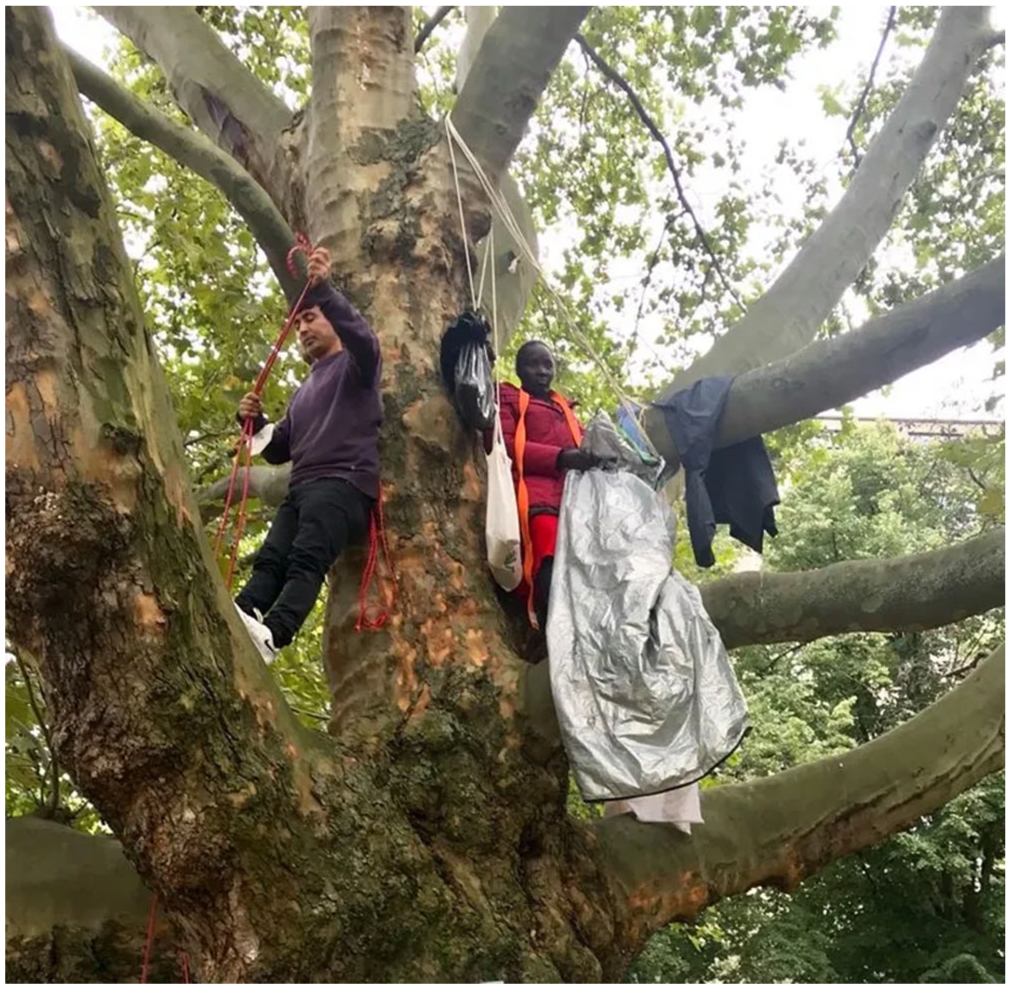
‘Drastic Measures: Refugees occupy a tree in Oranienplatz’. (Source: https://iwspace.de/2021/08/gefluchtete-besetzen-baum-auf-dem-oranienplatz/.)
This photograph, published on the IWS website in August 2021, shows two persons occupying a sycamore tree in Oranienplatz in the neighbourhood of Kreuzberg in Berlin, where about 35% of the residents have a ‘migration background’. 12 One of the two persons standing on its branches is activist Napuli Langa, who fled from Sudan, and occupied this very tree in 2014 to resist evacuation of the protest camp that had previously stood there. 13 The other person in the photograph is an Afghan activist whose name is not shared for their safety. Langa returned to occupy the tree to demonstrate the state’s denial of Afghan refugees’ right to stay in Germany in 2021, challenging the very idea of national borders (Schumacher, 2014). In this photograph, Langa embodies the memory of the former tree occupation action in which she protested the same state-led attack on asylum seekers. She observes the onlookers – including you and me – witnessing her on the sycamore. This marks the activists’ response to dispossession, together with their vulnerability and demand for recognition. It establishes a memory of precarity, disenfranchisement and resistance at the centre of Oranienplatz, the centre of Berlin (Landry, 2015). This act exemplifies Ansems de Vries’s (2016) claim that ‘practices of resistance are closely bound up with modes of governance’ (p. 890). Langa, alongside other activists and journalists reported on her occupation of the sycamore in various platforms such as the City Museum and in the Movement journal in 2015 (Langa, 2015).
In creating a public memory of the tree occupation by the same activists, in the same city square where they had demanded the right to stay and freedom of mobility for refugees and asylum seekers in 2014, IWS activists address the continued violence these groups suffer, which pushes them to choose drastic measures such as occupying a tree. This non-violent action demonstrates solidarity between different migrant-minority groups in enacting and protecting their and others’ right to stay in Germany, based on the Geneva Convention. In 2014, these actions succeeded in informing other residents of their rights, and in forming a community. In this self-described drastic measure of calling attention to their own invisibility, IWS re-signified displacement for passers-by as well as for those looking at the photograph. The photograph makes observable the permanent status of hanging between heaven and earth, and the horizons of possibilities delimited by unattainable citizenship (McNevin, 2020).
The IWS website says, The tree on Oranienplatz is symbolic of the refugee movement: In 2014, the activist Napuli Langa, who fled from Sudan, climbed the tree in protest about the evacuation of the protest camp that had previously been there [. . .] Only five days later, after the district had given an assurance that she would be allowed to rebuild an information tent, did the activist go down. (IWS, 2021a)
The spatial choices for protest, tree and tent are provisional for human habitation, reflecting the temporariness of the refugees’ condition and their conflict with the city that refuses to allow them to hold protest in a city and state that limit their mobility and their right to residence. In re-occupying the Sycamore, activists display the history of public space occupations by refugees in the same neighbourhood, thereby turning their predicament into a visibly shared public concern for all who witness the activists’ interventions.
By encouraging witnessing of the tree occupation, IWS becomes a counter-signatory of the state’s denial of migrants’ rights. It seeks to affect future memory by connecting present action to past atrocities and protest, specifically calling for an investigation of the case of a murdered woman, Rita Ojunge, who disappeared from a refugee shelter in Hohenleipisch in Brandenburg, and whose murder in 2019 was not fully investigated. IWS has worked with Women in Exile & Friends to demand for a search and expose the state’s refusal to pursue this case. It also commemorated the life lost in their repeated calls for investigation, which continued in 2024.
We will now observe the depiction of a tree, invoked in the MEU Festival website. Published on the Internet in 2021, the MEU Festival’s ‘About Us’ web page used the image of an olive tree growing in an arid landscape, and another picture of a courtyard desert oasis decorated with lushly green and trimmed trees and hedges arranged symmetrically around a fountain (Figures 2 and 3). 14 The images romanticize the Middle East either as fruit bearing, shade-affording nature or as a well-groomed oasis devoid of people, inviting a tamed gaze and obliterating signs of conflict, while showing its audience images of rootedness and livelihood from an area they know is a site of struggle. Anu initiators and MEU Festival curators, Hila Amit and Mati Shemoelof told me in interviews that these photographs had been chosen by German-background website designers of the main funding partner for the MEU Festival, led by the Berlin Literary Action, and that they had objected to the images the funders chose for the festival.
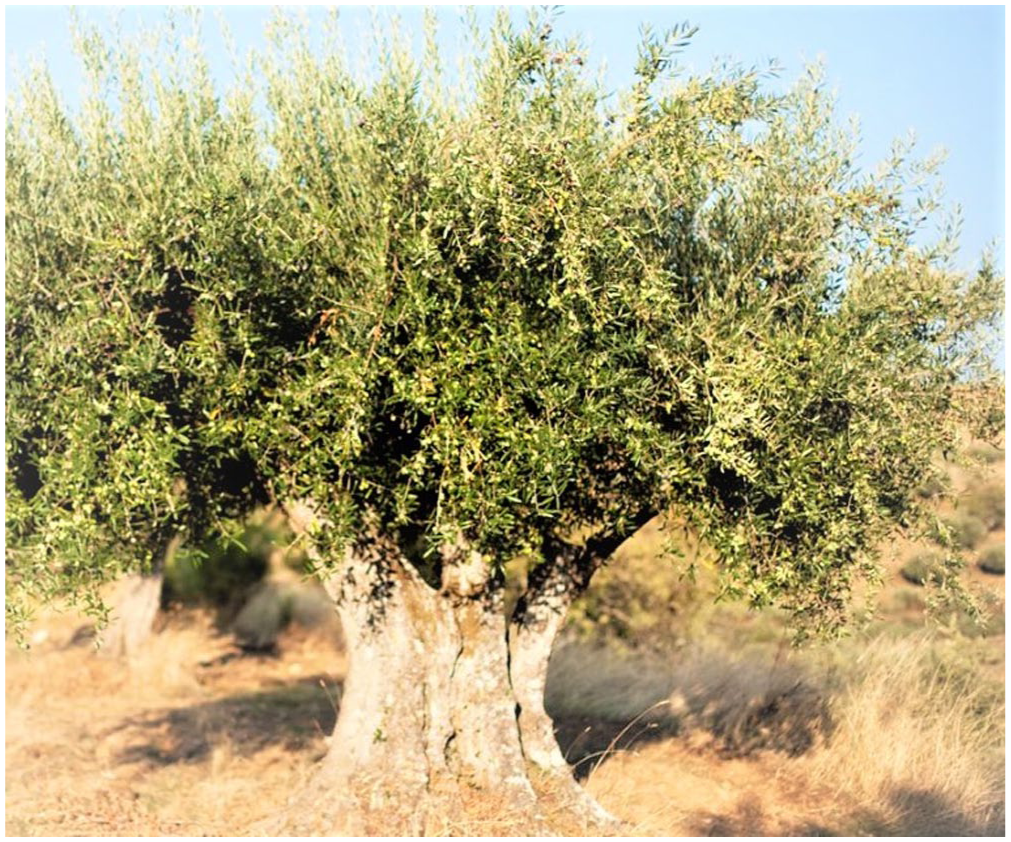
Middle East Union ‘About’ website image featuring olive tree. (Source: https://middle-east-union.de/en/aboutus/.) Private photograph of the berliner literarische aktion, showing Olive Tree in Greece.
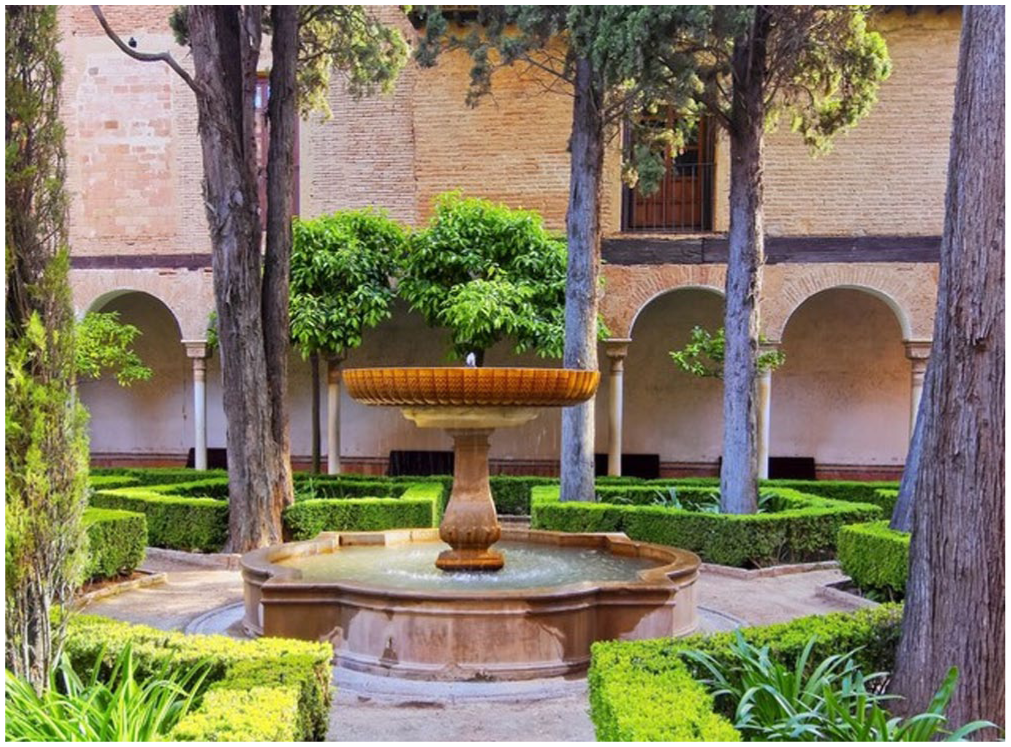
Middle East Union ‘About’ website image featuring water fountain. (Source: https://middle-east-union.de/en/aboutus/.) Private photograph of the berliner literarische aktion showing a fountain in Alhambra, Granada, Spain.
In their ‘about us’ introduction, Amit and Shemoelof, indirectly, critically engage the images as they invite the participants to imagine a Middle East, from Berlin, where actual people in their diversity, histories and conflicts are central and where their future can be newly imagined: Berlin is the perfect location to discuss the possibility of a Middle Eastern Union, especially because the city inhabits a contradiction. It is now a central crossroads for diasporic and exiled people from throughout the region. It is also, however, a centre of contemporary European hegemony – a former colonial power and a once fascist state that is now at the heart of the European Union. It is a European city that enables a Middle Eastern meeting point, and yet it is also part of a union that acts as a fortress with deadly borders. (The MEU, 2021)
MEU describes its positionality in Berlin as a diasporic site of emplacement. It sounds its voice, which does not emanate from the suggested gaze on the Middle East as a natural, tamed oasis empty of people. It responds to the legacies of authoritarianism and of imperial power which shapes EU borders as ‘Implicated Subjects’ (Rothberg, 2019). This concept offers a way in which to overcome the persistence of historical hierarchies between perpetrators, bystanders and victims in the collective memory of past injustices and their present manifestations. Refusing to align themselves with – or become complicit in – power relations that relegate migrant groups to society’s margins, MEU Festival participants reflected on their own entanglements in the systems of colonial and postcolonial domination that shaped the Middle East and, after the Holocaust, gave Jews a special status in Israel/Palestine, perpetuating conflicts between locals and migrants. However, in interviews with me, both Amit and Shemoelof shared that at the time of the MEU Festival, if was difficult for them – Israeli Jewish migrants – to co-lead cultural events with Palestinian activists and artists because of their historical positionalities in the Israel–Palestine conflict. The audience in the events was likewise visibly attentive to this complexity. For instance, they seemed moved and sometimes amused by the mention of a possible peace in the Middle East.
MEU Festival curators mobilize the position of the Implicated Subject to address the difficulty of forging meaningful cooperation between Israeli and Palestinian activists. On their website they write, Zionism and the establishment of Israel contributed to dismantling a fruitful cultural and spiritual dialogue. As new immigrants in the new Jewish state, Mizrahi Jews were requested to leave behind their ‘Arabnes’, and become part of the Zionist melting pot. With the loss of language, culture, names and shared past, the memory of a Jewish-Muslim dialogue was lost as well.
15
Focusing on the transcultural potential of their memory activism, they connect the diasporic emplacement in Berlin with the potential to remember a past both in Germany and in the Middle East that has been blurred by various national projects.
With this multi-perspectival memory activism, they also call to reimagine the potential of living together by connecting the Arab–Jewish diaspora and the Muslim minorities in Berlin. They write: Berlin offers a rare meeting point between Jews and Muslims [. . .] A diasporic space was created, a space for a dialogue that cannot take place today in the cities in the region these immigrants and refugees left. [. . .] From this unique standpoint, ‘Anu نحن אנו’ is reimagining possibilities for a different kind of poetic, one that reflects on a past of co-existence[. . .]The participants of Anu نحن אנו learn together about the joint past and the segregated present, and in doing so they symbolically break the walls and stereotypes separating Jews and Muslims.
16
Beginning in Berlin, the authors describe a process of relearning coexistence from the memory of a joint past, which could be understood as ‘nostalgic utopia’ (Bakshi, 2012: 11) from a present of segregation. This utopia is composed of what communities wish to remember about Jewish diasporas in Arab societies and Jews who migrated to Israel from Arab counties, combined with memories of divided Berlin and the Israeli–Palestinian conflict.
Witnessing in the space of appearance
In the activities of both Anu/MEU and the IWS, bearing witness to discrimination and acting are complementary processes. Speaking to a plural public in person and virtually, both groups challenge the majority society’s position that often involves a celebration of its own openness to ‘Others’, but rarely acknowledges the possibility of mobilizing political action to amend discrimination because of the diversity of actors’ cultural backgrounds.
Jennifer Kamau, co-founder of IWS spoke on 6 Oct 2020, in Oranienplatz about IWS activism (Kamau, 2020): being a part of the Oranienplatz movement was the biggest sense of belonging I felt at the time. Because the effect of the residency law is to keep you in limbo between the different offices that regulate and allow your stay. Walking in civil disobedience toward Oranienplatz showed us that we are continuing a fight that others have started, like the Turkish people, and the Vietnamese, and women in exile today.
Kamau’s story was recorded from Oranienplatz, a site that had brought disparate migrant activists together. She recalls earlier migrant struggles enacted there. IWS activists are aware that they are viewed in the German public sphere as outsiders. The IWS addressed the public by calling attention to the state’s abuse of the power, to its subjects’ life circumstances, and by calling on its audience to become witness–actors, in facing those conditions. Kamau and IWS create what Kacandes calls transcultural and transhistorical co-witnessing (Kacandes, 2017). Their testimonials are given in the actual space of Oranienplatz. They are also posted and archived online. Some make it into Berlin local news, which remains online, creating co-witnesses over and over. Notwithstanding the IWS power to make public the plight of refugees and asylum seekers, Kamau shares in an interview in July 2023, that the largest challenge the IWS faces is in sustaining support for their activism for non-citizens, whose life circumstances rarely improve by the public and academic interest in them. She points to the mobilization limitation of the space of appearance created by non-citizens, when it rarely serves as a measurable catalyst for policy change within a majority culture that excludes the activists and ignores their claims.
In the radio podcasts and in public events the IWS performs and invites co-witnessing, transcending the boundaries between observation and action (Wagner-Pacifici, 2005). IWS enacts hope in their public as well as migrant support activities (Rigney, 2018). It does so by creating a space for dialogue and truth. It additionally enacts hope as a coalition of members whose actions and spaces are sometimes visibly joyful, often include children, are supportive of each other and invite witnesses to practice a different gaze. Joy is an agentive, specific form of generative, aspirational politics. IWS’s interactions and their mediation activate what Tina Campt (2021) describes as a Black gaze that inspires other witnesses to join.
We will now analyse how Anu/MEU constitutes a space of appearance and attend to its challenges. The idyllic images of Middle Eastern oases that framed the MEU Festival’s ‘about us’ page with photographs of an Olive tree from Greece and a fountain from Spain, indexes a projection cast by majority society’s gaze on the Middle East as an oasis devoid of people. Only the participants’ writings and performance constitute a public space of appearance of a diasporic and transnational project in which global and local concerns for the lives of the actors create a shared public space as a tentative respite. Quoting sociologist Amro Ali in their Mondoweiss article about the MEU Festival, curators Amit and Shemoelof pointed to the possibility of actualizing this space in ‘migrant Berlin’: ‘Berlin is not just a city. It is a political laboratory that establishes a new kind of beginning’, wrote the researcher Amro Ali regarding the exiles from the Middle East who had to leave their homeland as a result of the ongoing protests and the accompanying state repression. But this sentence also applies to us – the Israelis who found the space here in migrant Berlin to create new shared visions, both artistically and politically. But can this creative process bring together people from all over the Middle East?
17
The state of diaspora brings together groups from different Middle Eastern societies, albeit from different positions – the Mizrachi Israeli Jewish authors do not consider their migration forced. However, they do connect their experiences with forced migrants where new diaspora communities (Werbner, 2002), such as Jews and Palestinians who left Israel and Palestine join ‘older’ ones: the Turkish, Afghan and Kurdish diaspora in a creative process anchored in the experience of migration. The Anu/MEU authors see diaspora as an opportunity for rearticulation (Kirshenblatt-Gimblett, 1994). Amit describes the quotidian choices and economic realities which enable urban social diversity: when asked ‘Why in Berlin’? Amit responded on 18 August 2021: we are here, we can afford to be here, we [. . .] communicate freely with each other. And we are not going back soon, so we can pose this question from here only, and it is the European powers who created the Middle Eastern borders the way they are, and also the European Union [. . .] We don’t need white men to explain to us the problems in the Middle East. (Goldman, 2021)
Amit describes unstaged, convivial encounters between Middle Eastern migrants in Berlin (Gidley et al., 2024). She invites her readers to witness the potential in such a space, where some of them also see themselves at home, to bring together various groups. Preparing for the staged MEU Festival, its curators remember imperial systems of dispossession which Arab–Jewish authors benefitted and suffered from. They make imaginable what Azoulay calls a potential history, in their case of the Middle East as a Union, enacted in Berlin (Azoulay, 2019: 8). Amit points to the illocutionary command, the sense of force in speech performances, that white men wield by using her locutionary agency to convey the message that MEU participants are aware of the naturalized power of white men to wield authority based on their privilege so that other voices are not as easily expressed and heard. Projecting a different voice and illocutionary command, those at the MEU Festival appeared in public together to prefigure a utopian solution to the Middle East’s many tensions and conflicts. The publications of the IWS (2018) make a similar claim in their book, We Exist, We Are Here: To exist, to be here –this is the act of defiance of all the women speaking in this book, who came to Germany against all odds. And their message is: in spite of the systems working against us, in spite of the everyday violence of living under patriarchy [..]racist attacks against us; we were, we are, and we will be here.
The practice of being-here actualizes plural publics who appear in Berlin.
Author and curator Martin Jankowski, the Festival Project Director (born and socialized in East Germany), opened the festival in German. The text he read
18
was projected simultaneously in English on a screen. He began with the words: Berlin has been a place of refuge for centuries, especially for artists and intellectuals’ [. . .] ‘Today, together with all our languages and hopes, we stand on the ruins of these multilingual tragedies of our city and try to add new, happier chapters.
Jankowski’s speech began in the present perfect continuous, describing Berlin as a place of refuge; then he recalled the present moment spatial–temporally ‘as ruins of multilingual tragedies’. In his words, multilingualism seems to be one of the causes of tragedy, as well as a source of hope. He framed the festival goal as a hope for ‘a happier’ future chapter in the story of Berlin.
Presented in English, and available onsite and on the website in English, German, Arabic and Hebrew, the Middle East Union declaration opened with the words: ‘We declare the establishment of the Middle East Union within the framework of humane, economic and social thought and practice, uniting the countries of the Middle East, North Africa as well as Turkey and Iran’. Mati Shemoelof spoke in the closing ceremony of the MEU Festival, to about 40 participants: You are in a historic time: today, we declare the Middle East Union. Do’,t laugh! When your grandchild, queer, or straight, binary or non-binary will ask you, where have you been when they declared the Middle East Union, you will say ‘here, with the’,. I will tell you in a few words: it is a feminist union, it is a queer union, it is a social justice union. It is a union with freedom and liberty, that people will try to enter, not fall and drown in trying to leave or come in. I would ask you to sign it. Because you are in a historic moment, because historical moments have documents and documents need signatures. Don’t laugh, it is like the declaration of independence.
In the event, Shemoelof invited the participants to sign the actual document and signed it himself, invoking Zionist rhetoric. The camera streaming the event showed that for long minutes participants signed their names. In addressing the historic moment juxtaposed with ‘don’t laugh’, Shemoelof referred to the parody of imagining an open and peaceful Middle Eastern Union during the MEU Festival of August 2021. Furthermore, asking the audience not to laugh was both an injunction (don’t dismiss our union) and a gesture of potential pleasure or joy. Shemoelof cited a poem he published in 2018 in his first German-Hebrew collection of poetry Bagdad, Haifa Berlin (Shemoelof, 2019), titled Thinking of Israel: Thinking of Israel/ I want to have a Middle Eastern Union –the ‘ME’. //Like the European Union. /Is it a lot to ask? /Israel why do you laugh at me? /I am a dreamer and you already know that Reality is made of dreams//.
By acknowledging the cynicism in Israel towards dreamers who wish for a peaceful, multiethnic ‘Middle East Union . . . like the European Union’, Shemoelof alludes to the medieval Sephardic poem, Zion, Won’t You Ask by poet and philosopher Yehuda Halevi. Charting out a lineage of dreams running from the medieval Sephardic diaspora’s yearning for Zion and his own dreams of a Middle Eastern Union, the protagonist reminds his interlocutor, ‘Israel’ that it, too, had made reality out of dreams. As Shemoelof foresaw, those in attendance at the closing ceremony did laugh. Perhaps out of discomfort or unease, or since they understood the irony.
Shemoelof called on the audience to imagine a future beyond the historical impasse and irony of a Middle Eastern Union in Berlin and be witnesses to the momentous historic event of declaring and ratifying that union. Addressing his virtual and in-person audiences as individuals who may laugh at the declaration and as co-signatories who will soon ratify it, Shemoelof worked to constitute them as witnesses to the making of post-national history. In a playful parody of Zionist rhetoric and practice, he invited the audience to recognize the dream both by laughing with and suspending judgement about it. Co-authoring the declaration into an embodied reality ‘here, with them’, a multiethnic public arose that would defy the hermeneutics of suspicion in Berlin, and wherever else it is experienced at the time of the event and afterwards, virtually.
Concluding remarks
The article discussed the memory activism of IWS and Anu/MEU as they enacted a space of appearance and witnessing platforms designed to elicit public reflection on the status of refugees, migrants and Muslim–Jewish relations. These urban activists’ appearance as speaking subjects in Berlin public spaces was facilitated by their ability to carve out a metropolitan diasporic space of appearance where migrant residents speak and publish in the languages of their collective repertoire, and as such garner visibility in the daily media of the host society. Constituting these spaces of appearance as spaces of plurality, which continually take place in the city through in-person and hybrid demonstrations, conferences, publications and literary events, the two groups created political intervention and invited witnesses to observe and share their experiences, and to imagine a more democratic future for all.
If the MEU Festival curators worked to resignify the present by organizing an event that will affect the future, IWS activists record violations of state and international law and instances of violence towards refugee women. IWS empowers the marginalized and suppressed voices of women who suffer from oppressive policies, adding much needed perspectives to the witnessing platforms they created. Both groups uncover a present full of ruptures which are made visible to new witnesses in their spaces of appearance. The majority German society does not recognize the migrants’ experience; it rather works to obfuscate the historical connections between modes of domination against women, people of colour and migrants. The witnessing platforms both groups created made this obfuscation apparent while enacting and training a different, more inclusive gaze.
In their activation of the space of appearance, both groups extend an invitation to think whether there is in fact no peaceful, taken-for-granted ‘place’ for them within the current norms and structures of German belonging. The articulation of their various positions in public space criticizes the differential access to rights enjoyed by German citizens, non-citizens legally residing in Germany and refugees seeking the right to remain. As we saw, IWS practices interruption such as occupation of a deserted school building or a tree; bus tours to refugee receiving camps, which interfered in the everyday routines of residents for whom the refugee camp and its connections to German migration policies remain invisible. Such interventions created witnessing platforms for various groups and a horizon of civic action for non-citizens, together with citizens. Future studies of non-citizens memory activist groups can analyse the intermedial impact of in-person and virtual interventions, to advance understanding of virtual spaces of appearance and witnessing.
The special attention to the city as a metropolis that is shared by IWS and Anu/MEU stretches the horizon of civic action further by returning the gaze on Europe, sometimes with a wink: is Berlin, is Germany, is Europe an oasis? Is the Middle East a desert? Are journeys to and from Europe one-way paths? Or can we imagine civic life differently? Such questions are further complicated through the various interventions made by Anu/MEU and IWS, who motivated and articulated civic life in Berlin as they offered an honest account of the possibilities and perils experienced by the city’s others.
Footnotes
Acknowledgements
I thank Tamar Katriel for her helpful comments on this article; my colleagues at Indiana University Sara Friedman and Jayanth Krishnan for their invaluable suggestions on an early draft of this article; The Washington and Lee University School of Law, and the Mandel Center for the Humanities at Brandeis University, for inviting me to present this work in 2025 and for their suggestions. Many thanks to the anonymous reviewers for their valuable feedback on this article.

Funding
The author disclosed receipt of the following financial support for the research, authorship and/or publication of this article: This research article was generously supported by Indiana University Bloomington Institute for Advanced Study.
Declaration of conflicting interests
The author declared no potential conflicts of interest with respect to the research, authorship and/or publication of this article.