







Abstract
The article presents “imagined conversations” as a method of narrative research presentation of a slow change in an institutional context, developed while researching academic censorship and publishing in the state-socialist Czech Republic and Hungary. The aim was, first, to capture the gradual transformation of institutions, the people in them, and the textual work they produced under politically restrictive conditions. Second, it was to allow the interviewees, researchers active in state academic institutions between 1969 and 1989, maximum space to represent themselves, while at the same time preserve the polyphony and contradictions present in the interviews due to the politically, emotionally, and ethically sensitive nature of the topic. The dramatized dialogues, created with the application of constructivist grounded theory and narratology, are “imagined” in the sense of being constructed from one-to-one interviews and that the resulting collective biography foregrounded the sense of a shared community (cf. Benedict Anderson’s “imagined communities”).
Keywords
Introduction
The term “post-academic writing” (Badley, 2019) has recently been applied to efforts to “‘carry on’ but differently” (p. 188) with regard to the form of research writing. It refers to the various experimentations with representing research data that have gained in popularity in recent decades in the context of opening scholarship to new ways of knowing in, among others, ethnography and anthropology (e.g. Rapport, 1987), sociology (e.g. Richardson, 2003), and narrative research (Bold, 2012). All these and also the more recent genre of social research novel (e.g. Leavy, 2019) inspired the creation of “imagined conversations”, a method of research writing I will describe in this article and discuss it as a contribution to “slow memory” (Wüstenberg, 2023) methodology that allows to represent a slow change in institutional processes.
I developed the method during a project on late state-socialist academic censorship (Oates-Indruchová, 2020), in which I used oral interviews to compensate for a lack of archival material on censoring practices during Czech “normalization”, as the period between 1969 and 1989 came to be known. In the writing-up phase, issues arose with representing the interview material in the conventional way, that is, by developing an argument from the interpretation of interview passages in the context of extant research and theory. The difficulties had to do with ethics of representation, the researcher’s positionality, and even with representing the complexity of the interview content. To resolve them, I drew on feminist methodologies and literary theory and presented the interview data as dramatized dialogues. The resulting “imagined conversations” reference Benedict Anderson’s “imagined communities” and the “horizontal comradeship” (Anderson, 1991: 6) of their members, because similarly to members of a nation, the scholarly narrators of my research shared the culture and the confines of late state-socialist academia.
First, some historical context: the communist regime that came to power in Czechoslovakia in 1948 began to reform itself from within in the early to mid-1960s. A progressive wing formed within the Communist Party and began to assert itself in early 1968 in the process now known as the Prague Spring. The process ended violently by a military invasion of five armies of the Warsaw Pact led by the Soviet Union. Within a year, a new, conservative regime was put in place, the reformers and their sympathizers were purged out of state institutions, whether political, educational, or cultural. The reform period was now referred to in terms of a crisis in society, while “normalization” settled as the label for the anti-reformist regime and the whole period until the demise of the communist regime in 1989. In Hungary, the reform process started earlier as a process of destalinization, culminated in the revolution of 1956, and was, likewise, suppressed by Soviet tanks. The level of state physical violence and punitive measures was far harsher in Hungary than in Czechoslovakia. A political relaxation came in 1963 after a far-reaching amnesty for those involved in the 1956 revolution, although a certain ideological tightening came after the events in Czechoslovakia.
I chose to research censorship in the period after 1968, because neither country had an official censoring body during that whole time and censorship was, therefore, “dispersed” (Burt, 1998) through phases of the creative process and institutional elements. From among the various areas of censorship, I chose censorship in academic publishing, specifically humanities and social sciences, for two reasons: publication of research results was expressly not within the remit of the so-called “press law” that regulated the content of media and publishing in post-1968 Czechoslovakia 1 and scholarly disciplines were designated as belonging to the “ideological sphere” and, therefore, brought under closer political surveillance (Oates-Indruchová, 2020: 1). The research aimed to study the Czech part of Czechoslovakia, because Slovakia, with its cultural and some political differences would have been a separate case. Later, however, a contrasting case became necessary to saturate some of the theoretical categories that had emerged from the Czech study but were not explainable from within the Czech environment. Hungary presented such a case, as a country that also did not exercise censorship through a central institution, but had a different political history, which affected the organization of academic institutions.
Method and sample of the research on censorship
The core of the research consisted of 20 semi-structured interviews with Czech academics and 8 semi-structured interviews with Hungarian researchers, each interview lasting around 1–2 hours. The narrators were historians, literary scholars and linguists, philosophers, sociologists and social scientists, and also two editors from Czech social science publishing houses. The Czech interviews took place in 2002–2003, the Hungarian in 2009. The interview guide included groups of questions on personal professional trajectory, the publishing process and hurdles on the way to publication, self-censorship, Aesopian language or writing in “code”, and reflections on and the reception of the narrators’ work after 1989. All those interviewed were active in academic research and/or university education in the period between 1968 and 1989. They were all senior academics enjoying respect from their peers also for the work they did during state socialism at the time of the interview. The latter criterion was key in order to avoid the Communist Party apparatchiks and include those whose loyalty was primarily with their disciplines, making it necessary for them to navigate the institutional quicksand to get their ideas published. I did not seek interviews with scholars publishing outside of the state publishing houses, in the uncensored underground, or samizdat, publications, although some of the narrators may have moved to these spheres toward the end of the period or published in both simultaneously, often under different names. Complementary sources included science policy documents and propaganda articles collected by the Radio Free Europe/Radio Liberty Research Institute and held in the Open Society Archives in Budapest and the holdings on the Editorial Board of the Czechoslovak Academy of Sciences in the Archives of the Czech Academy of Sciences in Prague. In data analysis, I followed the process of constructivist grounded theory method (Charmaz, 2006), to which I will return in more detail below in the section “Imagined conversations”, with the aim to build a theory of state-socialist censorship.
Theoretical framing to resolve difficulties with conventional research writing
The first few attempts to portray the narrators’ experience with the institutional context of state-socialist academic publishing ended up in failure. Every interpretation always seemed partial, not doing justice to the narrator or to the subject. No matter how long a quotation I chose to present in the text, how detailed its interpretation and how well-supported theoretically and by existing research, it never seemed enough and it sounded false. The failed attempts were accompanied by a sense of ethical discomfort. If I was to offer a flowing argument on the subject of censorship, any methodological reflections on the interview situation and on the positioning of both interview partners would have to come either somewhere in the introduction or conclusion, in a separate chapter, in footnotes, or in a follow-up publication. Moreover, the interviews were riddled with contradictions: between narrators from different disciplines, different generations, and often also within the same interview. Whenever I wrote down an interpretation of one utterance, others began to assert themselves over it. If I turned my attention to these other voices afterwards, it suppressed the possible simultaneity of their existence in one moment and situation in the past. Often, I found myself empathetic with the emotional charge of my narrators’ memories, but sometimes at odds with their moral stance. It was not always clear to whom the narrators spoke: to a colleague, a junior researcher, a young woman, or to someone with whom they at least partially shared a historical moment or about whom they supposed was going to judge their past actions in a world of which she had no experience? Why did they talk to me at all? Out of a researcher’s sense of commitment to the preservation of knowledge, gratitude to be given the opportunity to share their experiences and have them validated at the time when knowledge produced during state socialism was being discredited and delegitimized, or a desire to justify themselves and be understood? All this was part of the researched problem and of the research process itself but was being pushed into the background in the conventional form of reporting on a piece of research, in which every interview extract would become subject to the author’s interpretative assessment, textually separated from the agreements, elaborations, corrections, or disagreements voiced by other members of that specific community of interviewees. This added to my ethical discomfort, for although as researchers we are trained to be able to handle contradictions in our research material, we are to examine them in one voice, methodologically speaking. It is now acceptable, even required, in academic writing to spend some time explaining one’s positionality and reflect on its limitations, but then a clear argument without diversions into one’s shifting or multiple positions is still expected.
How to disrupt the authority of my single interpretative voice and delegate it to the voices of the other interviewees and at the same time to keep visible the power that I as the author inevitably hold over the final shape of the text? Feminist methodologies and literary theory offered a methodological approach and a key to a form of writing that would alleviate the ethical difficulties and would preserve the polyphonic quality of the interview material.
Feminist methodologies
Feminist methodologists have examined issues of power and privilege in the research process since at least the 1980s (for a recent comprehensive account see Sprague, 2016). This led them necessarily to questions of research ethics, ethics of representation, and the imperative of reflexivity on the positioning of the researcher. It then stands to reason that feminist methodology has greatly influenced qualitative research in social sciences—although this is not always acknowledged by authors in methods sections of their publications. Feminist methodologies pursue, among others, the principles of making visible the lives and experience of women; reflexivity of structures and assumptions underlying the research and its categories, including relations of power and privilege; ethics of research; and legitimization of the subjective and the emotional as important parts of women’s experience and also of research ethics (see, for example, DeVault, 1996; Fonow and Cook, 1991; McCorkel and Myers, 2003; Reinharz, 1992). Following these principles, I aimed at developing such a form of representation that would bring forward the lives and experiences of the narrators and maximize the space for their own representation, instead of speaking for and about them. At the same time, this form needed to extend the ethical principles to the representation of the research process, in order to make the reader aware of the shaping hand of the author. It needed to make visible the relationship of power that exists in any research situation and the privilege the researcher enjoys no matter how much voice in her text she grants the narrators, because: The “account” cannot be objective. It is a political product, its construction comprising a set of explicitly ideological moves. To put it briefly, representations are interpretations. They can never be pure mirror images. Rather, they employ a whole set of selective devices, such as highlighting, editing, cutting, transcribing and inflecting. [. . .] And even then [when the narrators are “let to speak out”], recorded speech goes through a number of transformations before it reaches its readers. (McRobbie, 1982: 51, emphasis in the original)
In other words, the production of knowledge is always “situated” (Haraway, 1988) in the subjective choices the researcher makes and in the social positioning of both the researcher and her communication partners.
Literary theory
If feminist methodology guided the overall approach to writing about academic censorship under state socialism, literary theory supplied the guidance on the form and structure of the resulting text. Working with any qualitative material, but particularly with interviews, can hardly ever be limited only to describing institutional structures and processes, it almost always includes also descriptions and interpretations of the processes of meaning-making in a community. This gives rise to another set of considerations, because: Social life is messy, uncertain and emotional. If our desire is to research social life, then we must embrace a research method that, to the best of its/our ability, acknowledges and accommodates mess and chaos, uncertainty and emotion. (Adams et al., 2015: 9; original emphasis)
I needed a textual form that would allow the preservation of the layers of meaning with all their social, professional, and emotional complexities and contradictions. It was feminist methodologists, Wanda Pillow and Cris Mayo (2012), who pointed out that “[i]f an author or researcher simply pours data into an existing analytical or writing format, the work feels artificial, forced, and lacking in impact” (p. 199). If I wanted to increase the contextualization of my interpretations within the power structures of a research situation and to present the interview process as “structured encounters organized around ‘telling about experience’” (DeVault and Gross, 2012: 209), I needed to foreground the fictional elements of research writing. Laurel Richardson (2003), a pioneer of imaginative forms of research writing, draws a parallel between research writing and fiction: In the routine work of the interviewer, the interview is tape-recorded, transcribed as prose, and then cut, pasted, edited, trimmed, smoothed, and snipped, just as if it were a literary text—which it is, albeit usually without explicit acknowledgment or recognition as such by the researcher. [. . .] The use of standard writing conventions, including the use of prose, conceals the handprint of the researcher who produced the written text. (p. 188)
The “handprint” is nothing other than the unreflected acts of interpretation by representational conventions that Angela McRobbie (1982) spoke about above.
Another literary parallel is built into the grounded theory method that I was using to analyze the data. The Finnish sociologist Pertti Alasuutari (1995) distinguishes two phases in the handling of qualitative data: the goal of the first is to construct a typology of an issue (the “what” of a problem), the purpose of the second is to “unriddle” the typology (the “why” of a problem) (Alasuutari, 1995: 13–18, 133–134). This process is very similar to the process of literary interpretation, such as, in the reader’s formulation of ideas about a character in a narrative text: during the reading process, the reader forms theories about the character and adjusts them as more information is revealed and the character’s actions are contrasted with the actions and reports by other characters (Rimmon-Kenan, 1983: 36–40).
This affinity provided a crucial impulse to presenting the interview material as dramatized fictional dialogues before I proceeded with their analysis and built the theory of state-socialist censorship from them.
Slow memory and slow remembering
In research on state socialism, Czech normalization is often treated as a static, uneventful period, even though that could have hardly been the case, if the period ended up in a “carnival of revolutions” (Kenney, 2002) across the Eastern Bloc. I propose to approach it as a period of “slow-moving change” instead and consider it through the lens of the “slow memory” paradigm that “seeks to address ‘uneventful’ transformations”, in the formulation by Jenny Wüstenberg (2023: 63), although the change in this case is definitely “faster” than the ecological change discussed by her. Wüstenberg (2023) postulates that “slow memory practices hope to achieve, instead of replicating fast rituals, [. . .] making the non-eventful past knowable in new (or more often actually old) ways” (Wüstenberg, 2023: 64). Looking at the lives of researchers active during state socialism, I wanted to present them as “whole persons” 2 whose working lives were developing gradually as their institutional environment was changing in small and from the outside perhaps imperceptible shifts.
Joanna Wawrzyniak (2024) lists the key methodological aims of slow memory: “to uncover the multiple mnemonic constructions of events, to turn mnemonic events into mnemonic processes, and to pay attention to marginal, everyday, disturbing” (Wawrzyniak, 2024). Katarína Bešková approached literary fiction on the 2011 Egyptian revolution with a concept of “slow remembrance”, proposing that the literature “encourages slow remembrance through its resistance to straightforward interpretation of the past” (Bešková, 2025: 12). What I propose here is to extend this methodology and concept to the method of research writing, in order to simulate the slowness of change on the page as a reading practice of slow remembering. I prefer to use the gerund to emphasize the processual “work” in which the reader engages when reading the account of my research, to which I gave a format borrowed from literary fiction for a reason similar to Bešková’s. The ambition is to capture the atmosphere, in which habit and weariness, rather than acts of violent repression, may have seeped into and undermined resistance, diminished creativity, gradually eroded values and powers of discrimination, and blunted critical edge, while social change crept into the conditions and relations of scholarly work, enabling evasions of ideological pressure and creation of alternative spaces for intellectual discussion in late state socialism. 3
A similar argument has been made in feminist work on the history of textile-making: knitting or embroidering meant remembering someone or something stitch by stitch as a practice of active remembering, healing, understanding, honoring, or dealing with a trauma (e.g. Hunter, 2019; Kargól, 2022). Likewise, I set to develop a method of representing the interview material that would engage the reader in a practice of remembering word by word, as it engaged me, the researcher, once I became familiar with it and developed “theoretical sensitivity” (Glaser, 1978, referred to in Charmaz, 2006: 7 and passim) in interpretating it. Another feminist scholar, Rachelle Chadwick (2024), refers to Virginia Wolf’s essay “How Should One Read a Book?” from 1926 and reminds us that: [R]eading, an activity that is intimately close to the practice of critique, is not a singular, coherent or unidirectional process but involves multiple possible activities and relationalities, e.g. immersion, receptivity, listening, empathy, judgement and evaluation. [. . .] At first, the reader must be receptive and open; they must not play the judge but instead immerse themselves in the other’s perspective (the writer, the protagonist). Judgements must be postponed and avoided. (pp. 379–380)
She then draws on the work of Rosalyn Diprose and Audre Lorde to introduce the concept of “epistemic generosity” in the exercise of feminist critique, which “[a]s a stance of open receptivity, [. . .] is associated with waiting, slowness and listening, rather than pursuit, suspicion, vigilance and self-affirmation” (Chadwick, 2024: 376; emphasis added). She proceeds to explain that it involves a certain evacuation of self (as far as this is possible). One has to be willing to let go of one’s own concepts and truths (even if temporarily) to listen and learn. [. . .] This kind of generous orientation does not necessarily mean accepting, condoning or agreeing with everything that the other says or believes; it does however mean being willing to listen, critically reflect and reassess; it means being teachable and open to thinking differently. (Chadwick, 2024: 386)
I approached my research subject—academic censorship under state socialism—by default with a set of expectations and preconceptions adopted through my training and by my personal positioning. It became clear in the first few interviews that if I were to find conceptually new knowledge, rather than add to the existing stock of memoirs and accounts of institutional repression of creative thought, I had to “evacuate myself” of my preconceptions, open my ears and mind, allow my narrators to educate me, and accept that whatever they said was “true” factually or emotionally. I had to learn to suspend judgment and categorizations.
The challenge came in the writing phase in mediating this change of perspective to my reader. I was writing my book in and for an environment that also held similar—or stronger—preconceptions about knowledge production during state socialism, if the media and a good part of existing published research were to be believed. It was an ethical and communicative imperative to find a form of research writing that would invite and allow also my reader to exercise epistemic generosity.
Imagined conversations: constructing the “primary text”
Bearing in mind that every transcription is already an interpretation, I aimed at as accurate a transcription as possible, but not as detailed as it would be necessary, for example, for some linguistic analytical methods. All spoken words, including fillers (“Hmm.”) were transcribed, paralinguistic features (“laughter”) were recorded and interruptions, silences, and unclear wording due to sound quality marked. I coded the transcripts manually following the standard grounded theory approach: first open coding, then axial coding. The open coding of the transcribed interviews yielded 119 codes, following Barney Glaser’s (1978) recommendation to use gerunds whenever possible to foreground processes of meaning-making (Charmaz, 2006: 136) and thus aid the subsequent grounded theory building. I proceeded with axial coding to group the data fragments “into components of an organizing scheme” (Charmaz, 2006: 61) and ended up with four large codes, which then could be raised into categories, and their subgroups: institutions, text, author and language, and a smaller fifth category “assessment of the past”. Alasuutari’s (1995) two-phase analysis—creating the typology of the researched problem and “unriddling it” (pp. 13–18, 133–134)—guided the next and crucial step in developing my form of research writing: I would compose the typology from the coded and sorted extracts first and conduct the unriddling, the interpretation of the typology in the published text, afterwards.
This two-part structure corresponded to what literary studies call “primary” and “secondary” text, the fictional text, and its critique and interpretation. At the same time, it reflected the decision I made early in the interviewing process regarding my subject position as an interviewer. I realized during the pilot interviews that if I asked my questions from a seemingly informed, peer position, the narrators left a lot unsaid with the subtext of “you know what I mean”. They stimulated, even demanded, the Bakhtinian “active understanding”, their “historically determinate utterances [. . .] always oriented towards and shaped by an anticipated response” (Shepherd, 1989: 92). I thought I knew what that response ought to be and what the speakers meant, but that left my data thin, I needed to have this “shared knowledge” verbalized by the narrators themselves. Obtaining that meant an active surrender of my peer status, disempowering myself as a researcher, and allowing the informants to instruct and enlighten me. This carried discomforting implications for a young female researcher who wanted to be taken seriously by her narrators, all of them more senior than herself and half of them male, but it was necessary. Apart from aiding in generating responses rich in detailed descriptions of procedures and meaning-making, this approach allowed me to reinforce the literary component of the analysis and at the same time to contribute to the visibility of the research process—I would write myself in as a character in a story.
The work on the novel of initiation by the Czech writer and literary theorist Daniela Hodrová (1993) provided inspiration for the manner of presenting the character: as a novice in a quest narrative. The novice would be guided by the narrators as her mentors. That way, the resulting text structure would take the readers gradually through the “realms” of the researched problem (i.e. stages, barriers, and hoops of the publishing process in state-socialist institutions), corresponding to the five categories of institutions, text, author, language, and assessment of the past; encourage the readers to “evacuate” their selves of their “concepts and truths [. . .] to listen and learn” (Chadwick, 2024: 386); and to postpone judgment until the “unriddling” part.
Once coded segments were marked throughout all the interview transcripts; they had to be arranged into the typology needed for building a grounded theory—all the segments sorted by the 119 open codes and the five axial categories. Up to this point, I followed the standard method. However, to present the typology to the reader, I had to develop a set of rules for turning it into a readable form, the actual “primary text”. From another perspective, I intended to present the whole typology, which usually stays unpublished and is only described, but not shown, in published findings of a piece of research using the grounded theory method, to my reader.
If the narrators were to be given substantial space to represent themselves and given that the coded segments all consisted of direct speech, dialogue was the most suitable narrative form of presentation. At the same time, my own verbal interventions were to be minimal, while making visible the researcher’s privilege to shape the text. Figure 1 shows an example of the construction of the dialogue from a sequence of coded segments.
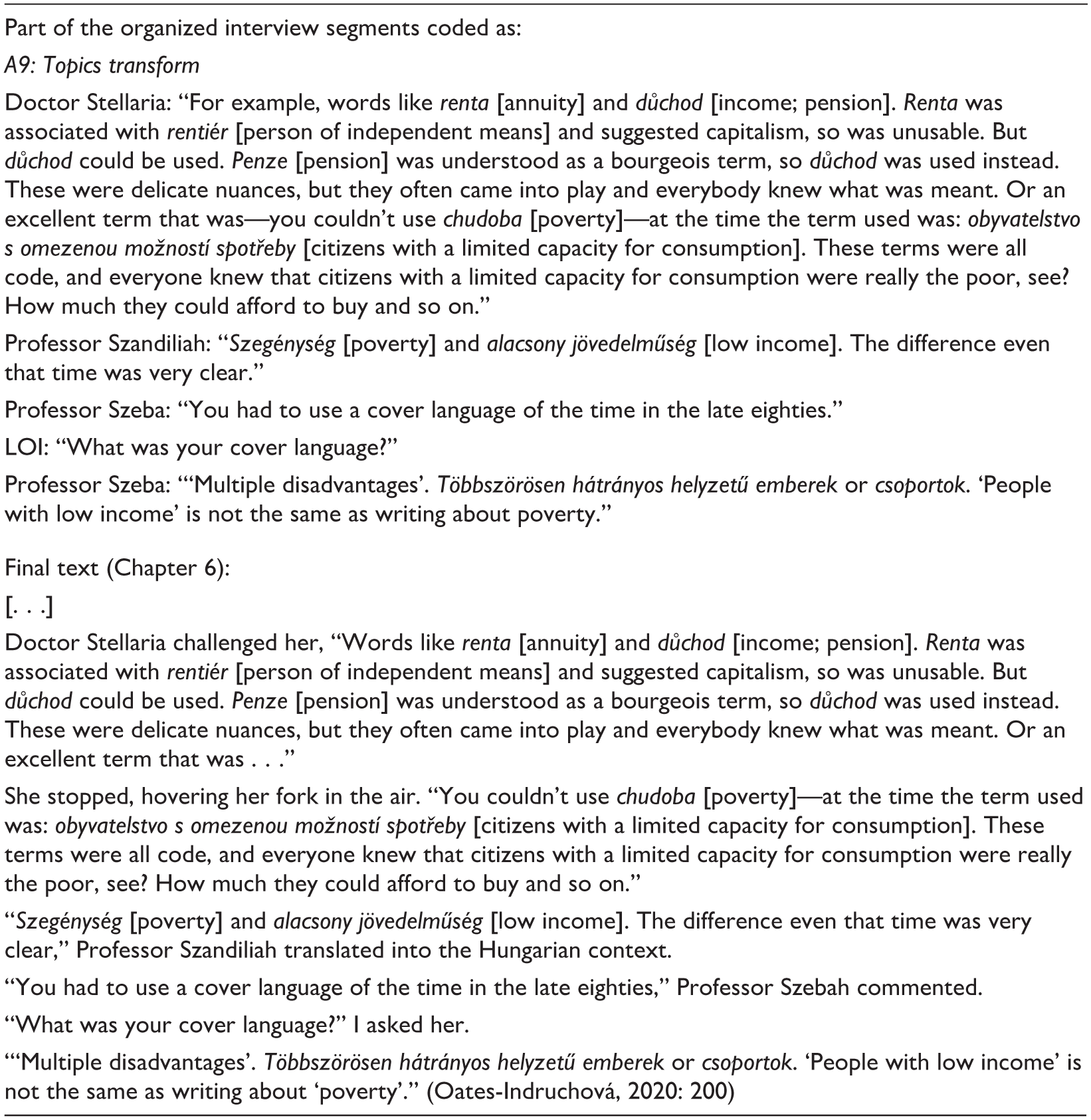
The construction of an “imagined conversation”. Translation of Doctor Stellaria’s utterance David Short.
It was hardly possible to publish all coded segments, which amounted to several hundred pages of transcripts. Hence, I set the main criterion for creating the dialogues so as to include all information once and only once, that is, keeping only one segment per piece of information and excluding all “repeats”. This is consistent with the meaning of “typology” according to Alasuutari: the researcher needs to reduce the amount of data, while keeping all parts of the studied problem together. I then reviewed the division of the codes within each group into sub-categories, and the order in which they were to be presented. For example, the material on the institutional environment clearly separated into the strategies institutions adopted toward their researchers and the strategies the researchers adopted toward their institutional surroundings. The latter fell into three further sub-categories: “surviving (personally as professionals)”, “continuing and surviving”, and “continuing and developing”. The final stage of organizing the transcript segments consisted in ordering them within their sub-categories into sequences with a potential to tell a story: moving from an introduction of an issue, through complications to a closure. This sequential rearranging of interview data would have been happening also in conventional research writing, in which interview segments would be selected for the development of the author’s argument. The difference here is that after the initial exclusion of the “repeats” all of the material is presented in a sequence. This allows the readers to develop the argument—slowly as they read—themselves from the juxtaposition of the full scope of the narrators’ views on any given issue, rather than being given the interpretation immediately by the author.
The other criteria concerned editing and stringing the segments into dialogues. It goes without saying that editing decisions were the most delicate ones. They were to be limited to matters of syntax, shortening the length of segments and anonymization. For example, the English translation of the raw Czech transcript of the first two sentences from Figure 1 would read something like this: “So, for example, the word renta [annuity], that is to say, důchod [income; pension]. Renta, the word was associated with rentiér [person of independent means], that is, with capitalism, was unusable, right?” The main criterion in editing was the balance between respect for the speaker as an educated person of senior academic rank and respect for the reader: most of us add filler words here and there or insert off-topic diversions into our sentences. It is always a subjective decision, although guided by theoretical sensitivity, when such words and little phrases need to stay and when they can be cut without changing the speaker’s meaning. The same goes for the interviewer’s indications of active listening (“Aha”, “Yes”). While important in the interview situation and in certain types of data analysis, in this research writing these would not bring any knowledge gain, only noticeable disruption of the reading flow. If, however, the interviewer’s interjections were requests for more supplementary information, they had to stay, because the order in which that information was communicated was part of the knowledge gain. I observed the same criteria of balancing the respect and knowledge gain when cutting the length of an utterance. Namely, whether the cut had to be marked in the final text as an ellipsis ([. . .]) or a new dialogue item, or if it was possible to make it a continuous text. I am sure that the result is not perfect, but I did not make any one such decision without careful consideration for the context of the utterance. Equally, the treatment of silences and unfinished sentences is always a highly sensitive matter ethically and with regard to interpretation. I had to make decisions when a short break in the flow of speech could be edited out and when it needed to be marked by turning it into a break in conversation, such as the paragraph break in Figure 1 : “‘Or an excellent term that was . . .’/ She stopped, hovering her fork in the air. ‘You couldn’t use chudoba [poverty]’.” The new paragraph and the inserted descriptive phrase indicate that the speaker interrupted her sentence to provide an explanatory context to the listener. 4
Gayatri Chakravorty Spivak (2012) reminds us that “translation is the most intimate act of reading” (p. 315) and “[r]hetoric must work in the silence between and around words in order to see what works and how much” (p. 314). Therefore, I had to approach all utterances with sensitivity to the significance of individual words, limit changes to a minimum, and not alter any subtleties of meaning, while retaining the information. Writing the text in English, rather than in the original Czech presented a certain advantage to the translator, David Short, in terms of word-choice and syntax, but we worked closely together, so as to remain as close to the originals as possible.
Anonymization in this project was particularly difficult, because it extended not only to the names of the communication partners, but also to their institutions and authored works. In the many conversations I have had over the years about the project with colleagues from various disciplines, the historians typically insisted that in the interest of precision, I should use the real names of the interviewees. I disagreed and maintained the anonymity of my narrators on both ethical and conceptual grounds. The aim of this work was to grasp a theoretical problem—how scholarly communication worked in a particular politically constraining environment and to develop a theory of state-socialist academic censorship—rather than to supply historical detail. Leaving the real names of the narrators and the places and people mentioned by them in the text would draw the attention of the readers away from the aim of the argument. That would hold especially true for the Czech readers eager to put the puzzle pieces together into a tableau of people they knew or knew about. Whenever possible, I replaced concrete with generic names, such as “a research institute of the Academy of Sciences” or “an applied research institute.”
For the narrators, I developed a system of nicknames that allowed the preservation of individualities of each “character” and their “demographic” identification by sex, academic rank, generation, discipline, and country (Czech Republic or Hungary). I tested several possibilities and settled on the combination of the real-life rank of the narrator at the time of the interview and a surname inspired by Latin botanical names for the Czech “characters” and Dacian plant names for the Hungarians. 5 The choice of two dead languages and the scientific vocabulary seemed the best fit for the subject matter and for the creation of a certain “alienation affect” further to underline the imaginary aspect of the conversations. Czech women’s nicknames end in an “a”, Hungarian women’s in an “h” (as in the proper name “Hannah”), Czech male characters’ names end with the Latinized “s”, and Hungarian with the adjectival “i” in that language. 6 The first letter of the surnames then points the reader to the disciplinary specialization of the characters: “S” for sociologists, “H” for historians, “F” for philosophers, “L” for literary scholars, and linguists and “E” for editors of academic publishing houses. One other code that I needed to signpost was the age of the narrators, because “generational difference” became an important theoretical category in the analysis. I used regular script and CamelCase to mark this difference. Thus coded, each character becomes uniquely identifiable as a narrator, while the reader is simultaneously oriented toward the appropriate “demographic” group and will know that “Professor Hedera”, a Czech female historian born in the 1920s–1930s, converses with “Professor SzolPi”, a Hungarian male sociologist born in the 1950s.
The last stage in the dialogue construction consisted in supplying the setting, the transitions, and the mood. I intended to give as much voice as possible to the narrators and minimize my own interventions, while at the same time, make my “handprint” (Richardson, 2003: 188) as the author of the final text visible. To avoid creating a false impression of the setting that a particular group of narrators met for a group interview in some concrete place, I seated the Czech characters around a generic conference table in a 2-day symposium, with the Hungarians joining in here and there by videoconference projected on an imaginary wall. This fictional context is both explained in the introduction to the book published from the research and marked in the book’s structure, the chapters with “imagined conversations” are framed as a bloc of material outside of the “scholarly” chapters and are introduced with a list of dramatis personae.
Transitions between utterances would, apart from the interviewer’s recorded and transcribed questions, ideally consist of the simple dialogue tags “Professor SalVia said” or “Professor HorMi responded”, but the nature of the sequences of utterances precluded that. They did not originate in a group conversation and did not always form a seamlessly logical narrative. Also, I as the researcher needed to signpost changes of topic, introduce new concepts or theoretical categories, and reflect on what I was learning as the “novice” on a quest. I therefore assumed the role of an extra-homodiegetic narrator (Rimmon-Kenan, 1983: 94–96): external to the telling of the story (because the story is told after the completion of the research), but a participant in the telling of the individual “stories” as the interviewer. In this capacity, I either inserted longer transitions between sequences of direct speech or created chapter sections around imaginary conference breaks (for refreshment or due to technical disturbances) where a more distinctive division was needed.
Finally, a conversation needs an atmosphere and changes of mood, while an academic account should refrain from adding emotional coloring to data, although preserve emotions expressed in the interviews. I resolved to include expressions suggesting mood or marking an emotion without modifiers, if the silences, laughter, or similar paralinguistic elements had support in the actual recorded interview, and with modifiers if they did not, but the conversational situation opened itself to their inclusion. To give an example of the latter, I write “Doctor SiLena looked timidly—perhaps defensively—at Professor Hedera”, where the word “perhaps” foregrounds the “handprint” of the researcher and emphasizes the fictionality of the conversations.
I called the result “imagined conversations” for two reasons. First, they were imagined in the sense that they never occurred in their entirety but were composed from one-to-one interviews. Second, together, they present a collective biography of a group of narrators who formed “an imagined community”: they all belonged to academia, had to navigate state-socialist institutions, and often worked in the same discipline. Indeed, they bore the characteristics of Benedict Anderson’s (1991) “horizontal comradeship” (p. 6): “they did not necessarily know each other in person, but related themselves to the boundaries of ‘us’ (academics who, during normalization, remained loyal to the discipline) and ‘them’ (those whose loyalty was primarily to the Party)” (Oates-Indruchová, 2020: 33).
Discussion
The “imagined conversations” as constructed by means of the methodological innovation presented in the previous section, constitute five out of the nine chapters of the book published from the project (Oates-Indruchová, 2020), slightly less than a half of the page count. They are preceded by the introductory chapter and by a chapter that sketches out the framework of science policies and political documents related to academic institutions. They are followed by an extended chapter that interprets them and by a short concluding chapter that reflects on the relevance of the project for the political present. The chapter with interpretations or, in literary terminology, “the secondary text”, builds a theory of state-socialist censorship and corresponds to Alasuutari’s (1995) “unriddling” phase. In that chapter, I return from methodological experimentation to a standard method of data analysis in grounded theory building: relating data to data, formulating and reformulating propositions about each group of data, and fleshing out emerging theoretical categories. The “secondary text” falls outside of the scope of this article and is not a subject of discussion at this place. However, two features of the constructivist grounded theory method are important with regard to the significance of the “imagined conversations” for the theorization of the researched problem in this or any other research that would adopt this method of data presentation: the direction of the theory building and the aim of the axial coding. The theory needs to be built from bottom-up (Charmaz, 2006: 11), pyramid-like: from and across the large data corpus upwards by gradually reducing the amount of data. The aim of the axial coding that groups codes into categories is no longer to increase the level of abstraction as it was in the original formulation of the method. Instead, it is to understand relationships between and within concepts, categories, and processes (Corbin, 2009: 42–50; Corbin and Strauss, 2015: 76–77). The goal is no longer to explain, but to understand.
This research tried to understand a problem existing in the past, albeit narrated in the present and having consequences for the present, which brings us to the origin of the grounded theory method. It was developed to study the present, although it has been applied to the study of historical material (Corbin and Strauss, 2015). In a sense, oral narratives about the past study a present problem, because they are told from the context of the present: historical, cultural, political, and the narrators’ own reassessment of their past experience. Molly Andrews (2000), studying the GDR experience in post-unification Germany, reminds us that “representations of the past which emerge in the present are precisely that, representations, with the stamp of the present upon them” (p. 181). Her observations are particularly apt for the subject of this research, because under the conditions of rapid social and political change after the demise of state socialism “members of the community are presented with a challenge of rearranging their pasts in a way that makes sense from the perspective of the present” (Andrews, 2000: 191). This is where Alasuutari’s (1995) approach is particularly helpful. He adapts the method to cultural studies, a discipline built on the foundations of history, sociology, and literary studies. He recommends including both the factual and the imagined into the typology of a problem, because both verifiable and unverifiable are part of it as potentialities (Alasuutari, 1995: 133–142). “Imagined conversations” are an attempt at a method of research writing that would allow the researcher to capture and the reader perhaps to “experience” a problem as it unfolded in its many dimensions in the past; not in any given one moment, but over a longer period of slow-moving change. They are what in conventional research accounts is the background story, described but otherwise not manifest: the researcher’s journey through the mass of collected data. Making the journey visible provides a textual strategy that builds slowing down into the reading process and by so doing opens a space for examining a problem from various perspectives. It invites empathetic reading and postponement of critique until one has read the whole story, the “primary text”.
In the “Introduction”, I argued that a conventional form of presentation of the interview data was not satisfactory for three reasons: ethics of presentation, the researcher’s positionality, and the fullness of representing the complexity of the content. “Imagined conversations” lessened all three difficulties, although it would be naive to claim that they resolved them to the full. No method that includes the study of social interactions and social life can be expected to be a panacea for intricacies of research dynamics.
The presentation of the interview material as dramatized dialogues did allow the narrators to represent themselves in their own voices to a greater extent than a conventional form of research writing would do and helped preserve the polyphonic quality of the interviews. Although the privilege of choosing which utterances to include, if there were duplicates in terms of content in the interview material, remained with me, they were at least contextualized within the utterances of their peer narrators on the same subject, rather than with my judgment about them. The sequencing and the overall representation is, of necessity, my interpretation, just as McRobbie (1982) pointed out about conventional research writing (p. 51), but the power relations of the research situation were decentered away from the interviewer and somewhat counterbalanced by shifting the context of assessment from the researcher to the peers.
I propose that the preservation of polyphony has been a major gain of the “imagined conversations”. Bešková (2025) found polyphony in the fictional portrayals of the Egyptian revolution a key textual strategy that disrupted the dominant narrative of the revolution and foregrounded that which was marginalized or forgotten (p. 5). Polyphony means more than multiple perspectives, it is “the registering of different points of views in multiple voices” (Marcus and Fischer, Anthropology as Cultural Critique, 1986, cited in Fontana, 2003: 54). Lynne Pearce (1994) argued that a key criterion of a polyphonic text is “the independence of characters from their narrator. The multiple voices and characters of Dostoevsky’s novels are not subsumed in the worldview of the author-narrator: they are fully independent and, as Bakhtin puts it, ‘equally valid’” (p. 45). Similarly, through this writing method, the narrators speak in a plurality of often discordant voices, to which the researcher is a listener and a moderator, but not an arbiter and evaluator of the presented views. She avails herself of those privileges only after the presentation of the “primary text”, which tells a story, one emplotted and choreographed by the author, but still a story composed from the narratives of the communication partners in the research. Only after that story is presented, does she proceed to relate the pieces of data brought together in the story to each other analytically to produce the “secondary text”, the interpretation, and theoretical conclusions.
This brings us to the issue of the researcher’s positionality. Social researchers proposed narrative writing as a research form before specifically to represent a variety of views regardless of whether the researcher could relate to them or not, because “narrative’s openness to multiple perspectives can successfully communicate the difficulties and dilemmas of studying those with whom we do not connect as well as those we do” (Ellis and Berger, 2003: 165). Casting myself into the role of a “novice”, a junior participant endowed with less knowledge than the other “characters”, helped bypass the dilemmas stemming from the different positionings that I either assumed or was ascribed by the narrators during our one-to-one interviews. It also gave the narrators an authority above that of the researcher in the narration, in the telling of the story, even though the overall authority over the shape of the narrative, the published text, by definition, stayed with her.
The “imagined conversations” have the appearance of imaginative writing, yet, as Laurel Richardson (2003) illustrated, a piece of conventional research writing undergoes so many manipulations of the research process that it is as much “a ‘research’ story” (p. 188), as a fictional narrative. The difference is that the “handprint of the researcher” (Richardson, 2003: 188) remains hidden. Although I am a participant, a character, in these conversations, I keep reminding the reader of my outsider status to keep visible “the handprint” of the researcher-manipulator and direct the reader to the constructed, fictional, nature of the dialogue, for “[a] disclosure of writing practices is [. . .] always a disclosure of forms of power” (Richardson, 2003: 188; quoting Derrida’s Margins of Philosophy). In all other respects, the content of “imagined conversations” was created by following systematic methods of both data collection and analysis.
Also the last difficulty, representing the complexity of the interview content, has been overcome to a reasonable extent. The polyphony allowed several perspectives to be present without the interruptions of the author’s interpretations and theorizing. This nudges the readers toward “epistemic generosity”, because reading “involves multiple possible activities and relationalities, e.g. immersion, receptivity, listening, empathy, judgement and evaluation” (Chadwick, 2024: 379–80). Conventional research writing, by contrast, directs readers’ attention to a single point and its logical connection to the next in the construction of the argument. Here instead, the readers are encouraged to “experience” the narrators’ predicament and “remember” the atmosphere of the past reconstructed through their testimonies on the page. “Imagined conversations” challenge the readers to pass their judgment after they traveled with the characters through the marshes of state-socialist academia, the occasional “islands of goodness” within, as one of the narrators put it, “breathed” the air of symbolic violence at every turn and enjoyed the respite of small gestures of resistance.
Conclusion
“Post-academic writing” may be a new term, but its various forms and genres are not. The anthropologist Nigel Rapport published a similarly dialogical representation of his research data in 1987. He recorded conversations in public spaces and composed them into “scenes” (Rapport, 1987). The crucial methodological difference between our two approaches is that words attributed to one speaker in one of his scenes may not have all been spoken by the same person in the original recording. I aimed to preserve the individuality of each “character”, because while unique as persons, each of them also represented a potentially larger group of similarly contextualized individuals: academics from the same discipline, institutional milieu, of the same generation and gender. I also tried to develop a form that would follow a reproducible and consistent method, while preserving the story character of the narrative.
Patricia Leavy’s (2019) social research novel Spark that inspired the final details of the setting of “imagined conversations” is an answer par excellence to Dorothy Smith’s postulation that “[k]nowledge is socially organized; its characteristic textual forms bear and replicate social relations. Hence, knowledge must be differently written and differently designed if it is to bear other social relations than those of ruling” (Smith, 1996, cited in DeVault and Gross, 2012: 229). Academics search for ways of writing that would bring fresh perspectives, achieve deeper understanding, include emotions, embodiment, and co-presentation of multiple perspectives, in short, allow us to get to know the social world better.
“Imagined conversations” present the many individual truths and multiple perspectives and thus aim to practice “strong objectivity” (Harding, 1993) and at the same time do not allow the readers to forget that knowledge is always situated (Haraway, 1988). The dialogue form preserves at least some of the dynamism of the shaping of the personalized selves, memory-, and meaning-making that took place in the interviewing process. Simultaneously, the readers are reminded that “[a]ny story we construct is partial, privileged, and rhetorically crafted for an audience” (Adams et al., 2015: 82). What the “imagined conversations” do as a whole is that they build the grounded theory—slowly—on the page: as one reads the story pieced together by emplotting passages from the interviews, the relationships between elements of institutional processes and personal decisions unfold, are then related to the next set of elements and the next one after that. The readers are invited to experience and practice slow remembering through the reading process.
Footnotes
Acknowledgements
The author thanks the members of the Working Group 6 of the COST Action CA20105 “Slow Memory: Transformative Practices for Times of Uneven and Accelerating Change” for their comments on the earlier version of this article.

Ethical approval statement
No new research with human subjects was conducted toward the writing of this article.
Consent to participate
No new research with human subjects was conducted toward the writing of this article.
Funding
The author disclosed receipt of the following financial support for the research, authorship, and/or publication of this article: The writing of this article was facilitated by the stimulating peer exchanges enabled by the COST Action CA20105: “Slow Memory: Transformative Practices for Times of Uneven and Accelerating Change.” The author also acknowledges the institutional support of the University of Graz.
Declaration of conflicting interests
The author declared no potential conflicts of interest with respect to the research, authorship, and/or publication of this article.
Data availability statement
No new data were generated for the purpose of this article.