







Abstract

“Don’t you think that a fiction can suggest a truth?” This question, formulated by the photographer Larry Sultan in his 1992 book Pictures from Home, opens Marianne Hirsch’s (1999a: xi) introduction to her edited volume The Familial Gaze (Hirsch, 1999b). The quoted extract is part of a conversation that Sultan has with his father, who is sceptical of the family photos taken by his son, pointing to what he perceives as their artificiality. To that, Sultan responds that he is more interested in how an image is interpreted by the viewer than in how it was made (Sultan, 1999: 10; see also Sultan, 1992). What kind of “truths” can a family photo and a family photo album convey? How do they record, construct, perform, and trouble our memories? In what ways does a family picture relate to the history of the family in question, and to the wider historical and cultural circumstances in—or against—which it was taken? These are some of the questions that have preoccupied scholars of family photography, which has been receiving long-overdue academic attention over the past three decades, in works by Hirsch and by many others. This is also the context to which Linn Schröder’s artist book Ich denke auch Familienbilder [I Also Think Family Pictures] and her eponymous exhibition at the Robert Morat Galerie in Berlin respond. Schröder, who is a German artist based in Hamburg and Berlin, a member of the Ostkreuz—Agency of Photographers, and a photography professor at the University of Applied Sciences in Hamburg (HAW), interrogates the boundaries of documentary photography, the family photo album as a genre, and the role of photography in family memory. Moreover, as this review essay argues, her book and exhibition combined might be turning the very relationship between memory and photography on its head.
On one level, Ich denke auch Familienbilder is a straightforward meditation on the notions of family, family photo, and family photo album. At the centre of the book are photographs of children, sometimes depicted with adults, but mostly on their own. We see Schröder’s own twin daughters, Oda and Charlie, but also her relatives’ and friends’ offspring. Some images appear documentary, while others are staged, with children posing in spooky costumes and uncanny masks or otherwise performing for the camera. In this sense, Schröder’s book both utilises the genre of the family photo album and comments on its carefully choreographed nature.
At the same time, the book goes as far as to challenge the idea of the nuclear family and its representation in family photo albums. For one, men do appear in the book, but very sparingly. The second photograph in the series is a black-and-white garden picture of a girl sitting in supposedly her father’s lap and staring into the camera, with the man covering the girl’s ears with his hands and tilting his head to the left. A different version of the image, with the girl looking down and the father’s gaze directed at somebody who remains outside of the picture’s frame and whose Birkenstock sandal is the only element visible to us, appears close towards the book’s end. The images signal trust on the part of the daughter and a certain detachment on the part of the father: he is here, bookending her story, and simultaneously somewhere else. The book contains one or two other photos in which male figures are present, but mostly it feels like a space of women and, even more so, their children.
Mother-and-child photographs are central to Ich denke auch Familienbilder (even though there are not many more of them in the book than father-and-child ones): pictures of Schröder herself and other mothers, in the company of their babies, toddlers, or older children, appear in one block in the very middle of the book. The mother-and-child iconography is conventional for the family photo album (Hirsch, 1999a, 1999b), and most of the relevant images in Schröder’s project fit in the category. Two, however, defy the convention. In one, two toddlers are sitting in an armchair, one looking to the camera’s left and the other observing the first one. The poses of two dogs in front of the chair mirror those of the children. Uncharacteristically, the toddlers’ mother remains in the background: while her elbows rest on the armchair’s back and her hands are crossed in front of her chest, suggesting protection, her face stays outside of the frame.
But it is the other image, placed on the back endpaper, that is truly disruptive to the mother-and-child pictorial tradition. It is Schröder’s 2012 “Self-Portrait with Twins and One Breast” (Figure 1). This striking photograph works with both Christian and family-album connotations of mother-and-child imagery, disrupting them visually and narratively. In Christian iconography, the mother represents innocence, unconditional love, and sacrifice, while the figure of the child stands for humanity’s salvation. Similarly, the family album’s trope of mother and child signifies—and to an even greater extent performs—a symbolic start of a new family, pointing to the joy of the “happily ever after,” the continuation of life, and the future. Both traditions are echoed in Schröder’s picture in unexpected ways. As the caption (provided at the end of the book) reveals, the photo shows the artist sitting on a bed and holding her twin daughters, each in one arm. The babies are almost naked, their tiny heads hanging over the mother’s elbows. Schröder’s head and legs below the knees remain outside of the frame. She is wearing a snake-print leotard that covers only one of her breasts; the other is amputated, the scar visible through a patch of fishnet fabric. A man’s hairy arm is reaching out towards the baby from outside the frame, providing a finger for the girl to suck on. Presumably, the baby’s father is trying to calm his daughter’s aching gums. But because he is engaging with the twin baby on the left, the side of the mother’s amputated breast, the artist seems to be raising the sensitive question of her own validity as a mother. The snake print of the leotard, combined with the patterned bed cover on which Schröder is sitting, feels almost like a military uniform. The mother in the photo is vulnerable but not at all weak: she has battled a deadly illness and birthed new lives. The image thus shows both a troubling past and a defiant future, and it does so in a visually arresting way.
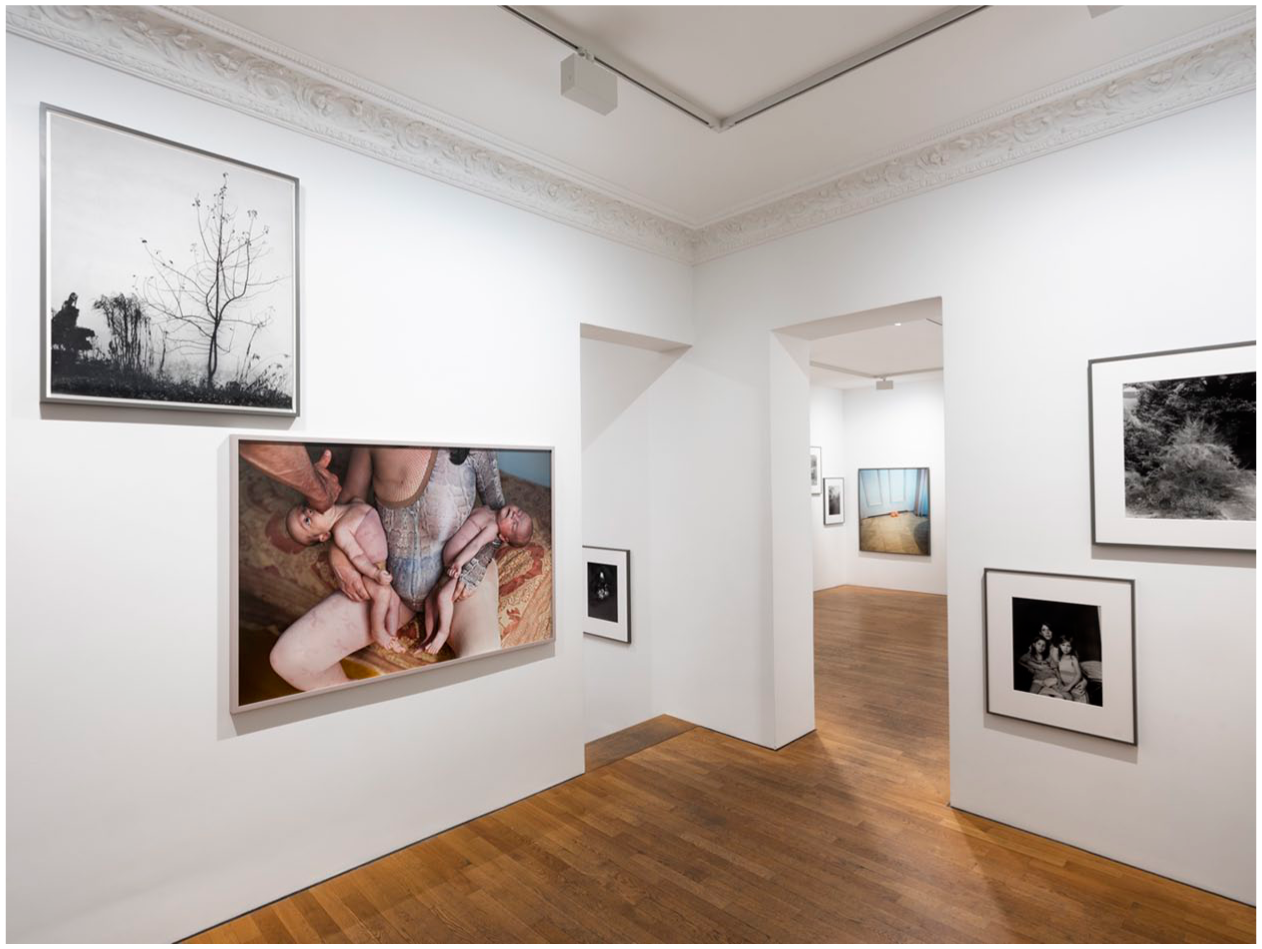
An installation view of Linn Schröder’s exhibition at the Robert Morat Galerie, Berlin.
The disruption of the family album genre continues in how Schröder organises her material. The book is divided into “chapters” by blank pages with colour gradients and by occasional landscapes; black-and-white photographs are interspersed with colour ones; and the arrangement of pictures—taken between 2012 and 2020—is decidedly not chronological. This creates a “temporal confusion,” as intended by the artist (Buesing and Klaas, 2021), adding to the impression of a family album gone off the tracks. The 2023 exhibition of Schröder’s project at the Robert Morat Galerie in Berlin emphasised this disorienting effect by presenting the pictures in different frames and at different heights (Figures 1 and 2). The installation felt like a staircase wall of a parental home, decorated with family photos but also, for seemingly inexplicable reasons, accommodating pictures of neighbours and friends with their children, and at times spotting the same image both in black-and-white and in colour.
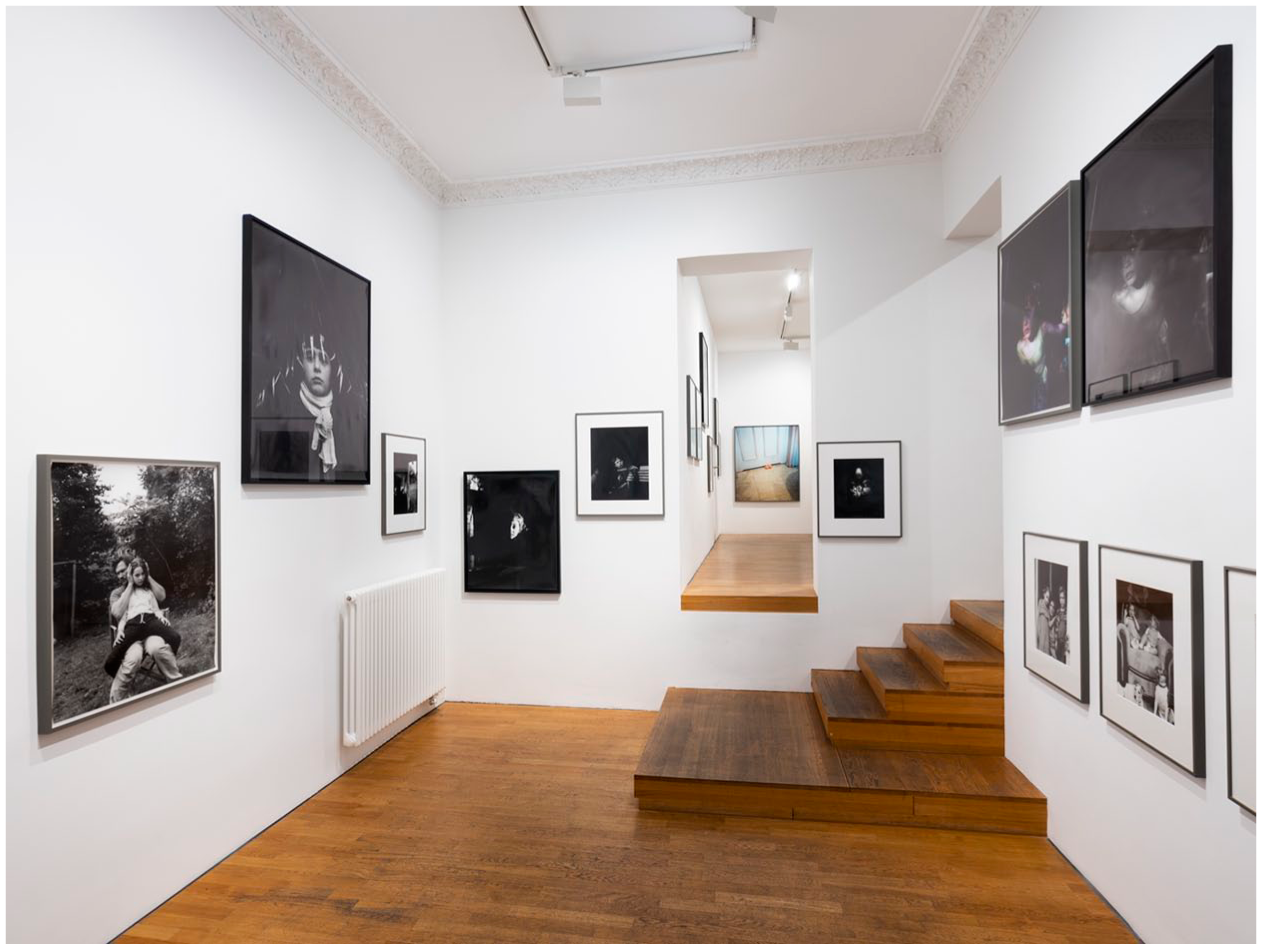
An installation view of Linn Schröder’s exhibition at the Robert Morat Galerie, Berlin.
And yet, it is family memory and its relationship to photography that this remarkable book challenges the most. Ich denke auch Familienbilder engages with the story of the artist’s German mother-in-law, who at the age of 12, in January 1945, had to flee Poland for Germany, escaping the Red Army’s offensive. Shortly before passing away, the woman wrote down the story of her escape, which happened at the temperature of –20°C and cost the lives of many children fleeing alongside her. Schröder apparently so intensely engaged with her mother-in-law’s written memories that, after a while, they began to feel like her own (Schröder, 2026, personal communication 1 ). This corresponds to Hirsch’s (1997, 2012) notion of “postmemory.” The term famously “describes the relationship of the second generation to powerful, often traumatic, experiences that preceded their births but that were nevertheless transmitted to them so deeply as to seem to constitute memories in their own right” (Hirsch, 2008: 103). Moreover, once her twin daughters became old enough, Schröder would repeatedly talk to them about their grandmother (Schröder, 2026, personal communication). In addition to sharing her mother-in-law’s memories with the girls, Schröder decided to take them on a trip to Poland, in order to find the places that their grandmother had passed during her flight and to take pictures there. This story fits well into the concept of postmemory, including “the role of the family as a space of [memory] transmission and the function of gender as an idiom of remembrance” (Hirsch, 2008: 103).
But the role of photographs in Schröder’s book seems to be different. Hirsch sees photography “as a primary medium of transgenerational transmission of trauma” (Hirsch, 2008: 103). The postmemory work of the children of Holocaust survivors was, according to Hirsch, significantly shaped by Holocaust-related photographic images, which played a key role in the second generation’s embodiment of the previous generation’s memories. Furthermore, their various artistic practices became tools for sharing their postmemory with the world: “Second generation fiction, art, memoir, and testimony are shaped by the attempt to represent the long-term effects of living in close proximity to the pain, depression, and dissociation of persons who have witnessed and survived massive historical trauma” (Hirsch, 2008: 113). This generation’s creative output has also contributed to the memory work carried out to prevent the forgetting of the Holocaust. In turn, Ich denke auch Familienbilder uses photography for different purposes. The book does not aim to tell the story of how Schröder’s mother-in-law fled Poland. Nor does it seek to represent the artist’s postmemory. What, then, does it attempt to do? How do the photographs in the book relate to memory?
Schröder’s project brings to mind the photographer Jo Spence’s (1934–1992) body of work. In her pioneering 1979 Beyond the Family Album, Spence critically examined and deconstructed the family photo album. Working with her personal collection of family snapshots and combining them with autobiographical texts and press clippings, the artist re-staged them to expose “how much these ‘private images’ were actually shaped by ‘public conventions’ defining a good portrait, conventions interiorized as common sense and natural even if actually socially specific” (Di Bello, 2025: n.p.), and to supplement these pictures with traumatic events that had, for the sake of appearances, been omitted from the family photo album. Moreover, in her later “photo therapy” projects, Spence developed (together with Rosy Martin) the artistic-therapeutic method of integrating “photographs into her journey toward better mental as well as physical health” after she had been diagnosed with breast cancer (Di Bello, 2025; see also Spence and Martin, 1988). Spence’s work on the family photo album and her photo therapy projects help us grasp what Ich denke auch Familienbilder wants to do. As this review seeks to show, Schröder, too, deconstructs the family photo album as a genre, even if using, unlike Spence, strictly visual resources. Schröder’s book might also allow the artist to work through some personal traumas, but—beyond baring her own vulnerability as a woman and a mother, as discussed above—the artist does not offer any further clues in this respect.
While helpful, all these explanations do not consider the role of the past in Ich denke auch Familienbilder or the significance of its engagement with one family’s three generations of women. Is Schröder attempting to turn postmemory into memory? This would mean that she is using her twin daughters (as well as other children and adults) as props. Or does the project—including the family’s trip to Poland—present Schröder’s way of transforming her own postmemory into “post-postmemory” (Ribbat, 2005) for her daughters? Again, this would imply a rather violent imposition: one can hardly imagine the kind of deviant mnemonic palimpsests that would be thus manufactured.
These questions, I argue, can be answered best with the help of the notion of “dialogic remembering” (Robbe et al., 2025) that this special issue introduces. Utilising, and at the same time contributing to the theorisation of, dialogicity in memory, “dialogic remembering” is a method of remembering in small groups that centres relationality. It seeks to form connections between interlocutors’ memories, even if they are very different, and to one’s own dormant memories. Ksenia Robbe et al.’s (2025) dialogic remembering events took place in museums. By contrast, the dialogic remembering in Schröder’s book takes place through her photographic practice.
Schröder is by no means trying to re-enact her mother-in-law’s memories, either for herself or for her daughters: Ich denke auch Familienbilder is not an attempt to transform postmemory into memory, or postmemory into post-postmemory. Rather, the artist employs her photographic practice to relate her mother-in-law’s memories, her own postmemory, and her daughters’ post-postmemory to each other. Schröder’s photographs thus capture lived experiences of relationality that are staged and performed based on these various kinds of mnemonic processes. By way of example, one photograph in the book shows a girl wearing a sheep mask and standing in a cereal field. For this girl, the photo-taking was probably part of the game that her mother had initiated; for her mother, an attempt to visually express a feeling that she had found difficult to express in words. But their mutual agreement to dedicate time and space to taking this picture, on a trip that honoured their grandmother’s/mother-in-law’s early life-forming experience, brought forth an intimate connection between the women and their mnemonic labours. The resulting relationality is uncanny, feeding on familial and personal traumas. It is also playful: the participating children see it as a game of wearing masks and engaging with other strange things. Importantly, they are also free to admit that they would rather go play than further engage with their grandmother’s memories, for at one point during the Poland trip, the girls exclaimed: “Not Grandma again, Mom. . . Can’t we go to a ball pit?” (Buesing and Klaas, 2021). But even if this does happen from time to time, Schröder’s photographic practice brings the three generations of women together in remembrance.
“Don’t you think that a fiction can suggest a truth?” Larry Sultan thus countered his father’s scepticism with regard to the staged family pictures he was taking. What role do photographs play in Ich denke auch Familienbilder? Historically, a photograph has been perceived as a record of time and space and thus a preservation of a memory. Roland Barthes (2000 [1980]), in turn, viewed it as a “countermemory,” something that is temporally incomplete, because the photograph contains two kinds of temporalities: “this-has-been” and “this-will-be.” While the former refers to the physical presence of the photographed subject in front of the lens, the latter refers to the imminent death and/or disappearance of the subject in time. Following this logic, while confronting the past life of a person in the present time of viewing a photograph, the spectator simultaneously announces and renounces the possibility of resuming the past via recollection (Shobeiri, 2024: 4, original emphases).
Schröder’s book and exhibition might fit into this explanatory schema. But behind the photos of the series—its resulting “fiction”—lies the “truth” of the artist’s photographic intergenerational dialogic remembering, a practice that has led to a bonding between the three generations of women and their memory, postmemory, and post-postmemory. What about the book and the exhibition as such? I suggest seeing them as a mini-archive of relationality.
