







Abstract
This article aims to further develop a concept that I recently coined in my postcolonial exploration of Kurdistani memory culture: that of the “apostrophic museum.” The term “apostrophic” is derived from the fields of rhetoric and poetry. It refers to a figure of speech that addresses an absent object or person, making the reader or listener into an “overhearer.” Through close-readings of the Yasser Arafat Museum in Ramallah and the Museum of Amna Suraka: In Order Not to Forget in Sulaymaniyah, it is shown that apostrophic memory sites, located in postcolonial societies, depict national heroes that address a homeland – in this case, Palestine and Kurdistan – and engage visitors as “overhearers” of this addressing. The article extends my earlier analysis of apostrophic museums by indicating how these two case studies shape two apostrophic acts, drawing on Frans-Willem Korsten’s analysis of apostrophic forms of address and Gilles Deleuze’s concept of virtuality. A first apostrophic act revolves around national heroes who apostrophize their countries, which gain a virtual quality. A second apostrophic act makes visitor into witnesses who turn away from these heroes to report to various others about what they have seen.
Introduction: the apostrophic museum
In Postcolonial Witnessing: Trauma out of Bounds, Stef Craps (2013: 19) argues that museum scholars should explore traumas of “non-western” people to decolonize the field of museum studies, and to study the memory cultures of minorities on “their” own terms and according to “their” own logic. One of the arguments that Craps develops to substantiate this claim, is that Western memory museums are embedded in societies in which those who still remember the events that these museums represent, and therefore constitute that which Pierre Nora (1989) characterized as a milieu de mémoire, are dying out. Western memory museums, this suggests, are often driven by the aims of “postmemory” (Hirsch, 2008) generations to keep these memories alive, with museums about the Holocaust forming a primary example. Craps’ (2013: 4) analysis also suggests that the traumatic memories that museums in postcolonial and post-conflict societies represent and commemorate do not so much concern specific “events” in a “closed” past that would be distinct from a peaceful and stable present. Instead, he agrees with Claire Stocks that they are entwined with ongoing experiences of unrest, conflict and trauma that come to permeate the representational frameworks and techniques employed by the museums.
Similar observations are developed by Britt Baillie (2013), who argues that instead of referring to “post-conflict societies,” it would often be more productive to reflect on the ways in which certain societies are permeated with what she calls “conflict-time” (p. 300). 1 The frameworks employed and constructed by museums to represent the past, Baillie specifically observes in this context, are in most cases (still) part of nation-building processes. And since these processes are often contested and threatened in different ways, the past that these museums represent continues to bleed into and shape the “conflict time” of the present.
Critical archival scholar Michelle Caswell’s extensive research on archives and record-keeping resonates with these ideas. For example, in her book Urgent Archives (Caswell, 2021), she explores alternative notions of temporality within the context of archiving and record-keeping. Referring to Mark Rifkin’s challenge to ontology-oriented Western epistemologies based on “white time” (a concept Caswell borrows from Charles Mills, 2014), she pushes back against linear temporality regimes that prioritize notions of progress and modernity, arguing they are rooted in Christian progress narratives (Caswell, 2021: 30–33). Caswell insists that “the” past is not simply “over” but continues to shape the present; to frame it otherwise, she argues, would be an act of “chronoviolence” (Caswell, 2021: 39–40). Drawing on critical race theory and queer theory, she foregrounds non-linear and alternative genealogies, highlighting the interconnectedness of past, present, and future. This perspective on temporality leads Caswell to advocate for a reimagined role for archival records, recognizing their liberatory potential and the power of memory work to actively respond to ongoing and cyclical forms of oppression in the present (Caswell, 2021: 87–89).
I strongly agree with Craps’ emphasis on decolonization and contextualization, as well as with Baillie’s and Caswell’s suggestions that the traumatic events represented in and commemorated by archives and memory museums in postcolonial societies often continue to reverberate in the present. In light of their observations, furthermore, I believe it is also important to construct common denominators that enable us to develop comparative angles, constituting what Michael Rothberg (2009) describes as a “multi-directional approach” to memory cultures, which foregrounds both similarities and differences. In this article, I turn to one such denominator by exploring the notion of the “apostrophic museum,” which I originally developed in my 2023 study Towards an Understanding of Kurdistani Memory Culture: Apostrophic and Phantomic Approaches to a Violent Past.
The notion of “apostrophe,” I observe in this book (Majid, 2023: 9–11), is derived from the Greek word apostrophos. As Dutch cultural theorist Frans-Willem Korsten writes in a helpful analysis of the concept, to which I return throughout this article, the word “literally means: ‘to turn’ (stréphein) ‘away’ or ‘aside’ (apo)” (Korsten, 2018: 187). Within the realm of poetry analysis, the term refers to a figure of speech that addresses an absent object or a person, often “calling it alive” (“Oh, death!” or “Oh! Love!”) by turning away from a listener or reader. As I observe (Majid, 2023: 10), Alan Richardson even argues that some apostrophic remarks “may be primarily intended for the overhearer,” since “to turn aside from one listener to another does not mean to turn one’s back on the former” (Richardson, 2002: 368; qtd. in Majid, 2023: 10).
This dynamic returns in what I call “apostrophic museums.” These kinds of museums, embedded in postcolonial and post-conflict societies, function as sites of memory where a nation that might not (yet) exist is addressed and conjured through exhibits, representational techniques and narratives. The act of apostrophizing the absent or potential nation, often through depictions of national heroes, transforms the museum into a space where a nation comes “alive” on an affective and ideological level. The museum visitor becomes an “overhearer” of this apostrophe, and is drawn into an engagement with the traces of a nation that exists primarily in memory, aspiration, and/or the collective imagination. One of the museums that I characterize as apostrophic is Amna Suraka: In Order Not to Forget, which is located in a former prison in the Kurdish city of Sulaymaniyah. It commemorates anti-Kurdish genocidal violence committed by Saddam Hussein’s regime. Throughout these commemorations of the past, I observe, the museum points to the ideal of an independent Greater Kurdistan that does not (yet) exist, making visitors into “overhearers” of this apostrophic gesture (Majid, 2023: 10). Below, I return to this museum and describe it in more detail.
In this article, I further develop and extend my earlier analysis of apostrophic museums by turning to Korsten’s analysis of the apostrophic act, as well as to the notion of “virtuality,” which I explore with the help of Gilles Deleuze’s (2000) Proustian reading of various forms of memory. I construct these arguments by discussing two apostrophic memory museums, which I visited in 2021 and 2022: the Yasser Arafat Museum in Ramallah (West Bank) and Amna Suraka: In Order Not to Forget in Sulaymaniyah (Kurdistan Region of Iraq), the latter of which plays an important role in my 2023 study.
Before I discuss the two museums, it is important to emphasize that my analysis is primarily of a conceptual and theoretical nature. Since I already developed an extensive empirical close-reading of Amna Suraka: In Order Not to Forget (Majid, 2023), my main goal in this article is to further expand my concept of the apostrophic museum with the help of Gilles Deleuze’s philosophical notion of virtuality, which I do not discuss in my 2023 book. I will do this by referring to elements of Amna Suraka and the Yasser Arafat Museum, but the scope of this article does not allow me to develop extensive close readings of these museums as a whole. My paper should therefore be understood as offering a theoretical suggestion regarding the concept of the apostrophic museum – a suggestion that can later, hopefully, be developed in more detail with the help of more extensive empirical research.
Heroes and nations
Let me first briefly introduce the two museums and the historical figures that they celebrate as national heroes. The Yasser Arafat Museum in Ramallah opened its doors to the public on November 10, 2016, a few days before the 12th anniversary of Arafat’s death. It celebrates the life of the Palestinian leader, who is buried at the museum’s site in a large mausoleum that is presented as “temporary”: Yasser Arafat’s wish was to be buried in Jerusalem, but the Israeli Prime Minister Ariel Sharon did not allow this to happen, out of fear that his presence in Jerusalem would “give Palestinians an added asset in their claim on that city. Furthermore, he claimed that it would present Israel with long-term security problems as a site for Palestinian pilgrimage and demonstrations” (Rubin and Rubin, 2005: 280). Instead, Arafat was buried in soil taken from the Al-Aqsa Mosque at the Muqata, at the site where he was besieged by Israeli military forces for 34 months during the second Intifada in 2002. Designed by the Palestinian-Jordanian architect Ja’far Touqa, a recurring element in the building is Palestinian stone.
The Museum of Amna Suraka: In Order Not to Forget, in turn, is located in the Kurdish city of Sulaymaniyah. It is housed in a former political prison constructed during Saddam’s regime (1979–2003). The museum aims to pay tribute to the suffering of its former detainees, as well as to Kurdish resistance against Ba’ath rule and, more recently, against the rise of Daesh (Islamic State). Furthermore, the museum celebrates Kurdistani folklore. The name of the museum literary translates as “Red Security,” and the word “red” refers to the colour of its walls. These walls, which have now turned grey, are filled with bullet holes. The prison was built between 1979 and 1985, and was used as security headquarters and administrative centre. It was only later that cells were added, and between 1986 and 1991 it functioned as a prison for political activists. Prisoners lived under horrible conditions and were tortured to testify about themselves and their comrades. From Amna Suraka, they were mostly sent to the Abu Ghraib prison in Baghdad or to prisons in Mosul or Kirkuk. Later, they were often executed after show trials at Baghdad’s revolutionary court (for more on this museum, see Majid, 2023). In 1996, the building came under full control of the Patriotic Union of Kurdistan (PUK). This political party gradually started a renovation process under the supervision of Hero Ibrahim, the widow of Jalal Talabani, leader of the PUK and president of Iraq between 2004 and 2005. In 2003, the year of the American-led invasion of Iraq and the fall of Saddam Hussein, the museum and the first exhibition rooms were opened to the public.
Both museums concern figures that are represented as national heroes. The website of the Yasser Arafat Museum states the following: “In an educational and cultural setting, the Museum aims to present to the people of Palestine and the world, the narrative of the Palestinian National Movement through the life and work of Yasser Arafat, the historic leader of the Palestinian people” (Yasser Arafat Museum, n.d.). I argue below that we can translate this statement to the claim that the museum represents Arafat as a national hero who apostrophizes the nation of Palestine.
A similar process comes about within Amna Suraka. This Kurdish museum contains different sections and exhibitions. One can visit the harrowing former prison complex, for example, learn about the history of Kurdish folklore, or find commemorations of the Kurdish genocide and several traumatic events in the history of the area, such as the mass exodus called Rakrdn. The heroes that the museum celebrates are formed by Peshmergas: Kurdish freedom fighters (the name loosely translates as “those who look death in the eyes”) who are specifically represented in the museum within the Hall of Peshmergas (opened in 2015) and the Hall of Daesh (opened in 2017). In both halls, these heroes are celebrated by linking their bravery – both in the distant past, fighting against Saddam’s forces, and in the recent past, fighting against Daesh – as necessary for the constitution of a Kurdish homeland. In the museum’s Hall of Peshmergas, for example, this figure is described as follows in a Kurdish text: The day a person decides to become a Peshmerga, his only interest is the freedom of his homeland. Therefore, a Peshmerga is a generous person, who, without hesitation, is willing to sacrifice his life for the freedom of his country. Peshmerga is one of the holy names, a name full of love and loyalty. The Peshmerga is an ambassador of generosity and of love. During the most difficult times, the scariest night and coldest days, only Peshmergas and the underground resistance were active. [. . .] The underground resistance in the cities and the Peshmerga in the mountains were not supermen. Nevertheless, they were sacrificial and full of love for their fatherland. The museum of Amna Suraka makes another attempt to open a truthful door to memories, this time in a new exhibition dedicated to the Peshmerga. [my translation]
We see here that “the” Peshmerga is presented as a national hero who has fought and continues to fight, even in the most difficult times, for the perseverance of the nation described as “his homeland:” Kurdistan.
The two museums and the apostrophic act
Let me now, based on these brief introductions, discuss the apostrophic act in the context of the Yasser Arafat museum and Amna Suraka. In these two museums, this act comes about with the help of several techniques that Arnold-de Simine (2013) characterizes, in her analysis of memory museums, as aimed at making memories “come alive” and bringing the past as close as possible to the present of visitors. This is often done by constituting empathic and affective connections to these events, Arnold-de Simine observes, enlarging the community of memory and even creating what she characterizes as new political subjects (2013: 203).
More specifically, the “present” of the apostrophizing hero is created in and by the museum through forms of re-enactment, mannequins, the re-creation of living quarters, and more. In this way, the museum generates what Alison Landsberg (2004) calls a “prosthetic memory.” In the first exhibition room of the Yasser Arafat museum, for example, the visitor encounters a mural painted by Husni Radwan, which depicts 65 figures that played an important role in Palestinian history. It is shaped in the form of a triangle, and in the middle and on top of this triangle we see a depiction of Yasser Arafat. Slightly larger in size than the other figures on the mural, he is surrounded by members and co-founders of the Palestine Liberation Organization. The background has a red and earthly colour, and behind Arafat we notice traditional Palestinian houses as well as the Al-Aqsa Mosque. On both sides, furthermore, two olive trees are depicted, emphasizing the connectedness between the Palestinian people, the (natural) land of Palestine, and the cultural and religious importance of the Al-Aqsa Mosque. On the opposite side of this mural, the visitor sees a wall that includes photos of civilians as well as of a young woman holding a gun. Above these photos, the visitor reads: “People also are the homeland,” both in Arabic and English. On a smart screen, one can zoom in on several Palestinian cities and study the demography of the Palestine of 1922.
In the museum’s second exhibition room, the visitor encounters an explicit act of apostrophizing: a poem written by Abd Al-Kareem Al-Karmi Abu Salma. The poem is apostrophic: it turns away from the reader to address Palestine. It goes as follows: Oh Palestine You are so precious, so beautiful and so pure The more I fight for your sake the more I fall in love with you Which soil other than this soil is made of musk and amber Which horizon in this world is as fragrant as your horizon The more I defend your land. The greener life becomes.
The second exhibition room contains both an Arabic and an English version of this poem. Since the museum revolves around the life of Arafat, the lyrical “I” of this poem comes to overlap with the “I” of the Palestinian leader. This overlapping comes about because different museal techniques connect Arafat’s life – and death – to the plight of Palestine as a nation.
After this second room, for example, the visitor finds herself in another room, which has four ascending ramps that are filled with pictures, maps, and audio material, but also with personal objects that belonged to Arafat (his glasses, his notebooks, and a gun he kept on his office desk). The museum embeds his life as a national hero in the area’s postcolonial history, furthermore, by telling a narrative that begins with the Ottoman Empire. This narrative revolves around several “Others” who constitute an “out-group” that is, throughout the museum, contrasted with “the” Palestinian “in-group”: 2 these “Others” are formed by British and, later, Zionist forces. The museum, for example, shows a copy of Arthur James Balfour’s 1917 letter to Lionel Walther Rothchild, which states that Palestine can be used as “a national home for the Jewish people.” Then the visitor finds information about the history of the British occupation after the surrender of the Ottoman army, as well as the several ways in which Palestinians resisted British rule (such as a text describing Sheikh Mohammed Izz Al-Din Al-Qassam’s battle against the Mandate forces on the 20th of November 1935) and, later, militarized Zionism. A text accompanying several pictures explains: “Zionist paramilitary organizations, The Haganah Irgun and Stern among others, escalate terrorist activities against Palestinian and British targets.”
It is here that the figure of the national hero starts rising within the narrative told by the museum, making visitors resonate and identify with the apostrophizing “I” presented in the poem cited above. We read about Arafat’s upbringing and see pictures of his grandparents. An accompanying text reads: “Mohammed-Yasser Abdul Raouf Arfat Al-Qudwa, later known as Yasser Arafat, is born on the 4th of August 1929, in the home of his grandfather, Saleem Khalil Abu Al-So’ud, in Al-Zawiya Al-Fakhriya on the southwest corner of Al-Haram Al-Sharif in Jerusalem.” The visitor also sees a picture of the street where Arafat lived until 1937, from where he later moved to Egypt. A replica of the main room of his grandparents’ home is accompanied by the following text: “Al-Buraq Wall (the Wailing Wall) can be seen through the windows. Visible through the window on the right is part of the Dome of the Rock; from the window on the left can be seen the front of Al-Tenkizia School and a minaret of Al-Aqsa Mosque above.” Not unlike the mural described above, this suggests that already from a young age Arafat formed the central locus of Jerusalem and the land of Palestine.
The museum then describes the many events that came to influence Arafat’s life. Given the scope of my analysis, I focus on the museum’s references to his last battle, which took place on the 21 September 2002: Israeli forces destroyed four buildings of Al-Muqata’s, Arafat’s Ramallah headquarters. Recordings of the attacks on Al-Muqata’a by the Israeli forces are displayed on a screen to the right of the bridge that connects the museum’s building with a completely reconstructed Al-Muaqata. In the latter building, the visitor sees bunk beds, personal belongings and uniforms: the past is here made into a part of the present, and visitors are provided with the feeling that they are witnessing what happened in the past.
The museum also shows the small room where Arafat spent the last 3 years of his life. It contains a single bed, a very small closet, and some headscarves and shirts. Next to his bed, we see a nightstand, a lamp, a prayer carpet, a painting by his daughter Zahwa, and a TV on the wall (see Figure 1). Before entering the headquarters, the visitor reads the text of a speech by Palestinian national poet Mahmoud Darwish (1941–2008). He wrote this speech for Arafat’s 40th Memorial Day. Before turning to the museum of Amna Suraka, I want to quote a part of the speech, since it illustrates the manner in which Arafat, as a national hero, is represented as being entwined with the process of Palestinian nation-building: Yasser Arafat was the longest chapter of our lives. His was one of the names of the new Palestine, rising from the ashes of the Nakba (catastrophe) to the embers of the resistance, to the idea of the State, to the reality of his painstaking establishment. But heroes of tragedies have ironic destinies: awaiting their final step towards the arrival gate to be denied the celebration of the happy ending of a life of hardship and sacrifice. He who farms the field is not always the one who harvests their fruits.
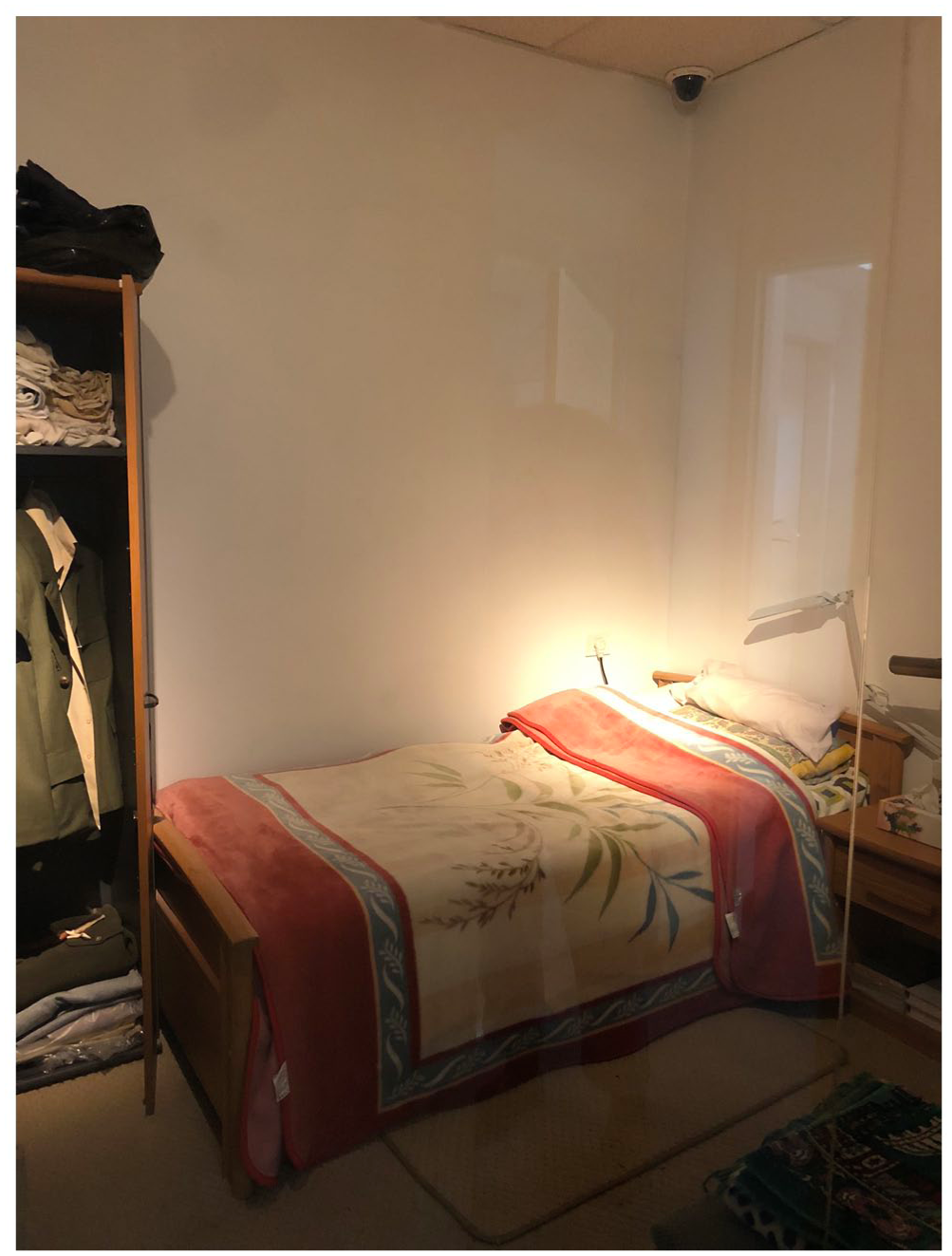
A reconstructed space that replicates the room where Yasser Arafat spent the final three years of his life, housed within The Yasser Arafat Museum (photograph made by the author).
Arafat is represented here as the national hero of an “us”. As a national hero who points the way and whose actions and life make this nation of Palestine come alive. Signs like these, I suggest, are not themselves apostrophic, but indicate to visitors that they are witnessing an act of apostrophe. The national hero does not himself address the visitor through these signs, after all. Instead, the museum describes him, as the hero, in the third person, making the visitor into a witness from whom Arafat has turned away to address his nation. An address that is lyrically given shape through the above-mentioned poem by Abd Al-Kareem Al-Karmi Abu Salma: “Oh Palestine.”
A similar process takes place in Amna Suraka. Again, I extensively describe how this process comes about in my 2023 study. Given the scope of this article, I therefore only foreground the museum’s apostrophic elements by focusing on two mannequins in the museum’s Hall of Peshmergas. One of these mannequins represents a Peshmerga seated in a wheelchair. The following English text accompanies this mannequin: When I decided to join the resistance force inside the city, and become a Peshmerga member, I never expected to see this day. To be thanked by my people. Since then I always considered it my duty to serve my nation. Martyrdom was our greatest aspiration. My friends are much more fortunate because they gave their lives for the cause while we only gave an organ. To all the Kurdish martyrs who became the symbol of Kurdistan’s glory and freedom.
This is not yet an act of apostrophizing: the text, after all, is written in the first person and implicitly addresses the visitor by explaining that the “I” is willing to sacrifice himself for his homeland.
This entwinement of the Peshmerga as a national hero or “martyr” on the one hand, and the nation of Kurdistan on the other, becomes apostrophic through a second mannequin. Representing a man half-dressed in a white robe, this mannequin holds a large Kurdish flag. The pedestal on which he has been placed is dripping with blood, and the walls around him are illuminated by red light. His white clothes recall the clothes worn by those who go on Hadj, providing the mannequin with an almost holy aura (see Figure 2).
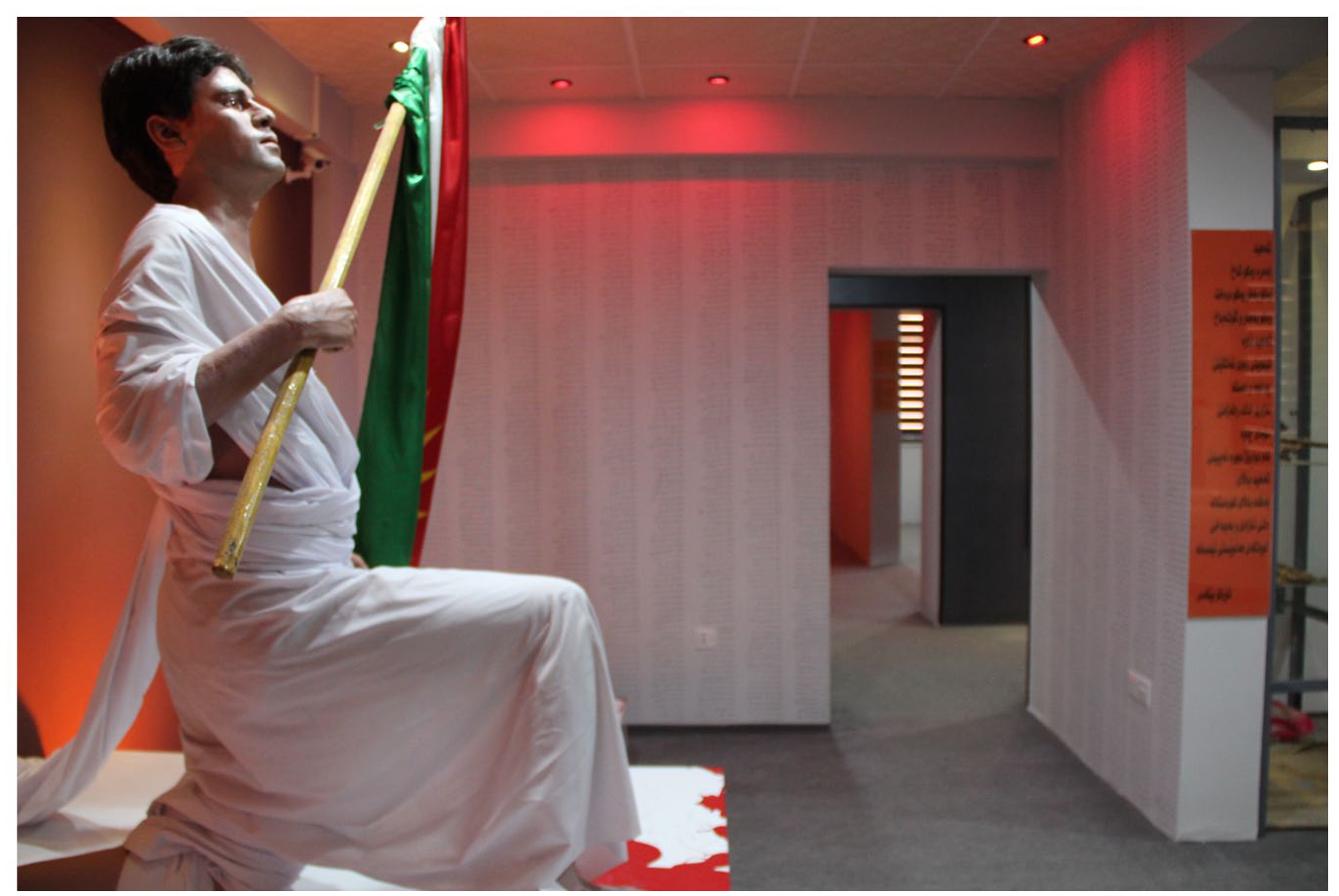
A mannequin representing a fallen Peshmerga holding the Kurdish flag, surrounded by walls inscribed with the handwritten names of martyred Peshmergas at the Museum of Amna Suraka (photograph made by the author).
No museal sign explains what the mannequin represents. However, on both sides a poem by Kurdistani national poet Sherko Bekas (1940–2013) is displayed. It tells the visitor what a martyr is and compares a martyr to elements of nature (mountains, snow, trees) and also body parts (fingers, hands), expressing that a martyr is someone who has given up his body for the fatherland, and is part of a larger whole – either the “body” of the Kurdistani or the natural motherland of the apostrophized Kurdistan itself. The decisions to use a poem instead of an informational text, and to show a mannequin dressed in white, surrounded by blood and carrying a Kurdish flag, emphasize the observation that these aspects of the museum are not so much aimed at representing the past and providing information about what happened, but at shaping a highly symbolic apostrophe. Most crucial is that this mannequin looks “over” the heads of visitors at “something” – Kurdistan – on the horizon: in this way, the museum places visitors in the position of witnesses. The mannequin does not look them in the eyes, but has, in contrast with the mannequin expressing himself to them in the first person, turned away from them to apostrophize “his” nation, as it lies on the horizon of the future.
Two apostrophic acts
Let me now extend and nuance the analysis that I developed in my earlier study (Majid, 2023), first with the help of the ideas of the above-mentioned Frans-Willem Korsten, then by turning to Deleuze’s notion of “virtuality.” Korsten embeds the apostrophe in the domain of law and emphasizes its rhetorical and theatrical aspects. These aspects, he writes, come about because of the figure’s movement of “turning away.” He observes the following, for example, about the appearance of apostrophic forms of address in a courtroom: “In speaking to the accuser first, [. . .] a lawyer may turn away to the judge. Or in speaking to the jury, she may turn away in order to start to speak to the audience. The shift in audience implies a shift in mode. One shifts from interrogation, for instance, to explanation” (Korsten, 2012: 16). Korsten argues that shifts like these often provide the apostrophe with an ethical dimension. The figure, he writes, “is not just calling upon an audience in a lyrical way, calling it to life, but it is calling upon its potential to respond. The theatrical origin of the apostrophe relates to response-ability, that is, which is less an aesthetic than an ethical category” (Korsten, 2018: 190).
Korsten’s emphasis on “response-ability” forms the basis of his analysis of the apostrophic aspects of the act of witnessing, about which he claims that it has two meanings that are brought together by the apostrophic act of “turning away”: “being a witness and bearing witness” (Korsten, 2012: 13). A witness, his argument goes, may shift between different modes, just like a lawyer may shift between modes in the above-described example of the courtroom. First, Korsten writes, a witness addresses something or someone – a suffering victim, for example – by seeing and noticing what is happening: she now is a witness through the mode of paying attention. During this act, however, a different address is implicitly shaped and expected: one that is based on the witness turning away from the victim and addressing another to whom the witness bears witness of what she has seen (e.g. to a jury in a court, a police officer, or a community). To do this, the witness adopts the mode of expression, since she expresses what she has seen to this other (Korsten, 2012: 19).
Even though the act of expression often does not take place at the same moment when the witness is addressing the victim, Korsten asserts that it nevertheless forms a crucial aspect of what it means to witness. If the witness would not express to some other what she has seen, after all, her witnessing has been in vain; then, what has happened – for example, the suffering of a victim – will not and cannot be recognized or acknowledged by a community to whom the victim bears witness in an ethical manner; a community that has to respond. Korsten describes these processes as follows in a long passage that I want to quote in full, since it presents a clear overview of the complexities of these movements. Furthermore, it introduces the notion of “virtuality,” which is important for my analysis: The act of witnessing implies a double form of address, then. It is on the witness’s attention that the hope of a victim will rest. Equally necessary, however, is the fact that the witness relates, simultaneously, to an audience that is virtually present. I am using virtually here in the sense Gilles Deleuze defines it: as something that is not yet actualised but, nevertheless, real and present. This is why the turning away is both reassuring and painful, because the turning away implies, and must imply, a painful but also hopeful not-being-there in the being-there of the witness. The not-being-there in the being-there is what constitutes both the theatrical and the rhetorical moment in witnessing, with affectively charged consequences for all the participants involved. Only when address of attention and address of expression coincide, in a different modality, can participants be “stirred.” And only then, or such is my contention can witnessing operate ethically, in relation to a community, in terms of responsibility. (Korsten, 2012: 18)
I return to Korsten’s reference to Deleuze and virtuality below, but first want to transform his ideas about a “double form of address” into an analytical framework that enables me to foreground the ethical and virtual dimensions of the ways in which the Yasser Arafat Museum and Amna Suraka are involved in processes of “postcolonial witnessing,” to use Craps’ term again.
As described above, I argue in Towards an Understanding of Kurdistani Memory Culture that apostrophic museums make their visitors into “overhearers” of an apostrophic act. These visitors find themselves in a situation in which national heroes have “turned away” from them to address – apostrophize – something else: the nation, apostrophically calling it alive. Following Richardson’s above-mentioned ideas, this “turning away,” as it is comes about within apostrophic museums, is specifically meant for these visitors as overhearers.
Korsten’s analysis of witnessing and of double forms of address enables me to slightly expand my earlier analysis: if we employ his framework, we are able to discern two acts of apostrophizing taking place in apostrophic museums, instead of only one. First, a represented national hero “turns away” from the visitor to apostrophize “his” nation; second, visitors who witness this act of apostrophizing “turn away” from this hero to a virtual other to report about what they witnesses. I have discusses the first apostrophic act above, as well as in my earlier study (Majid, 2023). Now, I want to focus on the second one, since especially this second act can be productively analysed with the help of Korsten’s vocabulary. I suggest that visitors pay attention to the apostrophe – are witness to it – and then turn away to a virtual other to bear witness of what they have seen. Put differently, they shift from the mode of address to the one of expression. As witnesses, visitors are “stirred,” to use another concept employed by Korsten, and are given a “response-ability” that embeds the act of apostrophizing that they witness, as well as the act of apostrophizing that they themselves perform, in the socio-political communities of which they form part.
Various interpretations could be developed of the nature of these latter communities. In Towards an Understanding of Kurdistani Memory Culture, I observe that Amna Suraka is aimed at a wide variety of visitors (Majid, 2023: 143–44), containing signs in Kurdish, English and Arabic. One of the English signs, in the Hall of Daesh, reads as follows and illustrates the ways in which the museum presents its own aims to its international visitors: The National Museum amnasuraka – not to be forgotten, is an important living historical site for commemorating the resistance as well as the graveyards of the Kurdish people against their oppressors. [. . .] The Museum is part of our identity in the four parts of Kurdistan and has aimed to transcend the artificial borders imposed on us, and so our generation are a source of great pride in a war imposed on us, because we represented humanity while still retaining our peace seeking spirit. In the process, we managed to not only unite the world, but to also win against the dark forces of terrorism. We honor the contribution and support of other nations and peoples and we are proud that we remained as Kurds and we gave sacrifices for retaining the balance for peaceful, mutual coexistence. We hope in return that the world after the end of the worshippers of darkness is a just world that honors and remembers the bravery and sacrifices made presented here.
A sign like this does not present an act of apostrophe. Instead, it speaks from an “us” (“we, Kurds”) and explains the museum’s character and intentions to its visitors. The text does, however, provide an idea of the context that is, according to this sign, relevant to understand the ethical and political dimensions of the museum. Based on an analysis of signs like these, I indeed argue that the international community – “a just world that honors and remembers the bravery and sacrifices made presented here” – can be understood as one of the intended overhearers of Kurdistani heroes as they apostrophize “their” nation in apostrophic museums.
Korsten’s framework, however, enables me to nuance this idea: international visitors, I argue now, become witnesses to the apostrophic acts as they come about within Amna Suraka. Then, the logic of the double address described by Korsten suggests that these visitors are implicitly expected to “turn” to the international community of which they form part, completing their own apostrophic act and reporting to this community about Kurdistani suffering for a Greater Kurdistan; for a country that does not (yet) exist and is not recognized as such. Within the museum, the international community can therefore be understood as what Korsten characterizes as the “virtual other” to whom international visitors “bear witness” of what they have seen in this same museum (Majid, 2023: 144).
The scope of this article does not allow me to develop this argument in more detail, but I suggest that Korsten’s analysis of the apostrophe’s logic implies that a similar process comes about within the Yasser Arafat museum as well. The intended visitors of this museum are Arabs and international visitors: all signs are in Arabic and English. There are no signs in Hebrew, suggesting that those who speak only this language are largely ignored, and are deemed to be irrelevant as witnesses to the apostrophizing of Palestine. The “virtual” overhearer of the hero’s apostrophic act, this implies, are Arabs as well as the international community, who are given the “response-ability” to express to others what they have witnessed.
Before I turn to the notion of virtuality, it is important to point out that there is a difference between, on the one hand, the apostrophic situations described by Korsten, and the ones generated in apostrophic museums, as I have described them above. In the former, witnesses perceive someone or something (the suffering of a victim, for example) and then turn to a virtual other to bear witness, generating an apostrophic act by turning away from this someone or something. In the case of apostrophic museums, on the other hand, witnesses are made to perceive not only a “person” (a representation of a national hero), but the performance of an apostrophic act by that person. When these visitors turn to a virtual other to bear witness of what they have seen, in other words, this “what” concerns an apostrophe as well.
Virtuality: different shades of “being-there in the not-being-there”
To further flesh out the logic of this apostrophic double address as it comes about within the Yasser Arafat Museum and Amna Suraka, I want to turn to Gilles Deleuze. As we have seen above, Korsten refers to this French philosopher to define the virtuality of the “other” to whom a witness turns as “something that is not yet actualized but, nevertheless, real and present” (Korsten, 2012: 18). In the case of the above-discussed apostrophe, for example, the international community gains such a virtual status. In a footnote, Korsten (2012) adds the following: “Deleuze is inspired here by Proust’s ideas on what is constant in past and present” (p. 18). Korsten does not further explore Deleuze’s writings on virtuality, however. I believe that details of Deleuze’s discussion of virtuality enable us to develop a specific analysis of the virtuality of the nations as they are addressed in and by the two museums. This discussion can be found in Proust and Signs (2000), in which Deleuze analyses Proust’s observations on the workings of involuntary memory. This kind of memory is most famously illustrated by the madeleine-episode in In Search of Lost Time, in which the sensation of tasting a madeleine is described as involuntarily triggering memories of the village of Combray, which the narrator used to visit as a child with his family. To a large extent, this triggering sets the narrator’s “search for lost time” in motion.
What is important for my analysis, is that Deleuze emphasizes that the manner in which Combray “rises up” from the past in Proust’s novel through the sensation of tasting the madeleine, is different from two more “real” or concrete images of Combray. First, the involuntarily remembered Combray should be distinguished from the way in which it was present in the past, when it was directly experienced – perceived – by the remembering self. Second, the involuntarily remembered Combray should also be distinguished from the way in which it would have appeared if it had been voluntarily remembered. Then, the village would have been experienced as past in the present of the remembering self, with the help of techniques that recall those aspects of Combray that this self still remembers on a conscious and deliberate level.
Since the village is recalled involuntarily, however, Deleuze writes that it appears in a different way: as its essence; as its truth. In his own words: Combray does not rise up as it was once present; Combray rises up as past, but this past is no longer relative to the present that it has been, it is no longer relative to the present in relation to which it is now past. This is no longer the Combray of perception nor of voluntary memory Combray appears as it could not be experienced: not in reality, but in its truth; not in its external and contingent relations, but in its internalized difference, in its essence. Combray rises up in a pure past, coexisting with the two presents, but out of their reach, out of reach of the present voluntary memory and of the past conscious perception. “A morsel of time in the pure state” (III, 872) is not a simple resemblance between the present and the past, between a present that is immediate and a past that has been present, not even an identity in the two moments, but beyond, the very being of the past in itself, deeper than any past that has been, than any present that was. (Deleuze, 2000: 60–61)
Deleuze (2000) then concludes, ““Real without being present, ideal without being abstract.” This ideal reality, this virtuality, is essence, which is realized or incarnated in involuntary memory” (p. 61).
I want to apply these ideas to my analysis of apostrophic museums: Deleuze makes it possible, I suggest, to argue that the nation as it is apostrophized in apostrophic museums should be characterized as a “not-being-there in the being-there” during the witnessed moment of the national hero’s apostrophe. This nation, in other words, becomes virtually present because of the apostrophic act. Because of this act, in other words, the nation that the hero apostrophizes is shaped, as Deleuze notes about Proust’s Combray, “in essence.” It arises as a “truth” that transcends two presents, in this case the present of the visitor and the “present” of the hero. As such, it gains the mythological and metaphysical status that Combray has for Proust’s narrator, partly “existing” outside of time as a nation that has always already “been.” This brings the two above-discussed apostrophic acts together: the national hero, this suggests, realizes the nation’s mythological existence, and has turned away from the visitor to address it, involuntarily calling it into being by being drawn to it. The visitor, in turn, witnesses this act and is “asked,” within the context of the museum – for example by Amna Suraka’s reference to “a just world that honors and remembers the bravery and sacrifices made presented here [in the museum]” and the Yasser Arafat Museum’s above-mentioned reference to “the world” on their website – to bear witness to virtual others; to a community that might then recognize this nation as a nation. At least that is the hope expressed by the apostrophic museum.
Of course, the two museums refer to nations that have a different status in this present, which means that the virtuality of the countries that they refer to plays a different role in each context. The Kurdistan that the Peshmergas apostrophize in Amna Suraka exists to some extent. The Kurdistan Region of Iraq already has its own government and has a semi-autonomous status. This means that its ontological status should be placed somewhere in-between the “not-being-there” and the “being-there” of Korsten’s Deleuzian characterization of virtuality. Nevertheless, it is not (yet) a completely independent nation, and the Kurdistan Region of Iraq only forms one part of the “Greater Kurdistan” that, as we have seen above, is apostrophized by Amna Suraka, and which includes the Kurdish areas of Iran, Syria and Turkey.
The context in which the Yasser Arafat Museum is embedded is different. The Palestine that the Palestinian leader apostrophizes in the museum – an independent and autonomous nation – does not (yet) exist, making the virtual “not-being-there in the being-there” shift more to the “not-being-there.” Its virtuality is illustrated in the museum by the artwork that ends the route that visitors follow: a video that is loosely based on Banksy’s famous image depicting a girl holding seven balloons, spray-painted on the 8-metre-high separation wall close to the Qalandia checkpoint. In this video, the girl holding the balloon comes alive and flies over the wall. She is animated, but the landscape through which she flies is real. By using animation, the video emphasizes the reality of the wall, which can only be transcended by animated fantasy. We see, for example, how an animated soldier lifts up the wall for a group of children, and they sneak through it. At the same time, by letting Banksy’s girl fly over the land and by showing this land as a whole, the video adopts a perspective that foregrounds the constructed nature of the national borders of Israel. In this way, it implicitly presents Palestine as a nation that has always existed as an essential “truth,” like the essence of Combray as it rises in the involuntary memory of Proust’s narrator; a truth recognized and understood, the museum suggests, by the apostrophizing Arafat.
Conclusion
Above, I have argued that the Yasser Arafat Museum and the museum of Amna Suraka construct two apostrophic acts in which different forms of virtuality play crucial roles. Within these museums, the national hero is depicted as having “turned away” from visitors to apostrophize “the” nation for which “he” is willing to die (a poetic “Oh, Palestine!” or a Kurdistan addressed by a mannequin “behind” the visitor on the horizon), in this way calling this country “into being” and paying attention to – addressing – its virtual existence as a nation. In the setting of the museums, a second apostrophe involves the visitor: this visitor becomes a witness to the suffering of the national hero as he addresses his country, and the visitor then has to “turn away” from the hero and bear witness to a virtual other. This can be the international community that is asked to recognize this suffering and the existence of the apostrophized countries, or local communities that in this way become part of a community built around the act of apostrophizing a not-yet-existing nation.
Given the scope of this article, I have only been able to focus on a small part of the objects, signs, rooms, videos and narratives that visitors of these museums encounter. Nevertheless, I hope to have shown that the notion of the apostrophic museum makes it possible to highlight various important aspects of the complex workings of memory museums, especially if these museums are embedded in postcolonial societies permeated with “conflict time.”
Footnotes

Funding
The author disclosed receipt of the following financial support for the research, authorship, and/or publication of this article: This research was supported by the Alfred Landecker Foundation and carried out as part of the research project “Preserving Memories, Bridging Gaps” (based at the Leiden University Centre for the Arts in Society, Leiden University). The groundwork for this research was carried out at Heidelberg Centre for Transcultural Studies, Heidelberg University, within the project “Gathering the Dispersed,” funded by the Volkswagen Foundation.
Declaration of conflicting interests
The authors declared no potential conflicts of interest with respect to the research, authorship and/or publication of this article.