






Abstract
Dear Sir,
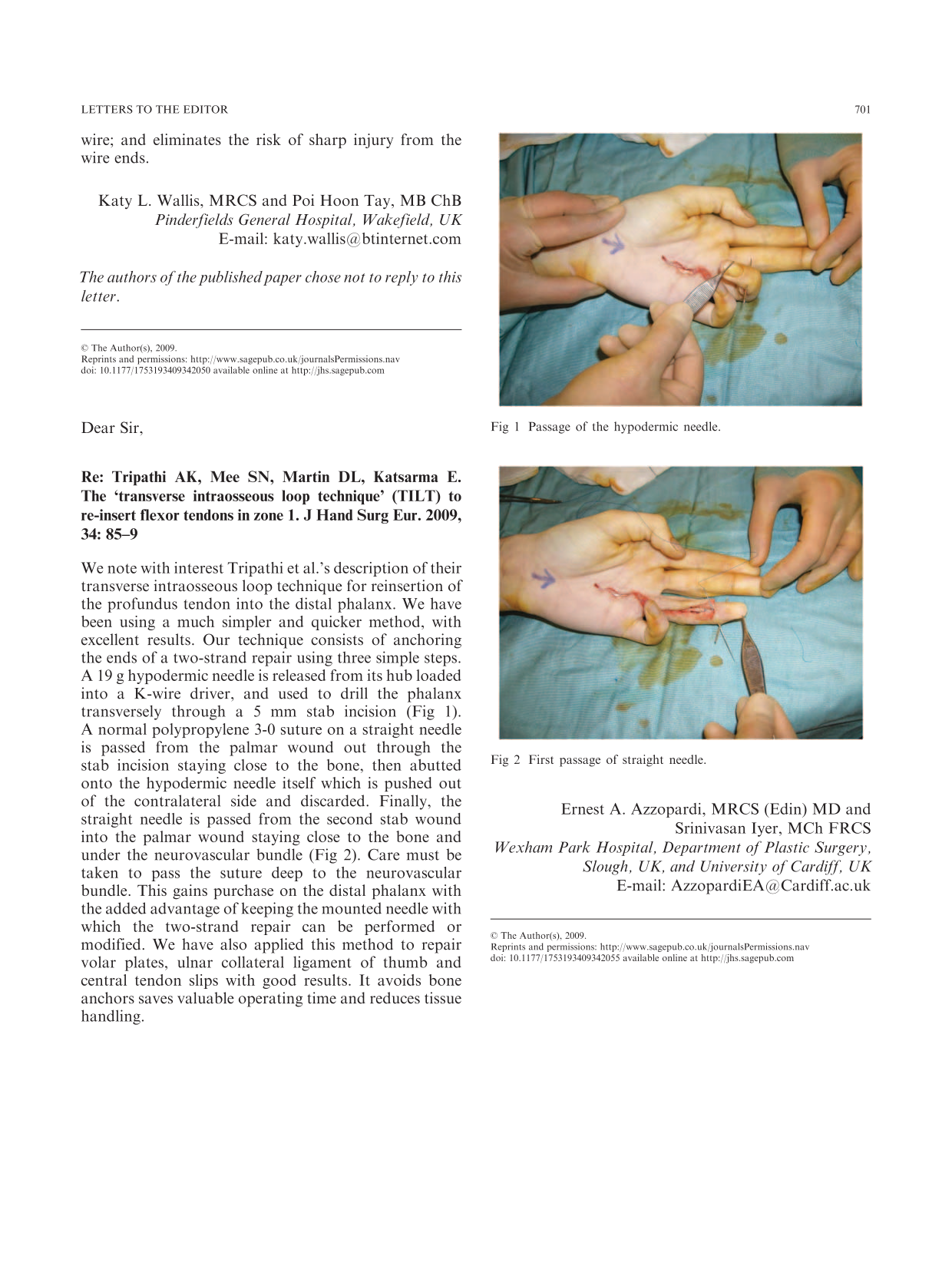
We note with interest Tripathi et al.'s description of their transverse intraosseous loop technique for reinsertion of the profundus tendon into the distal phalanx. We have been using a much simpler and quicker method, with excellent results. Our technique consists of anchoring the ends of a two-strand repair using three simple steps. A 19 g hypodermic needle is released from its hub loaded into a K-wire driver, and used to drill the phalanx transversely through a 5 mm stab incision (Fig 1). A normal polypropylene 3-0 suture on a straight needle is passed from the palmar wound out through the stab incision staying close to the bone, then abutted onto the hypodermic needle itself which is pushed out of the contralateral side and discarded. Finally, the straight needle is passed from the second stab wound into the palmar wound staying close to the bone and under the neurovascular bundle (Fig 2). Care must be taken to pass the suture deep to the neurovascular bundle. This gains purchase on the distal phalanx with the added advantage of keeping the mounted needle with which the two-strand repair can be performed or modified. We have also applied this method to repair volar plates, ulnar collateral ligament of thumb and central tendon slips with good results. It avoids bone anchors saves valuable operating time and reduces tissue handling.