







Abstract

Dear Sir,
Samurai swords are highly prized collectors’ items that played a unique role in the culture and history of Japan. For over 1000 years these swords have been associated with the Samurai warriors and the Shogun, who adhered to a strict code of ethics and honour. Central to this was a profound respect for their handcrafted swords. We present three cases of serious hand injuries resulting from sword assaults.
A 27-year-old right-hand dominant electrical fitter was assaulted with a sword, resulting in injuries to both knees and the left upper limb. He presented with an ischaemic left thumb and compromised vascularity of the other digits in the left hand. There was an oblique laceration through the base of the thumb extending across the palm to the little finger (Fig 1). At surgical exploration there was transection of the radial artery in the anatomical snuffbox and the ulnar artery at the proximal superficial palmar arch. The flexor pollicis longus and the flexor digitorum sublimis and profundus tendons to all four fingers were divided. The median nerve and the common digital nerve to the ring and little fingers were also completely divided. Extensor pollicis longus and brevis and extensor carpi radialis longus and brevis tendons were divided in zone V and the extensor digitorum tendons to the index, middle and ring fingers were divided in zone VII. The patient also required open reduction and internal fixation of the left olecranon and left tibial plateau.
Case 1 showing sword injury to the left palm.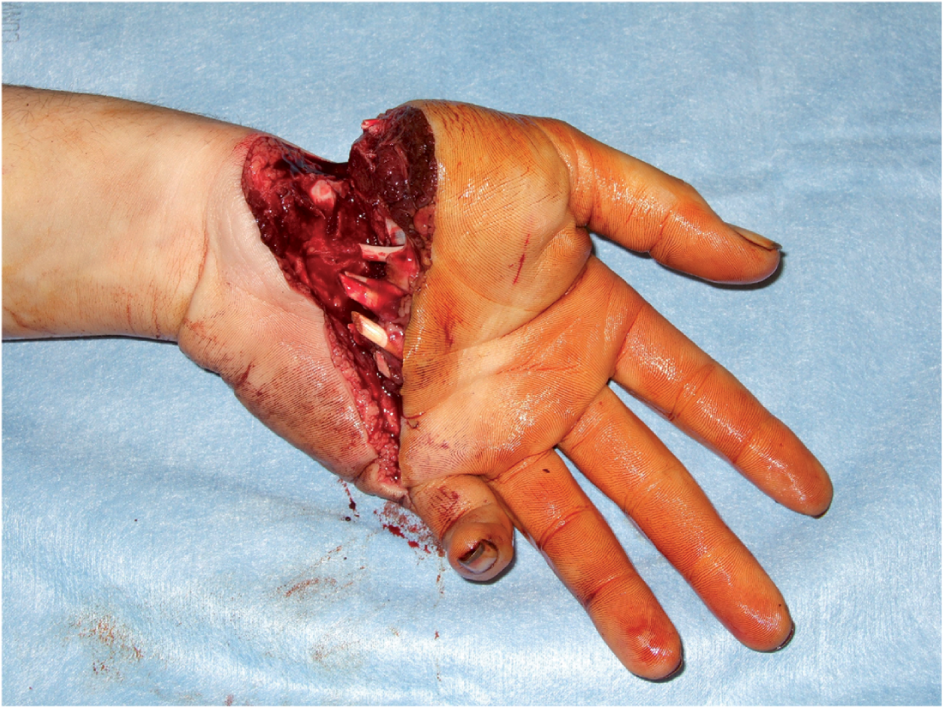
In the second case a 29-year-old right-hand dominant computer programmer was assaulted with a Samurai sword and sustained injuries to the right palm. A deep laceration extended from the base of the thumb through the first web space and a second laceration traversed the hypothenar eminence (Fig 2). The hand was perfused but distal capillary refill of the digits was delayed. He had a previous history of a sword injury to the same hand which resulted in division of the FDS and FDP tendons to the ring and middle fingers. Surgical exploration revealed complete division of the ulnar artery and nerve. The median nerve and flexor pollicis longus tendons were also divided and there was extensive damage to both the thenar and hypothenar muscles.
Case 2 showing deep lacerations to both the base of the thumb and hypothenar eminence.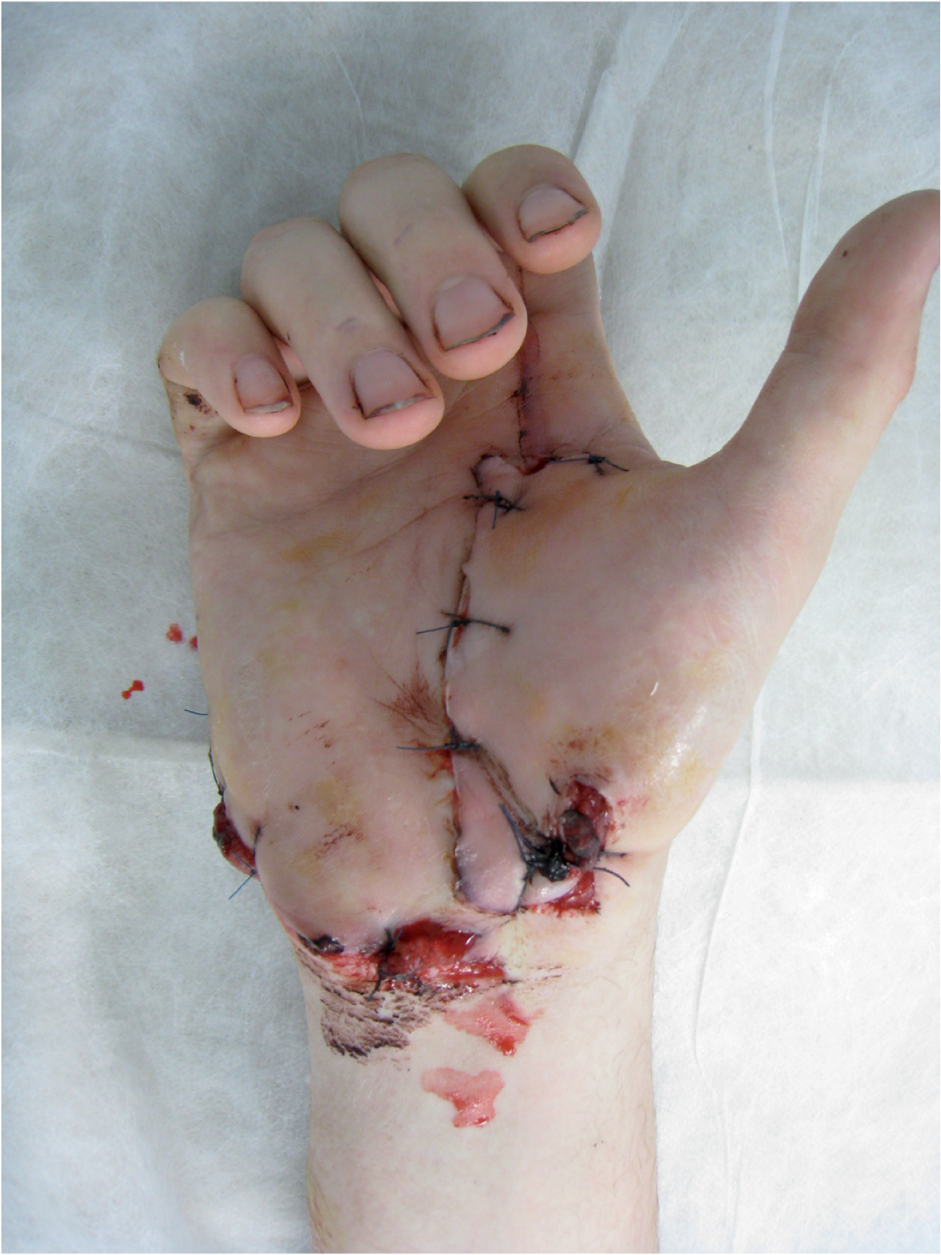
Finally a 29-year-old right-hand dominant carpenter presented following assault with a Samurai sword which resulted in complete transcarpal amputation of the right hand (Fig 3) which was treated by immediate replantation.
Case 3 showing transcarpal amputation of the left hand.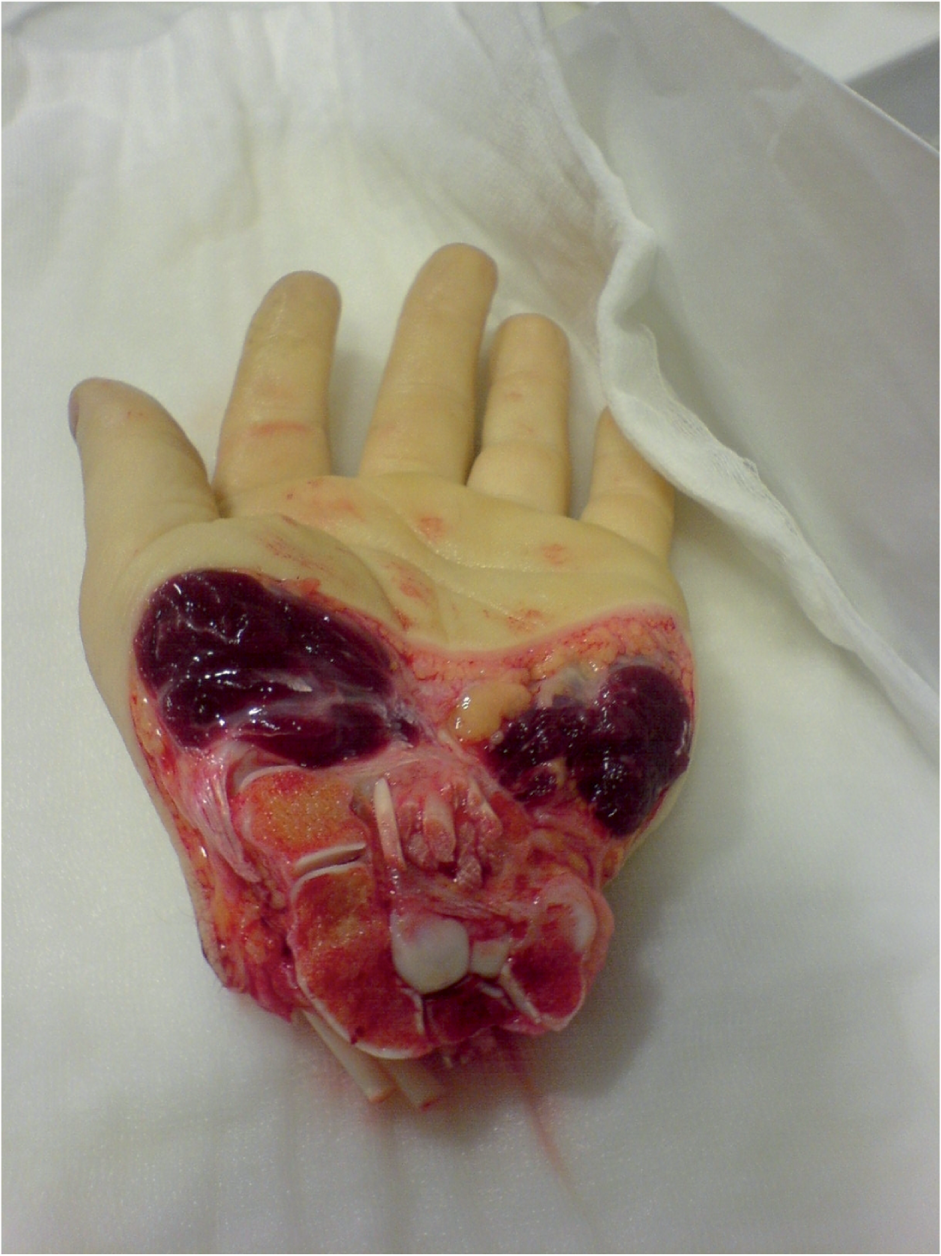
The Samurai sword has long been glamorized in literature and film and is renowned for its exceptionally sharp blade which, as illustrated in these cases, can slice through skin, tendon and bone in a single blow. In all of these cases the patients suffered very severe injuries requiring complex reconstructive surgery and protracted hospital admissions. In spite of intensive hand therapy functional recovery has been sub-optimal and all patients have difficulty carrying out everyday tasks. None has returned to normal work or recreational activities. The victims and alleged assailants were all Irish men and the sword attacks occurred in a country with no history or tradition in such weaponry.
Although there are very few reports of Samurai sword injuries in medical journals (Raul et al., 2003; Tsai, 1979), media reports would suggest that there has been an increase in the use of such weapons in violent crimes in recent years. This is due at least in part to the increased availability of these swords which can easily be purchased from speciality stores and on the internet for as little as 35 Euros. Legislation was introduced in the UK in 2008 which prohibits the manufacture, importation, sale or hire of Samurai swords (Schlesinger, 2007). This change in the law followed the use of swords in a number of serious assaults and homicides. Martial arts enthusiasts and genuine collectors are exempt from the law as it was identified that inexpensive replica weapons were most likely to be used in violent crime. The UK Home Office estimates that there have been approximately 80 assaults including five fatalities in which cheap imitation swords have been used. At the time of the reported cases there was no specific legislation governing the possession, importation or sale of swords in the Republic of Ireland. Swords could be purchased without identification, proof of age or specific permits. An increase in high profile assault cases involving swords sparked calls for a review of the law and in September 2009 new legislation was introduced prohibiting the sale, hire, manufacture or importation of these weapons with offenders facing prison sentences of up to 7 years (Brady, 2009). This case series demonstrates the extent and severity of hand injuries that can be caused by sword assaults with devastating loss of function for the victims. We hope that the recent amendments to the law will limit the availability of Samurai swords and reduce the number of serious assaults presenting to our service.
The authors wish to acknowledge the contribution of Mr Brian Kneafsey, Consultant Plastic and Reconstructive Surgeon, Beaumont Hospital to this short report.
Footnotes
Conflict of interests
None declared.