







Abstract

Dear Sir,
Subcutaneous rupture of the distal end of the triceps tendon with an avulsion fracture is an uncommon injury. The most common mechanism of injury is a fall or direct blow to the elbow, associated with sports or accidents, and considerable force is required for a normal triceps tendon to rupture. We recently treated three cases of subcutaneous probable partial rupture of the triceps tendon with a probable fracture at the base of the olecranon spur caused by minor trauma.
All patients were male military personnel, and their ages at injury were 45, 46, and 50 years. All were very active taking part in badminton, baseball, and Kendo (Japanese traditional fencing), respectively, for more than 20 years. They each had had a sore elbow for a couple of months before the injury, and in particular an olecranon spur was confirmed on radiographs in one. The first developed the rupture when training for badminton without a specific blow. The second slid into the home plate and touched the base with his hand without a blow to his elbow and the third felt elbow pain while he brought his bamboo sword down over his opponent’s face guard. A lateral radiograph revealed the bony fragment in each, and an MRI scan showed an incomplete rupture of the triceps tendon (Figure 1). As the patients were eager to resume their duties as soon as possible, we performed surgery. In each case, the bony fragment was partially connected to the triceps tendon, and the probable fracture had occurred at the base of the olecranon spur (Figure 2). The fragment was excised and the tendon was re-attached to the olecranon using suture anchors. All three patients returned to all previous activity within 3 months.
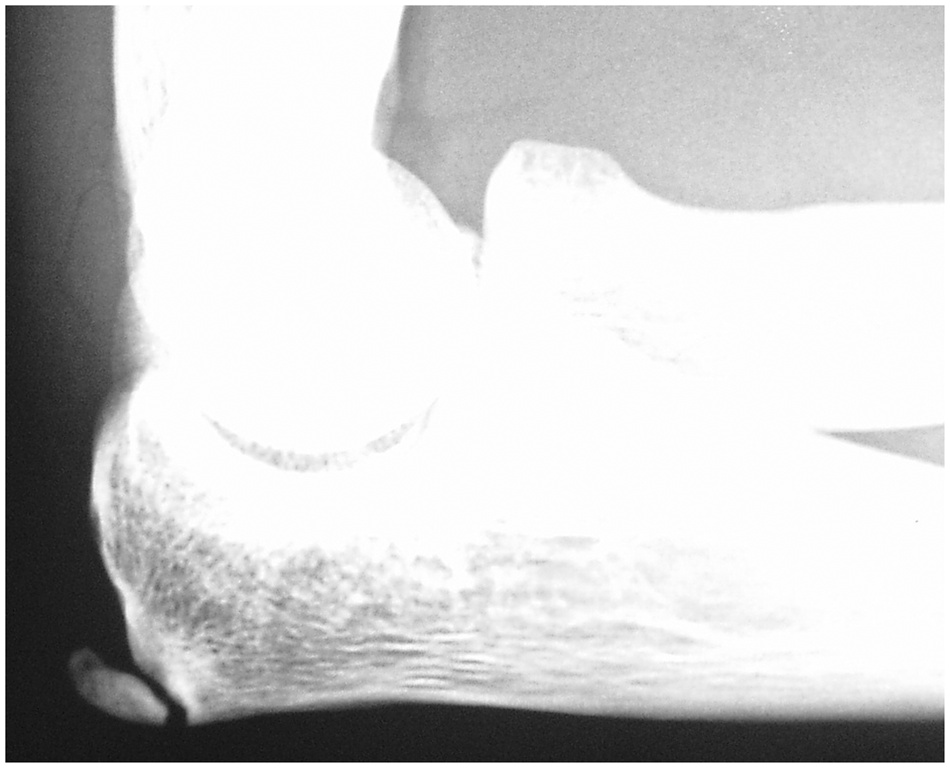
Radiograph revealed the ‘probable fracture’ at the base of the olecranon spur.
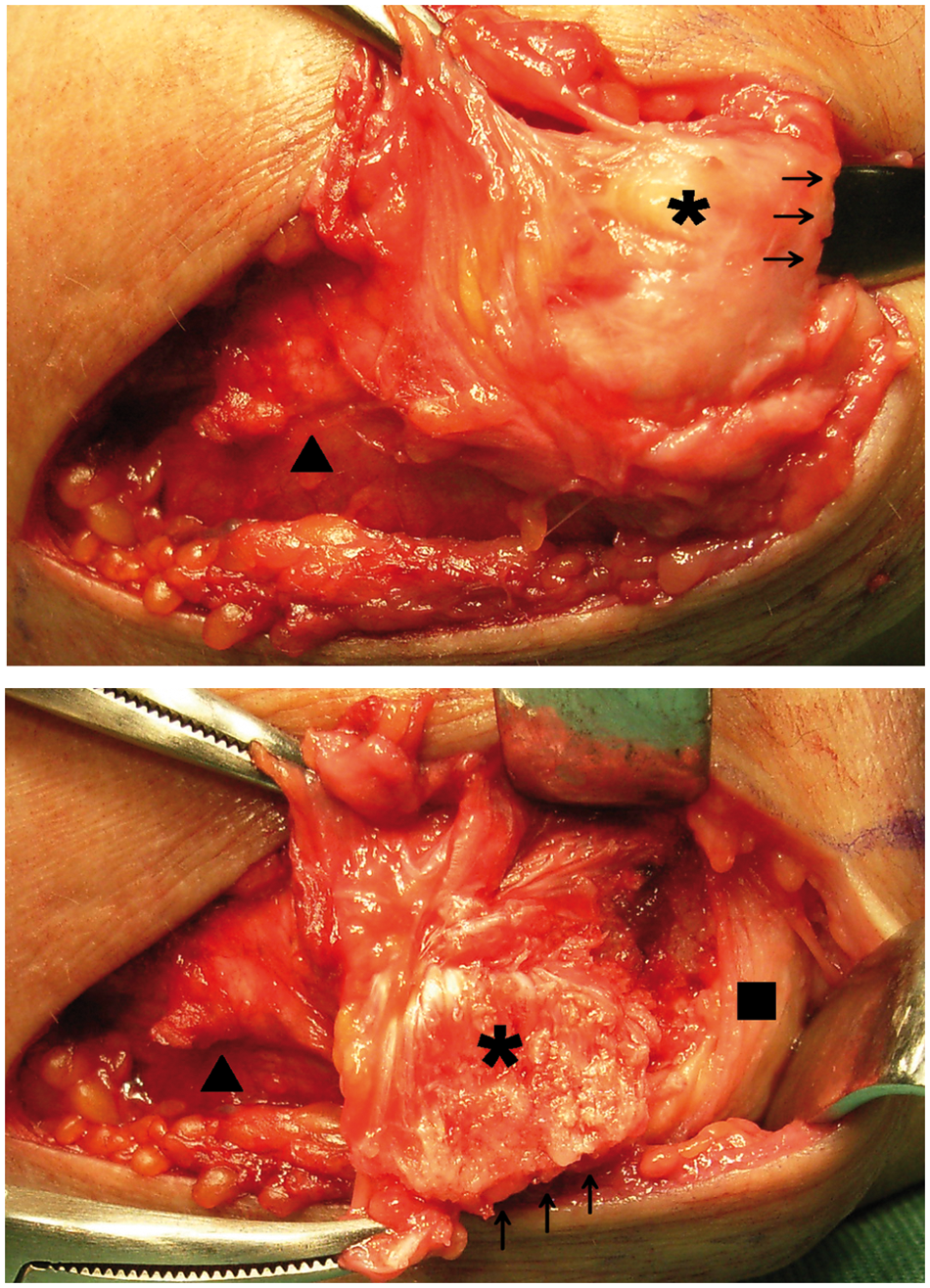
At surgery the bony fragment of the olecranon spur is seen. (Star: the bony fragment; rectangle: the olecranon; triangle: the triceps tendon; arrowhead: ‘probable fracture’ site at the base of the olecranon spur).
Three previous reports have suggested that the fragment was an olecranon spur (Kaempffe and Lerner, 1996; Lee, 1960; Tarsney, 1972). The triceps tendon is broad and consists of two aponeurotic laminae that originate in the middle of the muscle. The osteophyte was formed under the superficial tendon, and the superficial common tendon can be disrupted from the base of the osteophyte. On the other hand, the deep part is a muscular tendon, and it is disrupted at the musculotendinous portion (Madsen et al., 2006). Contraction of the triceps could possibly directly retract the tip of the olecranon spur and bend the osteophyte from the base of the olecranon with elbow flexion.
This study was approved by the Ethical Committee, National Defense Medical College, Tokorozawa, Saitama, Japan. The approval number is #792.
Footnotes
Acknowledgements
I express our gratitude to Yoshikazu Nakayama, MD, and Akiyo Ohtsuka, MD for their contribution and support on surgical treatment.
Conflict of interests
None declared.