






Abstract
Seventy-one patients (93 implants) had a de la Caffinière prosthesis implanted between 1980 and 1989 and were reviewed and reported in 1997. We reviewed this series 10 years later. Similar outcome measures were used as in the original study, pinch and grip strength measured and validated outcome scores obtained (DASH and EQ-5D). Radiographic outcome was assessed. Twenty-six patients with 39 implants were available for review at a mean of 19 years (range, 16–26 years). Survivorship at 26 years was 73.9% (95% CI, 61.2 to 86.6) for re-operation and 26.0% (95% CI, 0 to 52.7) for all failure. Patients had satisfactory power and thumb mobility and continued to be satisfied without pain. Registries should log such prostheses and add to implant survival data.
Keywords
Introduction
The de la Caffinière thumb trapeziometacarpal (TMC) joint replacement (Howmedica, UK) was introduced in 1971 to treat basal thumb arthritis. Replacement arthroplasty of the TMC joint avoids metacarpal shortening and basal instability seen after trapeziectomy (Davis et al., 1997, 2004), while preserving movement at the TMC joint, avoiding transfer of increased joint reaction force to adjacent joints seen after TMC joint arthrodesis (Mureau et al., 2001). There are several studies reporting outcomes following a variety of implants designed for this purpose, the most widely studied being the de la Caffinière prosthesis. De la Caffinière reported the initial results of his own series in 1979 (de la Caffinière and Aucouturier, 1979) and later in 1991 (de la Caffinière, 1991).
Long-term follow-up after replacement arthroplasty provides information that can aid improvement in prosthesis design and use. Implant registries (Malchau et al., 2002) has aided data collection and although there is some scepticism about their usefulness (Patt and Mauerhan, 2005), they are now viewed as essential (Morris et al., 2001; Sochart et al., 1996). Registries are quick to spot ‘outlying’ prostheses and can identify failure, such as that seen with the 3M Capital Hip Replacement System (Massoud et al., 1997). At present there is no implant registry for TMC joint arthroplasty and surgeons must rely on level IV evidence for their decisions. A recent Cochrane review found that no surgical procedure for TMC joint osteoarthrosis was superior, although it did conclude that simple trapeziectomy had the lowest risk of complications (Wajon et al., 2005). The TMC joint replacement outcome studies with the longest follow-up report mean intervals of 9–11 years (e.g. Chakrabarti et al., 1997; Søndergaard et al., 1991).
At the Norfolk and Norwich University Hospital a single surgeon used 93 de la Caffinière implants in 71 patients from 1980 to 1989. A detailed description of the operative technique was recorded in the original report (Chakrabarti et al., 1997). Follow-up of these patients was reported in 1997, in which following 16 deaths, 73 implants (55 patients) were available for review (Chakrabarti et al., 1997). This found that the replacement was well regarded by recipients, pain was improved and survivorship was comparable with that after hip replacements. We report the outcomes for the same series 10 years later, with a mean follow-up of 21 years (range, 16–26 years).
Methods
Permission was granted by the National Research Ethics Committee (ref. 06/Q0101/105) and from the Hospital Research Governance Committee (ref. 2006ORTH03L) to recall the original patients for clinical and radiological examination. The details for the original patients were retrieved from a database held at the Institute of Orthopaedics, Norfolk and Norwich University Hospital. For patients who had died, we looked at the case notes and/or radiographs to confirm whether the prosthesis was still in situ at the time of death and, where this was uncertain, the date of most recent prosthesis review was used as the date of censorship for the survival analysis (‘worst case scenario’).
All surviving patients were invited to return for clinical review. In the original study there were 62 women (82 implants) and nine men (11 implants). The predominant pre-operative symptom had been pain with a mean duration of 3 years. The mean age at operation was 57 years (range, 39–80 years). At the time of our study, 27 patients (36 implants) had died. Eight patients (eight implants) failed to attend for review but their implants had already been removed, from among the 11 revised in the original report. Two patients (two implants) declined to attend, without giving a reason. A further eight patients (eight implants) were not contactable. For all of these groups, the most recent review from the medical notes was used for outcome analysis. Therefore, 26 patients (39 implants) were assessed.
Patients were seen by two researchers and objective outcomes measured by, or under supervision of, the third. We employed the same outcome measures as in the original study. A 100 mm visual analogue scale was employed for pain, thumb stability and overall patient satisfaction. Opposition was assessed (Kapandji, 1986) and pinch and grip strength were measured using a Jamar dynamometer. Two validated outcome scores were employed: the DASH (Disabilities of the Arm, Shoulder and Hand, Hudak et al., 1996; range 0 to 100 where 0 is no disability and 100 is complete disability) and the EQ-5D (EuroQoL Group, 1990; range –0.594 to 1.0 where –0.594 is worst state of health and 1.0 is the best). Standard posterior-anterior and lateral radiographs allowed assessment of radiographic failure of the implant using the criteria from the original study. Failure was previously defined as a lucent line of 0.5 mm or more in three or more zones for either component (Chakrabarti et al., 1997).
Inter- and intra-observer agreement for the radiographic analysis was scored using the Kappa statistic. Kaplan–Meier plots were constructed for survivorship analysis, assessing two outcomes: failure defined by revision or removal of the implant and failure including the former group and those ‘at risk’ with radiographic evidence of implant loosening.
Results
Complete clinical data were only available for the 26 patients (39 hands) who attended for review. Summary statistics for this group are shown in Table 1. Intra-observer agreement for radiological outcome was 100% for the two investigators. Inter-observer analysis produced a Kappa score of 0.72 (95% CI, 0.35 to 1.00) for the metacarpal component (‘stem’) and 0.69 (95% CI, 0.46 to 0.92) for the trapezial component (‘cup’). In total, from 39 implants, three stems and 11 cups appeared radiographically loose.
Summary statistics at clinical review (n = 26 patients, 39 implants).
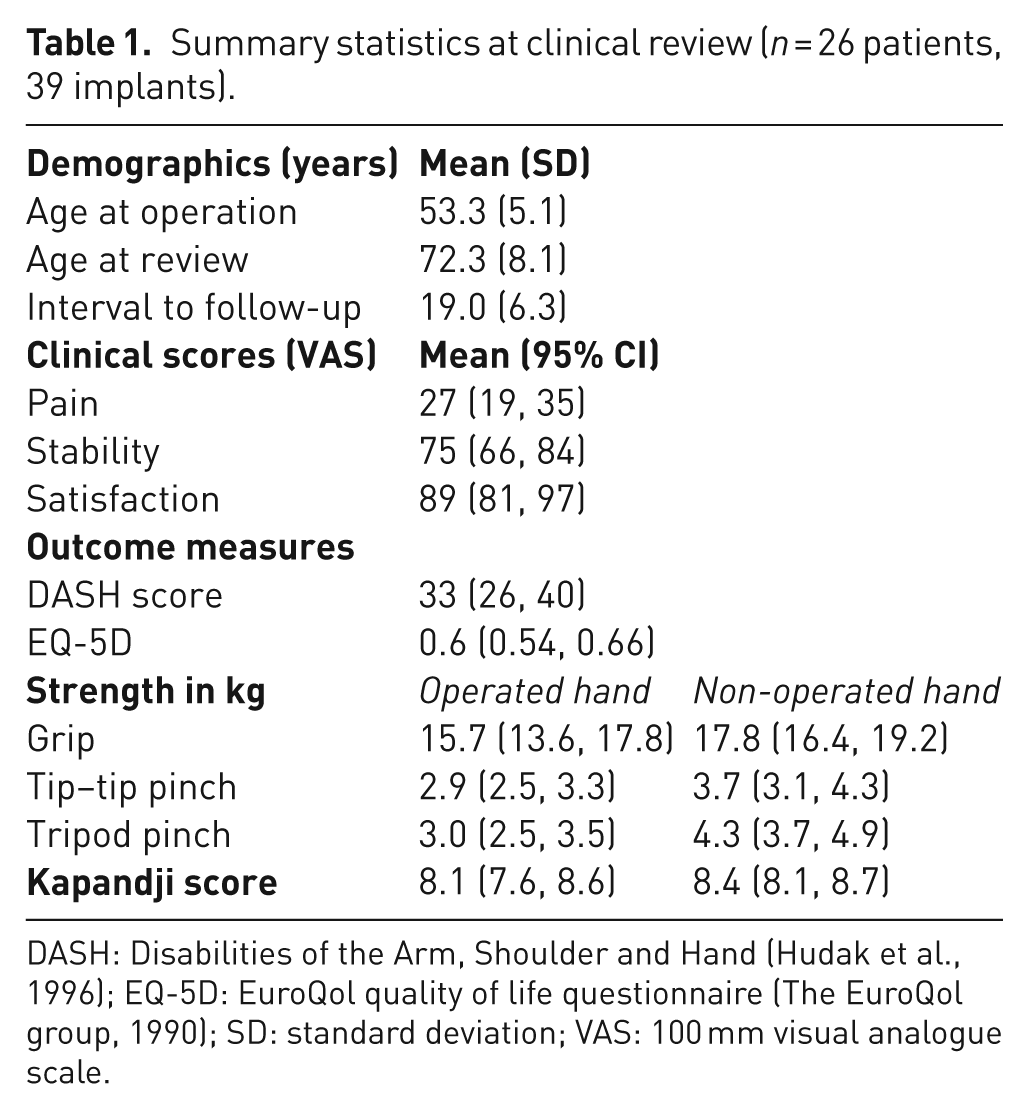
DASH: Disabilities of the Arm, Shoulder and Hand (Hudak et al., 1996); EQ-5D: EuroQol quality of life questionnaire (The EuroQol group, 1990); SD: standard deviation; VAS: 100 mm visual analogue scale.
In the original report, 11 implants had been revised. In the following 10 years, a further six implants were removed, all for pain. There were no revisions for infection. The Kaplan–Meier plots for the patients (Figure 1) show that the 26-year survival with failure, defined as revision or removal of the implant was 73.9% (95% CI, 61.2 to 86.6); 26-year survival with failure including ‘at risk’ implants (loose on radiographs) was 26.0% (95% CI, 0 to 52.7).

Kaplan–Meier graphs showing survivorship for the entire series with failure defined as (a) revision for any reason and as (b) implant revised or ‘at risk’ (radiographic failure).
Discussion
In the large joints of the lower limb (hip, knee), replacement arthroplasty is established as the reconstructive option for symptomatic degenerative joint disease. In the upper limb, particularly for small joints, the reconstructive options are varied and include simple excision arthroplasty, arthrodesis, osteotomy and replacement arthroplasty. A Cochrane review (Wajon et al., 2005) found that none of the procedures for symptomatic thumb-base osteoarthritis could be demonstrated to be better than the others. These conclusions are echoed in smaller, more recent studies (Raven et al., 2007). While most of the outcomes were similar between groups, pain was found to be less in patients having had trapeziectomy as opposed to arthrodesis.
The majority of reports on replacement arthroplasty are case series without controls, usually with short follow-up. Van Capelle et al. (1999) reported on 63 patients (77 de la Caffinière prostheses) at a mean of 8.5 years (range, 2–16 years) and documented a survival rate of 72% (95% CI, 59.3 to 84.7). Others have reported a variety of survivorship rates ranging from 82% at 9 years (Søndergaard et al., 1991; 18 of 22 implants) to 66.4% at 5 years (Wachtl et al., 1998; 95% CI, 34.5 to 97.1). Sambandam et al. (2007) commented that the majority of such outcome studies were methodologically flawed or lacked uniform outcome measures, rendering them difficult to compare. Our finding of a prosthesis survivorship of 73.9% at 26 years compares favourably with these reports. We found that the survivorship rates, with the end-point defined as prostheses ‘at risk’, were significantly higher than when considering ‘revision for any cause’. This reflects an aging, low-demand population clinically satisfied with an implant despite loosening on radiographs, who retained subjective stability and remained satisfied with the procedure. Stability and satisfaction, measured on a 100 mm visual analogue scale, was 75% and 89%, respectively, suggesting as have others (van Capelle et al., 1999), that this implant should be used in lower demand, female patients. Outcomes are similar to those reported by others (Badia and Sambandam, 2006; de Smet et al., 2004).
Newer prostheses such as surface replacements and pyrolytic carbon interposition spacers are introduced with good initial results (Pendse et al., 2009). All such prostheses should remain under long-term surveillance following implantation and we would support the construction of a joint registry to record implant fate and revision rates.
Footnotes
Acknowledgements
We thank Mr Andrew McKee, Consultant Hand Surgeon, for his help in radiograph analysis.
Funding
This research received no specific grant from any funding agency in the public, commercial, or not-for-profit sectors.
Conflict of interests
None declared.