






Abstract
We present patient outcomes following surgical excision of primary wrist ganglia over a 5 year period. Patients (48 of 59; 81%) responded to a questionnaire by post or telephone, with a mean time to follow-up of 44 (range 21–77) months. There was a statistically significant reduction in all reported symptoms, including pain, paraesthesia, weakness, stiffness, and cosmesis. The recurrence rate was 8%. In total, 98% of patients were satisfied or very satisfied with treatment. Surgical excision of primary wrist ganglia may have advantages over aspiration and reassurance alone, particularly in reducing recurrence and hastening resolution of symptoms.
Introduction
Wrist ganglia are the most common benign tumours of the hand and consist of a collagenous walled cavity containing gelatinous mucin material (Paul and Sochart, 1997). They occur more frequently in women (McEvedy, 1954). Several different treatment options are available, which can be broadly divided into reassurance, aspiration, and surgical excision. There are few studies that have compared outcomes of these different treatment modalities. In addition, the available evidence is limited by small sample groups, variations in follow-up, and different methods of reporting.
We have performed a retrospective postal/telephone survey to assess the outcome of surgical excision of primary wrist ganglia at a district general hospital in the southwest of England that serves a population of approximately 230 000. Forty-eight patients responded and gave information related to symptom relief, ganglion recurrence, and patient satisfaction.
Methods
Fifty-nine patients were identified using the hospital records database over a 57 month period between July 2003 and March 2008. Surgery was performed by consultant or middle-grade surgeons. All patients were appropriately counselled about the natural history, benign nature of wrist ganglia, and benefits and risks of aspiration and surgery. Patients were only offered surgical excision if they were in significant pain, reported functional impairment of activities of daily living, or had evidence of nerve compression, and did not want to accept the chance of spontaneous resolution. Patients receiving revision surgery were excluded.
All 59 patients had their operation under regional or general anaesthesia using a high-arm tourniquet. A standardized surgical technique was used for all dorsal ganglia, whereby the ganglion was traced down and removed at its origin. The dorsal wrist ligaments were split longitudinally in the line of their fibres and the capsular attachments released by sharp dissection. Any macroscopically abnormal scapholunate ligament at the origin of the ganglion was debrided using fine rongeurs. Volar ganglia were excised using two techniques: either the pedicle was traced down to the joint capsule and the ganglion excised at the capsule, or the scaphotrapezial or radiocarpal ligaments were split in the line of their fibres and the origin excised by sharp dissection. The surgical technique was surgeon dependant.
A questionnaire was sent out by post to obtain data relating to patients’ pre- and post-operative symptoms, recurrence, and opinion about further treatment if there was recurrence (Figure 1). The succinct and focused format of the questionnaire was preferred over more lengthy validated questionnaires to maximize patient response. Patients who failed to respond to the postal questionnaire were contacted by telephone. Patient satisfaction was assessed on a scale from 1 to 5, with a score of 5 given by patients who were very satisfied. Data were analyzed to compare the difference in pre- and post-operative symptoms, and significance of any difference was tested using the McNemar’s test for nonparametric nominal data. A p value < 0.05 was considered significant.

Postal questionnaire for data collection
Results
Seventeen patients failed to respond to the postal questionnaire. Of these, six were contacted by telephone, eight had moved from their original address, two remained uncontactable, and one had died. Data from a total of 48 (81%) patients were included in the analysis. In total, 29 ganglia were dorsal, and all but two of these arose from the scapholunate ligament (one from the lunotriquetral ligament and one from the extensor carpi ulnaris sheath). Of the remaining ganglia, 16 were volar arising from the scaphotrapezial or radiocarpal ligaments, and the location of three was not recorded. The mean age at time of surgery was 39 (range 14–71) years, and the majority of the patients were female (76%). The mean time to follow-up was 44 (range 21–77) months.
Pain (79%) and cosmesis (71%) were the primary pre-operative symptoms. Other symptoms such as paraesthesia, numbness, weakness, and stiffness were experienced by 27–44% of patients. Following surgery, there was a statistically significant reduction in all reported symptoms (Figure 2).
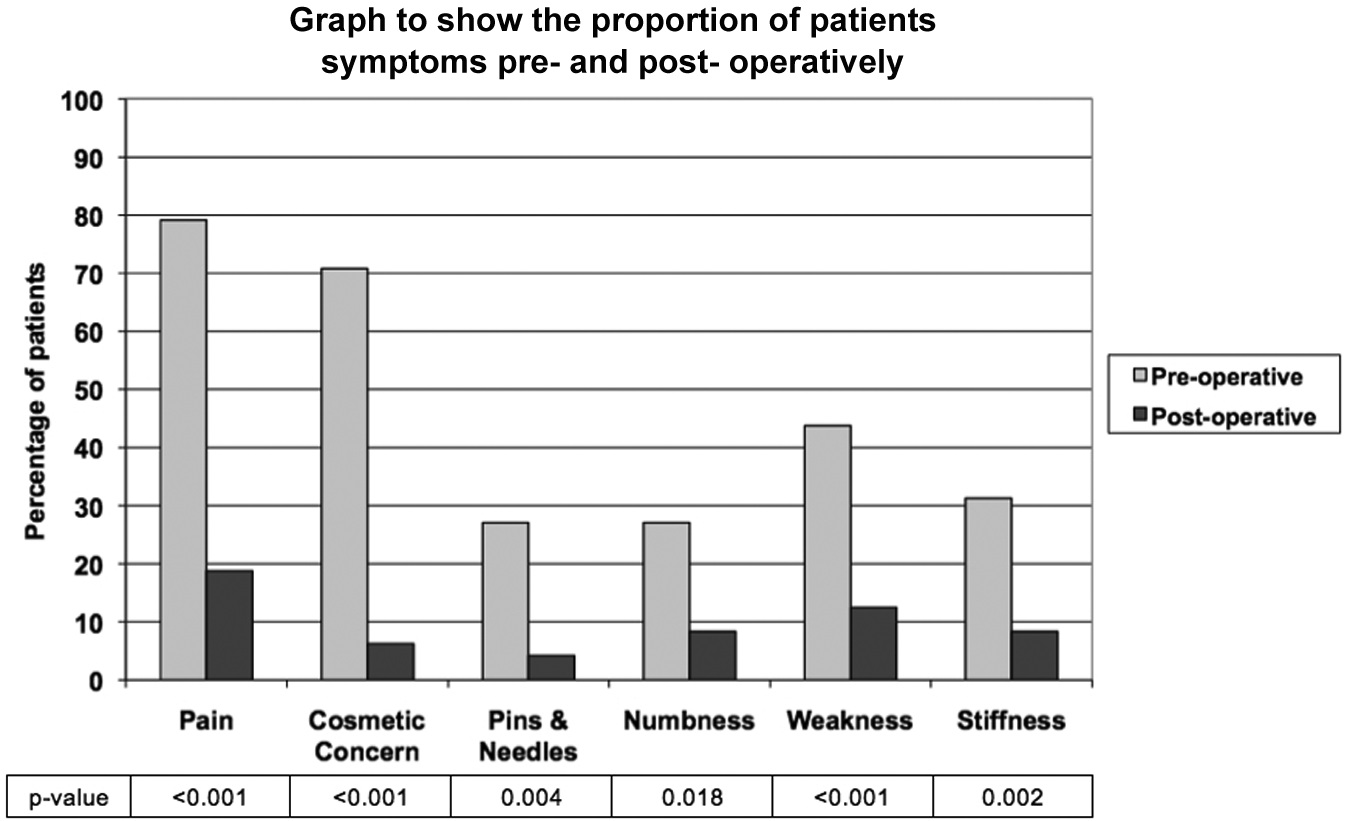
Graph showing significant improvements in patient symptoms with surgery
The ganglion recurred in four patients (8%; two dorsal and two volar), who nonetheless reported satisfaction levels of 4 out of 5. Three patients complained of new symptoms following surgery, including cosmetic concern, numbness, and paraesthesia. However, these patients remained satisfied with their treatment with a mean score of 4.
Discussion
The cause of wrist ganglia is unknown but various hypotheses exist, including the extrusion of synovial fluid from the joint space through a one-way valve mechanism into the ganglion cavity (Angelides and Wallace, 1976; De Villiers et al., 1989) and, alternatively, that mucin production results from metaplasia of cells relating to ligaments, tendon sheaths, or the joint capsule (Zachariae and Vibe-Hansen, 1973). The presence of a ganglion may also indicate underlying joint pathology (Dias and Buch, 2003). The choice of reassurance, aspiration, or surgical excision as a treatment option is influenced by patient symptoms, treatment outcomes, and cost.
The cost associated with ganglion excision surgery is substantially greater than that of aspiration. Stephen et al. (1999) estimated that the cost of one clinic visit was one-sixth the cost of a day case procedure. Moreover, as many ganglion aspirations can be performed in a primary care setting, the difference in costs may be even greater. Time off work is also less, estimated at 3 days for aspiration versus 11 days following excision (Dias et al., 2007). With respect to reassurance, it is important to appreciate that with such a high proportion of patients experiencing pain as a primary symptom, additional unrecognized sick leave may be encountered in this patient group.
Complications related to surgical excision of wrist ganglia include infection, nerve injury, CRPS, scapholunate dissociation, stiffness, and weakness, the combined incidence of which is estimated to be 8–20% (Dias and Buch, 2003; Dias et al., 2007; Paul and Sochart, 1997). As a result, excision of ganglia should only be performed if surgical outcomes are superior to more conservative options, or if these options have failed (Dias and Buch, 2003; McEvedy, 1954). However, studies that have compared outcomes of the three different treatment modalities are limited and results vary, probably owing to small sample sizes and variable follow-up.
Dias et al. (2007) reported patient outcomes of the three treatment modalities and suggested that there is no long-term benefit of excision or aspiration over reassurance. This evidence, together with the financial implications of ganglion excision surgery, has caused many primary care trusts to stop funding ganglion excision surgery, except in exceptional circumstances where prior approval is often required.
In this study, there was a statistically significant reduction in all reported symptoms following surgery. Pain and cosmetic concern fell from 79% to 19% and 71% to 6%, respectively. These results are similar to those published by Dias et al. (2003), who at 5 years follow-up observed a reduction in pain and cosmetic concern from 84% to 16% and 43% to 7%, respectively. The significant reduction in weakness and stiffness observed in our study was not observed by Dias et al. (2003), possibly due to differences in pre-operative incidence. Weakness was experienced pre-operatively by 44% of our patients compared with only 26% in their study. Similarly, 31% of our sample group experienced stiffness pre-operatively compared with 10% in their sample group. Considering that our data collection was performed retrospectively, it is possible that recall bias influenced our results through over-reporting of pre-operative symptoms. Dias et al. (2003) concluded that the persistence of symptoms such as weakness in their study might not be directly caused by the ganglion, but rather some underlying disorder. Two additional symptoms evaluated in our patient group included the prevalence of paraesthesia and numbness. Paraesthesia fell from 27% pre-operatively to 4% post-operatively, with a reduction in numbness from 27% to 8%.
In the report by Dias et al. (2007), they concluded there was no significant difference in the improvement of pain, stiffness, or cosmetic concern after treatment, irrespective of the type of treatment. In fact, following surgical excision the proportion of patients who complained of weakness was marginally greater than those treated with aspiration or reassurance alone. However, Dias et al. (2007) reported a statistically significant difference in recurrence rates following excision surgery (39%) compared with aspiration (58%) or reassurance alone (58% persistence at 6 years follow-up) (p = 0.02). Recurrence rates following ganglion aspiration range between 25% and 67% (Dias and Buch, 2003). In contrast, a literature review by Dias and Buch (2003) and Dias et al (2007) reported a recurrence rate following surgery of 8.3–42% at a follow-up time of 4–11 years. Our recurrence rate of 8% is similar to a report by Nelson et al. (1972), who followed patients for 1–8 years. Their recurrence rate was lower if the patient had their ganglion excised under general anaesthesia. One argument for our lower recurrence rates may relate to the shorter time to follow-up. However, by including only those patients in our study followed for 5 years or greater (cases 12), ganglion recurrence remained low, at only 17%. As a result, although Dias et al. (2007) could not find any significant differences in overall symptoms between treatments, a proportion of patients managed conservatively may experience symptoms for longer than those treated surgically. This has been shown to be the case for cosmesis (Dias and Buch, 2003).
It is also important to note that wrist ganglia that recur following one aspiration are unlikely to be eradicated through further attempts (Varley et al., 1997). In addition, the mean time to recurrence following aspiration is thought to be only 33 days (Stephen et al., 1999). It therefore seems appropriate that, if recurrence occurs following aspiration, then a plan to proceed to surgical excision should be considered.
A very high proportion of patients in our sample group were satisfied with the treatment they received, with 98% of patients scoring 4 or 5 out of 5. The mean satisfaction scores were equal for both men and women (4.75 vs. 4.66). Patients remained satisfied with their treatment, even if the ganglion recurred. This concurs with the data of Dias et al. (2007).
Our study was limited by the lack of a control group. In addition, because the data collection were retrospective, recall bias may influence some of the pre-operative symptom scores. The study does, however, show low recurrence rates and high patient satisfaction following surgical ganglion excision.
Our results indicate that surgical excision of primary wrist ganglia significantly reduces patient symptoms. In addition, our recurrence rates were low and in keeping with other studies that demonstrate reduced recurrence rates compared with aspiration and reassurance alone. In view of the relative costs of the treatment modalities, ganglion aspiration should be considered as a first-line intervention following appropriate patient counselling. Failing this, surgical excision remains an effective treatment option for symptomatic ganglia with low recurrence rates and high patient satisfaction.
Footnotes
Acknowledgements
We thank Zoe Sheppard, Dorset Research and Development Support Unit, Bournemouth University, UK, for statistical advice.
Funding
This research received no specific grant from any funding agency in the public, commercial, or not-for-profit sectors.
Conflict of interests
None declared.