






Abstract
Patients who report ongoing adverse symptoms following trapeziectomy may require revision surgery. We present a series of 10 patients who underwent revision surgery using a Silastic interpositional finger joint arthroplasty. Mean age was 60 (range 48–70) years, with a mean interval between primary and revision surgery of 34 (range 12–84) months. Review was performed at an average of 53 (range 21–136) months. Nine of the 10 patients reported improvement in pain, and all patients reported improvement in pinch grip, activities of daily living, and satisfaction at having undergone revision surgery. There were no complications. We found good medium-term results and high satisfaction rates. We advocate this technique as an effective treatment option in these difficult cases, provided other treatable causes of poor outcome are excluded.
Keywords
Introduction
Many surgical techniques have been described to address the pain of trapeziometacarpal arthritis. One of the principal options is trapeziectomy, which can be performed with or without ligament reconstruction and tendon interposition (LRTI) (Gervis, 1949; Gervis and Wells, 1973). Recent evidence has shown that adding the LRTI does not necessarily give better results than trapeziectomy alone (Salem and Davis, 2012). It is also recognized that a proportion of patients do not do well following either procedure (Wajon et al., 2009).
Revision procedures for patients with poor outcome following trapeziectomy are not widely reported in the literature. Here we report on a series of 10 patients who had poor outcome following primary surgery and were subsequently treated using a silicone finger joint interpositional arthroplasty as a revision procedure (Swanson finger joint; Wright Medical, Arlington, Tennessee, USA).
Methods
We reviewed the results of revision trapeziectomies performed over a period of 10 years by the senior author. These cases constituted tertiary referrals from other surgeons or requests for second opinions. In all cases the primary procedure had been either trapeziectomy alone or trapeziectomy with LRTI, as described by Burton and Pelligrini (1986).
In total, 17 patients were treated with revision surgery for ongoing pain and loss of function. Of these, seven were found to have specific identifiable causes for their symptoms, such as neuromas or scaphotrapezoid arthritis, which were treated accordingly; these patients did not need revision of the trapeziectomy bed itself. The remaining 10 patients were not found to have a specific focal cause of the pain and were treated with a Swanson finger joint arthroplasty to recreate the thumb length and fill the scar bed. All of these 10 patients had revision surgery that was performed by the senior author using the same technique.
Technique
Via a volar-radial approach, the base of the metacarpal is identified and the cavity between the metacarpal and scaphoid entered, with a synovectomy performed if synovitis is encountered. The surfaces of the scaphoid and the metacarpal are then prepared to accept the limbs of the Swanson prosthesis. If any sclerotic or subcortical bone is encountered it is not excised. The medullary cavities of both the thumb metacarpal and scaphoid are prepared using a combination of manual reaming and a power burr. The aim is for the implant stems to lie within the central axes of both the bones, i.e. along the axis of the thumb (Figures 1 and 2). The bony canals are prepared so that the silastic limbs fit snugly. The size of implant is chosen to “fill” the longitudinal gap between the thumb metacarpal and scaphoid, but not overfill it. The Swanson implant is inserted with the smaller distal stem in the scaphoid and the longer proximal stem in the metacarpal, i.e. in reverse to standard finger joint placement for obvious anatomical reasons. If the tip of the stem to be seated in the scaphoid is too long it may need to be trimmed short, but the tip entering the metacarpal cavity does not require trimming. The prosthesis is seated and checked for thumb position and stability. The implant has most commonly been placed with the concave surface facing radially, where it seems to fit most easily, but this is not critical. Following closure of the capsule and skin, a splint is applied that incorporates the thumb base and wrist, but leaves the thumb interphalangeal (IP) joint free. At 10 days the wound is checked and the splint is converted to a thermoplastic splint that extends from mid-forearm to thumb, leaving the IP free; this is worn for a further period of 5 weeks to allow the scar to form and consolidate. Thereafter, therapy ensues to rehabilitate the carpometacarpal joint.

Surgical photograph showing the volar approach and trimmed stem that will sit in the scaphoid, with the untrimmed stem lying within the metacarpal. The implant is placed in reverse to the direction of use for proximal interphalangeal joint replacement (i.e., distal –proximal and vice versa).
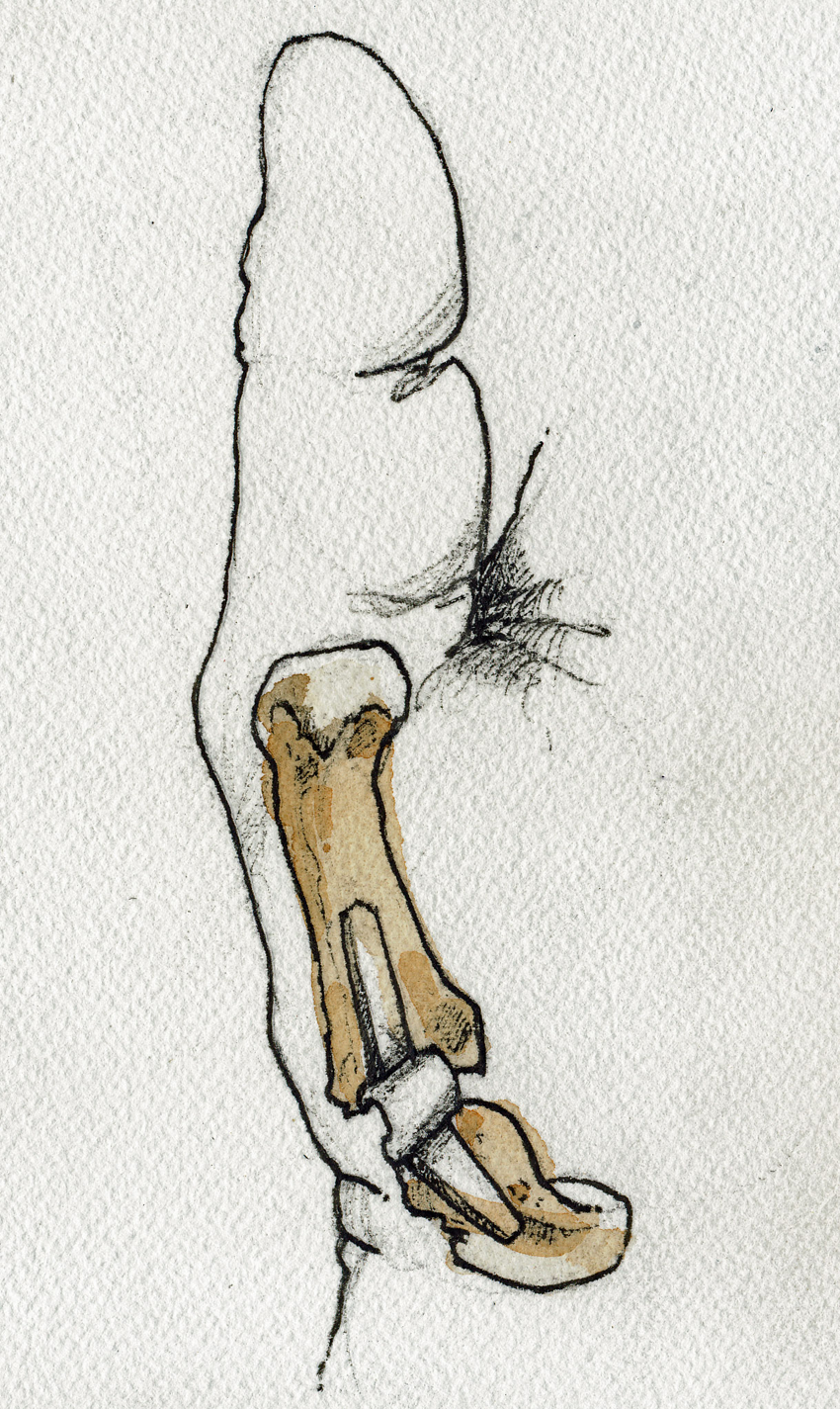
Illustration demonstrating the typical alignment required for the implant. Illustration courtesy of donaldsammut.com.
Assessment
Patients who underwent this revision procedure were interviewed retrospectively in person, except for two patients who were interviewed by telephone. Enquiries were made about subjective experiences, including pain relief, specific functional abilities, general activities of daily living (ADLs), and satisfaction with surgery. Pain was scored on a four-point scale: none, mild, moderate, and severe. Pinch strength was self-scored on a three-point scale: poor, moderate, or good. Ability to perform three specific daily tasks (opening jars, using keys, and writing) and general ADLs were assessed with a three-point scale of difficulty: unable (no), difficult, and able (yes). We designed this simple questionnaire, as we aimed to address the common ADLs and needed a brief and succinct assessment for this. We also wished to establish whether patients were glad to have surgery, as we felt this is a representative measure of satisfaction.
Results
There were 10 patients with an average age at revision of 60 (range 48–70) years and average time between primary surgery and revision surgery of 34 (range 12–84) months. In seven patients the primary procedure had been trapeziectomy with LRTI, and the remaining three patients had had trapeziectomy alone. The follow-up assessment interview took place at an average of 41 (range 9–124) months following revision surgery. Results are summarized in Table 1.
Details of individual patient outcomes following revision surgery
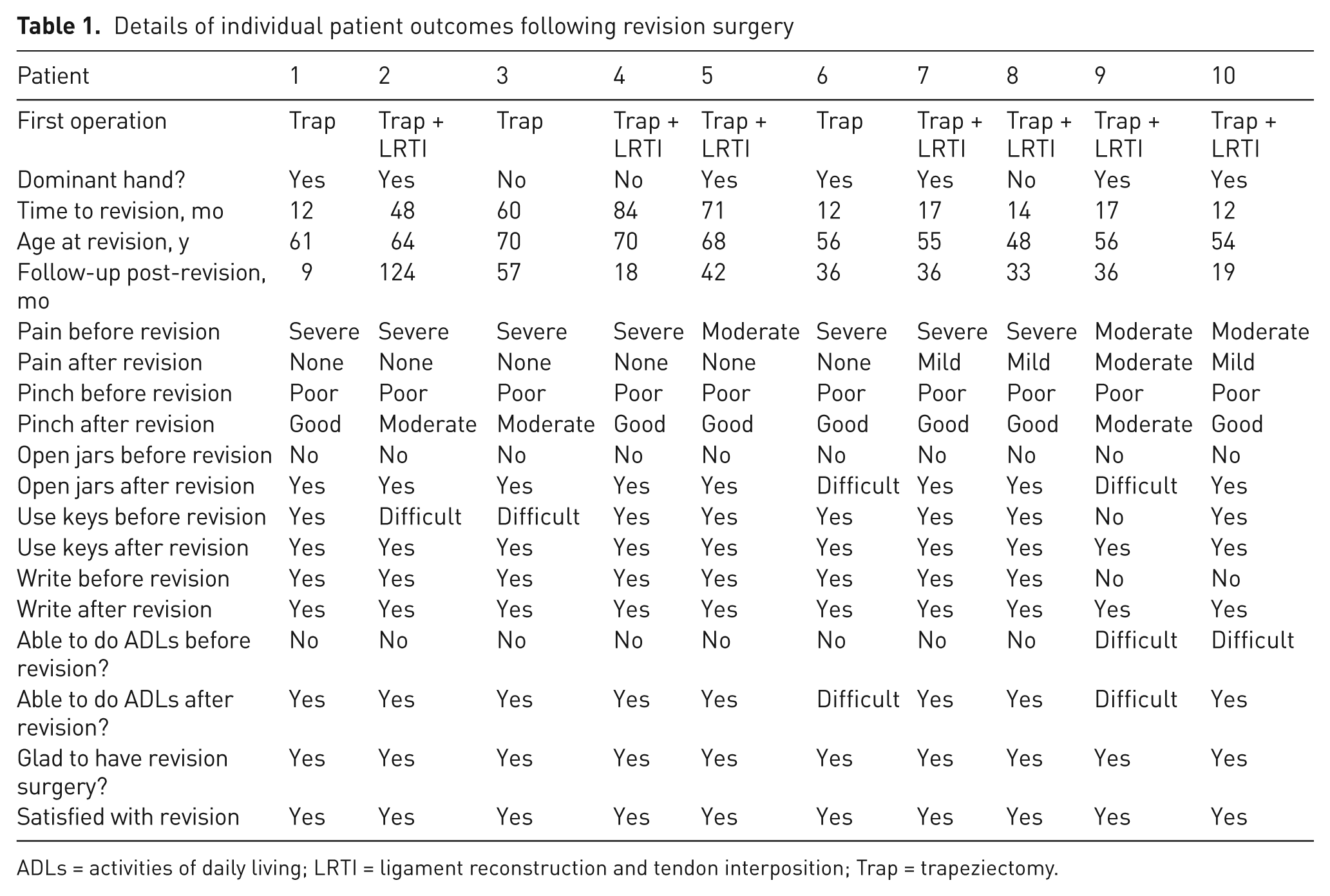
ADLs = activities of daily living; LRTI = ligament reconstruction and tendon interposition; Trap = trapeziectomy.
Pain
Nine of the 10 patients had improvement in their pain scores — five reported a drop from severe pain to no pain, and one reported a drop from severe pain to mild pain. Of the three patients who had started with moderate pain, one improved to no pain, the other to mild pain, and the last patient reported no change in pain level.
Function
All patients reported an improvement in pinch and ability to open jars after revision. Three patients reported improvement in use of keys after revision, and two patients reported improved writing after revision.
Nine patients reported improvement in general ADLs, and one reported no change in these, even though there was improvement in specific tasks. All 10 patients reported that they were satisfied with the results of revision and glad to have had revision surgery.
We report that there were no complications in this patient group.
Discussion
The aim of trapeziectomy is to provide a pain-free thumb that is strong and stable enough for ADLs. Apart from abutment between the metacarpal base and scaphoid due to proximal migration, persistent post-operative pain can be due to many other causes, such as incomplete trapezial resection, neuroma formation due to injury of sensory branches of radial nerve, unrecognized concomitant arthritis in the scaphotrapezoid joint, metacarpophalangeal arthritis, metacarpal base spurs, instability in the metacarpophalangeal joint, and complex regional pain syndrome.
When assessing symptomatic patients following unsuccessful primary surgery, the authors routinely seek potential concomitant pain sources, such as De Quervain’s tenosynovitis, carpal tunnel syndrome, scaphotrapezoid arthritis, and metacarpal collapse due to thumb metacarpophalangeal joint instability. Of the 17 patients reported here who underwent revision surgery, seven were found to have one of these alternative treatable causes for persistent pain, without the need for the revision interpositional arthroplasty technique herein described. We are of the opinion that the remaining 10 cases may have had ongoing abutment between metacarpal and scaphoid as the cause of their pain, despite the fact that this was not necessarily confirmed on stress radiographs. This led to the successful treatment rationale of placing an interpositional implant into the trapeziectomy bed.
Post-trapeziectomy pain is a difficult problem to treat, but fortunately is not common (Barron et al., 2000; Burton and Pellegrini, 1986; Eaton et al., 1984). Different strategies to deal with this problem are reported in the literature. Reports are mainly in small case series with moderate success. Glard (2006) reported moderate to good results in four patients using costochondral autograft as a salvage procedure, but this approach risks donor site morbidity. Cooney (2006) reported using bicondylar silicone spacer implants in two elderly low-demand patients to good effect. Connolly has reported the use of Swanson prostheses for revision in three patients with good results. Two patients had a Swanson trapezial implant, and the third had a metatarsophalangeal implant similar to the current series (Conolly and Rath, 1993).
We do not use silastic implants for primary procedures due to the risk of subluxation or dislocation, which in the literature has been reported as high as 32% (Conolly and Rath, 1993; Eaton, 1979; Weilby and Sondorf, 1978). Nonsilastic thumb carpometacarpal joint arthroplasties have not been shown to be very successful, with early high complication rates reported (Hernández-Cortés et al., 2012; Maru et al., 2012). In our series we report no problems of subluxation or dislocation; this may be due to the fact that the arthroplasty is stemmed and fits into channels created in the scaphoid and metacarpal, as well as the fact that the surrounding tissues might be less lax following revision surgery.
It is anticipated that the Swanson implants would behave similarly to how they behave in the finger, with possible longer-term implant fracture. This need not correlate with return of pain, because the implant acts as spacer to enable the process of encapsulation whereby a fibrous scaffold forms to stabilize the joint (Swanson, 1969).
Complications of revision surgery itself, are generally higher that primary surgery; Renfree reported a complication rate of 27%, the most common being neuroma (Renfree and Dell, 2002). In the current series, no long-lasting complications have occurred in any patient, although two patients suffered pain and weakness for several months before finally achieving a good outcome.
There is a reported risk of synovitis when using silicone implants (Christie et al., 1977; Khoo, 1993). In our series we did not encounter any clinical manifestation of this problem at time of follow-up.
There are drawbacks to our current series. Our data was collected retrospectively and is purely a subjective assessment without using a validated clinical scoring system. One of the patients had a compensation claim ongoing, and this may have created a bias on their reported results. The senior author does not routinely perform post-operative radiographs, and so we have not been able to correlate our clinical findings with radiographic assessment and do not have a radiographic baseline for further assessments. Despite these methodological drawbacks, this study demonstrates good medium-term results and high satisfaction rates in a group of 10 patients who underwent revision surgery for post-trapeziectomy pain and weakness using a Swanson finger joint implant. We advocate this as an effective option for these difficult cases, provided other treatable causes of poor outcome are excluded.
Footnotes
Conflict of interests
None declared.
Funding
This research received no specific grant from any funding agency in the public, commercial, or not-for-profit sectors.