







Abstract

Dear Sir,
We read with interest the published articles by Takeuchi et al. on mechanical improvements on epitendinous tendon repair techniques (Takeuchi et al., 2010, 2011). The tendon model used in these experiments was an artificial cotton roll model (Parotisroll™, Coltene/Whaledent Gmbh + Co., Germany). These cotton rolls were originally designed for dental applications. They are available in various sizes; size 5 (8 mm diameter) replicates the dimensions of a big human flexor digitorum profundus tendon. We use these easy-to-obtain cotton rolls frequently in our tendon repair courses as an artificial tendon surrogate (Figure 1). The aim of this study was to compare the biomechanics of tendon repairs with this cotton roll versus ovine tendons.
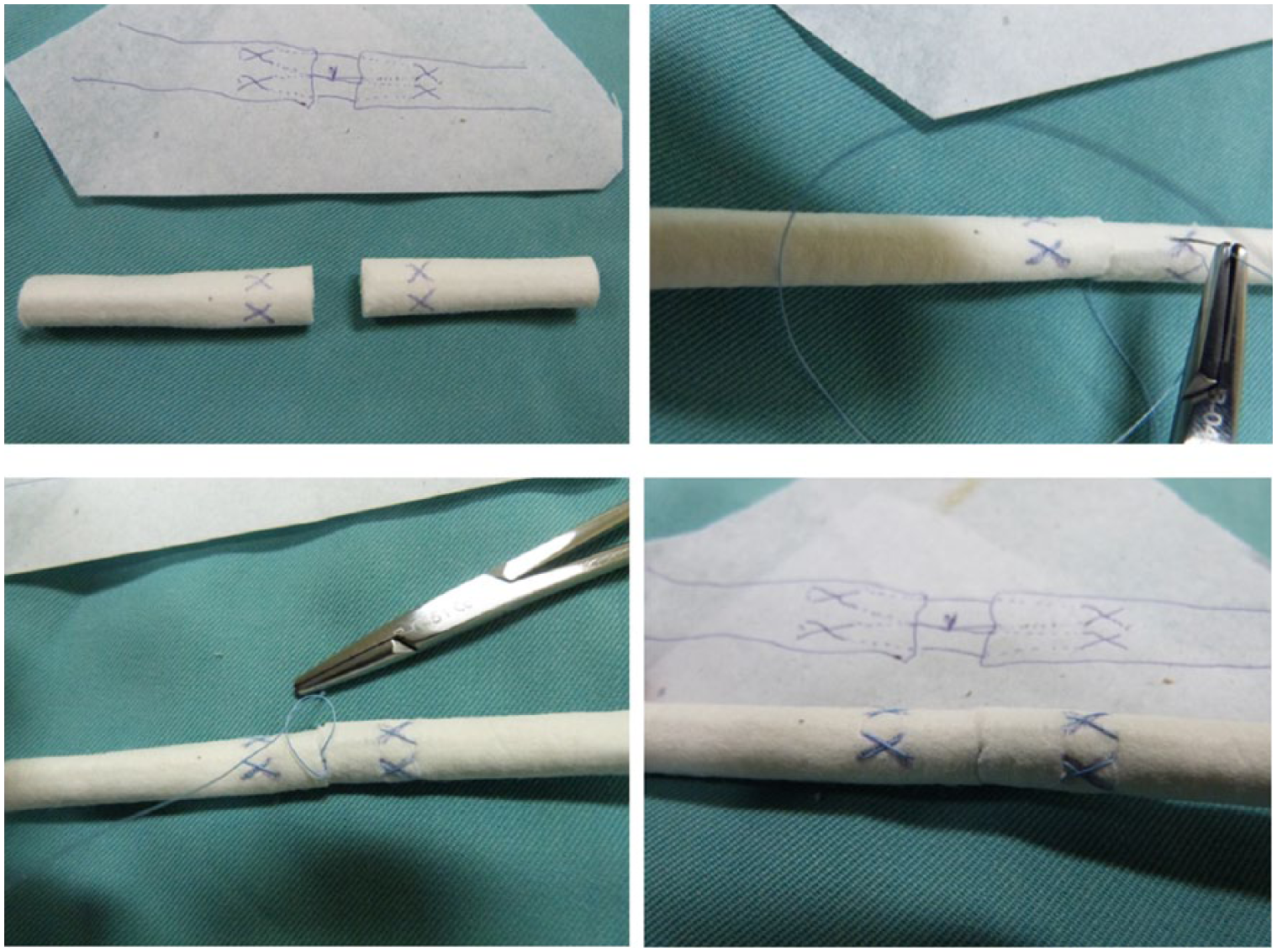
The cotton dental roll tendon model as a training tool for tendon repairs. Note, the repair configuration can be drawn on the artificial tendon before repair and the soft cotton material allows easy and precise placement of sutures.
A total of 24 artificial cotton tendons and 24 ovine flexor digitorum profundus tendons were repaired with a simple running epitendinous (peripheral) repair only (6/0 polypropylene sutures (Prolene; Ethicon, Somerville, NJ, USA)), an Adelaide (four strand) core repair only (3/0 braided polyester sutures (Ethibond; Ethicon, Somerville, NJ, USA)) or a composite core and epitendinous repair. All repairs were performed by the same surgeon. The core repair purchase length was set at 10 mm and cross-lock width at 4 mm (Peltz et al., 2011). The epitendinous repairs consisted of 14 circumferential loops with 3 mm suture purchase. A digital caliper (Mitutoyo CD-6-inch CS; Absolute Digimatic, Tokyo, Japan) was used to keep constant suture configurations and lengths. Mechanical testing of the repaired tendons was performed using a MTS 858 Mini Bionix materials testing machine (MTS Systems Corp., Eden Prairie, MN, USA). Samples were preloaded to 1.5 N, and subsequently distracted to final failure at a constant rate of 10 mm/min. Load (N), displacement (mm) and time (s) were continuously measured. The peak load (N), stiffness (N/mm) and mechanism of failure were determined for all repairs. Data are presented as means (SD; standard deviation) and were analysed using SPSS version 17.0 (SPSS Inc., Chicago, IL, USA). The significance level was set at p ⩽ 0.05. Compared with the repaired animal tendons, the cotton roll repairs showed significantly less resistance to failure in regards to peak load (p < 0.01 for the core-only group, p < 0.05 for the epitendinous-only group and p < 0.01 the for composite group) and stiffness (p < 0.01 for all three groups) (Table 1). In addition, the cotton rolls mainly suffered pull-out failures (92% (versus 4% in the ovine tendons)) compared with the predominantly suture or knot failures in the ovine tendon group (96% (versus 8% in the cotton rolls)) (p < 0.01) (Table 1).
Results of mechanical testing experiments.
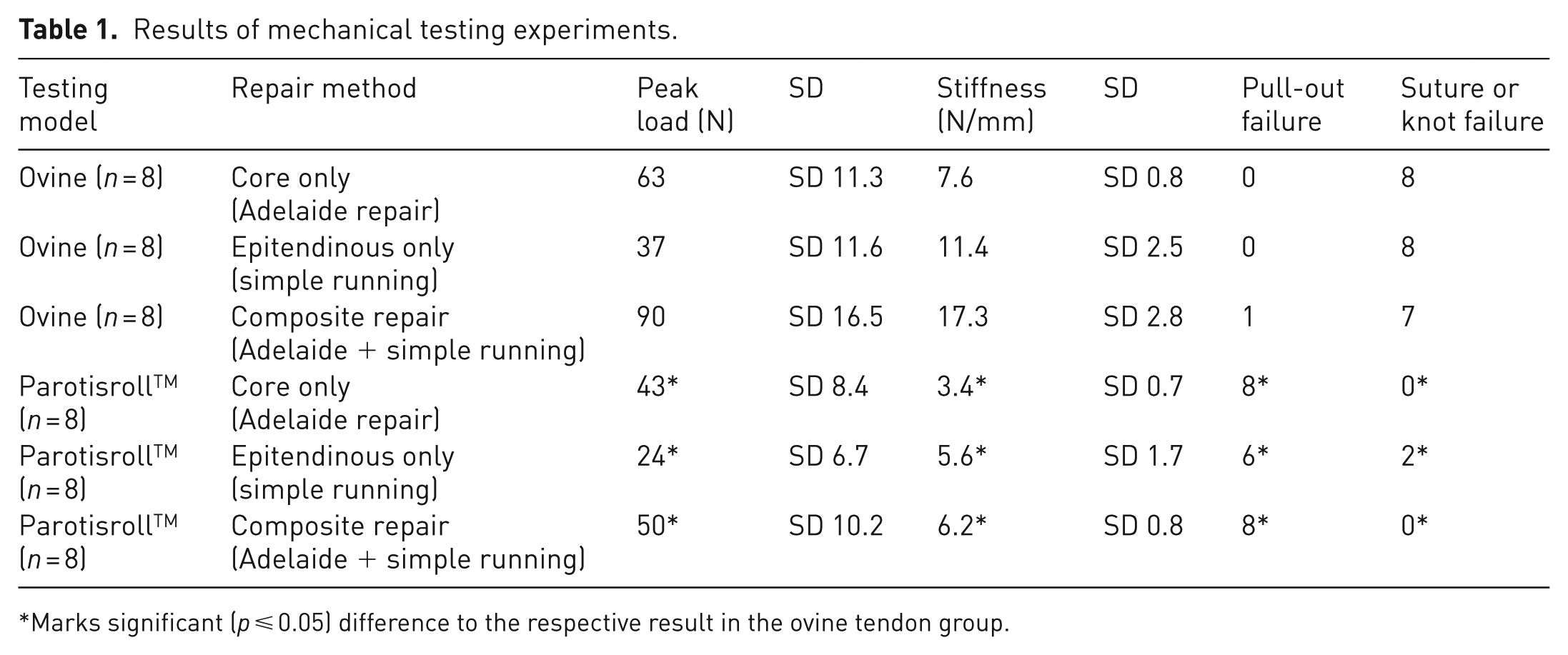
Marks significant (p ⩽ 0.05) difference to the respective result in the ovine tendon group.
These results challenge the use of cotton rolls as a surrogate for biological tendons in mechanical tendon repair experiments. Failure mechanisms and structural stability differ significantly between artificial and biological models. This divergence is also noticeable in a recent article by Kozono et al. (2016). In their study using cotton rolls in one part of the tendon repair experiment and porcine tendons in the other, mechanical results as well as failure mechanisms differed significantly.
In particular, the contrary failure mechanisms between models question the validity of results derived from experiments solely using cotton rolls as tendon surrogates. Nevertheless, the cotton dental roll model is an excellent model to teach and practice tendon repairs. It may also have a role in first trials for the development of new repair techniques (Kozono et al., 2016).
Footnotes
Declaration of conflicting interests
The authors declared no potential conflicts of interest with respect to the research, authorship, and/or publication of this article.